The FBI couldn’t find Ryan Eugene Mullen. Neither could a trio of private investigators. Only Michelle Gomez knew where to look.
Randall Sullivan | Wired | Dec 2013
[Full Story]
The FBI couldn’t find Ryan Eugene Mullen. Neither could a trio of private investigators. Only Michelle Gomez knew where to look.
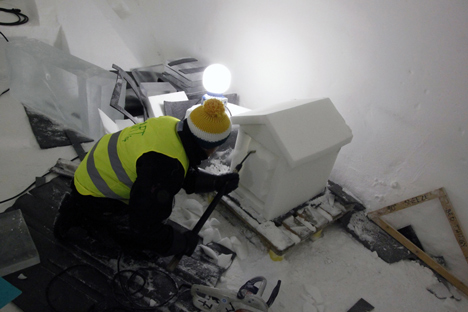
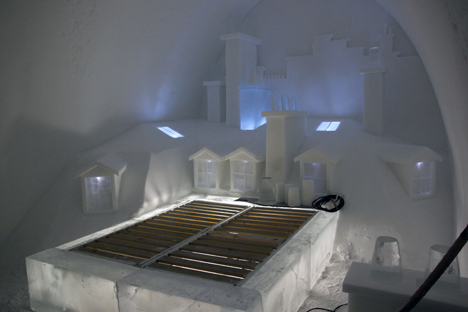
One of the suites at this year's Icehotel in Jukkasjärvi, Sweden, features blocks of ice carved into the shape of Parisian rooftops and chimney pots by French designers Les Ateliers de Germaine (+ slideshow).
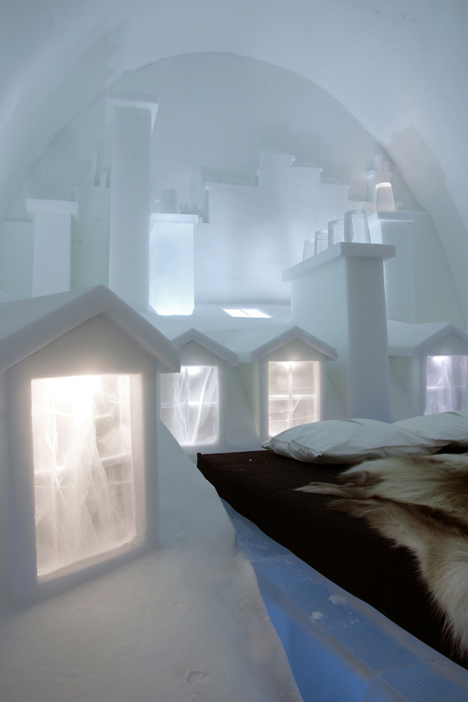
Located 200 kilometres north of the Arctic Circle, the Icehotel is the largest hotel built of snow and ice in the world. It is constructed afresh every year and various artists are selected to create different themed rooms, allowing visitors to spend the night in sub-zero temperatures.
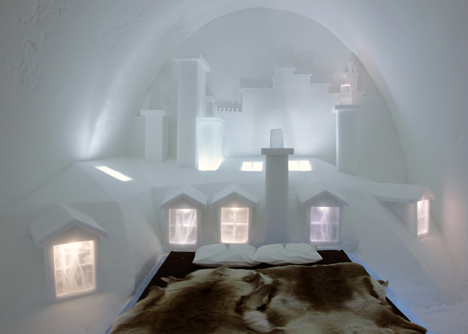
Luc Voisin and Mathieu Brison of Paris-based Les Ateliers de Germaine designed their space to represent "a postcard from France".
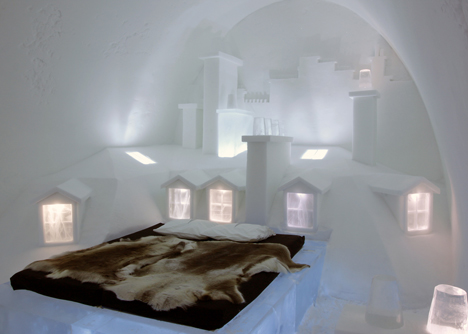
The room is based on Montmartre, one of Paris' most famous areas. It features a carved outline of the Sacré-Cœur basilica at one end, as well as a series of rooftops with illuminated dormer windows and chunky chimney pots.
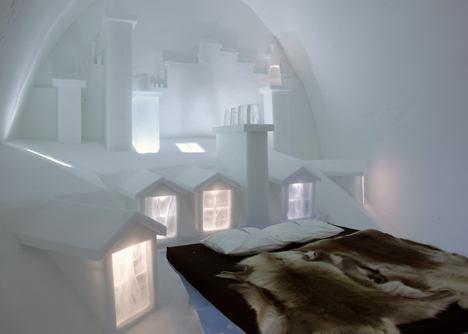
"Paris seemed to be the best example of a French city known all over the world," Voisin told Dezeen. "We thought about the way Paris is showed in cinema and literature. Because everything is a bit crooked in the room it looks like cartoon scenery."
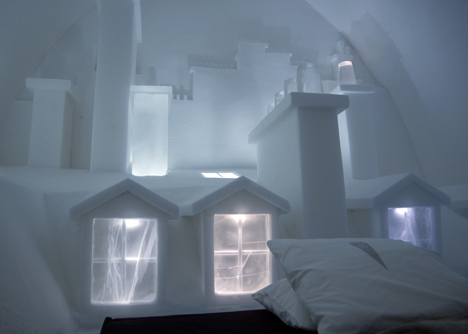
Voisin said the process of creating the sculptures was challenging because of the extreme weather conditions: "It is very interesting because the texture of the snow and ice changes so much depending on the temperature."
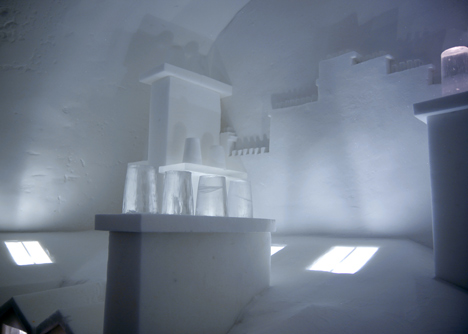
"From one day to another you might have to adjust your gesture if it is ten degrees less," he explained. "If it is warmer, the snow is wet and sticky, if it is very cold, the ice cracks and is very fragile."
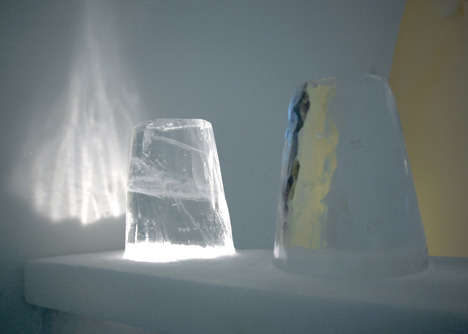
This year is the twenty-fourth edition of the Icehotel. Other suites created this year include a room modelled on a laboratory for a crazy scientist by Swedish designers Pinpin Studio.
Photography is by the designers.
Here's a description from Les ateliers de Germaine:
Icehotel Jukkasjärvi
Magical city, legendary city, romantic city, poetic city, symbolic city, Paris will always be Paris.
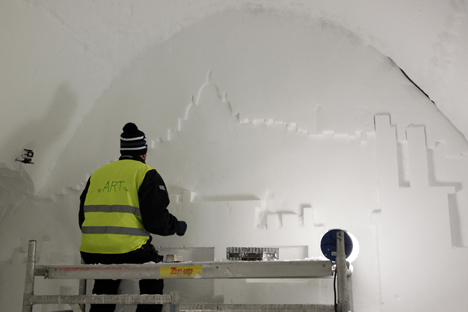
The cinema, literature and music have tried to capture the atmosphere and essence of Paris: it seems like it is an endless source of inspiration for artists and keeps attracting billions of tourists from all over the world.
Climbing to the top of the Eiffel Tower, walking on the Champs Elysées, visiting the Musée du Louvre, shopping in Le Marais, wandering along the River Seine or simply sipping coffee at a café, everyone can live and explore the city as they see fit, like adventurers.
More than a design, more than an architecture, it's a trip to the heart of one of the historical districts that we offer. You can feel the people living all around you, you might even see them if you're curiously peeking out the window. You are part of the city, you are the city.
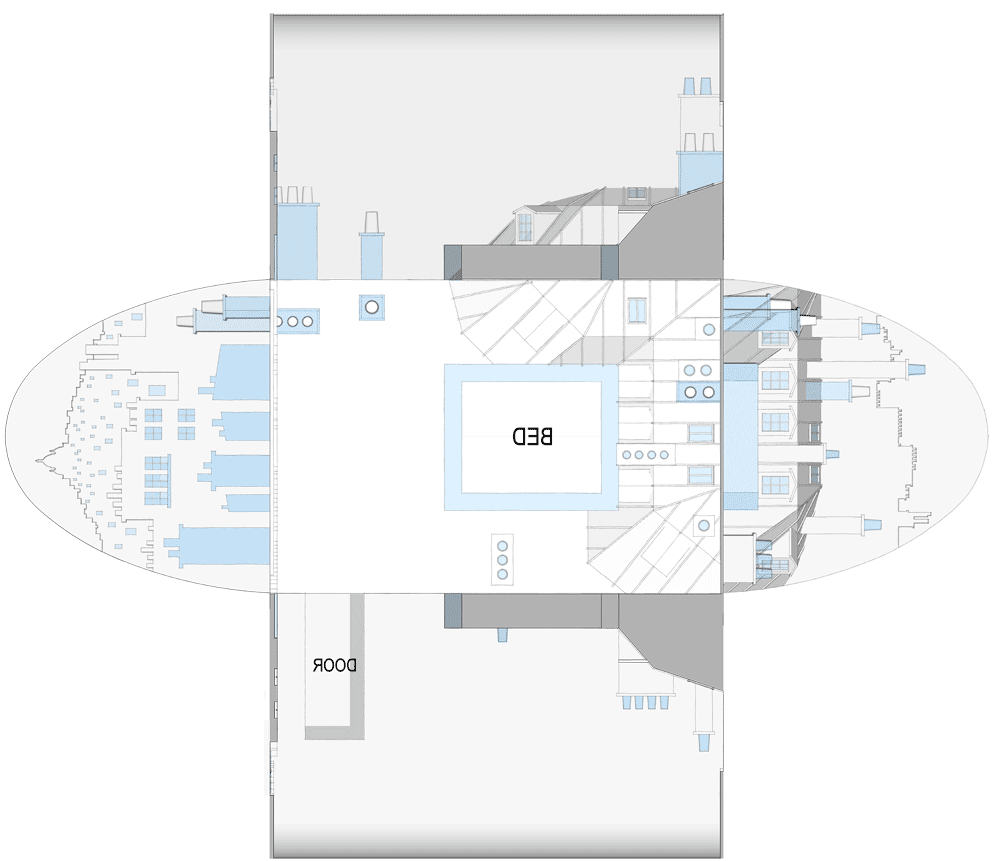
Suspended between heaven and earth, far from the chaos of the city, rocked to sleep between dormer windows and chimneys, overlooking the city skyline and its countless shining windows, this room will take you to Montmartre's rooftops, as Satine and Christian in Baz Luhrmann's Moulin Rouge.
The post Icehotel suite by Les Ateliers de Germaine
recreates the rooftops of Paris appeared first on Dezeen.
Japanese artist Kohei Nawa filled a dark room with billowing clouds of foam for this art exhibition in Aichi, Japan (+ slideshow).
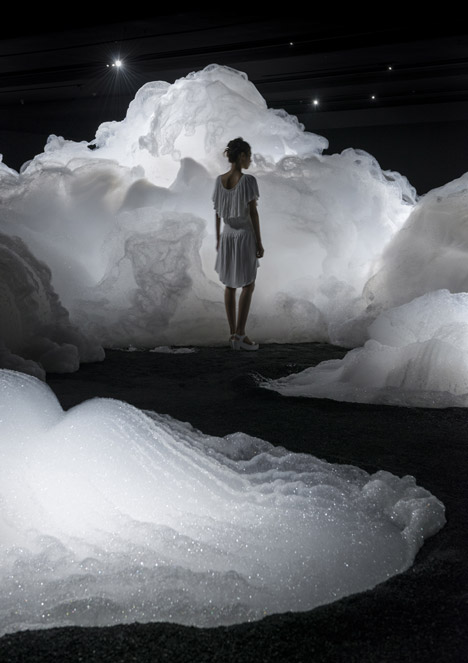
Kohei Nawa used a mixture of detergent, glycerin and water to create the bubbly forms of his installation, entitled Foam.
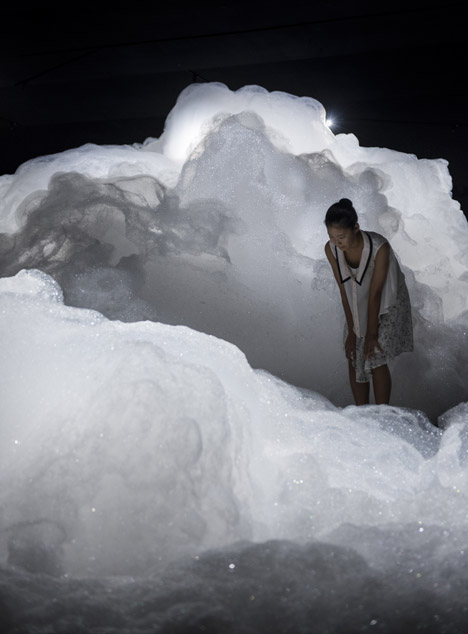
Described by the artist as being "like the landscape of a primordial planet", the large cloud-like forms were pumped up from the floor in eight different locations, creating a scene that was constantly in motion inside an otherwise black room.
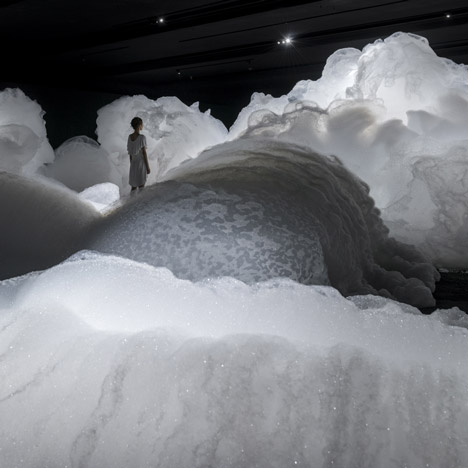
The artist experimented with different quantities of the three ingredients to create a foam stiff enough to hold a shape without being affected by gravity.
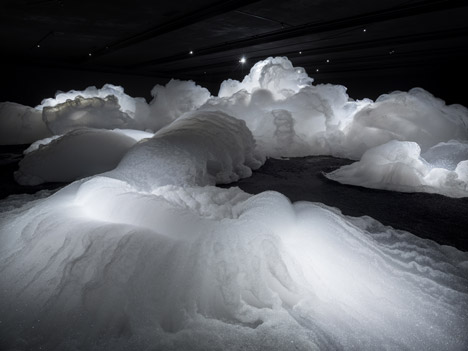
"Small cells bubble up ceaselessly with the slight oscillations of a liquid," said Nawa, explaining the process. "The cells gather together, totally covering the liquid as they spontaneously form a foam, an organically structured conglomeration of cells."
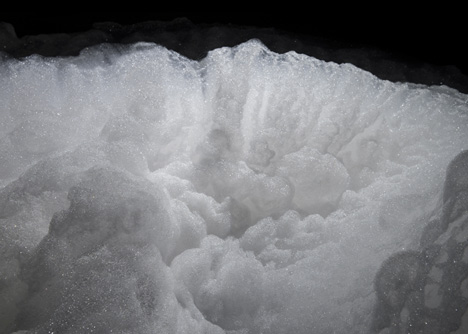
"The risen volumes of foam link together and reach saturation, but continue to swell, occasionally losing vitality and spreading out over the ground," he added.
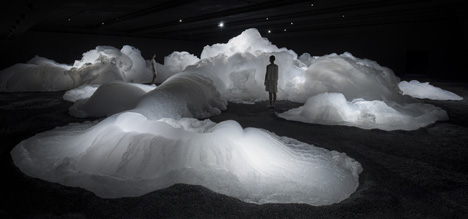
The exhibition was presented in Autumn 2013 as part of the Aichi Triennale, an art exhibition in Nagoya, Japan.
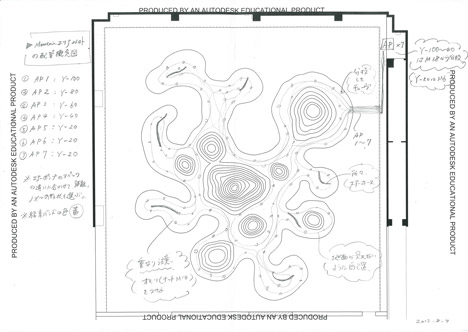
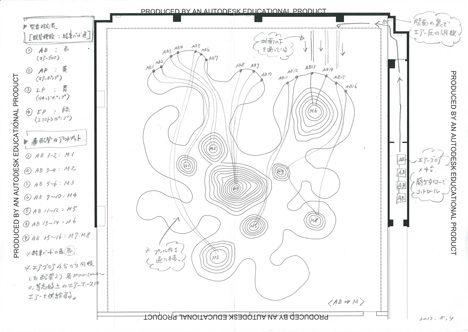
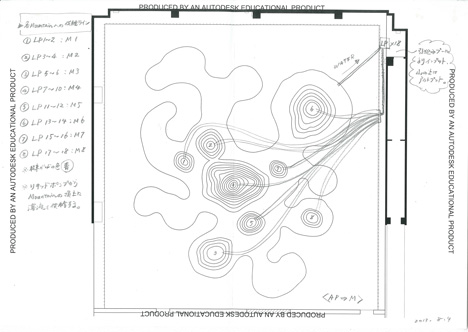
Photography is by Nobutada Omoto.
The post Kohei Nawa's Foam installation created
a cloud-like landscape of soapy bubbles appeared first on Dezeen.
Russian Sledgesvia overbey
BRING ME TO THE OWLS

Photo shared on Berkeleyside’s Flickr page, taken on Jan.1, 2014, by Alex Madonik
The burrowing owls that make their home at César Chávez Park on the Berkeley Marina every year are back.
Patrick Hickey, who works out in the pre-dawn hours most mornings at the park, says he has noticed a pair of the birds there for at least the past month.
“They sit right on the edge of the path perhaps three feet away. They always seem to flank the edge of the protected corner area,” he said. “They are quite small. They look at me but I say nothing and I keep moving. I think they realize I don’t want to mess with them. Or they are dangerously blasé!”(...)
Read the rest of Western Burrowing Owls are back on Berkeley Marina (171 words)
By Tracey Taylor. |
Permalink |
3 comments |
Post tags: Animals in Berkeley, Berkeley Marina, Berkeley wildlife, Cesar Chavez Park, Western burrowing owl
Russian SledgesWHAT
Russian Sledgesvia firehose
Alaska: 33
Chicago: -15 (-30 with windchill)
Russian Sledgesvia firehose <3
Russian Sledgesvia firehose comment
THIS IS WHERE I GO FOR MY EARLY MUSIC
Russian Sledgesvia firehose ("ST VINCENT AUTOSHARE")
St. Vincent has released a second song off her forthcoming self-titled LP. “Digital Witness” finds Annie Clark navigating the world of the web, singing lines like, “If I can’t show it / If you can’t see me / What’s the point of doing anything?” (In other words, “pics or it didn’t happen.”) The track is streaming below, along with another from the record, “Birth In Reverse.”
St. Vincent is due out Feb. 25 on Loma Vista, and all of Clark’s upcoming tour dates are listed below.
St. Vincent tour 2014
Feb. 13—Fritzclub Im Postbahnof—Berlin, Germany
Feb. 15—Paradiso—Amsterdam, Netherlands
Feb. 17—Ancienne Belgique—Brussels, Belgium
Feb. 18—La Cigale—Paris, France
Feb. 20—O2 Shepherds Bush Empire—London, United Kingdom
Feb. 21—Manchester Cathedral—Manchester, United Kingdom
Feb. ...


Russian Sledgesvia firehose

Book bracelet, made in England, c.1840
Russian Sledgesdidn't read
just sharing this to answer "no"

Periodically you have to ask this question again. Geeks aren't just running some of the world's biggest companies — they're also the heroes of mega-hit TV series like Big Bang Theory; and, in the post-Snowden world, they're international political subversives. So what the hell is a geek anymore?

    
|
Russian Sledgeswould go
 This is the sixth post in the Tokyo - Kyoto - Osaka series. Other posts in this series include the intro post: Tokyo, Kyoto, and Osaka, Matsugen (soba), Sushi Iwa, Ramen Honda (Tokyo Ramen Street), Ryugin, and Omen.
Russian Sledgesvia fiGe hoNe
A few years ago, I wrote about the tiny houses of Christiania in Copenhagen, Denmark. I was in Copenhagen again visiting family for the holidays and stopped by one of my all-time favorite communities again to photograph some of the tiny houses that dot this autonomous neighborhood. Christiania is a small community located within the city of Copenhagen where the 850 residents don’t pay property taxes, allowing them to build their own homes and create their own colorful architecture.
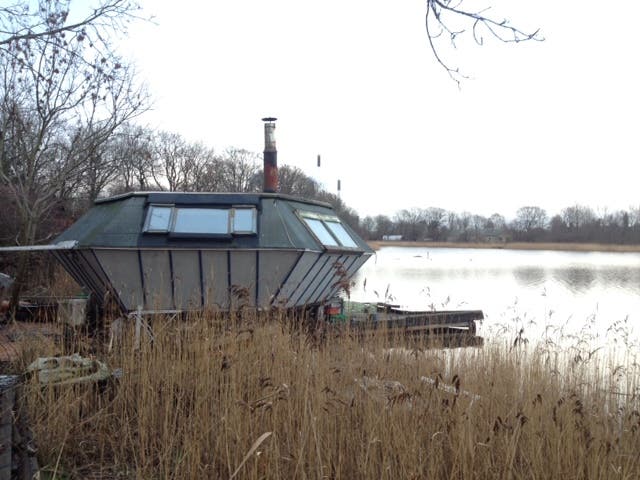
This place is a building inspector’s ultimate nightmare and a tiny house lover’s dream come true. Many of the tiny houses of Christiania were built utilizing already existing structures that were left over from when this area used to be a military base. The structures were added to with salvaged materials or items tossed out by non-Christiania residents. Other homes are created out of German bauwagens, boats, random windows, sheds or greenhouses. Since Christiania is also located in a park-like area with a large lake, residents take advantage of this and build some homes on floating platforms. I spoke to a Christiania resident about how to obtain a home or land in this free form community. He said it’s extremely difficult and you either have to know someone or you have to have grown up in the area to get hold of some land to build a house. Many residents stay for their entire lives and only give up their home to a friend or family member.
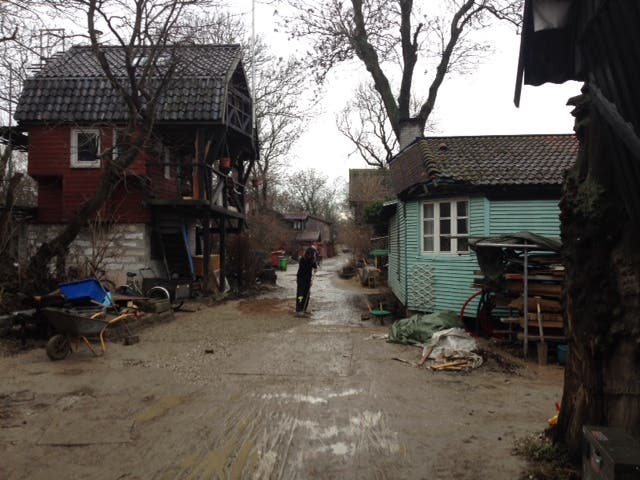
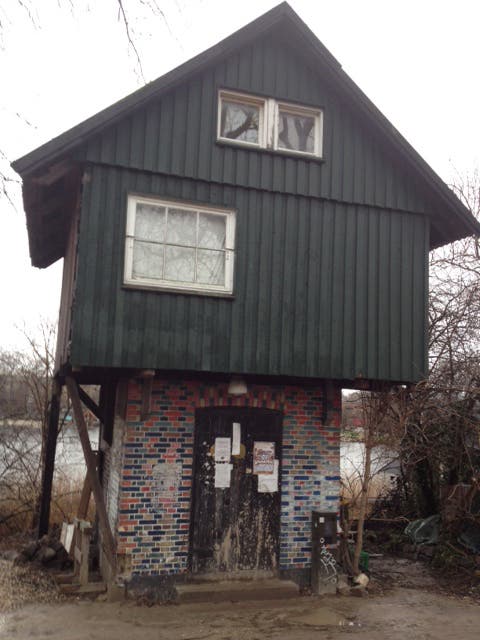
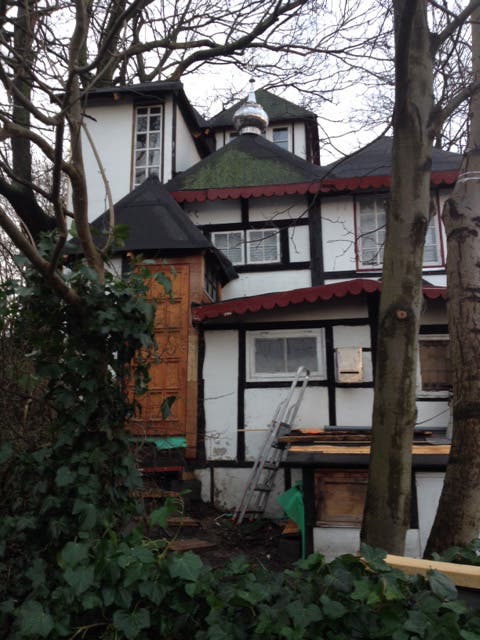


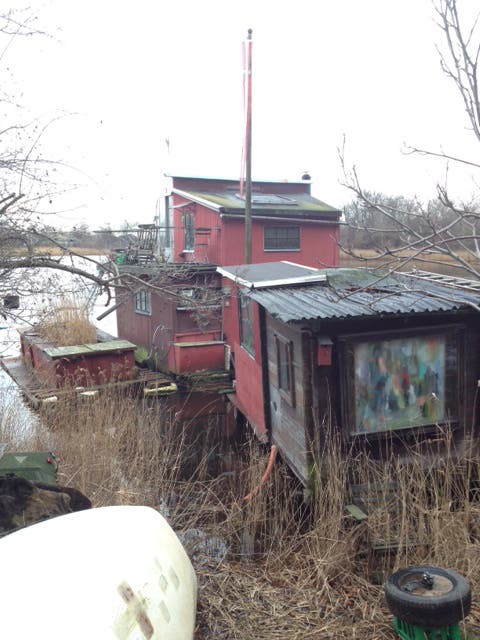


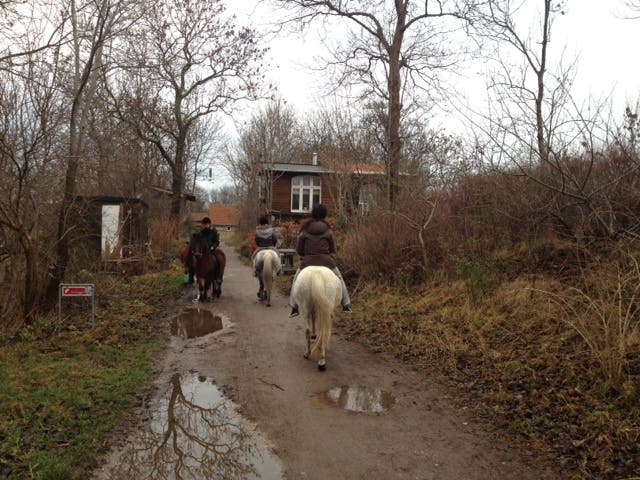

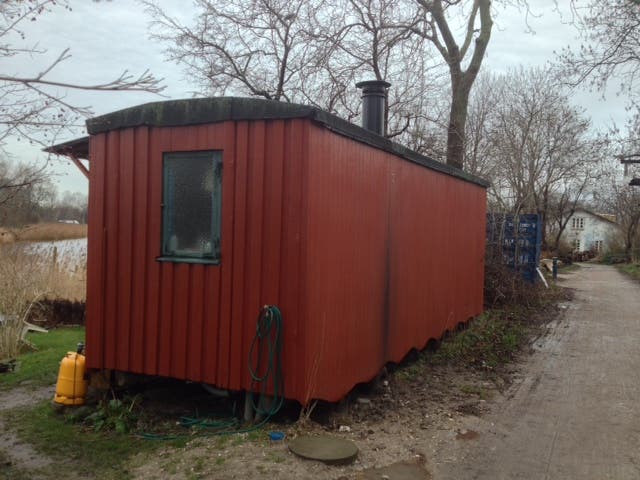
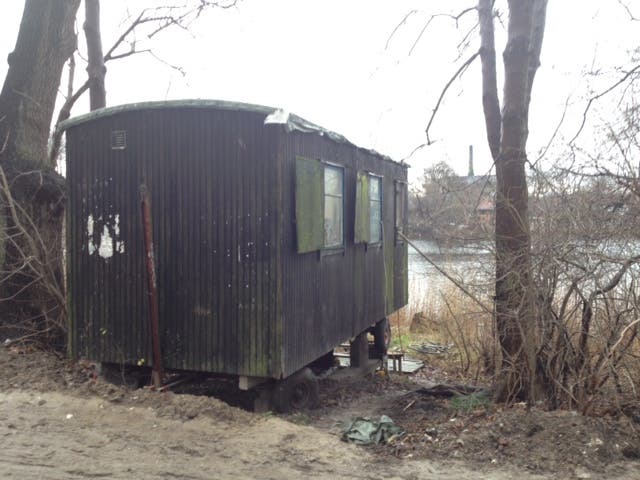



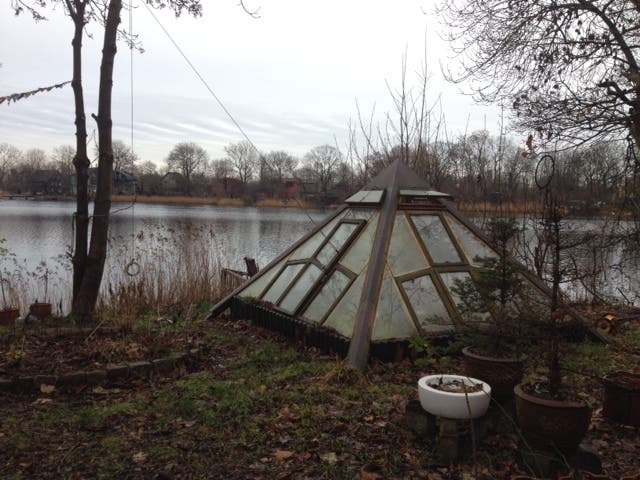



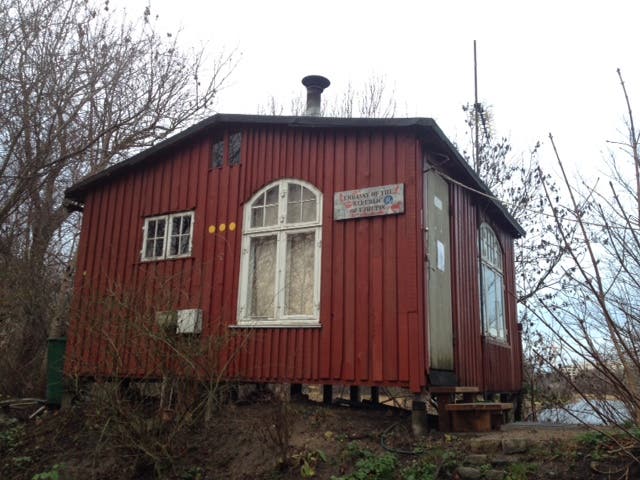

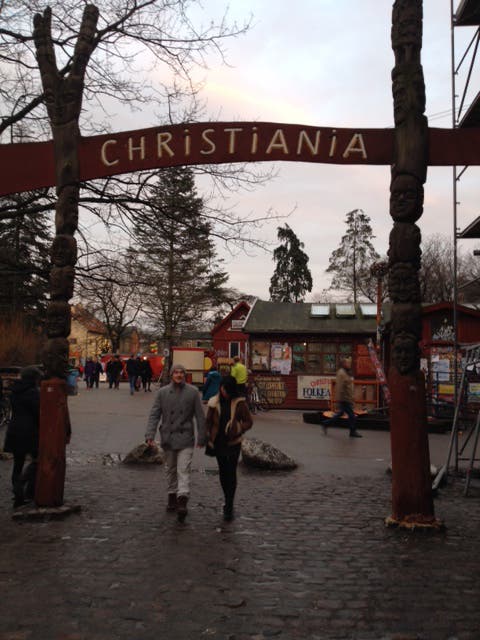
Photos by Christina Nellemann
By Christina Nellemann for the [Tiny House Blog]
Russian Sledgesvia firehose via tadeu
[citation needed] but yeah
Ahem.
Russian Sledgesvia saucie
"You might think people would exercise more in warmer, sunnier states. But that's not the case."
The new year is a time when many of us vow to head back to the gym. Moderate exercise not only helps us slim down and look better, it's also associated with all sorts of good health outcomes, from higher energy and productivity, better sleep and sex, and even greater longevity. In many cases, exercise may treat diseases as effectively as drugs, as one BMJ study recently showed.
Everyone knows it, but not everybody does it. Just a month after making those New Year's resolutions, 36 percent will already have given up, according to University of Scranton psychologist John Norcross.
And overall, American adults aren't nearly as fit as they should be, according to a report on aerobic and muscle-strengthening exercise released by the Centers for Disease Control and Prevention [see p. 326 of the PDF]. Drawing on data from the 2011 Behavioral Risk Factor Surveillance System survey, a nationwide telephone survey with more than 450,000 responses, the report looked at who met the 2008 Physical Activity Guidelines: two weekly sessions of muscle strengthening, and 150 minutes of moderate-intensity aerobic exercise (or 75 minutes of vigorous intensity).
Just 51.6 percent of U.S. adults met the aerobic activity standard and less than a third (29.3 percent) met the muscle-strengthening standard. Only roughly one in five Americans (20.6 percent) met both standards. (And, since the data is self-reported, there's a good chance these numbers might be inflated).
The overall numbers are concerning. And, they vary considerably by state.
To visualize this, my colleague Zara Matheson of the Martin Prosperity Institute mapped the variations for the percent of adults who reported meeting the guidelines for aerobic exercise, muscle-strengthening exercise, and both together. The first map, below, shows the overall pattern for aerobic exercise.

As you can see, participation in aerobic exercise is most prevalent along the West Coast, in the Rocky Mountain states and the northeast, and far less so in the middle and southern portions of the country.
Colorado tops the list among states, with 61.8 percent of adults meeting the standard for aerobic exercise; Oregon is second (61.1 percent), followed by Vermont (59.2 percent), Hawaii (58.5 percent) and California (58.2 percent). On the flip side, the lowest levels of participation in aerobic exercise are found in southern states – Tennessee (39 percent), Mississippi (40 percent), Louisiana (42 percent), Alabama (42.4 percent) and West Virginia (43 percent).
The second map shows the results for muscle-strengthening exercises.

The map shows a similar pattern, with higher participation in muscle-strengthening in the West, the Rocky Mountains, and northeast and lower levels in the interior and the South. D.C. now tops the list (36.1 percent – though as always, D.C.'s presence on state lists is complicated by being a 100 percent urban area).
Ranking the states, Colorado is in second (35.6 percent), followed by Alaska (33.8 percent), Virginia (33.4 percent) and Arizona (32.5 percent). Conversely, West Virginia (20.2 percent), Tennessee (20.6 percent), Oklahoma (23.8 percent), Mississippi (23.9 percent) and Louisiana (23.9 percent) have the lowest levels of participation.
And finally the third map, below, charts the states whose residents score highest on both types of exercise.

Again, the highest levels are in the West and Rocky Mountain states and the northeast, with the lowest levels concentrated in the interior and South. Colorado is again first, followed by D.C. (26.3 percent), Alaska (25 percent), Arizona (24.2 percent), Hawaii (23.7 percent) and California (23.7 percent). On the flip side, West Virginia (12.7 percent), Tennessee (12.7 percent), Mississippi (14.2 percent), Alabama (15 percent) and Louisiana (15.5 percent) have the lowest levels of participation.
• • • • •
What factors lie behind these geographical patterns?
To get at this, my MPI colleague Charlotta Mellander ran a basic correlation analysis on participation in exercise and a number of key socioeconomic, demographic and health factors. I report the correlations for combined aerobic and muscle-strengthening, but the pattern for the two types of exercise individually is similar. As always, I note that correlation does not equal causation.
You might think people would exercise more in warmer, sunnier states. But that's not the case.
As the maps suggest, both forms of exercise are highly correlated with one another. States where people participate more in aerobic exercise also have higher levels of muscle strengthening (the correlation between the two is .81).
Also not surprisingly, states where people exercise more also have significantly lower levels of obesity and smoking, two known causes of preventable deaths. Mellander found substantial negative associations between exercise levels and obesity (-.80) and smoking (-.63).
You might think people would exercise more in warmer, sunnier states. But that’s not the case. She found a negative correlation (-.38) between yearly average temperature and exercise across the 50 states.
Exercise levels also correspond to wealth and affluence, with substantial positive correlations to both income (.65) and wages (.64). States where people exercise more are also more highly educated, with a significant correlation (.68) to the share of adults who are college graduates. And exercise levels are higher in states with more post-industrial economies, as participation was highly positively correlated with the share of knowledge, professional and creative workers (.51) and negatively correlated with the share of blue-collar workers (-.65).
Fitness participation also tracks the nation's red/blue divide, being positively associated with the share of Obama voters (.51) and negatively associated with Romney voters (-.53). Exercise also hews closely to America’s religious divide. People in more religious states exercise less (the correlation between religiosity and exercise is -.69).
• • • • •
Writing in The Atlantic a couple of years ago, I noted that the physical fitness of our cities and metro areas is geographically spiky, and that "healthy or unhealthy lifestyles... are inextricably tied up with the nature and structure of our culture and society."
The fault lines of our economic geography shape our destiny: income, education, and social class influence everything from partisan preference to health. Exercise, it seems, is no exception.
"America's increasingly uneven geography of fitness," I concluded, "is perhaps the most visible symbol of its fundamental economic and class divide." This more recent report provides further evidence for this unhappy state of affairs.
All maps by MPI's Zara Matheson based upon CDC report data. Top image courtesy Shutterstock.com/Skydive Erick.

|
|
Russian Sledgesvia foster hodel


Revolving self-portrait, c. 1865
Self portrait by Felix Nadar
This is one caption written in Impact font away from becoming a reaction gif
I agree.
Russian Sledgesvia forksmaidenose

 Ich hab’ mir im Leben noch keine Gedanken darüber gemacht, dass man Schuhsenkel auch anders schnüren könnte, als so, wie man das halt macht. Aber ich hab’ mir kurz vor Weihnachten schicke neue Treter gekauft und werde mir dafür jetzt rote Dingens kaufen und dann schnüre ich mir ein Pentagram auf meine schwarzen Schuhe. Satanisten-Schnürsenkel from Hell FTW! Auf Ians Shoelace Site gibt’s noch haufenweise weiterer Schnürsenkelmethoden.
Whilst mathematics tells us that there are more than 2 Trillion ways of feeding a lace through the six pairs of eyelets on an average shoe, this section presents a fairly extensive selection of 39 shoe lacing tutorials. They include traditional and alternative lacing methods that are either widely used, have a particular feature or benefit, or that I just like the look of.
39 Different Ways To Lace Shoes (via Hacker News)
Russian SledgesThe office was bare except for several books Menino, the city’s first Italian-American mayor, was leaving behind about the Irish — and a letter left on the desk for Irish-American Martin J. Walsh, who is being inaugurated today as the new mayor.
“Executive decree, let’s dissolve all commissions and committees, “ Menino said, chortling. Then he looked at his watch and grumbled something about his plane being canceled. “What kind of operation are they running over there?” he said, nodding his head out the window toward Logan International Airport in East Boston.
He declined to say where he was traveling.

|
|
Russian Sledges#linkbait
[Originally published January 6, 2014.]
Calm your tits. I understand your obsession, but you people are out of control. I’m cute. I’m silly. I’ve got attitude. I get it. But wake the hell up already! Every internet link I see, every commercial I watch, every hipster-ass music festival in a nasty-ass desert… there is always a cat. What’s the big deal?
In case you forgot, I’m only a pet. So get the fuck over it.
BREAKING NEWS: I’m ridiculously adorable. Listen up, Katie Couric: everyone already knows that. Get with the program. Us cats are not commercial worthy. “Cat Herders”? No thank you. “Cats with Thumbs”? Pass. “Telecom Kittens”? I want my money back. That Skittles commercial, “Cat Lick,” is the reason I attacked your ankles last week.
Apology not accepted.
Oh, you thought you’d post videos of me? Look, I’m having a panic attack in a box. Look, I’m in a costume made of fruit. Look, I’m ironically getting along with other animals. Guess what Spielberg? I made a few videos myself: Your face when I scratch the shit out of your mother’s first designer handbag that she’s “been waiting her whole life to own”; your face when I use your shoe as a litter box; your face when I refuse to leave while you’re mating.
Keep posting videos of me being vulnerable and I’ll start posting videos of you eating your feelings.
No, you cannot “has cheezburger.” You know what you can have? Toxoplasmosis. That’s right, asshole, I am not afraid to give you a parasitic disease. Keep messing with my shit and see what happens.
Test me. I dare you.
So go ahead, continue making those annoying-ass cat memes. We’ll see who the real victim is soon enough. Just stop freaking the fuck out over domesticated animals. It’s embarrassing. Get a grip and move on.
Now scratch my belly.
Russian Sledges#centralsquare

|
|
Russian Sledgesit's black and white, but I think those coats are hudson's bay point blankets:
http://en.wikipedia.org/wiki/Hudson's_Bay_point_blanket
http://www.llbean.com/llb/shop/22955?page=hudsons-bay-point-blanket
 Photo of a group of four women wearing skis and blanket coats in British Columbia, 1940.
Russian Sledgesvia snorkmaiden


Russian Sledgesvia multitask suicide
Many people will be somewhat surprised that the American Dialect Society's "Word of the Year" choice was because in its use with a noun phrase (NP) complement (though the Megan Garber's Atlantic Monthly article on it nearly two months ago should perhaps have been a tip-off). It seems to be unprecedented for a word in a minor category like preposition to be chosen rather than some emergent or fashionable word in one of the major lexical categories: recent winners have included 2012's hashtag (noun), 2011's occupy (verb), 2010's app (noun), 2009's tweet (noun and verb), 2008's bailout (noun), 2007's subprime (adjective), 2006's plutoed (past participle of verb meaning "downgrade in status"), and 2005's truthiness (noun). And it also seems to be unique in representing a new syntactically defined word use within a given category rather than a new (or newly trending) word. The syntax of because calls for a little discussion, I think, given that Megan Garber thinks the word has become a preposition for the first time, and every dictionary on the market is wrong in the part-of-speech information it gives about the word (write to me if you can find a dictionary of which this is not true: I'd love to see one).
What the American Heritage Dictionary (AHD) says about because will do as a basis for discussion, since the dictionaries pretty much all agree (they basically just plagiarize each other). There are some that say because is an adverb (Wiktionary does, for example), which is stupid in various ways I won't go into here, but what the AHD reports is more standard (it agrees completely with Webster's Third New International Dictionary): it says that because is a "conjunction", but there is also a word spelled because of, which is a preposition. Both claims are flamingly and demonstrably wrong.
Traditional grammar recognizes two types of "conjunction" (I put the word in scare quotes because, although famililar, it is a most undesirable choice of terminology, since it has a different use in logic): there are "subordinating conjunctions" and "coordinating conjunctions". Because doesn't resemble the archetypal members of either class of words.
Why because isn't a "conjunction"
First, let's consider the "subordinating conjunctions" (The Cambridge Grammar calls them subordinators). The archetypal exemplar is the unstressed word that (not the stressed demonstrative with the same spelling). It introduces subordinate clauses, as in Ted says that the world is flat, which are nearly always complements (i.e., they are required or specifically licensed by the foregoing main clause word, in this case believe). That is meaningless in its own right, and often omissible (Ted says the world is flat is grammatical and has the same meaning). Preposing the constituent that it introduces (i.e., shifting that and the following clause to the beginning of the main clause) generally sounds pretty weird: the strikingly odd sentence ??That the world is flat, Ted says would need a special context where different things Ted says are being contrasted with one another. It is not at all just a variant of Ted says that the world is flat.
None of this holds for because, as used in sentences like Ted is ridiculed because he holds ridiculous beliefs. Because introduces constituents that are hardly ever complements. In The reason he left is because he was not respected the because phrase is the complement of is, and in the colloquial Just because he's a Republican doesn't mean he's evil the subject is the phrase beginning just because. But mostly because phrases are adjuncts. Thus *Ted says because the world is flat is not grammatical at all due to the lack of a complement for say (you would have to understand it elliptically, with something missing after the verb says, so it means "Ted says it is because the world is flat"). And of course because is not meaningless: it contributes a crucial logical relation of cause or reason. It can therefore never be omitted without radical change to the meaning and usually the grammatical permissibility of the sentence (*Ted is ridiculed he holds ridiculous beliefs is not grammatical). Moreover, shifting the whole because-phrase to the front is perfectly normal: Because he holds ridiculous beliefs, Ted is ridiculed is perfectly normal in lots of contexts. In short, because is nothing like that in its syntax or its semantics.
What about the other "conjunctions"? The classic "coordinating conjunction" (which CGEL calls a coordinator) is and, which introduces non-initial components of coordinate constituents, as in Roses are red and violets are blue. Switching the positions of the two clauses separated by the and normally gives a grammatical result with the same truth conditions: Violets are blue and roses are red is true if and only if Roses are red and violets are blue is true. Preposing the and plus what follows it is never permitted: *And violets are blue, roses are red is totally ungrammatical.
The opposite of all of this holds for because. The sentence Roses are red because violets are blue has a completely different meaning from Violets are blue because roses are red (the direction of the causal arrow is reversed). And Because violets are blue, roses are red is a grammatical alternative way of expressing the same thing as Roses are red because violets are blue.
So why do all dictionaries make the self-evidently false claim that because is a "conjunction" and thus either like that or like and? In short, because they are all lazy followers of a stupid tradition that has needed rethinking for 200 years (some would say it's more like 2,000 years, because it originates in classical times). They are locked into system of respecting an ancient analysis that doesn't work.
The "conjunction" notion is based on the extremely vague notion of joining: a "conjunction" is supposed to be a word that "joins" two elements together. Very little thought is required to see that if using C to "join" A together with B means simply forming the sequence "A C B" then almost anything can be called a "conjunction"; and no stricter and more tightly framed definition has been given. (It couldn't be, given the diversity of what it would have to cover: subordination of finite and nonfinite complement and adjunct clauses, coordination of clauses, and coordination of other things such as NPs.)
Why because of isn't a preposition
That brings us to the similarly brainless claim that there is a preposition spelled because of. I'm not going to say that the dictionary should never recognize something as a word if it has a space in it; foreign-derived proper nouns like Santa Cruz are best thought of as words rather than phrases, and there may be some space-containing words other than proper nouns. But because of isn't one of them.
I don't need elaborate arguments to convince you of this. I simply searched the Wall Street Journal corpus (44 million words from the late 1980s that has served as a convenient testbed for all sorts of computational linguistic experiments over the past twenty years), looking for cases of because and of with some stuff in between. Within half a second my laptop provided these results:
These don't just have words and spaces in between because and of; they actually have commas in there! Do you want to posit words in the dictionary that have commas and spaces and sequences of three or four words inside them? Do you want to propose that the dictionary should include not just the one word because of but several million others like because, some retailers thought, of and because, it is widely believed, of? If you do, you're a fruitcake, and I'm not addressing you. If you are a Language Log reader you will see what I mean. There is no preposition because of; these are two separate words, with their own functions, capable of being widely separated by other words.
The correct part-of-speech classification"
Of, naturally, is a preposition. It is the commonest and most stereotypical of all prepositions in English. It heads preposition phrases (PPs) like of our public universities. So what should we say about because? Contrary to all the dictionaries, it is a preposition. As its complement (the phrase that follows it to complete the PP) it may take either a clause (as in the PP because he holds ridiculous beliefs) or a PP with of as its head (as in the PP because of our public universities). Some prepositions can occur with no complement (as in We went in), some require an NP (as of does) some require a clause (as although does), and some require a PP (like out in those uses that do not involve exiting from delimited regions of space: notice that They did it out of ignorance is grammatical but *They did it out ignorance is not).
The change that has caught the eye of the American Dialect Society is simply that because has picked up the extra privilege already possessed by prepositions like of: it now allows a noun phrase (NP) as complement (with a subtly different shade of meaning: because money seems to express only a rather vague and non-serious commitment to the idea that the reason is financial). So syntactically speaking, in the following table of prepositions (in red) and their complement categories (in blue), a single entry has been changed (✓ means "grammatically permitted", * means "grammatically forbidden", and % means "grammatically permitted in some semantically limited contexts"):
| (none) | NP | of-PP | Clause | |
| in | ✓ | ✓ | * | * |
| out | ✓ | % | % | * |
| since | ✓ | ✓ | * | ✓ |
| of | * | ✓ | * | * |
| because | * | * | ✓ | ✓ |
The language has simply added to its stock of grammatical possibilities (as it can, because syntax) a single check mark, replacing the second asterisk in the last row. Think of it as the first American Dialect Society grammatical Check Mark of the Year. And if you would like the dictionary to cover (as Wiktionary does) the colloquial use ofbecause on its own as an imperiously uninformative answer to a why question ("Why do you have to wear your mittens? Because!"), then we can get rid of the first asterisk as well, and the relevant line will look like this:
| (none) | NP | of-PP | Clause | |
| because | ✓ | ✓ | ✓ | ✓ |
That represents because as a preposition that is sometimes used with no complement, and sometimes (in the new usage that the ADS has just recognized) with an NP complement, and also (much more commonly) with an of-PP complement or a bare finite clause complement. That's a syntactically accurate classification, which dictionaries ought to adopt — but don't hold your breath waiting.
[This post was revised on Monday 6 January 2014; several small errors were corrected and a few additional points were added. For a more thorough treatment of the topic of classifying words like because, see my paper "Lexical categorization in English dictionaries and traditional grammars", in Zeitschrift für Anglistik und Amerikanistik 57 (3), 255–273 (2009); uncorrected final proof PDF here. —GKP]