watchdog 85 Images has added a photo to the pool:

OLYMPUS DIGITAL CAMERA
This video is proof that a beaver is alive and well in England, centuries after they were believed to have gone extinct in that country. No one is sure how it got there, but it's munching on trees in Devon.

    
|

|
|
Russian Sledgesvia firehose
 hodad
hodadThis one’s for you, @firehose
Remember, shaking a clear drink is like shaking a baby: first there’s going to be a lot of foam, and then you’ll be staring death in the face.
Russian Sledgesvia multitask suicide
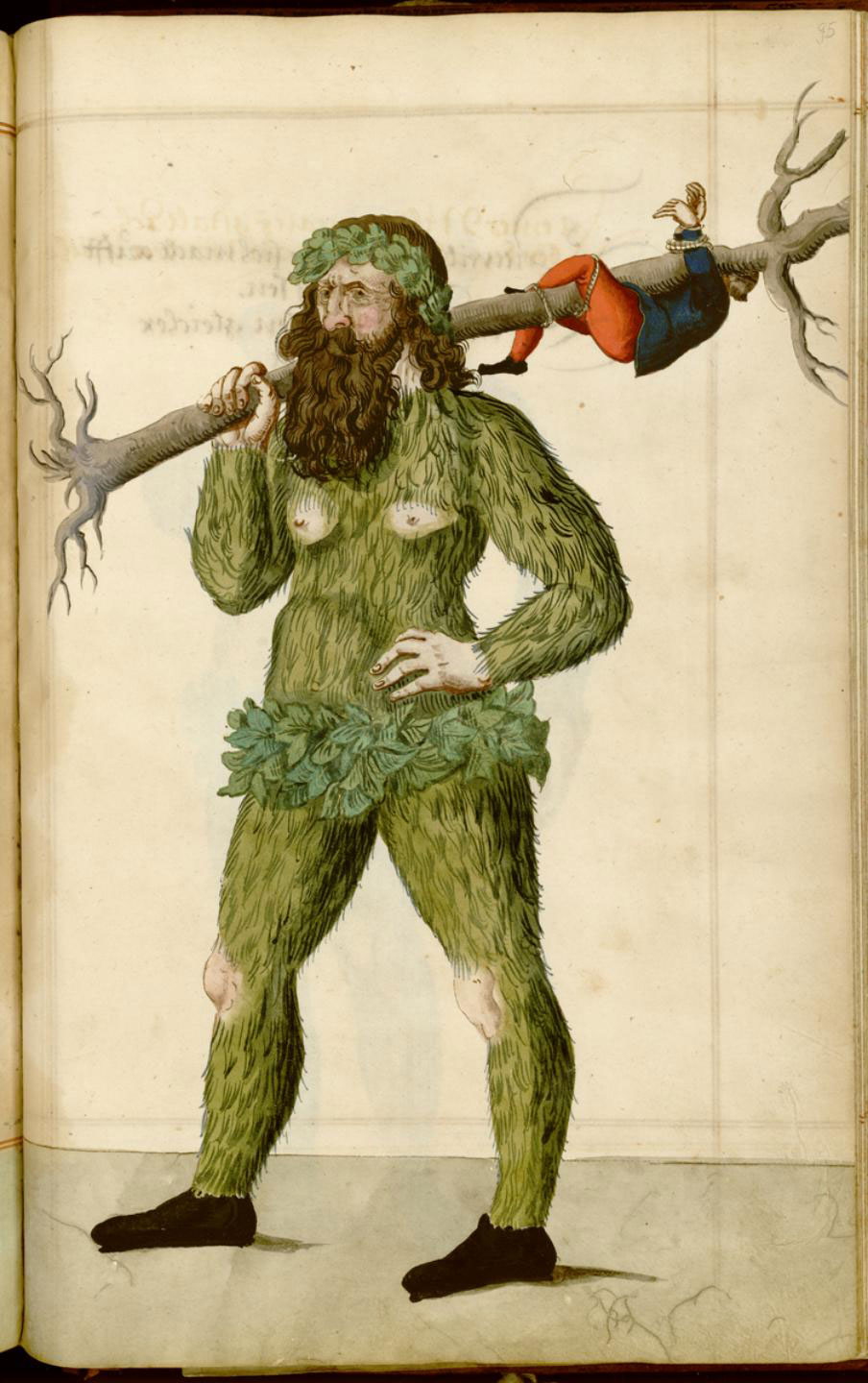
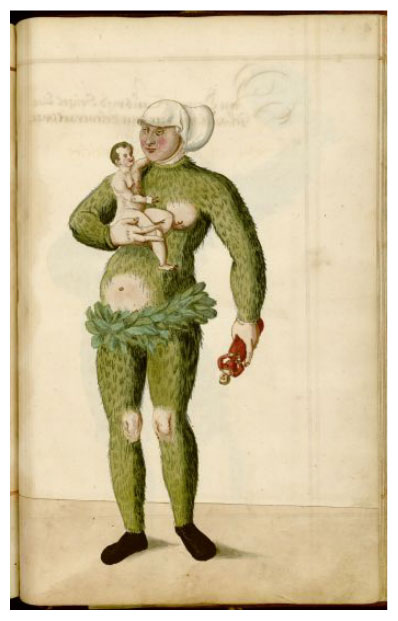
BibliOdyssey, which you can now follow on Twitter, points to a wonderful collection on Pinterest by user "Iki" of images of "Imaginary gardens in art: from unicorns to mandrakes & from Botticelli to Blake." This particular image featured above, from that Pinterest set, comes from "Medieval Mondays: Wild men in Medieval folklore," a post on the blog of A.J. Walker.
"Medieval Europeans were fascinated by what anthropologists call 'liminal zones,'" writes Walker, "Areas crossing from one state of existence to another, in this case from civilization to wilderness."
There was a lot of wilderness in medieval Europe, and since most people didn't travel, this wilderness was looked upon with wonder and fear. Who knew what might be living in that primeval forest? At the edge of human habitation there certainly were some strange people: bandits, hermits, madmen, so perhaps there were monsters too.Medieval society was a strict and hierarchical one. Everyone had their place and they better stick to it. In the more rural areas, though, the church and state had less of an iron grip, and people could get away with more. Time and again in the historical record there are reports of rural people engaging in rituals that look like pagan survivals or revivals. These were dangerous but exciting, and medieval people looked upon these remote regions with a guilty thrill. The wild man is a projection of this.
Images of wild men are so frequent that some have argued that they may have been real. Some say there may have been primitive tribes living in the more remote regions, or even surviving Neanderthals. There's no evidence for this. I think there probably were a few wild men, people who left society either by choice or by force, who lived a semi-wild life in the woods, wearing uncured pelts as clothing. They may have been a danger to farmers living on the edge of civilization, stealing livestock or women and children as is often depicted in wild men imagery. In the weird, wonderful world of the Middle Ages, it's not unlikely.
 "Medieval Mondays: Wild men in Medieval folklore" [2011]
Also, you can read this book online: "The Wild Man: Medieval Myth and Symbolism," by Timothy Husband and Gloria Gilmore-House (1980), published by the Metropolitan Museum of Art, New York.
Looks like the "wild man" image at the top of this post comes from UCLA's digital collection, and is a plate in a Medieval book depicting carnival costumes in mid-1500s Nuremburg, Germany.
Check it out in the manuscript viewer.
The excellent website Public Domain Review has more on this image collection. 
|
|
Russian Sledgesvia snorkmaiden

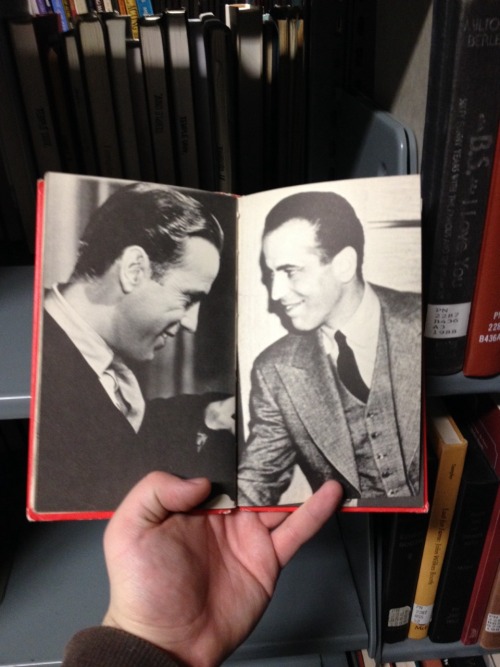
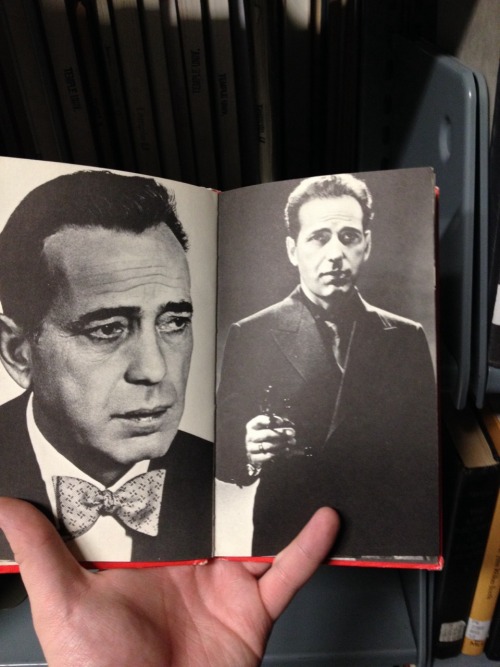

Nia and I found this book in the library. There is no context, description, or listed author. Every page is a picture of Humphrey Bogart. The only words we could find were the title and the dedication.
I want this book
Russian Sledgesvia firehose ("Sam the Eagle to Doctor Teeth in 1.2 seconds flat")


James Freeman of Blue Bottle Coffee. Photo: The Chronicle/Paul Chinn
While Peet’s opened a shiny new San Francisco flagship and Guy Fieri is putting Flavortown in your mug, Blue Bottle Coffee has completed a second round of funding, following up on its 2012 $20 million influx with a fresh $25.75 million investment from high-profile Internet people, as well as Morgan Stanley Investment Management.
Many are saying that this is a sign that America can and will welcome the upscale artisan coffee culture that San Francisco has long embraced. That said, The Chronicle’s Caleb Garling has a smart take on the investment, which he points out isn’t necessarily a vanity project for a bunch of rich “hipster techies” that might like to hang out at Blue Bottle:
We should be thinking less about the price of the cup of coffee but rather, the logistics it takes to create it. That requires a lot of smart software. To me, this is a relatively cheap investment in a company with a (ahem) ground-up look at supply chain management.
Getting that latte into your cup requires an immense amount of coordination through a mind-numbing matrix of roasters, shipping companies, delivery men, farmers, brokers, wholesalers and myriad unnamed players in between. Those are nodes on a grid — data. And that’s where a lot of investment dollars seems to be heading these days.
Blue Bottle currently has five Bay Area cafes (plus five in New York), and is in the process of opening two more in the Bay Area, in Oakland and Palo Alto.
For those wondering about what all this means for Blue Bottle (and more importantly, consumers) in the near future, the company addressed that very question on its blog today:
So what will change? Well, lots, we hope. We plan on opening an R and D facility to workshop green coffee, roasted coffee and the food that accompanies our coffee. We will be traveling more to source a greater percentage of our coffee directly, and working on deepening our relationships with our existing coffee-growing partners. We will be working on sustainable packaging that will let our customers enjoy our coffee for longer periods of time. We will (finally!) be releasing a bottled iced coffee that will be the equal of the iced coffee we sell in our shops. And we will be opening more shops.
· All Blue Bottle Coffee coverage [Inside Scoop]
· Previously: Blue Bottle’s new ownership raises questions [Inside Scoop]
Russian Sledgesattn overbey
 King crabs: they're delicious. And this lavender one was recently spotted in a shipment to Japan from Russia. Why is it lavender? Is it even lavender? Personally, I think it's more of a cornflower blue, but that's just me and I'm willing to argue about anything. How many legs does a crab have? "Eight and two claws." No they don't, they have twenty.
Marusan Mikami President Kenetsu Mikami told Hokkaido Doshin: "I've been dealing with crabs for 25 years, but this is the first time to see that colour. It could be a good omen." That is perhaps an optimistic view, but experts at a research centre in Hokkaido suggested the cause of the crab's colour was "the effect of its diet or possibly a mutation causing a lack of pigment."Hmm, my money is on genetic mutation. Jk jk, my money is in a shoebox under my bed. I'm saving for a new car. "What kind?" Matchbox. Do they really think the crab's color might be the effect of what it eats? You pull up a thousand crabs from the same area and one is blue and you think it might be its diet? Hey, all you other crabs, what have you been eating? "Algae." Hey weird blue crab, what have you been eating? "Well you see, I saw this glowing crystal..." Thanks to Zinc, hands down one of my favorite metals that I get 25% of my RDA of in a bowl of cereal.
Russian Sledgesvia firehose

In response to last week’s #museumselfie day, today the New York Public Library is calling on book fans everywhere to take photos of bookshelves (their own or a library’s) for #libraryshelfie day. The project was organized by Morgan Holzer and Billy Parrott of the New York Public Library.
photos via New York Public Library
Russian Sledgesvia firehose
I didn't used to be extremely self-conscious about doing yoga around skinny white girls
thanks, internet
Below is my response to Jen Carons “IT HAPPENED TO ME: THERE ARE NO BLACK PEOPLE IN MY YOGA CLASSES AND I’M SUDDENLY FEELING UNCOMFORTABLE WITH IT” post on xoJane.com yesterday. Here is an excerpt of what she wrote:
A few weeks ago, as I settled into an exceptionally crowded midday class, a young, fairly heavy black woman put her mat down directly behind mine. It appeared she had never set foot in a yoga studio—she was glancing around anxiously, adjusting her clothes, looking wide-eyed and nervous. Within the first few minutes of gentle warm-up stretches, I saw the fear in her eyes snowball, turning into panic and then despair. Before we made it into our first downward dog, she had crouched down on her elbows and knees, head lowered close to the ground, trapped and vulnerable. She stayed there, staring, for the rest of the class.
Because I was directly in front of her, I had no choice but to look straight at her every time my head was upside down (roughly once a minute). I’ve seen people freeze or give up in yoga classes many times, and it’s a sad thing, but as a student there’s nothing you can do about it. At that moment, though, I found it impossible to stop thinking about this woman. Even when I wasn’t positioned to stare directly at her, I knew she was still staring directly at me. Over the course of the next hour, I watched as her despair turned into resentment and then contempt. I felt it all directed toward me and my body.
Now, I’d like to share my story… IT HAPPENED TO ME: I’M A BIG BLACK GIRL AROUND SMALL WHITE PEOPLE & I’M SUDDENLY FEELING UNCOMFORTABLE WITH IT (a response to Jen Carons)
A few weeks ago I was taking a 7am class at an small/pricey fitness center in NYC. The classes at this fitness center only have 12 people in them which means we all get lots of personal attention. While the majority of the students in my class were women, I was the only black woman in the class. Actually, I was the only black person in the class… and for what its worth, I was the only plus size person in the class too.
Before class began we all introduced ourselves. There was a Kristy, a Liz, a Lisa, some other names I can’t remember and me, CeCe.
For the duration of the class, our bubbly blonde instructor encouraged everyone by name, “Nice Kristy!”, “Good job Liz!”, etc. she would also encourage me “Go, Girl!” she’d say… “Alright, Girl!”… “Nice, GIRL!” she’d yell standing over me with a beaming smile.
Everyone else in the class was called by name, but I, the only fat black woman in the class was called “Girl” (or was it “Guurl”?)
Jen Carons account of being made hyper aware of her white-ness and her skinny-ness while in the presence of a big black woman resonated with me because I am in that situation regularly, of course I play the role of the confused black woman who doesn’t understand why people constantly talk about their color and size when they’re around me.
Can you imagine what it would be like to have people make announcements about the color of their skin or the size of their body every time they saw you? Welcome to my world!
Like when white men grab me to dance at a bar and then interrupt our fun to announce “I’m such a white boy, right?”
Or when small white women wistfully tell me how much they really wish they could gain weight and be more “curvy”.
You see, from where I sit Jen’s sudden awareness of her whiteness was only a reflection of how hyper aware she was of the big black woman in such close, intimate proximity to her.
I mean, it would be racist weird to say “OMG! You’re so big and black!” so instead she says “OMG! I’m so white and small”
As a plus size woman of color, people are constantly “telling on themselves” in regards to how they see me. It could be as simple as calling me “girl” instead of my name or being shocked when I sing along to Incubus songs, it could be something as nuanced as mentioning their own appearance in contrast to mine, or as awkward as quoting Tyler Perry to me and assuming I’ll get the reference (I won’t).
If Jen Caron would like to think about how a big black girl feels, she can think about one of my realities: I’ve come to accept that for many of my associates, I am a big black woman for a very long time and then once they get over their own stereotypical interpretations of what that is, I become a person named CeCe.
I do give Jen credit for trying to put herself in my shoes though, she said…
I thought about how that must feel: to be a heavyset black woman entering for the first time a (yoga) system that by all accounts seems unable to accommodate her body. What could I do to help her?
The answer to that is easy, I don’t need your help… I’m good!

Russian Sledgesvia firehose
AFP |
Dozens of Rebels Killed After Philippine Peace Deal Is Struck New York Times MANILA — More than 40 people have been killed and a school district supervisor kidnapped in separate incidents around the island of Mindanao, days after a landmark peace deal was struck with the largest Muslim insurgency group in the Philippines, ... Close to 40 rebels killed as troops pursue BIFF in MaguindanaoGMA News Philippines Military Offensive Kills 37 RebelsVoice of America 37 killed in BIFF-military clash in MaguindanaoPhilippine Star Inquirer.net -Shanghai Daily (subscription) all 94 news articles » |
Russian Sledges#JJBFR forever and ever amen
Russian Sledgesvia saucie
The shuttle buses that ferry tech workers from San Francisco to Silicon Valley are accused of causing all kinds of secondary ills: They encourage people to live far from their workplaces. Those people move into neighborhoods where they otherwise might not live, driving up local rents. Then as neighborhoods evolve to cater to relatively wealthy young professionals, others are squeezed out.
It's possible, though, to think about this process a little more critically, to consider actual data. Last week, we wrote about some research from graduate students at Berkeley who tried to study how these shuttles influence employees' decisions on where to live and how to commute (bottom line: tech shuttles probably do take cars off the road, but they also contribute to the region's imbalance between jobs and housing).
Chris Walker, a data journalist now based in Mumbai (he's responsible for some other great data visualizations), has been thinking about the blurry cause-and-effect here, too: Can we actually say that these tech shuttles are driving neighborhood change?
"That's the easy conclusion to jump to," Walker says. "And I think that's what a lot of people would want to jump to: that these shuttles came first, and then all of a sudden these neighborhoods gentrified and became really unaffordable. But the story is obviously a lot more complicated than that."
Walker lived in San Francisco from 2007 to 2011, and – as anyone who lived there then probably recalls – many of the neighborhoods now clogged with private shuttles seemed to be growing more expensive then, too. So what does recent data from the city say? Walker tried to explore this with a couple of interesting maps built with open data from City Hall. Some of them rely on business registration data from the city to visualize the density of new restaurants, bars and salons registered with the city between 2011 and 2013 (in theory, these are the kinds of new businesses that would chase after clusters of wealthier consumers).
This is the map of recently registered restaurants and cafes, shown by orange-ish dots, with gray markers highlighting private shuttle stops (as they were identified and mapped in 2012 by Stamen):

In another map using city property assessment rolls, Walker plots all of the properties in town that appreciated by more than 70 percent between 2011 and 2013 (out of 196,782 taxable properties in the city, 6,389 met this description). Here, each of those properties is marked by a single dot:

The areas with densely clustered properties appear the brightest, as you can see in this zoomed-in view of the area around The Mission.

Walker isn't claiming here to have put his finger on a great indictment of the Google Bus. But this property-assessment map in particular raises another issue: it's clear that the entire city is becoming less affordable, even those places where tech workers can't live within walking distance of their commuter shuttles. "I think it’s an important thing to point out," Walker says. Still, rising property values – at least by this metric – are particularly prevalent in the neighborhoods served by these buses.
Here is Walker's take: "The shuttles are accelerating the process of gentrification that was already happening. There is a feedback loop. The tech workers are attracted to neighborhoods that are nice, but by moving there en masse, they are feeding into these affluent clusters in the city and making them even more unattainable for the median earner, or for people who are struggling."
That theory is likely closer to the truth. Inconveniently, it supports neither the simple claim that tech shuttles are the cause of all this change, nor the blanket defense that San Francisco can only stand to benefit from an influx of the people who ride them.
All images courtesy of Chris Walker.

|
|
Russian Sledgesvia firehose


With roots as far back as 1848, Morton Salt (known as such since 1910) is the leader in salt products in North America, providing salt for "culinary, water softening, household and road deicing, food processing, chemical, pharmaceutical, and numerous industrial uses". Delivered in an iconic, dark blue, cylindrical package for household use, Morton Salt is, like Coca-Cola, one of the most enduring American products and its Umbrella Girl, introduced in 1914, one of the most well-known and longest-lasting characters from the early days of advertising. Last week, as part of her 100th birthday celebration, Morton Salt announced a slight redesign to the Umbrella Girl and an upcoming introduction of a new packaging system to be rolled out in the next couple of months. Two New York, NY-based agencies were involved: Pause for Thought designed the new logo and packaging (not shown, yet) and Addison developed the masterbrand positioning and 100 anniversary branding.
It was 1914 when the little girl with the umbrella was introduced on the familiar blue round package of Morton Salt and in a print ad in the October issue of Good Housekeeping. The Morton Salt Girl and "When It Rains It Pours®" slogan were created over a century ago for the company's national advertising campaign to help illustrate that Morton Salt could flow freely even in damp weather, a major product innovation at the time.

The Morton Salt logo is widely recognized for its bold "Morton Salt" word mark. The new logo now features a fresh and friendly font, while maintaining the leadership qualities of the original word mark, specifically the bold, all-caps type style. The letter "R" in the new "Morton" word mark also carries a slight kick to mimic the Morton Salt Girl's step.

To use Morton Salt's own copyrighted slogan: "When it rains it pours" — which was created to communicate that even in humid and damp conditions Morton Salt's salt would pour freely out of its container as opposed to other salts that would get all bunched up. That tagline is now used to express that many things have gone bad (or sometimes good) in quick and multiplied succession. Here it applies to yesterday's Triumph Motorcycles post where we saw the same typographic update going on with Morton Salt: moving from a flared sans serif to a rounded-corner sans serif. The flared serifs are less obvious here, but they are there and, as is the case with this maneuver, whatever the new wordmark gained in friendliness it lost in uniqueness and flavor. It may resolve some of the tight spacing of the old typography but, other than the swoopy tail of the "R", there isn't anything memorable about the new wordmark. Too much subtle quirkiness has been sacrificed with little in return.
In addition to the word mark, the company updated its Morton Salt Girl icon as part of its brand refresh — but in small, subtle ways. The new Morton Salt Girl has cleaner, simplified linework to fit better with the new "Morton Salt" word mark.

The new Umbrella Girl has been updated for the better, removing some of the extraneous line work that muddied up the illustration when rendered small. Compared to the 1933 – 1941 and 1956 – 1968 updates, where new dresses and hairstyles were introduced, this is a very conservative update. With good reason. On the 100th anniversary of an icon, I don't think anyone — client or designer — wants to be responsible for potentially ruining a very good thing. I'm not promoting aversion to change but, let's face it, a drastic change to the Umbrella Girl, in the Huffington Post-era of logo journalism, would be catastrophic.


There is not much else to see at the moment. When the packaging comes out, if it's interesting, we will do a follow-up. In the meantime, let's appreciate that the Umbrella Girl didn't get a Barbie-like makeover.

Russian Sledgesvia overbey ("Bitcoin is for sociopaths")
Arianna Simpson:
I walk in and a group of people are already sitting at a long table. I say hi and hover for a second, determining where to sit. Entirely uninvited, and before I even have a chance to react, one guy proceeds to grab me by the waist and pull me into an awkward, grope-y side hug next to him on the bench. To reiterate, I’ve never met this man in my life. I try giving him the benefit of the doubt and make some quip about his being a friendly sort, but it gets uncomfortable pretty quickly when he puts his hand on my leg and leaves it there until I squirm uncomfortably.

Jen Caron, a self-described "skinny white girl," enjoys yoga. Or she did, at least—until a harrowing experience which can be accurately described as, "There was a new person at yoga, and that person was black."

|
|
Russian Sledges#jjbfr
Russian Sledgesvia multitask suicide
#neej
 A case study in the New England Journal of Medicine details the tragic story of an electrician who received a shock of 14,000V and was blinded as part of his injuries. Accompanying the article is this striking photo of the scars on his eyes, which resemble the plasma ball effects, the sort of thing you'd expect from a science fiction movie.
A 42-year-old male electrician presented to the eye clinic with decreasing vision 4 weeks after an electrical burn of 14,000 V to the left shoulder. His vision in both eyes was limited to perception of hand motions, with an intraocular pressure of 14 mm Hg in each eye. Slit-lamp examination showed bilateral stellate anterior subcapsular opacities of the lens (top panels, right and left). Dilated funduscopic examination showed scattered cotton-wool spots and bilateral optic-nerve pallor, which was greatest in the left eye (bottom panels, right and left).
Ocular Manifestation of Electrical Burn [Bobby S Korn/Don O Kikkawa/New England Journal of Medicine]
(via JWZ) 
|
|
Russian Sledgesvia snorkmaiden
oh my god
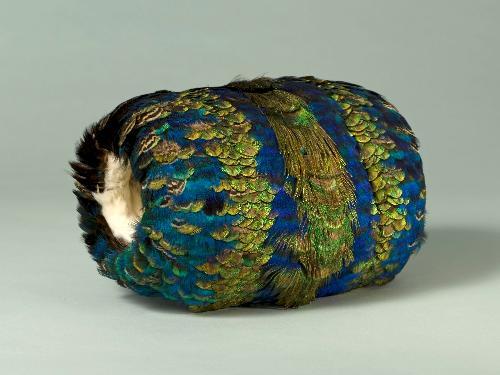
Muff
1860
Musée Galliera de la Mode de la Ville de Paris
Russian Sledgesvia firehose autoreshare


Love is all a matter of timing…
Tony Leung Ciu Wai and Maggie Cheung - In The Mood For Love
Russian SledgesSUPERB OWL
Russian Sledgestw: sexual assault (again)
Russian Sledgesvia firehose
Russian Sledgesvia firehose
DHH is considering an "emergency" set of rules for abortion clinics, which currently includes new building standards and an unprecedented requirement that a woman take certain blood tests at least 30 days before she can have an abortion. This last requirement would force women seeking abortions to have the procedure later into their pregnancies, making it riskier and more costly, and could make it impossible for some women to obtain a legal abortion before Louisiana's 20-week gestational limit.
Moreover, the blood tests indicated by the new rules, which check a patient's hematocrit and hemoglobin levels before a surgery, are normally performed the day of an abortion procedure because they need to be as current as possible, women's health care providers said.
Russian Sledgeson a happier note, here is a friend-of-a-friend who seems to dominate cosplay competitions