Shared posts

31 Mar 15:48

Our very first fabric! Please welcome Eloise

by Charlotte Hintzen

It's been a long time brewing and MY has it been difficult not to let this cat out of the proverbial bag (ok fine, except for this one shneaky peek we allowed ourselves a couple weeks back). But, now that's all out the window, no more secrets ladies and gentlemen, all is to be revealed and caution thrown to the wind.... we've started selling fabric

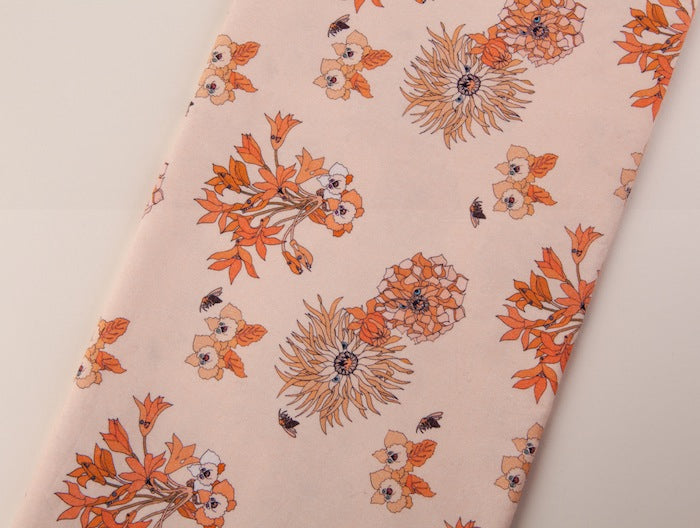
And, like any sensible little company, we're starting small. So, just for now, we've started with a limited run of this one design. And GEEEEZ are we in love with it! Please welcome Eloise, our gang of beautiful flower monsters, named after the very talented London-based textile designer Eloise Jephson who gave them life.


....aaaand, oh go on, a little closer look 


And now for some facts and stats about the fabric itself: 

  • It is 100% cotton poplin
  • It was woven in India and printed in England
  • It has a width of 58 inches / 147cm
  • It has a weight of 138 gms per m2 / 5.8 oz per yd2 

As a medium weight cotton, it can be used for a whole variety of things, such as:

  • Adult's clothing (including all of our sewing patterns)
  • Children's clothing
  • Cushion covers, lampshades and other homewares
  • Tote bags, pencil cases and other accessories
  • Quilting and applique

A little note about how to take good care of your fabric: 

This fabric was digitally printed with eco and skin friendly pigment inks. A post treatment was then applied to make sure that this fabric can handle the washing machine! However, in order to maintain vibrancy of colours in general, it is always best to wash on as low a heat as possible. Because the post treatment does add a tiny bit of extra stiffness to the fabric, we recommend that it is washed with a little bit of fabric softener thrown in too.

Sooooo...*deep breathe*... what do you think??? We are planning to constantly be working with young artists, designers and illustrators to create a library of exciting designs for us, the new wave of DIYers and Dressmakers - so all feedback is mightily appreciated! In the meantime, as ever, we absolutely cannot wait to see what you make. 

xx

13 Mar 13:34

Arms Wide Open

by editors
Russian Sledges

I never realized that the surface of the enormous jesus statue was a fucking mosiac:

'But the original pale grey-green stones that make up the mosaic surface have run out - so there is a possibility that the statue will gradually turn a darker shade.

Already, years of piecemeal repairs mean the statue is a patchwork of varying shades of grey, blue and green, when seen from close quarters. Future repairs will be further from the original colour, unless a new deposit of the stone is found.

Marcia Braga, the architect who led a restoration of the statue in 2010, says she faced difficulties finding the right stone. In the process of replacing 60,000 tiles, she rejected 80% of those supplied by the quarry.

“The idea is to do something as close to the original as possible because when you use different colours it’s not a pleasant aesthetic,” she says.

Reports that all the statue's six million stones will be replaced, and that Christ the Redeemer will change colour in one fell swoop, have been denied.

The next major renovation is expected in 2020, 10 years after the last. As yet no decision has been made on how many tiles to renew, but any new stones used will be a deeper shade, “a different, a darker green”, says spokesman for Brazil’s National Institute of Historic and Artistic Heritage.

“The stones of Christ are hard to find.”'

The battle for Rio de Janeiro’s iconic Cristo Redentor statue.

Donna Bowater | BBC | Mar 2014
[Full Story]
13 Mar 12:38

Gay veterans won't march in Boston parade

Russian Sledges

'Walsh says he won’t march if gay groups are excluded. A Walsh spokeswoman tells The Boston Globe (http://b.globe.com/1klIvUf ) the mayor is disappointed no deal was reached.'

BOSTON (AP) — A gay rights advocacy group says it is ending its efforts to get organizers of Boston's St. Patrick's Day parade to allow gay military veterans to march.


13 Mar 12:29

APNewsBreak: Transgender troop ban faces scrutiny

SAN FRANCISCO (AP) — An independent commission led by a former U.S. surgeon general has concluded there "is no compelling medical reason" for the U.S. armed forces to prohibit transgender Americans from serving. It's urging President Barack Obama to lift the ban by executive order.


13 Mar 12:01

Post-war, In focus

Russian Sledges

via firehose


Post-war, In focus

13 Mar 02:15

How To Eat In Other Languages | Incredible Things

by hodad
Russian Sledges

via firehose

#mampf #schland

13 Mar 01:45

text-mode: BBS Ads Collection v1.0 by Dipswitch/DCS^BM, check...

Russian Sledges

via firehose via Jakkyn

@}-,-`-


text-mode:

BBS Ads Collection v1.0 by Dipswitch/DCS^BM, check it here!

13 Mar 01:38

America's Most Unequal Metros

by Jed Kolko
Russian Sledges

via saucie

#thatpartofconnecticut

Income inequality has been growing in America, driven by technology, globalization, and other factors. It’s caused tensions between the haves and have-nots, which often get played out at the local level, and these tensions have erupted into fights over housing affordability and public services.

Are growing income gaps limited to particular metros, or is this trend widespread? To untangle the facts about local income inequality, we compared the incomes of rich, median, and poor households in the 100 largest metros in 2012, 2006, 2000, and 1990, using Census data (see note below). A rich household is defined as being at the 90th percentile – which means being above 90% of all households in the metro; the median is at the 50th percentile, while poor is defined as at the 10th percentile. Our main inequality measure is the ratio of incomes at the 90th and 10th percentiles (the “90/10 ratio”), which shows the size of the gap between the rich and the poor. A higher value of the ratio means incomes are more unequal; among the 100 metros, the 90/10 ratio ranges from below 9 to above 18.

Taking this approach, we found that some metros are much more unequal than others, and the most unequal metros tend to have higher housing costs and slower economic growth. Despite these differences, income inequality has increased in nearly all metros over the past two decades and has accelerated in recent years.

Income Gap Widest in Fairfield County, San Francisco, and New York

The most unequal metro in America isn’t a well-known big city; it isn’t even bankrupt or overrun with rich tech workers. It’s Fairfield County, CT, home to the tony towns of Darien and Weston but also to the city of Bridgeport, where one third of children are below the official poverty level today and which tried to go bankrupt back in 1991. There, the 90th percentile of income is 18.5 times the 10th percentile. San Francisco, New York, Boston, and Detroit – which did successfully go bankrupt last year – round out the top five. Among the top 10 most unequal metros, four are in New England.

Where Income Inequality Is Highest

# U.S. Metro 90/10 ratio, 2012
1 Fairfield County, CT

18.5

2 San Francisco, CA

17.9

3 New York, NY-NJ

17.7

4 Boston, MA

16.2

5 Detroit, MI

15.2

6 Miami, FL

15.1

7 Philadelphia, PA

14.7

8 Springfield, MA

14.2

9 Peabody, MA

14.0

10 Toledo, OH

13.9

Note: the 90/10 ratio is the ratio of income at the 90th percentile to income at the 10th percentile, for a given metro. A higher ratio means greater income inequality. For the 90/10 ratio for the 100 largest metros, click here.


At the other extreme, the least unequal metros in America include three in Florida that are popular with retirees: Lakeland-Winter Haven; Cape Coral-Fort Myers; and Palm Bay-Melbourne-Titusville. But equality isn’t just for places with lots of older folk: Salt Lake City and Raleigh are also among the least unequal metros despite having relatively young populations.

Where Income Inequality Is Lowest

# Metro 90/10 ratio, 2012
1 Lakeland-Winter Haven, FL

8.6

2 Allentown, PA-NJ

9.0

3 Salt Lake City, UT

9.2

4 Bethesda-Rockville-Frederick, MD

9.3

5 Tacoma, WA

9.3

6 Las Vegas, NV

9.4

7 Colorado Springs, CO

9.4

8 Cape Coral-Fort Myers, FL

9.5

9 Raleigh, NC

9.8

10 Palm Bay-Melbourne-Titusville, FL

9.8

Note: the 90/10 ratio is the ratio of income at the 90th percentile to income at the 10th percentile, for a given metro. A higher ratio means greater income inequality. For the 90/10 ratio for the 100 largest metros, click here.


Why Are Some Metros More Unequal Than Others?

The 90/10 ratio is twice as high in the most unequal metros when compared with the least unequal metro. What explains these huge differences in income inequality? It’s hard to disentangle all of the factors that might cause or be affected by inequality, but some simple correlations can help. After examining a wide range of demographic, economic, and housing measures, two factors stood out as being most strongly correlated with local income inequality: (1) housing affordability and (2) longer-term growth.

First, let’s take a look at housing affordability. Affordability and equality typically go together, and the least affordable housing markets tend to be the most unequal. The correlation between the 90/10 income ratio and the percent of for-sale homes affordable to the middle class (defined as households with median income) – is -0.4 and statistically significant. As the scatterplot shows, the four most unequal metros (Fairfield County, San Francisco, New York, and Boston) are also among the most unaffordable. Yet there are many exceptions to this pattern: Detroit, Toledo, New Orleans, and Philadelphia are also quite unequal but are relatively affordable, and on the flip side, Ventura County, Orange County, and Honolulu are more equal but far less affordable.

Inequality_HousingAffordability_Scatterplot_Mar2014

Why are unaffordable housing markets more unequal? Here’s a potential explanation: expensive housing pushes out many low- and middle-income households, and, in turn, richer residents bid up home prices and rents. At the same time, to compensate for high housing costs, many expensive big cities have policies or programs – like rent control or inclusionary zoning – that preserve or build some housing for lower-income residents (though, ironically, such policies could reduce overall housing affordability if they discourage new housing supply).

The second factor is growth. Faster growing metros tend to be less unequal. Whether growth is measured using employment change or construction activity, the correlation between growth since 1990 and inequality today (using the 90/10 ratio) is between -0.4 and -0.5. The link between growth and income equality is especially strong for low-income households; in other words, slower job growth (as well as less construction) is associated more with the poor falling farther behind, rather than with the rich pulling farther ahead.

Higher inequality, therefore, is associated with both lower affordability and slower growth. (A more sophisticated analysis would be needed to identify strategies for reducing inequality and to determine whether improving housing affordability through more housing construction could, by itself, reduce local income inequality.) While the reasons for local income inequality aren’t crystal clear, the trend toward bigger income gaps is clear – as the final section shows.

Everywhere, the Rich are Pulling Away from the Pack

Income inequality has grown in nearly all of the 100 largest metros. Between 1990 and 2012, the 90/10 ratio increased in 94 of the 100 largest metros – above all in San Francisco, Fairfield County, and San Jose. The 10 metros where inequality increased most include four in California and five in New England, as well as Honolulu.

The 10 Metros Where Inequality Increased Most

# U.S. Metro Change in 90/10 ratio, 2012 versus 1990
1 San Francisco, CA

7.4

2 Fairfield County, CT

7.0

3 San Jose, CA

5.1

4 Orange County, CA

4.2

5 Springfield, MA

4.0

6 Boston, MA

4.0

7 Oakland, CA

3.9

8 New Haven, CT

3.7

9 Honolulu, HI

3.7

10 Hartford, CT

3.7

Note: the 90/10 ratio is the ratio of income at the 90th percentile to income at the 10th percentile, for a given metro. A higher ratio means greater income inequality. For the change 90/10 ratio between 2012 and 1990 in the 100 largest metros, click here.


Just six metros bucked the trend of widening inequality, all in the south-central region of the U.S:

The Only Six Metros Where Inequality Declined

# U.S. Metro Change in 90/10 ratio, 2012 versus 1990
1 Baton Rouge, LA

-1.1

2 Austin, TX

-0.8

3 Memphis, TN-MS-AR

-0.3

4 Tulsa, OK

-0.2

5 New Orleans, LA

-0.2

6 Little Rock, AR

-0.1

Note: the 90/10 ratio is the ratio of income at the 90th percentile to income at the 10th percentile, for a given metro. A higher ratio means greater income inequality. For the change 90/10 ratio between 2012 and 1990 in the 100 largest metros, click here.


Not only has inequality increased over the past two decades, but it has also accelerated in the last few years. Averaging over the 100 metros, the 90/10 ratio increased by the same amount in the most recent six years alone (from 11.1 in 2006 to 12.2 in 2012) as it did in the previous sixteen years (from 10.0 in 1990 to 11.1 in 2006). Furthermore, between 2006 and 2012, inequality increased in 84 of the 100 largest metros, so the growth in inequality was more widespread in those years than in 1990-2000 and 2000-2006, when fewer metros saw inequality widen.

Income Inequality is Accelerating

Year

90/10 ratio, average of 100 metros

# of 100 largest metros in which 90/10 ratio increased versus previous period

1990

10.0

N/A

2000

10.8

74

2006

11.1

73

2012

12.2

84

Note: the 90/10 ratio is the ratio of income at the 90th percentile to income at the 10th percentile, for a given metro. A higher ratio means greater income inequality.


More strikingly, the growth in inequality at the metro level since 1990 has been more about the rich pulling away from the pack than the poor falling farther behind. To demonstrate, inequality can be measured by comparing rich households’ incomes to the median using the ratio of the 90th to 50th percentiles and separately comparing poor households’ incomes to the median using the ratio of the 50th and 10th percentiles. Here’s what these measures show: between 1990 and 2012, the 90/50 ratio increased in all 100 metros, while the 50/10 ratio increased in 68 metros and decreased in 32. That means that every large metro has seen the rich get farther ahead of the typical household, but only two thirds of metros have seen the poor fall farther behind.

The tensions over growing local inequality, therefore, are backed by the facts. Nearly every major metro has seen the income gap between the rich and the poor grow since 1990, and the gap has widened faster in the last six years. The growth in inequality is more about the rich getting richer than the poor getting poorer, though both are happening. And where housing is less affordable, income inequality is more extreme.

Note: Inequality is measured as the ratio of different percentiles of household income at the metro level. All income data come from the Census: the 1990 and 2000 decennial Censuses, and the 2006 and 2012 1-year American Community Surveys. Metros were identified based on Public Use Microdata Areas (PUMA’s) mapped to consistent 2009 definitions for metro areas and divisions. Census data were obtained through IPUMS, which requests to be cited as such: Steven Ruggles, J. Trent Alexander, Katie Genadek, Ronald Goeken, Matthew B. Schroeder, and Matthew Sobek. Integrated Public Use Microdata Series: Version 5.0 [Machine-readable database]. Minneapolis: University of Minnesota, 2010.

Top image: A homeless man sleeps on the sidewalk under a holiday window at Blanc de Chine, Wednesday, Nov. 20, 2013 in New York. (AP Photo/Mark Lennihan)

This post originally appeared on Trulia's Trulia Trends blog, an Atlantic partner site.


13 Mar 01:37

‘Super Mario Bros.’ Video Game Levels Displayed Across Four Computer Monitors

by Rollin Bishop
Russian Sledges

via firehose

Super Mario Bros. on Four Computers

Twitter user @Morikuma_Works, whose profile says they are an engineer at a company in Japan, posted two images of the video game Super Mario Bros. displayed across four computer monitors. Specifically, @Morikuma_Works posted a picture of both the levels World 1-1 and World 1-2. It’s unclear whether these are simply wallpapers or the actual game hacked to run across four monitors.

Super Mario Bros. on Four Computers

images via @Morikuma_Works

via Kotaku

13 Mar 01:36

Tent-camp in Golden Gate Park

by Boston Public Library

Boston Public Library posted a photo:

Tent-camp in Golden Gate Park

Local Accession Number: 06_11_001695
Title: Tent-camp in Golden Gate Park
Genre: Stereographs; Photographic prints
Created/Published: Chicago : Published by Siegel, Cooper & Co.
Copyright date: 1906
Physical description: 1 photographic print on stereo card : stereograph ; 9 x 18 cm.
General notes: Title from item.; No. 3[?].; Stamped on verso: Copyright by Tom M. Phillips, 1906.
Subjects: Tents; Disaster victims; Refugee camps; San Francisco Earthquake and Fire, Calif., 1906
Collection: Stereographs
Location: Boston Public Library, Print Department
Shelf locator: San Francisco
Rights: No known copyright restrictions.

13 Mar 01:27

OH I KNOW YOU DIDN’T FORGET ABOUT ALICE KOBER WHEN YOU...

by gguillotte
Russian Sledges

#sickburnunit


OH I KNOW YOU DIDN’T FORGET ABOUT ALICE KOBER WHEN YOU POSTED MICHAEL VENTRIS.

She only DID ALL THE WORK, decoding a third of Linear B by herself, smoking cigarettes at her mom’s house and filing her work by hand on index cards she had to make herself because of war shortages using her empty cigarette cartons as filing drawers. And she didn’t just stumble on the win—she called her shot when she graduated, and the only thing that stopped her was death by cancer.

She called in the sick burn unit on academic chumps who were beneath her and heaped praise on the ones she respected. She and Ventris met once—he didn’t think she was worthy of figuring out Linear B because she was a woman. She didn’t think he was worthy because he was an incompetent amateur.

After he “discovered” Linear B, Ventris said it was like filling out a crossword puzzle without the black squares and borders. EXCEPT, 50 YEARS LATER, WE FOUND OUT THAT VENTRIS USED KOBER’S NEARLY COMPLETE DECODING AS THE BASIS OF HIS WORK.

To Ventris’ credit, he acknowledged Kober in his work, but because he’s a man and it was the 1950s, nobody reported it. Nobody found out how close Kober had gotten until her archives were cataloged in 2013.

So yeah, Ventris may have had the brooding and cheekbones that Tumblr loves so fucking much, but Kober? Crush crush crush.

13 Mar 01:26

Linnea Regnander featured in Ladylike | Flair Italy | Photos:...

Russian Sledges

#bias #prints


Linnea Regnander featured in Ladylike | Flair Italy | Photos: Bruno Dayan

Via

13 Mar 01:24

Robert Gober Untitled  ::   Hieronymus Bosch The Garden of...


Robert Gober Untitled  ::   Hieronymus Bosch The Garden of Earthly Delights (Right Panel and Detail)

13 Mar 01:21

Fuck your footwear as decor.

Russian Sledges

nah, I'm just too lazy to put it away


Fuck your footwear as decor.

13 Mar 01:19

Dead cattle on Mission Street

by Boston Public Library

Boston Public Library posted a photo:

Dead cattle on Mission Street

Local Accession Number: 06_11_001698
Title: Dead cattle on Mission Street
Genre: Stereographs; Photographic prints
Created/Published: Chicago : Published by Siegel, Cooper & Co.
Copyright date: 1906
Physical description: 1 photographic print on stereo card : stereograph ; 9 x 18 cm.
General notes: Title from item.; No. 25.; Stamped on verso: Copyright by Tom M. Phillips, 1906.
Subjects: Dead animals; Debris; Earthquakes; San Francisco Earthquake and Fire, Calif., 1906
Collection: Stereographs
Location: Boston Public Library, Print Department
Shelf locator: San Francisco
Rights: No known copyright restrictions.

13 Mar 01:18

General Electric Stereophonic Hi-Fi Record Player Solid State...


General Electric Stereophonic Hi-Fi Record Player Solid State Stereo Wall Cabinet - Via

13 Mar 01:17

BroApp - Your Clever Relationship Wingman

by overbey
Russian Sledges

overbey, is this what you're using to send me freaky quotes from the yogavasiṣṭhamahārāmāyaṇa?

“BroApp is currently only available for Android devices.” Makes sense.
13 Mar 01:15

Historical Map: Hamburg Hoch- und Untergrundbahn, c. 1912 A...


Historical Map: Hamburg Hoch- und Untergrundbahn, c. 1912

A beautiful old map showing Hamburg’s Ringbahn and spur lines. I believe that this map is from no later than January 1912, and it may be from even earlier, as the legend denotes that all the routes shown in red (the beginnings of today’s U-Bahn system) are “intended for execution” – that is, planned or under construction, not actually built.

Construction of the Ringbahn began in 1906, and the first section between Rathaus and Barmbek stations was opened on February 15, 1912. The ring was completed by the end of June that year. The spur lines as shown on this map opened in stages between 1913 and 1915.

See also this amazing Hamburg train carriage ceiling map from 1915.

mapsolutely:

The Hamburg subway in 1912.

From Hamburger Untergrundbahn

13 Mar 00:05

The Amtrak Residency: Why I Think This Is A Terrible Idea For A Writer

Russian Sledges

via firehose

#trains

image

I’ve felt sorry for Amtrak for a long time. Economic pressures and the unique problems of any rail system based inside the US (where automobile travel has too long been the be-all and end-all) have turned it into a faint shadow of the formerly great passenger and freight rail lines that helped define the 19th and early 20th-century history of the US.

But I’m finished feeling sorry for it as of now. It’s no crime to have fallen on hard times. But offering people what seems to be something wonderful and then ripping them off the minute they start trying to take advantage of it? NOT GOOD.

On the face of it, it sounds like a lovely offer.

#AmtrakResidency was designed to allow creative professionals who are passionate about train travel and writing to work on their craft in an inspiring environment. Round-trip train travel will be provided on an Amtrak long-distance route. Each resident will be given a private sleeper car, equipped with a desk, a bed and a window to watch the American countryside roll by for inspiration. Routes will be determined based on availability.

Applications will be accepted on a rolling basis and reviewed by a panel. Up to 24 writers will be selected for the program starting March 17, 2014 through March 31, 2015.  A passion for writing and an aspiration to travel with Amtrak for inspiration are the sole criteria for selection. Both emerging and established writers will be considered.

But then you read the terms and conditions, and the alarm bells go off big time. Go read them: I’ll wait. I’m not going to reproduce them here: they give me the pip.

Clause 5 is where the trouble starts. Clause 5 essentially says: “When you turn in your application, gee, anything can happen to your original writing. Who knows? We have a billion PR people working for us whose work yours might be [airquotes] confused with [/airquotes]. By signing this you agree that should this happen, you have no recourse, and we never have to credit you or pay you one thin dime. [But you’re so desperate, you won’t care, will you?] #lol #loser”

Clause 5 by itself ought to be enough to make you walk away, it’s so slimy. But then comes clause 6, in which you assign to Amtrak the irrevocable world rights to all the data in your application including your writing, forever and a day. And the day after that. 

I learned the lesson long ago both from other freelance writers and at my agent’s knee, and the lesson is as important now as it ever was — in this day of the effortless digital ripoff, perhaps way more so. The lesson is this: Never give anyone world rights to any of your writing.  Ever. Ever. Because who knows if that one piece of writing is the one that would have made you famous worldwide and rich beyond the dreams of avarice? I wouldn’t sell anyone world rights to a story for a million dollars and that necklace of flawless cabochon emeralds I saw in the window at Harry Winston that one time*. But give away world rights to something for a single lousy train ticket? I don’t think so. They could plate the inside of that sleeper with platinum and lay on catering from Dallmayr and I still wouldn’t do it if it meant they got to keep world rights.

Better pay the ticket price yourself and keep the rights to your work in your own pocket than swap those rights for the chance at a single train ride, sleeper or not. (And something else to note here. There is no declaration of who owns the rights to the material you produce on this train trip. There is no way to tell what paperwork you’re going to be required to sign if you actually win. Oh, and did I mention the background checks they want to conduct on you first, to make sure you’re not some kind of crypto-crook who’s going to embarrass them? Clause 9.)

…Now, I hear they’re fixing clause 6 in some way or other (doubtless already having heard the first wave of complaints). That’s all well and good. But I haven’t heard a word about clause 5, which stinks to just as high a heaven.  And they tried to get away with clause 6 as it was. That says way too much about their concept of good faith as it applies to writing, and writers.

It’s not worth it. This thing is poison. So please, I beg of you, step away from the very large diesel-powered vehicle. I too am passionate about train travel and writing… way more than most people might guess on the first count. But this is not the way to go about it. If they’re willing to try to take this much off you before you even win, what happens when you actually get on board?

*I leaned my forehead against the window right there on Fifth Avenue in the twilight and moaned like a broken thing. Ah God those emeralds. They didn’t have a single inclusion, not one of them. (sigh) …Never mind.

Writing on the train on one’s own nickel: the Belfast-Dublin Enterprise, 2004

(CC train image at the top from Jack Snell on Flickr)

12 Mar 21:47

New Jersey bars Tesla from selling cars directly

by Megan Geuss
Rearward visibility isn't terribly expansive, due to the extreme angling of the rear deck.
Steven Michael

On Tuesday, the New Jersey Motor Vehicle Commission (NJMVC) voted unanimously to impose new rules that would prohibit Tesla, as a manufacturer, from selling directly to consumers. Instead, the commission said that Tesla would have to sell its cars through a franchised dealer—a situation that the electric car maker has repeatedly rejected.

New Jersey is the third state to impose similar restrictions on Tesla sales. Arizona and Texas have both relied on preexisting laws that protected third-party car dealers to keep Tesla stores out of their states. The reasoning: to protect the sunk costs that franchises have put into their dealerships and to promote competition among dealers.

The New Jersey Coalition of Automotive Retailers (NJ CAR) was behind the push for the latest franchising rules. NJ CAR President Jim Appleton told NJ.com that the traditional franchising system "also promotes greater access to warranty claims and safety recall service, which are both something manufacturers hate."

Read 8 remaining paragraphs | Comments

12 Mar 18:52

Bibim in Allston May Be Coming to Somerville's Davis Square

by Marc
It looks like a Korean restaurant in Allston may be expanding to one of the busiest sections of Somerville, taking over the space where a location of a burger chain had been.

Eater Boston is reporting that Bibim is looking to open in Davis Square, moving into the former McDonald's site on Elm Street in the heart of the square. The article mentions that the restaurant is hoping to get both a common victualer license and a full liquor license, with The Somerville News Weekly mentioning that the city will hold a meeting on the liquor license on Monday, March 17.

[March 18 update: Bibim appears to be one step closer to opening, as Eater Boston mentions (via @Ward5Online) that they have been granted a full liquor license.]

The original Bibim can be found at 166 Harvard Avenue in Allston where Color Restaurant used to be. The restaurant offers such items as fish cakes, dumpling soup, kimchi pancakes, beef bulgogi, fried chicken, bibimbap, and bubble tea.

The address for this planned Korean spot in Davis Square is 243 Elm Street, Somerville, MA, 02144.

Tweet
12 Mar 17:44

Hack Madness: The MIT Tournament of Hacks—Round 1

by Jay London

hack_madness_select_2.7.14Update: Round 4 voting is open—Vote now!

Welcome to the opening round of Hack Madness: The MIT Tournament of Hacks—the Alumni Association’s quest to determine the MIT community’s favorite hack. Round 1 voting is open and ends on Tuesday, March 4, at 11:59 p.m. EST.  Vote in the polls below or the Alumni Association’s social media channels.

Vote by region:

View the full interactive bracket and visit the Hack Madness page for tournament details. Check back to Slice of MIT on Monday, March 10, at noon to see the third-round winners and vote on the next round.

Edwin Phortey Region

Harvard-Yale Game vs. Scrabble

Take Our PollIn 1982, hackers inflated a weather balloon near the 50-yard line that spelled “MIT” before it burst, spelled “M-I-T” with their bodies at halftime, and tricked fans into holding “M-I-T” signs in the stands.

In 1986, the tiles of the Weisner Building (E15) transformed into a Scrabble board. In 2007, E15 was Scrabbled as part of a larger hack that placed board games at different locations.

The Great Dome vs. The Big Screw

Take Our PollTwo days before the 1999 release of Star Wars, the Great Dome was transformed into R2-D2. Hackers also provided disassembly instructions addressed to “Imperial Drones” and signed “Rebel Scum.”

The multiple screw-on-dome hacks pay homage to the Institute Screw Contest, a charity fundraiser that honors faculty and staff voted most successful at “screwing”  students.

Circus vs. Cathedral of Our Lady of the All-Night Tool

Take Our PollLobby 7 was transformed into a big top in 2012, complete with a model ring master, trapeze artist, high-wire artist, acrobats, contortionists, and a stunt man set to be shot from a cannon.

20 years earlier, Lobby 7 was reimagined as a “tool”-dedicated cathedral, filled with stained-glass, pews, an altar, an organ, a confessional, and holy relics. Two MIT alumni were married in a Wiccan wedding ceremony.

Snow Shower vs. Disney Buys MIT

Take Our PollIn 1968, students faked a blizzard by filling shower stalls with snow, opening windows, and turning on the shower. They told the Boston Herald that they invented snow-making shower nozzles. The paper ran the story on their front page.

In 1998, the hacked MIT homepage claimed Disney had bought MIT for $6.8 billion and linked to a press release that announced President Vest would become Disney’s V.P. for Nerd Education.

James E. Tetazoo Region

Smoot vs. Bruno

Take Our PollIn 1958, Seven students calibrated the Harvard Bridge using a 5’7″ freshman named Smoot. The bridge’s length: about 364.4 Smoots. Today, Smoots are recognized in the dictionary and by Google.

Created in 1972, a Bruno is a unit of volume equal to the size of the dent in the ground resulting from a six-story drop of a piano. A Bruno’s sound only occurs when a piano is thrown from Baker House.

Nerd Xing vs. VOMIT

Take Our Poll The gold standard of MIT sign hacks. Posted above a crosswalk at 77 Massachusetts Ave., a non-descript sign with a silhouette was turned into an MIT student equipped with a back pack, a lab kit, and floppy disk. (Hey, it was 1987.)

in 2006, hackers added two additional letters to the five-foot stainless steel MIT sign in front of the Stata Center: V and O, thought to be commentary on the building’s unique design.

Solar-Powered Subway Car vs. Campus Police Car

Take Our PollIn 2009, hackers installed an MBTA-looking vehicle on the Great Dome and used solar power to navigate it around the dome’s perimeter. The train’s next stop was listed as “Baker House.”

An MIT police cruiser appeared on the top of the Great Dome in 1994. The car was equipped with flashing lights, a dummy police officer, donuts, a parking ticket, and plate number “IHTFP.”

Vest’s Office vs. Hockfield’s Note

Take Our PollIn 1990, on Charles Vest’s first day as MIT president, his office was hidden by a bulletin board carefully placed in front of the president’s office door. His staff thought they were on the wrong floor.

On the morning of President Susan Hockfield’s inauguration in 2005, the non-descript wall of MIT’s Treasurer’s Office was transformed into an oversized $1 bill that featured the new president’s face.

Jack Florey Region

Caltech Cannon vs. Athena

Take Our PollIn 2006, students traveled cross-country to rival Caltech and transported the school’s three-ton cannon back to MIT. They also fashioned an over-sized Brass Rat for the cannon’s barrel.

Athena is a Greek goddess and the name of the Institute’s long-time operating environment. During final exams in 2009, a massive Athena statue was placed in the center of MIT’s Killian Court, complete with a Mens et Manus-inscribed shield.

Dipsy Duck vs. Primrose Path

Take Our PollIn the 1948, students unveiled the Dipsy Duck, a 12′ supposed generator that could be placed near rivers to produce exactly 3.14159 (π) volts. They also claimed it could be powered by beer.

In the mid-1980s, the 122′ path across Kresge Oval—the “Nerd Path”—was covered with an array of colorful primroses. In a nod to the path’s role as a shortcut, each end of the path was planted with impatiens.

Portable Toilet vs. Halo 3

Take Our PollIn 1960, the John Harvard statue purportedly doubled as a public restroom. A toilet stall door was positioned at the statue’s base with an advertisement reading “Johnny-on-the-Spot, Portable Toilets, Rented/Serviced.”

Hackers honored the release of the 2007 video game Halo 3 by decorating John Harvard as video game character John-117 “Master Chief.” The statue was equipped with John-117’s helmet and assault rifle and a beaver emblem on his right shoulder.

Lunar Module vs. Wright Flyer

Take Our PollOn the same day that Athena appeared in Killian Court, hackers commemorated the 40th anniversary of the first moon walk by placing a half-scale Apollo Lunar Module and an American flag on the Great Dome.

Honoring another aerial anniversary, hackers honored the centennial anniversary of the Wright Brothers’ first controlled flight by placing a replica Wright Flyer—equipped with a dummy pilot—on the top of the dome in 2003.

Institute Historian T.F. Peterson Region

Tetris vs. VU Meter

Take Our PollIn 2012, Bldg. 54 was transformed into a giant game of Tetris. Players controlled the blocks from a console in front of the building and, upon defeat, the blocks crashed to the bottom.

On July 4, 1993, Bldg. 54 was converted into an enormous VU meter synced to the sounds of the Boston Pops’ Independence Day concert. The meter included had nine 6′ x 4′ red lights and had an output of more than 5,000 watts.

Kidnapped Guests vs. Claiming Harvard

Take Our PollIn the 1940s, Harvard guests were the subject of periodic “kidnappings.” Actor Eddie Anderson was intercepted and brought to an MIT fraternity party. Burlesque queen Sally Rand was taken to an MIT reception and named “Associate Professor of Entertainment Engineering.”

In 1982, MIT students staged a faux takeover of Harvard, including a student resolution granting Harvard colonial status, a “Free Harvard” banner, and a mock abduction of MIT’s undergrad president.

Lobby 7 Inscription vs. Ender’s Game

Take Our PollIn 1994, the etched-in-stone inscription in Lobby 7 replaced the words “Agriculture and Commerce” with “Entertainment and Hacking.” Hackers used Styrofoam that was painted to resemble stone and held in place by spring-loaded devices.

When the Ender’s Game movie was released in November 2013, hackers staged a pivotal scene in the movie—a training exercise in the Battle Room. Hackers also draped the logos of three Ender’s Game armies down Bldg. 10.

Cow on Dorm vs. Car on Dorm

Take Our PollIn 1928, students transported a live cow to the roof of the six-story Class of 1893 Dormitory (now East Campus dorm). The Boston Herald reported that the cow went up to the roof easily but a “small army” was needed to bring her down.

In 1936, students used a block and tackle left behind by painters to pull an automobile to the roof of the Class of 1893 dorm. The car had the infamous phrase “Tech 2 Hell” on its roof.
12 Mar 17:40

Randall "XKCD" Munroe is doing a What If? book!

by Cory Doctorow

XKCD creator Randall Munroe has announced that Houghton Mifflin will collect his amazing What If? science columns into a book called What If?: Serious Scientific Answers to Absurd Hypothetical Questions, to be published in September 2014. It will include in-depth answers to questions that he hasn't yet answered online, as well as expanded and updated versions of his previous columns.

What If? is one of my Internet must-reads, and I look forward to each new installment, and always read it with delight.

See, for example: Fermi estimation, printing out Wikipedia, total possible English-language tweets, extinguishing the sun, murder by superball, Fedex vs file-transfers, cooking steak with freefall, a mole of moles, robot uprisings and relatavistic baseball.


As I’ve sifted through the letters submitted to What If every week, I’ve occasionally set aside particularly neat questions that I wanted to spend a little more time on. This book features my answers to those questions, along with revised and updated versions of some of my favorite articles from the site. (I’m also including my personal list of the weirdest questions people have submitted.)

What If?: Serious Scientific Answers to Absurd Hypothetical Questions [Pre-order]

What if I wrote a book? [XKCD]


12 Mar 17:38

Drink-By-Drink at The Coachman, the Former Heaven's Dog in San Francisco

by Camper English
Russian Sledges

via firehose ("just click through, hot shit damn")

The Coachman opened recently in the space of the former Heaven's Dog. It's from the same owners - Charles Phan of The Slanted Door. I went in to drink my way through most of the cocktails on the menu - and a few that aren't yet. The space got an upgrade from the HD days, with a more open dining area and additional seating in a second alcove in the bar area. The space has always been dominated by the long bar carved from a slice of tree, but now it seems to allow more people to enjoy it. Heaven's...

[Visit Alcademics.com for the full post.]
12 Mar 17:14

This is what 'Dungeons & Dragons' yoga looks like

by Ben Popper
Russian Sledges

attn overbey

If you've ever attended a Yoga class and found yourself idly fantasizing about slaying dragons while waiting for the instructor to announce the next pose, experimental artist Scott Wayne Indiana has created just the thing. Dubbed "D&D Yoga," the practice combines traditional stretches with a voiceover narrative and the frequent rolling of 10-sided dice.

The idea for fusing these two very different pastimes came to Indiana during a yoga retreat where the teacher led the class in voice-guided meditation. In place of an amorphous spiritual journey, he decided to provide a fantasy adventure. "Another door is in front of you — this door has been nearly hacked apart, but leads you further on into the temple," Indiana instructed students at...

Continue reading…

12 Mar 17:10

Hello Coco!

by Tilly
Russian Sledges

I made the funnel-neck shirt version, with white and minty-teal stripes, in ponte de roma


Say bonjour to Coco, my new sewing pattern – and my first sewing pattern that’s available PRINTED as well as digital! Woop! Coco is available to order NOW in my shiny new shop. Let me tell you more about it…

Coco is an everyday top and dress with multiple variations, designed to be made in medium weight, low stretch knit fabrics (interlock knit, double knit, ponte di roma…). If you’re new to sewing with knit fabrics, then the Coco pattern is the PERFECT introduction. It can be sewn on a regular sewing machine – no overlocker or serger required. I’ll walk you through the whole process, with lots of tips and tricks for making sewing with knits simple.  The garment is easy to fit and there are no zips, buttons or other fiddly bits involved - just throw it over your head! The simplest version of the pattern only has three pieces, so the whole project is super duper speedy. Sound good? Good! Let’s talk about the design of the garment in a bit more detail...


I’d been dreaming about creating a sewing pattern for the perfect Breton top for ages. Wearable and stylish at the same time, Breton or "marinière" tops are my favourite things to wear in the world. Coco is a classic Breton design – easy-fitting (not too tight, not too loose), with turn-and-stitch boat neckline, and choice of three quarter or long sleeves. I added gentle shaping at the waist to make it more feminine and flattering side splits that skim over the hips. Stripes are totally optional of course – it also looks great in solids, polka dots, florals, graphic prints, quirky prints… But Coco isn’t only a top…


… there’s also the dress version! This mid-knee length tunic dress is so comfortable and easy to wear – snuggly over woolly tights in the winter, easy to throw on in spring, and great for strolling the Riviera this summer. Can I tell you something? This is my favourite dress EVER!!! It’s just so… gah! I love it!


And that’s not all! There’s also the option of adding a sixties style wide funnel roll neck and turned up cuffs – this is a style I’ve become a little obsessed with of late. Very Audrey, non? You can also add the funnel neck or cuffs to the dress. In fact, Coco is a seriously versatile pattern. I’m only showing three versions here, but basically you can make a wardrobe full of Cocos which all look different. The pattern also comes with two different size patch pockets which you can add or omit depending on your preference.


So that’s the garment design. Please can I tell you about the pattern format? I’ve thought long and hard about how to make my sewing patterns simple and enjoyable to use to everyone, including people who have never even seen a sewing pattern before, and you guys gave me some great ideas a little while back when I was at the research stage.


Remember the first time (and maybe even the last time) you looked at a sewing pattern, how perplexing it was to get your head around how the pieces would come together to create a piece of clothing? I’ve labelled the seam lines and markings on the pattern pieces to make it easy to picture how it all fits together. You are welcome.


The printed pattern comes on durable paper that you can use again and again without having to trace it off first. You can fold it back up again neatly when you’re done, without it scrunching up into a stupid ball like tissue patterns do (urgh), and slide it back into the gusset envelope. Gusset. (Good word.) This envelope is so roomy you could even keep fabric swatches in here.


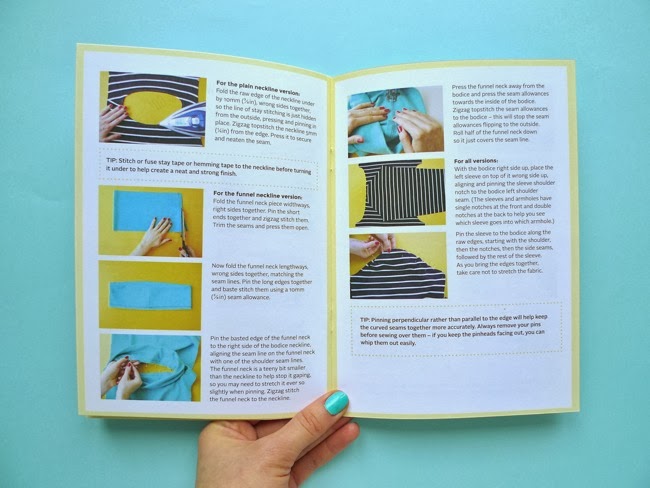
The printed pattern is accompanied by a full colour guide with photos showing you every step. It’s seriously beautiful – like a mini book in itself! The guide includes a jargon buster, an introduction to sewing knits, and the steps are explained clearly, without assuming any prior knowledge. If you need any further help, I’ll also be writing some more detailed instructions online in a series of blog posts going up over the next few weeks, with loads of tips and tricks for sewing knit fabrics.

The printed pattern comes in a gorgeous package, with a fresh and modern design which I hope will appeal to a whole new wave of potential DIY dressmakers. The paper is FSC certified and printed using vegetable-based ink. Unusually, every element of the pattern was printed in the UK.


The pattern is also available in digital format as a PDF download to print at home (or at the office – ssshhh!). This is a great option if you are on a budget, if you want to avoid international shipping costs, or if want to make it NOW! The digital version of the guide is black and white text only to save on printer ink, and the pattern is tiled so you can print it off on A4 or US Letter paper and tape the pages together to form a full size pattern. Want to see the sewing steps in colour photos? No problem – I’ll be putting the tutorials online too over the next few weeks.

Due to popular demand, I'm pleased to announce that the pattern comes in eight sizes – that’s two extra sizes larger than my previous patterns! The full size chart is available to view in the shop, in both metric and imperial measurements, along with other details such as what fabric and supplies you need. Over the next few weeks I’ll be working on updating my other patterns, Miette and Mathilde, which are currently digital patterns, to have all the same features as Coco – including labelled seams, eight sizes and printed format option. Watch this space...

Coco is now available to buy in my new online shop!


Over the next three weeks, I’ll be posting the steps and lots of extra tips for sewing Coco:

Thurs 20 Feb 2014 – Design ideas
Fri 21 Feb – Choosing fabric and supplies
Mon 24 Feb – Choosing your size and adjusting the pattern
Wed 26 Feb – Tips for cutting knit fabric
Fri 28 Feb – Introduction to sewing knit fabric on a regular sewing machine
Mon 3 - Fri 7 March – Sewing Coco!

… plus some bonus posts after that on things like sewing stripes and customising your Coco. We can sew Coco together as a group sewalong, or you can refer to these posts whenever you’re ready as they’ll stay up on the Coco page permanently. And of course you can simply use the instructions in the booklet that accompanies the pattern if you want to be amongst the first to sew it up!

I’d LOVE to see what you make, so please leave a link to a photo either on the blog or tweet me using the hashtag #SewingCoco. I’ll pin these images to the Coco gallery on Pinterest and will feature some of them in future blog posts, so if you leave/send me a link I’ll take that as consent for me to share your pictures.


Well, I’m sitting here now, patterns and mailing supplies at the ready, waiting for your order so I can start playing shops. Roll up, roll up, get your Coco sewing pattern here!
12 Mar 16:56

Femen’s Patriarch Exposed

by Marlow Stern
A SXSW documentary reveals that the band of Ukrainian topless protesters is controlled by a manipulative man who confesses, 'I’m a patriarch in an organization against patriarchy.'
    
12 Mar 16:53

Getting the math of the Universe to cancel out

by Chris Lee

The vacuum of space isn't actually "empty"; it teems with particles that pop in and out of existence, giving the vacuum an energy of its own. But here's an embarrassing fact about that energy: it predicts that the cosmological constant (which provides a measure of the rate of the expansion of the Universe) should be 10120 times larger than we think it actually is.

Most scientists prefer things to be a bit more accurate than this. Still, the main question on cosmologists' minds is not why the predicted and real values appear to be so different, but how it is that the vacuum energy does so little. An answer of sorts has recently appeared in Physical Review Letters. But before we get to the paper, let's delve into the nature of the problem it's trying to solve.

An expanding Universe

When Einstein was first formulating a new theory of gravity, his solutions predicted that the Universe was expanding. At the time, the Universe was widely regarded to be static, so Einstein added a constant that counteracted the expansion and kept the Universe unchanging. Everyone rejoiced—electromagnetism, space, time, and gravity could all live together in harmony.

Read 10 remaining paragraphs | Comments

12 Mar 15:45

Hi-Fi Pizza closes after more than 40 years in Cambridge - News - Cambridge Chronicle & Tab - Somerville, MA

by russiansledges
After more than 40 years as a Central Square staple, Hi-Fi Pizza and Subs has closed, according to the restaurant’s landlord, who said the next tenant will not be serving food.
12 Mar 15:40

Even Urban Outfitters admits that its clothes fell out of fashion

by John McDuling
Russian Sledges

via firehose

Urban Outfitters store

It’s refreshing to hear an executive operating in the brutal market for teen/young adult retail admit that its problems don’t stem from youth unemployment, the weather or the internet, but rather, bad fashion calls.”When the fashion did change, a number of people, including us, didn’t call the fashion as well as we could have,” Urban Outfitters CEO Richard Hayne said on a conference call late yesterday.

Urban Outfitters reported record fourth quarter sales and earnings last night, but this was mainly driven by strong performance at its Anthropologie stores (where sales from stores open for at least a year were up 10%) and its Free People stores (up 20%.) The Urban Outfitters chain continues to struggle: same-store sales were down 9%. The company’s share price has fallen by about 5% this morning.

Here’s an even more detailed assessment from Hayne on the challenges facing the company’s main brand.

“There are no fundamental structural changes in the young adult market other than the disruption caused by the internet and mobile technologies, both of which, we have been discussing now for many years,. This market is highly competitive,but I believe the theories which correlate demographic shifts, poor employment numbers, online tipping points, or other similar factors to the difficult sales in the young adult market are off point. Sales correlate directly with fashion hits and misses, and I believe the Urban brand has had fewer hits than normal. It’s that simple.”

You will recall that there has been some concern among analysts that the Urban Outfitters chain is pushing the boundaries a little too far with some of its designs.

Screen Shot 2013-12-16 at 4.28.55 PM

It turns out those concerns were warranted. The challenge for the company is to improve the  ”accuracy of the fashion call ” which will help it elevate the brand from a “fashion and quality perspective,” Hayne said.

Fortunately, it could be well positioned to exploit the next seismic shift in fashion—the anticipated popularity of high-waisted jeans in mainstream America. Goldman analysts argue that Urban Outfitters eventually came to profit from skinny jeans and could benefit from the next shift.

Screen Shot 2014-02-11 at 8.56.18 AM