Shared posts

02 Nov 13:00

Hasn't David Gauke got a point?

by Mark Thompson
The New Statesman is highlighting a "Quote of the Day" from Treasury minister David Gauke today regarding the child benefit cuts (taken from an interview by Paul Waugh and Sam Maccrory on Politics Home):

"I think there’s a lot of people who are in favour of reducing the deficit but then when it’s something that affects them there can be a degree of fiscal nimbyism."


Well hasn't Gauke got a point? This will affect the top 15% of families. You can't get a much more progressive attempt to cut the benefits bill.

Of course people are going to complain when their benefits are cut but I'd rather it was this than further cuts elsewhere in the benefits system. If I had my way "universal benefits" like the winter fuel allowance and free bus passes would also be means tested.

I'm not claiming the way in which this policy is being implemented is good by the way. It's very messy but the principle that cuts should fall where possible on those with the most income is surely one the New Statesman should be applauding?

02 Nov 12:52

Free Fiction Monday: Dread Unlocks

by Kristine Kathryn Rusch

In Los Angeles, everyone knows Ms. Tarbell dispels dread. She finds an amazing amount of it in that sunlight-filled city, but nothing like the unnamed horror she faces on her current case. It arrives in a van. It has cameras, an agenda, and the ability to change her life in awful, nasty, inconceivable ways. First written for a Lovecraft celebration, “Dread Unlocks” reveals the creeping uncontrollable dread in modern life, a dread Lovecraft himself might find too horrible to contemplate.

“Dread Unlocks” by Bram Stoker nominee Kristine Kathryn Rusch is available for $2.99 on Kindle, Nook, Smashwords, and in other e-bookstores.

The free story will only be available for one week.  If you missed this one, click on the links above.  There’s another free story lurking somewhere around this site. Track it down, read, and enjoy.

02 Nov 11:10

Super-Endorsements 2012:

by Caleb
02 Nov 02:31

Debi watches Arrow (sydht!) 1.04: An Innocent Man

This show is getting both more interesting and more ridiculous. Diggle is awesome, Laurel is less so, and that John Barrowman shows up, but not until the end so if you were planning to watch when he appeared, you don’t need to watch this one.

So when we realized Ollie was killing people in this show, I was worried that that was going to be just the way the show worked. Throw the Batman Rule out the window, Punisher with a bow only not as interesting, douchebag of the week blah blah.

Then there was that one face Ollie pulled at Deadshot last week and I thought “maybe they’re going to run with Ollie learning why the Batman Rule exists in the first place…” and I think they’re heading further in that direction in this episode. Note the title: Oliver Queen is definitely not an innocent man anymore. Plus the flashback sequences are actually thematic, this time!

Note, I have recapped some of these scenes out of order, especially near the end, in order to get related threads together. Because in chronological order, they get very choppy.

The DRAMATIC INTRODUCTORY VOICEOVER is now so blah by the numbers that I actually had to check my transcript from episode 2 to see if they’d decided to go with one standard. The answer is no, and I think I’m disappointed. Yet entertained. Which is par for the course, so far.

So remember when we left, Ollie had dragged Diggle back to the Arrowcave, the latter suffering from gunshot wound and curare poisoning, one or both of which Ollie cured with magic herbs, then revealed his secret identity to Dig.

Diggle responds by swinging his fist at Oliver’s face.

I respond by going “YEAH! HIT HIM AGAIN!”

Ollie, who has clearly been waiting for the opportunity to monologue out loud, gives Diggle a speech about how Starling City is dying, blah blah criminal elite blah blah poverty blah blah FOR JUSTICE pleasebemyfriend?

NNCR: Oliver Queen really really likes giving speeches about poverty

Long speech short:

“Join me, Diggle. You’re a soldier too.”

“You’re not a soldier, you murdering asshole. Get me out of here.”

Diggle and I are not the only people who think that Ollie is an asshole. When he gets back to Queen Manor, he finds Laurel waiting for him, having come around to see if he was okay, you know, after the shoot out aimed at his family. She takes the opportunity to have a well justified go at Ollie for having skipped out on his terrified family, and for being a selfish jerkwad. Thea catches the end of it and offers Ollie her sympathy, because really all Thea’s wanted since Ollie got back is a big brother she can talk to about boys and girls and stuff. Ollie blows her off and goes to bed.

FLASHBACK TIME. In the island cave, Ollie opens his wallet and pulls out a completely non water damaged photo of Laurel. He’s moping at it when his captor wanders carrying a wooden cage containing a flightless bird. He places it in front of Ollie, points at it and says “Shengcun.” Ollie is confused, so Captor points at it again and says “Shengcun” until Ollie is bored of the conversation, and goes back to apologing to the picture of Laurel. END FLASHBACK.

Ollie wakes from his nightmare and wanders into the living room to find Thea chilling out on the couch, watching news coverage of a Peter Declan, who was arrested for killing his wife around four years ago, and is now about to be executed for it. But Thea is, of course, more interested in talking to her big brother about social life stuff, such as girls, and by girls she means Laurel.

“Make a play,” she says. “Show her [he's not the same person he used to be]. Be yourself – your new self.”

I love Thea and I want Ollie-Thea sibling scenes forever, please.

Mind you, Thea’s advice of being himself hasn’t worked with the other person in Ollie’s life – it turns out the next morning that Diggle quit his job, leaving Moira to hire a new bodyguard; a clean shaven hard jawed man called Rob Scott, presumably a reference to graphic designer and Green Arrow fan Robert Scott – or maybe not, but at least Real Life Rob Scott has a decent Ollietache.

Moira is ALSO watching the news on Peter Declan, and it catches Ollie’s eye when it is mentioned that the victim worked for Jason Brodeur – and he was invested enough in his own publicity to release a statement on the occasion of his former employee’s murderer’s execution. Ollie repeats the name out loud, and Moira’s all “yeah, she worked for him, so?”

“No reason,” says Ollie, and asks Rob to fetch him the car. Rob refuses on the grounds that letting Ollie out of his sight is probably a bad plan. And presumably because he’s a bodyguard, not a driver. Ollie complains that someone has to drive him into town, so Rob goes off to fetch the car.

Rob is – not that bright.

Ollie takes a motorbike.

In the Arrowcave, Ollie can be alone with his inner monologue that explains the Declan case. Tried for killing his wife, Peter had no alibi and all the evidence, including fingerprints on the murder weapon, pointed to him. Ollie has decided this is bullshit based on one thing: Camille Declan, the victim, worked for Jason Brodeur, who is on THE LIST.

I am not even kidding on this. She worked for someone on The List (the list that seems to make up all the “job creators” in the city)  and therefore her boss killed her. That’s really Ollie’s logic.

[Cut to Brodeur talking to a goon so we know it's true, and that Camille blew the whistle about the company's toxic dumping, but that doesn't make Ollie's logic any less shitty.]

Anyway. Boss=evil, therefore boss=murderer therefore Peter Declan is innocent and he’s facing execution. He needs an attorney. Who’s an attorney that Oliver knows?

So I might be a bit worried that Joanna doesn’t really exist but is actually a figment of Laurel’s imagination. She never seems to seriously interact with any of the other characters, and only ever talks to Laurel, and usually about Laurel’s love life, or lack thereof. Sometimes she tells Laurel that Laurel’s doing lawyering wrong, but there is no evidence that Joanna has a life or interests of her own. Everytime she’s on screen I rejoice because she’s so well acted and definitely a pleasure to watch, but everytime I have to recap a scene she’s in I always make the :-| face.

But she really wants Laurel to get laid.

Laurel leaves her at the office and heads home to her apartment, only to find her lightswitches don’t work and she has an intruder. A man in a green leather hood. She responds the only way you’d expect her to behave if she found an intruder in her apartment – by pulling a gun on him.

Both disappoint in this scene – Laurel, by not firing a bullet straight into the home invader who not only completely ignores her order not to move, but who also invades her personal space in the CREEPIEST CONTROLLING MOST MANVADING WAY EVER. And Ollie, for being the creepy controlling manvadiest, but also for apparently using a voice synthesizer that makes him sound like Smallville Ollie. Don’t do that, Ollie. No one liked that Oliver Queen, and no one likes Christian Bale’s Batman voice. You don’t want to go there.

But mostly, it’s just a very creepy scene, in which Ollie basically asks Laurel to look into the Peter Declan case because he’s innocent, okay? Pleeeeease, Laurel? You’re such a good lawyer! Then he pulls a Batman and disappears.

Because Laurel is a sucker for a man dressed as an idiot who tells her she’s a Good Person, she goes the next day to the prison where Declan is incarcerated, and proceeds to prod him about the murder, listing all the evidence. Declan tells her that they had been fighting over Brodeur, who had been dumping toxic waste in the Glades. Camille had told a supervisor, and Peter had been mad about that, so they fought loudly enough for the neighbors to hear. He is Very Sincere, so of course Laurel believes everything and becomes convinced of his innocence as well.

I have no idea why, if Declan knew about the toxic waste dumping, he hasn’t been telling anyone and everyone who would listen to him, and taking advantage of all the media coverage we’ve seen so far this episode. Maybe he only remembered it this morning?

NNCR: The prison where Declan is staying is called Iron Heights. In the DCU, Iron Heights was a prison near Central and Keystone Cities (the Kansas/Missouri border) that played host to many of the Flash’s Rogues Gallery from time to time. I don’t think that Star City has an associated prison like this and Gotham’s Blackgate, but as it is situated in Northern California, and as in the DCU, Alcatraz is fitted out for metahumans, I wouldn’t be surprised if that one wasn’t used.

Walter Steele has adorable orange tinted glasses! And he is late for a lunch date with his wife because he was distracted by finances. A $2.6m withdrawal from the company’s accounts that has to be, um, accounted for.  He tells Moira that he’s sure it’s just a bookkeeping error, but compliance is worried shall we go for lunch?

Walter, by the way, is awesome this episode. He is rapidly becoming one of my favorite characters, along with Thea and Diggle.

Meanwhile, Quentin and Laurel are on screen together and this makes me happy because they so clearly love each other very much. Laurel wants more information about the Declan case, and Quentin explains the case looks open and shut. Could Brodeur have framed him because Camille went to a supervisor that day? No, says Quentin, because that same supervisor, Matt Istook, testified and said he didn’t see her that day.

Also cute on screen together are the Diggles: John and his sister in law Carly, at Big Belly Burger. She is judgmental about him getting shot in the shoulder, and also about Ollie, who then turns up with his new BFF Rob, who informs Ollie sternly that the area is secure.

“Hi Diggle, thanks for not calling the cops on me. Will you be my friend again?”

Is what Ollie should say, but instead he tight lippedly preaches at Diggle about Doing Good and about Righting the Wrongs done by his Family and hey look I have a List of people to kill. It’s very Serious Business. Oh, and did I mention that I’ve been investigating your brother’s murder and they found curare in the bullets that killed him.

Remember that?

I love that I’ve been rewarded with my obsessively screencapping and examining this show for continuity already.

Anyway, one speech about poverty later, he tells Rob he’s off to the washroom. Rob stands obediently by Diggle’s table, until Diggle feels sorry for the poor sod and lets him know that Ollie’s probably long gone by now.

Meanwhile, Moira has a confession to make to Walter. 2.6m is exactly the amount she invested in a friend’s start up venture three years ago. She’ll call accounting and sort it out, okay, honey? (Walter is SUSPICIOUS.) And Laurel has a confession to make to Joanna: the reason she’s involving herself in the Declan case is because of The Guy in The Hood. Joanna thinks Laurel is nuts.

I don’t really disagree.

Laurel meets with Hood on a rooftop (Oh, honey), and tells him that Matt Istook has already testified and said he didn’t speak to her. Ollie has the great idea that he should beat him into giving a different confession. Does Laurel point out this is in no way going to be admissable in court? Does she heck. Instead she tells him that he seems lonely. (Oh, honey).

Ollie runs off to find Matt Istook, and handcuff him to the traintracks, and shout at him about how he has to confess, damn you. Of give Ollie that file he’s just heard about. WHERE IS IT? When he gives up the location, Ollie frees him with an arrow, just in time to miss the train.

NNCR: The train Ollie threatens Matt with is going to Bludhaven. In the DCU, Bludhaven is situated right next to Gotham City, and is usually set up as being even crime-ier than Gotham. Dick Grayson, Nightwing, hung out there for a while, before Jason Todd nuked it. I wasn’t paying that much attention, it was a silly story line.

FLASHBACK TIME: Captor is cooking some meat. Ollie is hungry. He reaches out to take the meat, and Captor twists his hand, throwing him to the floor. Ollie tries again. The rejection is painful. Captor points at Ollie’s caged bird and mimes wringing its neck. “Shengcun,” he says. “I’m not going to kill the bird,” Ollie protests. END FLASHBACK.

Ollie delivers the files to Laurel, but not before cutting power in her office, which remains a dick move. Laurel says that as an attorney she’d never be able to get evidence like this. She used to think that playing by the letter of the law would fix everything.

“And now what do you think?”

“I think [this city] needs someone who cares about the lives of other people. Someone like you.”

Oh, honey.

Back at Queen Manor, Thea is pleased to find her brother – shocker – actually smiling. He’s all smug because he tried the ‘be yourself’ thing with Laurel and he thinks it’s working.

THAT, Oliver Queen, is NOT WHAT SHE MEANT. I don’t care if it’s working, IT SHOULDN’T.

Enter Rob, on his own, tired. Ollie smugs at him. “You gotta keep up.”

Back in Laurel’s office, Quentin is not amused. Because Matt Istook filed a complaint claiming the Hood harrassed him last night. And who has recently acquired that name from the police? Daddy is not happy, Laurel. Words are exchanged, Laurel actually breaks out the “if the police had done their job in the first place” line. It’s bitter.

And it doesn’t even work. Laurel takes the file to the Superior Court and is immediately challenged by Brodeur’s lawyers under slander. The judge actually uses the line “Ours isn’t a court of justice, it’s a court of law.” Just to make the point, y’know? Laurel storms out, but not after threatening Brodeur up close and personal.

Things Laurel Lance learned by having the Triad sicced on her:

-

-

-

Mind you, she is one scary-ass lawyer, because now Brodeur’s pissing himself, and his lawyers assure him that where Laurel is off to now – Iron Heights to talk to her client – is a very dangerous place.

Laurel takes the bad news to her now regular meeting with the Hood, and he asks what she needs to help Declan. She suggests a signed confession from Brodeur might help. So off he goes.

Felicity Smoak has been summoned to the CEO’s office! She’s quirky and spunky and a little overdone, but I still love her. Walter asks her to look into the transaction his wife authorized a few years ago: discreetly, please. She returns a few scenes later, to tell him that the company Moira “invested” in doesn’t exist. The money was used instead to set up an offshore LLC called Tempest. (Another Shakespeare reference?) This company has left no paperwork at all, but in 2009 (three years ago) it purchased a warehouse in Starling City.

Walter then heads off to the warehouse. The door is password protected and he tries TEMPEST, OLIVER and THEA before cracking it with ROBERT. Can I just say how much I hate it when passwords are used as a plot point? A lot is how much I hate it.

Inside the warehouse is:

The Queen’s Gambit, the boat that crashed, leaving Ollie a castaway.

Carla would like Diggle to stop moping and move on from the job he quit, please. She has a son, it transpires, and she’d like for him not to lose his uncle as well as his father.

“Does it ever bother you, ” Diggle asks, “that they never caught the guy who killed Andy?” Then he talks about being in the army, and how since coming home he’s been protecting spoiled rich jerks. He misses making a difference, yanno?

Carly says to go and do something he believes in. What if it’s wrong? “If you believe in something, John, it’s not wrong.”

As you’d expect, Ollie’s method of getting a confession out of someone is to yell at them and shoot arrows at them; in Brodeur’s case, actually through the hand. By an incredible coincidence, it’s during this confrontation that Brodeur’s cell phone rings to tell him that “it” is going down in an hour.

“WHAT’S GOING DOWN IN AN HOUR?”

Brodeur gloats about Declan’s execution “getting moved up” and gets an elbow to the chin for his efforts.

An Iron Heights, Laurel tries to assure Declan that they’re working on something, and they’re doing everything they can for him, while outside, Ollie jumps a guard from behind and steals his uniform. Brodeur’s goon turns up, bribes another guard and tells him to open the cages. PRISON BREAK.

The guards supervising Laurel and Declan run off to um, get themselves beaten and killed by escaping inmates in what is actually a very severe scene of mob violence. Laurel and Declan flee in the other direction, almost right into a crowd of prisoners, but are saved by a man in a guard uniform and a balaclava, wielding a bow and arrow. HOW MYSTERIOUS. Running away from the mob, they run straight into Goon, who proceeds to beat on Laurel, in a just as disturbing scene that involves him straddling her on the floor, strangling her.

Ollie Loses His Shit. he throws himself on goon and beats the everloving crap out of him, stopping only when Laurel throws herself on top of him to knock him off. They look into each other’s eyes, and what Laurel sees terrifies her.

Outside, Quentin Lance is relieved beyond belief that his daughter is okay, and they hug the heck out of each other. Brodeur’s bodyguard confesses to Camille Declan’s murder (though it’s not obvious how), but Laurel still apologizes. Quentin gives an ‘I warned you about him’ spiel, but she stops him. She knows. He’s a killer.

Declan is free, another name is crossed off the list. All happy, right?

FLASHBACK TIME. Ollie is still really hungry. Ollie’s bird is still alive, but Ollie’s never killed anything before. He apologizes, and wrings its neck. While he’s eating, Captor explains that ‘Shengcun’ means ‘survival,’ and if Ollie wants to survive, he’s going to have to a) kill some things and b) quit moping about his girlfriend, okay? END FLASHBACK.

Wait, says Quentin, there was a man in a hood in there? No, Laurel explains, he was IN DISGUISE. Good golly, thinks Quentin, his outfit comes off?

He goes back to the police department, and gets everyone together to look at the CCTV footage of the Exchange Building from last week. Because they’ve been looking for a Man in a Hood, and not, say, people running around being suspicious.

OH LOOK, they found footage of Ollie grabbing his kit out of the trash can.

BUSTED.

And now the moment everyone who isn’t me has been waiting for: Moira walks across a parking lot and into a Limousin and who should be waiting for her but Some Guy In A Suit.

Yes, yes, it’s John Barrowman, also known as Captain Sexy in the Sexy Sexy Spinoff of the only British science fiction show Americans have ever heard of because Hitch Hikers doesn’t count. John Barrowman is worried, you see, about the Hood, because he’s been looking at the people the Hood has killed, and every single one of them is on The List. Yes, even Warren Patel, the guy who was only targeted last week because he happened to hire Deadshot.

He says “The List” by name, which is either sloppy writing or intriguing. I’ll give the show the beneift of the doubt and suspect the latter.

Back in Queen Manor, Diggle has shown up, which is convenient, because Rob just quit. He’s not after the bodyguard position, he says, but that other job, which is absolutely definitely I’m not kidding about this, not a sidekick gig. But, he says, Ollie’s going to run around being an idiot no matter he does, and as the only guy in the entire city with a lick of sense, Diggle is burdened with the responsibility of not letting Ollie get himself killed.

Line of the week:

Ollie: I’m not looking for someone to save me.

Diggle: Maybe not, but you need someone just the same.

Digs is clearly going to be around to be Ollie’s moral compass, and to at least limit the dumbass douchebaggery he does per episode, which I’ll be honest, is kind of wracking up here.

This moment of beautiful bro-hood handshaking is interrupted by the sudden appearance of Quentin Lance, who barges in with a bunch of uniforms, heading straight for Ollie. I want to take a moment here to mention once again, how great is Walter, who stands between Quentin and his step son, and to whom Thea calls out to stop it. Ollie might have daddy issues around Walter, but I’m loving him.

Ollie is handcuffed, and Quentin, with relish but mostly with anger, recites the list of charges: Obstruction of justice, Aggravated assault, trespassing, acting as a vigilante and murder.

Take that, Ollie.

Tune in next week, where we’ll see how Ollie gets out of this one. Me, I’m glad that the identity thing is being played around with this early. Green Arrow has always had an on-off relationship with the thing.

This post can also be found at Thagomizer.net. Feel free to join in the conversation wherever you feel most comfortable.

01 Nov 15:58

Why crime goes down when street lights are turned off

by Jonathan
In the past I have supported the idea of turning off street lights in the deep of the night. This is not just because it saves money, but also because it may give us back the experience of seeing the awesome nighttime sky.

And in May I reported a counterintuitive claim from West Mercia Police that crime goes down when street lights are turned off.

But now there is a convincing theory as to why this is the case (found via Conservative Home).

Because This is Bristol quotes a city councillor, Ron Hardie:
“The police have told us they have not seen any notable increase in crime. 
“In fact, in some areas, there has been a reduction of 20 per cent. 
“I understand from the police that burglars don’t like it when it’s dark. 
“They like to be able to see their escape route and they like to ‘case’ a premises before they strike. 
“They would attract too much attention if they were using torches.”
Mr Hardie is a Labour councillor. His sensible attitude contrasts with his party's attempts nationally (encouraged by the Observer) to drum up a scare about street lights being switched off in the middle of the night.
01 Nov 15:50

REMEMBER WHO YOU ARE

by iamjamesward
Andrew Hickey

Warning -- the comments here are dominated by an argument by a dippy conspiracy theorist with no sense arguing with Ben Henley, who happens to be accidentally right in this specific case but who is one of the biggest pricks in the world.

I knew it was going to be a long day. In fact, I was dreading it.

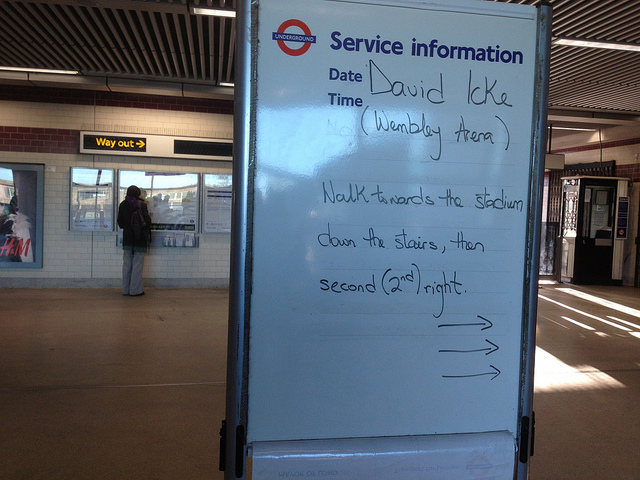
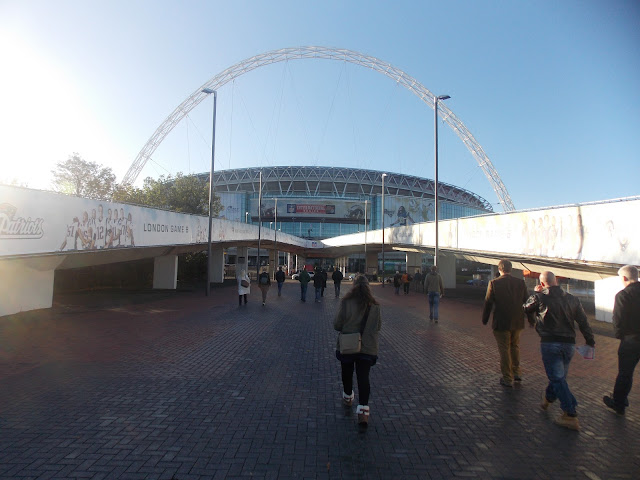
Wembley

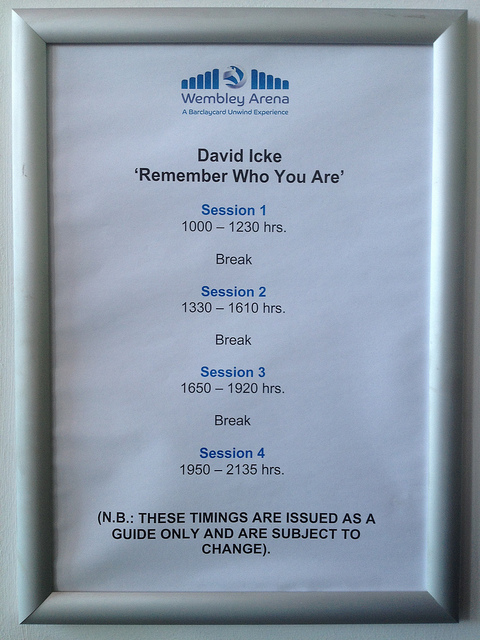
About a year ago, while looking at something or other online, I saw that David Icke was going to be speaking at Wembley. Immediately, I bought a ticket. The tickets were quite expensive, between £40 – £60. I figured that if I was spending £40 on a ticket to see David Icke, I might as well spend £60 and get a better seat. That was a year ago. It seemed funny a year ago.

Since then, I’ve been to the “Inspired By David Icke” discussion group several times. I’ve met quite a few people who believe Icke’s theories. I’ve gone to the pub with them. It’s easy to dismiss these people as weirdos and cranks, but on the whole, the people I’ve met have been fairly normal. Nice. Likeable. I say “on the whole”, because there have been a couple of exceptions (a guest speaker at one session spoke about how our souls choose the experiences we have in our lifetime, and so with positive thinking, we can ensure that we only have positive experiences. The problem with this, of course, is that it raises the question of why people have negative experiences – did the souls of babies dying of starvation or those maimed in wars or victims of abuse choose those experiences? Of course they didn’t and it’s vile to suggest they did. But apart from that bloke, they’ve been nice).

To prepare for seeing Icke at Wembley, I bought a DVD of a previous talk he had given. Human Race Get Off Your Knees: The Lion Sleeps No More was filmed at the Brixton Academy and is a four-disc set. This is why I was dreading seeing Icke at Wembley. I knew it was going to be a long day. At the end of the second disc of The Lion Sleeps No More, after speaking for several hours, Icke looks at his watch and says “Well, we’ve come a long way, haven’t we? What we’re going to do now is have a break for, say, forty-five minutes…”

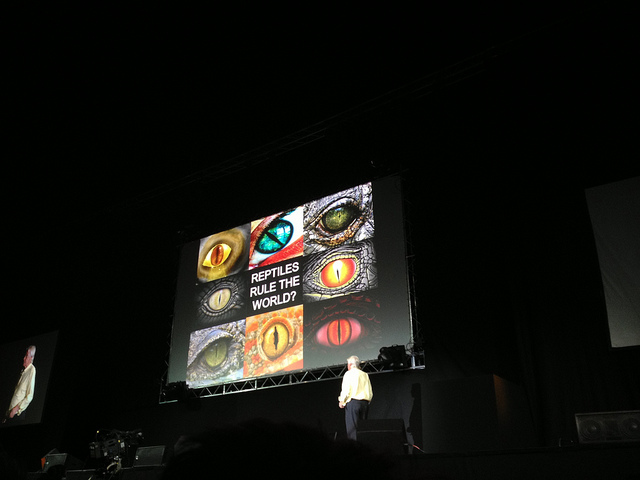
I arrived at Wembley and took my seat (seat 12, row 4, block A2) unsure of quite what to expect. There was a giant screen with a picture of David Icke. A clock counted down. Music was playing: God by John Lennon, Holding Out For A Hero by Bonnie Tyler, Don’t Look Back In Anger by Oasis, I Want To Break Free by Queen. These same songs would play during each break. Holding Out For A Hero is a brilliant song. With a few minutes left, a group of dancers came on stage and did a sort of euphoric dance.

Icke’s son, Gareth, is in a slightly awful rock band, and they did a couple of songs before each session began. I suppose he can now say that his band have played Wembley Arena, but to be honest, it seemed like nepotism to me. Bloodlines.

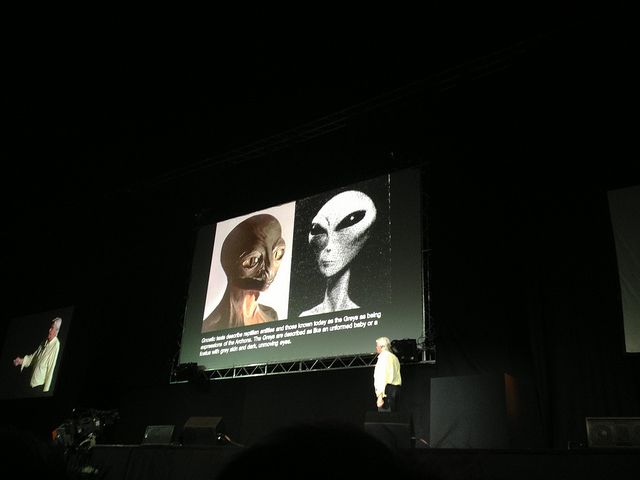
If you are not familiar with Icke’s ideas, his basic theory is that the universe is created from vibrational energy. The world as we perceive it is just a holographic projection of this vibrational energy. Humans are infinite awareness, we are consciousness, but there is a conspiracy to stop us from realising our true potential and instead to keep us locked in “five sense reality”. This conspiracy is led by entities Icke refers to as Archons, who are reptilian multi-dimensional beings beaming messages from the rings of Saturn (the messages are then amplified by the Moon, which is a hollow structure designed for this purpose). By manipulating our genetic code, the Archons have trapped us in this five-sense prison (this he refers to as “the hijack”, although in the Bible, it is referred to as the fall of man). There are also genetically modified human/reptilian hybrids who control the population through the media, politics and finance in order to preserve their bloodlines and keep us in a state of fear and negativity. These emotions create low frequency energy which they feed off. To combat them, we should give out positive energy and “choose love”. It’s quite a simple idea.

Whenever people mention Icke, they always say that he thinks “lizards control the world”. I’m not sure why people always pick up on the fact they’re “lizards”. He’s talking about multi-dimensional beings from space controlling humanity. Is the oddest thing about that idea really the fact that those multi-dimensional beings happen to resemble lizards? Although I thought he cheated slightly at one point. He was explaining how ancient cultures all over the world depict reptilian beings in their art and folklore – the Uraeus of ancient Egypt, the serpent in the Garden of Eden, the Chinese dragon. In this list, he also included the story of the Frog Prince. That doesn’t count, surely. Frogs are amphibians. You can’t claim them as “reptilian” just because they’re green. That’s like saying a cucumber is a lizard.

To be honest, much of what he said was very similar to the stuff in The Lion Sleeps No More DVD, although he didn’t mention Saturn on the DVD. Maybe the Saturn stuff is new. On The Lion Sleeps No More DVD, he seems more interested in his idea of the “Moon Matrix”. This is his idea that the Moon is an artificial structure and is hollow. He explains how he came to this conclusion:

What happened was that I was writing this latest book and I sat down one morning, and I’ve had one or two thoughts about this before but they’ve come and gone, but I sat down one morning at the computer to start writing and it was like, and I’ve had this so many times in my life in the last twenty years, it was like an energy field descends upon me and suddenly, I just knew the Moon was not what it seems to be.

That sounds pretty convincing to me.

He didn’t explain how the Saturn theory came to him, but did talk extensively about the symbols used by secret societies and religions to represent Saturn (= Satan). This list included the following:

  • eyes
  • circles
  • pyramids
  • triangles
  • reptiles
  • owls
  • bulls
  • fire/flames
  • the Phoenix
  • crescents
  • horns
  • boats
  • goats
  • twin pillars/towers
  • concentric circles
  • rings
  • the number eight
  • spiders
  • the number 666
  • six-pointed stars
  • skulls/skull and crossbones
  • hexagons
  • cubes
  • squares
  • the Crucifix
  • the Kaaba
  • the tefillin
  • the colour black
  • the colour red
  • black and white squares/tiles
  • mortar boards
  • the Greek god Chronos
  • the Grim Reaper
  • time
  • Old Father Time
  • sickles/scythes
  • crowns
  • protruding tongues
  • white beards
  • Santa

It’s quite a long list and one which seems to include most shapes and ideas and colours and things. I was slightly disappointed that I wasn’t included in the list to be honest.

There was also a section on how these symbols are used in popular culture. Madonna and Lady Gaga both use a lot of them apparently, as do Jay-Z and Beyonce. One thing which was a bit odd was that he twice referred to imagery used by Annie Lennox during the Olympic opening ceremony and each time said “I’m not saying she’s involved in any of this” but never offered this benefit of the doubt to anyone else. I suspect Icke has a soft spot for Annie Lennox.

The third session involved Icke listing pretty much every conspiracy theory going and blaming it all on the Archontic influence: chemtrails, 9/11, 7/7, Dunblane, water fluoridation, global warming, Columbine, HAARP, Agenda 21. It’s all true, and it’s all the fault of the Archons. I’ve met a couple of 9/11 Truthers before, but I was still a bit shocked to hear thousands of people around me cheer when Icke claimed the Twin Towers were destroyed using directed-energy weapons.

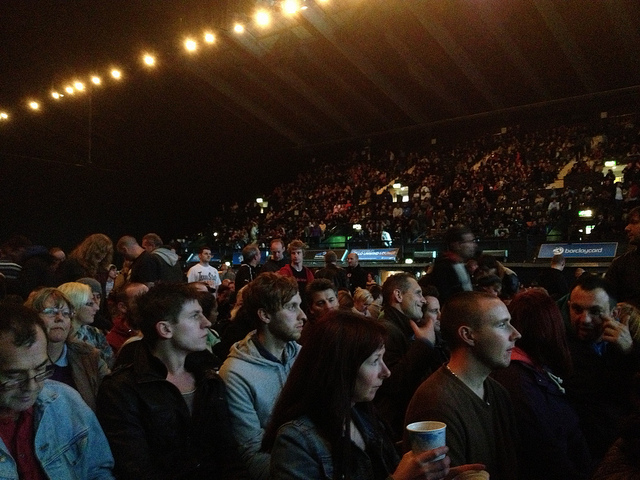
Maybe it was a mistake to have paid the extra £20. I was four rows from the front, and while that meant that I could see everything perfectly (there were a couple of moments when Icke looked almost moved to tears), I didn’t really feel the scale of the event. Maybe if I’d been further back, I would have realised better just how many people were there.

The previous DVD I’d watched had quite a confrontational message: human race, get off your knees. At Wembley, Icke was more positive. Although having said that, there was quite a powerful bit at the end when Icke showed pictures of people working in the arms trade or in politics and simply shouted “WHAT ARE YOU DOING? YOU HAVE CHILDREN. YOU HAVE GRAND-CHILDREN. YOU SHOULDN’T BE DOING THIS”. You don’t have to believe in Archons to agree that “What are you doing?” is a good question to ask people in authority. “I’m sorry but it fucking makes me sick” he said, before adding “And yes, I am available for children’s parties”. These few moments of what appeared to be genuine anger stood out against what was otherwise a genial and often funny presentation. He does perhaps rely too often on the use of an exaggerated West Midlands accent in order to reinforce a weak punchline, but then so does Lenny Henry, and I doubt he could sell out a gig at Wembley Arena.

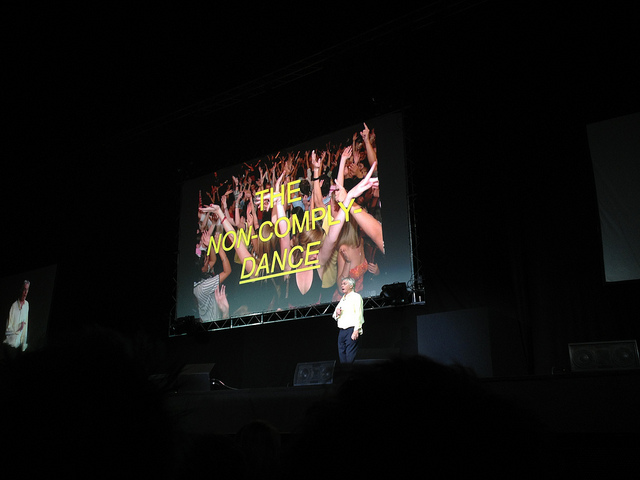
Eventually, nearly twelve hours after he originally took to the stage, Icke reached his conclusion. We need to choose love, he said. Since his Brixton talk a couple of years ago, we have seen riots on the streets of London. “What you fight, you become” he explains. You cannot fight a violent state through violence. Instead of violent protest, Icke proposes a “non-comply-dance”. Dancing in the face of authority. Positivity instead of aggression.

And here is Icke and his team of dancers doing their non-comply-dance:

This also happened:

Apologies for the poor quality of the video, but by that stage, I’d basically been drinking all day and had just spent twelve hours listening to David Icke talking about Archons. My favourite dancer is the guy in the white shirt and brown cords who is just behind the guy with long hair in the black T-shirt. Everyone else dances in a lost, euphoric way except for him. He waves his hands in the air and jumps from foot to foot in more or less the same way as David Baddiel in the video for Three Lions. I suspect he only agreed to dance on stage because he thought he might be able to kiss a girl if he did.

And then there was some chanting:

Finally, Icke finished with his message of love:

I think that’s how I’m going to end this year’s Boring Conference (tickets available here)

Icke even extended his message of love to the reptilian Archons and the bloodline elites who manipulate and control humanity. I thought that was nice.

Of course, you can laugh at Icke, make him a figure of fun, but ultimately, his message is a positive one. We are love. The logic behind every single step he’s taken might be completely wrong, it is completely wrong, yet somehow he’s ended up in almost the right place. And at the very least, you have to admire a man who can get thousands of people to come to Wembley Arena to watch a twelve-hour PowerPoint presentation.


01 Nov 15:25

They surely are not violent

by Shaun Usher


Today sees the long-awaited publication of Dan Wakefield's Kurt Vonnegut: Letters, a book that I've been anticipating for what seems like decades, and which, despite having only been in my possession for a few days, I can safely say is quite easily one of the best collections of correspondence I've come across. It really is a triumph, and wonderfully edited.

Below are just two letters from the book — both of which feature Kurt Vonnegut the proud father. The first was written in 1967, and sees Vonnegut backing his son's refusal to fight in the Vietnam War. The second letter was written to a Canadian teacher in 1988, in response to a censorship row that had erupted over his collection of short stories, Welcome to the Monkey House.

(Source: Kurt Vonnegut: Letters; Image: Kurt Vonnegut, via Guardian.)

November 28, 1967

To Draft Board #1,
Selective Service,
Hyannis, Mass.

Gentlemen:

My son Mark Vonnegut is registered with you. He is now in the process of requesting classification as a conscientious objector. I thoroughly approve of what he is doing. It is in keeping with the way I have raised him. All his life he has learned hatred for killing from me.

I was a volunteer in the Second World War. I was an infantry scout, saw plenty of action, was finally captured and served about six months as a prisoner of war in Germany. I have a Purple Heart. I was honorably discharged. I am entitled, it seems to me, to pass on to my son my opinion of killing. I don't even hunt or fish any more. I have some guns which I inherited, but they are covered with rust.

This attitude toward killing is a matter between my God and me. I do not participate much in organized religion. I have read the Bible a lot. I preach, after a fashion. I write books which express my disgust for people who find it easy and reasonable to kill.

We say grace at meals, taking turns. Every member of my family has been called upon often to thank God for blessings which have been ours. What Mark is doing now is in the service of God, Whose Son was exceedingly un-warlike.

There isn't a grain of cowardice in this. Mark is a strong, courageous young man. What he is doing requires more guts than I ever had—and more decency.

My family has been in this country for five generations now. My ancestors came here to escape the militaristic madness and tyranny of Europe, and to gain the freedom to answer the dictates of their own consciences. They and their descendents have been good citizens and proud to be Americans. Mark is proud to be an American, and, in his father's opinion, he is being an absolutely first-rate citizen now.

He will not hate.
He will not kill.
There's no hope in that. There's no hope in war.

Yours truly,

Kurt Vonnegut, Jr.

-------------------------------

William G. Kennedy,
Fenelon Falls Secondary School,
Fenelon Falls,
Ontario

November 16, 1988

Dear Mr. Kennedy—

My publisher, Dell, has just sent me a copy of your letter of October 19 regarding the attempted censorship of my book Welcome to the Monkey House. You and R.A. Baxendale have my sympathy, and I am honored by your inclusion of some of my short stories in your curriculum. Your laws differ from ours in many respects, so I can offer no legal wisdom. I can only say that efforts by groups of parents to get certain works of literature withheld from an entire school community are common in this country, and have in every case been thwarted by decisions of higher courts.

Some primitive facts which may be of some slight use to you when talking about me to primitive people: I have seven children, four of them adopted. The six who are full grown are monogamous, sober members of their communities—a cabinetmaker, a television writer, a pediatrician, an airline captain, a successful painter, and a successful printmaker. They would have heard the word fuck by the time they were six, whether they had had me for a father or not. As for shit and piss: they spoke of almost nothing else when they were only three, which was surely their idea as much as mine. One man wrote me that he could learn more about sex from talking to a ten-year-old than he could from reading my collected works, which is true. Nowhere have I celebrated the use of any sort of drug, nor sexual promiscuity, nor bad citizenship.

I express dismay at violence and humorlessness in everything I write, and in my ordinary life as well. I celebrate compassion and tenderness, and parents of every persuasion should be happy to have me do that, and especially those who are enthusiastic about the Beatitudes. Speaking, as the censors do, of giving "a five year old a hand grenade": do the censors allow lethal weapons in their homes, or tell war stories within the hearing of their children, or allow children to watch TV cartoons where the mouse blows up the cat, or drops a great weight on it from on high, or digs a pit for it lined with spikes! Do they shoot animals, and then show the bullet-riddled corpses as though they were something to be proud of? I never did. As I have already said, six of my children are full grown now, and are admittedly sexy with their legal mates, and are also toilet trained, thanks to all the talk early on about shit and piss. But they surely are not violent.

Cheers,

Kurt Vonnegut

RSS Feed proudly sponsored by TinyLetter, a simple newsletter service for people with something to say.
01 Nov 15:21

...

by Lawrence
Wait. Who's scriptwriting this new Star Wars movie?

Because I just had the worst thought in the entire history of time.

01 Nov 15:20

Debi Watches Arrow (sydht!) 1.03: Lone Gunmen

IN BEFORE THE FOURTH EPISODE. Delayed by illness as I mentioned, also that big old Hurricane Sandy getting all in my business.

The third episode into Arrow, and I find myself mostly waiting for the show to get good, rather than actually enjoying it. They keep throwing hints of some interesting developments at me, then pull it away and give me something sub par, and frankly, kind of boring. Step it up, show. Step it up.

Lone Gunmen features as the main antagonist one of my favorite villains from DC Comics, but one who never serves well in screen adaptations because – well, he’s great in the comics where he’s part of a villainous and dysfunctional team, but as an anatagonist for a hero, he’s less than exciting, as we shall see.

So we start with my favorite things that are already feeling old: DRAMATIC VOICEOVER and GRATUITOUS SHIRTLESSNESS.

So there’s two things I want to say about these voiceovers: the first is that I am disappointed the show isn’t starting with the same dramatic voiceover each time, because I suspect the screenwriters are going to run out of ridiculous cheesy cliches pretty quickly.

The second thing is that Stephen Amell, who is a terrific actor in the rest of his scenes, cannot make them sound good. It makes me feel like I owe Ben Affleck an apology for making fun of his appalling voiceovers in Daredevil. Maybe it’s just impossible to deliver well a badly written dramatic voiceover narration.

Anyway, so Ollie is pained and secretive blah blah bad guys are a cancer on the city blah blah no really that’s the metaphor they chose to use Ollie is a cancer surgeon blah blah now he’s going after a guy called James Holder for – you know what? I don’t care, I’m sure you don’t care and I’m pretty sure the writers don’t care either. Oh, except that he’s apparently responsible for a series of fires in the Glades, which gives me an opportunity for my first:

Note to Non-Comics Readers: The Glades is an area of low income, slum areas in the Star City of DC comics and now apparently of Starling City of TV’s Arrow. It’s not quite the City Narrows (warning: TV Tropes), but more an area that can be used to show off Ollie’s special variety of political Leftishness.

You can tell James Holder is a bad guy because he talks on the cell phone at night by his rooftop pool. I’m pretty sure if I had a rooftop pool I would talk on my cell phone by it occasionally, but only evil people have rooftop pools on TV. LOOK I DON’T KNOW, OK?

The rooftop pool is where Green Arr… sorry, Man-inna-Hood shows up and shows Holder his security team’s guns. Does Ollie kill bodyguards? I guess he does, it’s just – that’s one hell of a lot of collateral damage, Olls. So then he yells at him about the fires, and presumably is about to threaten him, when he is interrupted by a sniper, who shoots Holder dead.

That’s what you get for having a rooftop pool and enemies, Holder.

Before the shot, we get a closeup view of the sniper’s gun, and a big red lens of an eye piece, through which he’s taking aim on his victim.  Ollie doesn’t get this – he just gets a muzzle flash as the sniper shoots at him, helping him to determine which building the bad guy is using. But it’s enough for anyone whose familiar with comics to know who we’re dealing with.

NNCR: This is Floyd Lawton, aka Deadshot, a mercernary/Assassin who is visually recognizable by his single red eyepiece and his wrist mounted automatic firearms. And for having facial hair as ridiculous as Ollie’s own. He was a run-of-the-mill Batman villain and appears in Arkham City, the Nolanverse Gotham Knights and the Justice League cartoon. In my opinion, he comes into his own as part of a team in Suicide Squad and later Secret Six. He is currently appearing in the New 52′s Suicide Squad. It is never explained why having a sight on your face rather than on your weapon is supposed to be a good thing.

Back in the Arrow Cave, Ollie gets his shirt off to sew up his own gunshot wound, and is in the middle of DRAMATIC VOICEOVER when he notices the wound isn’t healing and he’s feeling faint. His conclusion: The bullet is poisoned! Running to the case he brought back from the Island, he retrieves some herbs and a bottle of water, takes them both and passes out. Lucky he has magic cures-all-poisons herbs from the island. He should really get this to the local hospitals.

NNCR: No, Deadshot in comics never poisoned his bullets.

Passing out means ISLAND FLASHBACK TIME! After being shot in the shoulder by an arrow, Ollie wakes up to find himself in a cave with the man who shot him. The stranger speaks a language I don’t recognize – it may be Chinese as I think the island is off the Chinese coast but other than that I got nothing. He gets subtitles, though, and tells Ollie that he shot him to “protect him,” and gives the poor confuses playboy some herbs and a drink. before pulling out the arrow. END FLASHBACK.

Ollie is woken by his alarm telling him it’s seven in the morning and he heads home, where he finds Thea in the company of Starling City’s Finest. Diggle explains that the cops brought her home drunk after she broke into a store the night before.

Moira is most definitely not impressed with Thea’s blossoming criminal career.

BECHDEL TEST PASS. It only took two and a bit episodes.

Thea snarks at Moira, informs her she’s taking a sick day from school, and flounces off, leaving Ollie to tell Moira that she’s being a terrible mother and that she’s letting Thea get away with the same crap that he got away with, and look how he turned out. Important note: Ollie didn’t have nearly the same shit when he was adolescent that Thea grew up with. I’m just saying.

On the rooftop pool crime scene, Quentin Lance suspects something is up. He’s talking to regular detective whose name I don’t know (I need to find this out, if only because “African American sidekick” might get him confused with Diggle or Joanna. Show’s got issues. Show has to sort these issues out please?

Anyway, Det. Sidekick points out that they recovered arrows, and that James Holder was exactly Arrow’s type, to whit: wealthy dirtbag. Only he uses the phrase “The Hood,” now, so I guess that’s where we’re going? Quentin points out that Holder was shot, and the Hood doesn’t use firearms.

Thanks for raising the point, detectives. Why doesn’t The Hood use firearms? It’s not because he’s using non-lethal force, and it’s not because he’s using projectile gimmicks like trick arrows, so why a bow and arrow, exactly? Other than being based on Green Arrow, of course.

Based on Green Arrow and Batman, obviously, because in the Arrow Cave, Ollie is performing chemical forensics on his bloody bandages, and discovering that the bullets were laced with curare – a “rare and deadly” poison, and therefore probably unconnected to the Real World curare - which is a paralysing agent that causes asphyxiation. Using this information and a computer, he links this murder to a series or murders worldwide: Chicago, Markovia, Corto Martese are named.

NNCR: Markovia is a fictional East European country in the DCU, and the country of origin for Geo-Force and Terra. It is also where the original Losers team died in the 1940s. Corto Maltese is a fictional island nation that is probably off the coast of South America, somewhere. in the 1989 Batman film, Vicki Vale had been taking pictures of the violent revolution they’d recently had.

It’s from these computers that Ollie pulls up the codename Interpol uses for him – Deadshot. And in DRAMATIC VOICEOVER, he explains that while he, Ollie, was only planning on killing James Holder after shouting at him and robbing him to reimburse his victims, Deadshot has “no morality! No honor! No code!” and therefore Ollie’s going to put him right at the top of his ‘murders to do for daddy’ list.

Oliver Queen bears far too close a resemblance to season one Prince Zuko for my taste. Only much much douchier.

This all fades to a silent scene of Deadshot, in which…

…in which we discover…

…in which…

I’m sorry, this is where I dissolved into helpless squeaks of what the fuck?, because Deadshot  tattoos the names of every one of his victims onto his body. With his own hand. With decorative swirls.

I can’t stop giggling.

NNCR: It’s true, comics!Deadshot had no morality, code or honor. It’s not true that he tattoos names of his victims onto his body because 1) that’s sort of a code or honor-related thing, right? b) that would imply he gave a shit about the people he killed, and THREE, it’s freaking ridiculous, that’s why.

NNCR: Among the names on Deadshot’s body are: Andrew Diggle, the writer of Green Arrow: Year One; Danny and Wes Anslem, the the kidnappers responsible for the name of Floyd Lawton’s son Eddie (Wes, who actually raped and murdered Eddie, is a bigger name); Andy Haskell, who was also involved in the kidnapping; Yasemin Soze, a sharpshooter who showed up in the Birds of Prey and reappeared in Suicide Squad, having replaced Lawton on Task force X. He killed her, and she was ressurected as a zombie. Other names include John O’Neil, which I expect is a nod to Green Arrow writer Denny O’Neil; Gordon Verheul and Glen Winter, cinematographers on Smallville;and a bunch of other names that when Googled produce IMDB pages so I guess they’re known to the show runners.

Yet another NNCR (edited): I just had a look at a better screencap and I missed an awesome one! Also on Deadshot’s shoulder is Joe Cray, a senator who once manipulated the Suicide Squad to his own political ends. Rick Flagg, the most Good aligned of the squad, and Lawton’s bropal of the time, found out and went on an angry mission to kill the Senator. This would have had grave consequences, so the Squad were dispatched with orders “do not let Flagg kill Cray, even if you have to use lethal force!” – so Deadshot killed Cray.

Ollie has a REALLY CLEVER IDEA. He’s going to turn the Queen Industrial Inc. warehouse – the one above the Arrow Cave – into a NIGHTCLUB! Tommy Merlyn thinks this is a great idea because partying, and that he and Ollie should go and check out this other nightclub run by Max Fuller. Ollie’s a little wary because he slept with Max Fuller’s fiancee, but yolo, right?

Tommy leaves, and Ollie asks Diggle what he thinks. Diggle thinks Ollie is a self important rich white dude opening a high end nightclub in the middle of a poor (and implied predominately Black) neighbourhood, [the Glades] where the locals won’t see a penny of the proceeds. So screw you, Oliver Queen. Only more classy than that because Diggle is the classiest of the lot of them.

Talking of nightclubs – Joanna is unhealthily invested in her best friend’s love life. Specifically Laurel’s apparent inability to get over Ollie and sleep with anyone who isn’t his best friend. Joanna’s solution to this is for them both to go to a nightclub. I’m sure this is a perfect plan and will not end up with them meeting the men who also coincidentally decided to go clubbing that same night at all.


Moira’s decided to try her hand at this mothering business, and informs an annoyed Thea that she’s grounded, thank you very much. Thea’s shocked by this turn of events and blames Ollie’s appearance. Moira says that she doesn’t need Oliver to teach her how to be a mother, which is obviously a blatent lie, because she’s only here because he told her to.  While this started out as a Bechdel pass, it was really a segue to talk about Ollie, but it doesn’t last long.

Having ditched Diggle, Ollie is now spending the day Detecting. He returns to Holder’s neighbourhood and uses his own memories of the shooting to track the path one of the bullets must have taken, and some impressive parkour skillz to climb up the side of a building and pull the bullet out of a wall. Back in the Arrow cave, he identifies the bullet as a 7.62mm, and tracks Deadshot’s money trail back to the Bratva. Finally, he monologues, some good luck. It’s never mentioned how he got hold of the money trail without knowing the assassin or the people who hired him. Money trail of who bought the bullet? IDEK.

The roommates are home while I recap this, and at this point, Ana asks if he inner-monologues a lot. I crack up.

The poor police, however, have to rely on actual forensics, and Det. Partner is telling Det. Lance that they found two 7.62mm bullets in Holder, and that ballistics estimate the sniper was 100m away. So The Hood, who turned up at the building, took out Security and left some arrows, might not have been involved in shooting from another building. They’ve also found curare in Holder’s blood stream. Quentin leaves, apparently bored with all this lab-based scientific forensics, and goes to stand by the rooftop pool until something comes to him.

Ollie heads to a Russian owned car-shop, and gets to show off the Russian he was able to speak in the pilot to Raisa.

I miss Raisa, she was awesome. I’m sad she doesn’t appear to have survived from the pilot.

Ollie tells them he’s looking for Alexei Leonov. They say they’re no one here by that name and when he gets pushy, pull a gun on him. Ollie breaks the gun hand (and Eliot Spencer is vindicated. Limited range of efficacy) and displays one of his many shiny new tattoos from his life as a castaway. This evidently identifies him as a captain of the Bratva and comes with entry to the shop’s basement and free vodka.

Ollie explains that he wants to use a hired gun that the organization has used before; the one who uses 7.62mm laced with curare. He is assured that they will look into it. And also confirm Ollie is a Bratva captain, otherwise they will kill him and his family.

Meanwhile, Deadshot has been busy! He’s now tattooing the name “Carl Rasmussen” onto his body while watching a news article on this worthy’s death. We also finally get to see his face. Like the protagonist of the show, he is insufficiently bearded.

I fixed it.

Now two people are dead, the police can make connections. Such as that both victims were looking to make bids on a buy out of a company called UNIDAC Industries. In their investigation, they start questioning other people known to be involved in that auction, such as Walter Steele. There may be others, but Quentin Lance hates the Steele-Queen company so off he goes. To question and to “warn” other prospective bidders to be careful.

Walter Steele informs the cops that Diggle’s got it covered.

Diggle, who’s very good at his job but has been shown many times to be not enough people to handle Oliver Queen’s personal security on his own, is now in charge of security for a family of four. YAY. Of course, he’s still got to do this job on his own.

Talking of which – the bouncers at Fuller’s nightclub won’t let Diggle in because his name’s not on the list, so Ollie cheerfully dumps him and goes into the party. But guess who is at the club? Well, Laurel, for one, though that’s no surprise, and a drunken giggly Thea.

Interesting aside: Joanna is at rhe club, but she has no lines and is just seen beckoning Laurel on to the dance floor. I’m beginning to wonder if Joanna actually exists or is just a figment of Laurel’s imagination, as she has no storyline or friends of her own. This theory is held up by the fact that I’m pretty sure I’ve written some of Joanna’s actual dialog while RPing Dinah Lance.

Ollie chides Thea for being out drunk when she’s grounded, Thea yells at Ollie for being a dickish controlling big brother. She tells him at Laurel and Tommy have been having sex, and Tommy tries to apologize. Ollie tells him not to worry about it, because he’s got more important things to worry about, like his drunk teenage sister. Thea storms off, so that Max Fuller can turn up and take his turn in the mad-at-Ollie parade.

He and his bodyguards (of which he has several, being not as much as a tightwad as the Steele-Queens) escort Ollie off to a curtained-off back room, where one of the goons can punch him inna face as a prelude to beating that smug look right off Ollie’s face. Tommy runs in to try and protect him, before realizes that this just means both him and his BFF will have the smug looks beaten off their faces. The beating commences, and while Ollie apparently fights back, it doesn’t go well for either of them.

Until.

Until Laurel bursts through the curtain, grabs Max from behind, hits him hard several times in the back and throws him to the floor. It’s pretty awesome.

Ollie, Tommy and Laurel are all banned for life from Max’s club, which I don’t think they’re sorry about. Ollie, of course, is staring at Dinah like he’s mentally undressing her, and then re-dressing her in a teddy and fishnets.

“Where did you learn to do that?”

“Cop dad, remember?”

NNCR: “Police officer father made me take self defence classes” is pretty much the origin story for Dinah Laurel Lance’s mother, the golden age Black Canary.

Ollie tries to talk about the Laurel/Tommy thing, but she walks out. “Tommy and I don’t  need your blessing and I don’t’ need your forgiveness.”

ISLAND FLASHBACK TIME: Ollie wakes up in the cave, sees his captor is asleep, and runs for it, hurtling through the island forest until his shoulder wounds hurts too much. then he steps into a trap and is sprung into a suspended net. END FLASHBACK.

Diggle was presumably waiting outside for the lads, because he escorts them both to Big Belly Burger.

NNCR: Big Belly Burger is a fast food joint seen throughout the DCU. In the comics, it’s MacDonaldsish. In Arrow, it looks more like a Wimpy’s.

This branch is being staffed by Diggle’s sister in law. Tommy announces she’s cute, but Ollie is the creepy one, because within three seconds of entering, he has noticed that she isn’t wearing a wedding ring.

Her name is Carly, and she’s a tad protective of Diggle, given that his brother – her husband – was killed doing the same job. This is more interesting than just more backstory for Diggle if you bear in mind that Deadshot had “Andrew Diggle” tattooed on his chest. They might just be shoutouts to the same writer, but.

Tommy tries to apologize some more about shagging Laurel, like that had anything to do with the guy who was dead at the time, but they are interrupted when Oliver gets a call on his cell phone, and explains to Tommy that it’s a Russian model -could he have a little privacy?

For no reason, Ollie then immediately switches to English. He checked out in the Bratva’s background checks, and they have information for him about Floyd Lawton, and an address for the last time he stayed in Starling City; a hotel at 1700 Broadway, room 52.

NNCR: One of DC’s most surprisingly good titles was a story that took place in “real time,” over 52 weekly issues, in which apparently disconnected storylines moving at different paces each connected and intertwined. It is ALSO the canonical number of universes in the DCU multiverse (DCM?) and currently the number of ongoing comic titles published in the same continuity: the “New 52″ launched in September 2011. Although the titles making up that stable have changed a couple of times, last time I checked, there were still 52 titles.

Fortunately, Lawton is still hanging out in exactly the hotel room! He’s playing on his laptop when The Hood arrives to shoot at him, and returns fire with a firearm mounted on his wrist.

NNCR: Deadshot has had these wrist magnums for as long as I’ve been reading him. And no, I don’t think it’s ever explained how he pulls the trigger.

After a bullets vs arrows fight, which Ollie wins by standing behind the wall to the hallway (which doesn’t look bulletproof), Deadshot scrams out of a window, leaving his no bullet riddled laptop. Ollie takes that and the next morning drops in on the IT department at Q Consolidated, where he finds Felicity Smoak.

NNCR: Felicity Smoak is the step mother of Ronnie Raymond, one half of the gestalt superhero Firestorm. In comics, she manages a computer software firm. In Arrow, apparently, she asks people if they’ve tried turning it off and on again.

Ollie says that he’d like some help salvaging his laptop after he spilled a latte on it. Felicity says that it looks like there are bulletholes in it. He remarks that his coffee shop is in a bad neighborhood  It’d be excruciating, if I could stop giggling at the ridiculous.

NNCR:  Oliver Queen is generally absolutely appalling with computers. In comics, this is usually put down to his being a good ten years older than a lot of his superheroic contemporaries.

Moira interrupts Thea’s quality sulking time to insist that she comes along to Walter’s stock option, which I always thought was something boring and financial but turns out to be accountant code for party. Who knew, right? As before, the scene rapidly veers away from Bechdel territory, and becomes a conversation  about how Robert Queen was so much better at parenting Thea than Moira is. There’s a story about a cat, but really, it’s Moira saying, in her broken spoiled rich girl way, that she’d kind of like to try harder at this mothering thing, if Thea’s on board with that.

But first, Thea absolutely has to come to the party – I mean, stock option. I mean, that thing where all the participants are being picked off by an assassin from Interpol’s most wanted list.

Talking of which: it’s the building in which this auction is scheduled to take place, that Felicity finds the blueprints of on the laptop. Ollie asks what this ‘UNIDAC Industries Auction’ is, and she points out it’s supposed to be his laptop. She makes direct reference to Hamlet, with Walter as Claudius, in explaining that Walter is one of the bidders at this auction. And that this laptop actually belongs to one of the guys he’ll be competing against.

“Floyd Lawton,” Ollie concedes.

“No,” (you idiot) “Warren Patel. Who’s Floyd Lawton.”

“He is an employee of Mr. Patel, evidently.”

Sitting right in front of Felicity, Ollie pulls a JD and monologues to himself about how the Exchange Building is surrounded by three towers, ideal for a sniper. He can’t cover them all himself. He’ll need help.

I’d really like it if “call the damn police” is high on the solutions list for any superhero, really.

And by “call the police,” what Ollie means, is jump Quentin Lance in an alley, pin him against the hood of a car, and tell him all about Lawton, and Warren Patel, and to tell him, “I need your help.”

I kind of think there are better ways to have this conversation than throwing someone down onto the hood of a car, I’m just saying.

Meanwhile, at the auction, Thea has decides to turn up and Walter and Moira are both delighted. Walter is a fond step-father, it seems, and he’s glad she’s there. I’m really liking Walter Steele, by the way. He’s a stand up bloke, and seems to have nothing to do with any the the sinister plots. Which either means he’ll be revealed as a big bad later, or he really is a nice guy. I’m hoping for the latter.

The police arrest Warren Patel, and escort him away for questioning. Meanwhile, Quentin has people on the lookout for Lawton, and calls in with his units. They all report all clear, including one unit that dundunDUN has been replaced BY Floyd Lawton.

Presumably the original Unit Five is a fresh recruit, recently promoted in the vacancies following the deaths of the people providing protection for  Laurel last episode. Anyway, he’s dead now.

Time out from drama for Laurel and Tommy. Tommy wants to talk about how Ollie didn’t seem to mind about their shagging. Laurel points out this is because he obviously already knew. So does this mean that they can maybe keep doing it? Tommy asks. He’d like to have a go at this boyfriend thing. Okay, but you have to be less of a dick, she says. Dinner? Fine.

Back to the plot!

Ollie is swanning around the place like Ollie-the-dick not The Hood, and stops to trade barbs with Quentin. Ollie tries to thank him for keeping an eye out for his family and Quentin rolls his ‘just doing my job you dickhead’ eyes. To Diggle!

“Dig! Got your eyes open?”

“That’s what I’m here for, sir. That and answering patronizing questions.”

In his stress, Ollie accidentally betrays his competence and tells Diggle that he’s expecting something before the auction. Ollie backsteps with “I heard the story on the radio,” but Diggle’s on to you, my boy!

Ollie is then shocked to learn of Thea’s presence everywhere he doesn’t want her, like at an auction where there’s a probable chance someone might be assassinated, and he insists Diggle take both her and Moira home. While this is going on, Quentin notices a laser dot homing in on Walter and dives to get him out of shot.

The first shot therefore misses and takes down a waiter, and Deadshot, like the professional he isn’t, proceeds to fire more rounds into a room of screaming, panicking people. In the panic, Ollie repeats his insistence that Diggle look after the Queen women, and runs off to the service stairs, where he stashed his hood in a sack in a trashcan.  Diggle, because it is his job to protect all the Queens, follows at a more cautious pace, his piece out and ready.

Trick Arrow time! Ollie uses a grapple arrow and a zip line to swing across into the tower Deadshot is using, surprising the assassin by  arriving on the scene via window smashing. There follows another bullets vs bow match, in which we already know the world famous assassin is going to be horrendously outmatched.

NNCR: Although Ollie has made an appearance in a Deadshot comic, Deadshot isn’t really a Green Arrow rogue. There is a reason for this.

Ollie brings it quickly into a hand-to-hand fight, because range of efficacy, and beats the crap out of Lawton some before he gets away and they end up back to Lawton with a gun and Ollie having to hide behind a pillar.

At this point they have the following petulant boy conversation, which I swear I am only slightly paraphrasing for brevity.

“I admire your work!” Lawton whines. He’s obviously mad that this other murderer he’s a fan of is being such a dick.

“WE’RE NOT THE SAME! YOUR PROFESSION IS MURDER.”

“You’ve taken lives.”

Ollie makes EXACTLY THIS FACE: :-|

“FOR THE GOOD OF OTHERS. You’re out for yourself!”

Deadshot responds to that by shooting at him, which is pretty much what he deserves. Ollie appears behind the pillar long enough to fire one single arrow. Right through Lawton’s eyepiece and by extension, his eye.

Good. He was a boring antagonist.

A close up reveals he’s still breathing, but you wonder how long he’s got.

Obviously, because I like reading far too much into one expression, I like to hope that this is the start of some serious Ollie soul searching. How exactly is what he’s doing and what Lawton’s doing all that different? Will it be the start of a construction of a more complex superhero morality?

I doubt it, but I hope so.

Then Diggle arrives on the scene, having been shot in the shoulder and having had to run from the other building. He’s a tiny bit surprised to have the Hood scoop him up and craay him off, but he’s in shock and has been shot and poisoned, so what’re you going to do?

FLASHBACK TIME. Ollie’s captor shows up, cuts him free from the net and calls him a fool for running around on his own. they’ll find him, he says. Then he departs, leaving poor still wounded playboy Ollie to stagger after him. After they’ve gone, black clad ninja dudes show up and inspect the empty net.END FLASHBACK.

In the Arrow Cave, Ollie gives Diggle the herbs and water that cure all poisons but especially curare, and he splutters back to live. Given that Ollie knew that Deadshot would be at the auction tonight, shooting people, and he knew that he had herbs that antidote these poisons (or indeed all poisons, ’cause he didn’t know what he had when he used them on himself), I can only assume at this point that he also informed all the local hospitals how to treat curare poisoning in gunshot victims.

Anyway, Diggle splutters back to life, and there’s Oliver Queen! In the Hood costume! Shock and Awe!

“Hey,” says Ollie.

Tune in next week – or tonight, now I guess, when Diggle will hopefully be sporting red with a yellow hat and calling himself Arsenal.

What?

Dialog of the Week:

Diggle: “So how was your evening, sir?”
Ollie: “You mean after I said I had to go to the bathroom at dinner and never came back?”
Diggle: (deadpan) “I guess from now on I’ll be watching you pee.”

This post can also be found at Thagomizer.net. Feel free to join in the conversation wherever you feel most comfortable.

01 Nov 15:19

CCTV makes people more anxious

by Jonathan
After yesterday's suggestion that turning off street lights late at night cuts crime, here is another possibly counterintuitive idea: CCTV increases people's sense of anxiety.

In today's Guardian Anna Minton writes about a study she carried out on a Peabody Trust housing estate in central London:
What we found independently was that, although increased security, and in particular CCTV, was often very popular with residents, it did not necessarily lead to feelings of increased safety, with residents reporting that the presence of CCTV could instead increase anxiety. 
Security measures including gates and internal doors elicited a similar response, with residents illustrating that "defensible space" can increase fear of strangers. "Because of the doors, if you see someone you don't know, there is an element of 'Who is this?'" one resident commented. 
A practitioner added: "The more you secure a block or an estate, the more it gives a message that something is wrong with that estate." 
Incidents of actual crime were barely mentioned. By far the biggest problem was young people hanging around late into the night in the courtyard of the estate, which is surrounded by housing. On a number of occasions the play area had been vandalised. Because the young people in question were either residents or friends of residents, barring access to the estate through the use of gates did not seem sensible. 
The study suggested that high security was offered as a technical response to a complex social problem, which required a different kind of solution. It was clear that residents felt that "knowing people", whether it be caretakers, youth workers or each other, was the key to creating trust.
01 Nov 15:16

1st November 1872 – Susan B. Anthony Registers to Vote

A letter from Susan B. Anthony, celebrating her registration and vote

Today we recall an extraordinary episode in the long struggle for women’s suffrage in America, when Susan B. Anthony – one of the movement’s leading lights – launched a bid for the right to vote so clever and audacious it still dazzles nearly a century and a half later. Ever since the 14th Amendment to the U.S. Constitution was adopted in 1868 – which, in the aftermath of the Civil War, prohibited state and local governments from “depriving persons of life, liberty, or property” – Susan had been waiting for an opportunity to exploit what she believed to be a legal loophole. The chance to test her theory arrived on the morning of November 1st 1872 when her local Rochester newspaper published an editorial that read:

“Now register! Today and tomorrow are the only remaining opportunities. If you were not permitted to vote, you would fight for the right, undergo all privations for it, face death for it. You have it now at the cost of five minutes’ time to be spent in seeking your place of registration and having your name entered. And yet, on election day, less than a week hence, hundreds of you are likely to lose your votes because you have not thought it worth while to give the five minutes.”

Just like the arrogantly patriarchal 14th Amendment, the impassioned editorial had made a glaring omission: there was no mention of gender.

Later that same day, Susan and three of her sisters marched into a local barbershop doubling as a registration centre. Reading the 14th Amendment aloud to the three male electoral registrars, she pointed out that nowhere did it state these privileges were restricted to men – and in accordance with the amendment’s citizenship provision, the women demanded their constitutional right to register. The dumbstruck registrars at first refused, but were no match for this determined woman’s incontrovertible arguments. Reluctantly, they allowed the four sisters to sign their names in the voter registration book. The next day, fifty other women converged on registration centres throughout Rochester and demanded that they too be allowed to register their names.

Four days later, Susan B. Anthony stepped into a voting booth and marked her ballot in the 1872 presidential election. The momentous victory was, however, short-lived; on November 18th, a U.S. deputy marshal appeared on her doorstep with a warrant for her arrest. Sixteen other women had also voted in Rochester on Election Day, and all were arrested – but only the high-profile Anthony was brought to trial for civil disobedience. The infamous milestone case of the United States v. Susan B. Anthony convened seven months later. The presiding judge, Ward Hunt, was a renowned adversary of women’s suffrage and, in the farcical spectacle that followed, refused to allow Susan to testify on her own behalf, deeming her “incompetent”. At the end of the proceedings, he actually ordered the jury to find Susan guilty. Before the stunned jurors could even respond, Hunt dismissed them and declared the trial over. This cynical move ensured that an appeal could not be made to the Supreme Court – which, from the outset, had been Susan’s endgame. Her sympathetic attorney immediately called for a new trial on the grounds that his client had been denied the right to a verdict by jury. The motion was denied, and the defendant was ordered to pay a $100 fine.

Susan B. Anthony’s bold attempt to manipulate the U.S. Constitution perhaps came too soon. It would be another forty-eight protracted years before American woman won the right to vote, and Susan would not live to see that great day which her efforts in no small part made possible.

She never paid the $100 fine.

01 Nov 13:55

Autistics Speaking Day: This is why we need it.

by Neurodivergent K
The past couple days I have been talking about the Orycon having an autism panel utterly devoid of Autistics panel situation. And I will likely be talking about it the next couple days as well.

This situation is proof that we need Autistics Speaking Day-that our work is not yet done.

It should be a given that when people talk about us, they should instead stand beside us and talk with us. It should not be a novel idea that Autistic people have things to say on autism. The idea of Autistic advocates, or Autistic adults, or Autistic people who are not directly related to the neurotypical who decided that they're an autism expert, that shouldn't be a novel idea.

They should never have planned a panel without Autistic representation. If for some reason they had made the oversight, they should have been apologetic and done their best to fix it.

They would not have doubled down, derailed, and tried to tell me why non autistic parents of autistic children are better representatives of autism, the Autistic experience, than actual Autistic people are.

That is the sort of behavior that, in a world that doesn't need Autistics Speaking Day, would be socially disadvantageous in the extreme.

Maybe one day we won't need Autistics Speaking Day.

That'll be the day that not a single presentation on autism is given without an Autistic point of view strongly represented.

That'll be the day that not a single book or article on autism gets past editors without notable Autistic input.

That'll be the day that everyone understands that knowing an Autistic person doesn't mean you know what it is to be an Autistic person.

That'll be the day that everyone-and I do mean everyone-knows that not all autistic people are exactly alike.

It'll be the day that general society knows that Autistics grow up-the day that not every piece of media is about autistic children.

It'll be the day when we are finally acknowledged on the experts of our own reality, as the primary stakeholders in autism discourse, and as the people who have the ultimate perspective on the Autistic experience.

We won't need Autistics Speaking Day when our voices are heard every day.

Orycon just showed me how far we have to go.
01 Nov 13:28

Attention henchmen! Voting machines and other flawed conspiracies

by David Brin
After some introduction, my remarks this time will swerve specifically toward a special set of individuals out there called "henchmen." But the rest of you may find it interesting. 

Will the 2012 election be stolen?  And if it is... can the theft be reversed?
Given the abysmal reputation that President George W. Bush earned -- even among conservatives -- there is no doubt that most Americans would send a warning back in time, to prevent the theft of the election of 2000, if only they could.  (If you demur, please answer my 6 year challenge: Name one unambiguous metric of US national health that improved across the span of 2001-2009 GOP rule; nearly all such measures of health plummeted.) Even if the likely outcome would have been President McCain or President Jeb Bush in 2004.
Another nail-biter election will be upon us in a week. The contest is not so much between Obama and Romney, or left vs. right, or Democrats vs Republicans, or even Red America vs. Blue America in Phase 3 of the U.S. Civil War. It is, rather, a crucial stage in the latest oligarchic putsch to reverse a 250 year experiment. And possibly a return to the way of life known by 99% of human societies.
What will happen if the outcome teeters close, as it did in 2000?  Can we expect sudden, surprising shifts in vote counts from crucial precincts, as happened in that fateful year? Shifts that coincidentally always err in one direction? Or weird anomalies from the early-voting tallies?  Or from absentee ballots?
Of course we can.  Other writers have analyzed the potential for fraud that has been building for years, whether through voter roll purging, vote suppression or direct shenanigens by the companies who own and operate most of the nation's electronic voting machines.  I urge you to get educated; Look at reports by an NSA analyst and others about these incredibly brazen campaigns to outright cheat the process we rely upon as citizens and heirs of the Founders, who counted on us to carry forward their Great Experiment. 
== The blatant examples are one-sided ==
I'll offer just one detail here, though it screams the travesty.  In most blue states (e.g. California) the voting machines are either fed a hand-marked paper ballot to read, or else they provide a printed receipt that the voter can inspect and drop into a separate box. Either way, all votes made in that precinct can be audited.  No matter how many back doors and cheats might be built secretly into the machines or programs, no one will dare pull a major electronic switcheroo, if enough precincts will be randomly hand-counted and audited.
The same is not true in many red states, where GOP-run legislatures gave voting machine contracts to a trio of companies alll of whom have strong Republican Party connections. (The address of one of those companies?  ES&S: 11208 John Galt Blvd. Omaha, NE   I kid you not.  John Galt Blvd.)
Moreover, in most red states that use electronic voting, the process does not involve a separate box of auditable paper ballots. No way for anyone to catch a glitch or falsified result.  Now why... why would they do that? Why would anyone do that, except in deliberate furtherance of fraud?
This potential theft will be exacerbated by the fact that news organizations and polling firms are cutting down on exit polls, this year.  Exit polling has proved to be a major deterrent to cheating, because of its high degree of accuracy.  In precincts that are neither exit-polled nor auditable by paper receipts anything -- including skullduggery and cheating -- can happen.  And many folks expect that cheating will happen... say in Virginia or Florida... if the election is tight.
Now, at a macro level, this says an awful lot about the deep and growing difference in philosophy and psychology in Blue viz Red America. An attitude of win-at-any-cost prevails as a way of life in one realm, while the other moves deliberately in the opposite direction, toward accountability and adult behavior.  Want backup for that assertion?  Only in blue states have citizen revolts ended the foul practice of gerrymandering, returning a meaningful choice to voters.  In California, for example, districts are now compact, reasonable, and are much more competitive, giving citizens some real leverage, for a change. Even if you are a republican living in a largely democratic district, as the Berman-Sherman run-off shows, you now have a chance to be heard and heeded, as never before, because gerrymandering, a blatant crime, is gone in California.
No red state has done this.  The picture is complete; and I will say it even more starkly, below.
But first... I must now stop talking to the majority of you and address the bulk of message to a very small subset. (The rest of you are welcome to listen in! This involves you too.)
== Henchmen, pay attention ==
* There is an old saying. 
When you're playing poker, if it's not immediately evident who the patsy is...
...the patsy is you. *
I have something to say to a very special audience.  Those of you out there who are actually involved in endeavors to game or cheat the electoral process.
Yes, I am talking to you guys -- the henchmen (because that really is the word) of those conniving Blofeld types who plan to manipulate voting machine results, or who are purging voter rolls or arranging for "accidental" losses of ballots or biased disqualifications or any of the other shenanigens at issue here.
You know that we know it's going on. And despite that, you've already decided on your path. Perhaps you've let Roger Ailes convince you that your fellow citizens cannot be trusted with a decision this vital. Or that we have a muslim, commie, satanist-usurper in the White House and you are cheating for the nation's good. Or else you are being very well paid! Or you're being blackmailed. Or some combination of the above. You know that, in this day and age, it is vital to keep conspiracies small, but have you ever sat down and thought about why?
(Elsewhere I've made clear I'm an equal opportunity skeptic. I opposed the USSR's evil empire and frequently inveigh against some of the idolatries and stupidities we sometimes see from the extreme left, such as "Loose Change" conspiracies about the tragedy of 9/11. Stupidities so awful that across any year they add up to a whole day's worth of the spew we get from Fox. Yes, that bad.)
I discuss the difficult situation of henchmen in both my novel EARTH and in my nonfiction book The Transparent Society: Will Technology Make Us Choose Between Privacy and Freedom?  For in this modern era, with cameras and recording devices getting ever smaller, the chances that you'll get caught with firm evidence showing you committing illegal acts will grow with every passing day.
Indeed, if you have discussed details in meetings with co-conspirators, you had better assume the other fellow was recording you, and stashing the record somewhere, in case he ever needs it.  To blackmail you.  Or to offer in a plea bargain.
Moreover, if you have not already done this -- recorded your compatriots in secret, in case you will ever need leverage -- then you have proved you are the patsy, the stupid one, the pawn who will be sacrificed, if things ever fall apart.
This lesson applies to all conspiracies, not just to present efforts aimed at stealing the U.S. elections.  If you are a henchman, but do not want to be sacrificed like the hundreds who die for the villain in every Bond film, then you had better prepare a little blackmail of your own.
== The henchman's dilemma ==
If you are going to play, you really must read up. Be knowledgeable, an intellectual henchman. Because you're doomed otherwise.  Read about positive sum versus zero sum games.  And especially the type that fascinates scientists today, called "Prisoner's Dilemma." To save time, do a first-cursory wiki before coming back here.  Go ahead, I'll wait. Understand what it means! It applies to you.
You are in a prisoner's dilemma with other members of the conspiracy. So long as the cabal stays very small and is richly motivated, there's a chance that everyone will hold together. But consider... what if someone breaks?
Suppose some news reporter, or FBI agent, or unhappy spouse or younger brother, gets wind of the conspiracy well enough to start bugging the meetings?  Or to threaten one of your comrades and get him to turn states' evidence?  Or someone decides they are sick of being blackmailed that that it's time to be a man. Or suppose there's a counter-offer on the table that's hard to refuse?  (I'll talk about just such an offer, in a bit!)
What's to stop one of your colleagues from blabbing? Consider the tradeoffs.
Whoever blabs first will get:
-  Amnesty or a pardon.  Or else (at worst) a wrist slap.
-  A big fat book deal.
-  Appearances on a hundred talk shows.
-  A top "security" job some California tech billionaire who hates Roger Ailes.
- A new identity, if you want one.  (It won't be needed.)
- Admiration & adoration from grateful citizens. Positive mention in history books.
-  To be on the inevitable winning side.
All the other members of the Cabal will go to prison. For conniving to steal elections, they will be reviled and their names cursed, not only in this generation, but in tones now used for John Wilkes Booth and Benedict Arnold.  Some will simply die, as the top guys cover their tracks.
Oh, yes, some of the top folks may have insulated themselves.  They are the ones who have already recorded you making incriminating statements and actions, but have been careful, themselves. They already have contingency plans and know who the patsies are, who will be tossed to the wolves if anything goes wrong. Be assured, you are one of them.
In fact, I believe these top fellows are wrong about their own insulated safety, this time. Transparency is likely to skewer them like bugs, when the light starts shining. But that's a future thing, driven by coming technologies. I admit that, in past times, Blofeld often got away.
He did so by sacrificing pawns. And that's your role in Plan B. Furthermore consider this. The very best way to sacrifice a pawn is to make sure that the pawn both takes the blame and is dead, so he can't squeal. What? You think they wouldn't do that to you? Gosh, there's one born every minute.
== Happy with the position you are in? ==
Oh, but if I have planted uncomfortable thoughts, you can still shrug it all off.

 "Brin wants me to be the squealer.  He's trying to talk me into being a whistle blower, so he can help that Blue America filled with scientists and intellectuals and city folks and evil muslim-satanic-commie presidents!"
Go ahead and rationalize all you want.  But the fundamentals of what I've said here apply, no matter who is saying it, and you know that's true.  They apply to all conspiracies. And yes even to good ones! Those that are working against tyranny.
Well, except for the part about book deals and talk shows and being a hero and getting to party with starlets and the rest. That will only happen if you blow the whistle on nasty stuff. And the public will call your cabal of vote stealers nasty. Sooner or later, even a century from now, they will hate you.
Oh, there's one more thing.  I know some of those tech billionaires.  And take my word for it - they will match whatever you are currently getting from the conspirators!  If you spill the beans convincingly on a nasty cabal that is stealing elections -- or anything similar -- you will be paid at least as much as the Blofelds are now paying you to help them cheat. Double... triple! And Blofeld can't offer you the book deal, talk shows or starlets.
In fact, I am letting a cat out of the bag. (I have permission to say this much.) If we see a repeat of 2000, with an election -- even a local Congressional race -- stolen by weird electoral veers in suspicious precincts that stink to high heaven, those billionaires will go public with their offer! Millions in exchange for proof that is iron-clad and solid. 
Now look at your co-henchmen in the conspiracy. Consider that they have already recorded you. They have such proof, stocked and hidden away. While you twiddled your thumbs. They are positioned to take advantage of such offers, while you are not. And only the first one to blab will get the bonanza.
I'd get busy, if I were you.
== Other ways of stealing the election ==
Enough talking to henchmen. Now back to you regular readers.  
Of course, the problem is about more than electoral cheating. This putsch is being waged across a broad front. By far the biggest part is the tsunami of money, the insane degree to which our democracy is being bought.  The very same Supreme Court that gave us George W. Bush and the plummet of America that followed, has opened the floodgates of private cash -- and even secret foreign lucre -- to inundate our electoral process.
Who bought your candidate? See the top corporate donors for each candidate for the house and senate... and remember, we don't get any of this info re the real graft... the super-PACS. Are you happy with this?
There are some incredibly smart and wise suggestions for how we could get most of the money out of politics. (Currently, legislators spend HALF of their time fund-raising.  Think about that.) Professor Lawrence Lessig, in particular, has a set of well-backed changes that are deliberately NOT socialistic, but that would still level the playing field and make politics about competing fairly for our votes, again. Ah, but can it happen during Civil War Part III?

Not only are corporations people, but the tradition of One-Person-One-Vote will be replaced by Wallstreet-style "corporate democracy" in which votes are tallied according to the number of shares that you own.
Make no mistake, that is the objective.  We have seen that they cannot claim competence at war... or at peace... or at fiscal management... or science.  Every "social" issue from abortion to religion to flag waving... all of those things are secondary, mere ways to marshall emotion from Red America. The way slave-owners marshaled a million poor whites to march and die for the oligarchs' privileges, during the first phase of the American Civil War.
== The Chief Result: an America that no longer negotiates ==
The utter demise of the species "moderate republican" is best illustrated in this fantastic graphic from the XKCD online series. It demonstrates the blatantly obvious -- how the GOP has become the most tightly disciplined and partisan political force in US history, marshalled and commanded by one man... Roger Ailes... at the behest of several petro-princes and foreign billionaires.
== What can the rest of us do? ==
Send emails to the news networks and polling firms, demanding that they beef up exit polling this year, instead of letting it decline.
Volunteer to do poll watching and/or get-out-the-vote.  And tell your friends who despise both major parties to go have a look at Gary Johnson.
Write about this online and maybe viral this posting you are reading now.
Start talking to others about the notion of a "henchman's prize" to accomplish much the same good work that is being done by whistle blower laws.
Tell especially any henchmen you know! Or anyone who might know a henchman. They need to read this. To think about it. Hard.
Talk about how angry you will be, if 2000 is repeated, and how vigorously you will resist, if the election is stolen.  And -- if it is -- come back here.  I'll have suggestions. . . ...a collaborative contrarian product of David Brin, Enlightenment Civilization, obstinate human nature... and http://davidbrin.blogspot.com/ (site feed URL: http://davidbrin.blogspot.com/atom.xml)
01 Nov 11:23

‘If conservatives really believe in the evil of abortion, they are morally obligated to embrace a policy that stands to limit it so impressively’

by Fred Clark

Eric C. Miller, writing at Religion Dispatches, calls the bluff of evangelicals and others who have based their entire politics on opposition to legal abortion.

Miller presents the compelling argument for contraception as the most effective approach to radically reducing the abortion rate. If that is the goal — as opponents of legal abortion claim — then the Affordable Care Act is a more effective means of achieving that goal than overturning Roe v. Wade would ever be.

But what if that goal was only a pretense? What if opposition to legal abortion wasn’t really based on a desire to reduce the number of abortions, but were based mainly, instead, on a desire to control and punish women?

Well, if the latter were true, then those claiming to want fewer abortions would be among the loudest opposing the Affordable Care Act and fighting for the candidate who has pledged to repeal it.

This is not hypothetical. This is the evidence we have. This is proof — political action that contradicts the sanctimony and pious words. This is the proof that exposes the disingenuous lie that has shaped American politics for more than 30 years.

Here’s a big chunk of Miller’s piece, “Barack Obama, Pro-Life Hero“:

On October 3, researchers at the Washington University School of Medicine published a study with profound implications for policy making in the United States. According to Dr. Jeffery Peipert, the study’s lead author, abortion rates can be expected to decline significantly — perhaps up to 75 percent — when contraceptives are made available to women free of charge.

… As most observers surely know, the Affordable Care Act (a.k.a. “Obamacare”) requires insurance coverage for birth control, a provision staunchly opposed by most of the same religious conservatives who oppose legalized abortion. If Peipert is correct, however, the ACA may prove the single most effective piece of “pro-life” legislation in the past 40 years.

… Dr. James T. Breeden, president of the American College of Obstetricians and Gynecologists, called the data “an amazing improvement,” adding, “I would think if you were against abortions, you would be 100 percent for contraception access.”

But it remains the case that, by and large, those most opposed to abortion are not “100 percent for” contraception access. In fact, Peipert’s study comes at a time when more than thirty federal lawsuits have been filed by social conservatives bent on overturning the ACA’s contraception mandate.

… In providing strong documentation that no-cost contraception is successful in dramatically limiting abortions, Peipert has placed the ACA’s opponents in a potentially difficult position. Fierce resistance to abortion is a central plank in the social conservative platform, and has for decades served as one of the standards around which millions of activists and voters have rallied. That a path to the drastic decline in abortions that these individuals have so desperately sought has suddenly been provided them by a president they so openly despise is, at the very least, a political puzzle.

But by addressing the problem of unintended pregnancy—rather than the politically fraught problem of abortion — “Obamacare” addresses the issue at its root. Though abortion has served as the central locus of the “culture war” for nearly forty years, it has always been a secondary concern — a problematic solution to a deeper and less sensational problem. By insisting on mere illegality, pro-life forces have turned a blind eye to the troublesome side-effects of illegal abortion even as they dedicated themselves to a largely symbolic political victory.

In the Affordable Care Act’s contraception mandate, we have a previously unimaginable opportunity for satisfying compromise on abortion. In accordance with liberal demands, the procedure will remain safe and legal, and reproductive choices will be extended to those who have been unable to afford them in the past. In exchange, conservatives will see abortion rates plummet, achieving a result comparable to that of illegality but without the fierce controversy or government imposition in the lives of individuals.

… If conservatives really believe in the evil of abortion, they are morally obligated to embrace a policy that stands to limit it so impressively.

01 Nov 08:31

Little Utopias

by Unmann-Wittering


Model Villages are by no means confined to our little islands, but they were invented here and, for me, they seem to encapsulate three great British traditions: gawping, hobbies, and our insistence on imposing our idea of order onto an unordered world.

An aerial view of Bekonscot

The first Model Village proper was Bekonscot in Buckinghamshire. A rich man’s obsession, it was initially a private project, and only opened to the public in 1929 after featuring in a news reel which stirred up frantic interest in this Lilliputian marvel.  Many more miniature parks followed, mostly designed as tourist attractions, often in seaside resorts. Great Yarmouth has one, as does Torquay, Dorset and the Isle of Wight. Blackpool have one, too, of course, as you knew they would.    Although there are examples all around the world, these typically merely reproduce famous landmarks at a reduced scale. The best kind of British Model Village instead creates an idealised fantasy environment: a village or small, manageable town which is perfectly proportioned and presents a nostalgic portrait of Olde England. There is usually a Church, a Butchers, a Bakers, a Bobby on a bike, a cricket match in progress, a pub; thatched roofs and narrow roads, buses and steam trains, a winding river with anglers on the bank and jaunty boats on the water – all the signifiers / clichés of the land of lost content, a cosy, rural environ essentially unchanged from the Edwardian era. This safe, self-contained microcosm can be taken to mind boggling length: the Isle of Wight and Bourton on the Water’s model villages have their own model village, for example.


Bourton on the Water's Model Village's Model Village
There are no riots here, no anti-social families, no over-crowding, no litter or tiny pools of vomit- no problems whatsoever, in fact, instead a happy, harmless, comforting stasis: everything in its place, reassuring, safe – even death is banished, although dry rot can be an issue (a couple of model village’s include burning houses, but each conflagration is under control, and the good old Fire Brigade are in attendance).


Roland Callingham, inventor of the model village as we know it
The model village is created not by gradual settlement like normal centres of population, but seemingly all at once, by the guiding intelligence of a God-like figure and the myriad hands of his craftsmen (Bekonscot was accountant Roland Callingham’s idea, but he pressed his maid, gardener, cook and chauffer into helping him with the work). To this end, the design and purpose and feel of the development are informed by the deity’s sensibilities and preferences / prejudices, and it is their concept of order that is imposed. This desire for order is, of course, also reflected in the real life model communities that were built specifically to provide housing for workers in the shadow of the factory or industry they served, as well as in the post-war enthusiasm for new towns, with their carefully placed amenities and logical but convoluted road systems. Again, as in their small scale counterparts, order is informed by a patrician view of the world.  
Model village, Great Yarmouth

Model community, Bournville
George Cadbury
Model village, Isle of Wight
Model Community, Port Sunlight
William Lever (brother not pictured)

The village of Bournville doesn’t have a pub, for example, as George Cadbury was a Quaker and disapproved of alcohol (one hundred years on, it still doesn’t have a pub - The Creator’s shadow looms large). Port Sunlight was an early example of a profit sharing scheme, but William Lever made the decision that the workers share would be put into houses rather than into their hands (in typical patrician style, he feared cash would be wasted on sweets and alcohol). The workers were not consulted, just as the thousands of Londoners forcibly rehoused into the new towns at Stevenage and Bracknell and Hemel Hempstead were not consulted. It may very well have been ‘for their own good’, but it’s nice to be asked.

Similarly, private developments at Thorpeness and Portmeirion also follow the pattern. Thorpeness is a strange resort of artificial lakes and mock-Jacobean chalet type accommodation, a holiday village for the wealthy friends of multi-millionaire Glencairn Stuart Ogilvie based, in part, on Peter Pan’s Neverland; Portmeirion, the famous location for ‘The Prisoner’, crams an Italianate village into a relatively compact space, an architectural showcase for the work of Sir Clough Williams-Ellis. Both were created as private empires, idiosyncratic worlds shaped to suit an individual, and, long after the creator has died, ‘little’ people still fight to preserve the traditions and order arbitrarily imposed in the past.

Unique skyline at Thorpeness

The extraordinary Portmeirion 

Sir Clough Williams-Ellis and his most famous long-term resident
Whether full size or 1/12th scale, the motivation for the creator of the model is clear: to produce, like God, a perfect, complete world in your own image – an opportunity that I suppose we are all working towards to some extent with our own homes, gardens, sheds and blogs. It is perhaps no surprise that the publicity material for model villages rarely fails to mention ‘feeling like a giant’ as one of the benefits of visiting, as if power or a sense of omniscient omnipotence is passed down to the tourist as they traipse around the exhibit – seeing life all at once, from an elevated position, perhaps with an enormous sandal clad foot poised to crash down on it all.   

PLEASE NOTE: This post was originally published on 'This Is Not The Universe'. I have decided to migrate some material from one to the other - the lines between the two were always slightly blurred. From now on, 'IOT' is about horror, sci fi, film, tv and everything else this terrifying island of ours has to offer. Oh, and film double bills will be back on Fridays and Saturdays!  
01 Nov 08:27

November 01, 2012


Today's comic is based on a twitter conversation I had with Joel Watson of Hijinks Ensue

AND OH shnap! The new adventure-of-your-own-choosing novel is in our store now.


01 Nov 08:20

Day 4317: JAMES BOND: Skyfall

by Millennium Dome
Friday:

Hooray! I have a new THEME SONG to sing along to!

"We've got Trifle...
"We've got crumble..."
"We've got pies full...
"To eat all...
"Together!"

Yes, it's celebration time. And not just my Daddies' anniversary. You didn't think I wouldn't get in to see the newest James Bond film, did you?

The thing is, before I can tell you all about it, there's a fairly MASSIVE SPOILER (no, not the one about Naomie Harris; the REALLY big one).

So what CAN I tell you?

M drives a Jaguar XF in British Racing Green. I mention this for no reason...


Yes, we have an ejector seat.
OK, spoilers-ho! You have been warned.

There's something very odd going on with time in Bond's continuity.

For a start, the familiar set up at the end of this film – M, Tanner, Moneypenny, the wood-panelled office – all feels as though this is bringing us back to the beginning, and the start of Dr No. Which makes Bond's timeline into a weird Möbius loop in which he goes on to have the adventures we've seen earlier, until ultimately the new M is replaced by a woman who sees Bond as a sexist, misogynist dinosaur.

But then there's the car. The DB5, the most famous car in the world. It would make sense for the Aston Martin that Craig's Bond uses to make his escape with M to be the one that he won from the short-tempered Dimitrios in "Casino Royale". But then it's got the ejector seat. For that matter it's got the machine guns! Are we supposed to understand that this is the car that Q (Desmond Llewellyn) gave to Bond back when he was Sean Connery? Does that mean that all of the adventures that happened to "earlier" Bonds have now happened to this Bond between "Casino Royale" and "Skyfall"? And, as an aside, if he's ditching the Jag because it's a company car... isn't the Aston Martin just as much of a company car? Or are we supposed to conclude that he's read the files from the Connery era and been... tinkering... with the car from "Casino Royale"? Well, as he says to this year's in-every-sense-fabulous villain Silva, everyone needs a hobby.

In fairness, it seems very odd that after "Casino Royale" was about Bond's origin story, his first mission, and the "Quantum of Solace" took place immediately afterwards, starting literally minutes after the point where "Casino Royale" finished, meaning that they both take place over a course of a few weeks at the start of Bond's double-oh career, then suddenly "Skyfall" is talking about him as a washed up, out of date, past-it old man.

Of course, in part, that's because this film is discussing Bond – and the Secret Service in a wider sense – as to whether they still have any relevance in a post-Empire, post-Cold War world. There's some irony there, in that Judi Dench's M came in in "Goldeneye" describing Bond as a relic of the Cold War and here she is now defending the service and the double-oh section on the grounds they are more needed than ever.

Does the world need an Empire to look after it? Does it need Britain? We certainly don't seem to have done that good a job. Just as Bond, old, tired, half-broken is a symbol of what we think we still are, Silva is emblematic of all the sordid little compromises we've made just to get along. Your sins will find you out, indeed.

"Fiat justitia ruat caelum"

"Let Justice be Done, though the Sky fall"

This is the dilemma presented at the conclusion of Moore and Gibbons' seminal "Watchmen": the World has been saved from nuclear armageddon by a grand deception, but that deception itself was a crime that cost millions of lives. Justice – personified by the vigilante Rorschach – demands that the perpetrator of that crime be exposed and punished, even though the inevitable consequence will be the unravelling of the fragile, new-formed peace and almost certainly the end of the World.

"Skyfall", the twenty-third James Bond film, starts from a similar choice. Not, admittedly, on the same scale, but coming from the same place. M commits an injustice, handing over one of her own agents to the Chinese, knowing he would go to torture and death, in return for six other agents and a peaceful hand-over of Hong Kong. One of those dirty little diplomatic compromises that see innocent people chewed up and spat out by the system in the name of the greater good.

M justifies this – to Bond, to herself – by picking an agent, Tiago Rodriguez, who was exceeding his brief, doing a little work for himself on the side. But recall her first scene, her very first scene back in "GoldenEye" with an older, more cynical Bond:

"If you think I haven't got the balls to send a man out to die, then you're dead wrong. But I won't do it on a whim."

With hindsight (or retcon) she's not talking about what she might do (to Bond) but what she has already done.

Rodriguez however survives to reinvent himself as cyber-terrorist Raoul Silva (Javier Bardem), an alarmingly-what-have-you-done-to-your-hair-bleach-blond ambisexual with a topical penchant for revealing the innermost secrets of the Secret Service – in the memorable phrase of the Metro's reviewer "half Julian Assange, half Julian Clary".

Silva's pronounced accidie – not to mention sexual ambivalence – is a reflection of Bond's creator, Ian Fleming, and many of the characters he wrote, especially the villains, where sexual deviancy as much as ethnicity was linked to moral corruption, charming old bigot that he was. Bond's response – "what makes you think this is my first time?" – is a "fifty-seven academics just punched the air" moment, reflecting the oft-asserted suggestion that Bond himself may be an over-compensating closet homosexual (again, allegedly, like Fleming himself).

In the movies, Bond Villains tend to fall into one of two categories: the charismatic "masterminds" like Drax ("Moonraker"), Stromberg ("The Spy Who Loved Me"), Goldfinger (hazard a guess) or, of course, Blofeld (five out of the first seven movies); and the "anti-Bonds" such as "Red" Grant ("From Russia With Love"), Colonel Moon's alter-ego Gustav Graves (in "Die Another Day"), or Alex "Janus" Trevelyan from "GoldenEye".

Silva clearly falls into the latter category (though, actually, the "anti-Bonds" have become much more common in these days when we expect baddies to do their own physical brutality without the need for henchmen).

"Skyfall" hinges around the scene in the middle, literally and metaphorically at the heart of the film, where Bond is tied to a chair and introduced to Silva, his opposite, for the first time. Not so much a clash of personalities – or even a homoerotic seduction – as a presentation of two mutually-exclusive worldviews.

"Mommy was very bad," says Silva.

"She never lied to me," asserts Bond.

Did she lie, when she said Bond passed his MI6 assessments? Or did he lie to the assessments, faking his low scores in the knowledge that the Service had been penetrated by someone easily capable of discovering his results? Either that or Bond stages a truly remarkable recovery once back in the field, eliminating six of Silva's men in as many seconds before holding the man himself at gunpoint while the helicopter cavalry arrive.

Of course, she tells lies to him all the time. But that's not the point.

From the very beginning, the relationship between M and Bond, that is between this M and this Bond, has been characterised by deception. He has repeatedly shown the ability to penetrate her defences, to her flat, to her computer, to her real meaning behind the words she uses. His talent is either impossible or something in which she has connived. Similarly, she has repeatedly given him orders to do one thing while anticipating that he will do what she really wants instead. She gives him purpose. He gives her deniability.

What Bond is saying is that there is a deeper truth to his relationship with M, one they have not, possibly cannot have, acknowledged. M has never misused Bond. Not even when she gives the order – "take the bloody shot!" – that sees him knocked off a train and believed drowned. He's aggrieved that she didn't trust him to do the job on his own, but he also implicitly understands that "licence to kill" means "licence to be in the line of fire".

A brief digression: during the fight in the lair of the Komodo Dragons – yes, Komodo Dragons are this year's piranha fish – when Bond effects his escape by using one's back as a step, it occurred to me, "hey, isn't that the alligator scene from 'Live and Let Die'?" and I began to wonder if there aren't references to all the other Bond films, a game played as recently as "Die Another Day", the twentieth in the sequence.

It's quite possible that once you start looking for these things, then you end up reading them in whether they are there or not, so when Bond's response to Ben Wilshaw as the new Q is "You must be joking" (as Connery to Desmond Llewellyn in "Goldfinger") or you see the unlikely return of the signature gun from "Licence to Kill" you think you're onto something, but then you find yourself thinking is Sévérine armed with a Beretta as a reference to the gun M takes off Bond in "Dr No." and then you're reduced to bluffing "didn't Silva mention something about redirecting a satellite" as a nod to the central plot of "Tomorrow Never Dies".

In spite of that, Alex felt that there were particularly strong echoes of the Pierce Brosnan years.

And that's quite appropriate because those are also the Judi Dench years.

So, in particular, as a former SIS agent, literally burned by the Service, scarred and obsessed with (from their point of view) betrayal, Silva is an almost exact match for the villain of her first movie, Sean Bean's two-faced 006; while the personal history with M brings to mind Sophie Marceau's Electra in "The World is Not Enough".

The repeated theme of the post-1990 Bonds has of course been "what is the point of you any more"; "GoldenEye" very strongly playing the before/after the fall of communism card, while the New World Order, particularly the rise of China, is the backdrop of both "Tomorrow Never Dies" and "Die Another Day". While, again, "The World is Not Enough" uses a wounded shoulder as a repeated reference to Bond's aging and the damage that his life does to his body.

Though if we're speaking of thematic similarities, the other Bond film that comes to mind is "For Your Eyes Only", with "Skyfall" resonating thematically with the 1981 film's motifs of revenge and an older Bond.

"For Your Eyes Only" saw Roger Moore's Bond placing flowers on the grave of his wife Tracy, not only a part of that film's recognition that Bond was a man with "a past", but also the first time the series had made even an implied statement that Moore's Bond was the same man to whom the events of "On Her Majesty's Secret Service" had happened. (In contrast with "Live and Let Die" which had gone out of its way to suggest Moore's agent could be a different man, drinking whisky instead of martini, armed with a huge Smith and Wesson rather than the Walther and so on.) Similar intimations of mortality are shot through "Skyfall", starting from the foreshadowing of Bond's concern that a wounded fellow agent will bleed to death before medical help can arrive, through his bearded reappearance – like his own ghost – in M's house, and via the word in passing that M's husband (seen – ish – in "Casino Royale") has died, to the graves at the chapel on the Skyfall estate in Scotland.

That progression reminds me just how long this movie is. At 143 minutes it's technically a minute shorter than "Casino Royale". But it's a lot longer than the 108 minutes of "Quantum of Solace".

And while "Quantum of Solace" felt like little more than an extended pre-title sequence, "Skyfall" feels like at least three Bond films in one: the pre-titles that does the now-traditional Craig era free-running escapades but bigger and bolder (as with the trip to Venice in "Casino Royale", this chase round Istanbul seems to suggest that you can't go wrong when returning to the locations of "From Russia With Love"); the trip to Macau and Shanghai and then by junk to Silva's island, which is very much "The Man with the Golden Gun"; Silva's "he wanted us to catch him" plot, which is a mash up of "Silence of the Lambs", "Day of the Jackal" and, as almost everyone has spotted, the Joker's twisty-turny plot from "The Dark Knight"; and then the final "Home Alone" section. (Somehow I'd guessed from Adele's lyrics that "Skyfall" – like "Goldeneye" in the real world – would be the name of a house.)

The colour tones for each section are quite distinct too, the bright sunlight of Istanbul (before the fall); the super-saturated lighting, be it neons in Macau, fireworks in Shanghai or over-bright sun in the Island, all suggesting an unreal, exotic, other world; giving way to the greys of rain-soaked Britain. As night comes in in the last third it feels cold and oppressive in a way that it didn't in the Far East parts.

Pastiche of Nolan (Silva's island, like something devastated by a tsunami, is as reminiscent of "Inception" as the later plot twists are of "The Dark Knight") is clearly the new pastiche of Bourne. But about that plot-within-a-plot. The Joker, in "The Dark Knight" has an endgame beyond the exigencies of getting himself locked up so that he can get into the secure prison cells of the Gotham PD. That's all just one more step on the way to making himself top dog of Gotham's criminal underworld (and putting that underworld back in charge, the way it was before Batman).

Silva has no such overriding aim. His motives appear to begin and end with taking revenge – or, from his point of view, seeing justice done – by having M humiliated and killed. Which makes the whole business seem ridiculously overcomplicated. For goodness' sake, he's got a bomb planted set to derail a passing tube train just on the off-chance that someone manages to work out how he's got out of MI6, decrypt his computer map, work out where he's going and chase him through the tunnels and the tube to get there. That's serious planning in depth.

(And was I alone in being surprised – and a little disappointed – that that tube train wasn't as full of commuters as every other tube train and platform we'd seen up to that point?)

I kept expecting the other shoe to drop, for there to be a reveal of the "diabolical mastermind" behind the scenes, pulling Silva's strings.

In that scene on Silva's island again, the villain explicitly describes his cyber-terrorism as picking his own secret missions "for the highest bidder" which led me to expect him to be acting as an agent or a catspaw for someone else.

At this point you might rightly be thinking of a final-scene cameo from Jesper Christensen as "Mr White", although after the perceived critical failure of "Quantum of Solace", we're sadly unlikely to be seeing him or his SpECTRE-lite buddies again. Sadly, in my view, because SpECTRE would be the final part of re-creating the original "classic" Bond set up.

But the real "obvious suspect" was Ralph Fiennes (here playing Lord Voldemort in a very grumpy mood in spite of getting his nose back – actually, his character's name is Mallory, but I kept thinking of him as a Marlow. As in Kit.). His backstory places him in charge in Northern Ireland and even "Spooks" uses that as code for "a bit dodgy" whenever they want Harry to be a bit more shades of grey. Plus, he ends up with M's job – how is he not obviously the villain?

The fact that he saves M's life, and gets shot in the shoulder for his pains, seems like exactly the sort of "appears to be the hero" Xanatos Gambit you'd expect from a master manipulator.

In fact, Silva bursting into the inquiry, guns blazing, doesn't appear to serve any purpose other than giving Mr Fiennes his "I know an awful lot about intelligence and I can save you from terrorists" moment.

(And to show that, for all their supposed brilliance, when it comes down to it neither Silva nor Bond can shoot a moving target from three feet away.)

For the first half of the movie, the McGuffin – oddly forgotten in the second half – has been a list of all NATO agents embedded within terrorist cells (initially on the hard drive Bond and Eve struggle to recover in the pre-titles; later in possession of M's mysterious enemy whom Bond seeks to trace). Cheekily, this is clearly the "NOC list" plot device of the first "Mission: Impossible" film. But also, as M's debriefing with Lord Voldemort stresses, it's a list that the Secret Service shouldn't have ought to have had, and that our allies do not know we possessed.

This is the sin that will bring M down – something that the film doesn't properly emphasise – that she will be exposed for spying on our friends, an act of betrayal.

Silva's discovery that MI6 have acquired this list must precipitate the events of the film. His possession of the list is what gives him the leverage to precipitate the public inquiry.

But, given that he can and does blow up M's office whenever he likes, he doesn't need to do that just to "draw her out". If he just wants to kill her, he could have done that at any time. So he must want the inquiry to judge her and find her guilty.

So doesn't attacking M at the inquiry rather undermine his aim to see her humiliated and fired by that inquiry?

Rather he makes her point for her: that enemies can spring out of the shadows anywhere.

(Rather like the Doctor in "The Trial of a Time Lord", this is the sort of thing that usually ends up with the accused being cleared of all charges in spite of clear evidence of wrongdoings on the grounds that the baddies have proved them to be sort of right. About something or other.)

But what happens here? Cui bono?

After terrorist gunmen attack a Parliamentary inquiry and a disastrous attack on the London Underground (even if there isn't anyone but the driver on that tube), it would be astonishing not to see a huge increase in funds to our first and possibly only line of defence: the Secret Service. Just look at what happened post-September 11. Or Post-July 7. With M herself forced to retire by revelations – or even killed by the terrorists – surely it's all going to fall into the lap of her successor.

And indeed it does. It's just there's never that moment of revelation when he "does the evil voice".

(Actually, as Alex remarks, Fiennes spends most of the film in the nice three-piece suit he wore as Steed in the "The Avengers" movie. No, not the one that's taken more than a billion dollars at the box office. The other one. Along with M being taken for an "Emma"; the same psychiatrist, Nicholas Woodeson (playing Dr Darling/Dr Hall), along to do the evaluations; and the coda beginning with Bond on the roof of Whitehall in just about the place where Mother takes tea with Steed and Mrs Peel at the end of "The Avengers" it's kind of hard not to think of this as a takeover of one British spy franchise by another, rather more stylish, one. And "M" could stand for "Mother".)

Also, isn't Bond's ploy to lure Silva to Skyfall with "a trail of breadcrumbs that only Silva could follow" a bit redundant given that to the best of his knowledge only Silva is following them?

Of course the most surprisingly overlooked suspect is... Bond himself. With his own "death" as motive, and his previously established ability to walk in and out of M's secrets giving him means and opportunity, it's a shocking oversight that it isn't even mentioned that he might be the one doing this. Even if it was only for him to raise the issue and M say that she'd already thought of that.

It will take time, and a good many more viewings, before I can decide whether this, like "Casino Royale", is a truly great Bond movie. (Though I can tell at once that it's a huge improvement on "Quantum of Solace".) As with "Casino Royale", they've concentrated on telling an emotional story about Bond's relationships, and in Daniel Craig they have an actor well able to portray those emotions through minimalist quirks. They've also allowed him to have a little more fun with the character, and unlike Timothy Dalton in "The Living Daylights" (who you can see wince every time he has to deliver one) Craig clearly enjoys the occasional quip.

He also has a brilliant chemistry with his "Bond Girl", Judi Dench, who obviously steals the show and all of the expletives. She gets to write Bond's obituary, closer to the original book of "You Only Live Twice" than the Roald Dahl-penned movie (and doesn't this make it thrice if he's supposed to be the same Bond?). There's a case to be made that that big spoiler at the end here is as big a trauma for this Bond as the death of Tracy was for his earlier incarnation in "On Her Majesty's Secret Service".

Both of the other women – Naomie Harris and Bérénice Marlohe – get to play a mix of strong and vulnerable, and also sexy, without (I hope I'm right) being demeaned by this. I found myself, against expectations, warming to Ben Whishaw as Q – I'd not liked him in "The Hour", though I had in "Richard II" – with a larger part than I'd expected too. (Madam!) Though only a moron would connect a known cyber-terrorist's laptop to the SIS mainframe and not expect what happens to happen. Javier Bardem as Silva is terrifying and also hilarious, often both at once (though I bet people thought the same of Mr Wint and Mr Kidd in "Diamonds are Forever" at the time too).

This is Daniel Craig's third decent Bond film... assuming you count "Happy and Glorious". Apparently, rumour has it, he has signed up for another two Bond flicks, possibly a two-parter. In which case, on the strength of this, I am delighted to agree with "Skyfall's" closing caption:

JAMES BOND WILL RETURN
.
01 Nov 08:13

CONFIRMED: The LDs are backing a LAB move to kill off the boundary changes until 2018 at the earliest

by Mike Smithson

Ex-Lib Dem CEO, Lord Rennard, backs move to kill off boundary changes until 2018. @paulwaughpolho.me/RqTNK7 twitter.com/MSmithsonPB/st…

— Mike Smithson (@MSmithsonPB) October 30, 2012

This has the backing of Nick Clegg?

Thanks to Paul Waugh at PoliticsHome for this but a Labour move in the Lords to put the boundary review back to 2018 is being supported by the ex-Chief Executive of the Lib Dems, Lord (Chris) Rennard.

Waugh wondered whether Rennard was acting along on this. I’ve just had it confirmed that this does have the backing of the party.

There has been an issue with the review process at the moment. This is still going on and costing public money even though Nick Clegg has said that he and the other 56 LD MPs would be voting against when the final plan is published October 2013.

Now, according to Waugh, a LAB peer, Lord Hart, has tabled an amendment to the Electoral Registration Bill to put back Boundary Commissions reviews until 2018 – six years on. One of those putting their names to the move is Chris Rennard.

If passed by the upper house this would have to come to the commons where there would be a vote. Effectively the LAB amendment in the Lords is bringing the vote forward which will at least create clarity.

Mike Smithson

For the latest polling and political betting news from the US and UK

Follow @MSmithsonPB

01 Nov 08:11

Comic for October 31, 2012


01 Nov 00:05

Time Can Be Rewritten 33 (Continuity Errors)

by noreply@blogger.com (Philip Sandifer)

Back in the dark days of the wilderness years, when I mistakenly thought I had either talent or inclination to write fiction, I had a fiction teacher who cautioned me off of being clever. Cleverness, he gravely told me, is a trap. Once you are pigeonholed as a “clever” writer it is all over for you. Steven Moffat, as it happens, is terribly clever. And this is the source of most of the attention paid to “Continuity Errors,” hailed as one of the best Doctor Who stories of the Virgin era, focuses on how clever it is.

This is not wrong. The story is utterly clever. The Doctor meddling extensively with history in order to check out a library book is one of the greatest premises ever. Telling it from the librarian’s perspective so that the shifts in her history happen between the lines is a beautiful little trick. And the cuts away to a lecture about the dangers of the Doctor that casually renders many of the ridiculous premises of the series diegetic add a splendid bit of menace to proceedings, making the familiar trappings of Doctor Who just a bit uncanny.

This, of course, is also the problem. This sort of cleverness comes perilously close to breaking the structure of the series. Yes, it’s terribly fun to have a Doctor who does things like handle a stray attack of evil plants just to make a librarian less angry so that he can stop an alien war. But the entire story hinges on the fact that this sort of thing only works if your perspective isn’t lined up with that of the Doctor’s. The entire point is that the Doctor is having a comically elaborate adventure for seemingly small stakes. This is good for a short story from the perspective of the people affected, but you really can’t build it into an ongoing series where the Doctor is the main character.

In Moffat’s defense, of course, he doesn’t try to. He writes a twenty-six-page short story and then buggers off out of Doctor Who for the next three years, then for another six after that. The fact that he eventually ended up in charge of the entire series does not mean that it’s sensible or valid to interpret his first story as some sort of blueprint for the future. Not even when several of the ideas get used then. Yes, there’s the objection raised by Lawrence Miles to the Graham Williams era whereby granting the Doctor seemingly unbounded power and suggesting that maybe he and Romana can fly “breaks the narrative” or whatever, but that remains as silly in 1996 as it was in 1978. As ever, the issue is that the rules are different in different contexts. It’s much like the old rule of thumb in Marvel Comics that Doctor Doom is a villain that takes the entire Fantastic Four to defeat, except when he’s in a Spider-Man comic, in which case Spider-Man can do it. Or in an Avengers comic, where it takes the entire Avengers. In a willfully silly short story the Doctor goes to these sorts of elaborate lengths to get a library book. But in a more normal adventure he doesn’t.

(Later, of course, Moffat builds this out to more exquisite lengths via his conception of what the Doctor gets up to between adventures, explained in particular detail in the “Night and the Doctor” suite attached to the Season 6 box set. But the basic concept there is clear - the interstitial moments in which the Doctor fits ludicrous chains of non-adventures and preposterous things function precisely because they are untelevised and thus do not impact the long-term storytelling in the same way.)

So yes, the idea that time and history can be so cavalierly rewritten as “Continuty Errors” implies is a mess. There’s a direct line from this to the absurdist reductions of The Curse of Fatal Death, which largely amounts to taking the ideas of this story to their logical conclusions. But there’s a natural defense here based on the fact that a short story collection from Virgin and a Comic Relief special are by their nature marginal texts in which this sort of larking about can be accomplished safely.

But that risks discarding “Continuity Errors” as a piece of mere cleverness - interesting because it has some good jokes, but ultimately something that has to be ignored. And while treating it as the secret decoder ring for the entirety of the Moffat era is overplaying one’s hand ridiculously, treating it as utterly disposable fluff is missing the point as well. Especially because this is Moffat’s first piece of published Doctor Who writing, and the longstanding nature of his fandom is exceedingly well documented. So when given the brief to do a short story with any Doctor, the fact that this is the first thing he went for has to be treated with some seriousness.

Actually, perhaps the first thing we should discuss is that we’re doing this story now. I mean, it’s a solo Benny/Doctor story, so this is the last place we can put it, since we’re doing Original Sin on Friday. But we were going to do Moffat’s first piece of Doctor Who wherever it landed. Why is it landing in the Virgin era itself? It’s certainly not that he was a fan of the Virgin era broadly - the infamous four-way interview establishes that he did not read them regularly, though he had read a few. And yet he did not set it in his beloved Davison era, which is, from most portrayals of Moffat, what you’d expect. Of course, his love of the Davison era is based almost entirely on his love of Davison as an actor, and he wouldn’t have that in prose. One could chalk this up to why he never wrote for Big Finish - they didn’t have McGann on board when they asked Moffat, and Moffat only wanted to write unbound by future continuity. But this came out in 1996, and it’s not unbound by future continuity. Benny stopped being the sole companion in mid-1995. Hence this being a Time Can Be Rewritten entry.

So why did Moffat chose this era? Well, actually, it’s not quite fair to say he chose this era. He chose Paul Cornell. The influence of Cornell on Moffat, broadly speaking, is pretty obvious. Moffat has lifted Cornell’s stuff thoroughly, most obviously in Girl in the Fireplace. Moffat was the best man at Cornell’s wedding. They get along. And “Continuity Errors” is not so much set in the Virgin era as it is in Paul Cornell’s vision of Doctor Who. “Continuity Errors” specifically references Cornell, or, rather, Orcnell, who wrote a book called Four Seasons and a Wedding, which doubles as a concise summary of Cornell’s five New Adventures. The use of Benny as a companion is thus best read in terms of the fact that Benny is Cornell’s creation, and Moffat’s characterization of her draws much more heavily from Cornell than from other writers.

This puts Moffat’s story more firmly in context. The focus on a tiny and seemingly insignificant thing - a single library book and the Doctor’s need to read a copy - is very Cornell, with its implicit valuation of the mundane and the small in the face of the epic. It’s as notable that what the Doctor does is save a marriage, rescue a child, and give a few lectures as it is that he’s wildly rewriting history. It’s easy to miss the fact that “Continuity Errors” is also a story about the Doctor saving a species from genocide by fussing about library rules. The Robert Holmesian equation of the mundane and the cosmic is alive and well here. And while in this case he takes a somewhat larking, silly perspective on that, that’s probably the right angle for a book of short stories.

But what really stands out as one of the defining traits of Moffat’s writing - something that is true for really just about everything he’s done, which is that he’s terribly adept at complex structures. This starts to feed back into the basic pigeon-holing of Moffat as a “clever” writer, but as with most of Moffat’s overt cleverness looks not only can be deceiving, they outright are, and “Continuty Errors” is a prime example of this. Structurally it’s quite complex, cutting back and forth between the librarian’s point of view as her life changes around her without her noticing it and a lecture about the Doctor that sets up the story’s larger probing of the themes of the story - the ways in which the existing gaps in the series’ mythology create a sinister air to the Doctor. The lecture muses, for instance, on “why any military outfit he comes in contact with hands him the keys to the gun cupboard, not to mention supreme command, before they’ve even cleared him of the murder they’ve usually just arrested him for,” before finally musing, “most troubling of all, everyone on record as having known the Doctor insists that he is a good man, a hero in fact. But did they think that for themselves? Or did he think it for them?”

The first thing to point about this structural complexity is that it’s not showing off. I mean, it is to an extent, but it’s mostly about finding a way to focus the story on the right part of the action. The story is about the librarian having her memories changed, but as she doesn’t understand what’s happening to her it needs some sort of focus elsewhere to give context to what’s happening. But if you take the point of view anywhere other than her experience you lose the meat of the story. Moffat’s virtuoso structure thus lets him tell the story from the perspective of an unreliable and limited narrator while also continually highlighting the nature of the gaps in her reliability so we get both her interior experience and the context it exists in. It’s not just a way of being terribly clever, it’s a way to tell a story that can only come out of a structure like that, and a way focused on character building.

That said, Moffat is terribly clever. And he couples all of this with a doozy of ideas. “Continuity Errors” and its associated one-page afterword make the explicit claim that “when, as has happened more than once, a culture extrapolates his existence from his multiple interventions in their history, the Doctor has a favourite ‘panic button.’ He simply slips back in time and introduces himself as a fictional character in the popular mythology of that particular world.” This ties in with the title of the story itself, and the way in which the lecture raising suspicions about the Doctor plays off of the ever-present logical gaps in the series. On one level it’s the most developed form of the paranoid approach to date, in which the gaps and complexities of the documented record subvert the entire heroism of Doctor Who. Except that it’s all so much fun. Moffat takes a calculated risk here, and it pays off perfectly. He enumerates all of the reasons to hate the Doctor, suggests that the entire existence of Doctor Who as a narrative might be a vast conspiracy within its own narrative to get us to like the Doctor, and then trusts, quite rightly, that anyone reading Decalog 3 is going to be a sufficient Doctor Who fan to be utterly unconvinced.

Because, of course, Moffat’s cleverness is simply more fun. It’s far more fun to have a magical figure who fights off giant plants, saves marriages, and prevents genocide with library privileges than it is to have some dour and conspiratorial manipulator pulling the strings for his own twisted agenda. And Moffat, following firmly from Cornell’s work on the Seventh Doctor, establishes that that is, in fact, what he is. That, in the end, is the rejoinder to those who would object that Moffat’s conception of the Doctor is too powerful and breaks the narrative. Much like the sonic screwdriver is largely defensible under its current form of “being able to do anything that it wouldn’t be more interesting to do in another way,” Moffat’s conception of the Doctor is simple: he is, in any situation, the one that it would be by far the most fun to have win.

And so he always does.
31 Oct 23:51

Movies, free, good ones

by Michael Leddy
From the Pratt Chat Blog at Baltimore’s Enoch Pratt Free Library: thirty-two films to watch online for free. If you’ve never seen it, I’d suggest starting with Carnival of Souls (dir. Herk Harvey, 1962). It’s unforgettable. Trust me, if you can.
You’re reading a post from Michael Leddy’s blog Orange Crate Art. This work is licensed under a Creative Commons 3.0 License.
31 Oct 23:46

The BBC Micro

by Jimmy Maher

Continental Europe is notable for its almost complete absence during the early years of the PC revolution. Even Germany, by popular (or stereotypical) perception a land of engineers, played little role; when PCs started to enter West German homes in large numbers in the mid-1980s, they were almost entirely machines of American or British design. Yet in some ways European governments were quite forward-thinking in their employment of computer technology in comparison to that of the United States. As early as 1978 the French postal service began rolling out a computerized public network called Minitel, which not only let users look up phone numbers and addresses but also book travel, buy mail-order products, and send messages to one another. A similar service in West Germany, Bildschirmtext, began shortly after, and both services thrived until the spread of home Internet access over the course of the 1990s gradually made them obsolete.

The U.S. had no equivalent to these public services. Yes, there was the social marvel that was PLATO, but it was restricted to students and faculty fortunate enough to attend a university on the network; The Source, but you had to both pay a substantial fee for the service and be able to afford the pricy PC you needed to access it; the early Internet, but it was also restricted to a relative technical and scientific elite fortunate enough to be at a university or company that allowed them access. It’s tempting to draw an (overly?) broad comparison here between American and European cultural values: the Americans were all about individual, personal computers that one could own and enjoy privately, while the Europeans treated computing as a communal resource to be shared and developed as a social good. But I’ll let you head further down that fraught path for yourself, if you like.

In this area as in so many others, Britain seemed stuck somewhere in the middle of this cultural divide. Although the British PC industry lagged a steady three years behind the American during the early years, from 1978 on there were plenty of eager PC entrepreneurs in Britain. Notably, however, the British government was also much more willing than the American to involve itself in bringing computers to the people. Margaret Thatcher may have dreamed of dismantling the postwar welfare state entirely and remaking the British economy on the American model, but plenty of MPs even within her own Conservative party weren’t ready to go quite that far. Thus the British post developed a Minitel equivalent of its own, Prestel, even before the German system debuted. But for the young British PC industry the most important role would be played by the British government’s broadcasting service, the BBC — and not without, as is so typical when government mixes with private enterprise, a storm of controversy and accusation.

Computers first turned up on the BBC in early 1980, when the network ran a three-part documentary series called The Silicon Factor just as the first Sinclair ZX80s and Acorn Atoms were reaching customers. It largely dealt with computing as an economic and social force, and wasn’t above a little scare mongering — “Did you know the micro would cut out so-and-so many skilled jobs by 1984?” The following year brought two more specialized programs: Managing the Micro, a five-parter aimed at executives wanting to understand the potential role of computers in business; and the two-part Technology for Teachers, about computers as educational tools. But even as the latter two series were being developed and coming to the airwaves, one within the BBC was dreaming of something grander. Paul Kriwaczek, a producer who had worked on The Silicon Factor, asked the higher-ups a question: “Don’t we have a duty to put some of the power of computing into the public’s hands rather than just make programs about computing?” He envisioned a program that would not treat computing as a purely abstract social or business phenomenon. It would rather be a practical examination of what the average person could do with a PC, right now — or at least in the very near future.

The idea was very much of its time, spurred equally by fear and hope. With all of the early innovation having happened in America, the PC looked likely to be another innovation — and there sure seemed to have been a lot of them this century — with which Britain would have little to do. On the other hand, however, these were still early days, and there did already exist a network of British computing companies and the enthusiasts they served. Properly stoked, and today rather than later, perhaps they could form the heart of new, home-grown British computer industry that would, at a minimum, prevent the indignity of seeing Britons rely, as they already did in some many other sectors, on imported products. At best, the PC could become a new export industry. With the government forced to prop up much of the remaining British auto industry, with many other sectors seemingly on the verge of collapse, and with the economy in general in the crapper, the country could certainly use a dose of something new and innovative. By interesting ordinary Britons in computers and spurring them to buy British models today, this program could be a catalyst for the eager but uncertain British PC industry as well as the incubator of a new generation of computing professionals.

Much to Kriwaczek’s own surprise, his proposed program landed right in his lap. The BBC approved a new ten-part series to be called Hands-On Micros. Under the day-to-day control of Kriwaczek, it would air in the autumn of 1981 — in about one year’s time. His advocacy for the program aside, Kriwaczek was the obvious choice among the BBC’s line producers. He had grown interested in PCs some months earlier, when he had worked on The Silicon Factor and, perhaps more importantly, when he had stumbled upon a copy of the early British hobbyist magazine Practical Computing. Now he had a Nascom at home which he had built for himself. A jazz saxophonist and flautist by a former trade, he now spent hours in his office trying to get the machine to play music that could be recognized as such. (“My wife and family aren’t very keen on the micro,” he said in a contemporary remark that sounds like an understatement.) Working with another producer, David Allen, Kriwaczek drafted a plan for the project that would make it more substantial than just another one-off documentary miniseries. There would be an accompanying book, for one thing, which would go deeper into many of the topics presented and offer much more hands-on programming instruction. And, strangely and controversially, there would also be a whole new computer with the official BBC stamp of approval.

To understand what motivated this seemingly bizarre step, we should look at the British PC market of the time. It was a welter of radically divergent, thoroughly incompatible machines, in many ways no different from the contemporary American market, but in at least one way even more confused. In the U.S. most PC-makers sourced their BASIC from Microsoft, which remained relatively consistent from machine to machine, and thus offered at least some sort of route to program interchange. The British market, however, was not even this consistent. While Nascom did buy a Microsoft BASIC, both Acorn and Sinclair had chosen to develop their own, highly idiosyncratic versions of the language, and a survey of other makers revealed a similar jumble. Further, none of these incompatible machines was precisely satisfactory in the BBC’s eyes. As a kit you had to build yourself, the Nascom was an obvious nonstarter. The Acorn Atom came pre-assembled, but with a maximum of 12 K of memory it was a profoundly limited machine. The Sinclair ZX80 and ZX81 were similarly limited, and also beset by that certain endemic Sinclair brand of shoddiness that left users having to glue memory expansions into place to keep them from falling out of their sockets and half expecting the whole contraption to explode one day like the Black Watch of old. The Commodore PET was the favorite of British business, but it was very expensive and American to boot, which kind of defeated the program’s purpose of goosing British computing. So, the BBC decided to endorse a new PC built to their requirements of being a) British; b) of solid build quality; c) possessed of a relatively standard and complete dialect of BASIC; and d) powerful enough to perform reasonably complex, hopefully even useful tasks. The idea may seem a more reasonable one in this light to all but the most laissez-faire among you. The way they chose to pursuit it, though, was quite problematic.

As you may remember from a previous post, Clive Sinclair and Chris Curry had worked together at Sinclair’s previous company, Sinclair Radionics, before going on to found Sinclair Research and Acorn Computers respectively. In the wake of the Black Watch fiasco, the National Enterprise Board of the British government had stepped in to take over Sinclair Radionics and prevent the company from failing. Sinclair, however, proved impossible to work with, and was soon let go. The NEB shuttered what was left of Sinclair Radionics. But they passed its one seemingly viable project, a computer called the NewBrain which Sinclair had conceived but then lost interest in, to another NEB-owned concern, Newbury Laboratories. As the BBC’s grand computer literacy project was being outlined, the NewBrain was still at Newbury and still inching slowly toward release. If Newbury could just get the thing finished, the NewBrain should meet all of the BBC’s requirements for their new computer. They decided it was the computer for them. To preserve some illusion of an open bidding process, they wrote up a set of requirements that coincedentally corresponded exactly with the proposed specifications of the NewBrain, then slipped out the call for bids as quietly as they possibly could. Nobody outside Newbury noticed it, and even if they had, it would have been impossible to develop a computer to those specifications in the tiny amount of time the BBC was offering. The plan had worked perfectly. It looked like they had their new BBC computer.

But why was the BBC so fixated on the NewBrain? It’s hard not to see bureaucratic back-scratching in the whole scheme. Another branch of the British bureaucracy, the National Enterprise Board, had pissed away a lot of taxpayer money in the failed Sinclair Radionics rescue bid. If they could turn the NewBrain into a big commercial success — something of which the official BBC endorsement would be a virtual guarantee — they could earn all of that money back through Newbury, a company which had been another questionable investment. Some damaged careers would certainly be repaired and even burnished in the process. That, at any rate, is how the rest of the British PC industry saw the situation when the whole process finally came to light, and it’s hard to come to any other conclusion today.

Just a few months later, the BBC looked to have hoisted themselves from their own petard. It had now become painfully clear that Newbury was understaffed and underfunded. They couldn’t finish developing the NewBrain in the time allotted, and couldn’t arrange to manufacture it in the massive quantities that would be required even if they did. It was just as this realization was dawning that they received two very angry letters, one from Clive Sinclair and one from Chris Curry at Acorn. Curry had come across an early report about the project in his morning paper, describing the plan for a BBC-branded computer and the “bidding process” and giving the specifications of the computer that had “won.” He called Sinclair, with whom he still maintained polite if strained relations. Sinclair hadn’t heard anything about the project either. Putting their heads together, they deduced that the machine in question must be the NewBrain, and why it must have been chosen. Thus the angry letters.

What happened next would prompt even more controversy. Curry, who had sent his letter more to vent than anything else, was stunned to receive a call from a rather sheepish John Radcliffe, an executive producer on the project, asking if the BBC could come to Acorn’s Cambridge offices for a meeting. Nothing was set in stone, Radcliffe carefully explained. If Curry had something he wanted to show the BBC, the BBC was willing to consider it. Sinclair, despite being known as Mr. Computer to the British public, received no such call. The reasons he didn’t aren’t so hard to deduce. Sinclair had screwed the National Enterprise Board badly in the Sinclair Radionics deal by being impossible to work with and finally apparently deliberately sabotaging the whole operation so that he could get away and begin a new company. It’s not surprising that his reputation within the British bureaucracy was none too good. On a less personal level, there were the persistent quality-control problems that had dogged just about everything Sinclair had ever made. The BBC simply couldn’t afford to release an exploding computer.

At the meeting, Curry first tried to sell Radcliffe on Acorn’s existing computer, the Atom, but even at this desperate juncture Radcliffe was having none of it. The Atom was just too limited. Could he propose anything else? “Well,” said Curry, “We are developing this new machine we call the Proton.” “Can you show it to me?” asked Radcliffe. “I’m afraid it’s not quite ready,” replied Curry. “When can we see a working prototype?” asked Radcliffe. It was already December 1980; time was precious. It was also a Monday. “Come back Friday,” said Curry.

The Acorn team worked frantically through the week to get the Proton, still an unfinished pile of wires, chips, and schematics, into some sort of working shape. A few hours before the BBC’s scheduled return they thought they had everything together properly, but the machine refused to boot. Hermann Hauser, the Austrian Cambridge researcher with whom Curry had started Acorn, made a suggestion: “It’s very simple — you are cross-linking the clock between the development system and the prototype. If you just cut the link it will work.” After a bit of grumbling the team agreed, and the machine sprang to life for the first time just in time for the BBC’s visit. Soon after Acorn officially had the contract, and along with it an injection of £60,000 to set up much larger manufacturing facilities. The Acorn Proton was now the BBC Micro; Acorn was playing on a whole new level.

Acorn and the BBC were fortunate in that the Proton design actually dovetailed fairly well with the BBC’s original specifications. In places where it did not, either the specification or the machine was quietly modified to make a fit. Most notably, the BASIC housed in ROM was substantially reworked to conform better to the BBC’s wish for a fairly standard implementation of the language in comparison to the very personalized dialects both Acorn and Sinclair had previously favored. After the realities of production costs sank in, the decision was made to produce two BBC Micros, the Model A with just 16 K of memory and the Model B with the full 32 K demanded by the original specification and some additional expansion capabilities. The Model B also came with an expanded suite of graphics modes, offering up to 16 colors at 160 X 256, a monochrome 640 X 256 mode, and 80-column text, all very impressive even by comparison with American computers of the era. It would turn out to be by far the more popular model. At the heart of both models was a 6502 CPU which was clocked at 2 MHz rather than the typical 1 MHz of most 6502-based computers. Combined with an innovative memory design that allowed the CPU to always run at full speed, with no waiting for memory access, this made the BBC Micro quite a potent little machine by the standards of the early 1980s. By way of comparison, the 3 to 4 MHz Z80s found in many competitors like the Sinclair machines were generally agreed to have about the same overall processing potential as a 1 MHz 6502, despite the dramatically faster clock speed, due to differences in the designs of the two chips.

By quite a number of metrics, the BBC Micro would be the best, most practical machine the domestic British industry had yet produced. Unfortunately, all that power and polish would come with a price. The BBC had originally dreamed of a sub-£200 machine, but that quickly proved unrealistic. The projected price steadily crept upward as 1981 wore on. When models started arriving in shops at last, the price was £300 for the Model A and £400 for the Model B, much more expensive than the original plans and much, much more than Sinclair’s machines. Considering that buying the peripherals needed to make a really useful system would nearly double the likely price, these figures to at least some extent put the lie to the grand dream of the BBC Micro as the computer for the everyday Briton — a fact that Clive Sinclair and others lost no time in pointing out. A roughly equivalent foreign-built system, like, say, a Commodore PET, would still cost you more, but not all that much more. The closest American comparison to the BBC Micro is probably the Apple II. Like that machine, the BBC Micro would become the relative Cadillac of 8-bit British computers: better built and somehow more solid-feeling than the competition, even as its raw processing and display capabilities grew less impressive in comparison — and, eventually, outright outdated — over time.

As the BBC Micro slowly came together, other aspects of the project also moved steadily forward. By the spring of 1981 three authors were hard at work writing the book, and Kriwaczek and Allen were traveling around the country collecting feedback from schools and focus groups on a 50-minute pilot version of the proposed documentary. With it becoming obvious that everyone needed a bit more time, the whole project was reluctantly pushed back three months. The first episode of the documentary, retitled The Computer Programme, was now scheduled to air on January 11, 1982, with the book and the computer also expected to be available by that date.

And now what had already been a crazily ambitious project suddenly found itself part of something even more ambitious. A Conservative MP named Kenneth Baker shepherded through Parliament a bill naming 1982 Information Technology Year. It would kick off with The Computer Programme in a plum time slot on the BBC, and end with a major government-sponsered conference at the Barbicon Arts Centre. In between would be a whole host of other initiatives, some of which, like the issuing of an official IT ’82 stamp by the post office, were probably of, shall we say, symbolic value at best. Yet there were also a surprising number of more practical initiatives, like the establishment of a network of Microsystem Centres to offer advice and training to businessmen and IT Centres to train unemployed young people in computer-related fields. There would also be a major push to get PCs into every school in Britain in numbers that would allow every student a reasonable amount of hands-on time. All of these programs — yes, even the stamp — reflected the desire of at least some in the government to make Britain the IT Nation of the 1980s, to remake the struggling British economy via the silicon chip.

When the first step in their master plan debuted at last on January 11, everything was not quite as they might have wished it. The BBC’s programming department reneged on their promises to give the program a plum time spot. Instead it aired on a Monday afternoon and was repeated the following Sunday morning, meaning ratings were not quite what Kriwaczek and his colleagues might have hoped for. And, although Acorn had been taking orders for several months, virtually no one other than a handful of lucky magazine reviewers had an actual BBC Micro to use to try out the snippets of BASIC code that the show presented. Even with the infusion of government cash, Acorn was struggling to sort out the logistics of producing machines in the quantities demanded by the BBC, while also battling teething problems in the design and some flawed third-party components. BBC Micros didn’t finally start flowing to customers until well into spring — ironically, just as the last episodes of the series were airing. Thus Kriwaczek’s original dream of an army of excited new computer owners watching his series from behind the keyboards of their new BBC Micros didn’t quite play out, at least in the program’s first run.

In the long run, however, the BBC Micro became a big success, if not quite the epoch-defining development the BBC had originally envisioned. Its relatively high price kept it out of many homes in favor of cheaper machines from Sinclair and Commodore, but, with the full force of the government’s patronage (and numerous government-sponsered discounting programs) behind it, it became the most popular machine by far in British schools. In this respect once again, the parallels with the Apple II are obvious. The BBC Micro remained a fixture in British schools throughout the 1980s, the first taste of computing for millions of schoolchildren. It was built like a tank and, soon enough, possessed of a huge selection of educational software that made it ideal for the task. By 1984 Acorn could announce that 85% of computers sold to British schools were BBC Micros. This penetration, combined with more limited uptake in homes and business, was enough to let Acorn sell more than 1.5 million of them over more than a decade in production.

As for the butterfly flapping its wings which got all of this started: The Computer Programme is surprisingly good, in spite of a certain amount of disappointment it engendered in the hardcore hobbyist community of the time for its failure to go really deeply into the ins and outs of programming in BASIC and the like (a task for which video strikes me as supremely ill-suited anyway). At its center is a well-known BBC presenter named Chris Serle. He plays the everyman, who’s guided (along with the audience, of course) through a tour of computer history and applications and a certain amount of practical nitty-gritty by the more experienced Ian McNaught-Davis. It’s a premise that could easily wind up feeling grating and contrived, but the two men are so pleasant and natural about it that it mostly works beautifully. Rounding out the show are a field reporter, Gill Neville, who delivers a human-interest story about practical uses of computers in each episode; and “author and journalist” Rex Malik, who concludes each episode with an Andy Rooney-esque “more objective” — read, more crotchety — view on all of the gee-whiz gadgetry and high hopes that were on display in the preceding 22 minutes.

There’s a moment in one of the episodes that kind of crystalizes for me what makes the program as a whole so unique. McNaught-Davis is demonstrating a simple BASIC program for Serle. One of the lines is an INPUT statement. McNaught-Davis explains that when the computer reaches this line it just sits there checking the keyboard over and over for input from the user. Serle asks whether programs always work like that. Well, no, not always, explains McNaught-Davis… there are these things called interrupts on more advanced systems which can allow the CPU to do other things, to be notified automatically when a key press or some other event needs its attention. He then draws a beautifully analogy: the BASIC program is like someone who has a broken doorbell and is expecting guests. He must manually check the door over and over. An interrupt-driven system is the same fellow after he’s gotten his doorbell fixed, able to read or do other things in his living room and wait for his guests to come to him. The fact that McNaught-Davis acknowledges the complexity instead of just saying, “Yes, sure, just one thing at a time…” to Serle says a lot about the program’s refusal to dumb down its subject matter. Its decision not to pursue this strange notion of interrupts too much further, meanwhile, says a lot about the accompanying concern that it not overwhelm its audience. The BBC has always been really, really good at walking that line; The Computer Programme is a shining example of that skill.

Indeed, The Computer Programme can be worthwhile viewing today even for reasons outside of historical interest or kitsch value. Anyone looking for a good general overview of computers and how they work and what they can and can’t do could do a lot worse. I meant to just dip in and sample it here and there, but ended up watching the whole series (not that historical interest and kitsch value didn’t also play a factor). If you’d like to have a look for yourself, the whole series is available on YouTube thanks to Jesús Zafra.


Comments
30 Oct 09:58

Super-Endorsements 2012:

by Caleb
30 Oct 09:57

Super-Endorsements 2012:

by Caleb
30 Oct 09:52

Today’s Video Link

by evanier

Here's an amazing nine-minute compilation of "100 Masters of Short Animation." It's probably most useful as a reminder of all the different things that animation can be in terms of technique and style and approach.

I won't pretend to understand the selections and exclusions. Willis O'Brien is in there but not Ray Harryhausen. Dave Fleischer and Walt Disney are in there but not Max Fleischer. Many Disney animators are in there but I think only one (Wolfgang Reitherman) of the legendary Nine Old Men...and so on. In some cases, the named person is the person who animated what you're watching. In some cases, it's the person who directed what you're watching. And in some cases, it's the person who hired the person or persons who directed and/or animated what you're watching.

But now that I've put those thoughts into your head, don't think of that. Just enjoy a reminder of the endless possibilities in animation...

30 Oct 09:37

A headline I didn’t expect ever to write: Tory right-wing calls for affirmative action in public sector

by Stephen Tall

I did a bit of a double-take on reading Fraser Nelson’s latest column in the Telegraph complaining that David Cameron has been ‘strikingly relaxed’ about appointments to government-funded bodies.

‘His allies say that he has been too much of a gentleman to play Labour’s game and start stuffing quangos with Tory placemen,’ says Fraser, whose tone suggests he’d like nothing better than for the Prime Minister to start stuffing quangos with Tory placemen.

His plea for greater patronage was taken up with alacrity by Tim Montgomerie at ConservativeHome who urged Mr Cameron to retaliate in kind ‘by having the same kind of political operation in Downing Street that Gordon Brown established to handle public appointments’.

In a quite remarkable turn of paradoxical phrase, Tim concludes:

… we could have a smaller state where patronage was less of a powerful political tool. So long as we do have a large state then we must do something to stop the Left’s march through the institutions.

Or, as Saint Augustine (pictured) would have put it more pithily: “Please God, make me good, but not just yet.”

Affirmative action — measures that favour minorities to counter the effects of a history of discrimination — is not normally associated with the Tory right-wing. But it’s amazing how perceptions change when you reckon yourself to be a discriminated-against minority, it seems.

Personally, I’m all in favour of appointing the best-qualified person to a post, no matter which party they support. After all, some of my best friends are Tories, y’know.

* Stephen Tall is Co-Editor of Liberal Democrat Voice, a Research Associate for the liberal think-tank CentreForum, and also writes at his own site, The Collected Stephen Tall.

30 Oct 09:36

THE GHOSTS IN THE LIVING ROOM

by Adam Curtis

Here is a ghost story for Christmas - it is a brief history of the appearance of ghosts and poltergeists and other spirits on television. Not fictional ghosts - but real ones, or the reports of their appearances, that you find in various news and documentary programmes.

But as so often when one looks at material in the archives, it turns out that it tells you less about the subjects of the programmes - the ghosts - than about the strange medium that possesses modern society - television.

In 1992 the BBC transmitted a drama that was based on a number of the factual reports I am going to show. The underlying aim of the makers of the drama was not just to frighten, but to demonstrate in a vivid way what had happened to the very idea of reality in television.

It was called Ghostwatch, and it caused a national sensation because thousands of viewers believed it was real. And, at the time, the BBC promised never to show it again.

I want to tell the story of the rise of the suburban poltergeist in factual TV from the 1970s onwards, how those reports inspired Ghostwatch, and how the extraordinary reaction on the night Ghostwatch was transmitted in 1992 showed clearly where the real ghosts of our society had now gone to live. They are inside television itself  - a strange nether world of PR-driven half truths, synthetic personalities, and waves of apocalyptic fear.


In the 1950s and early 1960s the reporting of ghosts on television followed the classical rules. The hauntings were in old houses, stately homes, or ancient ruins. Here is a perfect example. It is from the Tonight programme in 1963. The reporter also follows an accepted format - he is indulgently sceptical, but brings with him a religious "expert" who is going to exorcise the presence.

In order to see this content you need to have both Javascript enabled and Flash installed. Visit BBC Webwise for full instructions. If you're reading via RSS, you'll need to visit the blog to access this content.

But then, in the early 1970s, there was a peculiar change. The ghosts moved. They gave up haunting old castles and ruins and moved into the most ordinary suburban houses.

The battle between good and evil was now relocated into the suburban kitchens, bedrooms and even the stairs of modern Britain. Throughout, the ghosts also showed perfect taste in wallpaper.

Here is an extract from one of the earliest. It is the haunting of a council house in Swindon in 1973.

At this stage the film-makers are still following the classical editorial model. The local vicar brings in a religious "expert" to expel the poltergeist. The vicar smokes a fantastic pipe - and there is a wonderful shot of the Mr and Mrs Pellymounter watching the exorcism.

In order to see this content you need to have both Javascript enabled and Flash installed. Visit BBC Webwise for full instructions. If you're reading via RSS, you'll need to visit the blog to access this content.

As the suburban hauntings multiplied in the mid 1970s, the approach of the programme-makers changed. The idea of exorcism disappeared and the TV reporters decided to turn to science. They would use special recording equipment to discover whether the hauntings were real, and the stories were turned into a battle between superstition and reason.
 
Here is part of a film made by the BBC Northeast regional magazine programme in 1975. It's about a 1960s block of maisonettes that have been built over an old disused coal mine just outside Newcastle.

The reporter and the crew decide to stay all night in an empty flat - and set up their special cameras and audio recording equipment.

There also a wonderful long-held shot in which one of the haunted occupants shows the reporter what the spirit did with his golf clubs.

In order to see this content you need to have both Javascript enabled and Flash installed. Visit BBC Webwise for full instructions. If you're reading via RSS, you'll need to visit the blog to access this content.

The poltergeists kept spreading.

In January 1977 one turned up at 16 Ruskin Road, Dartford in Kent. Ann and Barry Robertson who lived there were terrified and are fleeing the house as the film starts.

There is a change in this film. The suburban couple at the heart of the story are no longer secondary figures in the story. They turn it into an emotional melodrama where they become the focus - Ann especially who has an epic turn of phrase:

"I can't even face taking the furniture with me because this thing - whatever it is - has interfered with my home. It's touched my things. And I'm so frightened that I won't even take the things with me now. So we're back to square one where we started. With nothing"

Suddenly suburbia becomes not boring - but sinister, mysterious and epic.

The film also interviews the man from Dartford Council who Ann and Barry are demanding rehouse them. He is sympathetic but then comes out with a great quote - "I'm afraid the Dartford Council Transfer Points Scheme doesn't recognise ghosts - and therefore they can't be pointed".

In order to see this content you need to have both Javascript enabled and Flash installed. Visit BBC Webwise for full instructions. If you're reading via RSS, you'll need to visit the blog to access this content.

And then - ten months later in November 1977 - the Nationwide programme made a film which brought all the elements of the modern haunted house together into a perfect form. And it also introduced a powerful new character into the melodrama - the psychic investigator who was determined to prove that the haunting was real.

A poltergeist had apparently turned up in a house in the north London suburb of Ponders End in the borough of Enfield. The Nationwide film was going to make this house famous.


And along with the house, the film would also make a star out of this man - he was Maurice Grosse who was an investigator for the Society for Psychical Research. Maurice Grosse would come to dominate the TV-ghostworld interface.


The film is beautifully made. It is possibly the best evocation of the mood that is at the heart of all these film reports - a transformation of the dull interior of an ordinary suburban house into an intense psycho-drama where even the most mundane of objects, in this case a Lego-block, becomes possessed by an inner destructive force.

And the poltergeist has by now gone beyond wallpaper. It has chosen the most wonderful bedroom to live in. The walls are covered with Bay City Rollers and David Soul posters. And the shot of an elderly psychic investigator sitting among the images of late 70s teen dreams while listening to the recordings of himself communicating with the poltergeist is just brilliant.

In order to see this content you need to have both Javascript enabled and Flash installed. Visit BBC Webwise for full instructions. If you're reading via RSS, you'll need to visit the blog to access this content.

The fascination with the Enfield haunting didn't stop there. Two years later BBC Scotland made another film inside the house.

This time they concentrated on the two daughters  - Margaret and Janet Hodgson. The crew filmed the two girls as the poltergeist seems to speak through Janet, the strange voice coming and going in front of the camera.


It is weird and a bit frightening - but you also think that she may be faking it. And it is fascinating to watch the long held shots of the two daughters, studying their faces to try and work out what they are up to. And it introduces a new element into these haunting stories - that children are not innocent, but potentially malicious and a bit dangerous (like in The Innocents). A modern fear that was going to grow much bigger in the 1990s - especially again on TV.

The girls have since said that they faked some of the incidents in the house. But they insist that they were only doing this to test and tease Mr Grosse - and that much of it was real.

The Scottish crew had also got their own mini-scoop. They persuaded the police who had seen the chair levitate inside the house in 1977 to describe it. It is a fantastic two-shot.

In order to see this content you need to have both Javascript enabled and Flash installed. Visit BBC Webwise for full instructions. If you're reading via RSS, you'll need to visit the blog to access this content.

The Enfield haunting became famous, and so did the psychic investigator, Maurice Grosse. He was completely convinced by the two Hodgson girls from Ponders End  and it launched him on a thirty-year odyssey to try and fight against the rise of what he saw as a narrow-minded sceptical rationalism in Britain.

Grosse was a wonderful person. He died in 2006 aged 87. He had been trained as an engineer - and back in the 1940s he had become an inventor. His most famous invention was called "The Cost-Effective Poster Machine". It is better known as the rotating poster display which you can still see today at thousands of bus stops.


In 1976 Maurice Grosse's 22 year old daughter died in a traffic accident. It devastated both him and his wife. But then Maurice came to believe that his daughter was trying to make contact with him from beyond the grave. This led him to join the Society for Psychical Research - and that took him into the Enfield house just a year later.

Maurice Grosse was well aware that his quest to contact the supernatural was driven by the intense feelings of loss he had experienced through his daughter's death. This made him intensely sympathetic to the people he encountered in his investigations.

In 1996 Grosse made a Video Diary with the BBC. He went around with a Hi-8 camera, operating it himself. He then had full editorial control - and used it to put together a beautiful and moving film.

It is structured around various of his visits to hauntings - both past and present - but he uses that structure to also tell the story of his life - both factual and emotional. He describes his daughter's death and the feelings that raised in him, and the odyssey it led him into, in a very moving way.

One of the most touching moments is when he sits in an ordinary living room and talks to a couple who believe their dead son appears to them on their television. Grosse himself then becomes overtaken by emotion and has to leave the room

As you watch the film it becomes clear that Grosse believes that it is these intense feelings that give people, and the places they live in, the power to summon up poltergeists. The feelings give people something special - the power to pierce through the disappointing reality of their suburban lives and enter into something new and special. Another, and possibly better, world of high drama and raised emotion.

In order to see this content you need to have both Javascript enabled and Flash installed. Visit BBC Webwise for full instructions. If you're reading via RSS, you'll need to visit the blog to access this content.

In 1988 a TV dramatist called Stephen Volk had an idea for a six-part drama based on all these suburban hauntings - the story would focus on how television had reported them. Volk's original idea was to have a TV reporter team up with a psychical researcher to investigate the haunting of a contemporary London council house. It was going to culminate in the final episode with a live broadcast from the house - and all hell was going to break loose.

Then Volk's producer, Ruth Baumgarten, suggested that instead they make a one-off play based on the sixth episode. Volk agreed. And he immediately realised that he could use the structure of a live outside broadcast to make a powerful drama that demonstrated dramatically what was happening to television as a medium - how the line between reality and fiction was getting blurred.

Out of that came Ghostwatch.


A few years ago Stephen Volk wrote a fantastic essay about the making of Ghostwatch. It was published by the Fortean Times. And you can find the whole thing here.

In it Volk describes his underlying aim - to make people look at what was happening to reality on television:

Ghostwatch was, of course, also about television.

It’s quite difficult now to think back to the televisual landscape of 1992. Formats that dissolve the boundaries between factual and fictional TV have since become the staple diet of the schedules, and it’s difficult to imagine a world where they were new or unusual. But this was the time of the first successful hybrids: docu-dramas and drama-docs. Drama series like NYPD Blue increasingly employed a hand-held camera style derived from documentary realism, and documentaries like Crimewatch and 999 were full of reconstructions using actors mix-and-matched to real footage of real people.

Ruth, the producer, and I discussed how we both felt we could no longer trust what we were seeing, what we were being shown or told by TV. The lines between the once distinct languages of factual and fictional TV were becoming dangerously blurred. Even the CNN Gulf War reports on Newsnight (with the infrared camerawork we duplicated in Ghostwatch) felt suspect, somehow unreliable. What was drama and what was not?
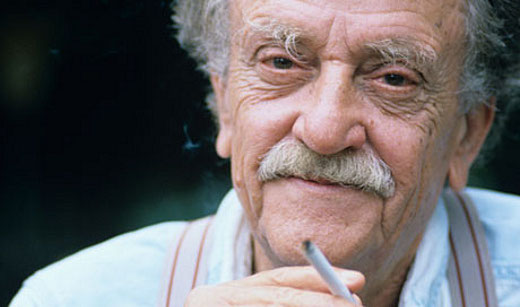
But then Volk added a line that I think goes to the heart of what has happened to TV ever since. The strange paradox that, at the very time that the audience is becoming more and more aware that not everything on TV is real, that same audience feel that if an event appears on TV - that is a guide to whether it is real or not.

Yet, paradoxically, television had also become the arbiter of reality, as John Waite exemplified on hearing of the release of his hostage cousin Terry in November 1991: “I won’t believe it until I see it on TV.”


Ghostwatch was transmitted on Halloween 1992. It was quite obvious from both the introduction and the titles that it was a work of fiction. But the reaction was astonishing - thousands of people rang in - either terrified or angry or to report that they were experiencing paranormal activity in their house at that very moment.

The next day there was a media storm - and the BBC reacted in its normal courageous way by burying the programme and disowning it. The Radio Times was apparently told never to mention it ever again. And Volk has described how it was like being airbrushed out of a photograph in Stalinist Russia.

But the extraordinary reaction rather proved the central aim of the drama.

It demonstrated the truth about modern television - that we all know that increasingly the line between fiction and non-fiction is blurred on TV. But far from making us distrust television this actually makes it more powerful. It possesses our imagination more powerfully precisely because we don't know what is real and what is not.

I think the reason is that, from the early 1990s onwards, the big confident stories of our time started to collapse, and people were faced instead with an everyday reality composed only of small and mostly mundane fragments. In the face of that, factual television has increasingly become a two-dimensional version of our world where everything is amplified and distorted.

News reporting and factual television are populated today by a strange nether world of PR-driven half truths, synthetic personalities and waves of apocalyptic fear. It is a world that is like ours but is exaggerated - weird, wonderful and frightening.

It is just like living in a haunted suburban house on the fringes of North London - except that it is now the whole world. All the mundane and banal aspects of reality are taken and infused with an hysterical intensity - that we are both fascinated by and terrified of - whether it be food or Al Qaida. Yet we know in our hearts that much of this is either distorted or just untrue.

It is the true spirit world of our time


It is made even weirder because, at the same time, audiences are shown harsh and terrifying moments of reality, but they are also insubstantial 2D images flickering on a box in the living room. They don't feel real, they look like a ghost world. Here is an example.

The tiny white figures you see that look like ghosts are actually still alive. But probably not for very long.
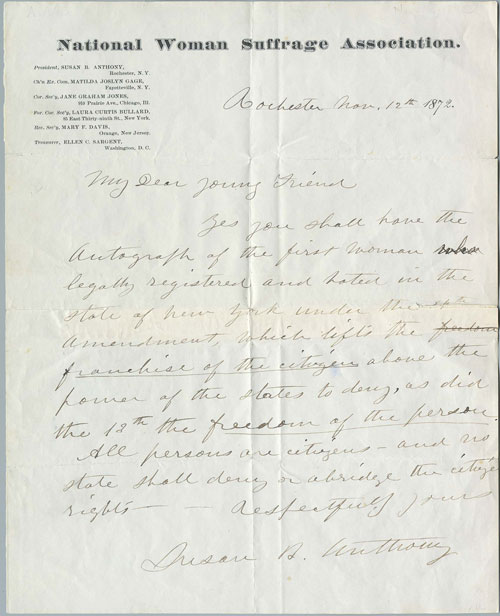
In order to see this content you need to have both Javascript enabled and Flash installed. Visit BBC Webwise for full instructions. If you're reading via RSS, you'll need to visit the blog to access this content.

And here are some extracts from Ghostwatch - which show how much it was rooted in the suburban poltergeist reports of the 1970s. But also how it used them to brilliantly evoke the mood at the heart of today's television - where so much is half-fiction and half-real.

It is also very frightening - and a brilliant piece of TV drama. Just remember it's not real.

In order to see this content you need to have both Javascript enabled and Flash installed. Visit BBC Webwise for full instructions. If you're reading via RSS, you'll need to visit the blog to access this content.

29 Oct 15:52

when you said you'd always be with me, you didn't say you'd be a total j-wad about it

archive - contact - sexy exciting merchandise - cute - search - about
← previous October 29th, 2012 next

October 29th, 2012: The findings presented in this comic owe a debt to Messrs. Holkins and Krahulik, upon whose earlier paper Green Blackboards (And Other Anomalies) this research is based.

– Ryan

29 Oct 15:00

Opinion: Secret courts are the final path towards the police state

by Daniel Furr

In November 1926, Mussolini established the Tribunale Speciale, which was a secret court designed to convict those of dissident and anti-state activities. The Organizzazione per la Vigilanza e la Repressione dell’Antifascismo was the secret police force, wtih the authority to arrest opponents of the regime.

4,000 citizens were detained in secret, tried in secret and exiled in secret. 10 individuals were even executed in secret. Secret courts were not isolated to Fascist Italy; Nazi Germany, the Soviet Union and countless authoritarian states used or use secret trials to silence dissidents and guard state secrets. The auspice of national security is invoked to justify the illiberal, oppressive and totalitarian nature of clandestine courts; it would become impossible to hold the state accountable, if it had the power to ensure actions and mistakes are kept hidden.

All governments, including this Liberal-Conservative coalition, are capable of abusing such great powers. Secrecy, as a Former American President once said, is repugnant to a free and open society; we should not fear openness and transparency. These are not only liberal principles, but democratic ones. This Justice and Security Bill will morph Britain into a quasi-police state, an Orwellian nightmare would await us. Our liberal democracy could become an arcane relic and at the mercy of a secret judicial system.

The Home Office also has a desire to extend snooping powers, even though countless accusations of abuse have appeared in the press. The state cannot be trusted with security measures; it will inevitably be exploited to monitor harmless and trivial matters. Imagine what could occur if secret courts were allowed? Legitimate protesters might find themselves tried and convicted without even knowing the evidence against them.

Liberal Reform have issued a press release, outlining possible scenarios in which secret courts could be used. The following example directly explains what might occur, if the bill passes:

(4) A newspaper publishes articles exposing corruption by government ministers in the arms trade. The government ministers and the arms companies sue for defamation. The newspaper relies on justification and brings forwards evidence that the allegations are true. The government minister wishes to adduce evidence of malice against the paper and says his sources are security sensitive. He uses a CMP (Closed Material Procedures) to determine the case in his favour relying on the evidence of the security services. The newspaper is effectively gagged from repeating the allegations.

Closed Material Procedures (CMPs)are just a bureaucratic term for secret courts; it is designed to ensure the intentions are pure and not harmful. Yet, a CMP is no different from the Tribunale Speciale; Mussolini’s secret judicial system took all evidence and accusations in private, too. Just because we are a democracy, do not assume the government has our best interests at heart. It will do all it can to save face and reduce the fallout from potential embarrassments and scandals.

I struggle to conclude how any Liberal Democrat M.P. could support and vote in favour of such measures; this negates the philosophy of our party and liberalism in general. Arbitrary government should be restricted, not strengthened. Authority should be opposed, not appeased. We did not go into coalition to construct a police state; it was on a promise to increasing freedom and personal liberty – not destroy it.

* Daniel Furr is a Liberal Democrat member from Canterbury and blogs here

29 Oct 14:50

Singularity Chess.

Singularity Chess.