


 When I first started writing about this 30 years ago, I called it the Mystery of the Great Silence -- a quandary that we've covered here and elsewhere, in articles that list over 100 hypotheses for why we appear to be alone. A topic that is also woven into the weft and flow of my new novel, Existence.
 After all, one of the top rationalizations that oligarchies have given, when they suppress science and markets, competitive invention and enterprise, is that the priests and lords are acting for the good of all. Preventing instability and disruption. Indeed, this is a chief point raised by Jared Diamond in his great, highly-recommended, but disturbingly off-target book COLLAPSE.
 In every conceivable way, from science to education... all the way to the rebuilding of a vastly powerful American Oligarchy, the GOP is your party if you feel that renunciation and a return to traditional patterns of aristocratic rule is preferable to Periclean instability. It is the Olde Way, pushed hardest via a media empire owned by multiple foreign billionaires, including the Saudi Royal Family.
 Still, in weighing this choice, I know what decision I will argue for. I vote to keep faith with Pericles and Adam Smith and Washington and Franklin and Lincoln and Frederick Douglas and Jonas Salk and Warren Buffett and the Silicon Valley geeks. Yes, the Periclean Western Enlightenment, with its egalitarianism, transparency, competitive markets, democracy and flat, anti-oligarchic social order does charge ahead into the future. And yes, the faster we charge ahead, the more we'll need transparency and freedom, to probe ahead of us, finding mine fields, quicksand pools and other pitfall-dangers ahead. And yes, the nostalgia junkies and oligarchy-lovers have a point when they cry out "slow down!"
 Please. Put aside preconceptions. Use curiosity to overcome the all-too human tendency -- to funnel disliked information through the emotional amygdala. If presented with clear and systematic proof that your side is incompetent, will you at least have a look? Instead of skimming.
 In tallying reasons for the deficit, we see one party vastly more at fault than the other, and yet that culprit is the noisiest in denouncing the debt it created! Supporting evidence comes from Forbes, the business magazine, which tallied the rate of increase of government spending under the last five presidents, including Reagan. The rate of increase was lowest under Clinton and Obama. Please. Click to scan the Eight Reasons for the Deficit and judge for yourself.
 Finally, do we really want our geopolitics run by someone who thinks that Syria is Iran's route to the sea?
When you vote for Mitt Romney, you vote to deny health care to sick people.
This is not theoretical, this is not hypothetical and this is not rhetorical: When you vote for Mitt Romney, you vote to deny health care to sick people.

That’s Violet McManus on the right. If you vote for Mitt Romney, you are — unambiguously and undeniably — voting to repeal her health care. She is a real person and what really happens to real people really matters. Elections are not a game.
This is an actual thing that will actually happen to millions of individuals and families. This is a real and significant thing that you will be doing to them. It is a real harm in which you will be an active participant. It is a real harm that you will be helping to inflict.
What really happens to real people really matters.
This is not theoretical, this is not hypothetical and this is not rhetorical: These are actual, flesh-and-blood real people with names and faces.
Ben Trockman and Caroline Long.
If you plan to vote for Mitt Romney, you should look at their faces and learn their names. Maybe you can recite them to yourself as a reminder of how “pro-life” you are.
When you cast your vote for Mitt Romney and Paul Ryan and for their promise to repeal the law that eases the pain or saves the lives of all these people, at least have the decency to own up to it.
Say it. Say it out loud. Say it defiantly. It’s what you’re doing, so at least have the stones to say it.
Say, “I don’t give a damn about Eric Richter.”
Say, “Screw you, Wendy Parris.”
Say, “Sucks to be you Robin Layman and Daniel Menges.”
Say, “Violet McManus, your pain means absolutely nothing to me.”
Say, “Declan McNulty, I do not care at all about your life.”
Say, “I’m not looking out for you, Shavon Walker, Ben Trackman or Caroline Long, I have more important concerns.”
Say, “Carolyn Cunningham can suffer and die, for all I care.”
Say, “Jennifer Lee means nothing to me.”
Whether you say it out loud or not, you’re saying it. You’re choosing it.
You’re doing it. To them. To real people with names and faces. Millions of them.
Congratulations.
 When I was a teenager - I would guess this was in 1977 - my mother and I went to visit her cousin and aunt who lived close to one another in Bexleyheath. Also present at the lunch was a neighbour of theirs called Bill Nettlefold.
Moreover, behind the jokes there was often, one feels, real shame, real anger, as perhaps in:
FAN MAIL FOR A POET
To he read over a network of high-power Radio Stations by an American Hot-gospellerHOW NICE for a man to be clever,
So famous, so true
So sound an investment how EVER
So nice to be YOU.
To peer into basements, up alleys,
A nose for the search.
To chal1ene with pertinent sallies,
And then JOIN the Church.
First comes Prufrock. then Sweeney. and then
Thomas à Becket.
How frightfully nice of the good men
In cloth to forget it.
The broad-hacked hippo so weak and frail
Succumbed lo the shock.
But the TRUE Church now can never fail,
Based upon ‘THE ROCK.
As a POET you visit today
The NICE Portuguese.
You can help England so in this way
I DO hope you please.
You WILL watch Spain’s terrible border;
Take care where you tread.
How AWFUL for England if you were
Shot down for a RED’
I like you, and whats more I READ you:
There are such a few
Christian Poets so nob1e indeed you
Must know it — YOU DO.
How nice for a man to be clever
So famous, so true
So sound an investment how EVER
So nice to be YOU.
W. T. NETTLEFOLD
This poem is a lament for a lost leader. Eliot had betrayed the admiration and respect shown him by the thirties men, not only by turning to orthodox religion after his mockery of it, but also by visiting a fascist country which was helping Franco in the Spanish Civil War. This again illustrates the way in which a poet was regarded as a person whose actions were as publicly important as his poems.I don't suppose there were two poets called Nettlefold active in the 1930s, so this must be my Bill Nettlefold. It is not great poetry - I suspect you had to be around at the time to understand this sense of betrayal - but I was delighted and astounded to find it in the Penguin book.

I have a hard time getting worked up about this story:
I have X'd out any information that you could use to change my reservation. But it's all there, PNR, seat assignment, flight number, name, ect. But what is interesting is the bolded three on the end. This is the TSA Pre-Check information. The number means the number of beeps. 1 beep no Pre-Check, 3 beeps yes Pre-Check. On this trip as you can see I am eligible for Pre-Check. Also this information is not encrypted in any way.What terrorists or really anyone can do is use a website to decode the barcode and get the flight information, put it into a text file, change the 1 to a 3, then use another website to re-encode it into a barcode. Finally, using a commercial photo-editing program or any program that can edit graphics replace the barcode in their boarding pass with the new one they created. Even more scary is that people can do this to change names. So if they have a fake ID they can use this method to make a valid boarding pass that matches their fake ID. The really scary part is this will get past both the TSA document checker, because the scanners the TSA use are just barcode decoders, they don't check against the real time information. So the TSA document checker will not pick up on the alterations. This means, as long as they sub in 3 they can always use the Pre-Check line.
What a dumb way to design the system. It would be easier -- and far more secure -- if the boarding pass checker just randomly chose 10%, or whatever percentage they want, of PreCheck passengers to send through regular screening. Why go through the trouble of encoding it in the barcode and then reading it?
And -- of course -- this means that you can still print your own boarding pass.
On the other hand, I think the PreCheck level of airport screening is what everyone should get, and that the no-fly list and the photo ID check add nothing to security. So I don't feel any less safe because of this vulnerability.
Still, I am surprised. Is this the same in other countries? Lots of countries scan my boarding pass before allowing me through security: France, the Netherlands, the UK, Japan, even Uruguay at Montevideo Airport when I flew out of there yesterday. I always assumed that those systems were connected to the airlines' reservation databases. Does anyone know?

Why am I an Atheist
Because it has dawned upon me that it is right to be so, and upon investigation I find no real evidence of the divine origin of the scriptures. And because I cannot, as a refined and respectable woman, take to my bosom as a daily guide a book of such low morals and degrading influences. Written by a lot of priests, I cannot accept a salvation that is based wholly upon the dreams of an ancient and superstitious people, with no proof save blind faith.
Everything that so many people think transpires from the supernatural, and many things that would really perplex the average mind, have a natural and material foundation in the workings of the human mind; that is, things that are not connected with our solar system.
It is ignorance of the scientific working of their own natures and mind that keep so much "mystery" in the air; and as long as there is a mystery afloat the people will ascribe it to the supernatural.
I am an Atheist because I know the Bible will not do to depend upon. I have tried it, and found it wanting.
In fact, I found in the scriptures the origin of woman's slayer, and that it was one of God's main points to oppress women and keep them in the realms of ignorance.
I am in the ranks of Liberalism because of its elevating principles, its broad road to freedom of thought, speech, and investigation.
MINNIE O. PARRISH
23 years old
Leonard, Texas


 You may or may not be aware that Peter Jackson’s Hobbits 1 is soon to grace our screens in the UK.
Here at Freaky Trigger we often find it difficult to keep track of all the recurring Character Actors in these epic films with large casts, especially under layers of prosthetics and make up.
Luckily for us then, that last night a group of dedicated FT correspondents stumbled across a handy cast list, written in P Jackson’s Actual Handwriting (see picture). So to save you multiple trips to IMDB to figure out who is playing 3rd Warg On The Left, here is that list in full:
DWARFS
James Nesbitt
Billy Connolly
Ken Stott
Brian Blessed
Robbie Coltrane
Jim from Neighbours
Paul Lassiter from Lassiters
The Gay Footman from Downton Abbey
2 Tall New Zealandish Dudes
Helen Mirren
Guy of Gorgeous
Guy of Elbow
Arse More Like
Sara Lund’s Jumper
Warwick Davies
Mr T
Roger Daltrey (from CSI)
Holly Valance
Mos Def
Jedward
Yer Pal Ma$e
Hurley out of Lost & Hurley out of Belle & Sebastian
Noel Edmonds
Dave Lee Travis
Bananarama (30th Anniversary Edition)
Stevie Jackson & Steve Hewitt
Wolf out of Gladiators
The Announcer from Robot Wars
My Two Dads
Ron Swanson
Sebastien Tellier
Lance Armstrong (edited out)
Cheech or Chong (but not both)
Frank Kogan
Dory out of Finding Nemo
Dorian from Birds of a Feather
Edgar from Inazuma 11
Jake Lloyd
Lytton
Bjorn and Benny
Steel and Peel
Lee and Herring
King and Kong (and Song)
Isambard Kingdom Brunel
GOBLINS
The Kooples
Boris Johnson
Norris McWhirter
Sandi Toksvig
Sandi Shaw
Sandi Thom
Sandi Denny
Skrillex
Grillex
Chorlton (minus Wheelies)
Rory Gilmore
Gary Gilmore
Colin Baker’s trousers
Horse e_books
Alex Chilton from Big Star
Endou the Ampharos 23!
Joe Dolce
Joanna Lumley
Jasper Carrot
Ra Ra Rasputin
Pete Wentz
Barry Wentz
Barry Sheen
Barry McGuigan
Barry Sarll
Barry Crier
Juan Sheet
Biggles
Professor Utonium
The Grabby Aliens from Toy Story
Theo Paphitus (Thetus)
Xenu
Xena
Britta
Lesley Knope
Air Bud
G-Dragon
Emperor Penguin #2
The Christmas Icicle
Penny Red
Monsieur Le Prosecutor from Spiral
WARGS
All computer-generated (but voiced by Guillaume, Hereditary Grand Duke of Luxembourg)
BASSISTS
The bassist from Big Country
Kris Novoselic
Mark King
Geddy Lee
Bonnie Langford
Mr Wimpy
OTHER
Cate Blanchett – Elf #1
Morrissey – the Necromancer
Cheryl Baker – Beorn’s Mum
Moira Stewart – Smaug’s Mum
Bill Oddie – Gandalf’s Mum
The Spiders from Mars – Spiders
Benedict Cumberbatch and Stephen Fry – Talons of Weng Chiang (1 each)
Minnie Mouse – herself
Laika (reserve)
This essay contains enormous spoilers for the 2010s run of the Marvel comic Journey Into Mystery. If you haven’t read it – the Kieron Gillen run, at least – and you have any interest in doing so, don’t read this first. Seriously.
1.
A theme of Sean Howe’s Marvel: The Untold Story – unavoidably, since it’s a theme of most superhero comics storytelling over the last 30-40 years – is “the illusion of change”. This is Stan Lee’s formula for what readers want – dramatic developments which are always reversible, and it’s what Marvel has always been so very good at.
But it gets harder and harder to do. The readers are wise to it, after all. Certainly death doesn’t work any more – so how about defeat? Marvel’s most recent kink is to have its heroes turn on one another – if the outcome of a hero versus villain battle is predestined, then the only battles its heroes can really lose are against other characters with their own books and fans.
Even here the arc of Marvel comics storytelling bends towards the status quo. And their emotional arcs reflect that too. In the House Of Ideas, change first brings disruption, excitement, thrilling uncertainty. Then a second act of steepening peril, and then – crescendo! – the return of the familiar once again. But renewed, cleansed through ordeal: there’s something almost mythic about it, isn’t there? Or “iconic”, to use a word comics writers began to lay claim to in the 90s, when the transparency of this cycle started to become apparent. The iconic Captain America has returned. The iconic Thor.
If readers like the changes? Well, nobody need lose out. You package them up, spin them off, put them out as their own comic, and everyone is happy. Because readers might like changes, but they like the familiar more.
In here, though, are the seeds of something different – a way to write a superhero comic, a modern, corporate superhero comic, which doesn’t have a happy ending. Or maybe, if happiness is really an endless cycle, it’s enough to say which has an ending.
What would you do? You take a property, a great big corporate property, one which is there in plain sight – maybe it’s in the most successful superhero film ever made. And you change it in a way which any old cynic is likely to see could never stick. And you sell the change. You sell it and sell it and make it work so well that even the cynics (even this cynic) thinks, my goodness, they’ve done it, they’ve really changed that character. You write the change so well you make everyone need it to be real, and then –
But however skilful you are, that would merely be cruel. If you’re going to fool everyone and have it end up tragic, not a misanthropic tease, you need to pick just the right character. You need a character where the trickery, and the lying, is central to who they are – so when the world ends you realise it was always going to. And even more, you need a character who’s on the readers’ side, not yours. You need a character who knows what’s at stake. You need a character who wants to change, so that when the world ends you still want it not to.
Illusions – in the stage magic sense – are lies we volunteer for, and the illusion of change is no different. This is Marvel’s promise, but also its prophylactic – nothing will really matter. What if that could be a lie too, of the other kind, the ones we don’t expect?
2.
Let’s meet our liar. A big one – Loki, the God of Lies (or Mischief), Marvel villain in good standing since 1963, half-brother and pest to the Mighty Thor, a rangy sneerer in yellow and green. He schemes, he plots, he brings on Ragnarok, he gets reincarnated as a woman, he schemes some more, he causes a crossover event, he gets blown up, the end of Loki. This is where the comic we’re interested in starts.
Journey Into Mystery, by Kieron Gillen and an assortment of artists, is the story of Loki back from the dead as a smallish and apparently innocent boy. He is still the God of Mischief, nobody really trusts him, but – as he occasionally says – “I only wanted to help”.
He does help. It’s a kind of Ponzi scheme heroism, where every victory is won by striking some horrendous bargain or kicking some frightful can further down the road, but they are won nonetheless. And Journey Into Mystery, for most of its 20+ issues, is a delightful comic – well-plotted, twitching with good lines, stuffed with a gleeful excitement that feels like creator and protagonist daring each other on. Old Loki was malevolent, Kid Loki – as he’s known – is a layer cake of cunning and wonder, a “loveable godling”. As the comic proceeds he gets a supporting cast, all perfectly weighted for a fandom’s needs – his best and only friend, the unflappable disdainful Leah; his comically bloodthirsty dog Thori; and Ikol, the last remnant of old Loki manifested as a magpie. Ikol mostly didn’t do much. Sometimes you forgot he was there.
Journey Into Mystery is great. I remember reading an issue on a flight to America and thinking, “God, Gillen’s really cracked this, he’s done something nobody’s managed to do – he’s done the ‘teen version of me redeems myself’ story and it’s worked”. I mean, Marvel has something of a history of this. Even while JIM was going on you had a teen Apocalypse in X-Force who might turn evil and a teen Wingless Wizard (really!) in Fantastic Four who might turn evil, and a few years ago we had a teen Kang who wanted to not turn evil, not to mention all the superHEROES who get teenified.
Why all the teens? Who knows – Kid Loki beat them all. He owned the comic, he was charismatic and adorable and infuriating, his supporting cast were a joy. His adventures were ridiculous and fun from the first storyline – a careen through myth and fairytale with Loki and crew as secret stagehands for a crossover event. Later on a kind of robot ghost of Anthony H Wilson turned up. “What?” I thought. “What?” and then “WHAT?” again when Ghost Robot Tony Wilson became the plot lynchpin of a crossover event himself.
That event teased the readers – maybe Kid Loki was bad all along, no, maybe he isn’t but everyone will believe he is. But he’s fine. He wins and the universe is saved. Everyone knows he’s a good guy now.
So of course, that’s when the wraith of Old Loki turns up again, and tells us that the whole thing – the whole comic, everything you’ve been reading, was a ploy to get people (you included! Except now you’re on the other side of the fourth wall shouting NOOO) to trust Loki. It worked, and now, by a scheme, Kid Loki will be wiped from existence, while Old Loki takes over his life, and gets the second chance for real we thought we’d already been reading about.
This happens in a page or two, by the way. One of my favourite things about JIM is how Kid Loki’s schemes teeter like mad jenga towers which take issues to unravel. Old Loki springs his trap in a couple of panels, cuts off Kid Loki’s routes of escape, and we spend the rest of the issue seeing our hero’s options dwindle and run out. There’s none of the joy of manipulation in Old Loki, he’s too good at mischief for it to be fun.
And that’s the end of the story, more or less. It’s a Twin Peaks kind of deal, not quite as harsh but it leaves you gutted nonetheless. Old Loki is in Kid Loki’s body, and maybe he’ll change but maybe he won’t. We had a wonderful character, a loveable prince of lies, and he was a weapon all along, a lie-in-waiting himself.
(If you want a blow-by-blow account of what’s going on in the last issue of JIM there’s an excellent one here.)
3.
Journey Into Mystery is a superhero comic with an unhappy ending – unusual enough in that. There’s an awful lot going on in it – ideas about myth, about storytelling and lies, about friendship – fans and writers will be picking over it for a long time. And the ending is very special.
But one of the things that’s certainly in it is this: Journey Into Mystery is a comic explicitly about the illusion of change. The illusion of change creates bubble realities that break out from the status quo and then are reabsorbed into them, and Journey Into Mystery kicks against this, gives you a bubble so good that it snaps the emotional arc. “The House always wins”, says Old Loki to Kid Loki, and in that moment you know he’s right and you hate the house, you hate the status quo, the realities that mean a comic which sells 20,000 can’t whip its sling and fell the expectations laid by a 40-year history or a movie that banked $1.5 billion. You don’t want the real Loki, the lean old fuck with the horned helmet, because you’ve been reading about the real Loki for the last 30 issues.
Kid Loki goes to oblivion saying just that. He won, because he got to change. The Old Loki won’t. No, I will, Old Loki says, and Kid Loki replies, “They won’t let you”.
Who? Not the other characters – that’s the story we’ve just been reading, about people who do (in the end) let Loki change. Who are “they”? The executives, the audience, the readers, the creators, all of the above. Sooner or later when Journey Into Mystery is safely filed away at #4 on a list of cult classics of the 2010s, or more likely before, someone will want to use the Old Loki unthinkingly, as a trope of villainy, a moustache-twirler in a horny hat. And they will, and Kid Loki will have won. Not the best of victories really. As Loki says, at the end, looking straight out at us through his newly hateful child’s eyes, “Damn you all.”
There is a phrase I see sometimes when I read comics blogs. “Putting the toys back in the toybox”. It’s said with approval – this is a good thing to be doing, you can mess around while it’s your go with a character but the toys aren’t yours and at the end things go back as they were. Another child will want to play with them. It’s a sort of twisted version of “put away childish things” where nobody gets to grow up. Kieron Gillen has, formally at least, and under subtle protest, put the toys back in the toybox. He may also have arranged the toys in the toybox so they spell out a terrible curse. And he’s taken a favourite toy with him – Loki, Kid in shape only, is heading for now to a new comic called Young Avengers.
Has nothing really changed, though? I’m not so sure. Stan Lee did not always believe in the illusion of change, and nor did the comics company he fronted. Lee laid the doctrine down when he became a Hollywood guy more than a comics guy, and meant it to stop what its creators were doing to Marvel’s properties, not to encourage a practise already installed. Marvel boiled with change for years anyway, and then it died down.
One reason change fitted Marvel is that the company seemed to have a mandate for it. Marvel had a fanbase very unlike anything comics had seen before – college students, self-aware literary nerds, hipsters even. It had that fanbase for, I’d guess, around a decade, 65-75, maybe longer – and then it lost its grip on it. By the time other comics pulled it back in the mid-80s, Marvel was nowhere. Then DC fell away too.
By the mid-90s the cool kids had long departed. Now teenagers – speculative, obsessed with violence and tits – were seen as the ones who had killed the form. It was commonplace for fans to shake their heads wearily over the ‘adolescence’ of comics fans (in attitude not age – these were ‘boy-men’, ‘fanboys’ and so on). This went hand in hand with a desire to recover a lost world of fandom – the true kids, the ones who used to buy off newsstands. (All-ages comics have been critical hits ever since).
All through this time, teenage superheroes were launched, briefly rose, and quickly fell. And the teenification of existing heroes began – Iron Man was a kid for a while. The endless launch of new teen characters – Good Teens to fight the Bad Teens who ruined everything – feels like a confused howl of frustration. While all-ages titles at least appealed to someone – if only via pester power – the new teenage superhero comics were a kind of cargo cult response to a vanished audience: erect spandex effigies of the lost readers and they will return. The mildly rebellious, essentially clean-living teens featured in them were utterly irrelevant. The real Marvel core – slightly older, college-age, knowing and itching to share their obsession – had drifted away.
But one of the things that stood out for me about Journey Into Mystery was its fandom: Kid Loki found that audience again. The average age of the mainstream comics reader is terribly old, and “adolescence” has been ceded to the guns’n’gams crew for years now. Real teenage and college-age fans went off to TV, films, anime, Potter, anywhere but American comics, and built fandoms which lived online. And Journey Into Mystery grabbed a fandom like this, mostly on Tumblr, which loved it, hated it, created around it, did all the things that living fandoms do. The Avengers movie helped of course – guarantor of authenticity on the one-hand, it also introduced a ton of open-minded fans to its characters.
I would say – though I’d love to be wrong – that Marvel or DC hasn’t published something which got that kind of intense, concentrated, creative young fandom in years. A week before the last JIM, news broke that the debut issue of My Little Pony: Friendship Is Magic had shifted an outrageous 90,000 advance copies (something very few regular Marvel books have done this decade). Cue much talk about “bronies” and the show’s weird subcultural fanbase. But bronies – smart, geeky, happy to look for nirvana in what others consider trash – are the Spider-Man fans of the 60s, five decades on.
Journey Into Mystery felt special not just because of its storytelling but because of the way its readership lived that storytelling. Which makes the ending all the harsher, perhaps. But I don’t think the wild fandoms of the Internet have that toybox mentality, for the most part. Maybe they can read tragedy as tragedy and accept it, not long for the wipe-clean caress of the reset button. I think an eye and ear for those fandoms were what made Marvel great, long ago. Perhaps they might again. Journey Into Mystery opened a door to them – the question now is whether anyone takes it.
One month ago today Liberal Democrat members voted overwhelmingly against the government’s plans for secret courts contained in Part II of the Justice and Security Bill. The motion was passed unamended despite the efforts of party leaders who attempted to dilute the motion into an apology for unfair trials.
Reporting of the Bill has continued, none of it reassuring. During the debate I said I could not understand why our government would suggest this illiberal measure, unless it was due to pressure from the US government. Disturbingly it seems I was right as it was what David Anderson QC, the government’s independent reviewer of terrorism said when he appeared before the Joint Human Rights Committee last week!
Since Conference, the campaign has grown. Many crossbench peers are willing to vote against the Bill. Sadiq Khan of Labour has already spoken out against, and Labour and Conservative members both Houses have similar misgivings. So where are the Liberal Democrats on this? Sadly it seems there is a clear split between the parliamentary party and the membership (from all sides).
Despite the clear will of the party, and the voices of more than 300 members who have signed the petition calling on our parliamentarians to respect what Conference voted for, and to implement it in parliament, the signs are not encouraging. Liberal Democrat parliamentarians have said “concessions will be sought” or “that some closed trials are better than no trials at all”. But those in parliament who support the Bill have failed to deal with the following points:
Party members decide our policies. One month ago the members decided Liberal Democrat policy on secret courts: It is for Part II of the Bill to be withdrawn by the government, or voted against by our parliamentarians. The issue will be raised at the Federal Executive meeting on Monday 29th October. I still believe that our parliamentarians will have to respect the principled stance taken by Conference. With many hundreds of other Lib Dem members I will be campaigning to make sure this happens.
Your support will help us to win this fight to kill this illiberal, unnecessary and oppressive Bill! Please join the campaign, by signing the petition here.
At first sight the search for peace and stability in Iraq, and the search for physical and mental fitness in the extreme contortions of modern Yoga seem to have absolutely nothing in common.
But curiously they do.
Both the terrible structural problems and distortions that underly Iraqi society today, and the strange, contorted poses that millions of people perform every day in things like Bikram's Hot Yoga, actually come from the fevered imagination of the British ruling class one hundred years ago.
As they felt Britain's power declining they wanted desperately to go back into the past and create a purer and more innocent world, uncorrupted by the messiness of the modern industrial world - a new Eden forged both by strengthening and purifying the human body and by inventing new model countries round the world.
And we are still suffering from the consequences of that terrible nostalgia.

At the end of the nineteenth century a fanatical craze for physical fitness swept through Britain. Millions of men and women took up gymnastics, body building and other physical exercises.
Such a thing had never happened before - and it was given a name - Physical Culture.
The craze had an almost religious intensity because those who promoted it said that it was the only way to prevent the British nation - and its Empire - from collapsing. Behind this was a powerful belief that the modern world of the 1890s - the teeming cities with their slums and giant factories - was leading to a "physical degeneracy" in millions of people.
It was a fear that had started with the elite who ran Britain's public schools. Matthew Arnold warned of "the strange disease of modern life" with its "sick hurry" and "divided aims". Out of that came a movement called "Muscular Christianity" which wanted to recreate the kind of heroic human being that existed before industry and the modern world came along and corroded everything.
It was a vision of a restored physical and moral perfection in the young men who were going to run the empire. And it involved doing lots of exercises in new things called Gymnasiums. Then liberal reformers got worried about the working classes - convinced that the slums were leading to a "physical degeneracy" . So they persuaded lots more people to do exercises.
Then a figure rose up who united all of this dramatically into a mass movement. He was called Eugen Sandow.
Sandow came from Prussia, he started as a circus and music-hall performer. But then in the late 1890s he invented something he called "body-building". It caused a sensation throughout Europe and America - and he became a massive celebrity because he was seen as the leader of a crusade of Physical Culture that was going to stop the degeneracy that was plaguing Britain.
Here is some film shot by Thomas Edison - showing Sandow in action.
In order to see this content you need to have both Javascript enabled and Flash installed. Visit BBC Webwise for full instructions. If you're reading via RSS, you'll need to visit the blog to access this content.
Sandow said that building the perfect body was a way of reconnecting with a pre-industrial time of virile physical perfection. He was very good at PR - and he told a story of how he had gone with his father to see the Greek and Roman statues in Italy. He asked his father why there were no more such men?
His father replied that in those days the rule of the survival of the strongest had not yet been corroded by the dangerous, cushioning effects of "civilisation". There and then, Sandow said, he resolved to lift from himself - and the world - "the stigma of weakness".
And to do that you had to "build" your body to look like this

Sandow also started a magazine called Sandow's Magazine of Physical Culture - to promote what he called The Gospel of Strength. It became the centre of a worldwide movement that incorporated bodybuilding with all sorts of physical exercises.
It was the start of the modern idea of fitness - and at its heart was an almost spiritual vision of restoring a lost wholeness to both human beings and to the world. The American promoter of Physical Culture, Bernarr Macfaddden wrote in 1904
"Our ancestors were strong, virile and conquering because they lived close to Nature and so absorbed her inexhaustible vitality. But we are losing our inherited vitality, slowly perhaps, but none the less surely."

In 1905 Sandow set up "The Empire and Muscle Competition", and then went off on a tour of the world. When he arrived in British India he became a sensation - thousands came to see him in his giant tent.
He had arrived in India at a time of rising tension. There were growing protests against Britain's rule, and Sandow's gospel of strength now began to get mixed up with another ideology - Indian nationalism. In the next twenty years, as Britain's hold over India weakened, the culture of physical fitness that Sandow had brought to the country would re-emerge in a strange mutated form as a way of fighting against British rule.
And in a further mutation this would lead to what we now know as modern Power Yoga.

After the First World War the territories of the old Ottoman Empire were divided up amongst the European powers, and Britain got three provinces in Arabia that would become the new country of Iraq.
Britain had created new countries within its Empire before and it had always started by surveying in extraordinary detail the societies they were ruling - compiling censuses and records of property boundaries and a mass of other details. Out of all that they then built a new administrative system.
It wasn't often very fair or democratic - but it bore some relationship to the reality of existing power structures.
But by the 1920s Britain was bankrupt after the war and couldn't afford such elaborate preparations. Instead a small group of elite administrators were allowed to create a new society out of their imaginations.
And their imaginations were influenced by exactly the same yearning for a return to a pre-industrial rural idyll that had created the Physical Culture movement in Britain.
What the British administrators did was take a romantic vision of a long lost Britain run by feudal landlords and project it onto Iraqi society - where the tribal Sheikhs were seen as being like the British landed aristocracy.

A historian called Toby Dodge has written an absolutely brilliant book called Inventing Iraq. It lays out in clear and very persuasive detail how this group of British Civil servants in Iraq built something that looked like a modern nation - but was in fact a facade. Behind it was really a weird nostalgic myth about Britain.
At the heart of this group was the legendary Gertrude Bell. She wrote the key "Review of the Civil Administration in Mesopotamia" in 1920, and Dodge shows how she, like many of the men working with her, completely distrusted the new modern middle class that had grown up in the cities like Baghdad.
This class had helped run the Ottoman Empire and the British believed that they were tainted - that they had been corrupted by the despotic Ottomans, and that if they were given power they could rise up and become despots themselves.
To prevent this, Bell and the other colonial administrators turned instead to the tribes in the countryside and the Sheikhs that controlled the tribes. The Sheikhs would be a far better alternative - powerful "people of influence" who could help the British run Iraq. They were "true" Iraqis, unscathed by Ottoman influence.
Here is a picture of Gertrude Bell.

What made the rural tribes and their leaders so attractive to the British was the fact that they seemed - in their imaginations - to be just like the stable feudal world of Britain with its rural nobility. The British were explicit about this, the Administrative Report for the Basra Division in 1918 said:
"These landlords are men of gentility and pride, occupying a position of influence and status reminiscent of that of the feudal landlords of English history"
Gertrude Bell was full of the romance of the Sheikhs, she said they were "aristocrats" who managed to keep the collectives they headed in a "natural equilibrium".
Some British administrators in Iraq thought this was mad - that you couldn't transmit authority and order through the tribal system, especially because the sheikhs' political and social power had declined long before the British turned up. It was also sidelining the one group who could help create a proper modern society - the middle class in Baghdad.
But, as Toby Dodge shows, the romantic vision of the sheikh as the linchpin of rural society won out. His judgement is blunt:
"This vision had little to do with the historical or social truth of the society. It sprang in large part from the colonial officials own understandings of the evolution of British society.
To the British the noble bedouin, untouched by all that was negative about the modern day, stood in stark contrast to those who peopled the cities - to those who had succumbed to the temptations of modernity."
If Dodge is right - and his evidence is very powerful - what the British did was create Iraq as an expression of their own fears about what was happening to their own country. They took their worries about the rise of the urban mass, and the horrors of industrialisation in Europe and projected this onto the complex societies that were all mixed together in the nascent Iraq.
They then ruthlessly ignored this complexity and gave a lot of power to the noble, virile sheikhs - who were very like the noble heroes that Eugen Sandow wanted to recreate with his bodybuilding.
Here is part of a film that gives a perfect and vivid illustration of this British romantic view of the Arab tribe as pure, uncorrupted society. It is made by the explorer Wilfred Thesiger who spent the 1940s living among the Marsh Arabs in Southern Iraq, and then with the Bedouin nomads who live in what is called The Empty Quarter that straddles Saudi Arabia and Iraq.
In order to see this content you need to have both Javascript enabled and Flash installed. Visit BBC Webwise for full instructions. If you're reading via RSS, you'll need to visit the blog to access this content.
But problems emerged right away.
The British supported the sheikhs who were prepared to co-operate, but there were others that the British deemed "unruly" - and because of this division there was growing anger and resentment among some of the tribes. And from 1920 onwards there were rebellions. But there was also a growing economic crisis in Britain - the defence budget had been cut in half and there wasn't enough money to find the troops that were needed to put down the revolts.
So the British invented what they called "Air Control". It was the first use of aerial bombing to put down a civilian uprising - and it was promoted as both a humanitarian and a moral way of keeping control. The bombers would be clean and precise, hitting only the buildings and fuel stores of the unruly tribes.
The first large-scale bombing was in November 1923 in the Samawah district on the Euphrates. It was against defiant tribes from the Bani Huchaim confederation. A British Special Services officer called John Glubb had done a reconnaissance and worked out who he thought were the sheikhs who led the tribes. His operations map showed:
"the location of the villages belonging to the Shaikhs and Headmen whose influence among the tribes rendered them particularly suitable for attack."
In doing this Glubb was following the simplified British vision of Iraqi rural society. In fact the society in Samawah turned out to be more complicated than he imagined. When the identified sheikhs were told to surrender or face bombing two of them came to the British and told them that they didn't have the power to make anyone surrender.
But the British thought they were being evasive - and the bombing went ahead. It was the shock and awe of its time. The RAF planes came in and bombed the villages, the people fled and returned as darkness fell. Then that night the planes came back with incendiary bombs and caught the villagers. An RAF report said that it was:
"to do away with the idea that they (the targets) will ever have any period of peace once an attack has begun."
The RAF's conservative assessment after the attack said that approximately 100 civilians had been killed and six villages destroyed. There was a lot of public concern in Britain about this new tactic, and in the face of this, John Glubb later claimed that only one Iraqi had died.
Glubb was one of the central military figures in Iraq - and his actions showed just how dangerous the simplified British vision of Iraqi society could be.
Here is a photograph of him:

Much later - in 1981- Glubb appeared on a very odd BBC chat show. It was called Friday Night Saturday Morning, and the theme was "The Arab People". It had a very strange collage of guests - first a Saudi prince comes on to defend his regime, then the romantic novelist Barbara Cartland dressed all in pink sits next to him and explains how every woman wants to have sex with an Arab sheikh.
Then John Glubb joins them to describe enthusiastically his bombing campaigns in Iraq in the 1920s. He starts by talking about the origin of "Air Control" but then slips away into a practiced, humorous after-dinner set of anecdotes about how the tribes were like little children who spent their time raiding each other - and had to be bombed to make sure they "played fair" like in cricket.
In an extreme, surreal way the programme illustrates the weird myth of "the noble sheikh" that the British had projected onto Iraq - and the extreme violence needed to sustain that myth.
In order to see this content you need to have both Javascript enabled and Flash installed. Visit BBC Webwise for full instructions. If you're reading via RSS, you'll need to visit the blog to access this content.
By the late 1920s there was a craze for Physical Fitness sweeping through India. It was something completely new to Indian society and it was led by a famous body-builder and gymnast called Professor K.V. Iyer. He had been inspired by the western ideas of Eugen Sandow and, like Sandow, he had turned exercise into both a physical and a moral duty.

Iyer modestly described himself as having "a body which Gods covet" and gave himself the title "India's most perfectly developed man"

What made Iyer's vision of a strong body so attractive to many Indians was not just physical. It was also a way of expressing the growing nationalism and hatred of British rule. Indian nationalists were very aware of the way their colonial masters dismissed all Indians as a weak and degenerate people - Baden Powell famously called them "enfeebled". A powerful body was a way of challenging that in dramatic physical terms.
In 1927 the popular journal Vayayam - The Body Builder - said its mission was "to uplift India from the mire of physical decadence."
K.V. Iyer was very aware of the paradox - that Indians were using European ideas of physical exercise to challenge their European colonial masters. And at the end of the 1920s he took his theories of body-building that were based on Western models and fused them with the spiritual ideas of Yoga. The aim was to create what one of Iyer's closest collaborators called "A Physical Culture Religion" which deliberately had roots in India's ancient past. They called it "The Yogic School of Physical Culture".
It was something very new - that had very little to do with traditional Yoga as it had been practiced for centuries. Yet it is the root of almost all the modern Yoga practiced today in Europe and America.
Such an idea is heresy to what are called the "Yoga Fundamentalists" in the west today who portray Yoga as having a special antiquity that goes back thousands of years. But recently a Yoga teacher and academic called Mark Singleton has written a fascinating and gripping book that challenges that idea head on. It is called Yoga Body.
Singleton goes back to the India of the 1920s and 1930s and shows in forensic detail how modern Yoga was constructed out of Western ideas of gymnastics and a modern Indian political nationalism. He points out that traditional Yoga has very few poses - and most of those are variations on the seated meditation posture. For hundreds of years, Singleton says, yoga was not about physical fitness but a system of meditation and philosophical enquiry.
Here is some footage - from BBC news in 1957 - of this new kind of physical yoga being displayed to the new leader of an independent India - Pandjit Nehru.
In order to see this content you need to have both Javascript enabled and Flash installed. Visit BBC Webwise for full instructions. If you're reading via RSS, you'll need to visit the blog to access this content.
And in a brilliant piece of detective work Singleton goes on to show how in the 1930s a completely fictitious spiritual history was created for this new kind of Yoga - which then allowed it to be sold back to the west as something ancient and mystical.
It happened in the Jaganmohan Palace in Mysore. The Maharaja was a fitness fanatic, he installed a gymnasium and invited K.V. Iyer to come and teach his body building there. As Singleton shows, in the next door room was an unknown yoga teacher called T. Krishnamacharya who then proceeded to take the yogic physical culture that Iyer had invented - and push it much further.
Here is a picture of the palace.

Out of it came a radically physicalised form of yoga which is the basis for almost all the modern forms of yoga like Power Yoga that have grabbed the western imagination.
What made this so attractive to the west was that Krishnamacharya said that his system was five thousand years old and based on an ancient text called the Yoga Kurunta. He had first heard of the text, he said, when he was taught the system by a guru high up in the mountains in Tibet. He had then returned and "discovered" a copy of the five-thousand year old Yoga Kurunta in a Calcutta library, which he then transcribed.
Strangely no-one has ever seen the original text. Unfortunately when his followers asked to see it Krishnamacharya told them that it had been eaten by ants.
Singleton makes it clear that the real inspiration was far more likely to have been the body-building contortions and gymnastic exercises going on next door in the gym of the Mysore Palace.
Here is some footage of one of Krishnamacharya's followers - who was also his brother-in-law - called B.K.S. Iyenegar who was the person who brought this yoga system to Europe and America and made it famous. The first is an early exhibition he did for the BBC in 1966. It is followed by a wonderful scene of the same Mr Iyenegar on a BBC evening magazine programme from 1981 getting the presenter to do this "ancient spiritual exercise". Iyenegar was by then 63 years old. Obviously this kind of yoga works.
In order to see this content you need to have both Javascript enabled and Flash installed. Visit BBC Webwise for full instructions. If you're reading via RSS, you'll need to visit the blog to access this content.
Gertrude Bell died in Iraq in 1926 - having taken an overdose of sleeping pills. Noone knows whether it was suicide or not. But what is known is that she had come to realise that the British attempt to build a nation out of Iraq had failed. In a letter she wrote:
"There's no getting out of the conclusion that we have made an immense failure here. The system must have been far more at fault than anything that I or anyone else suspected. It will have to be fundamentally changed and what that may mean exactly I don't know."

In many ways the story of Gertrude Bell and her family is also the story of the fall of the British Empire. Her grandfather had been a wealthy industrialist who had made his fortune in iron and steel. He then became a powerful Liberal party politician helping to create the global vision of Empire under Disraeli.
Gertrude was one of the generation who then struggled in the 1920s to keep that global vision alive in the face of economic crisis and political and public opposition in Britain - and failed.
Strangely it was Gertrude Bell's half-sister, Mary, who would show the way forward to the next stage of this global vision - a mystical vision of the world in which individuals around the globe were no longer dominated by political power - but instead united by a vague, spiritual force. It was the New Age philosophy - and Yoga was going to play a central role in this new ideology.
Mary Bell's eldest child was Sir George Trevelyan who would become one of the founders of the New Age movement in Britain. The central guiding idea of the movement was that the world was moving towards a new age in which the fragmented and divided societies and nations would die away. It would be a "oneness" - a restored unity with all the people of the earth, with nature and within your own body.

The earliest and most powerful concrete expression of these ideas was the Findhorn Foundation. It was a rural community in Scotland whose aim was to try and create a model for this new kind of unified world. Sir George Trevelyan helped create the Findhorn Foundation - and tirelessly promoted it as a vision of an alternative future for the world.
I want to show a programme that the BBC made in 1973 about Findhorn. It was taped in their community hall where the founders and many of the members of Findhorn were asked to explain their vision, questioned by a very sympathetic presenter called Magnus Magnusson.
It is incredibly funny and wonderfully bonkers, but it is also very touching. I particularly like the middle-aged, very respectable man who says that he often meets "the Great God Pan" on the streets of Edinburgh - and then says that the God Pan is sitting in the audience tonight - "somewhere towards the back".
And the man in charge of the Findhorn garden is just brilliant - both in his fashion choice and his conviction that the vegetables he grows know telepathically what he is thinking and can feel his love for them.
"The vegetables are happy to be eaten because it is an expression of love. It is a wholeness, a oneness. I am at one with the lettuce I eat, especially after I've eaten it."
Here he is - full of vegetables.

Sir George Trevelyan is sitting in the front row next to the two founders of Findhorn - Eileen and Peter Caddy.
What is fascinating is that none of these people are hippies - they are the disillusioned children of the British empire. The Caddys had met in the early 1950s when both were stationed on an RAF base in Iraq - it was RAF Habbaniyah, the airfield from where many of the Air Control raids had taken off. Both were disenchanted with their lives and had come back to Scotland to try and build an alternative kind of world.
Here is a frame grab of Peter and Eileen.

Sir George, the Caddys, and the others sit there describing eloquently and sincerely how they want to telepathically get in touch with nature to create a new Eden and build "a great harmonious oneness that links us all".
Everything they say is suffused with a yearning desire to recapture something that has been lost.
It's as if what they are really doing is creating a fantasy global empire that is run by what Peter Caddy calls "different administrative levels of natural spirits". An empire that is populated by thinking, telepathic, vegetables that are happy to be eaten - just like the happy natives that were content to be ruled by the white men that loved them for their simplicity and innocence.
In order to see this content you need to have both Javascript enabled and Flash installed. Visit BBC Webwise for full instructions. If you're reading via RSS, you'll need to visit the blog to access this content.
Behind the New Age movement in Britain was the same belief that had driven the physical culture movement sixty years before - that the modern world and above all industrialisation was corroding both the moral and physical fitness of human beings. The aim was to restore a new unity of mind and body.
But the movement couldn't turn to the old ideas of health and fitness because in the 1930s they had become inextricably linked with nationalism - above all in the Nazi cult of physical fitness and the superman.
And that is where Yoga came in because it offered a system of physical exercise that also promised to create a spiritual oneness with the mind. It was physical exercise cleansed of all political connotations - and based instead on a powerful mystical tradition that went back five thousand years (even if the ants had eaten all the evidence for that).
And Yoga really took off in the New Age movement. It was one of the physical activities at Findhorn - and by the 1970s it had swept through the West. Here is a wonderful bit of film. In 1978 the BBC sent Sir George Trevelyan to report of the Festival For Mind and Body at Olympia in London. And one of the first thing Sir George wants to show you is Yoga.
I wish more reporters were like Sir George - I love his style, especially the way he quotes Wordsworth's pantheistic vision of the world in the middle of Olympia.
In order to see this content you need to have both Javascript enabled and Flash installed. Visit BBC Webwise for full instructions. If you're reading via RSS, you'll need to visit the blog to access this content.
In Iraq Britain's failed attempt to create a modern state in the 1920s has haunted the country ever since.
In 1958 there was a military coup which began a period of bloody violence that led to the country being taken over by the Baath party in 1968. When they took power the Baathists deliberately set out to try and dismantle "premodern" tribalism. They did this both to try and finally modernise and strengthen the country - but also because the tribalism was so linked in their minds to collaboration with British imperialism.
The Baathists tried out experiments with the collectivisation of land ownership in 1970 - and then started to nationalise land in 1971.
But in the late 1970s the structure of power began to strangely mutate - and as Toby Dodge argues in his Inventing Iraq - it moved backwards towards a copy of the very same tribal structure of patronage that the British had instituted.
This happened because of the rise to power of Saddam Hussein and the Tikritis within the Baath ruling elite. As power became increasingly personalised around the figure of Saddam, the power of the Baath party came to depend on the al-Bu Nasir tribe - and within that the Beijat clan group.
And in the process Saddam began to do exactly what the British had done in the 1920s. He turned away from the urban political elite (in his case bloodily - by ruthlessly executing scores of senior Baath party members that he thought were threats to him) and moved towards using the tribal system. He set out to co-opt other tribes - and to try and break the power of others
Then - after the Gulf War in 1991 - Saddam went further. He effectively recreated tribal networks and tribal "recognized sheikhs" all across Iraq who were given resources and power in return for loyalty to him. Just like the British.
And as Dodge points out - that structure continued after 2003
"It is these very same "recognized sheikhs" that the British and American forces have begun to look to for the cost-effective provision of order in the post-Saddam era.
If one were able to pick up Iraq like a good piece of china and turn it over, it would bear the legend: 'Made in Whitehall, 1920'."
Here is footage of Saddam from 1981 that shows how he was reinventing this structure. There is footage of him going to rural villages, sitting next to the headman, and promising them stuff in return for their loyalty.
It is followed by a extraordinary description of how he invented himself almost as a super sheikh - his personal telephone number listed in the Baghdad phone book - that anyone could call and talk to - just like going to see the headman.
In order to see this content you need to have both Javascript enabled and Flash installed. Visit BBC Webwise for full instructions. If you're reading via RSS, you'll need to visit the blog to access this content.
Meanwhile Yoga conquered the western world.
But the history of Yoga is just as convoluted and contorted as the positions its followers adopt. For much of the ideas behind it were initially born as attempts to morally reinvigorate the minds and bodies of those who ran British Empire. Those ideas then swept through India and became part of a nationalism that challenged Britain's rule. They then were sold back again to the west in a new form - linked to a mysticism that gave a purpose and meaning to a nostalgic post-imperial generation.
Today yoga has morphed once again. Much of the new age mysticism linked to it has fallen away, and in an age of intense individualism where people increasingly feel disempowered, the human body has become the last territory individuals feel they have control over. It is the Empire of One - and Yoga is the administrative system that controls it.
Here is Jerry Hall reporting on the latest fashionable version - Bikram's Hot Yoga - and meeting Bikram himself who claims to have "800 plus" schools across the world. She also then visits an Ashram in India and is puzzled to find that their Yoga isn't really like what goes on in the Hollywood Hills.
In order to see this content you need to have both Javascript enabled and Flash installed. Visit BBC Webwise for full instructions. If you're reading via RSS, you'll need to visit the blog to access this content.
Tuesday saw the publication of HMIP’s first report into the Cedars ‘pre-departure accommodation’.
For those of you who aren’t versed in UKBA jargon (few are), ‘pre-departure accommodation’ was established in December 2010 as part of our strategy to end Labour’s abhorrent policy of routinely detaining children for immigration purposes.
Under Labour, from 2005-2010, 7000 children who had committed no crime were detained.
Children were imprisoned in appalling conditions, including the now infamous Yarl’s Wood centre.
Detention was often for weeks and months. In one case, for 190 days. The policy was one of locking children up indefinitely – an atrocious course of action for any modern country.
The scale of the changes we’ve made since coming in to office is immense. Now, families are only ever held in accommodation as an absolute last resort immediately before departure.
Cedars accommodation centre, which opened just over a year ago to replace Yarl’s Wood, is only used if families who do not have permission to be in the UK fail to co-operate with all the other options to leave the UK, such as the offer of assisted voluntary return.
Families are there for no more than 72 hours, unless in exceptional circumstances – such as when a plane is delayed – and then Ministers can only extend detention up to a week. Families are there to wait for the next flight, not to undergo weeks of prison-like conditions with no knowledge of the outcome.
This new centre consists of nine self-contained, family-friendly apartments. During the month in which it was inspected, there were between 2 and 10 detainees there, rather than the hundreds detained by Labour.
Our approach is the difference between giving every child, no matter where they’re from, basic human rights, or depriving them of those rights because the state finds it convenient.
But, for me, the crucial aspect isn’t the total number of people detained, or the length for which they’re detained, it is the conditions in which they’re held.
If a family has to be forcibly removed, because every other procedure has failed, that removal must never be a degrading and distressing experience for the innocent children who have done no wrong.
The children, after all, have committed no crime, and should not be punished, nor their learning and development interrupted.
Forgive me, then, for giving a full quote from the HM Chief Inspector of Prisons, to illustrate the change we’ve made:
… unlike our consistent finding at Yarl’s Wood, the conditions and length of detention at Cedars could not be said to cause distress to children and parents. In fact, parents told us that if they were to be removed forcibly, they would rather be held in Cedars for a short time, both to provide time for applications for judicial review, and to help them settle and prepare their children.
… It is an exceptional facility and has many practices that should be replicated in other places of detention. However, it is also, when said and done, a place that precedes a traumatic dislocation for children who have, in many cases, been born in this country or been here for much of their lives. It is to the considerable credit of staff at Cedars that children held in these circumstances were, in general, happily occupied, and that parents were able to concentrate on communication with solicitors, family and friends. This inspection found conditions and treatment that exceed by some distance what families have previously experienced before removal. For that reason, staff at Cedars deserve great credit for what has been achieved in circumstances that are never less than sad.
There are still some clear concerns, as there always will be in horrific cases such as these. The report notes that, although considerable efforts were made to avoid force at the point of removal, it had been used against six of the 39 families going through Cedars, and in one worrying case force had been used to effect the removal of a pregnant woman. This is clearly unacceptable, and I have already spoken to the Home Office about it – it must never happen again.
But long-gone are the days of “scant regard to basic welfare needs”, “serious child protection risks” and routine detention that was “harmful and damaging to children and young people”.
With Liberal Democrats in Government, these basic rights are protected for every single child.
* Julian Huppert is Liberal Democrat MP for Cambridge.
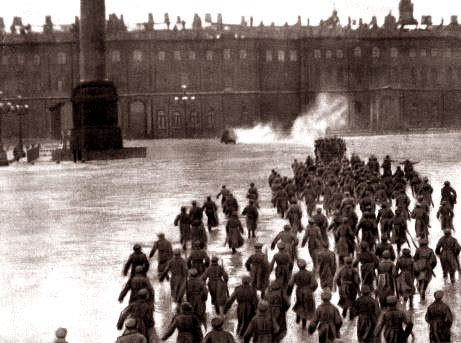
The 1920 Re-Enactment of the “Storming of the Winter Palace”
Today we consider the anniversary of Phase Two of the 1917 Russian Revolution, just eight months after Tsar Nicholas II’s regime was deposed and replaced by a Provisional Government. But the seizure of power by the Bolsheviks in their so-called October Revolution dwarfs even the monumental significance of toppling a millennium-long empire. For this epochal landmark in history marks the very moment when Marxism ceased to be a theory. Henceforth, socialism and communism became a practicing reality, and there would be grave implications for the citizens of the twentieth century.
The Great October Socialist Revolution – also known as the Soviet Revolution, or the Bolshevik Revolution, or Red October; and sometimes recognised on November 7th to correspond with the Gregorian calendar even though, at the time, the Russians were still using the Julian calendar – was in truth a rather underwhelming coup d’état and nothing at all like the mass uprising in February. The decision to seize power from Alexander Kerensky’s ineffectual Provisional Government occurred at a secret meeting only two weeks prior, shortly after Vladimir Lenin – disguised as a train engineer – slipped back into Russia from exile in Finland. The twelve members of the Bolshevik’s Central Committee, recognising that there was not the slightest chance their party could be democratically voted into power, resolved that “an armed uprising is inevitable, and that the time for it is fully ripe.”
The coup was launched on the night of the 24th. Signalled by a blank shot from the cruiser Aurora, Lenin re-emerged from hiding in the town of Smolny, where he took command of his armed proletariat Red Guards who proceeded onto Petrograd and, without need of one shot, seized control of its primary nerve centres including the post office, train stations, power stations and the central telephone exchange. At 2am on the 25th, the virtually unoccupied Winter Palace – former home of the Tsar and new premises of the Provisional Government – was taken bloodlessly by a small group of Red Guards. Accidentally happening upon the remnants of Kerensky’s government, the leader of the assault shouted: “I inform you, all you members of the Provisional Government, that you are arrested. I am Antonov-Ovseenko, a representative of the Military Revolutionary Committee.” The mainly illiterate revolutionaries then forced the prisoners to write up their own arrest papers.
And that was the October Revolution. With no army to fight on behalf of the Provisional Government – for they were otherwise engaged in a hopeless battle on the Eastern Front – the Bolsheviks had almost nothing to overthrow. As Lenin himself put it, they’d “found power lying in the streets and simply picked it up.”
So unlegendary was the coup that in 1920 Soviet propagandists staged a hagiographical re-enactment of the “Storming of the Winter Palace” in order to mythologise an event most Russians had never heard of. But the truth is, the Bolsheviks came to power after a single day of near-effortless revolution that resulted in only two casualties. The death toll would, of course, rise considerably, inconceivably so, as one of the bloodiest civil wars in history erupted. Only in its aftermath at the end of 1922 would Bolshevik power be consolidated.
A year later, Lenin would be dead – and the utopian humanism of Marxist theory would give way to the tyrannical reality of Stalinism.
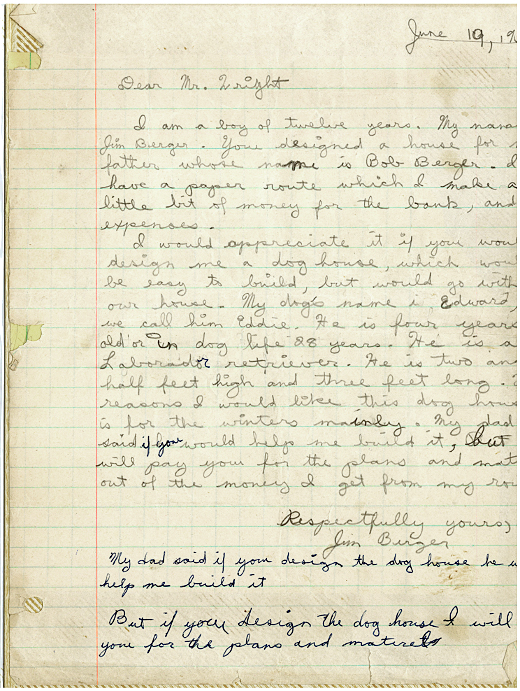
June 19, 1956
Dear Mr. Wright
I am a boy of twelve years. My name is Jim Berger. You designed a house for my father whose name is Bob Berger. I have a paper route which I make a little bit of money for the bank, and for expenses.
I would appreciate it if you would design me a dog house, which would be easy to build, but would go with our house. My dog's name is Edward, but we call him Eddie. He is four years old or in dog life 28 years. He is a Labrador retriever. He is two and a half feet high and three feet long. The reasons I would like this dog house is for the winters mainly. My dad said if you design the dog house he will help me build it. But if you design the dog house I will pay you for the plans and materials out of the money I get from my route.
Respectfully yours,
Jim Berger
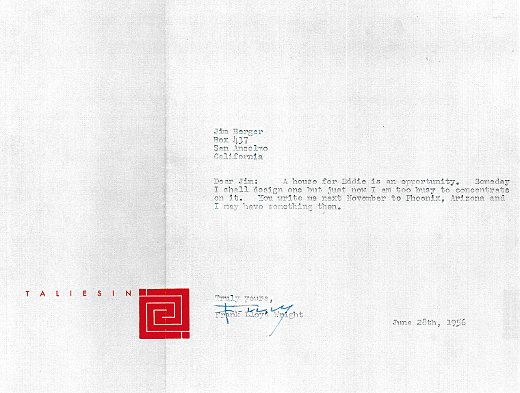
Dear Jim:
A house for Eddie is an opportunity. Someday I shall design one but just now I am too busy to concentrate on it. You write me next November to Phoenix, Arizona and I may have something then.
Truly yours,
Frank Lloyd Wright
June 28th, 1956
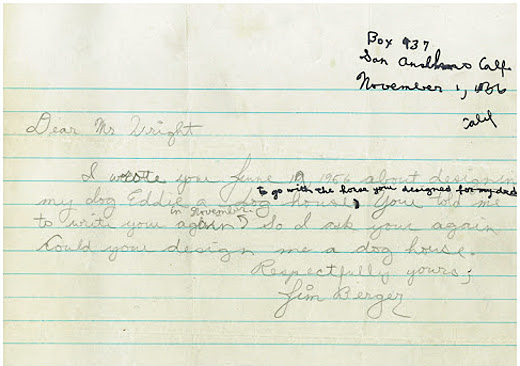
Dear Mr Wright
I wrote you June 19, 1956 about designing my dog Eddie a dog house to go with the house you designed for my dad. You told me to write you again in November so I ask you again, could you design me a dog house.
Respectfully yours,
Jim Berger


Mark Coker, the founder of Smashwords, has a blog up about Amazon Kindle Select. I pretty much agree with everything he said.
Take a read.
http://selfpublishingadvice.org/blog/amazon-plays-indie-authors-like-pawns/
 It’s fair to say that Liberal Reform and the Social Liberal Forum don’t always see eye to eye on economic matters, but on the issue of Secret Courts, they speak with one voice.
Last month, Liberal Democrat Conference in Brighton overwhelmingly passed a motion calling for:
- The Coalition Government to withdraw Part II of the Justice and Security Bill; and put in place instead a statutory scheme reflecting the current Public Interest Immunity system to be enacted which will retain judicial discretion, be a proportionate means of ensuring national security is not jeopardised by any litigation, and ensure the working successful democratic principle of open justice is retained.
- All Liberal Democrats in parliament to press the government to do this and in any event to press for the withdrawal or defeat of Part II of the Justice and Security Bill.
Today, both Liberal Reform and Social Liberal Forum websites carry a letter from the proposer of that motion, Jo Shaw, explaining why it’s so important that legislation enabling secret courts is voted down. She gives a number of examples to support her case:
1) A solider has his legs blown off when using MoD equipment he alleges was faulty. He and his family sue the MoD for negligence. The MoD refuses to compensate him and claims that the evidence about the alleged faulty equipment and the way he used it is national security sensitive, and therefore a Closed Material Procedure should be used. The government accuse the soldier in secret of being to blame for the accident (using a security sensitive source). He loses his case and never knows of the allegations against him or why he lost.
(2) A pensioner is knocked over by a car driven by the Security Services. She sues for damages. They claim that having regard to an alleged mission they were on at the time the driving was not negligent. They use a CMP to help them deny her compensation. She never knows the reasons why.
(3) An MI5 officer regularly visits one of his sources who has a young family in a safe house. He regularly abuses a young child of the family during the visits. The source is vulnerable and dares not complain. When the child grows up and wishes to take an action for damages against the officer the government obtains a CMP to ensure defence is heard in secret, and the reasons for denying compensation never made known.
(4) A newspaper publishes articles exposing corruption by government ministers in the arms trade. The government ministers and the arms companies sue for defamation. The newspaper relies on justification and brings forwards evidence that the allegations are true. The government minister wishes to adduce evidence of malice against the paper and says his sources are security sensitive. He uses a CMP to determine the case in his favour relying on the evidence of the security services. The newspaper is effectively gagged from repeating the allegations.
She adds that the signs indicate that the Bill can be killed off with members’ help and invites them to sign the petition asking our MPs, Lords and Ministers to deliver on this motion.
The press are always trying to split us into factions but this joint working shows that we’re a much more complex organisation than that.
* Caron Lindsay is Wednesday editor at Lib Dem Voice and blogs at Caron's Musings
October is a busy time of year for those who hit the streets for charity.
 This month, in my area, there’s a 5k for multiple myeloma, a walk for breast cancer, a 5k AIDS run, a 5k for Lupus, a 5k for juvenile diabetes, a 5k for carcinoid, two separate 5ks for kids with cancer, a 10k for multiple sclerosis, a 5k for ALS and a 5k for children with physical disabilities.
Name a disease and there’s a charitable research foundation committed to finding a cure, and for just about every such foundation there’s a corresponding 5k race or walkathon, lemonade stand, bake sale, golf tournament, banquet, concert, gala or festival to raise funds.
But for the biggest killer of them all, there’s nothing.
No 5k or 10k. No walkathon. No foundation promoting research. No research.
The deadly scourge that claims half of all human lives ever conceived is completely ignored.
Here’s Jonathan Dudley discussing this killer in his book Broken Words:
Due to hormone imbalances, genetic anomalies, and a number of unknown factors, between 50 percent and 75 percent of embryos fail to implant in the uterus and are passed with the monthly menstrual flow. If we agree with pro-life advocates that every embryo is as morally valuable as an adult human, this means that more than half of humans immediately die. This fact provides pro-life advocates with an opportunity to follow through on their convictions. Surely, a moral response to a pandemic of this magnitude would be to rally the scientific community to devote the vast majority of its efforts to better understanding why this happens and trying to stop it. Yet the same pro-life leaders who declare that every embryo is morally equivalent to a fully developed child have done nothing to advocate such research. … Even if medicine could save only 10 percent of these embryos — and we don’t know because no one has cared enough to ask — it would be saving more lives than curing HIV, diabetes, and malaria combined. One could say that this massive loss of human life is natural, and therefore, humans are under no obligation to end it. But it is not clear why the same argument could not be used to justify complacency in the face of AIDS, cancer, heart disease, and other natural causes of human death.
For anyone who genuinely believes the pro-life argument that “every embryo is morally equivalent to a fully developed child,” the sort of research Dudley describes ought to be an inescapable obligation.
And yet there are no charitable events to support the foundations funding such research. No such foundations exist to be supported. No such research exists to be funded.
That suggests one of two things. Either these pro-life advocates are complacent monsters every bit as callously unconcerned with saving unborn babies as those they oppose. Or else, just like those they oppose, these folks do not really believe that “every embryo is morally equivalent to a fully developed child.”
Perhaps there is some third explanation. There must be, right?
I mean there are millions of Americans who insist that every embryo, from the “moment” of conception, is a human person — the full moral equivalent of any other human person. That belief, more than any other, shapes our national politics, frames our national elections, and determines our national government. Because of that belief, millions of Americans will vote for Mitt Romney, regarding it as unthinkable to do otherwise.
Millions of votes will be cast based on this belief. Tens of millions of votes have been cast based on this belief. But there has not been even a glimmer of a notion of a thought in the direction of the sort of human-life-saving research that Dudley describes above.
Why not?
Former Mass. Gov. Mitt Romney, the Republican nominee for president, visited the Rev. Billy Graham earlier this month.
Presidential candidates have been doing this since before I was born. They meet with the respected evangelist, he prays for them and with them, they get their picture taken and announce what an honor it was to have met with the old preacher. The end.

Former Mass. Gov. Mitt Romney (left) meets with Franklin Graham (right) as the Rev. Billy Graham is posed between them.
Candidates have always known better than to seek or expect an endorsement from Graham. That has long been a matter of principle for him and for his ministry. Billy Graham was an evangelist, not a politician. He was called by God, he said, to preach the gospel to everyone — Democrats, Republicans, independents, everyone. And he refused to jeopardize that by taking sides in elections or partisan politics.
Until now.
Romney left North Carolina with Graham’s endorsement.
Graham did not speak publicly in support of Romney, but a statement attributed to the 93-year-old evangelist was released by the Billy Graham Evangelistic Association, led by Graham’s son, Franklin. And the following week, the BGEA began running newspaper ads in support of Romney. Those ads feature Billy Graham’s picture and words attributed to him by Franklin and the BGEA.
The BGEA took one more step unprecedented in its history — scrubbing its website of every critical reference to Mormonism and backing away from its longtime belief that the LDS Church is not Christian. Along with Romney’s political agenda, the BGEA endorsed his theology. Billy Graham and the BGEA had long characterized Mormonism as a “cult.” They no longer do so. Apparently, since Mitt Romney is a Mormon bishop, the elder Graham’s theological differences with Mormonism could not be allowed to cloud the endorsement of the Republican candidate now being attributed to him.
Here’s a whole bunch of links summarizing the BGEA’s newfound desire to reinvent Jerry Falwell’s Moral Majority.
David Badash of The New Civil Rights Movement was the first to call attention to the BGEA’s attempt to scrub its website of any criticism of Mitt Romney’s religion: “Billy Graham Endorses Romney Then Scrubs Site Calling Mormonism a ‘Cult.’” And Badash sees Franklin Graham’s grubby fingerprints all over this clumsy political maneuvering:
Billy Graham is 93 years old and in frail health. He’s been in and out of hospitals as recently as August.
It is unlikely that Billy Graham actually wrote the statement his organization released in his name.
Billy Graham’s son, Franklin Graham, earlier this year was widely condemned for comments he made on MSNBC’s “Morning Joe,” when he strongly questioned President Barack Obama’s faith as a Christian. “I can’t say categorically,” if Obama is a Christian, the younger Graham stated.
Adelle Banks of Religion News Service asks “Why is Billy Graham so involved in the 2012 elections?” Banks interviews Graham biographer William Martin, who says, “I’m reasonably certain that he’s not done this before.”
The new BGEA campaign is “more in line” with the son’s historical behavior than the father’s, Martin said.
“I think that Franklin has an influence in there,” Martin said. “But I can’t say … that he is leading his father to do something that he’s not willing to do.”
… Michael Hamilton, who chairs the history department at evangelical Seattle Pacific University, also sees the son’s hand behind Billy Graham’s political involvement.
“The ‘vote biblical values’ campaign repeats the slogans of the religious right in ways that Billy Graham never did until he was very old and frail,” Hamilton said. “I think it would be more responsible for the media and for Americans to interpret these statements as the statements of the Billy Graham Evangelistic Association and its current president, Franklin Graham, as opposed to the statements of Billy Graham himself.”
Jason Dye says the same thing, but with more candor and less tact:
[Franklin Graham] is a political hack who only needs to please a certain (and generally white, privileged, male-dominated) evangelical base. But he is shrewd enough to recognize that his father’s legacy is stronger and wider than his will ever be. As long as he can ride those coattails, he will. As long as he can convince his locked-away father — who is losing breath and consciousness — that he is taking care of him and convince his followers that the words that are supposed to be representative of Billy Graham are actually Billy Graham’s … then, glory be! Franklin Graham the scam artist/political hack can get away with destroying a legacy and helping to steal an election at the same time.
Ron Goetz is a bit more harsh — comparing Franklin to Grima Wormtongue, the poisonous, treasonous adviser who exploited the enfeebled King Theoden in Tolkien’s Lord of the Rings.
In two sentences, Hemant Mehta of The Friendly Atheist offers a clearer understanding of Billy Graham’s pre-2012 avoidance of politics — and the reasons for it — than Franklin or anyone else on the current BGEA board seems to possess:
I always thought that Graham’s appeal to most Christians was that he was never about politics; he was always about Jesus.
Now we know better: He’s as much a conservative shill as James Dobson, Bryan Fischer, Mike Huckabee, and all those other Christian leaders who see the government as little more than a tool to advance their faith.
The Burner Blog of Fuller Seminary responds to the BGEA ad in Graham’s name with withering sarcasm.
In The Guardian, Jonathan Wynne-Jones says, “Billy Graham’s lurch towards Mitt Romney risks his legacy“:
[The Grahams] are sending out a message that says God is on the side of the white, conservative Mormon rather than the black, liberal Christian.
By becoming so political they risk damaging the incredible work Billy Graham has done in spreading a gospel that preached forgiveness for all, because it turns out repenting might not be enough.
Instead, you have to ask for your liberal views to be washed away as well because your faith will always be suspect unless you subscribe to a certain brand of Christianity.
All across the board, this deviation from Billy Graham’s previous a-political stance has been seen as a disaster for his legacy and for the BGEA and it’s once-central evangelistic mission.
But it hasn’t been a disaster for everyone. As Graham’s hometown paper, the (Asheville, N.C.) Citizen-Times, notes, the BGEA’s spastic lurch toward partisan activism may have given Romney a boost with white evangelical voters:
The meeting was aimed at improving Romney’s image with conservative Christians, especially in the South where he will need strong turnout to win the White House.
Romney has faced some difficulty with evangelical voters, in part because some believe his Mormon faith means he is not a Christian.
And as the local TV news, CBS Charlotte, reports:
Romney’s embrace of Franklin Graham draws in an evangelical leader who has been criticized for his harsh views of Islam. The younger Graham has described Islam as evil and offensive and has said Muslims should know that Christ died for their sins.
This, I think, is the core of the story. Romney needed white evangelicals to embrace him as part of their sectarian tribe. And Franklin needed a prominent Republican to help restore his standing after a string of talk-radio-style incontinent gaffes. So they worked out a deal.
Two sons desperate for the power once wielded by their more-famous fathers — both unable to display the integrity their fathers displayed by pursuing something other than power. But they were able to help each other.
The oddest aspect of this story is that Billy Graham hasn’t just abandoned his long-standing principled opposition to taking partisan sides in an election. He has also purportedly abandoned his long-standing theological disagreement with Mormonism.
Whatever the merits or demerits of Graham’s view of Mormonism prior to late this year, the salient point here is that he believed it to be a “cult” — something other than Christianity. Now he and his BGEA are just treating it like one more denomination. (And — as Mark Silk points out — Romney, a former stake president in the LDS Church, took an unusual step from his side by agreeing to pray with non-Mormon Graham.)
As Chaplain Mike wrote at Internet Monk, “I think they just sparked a theological debate.”
And they did so, ironically, by pretending that there is no theological debate — or at least no theological differences equal to their political affinities.
Scot McKnight quotes from BGEA’s chief of staff, Ken Barun, who said the description of Romney’s religion was removed because “we do not wish to participate in a theological debate about something that has become politicized during this campaign.” McKnight notes:
This is precisely what has not been done; BGEA has politicized theology by removing it.
Elsewhere, McKnight noted: “Over the years Billy Graham has made mistakes in connections with the White House; this one appears to be another mistake in the political realm.”
The clumsy Franklin-ness of this whole business is that it doesn’t seem to have occurred to him or to anyone at BGEA that America has a secular government in a religiously pluralistic society. They seem to think that they couldn’t endorse Romney without endorsing Romney’s religion, and so — because they decided politics was more important than theology — they chose to give Mormonism a big sloppy kiss of BGEA-approval. Weird.
Evangelicals say that the Bible and theological orthodoxy are the most important things for a Christian to abide by. And yet, time and time again, evangelicals will forsake these tenets for political expediency.
… It seems that Graham, like many other evangelical leaders, is supporting Romney. That’s totally fine. But to sweep under the rug their long-standing teaching that the LDS Church is a cult is not only disingenuous, it’s downright deceptive.
And finally, Alan Bean provides a terrific bit of historical perspective in a post titled “Why Billy Graham is down with a Mormon president.”
“Billy Graham reflects the best and the worst of the culture that produced him,” Bean writes, speaking of mid-20th century Southern white evangelicalism. You should read the whole thing, but this part is particularly good:
If you can get past theology, white evangelicals and Mormons are cut from the same bolt of cloth. Both groups are highly patriotic, endorse hard work and personal responsibility, believe in a small government and insist on a dominant military. Truth be told, both groups have backed away from their traditional embrace of white supremacy gradually and with a marked lack of consistency or sincerity.
This racial ambivalence is easily explained. Jim Crow enthusiasts took a terrible psychological thumping during the civil rights movement of the 1960s. Men and women who had traditionally seen themselves as the conscience and moral heartbeat of America, suddenly found themselves denounced as bigots and haters, a loathsome cancer that should be excised from the body politic.
Southern evangelicals never recovered from the shock.
… Over three decades later, the specter of “liberalism” has grown to monstrous proportions in the evangelical imagination. If you hate liberals, the religious Right is willing to be your friend.
This explains why Billy Graham and other evangelicals are making peace with Mitt Romney’s Mormonism. Their theological opposition to the Latter Day Saints hasn’t dimmed in the least, but anti-liberal ideology, not Christian theology, calls the tune in this brave new world of ours. The Religious Right inhabits a Manichaean world. They can only be bathed in light if their opponents are shrouded in darkness. If evangelicals represent the salvation of the world, liberals must spell the damnation of all things good and lovely. They simply must.
See also:
• Religion News Service: “After Romney meeting, Billy Graham website scrubs Mormon ‘cult’ reference”
• Raw Story: “Billy Graham website admits scrubbing ‘Mormons’ from ‘cult’ list after endorsing Romney”
• CNN: “Billy Graham buys election ads after Romney meeting”
• David Badash: “Billy Graham, Even After Endorsing Romney, Still Believes Mormonism Is a Cult”
• Bruce Wilson: “Graham’s Romney Endorsement Accidentally Spreads ‘Mormonism Is a Cult’ Meme to Millions”
• Pastor Chris: “Billy Graham Sells Out Before Checking Out – Mormonism No ‘Cult’”
• A Life in Juxtaposition: “Dear Franklin Graham: DBAA With Your Family Legacy”
• Alise Wright: “Billy Graham, politics and promoting the gospel”
• Frank Schaeffer: “Franklin and Billy Graham Sell Their Souls for a Mess of Republican Pottage”
• Frank Schaeffer: “Billy Graham Endorses Romney’s Secret Conversion to Islam — Says ‘At Least He’s Not a Homosexual!’”
| archive - contact - sexy exciting merchandise - cute - search - about | |||
 |
|||
| ← previous | October 23rd, 2012 | next | |
|
October 23rd, 2012: Again I'm not sure what to put here so I have composed... a poem!
How much pie is too much pie?
– Ryan 
| |||
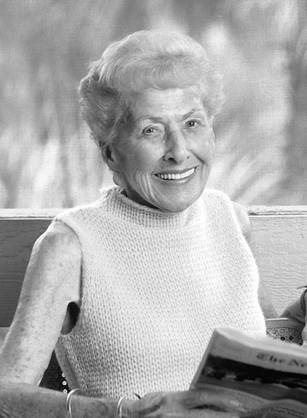
Jane Elizabeth Hodgson
There are many reasons why a pregnancy may be unwanted. A woman may have no access to contraception or already have too many mouths to feed. It may endanger her health, even her life. She may have been raped. The foetus may not be viable. No matter what the circumstances, the decision to terminate a pregnancy is one of the most difficult that a woman will ever make. So imagine how much tougher it would be if abortion was illegal. Millions of women across the world are still denied the right to a legal, clinical abortion for political, cultural and religious reasons.
And so today, the women of North America can thank their lucky stars for the work of obstetrician and gynaecologist Dr Jane Elizabeth Hodgson who died in 2006 aged 91, after a 50-year career.
Brought up in the early 20th century to consider abortion as immoral, the more Dr Hodgson saw the more she began to understand that the lack of abortion was immoral. She was troubled by the numbers of women attending her clinic begging quietly and desperately for abortions. Especially heart-breaking were the numbers of women she treated for complications from botched back-street jobs: you can imagine the kind of terrible injuries and infections she came face to face with. And all of it preventable. The majority of her work took place at home in Minnesota, but she worked in Africa and Central and South America. Everywhere she went she observed women’s lives, health and ambitions blighted by a lack of reproductive choice. She noted that: “a woman’s place in society was directly related to the availability of abortion services, contraception and family planning services. In countries where it was all illegal, women were much worse off as far as their overall rights, health care and poverty levels.” Look around – it is still the case.
In a 1970 a young pregnant mother of three arrived at Dr Hodgson’s clinic. She had contracted rubella, a devastating disease which causes defects in the unborn child. She wanted an abortion, sadly illegal in Minnesota except to save a woman’s life. Hodgson realised this could be the test case she needed to promote her cause. Hodgson was convicted of the ‘crime’ and sentenced to 30 days in jail, becoming the first US physician to be convicted for carrying out an abortion in hospital. Other legal challenges would follow. She established sexual health clinics, campaigned to ensure that women receive full reproductive health care and changed laws.
Throughout her life Dr Hodgson was harassed as a baby killer, sent hate mail and intimidated by small-minded people more interested in maintaining their vile dogmas than the health of vulnerable, frightened women. “If at any time I’ve ever had any doubt about what I’m doing, all I have to do is see a patient, and talk to her, and I realise it’s the right thing” she said.
Well into her 70s she was still practicing. When other physicians would not carry out an abortion having been scared off by the abusive, placard-wielding morons, they would call on Dr Hodgson knowing that she would go to a woman’s aid calmly, swiftly and without judgement.
It’s incredible to think that there are still people out there who wish to deny women basic reproductive choices and will resort to violence to achieve it. And so to the sacred-foetus-brigade, I say this: if you don’t want an abortion don’t have one. But if my daughter needs one, she’ll have one thanks, and it’s none of your damn business. It is not for anyone except the individual woman to make reproductive decisions for her.
[Written by Jane Tomlinson]

