Shared posts

15 Feb 15:03

Announcing New Lecture Series

by dwsmith
Andrew Hickey

I might sign up for one of these, see what they're like...

For some time now I have been mentioning that we will be starting up a lecture series at WMG Publishing. Well, we have the first three lectures done and will be adding in new lectures almost every week from now on out.

You can get full information at any time on the Lecture Series on the tab above.  I will announce new lectures as they come live and put them under the tab above and also on the sidebar list.

Right now there is a long lecture by me on Heinlein’s Rules and two regular lectures by Kristine Kathryn Rusch, one on how to Read Like a Writer and another on How to Write a Short Story: The Basics.

Some Basics About the Lectures

— Each lecture is on a topic that might interest writers in one fashion or another.

— These are video lectures. And each lecture is made up of a number of videos each about seven to ten minutes long. (A couple of the videos get much longer, however. But we tried to keep them in the ten minute range so that you could go and come from the lecture as you wanted and had time. Similar to what we are doing in the online workshops.)

— You can come and go and watch a lecture at your own pace. And come back as often as you would like for as long as you like.

— The passwords for each lecture will change on the first of each month, but if you have paid for a lecture, simply write for the new month’s password if you would like to come back and watch part or all of the lecture again in the future. (If you sign up during the last week or so of a month, we will give you two month’s passwords.)

The Available Lectures

More lectures will be added onto the list every week or so by a varied number of professionals on a varied number of topics. Check back regularly.

Lecture #1

Heinlein’s Rules.

15 videos by Dean Wesley Smith (who follows Heinlein’s Rules)

Price: $75.00 

Robert A. Heinlein, in 1947, in an effort to help new writers coming in, gave what he termed as his “business habits.” He basically said that if followed, his rules will make a want-to-be writer into a professional writer.

But Heinlein acknowledged that the simple five rules seemed almost impossible to follow. Heinlein said, “…they are amazingly hard to follow–which is why there are so few professional writers and so many aspirants…”

USA Today bestselling writer Dean Wesley Smith talks about each of the five rules, why they seem so difficult, why they work for writers when followed, and how to follow them even in this new world of indie publishing. Dean started following all five of Heinlein’s Rules in 1982 and since 1987 worked as a full-time professional fiction writer. He still follows the rules to this day.

You may not end up following Heinlein’s Rules, but you will learn a vast amount about writing from these 15 videos.

———–

Lecture #2

Read Like A Writer.

8 videos by Kristine Kathryn Rusch, award-winning writer and editor.

Price: $50.00 

Award-winning and bestselling writer, Kristine Kathryn Rusch talks about how aspiring writers read in the wrong fashion and for the wrong things. Then she goes on to explain how professional writers read to enjoy books and keep learning from other writers. And she tells you how to make that switch from reading poorly to reading to help your writing.

For a writer hungry to keep learning, reading becomes critical. But reading in the wrong fashion can set back your progress. A critical topic for all writers.

These eight videos may change how you look at books as a writer, and they certainly might help you bring back the fun of reading again.

———–

Lecture #3

How to Write a Short Story: The Basics.

7 long videos by Kristine Kathryn Rusch, award-winning writer and editor.

Price: $50.00 

Kristine Kathryn Rusch won a Hugo Award for both her editing and her short fiction, the only person in history to do so. She is the only writer in history to be in all four Dell Magazines (Asimov’s, Ellery Queen, Analog, and Hitchcock’s) in the same year. And she accomplished feat that in numbers of years now. Nominated for every major award in short fiction in varied genres for both editing and writing, she won a number of them.

In these videos, Kris lays out the basics of how to write a short story.

If you have questions about something in a lecture…

— If you have a question about something in the lecture, there are two ways to get an answer. First, at the bottom of each page is a comments section. Everyone listening to the lecture will be able to see the question and the answer, so that will turn into a FAQ area for each lecture.

— If your question is more private in nature, simply e-mail us and we will do our best to respond.

How to Sign Up

— The prices are on each lecture in the list below as well as the number of videos included in the lecture. Again each video is about eight to ten minutes long, with some being longer.

Step one…

Write Dean at dean@deanwesleysmith.com and give him the following information.

1… Name

2… E-mail address

3… Name of lecture(s) you are signing up for.

Please put “Lecture Series” in the subject line to help the spam filter bypass. 

Step two…

Pay for the lecture by either…

— PayPal to dean@deanwesleysmith.com

— Send a check made out to WMG Publishing to WMG Publishing, PO Box 479, Lincoln City, OR 97367.

Step three…

Once payment has been made, we will send you the password for the lecture(s) and from that point forward you are free to come and go with that lecture and watch each video as many times as you would like for as long as you would like.

The Lectures:

#1… Heinlein’s Rules… Dean Wesley Smith 15 videos… $75.00

#2… Read Like a Writer… Kristine Kathryn Rusch… 8 videos… $50.00

#3… How to Write a Short Story: The Basics… Kristine Kathryn Rusch…. 7 videos… $50.00

-

Watch for more lectures coming each week.

And if you have a request for a lecture topic or any questions at all, please e-mail me and put Lecture Series in the subject line.

We’re pretty proud of these. I hope you enjoy them.

15 Feb 14:59

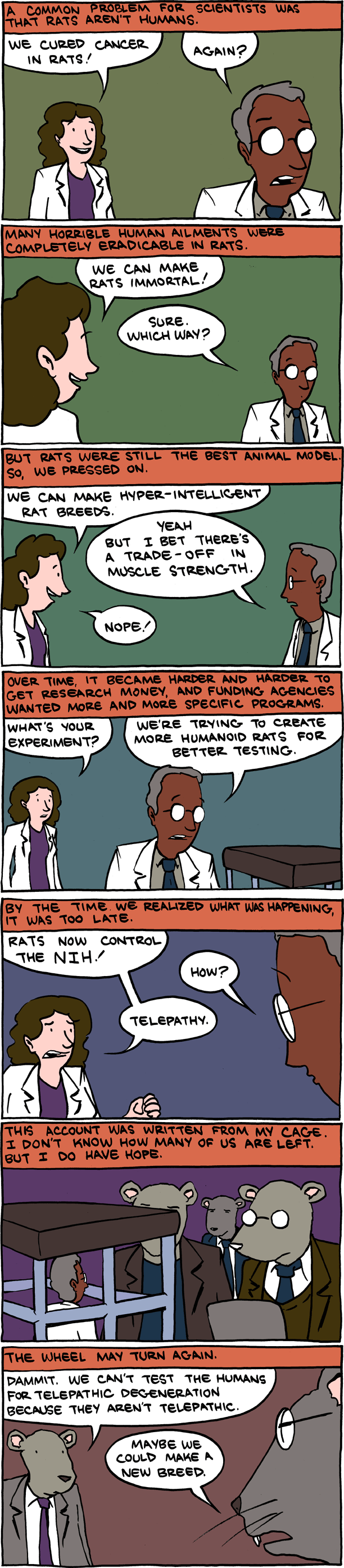
Comic for February 14, 2013

14 Feb 15:35

On IDS's Sun outburst...

by noreply@blogger.com (Lee Griffin)
Iain Duncan Smith has lashed out at those that helped strike a blow against the government workfare systems yesterday, in the Sun

LET me be very clear — our back to work schemes are successful

No they're not, at least not the ones that people have a problem with. This is the problem with our government talking about "back to work schemes", no one has a problem with paid for training, on the job training, apprenticeships. It is the compulsory and pseudo-compulsory act of "mandatory work activity" and it's siblings that are the problem, and they aren't working.

In fact the very existence of these schemes that purely provide us, the "hard working tax payer" (see below), the means to pay for someone to work for a multi-million pound national or international company without that organisation having to pay even a fraction of what they would otherwise, may well be entrenching a cycle of poverty in to our society that is impossible to get out from.

And a gentle reminder that if everything is so successful, we need to know why unemployment isn't even going down, really.

and are not slave labour.

Legally, no they're also not. There is, however, a perfect quote for this...

"There is always a choice."
"You mean I could choose certain death?"
"A choice nevertheless, or perhaps an alternative. You see I believe in freedom. Not many people do, although they will of course protest otherwise. And no practical definition of freedom would be complete without the freedom to take the consequences. Indeed, it is the freedom upon which all the other are based."
Lord Vetinari and Moist, in "Going Postal" by Terry Pratchett


The only technicality by which compulsory (or perceived compulsory, as was the case in court) work has to be undertaken, in order to retain benefit payments, doesn't classify as "Slavery" is that no-one is actually bound to legally or otherwise to that duty. They do, if they so wish, have the choice to simply have no money.

This is a choice that means they lose their home almost certainly, won't be able to buy food, or pay bills...not unless they have some friend, relative or local foodbank willing to give them hand outs.

So, are people being forced to do this work? No. Do they really have any other choice? No.

Nobody works for free on these placements because the Government continues to pay their benefits. So nobody is working for nothing, are they?

Dangerous words here from IDS. Why? If he deems that these people are working (and there is a contract there, so note this is very close to the line) then there is a bit of legislation that should apply to them. You cannot act like these people are workers in one breath, but then deny them the rights that we are calling for...a fair wage for a day's work.

I believe IDS has let his guard slip here, this comment/attitude may be useful for those campaigning against workfare going forward.

I disagree with the part of the ruling that found against our regulations and we will appeal against that

That is his right, to spend our money on feckless legal challenges rather than just get on with the job, of course.

but crucially the court did not find that anyone’s human rights have been breached because we asked them to do a work placement in return for Jobseeker’s Allowance.

See above.

The court said our technical regulations should be clearer and we have rectified that.

So...you're not appealing them then? Or you're appealing them even though you have found a way that you can comply with the ruling, which kind of proves the ruling's point? Oh IDS...

People who are fit to work should no longer expect to receive benefits if they do not do everything they can to get a job.

Which is weird, because there are people "doing everything they can" to get a job, like those that were in court fighting their sanctions, but the system doesn't recognise that they are doing this. It also doesn't recognise that regardless of how much those people are trying to get a job, but not finding one because there are not enough jobs to go around they will be forced in to less-than-minmum-wage labour after a set period of time.

I can kind of understand, though completely disagree still, with the idea that if you objectively find someone is simply not trying to find a job that you mandate them to take work experience... forcing people to take work after 9 months simply because they've been unemployed that long in an almost-triple-dip recession? That's not about expectations around benefits and all about a government that wishes to get people off of the unemployment statistics.

To compare work experience to “slave labour” is hugely insulting to people living in oppression around the world

A strange statement, because while no-one is truly equating the rather technical definition of being in slavery with the slave trade of the past, and horrific slavery that still exists, IDS seems to think it is ok to use these faceless victims as a reason to try to silence critics of the lack of ethics in his policies.

I honestly feel this is a subject that has so many parallels (though is of a completely different and less significant scale) to the perception of the slave trade in the past, what we are existing in now is a period where some people believe this exploitation of people's situation is ok, and others believe it is not. In the past those who believed in ethical behaviour won out and slavery was abolished and the right to be free from slavery is one of our core human rights.

It is that kind of belief in being above the lowest form of human behaviour that we need to rekindle now.

and sneers at hard-working taxpayers who pay for benefits.

Ah, the old "hard-working" line! Love this one. If you earn lots of money you are a "hard worker", if you can only get a job because someone cuts the hours of an existing employee...or worse still cuts jobs only to restaff them with those on welfare-to-work schemes, then you are a "shirker". How on earth do you try and quantify how "hard" someone sitting in an office waiting for calls to come in is working compared to someone that is about to lose their job as a cleaner only for it to be reinstated as a "mandatory work activity placement" months later?

IDS doesn't have anything of worth or factual value to add here, just rhetoric that aims to drive a wedge between those who have been fortunate and entrepreneurial, and those who are less fortunate. IDS, quite frankly, doesn't care enough about people to realise what utter horseshit he is spewing when he defends these kinds of schemes.

I hope we won't have to wait too long before compassion sets in and we understand what we are doing to people, all in the search to have a dubious statistical "win" to beat the opposition with at Prime Ministers Questions.
14 Feb 14:50

How to Understand Human Behavior

by Scott Meyer

I am away from the internet for a bit, and cannot moderate comments. As such, comments are disabled on this comic. They will be back soon. I apologize for any inconvenience.

Thanks as always for using my Amazon Affiliate links (USUKCanada).

14 Feb 14:48

Anniversary of 1906 Parliament under Campbell-Banneman

by noreply@blogger.com (Alun Wyburn-Powell)
Today is the anniversary of the start of the 1906 Parliament, under Sir Henry Campbell-Bannerman’s premiership. CB, as he was popularly known, was the first person officially to be designated ‘prime minister’. 

Campbell-Bannerman had actually become prime minister on 5 December 1905, when Balfour’s Conservative government resigned from office. After the dissolution on 8 January 1906, CB led the Liberal Party to its greatest ever election victory with 400 seats.  CB was the oldest person to become prime minister for the first time in the 20th century, at the age of 69 and the only prime minister to have died at 10 Downing Street. He resigned the premiership on 3 April 1908 in very poor health, but was allowed to stay in the prime minister’s residence by his successor, Asquith. Campbell-Bannerman died at number 10 on 22 April 1908.
  Today CB is an almost forgotten figure. He would have rivalled Clement Attlee in the modesty stakes, but Sir Henry Campbell-Bannerman deserves to be remembered for his landslide election victory and for presiding over a hugely talented cabinet containing Asquith, Lloyd George, Grey and Haldane.
13 Feb 23:28

Trans amendments to the Marriage (Same-sex Couples) Bill

by Zoe O'Connell

A number of amendments for trans people have been submitted formally in parliament, but unless you’re a legal whiz with some spare time to hand it’s not immediately obvious what they are. So, here’s a quick guide to what the relevant ones do…

Amendment 4 – Prevent voiding of marriages with a trans person

At the moment, a spouse can have a marriage voided (As if it had never happened) by claiming they did not know that their partner had a gender recognition certificate at the time they married, and this amendment removes this. There is no similar provision covering, for example, religion or similar and creates a situation whereby a spouse who does know about their partner’s history later claims ignorance if their partner is not very publicly “out”.

Amendment 5 – Remove spousal veto of legal recognition of gender

Because a marriage would, under the existing system, need to be converted to or from a civil partnership on one partner transitioning, there is a requirement for an interim Gender Recognition Certificate to be issued and the existing partnership be annulled prior to full recognition of legal rights. This was done to prevent a spouse being forcibly re-entered into a new relationship (Civil partnership or Marriage) they didn’t want and could not get out of due to the one-year minimum term before divorce can be applied for in a new relationship.

This is no longer the case, but the bill did not reflect that fully. Instead, it allowed a partner to delay or potentially block someone getting full legal rights in their acquired gender by refusing to give consent, a situation that would also incur additional costs for the trans person by forcing them to use the interim GRC process.

The amendment levels the playing field by only issuing an interim GRC if both parties request it, rather than simply if the spouse refuses consent. (As it stands, it also causes an Interim GRC to be issued in the case of a civil partnership, because the current bill does not allow for mixed-sex civil partnerships)

It takes 2 years post-transition to get a GRC, so an unhappy spouse still has plenty of time to apply for divorce.

Amendment 6 is tidy-up related to amendment 5, removing clauses that are no longer relevant.

Amendment 7 – Restoration of lost marriages

This simply allows marriages that had to be annulled so that someone could get legal recognition to be reinstated as if they had never been broken. If you want to know more, Sarah wrote about this for the Huffington Post.

Amendment 8 – Reissue of marriage and birth certificates

The bill did not make reissue of marriage certificates explicit, but this amendment does. It allow allows birth certificates to be reissued, with consent of all concerned. (The other named parent if the child is under 16, otherwise the child themselves)

There is still more we’d like to get done (Fixing pensions issues and swapping gendered terms like husband/wife for gender-neutral and non-binary terms like partner) but time is limited! Hopefully they’ll get in too eventually.

Of course, tabling amendments doesn’t mean they will pass but it does mean we are well on the way.

Featured on Liberal Democrat VoiceAnd finally, many thanks to Dr Julian Huppert MP for his help getting the amendments tabled.

11 Feb 15:47

Workflow

There are probably children out there holding down spacebar to stay warm in the winter! YOUR UPDATE MURDERS CHILDREN.
10 Feb 15:37

Why Eastleigh demonstrates that Labour will not win the 2015 General Election

by noreply@blogger.com (Richard Morris)
Well, there's another bold hostage-to-fortune type headline. But if the current limited polling is anything to go by, Ed M's in trouble...

Labour goes into the by election with no expectations of winning. Eastleigh is no 258 on their target list seat.  But on the current limited polling, they should be doing much better than this.

The two polls published so far run as follows

Ashcroft Private Poll


New Poll - Survation for MoS

Now, while it's dangerous to read too much into these polls, they tell us a number of interesting things. It's close between LDs and Tories, UKIP is doing much better than they normally do (they took between 3 and 4 % in the last to GE's - maybe the local Tories are not as nuts as I thought picking a tea party candidate) - but the most interesting thing is surely, for now at least, the performance of Labour.
They should be doing much better than they are in a seat like this - as Andrew Rawnsley points out, they should be thinking about winning..
Look how they did in the last two GEs here

In the last GE, with Brown as PM leading a hugely unpopular government, and mass tactical voting, they still managed 10% of the vote - not that far off the figure the MoS poll gives them now, even with the demise of the 'vote Lib Dem to keep the Tories out' strategy. (Actually,  I saw a tweet from a Labour supporter claiming we were sending leaflets out in Eastleigh yesterday saying that - really? Not so sure about that as a strategy if it's true - but I digress...)
Even the first poll that gives them 19% really only matches the 20% they got in the General Election before one - when they were still in government. Oppositions are meant to do better than long term governments in seats they don't hold
As I say - two snap polls, small samples, a one off by election. But if Labour can't do better than their 2005 GE performance, when they were led by Tony Blair, post Iraq and all - then there's no way they'll win an outright majority in 2015. Their lead in the national opinion polls suddenly looks very soft indeed.


10 Feb 13:11

I need feminism because I’m not an immature 5-year-old.

by feministaspie

At school, when I was 4 or 5, there would be huge lines of girls linking arms and skipping around the playground chanting “No boys allowed!”, and vice versa. I’d imagine that if a teacher had said “Can’t we all get along?”, they would have received confused stares. Sadly, although I’ve left school, I still see this situation all around me.

In the kyriarchy, gender is binary. In the kyriarchy, we’re all supposed to live as two teams and compete in the “battle of the sexes”. In the kyriarchy, so it seems, there can be only one winner. Throughout history, this “winner” has been men, although rigid gender stereotypes have been created for both sexes. That’s why the feminist movement developed. Feminism is the struggle for an alien concept to the kyriarchy - equality. And we’re not done yet. The patriarchy continues to cause so many problems, as demonstrated this week by OUSU WomCam’s “Who Needs Feminism?” campaign, in which over 470 pictures were taken, in various Oxford locations, highlighting why feminism is still relevant.

However, this is the kyriarchy, and the kyriarchy doesn’t know what “equality” means, and it certainly doesn’t know what feminism means. According the the kyriarchy, such a campaign must be misandric (even though at least 1/3 of the pictures are of men) because that’s what the kyriarchy does; it uses divide-and-rule. The kyriarchy thinks feminists are incapable of seeing how stereotypes affect men. The kyriachy sees feminist campaigns as “girls are better than booooooys!” playground chants, and the kyriarchy chants back.

Enter the #INeedMasculismBecause hashtag. Thankfully, it quickly filled up with parody tweets, but there were some genuine tweets in there, which have been listed and responded to in this brilliant post by Flightrisker. Most of the arguments are either statistically incorrect or just plain wrong (I’ve never seen a feminist campaign for all men to pay on dates. Ever.), and all are based on the typical right-wing media view that feminism is about female superiority. Just to clarify, it isn’t.

Here’s an example; the one true problem that kept cropping up in the hashtag was that mothers disproportionately gain custody of children in divorce cases. Think about this:

  • Mothers disproportionately gain custody of children because childcare is still seen as a woman’s job.
  • Childcare is seen as a woman’s job because of gender stereotypes.
  • Gender stereotypes are enforced by the patriarchy.
  • Therefore, mothers disproportionately gain custody of children due to the patriarchy.
  • The struggle against the patriarchy is feminism.
  • The #INeedMasculismBecause hashtag is a struggle against feminism, and therefore takes the side of the patriarchy.
  • Therefore, this hashtag is part of the problem.

The same could also apply to the idea that men always have to pay for dates.

As for the idea that feminists want special treatment for women – as I’ve already said, that’s not how it works. Contrary to what the media would have you believe, women and men are not two alien tribes who constantly play tug-of-war to see who’s better. However, many aspects of society gives special treatment to men; how many all-male speaking panels do you see or hear about compared to all-female panels? All-male bands and all-female bands? How many films and TV shows pass the Bechedel Test, and how many would do so if the sexes were reversed? It’s gone on for so long that most people, regardless of gender, just don’t notice anymore. This is the norm. So, when any attempt at equality is made, or at least campaigned for, suddenly it’s SPECIAL TREATMENT and WHAT ABOUT THE MEN and MISANDRY and all sorts of myths about feminism.

I am proud to call myself a feminist, because feminists have always fought for equality; the whole “battle of the sexes” thing is just plain immature, and oppressive to everyone. People are not just pawns in a huge sexist game where everyone thinks that their team is best. To quote my school days again: It’s not faaaaaaaaaiiir, and I’m not playing anymooooooooore!


Tagged: divide and rule, equality, everyday sexism, feminism, i need feminism, kyriarchy, mras, patriarchy, sexism, who needs feminism
10 Feb 13:10

Town in Steel (or some such pun that doesn’t quite work)

by Plucker

One joy of making the In Town series is experiencing the immense, sometimes ridiculous sense of pride in each place we visit, especially when there’s nothing obvious to show off about. Anyone can be proud of New York or Venice but it takes guts, talent, determination and an iron will to be proud of Corby.

No one there boasts about the panoramic views, because the most prominent view is of a 1970s concrete shopping centre that looks like a giant jumble sale, that’s infuriatingly complicated to find your way out of, so in desperation you head up some steps that lead to the sort of locked rusty gates you clamber over when being chased by Bruce Willis, then back past Greggs the bakers for the sixth time, when you become reconciled to setting up home in Poundland until you can persuade air rescue to send a helicopter.

It wouldn’t be easy to sell Corby as a tourist resort. The Holiday Inn franchise, bless them, gives it a go, and we stayed at the Corby branch of their franchise. I wonder how truthful that name is, and how many people decide that, for a change, instead of the beach they’re going for two weeks to a spot by a breaker’s yard on an industrial estate in Corby.

So the pride doesn’t revolve around its grand buildings or celebrities or restaurants, it stems from its ability to emerge from adversity.

The book Corby Works informs you humbly “Today Corby prospers again: a Phoenix risen from the ashes of its once proud heritage. A town that refused to die has, against all the odds, survived to see the dawning of a new age. A monument to its own endeavours and a shining example to others.”

It’s a speech that I think has been borrowed from Alexander the Great following his invasion of Egypt, but can easily be adapted to suit the re-opening of a fitness centre in Corby.

A project called Our Corby collated interviews and poems to create a film and a book, and found pride in unexpected areas, such as the history of the football team. For example there’s this magnificent piece –

“The unmistakable roar of a crowd, a goalmouth in silhouette,

The thud of a pass, the smell of grass, macassar oil and sweat.

This is a field where hearts are won, where names are muddied or made,

Where myths are born and chances torn and games like this one are played.

A lofted shot that clears the bar and leaves the keeper stretching up.

Yes that’s right, it’s the Inter-Village Graham Fraser Memorial Cup.”

But mostly the pride comes from its unique and brief history. It was built in the nineteen-thirties, in Northamptonshire, around the new steelworks, attracting unemployed steelworkers, many of which walked from Glasgow or Aberdeen for a job. So many came that the town retains a Scottish accent, even amongst people who’ve never been to Scotland.

Corby boasts the biggest Glasgow Rangers supporters Club outside Glasgow in the world. It hosts a Highland Games, and has the greatest sales of Irn-Bru outside Scotland, a fact cheered by the audience, in the way a Liverpool crowd might cheer if you mentioned they were five times winners of the European Cup.

I met Don and Irene, both in their seventies, at the Grampian Club. Don’s father had walked from Larkhall, near Glasgow to Corby in 1932, and though Don had hardly ever been to Scotland he had a smooth Scottish borders accent. He wore a jacket and tie to the club, and smiled as his wife told of the shows she’d seen at The Cube theatre, where I’d be doing the recording the next night. “The harmonies were glorious”, Irene said, “And I felt lifted, truly lifted.”

“I didn’t go”, said Don, “I was happier at The Grampian with a pint.”

Don did tell me an old steelworkers’ poem his dad often quoted, which also revealed the importance of the Golden Wonder crisp factory in the town. It went

‘I’m doon at the steel works, I work day and night

My wife’s making crisps, we have never a fight,

The reason we’re happy is clear de ye ken

My shift’s six to two and my wife’s two to ten’.

I mentioned the national steel strike of 1980 to Don, which he must have been involved with, but he giggled and gestured as if it had somehow passed him by.

Instead he and Irene talked of the times they went fishing, and swimming in the river that’s now blocked off as it’s too dangerous, and how the steelworks dominated every aspect of the town; the soot that ruined your washing if the wind blew the wrong way, the giant flame known as the Corby Candle you could see from near Peterborough. And Don grinned at almost everything Irene said, and as I left she told me she was looking forward to the show, and Don said “I won’t be there myself, I’m happier here at the Grampian with a pint.”

Don had been one of 14,000 people employed at the steelworks, until 1979 when Margaret Thatcher, having become Prime Minister, announced a series of closures at British Steel, including the plant at Corby, and the union responded by calling a national strike.

It began in 1980, while I was far away in Kent, a teenager new to the world of political activism, so I was excited at the idea of the strike, because somehow I might collect money for it or something and maybe even meet a steelworker, or at least meet someone from the north.

At one point two steelworkers even slept in the living room, which was a shock to my mum when she found them. To be fair to her, it must be confusing when a story you only expect to see on the news makes its way into your living room. It was probably as unlikely as coming home during the war with Iraq and seeing Saddam Hussein boiling an egg in the kitchen.

I spent three exciting months with the steel strikers, so I felt a connection with Corby. Because its story revolves around the opening and closing of that steelworks, and the strike consumed the whole town. There were sure to be a host of anecdotes and stories, hilarious and chaotic and inspiring, to use for the show.

Louise, an effervescent woman who delighted in how she shocked her grandchildren by entering swimming races in open rivers, had worked in the canteen at the steelworks. She bubbled with pride at the new poets and playwrights in Corby, but seemed unable to remember many stories from the strike.

Iain, who’d made tubes, and whose father moved there in 1933, living for the first few months under a bush, was enthusiastic about the kids’ art project he’d helped to set up, but couldn’t remember much about the days of the closure.

And that was the pattern. They’d enthuse about the new library and leisure centre, and joyfully explain how every human attribute; intelligence, common courtesy, the ability to pole vault, will be done far better in Corby than by the filthy inhabitants of Kettering, which has the sheer nerve to be another town, eight miles away.

But ask about stories from the strike and the closure and you’d hear “Hmm, can’t remember.”

During the recording, I asked the audience if anyone had a story to tell from those days. “I have, I was on strike”, called a tall middle-aged man, and he got up to speak.

“Well, it was just, you know, we travelled about and went on marches, and well, huh, that was it really.”

“How many of you went?” I asked. “How did you get there?” “Who was the wildest person you met?”

But every answer was “Don’t know really”, and everyone shuffled a bit, until it felt as if the whole audience collectively passed a motion that went “I think you’d best move onto another subject, Mark.”

So I talked about the characters I’d met in the Working Men’s Club and their Cold War with Kettering, and they all chirped up again.

Afterwards in the bar, Irene told me how much she’d enjoyed the show, and said “We weren’t being rude, love, when we didn’t have a lot to say about the strike and the closure. But it wasn’t an easy time. Don marched from Corby to London with a banner. It made him angry about everything, we split up for a year because it was too much to live with. But we were lucky, two of our closes friends committed suicide in the months after the closure. So people would rather forget about those times really. But there are so many people helping each other out now, it’s making the town recover, and we’re very proud of that. Don’t get me wrong though, we loved the show. Don would have loved it too, but he does enjoy his pint at The Grampian.”

PS We hoped to go for a post-show swim in the open river, but it’s been blocked off for being too dangerous. So we had to make do with the disappointingly miserably comfortable one in the Holiday Inn.

After each show we raise a drink to the next destination, with a tipple apt for where we’re heading. As the next recording was in Chipping Norton, we asked the waiter in a curry house if they sold champagne. “Yes”, he gulped, excitedly, “Yes I think we have some.” He’d clearly never been asked this before and came back to say “We have this one, for ninety-five pounds.” So we had a brandy instead. It’s the thought that counts.


10 Feb 13:05

How To Sell Ebooks

by Joe Konrath
I just hit a milestone that is hard for me to grasp. As of January, I've sold over one million ebooks.

That's a lot of ebooks.

The question I get asked more than any other is: How can I make my ebooks sell more copies?

That's actually not the right question to ask. Because there is nothing you can do to make people buy your ebooks, except maybe hold them at gunpoint or kidnap their pets. 

This business isn't about what you have to sell. It is about what you have to offer. And luck plays a big part.

But I've found you can improve your odds. Here are some things I've done that have seemed helpful.


GOOD COVERS

I can't overemphasize how important a good cover is. Hire a professional. And keep these things in mind:

1. At a glance, it should convey the type or genre of the book you've written.
2. It should be readable in grayscale.
3. It should be readable as a thumbnail.
4. Your name and the title should be large and clear.

There are other little tips that I recommend. Usually legacy book covers have a lot of writing on them, and that makes them subconsciously identifiable as professional. Taglines. Blurbs. "By the author of Whiskey Sour". That sort of thing. 

Your artist should know what vectors are, and the rule of three, and the importance of the color wheel, and all the other tricks used to make a cover pop.

If your sales are slow, consider getting a better cover.


GOOD PRODUCT DESCRIPTION

Did you know you can add basic HTML to your book description on Kindle using Author Central? I didn't. But I do now, and I'm using it to make my ebook pages better. 

Once your cover gets a browser's attention, you need a good book description to reel them in. Read back jacket copy on some of your favorite mass market paperbacks to get a feel for it. You can also add blurbs, reviews, a bio, past books, and more.

Make sure there is plenty of white space. I don't like big, blocky paragraphs, and I assume others don't either. Use bold and italics when needed, but don't overuse them.


GOOD BOOKS

This should be a no-brainer, but every book you publish should be well-written. It should also be well-edited, and well-formatted.


GOOD PRICE

You're going to have to experiment with this one. I have my novels priced at $3.99, my novellas and short story collections at $2.99, my trilogy sets at $9.99, and short stories at 99 cents.

Some of my peers sell for more, some for less. It's all about finding that sweet spot between unit sales and profit. I like my ebooks to be impulse buys, so I keep the prices low. Your results may vary.


VOLUME

The more books you publish, the greater your chances at finding readers. Besides new titles, you can also combine and split up titles to maximize your virtual shelf space.

I have box sets. I have single short stories that are also part of collections. I have joined forces with other authors, each of us putting a title into a set.

I also love to collaborate. That's an easy way to swap fans and increase readership


SOCIAL MEDIA AND ADVERTISING

My take on Twitter and Facebook is similar to my take on advertising. Maybe it'll bring in some sales, but I haven't found it brings in enough to justify the time and money spent.

I have 10,000 followers on Twitter. They don't follow me because they are anxiously awaiting news of my next published book, They follow me because of what I have to offer. Namely, information.

Sure, some of them may buy my books. But this number is minuscule compared to the number of people who have never heard of me before, and discover me for the first time surfing an ebook retailer.

My ebook The List has sold over 200,000 copies. In December it was featured in Kobo and earned $3,000 that month. In the last week, this book has earned me $2500 on Amazon.

I self-pubbed The List in 2009. This is not a new book. I don't advertise it. I don't blog about it, or tweet, or send out email blasts.

It is being discovered by people on their own. Kobo certainly gave it a boost by featuring it, but it was luck Kobo decided to do so. The List just came off a 5 day free period on KDP Select, which no doubt got it some attention, but that was zero cost to me and didn't involve me tooting my own horn anywhere.

I've done things in the past to increase my sales. Blog tours. Sending out review copies. Visiting bookstores. And I saw some success doing these things. But that success pales next to simply being discovered by strangers who haven't heard of you before.

Kobo and Amazon make it easy to find ebooks you like. Their user interfaces are surprisingly smart. Instead of pimping the books you've got, spend time writing more books to publish, then let their algorithms do their thing.


PLATFORMS

It's no secret that about 90% of my sales have been on Amazon. But 10% haven't. And that 10% equals a lot of money when you've sold a million ebooks.

I like dealing with Amazon. They are so smart, so motivated, and do so much right. They're the one to beat, and their online store is the best in the world.

I also like dealing with Kobo. They're dedicated, hungry, and also extremely smart. If you haven't visited Kobo.com lately, you should. They're doing some really cool stuff, making the shopping experience easier, better, and more fun.

Smashwords continues to raise the bar, innovate, and blaze new trails. Coker is one of the smartest men in the biz. I've done well with Smashwords.

I'm just now uploading my titles to Apple, so I don't have anything to report yet. But I'm not a fan of their iBookstore. It's clunky, not fun to surf, and lacks the ease of Amazon and Kobo.

B&N's PubIt program is easy to use, but I'm not impressed with their online store. Still, I've made some good money there.

Createspace is very easy to use, their books look great, and they integrate into both Amazon and B&N with ease.

Overdrive caters to libraries, and I'm making some money there, but they aren't easy to upload to. In fact, I'm not even sure they have opened up their site to self-pub yet.

As a writer, you should be on as many of these platforms as possible. The more places your books are available, the better.

Competition is good, because it makes everyone try harder, forcing them to raise their game to higher levels.

As a result, I haven't gone all in with Amazon. I don't like the exclusivity aspect of KDP Select. Amazon customers would have more choices, and authors would make more money, if it wasn't exclusive.

I also don't like proprietary formats. I think Kindles should read epub, and Nooks and Kobo ereaders should read mobi files.


FOREIGN SALES

My feeling are mixed on this issue.

One one hand, my agent has been amazing selling the foreign rights of my self-pubbed ebooks. I'm in more countries than I'd ever been in during my legacy years.

On the other hand, every right you sell is one you can't exploit yourself.

I've translated two works into German myself, at significant cost (a novel can cost $4k or more), but I'm in the black and set to earn profits forever. Forever is a long time.

But even though I'm doing well with ebooks, I'm not prepared, nor do I have to contacts, to translate every one of my fifty IPs into ten languages. I also don't have the 8 million dollars that would cost.

So my current solution is to sell foreign rights, but limit the term to three or four years, then they revert. That way I can make easy money now, and have the option of do it myself later without losing those rights forever.


AGENTS

If you want foreign deals, audio deals, movie and TV deals, or even a legacy deal, you probably need an agent.

But I don't recommend searching for one until you've sold a lot of ebooks. 50,000 is a good number. And I said sell, not give away for free.


EXPERIMENT

There isn't a single thing I'm saying here that you should automatically believe. Don't trust me, or any other so-called expert. Instead, try things out for yourself and draw your own conclusions.

Many newbies reading this don't understand what it is like to have a publisher controlling your book. Many even welcome that opportunity.

I couldn't be happier having complete control over my intellectual property. Being able to change covers, prices, titles, content, quickly and efficiently, is invaluable to me. I can publish instantly, on all platforms, and reach more readers than publishers can.

This is a business. You need to adopt a businesslike attitude.

Businesslike doesn't mean tweeting every ten minutes, begging your 27 followers to buy your book.

Businesslike means looking at numbers and understanding what they mean. Hiring out for things you can't do yourself, or hiring out when your time becomes so valuable you need to. Learning how to repeat cause and effect.

I have an accountant, a financial planner, and an assistant. I hire out for cover art, formatting, and proof-reading. I use a close-knit group of bestselling authors as editors. I discuss strategies with peers, often try new things that fail, and am constantly trying to prepare for the future by watching trends, predicting what will happen next, and analyzing my own habits.

Self-awareness is something everyone claims to have, but few people do. If you want to sell ebooks, look at why you buy ebooks.

When was the last time you:
  • Bought an ebook you saw in a tweet?
  • Clicked on an Internet ad?
  • Followed a Facebook ad?
  • Bought an ebook because you got a postcard in the mail?
  • Bought an ebook because you got an email about one?
  • Read a free ebook?
If you can figure out why you buy what you buy, not just with ebooks, but with every single thing, you'll learn a lot. 

Use that knowledge. And if it works well, write about it so I can learn it too.
10 Feb 13:03

Why do we dissect?

Half way between where I sit and the advance guard of Winter Storm Nemo, sits a bucket that contains a lot of formalin and two large freshwater mussels. Also on that table is two bivalve pairs, cleaned out yesterday after we hacked up the mussels inside them.

It was a messy, disorganized process that hit a snag very early on when I handed the kids (aged on a continuous spectrum between 5 and 10) their mussels and told them to prise them open.  In the 10 years since I last carried out a mussel vivisection during my undergraduate degree, muggins here forgot about the ridiculously strong adductor muscles that keep the shell firmly closed even in death. What resulted was five straight minutes of me hacking between the shells with a scalpel while fending off such “helpful” instructions as “SMASH IT WITH A HAMMER!”

(Meanwhile, one of our high school interns sliced the second open with no problems.)

At no point did it look like this. Image Credit: University of Wisconsin

Teaching with an age group as diverse as this one isn’t easy. Especially when there are scalpels involved: when the enthusiastic explorers are hacking flesh apart, I find my attention ripped away by younger children who, at the end of a long school day and nearing the end of an even longer school week, are losing their grip on their ‘indoor voice’ button. At the end of the class, one mussel was ripped asunder, and the other neglected and under appreciated.

It certainly wasn’t a textbook example of how a dissection class should go. And even though I’m still improving as a teacher, there are ways in which this class if never going to look like the focused, guided classes I remember from high school and college. And if it ever does, I’ll be doing my kids a disservice.

So why am I ripping animals apart with the help of children as young as five? What could they be getting out of it?

Well, I don’t expect the elementary schoolers to be able to label a detailed diagram of muscle internal anatomy. I don’t really expect them to be able to explain what we found (and didn’t find) when we pulled apart a Grantia specimen a few weeks ago, either. As much as I’m a – excuse me – sponge for facts sometimes, facts are not the point here. There are other things I’m hoping to impart to my students as we pick apart everything from a porifera to a frog.

  1. Getting your ‘ews’ out
    Dissection is on the face of it, a pretty gross act. Formalin smells. Gut contents can feature heavily when, for example, you’re cutting up an earthworm. We have, learned from the people around us, picked up this idea that anatomy is icky and that animal bodies – and by extension our own – are therefore taboo, disgusting things. We moved past the ‘ew’ phase pretty quickly in our worm lessons, and there’s a culture of respect coming out.
  2. Activation of Interest
    “Ugh, we going to cut something up?” in the first week from one of the boys, became “please can we dissect next week too?” within the course of an hour. Because, honestly? Getting your hands on a real, once living animal and being able to see a part of it you never have (and, let’s be honest, the ‘ew’ factor) is fun. It’s not something you do often (at least, not until you realize that every meal time is actually a dissection class, and your friends vow never to eat chicken in front of you again) and it’s exciting. Igniting a kid’s interest in science is rarely more complicated than showing them a new way to explore.
  3. Experience gives Meaning
    It’s nice to know things. But knowledge means absolutely nothing until you’ve seen, heard, felt, experienced something. I’m looking out of the storefront right now at a New York street being covered in snow. I know that snow is cold, but I understand how cold it is and even what cold means because I have stood outside in snow and been cold and wet and felt the bite. It’s all very well telling kids that bivalves have gills that serve the same function as a fish’s gills until they’ve seen, touched felt, accessed those gills themselves. No one wants to hear me lecture. Not when the alternative is experience.
  4. Repetition and Familiarity
    There’s a reason we started with sponges: they are relatively simple, there’s not too much to see (although, as with everything, what there is depends on the experience of your eye and the knowledge of what to look for.) While I tend to avoid discussion of ‘primitive’ and ‘advanced’ in zoology, getting used to guts and hearts and muscles will come in handy when faced with the detailed interior of a frog.
  5. Conceptual Framework
    One word I have no intention of bringing up in class is “homology” – although I expect that one or two of the 9/10 year olds will eventually ask a question that will force it out of me. We’re creating a biodiversity catalog, we’re not discussing evolutionary relationships. (We only have an hour a week. We only have time for taxonomy and anatomy.) I’m not going to discuss how bilateral and radial symmetry may have evolved. But we have seen some animals that are symmetrical in a mirror and some that are rotational. We’ve seen that the digestive system has some important similarities among phyla. When it comes to vertebrates, the heart, lungs, skeleton, stomach will be right there. I don’t care whether or not someone will be able to say exactly what a mollusc has in common with a frog, but once you look inside, the similarities are there. And when they are ready to start thinking about the interrelationships between animals, ourselves included, they will always have the memory of exactly how alike we all are underneath.


This post can also be found at Thagomizer.net. Feel free to join in the conversation wherever you feel most comfortable.

10 Feb 12:58

Snowmanticism

Today is a day of baking smells (cinnamon rolls for breakfast, fresh baked rosemary bread for lunch, cupcakes in a pile waiting for afterwards,) TV catching up, and cursing comic book artists for making outfits that are hard to copy.

It is also a day for looking out of the window at the eiderdown of snow that fell on the city overnight.

We walked through the snow, Ana and I, last night on returning from gaming night in Manhattan. It was early for a gaming night – midnight rather than two – because of the incoming storm that we didn’t want to be stranding by. And as he went into MacDonalds to get himself a snack, vegetarian little me stood outside, snug as an aphid in an afghan, in my Hunter wellingtons, winter coat, and big fluffy wolf hat. I buried my feet into the fluffy virgin blanket and looked up, squinting into the swirl of snowflakes that was making the night that special kind of grey you only get from snow and streetlights.

Up to 85% of all snowflakes have grown around a bacteria at their center, and as I watched them swirl around me, I reflected on what it meant to be surrounded by uncountable things that were once living. Of course, bacteria and other microbes float around unseen and unperceived all the time, but when they’re surrounded by delicate fluffy crystals, it’s hard to ignore it.

I’ve been thinking a bit about life recently, and my definition of it, and I don’t know when it happened, but I no longer think of ‘life’ as a discrete quantity. Not for me the concept of “a life,” separate from the others, and by extension, not ‘my life’ or ‘your life’ or ‘his life,” but a continuum, magical in my inability to sufficiently explain life to start with.

It’s easy to count the life withing this sack of skin as one, but even my body is a complex machine of symbiotics, not just the bacteria I play host to, but trillions of identical mitochondria, genetically distinct from he nucleus that dictates most of my proteins, but as vital to the functioning of this body as anything else.

I’ve been accidentally poking my head into that corner of the internet that deals with the politics surrounding the ‘beginning’ of life, and it doesn’t fit with me. Of course a human cell that divides is alive. Of course we can’t count each cell and call them distinct. Of course genetic distinction doesn’t make distinct lives any more than identical twins are one person. The life in this body isn’t a thing my parents created, it’s part of a thing that they shared with me. And while this body is temporary, and I may or may not share with the next generation in quite the same way, when I stand in the snow, enjoying the moment when trillions of living things are for once visible to my eye, I’m happy to share it with all of them.

This post can also be found at Thagomizer.net. Feel free to join in the conversation wherever you feel most comfortable.

10 Feb 12:27

http://beasthouse-lm2.blogspot.com/2013/02/dont-know-how-many-of-you-saw-polish.html

by Lawrence
Don't know how many of you saw the Polish Book Cover Contest at 50watts.com, but this was Michael John Dinsdale's entry. Guessing this will turn to to be more striking than anything published in Anniversary Year.
09 Feb 01:24

Political failure modes and the beige dictatorship

by Charlie Stross

Random meta-political noodling here ...

For a while I've had the unwelcome feeling that we're living under occupation by Martian invaders. (Not just here in the UK, but everyone, everywhere on the planet.) Something has gone wrong with our political processes, on a global scale. But what? It's obviously subtle — we haven't been on the receiving end of a bunch of jack-booted fascists or their communist equivalents organizing putsches. But we've somehow slid into a developed-world global-scale quasi-police state, with drone strikes and extraordinary rendition and unquestioned but insane austerity policies being rammed down our throats, government services being outsourced, peaceful protesters being pepper-sprayed, tased, or even killed, police spying on political dissidents becoming normal, and so on. What's happening?

Here's a hypothesis: Representative democracy is what's happening. Unfortunately, democracy is broken. There's a hidden failure mode, we've landed in it, and we probably won't be able to vote ourselves out of it.

Representative democratic government is theoretically supposed to deliver certain benefits:

  • Firstly, it legitimizes principled, peaceful opposition within the constitutional framework; we have multiple parties, and the party in power doesn't simply round up the opposition and have them thrown in a GULAG. They concede that the opposition may disagree with the party in power on precisely how the state must operate, but agree that it should operate: the difference is a civilized argument over details, not a knife-fight with totalitarian enemies.

  • Secondly, it provides for an organized, peaceful succession mechanism. When a governing faction becomes unpopular, it can be voted out of office, and will go peacefully, knowing that eventually their successors will become unpopular in turn, and there'll be another chance to take a bite of the apple. (Totalitarian governments tend to hang on until people start shooting at them, with a variety results we've recently had a refresher course in — Libya, Syria, Egypt, Iran.)

But. But.

What if the channels through which concerned people of goodwill who want to make things better enter the political process and run for election are fundamentally flawed?

Our representative systems almost all run on a party system; even pure PR systems like that of Israel rely on a party list. (I could take out Israeli citizenship and run for the Knesset, but I'd be running as "the Charlie Stross Party", not as myself: if I was a runaway success I'd need to find some extra representatives to tag along on my coat-tails.) Parties are bureaucratic institutions with the usual power dynamic of self-preservation, as per Michels's iron law of oligarchy: the purpose of the organization is to (a) continue to exist, and (b) to gain and hold power. We can see this in Scotland with the SNP (Scottish National Party) — originally founded with the goal of obtaining independence for Scotland and then disbanding, the disbanding bit is now nowhere to be seen in their constitution.

Per Michels, political parties have an unspoken survival drive. And they act as filters on the pool of available candidates. You can't easily run for election — especially at national level — unless you get a party's support, with the activists and election agents and assistance and funding that goes with it. (Or you can, but you then have to build your own machinery.) Existing incumbent representatives have an incentive to weed out potential candidates who are loose cannons and might jeopardize their ability to win re-election and maintain a career. Parties therefore tend to be self-stabilizing.

A secondary issue is that professionals will cream amateurs in any competition held on a level playing field. And this is true of politics as much as any other field of human competition. The US House of Representatives is overwhelmingly dominated by folks with law degrees (and this is not wholly inappropriate, given they're in the job of making laws). The UK's Parliament is slightly less narrowly circumscribed, but nevertheless there's a career path right to the top in British politics, and it's visible in all the main parties: you go to a private school then Oxford or Cambridge, participate in student politics (if you're on the left) or debating societies (if you're on the right), take a post as researcher or assistant for an MP or (less commonly) run for a local council office, then run for parliament. There are plenty of people in every democratic constitutional system who have never held a job outside of politics — and why should they? Such a diversion would be a waste of time and energy if your goal is to make a difference on the national stage.

The emergence of a class of political apparatchik in our democracies is almost inevitable. I was particularly struck by this at the CREATe conference, which was launched by a cookie-cutter junior minister from Westminster: aged 33, worked in politics since leaving university, married to another MP, clearly focused on a political career path. She was a liberal democrat, but from her demeanour, speech, and behaviour there was nothing to distinguish her from a conservative, labour, or other front-rank party MP. The senior minister from Holyrood was a little bit less plasticky, slightly more authentic — he had a Glaswegian accent! And was a member of the SNP! — but he was still one of a kind: a neatly-coiffured representative of the administrative senior management class, who could have passed for a CEO or senior bank manager.

So, here's my hypothesis:

  • Institutional survival pressure within organizations — namely political parties — causes them to systematically ignore or repel candidates for political office who are disinclined to support the status quo or who don't conform to the dominant paradigm in the practice of politics.

  • The status quo has emerged by consensus between politicians of opposite parties, who have converged on a set of policies that they deem least likely to lose them an election — whether by generating media hostility, corporate/business sector hostility, or by provoking public hostility. In other words, the status quo isn't an explicit ideology, it's the combined set of policies that were historically least likely to rock the boat (for such boat-rocking is evaluated in Bayesian terms — "did this policy get some poor bastard kicked in the nuts at the last election? If so, it's off the table").

  • The news cycle is dominated by large media organizations and the interests of the corporate sector. While moral panics serve a useful function in alienating or enraging the public against a representative or party who have become inconveniently uncooperative, for the most part a climate of apathetic disengagement is preferred — why get involved when trustworthy, reassuringly beige nobodies can do a safe job of looking after us?

  • The range of choices available at the democratic buffet table have therefore narrowed until they're indistinguishable. ("You can have Chicken Kiev, Chicken Chasseur, or Chicken Korma." "But I'm vegan!") Indeed, we have about as much choice as citizens in any one-party state used to have.

  • Protests against the range of choices available have become conflated with protests against the constitutional framework, i.e. dissent has been perceived as subversion/treason.

  • Occasionally cultural shifts take place: over decades, they sometimes reach a level of popular consensus that, when not opposed by corporate stakeholders, leads to actual change. Marriage equality is a fundamentally socially conservative issue, but reflects the long-term reduction in prejudice against non-heteronormative groups. Nobody (except moral entrepreneurs attempting to build a platform among various reactionary religious institutions) stands to lose money or status by permitting it, so it gets the nod. Decriminalization of drug use, on the other hand, would be catastrophic for the budget of policing organizations and the prison-industrial complex: it might be popular in some circles, but the people who count the money won't let it pass without a fight.

Overall, the nature of the problem seems to be that our representative democratic institutions have been captured by meta-institutions that implement the iron law of oligarchy by systematically reducing the risk of change. They have done so by converging on a common set of policies that do not serve the public interest, but minimize the risk of the parties losing the corporate funding they require in order to achieve re-election. And in so doing, they have broken the "peaceful succession when enough people get pissed off" mechanism that prevents revolutions. If we're lucky, emergent radical parties will break the gridlock (here in the UK that would be the SNP in Scotland, possibly UKIP in England: in the USA it might be the new party that emerges if the rupture between the Republican realists like Karl Rove and the Tea Party radicals finally goes nuclear), but within a political generation (two election terms) it'll be back to oligarchy as usual.

So the future isn't a boot stamping on a human face, forever. It's a person in a beige business outfit advocating beige policies that nobody wants (but nobody can quite articulate a coherent alternative to) with a false mandate obtained by performing rituals of representative democracy that offer as much actual choice as a Stalinist one-party state. And resistance is futile, because if you succeed in overthrowing the beige dictatorship, you will become that which you opposed.

Thoughts?

08 Feb 22:44

No, Wait, I Do Have Another Thought Re: Used eBooks

by John Scalzi

Which is this:

In the event that Amazon (or anyone else) gets into the business of selling used eBooks without compensating me (the author) for them, and you decide that you don’t want to buy the book new (i.e., I’m not going to get paid anyway), you know what? I would rather you pirate the eBook than buy it used. Because if you’re not going to pay me, the guy who wrote the book (or also the folks who edited it, did the cover art, marketed it and put it out there in the first place), why the hell should Jeff Bezos get paid? He doesn’t need the money; he’s a billionaire. Amazon doesn’t need the money either.

To be clear, what I would like for you to do is pay for the eBook new, at the very least if it’s your first time buying it. We don’t charge an arm and a leg for the things, and when you buy the book, I get to eat and keep a roof over my head and pay for my daughter’s (hopefully) eventual and no doubt ridiculously expensive college education. There’s a direct correlation between me getting paid to write novels, and me writing them. Just so that’s out there. But if you’ve determined you won’t, please don’t give Amazon (or whomever) money you won’t give me. That’s just mean.

Update: good point in the comments: The other option is to borrow the eBook version from the library! Yes, I totally support that.

Update 2: I just brought up a point in the comments that’s worth noting here: Amazon is among other things one of my publishers (they own Audible, which publishes most of my recent audiobooks), and in that role I’ve been very happy with them — heck, they pay for the shiny ads with my book in them on billboards and such — and they make me lots of money. The key here being that when it gets paid, I get paid. But if Amazon is getting paid for my work and I’m not, then I’m not happy about that. The real world! With its entangled business practices! It’s complicated!


08 Feb 22:33

February 08, 2013

08 Feb 22:30

The upcoming US generational shift few are paying attention to

by Tobias Buckell

Chris Mims notes on twitter:

Gen-Y-ers asked if they preferred 25 minute drive, or 50 min. bus-ride, WITH WIFI. 80% chose latter. 80% of Boomers chose car.

Boomers, of course, dominate politics and choices about infrastructure. For all their talk of planning for the future, it’s quite clear this is one of the most massive breaks with Gen-Y and boomers. Gen-Y has different expectations about what ‘freedom’ means. Freedom is the freedom to play/socialize/work while going somewhere.

NewImage

pic via Flickr user jpott

Boomers believe that the monthly cost of a car, insurance, infrastructure cost of roads, and the time cost (and loss of cognitive surplus spent by hours of commuting) are freedom.

Boomers are going to get old and retire soon, and find it harder and harder to drive around the world they created. They’ve left most of their parents to sit in retirement homes, often with limited access to a wider world because they can’t drive as it is.

Gen-Y already mostly rejects the car-centric world they created. Driving licenses are the on the decline. Miles driven are on the decline.

Once boomers start getting bunged into retirement home and Gen-Y has the reigns of politics, the change will accelerate. And it will be interesting.

08 Feb 14:47

European court of human rights decides that copyright interferes with the right to freedom of expression.

European court of human rights decides that copyright interferes with the right to freedom of expression.
08 Feb 14:39

Not a beard: an example of women's technical contributions going unrecognized.

Not a beard: an example of women's technical contributions going unrecognized.
08 Feb 14:36

Valentine Card 2013

by noreply@blogger.com (treelobsters)

  Download, print, fold.
 
08 Feb 13:19

Pop Between Realities, Home in Time for Tea 54 (The League of Gentlemen)

by noreply@blogger.com (Philip Sandifer)

So, I watched The League of Gentlemen for this post, and my immediate reaction was, essentially, barely coherent rage. At a very specific aspect of the show, for what it’s worth, namely the character of Barbara Dixon. Barbara Dixon is a transgender taxi driver where the entire joke is the grotesquery of her still masculine features and the way in which she describes in uncomfortable medical detail the surgery involved. The joke is in part how Barbara’s face is hidden from us, thus stressing the way she’s horrible and ugly. And it’s awful. It’s absolutely, vilely, offensively, awful. It’s a joke about how trans women aren’t real women and can never be attractive and are just deformed wretches. That’s the whole joke. Aren’t trans people ugly. I guess the punchline is when one of them gets raped and murdered for it?

Yes, this is an issue I’m particularly prickly on. Transphobia raises my hackles with a directness that other forms of offensiveness don’t. So much so that it’s just not a topic I’m eager to deal with on this blog. I could get two thousand words of sputtering outrage out of Barbara Dixon in which I meticulously track all of the horrific stereotypes trotted out by it and draw the direct line from what’s a “joke” in The League of Gentlemen to what gets real people killed for being trans. Because it’s there, and it affects people I love, and everyone involved should be ashamed, and I really doubt they are. But it would barely be about Doctor Who, and more to the point, the level of rage involved is just too exhausting to go through, and I just did the post on The Shadows of Avalon, and, I’m sorry, dear reader, I just don’t have it in me. So let’s instead just accept that I am never going to be able to give a polite and reasoned analysis of the merits of The League of Gentlemen and instead do the autopsy of this joke. In other words, how does a character like Barbara Dixon happen.

She’s hardly the only offensive bit of The League of Gentlemen. The canonical example is Papa Lazarou, a blackface circus clown whose actual skin color appears to be grotesque blackface makeup. He’s certainly a jaw-dropping character for the late nineties, and I’m thoroughly unconvinced he ends up anywhere near the right side of good taste, but there’s at least some defense that people marshall whereby he’s not actually a racist parody of minorities as creepy lecherous others, he’s a parody of racist depictions of minorities. I’m inclined to say that’s perhaps too slender a reed of irony to support the character, and that the central joke of Lazarou is in fact how creepy and horrible he is, not how bracing a parody of historical British depictions of race he is. But no matter, because nothing resembling that defense exists for Barbara Dixon. And there are more than these two examples we could turn to. So first of all, we should take her as a symptom of a larger problem. Given that, let’s look at where that problem comes from.

One theme we’ve been tracking as we slowly move the pieces into place for the big “Doctor Who comes back to television and unexpectedly is a phenomenal hit that becomes the biggest show the BBC has” moment is the steady transition of the role of cult television within the larger cultural ecosystem of television. We’ve already looked at how Buffy the Vampire Slayer marked a breakdown equation of “cult television,” i.e. television aimed at a specific middle class young male demographic that is permitted to have lower ratings in exchange for delivering a rabidly faithful audience with money to spend, with “genre television,” i.e. stuff with aliens, wizards, and/or vampires in it.

This separation, for a time, looked difficult. Simply put, cult television was at least produced and marketed in such a consistent and defined fashion as to seem totalizing and “how things were done,” so to speak. But in practice and hindsight we can see that the window was surprisingly narrow. As we started in on the Wilderness Years we noticed that Star Trek: The Next Generation, launched in 1987, not only didn’t rely on the cult model for its audience, its entire business model relied on the fact that Star Trek was not cult television and did not work that way. This should be instructive. Not ten years before the TV Movie an old and cancelled sci-fi show came back to massive success in a manner diametrically opposed to cult television. And yet when the TV Movie hit the cult paradigm was all that was possible. That the possibilities for genre television closed down so fast made it, in some ways, inevitable that they’d re-open.

But we should try to understand why the cult television model took root so thoroughly. Much of it had to do with the way in which geek culture changed in the nineties, and in turn changed the culture around it. I’ve just written an entire chapter on that for the book on They Might Be Giants’ Flood, but the short form is that in the 1990s, driven largely but not exclusively by the rise of personal computers and the Internet, the nature of what was “geeky” changed. Geek culture stopped being a core of signifiers: Star Trek, Dungeons and Dragons, an interest in math and science, etc - and started being an aesthetic akin to camp - something difficult to define exhaustively, but easy to list examples of.

The nature of this aesthetic is, I would argue, largely one of excess. Geek culture, in its various forms, is a reaction to the overflow of information. It is fundamentally an aesthetic of excess, not in the sense of going too far, but in the sense of reacting to an overabundance of stimuli and information. This sometimes takes the form of direct revelry in excess - the aesthetic of the collection, for instance, is a clear-cut example of geek culture just wallowing in excess. But the excess can be quieter too, and need not be materialistic excess. The romantic image of the hacker, for instance, as someone endlessly playing within systems and finding neat things to do is not based on material excess (indeed, the most stereotypical hacker is often something of an ascetic, paying little attention to their material living situation in lieu of focusing only on the system) but on a more intellectual excess. Excess is always accepted and tacitly valued - there can be no geeking out without excess - but the excess can also be a source of apprehension, as in the paranoia of The X-Files.

But because the rise of this aesthetic was gradual we went through a intermediate phase in which “geek culture” was recognized as a big thing, but where it was still understood in its narrow “set of signifiers” form instead of in the broader form it was transforming into. This was a fundamentally misleading phase, in that the broadening of geek culture was, in fact, why it was suddenly a much bigger thing. And so its collapse into a different sort of geek culture was in some ways inevitable. This is why the hedonism offered by Russell T Davies was so enticing: because in the modern world we are all geeks, reeling in the face of sensory and cognitive overload.

But while geek culture turned out to be the perfect response to the conditions of the late nineties, it is not as though its rise happened because everybody saw the light and became geeks. Rather it is that many of the core “geek signifiers” were never that far out of mainstream culture to begin with. The highlighting of geek culture in the nineties wasn’t just misleading because it failed to realize that geek culture was larger than the narrow banalities of cult television and its ilk, but because it assumed that geek culture was in a marginal position for any reason beyond historical accident. A broad view would remember that the BBC were pioneers of science fiction in the 1950s and 1960s, and that science fiction was massive in the late 1970s and early 1980s. Yes, it was going through a bit of a fallow period in the late 80s, but it had done that before - the late 60s/early 70s were middling in terms of popular science fiction, with a massive drop in interest following the moon landing. Then it came roaring back in popularity with Star Wars.

In other words, the other thing that the cult model forgot was that the supposed cult was actually far more porous and in the open than expected. And by the late 1990s/early 2000s the cult was beginning to make it into positions of reasonable power within the world of television. What this meant is that there was an awful lot of television that started cropping up in the late nineties that was blatantly written by people who had spent real time in cult television fandom. You had Spaced in 1999, for instance, with Simon Pegg and Edgar Wright, both of whom have done some stuff since. You had The Morning With Richard Not Judy in 1998-99, with Stewart Lee, who, again, has done some stuff since then. You had Queer as Folk in 1999. And you had The League of Gentlemen, which was straightforward sketch comedy, except that it was sketch comedy happening in the midst of scads of horror movie tropes. So, for instance, the first episode features a quiet subplot in which a local couple turns out to occasionally murder strangers and burn their bodies. And to its credit, this is done quite smartly - that plot starts by looking like a dreary recreation of the Cheese Shop sketch from Monty Python: the shop won’t actually sell anything to the hiker who stops in. But then it takes a macabre turn as the shopkeepers turn out to be, you know, homicidal.

It’s not, crucially, sketch comedy about horror movies. Rather, it’s something subtler: a fairly normal sketch comedy show into which the macabre continually intrudes. But the key thing to recognize is that the tone of the series assumes an audience who is familiar with the cult television mindset and approach. Even if there’s no sense that the show is making in-jokey references to specific texts, it’s clearly a show written by people who have stayed up late at night watching bizarre horror movies for people who have done that or something similar. The aesthetic of geek culture underlies everything that The League of Gentlemen does. But this is also what sets it up for its colossally offensive turn vis a vis Barbara Dixon.

I’ll set Mark Gatiss’s co-Gentlemen, Jeremy Dyson, Steve Pemberton, and Reece Shearsmith, aside for the moment. I’m not tracking their careers, and I’m honestly unaware of the extent to which this criticism tars them, although it’s notable that Dixon is voiced by Pemberton, and so one assumes is not Gatiss’s character specifically. But I think there’s a fairly clear-cut line to be drawn from the elements of The League of Gentlemen that owe a debt to cult television to why there’s a horrifically offensive bit of mockery of trans people in it. And it’s a line that explains, I think, many of the problems I’m going to express with Mark Gatiss in general over the remainder of this blog.

The crux of the problem is one of nostalgia. The fun of The League of Gentlemen, and I can at least see how it would be fun, even if I failed to have any, is that the show occasionally feels like various trashy yet glorious movies of the 1970s, which is to say, things that Mark Gatiss got on video in his late teens in the 1980s, or enjoyed watching as a child. And to The League of Gentlemen’s credit, it does nostalgia well by understanding that the tone of the thing being remembered is more important than the details. The bit about murdering the hiker, for instance, is apparently a reference to The Wicker Man, specifically in terms of how there’s a police officer investigating the missing hiker who also gets killed. This makes sense - there is a similarity there. But what’s interesting is that The League of Gentlemen doesn’t do any explicit references to The Wicker Man. It just uses a vaguely similar plot and larks about with the general tone of creepy local folk who kill outsiders. Which works well, because far more people remember the general feel of The Wicker Man than would remember most of the specific details. And in this regard there’s a wising up compared to the “kisses to the past” nonsense of the TV Movie, for instance.

The problem with nostalgia is that it’s terribly uncritical. It’s an unironic and unreconstructed love of the past. And it’s a fundamental aspect of geek culture, the staggering breadth of history, and, in the current moment, medial history being one of the most basic excesses that one engages with. Of course geek culture is going to be full of nostalgia. But Mark Gatiss runs into a problem here, which is that he’s consistently unwilling to be in the least bit critical about his nostalgia.

And so we get a situation like Barbara Dixon. On the one hand, she fits into a tradition of cross-dressing comedy in British comedy that is difficult to criticize in the general case. In most regards she’s no different from any number of characters Fry and Laurie, Monty Python, and dozens of other comedy acts have done, and she’s just another facet of the pantomime dame. Except that Gatiss and company have tied her to a real identity, namely that of trans women, and so instead of having broad comedy about gender conventions and their upturning we have a bunch of staggeringly, awfully vicious swipes at real people of the sort that are routinely used as justifications for their violent murder. And the same logic seems to animate Papa Lazarou - he’s a bunch of horror tropes thrown together to be funny with no real thought over the fact that they’re at best borderline racist.

Which is fundamentally strange. All evidence is that Mark Gatiss is a well-balanced center-left sort. He’s a competent writer - I’ve yet to see anything by him that’s extraordinarily good, but he can structure a plot. I know that sounds like damning with faint praise, but it’s really not: getting a plot to hang together is hard, Gatiss can do it reliably, and for that he’s reliably employed. He’s not vocally political, but the quotes I can find suggest that he’s a center-left sort. Maybe he wouldn’t be specifically sympathetic to the trans issue, but, you know, pull up the list of Gatiss’s problem moments up to present and one imagines he’d be, in the abstract, sympathetic to at least one of them. And yet he keeps making this mistake.

In both cases the problem is that nobody seems to have thought about the possibility that a bit of mass cultural froth could have political implications. Because it’s nostalgia. Nostalgia demands we treat the past as apolitical so that we can simply love it. It aspires to be apolitical art, which is impossible to start, and then to be apolitical art about history, which is doubly impossible. And while nostalgia is inescapable for geek culture, there are options: ways to be self-aware and smart about it. Queer as Folk is fundamentally a piece of nostalgia about the Manchester gay club scene, but it’s not blind to the implications. Nor was The Grand, Russell T Davies’s stab at period drama. But Mark Gatiss’s work fails to be self-aware about the implications of nostalgia. It just blindly apes things Mark Gatiss liked in the past. And the results, all too often, are catastrophic.
07 Feb 12:12

The Internal Memo That Allowed IBM's Female Employees to Get Married - Rebecca J. Rosen - The Atlantic

by andrewhickeywriter
07 Feb 12:03

Language That Is Person-First

by Neuroskeptic
An editorial in the Canadian Medical Association Journal by Roger Collier highlights the problem of Person-first language: Laudable cause, horrible prose

Person-first language (or language that is person-first, as it prefers to be known) is the nice idea that rather than calling someone, say, "blind", we should call them "a person who is blind", so as to remind everyone that they're not defined by their blindness but are a person first... clever, eh?

No. For one thing, it's just bad English. As Collier puts it: "There’s a reason Ernest Hemingway didn’t call his novel The Person Who Was Male and Advanced in Years and the Sea."

He goes on to quote linguist Helena Halmari who highlights a number of problems with the approach:
In English, emphasis naturally occurs at the end of sentences... so by pushing mention of a disability or disease deeper into a sentence, adherents to person-first language may actually be adding stress to those words. “What you have at the end of a sentence is the new information that gets the most attention,” says Halmari.
Worse yet...
Tucking the disability behind the noun may contribute to stigma rather than reduce it. After all, most adjectives with positive connotations precede nouns. We do not typically say a “person who is beautiful,” for instance, or a “person who is intelligent.” Sticking a word in the shadow of a noun can create the impression that there is something inherently wrong with it - that it should be hidden.
As a 'person with mental illness', I entirely agree. I am a man, a neuroscientist, a blogger; I'm not ashamed of those things, so I don't feel the need to erect linguistic fences between them and my person. I am also a psychiatric patient, a depressive, mentally ill; I'm not ashamed of that, either, and I resent the implication - however well-intentioned - that I should.

To me that's the really troubling part of this: the should aspect. The only reason you should not call someone something, is because they ask you not to.

Person-first advocates claim to be speaking on behalf of the 'group' who are harmed and offended by the current use of language - but who gave them that right? They don't speak for me, or anyone but themselves. I don't see 'the mentally ill' as a group at all, but even if it is one, they're certainly not our  elected representatives.

So non-person-first language doesn't offend me. In fact, I'm more worried by the idea that people will assume that, because I'm mentally ill, I want them to use person-first language. Now that's offensive.
07 Feb 12:00

Tuesday 5th February 2013

Andrew Hickey

"But reluctantly I accept that if I want to live in a civilised society I have to stop thinking about Tories in bed, fucking each other with their withered Tory genitals and just accept that being a horrible person and marrying another horrible person are choices that they are allowed to make. "

According to my calendar it's 2013, but today MPs were voting on whether grown-up people should be allowed to marry other grown-up people. I feel embarrassed for our country that there is any legal impediment on this issue at such a late stage in history and even more embarrassed that it required a discussion. That anyone could think anything other than, "Yeah, obviously if two people want to get married they should be allowed to, what business is that of mine?"
07 Feb 11:58

Prelude to Against Nature

by Lawrence Burton
Acolmiztli (Acohua Feline) - Mictlantecuhtli complex
acrylic on paper 23X35cm 30/07/99

Momacani swept back the material covering the entrance and suffered a churning within his gut, the sensation of something deeply wrong - a sudden, terrible awareness of the vacuum where what is and what should be had failed to connect. It was that blind instant of revulsion, worms clustered in an open wound.

A moment passed before he understood.

He would not be considered a familiar face in Lord Ahuizotl's court, although Ocotochtli had brought him here often enough, and he knew the layout of the palace with a degree of certitude. He knew this passage as host to the antechamber wherein scribes kept paint and bark paper, and also another space set aside for more general storage. Nothing else was found here but for these two rooms.

Ocotochtli stood in the lintelled entrance of the third and central chamber, the gravity of the situation bringing new wrinkles to his face. He was with two other men, both wearing colourful cloaks over white cotton robes - the Lord Ahuizotl and the Cihuacoatl, the first minister. A jaguar knight stood at attention nearby, face phlegmatic within the carved wooden maw of his helmet, but his posture spoke of obvious fear.

Ocotochtli beckoned to his apprentice. 'Step here. This is something you should see.'

Momacani went forward, hesitant, as much in the presence of royalty as the presence of mystery. He made to bow, reaching one hand towards the ground in prelude to the traditional greeting, but the ruler forestalled with a wave of dismissal.

'Be at ease, apprentice. I'm sure we can dispense with formalities on a day such as this.'

Momacani felt himself blush, although the embarrassment was forgotten as his eyes ventured across the threshold of the intrusive, improbable new room.

Ocotochtli stepped back. 'Please look closer. Your opinion is of value.'

He went forward as the priest and the ruler discussed him in muted tones - this is the fellow who you say has made himself so famous? and yes, I would say he has a polished eye for matters such as we see here. Momacani's thoughts were nevertheless entirely taken by the chamber interior.

All appeared as relics discovered within some ancient cavern. All took the form of life, yet fashioned as much by human hand as by nature; and all grown over with a patina of crystal. The reliefs upon the wall were of patently foreign design, and Momacani could make no sense of them; but the two bodies collapsed at the chamber's heart inspired unfamiliar ideas for no reason that he felt fully able to explain.

They had been a man and a woman, both young. Their garments appeared closer in weave to that of their surroundings than to anything worn in Tenochtitlan - dark armour formed from bone or perhaps a hard wood. Masks covered the upper part of their faces, animal skulls, although from what creature these were derived was not easily deduced. The entire tableau seemed a contradiction, like something very recently alive made subject to a dry lifespan of years within a single instant, ossified in the blink of an eye.

Ahuizotl gave voice, deep and pensive. 'Are these then spirits escaped from the dead lands, from the Place of Hares? What would you say, Momacani?'

The younger man stared at the corpses, wrestling with a thought that had no right to assail him with such familiarity. These were Mocolxiutecatl - Those of the Lineage of Time Twisted upon Itself, and this realisation bothered him no less than than did the matter of its origination.

How is it that I should know this, he wondered, yet lack recall of how I came by such information?

'I do not think they are spirits in a sense that would be understood by you or I, my Lord.' Momacani suffered a flutter of ill ease as he heard himself relating the inexplicable to the ruler of the known world. 'They arrived here by sorcerous means, I would say, but I do not think they truly understood the full detail of their transit. Whatever phantoms may have once guided them were weak, and lacking fame here at the heart of the world, they found no sustenance.'

The observation inspired further muttering: It is miraculous that he should know of such things, and then, sadly the child does not himself fully understand how he came by an intuition for such matters. He walks close to the sacred without properly divining his path.

A gentle old hand touching his arm, then Ocotochtli's voice of dry leaves. 'Come away now. It does no good to look upon such things for too long.'

Momacani stepped back in something of a daze.

The Cihuacoatl spoke at last. 'We must conclude that there is the world we see, and the world we do not see, and perhaps this is something born of a different place.'

Ocotochtli scratched angrily at his loincloth. 'That may be so, but this matter is beyond the scope of any conventional theological understanding.'

Ahuizotl stared gravely into the chamber. 'I say we must have People of Authority ready to deal with intrusions such as that which we see here today.' He set a hand to Momacani's shoulder, fixing the youth with a hard eye. 'I will speak with my Council of Four. Ocotochtli gifts us with shining testimony of your practical thoughts and clear sight. If it pleases, I would have you amongst this order of my Ixtilque.'

The apprentice nodded dumbly, humbled by the realisation that his Tlatoani had begged his favour as would a novice to a teacher. He once more turned his head to gaze upon the impossible. There was now only a stretch of wall set between two entrances - the scribes' chamber, and that in which palace officials kept wooden boxes and other materials. The Mocolxiutecatl had slipped from the surface of the earth like droplets from the back of a water bird. Whatever they were, it was as though they had never been here. Whatever province had birthed them, it was apparent that there must be a world which could not be understood by the ordinary terms of the sacred.

Something of the clouds and mist had visited itself upon Tenochtitlan...
07 Feb 11:58

Lord Bonkers' Diary: Call Nick Clegg

by Jonathan Calder

The latest issue of Liberator was waiting for me when I got home this evening, so it is time for us to spend a few days in the company of Rutland's most celebrated fictional peer.

Call Nick Clegg

My less far-flung readers will be familiar with Bonkers Hour on Radio Rutland. Each week members of the public telephone me with their questions on matters of current interest and I give my candid views. We encourage hard-hitting questions – though I, of course, reserve the right to evict tenants who get above themselves.

I have been telling Clegg for some time that the wireless is here to stay and that he should do something similar. So I am glad to learn that he is taking part in a programme of his own on a London radio station this very morning. I climb one of my follies with a receiver and a field telephone to join the fun.

Some fellow from Woking claims to have torn up his Liberal Democrat membership card. The fellow must be Mr Apollo himself as the things are printed on some form of laminated plastic these days and I can never tear it however sorely I am provoked. Then there is a question about some Spanish fellow called Juan Si that causes general hilarity. Should I know him?

Time to take part myself. I call the radio station and demand to be put on air at once. The conversation goes like this:

PRESENTER: Our next call is, er, Lord from Rutland.

ME: What this I hear about you supporting secret courts, man? Have you taken leave of your senses? What the devil is behind this ridiculous idea?

CLEGG: I can’t tell you that.

ME: Why not?

CLEGG: It’s a secret.

PRESENTER. Our next caller is Ron from Walthamstow…

Lord Bonkers was Liberal MP for Rutland South-West, 1906-10.
07 Feb 11:57

New York Times Hacked by China

by schneier

The New York Times hack was big news last week, and I spent a lot of time doing press interviews about it. But while it is an important story -- hacking a newspaper for confidential sources is fundamentally different from hacking a random network for financial gain -- it's not much different than GhostNet in 2009, Google's Chinese hacking stories from 2010 and 2011, or others.

Why all the press, then? Turns out that if you hack a major newspaper, one of the side effects is a 2,400-word newspaper story about the event.

It's a good story, and I recommend that people read it. The newspaper learned of the attack early on, and had a reporter embedded in the team as they spent months watching the hackers and clearing them out. So there's a lot more detail than you usually get. But otherwise, this seems like just another of the many cyberattacks from China. (It seems that the Wall Street Journal was also hacked, but they didn't write about it. This tells me that, with high probability, other high-profile news organizations around the world were hacked as well.)

My favorite bit of the New York Times story is when they ding Symantec for not catching the attacks:

Over the course of three months, attackers installed 45 pieces of custom malware. The Times ­-- which uses antivirus products made by Symantec ­-- found only one instance in which Symantec identified an attacker’s software as malicious and quarantined it, according to Mandiant.

Symantec, of course, had to respond:

Turning on only the signature-based anti-virus components of endpoint solutions alone are not enough in a world that is changing daily from attacks and threats. We encourage customers to be very aggressive in deploying solutions that offer a combined approach to security. Anti-virus software alone is not enough.

It's nice to have them on record as saying that.

EDITED TO ADD (2/6): This blog post on Symantec's response is really good.

06 Feb 19:50

if i ever make cookies but stop when they're just dough and eat the entire bowl of dough, six-year-old me is going to be way into his eventual adulthood

archive - contact - sexy exciting merchandise - cute - search - about
← previous February 5th, 2013 next

February 5th, 2013: The Teenage Mutant Ninja Turtles were taught by Splinter to be ninja teams or maybe ninja teens but the point is if I spent as much time thinking about violins as I did about fictional teen ninja teams I'd probably be able to share some interesting violin facts here. IF ANY EXIST THAT CAN EVEN BEGIN TO COMPARE WITH KRANG'S ORIGIN STORY, THAT IS

– Ryan

06 Feb 18:17

About Teather's "explanation" of voting against equality

by noreply@blogger.com (Lee Griffin)
I'm quite frankly annoyed by the duplicity of the argument that Sarah Teather, supposedly a liberal, has given for voting against the same-sex marriage bill tonight. It's not her alone that is using this lazy and factually incorrect argument to protect future generations of those that share her faith from having to deal with a changing world, but she's made a timely intervention that proves easy to fisk...

This evening I voted against the second reading of the same-sex marriage bill. It was one of the most difficult decisions I have ever taken. As a life-long liberal and a committed Catholic I spent many months reflecting on this issue in the lead up to the vote. I wanted to explain to people why I took this step.

Unfortunately, this will not be a very good explanation...

I have previously taken a very public stance in support of gay equality in a whole range of areas, including supporting civil partnerships legislation in 2004 (which I was very proud to do), voting for all stages of equality legislation passed in the last two parliaments, working with schools to address homophobia and lobbying the Home Office for fairer treatment of gay people seeking asylum from countries where they fear persecution. I feel strongly about these issues and have devoted considerable time to campaigning on such matters over the last ten years.

Some of by best friends are gay, hmm?

As will become apparent through this, Teather is the same kind of gay activist as most right wingers are charitable to the poor. They might give to organisations trying to save lives in war torn countries, but if any of those people try to claim asylum here then they can fuck right off. Teather sees a threat to her faith; she's happy to see gay people free from persecution...they just can't be allowed to join her club. That would be too much.

This is made all the more ridiculous by the fact that nothing about voting yes would change how much gay people are ostracised from her club anyway.

However, changing the definition of marriage for me raises other more complex issues.

I just want to say that the definition of marriage changes in no way to alter how marriage exists for those already married or wishing to get married. All it does is "extend the franchise", so how exactly this is a "complex" issue is beyond me. Complex if you are superimposing your own beliefs in to something that is actually nothing to do with your beliefs, perhaps.

I believe that the link between family life and marriage is important.

And so starts pretty much every "I'm trying to be liberal" argument, and each time basically points a gun at their own feet.

We know that permanent stable loving relationships between parents are very important for children.

Alright...I think we can all see where this is going...

Such relationships make it much easier to offer the kind of consistent loving parenting that enables children to grow into healthy happy adults able to play their part in society. I recognise that this kind of stability can exist outside of marriage, but the act of giving and receiving vows in front of others and making a commitment for life is an aid to stability.

This is, at best, complete nonsense. If marriage in itself was an aid to stability (though what Teather is talking about here is a wedding, not marriage, which does not in itself have to be religious...nor does it even have to be a marriage) then there wouldn't be an increase in the rate of divorce as time has gone on. As more people get married, less people should get divorced, not vice versa.

It is precisely the reason that marriage has formed the basis of family life for thousands of years, and is the reason that the state has historically tried to encourage it.

Bollocks. Marriage (in the way Teather talks about it) was first intervened in by the state in 1753, and this was not for "family" reasons. The main reason was to protect the revenue stream that marriages provided, and protect the underaged from being effectively traded in to marriage, by culling "clandestine marriages". It did nothing to promote the stability of families for Quakers or Jews because they weren't part of the act.

in 1836, over 80 years later, this was amended. To promote family life? No, to recognise diversity of religion...or more specifically to protect non-Anglicans from having no legal recourse against spouses that simply left them. Strengthening families? Only through strengthening the barriers to get out of them, it would seem. This is also when the arguments for equality started to get opposed by bigots that sought to put their own faith ahead of the rights of others.

"Not solemnized by the church of England, may be celebrated without entering into a consecrated building, may be contracted by anybody, and will be equally valid, whether it takes place in the house of God, or in the house of a registering clerk, one of the lowest functionaries of the state. The parties may take one another for better and for worse, without calling God to witness their plighted troth" - Henry Phillpotts, Bishop of Exeter.

Oh dear me, these philistines that believe their commitment to marriage, through other religious institutions or otherwise, is as great and good as the holy (Anglican) Catholic version!

Each episode in the way that the state "promotes" family life through marriage has simply been to either extend the franchise or remove the barriers, be it through allowing marriages that will be recognised by British Law in foreign countries, or increasing the type of premises that can be used, etc. etc.

Long (but not as long as 1000s of years) story short...the way the state has involved itself has not been to encourage family life, not in any explicit sense. To encourage marriages to take place under the legal framework of the UK rather than outside that framework...sure.

If we want to go back 1000s of years, as a "state", to the recognised beginning of a state run enterprise in marriage, then that would of course be Henry VIII and his various moves to provide himself the ability to get "divorced" without the religious baggage. Indeed at this stage he didn't take control out of any love of family. Sure, he wanted a son, but he had two girls before that. The state, the church and the king cared little for "family stability" with regards to his daughters, changing the fundamental constitution of the country to rid himself of his first child's mother, and eventually beheading the second.

I also recognise that not all couples who get married have children for a variety of reasons, and similarly that many children are now born outside of marriage.

But that clearly you think those children are receiving lesser "love" than their married-parent counterparts

My concern, however, is that by moving to a definition of marriage that no longer requires sexual difference, we will, over time, ultimately decouple the definition of marriage from family life altogether.

I want you to remember that she's said this, because it will be important later.

I doubt that this change will be immediate. It will be gradual, as perceptions of what marriage is and is for shift.

Like John Pugh before her, Sarah Teather here seeks to protect the future from us interfering lot. Thank god that people like Sarah here are there to ensure that as cultural changes happen, institutions are forced to remain the same so that future generations may not get an accurate idea of how culture has changed!

But we can already see the foundations for this shift in the debate about same-sex marriage. Those who argue for a change in the law do so by saying that surely marriage is just about love between two people and so is of nobody else's business.

That's because the definition of marriage is exactly that. The vows that people take in religious ceremonies are about partnership and love. Those championing same-sex marriages aren't taking anything away from what marriage is, they're just echoing it.

Once the concept of marriage has become established in social consciousness as an entirely private matter about love and commitment alone, without any link to family, I fear that it will accelerate changes already occurring that makes family life more unstable. (I should add, that I also suspect it will make marriage ultimately seem irrelevant. After all, how long before gay people begin to say, as many straight couples of my own generation have begun to say, "if marriage is just about love, why would I need a piece of paper to prove it?")

So, first... citation needed. If Sarah Teather has a definition stashed away somewhere that links the state involvement with marriage to the encouragement and promotion of family life, I'm sure we'd all love to see it.

Second: This is the WORST reason to try to stop legislation. I'm sorry, you're worried that people will subscribe to marriage in a way that differs from your view, so you wish to put road blocks in the way of that view taking hold?! How is that, in any world, a liberal stance to take? You don't want something to become irrelevant, so you intend to keep things legally irrelevant for a section of society instead?

Better that they're forced to find it irrelevant as standard, than to come to that conclusion on their own, eh?

Third, CITATION NEEDED! "Changes already occurring that makes family life more unstable"? I would LOVE to see a link between people marrying purely for love and commitment and divorce levels instead of, say, people marrying through family pressure and religious fear combined with a change in attitudes to sexual intercourse.

Seriously, if you have something that shows that people entering in to a legal partnership for private reasons of love are more and more likely to have unstable family lives, put it out there.

If I felt that the current legal framework left gay couples unprotected, I would be much more inclined to support the proposed legislation.

"Look, you already have it pretty good, why do you need to even have equality?"

Basically, I think David Lammy slamdunked this type of bullshit argument that is, quite frankly, insulting...

"Let me speak frankly. “Separate but equal” is a fraud. Separate but equal is the language that tried to push Rosa Parks to the back of the bus. Separate but equal is the motif that determined that black and white could not possibly drink from the same water fountain, eat at the same table or use the same toilets. Separate but equal are the words that justified sending black children to different schools from their white peers" - David Lammy MP

If you cannot see when you write a statement like the one above about how you are promoting a two teir society, as a fucking liberal, you should be ashamed.

However, the civil partnerships legislation, which I voted for in my first parliament, equalised relationships between same-sex couples before the law, providing the same protections as offered to heterosexual married couples.

And so the goalposts shift. Remember the statement I asked you to remember above? Right. So initially Sarah wants marriage to be all about married life, the promotion of the family unit. So here Sarah is creating an interesting paradox for herself.

If marriage is required to have the most stable family life, then everyone should aspire to be married. If civil partnerships are as good as marriage, then we should help encourage the most stable family life by calling it what it is...a marriage. But Sarah doesn't want to do this, and so she...mustn't support the strength of family life.

I felt strongly that it was right to support civil partnerships to ensure that gay people in committed long term relationships are not discriminated against financially and legally and can take part in decisions about their partner's health care. Virtually no new protections are offered to same-sex couples on the basis of this legislation on marriage, and any that are could easily be dealt with by amending civil partnership legislation.

"If gay couples have a problem, let's sort it out, but not in a way that threatens my perception of my faith, mmkay?"

If the new legislation doesn't offer anything much different aside from a change to the legal definition of marriage (that may or may not technically exist in law), and offers new protections that Sarah would support, then what reason at all is there to stand against it?

The argument in favour of same-sex marriage has mostly centred on rights.

Sure, it's part of the strongest sounding arguments. Rights for gay couples to be legally recognised as exact equals to hetero-couples, rights for religious institutions to perform same sex marriages if they wish to do so. It doesn't appear you're going to touch on the other religious institution's rights that you've tried to trample on today, nor the other wider reasons about culture or society. I guess it's easier to pretend that the tally if one libertarian view versus one socially liberal one and to just write it off as a draw.

But this isn't the only liberal philosophical perspective on the legislation. The more I considered this bill the more I was unsure about the state's role.

You seemed pretty sure above, the state has to promote a stable family life as much as possible, right?

If an important reason for marriage is that it is a space for having and raising children, I can see the relevance for the state being involved in regulating it and encouraging stability for the good of society and for children's welfare.

Ok...there better be something pretty damn mindblowing to change this from supporting the extension of marriage to opposing it...

Similarly, if there is a need for protection of rights to property and rights to make decisions, there are good reasons for the state to provide regulation.

Yet this isn't what gay couples are fighting for...I guess we've finished building our strawman now?

But neither of these things is what this legislation is trying to do. In this case, the state is regulating love and commitment alone, between consenting adults, without purpose to anything else. That feels curious to me, as I would normally consider that very much a private matter.

Actually, with purpose also to religious institutions that wish to be able to legally and religiously marry same sex couples but are currently being denied that right, but hey let's not let small fry religions like the jewish religion get in the way of this Catholic Crusade.

But let's just reverse things a second. Is the state regulating love and commitment here? They are not, they are bringing in line the regulations for civil partnerships to be recognised as a defined marriage, so it is, like in 2004, about affording same sex couples the same rights as hetero-couples on the same level. It is not just about private love and commitment.

I have found this a difficult decision because of my work previously on gay rights issues, and my judgment is finely balanced.

"Every bone in my body tells me there is no reason to oppose this, but my faith tells me I must...argh...decisions decisions."

I recognise that others may reflect deeply on these issues and come to a different view, in good faith. But it is my view that where the extra protections offered to same-sex couples are marginal, and where the potential negatives to society over a period of time may be more considerable, I am unable to support the bill.

And here we are with the negatives, this supposed peril that by allowing people to continue not as civil partners, but married partners, who have chosen to do this because of love and commitment, will cause widespread family breakdown in the UK. Citation needed indeed.

What Sarah is saying here is that she couldn't give a flying fuck if a homosexual couple have a "marriage" breakdown if it's not called a marriage. This doesn't affect family stability enough it seems. Suddenly call it a marriage and it's completely different though. The same rights and responsibilities with a different name CHANGE THE WHOLE GAME. Society will suddenly be negatively affected in a way they weren't by identical actions under a separate moniker.

Bonkers.

Although the vote today was subject to a free, unwhipped vote, I understand that my views place me out of step with most of my liberal democrat colleagues and party members. I have not often found myself out of step with party members over the last twenty years. But one of the things that always impresses me about our party is that we are liberal enough to accept that others may hold different views. Our party members hold strong views, but recognise and cherish the space for difference. I am proud of that.

I hope that no Liberal Democrat recognises this difference. I hope that the Lib Dems tend to be tolerant of their other members and MPs views because they are, at least, considered views with some basis in logic and reason. I hope that no-one lets this kind of nonsense pass as an "acceptable" view in a liberal society. That's not to say that Sarah can't have it, she's free to think what she wishes, but she's not free to pretend that the view is one of merit or substance.

The above from Sarah is pure and unadulterated prejudice, sprinkled with as many references as possible to say "I love the gays really!" while at the same time underhandedly insulting them.

Let's make no mistake here, she has said that if the world operated in a parallel universe where todays vote was a no, and same sex marriage never made it in to law, society would not suffer the dreadful, elusively "negatives" that are to come over time. Now, however, we are to lock up our doors, for the gaypocalypse is coming. She wants people to enter in to loving relationships as they are better for families, but also holds the contradictory belief that those in loving relationships are becoming more and more unstable family units. She thinks the world is changing, but doesn't want to do anything that will facilitate that change for fear of how people might think differently then than she does now.

How very, utterly, liberal.