Andrew Hickey
Shared posts
06 Feb 18:15
With a by-election to be called in Eastleigh after the resignation of Chris Huhne, what are the precedents from history for the Liberal Democrats holding the seat?
Since the formation of the Liberal Democrats in 1988, the party has never lost a seat at a by-election.
Before 1988 the Liberals also had a record of holding seats in all by-elections since 1934 - with just one exception - and this was an exceptional by-election.
In 1957, after the death of Liberal MP Rhys Hopkin Morris, the Liberals had to defend his seat at Carmarthen in the aftermath of the Suez crisis and with a new inexperienced party leader, Jo Grimond. Grimond dithered over supporting the Liberal candidate’s views on Suez and undermined an already-lacklustre Liberal campaign. But, the biggest problem which the Liberals faced at that by-election was that the Labour candidate was Megan Lloyd George, daughter of former Liberal prime minster David and herself a former Liberal MP and deputy leader of the Liberal Party. Megan had defected to the Labour Party in 1955. Megan Lloyd George won the seat. (Somewhat aggrieved, but always respectful of titles, Liberals sang the song 'Lady Megan is a Traitor' at party conferences.)
Although the defeat at Carmarthen reduced Grimond's party to its lowest total of just five MPs, the Liberals managed to bring their representation back to six MPs by capturing Torrington the following year.
So, Carmarthen stands as the only loss of a by-election by the Liberals since Lambeth North in 1934. The Labour candidate who captured Lambeth North from the Liberals was George Strauss, the son of a Conservative who had defected to the Labour Party. Having won the seat, George himself was temporarily expelled from the Labour Party in 1939.
In terms of time, Eastleigh is a long way from Carmarthen, and even further from Lambeth, and there are no high profile defectors of Megan Lloyd George’s reputation waiting in the wings to try and take Eastleigh from the Liberal Democrats. However, the Conservatives and Ukip will certainly try. The stakes are high all round and there is a 56 year record for the LibDems to defend.
Is Eastleigh a long way from Carmarthen?
by noreply@blogger.com (Alun Wyburn-Powell)
With a by-election to be called in Eastleigh after the resignation of Chris Huhne, what are the precedents from history for the Liberal Democrats holding the seat?
Since the formation of the Liberal Democrats in 1988, the party has never lost a seat at a by-election.
Before 1988 the Liberals also had a record of holding seats in all by-elections since 1934 - with just one exception - and this was an exceptional by-election.
In 1957, after the death of Liberal MP Rhys Hopkin Morris, the Liberals had to defend his seat at Carmarthen in the aftermath of the Suez crisis and with a new inexperienced party leader, Jo Grimond. Grimond dithered over supporting the Liberal candidate’s views on Suez and undermined an already-lacklustre Liberal campaign. But, the biggest problem which the Liberals faced at that by-election was that the Labour candidate was Megan Lloyd George, daughter of former Liberal prime minster David and herself a former Liberal MP and deputy leader of the Liberal Party. Megan had defected to the Labour Party in 1955. Megan Lloyd George won the seat. (Somewhat aggrieved, but always respectful of titles, Liberals sang the song 'Lady Megan is a Traitor' at party conferences.)
Although the defeat at Carmarthen reduced Grimond's party to its lowest total of just five MPs, the Liberals managed to bring their representation back to six MPs by capturing Torrington the following year.
So, Carmarthen stands as the only loss of a by-election by the Liberals since Lambeth North in 1934. The Labour candidate who captured Lambeth North from the Liberals was George Strauss, the son of a Conservative who had defected to the Labour Party. Having won the seat, George himself was temporarily expelled from the Labour Party in 1939.
In terms of time, Eastleigh is a long way from Carmarthen, and even further from Lambeth, and there are no high profile defectors of Megan Lloyd George’s reputation waiting in the wings to try and take Eastleigh from the Liberal Democrats. However, the Conservatives and Ukip will certainly try. The stakes are high all round and there is a 56 year record for the LibDems to defend.
06 Feb 14:57


Politics: A basic pension that ends means testing
by Iain Donaldson
The Coalition proposal to introduce a basic state pension above the level of means tested benefits has got to be welcomed universally. This is yet another step to wards ensuring that we simplify the benefits system and at the same time improve the lot of some of our poorest pensioners of the future.
Anyone who has been an elected Councillor or worked in an advice centre will be totally familiar with the fact that many pensioners simply do not claim what they are entitled to because they don’t like the paperwork. By introducing this new £ 144 a week basic state pension the Government is doing away with all that paperwork and ensuring that the money get to where it is needed.
Hopefully, in time, this scheme will be extended to include all our pensioners.
06 Feb 14:56


Politics: teach a man to fish
by Iain Donaldson
Several people have asked me what is Liberal or Democratic about this Government. I think I can finally articulate what my instincts have been screaming at me all along, it’s the fundamentals.
There is an old Chinese saying “Give a man a fish you feed him for a day, teach a man to fish you feed him for a lifetime.” and I guess that sums it up really.
Throughout my lifetime I have been standing watching successive Labour and Conservative governments giving people fish (metaphorically speaking) and never really tackling the fundamental cause of poverty.
This is the first Government in my lifetime that is taking a long term approach to tackling poverty, by using the education system not just to educate but to edify.
My gran, the one who persuaded me to take her to the polls early on the great day when I was finally able to cast my first vote and then pointed out ‘We are Liberals’ as the only party political comment she ever made in my presence, used to tell me ‘Education’ tells you how to read a book, ‘Edification’ learns you how to use that knowledge. Yes, I thought it was bad grammar too, but actually learning is something you do to yourself, others can only teach, and edification is something you achieve for yourself, others can only guide you.
Only the edified appreciate the importance of education and learning from an early age to lifting people out of ignorance, poverty and conformity. Indeed in many ways edification, that personal journey, is the opposite of ignorance.
Back then to this Government, it’s 15 hours nursery education for two year olds, pupil premium to enable schools to provide extra care as needed for impoverished children, its ring fencing of the education budget, it’s funding of Youth Contract and Apprenticeships, its weighting subsidies in further education to the poorest 29%, its extension of loans and other support to mature students are not just about looking after children. The extra £400 million invested in our mental health services is not just about care for the vulnerable. The billions being spent on research into medicine, science and engineering are not just about knowledge for its own sake. These measures are about a long ball game to tackle poverty, ignorance and conformity.
The latest measures through which more than one-in-five pupils will receive small-group tuition and one-to-one help during lunchtimes and after school as part of a Government drive to boost English and maths results, is a further step in that quest.
Head teachers will receive £54.5m to run booster lessons in the first year of secondary school aimed at 11 and 12-year-olds who failed to reach the appropriate level at the end of primary education.
Nick Clegg, the Deputy Prime Minister, said the so-called “catch-up premium” would stop pupils becoming frustrated in the classroom, leading to bad behaviour.
“The consequences for a pupil being left behind in the basics when they start secondary school can last for the rest of their education,” he said. “Every child should have the chance to succeed and get off on the right foot when they start their new school.”
The commitment of this Government to education that in turn fosters edification may well secure its place in history as one of the great reforming governments if all time.
When people ask how I can defend what the Lib Dems are doing in Government, my response is simple. This is the most Liberal government in my lifetime, and yes I want the next government to be even more Liberal.
If this government can achieve so much then how much more will be achieved by a Liberal government unfettered by the lust, greed and pride of the Tories; or the envy, gluttony, anger and sloth of the Labour Party?
06 Feb 14:55


Politics: Equal Marriage and party whips
by Iain Donaldson
There have been a lot of complaints from the pro-equal marriage lobby that there should have been a three line whip on the Conservatives to herd them through the ‘Ayes’ lobby. Last night’s result demonstrated exactly why David Cameron could not apply a whip if he wanted this legislation to go through.
There were a majority of Conservative MP’s in the ‘Noes’ lobby, and that means that there would have been a majority for the Tory whip to be against the legislation had it been applied. That would have killed the bill as the combined Lib Dem and Labour votes would have been insufficient alone to defeat a Conservative nay (NB. With marriage being devolved to Scotland and Northern Ireland the Scots Nats would not have voted).
The other myth that needs busting is the one that suggests that Labour or the Liberal Democrats could have carried the vote better were they the majority Government. 20% of Labour MPs and 25% of Lib Dem MP’s failed to vote in favour, and this means that Labour would have needed a 57 seat majority, and the Lib Dems an 81 seat majority to win the vote (a Lib-Lab coalition could not have delivered sufficient votes as there would not have been sufficient Lib Dems to take the vote to that majority).
The simple truth of the matter then, is that the staggering 225 majority in favour of Equal Marriage could only be achieved by a free vote in the house. No single party, or indeed combination of parties, could have delivered that vote alone in the current political climate.
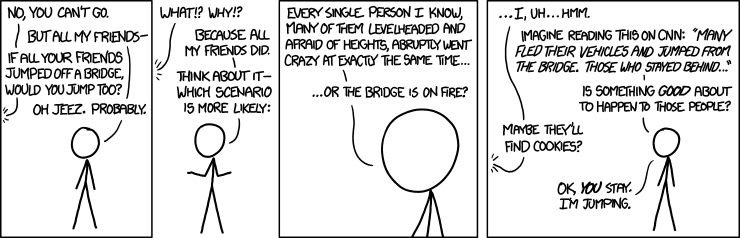
06 Feb 13:36
The Physical Impossibility Of Debate In The Mind of Someone On The Internet
by Andrew Rilstone
If you feel that this essay is worthwhile, please consider purchasing the "extended edition" (PDF, epub, mobi) in return for a small donation.

Right so bitwixe a titlelees tiraunt And an outlawe, or a theef erraunt, The same I seye, ther is no difference. To Alisaundre was toold this sentence: That for the tiraunt is of gretter myght, By force of meynee for to sleen dounright, And brennen hous and hoom, and make al playn, Lo, therfore is he cleped a capitayn; And for the outlawe hath but smal meynee, And may nat doon so greet an harm as he, Ne brynge a contree to so greet mescheef, Men clepen hym an outlawe or a theef. Geoffery Chaucer
Woman is the nigger of the world. John Lennon
Let us suppose, hypothetically, a country in which there was, and had always been, a link between complexion and seating on public transport.
Let’s suppose, for the sake of argument, that dark skinned people have to sit in the rear seats on busses, but light skinned people are allowed to sit in the front seats.
Let’s assume that this has been the case for so long that it’s practically invisible: most of the time, even the dark skinned people take it for granted that that’s the way things have to be.
Let’s also note that in this hypothetical and imaginary country, dark skinned people tend to come from the lower social classes, are less likely to own cars, and therefore have to use the bus service more frequently.
We could conceptualize this unfairness in two ways.
We could say that the neutral state of affairs would be for everyone to sit in the front seats, and that the dark colored people are disadvantaged by having to sit in the ones at the back.
We could say that the neutral state of affairs is for everyone to sit at the back, but the light skinned people have the advantage of being able to sit in the front if they want to.
Or we could say dark and light skinned people are equal (they can all sit down) but different (they have to sit in different areas.) But we probably wouldn’t. The phrase “equal but different” is used almost exclusively by light skinned people who are quite sure that dark skinned people are not their equal. So toxic is the phrase that even if a situation arises where it happened to be true — say, at a school where there were separate boys’ and girls’ soccer teams — you almost certainly wouldn’t use it.
So: either the dark coloured people are disadvantaged — suffering from unfair discrimination — or else the light coloured people have an unfair advantage or privilege. Both descriptions are equally true, or equally untrue: the glass really is both half empty and half full. But if you take the first model, you are apt to think in terms of stroppy black people demanding something extra; if you take the second, you are more likely to think in terms of mean white people refusing to share their treat with anyone else. Taking the second model also makes it harder to be indifferent: supporting the status quo means “supporting the privileged position of the white people.”
(Some parents tell children: “if you are very naughty, you will not get any ice cream.” Other parents tell them “if you are extra good, you will get some ice cream.” American parents, or at any rate, parents in American situation comedies, say “If you are bad, I will take away your ice cream privileges.” Using food as disciplinary tool is a really bad idea because and can result in all sorts of hang-ups and eating disorders.)
However you describe it, the situation is horribly unfair: so if the dark skinned people finally decide that they are going to sit in the front seats regardless of where law and tradition says they should sit, then everybody would support them on general principles.
There are, in fact, two sides two every question (apart from the one about who created the Silver Surfer.) It might, in fact, be that the fight about bus-seats isn’t worth having; or at any rate, that it isn’t worth having today. Better let the light skinned people keep their symbolic advantage than anger the more extreme elements on both sides and risk riots and reprisals. It is certainly the case that all the seats are much the same and the bus takes you where you are going regardless of where you are sitting. Changing a law, even an obviously unfair law, takes time, and the lawmakers may have more urgent matters they want to deal with first.(Politicians do have to think like that, at any rate so long as we remain a civil society with a constitution, laws and procedures, as opposed to one of those anarchists utopias where you tear up the rule book and everyone starts being spontaneously nice.) It might be that what is in everyone’s best interests is a harmonious society where even the most prejudiced light skinned people put up with even the most prejudiced dark skinned people, and that a gradualist approach to reform is more likely to bring this about than radical reform. Politicians sometimes have to think like that, too.
But I can’t imagine anybody actually arguing any of those points. The situation is so blatantly unfair that we would have a two-horse race: between the small minority of racists who don’t really want coloured folks on their busses in the first place, and an overwhelming majority who think that it is obvious (once the question has been raised) that everyone should be allowed to sit wherever they want to.
Similarly, there could in theory be a disagreement about what kinds of tactics the reformers should adopt. Should they simply disregard the law? (But doesn’t civil society depend on us all obeying laws, even laws we don’t like? If I am free to disregard the bus law, whence cometh my obligation to stick to the law about paying my fare, or the one about not punching the bus driver on the nose? Because it’s my duty is to obey a higher, god-given law of morality? But whose god? And who decides? The stronger side? But isn’t that how we got into this mess to begin with?) Do they have organized protests in which everyone ostentatiously and pointedly breaks the law on a particular day? Or do they start lying down in front of busses and picketing bus stations? Do they politely ask the transport staff to change the rules, or actively intimidate bus drivers until they are too scared to enforce them? What about the fellow who sets fire to himself on the back seat of the Number 9 to make his point? Or sets fire to someone else? Or blows up the whole bloody bus?
Most of us would say that it was our duty to support the dark skinned people regardless of whether or not we happened to like their tactics. Even discussing the tactics is tacitly supporting the injustice. The power imbalance is so obvious and blatant that it's incumbent on you to support the weaker side. You simply have no right to sit in the comfortable seats saying that, although you agree with the point that the people in the uncomfortable seats are making, you wish that they wouldn't make it quite so loudly.
“But what if the dark skinned people adopt violent tactics: are you obliged to support them even then?” I think you are. Or rather, I think that once you have asked the question “do you agree with violent tactics?” you have put yourself on the wrong side. “Violence” means “use of force by the side we don’t agree with”. It’s a word that the powerful invented by strong people to describe tactics used by weak people. It’s just very odd to look at the entire machinery of a nation state bearing down on the little guy and say “I deplore the fact that the little guy threw a stone at a police officer.”
“Terrorist” is what the big army calls the little army. It’s only “class war” when the poor fight back.
And this is true of every argument and every disagreement. Every quarrel is, in the end, a quarrel between a person with power, and a person without power. So you only ever have two alternatives: intervene on the side of the guy being beaten up; or intervening on the side of the guy doing the beating. If you do nothing, then you allowing big guy to carry on whacking the small guy, which amount to supporting the bully. If you say "But what if the fight really about? Maybe the little guy antagonized the big guy in some way?" then you are still doing nothing and allowing the victimisation to carry on.
Of course, you may dress it up in fancy words. "I feel sorry for you" I may say "I genuinely do. I have nothing against dark coloured people. Some of my best friends have dark coloured skin. But philosophically, you will concede that it is part of the Cosmic Essence of buses that the dark coloured people must sit at the back of them and light coloured people must sit at the front? You wouldn’t want to upset the Balance of the Force, would you? Or if you do not concede that, you must at least concede that that is part of my sincere and devout beliefs, and the since and devout beliefs of many other Jedi? So in order to preserve the Cosmic Balance, or out of respect for other people's faith, I must reluctantly sit in the comfortable seat. But do please understand that it isn’t about you. It’s about the bus.”
If I said this, I think that you might well take the view that I hadn't really said anything at all. All my talk about the Force and Cosmic Essences amount to "Well, I would give up my seat, but I don't feel like it." La la la I'm not listening!
Of course, most people are better at concealing their privilege under a poor mask of logic; but that's all it ever is -- a mask. Suppose I say: “Why does the law ban me from killing foxes for sport, but permit me to keep chickens in horribly inhumane conditions?” Aren't I just invoking concepts like "humane" and "even-handedness" — which are in the long run just as made-up an imaginary as the Cosmic Essence of Busses — to assert the hereditary right of rich people (like me) to own the countryside and do whatever they like it in?
Or if I say "Is there any statistical evidence that capital punishment reduces the number of murders in society?", aren't I just invoking mystical concepts like "statistics" and "evidence" to occlude my belief that I'm a rich white guy, want rich white guys to stay in charge, and think that culling a few hundred poor black guys every year to show the who's boss is a small price to pay for maintaining the status quo? My use of terms like "murder" and "capital punishment" show pretty clearly which side I'm on. When a weak person kills a strong person, we call it "murder"; when a strong person kills a weak person, we call it "capital punishment". (C.f The school teacher hitting a little boys backside with a big stick, while chanting "Never...hit...anyone...smaller...than...you.")
It isn't that my arguments are "bad". It's the whole idea of "argument" that's the problem. "Arguments", "logic", "evidence", "proof", "neutrality" are things you learned in school, and schools were set up by rich white guys to teach ideas thought up by rich white guys in order to keep rich white guys in charge.
How did the light skinned people get to sit at the front of the bus in the first place? Not by winning an argument, that's for sure.
Everything's really all about power. (Unless everything's really all about sex, but that's an argument for another day.) You might think that you are talking about theology or music or sanitation but if you look under the bonnet, it's always really about who gets to sit at the front of the bus. The question is never "who is right?: it's always "which side are you on?"
All of which leaves me rather stuck.
So far as I can see, everything I've said above is true. But when I'm asked a question, my inclination is always to work out the answer from first principles. At any rate, to use some kind of argumentation and try to work out what the other fella is trying to say, and if he's wrong why he's wrong and if he might have a good point. Which keeps putting me on the wrong side of the question.
I have just deleted three separate paragraphs giving examples of questions I may be on the wrong side of. I know how toxic discussions about questions that people are on the wrong side of can become, and how quickly.
I have also deleted a paragraph about why I think they become toxic. It has been explained to me that when I try to do that kind of thing, I come out, to use the technical jargon, "sounding like a cunt". (I suppose this is why it is called "vulgar Marxism".)
Despite early assurances, the internet does not contain a 3D virtual reality in which I can be taught Kung Fu by Lawrence Fishburne and drown Tom Baker. All the internet actually contains is words. Lots and lots of words. Oceans of words. Millions of writers telling us what they think. Good writers, bad writers, indifferent writers; informed writers; ignorant writers; boringly right, engagingly wrong. Writers telling you what they think about what other people wrote about stuff they read on the internet. Derrida was right. There isn't any stuff. There's only people talking about stuff. I've never experienced a murder, or an election, or a football match, or (god forbid) an instalment of I'm a Celebrity Get Me Out of Here. I just kind of intersect with the ripples these things put out in cyberspace. Which isn't really a space, and isn't really very cyber. It's more like a lot of very bored people making wisecracks in their coffee break.
But all this argument is taking place in a space in which we have already agreed that argument is not even possible. "Right" and "Wrong" aren't qualities that any argument has: they are just descriptions of which side you are on in a big fight that has been going on throughout history, and will carry on until, any day now, history comes to an end.
And you knew that already.
So why are you even reading this?
I beseech you in the bowels of Christ: think it possible that you might be mistaken.
Oliver Cromwell
The infidel might have a good point, you know.
Les Barker
If you thought that this piece was worthwhile, please consider purchasing the "extended edition" in return for a small donation.
Right so bitwixe a titlelees tiraunt And an outlawe, or a theef erraunt, The same I seye, ther is no difference. To Alisaundre was toold this sentence: That for the tiraunt is of gretter myght, By force of meynee for to sleen dounright, And brennen hous and hoom, and make al playn, Lo, therfore is he cleped a capitayn; And for the outlawe hath but smal meynee, And may nat doon so greet an harm as he, Ne brynge a contree to so greet mescheef, Men clepen hym an outlawe or a theef. Geoffery Chaucer
Woman is the nigger of the world. John Lennon
Let us suppose, hypothetically, a country in which there was, and had always been, a link between complexion and seating on public transport.
Let’s suppose, for the sake of argument, that dark skinned people have to sit in the rear seats on busses, but light skinned people are allowed to sit in the front seats.
Let’s assume that this has been the case for so long that it’s practically invisible: most of the time, even the dark skinned people take it for granted that that’s the way things have to be.
Let’s also note that in this hypothetical and imaginary country, dark skinned people tend to come from the lower social classes, are less likely to own cars, and therefore have to use the bus service more frequently.
We could conceptualize this unfairness in two ways.
We could say that the neutral state of affairs would be for everyone to sit in the front seats, and that the dark colored people are disadvantaged by having to sit in the ones at the back.
We could say that the neutral state of affairs is for everyone to sit at the back, but the light skinned people have the advantage of being able to sit in the front if they want to.
Or we could say dark and light skinned people are equal (they can all sit down) but different (they have to sit in different areas.) But we probably wouldn’t. The phrase “equal but different” is used almost exclusively by light skinned people who are quite sure that dark skinned people are not their equal. So toxic is the phrase that even if a situation arises where it happened to be true — say, at a school where there were separate boys’ and girls’ soccer teams — you almost certainly wouldn’t use it.
So: either the dark coloured people are disadvantaged — suffering from unfair discrimination — or else the light coloured people have an unfair advantage or privilege. Both descriptions are equally true, or equally untrue: the glass really is both half empty and half full. But if you take the first model, you are apt to think in terms of stroppy black people demanding something extra; if you take the second, you are more likely to think in terms of mean white people refusing to share their treat with anyone else. Taking the second model also makes it harder to be indifferent: supporting the status quo means “supporting the privileged position of the white people.”
(Some parents tell children: “if you are very naughty, you will not get any ice cream.” Other parents tell them “if you are extra good, you will get some ice cream.” American parents, or at any rate, parents in American situation comedies, say “If you are bad, I will take away your ice cream privileges.” Using food as disciplinary tool is a really bad idea because and can result in all sorts of hang-ups and eating disorders.)
However you describe it, the situation is horribly unfair: so if the dark skinned people finally decide that they are going to sit in the front seats regardless of where law and tradition says they should sit, then everybody would support them on general principles.
There are, in fact, two sides two every question (apart from the one about who created the Silver Surfer.) It might, in fact, be that the fight about bus-seats isn’t worth having; or at any rate, that it isn’t worth having today. Better let the light skinned people keep their symbolic advantage than anger the more extreme elements on both sides and risk riots and reprisals. It is certainly the case that all the seats are much the same and the bus takes you where you are going regardless of where you are sitting. Changing a law, even an obviously unfair law, takes time, and the lawmakers may have more urgent matters they want to deal with first.(Politicians do have to think like that, at any rate so long as we remain a civil society with a constitution, laws and procedures, as opposed to one of those anarchists utopias where you tear up the rule book and everyone starts being spontaneously nice.) It might be that what is in everyone’s best interests is a harmonious society where even the most prejudiced light skinned people put up with even the most prejudiced dark skinned people, and that a gradualist approach to reform is more likely to bring this about than radical reform. Politicians sometimes have to think like that, too.
But I can’t imagine anybody actually arguing any of those points. The situation is so blatantly unfair that we would have a two-horse race: between the small minority of racists who don’t really want coloured folks on their busses in the first place, and an overwhelming majority who think that it is obvious (once the question has been raised) that everyone should be allowed to sit wherever they want to.
Similarly, there could in theory be a disagreement about what kinds of tactics the reformers should adopt. Should they simply disregard the law? (But doesn’t civil society depend on us all obeying laws, even laws we don’t like? If I am free to disregard the bus law, whence cometh my obligation to stick to the law about paying my fare, or the one about not punching the bus driver on the nose? Because it’s my duty is to obey a higher, god-given law of morality? But whose god? And who decides? The stronger side? But isn’t that how we got into this mess to begin with?) Do they have organized protests in which everyone ostentatiously and pointedly breaks the law on a particular day? Or do they start lying down in front of busses and picketing bus stations? Do they politely ask the transport staff to change the rules, or actively intimidate bus drivers until they are too scared to enforce them? What about the fellow who sets fire to himself on the back seat of the Number 9 to make his point? Or sets fire to someone else? Or blows up the whole bloody bus?
Most of us would say that it was our duty to support the dark skinned people regardless of whether or not we happened to like their tactics. Even discussing the tactics is tacitly supporting the injustice. The power imbalance is so obvious and blatant that it's incumbent on you to support the weaker side. You simply have no right to sit in the comfortable seats saying that, although you agree with the point that the people in the uncomfortable seats are making, you wish that they wouldn't make it quite so loudly.
“But what if the dark skinned people adopt violent tactics: are you obliged to support them even then?” I think you are. Or rather, I think that once you have asked the question “do you agree with violent tactics?” you have put yourself on the wrong side. “Violence” means “use of force by the side we don’t agree with”. It’s a word that the powerful invented by strong people to describe tactics used by weak people. It’s just very odd to look at the entire machinery of a nation state bearing down on the little guy and say “I deplore the fact that the little guy threw a stone at a police officer.”
“Terrorist” is what the big army calls the little army. It’s only “class war” when the poor fight back.
And this is true of every argument and every disagreement. Every quarrel is, in the end, a quarrel between a person with power, and a person without power. So you only ever have two alternatives: intervene on the side of the guy being beaten up; or intervening on the side of the guy doing the beating. If you do nothing, then you allowing big guy to carry on whacking the small guy, which amount to supporting the bully. If you say "But what if the fight really about? Maybe the little guy antagonized the big guy in some way?" then you are still doing nothing and allowing the victimisation to carry on.
Of course, you may dress it up in fancy words. "I feel sorry for you" I may say "I genuinely do. I have nothing against dark coloured people. Some of my best friends have dark coloured skin. But philosophically, you will concede that it is part of the Cosmic Essence of buses that the dark coloured people must sit at the back of them and light coloured people must sit at the front? You wouldn’t want to upset the Balance of the Force, would you? Or if you do not concede that, you must at least concede that that is part of my sincere and devout beliefs, and the since and devout beliefs of many other Jedi? So in order to preserve the Cosmic Balance, or out of respect for other people's faith, I must reluctantly sit in the comfortable seat. But do please understand that it isn’t about you. It’s about the bus.”
If I said this, I think that you might well take the view that I hadn't really said anything at all. All my talk about the Force and Cosmic Essences amount to "Well, I would give up my seat, but I don't feel like it." La la la I'm not listening!
Of course, most people are better at concealing their privilege under a poor mask of logic; but that's all it ever is -- a mask. Suppose I say: “Why does the law ban me from killing foxes for sport, but permit me to keep chickens in horribly inhumane conditions?” Aren't I just invoking concepts like "humane" and "even-handedness" — which are in the long run just as made-up an imaginary as the Cosmic Essence of Busses — to assert the hereditary right of rich people (like me) to own the countryside and do whatever they like it in?
Or if I say "Is there any statistical evidence that capital punishment reduces the number of murders in society?", aren't I just invoking mystical concepts like "statistics" and "evidence" to occlude my belief that I'm a rich white guy, want rich white guys to stay in charge, and think that culling a few hundred poor black guys every year to show the who's boss is a small price to pay for maintaining the status quo? My use of terms like "murder" and "capital punishment" show pretty clearly which side I'm on. When a weak person kills a strong person, we call it "murder"; when a strong person kills a weak person, we call it "capital punishment". (C.f The school teacher hitting a little boys backside with a big stick, while chanting "Never...hit...anyone...smaller...than...you.")
It isn't that my arguments are "bad". It's the whole idea of "argument" that's the problem. "Arguments", "logic", "evidence", "proof", "neutrality" are things you learned in school, and schools were set up by rich white guys to teach ideas thought up by rich white guys in order to keep rich white guys in charge.
How did the light skinned people get to sit at the front of the bus in the first place? Not by winning an argument, that's for sure.
Everything's really all about power. (Unless everything's really all about sex, but that's an argument for another day.) You might think that you are talking about theology or music or sanitation but if you look under the bonnet, it's always really about who gets to sit at the front of the bus. The question is never "who is right?: it's always "which side are you on?"
All of which leaves me rather stuck.
So far as I can see, everything I've said above is true. But when I'm asked a question, my inclination is always to work out the answer from first principles. At any rate, to use some kind of argumentation and try to work out what the other fella is trying to say, and if he's wrong why he's wrong and if he might have a good point. Which keeps putting me on the wrong side of the question.
I have just deleted three separate paragraphs giving examples of questions I may be on the wrong side of. I know how toxic discussions about questions that people are on the wrong side of can become, and how quickly.
I have also deleted a paragraph about why I think they become toxic. It has been explained to me that when I try to do that kind of thing, I come out, to use the technical jargon, "sounding like a cunt". (I suppose this is why it is called "vulgar Marxism".)
Despite early assurances, the internet does not contain a 3D virtual reality in which I can be taught Kung Fu by Lawrence Fishburne and drown Tom Baker. All the internet actually contains is words. Lots and lots of words. Oceans of words. Millions of writers telling us what they think. Good writers, bad writers, indifferent writers; informed writers; ignorant writers; boringly right, engagingly wrong. Writers telling you what they think about what other people wrote about stuff they read on the internet. Derrida was right. There isn't any stuff. There's only people talking about stuff. I've never experienced a murder, or an election, or a football match, or (god forbid) an instalment of I'm a Celebrity Get Me Out of Here. I just kind of intersect with the ripples these things put out in cyberspace. Which isn't really a space, and isn't really very cyber. It's more like a lot of very bored people making wisecracks in their coffee break.
But all this argument is taking place in a space in which we have already agreed that argument is not even possible. "Right" and "Wrong" aren't qualities that any argument has: they are just descriptions of which side you are on in a big fight that has been going on throughout history, and will carry on until, any day now, history comes to an end.
And you knew that already.
So why are you even reading this?
I beseech you in the bowels of Christ: think it possible that you might be mistaken.
Oliver Cromwell
The infidel might have a good point, you know.
Les Barker
If you thought that this piece was worthwhile, please consider purchasing the "extended edition" in return for a small donation.
05 Feb 11:32
Collaborative Refutation
by Scott
At least eight people—journalists, colleagues, blog readers—have now asked my opinion of a recent paper by Ross Anderson and Robert Brady, entitled “Why quantum computing is hard and quantum cryptography is not provably secure.” Where to begin?
- Based on a “soliton” model—which seems to be almost a local-hidden-variable model, though not quite—the paper advances the prediction that quantum computation will never be possible with more than 3 or 4 qubits. (Where “3 or 4″ are not just convenient small numbers, but actually arise from the geometry of spacetime.) I wonder: before uploading their paper, did the authors check whether their prediction was, y’know, already falsified? How do they reconcile their proposal with (for example) the 8-qubit entanglement observed by Haffner et al. with trapped ions—not to mention the famous experiments with superconducting Josephson junctions, buckyballs, and so forth that have demonstrated the reality of entanglement among many thousands of particles (albeit not yet in a “controllable” form)?
- The paper also predicts that, even with 3 qubits, general entanglement will only be possible if the qubits are not collinear; with 4 qubits, general entanglement will only be possible if the qubits are not coplanar. Are the authors aware that, in ion-trap experiments (like those of David Wineland that recently won the Nobel Prize), the qubits generally are arranged in a line? See for example this paper, whose abstract reads in part: “Here we experimentally demonstrate quantum error correction using three beryllium atomic-ion qubits confined to a linear, multi-zone trap.”
- Finally, the paper argues that, because entanglement might not be a real phenomenon, the security of quantum key distribution remains an open question. Again: are the authors aware that the most practical QKD schemes, like BB84, never use entanglement at all? And that therefore, even if the paper’s quasi-local-hidden-variable model were viable (which it’s not), it still wouldn’t justify the claim in the title that “…quantum cryptography is not provably secure”?
Yeah, this paper is pretty uninformed even by the usual standards of attempted quantum-mechanics-overthrowings. Let me now offer three more general thoughts.
First thought: it’s ironic that I’m increasingly seeing eye-to-eye with Lubos Motl—who once called me “the most corrupt piece of moral trash”—in his rantings against the world’s “anti-quantum-mechanical crackpots.” Let me put it this way: David Deutsch, Chris Fuchs, Sheldon Goldstein, and Roger Penrose hold views about quantum mechanics that are diametrically opposed to one another’s. Yet each of these very different physicists has earned my admiration, because each, in his own way, is trying to listen to whatever quantum mechanics is saying about how the world works. However, there are also people all of whose “thoughts” about quantum mechanics are motivated by the urge to plug their ears and shut out whatever quantum mechanics is saying—to show how whatever naïve ideas they had before learning QM might still be right, and how all the experiments of the last century that seem to indicate otherwise might still be wiggled around. Like monarchists or segregationists, these people have been consistently on the losing side of history for generations—so it’s surprising, to someone like me, that they continue to show up totally unfazed and itching for battle, like the knight from Monty Python and the Holy Grail with his arms and legs hacked off. (“Bell’s Theorem? Just a flesh wound!”)
Like any physical theory, of course quantum mechanics might someday be superseded by an even deeper theory. If and when that happens, it will rank alongside Newton’s apple, Einstein’s elevator, and the discovery of QM itself among the great turning points in the history of physics. But it’s crucial to understand that that’s not what we’re discussing here. Here we’re discussing the possibility that quantum mechanics is wrong, not for some deep reason, but for a trivial reason that was somehow overlooked since the 1920s—that there’s some simple classical model that would make everyone exclaim, “oh! well, I guess that whole framework of exponentially-large Hilbert space was completely superfluous, then. why did anyone ever imagine it was needed?” And the probability of that is comparable to the probability that the Moon is made of Gruyère. If you’re a Bayesian with a sane prior, stuff like this shouldn’t even register.
Second thought: this paper illustrates, better than any other I’ve seen, how despite appearances, the “quantum computing will clearly be practical in a few years!” camp and the “quantum computing is clearly impossible!” camp aren’t actually opposed to each other. Instead, they’re simply two sides of the same coin. Anderson and Brady start from the “puzzling” fact that, despite what they call “the investment of tremendous funding resources worldwide” over the last decade, quantum computing still hasn’t progressed beyond a few qubits, and propose to overthrow quantum mechanics as a way to resolve the puzzle. To me, this is like arguing in 1835 that, since Charles Babbage still hasn’t succeeded in building a scalable classical computer, we need to rewrite the laws of physics in order to explain why classical computing is impossible. I.e., it’s a form of argument that only makes sense if you’ve adopted what one might call the “Hype Axiom”: the axiom that any technology that’s possible sometime in the future, must in fact be possible within the next few years.
Third thought: it’s worth noting that, if (for example) you found Michel Dyakonov’s arguments against QC (discussed on this blog a month ago) persuasive, then you shouldn’t find Anderson’s and Brady’s persuasive, and vice versa. Dyakonov agrees that scalable QC will never work, but he ridicules the idea that we’d need to modify quantum mechanics itself to explain why. Anderson and Brady, by contrast, are so eager to modify QM that they don’t mind contradicting a mountain of existing experiments. Indeed, the question occurs to me of whether there’s any pair of quantum computing skeptics whose arguments for why QC can’t work are compatible with one another’s. (Maybe Alicki and Dyakonov?)
But enough of this. The truth is that, at this point in my life, I find it infinitely more interesting to watch my two-week-old daughter Lily, as she discovers the wonderful world of shapes, colors, sounds, and smells, than to watch Anderson and Brady, as they fail to discover the wonderful world of many-particle quantum mechanics. So I’m issuing an appeal to the quantum computing and information community. Please, in the comments section of this post, explain what you thought of the Anderson-Brady paper. Don’t leave me alone to respond to this stuff; I don’t have the time or the energy. If you get quantum probability, then stand up and be measured!
05 Feb 11:25


#910; What Happens Alone, Part 1
by David Malki !

Part 1 of a new story — updates every day this week!
05 Feb 10:41
Palomino Blackwing non-users
by Michael Leddy
[Egg on face: I’d forgotten that Blackwing Pages called attention to Levenger’s advertising copy last year, in one of the very posts I link to below: Facts, Fiction, and the Palomino “Blackwing Experience.” E. B. White though is a new addition to the chorus of Palomino praise-singers.]
From the Levenger website:

I’m reminded of the Dashiell Hammett story in which the Continental Op looks at a sign in a bar — “ONLY GENUINE PRE-WAR AMERICAN AND BRITISH WHISKEYS SERVED HERE” — and begins to count the lies. No, Steinbeck, White, and Wolfe never sang the praises of the Palomino Blackwing, because they lived and died before that pencil came into production. To claim that these writers sang the praises of a Palomino product is equivalent to claiming that Blind Boy Fuller sang the praises of my National guitar. No, because my guitar is a replica. And so is the Palomino Blackwing.
California Cedar has chosen, again and again, to promote its products by invoking the names of prominent people, among them Duke Ellington, John Lennon, and Frank Lloyd Wright, all of whom lived and died before the Palomino Blackwing and thus could never have used that pencil. What’s more, there is no evidence that Ellington or Lennon or Wright had any particular allegiance to the original Blackwing. (Nor to my knowledge is there evidence that White sang the praises of the original Blackwing.) Facts are stubborn things, as someone once said.
Related posts
Duke Ellington, Blackwings, and aspirational branding
The Palomino Blackwing pencil and truth in advertising
And from Blackwing Pages
Facts, Fiction, and the Palomino “Blackwing Experience”
Wright or Wrong?
And from pencil talk
California Cedar: What’s going on?
[I’ve invoked the Op before, when writing about an “old-fashioned recipe” for lemonade. Martha White’s introduction to In the Words of E. B. White (2011) mentions “boxes of Blackwing pencils” from White’s office. Well-known photographs show White composing at the typewriter. Roger Angell’s foreword to the fourth edition of The Elements of Style describes White composing at the typewriter “in hesitant bursts, with long silences in between.”]
You’re reading a post from Michael Leddy’s blog Orange Crate Art. This work is licensed under a Creative Commons 3.0 License.
From the Levenger website:

I’m reminded of the Dashiell Hammett story in which the Continental Op looks at a sign in a bar — “ONLY GENUINE PRE-WAR AMERICAN AND BRITISH WHISKEYS SERVED HERE” — and begins to count the lies. No, Steinbeck, White, and Wolfe never sang the praises of the Palomino Blackwing, because they lived and died before that pencil came into production. To claim that these writers sang the praises of a Palomino product is equivalent to claiming that Blind Boy Fuller sang the praises of my National guitar. No, because my guitar is a replica. And so is the Palomino Blackwing.
California Cedar has chosen, again and again, to promote its products by invoking the names of prominent people, among them Duke Ellington, John Lennon, and Frank Lloyd Wright, all of whom lived and died before the Palomino Blackwing and thus could never have used that pencil. What’s more, there is no evidence that Ellington or Lennon or Wright had any particular allegiance to the original Blackwing. (Nor to my knowledge is there evidence that White sang the praises of the original Blackwing.) Facts are stubborn things, as someone once said.
Related posts
Duke Ellington, Blackwings, and aspirational branding
The Palomino Blackwing pencil and truth in advertising
And from Blackwing Pages
Facts, Fiction, and the Palomino “Blackwing Experience”
Wright or Wrong?
And from pencil talk
California Cedar: What’s going on?
[I’ve invoked the Op before, when writing about an “old-fashioned recipe” for lemonade. Martha White’s introduction to In the Words of E. B. White (2011) mentions “boxes of Blackwing pencils” from White’s office. Well-known photographs show White composing at the typewriter. Roger Angell’s foreword to the fourth edition of The Elements of Style describes White composing at the typewriter “in hesitant bursts, with long silences in between.”]
You’re reading a post from Michael Leddy’s blog Orange Crate Art. This work is licensed under a Creative Commons 3.0 License.
04 Feb 13:21
Are politics and polite disagreement mutually exclusive?
by Mark Valladares
Is it me, or is politics becoming ever more unpleasant as the years go by? Perhaps it has always been thus, but the unpleasantness is much more immediate, much more public than it was previously.
Once upon a time, politicians were treated with rather more deference than is the case now. Interviews with the media were more of a lecture than an inquisition, and there was little attempt made to challenge what was being said. It made for rather dull television, I suspect, but then there wasn't an awful lot of choice, was there? Effectively, you got to find out what the politicians wanted you to know.
As that deference has been stripped away, we have become a more informed electorate, with more media outlets, more rigorous questions, more research capacity. Alright, a potentially more informed electorate, as it has become more difficult to judge the value, accuracy and credibility of any one source, presuming that any one voter has the skills or desire to find out for themselves.
But the end of deference has gone beyond that to almost aggressive cynicism. The assumption that politicians are fair game for the sort of treatment that is now commonplace means that there is no level to which some in the political arena will not stoop.
It does, in too many quarters, seem entirely reasonable to describe someone with whom they disagree with as mad, idiotic, corrupt or simply evil. The notion that, for entirely honourable, philosophically consistent reasons, a different view might be held cannot, accordingly, be respected, it must be quashed in an aggressive, offensive, bombastic way. There can be no doubt, the heterodoxy must be preserved.
And yet, most people, most ordinary, non-political people don't lay claim to such certainty. If presented with a credible (in their eyes) argument, they can be persuaded to at least keep an open mind on an issue.
The internet has made matters far worse. You can now, from the safety and anonymity of your keyboard, make vile accusations as to the motivation of your opponents without evidence or accuracy, and drive the less thick-skinned from the field altogether. But what if they're right, either partly or wholly. Or, what if there are equally effective, but alternative, means of achieving the same thing? You have, technically, won. But mightn't everyone have lost?
The advantage of debate based upon mutual respect and an openness to other ideas is an increased likelihood of reaching a conclusion which taps more of the knowledge and expertise that exists whilst increasing buy-in. It encourages greater participation and engagement, broadens the field of potential elected officials and, by doing so, creates a politics that looks more like the communities it seeks to serve.
Isn't that the aim of the exercise?...
Once upon a time, politicians were treated with rather more deference than is the case now. Interviews with the media were more of a lecture than an inquisition, and there was little attempt made to challenge what was being said. It made for rather dull television, I suspect, but then there wasn't an awful lot of choice, was there? Effectively, you got to find out what the politicians wanted you to know.
As that deference has been stripped away, we have become a more informed electorate, with more media outlets, more rigorous questions, more research capacity. Alright, a potentially more informed electorate, as it has become more difficult to judge the value, accuracy and credibility of any one source, presuming that any one voter has the skills or desire to find out for themselves.
But the end of deference has gone beyond that to almost aggressive cynicism. The assumption that politicians are fair game for the sort of treatment that is now commonplace means that there is no level to which some in the political arena will not stoop.
It does, in too many quarters, seem entirely reasonable to describe someone with whom they disagree with as mad, idiotic, corrupt or simply evil. The notion that, for entirely honourable, philosophically consistent reasons, a different view might be held cannot, accordingly, be respected, it must be quashed in an aggressive, offensive, bombastic way. There can be no doubt, the heterodoxy must be preserved.
And yet, most people, most ordinary, non-political people don't lay claim to such certainty. If presented with a credible (in their eyes) argument, they can be persuaded to at least keep an open mind on an issue.
The internet has made matters far worse. You can now, from the safety and anonymity of your keyboard, make vile accusations as to the motivation of your opponents without evidence or accuracy, and drive the less thick-skinned from the field altogether. But what if they're right, either partly or wholly. Or, what if there are equally effective, but alternative, means of achieving the same thing? You have, technically, won. But mightn't everyone have lost?
The advantage of debate based upon mutual respect and an openness to other ideas is an increased likelihood of reaching a conclusion which taps more of the knowledge and expertise that exists whilst increasing buy-in. It encourages greater participation and engagement, broadens the field of potential elected officials and, by doing so, creates a politics that looks more like the communities it seeks to serve.
Isn't that the aim of the exercise?...
04 Feb 12:07
Day 4418: Bones in Car Park Confirmed as Chris Huhne
by Millennium Dome
Monday:
Today, former Energy and Climate Change Secretary and Duke of York, Mr Huhney-Monster, pleaded guilty to perverting the course of justice when he got his former wife to accept points for speeding through Bosworth Field.
Maligned by Shakespeare as a twisted schemer, the Duke – famous for his war cry of "more horsepower more horsepower my kingdom for more horsepower" – also asked for two counts of Princes in the Tower to be taken into account.
His rival in the Wars of the Rosettes Mr Tudor Clegg was unavailable for comment due to an uncontrollable fit of hysterical giggling.
Senior Liberal Democrats – and St Simon of Hughes, the new archbishop of Canterbury – expect to have the Duke taken out and buried in a car park somewhere.
A Liberal elephant was quoted as saying: Bother!
Richard of York is five hundred and sixty-one.
Today, former Energy and Climate Change Secretary and Duke of York, Mr Huhney-Monster, pleaded guilty to perverting the course of justice when he got his former wife to accept points for speeding through Bosworth Field.
Maligned by Shakespeare as a twisted schemer, the Duke – famous for his war cry of "more horsepower more horsepower my kingdom for more horsepower" – also asked for two counts of Princes in the Tower to be taken into account.
His rival in the Wars of the Rosettes Mr Tudor Clegg was unavailable for comment due to an uncontrollable fit of hysterical giggling.
Senior Liberal Democrats – and St Simon of Hughes, the new archbishop of Canterbury – expect to have the Duke taken out and buried in a car park somewhere.
A Liberal elephant was quoted as saying: Bother!
Richard of York is five hundred and sixty-one.
04 Feb 11:57
I’ll Explain Later
The Blue Angel is Paul Magrs’s second Doctor Who novel, co-authored with Jeremy Hoad. It features Iris Wildthyme in a dense plot weaving its way through multiple levels of reality, a Star Trek parody, and a few other bits of postmodernism to boot. Lars Pearson calls it “passionate, whimsical and charming,” while Doctor Who Magazine likes it, but only when it can contextualize it against “the inherited story arc’s desire to crumble the Doctor.” Regardless, it fares rather worse than the other Magrs books in the rankings, stuck at forty-eighth out of seventy-three Eighth Doctor Adventures. DWRG Summary. Whoniverse Discontinuity Guide Entry.
——
 It’s September of 1999. Lou Bega is at number one with “Mambo No. 5 (A Little Bit Of…),” which is impressively only one of two songs in the top two with “Mambo” in the title, and one of four in the top ten with explicit Latin influences, which clearly constitutes a bit of a fad. Two weeks later Vengaboys take number one with “We’re Going To Ibiza!,” and a week after that Eiffel 65 takes over with “Blue (Da Ba Dee).” Tom Jones and the Cardigans, Enrique Inglesias, and Ricky Martin also chart. In news, an earthquake kills 143 in Greece, and another kills 2,400 in Taiwan. The President of Indonesia is successfully pressured to allow an international peacekeeping force into the country. And the Midland Bank renames itself HSBC, a name under which it will do lots of impressively bad things.
While in books we have The Blue Angel, the first of two times in which Paul Magrs immediately follows Lawrence Miles in the running order, helping establish a strange sort of dualism between Faction Paradox and Iris Wildthyme as the defining ideas of the era. More than any other book in either the BBC or Virgin line, The Blue Angel wants to stand alone as a novel. It’s a novel that luxuriates in its own structure and space. Its style is not ostentatious or over the top - this is not Sky Pirates!, nor even, for that matter, The Scarlet Empress. But the entire book gives a continual sense of being structured and deliberate. Its casual play with multiple realities and refusal to impose an overall structure on them makes the book actively difficult to reconcile with the rest of the line in any direct way. It doesn’t contradict anything, but so much of what it’s doing stems out of its own structure and feeds into its own concerns that it seems almost silly to spend too much time connecting it elsewhere. On top of that, it is a book that actively declines to offer explanations for itself. It’s not quite a difficult book, but it’s a strange one that doesn’t quite fit in. In this regard it’s a welcome break from the pace of the EDAs I’ve mostly set for myself - in many ways it’s the one EDA I’m looking at because it’s interesting on its own merits instead of because it fits cleanly into the larger narrative of the series. Which is not, of course, to say that it doesn’t do that as well.
It’s possible, of course, that The Blue Angel was always intended to lead into plot events exactly as it does, with Paul Cornell’s revelation regarding Iris’s intentions in The Shadows of Avalon being exactly in line with what Magrs was writing. But it feels wrong, and I can only really go with “feels” here because it’s not well documented. Certainly Magrs isn’t completely cut off from the metaplot here - I have zero doubt that fitting Compassion with a receiver hooked to the TARDIS was an editorially mandated point. But that seems likely precisely because of how arbitrary a moment it is within The Blue Angel. Iris tricking the Doctor and keeping him from stopping the war, on the other hand, is what the entire book leads up to, and it’s built to in a way that feels so idiosyncratic and specific to this book that it’s difficult to believe that it’s intended as a bit of metaplot setting up the Compassion arc.
But if we assume that The Blue Angel isn’t self-consciously concerned with setting up plot material for future books, it’s still difficult not to read it as commenting on them. Simply put, a book about an inevitable future war that the Doctor is told he can’t win has resonance coming after Interference in a way that is particular to that era. For all that they are both wrapped up in their own concerns, it’s unthinkable that one could swap these two books, and not just for the way in which Iris works over the two books. As of Interference (and really as of Unnatural History) the Eighth Doctor Adventures moved into a period of being overtly concerned with Faction Paradox and the War plot. It’s telling that save for a little bit of advancement of the Dark Sam plot in Seeing I nothing in the eighteen months between Alien Bodies and Unnatural History really demonstrated the idea that the War was going to be the primary focus of the Eighth Doctor Adventures. For all that the Faction Paradox stuff is what people focus on in the Eighth Doctor Adventures, the run where it could possibly be said to be the major focus of the line goes from June of 1999 (Unnatural History) to July of 2000 (The Ancestor Cell). It’s a one year storyline that somehow ate the oxygen from everything around it. (Admittedly that year had five books primarily concerned with that arc: Unnatural History, Interference, The Taking of Planet 5, The Shadows of Avalon, and The Ancestor Cell)
And The Blue Angel, unlike The Scarlet Empress, falls into that year. Which makes its concerns with a plot that faintly echoes the War plot worth remarking on. On the one hand, the end of The Blue Angel is terribly unsatisfying. Iris yanks the Doctor out of the plot and refuses to let him go back and fix things. It builds to what is very consciously a non-resolution. But Iris’s explanation to the Doctor is telling: “you can’t always win,” she says, and explains that “I’ve sorted it out so you don’t have to go” to the Obverse.
We have noted that one of the major problems with the War plotline is the fact that it cannot possibly be executed within Doctor Who as such. As interesting as it is, a massive war where the first thing we learn - before, even, everyone who’s fighting in it - is that the Doctor dies in it is something that cannot actually be depicted in Doctor Who. The list of things that would actually completely disrupt the capacity of Doctor Who to keep telling new stories is short, but the War plot that was, at the time this book came out, consuming the novel line is actually one of them.
And Magrs’s book tacitly acknowledges that. Even though the Obverse War is not so self-evidently destructive to the longterm health of Doctor Who as the War, it’s presented in parallel: a war the Doctor cannot win, that the TARDIS itself recognizes as a hazard. In this regard Iris’s declaration that the Doctor doesn’t have to go to the Obverse is compelling. The Obverse is described in the novel as a realm where “Time and Space are not only not one, but never have been and never will be. In fact, they are barely on speaking terms. Can’t abide each other. And the Obverse is colossal. And none of our rules apply.” Which is to say, it’s a universe in which the assumption of coherence and unity is already broken.
(Several people have attempted to nail down Iris’s origins as hailing from the Obverse, but this misses the point so spectacularly as to not really be worth discussing - it’s almost as bad as the people who take a throwaway joke in a thing Paul Magrs wrote for Doctor Who Magazine as a sincere suggestion that Iris is a Faction Paradox construct.)
Saving the Doctor from going to the Obverse, in other words, essentially amounts to saving him from the narrative collapse that the War plot would point towards. But there’s, if not a problem, at least a concern to be raised here, which is that narrative collapse doesn’t seem inconsistent with what Magrs wants to do. After all, Magrs is, more than any other writer, prone to celebrating the multiplicity and irreconcilability of Doctor Who. The prospect of the Doctor entering the Obverse seems, superficially at least, like it should be gold to him.
But Magrs’s game is subtler than that. He’s not interested in smashing up the unity of Doctor Who, but in playing in the gaps within it. Magrs requires the existence of a quasi-unified Doctor Who in order to react against it and subvert it. This is, in fact, one of the key differences between postmodernism and complete epistemological anarchism. For all that postmodernism is about subverting and undermining singular truth, it still requires a dominant culture to work against. This is the paradox of the marginal, and is closely related to what ultimately brings down Miles and Morrison. The margins require a mainstream to animate them.
And Magrs seems at piece with this, to the point of having his most overtly postmodernist character, Iris, actively work to protect the Doctor from losing a sense of mainstream coherence. But this, in turn, must be thought of in terms of The Blue Angel’s genre: magical realism.
In the afterword to The Scarlet Empress Magrs argued that magical realism was the proper mode for Doctor Who. This fits with The Scarlet Empress, which amounted to throwing the Doctor (and Iris) into an essentially magically realist world and letting them get on with it. But The Blue Angel subtly tweaks that approach. Instead of putting the Doctor into a magically realist world, it takes a magically realist lens to what are mostly some standard Doctor Who tropes, with the odd bits of the Doctor and his lodgers, Fritz and Compassnion, going to the greatest extreme and being an almost stereotypically magically realist story that’s built up around the Doctor.
This involves a slight inversion of the normal order of things. In general when Doctor Who and a defined genre collide Doctor Who comes out on top. But here Magrs makes Doctor Who work according to the logic and aesthetic of magical realism. This creates an odd parallel with Interference, which was, after all, at least in part about putting the Doctor in situations where he wasn’t able to dominate the narrative, whether in the form of putting the Eighth in a Saudi Arabian prison to be tortured or in the form of putting the Third in an adventure he was unprepared to handle. This is, in many ways, one of the things the Eighth Doctor Adventures bring to the table that the Virgin line never did: the idea of stories where the Doctor was not the primary ontological force in the narrative. On the one hand this reflects on the changing terms Doctor Who existed on. The Virgin era had a swagger that the BBC Books era could never muster, and the fact that in 1999 it still looked to everybody like Doctor Who was dead as a doornail and never coming back meant that there was an innate lack of confidence in it. The idea that Doctor Who would win out over everything else seemed farcical.
But for Magrs that shift has a different tone. In both this and The Scarlet Empress Magrs takes specific aim at the Virgin line and its excesses, particularly the idea of the Doctor as Time’s Champion. In other words, for him, at least, it seems like Magrs’s move away from having the Doctor trump the entire narrative form has more to do with the shift from the Seventh to the Eighth Doctor. For Magrs, at least, making it so that the Doctor isn’t intrinsically trumping everything else in the narrative is part of proceeding beyond the hubris of the Virgin era.
But it’s also significant that Magrs opts to subsume Doctor Who within magical realism specifically. As a genre, magical realism is concerned with the line between the everyday world and the fantastical, and in the idea that there is something truly inexplicable about that line. The fantastic elements of magical realism sit beyond the realm of what is subject to explanation or understanding. It is, in other words, closely related to the question of the mainstream and the marginal. (Indeed, depending on your definitions, and particularly whether you see magical realism as a specifically Latin American literary genre, a wealth of magical realist writers can simply be reclassified as “postmodernist” or visa versa)
Magical realism, in other words, is in many ways a defense against the aesthetic direction that the Eighth Doctor Adventures seem to be moving in at this point in time. The flickering relationship between the mainstream and the glorious chaos of the margins is what Doctor Who thrives in. Certainly this is compelling, and fits in with the basic tenets of the show. Doctor Who is, after all, a show about a Victorian adventurer who has been repositioned to the margins instead of placed in the imperialist mainstream that he was designed for, and the notion of mercury as an alchemical concept sticks close to the line between the mainstream and the outside.
And so The Blue Angel winds up, in a very strange way, having its cake and eating it too. On the one hand it pushes towards a more fragmentary and incoherent Doctor Who than anything around it, and on the other it makes a quiet but firm argument for the importance of some center to Doctor Who. It is both more radical than anything else the Eighth Doctor Adventures do and an illustration of why the turn they’re about to take and the subsequent fragmenting of Doctor Who as a concept is so problematic.
Outside of These Experiments You Have Absolutely No Significance (The Blue Angel)
by noreply@blogger.com (Philip Sandifer)
I’ll Explain Later
The Blue Angel is Paul Magrs’s second Doctor Who novel, co-authored with Jeremy Hoad. It features Iris Wildthyme in a dense plot weaving its way through multiple levels of reality, a Star Trek parody, and a few other bits of postmodernism to boot. Lars Pearson calls it “passionate, whimsical and charming,” while Doctor Who Magazine likes it, but only when it can contextualize it against “the inherited story arc’s desire to crumble the Doctor.” Regardless, it fares rather worse than the other Magrs books in the rankings, stuck at forty-eighth out of seventy-three Eighth Doctor Adventures. DWRG Summary. Whoniverse Discontinuity Guide Entry.
——
 It’s September of 1999. Lou Bega is at number one with “Mambo No. 5 (A Little Bit Of…),” which is impressively only one of two songs in the top two with “Mambo” in the title, and one of four in the top ten with explicit Latin influences, which clearly constitutes a bit of a fad. Two weeks later Vengaboys take number one with “We’re Going To Ibiza!,” and a week after that Eiffel 65 takes over with “Blue (Da Ba Dee).” Tom Jones and the Cardigans, Enrique Inglesias, and Ricky Martin also chart. In news, an earthquake kills 143 in Greece, and another kills 2,400 in Taiwan. The President of Indonesia is successfully pressured to allow an international peacekeeping force into the country. And the Midland Bank renames itself HSBC, a name under which it will do lots of impressively bad things.
While in books we have The Blue Angel, the first of two times in which Paul Magrs immediately follows Lawrence Miles in the running order, helping establish a strange sort of dualism between Faction Paradox and Iris Wildthyme as the defining ideas of the era. More than any other book in either the BBC or Virgin line, The Blue Angel wants to stand alone as a novel. It’s a novel that luxuriates in its own structure and space. Its style is not ostentatious or over the top - this is not Sky Pirates!, nor even, for that matter, The Scarlet Empress. But the entire book gives a continual sense of being structured and deliberate. Its casual play with multiple realities and refusal to impose an overall structure on them makes the book actively difficult to reconcile with the rest of the line in any direct way. It doesn’t contradict anything, but so much of what it’s doing stems out of its own structure and feeds into its own concerns that it seems almost silly to spend too much time connecting it elsewhere. On top of that, it is a book that actively declines to offer explanations for itself. It’s not quite a difficult book, but it’s a strange one that doesn’t quite fit in. In this regard it’s a welcome break from the pace of the EDAs I’ve mostly set for myself - in many ways it’s the one EDA I’m looking at because it’s interesting on its own merits instead of because it fits cleanly into the larger narrative of the series. Which is not, of course, to say that it doesn’t do that as well.
It’s possible, of course, that The Blue Angel was always intended to lead into plot events exactly as it does, with Paul Cornell’s revelation regarding Iris’s intentions in The Shadows of Avalon being exactly in line with what Magrs was writing. But it feels wrong, and I can only really go with “feels” here because it’s not well documented. Certainly Magrs isn’t completely cut off from the metaplot here - I have zero doubt that fitting Compassion with a receiver hooked to the TARDIS was an editorially mandated point. But that seems likely precisely because of how arbitrary a moment it is within The Blue Angel. Iris tricking the Doctor and keeping him from stopping the war, on the other hand, is what the entire book leads up to, and it’s built to in a way that feels so idiosyncratic and specific to this book that it’s difficult to believe that it’s intended as a bit of metaplot setting up the Compassion arc.
But if we assume that The Blue Angel isn’t self-consciously concerned with setting up plot material for future books, it’s still difficult not to read it as commenting on them. Simply put, a book about an inevitable future war that the Doctor is told he can’t win has resonance coming after Interference in a way that is particular to that era. For all that they are both wrapped up in their own concerns, it’s unthinkable that one could swap these two books, and not just for the way in which Iris works over the two books. As of Interference (and really as of Unnatural History) the Eighth Doctor Adventures moved into a period of being overtly concerned with Faction Paradox and the War plot. It’s telling that save for a little bit of advancement of the Dark Sam plot in Seeing I nothing in the eighteen months between Alien Bodies and Unnatural History really demonstrated the idea that the War was going to be the primary focus of the Eighth Doctor Adventures. For all that the Faction Paradox stuff is what people focus on in the Eighth Doctor Adventures, the run where it could possibly be said to be the major focus of the line goes from June of 1999 (Unnatural History) to July of 2000 (The Ancestor Cell). It’s a one year storyline that somehow ate the oxygen from everything around it. (Admittedly that year had five books primarily concerned with that arc: Unnatural History, Interference, The Taking of Planet 5, The Shadows of Avalon, and The Ancestor Cell)
And The Blue Angel, unlike The Scarlet Empress, falls into that year. Which makes its concerns with a plot that faintly echoes the War plot worth remarking on. On the one hand, the end of The Blue Angel is terribly unsatisfying. Iris yanks the Doctor out of the plot and refuses to let him go back and fix things. It builds to what is very consciously a non-resolution. But Iris’s explanation to the Doctor is telling: “you can’t always win,” she says, and explains that “I’ve sorted it out so you don’t have to go” to the Obverse.
We have noted that one of the major problems with the War plotline is the fact that it cannot possibly be executed within Doctor Who as such. As interesting as it is, a massive war where the first thing we learn - before, even, everyone who’s fighting in it - is that the Doctor dies in it is something that cannot actually be depicted in Doctor Who. The list of things that would actually completely disrupt the capacity of Doctor Who to keep telling new stories is short, but the War plot that was, at the time this book came out, consuming the novel line is actually one of them.
And Magrs’s book tacitly acknowledges that. Even though the Obverse War is not so self-evidently destructive to the longterm health of Doctor Who as the War, it’s presented in parallel: a war the Doctor cannot win, that the TARDIS itself recognizes as a hazard. In this regard Iris’s declaration that the Doctor doesn’t have to go to the Obverse is compelling. The Obverse is described in the novel as a realm where “Time and Space are not only not one, but never have been and never will be. In fact, they are barely on speaking terms. Can’t abide each other. And the Obverse is colossal. And none of our rules apply.” Which is to say, it’s a universe in which the assumption of coherence and unity is already broken.
(Several people have attempted to nail down Iris’s origins as hailing from the Obverse, but this misses the point so spectacularly as to not really be worth discussing - it’s almost as bad as the people who take a throwaway joke in a thing Paul Magrs wrote for Doctor Who Magazine as a sincere suggestion that Iris is a Faction Paradox construct.)
Saving the Doctor from going to the Obverse, in other words, essentially amounts to saving him from the narrative collapse that the War plot would point towards. But there’s, if not a problem, at least a concern to be raised here, which is that narrative collapse doesn’t seem inconsistent with what Magrs wants to do. After all, Magrs is, more than any other writer, prone to celebrating the multiplicity and irreconcilability of Doctor Who. The prospect of the Doctor entering the Obverse seems, superficially at least, like it should be gold to him.
But Magrs’s game is subtler than that. He’s not interested in smashing up the unity of Doctor Who, but in playing in the gaps within it. Magrs requires the existence of a quasi-unified Doctor Who in order to react against it and subvert it. This is, in fact, one of the key differences between postmodernism and complete epistemological anarchism. For all that postmodernism is about subverting and undermining singular truth, it still requires a dominant culture to work against. This is the paradox of the marginal, and is closely related to what ultimately brings down Miles and Morrison. The margins require a mainstream to animate them.
And Magrs seems at piece with this, to the point of having his most overtly postmodernist character, Iris, actively work to protect the Doctor from losing a sense of mainstream coherence. But this, in turn, must be thought of in terms of The Blue Angel’s genre: magical realism.
In the afterword to The Scarlet Empress Magrs argued that magical realism was the proper mode for Doctor Who. This fits with The Scarlet Empress, which amounted to throwing the Doctor (and Iris) into an essentially magically realist world and letting them get on with it. But The Blue Angel subtly tweaks that approach. Instead of putting the Doctor into a magically realist world, it takes a magically realist lens to what are mostly some standard Doctor Who tropes, with the odd bits of the Doctor and his lodgers, Fritz and Compassnion, going to the greatest extreme and being an almost stereotypically magically realist story that’s built up around the Doctor.
This involves a slight inversion of the normal order of things. In general when Doctor Who and a defined genre collide Doctor Who comes out on top. But here Magrs makes Doctor Who work according to the logic and aesthetic of magical realism. This creates an odd parallel with Interference, which was, after all, at least in part about putting the Doctor in situations where he wasn’t able to dominate the narrative, whether in the form of putting the Eighth in a Saudi Arabian prison to be tortured or in the form of putting the Third in an adventure he was unprepared to handle. This is, in many ways, one of the things the Eighth Doctor Adventures bring to the table that the Virgin line never did: the idea of stories where the Doctor was not the primary ontological force in the narrative. On the one hand this reflects on the changing terms Doctor Who existed on. The Virgin era had a swagger that the BBC Books era could never muster, and the fact that in 1999 it still looked to everybody like Doctor Who was dead as a doornail and never coming back meant that there was an innate lack of confidence in it. The idea that Doctor Who would win out over everything else seemed farcical.
But for Magrs that shift has a different tone. In both this and The Scarlet Empress Magrs takes specific aim at the Virgin line and its excesses, particularly the idea of the Doctor as Time’s Champion. In other words, for him, at least, it seems like Magrs’s move away from having the Doctor trump the entire narrative form has more to do with the shift from the Seventh to the Eighth Doctor. For Magrs, at least, making it so that the Doctor isn’t intrinsically trumping everything else in the narrative is part of proceeding beyond the hubris of the Virgin era.
But it’s also significant that Magrs opts to subsume Doctor Who within magical realism specifically. As a genre, magical realism is concerned with the line between the everyday world and the fantastical, and in the idea that there is something truly inexplicable about that line. The fantastic elements of magical realism sit beyond the realm of what is subject to explanation or understanding. It is, in other words, closely related to the question of the mainstream and the marginal. (Indeed, depending on your definitions, and particularly whether you see magical realism as a specifically Latin American literary genre, a wealth of magical realist writers can simply be reclassified as “postmodernist” or visa versa)
Magical realism, in other words, is in many ways a defense against the aesthetic direction that the Eighth Doctor Adventures seem to be moving in at this point in time. The flickering relationship between the mainstream and the glorious chaos of the margins is what Doctor Who thrives in. Certainly this is compelling, and fits in with the basic tenets of the show. Doctor Who is, after all, a show about a Victorian adventurer who has been repositioned to the margins instead of placed in the imperialist mainstream that he was designed for, and the notion of mercury as an alchemical concept sticks close to the line between the mainstream and the outside.
And so The Blue Angel winds up, in a very strange way, having its cake and eating it too. On the one hand it pushes towards a more fragmentary and incoherent Doctor Who than anything around it, and on the other it makes a quiet but firm argument for the importance of some center to Doctor Who. It is both more radical than anything else the Eighth Doctor Adventures do and an illustration of why the turn they’re about to take and the subsequent fragmenting of Doctor Who as a concept is so problematic.
03 Feb 13:38
How To Social Media Crisis: A Sort of Guide
by Neurodivergent K
First, what is a social media crisis? It's really just when someone or some organization's bad behavior goes viral and they have to do damage control to save face and reputation and such.
The term "going viral" is fine, or "throwing a shitfit on the internet". So why "social media crisis"? Because when I called out Autism Speaks for plagiarizing me, they sent a guy to my blog to try to do damage control, on Twitter, all of that. His real name was there, & like a good little net native I looked him up. The job title his google+ said he had? Social Media Crisis Manager. This is the height of hilarity to me. So. Social media crises, we all are.
So. Someone did something shitty, and you want to make sure the world knows it? How do you do this?
0. Build networks. You need to do this before shit goes down. Networking, autistic, not exactly synonyms. But the key here is not just that you have a decent sized network (quality counts here, folks): it's that the people in your net have different circles from you.
Having multiple friends or contacts from multiple kinds of interests? That works to your advantage here. My atheism friends and my autism friends and my dance friends do not all know the same people, who in turn do not all know the same people. So anything that I say that they care about enough to pass on? It's going to be passed to people who didn't already see it from me.
A note on this, though: If I expect people to care about my shit, I have to care about their shit too. So don't just randomly add people just to have people. A degree of mutual interaction makes it way easier to spread the signal once things go down. Someone doesn't have to understand why I am annoyed and finding something exclusionary to pass it on anyway if we've interacted enough that they care without a doctoral level understanding of all the issues at play.
Good places to build the sort of network needed for good shit stirring are internet forums, social media like facebook and twitter and tumblr (omg tumblr), listservs, and real life contacts are useful too. But we're talking internet shitstorms here. Places you can connect with people.
1. Write up what happened, what makes it wrong, anything not wrong about it (if applicable), and post that shit somewhere public, like a blog. Somewhere with a permalink and not password protected. You want people to see it.
2. Post it to social media: tumblr, facebook, twitter, google plus. If you're posting about a company, hashtag (#tag) it on tumblr and twitter. You can hashtag the name of events and individuals too.
2b. Advanced users: On twitter especially, you can get the attention of people with way bigger following than you have by sending it to them: @username will plop that where Username will see it. Not all celebrities or semicelebrities are all that discerning about what they retweet, and plenty who are will get behind good shit.
2c. You might end up with people defending their shit to you on tumblr or twitter. Be ready for this.
3. Get your friends to pass things on as well. Usually friends share things, but I cannot emphasize enough that a social media crisis is a collaborative effort. I cannot throw a big enough shitfit all on my own to make change happen, and neither can any of you. Encourage your friends to post, tweet, share, reblog, et cetera. most of these things are super easy in terms of spoons-click a button and it's done.
4. Be relentless. This is the hard part. I get annoyed with myself asking the same "soooo you find any of the at least 100 adult autistics I personally know who are interested in your subject area? You look yet?" questions of people like Orycon day after day after day. But if you shut up they think they won. Fuck that. If you annoy them enough they have to respond, and if you annoy other people following them enough, they will respond. Being annoying is my superpower and I have learned to embrace it for this.
5. Be merciless. Know what you want. Refuse to back down. Make every communication public. Every last one. Remember this Orycon post? ALL the correspondence. And without it, they would have just been "oh whatever, an annoyed little bratchild", I am pretty sure. There's much less "xe said, ze said" when it's all posted publicly on the damn internet. They can say you're as unreasonable & hostile as they want, but when you already posted exactly how unreasonable and hostile you are? The bite kinda goes out of that one.
6. Do not go quietly into that dark night. Repeat, repeat, repeat. It's exhausting.
6b. Your friends & allies should be helping you with the rinse lather repeat. If you have a strong network you can bucket brigade it, pass it on around. No one should be trying to do this shit alone.
7. If you are really loud and persistent, they will want to talk to you. Do it in a way that is accessible to you. If they want to Skype and you don't talk on phones, tough shit for them. If you need a support person, take a support person. You are doing them a favor by trying to resolve things.
8. Know what would resolve things. And go get it.
9. Enjoy your "Social Media Crisis" merit badge. And a good long nap.
The term "going viral" is fine, or "throwing a shitfit on the internet". So why "social media crisis"? Because when I called out Autism Speaks for plagiarizing me, they sent a guy to my blog to try to do damage control, on Twitter, all of that. His real name was there, & like a good little net native I looked him up. The job title his google+ said he had? Social Media Crisis Manager. This is the height of hilarity to me. So. Social media crises, we all are.
So. Someone did something shitty, and you want to make sure the world knows it? How do you do this?
0. Build networks. You need to do this before shit goes down. Networking, autistic, not exactly synonyms. But the key here is not just that you have a decent sized network (quality counts here, folks): it's that the people in your net have different circles from you.
Having multiple friends or contacts from multiple kinds of interests? That works to your advantage here. My atheism friends and my autism friends and my dance friends do not all know the same people, who in turn do not all know the same people. So anything that I say that they care about enough to pass on? It's going to be passed to people who didn't already see it from me.
A note on this, though: If I expect people to care about my shit, I have to care about their shit too. So don't just randomly add people just to have people. A degree of mutual interaction makes it way easier to spread the signal once things go down. Someone doesn't have to understand why I am annoyed and finding something exclusionary to pass it on anyway if we've interacted enough that they care without a doctoral level understanding of all the issues at play.
Good places to build the sort of network needed for good shit stirring are internet forums, social media like facebook and twitter and tumblr (omg tumblr), listservs, and real life contacts are useful too. But we're talking internet shitstorms here. Places you can connect with people.
1. Write up what happened, what makes it wrong, anything not wrong about it (if applicable), and post that shit somewhere public, like a blog. Somewhere with a permalink and not password protected. You want people to see it.
2. Post it to social media: tumblr, facebook, twitter, google plus. If you're posting about a company, hashtag (#tag) it on tumblr and twitter. You can hashtag the name of events and individuals too.
2b. Advanced users: On twitter especially, you can get the attention of people with way bigger following than you have by sending it to them: @username will plop that where Username will see it. Not all celebrities or semicelebrities are all that discerning about what they retweet, and plenty who are will get behind good shit.
2c. You might end up with people defending their shit to you on tumblr or twitter. Be ready for this.
3. Get your friends to pass things on as well. Usually friends share things, but I cannot emphasize enough that a social media crisis is a collaborative effort. I cannot throw a big enough shitfit all on my own to make change happen, and neither can any of you. Encourage your friends to post, tweet, share, reblog, et cetera. most of these things are super easy in terms of spoons-click a button and it's done.
4. Be relentless. This is the hard part. I get annoyed with myself asking the same "soooo you find any of the at least 100 adult autistics I personally know who are interested in your subject area? You look yet?" questions of people like Orycon day after day after day. But if you shut up they think they won. Fuck that. If you annoy them enough they have to respond, and if you annoy other people following them enough, they will respond. Being annoying is my superpower and I have learned to embrace it for this.
5. Be merciless. Know what you want. Refuse to back down. Make every communication public. Every last one. Remember this Orycon post? ALL the correspondence. And without it, they would have just been "oh whatever, an annoyed little bratchild", I am pretty sure. There's much less "xe said, ze said" when it's all posted publicly on the damn internet. They can say you're as unreasonable & hostile as they want, but when you already posted exactly how unreasonable and hostile you are? The bite kinda goes out of that one.
6. Do not go quietly into that dark night. Repeat, repeat, repeat. It's exhausting.
6b. Your friends & allies should be helping you with the rinse lather repeat. If you have a strong network you can bucket brigade it, pass it on around. No one should be trying to do this shit alone.
7. If you are really loud and persistent, they will want to talk to you. Do it in a way that is accessible to you. If they want to Skype and you don't talk on phones, tough shit for them. If you need a support person, take a support person. You are doing them a favor by trying to resolve things.
8. Know what would resolve things. And go get it.
9. Enjoy your "Social Media Crisis" merit badge. And a good long nap.
03 Feb 13:36
Breaking Down The Coalition For Marriage's #EqualMarriage Briefing To Parliament
by noreply@blogger.com (Jae Kay)
The Coalition for Marriage has published its own briefing ahead of the marriage equality vote in the House of Commons on Tuesday. Prepare yourselves as we break down its summary.
There is no mandate – it wasn’t in the manifesto of any major party.
I've dealt with this argument before. Ultimately after the next election either the Conservatives or Labour will be elected into power (either alone on in another coalition) and at that point there will be a mandate for marriage equality (and probably an even more determined effort to get it if it is denied in this Parliament). The Coalition for Marriage are simply delaying the argument rather than doing anything to "save traditional marriage". It is the response of political cowards unable (or unwilling) to persuade Members of Parliament of the rightness of their own argument.
A sham consultation – it deliberately ignored 500,000 people.
That is because they didn't send in consultation responses advising the Government on how to implement marriage equality. They were petition signatories. Though their views are quite valid and certainly should be made clear to their MPs, petition signatories aren't very useful responses to consultations. Perhaps if they had written a response with their reasons for opposition it would've been both more impressive, more convincing and perhaps more effective. And a "tyranny of the majority" isn't a convincing moral argument against equal marriage.
No popular support – proper polls show the public doesn’t want it.
The Coalition for Marriage's "proper polls" have been carefully criticised before here. And again... tyranny of the majority arguments can lead to some unfortunate consequences. Will the Coalition for Marriage be happy if/when there is a majority of non-Christians in this country deciding what to do with those meddlesome followers of Christ?
And
A complicated argument this one. I do have sympathy for those who are sacked for their beliefs and sometimes for their actions. Such as those sacked in other countries for supporting equal marriage or even for just getting married themselves. And I have sympathy for those facing the sack in Catholic church run schools here in the UK for their own beliefs. In contrast to the Catholic church's rather public declaration of its intent to undermine the rights of teachers and parents, the Government has been far more vocal in support of the right of teachers.
So I have to ask... who are you trying to convince? On one hand we have people who run schools determined to stop equal marriage being discussed and on the other you have the equal marriage supporting Government declaring that teachers should have the freedom to their own beliefs but should teach a broader picture to children so that they can, with the evidence given, come to their own conclusions.
Alter the meaning of words – ‘husband’ and ‘wife’ will get new meanings.
I refer the Coalition for Marriage to their use of "proper" in the polling statement above.
Undermine marriage – marriage has declined in nations that have redefined it.
Marriage was declining in these countries BEFORE the redefinition and continues in countries that haven't introduced equal marriage (Italy's drop in marriages since equal marriage was introduced in Spain almost exactly mirrors Spain's [some data here]). See also Fact Checks chart. The fall in marriage is obviously a problem for those who consider it important but solving this drop isn't going to be as easy as stopping equal marriage.
Costly and complex – could set off a legal chain reaction eventually costing £5bn.
The cost comes from... allowing heterosexuals the right to perform a civil partnership (this isn't up for a vote on Tuesday) and them getting allsorts of benefits that they wouldn't have unless they married. Which is what the Coalition for Marriage wants them to do anyway. I'm pretty confused as to what the Coalition for Marriage is saying here. Ban marriage completely to save money?
Ignores children’s needs – marriage becomes all about the rights of adults.
Finally an argument on the meat of the matter. It ignores that many LGBT people have children. And not just through surrogacy and adoption. Ultimately this argument moves on to one about something far greater than same-sex marriage; the nature of modern marriage itself with relatively easy divorces and children born out of wedlock. It something that is clearly outlined in "What is Marriage?" and is something I'm not utterly convinced on as once taken to its conclusion it involves marriage being about what is best for the state rather than what is best for children or adults.
Leaves churches vulnerable – Government protections can’t be guaranteed.
Nothing is guaranteed. But I think the Government's quadruple lock, if nothing else, shows the good intentions of those of us on the equal marriage side of the argument. We do not want to force churches to do anything they don't want to with regards to who they marry. And I've dealt with the ECHR arguments in more detail here.
Under its Human Rights Charter section later on it tells us that the European Convention on Human Rights doesn't support marriage equality which sort of undermines its argument that the European Court of Human Rights will find against churches religious freedom.
People will be punished – treated like outcasts for believing in traditional marriage.
1) I refer to the Coalition for Marriage's obvious support for a "tyranny of the majority". Then they suggest people shouldn't be punished for holding views that are unpopular (and surely this undermines their argument that their views are popular!!).
2) I refer above to the Catholic church's similar beliefs in punishing employees who disagree with them. Ultimately there is another greater argument here, one I've dealt with before.
Further redefinitions – once you start, where does it end?
Firstly some of the "redefinitions" they quote are on civil unions (see their "equality isn't uniformity" section for their support of civil unions). And secondly... and? It perhaps ends here.
Splitting Church and State – it is a recipe for disestablishment.
Which will lead to greater religious freedom for the Church of England. No more distress in Parliament when the Church of England makes a decision Westminster doesn't like. And no Bishops in our legislature. All round a good thing.
Equality isn’t uniformity – equality already exists, there’s no need for this.
I've have tackled this old argument many times, but I'll point you to this post. Civil partnerships aren't even equality and the fact the Coalition for Marriage sees there is no consummation or adultery for same-sex couples shows this legislation isn't uniformity.
There is no mandate – it wasn’t in the manifesto of any major party.
I've dealt with this argument before. Ultimately after the next election either the Conservatives or Labour will be elected into power (either alone on in another coalition) and at that point there will be a mandate for marriage equality (and probably an even more determined effort to get it if it is denied in this Parliament). The Coalition for Marriage are simply delaying the argument rather than doing anything to "save traditional marriage". It is the response of political cowards unable (or unwilling) to persuade Members of Parliament of the rightness of their own argument.
A sham consultation – it deliberately ignored 500,000 people.
That is because they didn't send in consultation responses advising the Government on how to implement marriage equality. They were petition signatories. Though their views are quite valid and certainly should be made clear to their MPs, petition signatories aren't very useful responses to consultations. Perhaps if they had written a response with their reasons for opposition it would've been both more impressive, more convincing and perhaps more effective. And a "tyranny of the majority" isn't a convincing moral argument against equal marriage.
The Government had been absolutely firm in the consultation document that same-sex weddings would not be allowed on religious premises. Those who responded to the consultation, relying in good faith in the Government’s assurances about religious premises, found that the Government’s final proposals were radically different to those on which it consulted. Shortly before Christmas, the Government announced a major policy U-turn: same-sex ceremonies will after all be introduced in churches as well as in civil settings.Well actually... the Church of England made it quite clear to the Government, in their response to the consultation, that the Government simply could not create a whole new concept of "civil" marriage and that it would have to include religious ceremonies too or face legal consequences. The Government listened. Complaining that the Government didn't listen to consultation responses but then also complaining that they did in the very next paragraph shows a remarkable inability to follow through on the logic of your own argument.
No popular support – proper polls show the public doesn’t want it.
The Coalition for Marriage's "proper polls" have been carefully criticised before here. And again... tyranny of the majority arguments can lead to some unfortunate consequences. Will the Coalition for Marriage be happy if/when there is a majority of non-Christians in this country deciding what to do with those meddlesome followers of Christ?
And
@jaekay @c4equalmarriage Their briefing is wrong. The standard YG question does mention civil partnership, finds 55% support SSM, 36% opposeImpact on schools – teachers that refuse to endorse this will be sacked.
— Anthony Wells (@anthonyjwells) February 3, 2013
A complicated argument this one. I do have sympathy for those who are sacked for their beliefs and sometimes for their actions. Such as those sacked in other countries for supporting equal marriage or even for just getting married themselves. And I have sympathy for those facing the sack in Catholic church run schools here in the UK for their own beliefs. In contrast to the Catholic church's rather public declaration of its intent to undermine the rights of teachers and parents, the Government has been far more vocal in support of the right of teachers.
So I have to ask... who are you trying to convince? On one hand we have people who run schools determined to stop equal marriage being discussed and on the other you have the equal marriage supporting Government declaring that teachers should have the freedom to their own beliefs but should teach a broader picture to children so that they can, with the evidence given, come to their own conclusions.
Alter the meaning of words – ‘husband’ and ‘wife’ will get new meanings.
I refer the Coalition for Marriage to their use of "proper" in the polling statement above.
Undermine marriage – marriage has declined in nations that have redefined it.
Marriage was declining in these countries BEFORE the redefinition and continues in countries that haven't introduced equal marriage (Italy's drop in marriages since equal marriage was introduced in Spain almost exactly mirrors Spain's [some data here]). See also Fact Checks chart. The fall in marriage is obviously a problem for those who consider it important but solving this drop isn't going to be as easy as stopping equal marriage.
Costly and complex – could set off a legal chain reaction eventually costing £5bn.
The cost comes from... allowing heterosexuals the right to perform a civil partnership (this isn't up for a vote on Tuesday) and them getting allsorts of benefits that they wouldn't have unless they married. Which is what the Coalition for Marriage wants them to do anyway. I'm pretty confused as to what the Coalition for Marriage is saying here. Ban marriage completely to save money?
Ignores children’s needs – marriage becomes all about the rights of adults.
Finally an argument on the meat of the matter. It ignores that many LGBT people have children. And not just through surrogacy and adoption. Ultimately this argument moves on to one about something far greater than same-sex marriage; the nature of modern marriage itself with relatively easy divorces and children born out of wedlock. It something that is clearly outlined in "What is Marriage?" and is something I'm not utterly convinced on as once taken to its conclusion it involves marriage being about what is best for the state rather than what is best for children or adults.
Leaves churches vulnerable – Government protections can’t be guaranteed.
Nothing is guaranteed. But I think the Government's quadruple lock, if nothing else, shows the good intentions of those of us on the equal marriage side of the argument. We do not want to force churches to do anything they don't want to with regards to who they marry. And I've dealt with the ECHR arguments in more detail here.
Under its Human Rights Charter section later on it tells us that the European Convention on Human Rights doesn't support marriage equality which sort of undermines its argument that the European Court of Human Rights will find against churches religious freedom.
People will be punished – treated like outcasts for believing in traditional marriage.
1) I refer to the Coalition for Marriage's obvious support for a "tyranny of the majority". Then they suggest people shouldn't be punished for holding views that are unpopular (and surely this undermines their argument that their views are popular!!).
2) I refer above to the Catholic church's similar beliefs in punishing employees who disagree with them. Ultimately there is another greater argument here, one I've dealt with before.
Further redefinitions – once you start, where does it end?
Firstly some of the "redefinitions" they quote are on civil unions (see their "equality isn't uniformity" section for their support of civil unions). And secondly... and? It perhaps ends here.
Splitting Church and State – it is a recipe for disestablishment.
Which will lead to greater religious freedom for the Church of England. No more distress in Parliament when the Church of England makes a decision Westminster doesn't like. And no Bishops in our legislature. All round a good thing.
Equality isn’t uniformity – equality already exists, there’s no need for this.
I've have tackled this old argument many times, but I'll point you to this post. Civil partnerships aren't even equality and the fact the Coalition for Marriage sees there is no consummation or adultery for same-sex couples shows this legislation isn't uniformity.
03 Feb 13:02
Study: Less than one twentieth of Labour’s current polling share is from #GE2010 CON voters
by Mike Smithson
Worrying story for LAB that party not picking up enough #GE2010 CON converts.m.guardian.co.uk/politics/2013/… . twitter.com/MSmithsonPB/st…
— Mike Smithson (@MSmithsonPB) February 3, 2013
The red team is too reliant on non #GE2010 voters and LDs
There’s some worrying news for Labour this morning from a Fabian society study of the make-up of Labour’s current polling standing. It finds that the total of CON>LAB switchers since May 2010 has been just 400,000 voters.
The study found that about 1.4m of thoose currently telling pollsters that they’ll vote Labour did not vote at all at the last general election.
- As I’ve repeatedly argued here the least valuable voters are those who didn’t turnout last time. ICM discounts their views by 50% when working out its monthly voting intention figures – one of the reasons why it tends to show the smallest LAB leads
Many of these 2010 “no-showers”, the report says, could be former Labour voters “who became disillusioned with the party in its latter years in office”. Maybe – maybe not. The big hope EdM according to the study is that it deduces that 2.3m LD GE2010 voters have switched.
This is however based on a reading of the numbers which doesn’t take into acccount the fact many pollsters gross up their voting findings to exclude the don’t knows and refusers.
Taking them into account, according to ICM polling (see page 2 of this PDF) just 20% of 2010 LD voters, little more than million, have switched to Labour. 28% said “don’t know”.
ICM generally finds that just 5-6% of 2010 CON voters are now in the LAB camp.
General elections are not, of course, won on national party vote shares but what happens in the 80 or so key battleground constituencies. Are incumbents, especially those who won for the first time in 2010, going to enjoy a special boost?
- My reading is that there’ll be a disproportionate LD>LAB switch in the LAB-CON marginals. It’s the scale of that which will determine whether Ed gets his majority.
The outcomes in the LD-CON battle-grounds are irrelevant to the big picture because they won’t impact on whether LAB scales the 325 seat threshold required for a majority.
Mike Smithson
For the latest polling and political betting news
.
02 Feb 20:46
I agree with Iain on PR for local councils
by Mark Thompson
If I haven't mentioned it before on here it's good to see Iain Dale blogging regularly again. With some of his recent posts he is starting to get close to the standard he maintained in his heyday.
Anyway he has a post today where he is complaining about his local council and their expenses. Here are a couple of snippets:
I of course disagree with Iain's comments about not wanting PR nationally but the fact he is willing to entertain it for local elections is interesting. I have lived under one party fiefdoms almost everywhere that I have lived since I left home at the age of 18 in 1992 (various places in Manchester and Liverpool were locked down Labour and since moving down south in 1997 most of where I have lived have been true blue Tory strongholds) so I know exactly how he feels.
But the effect is more pernicious still than just arrogant councils who are unresponsive to the needs and concerns of their electors because they know a donkey with the right coloured rosette will get in. It also affects how competitive the parties are for seats at a national level. When a party has no councillors and very little chance of them in a local area they often atrophy*. Having elected officials at council level is the lifeblood for parties.
I think there is a strong case for all of those who insist that we need to keep First Past the Post for national elections using the argument that seats are not really safe and can be won over time to support a proportional system for local elections. That way although I would still disagree with them about the national situation, they would be actively trying to do something to make some of those safer seats more competitive by allowing parties to get a foothold locally. And a nice side effect would be more accountable local politicians and an end to the one party fiefdoms that Iain and I agree are highly damaging to our localities.
*I recognise that it is not always the case that this happens and there are notable examples of where local parties have fought from nowhere to eventually get councillors and sometimes even take over the council but generally the rule applies that weak local parties stay weak. Tunbridge Wells is clearly an example of this having been Tory for over 60 years.
Anyway he has a post today where he is complaining about his local council and their expenses. Here are a couple of snippets:
Tunbridge Wells is one of those councils whose political complexion has barely changed in 60 years. And it is unbelievably complacent. It fails to listen, its consultations are a joke and many of the councillors are fully paid up members of the Old Boys Network. There is a group of younger councillors who are trying to change things, but they are resisted at every turn by their older counterparts. This is the makeup of the council…
Conservatives 37
Liberal Democrats 5
Independent 2
Labour 2
UK Independence Party 2
....
I’ve never been in favour of PR for general elections, but I am persuadable for local council elections. We need to rid local government of these one party state fiefdoms, whether they are Conservative or Labour. They breed complacency and corruption. Council tax payers deserve better.
I of course disagree with Iain's comments about not wanting PR nationally but the fact he is willing to entertain it for local elections is interesting. I have lived under one party fiefdoms almost everywhere that I have lived since I left home at the age of 18 in 1992 (various places in Manchester and Liverpool were locked down Labour and since moving down south in 1997 most of where I have lived have been true blue Tory strongholds) so I know exactly how he feels.
But the effect is more pernicious still than just arrogant councils who are unresponsive to the needs and concerns of their electors because they know a donkey with the right coloured rosette will get in. It also affects how competitive the parties are for seats at a national level. When a party has no councillors and very little chance of them in a local area they often atrophy*. Having elected officials at council level is the lifeblood for parties.
I think there is a strong case for all of those who insist that we need to keep First Past the Post for national elections using the argument that seats are not really safe and can be won over time to support a proportional system for local elections. That way although I would still disagree with them about the national situation, they would be actively trying to do something to make some of those safer seats more competitive by allowing parties to get a foothold locally. And a nice side effect would be more accountable local politicians and an end to the one party fiefdoms that Iain and I agree are highly damaging to our localities.
*I recognise that it is not always the case that this happens and there are notable examples of where local parties have fought from nowhere to eventually get councillors and sometimes even take over the council but generally the rule applies that weak local parties stay weak. Tunbridge Wells is clearly an example of this having been Tory for over 60 years.
02 Feb 20:35
Opinion: We feel the handbrake of history on our Liberal reforming.
by Andrew Tennant
 I doubt it’s gone unnoticed, but there are rather a lot of Tories in parliament.
Some 306 Tory MPs were elected in May 2010 (47% of the total on 36.1% of the vote), compared to a meagre 57 Lib Dems (only 9%, despite the party actually getting 23.0% of the vote).
And so the Lib Dems in parliament have had quite a battle to achieve their successes so far in government.
First Past the Post is neither a fair, nor a kind system (so let’s hope it can still be changed as soon as possible!).
Thus, on Tuesday of this week, the arithmetic of the parliament resulting from our broken electoral system may, aided by the Tories, seek to conspire against the public’s wishes, with a sizeable number of more traditionalist backbench Conservatives set to rebel against the government motion to legalise equal marriage.
Hopefully, the motion will pass anyway.
The Tories have a contemptible record of opposing socially progressive reforms dating back over a century; acting as a handbrake on ideas to correct injustices, and to make the UK a fairer, more tolerant and more inclusive country.
But what history shows us, is that, in time, the reforms argued for by liberals almost always happen anyway.
The campaigners continue, the arguments for change remain sound, and with the blockage of the Tories electorally put aside, a majority is delivered to see the changes through.
That is why the Tories’ focus on their membership and core vote is self defeating.
Opposition to equal marriage is a vote loser. It will mean fewer Tories elected, which will mean more progressive voices for change when this and future reformist questions are inevitably asked again.
A temporary defeat won’t stop progress, for those fighting for change will not give up.
While the Tories could feasibly delay this legislation, which would be a great disappointment to campaigners, they cannot stop it forever.
Indeed, the more Tories who vote against equal marriage now, and who go on to lose their seats, perhaps the better for Liberal Democrats – for the sooner the more liberal Tories realise that they are in the wrong party and come over to join us, the Liberal Democrats, then the sooner we can grow as a parliamentary party, grow our influence, and go on to do what’s rightly desired by the public and right by the country.
* Andrew Tennant is a Lib Dem member in Loughborough.
02 Feb 15:49
MPs call for recognition of Mary Seacole in the history syllabus
by Joe Otten
Early Day Motion 919 is calling for the revised history curriculum to retain material on the Crimean war heroine, nurse Mary Seacole. You know, like Florence Nightingale, but better, braver and blacker.
If you haven’t heard of Mary Seacole, Horrible Histories, as usual, will tell you everything you need to know.
Was Mary Seacole long ignored by history because of her race? There is a backlash from some quarters suggesting that she is now being over-promoted as an exercise in multiculturalism. But you don’t have to read very much to see how important a story hers is, and the racial dimension also has a lesson for us.
Meanwhile, Florence Nightingale’s contribution to the use of statistics as a descriptive and persuasive tool, including the “invention of the pie-chart” is surely more significant than anything she did as a nurse. Why was she cast by history as a nurse rather than a statistician? Something to do with gender-appropriate roles I guess.
The EDM, at the time of writing is supported by 64 MPs including 11 Liberal Democrats.
02 Feb 14:06
2nd February 1970 – the Death of Bertrand Russell
Bertrand Russell, nearly 90, preparing to speak at a CND rally in Trafalgar Square.
On the 2nd of February 1970, after a long life in which he travelled far and wide, Bertrand Russell died less than a hundred miles from his Welsh birthplace. To some he was the most important philosopher of the 20th century… a Nobel-Laureate who produced seminal works in the areas of logic, mathematics, political philosophy, the philosophy of language, moral philosophy and more. Others saw him first and foremost as an heroic champion of peace, justice and liberal ideals… a tireless campaigner and activist; a pragmatist who never lost hold of his ideals. Unsurprisingly though, there were many who viewed him as a dangerous radical and a threat to the established order. So much so that he was ostracised by academia during the First World War, losing his job and eventually his liberty, ending up in Brixton Prison for several months as punishment for his tireless peace activism.
It was a cause that he would remain dedicated to his entire life, even as he produced some of the most important works of philosophy in the English language. For although he acknowledged — with great sadness — that the march of fascism had to be opposed, even if it be by force, Russell spent much of the final years of his life working to ensure that the horrors of World War Two would never be repeated. He became a leading figure in the Campaign for Nuclear Disarmament, where he constantly derided the notion that the maintenance of a nuclear deterrent – a strategy that came to be known as “mutually assured destruction” – was in any sense a rational policy.
And if there was ever an authority on rationalism, it was Bertrand Russell. Between 1910 and 1913 Russell, in collaboration with Alfred North Whitehead, published the three volumes of Principia Mathematica, which even its critics acknowledge is one of the landmark texts in the history of philosophy. Within Principia Mathematica can be found, according to Russell, the logical foundation of all mathematical propositions. Building on the earlier work of Frege, Russell linked set theory, logic and number theory in a manner that seemed to transfer to rationalism the absolute certainty of mathematics, and to mathematics a clarity grounded in reality. Indeed, none other than Albert Einstein would write to Russell,
The clarity, certainty, and impartiality you apply to logical, philosophical, and human issues […] are unparalleled in our generation
High praise indeed.
Indeed, a week before his death in 1955 Einstein would call on Russell to co-author his final public message – such was his deep respect for the man. It would conclude thus:
There lies before us, if we choose, continued progress in happiness, knowledge, and wisdom. Shall we, instead, choose death, because we cannot forget our quarrels? We appeal, as human beings, to human beings: Remember your humanity and forget the rest.
Although Principia Mathematica has its critics, it propelled Russell into the public eye in a manner that few philosophers have ever enjoyed. And while he would later admit that being a public figure was rarely enjoyable, he made better use of his celebrity status than most. Back when he was writing Principia Mathematica in 1910 he was already an activist in the Suffragette movement and in his late 90s was still campaigning for peace and justice, lighting up the anti-Vietnam movement with plans to set up a court in Sweden to place members of the US government on trial for crimes against humanity — up to and including President Johnson.
Politically Russell was a liberal socialist verging on the anarcho-syndicalist. Disillusioned with the imperialism of the western powers and the emerging commodity capitalism which he railed against, much to the annoyance of many of his colleagues, he travelled first to the Soviet Union and then later to China in search of a better model. In both places he was dismayed to discover systems predicated upon violence and oppression and was compelled to reject the State Socialism in which he had initially placed so much hope, falling back on a kind of liberal anarchism that he acknowledged was so fragile a flower that it was likely to be crushed underfoot wherever it took root. Likening State Socialism to a religious dogma, Russell was one of the few prominent left wing intellectuals in the west who dismissed the rise of communism in the east just as vociferously as he did the rise of capitalism in the west.
For although he was in favour of free trade, it was not free trade within a capitalist paradigm. He saw the capitalist system as oppressive and barbaric, and believed the very things that made human life valuable – “science and art, human relations, and the joy of life” – were soiled by the touch of capitalists and their ceaseless attempts to commodify them.
Russell never stopped campaigning for what he believed to be right. Even in his later years when cynicism crept into his writing, he never lost hold of his vision of a better society. A society described at the end of his wonderful book, Proposed Roads To Freedom: Socialism, Anarchism and Syndicalism when he looked towards a post-capitalist world…
… in which the creative spirit is alive, in which life is an adventure full of joy and hope, based rather upon the impulse to construct than upon the desire to retain what we possess or to seize what is possessed by others. It must be a world in which affection has free play, in which love is purged of the instinct for domination, in which cruelty and envy have been dispelled by happiness and the unfettered development of all the instincts that build up life and fill it with mental delights. Such a world is possible; it waits only for men to wish to create it.
Meantime, the world in which we exist has other aims. But it will pass away, burned up in the fire of its own hot passions; and from its ashes will spring a new and younger world, full of fresh hope, with the light of morning in its eyes.
[Written by Jim Bliss]
02 Feb 13:40
Taking a very serious situation (Harry stages a faux-robbery during the song while sharing the shocking statistics of handgun violence) and placing it over a jaunty track was a brilliant way for Harry to spread the message. Too bad more people didn't get to hear this limited edition record which was sold only at Beatlefest! Of course its message today, 31 years later, is just as strong. The flip side, "Judy" was written when tall, glasses wearing Judy stepped forward to pledge $500 to the N.C.B.H cause after Harry said he would write a song for whoever made the pledge. The track is pure Harry, with its whimsical nature and trademark stacked vocals.
As a bonus, here's the snappy radio edit of the blazing "Jump Into The Fire".
until next time! Derek Se
Derek's Weekly 45's: Some little records from Schmilsson (for tonight)
by Dereksdaily45
Harry Nilsson. The name alone seems to elicit an automatic sigh from those of us who love the music and the spirit of this man who died far too young. Stories of legendary partying (I especially love Micky Dolenz story of starting out in LA and waking up a few days later at a massage parlor in Phoenix) sometimes cast a shadow over the brilliance of his music; his vocal on "Without You" is one of those performances that is at the top echelon of immortal pieces of THE BEST of what talent has to offer.
Working as a bank computer programmer by night, young Harry spent his days in the mid '60's writing songs, which eventually got him a contract with Capitol records offshoot Tower. Two 45's were released, neither of which made much in the way of commercial inroads. "Good Times" had some serious hit potential, and perhaps its short length ruined whatever chances it had to be a hit. The song was also demo'd specifically for The Monkees, who instead chose to cover "Cuddly Toy"- the royalties from which allowed Harry to quit his bank job, and helped in his siging to RCA Records (where he spent the rest of his recording career).
While some great singles were drawn from Harry's LP's during the '70's, he was truly one of the great album artists of the first half of the decade. By 1980, a failed score (Popeye) and several albums that didn't live up to the earlier quality turned Harry basically into a retired artist. Tragically, due to the death of his friend John in December of that year, Harry found a new cause to devote his energy to; The National Coalition To Ban Handguns. One of the quirks of Harry's career was that he never performed live, yet against the odds became an enormously succesful recording artist. Harry's devotion to the gun control cause saw him make numerous appearances to speak on behalf of the crusade, and for this fan it makes him all the more heroic.
Harry also began making regular appearances at Beatlefest conventions, and he was know to blow minds of the crowds when he would get up and sing a song or two. For the 1982 fest, Harry spontaneously cut his second-to-last original release (discounting a few soundtrack and compilation cameos), With A Bullet.
Taking a very serious situation (Harry stages a faux-robbery during the song while sharing the shocking statistics of handgun violence) and placing it over a jaunty track was a brilliant way for Harry to spread the message. Too bad more people didn't get to hear this limited edition record which was sold only at Beatlefest! Of course its message today, 31 years later, is just as strong. The flip side, "Judy" was written when tall, glasses wearing Judy stepped forward to pledge $500 to the N.C.B.H cause after Harry said he would write a song for whoever made the pledge. The track is pure Harry, with its whimsical nature and trademark stacked vocals.
As a bonus, here's the snappy radio edit of the blazing "Jump Into The Fire".
until next time! Derek Se
02 Feb 13:38
Debi Watches Arrow (sydht!) 1.12: Vertigo
This is late this week because I’ve been having a less than optimal few days with a cold and a general feeling of ‘meh,’ so I didn’t write this yesterday, deciding to watch Gaksital and Parks and Rec instead.
But this isn’t a bad episode! It’s not an amazing episode either: I found it kind of boring for the drama it was supposed to bring to the series, and goodness did they ever ruin an opportunity for an interesting villain. However, it is actually cohesive to the extent that I realize I cannot keep to my organization by subplots anymore. Back to chronological recapping!

Bond Cold Open! As opposed to a Batman Cold Open, which is unrelated to the plot and just showcases the hero’s skills, in this case, the man being run to ground by Maninnahood is a drug dealer – specifically a dealer of Vertigo, which if you remember from last week, is the drug Thea got high on last episode before driving herself into a ditch.
Ollie pins the guy to a girder by the man’s sleeve and proceeds to yell at him. Don’t be scared of your boss, he yells, he scared of ME! It’s like the worst of any of Nolan/Bale’s Batman scenes: “SWEAR TO MEEEEEEEEEEEEEEE!” I don’t know if we’re supposed to be scared of Ollie when he does this, but like Bale, he comes off as laughably silly. Drug dealer guy is scared, though. Scared enough to give him a moniker: “The Count.”
Note to Non-Comics Readers: Count Warner Vertigo is a long standing Green Arrow/Black Canary villain. An actual Count of the fictional Eastern European Country Vlatava, Vertigo has the ability to disrupt the balance and coordination of his opponents. He’s a pretty interesting villain, really, and I’m kind of sad that they played this card so early in the show.
In the ArrowCave, Ollie and Diggle exposit and we learn that Ollie’s been running after the Vertigo dealers for days, working it hard. Diggle, however, turns Ollie right back around and points him at his family. Thea’s hearing is today and she needs her brother.
At the hearing, Thea’s counsel explains that they’ve reached a plea arrangement: at the time of arrest Thea was still 2 days short of 18, and the prosecutors have agreed to probation. The judge, however, throws this out, to make a point: he makes a snide remark about the Queens sweeping Thea’s priors under the rug (AFAICT, this is entirely made up) and claims the DA is trying to avoid dealing the Vertigo problem. Therefore, he’s going to use Thea Queen as a “poster child” (his words) for Vertigo, and Make An Example of her by bringing her to trial.
Agh.
[Laurel enters the courtroom in time to hear the judge's tirade, and Ollie notices. ]
But at Queen Manor, their attorney promises to do what he can, but that they should start preparing themselves for a bad outcome. It’s a stressful time for everyone, and Thea deals with stress the way she usually deals with stress! By throwing spiteful remarks at her mother about cheating on Walter and storming out. Moira rants mildly at Ollie about how the judge is just looking for someone to make an example of.
“Why does it have to be her?”
“Maybe it doesn’t.”
Ollie, demonstrating a very comics!Ollie grasp on secret identity, tells Moira he has to “go do something,” related to that. On the way:
ISLAND FLASHBACK TIME: Ollie in a cage now, confronted Yao Fei, demanding to know why he’s now working for Fyers, and why he even bothered keeping Ollie safe if he was going to turn him over. He asks Yao Fei to get him out, and gets only “I can’t” in reply. END FLASHBACK
Ollie’s lead takes him to the vice squad (is vice squad the right phrase?) of the SCPD, where he asks after “Det. Hall,” and encounters an old girlfriend: Mckenna Hall.

Just when you thought this show had hit maximum eyecandy potential.
Mckenna and Ollie discuss their heavy partying background, and then Ollie cuts straight to his needing to know about Vertigo for Thea’s sake. Ollie suggests that maybe they could find the dealer, because I’m sure that never occurred to the vice squad. He namedrops “the Count” like he’s doing them a big favor, and Mckenna says they’ve known about him for months, but hey, random ex-boyfriend who just turned up out of nowhere, have the entire police file on the Count.
No really, she just hands it over. I guess she thinks this is flirting? After Ollie leaves, Quentin appears as if from nowhere (where has he been these last few episodes?) and is grouchy.

Time to meet the Count! And in a minute of his appearance I’m glad they decided to use him as a Villain of the Week. In a wide-lapelled trenchcoat and a large crucifix around his neck, Seth Gabel’s Count is apparently modelled on a hybrid of Robert Pattinson in Twilight and Keifer Sutherland in Lost Boys and I’m already bored. He’s meeting with the dealer Maninnahood hung up in the Cold Open, and blah blah making an example blah blah injects him with Vertigo from two syringes in the neck.

I refuse to relate the biochemibabble he monologues while doing so. Who cares? ODing on Vertigo is really bad, mmkay? Count offers Dealer a gun with one bullet in it, Dealer shoots self rather than continue to live with the pain.
NNCR: Count Vertigo is not, in comics continuity, a vampire or even looks like a vampire.
Note for anyone else: Not all Eastern/Central European Counts are vampires.
Additional: I’m bloody sick of vampires.
You know what I’m not sick of? Laurel and Tommy domestic sceness. Even if they have to be ruined by Windows product placement (ugh), they are working out little kinks like morning person/evening person incompatibility (guess which is which) when they are interrupted by Ollie, wanting to talk to Laurel. She says that the hard line stance of the Judge’s is a platform for his reelection, and Ollie asks her to talk to Quentin to talk to the judge, for him. Again with the subpar Secret Identity milarky, Ollie says he’s working on something right now, but if that doesn’t come through, he needs Lance help.
Laurel tracks her father down. He’s particularly keen on any Queen having to face the full force of the law, but Laurel insists that Thea’s just a reckless kid and deserves a second chance. I have no idea why she goes this route, but she suddenly decides to compare Thea to Sara, and Quentin isn’t buying it. They discuss idealized memories of people, which is clearly more there to mirror Moira’s portrait of Robert than it is to advance Thea’s plot. Laurel does reveal a rather unhealthy way of looking at her friend’s sister, though: as all the potential that Sara had at that age. I’m sure this image of another person won’t go wrong.
“She doesn’t need prison,” says Laurel, “she needs help.”
Ollie is taking Diggle on a fieldtrip! To the Starling City HQ of the Bratva, remember how Ollie’s a captain in that criminal organization? Yeah.
Ollie tells them he wants to “get into pharmaceuticals.” Specifically Vertigo. So could they organize a meeting with the Count? Ollie offers the file that Mckenna randomly decided to give him, as a gift to get his attention.
(I don’t know who to react to that.)
In return, the Bratva man insists on one of my least favorite tropes of all time: Prove you are on our side by killing this guy!
(The only time this has been done well is when Deadshot, going undercover for the Suicide Squad, proves that he’s on their side by shooting an ‘undercover FBI agent!’ much to the annoyance of the government people listening to his wire. “We don’t have any agents in that organization.” “Lawton doesn’t know that!”)
Brtava man also namedrops Anatoli Knyazev as someone who “speaks very highly of” Ollie. Ollie explains that he saved his life.
NNCR: Anatoli Knyazev, aka. KGBeast was a cold-war era supervillain in the DCU, trained as a Soviet Assassin. After the collapse of the USSR, he became a mercenary for hire. His main point of interest is… being Russian.
Anyway, Ollie chokes the guy out as asked to, and the pulse check confirms his death. Diggle is clearly uncomfortable watching his best friend murder someone, but hey! Ollie previously told him to “go with it,” so it’s got to be okay, right?
ISLAND FLASHBACK: Yao Fei lets Ollie out of his cage and walks him over to where the other mercenaries are standing in a circle, watching Deathstroke beat the crap out of another prisoner, before killing him. When Fyers asks for anyone else to try, Yao Fei pushes Ollie into the ring. Fyers explains that the point of having mercenaries murder prisoners is to “strengthen unit cohesion,” therefore Yao Fei has to be the one to fight Ollie. Obviously. END FLASHBACK
Ollie and Diggle walk the body out to the parking lot, and Diggle is still mildly peeved that Ollie killed him. Dumping the body in the trunk of a car, Ollie hits a pressure point on the guy’s neck and BAM he’s awake.
Diggle: That’s a neat trick. You going to teach me that one day?
Ollie: No.
NNCR: This is a move that many people in comics could plausibly pull off, among them Dinah Lance and probably Batman. It’s not really a Green Arrow thing. Go with it.
Ollie knocks the poor sod out again and slams the trunk shut, telling Diggle to arrange a new identity for him and get him out of the city.
Diggle’s army training: Not so much about fighting, than on the forging new identities.
Laurel and Ollie have a sit down chat with Thea. Turns out Quentin went to chat with Judge Brackett and managed to talk him down Thea tries the “nobody asked you” line on Laurel and Ollie points out that he did, which Thea’s not altogether happy with. The new arrangement is 500 hours community service and 2 years probation, with someone to act as in loco parentis. Laurel volunteers to be Thea’s Responsible Adult.
NNCR: Dinah Lance was instrumental in the rehabilitation of the first comics!Speedy. She looked after Roy throughout his first night cold turkey, and developed a strong parental bond with him that was much more than just dating his fake!dad.
Thea says no thank you, she chooses jail.
WTF, says Ollie, that’ll ruin your life. Turns out, Thea’s more interested in ruining Moira’s life! Hooray for idiotic, spiteful teenagers! WTF, says Ollie again. And because he can’t think of anything else to say, he says that Moira didn’t cheat on Robert, Robert cheated on Moira. Also, Ollie gives the first hint of actually telling his family some stuff, and tells Thea that Robert admitted failing the family before his death. Obviously, Oliver is talking about being a Squiggle guy, and I still hope that the ‘betrayal’ Moira was talking about was opting out of the Squiggle. Drag Robert’s name through the mud for your own ends, people! GO!
When Thea storms out, it turns out that Moira was listening, and she gives an ‘how dare you’ before Diggle rescues him with news about the meeting with the Count!
Waiting for the meeting, Bratva guy decides to tell Ollie “Why they call him the Count.”
You’ll never guess.
Because in developing the drug he used to use two needles to stab people in the neck, leaving puncture marks on the bodies.
AGH ENOUGH WITH THE VAMPIRE IMAGERY.
Count turns up and gives another boring monologue about all the people he killed in testing. Ollie and Diggle both deserve medals for not punching him in his annoying face. Or maybe they’re about to, because then the police arrive – Quentin and Mckenna among them. Everyone scarpers under gunfire, and Ollie chases Count Punchable down a stairwell. Count Punchable turns around just as Ollie’s catching up, and stabs him with twin needles right in the chest. That’ll do it, I guess.
Diggle pulls Ollie back to the Arrowcave, strips him of his shirt, and mixes Ollie’s magic drug cureall from the episode with Deadshot. Ollie tries to strangle Diggs first, but Diggs forces the drink down his throat.
ISLAND FLASHBACK: Yao Fei beats a little crap out of Ollie, then chokes him out in exactly the same way that we saw earlier in the episode. END FLASHBACK
When Ollie wakes up, Diggle’s handcuffed him to a table. Allegedly to stop him killing his friend some more, but I reckon it’s because Diggle is into that. Or maybe just because Ollie is doing some stupid shit this episode. He did manage to pull the syringes out of Ollie, Vertigo still intact within it, with the bright idea of analyzing it.
The next morning, Quentin and Mckenna turn up at Queen Manor to talk to Ollie. They had arrived at the Bratva/Count Punchable meeting on information from a Confidential Informant, and Mckenna recognized Oliver himself on the scene.
Well ooops.
Ollie’s story goes like this: he was looking into the Count to hopefully get a visual for the Police Sketch Artist, and paid “some guy with a Russian accent” a lot of money to arrange a meeting. Did he get to see him? No.
No idea why he says that. A sketch would be helpful!
Quentin scowls and storms out. Ollie stops him to thank him for Thea and he says he did it for Laurel, not the Queens.
Moira starts yelling at Ollie for being stupid, and Ollie suggests the “real reason [she's] upset” is because of the Thea-Robert thing. It’s all very contrived and weird and no one seems to be under the right amount of stress for all the crap that’s happening to them right now.

Enter Thea, and Moira has the opportunity to explain herself and talk about preserving Thea’s memories of her father as this perfect ideal. Both ladies finally break down, hug and apologize. This is a touching scene on face value, but even more interesting if Moira’s now digging herself deeper into a mess of lies from the ‘he betrayed me’ line.
Ollie’s new plan is to analyze the liquid Vertigo to um… use the water to pinpoint Count Punchable’s lab? Don’t ask. Just watch as he gets a wave of dizziness from his OD and fall over.
ISLAND FLASHBACK Yao Fei, under Fyers’ watch, disposes of Ollie’s body by pushing him over a cliff into a river. END FLASHBACK
Despite Diggle’s protests that Ollie should be seeing a doctor about the drugs in his system, Ollie decides it’s a good idea to bring the Vertigo, needles and all, to Queen Consolidated and to Felicity Snoak. Because um, IT includes chemical analysis? WHY AM I STILL QUESTIONING THIS SHOW?
Lie to Felicity of the week: Ollie’s “friend” is starting a new energy drink but he won’t tell him the ingredients. Could Felicity please run spectral analysis to locate the factory? It’s still in syringes because, um, Ollie ran out of sports bottles.
Don’t knock it, though. Felicity emails Diggle the results that pinpoint the water source to East Glades and the Bay. where there’s an abandoned juvenile detention center that looks likely. Ollie walks off, but Diggle insists that he not go on account of being still under the influence and woozy. Ollie’s full of RIGHTEOUS JUSTICE and determined to stop the Count, but Diggle holds up a tennis ball and tells Ollie to hit it or stay.
Ollie opts for secret option number 3: leaving without his bow. Because Maninnahood can still land punches and kick and swing over bannisters with perfect accuracy when everything is blurry and spinny. He just can’t shoot a bow, y’see? Also throwing knives. He can throw those when he’s too wibbly to shoot arrows.
I’m too bored even to make screencaps.
Blah blah fight. Blah blah corners Count Punchable (who is wearing a WEREWOLF T-SHIRT FFS), Count Punchable monologues, they fight more. The cops arrive: Mckenna’s CI has provided the address at the exactt same night Ollie found it.
(Mckenna’s CI: Diggs?)
Aaaand Ollie decides to shoot Count Punchable up with Vertigo. Slow, deliberate, with a one-liner. Yep, murderous vindictive Ollie is back. So much for that character development. Sigh.

In comes Quentin with a gun and a chance to yell at the Hood for being a killer and about how disappointed he (Quentin) is that his daughter thinks he (Hood) is a hero. Ollie throws Count Punchable at Quentin and flees the scene, avoiding Mckenna on his way out.
Ollie drops Thea off at Laurel’s office for her community service as a legal clerk? I guess that’s what’s going on here. Ollie thanks Laurel, and she says it’ll be nice to have her around. Mold her into the sister Laurel lost, that kind of thing. This can’t be healthy, right? Anyway, then Mckenna, who is clearly now around to be a temporary love interest, calls up Ollie to announce how Count Punchable is being charged with everything, and also it was great seeing him.
But it doesn’t look like Count Punchable is going to stand trial soon. Cut to Quentin at a hospital, talking to a doctor about how no one has ODed on this much Vertigo and live, and Count punchable being wheeled off, strapped to a gurney, almost literally frothing at the mouth.
I guess this means they’ve set him up to be a recurring villain, but blegh. What a waste of a good comics villain.

ISLAND FLASHBACK Ollie wakes up in the river, swims frantically to shore, and flashbacks within a flashback to Yao Fei hitting his nerve cluster to bring him back to life, and tucking a map into his clothes before rolling him off the cliff. If we’re supposed to be surprised Ollie wasn’t dead, then the writers are doing something wrong. Ollie finds the map and unfolds it, finding “Shengcun” written in pinyin by a circled section of the island. Ollie’s only mandarin word: “Survive.” END FLASHBACK
Felicity is actually going to be important to the plot! She arranges a meeting with Ollie at the Big Belly Burger and divulges the following things: She’s not an idiot, she knows he’s been lying to her, but she still trusts him. She pulls out Walter’s book and hands it over.
Does it mean anything to Ollie? No, he lies. She goes on to explain that Walter said it belonged to Moira, and Felicity was asked to look into it, then Walter vanished.
The contents of that book, Felicity thinks, got Walter killed.
Good grief. Now all we need is for Felicity to admit she’s known all along that Ollie is the Hood, and the character will be redeemed in my eyes.
Verdict: As a standalone episode, and a showcase for Count Vertigo, this is boring as all get out. But it does do a good job of bringing together plot strands and cashing in earlier plot chips: “Shencun,” Thea’s drug habit, Felicity’s involvement. Such a shame it does it so boringly. And a waste of a good villain.
This post can also be found at Thagomizer.net. Feel free to join in the conversation wherever you feel most comfortable.
02 Feb 13:23
Jared Diamond on Common Risks
by schneier
Jared Diamond has an op-ed in the New York Times where he talks about how we overestimate rare risks and underestimate common ones. Nothing new here -- I and others have written about this sort of thing extensively -- but he says that this is a bias found more in developed countries than in primitive cultures.
I first became aware of the New Guineans' attitude toward risk on a trip into a forest when I proposed pitching our tents under a tall and beautiful tree. To my surprise, my New Guinea friends absolutely refused. They explained that the tree was dead and might fall on us.Yes, I had to agree, it was indeed dead. But I objected that it was so solid that it would be standing for many years. The New Guineans were unswayed, opting instead to sleep in the open without a tent.
I thought that their fears were greatly exaggerated, verging on paranoia. In the following years, though, I came to realize that every night that I camped in a New Guinea forest, I heard a tree falling. And when I did a frequency/risk calculation, I understood their point of view.
Consider: If you're a New Guinean living in the forest, and if you adopt the bad habit of sleeping under dead trees whose odds of falling on you that particular night are only 1 in 1,000, you'll be dead within a few years. In fact, my wife was nearly killed by a falling tree last year, and I've survived numerous nearly fatal situations in New Guinea.
Diamond has a point. While it's universally true that humans exaggerate rare and spectacular risks and downplay mundane and common risks, we in developed countries do it more. The reason, I think, is how fears propagate. If someone in New Guinea gets eaten by a tiger -- do they even have tigers in New Guinea? -- then those who know the victim or hear about it learn to fear tiger attacks. If it happens in the U.S., it's the lead story on every news program, and the entire country fears tigers. Technology magnifies rare risks. Think of plane crashes versus car crashes. Think of school shooters versus home accidents. Think of 9/11 versus everything else.
On the other side of the coin, we in the developed world have largely made the pedestrian risks invisible. Diamond makes the point that, for an older man, falling is a huge risk, and showering is especially dangerous. How many people do you know who have fallen in the shower and seriously hurt themselves? I can't think of anyone. We tend to compartmentalize our old, our poor, our different -- and their accidents don't make the news. Unless it's someone we know personally, we don't hear about it.
02 Feb 13:15
I’m Sorry
So sorry. Please accept my apology.
When I referred to myself as an “internet dreamboat”, I mean to say “internet steamboat”. The reference was to my weight.
I am not the nephew of the Sultan of Krumnail. That is not an actual location, but just a word I made up.
My service in the United States Marine Corps was exaggerated. I actually worked for six months at Marine Land Jumbo Subs, which is located in the United States.
I do not actually own a car. I have one of those motorized scooters with a shopping basket on the front that I call a car.
When I said “marriage is not that big a deal to me”, I should have said “the fact that I have repeatedly engaged in multiple” beforehand.
My income actually is in six figures, if you allow for a decimal point to indicate pocket change.
I was the governor of Colorado for several years, but only in a dream. The dream took place in Illinois.
When I said “I fought my way up from the mean streets”, I was referring to Double Dragon.
I did not invent the compact disc, but to be fair, it was pretty stupid of you to believe that.
“I came over on the Mayflower” was mostly accurate, except for the word “over”.
That time we were taking the word association test, and you said “lion”, and I said “Detroit”, I lied. The first word that actually came to my head was “delicious”.
My role in the downfall of the Soviet Union was largely limited to buying expensive tennis shoes.
I did not have a special kind of LASIK surgery called STAN STASIK surgery which gave me the power of the heart punch.
I was not, as I stated at various times, the fifth, seventh, ninth, or sixteenth Beatle.
In fact, many people other than me can prevent forest fires.
I actually do have a thirty-three-inch penis. It just doesn’t belong to me.
The “Etc.” in “Mailboxes Etc.” does not stand for my initials. Also, my initials are not ETC.
I cannot actually dance the Charleston, although I once danced the hokey-pokey in Charleston.
My nickname in high school was not “Radivarius”.
I cannot do the Japanese Tea Ceremony, the Balinese Dagger Dance, or the Kentucky Shuffle Fuck. Some of those may not even be real things.
While I was a teenage communist, I was not the Prime Minister of the Supreme Soviet of Glendale, AZ.
I am not Eddie Van Halen’s “role model”. In fact, I have been legally enjoined from making that claim.
The relationship I have with Bill Gates may be slightly different in my mind than it is in reality.
Every sentence I have ever spoken containing the word “piledriver” has been a lie.
I did not actually dance the hokey-pokey in Charleston.
Mirrored from LEONARD PIERCE DOT COM.
02 Feb 03:04
CREATe: a trade fiction author's perspective
by Charlie Stross
January 31st and February 1st this year saw the launch and inaugural conference of CREATe — the RCUK research centre for copyright and new business models in the creative economy. It's a seven-university, national scale academic consortium primarily led by law academics, intended "to help the UK cultural and creative industries thrive and become innovation leaders within the global digital economy".
I was invited along as one of the speakers, with a brief slot in which to describe how the analog to digital shift in the creative media has affected me. The conference was frenetically paced: I don't think I'll surprise anyone else who was there if I confess that I came away with my mind churning, but physically exhausted. As nobody got more than six minutes on stage during the case studies session, I had to deliver an abbreviated version of my talk. So I'm publishing the whole thing here, below the fold ...
I'm Charles Stross. I'm a full-time science fiction author, multiple award nominee, winner of two Hugo awards, with about twenty novels in print from major publishers (SF imprints of Macmillan, Penguin, and Hachette). I do this for a living; as I like to explain it, "I tell lies for money".
In my defense, it's better than what I used to do for a living. I started out as a pharmacist, then by a drastic sideways hop acquired a computer science degree and ended up working as a technical author and programmer in the first dot-com boom. And, as a side-effect, I first stumbled blinking onto the internet in 1989.
There have been ebooks on the internet for nearly eighteen years longer than I've been on it. If ebooks were people, some of them are old enough to be grandparents — legally. Project Gutenberg got started in 1971, after all, and one of its first homes was an ARPAnet connected mainframe.
And there have been ebooks off the internet — even commercially sold ebooks — for a long time as well. Anecdotally, I know of SF authors who tried selling novels (on floppy disk, for PCs) as far back as 1985.
During the pre-history of ebooks, various blind alleys were experimented with, mostly unsuccessfully. Nobody needed a $5000 PC to read books with in 1985, so some sort of value seemed to need adding. Infocom's text adventure games were marketed as "interactive fiction" and there's still a marginal but healthy sub-culture of IF authors and consumers to this day. Later, Voyager experimented with Apple's HyperCard as a delivery for books in hypertext form, distributed on floppy disk and CDROM.
But it took a very long time for the internet to take off as a sales channel for newly written trade fiction.
The problem with the interactive fiction and hypermedia attempts prior to 1998 was that they relied of physical media for distribution — and the media were much more expensive than ink on wood-pulp, not to mention limited to an audience who owned the even more expensive display device. (The actual cost of goods in a paperback or hardback is around 10% of the suggested retail price.)
To make matters worse, developing a hypertext with "value added" content is inherently more expensive than sitting down in front of a text editor and bashing out a linear narrative text. (You want music and special effects, both of which cost money.)
Then the internet came along. And the big incumbents in the publishing industry tried to ignore it for as long as possible.
To be fair, the big publishing incumbents are the little brothers of big media — typically the publishing subsidiaries of large multinational media conglomerates with magazine, newspaper, and sometimes music and TV/film publishing arms. They observed the damage caused to the music biz by file sharing and a botched approach to monetization, and then the film industry, with growing horror. However, during the late 90s and early 00s, ebook uptake was impaired by fragmentation. As late as 2007 there were around half a dozen battling ebook file formats and corresponding platforms, with no clear winner until Amazon bought MobiPocket and used their system as the basis for the Kindle (into which Jeff Bezos pumped many millions of dollars, effectively subsidizing the early adopters.)
In addition, sales of commercial ebooks were hampered by contract boilerplate.
Books are sold by reverse auction; highest-price editions appear first, then over time the price is lowered, through limited editions, hardcovers, trade paperbacks, mass market paperbacks, and so on.
However, books are also sold through distinct sales channels. Hardcovers and trade paperbacks are sold as trade goods, on sale-or-return credit. Mass market paperbacks are essentially disposable items, like magazines, where the covers are stripped and returned for credit if they're unsold.
Were ebooks a sales channel or a reverse-auction price point? Nobody in 2005 had a clue. Publishers set up internal web/internet divisions, which then made a bid for control over the new ebook channel, and the trade publishing divisions then tried to sabotage the internal empire builders by forcing them to sell ebooks for a higher price than the corresponding paper edition. Chaos ruled!
What forced them to focus was an external threat: Amazon.
Amazon's goal is to use the internet to collapse all existing producer-to-consumer supply chains, and position themselves as the sole intermediary. Jeff Bezos picked the book retail channel as his first target for disruption because it looked moribund, chaotic, and vulnerable. Amazon's deep-discounting of books threatened publishers with a price war and was eroding the traditional retail channels, which had been left weak since 1992 when WalMart effectively destroyed the US mass market channel by reducing their number of wholesale suppliers from around 470 to 90 across the USA (destroying a bunch of local specialist wholesale market information and creating the gap that B&N and Borders expanded into).
Bezos' pushed development of the Kindle, and sold it to the Big Six as a safe ebook platform with DRM and standardization. Trouble was, it was a walled garden: the publishers only realized around 2009-10 that they'd handed the DRM keys to Amazon, locking their customers into a vertical silo, and Amazon were now free to squeeze them for deeper discounts.
The publishers response was to look for a white knight, in this case Apple with the iBook store and the Agency model. This then led to a DoJ anti-trust investigation (ironically favourable to Amazon, the 500lb gorilla with the 90% market share) and leading to the slowly emerging situation of oligopoly, in which three primary DRM platforms lock customers into specific sub-markets — Adobe Digital Editions, Kindle, and Apple's FairPlay.
(There is some movement on the DRM requirement within the publishers; Macmilan dropped the requirement for DRM on genre fiction titles last year, for example, having finally worked out that piracy was less of a threat to their long-term future than being bent over a barrel by Amazon. Who play hardball with publishers in pursuit of steep discounts. Did I say hardball? More like rollerball. And they play dirty.)
So. What does all this mean for me, as an author?
Rewind to 2003.
I have a literary agent, on comission, to handle contractual negotiations with traditional publishers. They buy the territorial rights to my manuscripts, polish, edit and turn them into books, then publish those books through trade and mass market channels. They then pay me a royalty. Royalty terms are recondite and vary with channel, number of units shipped, discount off SRP at which they were sold, number of returns, and so on. Very roughly, the publisher covers production and manufacturing costs, splits the profits with author, and the distribution chain takes the other 60-70% of the price the end-customer pays.
Forward to 2013.
As a successful novelist my picture is ... unchanged, except that there is a new distribution channel: ebooks. Ebooks are not subject to sale-or-return accounting; every sale is final. Ebooks never go out of print, so contract reversion terms are different. The retail price is typically lower but the sales channel has fewer middle-men so the royalty rate is higher. Production costs are, surprisingly to most people, nearly as high as for dead-tree books (ebooks still need editing and proofreading and marketing).
Mass market paperback sales are down around 50-70% in the USA. (In the UK the mass market channel disappeared in the early 1990s; all paperbacks are sold as trade books.) Ebooks are now up to 60% of gross sales, from 6% in 2008-09 and 0.6% in 2005.
Hardcover or trade paperback sales are, mostly, unaffected by ebook sales. These are premium products sold to people who like buying lumps of dead tree. They may dwindle over the coming decades but the hardcover market is still okay.
So ebooks are the new mass market paperbacks; easily distributed, cheap, disposable reading matter.
But what's life like for unsuccessful novelists?
Here's where things get interesting.
The barrier to entry for publishing has all but collapsed. Anyone with a credit card and an address can self-publish a book via Amazon. It probably won't sell; the new author's biggest enemy is obscurity. But once in a blue moon, something catches fire — E. L. James for example — and word of mouth (which is still the best marketing tool an author has) causes it to explode. With no physical product to go out of stock, there's no deferment of gratification for the customer: so an obscure ebook can go bestseller overnight under the right circumstances.
(However, if you self-publish it probably won't be you.)
Good self-published writers are equally likely to be headhunted by publishers as to break through on their own. John Scalzi (multiple Hugo-winner and New York Times top 10 bestseller) self-published his first novel on his blog before it was acquired by Tor. But John had form as a journalist and AOL editorial content provider before he did that. Beginning authors generally have little or no ability to judge the quality of their own work, and may therefore self-publish prematurely.
The flip side is that self-publishing provides another avenue for authors with a track record who are currently out of favour with their traditional publishers (for failing to meet ever-rising sales targets) to reach their market. I know of several experienced authors in my field who have switched to self-publishing. They generally end up spending extra time on production and marketing rather than the primary specialty, writing, and they don't usually make more money by self-publishing, but they're no longer entirely dependent on the goodwill of a publisher who may be being held to profit levels set by the accountants of a media conglomerate. They can, in other words, specialize.
02 Feb 02:57
Why not move to Romania?
by noreply@blogger.com (Simon Titley)
A Romanian newspaper has responded to the suggestion that the British government should run an advertising campaign dissuading would-be Romanian immigrants from coming to Britain – with a spoof advertising campaign inviting Britons to move to Romania.
“Half our women look like Kate. The other half, like her sister” says one of these Romanian ads.
Romanian and Bulgarian citizens will enjoy the same freedom of movement as any other EU citizens after 31st December, when temporary restrictions on moving to Britain expire.
This has prompted some right-wing tabloids to run scare stories suggesting that millions of Romanians and Bulgarians will descend on Britain the minute the restrictions end.
The number of immigrants is unlikely to match the absurd estimates published by the Daily Express. Even if it did, would the coalition government seriously wish to advertise its achievements by telling the world how awful Britain is?
“Half our women look like Kate. The other half, like her sister” says one of these Romanian ads.
Romanian and Bulgarian citizens will enjoy the same freedom of movement as any other EU citizens after 31st December, when temporary restrictions on moving to Britain expire.
This has prompted some right-wing tabloids to run scare stories suggesting that millions of Romanians and Bulgarians will descend on Britain the minute the restrictions end.
The number of immigrants is unlikely to match the absurd estimates published by the Daily Express. Even if it did, would the coalition government seriously wish to advertise its achievements by telling the world how awful Britain is?
02 Feb 02:57
Doctor Who 50 Great Scenes – 45: Robot
by Alex Wilcock
Counting down towards the fiftieth birthday of Doctor Who with Fifty great scenes… Tonight’s celebrates the late, wonderful Elisabeth Sladen’s birthday by going back to a particularly fine moment for Sarah Jane Smith, joined by the Doctor and Harry to set out in their first trip in the TARDIS together. And mine. Beware spoilers for Robot, the story that first captivated three-year-old me and led to all this, as the coda still charms me every time…

This story changed my life – and not just by giving the best advice to any child (or worst for them, if you’re a parent). Can I imagine any of it without Doctor Who? Without reading, politics, Richard? I wouldn’t want to. So it’s hard to think of an adventure closer to my heart, nor a team that makes me smile so delightedly as the Doctor, Sarah and Harry. This is the scene where they come together as a proper TARDIS crew, with Harry taken for a ride, the fourth Doctor offering his first jelly baby, and Sarah Jane – ah, Sarah Jane. With Sarah Jane grounding the Doctor and standing up to him when he’s gone too far – but then, the grown-up of the three, making a deliberate choice to be child-like and, in doing so, giving the Doctor consent to fly again. With my Fifty restricted to the Doctor Who TV series, there are sadly no selections from The Sarah Jane Adventures – but there is, there has to be, Sarah Jane Smith.

The new Doctor (Tom Baker) has been amazingly physical and inventive in his first story, body and mind in constant motion as he seizes the series. And arrayed against him, fascists, nuclear Armageddon, and an impressive, intelligent Robot, to whom only Sarah Jane Smith (Elisabeth Sladen) ever shows kindness and whose mind is eventually broken by manipulation, loss and despair. Sarah Jane has been almost as much the star of this show as the new Doctor – the first to discover what’s going on, on her own initiative; brave; clever; inquisitive; ruthless with a gun in facing down the villain; but also compassionate. When the Robot takes on the whole world, the Doctor is worried for the world… But Sarah Jane is, very Doctorishly, also concerned for the Robot, an immensely powerful, suffering child. Her sympathy for the Robot was my first lesson in moral sense from Doctor Who: empathy for the ‘other’, and ever since wondering if every artificial intelligence has an existential crisis of its own (and knowing instinctively what an ‘existential crisis’ was long before I had the words for it).
The Doctor saves the world, and he’s newly alive, and loving it, and he’s very, very clever, and for all those reasons, he deserves to look pleased with himself. But in doing all of that, he’s killed someone – someone that Sarah Jane cared about – and that makes his triumph feel almost as wrong as it’s right. That’s why it’s so right that the story doesn’t let him off with it. I’ve often pointed out the plot elements that Russell T Davies’ stories take from this season of Doctor Who: perhaps he took some of its heart, too, because just as he showed that sometimes the Doctor needs a strong woman friend to tell him he’s gone too far, the camera cuts from the Robot crumbling to dust to the effect that it – and the Doctor – has had on the Doctor’s best friend…
In the aftermath, Sarah Jane sits forlornly in the old Doctor’s lair, the UNIT laboratory. The new Doctor enters, this regeneration not haughty but naughty, and before leaving that lab for the last time at the end of the scene, at the start of the scene there’s what turns out to be an iconic moment when Tom takes his first bag of jelly babies from his pocket and, desperate to make her happy again, says, for the very first time:
She doesn’t respond; so he moves from being the little boy offering a present so he doesn’t have to apologise to trying to engage her in argument. He had to do it… And she knows, it did terrible things, “but at first, it was so human.” And he admits that it was: “capable of great good, and great evil,” and in doing so, that he too has the knowledge of good and evil that she demands of him. Then, having given a little to his friend, the only worry that was keeping him there, he’s off. Even though – especially though – the Brigadier wants him to address the Cabinet, the PM and the Queen and write a mass of reports. And that’s exactly the point at which Sarah Jane, already established as the grown-up in this relationship, puts her finger on what his tantrum’s all about.
And in the most important moment in the whole scene, where she could tell him to face up to his responsibilities, or refuse to forgive him and stay, unhappy… She stands, firmly shoots out her arm, and naughtily snatches a jelly baby. She’s not given in to him, but made her own choice, and she wants to be a child, too.
Which is when poor Harry enters. A marvellous portrayal of an upper-class not-quite-twit, Ian Marter makes the character work by being so utterly endearing and eager to please. He’s mostly been the comic relief this time; in the next story, he provides more comedy to leaven the horror, then gets serious for the next two stories before briefly slipping back into comic relief and then, startlingly, becoming part of the horror… But first, he has to step into the TARDIS. He’s new to UNIT; he’s new to the series; and he doesn’t know what’s coming. I didn’t, then, either, and I was just as wide-eyed as Harry. But you know, don’t you, reader? So when the Doctor tells Harry he’s going on a little trip and, a similarly generous offer, gives him a jelly baby, Harry’s the only one who doesn’t understand the subtext.

Sarah Jane giggles. The Doctor, hurt, takes back the jelly baby. And Harry, who’s the most boyish of them all, tries to be adult and tells the Doctor that they’re both reasonable men. Which is his third mistake just since walking through the door. And that they both know that police boxes don't go careering around all over the place. Which is his fourth. And then he listens to the Doctor, who’s acting innocent. And that’s his biggest mistake of the lot.
There’s even a lovely little coda to that coda. Just as the TARDIS fades away, the Brigadier (Nicholas Courtney) comes into the lab and clocks it. It’s not really the TARDIS that’s fading away before that unbeatable time tunnel titles whoosh in here, but UNIT from Doctor Who – we go with the TARDIS, not stay behind on Earth. But I still love the Brigadier with all my heart, as much as I still love the Doctor, Sarah Jane and Harry. So though we didn’t know at the time that the first journey of one era meant it had to be the last words of another, it’s lovely that he has the beautifully underplayed last words:
Only Number 45? I love this scene so much that it feels like it should be higher. But there are so many more great scenes to come!

It’s part of another great start, and another one close to my heart for all sorts of reasons. Another new Doctor who gives the series a fantastic lift-off; another ordinary, extraordinary woman companion who’ll stand up the Doctor; another man companion who’s a bit of a fifth wheel. The Doctor (Christopher Eccleston) has taken Rose (Billie Piper) off into space and time for excitement, and adventure, and really wild things. Sounds awful, her mum Jackie (Camille Coduri) thinks, and that’s even after she gets over the shock of Rose going missing for a year and assuming her dead. So the Doctor’s not having a great time – he gets a slap. And neither is Rose – she gets an earful. And she doesn’t even have the pleasure of knowing she’s the only person on Earth to have seen alien spaceships: as already featured in my Eleven More Great Scenes, it’s at that precise moment that one crashes into Big Ben and the headlines.
Everyone gathers at Jackie’s flat to welcome Rose back and watch spaceships on the telly; Matt Baker’s even making one out of cake – with more jelly babies – on Blue Peter. [EXCLUSIVE SCANDAL: I met him once, and he admitted he didn’t make it. What an outrage!] But in a closed-off city hospital, there’s an ‘alien’ somebody made earlier out of bits they had at home. Oh, and with my Fifty restricted to TV Doctor Who, there’s no Torchwood – but there is Tosh. It’s a third of the episode in and it looks like only a few people having a jolly time in Downing Street know what’s going on, so as they laugh, the Doctor gets itchy feet and leaves the flat for the “BAD WOLF”-scrawled TARDIS. But as he steps onto the balcony…
But I love that line for another reason, too. It doesn’t just sum up the freshness of Rose back in 2005, but the sheer exhilaration of 30th July, 2004, looking up in wonder at a block of flats alive with massive lights in the dark night, watching Christopher Eccleston act a lot with his hands and one cool, clear line from Billie Piper to command our attention. As if she needed to. Because that had been the day that a friend of ours a few streets away had gone to see – no, really – the doctor, on the Brandon Estate. And found the local surgery mocked-up as a Chinese take-away, and a TARDIS round the corner. And knew he’d be coming back to see the Doctor, and gave us a call. That night of marvels, Richard and I saw Doctor Who being made, and held that line in our hearts for nine months until it was reborn.
Next Time… Where do you expect to find a ship? Not here.
“Doctor, you – you’re being childish.”
“Well, of course I am. There’s no point in being grown up if you can’t be childish sometimes.”

This story changed my life – and not just by giving the best advice to any child (or worst for them, if you’re a parent). Can I imagine any of it without Doctor Who? Without reading, politics, Richard? I wouldn’t want to. So it’s hard to think of an adventure closer to my heart, nor a team that makes me smile so delightedly as the Doctor, Sarah and Harry. This is the scene where they come together as a proper TARDIS crew, with Harry taken for a ride, the fourth Doctor offering his first jelly baby, and Sarah Jane – ah, Sarah Jane. With Sarah Jane grounding the Doctor and standing up to him when he’s gone too far – but then, the grown-up of the three, making a deliberate choice to be child-like and, in doing so, giving the Doctor consent to fly again. With my Fifty restricted to the Doctor Who TV series, there are sadly no selections from The Sarah Jane Adventures – but there is, there has to be, Sarah Jane Smith.

My apologies at this point to regular readers for having been an irregular writer. I had intended to write this for Saturday 19th January, which would have been ideally placed between the 18th – on which Robot Part Four was originally transmitted in 1975 – and the 20th – which was Tom Baker’s 79th birthday. That would also have followed on naturally from my posts about My Doctor Who Thirty-Eighth Anniversary and my Favourite Season Countdown, going straight to Number Two on the list (and to Number Three, below). Happily, tonight would not only have been Elisabeth Sladen’s birthday, but is the anniversary of Part Two of The Ark In Space, her first full story that I saw, and which gave me the finest nightmares in all the world. So that’s almost worth the wait. As to what caused the wait… Not only have I been more ill than usual (as usual), but my mouse karked it, and I found myself completely unable to get to grips with the swish new RSI-beating joystick replacement I bought. So thank you, my lovely Richard, for so many things but on this particular occasion for buying for me (though it was your birthday and not mine) a less radical vertical mouse that I can more or less use, and that more or less diffuses the pain. I won’t make any rash commitments to catch up this time, but merely offer a few extra photos by way of making up for lost weeks, and a special preview of one of the few things I’ve been doing in the blizzardy weeks between (re-enacting not The Ark In Space, but a thematic successor to that story, first broadcast thirty-seven years ago yesterday evening).
The new Doctor (Tom Baker) has been amazingly physical and inventive in his first story, body and mind in constant motion as he seizes the series. And arrayed against him, fascists, nuclear Armageddon, and an impressive, intelligent Robot, to whom only Sarah Jane Smith (Elisabeth Sladen) ever shows kindness and whose mind is eventually broken by manipulation, loss and despair. Sarah Jane has been almost as much the star of this show as the new Doctor – the first to discover what’s going on, on her own initiative; brave; clever; inquisitive; ruthless with a gun in facing down the villain; but also compassionate. When the Robot takes on the whole world, the Doctor is worried for the world… But Sarah Jane is, very Doctorishly, also concerned for the Robot, an immensely powerful, suffering child. Her sympathy for the Robot was my first lesson in moral sense from Doctor Who: empathy for the ‘other’, and ever since wondering if every artificial intelligence has an existential crisis of its own (and knowing instinctively what an ‘existential crisis’ was long before I had the words for it).
The Doctor saves the world, and he’s newly alive, and loving it, and he’s very, very clever, and for all those reasons, he deserves to look pleased with himself. But in doing all of that, he’s killed someone – someone that Sarah Jane cared about – and that makes his triumph feel almost as wrong as it’s right. That’s why it’s so right that the story doesn’t let him off with it. I’ve often pointed out the plot elements that Russell T Davies’ stories take from this season of Doctor Who: perhaps he took some of its heart, too, because just as he showed that sometimes the Doctor needs a strong woman friend to tell him he’s gone too far, the camera cuts from the Robot crumbling to dust to the effect that it – and the Doctor – has had on the Doctor’s best friend…
In the aftermath, Sarah Jane sits forlornly in the old Doctor’s lair, the UNIT laboratory. The new Doctor enters, this regeneration not haughty but naughty, and before leaving that lab for the last time at the end of the scene, at the start of the scene there’s what turns out to be an iconic moment when Tom takes his first bag of jelly babies from his pocket and, desperate to make her happy again, says, for the very first time:
“Would you like a jelly baby?”

She doesn’t respond; so he moves from being the little boy offering a present so he doesn’t have to apologise to trying to engage her in argument. He had to do it… And she knows, it did terrible things, “but at first, it was so human.” And he admits that it was: “capable of great good, and great evil,” and in doing so, that he too has the knowledge of good and evil that she demands of him. Then, having given a little to his friend, the only worry that was keeping him there, he’s off. Even though – especially though – the Brigadier wants him to address the Cabinet, the PM and the Queen and write a mass of reports. And that’s exactly the point at which Sarah Jane, already established as the grown-up in this relationship, puts her finger on what his tantrum’s all about.
And in the most important moment in the whole scene, where she could tell him to face up to his responsibilities, or refuse to forgive him and stay, unhappy… She stands, firmly shoots out her arm, and naughtily snatches a jelly baby. She’s not given in to him, but made her own choice, and she wants to be a child, too.
Which is when poor Harry enters. A marvellous portrayal of an upper-class not-quite-twit, Ian Marter makes the character work by being so utterly endearing and eager to please. He’s mostly been the comic relief this time; in the next story, he provides more comedy to leaven the horror, then gets serious for the next two stories before briefly slipping back into comic relief and then, startlingly, becoming part of the horror… But first, he has to step into the TARDIS. He’s new to UNIT; he’s new to the series; and he doesn’t know what’s coming. I didn’t, then, either, and I was just as wide-eyed as Harry. But you know, don’t you, reader? So when the Doctor tells Harry he’s going on a little trip and, a similarly generous offer, gives him a jelly baby, Harry’s the only one who doesn’t understand the subtext.
“What, in that old police box?”

Sarah Jane giggles. The Doctor, hurt, takes back the jelly baby. And Harry, who’s the most boyish of them all, tries to be adult and tells the Doctor that they’re both reasonable men. Which is his third mistake just since walking through the door. And that they both know that police boxes don't go careering around all over the place. Which is his fourth. And then he listens to the Doctor, who’s acting innocent. And that’s his biggest mistake of the lot.
“You wouldn’t like to step inside a moment? Just to demonstrate that it is all an illusion?”Sarah Jane, ever kindly, sounds a warning note not to be mean to the new boy, but she can’t help pissing herself adorably when Harry goes into the TARDIS. And out again. And then they all pile back in, and off into time and space to have what you know is going to be the scariest, and most fun, and most marvellous adventures anyone could ever imagine.
“Well, if you think it’ll do any good.”
“Oh, yes, it’ll make me feel a lot better.”
There’s even a lovely little coda to that coda. Just as the TARDIS fades away, the Brigadier (Nicholas Courtney) comes into the lab and clocks it. It’s not really the TARDIS that’s fading away before that unbeatable time tunnel titles whoosh in here, but UNIT from Doctor Who – we go with the TARDIS, not stay behind on Earth. But I still love the Brigadier with all my heart, as much as I still love the Doctor, Sarah Jane and Harry. So though we didn’t know at the time that the first journey of one era meant it had to be the last words of another, it’s lovely that he has the beautifully underplayed last words:
“Doctor, about that dinner at the Palace: Her Majesty—
“Yes. Well, I’ll tell them you’ll be a little late.”
Only Number 45? I love this scene so much that it feels like it should be higher. But there are so many more great scenes to come!

Bonus Great Doctor Who Quotation – Aliens of London
It’s part of another great start, and another one close to my heart for all sorts of reasons. Another new Doctor who gives the series a fantastic lift-off; another ordinary, extraordinary woman companion who’ll stand up the Doctor; another man companion who’s a bit of a fifth wheel. The Doctor (Christopher Eccleston) has taken Rose (Billie Piper) off into space and time for excitement, and adventure, and really wild things. Sounds awful, her mum Jackie (Camille Coduri) thinks, and that’s even after she gets over the shock of Rose going missing for a year and assuming her dead. So the Doctor’s not having a great time – he gets a slap. And neither is Rose – she gets an earful. And she doesn’t even have the pleasure of knowing she’s the only person on Earth to have seen alien spaceships: as already featured in my Eleven More Great Scenes, it’s at that precise moment that one crashes into Big Ben and the headlines.
Everyone gathers at Jackie’s flat to welcome Rose back and watch spaceships on the telly; Matt Baker’s even making one out of cake – with more jelly babies – on Blue Peter. [EXCLUSIVE SCANDAL: I met him once, and he admitted he didn’t make it. What an outrage!] But in a closed-off city hospital, there’s an ‘alien’ somebody made earlier out of bits they had at home. Oh, and with my Fifty restricted to TV Doctor Who, there’s no Torchwood – but there is Tosh. It’s a third of the episode in and it looks like only a few people having a jolly time in Downing Street know what’s going on, so as they laugh, the Doctor gets itchy feet and leaves the flat for the “BAD WOLF”-scrawled TARDIS. But as he steps onto the balcony…
“And where d’you think you’re going?”Just as Tom’s Doctor offered Sarah Jane the trip of a lifetime in a jelly baby and she chose to accept it on her own terms, this Doctor asked “D’you wanna come with me?” in that trailer – and though Rose, too, chose to go with him, this question fired back at him is the natural sequel to his more famous line. I just love the cocky confidence of Rose, knowing exactly what the Doctor’ll be doing. He talks about history happening, and insults humans, and thinks maybe it’s first contact, and is excited for humans, and tells her to stay. And she does stay – on target, asking exactly the right questions to cut through all his bluster. So that before he heads off, she wins not just his respect, and his crabby face, when he turns to go, but – for the first time – her own TARDIS key.
But I love that line for another reason, too. It doesn’t just sum up the freshness of Rose back in 2005, but the sheer exhilaration of 30th July, 2004, looking up in wonder at a block of flats alive with massive lights in the dark night, watching Christopher Eccleston act a lot with his hands and one cool, clear line from Billie Piper to command our attention. As if she needed to. Because that had been the day that a friend of ours a few streets away had gone to see – no, really – the doctor, on the Brandon Estate. And found the local surgery mocked-up as a Chinese take-away, and a TARDIS round the corner. And knew he’d be coming back to see the Doctor, and gave us a call. That night of marvels, Richard and I saw Doctor Who being made, and held that line in our hearts for nine months until it was reborn.
Next Time… Where do you expect to find a ship? Not here.
02 Feb 00:50
Tagged: ableism, actuallyautistic, ASD, asperger's syndrome, autism, everyday sexism, feminism, gender stereotypes, gender stereotyping, kyriarchy, sexism

“I before E”: Stereotypes and self-fulfilling prophecies
by feministaspie
“I before E; except when you run a feisty heist on a weird beige foreign neighbour”
Personally, I’ve always found the “I before E, except after C” rule rather odd. I mean, how many exceptions do there have to be before it’s admitted that a rule isn’t quite that straightforward? Having said that, when it comes to implementing rigid rules that don’t actually work, the kyriarchy has a lot to answer for.
“Real women have curves.” “Real men play with tanks.” ”Real women don’t put out on the first date.” “If you don’t like football, then you’re not a real man.” Have a quick scroll through Facebook, Pinterest or basically any social networking website of your choice, and you’ll see so many stereotypes like this. Worst of all, there’s the implication that if you don’t fit the stereotype, apparently you’re not a “real” wo/man.
This, obviously, is completely ridiculous. If you identify as a certain gender, congratulations, you’re a part of that gender. That’s all you have to do. Whether or not you look or act in a certain way, or have/lack certain interests, has absolutely nothing to do with it. However, the implication that it does is everywhere. Women and girls who don’t fit the “feminine” stereotype are called “tomboys” or “not really a girly girl” (how does that even make sense?) whereas men and boys who don’t fit the “masculine” stereotype are called “girls” which, in the patriarchy, is a derogatory term. And homophobia, heteronormativism, cissexism and transphobia are also rife. (Seriously, spellcheck? Transphobia isn’t a word? Really?!) In other words, if you are a certain gender and you don’t do as the kyriarchy tells you concerning your gender, you’re not a “real” member of that gender, the implication being that you’re fake.
It’s not just gender, either. If you haven’t seen it already, the #heardwhilstdisabled Twitter hashtag is a must-read; amongst the stories of shocking ableism, there is a noticeably high proportion of people who have been told they’re “not really disabled”. Personally, I’ve lost count of the number of times I’ve been told I can’t be autistic. My parents had real problems getting me an Asperger’s diagnosis because I was doing well academically, for instance. According to most other people around me, I’m “not that autistic” because I am verbal and relatively independent. I’ve even seen and heard “high functioning Asperger’s” being deemed “not really autistic” a few times.. (For more information on why the use of functioning labels to describe autism is problematic, see this post “When Autistics Grade Other Autistics” by Amy Sequenzia)
So, if you don’t fit the stereotypes society expects of you, your experiences are questioned. What’s more, the stereotypes fuel themselves, to the benefit of the kyriarchy, For instance, let’s use the stereotype that all women love shoe shopping. If I were to object to this, I would probably be referred to as “boyish” or “not a girly girl” or something. As a result, the only “real women” in the eyes of the person using the stereotype are those who, in fact, do love shoe shopping. Therefore, all “real women” love shoe shopping. In short, it’s selective bias.
If you don’t conform, you don’t count. You’re merely “the exception that proves the rule”. But, as I said earlier, how many exceptions must there be before the rule can be disproved? In fact, I’d go as far as saying that nobody conforms to every single stereotype enforced upon them by the kyriarchy. We are all exceptions.
So, next time you “run a feisty heist on a weird beige foreign neighbour“, consider using a different dictionary. I before E except after C, and under the kyriarchy’s logic, those words aren’t real.
Tagged: ableism, actuallyautistic, ASD, asperger's syndrome, autism, everyday sexism, feminism, gender stereotypes, gender stereotyping, kyriarchy, sexism
01 Feb 18:09
consider this CANDIDATE FACT: giants are why we invented the large hadron collider??
| archive - contact - sexy exciting merchandise - cute - search - about | |||
 |
|||
| ← previous | January 31st, 2013 | next | |
|
January 31st, 2013: Guess what's out today? Adventure Time #12! I wrote the story and it has some FUN TIMES in it; I can promise you THAT. There is a preview here and HERE is a piece of art from the comic!
Available at your local comic shoppe! – Ryan 
| |||

01 Feb 17:54
Quantum crypto still not proven, claim Cambridge experts.
Quantum crypto still not proven, claim Cambridge experts.