Shared posts

11 Jul 23:58

"Son Oil" Baby Marinade (1979)

by About me
It has been some time since the mayor permitted us access to his collection of 1970s pharmaceutical postcards. Here's one for the summer:


The text on the reverse of the postcard:

"A child's skin is vulnerable and can easily burn, which could impair the flavour. To avoid damaging the skin first blanch the child for fives minutes then generously apply Son Oil. Add salt, pepper and newts to taste, then leave the child in the garden during the hottest part of the day. Whimpering usually means that the child is ready to be transferred to the grill or oven. Warning: Illegitimate or unbaptized children burn more quickly."
11 Jul 17:01

#947; In which Coasters are crafted

by David Malki !

It solves the problem of ''what do we do with this kitchen oil and magazine reply cards'' and introduces the (potentially more severe) problem of ''what will we do with all these turtle coasters, please no, it won't stop making turtle coasters, too many turtle coasters, send help''

11 Jul 01:05

The "War on Drugs" is killing our citizens

by Mark Thompson
During prohibition in the USA in the 1920s many people were poisoned and died due to alcohol that had been produced in sub-optimal conditions and in some cases had been adulterated with various chemicals. It was an obvious consequence of the fact that the trade in a substance that millions of people wanted had been driven underground.

People like to describe this sort of thing as an "unintended consequence". Their argument is that they are trying to stop the trade in substances they have decided to outlaw and that they do not intend people to die as a result.

In recent weeks six people in the west of Scotland have died as a result of taking what they thought were ecstasy tablets but in fact contained a dangerous toxic stimulant.

Since the "War on Drugs" started in the early 1970s there have been countless thousands of people who have died due to taking what they thought was one substance but was in fact another. Or they thought it was of a particular concentration but it turned out to be much stronger than they had realised and by the time they did it was too late.

Imagine if you went down to a shop to buy a bottle of alcoholic beverage and instead of it being labelled "Wine" or "Whisky" or "Vodka" along with a clear ABV percentage (e.g. 13.5% or 40%) instead there was no label and you had no idea what was in the bottle. It might be something that is around 10%. It might be 40%. It might be 80%. There is no way to tell. Also, you think it contains an alcoholic drink but it might instead contain something that if ingested even in small amounts would kill you.

That's analogous to the sort of situation that people who take drugs in this country regularly face. Most of them get lucky. But some of them do not.

The simple fact is that exactly like they found in the USA, prohibiting a substance drives trade underground and quality control goes out of the window. By 1933 the US had learned the horrible lessons that prohibiting alcohol had caused far more problems than it solved and reversed the law in short order. But we are still to learn the lessons regarding drugs more than 40 years on from their prohibition.

There have been so many deaths like those in Scotland recently that I am no longer willing to accept the term "unintended consequences" to describe them. I would not go so far as to say our politicians want these people to die but it is clear that they see them as some sort of collateral damage in the "War on Drugs". They are not collateral damage. They were human beings with thoughts, feelings, friends and family exactly like you and I.

It is nonsensical to declare war on a substance. The "War" if it exists at all is on our own citizens, particularly our young and often very vulnerable citizens. They bear the brunt of the poison they put in their bodies due to lack of any sort of quality control. They serve the time in prison if they are caught with "controlled substances" and have their future prospects utterly ruined.

It is time to recognise that criminalising substances that people want to put into their systems simply makes the problem worse. Much worse.

It only took 13 years for the Americans to realise this in relation to alcohol. I really do wonder why it  has taken more than three times as long (and counting) when it comes to other substances. Because the problem is exactly the same.

The phrase "those who fail to learn the lessons of history are doomed to repeat it" has never been more apt.

11 Jul 01:00

Reporting Sexual Harassment in SF/F, 2013 Edition

by Jim C. Hines

I first put together this resource list in 2010. I intend to keep updating and reposting it every year until it’s no longer necessary.

If you’ve been sexually harassed, it’s your choice whether or not to report that harassment. It’s not an easy choice, and I obviously can’t guarantee the outcome. But I can tell you that if someone has harassed you, it’s 99% certain that they’ve done it to others. You’re not alone.

Please also see this post by Elise Matthesen about reporting sexual harassment. Of particular note is her explanation of the “formal” reporting process vs. informal or anonymous reports.

Reporting to Publishers:

As a general rule, if you’ve been sexually harassed by an editor or another employee of a publisher, complaints can be directed to the publisher’s H.R. department. Please note that reporting to H.R. will usually trigger a formal, legal response.

I’ve spoken to people at several publishers to get names and contact information for complaints, both formal and informal. I’ve put asterisks by the publishers where I spoke with someone directly.

  • Ace: See Penguin, below.
  • Alliteration Ink*: All complaints, formal and informal, should be directed to steven -at- alliterationink.com. Also see their respect policy.
  • Apex Publications*: “Any harassment issues related to Apex Publications should be sent to Jason Sizemore.” jason -at- apexbookcompany.com.
  • Baen*: Toni Weisskopf, toni -at- baen.com. From Toni, “You would come to me with any complaint about the company.”
  • DAW*: Sheila Gilbert (sheila.gilbert -at- us.penguingroup.com) or Betsy Wollheim (betsy.wollheim -at- us.penguingroup.com).
  • Del Rey/Spectra*: HumanResources -at- randomhouse.com.
  • Edge*: Brian Hades (publisher -at- hadespublications.com).
  • Harper Collins: feedback2 -at- harpercollins.com.
  • Jo Fletcher Books*: Contact Jo Fletcher directly. jo.fletcher -at- jofletcherbooks.co.uk.
  • Orbit: Andrea Weinzimer, VP of Human Resources. andrea.weinzimer -at- hbgusa.com. Inappropriate conduct can also be brought up with the publisher, Tim Holman tim.holman -at- hbgusa.com.
  • Penguin: Contact page links to an e-mail submission form.
  • Random House: Contact page has some info.
  • Roc: See Penguin, above.
  • Solaris Books: Please use the Contact Page.
  • Tor*: Report the incident directly to Macmillan Human Resources, or to Beth Meacham, at bam -at- panix.com or in person. Reports can also be made online at http://speakup.macmillan.com (please note that the online form is not a “formal” report unless you follow up with HR).

Publishers – I would love to expand this list with better information. Please contact me.

Reporting to Conventions:

Often harassment doesn’t come from editors, but from authors, convention guests, or other fans. If this happens at a convention, you can contact convention security, ops, and/or the convention committee. Many (but not all) conventions include harassment policies in the program books and the websites.

A convention committee doesn’t have the same power as an employer. However, if harassment is reported at a convention, the individual may be confronted or asked to leave. In addition, reporting harassment by guests (authors, editors, etc.) is very helpful to the convention in deciding who not to invite back.

To any convention staff, I would encourage you to make sure you have a harassment policy in place, and equally importantly, that your volunteers are aware of that policy and willing to enforce it. Please see the “Other Resources” section below for starting points on developing such a policy, if you haven’t already done so.

Please see also John Scalzi’s Convention Harassment Policy Pledge, which has been c0-signed by more than 700 people who will not attend conventions that lack a posted and adequately publicized harassment policy.

Other:

Science Fiction/Fantasy Writers of America (SFWA):

Per SFWA’s president Steven Gould, if you feel you are being harassed at a SFWA event or in SFWA online environs, please contact any SFWA board member, employee, or our ombudsman, Cynthia Felice, at ombudsman -at- sfwa.org. You don’t have to wait until after the fact to report it. (Though that is also your choice. There is no expiration date on harassment.)

What to Expect:

Ideally, someone who was sexually harassed could report it and expect to be treated with respect. Their concerns would be taken seriously, and all possible steps would be taken to make sure the behavior did not happen again, and that the offender understood such behavior was unacceptable. Disciplinary action would be taken when appropriate.

This is not a perfect world. Employers are required to follow the laws and their own policies, which take time. Even a formal report may result in nothing more than a warning (particularly if this is the first report of harassment).

That said, when I originally posted about sexual harassment in fandom, everyone who responded expressed that such behavior was unacceptable. And there were a lot of responses, from fans, authors, editors, con staff, and agents. The growing conversation suggests that more and more of us are taking sexual harassment seriously and working to put an end to this behavior.

As a rape counselor, I saw how powerful and important it can be to break the silence around assault and harassment. However, it’s always your choice whether or not to report. Making that report will be stressful. It may also be empowering, but there are no guarantees. It may or may not have visible results.

First and foremost, please do whatever is necessary to take care of yourself.

Other Resources:

Essays:

Please contact me if you know of additional resources that should be included here.

10 Jul 21:53

A New Interpretation of the Marshmallow Test

Submitted by elharo • 71 votes • 24 comments

I've begun to notice a pattern with experiments in behavioral economics. An experiment produces a result that's counter-intuitive and surprising, and demonstrates that people don't behave as rationally as expected. Then, as time passes, other researchers contrive different versions of the experiment that show the experiment may not have been about what we thought it was about in the first place. For example, in the dictator game, Jeffrey Winking and Nicholas Mizer changed the experiment so that the participants didn't know each other and the subjects didn't know they were in an experiment. With this simple adjustment that made the conditions of the game more realistic, the "dictators" switched from giving away a large portion of their unearned gains to giving away nothing. Now it's happened to the marshmallow test.

In the original Stanford marshmallow experiment, children were given one marshmallow. They could eat the marshmallow right away; or, if they waited fifteen minutes for the experimenter to return without eating the marshmallow, they'd get a second marshmallow. Even more interestingly, in follow-up studies two decades later, the children who waited longer for the second marshmallow, i.e. showed delayed gratification, had higher SAT scores, school performance, and even improved Body Mass Index. This is normally interpreted as indicating the importance of self-control and delayed gratification for life success.

Not so fast.

In a new variant of the experiment entitled (I kid you not) "Rational snacking", Celeste Kidd, Holly Palmeri, and Richard N. Aslin from the University of Rochester gave the children a similar test with an interesting twist.

They assigned 28 children to two groups asked to perform art projects. Children in the first group each received half a container of used crayons, and were told that if they could wait, the researcher would bring them more and better art supplies. However, after two and a half minutes, the adult returned and told the child they had made a mistake, and there were no more art supplies so they'd have to use the original crayons.

In part 2, the adult gave the child a single sticker and told the child that if they waited, the adult would bring them more stickers to use. Again the adult reneged.

Children in the second group went through the same routine except this time the adult fulfilled their promises, bringing the children more and better art supplies and several large stickers.

After these two events, the experimenters repeated the classic marshmallow test with both groups. The results demonstrated children were a lot more rational than we might have thought. Of the 14 children in group 1, who had been shown that the experimenters were unreliable adults, 13 of them ate the first marshmallow. 8 of the 14 children in the reliable adult group, waited out the fifteen minutes. On average children in unreliable group 1 waited only 3 minutes, and those in reliable group 2 waited 12 minutes.

So maybe what the longitudinal studies show is that children who come from an environment where they have learned to be more trusting have better life outcomes. I make absolutely no claims as to which direction the arrow of causality may run, or whether it's pure correlation with other factors. For instance, maybe breastfeeding increases both trust and academic performance. But any way you interpret these results, the case for the importance and even the existence of innate self-control is looking a lot weaker.

24 comments
10 Jul 21:39

“One morn a Peri at the gate/Of Eden stood disconsolate”: This Side of Paradise

by noreply@blogger.com (Josh Marsfelder)
Oh, I give up.

“This Side of Paradise” is a story about how dangerous idealized societies are. It's also about how the pursuit of simple, communal living and an exploration of love are inhuman temptations and how it's far better and more proper to focus on duty, responsibility, modernist, technoscientific notions of progress and suffering. At its best it's a crass indictment of collectivist lifestyles as being “lazy”, “stagnant” and “counterproductive” and at its worst it's the exact same goddamn story as “The Return of the Archons” from three bloody weeks ago. It's also written by the same guy who penned “The Corbomite Maneuver”.

So yeah heads up there's no way in hell there was ever the remotest chance of me liking this one. Just so I get it all out in the open right away: I think “This Side of Paradise” is utterly immoral and I have no intention whatsoever of mustering up a redemptive reading for it. I've also just about lost patience completely with this season, as this is the fourth story in a row with a rock-bottom cynical, nihilistic and actually downright mean-spirited attitude about it and at this point the series is genuinely teetering on the edge of invalidating itself and self-destruction. Thankfully, by the grace of some divine cosmic miracle I have something to talk about in this post aside from the unbelievably depressing and infuriating plot.

Firstly, there's a second name on this script apart from Jerry Sohl (or rather his pseudonym Nathan Butler), the aforementioned writer who previously made me want to suplex my TV set with “The Corbomite Maneuver”. That name would be D.C. Fontana, who slips into her familiar Star Trek role with this episode. Fontana is one of the single most important creative figures in Trek history, story editing the lion's share of the Original Series before becoming the joint showrunner of the Animated Series with Dave Gerrold and continuing to contribute scripts to the franchise as late as Star Trek: Deep Space Nine. This is actually the third time we've seen Fontana's name in the credits, but this is the first opportunity we've had to explore her impact on the series in any meaningful way. She wrote the teleplay for “Charlie X”, but that was mostly a Gene Roddenberry effort, and she also wrote “Tomorrow is Yesterday”, but I decided to use my essay on that episode to play with temporal mechanics instead. Which actually turned out to be fortuitous, because not only is this really the best time to introduce Fontana as it's where she first becomes story editor, it also spares me actually having talk about “This Side of Paradise”.

Fontana heavily retooled Sohl's original contribution, apparently at the behest of Roddenberry, who is said to have told her “if you can rewrite this script, you can be my story editor”. He must have liked the job she did, as she was promptly hired for the position as soon as the story went out. Fontana's alterations do undoubtedly improve the episode: She has the plants scattered all over the colony instead of being in one easily-avoidable cave as Sohl had written them and she also takes the love story with Leila, originally intended for Sulu, and gives it to Spock instead, which allows Leonard Nimoy to explore his character in a way he hasn't really been able to since “The Naked Time”. However that being said, it's hard to argue this is Fontana's best contribution to the show (even at this point in her career: Scary temporal connotations aside “Tomorrow is Yesterday” is an absolute riot and this...isn't). Even Fontana is incapable of salvaging the story from its blatantly reactionary overtones. So let's talk about Spock instead.

As I've mentioned before, Spock is in many ways the central character of Star Trek. This is mostly due to Roddenberry's particular interests: He is fixated at this point, in a sense, on the split between logic and emotions and he is very interested in when it's better to lean on one than another. We can infer this quite easily from the fact Spock was originally Number One, who was a character especially written for Roddenberry's muse Majel Barrett. Barrett is on record saying Number One was the first character created for Star Trek and while the captain character wasn't *quite* an afterthought, Roddenberry was specifically interested in her. Even though Leonard Nimoy is demonstrably not Majel Barrett, this has carried through to the series. As fascinating as Kirk has become, this is about 99% due to William Shatner camping and queering him up to positively delightful degrees. Kirk-as-written is basically a generic, masculine commanding presence and the only other person we've seen apart from Shatner who seems to truly get him has been Paul Schneider: Indeed in this episode Kirk overcomes the spores' evil temptations of love, happiness and tranquility through force of sheer aggressive manliness, which really says more about Star Trek's ethics in one scene than I could ever hope to with the entire section of the blog I've set aside for it.

But Spock doesn't have these drawbacks. He's increasingly become able to explore the concept of human emotion in ways the other characters aren't able to, and, under Fontana, he's eventually going to become basically the best evidence the show has that it's got anything at all to do with leftist counterculture or any kind of spiritual dimension. While we're still a ways away from seriously talking about that, Fontana is laying the groundwork here. When it's not being intolerable, “This Side of Paradise” actually has some provocative things to say about Spock and romance. The whole point of his relationship with Leila is that she's capable of seeing sides of him Spock's not able to show to anyone else. In that sense, were I inclined to be charitable, I could read the spores as an extension of that theme, metaphorically representing intimacy and emotional vulnerability. This manages to work both better and worse than in “The Naked Time”: Better in the sense that establishing a pre-exisiting relationship with Leila gives her an authority Nurse Chapel didn't have, but worse in that the episode is nowhere near capable of supporting this kind of character moment, certainly not compared with “The Naked Time” which, despite its numerous faults, did sort of have that as a central theme.

Credit to Fontana, this does also result in the episode's one interesting idea. See, Spock can very easily be read as a closeted character: His inner conflict over wanting to explore his emotions and feeling ashamed of his desire to do so is a very apt metaphor. While this is far from the most slash-worthy episode of the Original Series (or even this season) and despite the fact his relationship with Leila is very obviously a straight one, the basic narrative is still there, and this will only continue to develop over the course of the series' initial run. Nimoy is excellent at this, conveying all the different levels of Spock's anxiety and turmoil beautifully, and this is the first time he's been able to really do so since the very beginning of the series. However, because this episode is rubbish, it manages to ruin this by having the spores be a Bad Thing that needs to be overcome through firm, rigorous vigilance, essentially advocating everyone to go back in the closet, lock the door and never speak of it again,

Actually you know what, let's talk about the plot a bit. While the majority of “This Side of Paradise” can't seem to decide if it wants to condemn the evils of red communism, critique the concept of the utopia the way “The Return of the Archons” did or yell at the damn hippies to get off its lawn, the final scene is interesting, as it actually problematizes Kirk's blustering speech about how humans aren't meant for paradise. As if the fact the benevolent spores of love and happiness are killed by anger and sadness wasn't quite enough, Spock says the time he spent with Leila at the colony was the one time in his life he was ever allowed to be happy, and the whole thing ends on a very uncertain note. It almost seems as if the show is expecting us not to be comfortable with the idea of “walking out of paradise on our own”, as it were. However, this also doesn't work, and here is the one time I might actually prefer Gene Roddenberry's overly simplistic, two-fisted conception of morality over some kind of nuance: Where “The Return of the Archons” managed to end up at a fairly straightforward critique of utopianism, “This Side of Paradise” ends up drenched in a very particular version of Western, Christian-influenced thinking.

Setting aside the larger reactionary, anti-youth elements of the story, the concept of paradise, especially given Kirk and McCoy's lines at the end of the episode, is very much drawn from the Book of Genesis. Doctor Sandoval is, after all, essentially trying to build a new “Garden of Eden”. As is common to popular readings of Genesis, paradise is seen as something that we're not allowed to have in the mortal plane. While this episode never goes to the next level and actually *says* we have to wait for happiness in the Kingdom of Heaven, it ticks pretty much all the other boxes: Kirk's big objection to the Omicron Ceti colony is, essentially, that it's fundamentally wrong and humans aren't supposed to have something like that. Humans aren't meant to live in paradise because they're just not: They're meant to work and to suffer. This is about as stereotypically Christian as it's possible to get. I suppose I could make an effort to try and read this as some kind of Buddhist parable, as some threads of Buddhism do indeed posit existence is suffering and Star Trek is going to have more than a casual flirtation with Eastern spirituality in the far future, but that's a stretch even for me. There's too much Biblical imagery to ignore and the idea the Star Trek writing staff circa 1967 was knee-deep in Buddhist philosophy is one I have a very hard time accepting.

I also want to briefly mention DeForest Kelley, who gives the other real standout performance here. We haven't been able to talk about Kelley much, but one thing that's become clear to me over the course of the first season that in many ways he's playing McCoy with almost as much of a performative streak as Shatner gives Kirk. He never quite makes the final connection from performativity to camp to drag, but he's definitely giving an overstated performance. This contrasts significantly with how he was depicted in Sohl's previous effort, which also happened to be his debut. There, Kelley played McCoy with genuine humanness and believability, a true successor to Boyce and Piper who also managed to one-up them. Now, he's almost as much of a caricature as Kirk: The switch seemed to take place somewhere around “The Enemy Within”, and ever since McCoy has been defined by a kind of raw, crackling emotional passion, mostly to contrast with Spock's logical aloofness. The pinnacle of this development in this regard will, of course, be the episode airing in just a few week's time, but it's abundantly clear here: Once McCoy gets infected with the spores, Kelley switches to an absolutely hilariously stereotypical southern gentleman, drawling out his lines to cartoonish extent, peppering his dialog with conspicuous “y'alls” and “Jimmy-boys” and drinking mint julep. I'm not quite sure why Kelley never gets the reputation for camp excess Shatner does or is linked with Spock quite the way Kirk is in pop consciousness, but he's well on his way to leaving his own mark on the series' legacy.

But that's the problem: Nimoy and Kelley are the *only* likable things here, with even Shatner getting once again shafted with some truly godawful, morally bankrupt dialog. As nice as it is to see D.C. Fontana stepping up to a more active role in the show, this is nobody's best effort, is one more in a month of truly depressing episodes and, worst of all, continues to push Star Trek further and further away from the counterculture and the ability to contribute in some way to material social progress. We've got four more episodes this year and then two more seasons after that, but it's starting to feel like even people like Gene Coon, William Shatner and DeForest Kelley are giving up on the show at this point. One does have to wonder if, after episodes like this, “The Enemy Within” and “Space Seed” if Star Trek is actually something that can continue and has something to offer to society, or if it's just being kept alive on life support at this point.
10 Jul 17:55

Richard Grayson has left the Liberal Democrats

by Jonathan Calder
I am very sad to see this article by Richard Grayson on the Compass website:
Either way, the sad conclusion I have come to is that I have more faith in Labour and the Greens, than I do in the Liberal Democrats to put forward a package of policies which former Liberal Democrat voters can support. 
It is very much that – sad – to have reached the conclusions that I have about the Liberal Democrats. I do feel that if people like me who have been involved in the Liberal Democrats at many different levels for 25 years, have come to such views, as many have already done, then there are some serious problems for the party. 
I no longer know where the party’s real heart is and have serious doubts as to how far it could be effective in another coalition, with Labour even, let alone how far it could survive another with the Conservatives. 
However, I also feel a personal sense of liberation, at no longer having to feel that I need to have any sense of allegiance to the party, when I feel so utterly appalled by the way it has behaved since 2010.
Richard was at one time a central figure in the party, being Charles Kennedy's right-hand man. His more traditional social democratic politics are not mine, but we cannot afford to lose people like him.

I am worried that Nick Clegg has a much clearer idea of whose support he does not want than of whose support he does.
10 Jul 17:54

Dustin Hoffman had a realization about women when first made up to play Tootise

by Tobias Buckell

Wow. [via Theresa DeLucci]

“Dustin Hoffman on playing a woman in Tootsie (1982)

‘If I was going to be a woman, I would want to be as beautiful as possible. And they said to me, ‘Uh, that’s as beautiful as we can get you.’ And I went home and started crying to my wife, and I said, ‘I have to make this picture.’ And she said, ‘Why?’ And I said, ‘Because I think I’m an interesting woman when I look at myself on screen, and I know that if I met myself at a party, I would never talk to that character because she doesn’t fulfill, physically, the demands that we’re brought up to think that women have to have in order for us to ask them out.’”

(Via Batman Is Still Better Than Spider-Man.)

You can see more about Dustin and the movie here as well.

10 Jul 11:55

A Bad Dream

by Charlie Stross

Is the United Kingdom a one party state?

(You might be forgiven for thinking this is a joke question, but please bear with me.)

Three main political parties have substantial representation in the House of Commons in Westminster; there are a handful of independent MPs and members of regional or minority parties, but in general governance is in the hands of the Conservative Party, the Labour Party, and (to a lesser extent) the Liberal Democrat Party ...

It's fairly clear that, in addition to having rich tribal identities going back centuries, the individual members of these parties hold very different beliefs about how the UK should be governed. It would be hard, for example, to find much in common between the beliefs of my local MP (an old school Labour Fabian Society member) and those of the conservative back-benchers who lately thumbed their nose at the Prime Minister by sneaking an Alternative Queen's Speech motion into Hansard, calling for various policies that surprise no-one ("bring back hanging" being about the most progressive of them). Scratch a Liberal Democrat and, along with a lot of hand-wringing, you'll get broadly socially liberal policies (and, unless they're an Orange Book type, broadly socialist ones as well).

So why, when we have three clearly divergent political cultures, do I have the feeling that there's nobody to vote for — that whichever government is formed after the next election will continue to iterate and evolve the policies that have dominated British politics since May 1979?

I'm nursing a pet theory. Which is that there are actually four main political parties in Westminster: the Conservatives, Labour, the Liberal Democrats, and the Ruling Party.

The Ruling Party is a meta-party; it has members in all of the three major parties, and probably the minority parties as well. It always wins every election, because whichever party wins (or participates in a coalition) is led in Parliament by members of the Ruling Party, who have more in common with each other than with the back bench dinosaurs who form the rump of their notional party. One does not rise to Front Bench rank in any of the major parties unless one is a paid-up Ruling Party member, who meets with the approval of the Ruling Party members one will have to work with. Outsiders are excluded or marginalized, as are followers of the ideology to which the nominal party adheres.

Your typical Ruling Party representative attended a private school, studied Politics, Philosophy and Economics at Oxford (or perhaps Economics or Political Science at the LSE). If they took the Eton/PPE route they almost certainly joined the Oxford debating society. Alternatively they might be a barrister (a type of lawyer specializing in advocacy before a judge, rather than in back-office work).

The Ruling Party doesn't represent the general electorate, but a special electorate: the Alien Invaders and their symbiotes, the consultants and contractors and think-tank intellectuals who smooth the path to acquisition of government contracts or outsourcing arrangements — the government being the consumer of last resort in late phase consumer capitalism — arrangements which are supported and made profitable by government subsidies extracted from taxpayer revenue and long-term bonds. The Ruling Party is under no pressure to conform to the expectations of the general electorate because whoever the electors vote for, representatives of the Ruling Party will win; the only question is which representatives, which is why they are at such pains to triangulate on a common core of policies that don't risk differentiating them in a manner which might render them repugnant to some of the electorate.

Now, here's the problem with the Ruling Party system:

Democracy is a rather crap form of government, with several failure modes (of which the tendency to converge on an oligarchy is but one), but it has one huge advantage over other forms of government: it provides a mechanism for peacefully transferring power when a governing clique has outlived its popularity. We hold elections, not civil wars: we kick the bums out, their replacements clean house, and some time later the bums — chastened and perhaps minus some old, familiar, unpopular faces — get another chance.

But with the Ruling Party consolidating its grip on the front benches of the Nominal Parties — and this is not merely a problem in the UK, but in Canada, Australia, and elsewhere — the mechanism for ensuring a peaceful succession has broken down.

Moreover, we are now discovering that we live in a panopticon, in houses of glass that are open to inspection and surveillance by the powers of the Deep State. Our only remaining form of privacy is privacy by obscurity, by keeping such a low profile that we are of no individual interest to anyone: and even that is only a tenuous comfort. Any attempt at organizing a transfer of power that does not ring the changes and usher in a new group of Ruling Party faces to replace the old risks being denounced as Terrorism.

Regimes that brook no peaceful succession have to clamp down on dissent as their policies become increasingly unpopular. (Unpopularity can be avoided for some time — often for decades, in periods of economic prosperity — but eventually even the most enlightened regime loses the Mandate of Heaven, if only due to natural forces beyond their control.) And the new tools of surveillance guarantee that the scope for repression will be vast, for once you begin looking for subversion you will find a populace with no options for legitimate dissent provides unlimited targets.

My conclusion is that we are now entering a pre-revolutionary state, much as the nations of Europe did in 1849 with the suppression of the wave of revolutions that spurred, among other things, the writing of "The Communist Manifesto". It took more than a half-century for that pre-revolutionary situation to mature to the point of explosion, but explode it did, giving rise to the messy fallout of the 20th century. I don't know how long this pre-revolutionary situation will last — although I would be surprised if it persisted for less than two decades — but the whirlwind we reap will be ugly indeed: if you want to see how ugly, look to the Arab Spring and imagine it fought by finger-sized killer drones that know what you wrote on Facebook eighteen years ago when you were younger, foolish, and uncowed. And which is armed with dossiers the completeness of which the East German Stasi could only fantasize about.

ADMIN NOTE:

Some folks — typically the American libertarian peanut gallery — seem to feel the need to piss on the comment-thread fire hydrant to mark their opinion that all politicians, as a class, are corrupt. I will be deleting these comments. Because that mind set is not helpful; it breeds cynicism and apathy rather than addressing a very real problem. Moreover, they're wrong — at least based on my highly subjective appraisal of all politicians I've ever met. (I may disagree with them, but I don't think they're imbeciles or corrupt just because they don't share my outlook.)

I also reserve the right to delete comments that derail the discussion into a dead-end siding on the topic of American Exceptionalism. (Discussions of how the USA does/does not fit within this theory: fine. "But America is special!" Not so fine.)

10 Jul 11:46

Embarrassing truth – Supporters of different parties don’t hate each other

by noreply@blogger.com (Alun Wyburn-Powell)

From 1945 to 1999 only the Labour and Conservatives Parties could claim demonstrable competence and experience in office. Now, whether we like it or not, there is no longer a monopoly (well, strictly, a duopoly) on power in Britain.

Two major things have changed. The devolved administrations in Scotland, Wales and Northern Ireland were established in the late 1990s and since 2010 we have had a coalition government at Westminster.

Mainly thanks to Tony Blair’s devolution legislation, we have ten different parties which have proved themselves capable of serving in office in one of the devolved administrations or at Westminster – Labour, Conservative, Lib Dem, SNP, Plaid Cymru, DUP, Ulster Unionist, Alliance, Sinn Fein and SDLP.

Tellingly, all ten parties have been able to provide competent ministers and policy contributions and all have been able to work together. The most potent symbol of this was the working relationship established between Ian Paisley and Martin McGuinness. If they can do it, given their histories, it is difficult to argue that any two other parties cannot work together. Many people would still insist that Labour and the Conservatives could not form a coalition.  But, in many countries the equivalent of this has happened and an objective observer could argue that the policy differences between them are really quite slender.

There are stories of tribalism, rudeness and worse among supporters of different parties on Twitter and initially this made me reluctant to join. However, my experience over the last nine months since I joined, (Alun Wyburn-Powell@liberalhistory) has reinforced my opinion that there is a significant underlying level of respect across party boundaries. With followers from many different parties (or none) and judging by several thousand interactions with people of many different political persuasions, only one person ever (not a follower), on just one occasion, was actually slightly rude. Interestingly, this person seems no longer to be a member of any political party. In my experience, inter-party respect and polite discussion is alive and well in Britain.

Cross-party relationships are actually in much better shape than we are sometimes told. Tony Blair should probably be given more credit for this than anyone, but I am not sure how grateful the Labour Party is for his largesse!
09 Jul 12:23

Pop Between Realities, Home in Time for Tea 65 (Fandom Redux)

by noreply@blogger.com (Philip Sandifer)

This will be review for some people, but the blog’s picked up a fair number of new readers since hitting the new series, and some recap is thus in order. But let’s talk about orthodox Doctor Who fandom, shall we?

T-Zero in Doctor Who fandom is May of 1976, which is when the BBC officially recognized the Doctor Who Appreciation Society (DWAS) as the official fan group, succeeding the Doctor Who Fan Club, which had been around since the 1960s. From DWAS came the first wave of pro-fans: David J. Howe, Jeremy Bentham, and John Peel are the most recognizable names. And many of them became instrumental in the meticulous documentation of Doctor Who. Terrance Dicks and Malcolm Hulke turned to them for The Making of Doctor Who, and most of the early reference books to the series came out of their work.

The thing is, their tastes in Doctor Who were… idiosyncratic. DWAS president Jan Vincent-Rudzki wrote one of the most legendary reviews of a Doctor Who story ever as he tore into The Deadly Assassin for its numerous supposed violations of past continuity. The irony, in hindsight, being that The Deadly Assassin was sufficiently good that it obliterated most of the faltering prior continuity about the Time Lords and became the standard piece of continuity, making Rudzki’s tone of outrage more than slightly farcical. Later highlights included John Peel declaring in all seriousness that City of Death, one of the most beloved Doctor Who stories ever, with a script largely by Douglas Adams, was “pure farce” with characters “so stupid as to be unbelievable,” and described it as “continual buffoonery.” Fandom was particularly history focused (it’s notable that Peel ended his review with “Come back, Pat Troughton, all is forgiven…”), and viewed the present day of the series as a falling off from some great ideal in the past.

Nevertheless, for a variety of reasons, the BBC took fandom seriously. The changing nature of television in the late 70s/early 80s meant that Doctor Who’s family-friendly Saturday teatime slot was dying, and it got moved to a schedule befitting a soap opera in an attempt to create a male version of a soap targeted to its existing obsessive fans. John Nathan-Turner made the savvy in theory if misguided in practice decision to actively court fandom, revamping the Doctor Who Weekly comic magazine into a professional quality version of DWAS fanzines TARDIS and The Celestial Toyroom. Results were mixed - audience research techniques were too primitive in the late 70s/early 80s to realize that fandom was not in fact coextensive with “people who watched Doctor Who,” and despite basically having the right idea Nathan-Turner and his production team proved inadequate to the task of creating what was, for the early 80s, essentially an entirely new model of television.

The thing is, fandom wasn’t representative of the whole audience, nor even of the whole audience of dedicated fans. Gareth Roberts has written of his profound alienation from DWAS upon getting his first issues of their newsletter, which savaged the series as it existed in the late 70s because, as he puts it, “they believed that Doctor Who should be more like something called ‘the Barry Letts era’, whatever that was. I didn’t know who Barry Letts was.” Roberts was a ten-year-old fan who liked Romana and K-9, and DWAS as it existed failed spectacularly to account for that category of fandom. Roberts didn’t renew his DWAS subscription. Instead he grew up and became one of the major architects of Doctor Who’s future.

But that’s the future. Back to 1980. Upon taking over the series that year, John Nathan-Turner took one particular fan, Ian Levine, onboard as an unofficial and uncredited continuity adviser to the series. This proved a spectacularly bad idea for reasons the blog has covered at length. Levine is a short-tempered man who is quick to grab credit when things go well and quicker to shift blame when they go poorly. He has rather more money than is entirely appropriate or necessary, a vision of what Doctor Who is and should be that is idiosyncratic even by the standards of DWAS, and no patience whatsoever with anyone who doesn’t share that vision. The result is unfortunate, and there is no way to spin his direct involvement with the production of the program as anything other than an unmitigated disaster.

Why was he brought on? Likely because he was reasonably well-known to the BBC, having been a vocal agitator in the period where the practice of junking old episodes of Doctor Who ended, and spent a few years effectively running the effort to recover missing episodes. As with everything involving Levine, this is contentious - he claims a higher total of missing episodes than is entirely fair. In practice he ran the recovery effort, and so anyone who found a missing episode in the earliest years of the search - when most of the missing episodes were found, since it was the point when anybody realized there were any missing episodes and that this was a problem - came to him with it. This led him to have a finger in a lot of finds just by virtue of being the guy at the other end of the phone. It’s also worth noting that Ian Levine remains the only documented case of someone holding a missing episode in secret and not telling the BBC. Still, he was known to the BBC and had worked with BBC executives in the course of missing episode recovery, and so was the natural choice to bring on in an attempt to engage with the fandom that was intended to be the primary audience of this new weekday evening Doctor Who.

Levine, incidentally, is widely considered to be who Victor Kennedy in Love and Monsters is based off of. And by “widely considered” I mean that you’d have to be out of your skull to think that Davies didn’t have Levine in mind when creating that character. But more on that Wednesday.

As mentioned, the bold new approach to Doctor Who failed. The reasons are numerous: a profusion of poor episodes, a paucity of good ones, declining budgets, and a particularly hostile climate at the BBC. The turning point came an episode after The Five Doctors, at the start of 1984, as the story Warriors of the Deep was deemed in hindsight unfit for transmission. Warriors of the Deep was a particularly blatant bit of fan service, bringing back the Silurians and the Sea Devils from the Pertwee era and giving them a team-up. It was also terribly scripted and poorly shot, resulting in an infamously bad story. But in many ways what is most telling about Warriors of the Deep is that it existed - that is, that it was genuinely believed that bringing back two monsters unseen in over a decade was a good idea for the sake of it, and that this single-handedly justified the story.

This coincided almost perfectly with the fallout from Longleat, where, in 1983, a two-day Doctor Who exhibition brought a shockingly large number of fans, many of whom were pleasantly surprised to discover that there were other Doctor Who fans who, well, to be perfectly blunt about it, were nothing like Ian Levine. And this led to Doctor Who fandom in its second form - a somewhat snarky counterreformation that was immediately vindicated when the series in its Ian Levine inspired form crashed and burned, leading to a wealth of finger-pointing and recrimination.

And this is the key thing to realize about Doctor Who fandom in the UK. As an organized activity that went beyond the narrow confines of the officially recognized DWAS it essentially only existed in the period when the show was being actively cancelled. To say that this fact left scars on fandom is an understatement. Equally, however, that generation of fandom became somewhat significant, to say the least. The monthly fan meetups at the Fitzroy Tavern for drinking and bitching were attended by a wealth of important people who went on to write for the show, including such marginal figures as Steven Moffat. And a generation of fans who started writing for the Virgin book line during the wilderness years eventually ended up, you know, running the thing - in the first season only Rob Shearman hadn’t ever written for Virgin, and he’d written for a different fan line during the wilderness years.

The thing is, as much fun as that era of fandom was and as much influence as it had, it was an era of fandom defined first and foremost through the adversity of being fans of an unpopular and widely mocked show that was off the air. And even though a segment of that fandom brought it back and made it a hit, this generation of fandom had, in some instances, some difficulties adjusting. Particularly the portions of that fandom that were somewhat more in line with Ian Levine when it came to the world.

Levine still haunts fandom, for what it’s worth. Those who have followed the missing episode rumors without being hugely aware of Doctor Who fan politics were likely surprised when large amounts of the story hinged on whether one particularly excitable Doctor Who fan believed the rumors, but that’s Ian Levine for you. Likewise, the rushed announcement of Matt Smith’s departure was largely because Levine leaked news of Smith’s departure, though Levine’s investment, characteristically, was his outrage at further delays to the production schedule, which, for him, amount to moral abominations. And he’s far from the only fan of the sort that is probably, in hindsight, better kept indoors and away from polite company. That’s the nature of Doctor Who fandom - a motley collection of oddballs from all walks of life, some of them perfectly ordinary sorts who happen to really like a television program, and others who are… a bit broken and in need of a place who will take them.

What’s important to realize, then, is that there remains a portion of Doctor Who fandom for whom the new series is… difficult. Who didn’t want to be fans of the most popular show on television. They wanted to be fans of a marginal cult show that nobody liked, because, quite frankly, that was safe and pleasant. There are lots more who were overjoyed to see Doctor Who back and actually quite good, but there are people for whom the transition was genuinely awful. It’s instructive to look at rec.arts.doctorwho (aka RADW), the Usenet newsgroup that had been one of the primary vectors for Doctor Who fans to congregate in the early days of the Internet, and remains active to this day. Let’s specifically look at Love and Monsters, that having been a story that upset this particular type of fan more than most.

Perhaps the most interesting thing about RADW’s reaction to Love and Monsters is its odd obsession with the Sylvester McCoy era, to which it was repeatedly compared. “Jesus, what is this? Sylvester McCoy era dross??” asked one poster, while another suggested that “the last two episodes were worse than even the worst of McCoy story. L&M was RTD's Happiness Patrol and Fear Her was his Paradise Towers,” further proclaiming that “RTD has done nothing for Doctor Who except ruin it after 18 episodes which is fewer than JNT needed,” while insisting that the TV movie would have provided the template for a series just as successful as Davies’s revamp.

This may require some context. The early aughts were not a great time for the Sylvester McCoy era, which had enjoyed a long popularity in the 90s, but, following the TV movie, was largely reacted against. That’s neither here nor there - the rise and fall of various eras in fan esteem is of intellectual interest to all but the most dedicated of fan historians. What’s significant is that Love and Monsters, which was the 15th most watched television program in its week, should be compared in the first place to a then nearly twenty year old era in which the show’s highest chart placing was 71st, and where for some stories it didn’t even chart high enough to make it into the ranked figures. Because in 2006 the Sylvester McCoy era was, for a particular segment of fandom, the embodiment of bad Doctor Who, and it was important to complain bitterly about it even while making sure to be clear about how awful the new series was.

Because this is what people seriously believed that Love and Monsters was. Here are some of the more revealing statements, quoted mainly for what they demonstrate about the people making them.

“The X-files at its worst was still played and written in a believable manner but almost every minute of the RTD series is played and written as pure PANTOMIME. There is no similarity between the CRAP RTD has come up with and the X-files. Even the worst self parodies in Stargate SG1 and Farscape were never played as pantomime or written so unbelievably, even the one where Crichton became a cartoon, or the one where a 50's B-Movie style TV Sci-Fi series was made based on the original SG1 adventures, but in the new RTD series almost every single story has been written as a joke. He's turned the show into laughingstock.”

(In response to someone observing that Ursula is played by Shirley Henderson, who played Moaning Myrtle in the Harry Potter films): “To notice this I would have had to watch the Harry Potter movies. I think this explains why so many people on this NG [newsgroup] seem to like the new DW series- if you watch any old shit aimed at children, then you probably don't know any better.”

“That sucked so hard, it sucked every last iota of goodness out of the universe, leaving nothing but a blistered, suppurating wasteland of darkness and pain.”

The assumptions underlying these posts are profoundly revealing - that the problem with the new series is that it’s watched by people who enjoy “trash” like Harry Potter, that the worst thing the show could possibly be is silly, and, of course, the extreme and comical (admittedly perhaps willfully so) image of a television episode so bad that it can destroy all pleasure in the universe. Which, actually, might just as easily not have been exaggeration given some fans.

It’s also important to realize that the wilderness years were still recent. The Eighth Doctor era and the Ninth Doctor era actually concluded the same month, with the final Eighth Doctor Adventure coming out in June of 2005. The Big Finish line continues to this day. 2006 feels like we’re well into the new series, and we are, but nobody who had lived through the wilderness years  had forgotten about them, and the sudden change in what Doctor Who was as a cultural object was still dizzying.

Even today, though, these fans exist. You can find plenty on GallifreyBase, the current largest Doctor Who forum, should you be filled with enough self-loathing to go looking. They’re a distinct minority of fans, but they’re there and loud. And in the most recent poll on the subject (back in 2011) Love and Monsters had 17.83% of posters rate it as a 1/10, the single largest voting block. (Though notably, 218 people rated it from an 8-10, and over half of those polled rated it “very good” or better, while only 186 rated it from a 1-3. It is an episode that is hated loudly, but not universally. This, however, is a progression in opinions - a poll run by Doctor Who Online at the time had over half of the voters rating it 1/5, and two thirds rating it either 2 or 1.) But it’s in many ways more instructive to look at people in the endless “classic series vs new series” debate threads who continue to insist that the new series has ruined Doctor Who.

As bizarre as many of these declarations are, and they are completely bizarre, it’s worth stressing that this is completely understandable. For people for whom their love of Doctor Who was defined by its marginality, the mainstream is a hostile and scary place. And for those to whom being a Doctor Who fan was a cause of mockery the idea that Doctor Who is serious business becomes an odd refuge, regardless of its relationship with fact or reality. Which is to say that I do want to highlight these fans and point out the myriad of ways that they’re wrong, but I don’t want to do so out of any sort of malice or desire to laugh at them. Rather, it’s important to grasp what Doctor Who fandom, or, at least, a portion of the fandom that had existed during the wilderness years, was like. Especially before Love and Monsters, a story that is, after all, about those fans.
09 Jul 11:36

Arrogant, Patronising and Discriminatory: Some of Shirley Williams’ Greatest Mistakes

by Alex Wilcock

“Equality is not the same as sameness” was the arrogant war-cry of the Apartheid regime and, shamefully, now of Liberal Democrat Queen Mum-equivalent Baroness Shirley Williams. Reports by Pink News and Lib Dem Voice of grandstanding homophobic actions are finally bringing into the open the unpleasant side of her that many of us have had personal experience of over the years.

There are many things to admire about Shirley Williams, but her ‘commitment to equality’ isn’t one of them. It’s an extremely narrow one: proposing only her own programme of equality for women; and only the ‘right sort’ of women. It’s a great shame but perhaps unsurprising that she’s become so conservative in her years as an unelected, unaccountable peer that no-one can ever vote out. It goes back a lot further and wider than merely leading the charge in the House of Lords to put the gays in their place and propose legal special privileges for – surprise – only people like Shirley Williams.


Shirley Williams – Bully

I’ve never said this in public before. I’m writing now in part because my ever-declining health means I’m unlikely ever to seek any position again within the Lib Dems through patronage or election. I’m obviously spurred by her being not just a quiet fellow-traveller with the House of Lords bigots but appointing herself chief of the anti-equal-marriage legislators. And I regret not having thought about this over the last few months and supplied testimony to the Lib Dems’ independently-led enquiry on internal party processes. Because there is no way on Earth that I would ever trust any internal process led by Shirley Williams. She is the most arrogant and biggest bully I have ever encountered within the party, and the one who was most open about their prejudices and about acting on them.

What particularly sticks in my mind is not just her very prominent and active legal homophobia but her deplorable attitude to young people – patronising, hostile and going out of her way to block their progress within the Lib Dems. I remember particularly vividly her spiteful, patronising and ageist attacks on all the young women who disagreed with this self-satisfied grandee during the party’s debates over sexist shortlists, where any woman with the temerity to disagree with her exact decree of what should be was put down in such ageist and indeed sexist terms that any similarly haughty male Lib Dem peer would have been excoriated for.

I have direct, personal experience of Baroness Williams’ bullying ways, too. When I was young and very active in the party I encountered occasional prejudices and put-downs: certainly, when I was over a decade younger than anyone else elected to the Federal Policy Committee, I was often looked down on and had to work much harder to prove myself. Despite having been very out at all levels of the party I’ve ever been involved in, back when that was surprisingly rare, I’ve experienced very little homophobia (usually discreetly), more often having had people sneer because I had no money and, for example, had to hitch-hike to meetings (at which I didn’t wear a suit). But the overwhelming number of times I saw people try to put me back in my box was for ideological reasons – which was fair enough, as long as we both had an equal say and I could beat them, too.

The biggest exception to all this was back in 1999. Who else but Baroness Shirley Williams was in charge of making sure than all new peers would be exactly the same as the existing peers interviewing all the newly elected members of the party’s first Interim Peers’ List. This was a baby-step innovation in which, against strenuous opposition from the party’s Great and Good, the Lib Dems took a small step towards practising what we preach in electing our party nominees to the Lords rather than leaving it entirely to the Leader’s patronage that appointed the Great and the Good like Shirley Williams from on high.

Believing that the average age and background – and views – of peers should change radically, I and several other (at the time) young people (at the time) put ourselves forward and, of the original fifty, three of us were elected to the panel in our twenties. I have never, ever, been so patronised and discriminated against in the party as by Shirley Williams on that occasion: she made it very clear that she was against the plebs having a vote for Lords selection at all, and that she would do everything in her (considerable) power to prevent any young person being given a place, whatever the mere party members had voted for. It was less an interview than a lecture. She wasn’t openly homophobic to me at the time, but after the second time I’d mentioned my partner with the word “he” and she’d talked about “she” I decided not to bother correcting her again, as there was clearly no way she was ever going to get it.

Afterwards, I met up with another of the three, a young woman who also had never been so bullied and humiliated by anyone in the party as by Shirley, again primarily because of Baroness Williams’ quite open and arrogant ageism. It’s the only time I’ve seen a woman in tears at their treatment by anyone in the Lib Dems.

But she was both a young person and a woman who had the temerity to disagree with the great Shirley, so no doubt Baroness Williams would claim that she treated her ‘equally’ with her longstanding mates who were on the list… Just not the same.

So that’s Shirley Williams: a very, very narrow commitment to equality, for only ‘her’ chosen sort of women. Her latest arrogant moves for legal special treatment for her own special interests and people of her own background, her own interests and her own opinions shouldn’t come as a surprise to anyone who’s seen her commitment to equality for the Great and Good – but not for people who are not the same – at work over so many years.


How Do You Want To Be Remembered?

Update: Inspired by Baron Tony Greaves’ quite staggering degree of self-unawareness on the Lib Dem Voice thread – a Lord accusing a blogger of “using his privileged position… to pursue his personal hobbyhorses” and describing his fellow unelected, unaccountable, unbearable grandees as “good Liberals” for using the law and their ultra-privileged personal prejudices to grind my relationship into the dirt, as they have for many years, I ask a simple question. You might put it, politely, to any Lib Dem peers of your acquaintance.

Imagine a “good Liberal” of, say, the middle of the last century who had an impeccable record in progressive opinion and legislation save that, for reasons of moral concern, and religion, and tradition, they just weren’t comfortable with black people and white people marrying and strained every sinew in their later years to prevent the heinous sin of mixed-race marriage, because “Equality is not the same as sameness”.

Is there any way on Earth that we would remember their legacy as a “good Liberal” today?

How do Liberal Democrat Peers want their legacies to be remembered?

Former self-styled radical Tony Greaves appears to be going out of his way to prove the point that taking a place in a ‘democratic’ legislature from which no mere mortal has the power ever to remove you rots your brain into ‘going native’.


09 Jul 11:31

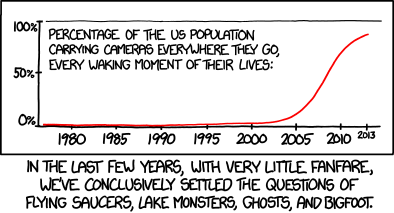
Settled

Well, we've really only settled the question of ghosts that emit or reflect visible light. Or move objects around. Or make any kind of sound. But that covers all the ones that appear in Ghostbusters, so I think we're good.
09 Jul 10:53

When you meet someone who’s been told they don’t matter, give them a chance to matter

by Fred Clark

I’ve been thinking about this post from Richard Beck since he posted it on Friday.

Beck is a professor of psychology, and he starts off with an unremarkable psychological observation: “We all want to matter. To be the focus of respect, esteem and interest.”

True enough, but not exactly revelatory. But Beck, as he often does, explores what this means and teases out pastoral and prophetic implications.

He doesn’t use those words — “pastoral” and “prophetic.” That’s seminary-speak for the same idea conveyed in the unofficial motto of journalists, preachers and stand-up comedians: Comfort the afflicted and afflict the comfortable. The former is what we mean by pastoral. The latter is prophetic. Richard Beck’s discussion of “Mattering” pulls off the tricky feat of doing both at the same time. I think this is a significant post about significance, an important post about importance, etc.

Let’s consider the pastoral side first, because Beck starts there:

What if it is hard to matter? What if you have nothing in your life that commends you to others? What if you aren’t successful, don’t have a job, don’t have kids, or a spouse, or money for the Instragram-worthy vacation?

How do you matter when you have to take a bus, have your electricity turned off, or need to ask others for food?

Well, you find other ways to matter.

Beck describes a couple of men like that who attend his church. They’re lonely and powerless and seeking a sense of significance in a world that regards people like them as insignificant. One has become a “confabulator,” using tall tales to find a sense of importance. The other seems to be perpetually injured. Beck says of these Eleanor Rigbies:

Though his stories don’t jibe with reality, you listen attentively and express interest and concern. Because he wants to matter.

And:

When you see him you inquire about his most recent injury. And he tells you the story of the accident. And you listen because this is how he matters.

Note the use of the second person in those sentences. I’m sure students of rhetoric and grammar have a name for that, but I don’t know what it is — something like “second-person normative” maybe. That’s another little trick used by both preachers and comics. And mothers. It’s sort of aspirationally presumptuous — a way of sneaking in an “ought” without triggering our defenses against moralistic language. Whether or not it is an accurate description of what “you” actually do when encountering such people, it challenges us to make it accurate, to be or to become the kind of “you” for whom it is accurate.

To be honest, in my case, it’s not always accurate. I often look for any chance I can find to escape from people like those Beck describes, to avoid having to listen to their stories, which tend to be frustratingly long and time-consuming, and I haven’t got a lot of time to spare. I have other things I have to do — important things, things that matter, and …

Uh-oh.

Beck’s next example hit even closer to home for me:

Occasionally I drive a van for our church Freedom Fellowship on Wednesday. Driving that route has taught me that sometimes we matter because of what we know. And even the smallest, thinnest epistemological edge can give you this sense of mattering. At the start, being new to the route the regular passengers knew the locations and best routes to get everyone that needed to be picked up. The first few times I drove I needed help about where to go next. People helped me and it made them feel like they mattered. They knew something that I didn’t. Their knowledge allowed them to help me, placed them in a superior position.

But as I’ve driven more and more, I need directions less and less. But still the directions come. I know I need to turn left, they know I know that I need to turn left, but I’m still told to turn left. Why? Because telling me how to go helps them matter. And they are going to hold on to that mattering for as long as possible. And I’m not going to rush them. Sometimes I ask for directions when I don’t need them.

I know this situation. I’ve been there — precisely. The very same thing happened to me this morning, driving my co-worker home from the night-shift at the big-box warehouse-store. And it will happen again tomorrow morning. I know where he lives and how to get there from the store, but every time he gives me directions.

The person in this picture is very important.

That was really starting to bug me, until I noticed that it was really starting to bug me.

I noticed, specifically, that I found it disproportionately irritating in the same way that it’s so easy to be irked or rankled or infuriated by the perpetual advice given us by the various managers and assistant managers and department managers at the store. Annoyance with this advice is a perennial topic of conversation among the crew at lunch breaks and coffee breaks. It took about a month on the job before I figured out why.

See, what we do there is we re-stock shelves. We take pallets of merchandise off of trucks and break them down and sort them and then, with cages, carts and pallet-jacks, we haul them to the various parts of the sprawling store where we slice open boxes and ensure that the shelves are filled with their bounty of offerings the following morning. It’s not complicated — all of the merchandise and all of the shelves are coded, and matching those codes isn’t particularly tricky. It may be a kind of menial drudge work, but like all such work it can be done with care, and the guys in the crew are good at it. They do it fast and they do it well. They’ve been at this a long time and they know what they’re doing.

And I think that is why all that unbidden, unnecessary advice from the various managers gets under their skin. It’s an implicit suggestion that they don’t know what they’re doing. It’s a kind of refusal to give them the respect they’ve earned as people who know what they’re doing.

That bugs the guys on the crew. It bugged me, too, enough to make me start trying to figure out exactly how and why. And once I started exploring that, I came to see that all those manager-types were wrestling with the same thing. They, too, were just struggling to find some source of respect or of self-respect in a job that doesn’t offer as many sources of that as we all might like or want or need.

In Richard Beck’s terms, “We all want to matter.” We all require some sense of “respect, esteem and interest.” Once I realized that cheerfully accepting the superfluous instructions or inaccurate advice of one of those various bosses was an opportunity to allow them that, I was able to take the focus off myself — and thus off of my reflexive resentment over being denied even that slight source of mattering. I began, instead, repeating the mantra: This is water. This is water.

That’s from David Foster Wallace’s 2005 commencement speech at Kenyon College. Please read the whole thing, but here’s the core of it:

The really important kind of freedom involves attention and awareness and discipline, and being able truly to care about other people and to sacrifice for them over and over in myriad petty, unsexy ways every day.

That is real freedom. That is being educated, and understanding how to think. The alternative is unconsciousness, the default setting, the rat race, the constant gnawing sense of having had, and lost, some infinite thing.

When you meet someone who maybe feels like they don’t matter — or who has been told they don’t matter, or who has been assigned a lot in life that the world says doesn’t matter — you have the chance to choose consciousness over unconsciousness. You have the chance to regain a piece of some infinite thing.

You have a chance, in other words, to show that person that they do matter — to reassure them that they are deserving of respect, esteem and interest. Even if you don’t need directions, sometimes you should ask for them because the other person needs to give them.

That’s a way of comforting the afflicted. That’s a kind of pastoral ministry.

But this matter of mattering also has prophetic implications. Richard Beck discusses those as well, and so will we here, but let me save that for a part 2 and a follow-up because right now I’ve gotta go. Those shelves won’t re-stock themselves you know.


07 Jul 08:07

Planet of Giants

by Iain Coleman

We have been reduced roughly to the size of an inch.

Atoms are mostly empty space. We’ve known this since 1909, when Ernest Rutherford’s researchers Hans Geiger and Ernest Marsden fired alpha particles at gold foil in an attempt to probe the structure of the atom. To their surprise, most of them went straight through. To their even greater surprise, a few of them bounced straight back. This led in short order to the basic model of the atom that we still use today: a tiny, positively charged nucleus containing almost all the atom’s mass, orbited by negatively charged electrons.

It’s this structure of the atom that makes things the size they are. The direction of the electric force between two charged particles depends on whether the charges are of the same sign, or opposite signs. If they are opposite, the force attracts the particles together: if they are the same, the force pushes them apart. Whether the force is attractive or repulsive, it increases the closer the particles get to one another. So the harder you try to push two electrons together, the more strongly they will try to push each other apart again.

Since the outside of the atom is made of electrons, the same thing happens as you try to push atoms together. And that’s what determines the size of objects in the world around us: the balance between the forces that keep atoms together, and the forces that push them apart.

If you’re going to shrink something, then, you have to change that balance. The obvious way is to simply squeeze the atoms closer together, applying enough pressure to overcome the repulsive electric force between the electrons. That’ll work, provided you don’t mind squishing whatever you’re trying to shrink.

If you want to shrink a person, and not turn them into a compressed pellet of dense goo, you’re going to have to be a bit more sophisticated. Instead of increasing the force pushing the atoms together, you could try to reduce the repulsive electric force, making the atoms naturally huddle up closer to each other.

The strength of the electric force depends on a physical constant called the permittivity of free space, usually labelled ε0 (epsilon-nought). The permittivity of a material is a number that tells you how it is affected by an electric field, and ε0 tells you the same thing about space itself. The higher ε0, the lower the force between charges. So, make ε0 bigger, electric fields get weaker, and atoms sit closer together. Shrinking accomplished!

Except… how exactly do you increase ε0? OK, use some mysterious property of the Tardis, fair enough, but what actually would have to be happening?

Well, the reason why ε0 is the size it is, the reason why space even has this property of permittivity at all, is still not entirely understood, but it probably goes something like this. In a normal material, made up of protons and electrons, an electric field makes these particles line up to a greater or lesser extent. Every material has its own molecular structure, its own configuration of protons and electrons, and this determines its permittivity. Empty space doesn’t have protons and electrons in it – that’s why it’s called empty space – but it does have something altogether stranger.

According to the theory of quantum fields, particles can pop in and out of existence for microscopic fractions of time. How long these virtual particles can exist for is governed by Planck’s constant, which is a very small number indeed – and that’s why we’re generally unaware of it happening. But it does mean that what we think of as empty space is in fact a boiling sea of virtual particles, appearing and disappearing in the blink of a quantum eye.

When an electric field passes through some part of empty space, these virtual particles line up with it just like the protons and electrons in a real material. If you want to increase the permittivity of free space, you need to have fewer virtual particles about – and that means reducing Planck’s constant.

So there you have it. Something goes wrong with the Tardis, it somehow reduces Planck’s constant in the bodies and clothes of our time travellers, and everybody shrinks. Job done.

Except… there are some complications. Mucking about with these constants doesn’t just bring atoms closer together. It also changes a lot of other things, including the energy levels of the electrons within the atoms. All of chemistry, and therefore all of biology, is determined by these energy levels. Change these, and you screw up every single process within our bodies. The consequences would at least be mercifully brief.

But let’s say you somehow manage to do this in such a way that everything still works, albeit in a miniaturised form. You still have problems. Breathing, for a start. The oxygen atoms in the air will be much too big for the now-miniaturised alveoli in the lungs, which allow the oxygen to pass into the blood. Seeing will be interesting, too. The light receptors in the eyes will now respond to much shorter wavelengths. For a shrinkage factor of 100, which would roughly shrink an adult down to about an inch, the eyes would see, not visible light, but X-rays. This would be pretty cool, except that there are not many X-rays around at the surface of the Earth – the X-rays from the Sun being absorbed by the atmosphere, which is just as well otherwise we’d all die – and so it would be like wandering about in the dark all the time.

And, even more fundamental and even more inescapable that all of these, there is the matter of weight. Pushing all these atoms together doesn’t change their mass. A person who weighs 70 kg normally will still weigh 70 kg after shrinking. Four such people standing on a table would make it collapse, and crossing soft ground would be impossible as every step would just sink deep into the earth.

All in all, this notion of shrinking people by bringing their atoms closer together doesn’t seem all that clever after all. What happens if we take some of the atoms away instead?

Certainly, removing 99 atoms out of every hundred would shrink a person. But you’d have to be a bit careful about it. Removing atoms blindly would end up destroying the delicate internal machinery of the body’s cells, with fatal consequences. The only way this approach might work is if you take away 99% of each type of cell, like shrinking a wall by removing some of the bricks. The bricks will still work and the wall will still stand, just a little shorter.

Bodies, however, are more complicated than walls. I dare say a length of bone or gut might more or less continue to function with 99% fewer cells. Even the retina might be OK, although the shrunken eyeball will not be able to focus, so one way or another the person ends up blind. But what about the brain? The complex connections between neurons are the basis of all our thoughts and memories, not to mention the unconscious processes that keep our bodies working. Remove 99% of these cells, and you destroy virtually all of the brain, right down to the basic functions that regulate breathing and circulation.

And even if all these problems could be overcome, these is still this fundamental issue of mass. It can’t just vanish – the conservation laws won’t allow it. And evidently it doesn’t just hang around, or our miniature heroes would find themselves drowning in great puddles of organic goo. No, the only way to get rid of mass entirely is to convert it to energy.

How much energy? That’s easy to calculate. Einstein’s famous equation E=mc2 tells us that mass and energy can be turned into one another, with the conversion factor given by the speed of light squared. This factor of c2 works out at just over 20 megatons per kilogram. Shrinking a 70 kg person, therefore, releases just over 1400 megatons of energy. The whole Tardis crew probably amounts to roughly 250 kg, so that’s an energy release of 5000 megatons. (Let’s not even try to figure out the numbers for the Tardis.) This is nearly ten times the size of the entire US nuclear arsenal, and a hundred times greater than Tsar Bomba, the largest bomb ever detonated.

To get an idea of what would happen if all this energy were released in, say, London, we can use one of my favourite web apps: Alex Wellerstein’s NUKEMAP.

DIagram showing blast and heat radii from 5000 MT explosion in London

Blast and heat radii from 5000 MT explosion in London. (Plotted with NUKEMAP.)

The fireball stretches from Croydon to Edgeware. Buildings from Dover to Coventry are blasted to rubble. And everything from Newcastle to Paris is on fire.

Admittedly, this is a crude model. The nukemap is designed to deal with man-made nuclear weapons, and doesn’t necessarily scale up accurately to such colossal power. It also doesn’t take into account the curvature of the Earth, which would be significant on this scale. Finally, using this model means assuming that the energy is released all at once. Just as loose gunpowder will burn rather than explode, a more gradual energy release would not create such a gargantuan blast. However, it would still dump the same amount of heat into a very small volume of the atmosphere, so the firestorm effects at least would be broadly similar. It certainly puts the environmental threat from Forrester’s dastardly insecticide plot into perspective.

So, to conclude, there doesn’t seem to be any way to make miniaturisation work. The best case scenario has the miniature person blindly choking to death in seconds. The worst case scenario incinerates half of Britain. Perhaps it’s best if we never speak of this again.


07 Jul 08:05

RIP Douglas Engelbart.

by Stanislav

Douglas Engelbart – perhaps the last of the great American inventors – is dead. The newspapers are keen to remind everyone that Engelbart invented the computer mouse, but they are largely silent on the matter of his having personally created almost every one of the concepts we think of as part of the standard human-computer interface, including the very idea of an interactive graphical workstation. This is because a silent army of dutiful piss-ants is, by unspoken agreement, always given credit for the bulk of their betters’ accomplishments.

The video clip below is the opening segment of what has long been known as “The Mother of All Demos.” If you have not seen “The Mother of All Demos,” your education in the history of computing is woefully incomplete:

Who among those living today could hope to produce something equaling the pure novelty – the sheer intellectual audacity – of just a single one of the things which appear in “The Mother of All Demos” ?

07 Jul 07:59

Musical Quickie 1: Paint It Yellow Meme*

by Alex Wilcock

So, Nick Clegg and Mick Jagger: everyone’s quoting the 1967 description of Mick’s views as “straight John Stuart Mill”, but has he done what the rest of us haven’t and convinced Nick of the merits of Lib Dem drugs policy, or further? I only ask (as I did of Nick the first time I interviewed him, to his well-concealed delight).

Anyway, this is only a quickie, but will include the two cooler Lib Dem-pop crossovers and a terrible joke (I can almost hear you sigh). But first, Jennie Rigg’s meme to rewrite Rolling Stones songs for the Lib Dems: fab. I’m especially knackered and in lots of pain this week, so my creative energies are low, but click here to see some of the entries so far.

Just meandering for a moment – were I writing the detailed music-related article I meant to instead of this quickie, it’d be about Tom Robinson. So imagine I have, and that I’ve recommended the newly-released Tom Robinson Band Anthology 1977-1979 (though I want the stuff from 1989-1990 when I was going to their gigs).

Tune into a Tom special on Neil McCormick’s Needle Time on Vintage TV at 7pm tonight, because I won’t have written anything proper by then and you’d’ve missed it.

Back to the story of the week, which is Nick Clegg and Mick Jagger and co having dinner together. Which is cool. And Jennie’s plan to get Mick to guest at Glee Club. Which is terrifying.

Enjoy Hyde Park, Mick, and though today’s may not be as iconic, I bet you all play better this time… Though a better performance than Glee Club isn’t hard.


Rolling Stones Feat. Lib Dems – My Favourite New Entries

Jennie:
“I see a red door and I want to paint it yellow”

Jennie’s concept / Magister’s lines:

Sympathy for the Paddy
“So if you meet me, have some courtesy,
“Have some sympathy and some taste
“Use all your well learnt politesse
“Or I’ll kill you with one hand.
“Because I can, you know. Would you like to hear my joke?”

Nick Barlow’s all-too-familiar title:

Here Comes Your Nineteenth By-Election


But most of all the lovely Andrew Hickey’s massive wins with:
“I know
“It’s only a rogue poll
“But I like it…”
Oh yeah – I meant to write about a possibly rogue poll that was way better for the Lib Dems than anything else recently, but possibly worthwhile as it was polling about something other than the usual. Remind me, reader.

And the outstanding…
“I’m canvassing apartments on the ninety-ninth floor of my block
“I knock on the door looking through the window and hoping the barking will stop
“Then out comes a guy who’s all dressed up like a Union Jack
“And says I’ve won his vote if I’ll just send those immigrants back

“I said, hey! UKIP! Get off of my round!
“Hey! UKIP! Get off of my round!
“Don’t hang around ’cause two’s a crowd”

Finally, Magister for Simon Hughes:
“Start me up!
“If you start me up
“I’ll never stop.”
That’s one for me, too, obviously. Simon and I once did a pair of set-piece speeches to finish a Lib Dem Youth and Student Conference. Everyone missed their trains. Including me (remember, this article is a “quickie”).


On a more critical note, the Jumpin’ Jack Flash (probably my favourite Stones song, along with Saint of Me) suggestions have missed the points – they’re clearly about the wrong ex-MP. Surely…
“But I’m all right now, in fact, it’s a gas
“But I’m all right, I’m jumping lights – flash!
“Step on the gas, gas, gas”
…should make you think of an even more recently ex-ed MP (and a certain Elephant denies all responsibility for that lyric).

Too shuhne?


That Cool Lib Dem-Pop Crossover Chart In Full

Nick and Mick’s new entry only at number 3, I’m afraid, below…

Number 2: Jeremy Thorpe and Jimi Hendrix – when they were both big

(Google for the cool pictures; I’d provide a link, but they all seem to be either scandals or rip-offs, so I’m disinclined to)

And a surprise Number 1: Norman Lamb and Tinchy Stryder

Because mortgaging your house to help launch an unknown rapper’s career and him making it big is significantly cooler than a photo-op or a meal, however cool the star.


*My urge for terrible puns means I was tempted to title this Paint It Yellow Sub-Par Meme, but it’s not sub-par. It’s fab. It’s also the wrong ’60s band, and though it has the major Glee Club advantage that it’s a song everyone can sing, since the Coalition we can no longer sing along to:
“We all live in a yellow squeaky-clean…”
07 Jul 07:31

Hetero cunnilingus: apparently it’s to stop you cheating

by stavvers

I read a paper. It left me in convulsions of laughter. It is, of course, an evolutionary psychology one.

The paper “Is Cunnilingus-Assisted Orgasm a Male Sperm-Retention Strategy?” sets out to answer the all-important question which has apparently been bugging the evolutionary psychology community since it evolved the gene to apply a just-so explanation to every aspect of human behaviour: why do heterosexual couples engage in something fun?

They ponder that it must be a strategy for either keeping sperm in there to make sure it all swims the right way, or maybe it’s to stop women cheating. I was surprised to note no mention of the bonobo, a closely related ape which tends to use oral sex as a greeting and fuck everything that moves, presumably because the authors had already ruled out the alternative hypothesis of “oral sex is fun.”

Anyway, following a very short questionnaire where they asked some dudes how hot their girlfriends were, and how hot other men found their girlfriends, whether their girlfriend came, and when they spaffed in relation to going down, the authors concluded that cunnilingus definitely didn’t evolve to keep the jizz in the right place. Therefore, they decided, it must be to stop cheating.

I promise I am not exaggerating this paper. This is a literal, actual paper which was literally, actually published in a literal, actual peer-reviewed journal. And if any of it is correct, I’m damn glad I’m not heterosexual, because their sex lives sound joyless. 


06 Jul 12:09

Douglas Engelbart (1925-2013)

Actual quote from The Demo: '... an advantage of being online is that it keeps track of who you are and what you’re doing all the time ...'
06 Jul 12:03

Why Are UK Trans People Going on About a “Spousal Veto?”

Originally published at Sarah Brown's Blog. You can comment here or there.

I have been given to understand that the issue of the spousal veto in the Same Sex Marriage Bill is confusing to those not immersed in trans issues. I appreciate that, because if you don’t understand the processes we have to go through, then it’s not clear what is being vetoed and under what circumstances. I’ll attempt to explain. It’s long, but if you scroll to the bottom there is an executive summary.

Part 1: Corbett v Corbett

In 1970, the divorce of trans woman model, April Ashley and Arthur Corbett, later the 3rd Baron Rowallan, came before the court. In order to avoid giving up part of his substantial estate, Corbett’s team advanced the argument that the marriage was never valid in the first place, because April Ashley was really a man.

The judge agreed and thus set a precedent that meant that trans people were, from that point on, treated by the government as their birth sex forever for all sorts of legal reasons. This didn’t just affect marriage: it also affected stuff like employment protections, what prison you would be sent to if you were found guilty of an offence, and so on.

Prior to this, trans people had been applying for corrected birth certificates and getting them, effectively being recognised in their new gender. This practice ceased completely, and trans rights in the UK entered a dark age.

Part 2: The Gender Recognition Act

Fast forward 3 decades. The European Court of Human Rights had ruled that the government had to legislate to fix the unfairness inflicted upon trans people by the Corbett v Corbett ruling. The government kept dragging its heels, but in 2004 eventually passed the Gender Recognition Act. In a nutshell, the act did the following:

  • It created a thing called a Gender Recognition Certificate (GRC).
  • Upon issue of a GRC, you would be issued a new birth certificate, and gain the other protections in law that you lost by transitioning (e.g. employment nondiscrimination rights).
  • You could only apply for a GRC if you’d been transitioned 2 years and had a report from your GP and the doctor who originally diagnosed your gender dysphoria.
  • There was a time-limited “fast track” for people transitioned more than 6 years: you didn’t need the original diagnosis (because your doctor may have retired or lost your notes).
  • You didn’t need to have had surgery, but if you hadn’t you had to justify why not.

Never wanting anything to be simple, and demonstrating an enduring instinct for screwing trans people over, the civil service (via the government of the day) included a nasty little gotcha: you weren’t eligible for a GRC if you were married.

Of course, you didn’t have to apply for one, but if you didn’t, you didn’t get your rights back. To deal with this, the act created something called an “interim gender recognition certificate” (IGRC). The name is entirely misleading: it’s not a GRC, it doesn’t grant the same rights or anything. All it does is give you a cast-iron reason to initiate marriage annulment proceedings within the next 6 months, at which point the IGRC expires and you go back to stage 1.

If you complete annulment proceedings with an IGRC, you automatically get a GRC and new birth certificate. Anticipating the 2005 Civil Partnership Act, the Gender Recognition Act then allowed you to enter a civil partnership with your former spouse. 151 couples have since done this (I am part of one of them).

If you’ve seen trans people talking about the “confiscated marriages”, it’s those 151 marriages we are talking about, where we were essentially coerced into giving up our marriages to restore our rights.

Interlude: The Equality Act, 2010

In 2010, a year after my marriage was annulled, the Equality Act 2010 passed. This revoked the employment nondiscrimination protections granted by a Gender Recognition Certificate. Thanks guys, appreciate that.

Part 3: Same Sex Marriage Bill

The advent of same sex marriage brings an end to this coerced divorce, or rather it should, but the government and civil service have cocked it up.

Firstly, you still have to end your relationship if you are in a civil partnership, although you can convert it to a marriage first to avoid that.

Secondly, and more offensively, rather than just ending the requirement to be unmarried when you have a GRC awarded, the Same Sex Marriage Bill requires your spouse to consent to the granting of a GRC. This is significant because, despite being gutted somewhat by the 2010 Equality Act, GRCs still restore some rights (the ones we lost in 2010 we just stay without for good). If your spouse doesn’t consent, you get an IGRC instead, on the same terms as before: start to annul within 6 months of return to square one.

So basically, if your spouse can’t, or won’t sign the consent form, you have to divorce them to get your rights. This creates what is possibly the most passive-aggressive legally sanctioned way to initiate a divorce ever, i.e. “I don’t want to divorce you, but I’m going to veto your human rights until you divorce me”.

The government call this “both parties having a say in the future of their marriage”. What trans people call it isn’t actually printable, but in polite company we call it, “the Spousal Veto”.

Part 4: Lobbying

We don’t like the spousal veto. We really, really, don’t like it. Your spouse doesn’t get to veto your transition, your surgery, or anything else. They get to veto this though. In 2013, we are passing a law in the name of equality that makes the human rights of one party to a marriage the “gift” of the other.

So a bunch of us tried to get it changed. Much of the work around this has been done by a dozen-or-so people, including me. We wrote some amendments, which were submitted by my MP, Julian Huppert, aimed at restoring the stolen marriages and ending the spousal veto, amongst a couple of other things (one being that if your spouse discovers you’re trans and you can’t prove they knew before you married, they can have the marriage declared invalid. We aren’t all that keen on this either).

The amendments were rejected by the government at committee stage, so Julian put them again at Commons Report Stage, and gave what must rank amongst the best transgender-related speeches ever on the floor of the Commons.

And then an interesting thing happened: the minister in the Commons, Helen Grant, rejected the amendments using the exact same words that the civil servant responsible for drafting these bits of the bill had used when talking to our little bunch a few days earlier, when we met them in London.

It also became apparent to us that the veto had arisen on the basis of what sounded, when described, like the civil servants pretending they were married to trans people and writing into law what they would want for themselves.

The bill passed onto the Lords, with the veto intact. By now it had become apparent that the government would die in a ditch over not restoring the lost marriages, and I reluctantly gave up campaigning for their restoration to concentrate on the veto – the thing that we all agreed was the single most offensively transphobic provision in the Bill.

Part 5: Lords amendments

A number of us started talking to various Lib Dem and Labour peers, and it came to pass that while the government was adamant the veto needed to stay, they might be minded to give a bit of ground, and could we draft two amendments: what we wanted, and a compromise for if we couldn’t get it. This we did. The first amendment was no veto. The second was a veto, but if annulment proceedings hadn’t commenced (at the behest of either party) within 6 months, or a decree nisi hadn’t been issued within 12, the spouse lost the veto and gender recognition could go ahead.

Our compromise amendment was debated on the floor of the Lords, with brilliant speeches in support by Baroness Barker of the Lib Dems and Baroness Gould of Labour. The amendment was rejected.

This brings us close to the present day. There followed a flurry of desperate emails to try to salvage something. In the end, this week the government published an amendment. They were going to reintroduce the “Fast Track” for getting a GRC, but only for people who have been transitioned 6 years at the point the same sex marriage bill passes, and only if they’re married. The rationale is that some have waited, refusing to divorce, without their rights, and they might not be able to get the original diagnosis any more. These are couples who have put their commitment to their marriage over and above the human rights of one partner, in what must count as one of the strongest testaments to love that there is.

Oh, and by the way, there’s a spousal veto on this as well. Given what these marriages represent, the government could not have been more crassly offensive if they’d tried.

And that was the end of the battle, or so we believed, until out of the blue came the promise of another amendment, specifically to address the veto!

Part 6: The veto amendment

Here is what the government are proposing to do. Instead of saying you need signed spousal consent to get a GRC, otherwise you get an IGRC, they want to say that you need signed spousal consent for the marriage to continue.

As far as I can tell, this is a bit of legal manoeuvring. It seems that to address our objections that the consent is a veto over the issue of a GRC, the government are explicitly recasting it as permission to stay married.

Of course, if your spouse doesn’t grant that permission, you don’t get the GRC, just the same as before. It doesn’t actually change anything – the veto remains.

Summary

That was long, so I’ll summarise it in a TL;DR version.

  1. 1971 – Corbett v Corbett case removes ability for trans people to get rights associated with new gender, leaving them in limbo where they have neither the rights of the gender they started off with, nor the ones from where they ended up.
  2. 2004 – Gender Recognition Act restores those rights, but you have to have your marriage confiscated first.
  3. 2010 – Equality Act takes some of the rights back
  4. 2013 – Same Sex Marriage Bill proposes an end to confiscated marriages, but your spouse gets to veto your rights while you remain married.
  5. Bill passage – government gets increasingly transphobic while they defend the need to maintain the veto provision.

06 Jul 11:37

BLUR – “Country House”

by Tom

#725, 26th August 1995

Blur-Country-House-54546 BOXING?

A “heavyweight battle”, the NME cover-billed it. And if “Country House” vs Oasis’ “Roll With It” was a title bout, the music press were desperate to play Frank Warren.

Perhaps they had most at stake. It was, in a way, their last great fight. Many other moments define Oasis. Blur are best remembered for different songs. Britpop itself? Well, this was the high tide – probably the main reason Oasis even count – and the rivalry became an ongoing, rather tiresome, pop storyline for years after. But even then the battle is just one of a scrapbook of memories: Britpop had to be a thing already for this tussle to even matter.

The press, though – this is the climax of its 80s and 90s story, its turn away from other music to keep the indie flame burning, and how it saw its favourites gradually win over first the radio establishment, then a wider public. And look – here they are! Top of the charts, ma! Whoever wins, we won, is the NME’s message, but in that final ridiculous week the story had outgrown them. After Britpop, readers dwindled, and no new story emerged: the price of ‘we won’ turned out to be that there wasn’t a “we” anymore.

FOOTBALL?

The run-in, as I recall it. Oasis, releasing their second album, were a coronation away from being the biggest band in the country. Blur, veterans on their fourth, were returning conquerors, Parklife having defined them (and their genre) in the record-buying eye. Singles release dates at first didn’t sync, then did. Alan McGee at Creation refused to blink. The nation held its breath – or ignored all this entirely.

But just as Cup Finals and Playoffs can be disappointing, cagey affairs, so the Battle Of Britpop played out more warily than it might have. Oasis, it would become apparent, had left commercially far stronger singles than “Roll With It” on the bench – the track doesn’t even show up on their Noel-picked Greatest Hits. Blur didn’t – there are better songs on The Great Escape than this, but “Country House” is one of the few that gets in your face enough to do this job.

WRESTLING?

It’s also a honking, parping pantomime. Both bands played up to their image: if you’d written the whole thing as a TV drama and had to fake up convincing singles, you might have ended up with songs rather like “Country House” and “Roll With It”. Blur could be tough to pin down, but “Country House” gave the public more of what they’d already rewarded from the group – uptempo, brash songs with a bit of satire on top. It’s a bustling, dense song – fun-packed and glassy-eyed, with desperation never far away: that niggling two-note phrase cycling under the final choruses, for instance. It pushes catchiness into exhaustion, mirroring the breakdown of its lead character. My first thought is it’s trying too hard, then I realise that’s the point, then I think it’s trying too hard to make that the point. Then I want it to stop. Then I end up playing it again. The grotesque, much pilloried video only adds to the headaches. Modern life is, as they say, rubbish. But were Blur – was this whole stunt? – criticising it, reflecting it, or making it worse?

ADVERTISING?

In the context of The Great Escape, Country House fits nicely: the album is full of brittle people, awful lives, and melancholy just under the skin. It’s an honest taster – as is “Roll With It”: Oasis at this point met expectations, good and bad. These singles were advertising more than just their LPs, though. To the new establishment at Radio 1 – who grabbed the Britpop battle baton enthusiastically from the NME et al – they were a vindication of controller Matthew Bannister’s brutal repositioning.

Bannister inherited a station listened to by about 20 million people, but the audience skewed too old – his vision, backed up by multiple moody, black-and-white promo vids, was of a station where credible presenters would play credible music to a credible audience. It’s a vision that’s endured ever since – shifting Radio 1’s role away from mirror of pop and towards its mentor. In 1995, though, with ratings collapsed and tabloids circling, Bannister needed a win: the Britpop battle gave him one, putting the spotlight on exactly the music his ideal audience segment loved.

In a sense he was lucky, but the showdown couldn’t even have happened a few years prior. “Chart battles” – we’ll see a fair few more – were a creature of the new age of first-week sales spikes: the winner was guaranteed a number one. If this was, as some said, the first time in ages the charts had mattered, they were mattering in quite new ways.

SEALED KNOT HISTORICAL RE-ENACTMENT?

The retro angle is something of a red herring in the music, too. Blur had influences, as obvious as their rivals’ – the “Country House” lytic is Kinksy, there’s plenty of Langer and Winstanley’s 80s sound in the horns, other tracks on the album nodded to Numan and XTC – but neither they or Oasis ever really sounded like anyone but themselves. As with Oasis, the voice played a huge part: Albarn’s distinctive, stylised singing could flip from naughty choirboy to music-hall rabble rouser with ease, but whoever he played you could spot him immediately (“..inna cun-TREE” could be nobody else). Most of his styles, to be honest, set my teeth on edge: there’s an ironic, above-it-all veneer to his vocals which seemed to begin as strategy on their early records and settle into habit. If I often end up buying Albarn’s melancholy anyway, it’s because he can be a great melodist, not really because of his singing or delivery.

PLAYGROUND SCRAP? CLASS WAR?

On “Country House”, Albarn’s not really trying to be sensitive – it’s one of his occasional character songs, indulging a taste for social observation. It’s about a guy retreating to the country because he’s going through some kind of crisis and either having or faking a breakdown – but the music does a much better job of capturing this chap than the words. Take, for instance, the Balzac/Prozac bit. It was approvingly quoted, apparently evidence Blur were The Clever Ones in this schoolyard swots v jocks fight – but it feels very rhyme-first, with “Woah, it’s the century’s remedy” clunking in to hammer home how zeitgeisty Blur are being. An unfair comparison perhaps, but on “Sunny Afternoon” Ray Davies becomes his character and the music becomes his world, and so the listener gets inside it too. The geezer in “Country House” is caricature – the one stab at any kind of inner life that mocking “I am so sad, I don’t know why” refrain.

(Meanwhile, over on the other channel, Noel’s “I think I’m gonna take me away and hide / I’m thinking things that I just can’t abide” is a good summary of depressive self-hatred. Liam then sings it in the same surly monotone the rest of “Roll With It” stews in.)

So there’s no empathy in “Country House”, just observation, and bald observation at that. Just as on “Parklife” and much of “Girls And Boys”, Albarn does comic journalism, not storytelling: he’s the Peter York of pop, the songwriting equivalent of jokey pen-portraits of “social tribes” in a Sunday supplement. If the bands’ backgrounds made it easier to overlay unhelpful North v South, Working v Middle Class conflicts on Oasis v Blur, this kind of thing helped the charges linger.

IT’S ALL ABOUT THE MUSIC, MAN?

Both singles are rescued by their guitarists. Where on “Some Might Say”, Liam bossed the song, he’s flatter on “Roll With It” and the wall of sound has to put in serious work to stop the song becoming a complete trudge. On “Country House”, meanwhile, Graham Coxon puts down a delightful Christ-Are-Pavement-Hiring? guitar solo that’s as endearing as the rest of the track put together.

BALD MAN COMBFIGHT?

The standard anti-Britpop line – the what about Goldie argument, you might call it – hardened quickly during 1995. Why were we paying attention to this charade when there was so much more interesting things happening? How could these throwbacks represent the real, multicultural Britain? I subscribed to this thinking myself, and the “Battle” fuelled it – on paper the idea of Britain’s indie bands straining muscle and sinew to create amazing pop singles was seductive, but if these two weakling, just-about-OK records were the result, the idea was a bust.

Since then I’ve softened. For one thing both “Country House” and “Roll With It” sound a bit better than they did. But also the effects on British indie music, let alone British pop, weren’t nearly as deadening as they seemed at the time. This isn’t as good as Britpop got, but it was as big as Britpop got as a pop event. The noise died down and the charts went on their merry – and increasingly diverse – way.

POSTERITY?

So who won? Oasis won the war and conquered the country. The NME won a last chance to set the agenda. Radio 1 won time to finish its credibility revolution. Graham Coxon, as it later turned out, won a musical argument. And Blur won the Battle of Britpop. Which was just about fair, because of all the records by all the big Britpop bands, none strained so hard to sound like Britpop as “Country House”.

05 Jul 15:26

“Marooned for all eternity in the center of a dead planet.”: Space Seed

by noreply@blogger.com (Josh Marsfelder)
Shame I already used "I got your gun".

I suspect if there's one episode of the original Star Trek that my readers will expect me to come up with some mad, overblown stream-of-consciousness, recursive mess of a writeup for it would probably be this one. I hate to disappoint expectations, but that's not going to be the case here. There was a fairly unbroken streak of episodes starting midway through the season that all seemed to call out for that kind of interpretation, hence a number of the last few blog posts have been in that style, and there's at least one more coming up that will more likely than not warrant it as well, so my abandoning that structure is certainly not something to worry about for the short term. However, “Space Seed” calls for a different approach.

The elephant in the room is naturally that this episode provides the subject matter for the consensus-best Star Trek movie, which is at once a kind of revisit and reimagining of the events of “Space Seed” and also the debut of Nicholas Meyer's unique, and much loved, interpretation of the franchise. Whether or not I feel Star Trek II: The Wrath of Khan is actually deserving of the kind of breathless worship it gets from mainline fandom or is worthy of the title of Best Trek Ever, let alone Perfect Cinematic Masterpiece, is something I'm not going to even begin to worry about until we reach 1982, which is still quite a long ways off from where we are now.

The more important thing to keep in mind for now is that Carey Wilber, who was the actual writer of this episode is not Nicholas Meyer, and this is really where we need to begin before we get anywhere near close to figuring out what this episode really is. Gene Coon has a secondary credit on the teleplay, but given this episode's plot and general tone I'm going to assume he just did some cleanup work after the fact because, for reasons I'll get into a bit later, “Space Seed” doesn't feel like Coon's material at all. Actually, I'll just come out and tip my hand right away. I'm positive this is going to be a nuclear bomb of a claim to make and this is without doubt the entry that will turn away any longterm Star Trek fans who haven't been driven off already, but this is my reaction and my blog and I get to say it: This episode is bad. Really bad.

Actually, I take back part of that last paragraph. This isn't *bad* television: It's as competently and professionally made as any of the strongest episodes of the series so far. In this regard, the incoherent structural jumble of something like “The Menagerie”, or especially “The Alternative Factor”, is much worse. But the thing is both of those episodes hinted at, or maybe accidentally hit on, deeper, more exciting concepts and wound up delightfully oversignified as a result. No, “Space Seed” isn't *bad* television, it's *wrong* television. We're right back in the territory we last tread in “The Corbomite Maneuver”, and in fact this one is infinitely worse: What we've got here is a perfect microcosm and embodiment of everything that's wrong with Star Trek in 1967.

Let's start with the obvious. Marla McGivers is terrible. She spends her off-time drawing and lusting over erotica of muscly, hyper-masculine historical figures and when she actually has a job to do she stands around dumbly and immediately falls for Khan before the dude's even been defrosted. Once Khan comes aboard the Enterprise, she quickly and enthusiastically submits to his dominance and authority and than enters into what can absolutely only be described as an abusive relationship with him. Furthermore, McGivers' character is *defined* by her submissiveness: In Wilber's original script, she was meant to have a friend named Yeoman Baker, and there was to be a scene where Baker tells her a Lieutenant Hanson wants to take McGivers to the ship's dance, which is apparently a thing now. McGivers was to have told Hanson to “get lost” and that she was “waiting for a man who will knock down my door and carry me to where he wants me”. And, well, there's not a whole lot of ways for me to redeem that.

What's almost even worse than McGivers herself is how the rest of the crew treats her. Kirk is noticeably disdainful and dismissive towards her from the beginning, sneering at the notion a mere historian would be a part of his crew. With one line, the show brings up years and years of prejudice towards both women and the humanities, and how the two are a natural, proper fit for each other. The humanities are frequently seen as more “feminine”, and thus inferior, fields of study when compared to the hard sciences, or indeed the military. That scene was enough to get me balled up with rage, and this offensively authoritarian, male supremacist attitude defines the rest of the episode. McGivers might even have been acceptable to me had there been other women to contrast her with: Maybe Yeoman Baker would have been that character. I doubt it, but we'll never know. Even when “Shore Leave” gave us Yeoman Barrows, who was almost comically stereotypical, that episode at least also had Alice to contrast with her. McGivers is played painfully straight and just lands at irredeemably offensive and retrograde.

There's Uhura, of course, but I can't keep leaning on Uhura as a feminist and racial Get-Out-Of-Jail-Free card for the show. The blunt reality is she's simply not an important enough character according to the show's own internal structure and logic. I wish she was, but 23 episodes after her debut, her role hasn't developed much beyond generic background space switchboard operator and she barely gets any lines in any given episode. Nichelle Nichols is a wonderful stage presence and makes Uhura far more memorable and likable a character than she would have been without her, but the sad truth is this simply isn't enough. And here, of course, she gets beaten by Khan's super-soldiers and bursts into tears.

Then we come to Khan himself. Now, before I get any more hate for this piece than I already know I'm going to get, let me first say for the record Ricardo Montalbán is brilliant: He delivers a tremendously multi-layered and charismatic performance that's unlike just about anything else we've seen on Star Trek so far, and that alone may be the reason this story gets revisited in fifteen years' time. The first thing to note about Khan as a character then is he's another in a line of evil or otherwise dark doubles or reflections of Captain Kirk. A surprisingly significant number of episodes this season have dealt with this theme: First we had Gary Mitchell in “Where No Man Has Gone Before”, then the Good!Kirk/Evil!Kirk split in “The Enemy Within”, Kirk's android duplicate in “What Are Little Girls Made Of?” and Trelane in “The Squire of Gothos”. By this point this particular thread could charitably be called “tired”, but Khan is without question the most memorable of the lot.

Khan is also a unique twist on this particular formula, and it's worth putting in the context of all those other characters like him. Coon's big contribution to this script seems to be changing Khan's background details. Wilber originally wrote him as Harold Erikson, a regular, non-enhanced criminal who would become a space pirate. Coon apparently suggested Erikson should become “a true rival to Kirk” and introduced the genetic engineering dictator plotlines. The name change to Khan came when Montalbán was cast (the Noonien was apparently Gene Roddenberry's idea, who named him after an old Chinese friend of his he wanted to reconnect with, which I'll just let speak for itself). Of course, as conceived this gives the character rather disturbing Nazi overtones, especially given the way the episode as filmed actually plays out. Whether or not it's better he became a charismatic, masculine, generically foreign man (Khan is supposedly Indian, Montalbán is Mexican, the show seems to think the two are one and the same) is something I'll leave to you to hash out.

Regardless, Coon's edit is worth paying very close attention to: He specifically said in order to become a match for Kirk, Khan would need to be functionally superhuman, which is highly interesting given the reading about Kirk's character we've been building since “Where No Man Has Gone Before”. We should also contrast Khan with Trelane, the last such instance of an antagonist being a mirror of Kirk: What's crucial to note here I feel is that Trelane was for all intents and purposes a mirror of William Shatner, or at least Shatner's performance-He's the other side of Shatner's drag action hero. Khan, however, is explicitly a rival for *Kirk*, or at least he's meant to be, and Jim Kirk-as-written and William Shatner are absolutely not interchangeable, something a great many Star Trek fans and, actually, members of the larger pop culture, would do well to remember. But Khan is more than just Kirk's evil clone or doppelganger; He's also his equal, and by doing this the show opens up a whole host of problematic subtexts, and I'm not sure exactly where this leaves Star Trek at the end of it all.

What I do know is that, through this, “Space Seed” takes the show to some very dark places, and I'm not convinced this is a good thing. Khan is a ruthless dictator and the product of eugenics such that he considers himself morally, intellectually and physically superior to anyone not of his lineage. Also, as befits his name, his one desire is to conquer the universe and lord over an empire of his making. But Khan is also frequently and distressingly validated in these beliefs: In many ways he really *is* superior, or at least the show seems to want us to think he is. He frequently comments on how humanity hasn't fundamentally changed in two centuries, easily outmaneuvers and dispatches the Enterprise crew, and the only reason Kirk survives his intended execution is due to McGivers betraying Khan and saving his life at the last second in an act that is framed both diegetically and extradiegetically as a “weakness” on her part. Even once Kirk regains control of the ship and rounds up Khan and his soldiers, the hearing he gives is essentially a surrender-As Khan explicitly says, he gets what he wants. A planet to rule and turn into the seat of a new empire. Khan wins.

What's even more disturbing is that Kirk, McCoy and Scott *admire* Khan, and are furthermore actually in *awe* of him. Once they discern his identity, they take turns musing that he was “one of the good ones”, stresses that there were “no deaths” under his rule and go out of their way to praise his charisma, energy, ambition and style of dictatorship. This manages to do the impossible and cause Spock to be visibly shocked and appalled, but his protests are laughed down and dismissed with an incredibly unconvincing bit from Kirk and McCoy about how humans can detest a person for what they did while admiring their stamina. This is exacerbated by the fact Kirk and McCoy are just about the most patronizing and demeaning to Spock we've ever seen them: McCoy calls him unfeeling and inhuman and launches into an ugly rage for really no reason and Kirk is intolerably smug and condescending to him throughout the entire episode. This is, frankly, undistilled speciesism conveyed in racist language and bald-facedly patriarchal. No manner of diverse casting is going to make up for this.

But this is, sadly, to be expected, given what the rest of this episode is doing. Look at the word choice here: If Khan is Kirk's “rival” or equal and opposite, than we're to take them as expressly comparable entities. The threat Khan poses is not that of a dark mirror of what humanity might become or the dangerously re-emerged relic of a misbegotten age long in the past, it's that he might just show himself to be manlier and more competent than Kirk. The central battle of “Space Seed” isn't authoritarianism sparring with democracy, nor is it even a fight over the value of eugenics: It's a war to control the Enterprise and over who gets to be the leading man. The show is overtly likening Kirk to Khan, and it's not doing anything to problematize this. And Kirk definitely is not opposed to Khan on principle: Putting aside for the moment his hero worship of Khan's suave badassery, his dropping of official charges against him and granting him and his followers a planet has to be seen as a tacit endorsement of his beliefs. If he were truly interested in demonstrating humanity had evolved, he absolutely would have brought Khan to justice. Even Spock gets to say “It would be worthwhile to return in several centuries to see what grew of the seed you planted here today”.

Aside from once again completely derailing the ethics of Star Trek, this also gives us one of the most distressing morals in the show's history. There is an unsettling tendency amongst some classical liberals to believe that a temporary dictatorship might be beneficial, even necessary, to bring about true egalitarianism in the future. There is a quote often attributed to 18th century French economic philosopher Anne-Robert-Jacques Turgot, Baron de Laune in which he is alleged to have said “Give me five years of despotism and France shall be free”. The alleged theory, which is scarily believable given some aspects of liberal thought, is that an enlightened absolute ruler would be better than looser, more generative forms of government because we'd finally have someone who knew what they were doing in charge and he (it's always a he) would be able to institute reform without hindrance from annoying checks and balances from less-intelligent obstructionists. I'm also reminded of the Philosopher Kings mentioned in Plato's The Republic, which uses very similar language: People would be best served under the kind, wise and benevolent patrician authority of a king who was also a scholar. Jesse Walker, editor of Reason Magazine, further elaborates on these issues in this article, where he takes to task free-market economist F.A. Hayek, Jorge Louis Borges and other such leftist thinkers who, in seeming violation of their stated beliefs elsewhere, at one time or another expressed fondness and admiration for Vladimir Lenin, Mao Tse Tung and Augusto Pinochet, some of the most violently right-wing totalitarian governments of the modern age.

This is what Khan is. A tyrannical dictator, but one of the “good” ones. A monomaniacal despot, but one who is somehow more “enlightened” and “liberal” in his views, as if that's supposed to be some kind of excuse. His eugenics backstory and the crew's deference to him is incredibly telling: Khan is not some artefact of Earth's shameful past: If Star Trek is about idealistic futurism, then Khan is the show's own potential future. After all, as he is so fond of saying, humanity hasn't evolved much, and right now the terrifying thing is he's the only clear-cut vision of the future Star Trek's given us so far. And why wouldn't he be? Wasn't the original pitch for the show about a crew of space naval officers going around telling morality plays, teaching everyone the difference between Right and Wrong? Just last episode we had Kirk strolling onto Eminiar VII and making all their decisions for them, all the while touting humanity's inherent barbarism. Here we have him the most stern, authoritarian and masculine he's been since “The Corbomite Maneuver” and treating Spock with open contempt for not being human enough to understand the value of emotion and illogic. Why isn't the end result of this train of thought going to look suspiciously like Khan Noonien Singh?

And let's go one better. Let's also take another look at Khan's relationship with McGivers. At first, this seems to open up the one confusing structural logic hole in the otherwise very tight production we've got this week: Khan has thirty genetically perfect Überfraus aboard the Botany Bay: Why would he waste his time pursuing someone of inferior stock? His interest in McGivers can really only be seen as a means to an end to get access to the Enterprise. Sure, he gets a line at the end about how she's a “superior woman” and he's glad she's joining them, but it really doesn't take as far as I'm concerned. But that's exactly it. The reason Khan is interested in McGivers is horrifically clear: Because he can use her. Because he can control her. He can dominate her completely and utterly and she'll love it. Oh, she may not at first, but he'll just need to give her a strict lesson from the back of his hand to make her step in line before him. Of course he's not going to be interested in the Überfraus: They're his equals, or perhaps they might be superior to even him in some respects. Either way he'd have to treat them accordingly, and that's not something Khan wants in a female companion. Nor, would it seem, is it what Star Trek wants in its female characters.

We're coming off of a stretch of episodes that have been about nothing if not tearing down the show as it exists right now bit by bit. This isn't by definition a bad thing, but against that backdrop “Space Seed” is horrifying. This episode would have us believe the only way forward for Star Trek is Khan's enlightened despotism. Well I'm not going to stand for that: There is absolutely nothing leftist or progressive about authoritarianism, totalitarianism and male supremacy, no matter how much “liberal” or “socialist” language the monster wishes to clothe himself in. Tyranny and domination are tyranny and domination regardless of the form they take. I cannot tolerate this and I will not accept this. The other side of the argument is no better: Can the equation of Kirk and Khan, and thus “Space Seed” on the whole, be read as yet another condemnation of the show's militarism and patriarchy? If so that's even worse, as Coon has doomed the show to an inevitable and inescapable future of iron-fisted despotism.

But, no matter how toxic it may be, I'm stuck with it for now. Thanks in no small part to the success of Star Trek II: The Wrath of Khan, there are few episodes in the Original Series more influential, more fondly remembered or with more of an artificially inflated reputation than “Space Seed”. And, as a result, I'm marooned here. Trapped once again facing down the show's Death Drive, this time brought upon by its own egotistical conception of itself and delusions of lordship. I really want to help turn Star Trek into something that can be taken as a genuine source for good in the world and as a version of idealism that it's actually possible to respond to and is something to strive towards. But at the moment the biggest obstacle in my path is Star Trek itself: I can, once again, appeal to the future, but now it's a question of what that future is going to entail, exactly. A future that leads to Khan Noonien Singh is not one anyone should be allow to come to pass.
05 Jul 12:49

Khat fight; evidence loses.

by septicisle
Yesterday, the home secretary Theresa May did something both commendable and liberal.  She stood up in the Commons and made clear it is unacceptable that the police's use of stop and search is still resulting in disproportionate numbers of young black and Asian men being hassled purely for going about their daily business.  Launching a consultation after a pilot study made clear that when threatened with action, the number of searches fell without there being a corresponding rise in crime, it might just result in one of the grievances that helped spark the riots of two years ago being tackled.

There is though a unwritten rule when it comes to being a modern home secretary.  For every apparent liberalising reform you introduce, you have to then do something that makes life that little bit more miserable for one section of society.  Hence the utterly absurd, ridiculously counter-productive and flying in the face of all the evidence decision today to make khat, or qat, a Class C drug.

This is now the third time in relatively quick succession that the Advisory Council on the Misuse of Drugs has seen its expert advice disregarded for entirely political reasons.  First, Labour under Gordon Brown ignored the council's report that said cannabis should remain Class C, with the panel a year later recommending the downgrading of Ecstasy, or MDMA, to Class B from A.  The head of the ACMD, Professor David Nutt, was then unceremoniously sacked by Alan Johnson after he continued to criticise the government for ignoring the council's advice.  Now with the supposedly more government friendly Professor Les Iversen at the helm, the coalition has decided it simply can't accept their view that khat is only a "mild stimulant" and its effects on the community are relatively negligible (PDF). Iversen merely says that he is "disappointed".

Theresa May for her part claimed that as some of the evidence is on the light side, it's possible the ACMD has underestimated the harm caused by khat, and so she pledges she's acting to protect "vulnerable members of the community". This is rather at odds with the coalition's economic policies, but let's take her word for it. That the ACMD had previously looked at khat in 2005 and came to the same conclusion is irrelevant, nor would it apparently make a difference if further research was commissioned.

The real reasoning behind the ban it seems is, err, that everyone else has already made it illegal. Whether the fears are substantiated or not, it seems the government has come under pressure from both the US and mainland Europe lest the UK become the main trafficking hub for the plant. Again, that khat is an extremely minority pursuit seems irrelevant, as the figures quoted in the ACMD report (2,500 tonnes imported in 2011, worth approx. £13.8m with VAT receipts of £2.8m) suggest. Normally the Tories love nothing better than sticking two fingers up at Europe, but it seems on this occasion that it's lobbying from the US that has made the difference. Considering the now wildly divergent laws that different US states have on cannabis, a drug that the ACMD believes is more harmful than khat, and that the US led war on drugs has worked so magnificently so far, a minister with more backbone would tell them where to get off. But no.

Unfortunately, as the ACMD report also sets out, in hardly any of these countries was khat subject to a harm review prior to it being made illegal (pages 57-58).  Indeed, in the Netherlands, where khat has recently been added to the same list of technically illegal but tolerated substances such as cannabis, the government there also ignored a review that found khat was relatively benign (PDF).  The report also makes clear the obvious consequences of putting khat in Class C: at the moment khat costs between £3 and £6 a bundle to the consumer.  Make it illegal though, and the cost will inevitably increase, attracting those already involved in the wider drugs trade who previously saw the market cornered by legitimate traders with low profit margins.  As Transform say, not only is the government ignoring expert advice that says the harm posed by khat is too low for it to be controlled, doing so will almost certainly make the problems there are worse.

For as Dr Alex Klein argues, there's more at work here than simply the positives and negatives of a plant that in Somali communities plays a role somewhat analogous to that of alcohol in our own.  He believes that the campaign to ban khat is led by those who see the "mafrishes", the cafes where khat is chewed, as a challenge to the authority of the mosque and Islamic organisations.  With the plant banned, and those opposed to the mafrishes likely to quickly inform the police if illegally imported khat continues to be chewed there, the potential for conflict is likely to increased rather than decrease.  Instead of regulating khat, for argument's sake similarly to alcohol, making mafrishes apply for licences, the government wants to move in one fall swoop from khat being completely legal to illegal, even if it's likely to be policed in a similar way to personal possession of cannabis now is.

The government though doesn't want to get into a debate where khat is compared to alcohol, for the reason that it's one it would almost certainly lose. As David Nutt comments, "[I]f politicians wish to argue for drug prohibitions on a moral basis, because they think it is obnoxious and dissolute to sit around getting high from leaves or intoxicated by drink, that's fine, let them make the case, and see whether parliament or the electorate have an interest in policing people's personal habits".  It's far easier to instead rely on claims of links to terrorism, just as it's also easier to ban something getting the blame for a problem rather than tackle the real root causes of why Somalis tend to be marginalised.  When the self-appointed leading campaigner against khat claims there is no such thing as a responsible user of the plant, something immediately disproved when the Independent last year visited a number of mafrishes, it's clear that evidence is still always likely to be trumped by emotion.
05 Jul 08:58

#490 Double Down

by noreply@blogger.com (treelobsters)
04 Jul 09:33

This Dread World and the Rolling of Wheels (The Last War in Albion Part 3: William S. Burroughs, Michael Moorcock)

by noreply@blogger.com (Philip Sandifer)
“This dread world and the rolling of wheels” -William Blake, The Book of Urizen, 1794

Figure 17: The working class neighborhood of Northampton
Alan Moore grew up in was called The Boroughs
[previously] Burroughs provides no such easy access route, and is beloved less by the academic consensus than by generations of committed counterculture figures who, like Ballard and Moorcock, “weren’t so much influenced by him as inspired by him.” At times not so much a writer than a stunningly competent criminal, Burroughs effectively hit on the brilliant scheme of supporting a drug habit by writing about it. Famed for shooting his wife to death in an ill-advised drunken William Tell impression, Burroughs’s style is an obvious antecedent for Ballard’s harshly visceral lists in The Atrocity Exhibition. His masterpiece is Naked Lunch, an unstructured ramble of a book that was the subject of several landmark obscenity trials, all of which it won. It wanders from misadventure to misadventure, steadily dissolving reality into a paranoid dreamscape that seems to have been Burroughs’s drugfucked experience channeled onto the page, a world where “One Friday Fats siphoned himself into The Plaza, a transulcent-grey foetal monkey, suckers on his little soft, purple-grey hands, and a lamprey disk mouth of cold, grey gristle lined with hollow black erectile teeth, feeling for the scar patterns of junk,” a paragraph that exists as part of a sprawling multi-paragraph sentence with no end in sight.

Figure 18: Heroin
Burroughs transitioned this into a literary career such that a reasonable circle of admirers that improbably allowed him to live a heroin-addicted lifestyle until the ripe old age of 83, sustaining a pleasant existence in Lawrence, Kansas where he could have his drugs without the preying cityscape waiting to devour him. But his paranoia was not merely of the perverted rabbit hole of criminal culture that urban drug culture offered him. Rather, he feared the very technology of language, describing it as a “control machine” that was indistinguishable from his own addiction in its tyranny over his thought. This sort of paranoia struck a chord as the technological utopias of the post-World War II era fully gave way to a more unsettled pre-apocalyptic nightmare of nuclear war led human science to become what Iain M. Banks, vanguard of the post-new wave generation of science fiction in the UK, described in 1996 as an Outside Context Problem - something that “most civilizations would encounter just once, and which they tended to encounter rather in the same way a sentence encountered a full stop.” As science became dangerous so did science’s imaginative dimension.

Burroughs, like many figures within and without the war, was overtly an occultist, creating with British performance artist Brion Gysin the cut-up technique, in which written works are physically shredded into strips and remixed to produce new phrases, a practice Burroughs believed to have actual magical import, to the extent that he joined the chaos magic organization the Illuminates of Thanateros late in life. His parallelism with Grant Morrison’s later work is profound enough that it is tempting to suggest him as the real origin for Morrison’s Near Myths stories. But in a 1989 interview Morrison boasts of having “used cut-ups and non-sequiturs before I’d even read a Burroughs book,” specifically pointing to his “unreadable Gideon Stargrave” stories in Near Myths. This suggests that Burroughs provides a sort of deep-lying influence here, filtered through the new wave science fiction writers Morrison was more overtly following from.

This, at least, suggests the tradition in which to position Morrison’s earliest work - a casually eschatological tradition focused on formal experimentalism. But none of this captures the peculiar iconography of Morrison’s comics: the juxtaposing of dandy secret agents and sword and sorcery apocalypses, or the psychedelic Bond pastiche of Gideon Stargrave. Explaining that requires turning to the influence Morrison’s anxiety runs higher regarding, Michael Moorcock. 

Moorcock is an oddity of a writer in part because he’s worked in so many genres, or, perhaps more accurately, so many flavors within the basic sci-fi/fantasy genre. For the purposes of talking about Gideon Stargrave, however, it is specifically his Jerry Cornelius series that matters.

Figure 19: The first Jerry Cornelius
book remained vaguely in the realm
of the normal
Jerry Cornelius is an attempt to do heroic fantasy in the style of The Atrocity Exhibition. Where The Atrocity Exhibition attempted to blur the mediated pornographies of sex and death into one psycho-cultural landscape, the Jerry Cornelius novels switch quickly among narrative frames and worlds, with characters dying and coming back freely and casually. Moorcock admits to the similarity, saying, “just as Ballard found his remedy in the form he used for Atrocity Exhibition and the later stories published from 1965 onwards, I felt I’d found my remedy in the form I used in The Final Programme.” And so Jerry Cornelius adventures through an ever-shifting world. But what’s key is that he adventures - for all the formal complexity of his world, the Jerry Cornelius books feature deceptively straightforward plots. 

Moorcock has cited Mike Harrison, a friend within the New Worlds scene who wrote three Jerry Cornelius stories of is own. Harrison, as Moorcock explains it, “said that Jerry was more a technique than a character,” going on to muse that “he’s a narrative device.” In a 2009 interview Moorcock explained that Cornelius “is someone learning to exist, through all kinds of strategies, in our contemporary world,” a character he found useful because he felt like his other writing “was able to deal with the big philosophical issues but not the specifics of modern life,” while he “wanted a character who was able to exist in a lot of different contexts in contemporary cities, especially London.” So Cornelius was a shifting cipher of a character who filled a narrative function in a story that endlessly changed what sort of world it was in.

Moorcock drew attention to this fact by basing the first Cornelius novel, The Final Programme, upon his earliest story with his most famous creation, Elric of Melniboné. “Since Elric was a ‘myth’ character,” Moorcock explains, “I decided to try to write his first stories in twentieth century terms.” This quote comes in an essay towards the end of the collection Elric at the End of Time entitled “New Worlds - Jerry Cornelius,” which contextualizes the Cornelius books in the entire tradition of new wave fiction that Moorcock, as editor of New Worlds, was a central figure in.

But it is in many ways more interesting to approach Cornelius through the character whose story The Final Programme is based off of. Elric of Melniboné is an inversion of the standard sword and sorcery tropes - a scrawny albino with no interest in war partially possessed by his black blade Stormbringer and forced to feed it souls over the course of a weary and tragic journey as a roaming warrior. Like Cornelius, he is as much a narrative structure as anything - Moorcock has always insisted that “I don’t do world-building,” and the stories attracted early letters complaining about the lack of detail in Melniboné’s background and history. Elric is, by Moorcock’s own admission, himself as a late teenager - “angsty, self-blaming, feeling I was doing harm to others around me and so on,” although, in typical Moorcock style, he also cites Charles Maturin’s 1820 gothic novel Melmoth the Wanderer and Bunyan’s Pilgrim’s Progress as inspiration. 

Figure 20: Michael Moorcock contributed plotting to the
1972 issue of Conan the Barbarian in which Conan met
his literary inversion Elric of Melniboné, which was written
for Marvel Comics by Roy Thomas. From Conan the
Barbarian
#14, 1972
The Elric novels are probably Moorcock’s most enduring creation, serving as the centerpiece for Neil Gaiman’s quasi-autobiographical short story “One Life Furnished in Early Moorcock,” which Gaiman describes as “a story about a boy a lot like I was once and his relationship with fiction… when I was twelve, Moorcock’s characters were as real to me as anything else in my life.” Within the story Gaiman describes the Elric tales as “honest. There was nothing going on beneath the surface there. Elric was the etiolated prince of a dead race, burning with self-pity, clutching Stormbringer, his dark-bladed broadsword - a blade which sang for lives, which ate human souls, and which gave their strength to the doomed and weakened albino.”

This was itself a reasonable pastiche of Moorcock’s style in the Elric novels, which were themselves an excited pastiche of the sword and sorcery style epitomized by Robert E. Howard’s Conan the Barbarian stories. “Elric had wound a scarf around the rail and tied the other end to his wrist,” Moorcock writes in the first book. “Dyvim Tvar had used a long belt for the same purpose. But still they were flung in all directions, often losing their footing as the ship bucked this way and that, and every bone in Elric’s body seemed about to crack.” 

But this style is markedly different from that of Moorcock’s other major lines. In the Dancers at the End of Time line, for instance, Moorcock told the tales of Jherek Carnelian in the dying days of the universe itself, as it collapses inwards upon itself. Full of time travel and decadence, the Dancers at the End of Time line offers an almost completely different tone. “From the farmhouse came a great banging about,” begins one passage in An Alien Heat, the first Dancers at the End of Time story, “shouts and barkings, and lights appeared downstairs. Mrs. Underwood grabbed Jherek by the sleeve and drew him inside the first building. In the darkness something snorted and stamped. ‘It’s a horse!” said Jherek. ‘They always delight me and I have seen so many now.’” 

It is not, crucially, that Moorcock simply maintained a wide variety of franchises and writing styles. Moorcock freely mixed his worlds together, as in the novella Elric at the End of Time, which, as its name suggests, thrusts Elric into the decadent world of Dancers at the End of Time. Its style is giddily parodic of Elric’s at times nonotonous angst. Elric is prone to lengthy cod-epic monologues where he proclaims “I am of older blood, the blood of the Bright Empire itself, the blood of R’lin K’ren A’a which Cran Liretn mocked, not understanding what it was he laughed at” and other such nonsense. And yet at the End of Time such monologues are but curiosities - when he demands to be returned to Melniboné “so that I may fulfill my own doom-laden destiny” another character looks at him “with afectionate delight. ‘Aha! A fellow spirit! I too have a doom-laden destiny.” His gloom giving him no particular credential here, Elric is reduced to muttering, “I doubt it is as doom-laden as mine.” 

The intersections of these fictional worlds is governed by an overall system Moorcock calls the Multiverse, which is based around the idea of the Eternal Champion, a figure that exists in all worlds and that all of Moorcock’s protagonists are iterations of. Within the Multiverse the struggle between law and chaos (the latter represented by an eight-point star that, in 1978, was appropriated by Peter J Carroll in Liber Null as the symbol of his newly created system of chaos magick), is endlessly mediated by said Champion, any given manifestation of which is just a facet of the whole. Many, though not all of the incarnations have the initials JC, hence the similarity in names between Dancers at the End of Time’s Jherek Carnelian and Jerry Cornelius.

Figure 21: Text as visual object in
A Cure for Cancer, 1969
In many ways Jerry Cornelius is the purest expression of this. As mentioned his first book, The Final Programme, is a relatively straightforward style. But by the second volume, A Cure for Cancer, Moorcock found it necessary to append a reader’s note that notes “this book has an unconventional structure,” and Moorcock is doing things like having an entire chapter entitled “Mystery of Yowling Passenger in Snob Auto” where the majority of the text consists of a man in the backseat of Jerry’s car, the controls of which are “beautifully designed in diamonds, rubies, and sapphires” and “responded with delicate sensuality to his touch,” screaming incoherently. “'Aaaaaaaaaaaahhh! Why? Why? Aaaaaaaaaaaaaaaaaaaaa
aaaaaaaaaaaaaaaaaaaawhyaaaaaaaaaaaaaaaaaaaaaaaaaaaaaa
aaaaaaaaaaaaaaaaaaaaaaaaaaaaaaaaawhyaaaaaaaaaaaaaaaaa
awhyaaa,” one representative passage comments, “whyaaa
aaaaaaaaaaaaaaaaaaaaaaaaaaaaaaaaawhyaaaaaahhhhh! YOU WON'T GET AWAY WITH THIS YOUNG MAN! Yaaaaaaaaaaaaaaaaaaaaaaaaaaaaaaaaaaaaaaaaaaa! You'll regret thisaaaaaaaaaaaaaaaaaaaaaaaaaaaaaa! WHY! WHY! WHY!,” before continuing “AAAAAAAAAAH! Yaaaaaaaaaaaaaaaaaaaaaaaaaaaaaaaaargh! Yaaaaaaaaaaaaaaaaaaaaaaaaaaaaaaaaaaaaaaaaaaaaaaaaaaaargh! THE AUTHORITIES WILL SOON CATCH UP WITH YOU, MY FRIEND!,” and concluding “OOOOOOOOOOOOOOOOOOOOOOOOOOOOOO OOOOOOOOH. URSH! YAROOOOOOOOOOOOOOOOOOOO! I SAY, STOP IT, YOU ROTTERS! OOOOOOCH! GAARR,” at which point Jerry inserts a comment, setting off another round in which the character’s screams of “AAAAAAAAAA” are typographically arranged so that the As themselves form larger letters A on the page.

The Cornelius books are characterized by large quantities of philosophical dialogue in amidst the action set pieces, which often fade towards the background. A few chapters after the yowling passenger Cornelius recalls a conversation where “a girl had once asked him, stroking the muscles of his stomach, ‘what do you achieve by the destruction of the odd library? There are so many. How much can one man do?’ ‘What he can,’ Cornelius had told her, rolling on her. ‘It’s History that’s caused all the trouble in the past.’” Moorcock has commented that the Cornelius books are populated by “characters who are aware of the psychological implications of their statements and actions. That is they are as aware of the unconscious as the conscious. [continued]
04 Jul 09:09

Left-Handed Form: The Stakes

by LP

“You can’t tell me this shit can’t get done without people beatin’ on each other, killin’ each other, doin’ each other like dogs — and without all that, you ain’t got Five-0 down here on our backs every five minutes, throwin’ us around and shit.  You think Five-0 care about niggas gettin’ high?  In the projects?  Man, Five-0 be down here about the bodies, yo.  That’s what they be down here about.  The bodies.”

D’Angelo Barksdale, as was all too common to his tragic character on The Wire, was right, but he was also wrong. Here, he was framing a question that’s quite familiar to anyone who has looked at crime from the outside:  why is there so much violence involved, even in crimes that can be committed without violence such as theft, fraud and the narcotics trade?  Why is it that, both in real-life crimes and the popular culture they inspire, the endgame so often involves a bloody death — more often than not at the hands of one’s own?  There is no end to the speculation:  most commonly, prior to the reform movements of the late 19th century, the answer was that criminals were simply a different breed than ‘normal’ people, a “superstitious and cowardly lot” who were prone to violence the same way that koalas are prone to eating eucalyptus leaves.

But this is an outsider’s view, and one of the reasons D’Angelo gets it wrong is because he is an outsider to the straight world just as much as people in the straight world are outsiders to his.  He speculates that every other kind of business gets done without cheating, lying, and double-dealing, but this is a mistake.  It is not that other businesses, many of which gather profits that make his uncle Avon’s drug empire look like the puny provincial enterprise that it is, do not engage in underhanded play; it is that their operations sport the imprimatur of the law, and the stakes for misbehavior are generally quite low.  In all of the shadowy business engaged in over the last few decades by bankers, realtors, financiers, and corporate mavens — business which has resulted in the theft of mega-billions, the crippling of the global economy, and, yes, plenty of bodies — you could count the number of people who have gone to jail on one hand, and have plenty of fingers left over to count the people who were subsequently pardoned or released.

It is the law that criminals fear.  In the great dichotomy of crime and punishment, the criminal fears punishment as much as the solid citizen fears crime, and perhaps even more so, because the average person may go his whole life without being the victim of a major crime, but almost every criminal will sometimes have to face the weight of the law.  It can even be said, and often has been, that the only reason there is crime is because there is punishment.   The most serious consequence of the drug war isn’t the effect of narcotics on their users; it is the ruinous consequences of the illegality of those narcotics.  Just as homosexuality would not exist without homophobia, crime would not exist without punishment, and on the endless list of ways humans have developed to ruin each other’s lives, imprisonment ranks very near the top.

So pervasive is the fear of prison that it acts as a deterrent if not a reformer.  Most of us are too paralyzed by the fear of jail to even attempt the pettiest of crimes.  The bar for entry into the criminal fraternity is staggeringly low; it needs only the willingness to overcome that fear.  People who are good at violence are usually no bigger, no stronger, no better trained than anyone else; their greatest possession is the will to fight, and to ignore the consequences.  So too with crime.  Once the decision has been made, though, the threat is always and forever there, to the extent that getting away with one’s crime is only half the accomplishment.  One can rob a bank, can deal drugs, can steal a car or loot a home, and long after the money is pocketed and spent, there is the knowledge that someone is still looking for you, someone still wants to punish you, that keeps you forever in the shadows.  Malcolm X, who knew a thing or two about the subject, said that to have been a criminal once is no disgrace; the disgrace is in remaining a criminal. But not everyone can find Brother Malcolm’s escape route, and the criminal mentality stays ingrained in every function of a man until the threat of punishment has vanished.

The portrayals of crime in popular fiction, as in reality, deal with the stakes in different ways.  In Richard Stark’s Parker novels, which largely concern themselves with the mechanical plotting of a crime and the audacious and perilous ways in which those plots are carried out, the law is almost entirely invisible; it is an omnipresent threat, but even when everything falls apart, the police are almost never seen or heard.  It is understood that the economic, physical, and psychological annihilation represented by a prison term is a fate so unthinkable that any sensible criminal would do whatever necessary to avoid it.  In The Sopranos, we see the authorities a bit more, but because we are still forced into an authorial perspective largely lensed through the criminal element, they tend to represent a potentiality rather than a reality.  We are, however, made much more keenly aware of what prison represents (no one, from Tony Blundetto to Richie Aprile, emerges unscathed), and how the high-stakes penalties for drug crimes have done to the concepts of loyalty and and the code of silence.  Here we get frighteningly close to the reality of why crime is so pervasively violent:  though the penalty for squealing can be death, the costs of decades of imprisonment are equally ruinous.  Anyone facing arrest must now roll a dangerous pair of dice, with murder, endless jail time, or a life of looking over one’s shoulder are the only outcomes.

On The Wire, we see the police constantly; freed from a narrow perspective and allowed a bird’s-eye view of the interconnectedness of the entire stable of actors, we can see it all.  We learn that the men at the top, the ones with the most to lose financially, are the ones who order death for their underlings as the price of betrayal; we learn that the law enforcement community, seeing this same betrayal as their only shot at punishing the men at the top, shamelessly manipulate the people they arrest into becoming informers with hollow threats, empty bribes, and all manner of chicanery; and we learn that for the bottom-rungers, there was never any more hope for them in the game than there was out of it.  The takings were low — just enough for new clothes and a place to stay, never the glittering prizes of the higher-ups — and the stakes were high.

Even a successful criminal enterprise is fraught with peril, with the fear of jail driving an easy casualness about death.   Two of the most lucrative robberies in American history, the Air France robbery of 1967 and the Lufthansa heist of 1978, were both carried out by the same crew (including Jimmy Burke and Henry Hill); both, as depicted with some accuracy in Martin Scorsese’s GoodFellas, were enormously successful and dazzlingly popular.  If any crime should have resulted in exultation instead of bloodshed, it should have been the Lufthansa heist.  But its very success was the reason for its bloody aftermath; the take was so much greater than originally anticipated (it netted the equivalent of $20 million in today’s dollars), Burke immediately realized that it would draw all the more police attention, and that its perpetrators, including himself, would face all the more prison time.  Determined not to let that happen, he began systematically eliminating everyone involved who might possibly talk to the police; a robbery that went off without a single shot being fired ended with nine people murdered, all for fear of the law.

Still, for all the devastating effects of jail (which one only need look at the state of our African-American population, disproportionately punished beyond reason by the blind brutalities of the system, to see the consequences of), it is not this fear alone that can fully explain the tendency towards violence in the criminal community.  Many newer, leaner, younger manifestations of organized crime, indeed, never developed the taste for legitimacy and bourgeoisie contentment cultivated by their more mainstreamed forebears.  Black and Latino street gangs, in particular, have made prison life contiguous with their criminal activities; inside as well as out, they keep the business running, dispense judgment and issue commands, and viciously patrol their turf.  For them, crime is an atmosphere, not a means to an end, and doing a stretch does little to interrupt the course of their lives.  That this does not in any way lessen, and in fact exacerbates, their tendency towards violent punishment for going against the gang will be the subject of our next installment:  crime as a tribal institution, and the quest for ‘respect’ and its relationship to violence.

04 Jul 04:58

How to Make a Difficult Decision

by Scott Meyer
Andrew Hickey

This is a conversation I've been having more and more...

In honor of the 4th of July, this week's Asking the Wrong Guy, is a special all UK edition, because that makes sense!

Thanks again for using my Amazon Affiliate links (USUKCanada).

03 Jul 21:47

Ban qat? Theresa May might as well ban cats | David Nutt | Comment is free | guardian.co.uk

by andrewhickeywriter
03 Jul 20:48

In the land of the morally blind, the blind lead the way: the Marrakesh copyright treaty.

In the land of the morally blind, the blind lead the way: the Marrakesh copyright treaty.
03 Jul 20:45

Marco Arment on RSS

by Michael Leddy
Marco Arment on RSS and and the end of Google Reader:
RSS represents the antithesis of this new world: it’s completely open, decentralized, and owned by nobody, just like the web itself. . . .

That world formed the web’s foundations — without that world to build on, Google, Facebook, and Twitter couldn’t exist. But they’ve now grown so large that everything from that web-native world is now a threat to them, and they want to shut it down. “Sunset” it. “Clean it up.” “Retire” it. Get it out of the way so they can get even bigger and build even bigger proprietary barriers to anyone trying to claim their territory.

Well, fuck them, and fuck that.
[RSS is what creates a website’s feed.]

You’re reading a post from Michael Leddy’s blog Orange Crate Art. Your reader may not display this post as its writer intended.

This work is licensed under a Creative Commons 3.0 License.