
(via Jason Mecier) Tin Fey, in teevee related crap
TertiarymattNot ONLY teevee crap, though.
TertiarymattA strange little game.


TertiarymattIn case you were wondering what it takes to build a medium scale distillery. #scotchstudies
TertiarymattOccupy is not dead.
This blog has not been updated lately because I’ve been involved in organizing the Rolling Jubilee, a campaign to purchase defaulted debts for pennies on the dollar and abolish them.
Rolling Jubilee blew up in the media, taking us all by surprise. Unfortunately, there was not a lot of time to consider what it all meant. Three months in, I’d like to reflect on what we did and why.
Rolling Jubilee required the tireless effort of many unpaid organizers who spent months researching the debt industry, building relationships with debt buyers and attorneys, developing websites, and planning a star-studded telethon in NYC. Throughout the process, we did not know whether the campaign would be a success. Would people want to help abolish the debts of total strangers? We set the modest goal of raising $50,000 to erase approximately $1 million of debt and hoped for the best.
From the moment the Jubilee launched, our expectations have been wildly exceeded. Contributions flowed in. We smashed our initial goal in the first 36 hours. At this writing, we’ve raised over $550,000 to abolish more than $10 million of debt. The campaign also attracted media attention and was featured in many publications, including the New York Times, Forbes, and Mother Jones. Since early November, the internet has been abuzz with conversation about debt and its discontents. In addition to raising money to abolish debt, the Rolling Jubilee has succeeded by an equally important metric: starting a public conversation about the predatory debt industry and raising critical questions about how debt functions as a centerpiece of capitalist exploitation.
The campaign continues. In December, we announced our first purchase of medical debt, which will be followed in a few weeks by another, much larger purchase. Now that the Jubilee is up and running, I’d like to explain why the campaign is important and respond to some of Strike Debt’s critics on the Left. As I don’t speak for Strike Debt, these views are my own.
First, the basics: when a debtor defaults, the lender can sell the debt for pennies on the dollar to buyers and brokers on a secondary market. In some cases the lender is required by law to sell off defaulted debt. That means that if you owe $100 and don’t pay it back, the lender can sell your debt for between $5 and $20 (and sometimes even less) to the secondary market. Selling the debt allows the original lender to get a tax write off, a kind of mini-bailout. Then, collectors try to get you, the debtor, to pay the full amount. Many different kinds of debt – from credit cards to payday loans – are sold this way. Lenders and debt collectors essentially traffic in human misery.
In some ways, those of us involved in Strike Debt were unprepared for the avalanche of emotion that followed the launch of the Jubilee. We heard from uninsured people whose lives had been ruined by one grim medical diagnosis. We received desperate letters from former students whose loan payments had ballooned to amounts unpayable in a lifetime. We heard from families trying against all odds to save their homes in foreclosure. Some wrote to ask for help that we cannot provide, as all debts are sold in anonymous bundles. For the most part, though, debtors wanted only to release their shame and tell their stories.
It is clear that, in addition to offering concrete help to a few, RJ has opened the door to a broad conversation about debt as a system of domination.
Yet, not all responses to the Rolling Jubilee have been positive. Shouldn’t people have to pay their debts, some wondered. Aren’t you encouraging irresponsible behavior, others wanted to know. Of courses, both of these claims are ridiculous. Why should people have to go into debt for basic needs in the first place? And why should the little people have to pay their debts when banks receive bailout after bailout? In fact, the Rolling Jubilee poses an even more fundamental question: which kinds of debt are legitimate and which are not?
Surprisingly, some critics on the left chose not to engage these questions and, instead, expressed deep reservations about Rolling Jubilee. Economist, Richard Wolff, declared the campaign “misdirected” and suggested that Strike Debt open offices across the country to help student debtors apply for forbearance. Unfortunately, forbearance is not necessarily a good, long-term option for student debtors and opening offices around the country is more easily proposed than done. More frustrating about Wolff’s suggestion is that it does not engage the campaign as designed and offers the easy advice that Strike Debt should have, all along, been doing something completely different.
Nation writer, Doug Henwood, chose a more direct approach. In one of several attacks published on social media and on his blog, Henwood wrote that, by urging “debt repudiation,” Strike Debt was ignoring the danger that mass debt refusal poses to the larger economy. Apparently, those who don’t pay their bills are more to blame for financial meltdown than the people who issue credit lines, cause a global recession through fraud and speculative investments, and then blame everything on schoolteachers and pensioners.
Equally perturbed was Yves Smith, of Naked Capitalism. Smith devoted no less than three lengthy posts to discussing the alleged tax implications of Rolling Jubilee. Strike Debt has said repeatedly that Rolling Jubilee was created in consultation with tax attorneys. Odder still, she went back and forth between accusing Strike Debt of harming debtors and of doing nothing of consequence.
I am baffled at the focus on these non-issues. First, these critics seem to know little about how organizing actually works these days. Does Wolff really think student debtors would flock to an office to fill out paperwork? Others from the establishment Left seem intolerant of anything that doesn’t repeat old formulas. On Facebook, Henwood suggested that Rolling Jubilee was somehow an insult to Wal-Mart strikers. And, though Smith spent some time skimming tax law to find bits and pieces that backed up her presumptions, she didn’t reach out to a single Rolling Jubilee organizer, some of whom are known to her, to learn more about the campaign.
Missed opportunities are the most unfortunate outcome of Left critiques of Rolling Jubilee. There is, in fact, a lot more to Strike Debt than a single campaign. And there are many urgent topics related to debt that public intellectuals should be writing about, even if they don’t approve of Strike Debt’s particular tactics. The Jubilee is not beyond critique. The problem is that much of what has been written fails to examine the campaign in the context of a social movement and does little to educate the public about the role of debt in the economy. Furthermore, in the context of the outpouring of suffering, grief, and outrage that the Jubilee has prompted, the assessments cited above seem jarringly dissonant.
I am not sure yet what this dissonance signifies. But it has made me think a lot about the role of public intellectuals and about the state of Left critique in America. I want to discuss some of the core issues that we all ought to be talking more about, especially since the Rolling Jubilee began.
Race, Class and Debt
While the Rolling Jubilee is not going to buy and erase all defaulted debt, that is hardly the point. Strike Debt has furthered a conversation about the profound injustice of our economic system, especially in relation to race and class. A debt crisis is a gold mine for vulture capitalists in the debt industry who use all sorts of aggressive and illegal tactics to profit from people’s misery. The New York Times reported in August that as many as 90% of lawsuits filed by credit card issuers cannot be proven in court because lenders do not have the proper paperwork. If you’ve heard of robo-signing in the mortgage market, you know what’s happening in other debt markets as well. The debt system affects some more than others. The housing crash was particularly terrorizing for African Americans. In fact, the recession produced a drop in black household wealth so dramatic that it is as if the civil rights movement never happened.
The secondary debt market, where Strike Debt is purchasing and abolishing debt, is racist profiteering at its most extreme because it takes advantage of people rendered vulnerable by an economy that has never worked for them. In NYC alone, over a two-year period, debt collectors siphoned almost $1 billion from the city’s poorest residents. Even more disturbing, debt collectors are aided by the legal system. The courts have pronounced default judgments against debtors, even if collectors can’t prove any money is actually owed. Many debtors don’t know they’ve been sued until collectors garnish their wages or benefits. People of color in low-income communities are prime targets. According to “Debt and Deception,” a stunning report by the social justice organization, NEDAP, “Sixty-nine percent of people sued by debt buyers [In NYC] were black or Latino.” Furthermore, the study states:
Virtually all (95%) of people with default judgments entered against them by debt buyers resided in low- or moderate-income neighborhoods, and more than half (56%) lived in predominantly black or Latino neighborhoods.
The idea that people go into debt for luxuries is absurd. Regulating the collections industry is only a small part of the solution, as it would not address the fundamental problem that people are forced to go into debt for basic needs. More importantly, Rolling Jubilee reveals something fundamental about the economy. In the dark corners of the speculative debt market, the essence of capitalism, where everything is reduced to the profit motive, is writ large. It is unreasonable to study the research and conclude otherwise. This is the conversation that public intellectuals and the media ought to be promoting.
Medical Debt
Debt is more than just a symptom. Currently, Strike Debt is focused on using the Rolling Jubilee fund to buy and abolish medical debt, forwarding a discussion of our failed health care system. Medical debt is one of the most odious kinds of debt due to the simple fact that it should not exist. This is an argument that more public intellectuals on the Left ought to be making, especially because medical debt is not exactly exotic. According to a 2006 study in Health Affairs, “a recent national survey found that one out of six nonelderly adults—about twenty-nine million people—had recent or accrued medical debt.”
Millions suffer and millions more are one illness or accident away from financial devastation. Lenders, especially big banks, are poised to profit handsomely from that possibility. If you have private health insurance, there are still plenty of reasons to worry. More than two-thirds of personal bankruptcies are linked to medical debt and most of those people had insurance at the time they incurred the debt. According to Health Affairs, “15% of those who had insurance for all of the past twelve months reported having medical debt, and 70 percent of all those with debt said that they were insured at the time the debt was incurred.”
The private insurance industry is wholly inadequate to providing the majority of people with the care they need to live healthy lives. Our health is at risk because medical care in the US is a profit-making enterprise that enriches the few at the expense of the rest of us. The Rolling Jubilee helps make this fact concrete. It is strange that some are more interested in drumming up controversy to make themselves seem relevant when they could be educating their audiences about something as inhumane and undemocratic as medical debt. This is especially troubling in light the Affordable Care Act, Obama’s attempt to address the health care crisis with market-driven solutions.
The evidence is overwhelming that a health care industry based on private insurance actually promotes illness. People with medical debt, even those with insurance, are less likely to seek out care, fill a prescription, or take a necessary test because they are ashamed and don’t want to incur more debt. A 2004 study in the Journal of General Internal Medicine stated that “over two thirds of those who either had a current medical debt or had been referred to a collection agency reported that it caused them to seek alternative sites of care or to delay or avoid seeking subsequent care when needed.”
The US health care system is making people sick and keeping them that way because illness is profitable. And it’s not just the debt itself that causes harm. Aggressive medical debt collection practices are also common. Many people have been harassed by collectors during and after hospital visits. The New York Times recently reported that one collection firm agreed to pay $2.5 million as punishment for violating a federal law requiring hospitals to treat everyone who needs help. This wrist-slap fine is offensive when one considers the profits involved and the disturbing tactics the firm used, including embedding collections agents inside hospitals and stealing private information about patients from doctors.
Debt is a Trap
By focusing on medical debt, the Rolling Jubilee also illustrates how different kinds of debt are connected. When people can’t pay doctor bills, they often turn to other forms of credit, which compounds the problem. “People with medical debt are often subject to legal judgments, wage garnishment, attachment of assets including bank accounts, or liens on their homes, which can lead to foreclosure,” Health Affairs researchers Robert W. Seifert and Mark Rukavina explained.
Medical debt is a cause of foreclosure. This fact helps shatter the myth that different kinds of debt are distinct examples of consumer irresponsibility. As noted in the Debt Resistors’ Operations Manual (another Strike Debt initiative), people who can’t afford medical care often turn to credit cards, the plastic safety net, to pay for daily necessities. Thus, credit card debt, often assumed to be the result of profligate spending by impulsive shoppers, is actually inextricably linked to the unaffordability of health care.
A report by the public policy group, Demos, Borrowing to Stay Healthy, concurred. “Twenty-nine percent of low- and middle-income households with credit card debt,” the authors wrote, “reported that medical expenses contributed to their current level of credit card debt.” Using the health care industry as an example, the report also illustrated the circular logic of the debt trap
Because health insurance is tied to employment, a serious medical condition can have the effect of limiting the ability to work, earn income, and remain on an employer-sponsored health plan. Lapses in health insurance are strong predictors of medical debt.
Debt is a rigged system of overlapping and mutually reinforcing types. For many, there is no exit. The Rolling Jubilee is one way to illuminate the problem. Public intellectuals ought to take advantage of the opportunity to lead a conversation about what really matters.
The theorist Alain Badiou, in Philosophy for Militants, has written that conditions and tactics will evolve as new generations of radical actors emerge. An effective philosophy, he stated, is one that “comes in the second place . . . après coup, or in the aftermath, of non-philosophical innovations.” Rolling Jubilee is only one tactic in a broader movement for a fair economy and a more just world. The current moment is not aided by acute critiques of specific interventions. A better role for those with access to public forums is to promote, in the aftermath, a broad discussion of the underlying issues and to articulate how the details fit into a larger vision. In the case of Rolling Jubilee, the issues are the debt economy and the possibility – glimpsed anew in the last few weeks – of turning suffering and outrage into action.
TertiarymattYeah. Note: I will never get tired of this sort of joke.
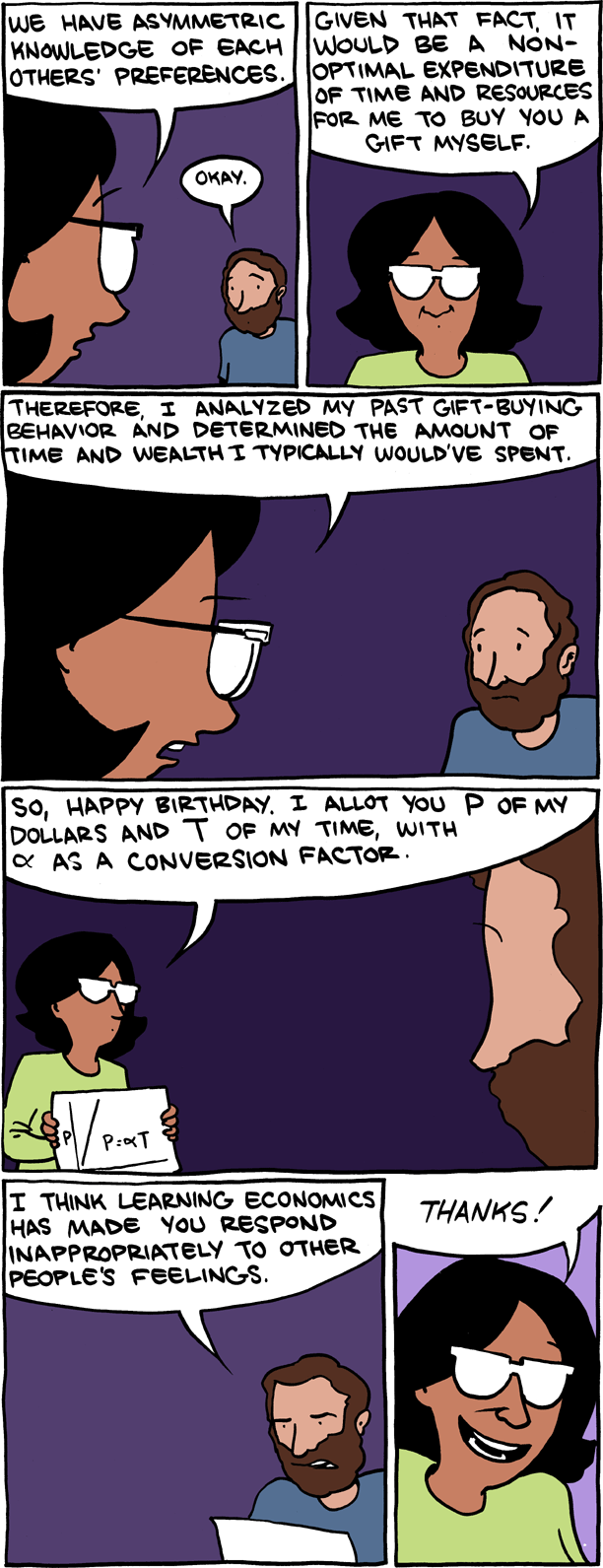
TertiarymattBut I don't have a phone or a tablet.

TertiarymattUptight Infinity

TertiarymattThe "response" is weak, at best.

I don't really get involved in the day to day world of webcomics any more, and I'm not the go-to guy for information on How Web Commerce Is Supposed To Work. But this goes beyond a simple disagreement in how to run a business: as far as I can tell, Inkoutbreak.com is secretly embedding ads in the websites that use its service. I present my observations below.
Update 26 Jan 2013, 8:58 PM EST: Brian King of InkOUTBREAK responds in comments.
TertiarymattThis... this is very pretentious.

I don't know how accurately it measures creative output, but the Sharpener Jar is definitely a practical alternative to the underground artisanal pencil sharpening movement. So it should come as no surprise that designer, entrepreneur, teacher and sometime Core-toonist / Sketch-notetaker Craighton Berman (a.k.a. Fueled by Coffee) has nearly quadrupled his $2,500 Kickstarter goal in just four days.
Every day professional "creatives" spend their waking hours sketching, writing, doodling, brainstorming, drawing, and scribbling on paper—hoping that their next amazing idea will eventually appear. This process fuels a unique angst in the modern-day artist; they spend most of their time merely thinking about what to make with nothing physical to show other than a pile of sketches. Can you get credit for creative effort without showing an end product? How is your boss going to know that you spent most of the day working and not just surfing Tumblr? How can you prove to your clients that your rates are justified despite the absence of actual finished work? Can creative output really be measured?
As in the Dux Inkwell sharpener, an extant glass vessel takes on a new purpose as a reservoir for pencil shavings, underscoring the ritualistic appeal of paring down a stick of wood and graphite.

On the other hand, unlike the Cuppow, Berman has opted to include the jar (and lid and threaded ring) with the sharpener, which surely adds a bit of unnecessary shipping/packaging expense to the product. Hence, the $39 pricetag for a single Sharpener Jar—assuming that the 32 remaining "first editions" at $34 will sell out shortly. (Still, it could be worse: $210 worse.)
 We'd love to see these letterform pencils IRL...
TertiarymattThis also.

It's been a while since we looked in on woodworker/inventor Matthias Wandel, and the man has not been idle. One of his recent contraptions that caught our eye is his Router Copy Carver, an ingenious sliding mount that you can use with a palm router to trace 3D objects; it's essentially a pantograph with a Bosch Colt as the copying head.

The best part is that Wandel shows you how he built the thing, step by step, and you're bound to be impressed by some of his solutions, like a trio of rollerblade bearings arranged in a triangle to hold the crossbar in position while allowing smooth travel. He's even designed a box to hold counterweights opposite the router to prevent fatigue during extended use.

Here's Part 1, where he builds the router-holding carriage that will handle the X- and Z-axes:
(more...)TertiarymattThis on the other hand, is awesome.

Philadelphia-based James McNabb, who runs furniture design/build studio McNabb & Co., doesn't let wood cut-offs go to waste; instead he goes at them with the bandsaw. The resultant forms, produced from the process he calls "sketching with a band saw," resemble buildings:

Thus was born McNabb's City Series...
...a collection of wood sculptures that represent a woodworker's journey from the suburbs to the city. Each piece depicts the outsider's perspective of the urban landscape. Made entirely of scrap wood, this work is an interpretation of making something out of nothing. Each piece is cut intuitively on a band saw. The result is a collection of architectural forms, each distinctly different from the next.


TertiarymattGiven that I love rye (and wish people would experiment more with malting things besides barley), I would like to have a bottle of this.
Lot No. 40 2012 Release, 43%, C$40
For decades a handful of whiskies monopolized the high end of the Canadian connoisseur whisky scale. Eight major whisky makers in Canada had their own ultra-premium brand, and that was about it. This all changed in 2012 when, to the disbelief of whisky aficionados, Canadian distilleries launched more than a dozen top-notch new whiskies. And among these, a reprise from more than two centuries ago was greeted with audible cheers.
 Joshua Booth, an 18th century miller, distiller, and politician made whisky on his farm at Lot No. 40 near Millhaven, Ontario. Seven generations later his whisky is back in production. This is its second return. Late in the 1990s Booth’s great-great-great-great grandnephew, Michael D. Booth — a Hiram Walker distiller — made a whisky called Lot No. 40. It was part of Corby’s superb (but ill-fated) Canadian Whisky Guild that stalled in the marketplace and was quietly discontinued.
In the meantime, a North American rye renaissance has generated a much more receptive environment. Corby’s new Lot No. 40 is all rye whisky with a twist, distilled from a mash of 90% rye grain and 10% malted rye. This time Joshua Booth’s creation is selling briskly.
It’s not history, but flavor that matters in the end. This is one powerfully flavorful whisky that boldly mingles the galvanizing piquancy of distilled rye grain with the soaring floral fragrance of malted rye, and a fruitiness that comes with age.
Here, the exhilarating spiciness of rye simply seethes blistering dried ginger. But it all begins with rye: sour rye bread; floral fruity rye; hard, dusty, and earthy rye. Then a trio of baking spices: cloves, ginger, and nutmeg. Sweet fruits and hard Christmas candies balance a farm-tinged sourness that fades into citrus fruit with velvet oak tannins. A contemporary masterpiece, seven generations in the making.
—Davin de Kergommeaux
Tomorrow, Whisky Advocate’s 19th Annual Award for the Irish Whiskey of the Year will be announced.
This is a must-read for creatives who have ever tried to explain their “job-things” to their parents.
You should totally read this.
TertiarymattWish formatting would stick around from Tumblr.
“Secretary of State Clinton showed up to answer tough and sometimes ridiculous questions regarding the deadly September 2012 attack on the U.S. diplomatic mission in Benghazi, Libya. In the process, she offered a tutorial for today’s young women.Key points:1) When a man asks you a question and then refuses to look at you as you answer, just keep going. Don’t let his rudeness silence you.2) When he interrupts you, return the favor.3) When he says things you know are not true, correct him. Repeatedly.4) When he attempts to bully you, mow him down with facts.5) And whenever possible, smile. Nothing rattles an angry man like a woman who looks happy to annoy him.”—
Hillary Schools Congress and Teaches Girls by Connie Schultz on Creators.com - A Syndicate Of Talent (via immlass)
That last one. It really throws men off when you do that.
(via parentheticalaside)
TertiarymattIn case anyone was wondering what I am doing with my life, here is an article written by my adviser.
Cities face unprecedented challenges. Global environmental change is placing increasing pressure on ecosystem functions and their ability to support human activities. The exponential growth of human activities is a key driver of such change, so much so that Planet Earth has certainly entered a new Epoch—the Anthropocene, in which humans have as much influence as nature itself (Steffen et All 2007).

The Anthropocene (Steffen et al 2007). The term Anthropocene suggests that the earth has now entered a new epoch. Over the last 50 years, human activities have accelerated a range of key trajectories, as is clearly visible in the 12 indicators charted between 1750 and 2000. Some activities were not present before 1950; for others, the rate of change increased sharply after 1950.
Urban regions pose enormous challenges to ecological and human well-being from local-scale atmospheric and water pollution to global-scale phenomena such as climate change threatening ecosystem’s capacity to deliver important ecological services (Alberti 2010). At current rates of urban growth, expected global land cover change will result in significant loss of habitats in key biodiversity hotspots (Seto et al. 2012). Urban regions are also the place where the majority of the human population will face the potential consequences of expected irreversible changes in climatic, hydrological, and ecological regimes such as flooding, droughts, sea level rises (Figure 1).

Extreme Events Source: Mosaic by Michal Russo. Photos: fire: Maxim Gusakov, fotopedia.com; flood: Marco Dormino, fotopedia.com; wind: http://freeaussiestock.com; droughts: suburbanbloke, fotopedia.com.

Beach community after Hurricane Sandy. Photo: Mark Olsen (USGS).
Rapid modifications of biophysical systems have the potential to trigger regime shifts (see below)—abrupt and irreversible changes—that will have significant consequences for human health, access to resources, human safety, security, and overall human wellbeing (Rockström et al. 2009). Researchers have found that the likelihood of regime shifts is higher in ecosystems where humans have reduced their resilience by modifying biogeochemical cycles, altering hydrological regimes, reducing biodiversity, and changing the magnitude, frequency, and duration of disturbance regimes (Folke et al. 2004). Potential regime shifts—from climate change and flooding to water pollution—pose enormous challenges to the stability of urbanizing regions and make them vulnerable (Miller et al. 2010). The recent Hurricane Sandy and the less recent but tragic Katrina, along with the Japanese tsunami, clearly illustrate the unexpected shocks cities face in the next decades.
How can cities navigate through such uncertainty and make robust decisions to ensure human wellbeing over the long term?


Regime shifts are large, abrupt, persistent changes in the structure and function of a system. An external shock can trigger a completely different system behavior, here represented by the ball moving into a new regime. But regime shifts also depend on slow changes in external drivers and internal feedbacks that change the domains of attraction of the regime: from a resilient state represented in the figure by the dotted line to a less resilient state represented by the continuous line. The resilience of a state corresponds to the width of a stability pit. The loss of system resilience changes the thresholds that push the system into a new regime. Definition: Biggs, R., T. Blenckner, C. Folke, L.J. Gordon, A. Norström, M. Nyström, and G.D. Peterson. 2012. Regime shifts. In: Sourcebook in Theoretical Ecology. A. Hastings and L. Gross, editors. University of California Press, Berkeley Photos: earth: woodleywonderworks; fire: Maxim Gusakov,fotopedia.com; flood: Marco Dormino, fotopedia.com; wind: http://freeaussiestock.com; droughts: suburbanbloke, fotopedia.com.
The Challenge
At the core of the challenge we face is the inevitable uncertainty of dynamic coupled human-natural systems (Liu et al. 2007). Both ecosystems and societies experience continuous fluctuations in their structure and function. Occasionally, change is punctuated by sharp shifts: abrupt transitions to an alternative state with significant implications for system function and dynamics (Scheffer et al. 2001, Scheffer et al. 2012). Scientists have documented examples of regime shifts for quite some time. More recently they have described several examples in urbanizing regions (i.e. urban lakes, invasive species, floods), but we still do not fully understand the significance of such dynamics.
Urban ecosystems are highly complex. Change and evolution in such systems emerge as interacting agents engage in simple behaviors. Uncertainty and the likelihood of surprise are driven by the complex interactions among ecological and social drivers and their unpredictable dynamics (Alberti 2008). In urban ecosystems feedback mechanisms that operate between ecological and human processes can amplify or dampen changes, and thus regulate the system’s response to external pressures. For example, land cover change and rapid loss of tidal marshes coupled with the hydrological and ecological changes associated with the development of hard flood control structures (e.g., dikes, dams, levees, groins, seawalls, and storm water) increase system vulnerability to extreme climate events and prompts more demand for flood-control infrastructure.
Extreme Climate Events
All around the world, extreme climate events are becoming normal when compared to historical records. Climate scientists predict more frequent hot days, heavy precipitation, high-speed winds, and a likely increase in hurricanes (in the United States and the Caribbean) and flash floods (e.g. in East Africa), with significant consequences for human and ecological wellbeing (figures below, IPCC 2012). Economic losses from climate-related disasters have increased, with large variations across places and years (below, IPCC 2012). Global losses due to the weather- and climate-related disasters reported over the last few decades mainly reflect the monetized direct damages to assets, and are not distributed equally. Since 1980, estimates of annual losses have ranged from a few billion US dollars to over $200 billion (in 2010 dollars), with the highest value for 2005, the year of Hurricane Katrina (IPCC 2012).

Projected changes in precipitations. 20-year return values of the annual maximum 24-hour precipitation rates (IPCC 2012).
 For a recent IPCC special report, ‘Managing the Risks of Extreme Events and Disasters to Advance Climate Change Adaptation’ (SREX), 220 scientists collaborated for 30 months, looking at historical trends and projected trajectories to assess current frameworks and strategies. Their report points out that existing measures for managing risk and adapting to change need to be improved dramatically to face projected extremes.

Projected changes in temperatures (in °C) in 20-year return values of the annual maximum of the daily maximum temperature (IPCC 2012).
 When multiple phenomena with uncertain trajectories—for example, storm surges and power outages—affect the function of cities simultaneously, the element of surprise can be enormous. Suddenly, resources and activities that everyone takes for granted, such as mobility or an energy supply, are unavailable, causing ripple effects on people’s safety and wellbeing.

Regional Distribution of Climate Disasters. Weather- and climate-related disaster occurrence and regional average impacts from 2000 to 2008 (IPCC 2012).

Losses from Disasters (1980-2010). Overall losses and insured losses from weather- and climate-related disasters worldwide (in 2010 US$) (IPCC 2012).
Climate scientists did predict that given the expected increase in extreme events such as hurricanes, the subway tunnels in New York could flood as they did during Hurricane Sandy, but far less predictable were the many interactions with rail and road closures and the potential consequences of the shifting mobility patterns of thousands of city dwellers, especially since power outages and other system failures were simultaneously limiting the access to food supplies and drinking water.

Submerged Costal Metro Areas (Boston). This map, first published in the New York Times illustrates the potential impacts of climate change on costal metro areas. For example, 86% of Cambridge and 37% of Boston land area will be flooded in the next centuries (100-300 years) based on the estimate Sources: Remik Ziemlinski, Climate Central; U.S. Geological Survey; National Oceanic and Atmospheric Administration; U.S. Fish and Wildlife Service.
By 2030, many coastal cities are likely to face raising waters at least 4 feet above the high-tide line due to storm surges and sea level rise (Climate Central 2012). A recent report by Strauss et al. (2012) estimates that urban areas and their communities are highly vulnerable to sea levels rising anywhere from 0 to 6 m above mean high tide. They found important threat levels: 22.9 million Americans live on land within 6 m of the local mean high tide.
The future of Planning
Strategic decisions about urban infrastructure and growth management are based on our assessment of the past and our expectations for the future. How we think about the future has significant implications for the choices we make and the decision-making process we apply. Traditional approaches to planning and management typically rely on predictions of probable futures extrapolated from past trends.
However, long-term trends are increasingly unpredictable given the complexity and uncertainty of coupled human-natural systems. Predictive models that are designed to provide accurate assessments of future conditions can only account for some of the interactions between highly uncertain drivers of change and the surprising, but plausible, futures over the long term. Important progress has been made in complex modeling, and improved simulation and computer power have allowed us to process quite astonishing amounts of data; still, our models are constrained by our limited knowledge, unverified assumptions, and short-sighted mindsets.
Myths in Planning
To address the inherent uncertainty of coupled human-natural systems, we need to expose some common myths in urban planning. I expand the discussion of the myths in a chapter in my forthcoming book Cities as Hybrid Ecosystems (2014).
Stability: Thresholds remain constant over time, and thus are predictable.
Planners have long assumed that systems are stable: that they return to equilibrium when confronted with external disturbances. Steady state is a condition in which nature exists at or near a persistent equilibrium. The steady-state paradigm holds that disturbance can be controlled and that by using an optimization strategy, systems can achieve sustainable carrying capacities. Within this perspective, thresholds that would produce change to a new state (i.e., a different equilibrium) remain constant over time, and are predictable and avoidable.
But this isn’t the case. Coupled human natural systems may exhibit nonlinear responses to perturbations. There can be more than one stable regime. Both the position of a threshold along a driving variable and the depth of the basin of attraction can change. Resilience is a dynamic property. In coupled human natural systems such as cities, reciprocal influences between system shifts in both the ecological and social systems may occur (Walker and Meyers 2004)
Optimality: There is an optimal resilient urban pattern and type of infrastructure.
The idea of optimality—that one can find the optimum among a set of possible alternatives given a set of conditions—is a direct consequence of the steady-state paradigm. Planners come to assume that an optimal solution exists. Decisions based on seeking the optimum assume that we can quantify risks. However, in the presence of irreducible uncertainties, we encounter multiple plausible futures whose relative probabilities are unknown. The farther we look into the future, the more the uncertainty increases—and it may increase even more with new understanding from advancement in scientific research. For systems to function in an uncertain environment, robustness rather than optimality is a more appropriate target for planning and decision-making.
Transferability: What is resilient in one region and at one scale is resilient in other regions and at other scales.
Many planning strategies are based on the assumption that what is resilient for a specific system function, at one scale, and in one region, is resilient for other functions, at other scales and in other regions. In complex social-ecological systems, multiple regime shifts may occur in multiple biophysical (climate, hydrology, biogeochemistry) and human (social, economic, and political) domains at multiple scales. Furthermore in evolving systems, changes in scale influence resilience (Walker and Meyers 2004). Increasing the scale of urban systems may expand resilience by adding a diversity of ecosystem types, they depend upon, but urban expansion may increase the relative costs and impacts of maintaining urban activities on a larger scale. If planners focus on the resilience of a specific subsystem, at a specific scale, that may cause the system to lose resilience in other ways. Instead, to maintain resilience we must focus on maintaining adaptive capacity and coping with uncertainty.
Adaptability: We can maintain resilience by adapting our current institutional frameworks.
Human and natural systems have evolved through change, adaptation, and extinction. But researchers in separate domains have studied of how human systems and natural systems adapt. As a result, we do not fully understand how coupled human-natural systems evolve and adapt and what the limits are to their adaptability. Adaptation planners are assuming that we can maintain resilience by adapting our current institutional frameworks. In fact a co-evolving paradigm may require reconfiguring current planning frameworks and fundamentally transforming current institutions for managing our cities.
The Myth of a Resilient Urban Pattern
Evidence that urban planning subscribes to such myths is provided by the dominant idea and search in planning for an optimal resilient pattern of urbanization. The idea of an “optimal pattern” is based on the assumptions that thresholds remain constant over time, that they can be detected and predicted, and that what is resilient in one region and at one scale is resilient in other regions and at other scales. Furthermore, adaptation planning is grounded in the idea that we can maintain resilience by adapting our current institutional frameworks.
Building on the emerging evidence in urban ecology, I challenge the hypothesis that a shift in the pattern of urbanization toward a single “optimal” pattern is a desirable objective that will ensure resilience (Alberti, forthcoming). I argue that no single pattern is consistently more resilient than another. Resilience depends on variable biophysical and socio-economic conditions across regions and scales. Optimizing one function at one scale may increase the vulnerability of the whole system.
In my new book Cities as Hybrid Ecosystems, I advance the hypothesis that to enable resilience, it may be necessary to create a diversity of urban patterns within and across urbanizing regions.
Resilience in Urban Ecosystems
The resilience paradigm recognizes the existence of multiple stable states and focuses on adaptation as a strategy to maintain system function. Resilience is the capacity of a system to absorb disturbance and reorganize while undergoing change so it can retain essentially the same functions, structures, identity, and feedbacks (Holling 1973). In coupled human-natural systems, resilience emerges from the interactions of human and ecosystem drivers, patterns, processes, and functions (below).
My colleague John Marzluff and I together with my team at the Urban Ecology Research Lab (UERL) are currently working toward a new transdisciplinary network to advance scientific understanding of regime shifts, resilience and adaptation in urban ecosystems. This network aims to inspire, generate, and facilitate new modes of interaction and collaboration among diverse members of the scientific communities and practice to produce a new level of synthesis of existing knowledge, identify research priorities, and establish new empirical evidence on the relationships between ecological resilience and human wellbeing in urbanizing regions.

Resilience in Urban Ecosystems (Alberti, forthcoming). Credit: Marina Alberti
Evidence emerging from the study of complex systems can provide insights for planning and management. In a recent paper in Science, Sheffer et al. (2012) suggest that system shifts may result either from unpredictable external shocks or from critical transitions. Drawing on two separate lines of investigation—on complex networks and on the proximity of critical thresholds—they suggest that both the heterogeneity of the components and their connectivity affect the stability of systems on the long run. By building on such observations in ecological systems, we can develop hypotheses about the fragility and robustness of coupled human-natural systems and test them in urban ecological systems.
Patterns of Resilience
I suggest that the diversity of urban patterns (e.g., centralization, building density, road connectivity) may control the resilience of urbanizing regions, because it is the diversity of processes alternative patterns can support that expands the region’s capacity to adapt to a variety of conditions that can emerge in the future (Alberti, forthcoming). In the most recent examples of extreme climate events that have tested the resilience of large urban regions across the world, the greatest surprises are in what worked: the countless ways in which unintended functions and flexibilities created by an imperfect and redundant urban infrastructure (i.e., transportation systems) provided alternatives and ways out. When the subway floods unexpectedly and shuts down for a week, many interconnected activities will jolt, and mobility patterns will shift suddenly. It is under these circumstances that we come to see how heterogeneous and modular the city networks and systems actually are. Examples are provided by the power of real-time communication technology such as cell phone networks, by on-line retailers’ delivery systems, and by the redundancy and flexibility of multiple transportation and infrastructure systems.
Critical transitions pose great challenges and opportunities. Innovation and creativity are important ingredients of resilience; at the same time they are often triggered by the same forces that drive critical transitions (Allan et al. 2010). Critical transitions offer unique opportunities for positive transformation and generate he seeds for cities to become more resilient and innovative. When new frames of reference and new constraints emerge, they require people and planners to see opportunities and risks they have never experienced before. Such new frameworks highlight problems and unequal distributions, and expose tradeoffs and synergies; thus they expand the boundary conditions of what is possible and desirable.
From Resilience to Transformation
Resilience is about avoiding system shifts. But persistence is not always desirable. Many undesirable states, such as degraded ecosystems or social inequalities, may be quite resilient. So while resilience planning focuses on predicting and adverting potential thresholds and system shifts, moving towards a desirable state requires transformation (Walker et al. 2004).
Resilience in coupled human-natural systems requires transformation towards what is desirable (Folke et al. 2010, Ernston et al. 2010). This implies addressing the diversity of human values and the existence of conflicts. A co-evolving paradigm may be more appropriate. This view focuses not only on unpredictable dynamics in ecosystems, but also on institutional and political flexibility for learning, reconfiguring problem solving frameworks, and devising innovative policies. Instead of seeking to reduce uncertainty, planners and decision makers will need to identify and adopt robust strategies that will be appropriate under a broad range of alternative futures.
Future policies and management practices will succeed or fail based on their ability to take into account the complexities and uncertainties of these systems. When policies aim to stabilize the ecological system or eliminate its variability, the inevitable outcome is collapse (Carpenter and Gunderson 2001). This is where scenario building can be valuable, as both a systemic method and a framework to expand our ability to think creatively about the future by focusing on complexity and uncertainty (Peterson et al. 2003). Rather than focusing on accurately predicting a single outcome, scenarios let us examine the interactions between various key uncertain factors that will together create alternative futures. Using a series of hypothetical future scenarios, we can assess the robustness of alternative strategies.
Local governments need to make important decisions about land use management and investments in infrastructure that can influence the direction of urban development in the near future.
I suggest five principles for planning under uncertainty towards enabling resilience and innovation in urban ecosystems (Alberti, forthcoming):
Marina Alberti
Seattle, Washington USA
Excerpted from weev’s statement of responsibility for the AT&T data breach, prior to his sentencing hearing. Please read the whole thing here.
…
In June of 2010 there was an AT&T webserver on the open Internet. There was an API on this server, a URL with a number at the end. If you incremented this number, you saw the next iPad 3G user email address. I thought it was egregiously negligent for AT&T to be publishing a complete target list of iPad 3G owners, and I took a sample of the API output to a journalist at Gawker.
I did this because I despised people I think are unjustly wealthy and wanted to embarass them. I thought this is the United States of America where we have the right to do basic arithmetic and query public webservers.
I was convicted of two consecutive five-year felonies, and am now awaiting sentencing.
I left the Aaron Swartz memorial tonight emotionally exhausted. Here is a guy who was beloved by many of my close friends, whose suffering and miseries I have shared in kind. I’ll never forget when the Secret Service started following me. My lover at the time and I treated it like a game, spending our days ditching surveillance in the best ways possible: speedboats, helicopters, club bouncers.
Over time, this has become less and less of a game. It soon became clear that I could not be both an activist and a capitalist. I quit my six figure job at the time because the former was more important to me. Then one day, everything changed. FBI agents tried to frame me for terrorism in 2008. Twice. They ruined my career, my relationship, my life. Nobody believed that I could be a terrorist so now they try to libel me as an identity thief.
Lawrence Lessig said of Aaron’s indictment that the prosecutor Ortiz was “either an idiot, or a liar.” I know this feeling all too well.
One of my prosecutors, Michael Martinez, claimed that our querying a public webserver was criminal because “it isn’t like going to ESPN and checking your sports team’s scores.”
The facts: AT&T admitted, at trial, that they “published” this data. Their words. Public-facing, programmatic accesses of APIs happen upwards of a trillion times per day. Twitter broke 13 billion on their API ages ago. This is something that happens more than the entire population of Earth, daily. The government has no problem with this up until you transform the output into something offensive to important people. People with “disruptive” startups, this is your fair warning: They are coming for you next.
…
Ivy league educated and wealthy, Aaron dealt with his indictment so badly because he thought he was part of a special class of people that this didn’t happen to. I am from a rundown shack in Arkansas. I spent many years thinking people from families like his got better treatment than me. Now I realize the truth: The beast is so monstrous it will devour us all. None will be spared.
TertiarymattGrrr.
Let’s put Apple’s amazing cash on hand numbers into perspective once again. The company now has $137.1 billion in cash — a 12.9 percent increase from the last reported number, $121.3 billion. With such a big figure, it’s hard to realize how big it actually is. In 2012, HP had $120.4 billion of annual revenue. Apple slightly edges HP’s revenue with its cash. Even more impressive, Apple has slightly more cash than Vietnam’s nominal GDP of $123.6 billion. Samsung Electronics’ annual revenue is a bit higher than that, as it is expected to reach around $180 billion for the fiscal year of 2012. But Apple is still dominating its competitor when it comes to cash.
And what will Apple do with this enormous stockpile of cash? They obviously haven’t the faintest fucking idea what to do with it. And I feel this strange certainty that they aren’t ever going to do the incredibly amazing things they COULD be doing.
TertiarymattOf course, any modification that improves salt tolerance will produce mindless opposition.
TertiarymattI also want a bottle of this:
Corsair Triple Smoke, 40%, $45
Darek Bell and his partners at the Corsair Artisan distillery in Nashville have been swinging hard since they opened, rolling out one new whiskey after another. There are craft brewers who put out fewer beers in a year than Corsair does whiskeys. Rasputin, Nashville, Quinoa, Wry Moon, Pumpkin Spice Moonshine, Ryemageddon, 100% Rye…and our Artisan Whiskey of the Year, Triple Smoke.
![triple_smoke[1]](http://www.whiskyadvocateblog.com/wp-content/uploads/2013/01/triple_smoke1-300x300.png) Bell will try just about anything when it comes to distilling: “Creativity is free,” he says. He’s written a book about it, Alt Whiskeys, that covers the gamut of that creativity: alternative grains, yeasts, hops, spices, and smoke, the whole bag of brewers’ tricks, really. Bell touches on several ways to get smoke into whiskey in the book, and uses multiple smoked grains in Triple Smoke.
Bell will try just about anything when it comes to distilling: “Creativity is free,” he says. He’s written a book about it, Alt Whiskeys, that covers the gamut of that creativity: alternative grains, yeasts, hops, spices, and smoke, the whole bag of brewers’ tricks, really. Bell touches on several ways to get smoke into whiskey in the book, and uses multiple smoked grains in Triple Smoke.
Triple Smoke uses three batches of malt: one each smoked with peat, cherrywood, and beech. The peat is the Scottish tradition, the beechwood-smoking will be familiar to fans of smoky German rauchbier, and the cherry is just for fun.
They all come through in the whiskey. The nose is layered, with the rich island peat filling the middle, bacony beechwood curling out from underneath, and more delicate cherry top notes. After a quick rush of juicy malt, you’ll get the peat front and center again, the beech around the edges of the mouth, and the cherry floating above it. Imagine having a sip of Islay whisky with a smoky Bamberg-brewed chaser…and then a light pull on a fine pipe tobacco.
None of that would work if it weren’t for a solidly made malt whiskey providing the framework. That’s what makes Corsair more than a freak show of variety. Anyone can throw grains, smoke, hops, or spices in a fermenter or a still. It takes skill, restraint, and a good palate to make an award-winner out of it. —Lew Bryson
The American Whisky of the Year will be announced tomorrow.
TertiarymattI want a bottle of this.
Four Roses first introduced a limited edition small batch bourbon a good 4 or so years ago. At that time the distillery called this product “Mariage” (one “r”) because it started as a marriage of 2 different bourbons from the distillery’s ten bourbon recipes.
In speaking with Four Roses Master Distiller, Jim Rutledge, in early 2011 (videos here), he informed me that the term “Mariage” was often mispronounced by the buying public. Consumers were confusing the term with a the wine term, meritage. In addition, the name was limiting for the distillery due to the common meaning of marrying just two components. Jim was interested in creating a small batch blend that didn’t constrain him to only two whiskeys.
For the 2010 release, Four Roses chose to stick with simplicity, calling the bourbon the “Limited Edition Small Batch”. The name has stuck since. The 2012 edition is a blend of a 17 & 11 year old OBSV, 12 year old OBSK, and a 12 year old OESK.
For clarification, the “B” in the designation refers to the distillery’s higher rye (35%) bourbon while “E” is the lower rye (20%) version. Even at 20%, that’s a great deal more rye content than the average bourbon whiskey on the market. Venturing a guess, I’d say average is closer to the low teens in terms of percentages. In addition, the “V” in the recipe refers to the distillery’s fruitier, creamier yeast strain. “K” refers to a spicier strain of yeast. These four whiskeys were “mingled” (as Jim refers to it) together to create a harmonious blend. The results are something truly epic.
Four Roses Limited Edition Small Batch Bourbon (2012), 55.7% abv (111.4Proof), $70/bottle
Color: Medium Amber/Copper/Burnt Orange
Nose: Cinnamon, allspice, candied orange, brandied cherries, maple fudge, and heaps of vanilla. So full of bright wood spice tamed by sweet, soft fruit.
Palate: Vanilla cream, maple, and toffee on the palate with prickles of cinnamon and chili heat. Bitter orange, grapefruit, and cherry add a layer of fruitiness. Well structured, and layered flavors unfold with each sip.
Finish: Wood and spices bring on warmth while the fruit and vanilla notes linger long.
Overall: Four Roses has managed to create one of the great bourbons of all time with the 2012 Limited Edition Small Batch. I can’t think of a more complex and satisfying pour of whiskey for 2012 than this one. It’s amazing that in a time when the Pappy and the Antique Collection products seem to gain all of the press, a whiskey of this stature can still be found on shelves. What I enjoy so much about Four Roses is that it tastes like………Four Roses. There’s nothing else quite like it. The wood never dominates and these whiskeys amaze you with both their finesse and their power. At 55.1% alcohol, I had little trouble sipping this neat. A splash of water tones down the heat, ramps up the fruit, and makes for a completely different (yet not less satisfying) sip. Well done Four Roses – my shoe-in American Whiskey of the Year.
Sour Mash Manifesto Rating: 9.8 (Epic)
TertiarymattJimmy Carter: Still the best ex-president.
Losing my religion for equality
Jimmy Carter on why religions destroy the lives of women, and why he can no longer be a part of it.
TertiarymattMy nice ordered list formatting is all fucked up because of the tumblr feed, but the indenting will get you there. I wrote most of this, with input from various conservative gun maniacs I know. Many of them hated it, but just as many thought it was something they could live with. Unshared/reshared due to a small error.
Dear (your legislator here),
We currently find ourselves in the middle of an intense debate on “Gun Control”. There are only a handful of subjects in public policy that give rise to such sharp divides among the public. It is the opinion of the authors of this document that it is possible to both protect the right to bear arms as defined by the 2nd Amendment and the Supreme Court of the United States and also to have reasonable policies that protect law abiding citizens from gun violence and criminal activity. We have therefore pooled our knowledge in order to present you, our representatives, with ideas in how to do so.
We do not believe that such policies at all resemble the Assault Weapons Ban, the new version of it that Senator Feinstein has put forward, or the recent action taken by the New York state legislature. Laws focused on the cosmetic attributes of firearms (particularly firearms rarely used in crimes!) will do nothing to protect the American people, and only serve to erect barriers for law abiding citizens. Nor do the authors of this document find the arguments put forward to restrict magazines (whether internal or external) above a certain arbitrary size to be persuasive. Criminals do not abide by the law. This is the very definition of criminality, and they will not respect bans on the purchase of magazines of any size, nor is the need to reload slightly more frequently likely to save lives (Cho, the Virginia Tech killer, reload repeatedly while engaged on his killing spree).
Further, we do not believe that it is wise to make public policy out of emotional turmoil, or in order to attempt to prevent exceptional and rare events like the shootings in Aurora or Newtown that occurred in 2012. The facts of the matter are that orders of magnitude more children die of accidental drowning, are poisoned, or die in car accidents than are murdered by deranged rampage killers. Thus, we cannot in good faith agree with policies that would restrict the rights of ordinary, law abiding Americans in attempt to constrain those who wish to commit violence and mayhem. However, that does not mean that we should not make some attempt to keep firearms out of the hands of such individuals, when possible.
If we wish to have sensible laws regarding control of firearms, they should be aimed at the guns most likely to injure us: handguns used by criminals. To this end, we suggest a system of universal background checks, in order to make it more difficult for straw-purchasers to operate and pass guns into the hands of criminals. This idea has been put forward by the President, and is widely supported by the public, with nearly 90% of Americans believing this is a good idea, according to a recent poll. While ordinarily the creation of a black market should be considered a negative, in this instance the clear creation of a legal and an illegal market out of the fuzzy gray mass of private gun sales may be useful to law enforcement.
It is true that requiring background checks and the retention of documentation of transfers does pose some burden to law abiding citizens, and we do not do so lightly. This is particularly the case in much of rural America, where individuals may have to travel some distance in order to meet with an authorized official to conduct their sale. However, if we wish to impede the traffic of illegal firearms within the United States, such measures may be necessary. We also wish to suggest that universal background checks may provide an assurance to citizens that they are not selling their firearms to unsavory individuals who will use them to commit crimes, or pass them to criminals.
In addition, we believe that all citizens have the right to defend themselves. There is currently some degree of uncertainty on the part of the States as to what might constitute a reasonably constructed restriction or requirement for the issuing of permits to own and carry handguns in public. Recent decisions issued by the courts have shown that it is possible for the States and their component governments to overstep their authority in restricting citizen access to firearms (demonstrated in both District of Columbia v. Heller and McDonald v. City of Chicago) and also that there is an individual right to bear arms, which the States are required to protect via the “due process” or potentially the “privileges or immunities” clause of the 14th Amendment.
We thus believe it is appropriate for the Federal government, through the establishment of a Federal Permit to Carry a Concealed Weapon, to provide an example of what constitutes an appropriate program and an upper boundary on what may be required of a citizen of the United States in acquiring and carrying a firearm. Several states, in particular the State of Utah, have permitting programs that are both strict and widely sought after by individuals wishing to carry a concealed weapon, due to this permit being widely respected by other States. This demonstrates that many citizens are comfortable with the idea that they must prove to the appropriate authorities and to their fellow citizens that they are law abiding and responsible individuals, before carrying a concealed firearm.
The advantages of such a Federal program are straightforward and numerous:
For citizens, it would provide a single, national permitting program that would be valid throughout the United States, as well as an opportunity to learn safe gun handling skills, defensive tactics, and relevant law.
For those who are concerned about concealed carry and the wide availability of firearms, it would provide reassurance that those who are carrying concealed weapons are competent, law abiding citizens who are familiar with not only their rights, but also their responsibilities.
For the States, it provides a ceiling for how restrictive a program for CCW may be, and a model that they may wish to modify or adopt. Most States currently have much less stringent requirements to carry a concealed weapon, and citizens who have no interest in concealed carry outside of their home state may continue to use those processes for the purposes of being permitted within that state. Those States which have been instructed by the Courts to reconsider their policies can look to the proposed program and those similar to it in other States for guidance.
Finally, for the Federal government, it provides an opportunity to promote sound and responsible practices within the community of gun owners (of which the Federal government has a long standing tradition), offer an example for what the ceiling in reasonable restriction in creating a CCW permit program looks like to the States. Such a program may perhaps avoid future conflict with the Constitution, and thus the courts, saving tax paper money and time within the already very busy court system.
The two additional ideas in the proposal below seek to address the rare problems presented by severely disturbed individuals and the dearth of clear research on the factors controlling gun violence in the United States.
The parents and doctors of deeply disturbed and violent children—children who will eventually become adults outside of their parent’s control—are the ones best situated to alert us to the danger their children may present to us as a society, and we ignore them at our peril. However, it is irresponsible to deny that even the dangerously disturbed may one day be healed of their afflictions, and be no more a danger to society than any other individual. Therefore we must also have a process by which individuals who have been flagged as unfit to own a firearm by their guardians can petition to have their rights restored.
We should also attempt to make our public policies decisions based on the best available facts and scientific research available. The current state of research regarding gun control and gun violence is such that both sides may draw on the same data to support their argument, and no clear consensus currently exists within the research. The problem of violent crime involving guns is one that is likely to be highly sensitive to setting: the history of a place, spatial scale, and the influence of neighboring jurisdictions, etc make for a complex set of factors that will influence the use of guns by criminals. The relationships that control use of guns by criminals are thus not likely to stay constant across time and scale; if this were so, we would not see so much variation within even individual States in the Union, between major US cities and between the US and other nations. It is thus vital that we conduct research at various spatial scales, in diverse locations, to attempt to gain insight into what effective gun control might look like, and how that will vary from place to place within our nation.
Finally, we extend those feelings to the ideas that we put forward here, and believe that they should have an expiration date. Should they be found to be ineffective, counter-productive, or otherwise useless, let them expire. If they should prove useful, let them be updated and re-implemented.
We do not expect all of our suggestions to be to met with wide enthusiasm by the anti-gun lobby, nor do we expect them to be instantly embraced by the pro-gun lobby. Indeed, even within the authors there is far from universal agreement on the desirability of all components of these programs. However, it is our opinion that the programs presented represent a fair trade-off and a balanced approach to gun policy.
Note also that one area in which the proposal below is sorely lacking is in the creation of penalties to go with violations of the requirements of the proposed programs. The authors did not feel sufficiently competent regarding criminal and civil penalties, and it should be noted that the proposal below is thus deficient in this respect.
Sincerely,
anyone who agrees with me
A three year allocation of 50% of Firearms and Ammunition Excise Tax (FAET) funds, for:
funding for state and local agencies to train individuals in the use of the National Instant Criminal Background Check system;
use by BATFE to create certification and training standards and testing materials for instructors in the Federal Permit to Concealed a Carry Weapon program.
A ten year, annual allocation of 10% of funds collected via the FAET to the Centers for Disease Control and Prevention specifically for the conduct of research into the effectiveness of the requirements put into place by this law, and into the efficacy of gun control policy generally.
Establishment of a registration system for parents of highly disturbed and violent minors such that;
upon filing of a request with the FBI by the legal guardians of a child, supplemented by statements of concern by two certified mental health professionals familiar with the child,
a notification of denial shall be placed in the NICS such that upon reaching age of majority the child may not purchase a firearm without first appealing to have the notification removed,
that the FBI in its role of managing the NICS develop a prompt, transparent process through which individuals with mental health holds may appeal their status.
This requirement shall expire ten years after having been enacted, unless renewed by an act of Congress following findings of effectiveness by Congress or the CDC.
Establishment of a universal background check system for transfer of firearms, composed of the following components and requirements:
Authorization and training of local and state government officials to conduct background checks and authorize transfers such that:
after proper training and certification, any and all currently serving, uniformed law enforcement personnel be granted authority to authorize the transfer of ownership of a firearm as an FFL, both on and off duty;
that law enforcement agencies be allowed to form their own policies as to when, where, and if such transfers may be conducted by the on-duty officers within their jurisdiction, in order to reduce the potential burden on their operations, and to avoid conflict with privately operating FFLs;
that law enforcement agencies may also designate non-uniformed staff to perform authorization of transfers, after proper training and certification, should they demonstrate inadequate resources to perform this task with uniformed personnel;
that state and local governments may designate additional representatives to conduct background checks and authorize transfers between private parties, including but not limited to court clerks, officials within the prosecutor’s office, etc.
Law enforcement or other county, municipal or state agencies may request federal funds collected via the FAET from TTB and marked for training program implementation purposes to train their personnel in use of the National Instant Criminal Background Check System and for other uses related to oversight of firearms transfers.
That all purchases or other transfers of ownership of firearms be subject to proper NICS background checks, according to the following guidelines:
such background checks shall be conducted by an FFL, a law enforcement agency or officer, or other authorized officials;
that the costs of such background checks by law enforcement or other government agencies be limited to $25 per transaction (adjusted biannually for inflation), with agencies that demonstrate this amount to be insufficient to cover the demand placed upon them to able to appeal for a change in fee to TTB;
that should the NICS system fail or otherwise become unresponsive for longer than 48 hours that pending private transfers be authorized automatically, unless the authorizing agency, FFL or other interested party can provide material evidence that it should not be granted;
that no details regarding serial number, type, or number of firearms transferred between private individuals be included in the background check process, unless otherwise required by state or federal law;
that individuals engaging in sale or purchase of a firearm be required to retain their transfer paperwork for five years after the data of sale.
The seller/transferor of the firearm(s) in question shall retain a form with:
the name and signature of the purchaser/transferee;
make, model, and serial number of firearms transferred;
Date of transaction;
NICS transaction number.
The purchaser/transferee of the firearm(s) in question shall retain a form with:
the name and signature of the seller/transferer;
make, model, and serial number of firearms transferred;
Date of transaction;
NICS transaction number.
These forms shall be made available to law enforcement when requested for the sole and exclusive purpose of providing a material trail for investigating the origins of firearms used in criminal activities.
This requirement shall expire ten years after having been enacted, unless renewed by an act of Congress following findings of effectiveness by Congress or the CDC.
Establishment of a Federal Permit to Carry a Concealed Weapon (FPCCW) program, defined as follows;
That an individual shall receive a Federal Permit to Carry a Concealed Weapon within no more than 30 calendar days upon completion of the following requirements within 30 calendar days from the beginning of the process with the Bureau of Alcohol, Tobacco, Firearms and Explosives (BATFE):
submission of proof of identity:
including fingerprints,
social security number,
current residential address,
copy of government issued ID,
a passport quality photograph;
submission of proof of completion of a certified educational course that shall be not less than 8, but not more than 12 hours in duration, consisting of three parts:
a 4 hour basic handgun operation and safety course, including coverage of basic maintenance, safe and secure holstering and concealment methods, dealing with malfunction (failure to feed, fire or eject, misfire, jams, etc), and basic shooting skills;
a 2 to 4 hour course on Federal and State laws regarding restrictions on carrying concealed based on location and mode of travel, as well as legal responsibilities and repercussions that defending oneself with a firearm may create;
a 2 to 4 hour course involving practical defensive scenarios using dummy training firearms, including recognizing and de-escalating potentially dangerous scenarios;
submission of proof of completion of a certified paper examination regarding the legal rights and responsibilities associated with the permit;
passing a practical marksmanship examination;
passing a thorough background check, including for criminal offenses and other conditions that would disqualify an individual from acquiring a firearm under the Brady Act;
that should the applicant be currently serving military personnel or veteran, or a law enforcement officer they would be exempt from the course requirements, while still subject to the practical and paper examinations, ID requirements, and background checks;
and paying a $100 fee (adjusted biannually for inflation).
The FPCCW shall be valid for a period of five years, upon which time the holder must undergo a renewal process, consisting of:
passing a marksmanship exam,
a brief paper examination regarding relevant changes in law regarding their rights and responsibilities as permit holders and owners of firearms,
demonstrate (via the NICS) that they have not committed any criminal offenses or other acts that would restrict their access to firearms,
pay a small (~$20) renewal fee.
Should FPCCW holders allow their permit to lapse for more than 1 years time, they must begin the permitting process from the beginning, as if they had never held a FPCCW previously.
Should the holder of a FPCCW demonstrate negligence with their firearms (through loss, accidental discharge, or otherwise failing to adhere to the laws and responsibilities of concealed carrying of a weapon), their permit shall be suspended, pending a review by BATFE.
FPCCW holders shall also be responsible for reporting their permit lost or stolen within 30 calendar days of loss, and to update the address on their permit within 90 calendar days of changing physical address. Failure to do so shall result in the suspension of the permit, and potentially permanent loss, pending review by BATFE.
FPCCW holders shall respect all Federal and State laws regarding locations into which firearms may not be carried (open or concealed), and failure to do so will result in suspension of their permit and potentially permanent loss, pending review by BATFE.
BATFE shall be charged with the following duties, and may create an office or program to meet them:
creating certification standards, tests and establishing fees for the permitting of instructors within 1 year of this program going into effect, and to begin certifying instructors by the end of that period;
to establish a clear, unambiguous and prompt adjudication and appeals process for permit holders concurrently with the certification of instructors;
to develop the examination regarding Federal rights and responsibilities of firearms owners and those carrying concealed weapons, to keep this material up-to-date, and to create annual study material updates for those seeking to renew their permits.
Certified Instructors within the FPCCW program shall have the following duties:
to establish their own fees for the administering of the appropriate courses and tests;
to establish the course content regarding local and state laws and to write relevant portions of the written examination;
passing or failing individuals on their practical marksmanship examination.
Instructors found to be lax or negligent in the issuance of passing scores to applicants shall be stripped of their certification pending appeal, and be investigated by Federal authorities for evidence of criminal wrong-doing.
All permit holders passed by such instructors will be held to carry valid permits, unless evidence is uncovered that particular individuals engaged in fraudulent activities (or other crimes, such as bribery) with the instructor in order to receive passing scores necessary for their permit application, and such individuals shall have their permits suspended until cleared of wrongdoing in a federal court of law
Funds raised by fees submitted by applicants and instructors shall be allocated as follows:
50% of funds from the fees submitted by applicants, and 100% of instructor certification fees shall be used to maintain the certification process and development of instructional material. Should this prove to be insufficient, these programs may be included by BATFE in their annual budgeting process;
50% of permit application funds, and 100% of renewal fees raised through permit applications would be allocated to a grant process for educational and youth programs, to fund programs that engage young people with the outdoors through conservation, environmental education, and traditional shooting sports, with an emphasis at engaging at risk populations. This grant process shall be overseen and managed by BATFE.
No State shall enact a law regarding the concealed carry of a firearm that imposes greater restrictions on citizens than the Federal Permit, nor shall any State attempt to invalidate or infringe upon the privileges granted to holders of FPCCW holders.
This program shall expire ten years after having been enacted, unless renewed by an act of Congress.
TertiarymattYISSS
TertiarymattSeriously.

(via Battlepug.com - Battlepug the Web Comic by Mike Norton)
If you’re not reading Battlepug… well, why?
TertiarymattNice figures and what not on the click through.
UNSCEAR also found no observable health effects from last year’s nuclear accident in Fukushima. No effects. The Japanese people can start eating their own food again, and moving back into areas only lightly contaminated with radiation levels that are similar to background in many areas of the world like Colorado and Brazil.
The huge waste of money that is passing for clean-up now by just moving around dirt and leaves (NYTimes) can be focused on clean-up of real contamination near Fukushima using modern technologies. The economic and psychological harm wrought by the wrong-headed adoption of linear no-threshold dose effects for doses less than 0.1 Sv (10 rem) has been extremely harmful to the already stressed population of Japan, and to continue it would be criminal.
To recap LNT, the Linear No-Threshold Dose hypothesis is a supposition that all radiation is deadly and there is no dose below which harmful effects will not occur. Double the dose, double the cancers. First put forward after WWII by Hermann Muller, and adopted by the world body, including UNSCEAR, its primary use was as a Cold War bargaining chip to force cessation of nuclear weapons testing. The fear of radiation that took over the worldview was a side-effect (Did Muller Lie?).
Of course, doubling the dose doesn’t double the cancers below 10 rem/yr (0.1 Sv/yr). It has no effect at all. The millions of nuclear workers that have been monitored closely for 50 years have no higher cancer mortality than the general population but have had several to ten times the average dose. People living in New Mexico and Wyoming have twice the annual dose as those in Los Angeles, but have lower cancer rates. These cannot occur if LNT were true, because LNT states this could not occur. There are no observable effects in any population group around the planet that suggest LNT is true below 10 rem/yr (0.1 Sv/yr) even in areas of the Middle East, Brazil and France where natural background doses exceed 10 rem/yr (0.1 Sv/yr).
”Like We’ve Been Saying — Radiation Is Not A Big Deal - Forbes
This is the only subject that ever attracted much comment on my blog, really. It actually appears there is some support of the theory that too little radiation is bad for you.
TertiarymattI hate agreeing with Clarence Thomas, but I pretty well agree here. If a fact is material to sentencing, it should damn well be established beyond a reasonable doubt by the prosecution.
At 10 a.m. Monday, the Supreme Court will hold one hour of oral argument on the role of judges and juries when the law requires a minimum sentence after conviction of a specific crime, in Alleyne v. United States (docket 11-9335). Arguing for the convicted individual, Allen Ryan Alleyne, will be Mary E. Maguire, an assistant federal public defender in Richmond, Virginia. Representing the federal government will be Deputy U.S. Solicitor General Michael R. Dreeben.
Background
For several decades, the Supreme Court has been struggling — and often has been deeply divided — over how to sort out the roles of juries and judges in the process of criminal sentencing — specifically, who gets to decide the facts that bear upon how severe a sentence may be? Much of the time, the focus has been on whose duty it is to decide the facts that will support a sentence that is longer than the maximum specified for a given crime. Since the Court’s decision in 2000 in Apprendi v. New Jersey, the Court majority has ruled repeatedly that, if a fact is going to lead to an enhanced sentence, prosecutors have to prove that to the jury and must do so by satisfying the toughest legal standard: beyond a reasonable doubt.
But the Apprendi decision left intact older rulings by the Court that a judge, applying the least-demanding standard (preponderance of the evidence), had the authority to decide to increase a sentence above the minimum. That involves what are called “mandatory minimum sentences.” A legislature decides that, for some crimes, the convicted individual should have to face the prospect of a minimum sentence that is higher than the floor while still below the maximum. The theory is that something about a specific crime made it more serious and thus deserving of more punishment. This principle was established clearly by the Court in the 1986 decision in McMillan v. Pennsylvania. It has since been reaffirmed, but by a shakier majority, and the Court is now set to reconsider the issue.
The Court is now confronting, in the case of Alleyne v. United States, whether to extend the Apprendi view of the central role of the jury in finding sentencing facts to the realm of the mandatory minimum sentencing. Justice Clarence Thomas has been arguing for years that, constitutionally, there should be no difference between finding facts to support a sentence beyond a maximum, and finding facts that will push a sentence above a minimum, or floor; either way, he has said, the convicted individual is exposed to greater punishment than is otherwise prescribed, so both should depend upon the jury as fact-finder, in order to satisfy constitutional due process.
Thomas, though, has stated that view as a dissenter, most notably in the 2002 decision in Harris v. United States. There, an uncertain majority (four Justices plus a reluctant fifth) stayed with the position declared in the McMillan decision sixteen years earlier, and upheld the authority of a judge to find by a preponderance of the evidence the facts necessary to support a mandatory minimum sentence.
For years, though, defense lawyers have been urging the Court to go along with the Thomas approach, and that idea has picked up the support of Justice Stephen G. Breyer (who provided, with some doubts, the fifth vote in Harris v. United States). The Court had not granted any of those requests. And the Justice Department relied upon those denials of review in urging the Court, during this Term, to continue to leave the Harris precedent unexamined.
Aside from Breyer, only two Justices remain from the Harris plurality: Justice Anthony M. Kennedy, who wrote the main opinion, and Justice Antonin Scalia. (The others were now-retired Justice Sandra Day O’Connor and the late Chief Justice William H. Rehnquist.) Along with Thomas, the only other dissenter still serving is Justice Ruth Bader Ginsburg (they were joined by since-retired Justices David H. Souter and John Paul Stevens).
On October 5, the Court agreed to reexamine Harris, granting review of this simple question: “Whether this Court’s decision in Harris v. United States…should be overruled?”
At issue in Harris was whether added punishment is based on a finding of an element of the crime, or rather on only a decision about a sentencing factor. Elements of a crime have to be charged in the indictment, and found by a jury, beyond a reasonable doubt, but sentencing factors are for the judge to resolve, using the relaxed preponderance standard. The majority provided an interpretation of the federal law providing that, if an individual is convicted of carrying a gun during a serious or violent crime, that individual would receive — in addition to the penalty for that specific crime — a separate minimum five-year sentence. (The mandatory minimum would rise to seven years if the gun had been “brandished” — that is, used in a menacing way, and to ten years if the gun had actually been fired.)
The Court majority upheld that law even though, in the specific case, the indictment had not charged William Joseph Harris with brandishing a gun while selling drugs out of his pawnshop. He had been charged, though, with carrying a gun during that crime. The trial judge in the case, however, found by a preponderance of the evidence that Harris had brandished the gun, and imposed an added-seven year sentence. The Fourth Circuit Court ruled that “brandishing” was only a sentencing factor, not an element of the crime, that this satisfied the Court’s McMillan precedent, and that it did not violate Apprendi.
Justice Kennedy’s plurality opinion agreed with that interpretation of the “brandishing” issue, so that factor did not need to be charged in the indictment, decided by the jury, and decided by a reasonable doubt test. That group of four Justices also concluded — with the support of Justice Breyer — that the Apprendi line of cases did not apply to mandatory minimum sentences, but only to mandatory maximums. So long as the added punishment imposed by the judge was within the specified range of potential sentences, the plurality said, it could be imposed based upon the judge’s finding alone. Since then, however, Breyer has joined Justice Thomas in urging the Court to reexamine Harris, and that is what the Court plans to do in Alleyne v. United States, a petition filed in March of last year and granted — over the Justice Department’s objection — near the opening of the Term.
Allen Ryan Alleyne of Richmond, Virginia, along with his girlfriend, Valencia Jones, allegedly planned to rob the owner of the convenience store where Valencia worked. The plan was to rob the manager, Pat McLaughlin, as he was leaving the store with the day’s proceeds. On October 1, 2005, Alleyne and an accomplice (who has never been identified and has not been prosecuted) decided to go ahead with the plan, after watching McLaughlin’s daily movements.
They rented a car, drove ahead of McLaughlin as he left the store, and then pulled over. Faking car trouble, they flagged down McLaughlin. The accomplice, who had been driving, got out of the car, walked over to McLaughlin’s car, pointed a gun at the store manager, and demanded the money bag, which contained $13,201. Alleyne slid over into the driver’s seat, and drove away with the accomplice. (Valencia Jones testified against Alleyne at the trial; she was later convicted for her role in planning the robbery and taking some of the proceeds.)
Alleyne was indicted for robbery and one count of using or brandishing a gun during the crime. The jury convicted him of robbery, and of possessing a gun, but did not find him guilty of brandishing the gun. The judge sentenced Alleyne to forty-six months in prison for robbery. Then, after finding that Alleyne would have known that his accomplice would brandish a gun, tacked on another eighty-four months (seven years), making a total prison sentence of 130 months. The trial judge said he was bound by the Harris precedent, and his conclusion on brandishing was based upon a preponderance standard. The Fourth Circuit Court, also feeling bound by Harris, upheld the full sentence, including the added seven years.
Petition for certiorari
Public defenders in Richmond took Allleyne’s case to the Supreme Court, urging it to overrule Harris and to apply the same constitutional limits that restricted sentencing judges’ power to enhance the punishment beyond a maximum to the situation when the judge imposed a mandatory minimum, above the floor of the range specified in the law. The petition took note of Justice Thomas’s efforts to reopen Harris, and Justice Breyer’s movement toward that position.
The petition gave three reasons why the Court should hear the case: that the brandishing issue has been fully litigated in this case and in other lower courts, that this case is essentially a twin of the Harris case that involved the very same gun crime punishment law, and that the judge had applied the seven-year minimum only because the judge felt bound by Harris to make the finding despite the jury’s refusal to convict on brandishing.
Lower courts, the petition noted, have no power to second-guess Harris, but the Supreme Court does, and should now resolve its continuing status. Even the judge in his case, Alleyne’s counsel argued, “understood the primacy of the jury’s role,” and even expressed his reluctance to overrule the jury on the brandishing point.
The Justice Department noted that in at least five cases, some very recently, the Court had denied petitions “arguing that Harris should be overruled or asserting that Harris already has been overruled implicitly.” The brief in opposition said that nothing had changed since the Harris decision in 2002, and it noted that the Court in Harris had reaffirmed its position on mandatory minimums even in the face of an argument that Apprendi required a different approach. The brief quoted the Court plurality as having said that judges had always considered aggravating circumstances that justified added sentences that were still within the range set by law. The Court should feel still bound by Harris, it argued.
With the Court’s membership substantially changed since 2002, there obviously were four votes to take a new look at the precedent.
Briefs on the merits
In an ambitious brief on the merits, Alleyne’s lawyers argued not only that Harris be cast aside, but that McMillan, too, be overruled, on the argument that both were wrong when decided. McMillan, it contended, was “a break from the historical treatment of facts triggering increases in the absolute limits of punishment.” The Court could have rectified that in Harris, but did not, the brief commented, and it suggested that the Court should now do so, without being guided by the doctrine of stare decisis to stand by Harris.
As expected, the brief interpreted Apprendi as broadly as possible, contending that it stood for the proposition that facts that increase the prescribed range of penalties facing a defendant must be submitted to a jury and proven beyond a reasonable doubt. Even when Apprendi was decided in 2000, it was clear, the brief said, that the Court one day would have to revisit its McMillan ruling.
Its grievance with McMillan (which the lawyers obviously had concluded needed to be undercut if Harris was to be overruled) was based on a reading of history, finding in that background a “deeply rooted understanding that juries alone can find facts that expose criminal defendants to additional punishment. That understanding is older than our nation, and the Framers embedded it in the Sixth Amendment. It is equally well-settled that facts that must be proved to the jury must be proved beyond a reasonable doubt, a right protected by the Fifth Amendment.”
To the basic point in both of the challenged precedents, that mandatory minimums are different from going beyond maximums, the Alleyne brief asserted that a mandatory minimum sentence does in fact change the range of permissible sentences by increasing the punishment that would otherwise be available to the judge to impose. Once it is understood that a fact that moves the sentencing above the floor, then it follows that greater punishment results, and that must be attributable to a finding by a jury beyond a reasonable doubt, the brief argued.
As a back-up argument, Alleyne’s counsel suggested that the Court could avoid a constitutional ruling by interpreting the gun-punishment law at issue either to declare that the law is aimed at three separate crimes that have fixed-term sentences, instead of maximums up to life, or to read it as establishing three separate crimes with “brandishing” and “discharging” as elements of the crimes. The brief said that the first alternative is preferable, and would be more favorable to Congress’s legislative product, but either interpretation would overturn Alleyne’s sentence.
The Justice Department’s brief on the merits relied heavily upon the stare decisis argument, contending that both McMillan and Harris have been entirely justifiable reactions to the “twentieth century innovation” of mandatory minimum sentencing laws that were “designed to promote consistency in sentencing and establish legislative restraints on judicial discretion.” Harris, it argued, followed McMillan faithfully on the constitutional point, and explicitly rejected the contention that McMillan and Apprendi could not be reconciled, the Department asserted.
What Apprendi is all about, the government filing said, is preventing a judge from increasing the range of potential punishment. Its rationale, therefore, has no bearing upon a judge’s authority to impose a specific sentence that remains within the range laid out by the legislature, the brief went on. When a judge imposes a mandatory minimum, the brief added, that does nothing to disturb the protection that Apprendi provided, because the sentence “cannot exceed the maximum based on the facts found by the jury.”
More broadly, the government argued that “judicial factfinding in a discretionary system” does not offend the right to a jury trial, because a judge — when staying within a specified range — is determining only the facts necessary to select a sentence that is contemplated by the range itself. “Such judicial factfinding raises no constitutional concern because the facts found by the jury authorize the sentence imposed….Once the jury verdict authorizes a particular maximum sentence, the finding of a fact — here, for example, brandishing — that raises the minimum sentence within the authorized range poses no threat to the jury’s power.
The government sought to answer Alleyne’s arguments about reinterpreting the brandishing law in order to avoid having to decide the constitutional question. Those very arguments were made in Harris as to this specific law, and were rejected, the brief said.
In strongly defending the past precedents, the government added a policy argument: in the wake of both of those rulings, in 1986 and 2002, Congress and state legislatures have relied upon them to pass numerous mandatory minimum sentencing laws, so overturning the precedents at this point “could provoke unpredictable legislative responses with potentially adverse consequences for defendants, prosecutors, and courts.”
Alleyne’s side of the case has drawn the support of a variety of criminal defense and civil liberties organizations, sentencing reform advocates, and the Families Against Mandatory Minimums, an advocacy organization, which contends that such sentencing regimes result in “inflexible and excessive penalties.” The federal government has the support of fifteen states, undertaking primarily to counter Alleyne’s arguments that mandatory minimums run counter to history.
Analysis
With Justice Thomas leading the charge, Allen Alleyne would appear to start with a considerable advantage. The Apprendi rationale, with its emphasis on the historic role of the jury, has strong support within the Court, and Thomas has done more than any other member of the Court to dismiss as artificial the attempt to limit Apprendi to the realm of exceeding maximums. And, with the likely support of Justices Breyer and Ginsburg, Thomas would appear to be within reach of a majority even if he could not draw either Justice Kennedy or Justice Scalia away from their positions in Harris. All he would need was a split among the four Justices who have joined the Court since Harris: Chief Justice John G. Roberts, Jr., and Justices Samuel A. Alito, Jr., Elena Kagan, and Sonia Sotomayor.
It is already clear, from the grant of Alleyne’s petition, that there are four votes for reexamining the strength of the Harris precedent. That is especially important, in view of the fact that the case was granted after repeated failures of previous attempts to reopen the issue.
Although Alleyne’s counsel have sought to raise in the briefing, for the first time, non-constitutional ways to decide the case by reinterpreting the statute, the Justice Department has made a strong counter-argument that the Court does not usually reconsider statutory interpretations on the premise that Congress could change them if it wished so the Court should not do so itself. That puts the emphasis, then, on the constitutional question and, while the Court does not lightly overturn a constitutional precedent, it will do so if it has become persuaded that time and other decisions have undercut its reasoning and intellectual force.
In the end, it very likely will depend upon how a majority understands Apprendi after having had ten years of experience with it since Harris.
In association with Bloomberg Law
TertiarymattSome actual good news!
TertiarymattA fun game: from this article, click through article after article pointing big, big problems with the current cosmological model.
TertiarymattThis whole article is worth reading. Especially the length questions about how to use "fuck" in a grammatically proper manner when speaking.
The bLogicarian: A Note To Arabic-Learners
Some classic lines in here.

