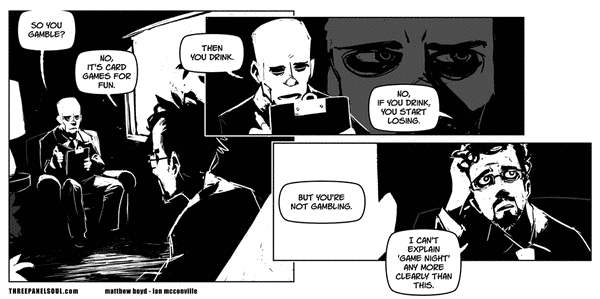
From myself and Rich Stevens, a new t-shirt for those of you with internet toxicity. We hope you like it. Purchase page is over here, at the Doctor Whisky store.
From myself and Rich Stevens, a new t-shirt for those of you with internet toxicity. We hope you like it. Purchase page is over here, at the Doctor Whisky store.
Edit, 12/14, 10:59pm: This post has now been updated with responses from the new study’s lead author.
A few months ago I wrote a story for National Geographic News that seemed to pique a lot of readers’ imaginations, and understandably so. It was about a study by Dean Snow reporting that, contrary to decades of archaeological dogma, many of the first artists were women.
Neat, right? But now there’s a twist in the tale: Another group of researchers is claiming the study’s methods were unsound. Snow has his own critiques of the criticism (more on that later). I’m less interested in who’s right than a fundamental question behind the controversy, and one that is relevant to all archaeological investigations: What does the present have to do with the past?
Snow’s study, published in the journal American Antiquity last October, focused on the famous 12,000- to 40,000-year-old handprints found on cave walls in France and Spain. Because these hands generally appear near pictures of bison and other big game, scholars had long believed that the art was made by male hunters. Snow tested that notion by comparing the relative lengths of fingers in the handprints. Why? Because among modern people, women tend to have ring and index fingers of about the same length, whereas men’s ring fingers tend to be longer than their index fingers.
Snow first scanned the hands of 111 people of European descent who lived near Pennsylvania State University, where he is an emeritus professor of anthropology. By comparing male and female hands on specific measures — such as the length of the fingers, the length of the hand, the ratio of ring to index finger, and the ratio of index finger to little finger — Snow developed an algorithm that could predict the sex of a given handprint. He also validated the algorithm on a second set of modern hands (50 males and 50 females).
The algorithm was only weakly predictive — with an accuracy of just 60 percent — because there’s a lot of overlap between the hands of modern men and women. But the equations were far more accurate when used on a set of 32 ancient hand stencils. The various measurements of these hands fell at the extreme ends of the modern sample, making it easy for the algorithm to categorize them as male or female. Snow found that 24 of the 32 prints — 75 percent — were female.

These hand stencils found in the El Castillo cave in Cantabria, Spain, were made by a man (left) and a woman (right), according to Snow’s study. Photos by Roberto Ontanon Peredo.
The new study, published Monday in the Journal of Archaeological Science, challenges Snow’s reference sample. A team led by Patrik Galeta of the University of West Bohemia in Pilsen, Czech Republic, collected handprints from 100 contemporary people in southern France and then ran those measurements through Snow’s algorithm.
Galeta found that Snow’s algorithm predicted female hands fairly well, but was useless for males, making it overall a bad predictor of sex. The study showed, in other words, that sex differences in hands among modern people living in Pennsylvania are not the same as differences among modern people living in France. “Our understanding is that hands of French males are on average smaller than U.S. males,” Galeta notes. And that, he adds, “is why U.S. methods failed to correctly identify French males.”
The bottom line: if two modern populations don’t match, then how can we possibly say anything about handprints tens of thousands of years old?
“What this shows is that a basic assumption that everyone has been making is wrong, which is that we can take a contemporary human population and use it as a model across space and time,” says archaeologist David Whitley of ASM Affiliates, an archaeological consulting firm in Tehachapi, California. Whitley was not involved in either study.
This might explain, Whitley adds, why researchers studying these old handprints have often come to contradictory conclusions. Before Snow’s work, evolutionary biologist R. Dale Guthrie performed a similar analysis of the cave prints and reported that most of them came from adolescent boys.
Snow, however, doesn’t agree with the criticisms of the new study. “I would stand by my guns here,” he says.
He sees two possible reasons that his algorithm didn’t work on the new French sample. One is that the Czech researchers didn’t use his algorithm in the same way that he did. Snow did his analysis in two steps, running the data first through an equation related to the length of the hand, and then running those results through another equation based on the ratio between the index and ring finger. The Czech researchers, in contrast, looked at the two equations separately.
Alternatively, it could be that the Czech researchers didn’t measure hand length the same way Snow did, he says. Snow measured from the tip of the middle finger to the creases where the wrist meets the palm. “If you measured the length of the hand using some other terminus at the base, you might lose a centimeter or so of the overall length,” Snow says.
So who’s right, and how can this be resolved? “I would have to see their data, and they would have to see my data, and we would have to work it out,” Snow says.
So far neither group has made contact with the other, though both parties seem willing. and the Czech group has not yet responded to my queries about their work. (If and when they do I’ll be sure to update this post.) The Czech group, for the record, rejects both of the explanations Snow proposed, saying that they used the algorithm and measured the hands exactly as Snow did.
Even if the Czech group is right, Snow says the main conclusion doesn’t change. “Even with their sample, they can show as well as I can that there were some women in them caves,” he says. “They might argue, well was it 50-50 or 70-30 or 80-20, but that part of it doesn’t concern me so much.”
Experts have been arguing over the identity of these handprints for decades, and that debate isn’t going away anytime soon. That’s part of good science. But I think this story also says something interesting about archaeology.
Archaeologists are constantly turning up objects from the distant past, and their job is to figure out what (or, in this case, who) they were. They begin, naturally, by making assumptions based on the objects and people we’re familiar with today. “It’s an issue we always confront — making ‘presentist’ projections onto the past,” Whitley says.
In the case of these handprints, the projection relates to our bodies. But it could be anything. “If you find a pot, then just calling it a pot assumes you have some understanding of what it was,” Snow says. “We all make inferences. You just have to be reasonably comfortable with your inferences.”
Welcome to a new blog from PLOS focussed on how scholarly communications is changing, and how it should be changing. The big announcements will still be on the official PLOS blog and PLOS.org but here we will be regularly covering policy, evidence, and opinion of how our world is changing.
Open Access will be at the center of what we discuss, but we chose deliberately not to have ‘Open Access’ in the name. The successful implementation of full Open Access is a necessary, but not sufficient condition of realizing the potential that the web brings to research communication.
We need proper (and appropriate!) sharing of research data and materials, we need to more effectively share our methods and processes, we need continuous review systems that provide the quality assurance that makes these useful. We need new infrastructures to make this possible, improved funding instruments and incentives that support an effective research community, and new means of monitoring and tracking research and how and where it is used.
So this blog will be about the “Opens”: open source, open data, open standards, open review and more. “Opens” as a noun if you like. But it will also be about “opens” as a verb. A discussion of what needs to be done to take advantage of the potential of the web. At the center of this will be Open Access as the critical step we are now negotiating. News, views and critical analysis alongside guest posts from the wider community. But always with an eye to the future; a view of how the world could be if we choose to make it.
William Gibson said “The future is already here – it’s just not very evenly distributed.” Like all the best cliches there is a nugget of real truth here, an admonition to open our eyes, to truly look for and to see the way the world is changing around us, rather than to filter everything through our existing world view. What we aim to do here is to tell the stories, critically analyse the evidence and to use these to suggest a path forwards.
And what better way to kick this off than with this video of Open Access advocates, funders, publishers, and above all those using the research to advance understanding, health and education in the wider world.
Accelerating Impact: View exceptional real-world applications of Open Access research. Video features six teams of scientists whose innovative reuse of existing research enabled important advances in medical treatment and detection, ecology and science education. These examples demonstrate how the reuse of Open Access research can accelerate scientific progress and benefit society as a whole. Includes comments from Open Access advocates from publishing, academia and industry and features finalists, winners and sponsors from the Accelerating Science Awards Program (ASAP)
The post Welcome to PLOS Opens… appeared first on PLOS Opens.
TertiarymattI thought about getting some UV ink-based tentacles and eldritch horrors recoiling from my elder sign tattoo, but everyone thought I was mad.

Tonight's comic wants to see your tattoo.
TertiarymattWeird immortal contagious dog cancer.
When I was eleven, we buried my first dog under an apple tree. We got another one soon after, and he died about a decade later while I was away at college. That was a pretty typical experience when it comes to kids and dogs. In a study published last year, British researchers found that the median lifespan of a pet dog was all of twelve years. Dogs can be fine companions over the course of a human childhood, but they are hardly Methuselahs.
There is, however, one remarkable exception. A dog that was born 11,000 years ago stumbled across the elixir of life, and is still alive today. It didn’t find immortality through a diet of mung beans or daily doses of resveratrol. Instead, that ancient dog employed a more radical solution. Some of its cells became cancerous and invaded other dogs, and those dogs then spread its cells to still other dogs. That ancient dog lives on today in the bodies of countless dogs around the world today.
The first record of this immortal dog appeared over 200 years ago in a book called A Domestic Treatise on the Diseases of Horses and Dogs, published in 1810 by a British veterinarian named Delabere Pritchett Blaine. Blaine had seen dogs with a kind of cancer that he described as “an ulcerous state, accompanied with a fungous excrescence” that arises in “organs concerned in generation.”
Veterinarians became more familiar with the cancer in the following decades. A tumor the shape of a cauliflower would appear around a dog’s genitals, growing quickly and becoming prone to bleeding. Some dogs died from the cancer, although many of others experienced a remarkable cure: after a few months, the tumors spontaneously shrank and vanished on their own, never to return.
In 1871, a Russian veterinarian proved that these tumors were actually infections. He cut off a bit of a tumor from one dog and then rubbed it around the genitals of another. The second dog got cancer, too. Like the bacteria that cause syphilis or the virus that causes AIDS, the cancer took advantage of sexual contact to spread to new hosts. Since then, canine Transmissible Venereal Tumor, or CTVT for short, has turned up in dogs on every continent.
CTVT remained an obscure condition known only to vets for decades. But it has gained a scientific celebrity in recent years, as scientists have started to examine the DNA in the cancer cells. If CTVT was an ordinary form of cancer, the DNA in a tumor would be a modified version of the DNA in the dog’s healthy cells. But CTVT is far from ordinary. The DNA in one tumor is very similar to the DNA in other tumors–even tumors growing in dogs on the other side of the world.
To get a deeper understanding of this cancer’s remarkable history, a team of scientists led by Elizabeth Murchinson of the University of Cambridge has now sequenced two entire CTVT genomes for the first time. They published their analysis of the genomes today in the journal Science.
Murchison and her colleagues selected two sick dogs from opposite ends of the canine universe for their study: one is a so-called “camp dog” that that live alongside Australian Aborigines. The other dog is a cocker spaniel in Brazil.
As distant as the two dogs might be, their cancer cells are very similar. Murchison and her colleagues found that their genomes share about two million mutations in common that are not found in ordinary dog cells That staggeringly huge collection of mutations is a powerful arsenal of evidence that the tumors descend from a common ancestor, rather than having evolved independently from normal cells in different dogs.
Those mutations also gave Murchison and her colleagues a molecular clock they could use to estimate how long ago the cancer originated from an ordinary dog cell. When cancer cells grow and divide, some of their DNA mutates at a roughly regular rate. In an ordinary tumor in humans, a few thousand of these mutations might accumulate. The two million mutations found in the CTVT genomes show that they’re far older than a few years. In fact, they suggest that the cancer originated in a dog 11,000 years ago, just as the Ice Age was ending.
In the past, scientists have debated whether CTVT got its start in a dog or a wolf, which then mated with a dog. This new research settles that debate in favor a dog. And not just any dog. The cancer cell genomes are most similar to those of huskies and Alaskan malamutes, which belong to one of the oldest lineages of domesticated dogs.
Here, then, is how it seems that a malamute-like dog got to live forever. One of its immune cells turned cancerous and grew into a tumor somewhere around its genitals (Murchison and her colleagues can’t say if the dog was male or female). Inside that original dog, the cancer accumulated hundreds or thousands of mutations. When the dog mated, some of the cancer cells from the bleeding tumor slipped into the body of its partner.
Normally, this should have been the end of the story. Immune cells in the second dog should have recognized the foreign cancer cells and wiped them out. Murchison and her colleagues suggest that this didn’t happen because the dogs belonged to an early population that was very small. Small populations can also be very inbred, with little genetic diversity. That similarity may have made it hard for the immune system of the second dog to distinguish the cancer cells from itself. The cancer cells exploited this loophole and grew in their new host. When the second dog mated with a third, the cancer spread further.
Along the way from dog to dog, the cancer continued to evolve. As the cells divided, some picked up mutations that allowed them to grow faster than others. The cancer adapted to its new way of life as a parasite. As it spread out of its original population, it evolved new deceptions to escape the notice of other immune systems, enabling it to infect other breeds. And it has never lost its ability to grow, even as a thousand generations of dogs it inhabited have died. (One source of its immortality may be its ability to steal energy-generating factories from the cells of its hosts.
Intriguingly, Murchison and her colleagues found that relatively few mutations are unique to the two tumors. The scientists estimate that the two tumors share a common ancestor that lived just 460 years ago. That’s around the time that dog breeders produced many of today’s breeds. It’s also when Europeans started colonizing many parts of the world, bringing their cancer-laden dogs with them. We have created propitious conditions for the global spread of a contagious cancer.
As sinister as CTVT may seem, it could be a lot more dangerous. You need only compare it to the only other known example of contagious cancer in the wild–a facial tumor that is spreading among Tasmanian devils. Like CTVT, the devil’s tumor spreads by taking advantage of the contact Tasmanian devils make with each other–instead of mating, they spread when the devils bite each other in the face during fights. But they’re drastically different in how they affect their host. CTVT typically disappears spontaneously from dogs. The devil’s tumor can balloon so fast that it often kills a Tasmanian devil in a matter of months.
While CTVT arose 11,000 years ago, the devil’s tumor only evolved in the 1980s. And yet its virulence is now threatening to drive Tasmanian devils to extinction within the next few decades unless the epidemic can be halted. It’s possible that dogs suffered such a brutal outbreak when CTVT first emerged, but the cancer has evolved a different strategy, spreading without being so deadly. It’s possible that Tasmanian devils will be saved by the same taming of their cancer. Unfortunately, we’ll know within a couple generations whether that happens or not.
Here are two videos about contagious cancer–first a talk I gave last year in San Francisco, and then a TED talk by Murchison
TertiarymattPerhaps another piece of evidence for humans in the New World rather earlier than generally accepted?
Many plants have worked their way into our lives, but few have done so with as much flair as the calabash. For over ten thousand years, people have used the calabash (known also as the bottle gourd and formally as Lagenaria siceraria) in all sorts of ways. They’ve eaten it as food. They’ve used it as fishing floats, as pontoons for river rafts, as goblets, as pipe stems. And around the world, people make music with it.
Here’s a whirlwind calabash concert tour around the planet:
Ravi Shankar jams on his sitar, the Indian classical guitar carved from a calabash, at the 1967 Monterey Pop festival:
Naná Vasconcelos plays the berimbau, the Brazilian instrument with a calabash as a resonator, in Rome in 1983:
From Mali, Toumani Diabate plays the kora:
And in China, here’s Crescent Dai performing (and talking about) the hulusi, also known as the bottle gourd flute
The calabash is a domesticated plant that depends on us for its survival, like wheat or almonds. Its closest wild relatives grow in Africa. When people domesticated the gourd, they bred a rugged, light-weight shell that could hold up for years. But the course that the calabash took from wild plant to domesticated tool has been hard to uncover.
Archaeologists have found pieces of calabash dating back 11,000 in East Asia. In the New World, people were using calabashes at least 10,000 years ago.
In 2005, a team of scientists isolated some DNA from ancient calabashes in North and South America and found that they resembled calabashes from Asia more than African ones. Since the people of the New World originally came from Asia, traveling over the Bering land bridge, the scientists proposed that they took calabashes with them.
There’s a problem with this idea, though. If Asians carried calabashes into Alaska, they had to grow them along the way. But the short growing season in the Arctic would have made it impossible to rear the tropical plant. What’s more, the people who have settled in Siberia and Alaska don’t use any plants as containers. They use materials from animals, such as hides.
It was possible that the 2005 study didn’t have the precision to get the true picture of calabash history. The scientists only looked at a few genetic markers–tiny stretches of DNA at certain locations in the genes of different plants. It was possible that these markers had changed too rapidly over thousands of years, so that distantly related calabashes evolved similar sequences.
A group of researchers led by Logan Kistler at Pennsylvania State University decided to take another crack at the calabash. They gathered much more data this time around, gathering living gourds from every continent as well as the Pacific islands, and analyzing nine sets of ancient remains. And instead of looking for a handful of genetic markers, they sequenced 86,000 base pairs from the DNA in the chloroplast, the light-generating structures passed down from female plants to their offspring. By comparing the DNA from the plants, they were able to trace the branches of their family tree.
This is the tree. The x-axis is a time scale, going from 250,000 years ago to today. The numbers at the nodes are statistical measurements of how likely the trees are to be accurate. Branches with a 1 have the highest possible statistical support. The red names refer to gourds from archaeological sites in the New World.

Kistler et al PNAS 2014
As you can see, a wild African gourd belongs to the deepest branch. The tree then splits into two main lineages: one that includes African domesticated gourds, and the other that includes Asian ones. Both the ancient calabashes and the living ones from the New World belong to the African branch of the tree. If the calabashes had taken an Arctic journey, you’d expect a very different tree, with New World plants showing a kinship with Asian ones. This tree makes that journey hard to accept.
Making matters even worse is the great age of the New World lineages. Kistler and his colleagues tallied up the mutations along each branch to estimate how long ago they split from a common ancestor. The New World calabashes share a common ancestor with African calabashes 60,000 to 103,000 years ago. That’s long before people made their way to the New World about 15,000 years ago. However the calabashes originally got to the New World, it wasn’t on anyone’s shoulders.
Kistler and his colleagues argue instead for a different journey–or, rather, different journeys for people and plants. Back about 80,000 years ago, wild calabashes grew only in Africa. Sometimes their seeds were washed out to sea. Computer models of the Atlantic currents indicate that it might have taken just a few months for the wild calabash seeds to travel to the New World. The ocean-faring seeds sprouted in their new home. While Alaska would have been a poor place for the gourds to grow, places like Florida, Mexico, and Brazil would have been ideal.
Africa was likely the first place where people domesticated gourds. Different groups of people may have come across different wild populations of the plants, and selecting the gourds with the toughest shells to use as containers. When this happened is hard to say–the oldest archaeological evidence for gourds in Africa is less than 5,000 years old, but there could be other calabash fragments waiting to be discovered.
It’s tantalizing to look at the asiatica branch of the calabash tree. All the Asian, European, and Pacific gourds share a common ancestor with a domesticated Ethiopian gourd that lived 60,000 years ago. That’s right around the time that modern humans expanded from East Africa into the rest of the Old World. We know that by then they were using ostrich eggs as containers. They didn’t take ostriches with them out of Africa. Did they also take calabashes? That’s possible, but it’s also possible that a wild relative of the Ethiopian calabash spread across the water to coastlines in the Near East or South Asia, where people started to domesticate them.
What is clear is that people carried calabashes a long way, putting them in their canoes as they sailed to the islands of the Pacific. But there’s no evidence that the people who traveled across the Bering Land bridge had calabashes with them. Instead, the evidence suggests, their descendants eventually stumbled across wild calabashes growing along the east coast of North and South America, descendants of seeds that had drifted across the Atlantic while the ancestors of the people of the New World were living in Africa over 40,000 years before. And just as people in other parts of the world had done when they discovered wild calabashes, the people of the New World started using these plants.
Wild calabashes are practically impossible to find any more, either in the New World or in Africa. Humans may be the reason why. Originally, the plants probably developed big gourds to protect their seeds from small predators like birds and rodents. Only big mammals like ground sloths may have been able to feed on them. Like a number of other plants, calabashes may have had seeds adapted to survive a trip through the gut of a big mammal. The mammals could then spread their seeds in their droppings, maintaining the plants across a wide range.
Many of those giant beasts are now extinct. While the end of the Ice Age may have played a role in their demise, it’s also possible that human hunters may have helped push them towards oblivion. Having lost their animal partners, wild calabash would have started to dwindle. Meanwhile, though, humans were caring for a few strains of calabashes that had the traits they valued. Thus evolution pushed the calabashes to their remarkably durable state.
Scientists have long been impressed by the triumph of the calabash. Among domesticated species, only the dog has spread further. But the global journey of the calabash was actually two great trips, one taken by humans over land and another taken by plants, over the sea.
TertiarymattRather an interesting way to write a book, I reckon.
Upcoming Book on Open Science with R
We're pleased to announce that the rOpenSci core team has just signed a contract with CRC Press/Taylor and Francis R series to publish a new book on practical ways to implement open science into your own research using R. Given all the talk about the importance of open science, the discussion often lacks practical suggestions on how one might actually incorporate these practices into their day to day research workflow.
In many ways writing this book will be an exercise for us to share our research workflow with the rest of the community. If R plays an important role in your research this book will help you learn how to:
The publisher has been kind enough to allow us to maintain a public version the book as a GitHub repository. Anyone will be able to read our chapters, review, comment, and send pull requests. The final edited and nicely formatted version with a complete index will of course only be available via the publisher copy. But that is a small trade off in this case. As an added advantage, we will be able to keep the material current and up-to-date long after publication.
GitHub repository for the book
Issues, comments and suggestions
We expect the book to be out shortly after July 2014.
TertiarymattI remain very curious about Mezcal.

As many of you well know, we're not big fans of packaging or gift sets at K&L because they take up valuable space and they're a pain to ship. However, we will make exceptions now and again -- especially if it truly benefits the customer. In the case of mezcal, we know how curious many spirits fans are about the different flavor profiles and the various species of agave. Wouldn't it be great if a fantastic producer, known for making traditional and rustic mezcal, offered three smaller-sized bottles in a gift pack with appropriate glassware?
That's why we picked up a large chunk of Wahaka's new gift set, featuring the standard Espadin, the super rare Tobala, and the lovely Ensemble; which is a field blend of 50% Espadin, 25% Tobala, and 25% Madre Cuishe. You get three 200ml bottles and two old school tasting glasses for $84.99.
If you don't feel like blowing $215 to try a full bottle of each, why not get the gift pack and try them out first. It's a great way to get your feet wet and decipher between standard cultivated agave, a rare wild species of agave, and a blend of various cultivated and wild species together.
I'm pumped.
-David Driscoll
TertiarymattAnyone ever tasted this?

On Monday night, David OG and I will be boarding red-eye flights to Miami where we'll catch a morning connection to Trinidad. After a seven hour layover on the island, we'll finally catch our last flight into Georgetown that evening. Almost twenty-four hours later we'll finally arrive in Guyana -- the home of Demerara Distillers and El Dorado rum. We'll only be in South America for three days before we turn right around and fly back Saturday morning. Yet, we're willing to do what it takes to get there because both David and I have a strong feeling that rum is due for a big resurgence and that the lynch pin of that movement is going to be the Demerara Distilling Company Ltd. No other producer of rum has a legacy like DDL and no other distiller is in a position to make as serious of an impact on the booze industry.
We'll get into the history of rum distillation in Guyana later; about how production dates back to the 1670s and how all the estates have now been consolidated into one company. We'll also break down how each of their four stills works and how long they've been in operation. I'm sure we'll learn more in-depth and fascinating details once we're physically there and those details will definitely be more interesting when supported by photography. What makes Demerara Distillers an exciting company to work with goes far beyond tradition, heritage, and history, however. We're partnering with a producer that is self-owned and is not part of a larger corporate group. They make the ultimate decisions about any future developments without having to worry about how those actions are going to affect other parts of their whisky, brandy, or wine portfolios. They're not looking to expand their empire or join up with another beverage group. They're looking to do one thing and one thing only at Demerara Distilling Company: make really good rum.
And they make a lot of rum. About 20 million liters worth a year, of which 75% goes to bulk rum sales abroad. They make their money up front on the white goods, which allows them the freedom and the ability to concentrate their full attention on making sure the other 25% is as brilliant as can be; the rum that eventually goes into the El Dorado expressions. DDL has so much rum laying down in its warehouses that it's actually reminiscent of where single malt whisky was fifteen to twenty years ago -- when producers would carelessly dump older barrels into their standard twelve or fifteen year expressions to add richness and texture. When you buy a bottle of El Dorado 12, 15, or 21 year, you're not just getting the bare minimum of maturity. They're definitely blending in older rums to these expressions because they have plenty of rum to do so with. This also means you're not going to pay all that much, either (we currently have the 12 year for $25.99, which is just crazy considering how good that rum is).
What makes rum such an intriguing spirit is that it offers drinkers the best of both worlds: light, fragrant, and flavorful white rums for mixing cocktails, as well as dark, barrel-aged rums of various maturity levels that allow for contemplative sipping. Despite our trip to Barbados last year and our continued work to source interesting casks (like the very expressive Faultline St. Lucia), I feel like we don't really understand rum's true potential. More importantly, I feel like because of our lack of understanding, we haven't been able to clearly communicate to customers how amazing rum can be and why we find it so compelling. That's why I'm going to get on that plane Monday night and brave the long trip south to a small country tucked between Venezuela and Brazil, just north of the equator. It's the most historic rum producing region on the planet and the Mecca of molasses for serious rum distillation.
Demerara sugar is some of the most-coveted due to its crystallized form and caramel-like flavor. The molasses from the refinement process of Demerara sugar, however, is only sold to one customer: Demerara Distillers. The only company allowed to distill rum from Demerara molasses is DDL and the quality of that molasses plays a large part in making their rum so delicious and flavorful. I want to better understand sugar and molasses and how they can affect flavor. I want a better breakdown of column still distillation vs. pot still distillation and how maturation in severely humid conditions creates a different flavor. I want to experience the blending process first hand and decipher between different types of rum distillates. I want to process that information, write it down, document it with my camera, and share it with all of you. That means I've got to go to Guyana.
In my personal opinion, DDL is going to be the epicenter of a serious tremor that will soon shock the booze business. With pricing and availability continuing to frustrate whiskey drinkers, I think rum is poised to play spoiler to what has so far been a very small party.
-David Driscoll
Orthodox Caveman by SUNN O))) is, in its slow and ponderous fashion, one of the greatest metal tracks ever recorded, in my opinion.
TertiarymattPersonally, I have no intention of simulating 5,000 datasets and performing regressions on them by hand. So I know what my answer is.

TertiarymattSeriously.
Leap, for the World Economic Forum 2014 (by flight404)
Zoe makes me cry kind of more often than is fair, really.
The rOpenSci team has been cranking out a large number of software tools over the past several months. As regular blog readers are aware, our software packages provide programmatic access to a diverse and extensive trove of scientific data. More recently we've expanded our efforts to build more general purpose and cross-domain tools. These include tools for reading, writing, integrating and publishing data, a unit testing platform for data, and a mapping engine that can visualize various kinds of spatial data. Many of our projects are inspired by ad hoc discussions with other scientists and software developers both online (often on Twitter and GitHub) and offline. Several of these folks are now regular contributors to the project. To foster more such collaborations and drive new software innovations, we are excited to announce our first developer meeting next month at GitHub's headquarters in San Francisco. This meeting is made possible by support from the Alfred P. Sloan foundation and GitHub.
In addition to the core development team, we have invited several key R developers and scientists to collaborate on projects in an unconference unhackathon format. The goal is to have participants (or anyone really) informally propose ideas on our meeting GitHub repo before and during the meeting and hack on ones that seem exciting. We hope to work on various projects related to open science, data visualization, data pipelines and text mining.
The event is invitation only due to funding and space limitations, but we would like to open up a handful of spots to anyone interested in joining us. We welcome inquiries from scholars, students, developers, data managers, and any interested amateurs. You don't have to be an R expert as long as you're open to learning and brainstorming on exciting projects and ideas. If this sounds interesting to you please send an informal email to info at ropensci.org with a little bit of about what you do and why you are keen on attending this event. We especially encourage women and minorities to apply. Financial assistance for travel to the event may be possible depending on availability of funds. If you require financial support, please mention that in your email.
We are quite looking forward to a fun and intellectually engaging meeting.
Originally posted 2014-02-12 by Karthik Ram in R, Community, Hackathon.
Tertiarymatt#menswear
 It’s a pleasure to be making quite a few of these car coats recently. It’s understandable, as they are the perfect garment that can look formal enough for Savile Row, but relaxed enough to wear with a sweater and jeans at the weekend.
We’ve been making these in classic dark blues, greys and tweeds of all designs. These two coats on the left are almost complete, a set of horn buttons and a good pressing will finish them off nicely. The green coat is made from Austrian Loden - which adds a really beautiful dimension. This unique texture and colour is extremely elegant but again works perfectly with less formal clothing.
It’s a very simple style of cut, but what makes these different is that they’re cut shorter, which makes them easier to wear and the sporty half belt gives a slightly less formal appearance. In essence though, it does what its designed to do and keep out the cold.
We’ve been working flat out here to get fittings ready for our next US visit this March. We’re also delighted that we’ll be adding Boston to our regular schedule. We have some good friends there and visited the city briefly on our last visit. It’s our last stop after San Francisco and New York. The full USA itinerary can be found here.
I hope you like our new look English Cut website. We’ll be doing our best to give you good information as usual so we hope you’ll drop in from time to time.
Anyway, I need to get on with a large batch of trimming tonight, especially as Mr Mahon is having a couple of days off with his family – celebrating the safe arrival of son number three…. of course, a huge congratulations to the Mahon family. Although, it has to be said, with the arrival of ‘Apprentice’ John Mahon at the weekend, I feel my chances of taking over the famous shears may be diminishing.
Yours sincerely,
Tom Ritson
Apprentice Cutter
Picture below: Mahon son number one holding number three…


Random art: Trying to think up 16th century flotsam & jetsam.
TertiarymattRelevant to your interests, etc.

We are proud to officially announce our lineup for Linework 2014!
Art by Special Guest Michael DeForge.
Exhibitors:
The Little Friends of Printmaking
Teenage Dinosaur
Whew! And we even have a couple of surprises left up our sleeves… Stay tuned for late-breaking additions, interviews with our exhibitors, and much more. Winnowing down to this final list was very difficult, and we had to leave lots of creators off that we would have loved to host at the show, but in the end we can’t believe what an amazing array of illustrators, cartoonists, and publishers have chosen to exhibit with us our first year! Thank you!
Woo! See you there, gang!
TertiarymattThis is a good interview. I need to check out newer Darkthrone material, it seems.
When MetalSucks rings Fenriz (Gylve Fenris Nagell) at 8 a.m. our time, we’ve barely had a chance to organize the day. Fenriz, however, has finished his day at the Norwegian postal service on the other side of the planet and is digging in for more work on his many creative projects.
Fenriz estimates that we are fifty-sixth or fifty-seventh in the cycle of interviews to promote Darkthrone’s new album The Underground Resistance, yet another fast and dirty album that will leave those pining for a return to A Blaze In the Northern Sky in mourning but excite the rest of us who know better. Since Fenriz has been asked every question multiple times about this record and his career (not to mention black metal) we thought it would be wise use of our Norwegian phone card to take a closer look at how he spends the bulk of his time: in the office.
Despite his legendary underground credibility, Fenriz is a two-decade plus working stiff like many of our readers (except for those unemployed or unfit for work). When we caught up with him he’d just finished hours of working a letter sorting machine. Fenriz talked to us about his life outside of Darkthrone, and how what many view as mindless work has been the impetus for much of his music.

Drawn today, for a freelance project.
TertiarymattRemember kids, the surveillance state isn't a joke.


Penis tree
Roman de la Rose, France 14th century.
Français 25526, fol. 106-160r (compillation contains fols. 106v, 111v, 160r)
hmmmm
no wait
no
hmmmm
TertiarymattWould drink.
We welcome Geoff Kleinman, editor of the DrinkSpirits website, as a guest blogger on the subject of aged gin…which can be tantalizingly close to whisky.
 Aged Gin isn’t a new spirit category, but it’s a category that has been getting an increasing amount of attention. Craft distillers have embraced aged gin as another vehicle for creative expression and as an aged product that can be sold during the long waiting game that’s required for aged whisky. The problem with the category is that, at times, it tends to blur the lines between gin and whiskey, with one product, Pow-Wow Botanical Rye, completely obliterating the lines.
“Early American gin (up through the 1860s) was made in the flavored-whiskey style, and it was often barrel aged. Later, once (neutral-spirit based) English styles took root, that, too, was often aged, but much more lightly,” explains David Wondrich, spirits historian and author of Imbibe!.
One of the first contemporary entries in the aged gin space came from Ransom Spirits, in Sheridan, Oregon. With Ransom’s Old Tom Gin, distiller Tad Seestedt helped resurrect a “lost” style of gin and in the process helped kick off a new wave of the aged gin category. “The idea was initially to replicate the short amount of time that the gin would have historically spent in barrel during transport over land or sea to its final destination. We also realized afterwards that the barrel aging had an obviously pleasant effect on the gin,” says Tad Seestedt.
 Ransom’s Old Tom Gin soon became a darling of the craft spirit world, and it opened the door for more craft spirit companies to follow in the aged gin space. “One of the most challenging aspects of “craft distilling” is that the big boys make outstanding products – aging gin allows me a chance to not only be creative but create products that the big boys fhave to play catch up, like with Beefeater’s Burroughs Reserve,” says Paul Hletko, founder and master distiller of FEW Spirits.
Many craft distillers don’t have the ability to truly rectify spirits and scoff at using neutral grain spirits for their products. The result can be a malty botanical spirit with similar characteristics to a young whiskey. “The primary difference, besides the addition of the botanicals to the spirit, is the distillation proof of the base spirit. As you know, whiskey is distilled to a much lower proof off the still, so there are fusels and other congeners in the whiskey distillate that aren’t there in the base of the gin distillate,” remarks John Little, head distiller of Smooth Ambler Spirits.
Seeing this intersection between aged gin and aged whiskey, Amir Peay, CEO and founder at Georgetown Trading Co., created Pow-Wow Botanical Rye. “We took a fine, mature whiskey and then infused it with whole botanicals over an extended period of time. My idea of a good whiskey is one that is complex and balanced, and I wanted to see if we could take a great whiskey and add new layers of botanical complexity that worked in concert with the existing flavors.”
The dividing line between a botanical flavored whiskey and an aged gin may be murky, but it’s there. “Aged London dry style gin, or any gin that’s based on neutral spirits, is not aged whiskey, it’s aged vodka. If you make your gin with an unrectified grain spirit that’s been distilled to a relatively low proof, as the Dutch do with their moutwijn, then it’s a flavored whiskey,” explains David Wondrich.
While aged gin is predominantly seen among craft distillers, this year Pernod Ricard got into the space with their limited Beefeater Burrough’s Reserve “Barrel Finished Gin.”
“Aged or rested gin opens up another drinking occasion for gin. Most people wouldn’t think to sit and enjoy a glass of neat gin with a cheese plate after dinner, but with Burrough’s Reserve on the market now we can,” says Nick van Tiel, Pernod Ricard’s English gins brand ambassador.
Whether or not whiskey drinkers will embrace the aged gin category remains to be seen, but it’s certainly a category that deserves exploration. Paul Hletko best sums it up: “It is a wide open place, and much of what we do is education on what ‘brown gin’ is and why it’s brown. But the opportunity to be creative is worth it.”
The post Gin Meets Whisky (in a barrel) appeared first on Whisky Advocate.
Tertiarymatt#twopeople
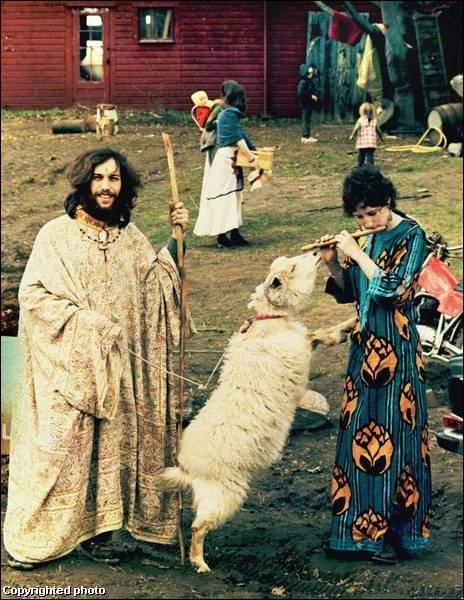
Tree Frog commune in Guilford, Vermont in the 70s.
now this is a commune that speaks my language
We are not sure when Indiegogo featured “Heating the Rez” on their homepage in “New This Week” but we were just alerted to that awesome gesture by Indiegogo; We are almost 50% funded for the start of the renewable solution and are working on 2 fundraiser runs (Rapid City, SD and Bismarck, ND) to…
"The goal, the modus operandi of Lakota society is to be a good relative, to be generous where you can be generous, to help where you can help.”
Worthy words from a worthy fundraiser, which I was glad to contribute to, and which you may like to consider. We are all feeling the cold this winter.

A very good piece on an image that went viral not long ago, and indeed was sent to me several times! Click through.
TertiarymattDylan draws fancy ladies, sometimes.

Announcing (the finished portrait of) HER ROYAL HIGHNESS, PRINCESS ELEANOR.
Why on earth would such an august personage come to the most remote island in the kingdom? You will have to wait and see.
TertiarymattCousin to the Triple Dog Dare.