Shared posts

20 Dec 18:47

Grothendieck's Activism And What It Says About The World

by leinster
MathML-enabled post (click for more details).

Mathematician Ivar Ekeland has an excellent, thoughtful, article at Mediapart, reflecting on the second phase of Grothendieck’s adult life.

The article is perhaps more about mathematics and its place in the world than about Grothendieck specifically. Among the questions Ekeland asks: What exactly are you, as a researcher, looking for? What are your intellectual boundaries? How do you justify spending your life on mathematics? Why was Grothendieck a less successful activist than mathematician? And what does that say about the world?

Below the fold is my translation of selected passages from Ekeland’s article, which is in French. Feel free to suggest improvements to the translation.

MathML-enabled post (click for more details).

The rest of this post is a translation of parts of Ivar Ekeland’s article at Mediapart.

While for many of us, research is a career (although an honourable one, and preferable to many others), for Grothendieck it was everything: the search for the truth is an end in itself, for which any sacrifice is merited. […] And there we have the first of the questions that Grothendieck’s life poses to me: what exactly are you searching for? Does the quest for truth stop at the boundaries of mathematics?

As far as he was concerned, obviously not. He sought the truth wherever it could be found, and he examined our society with the same gaze he brought to mathematics. But he did not have the same success. As his student Pierre Deligne said, “he had the impression that the fact of having proved the reality of the problems would make things change, as it does in mathematics”. This is the immense disappointment that must be faced every day by campaigners in all causes, whether it is against global warming, tax havens, social injustice, or the occupation of the Palestinian territories: much as one might demonstrate the reality of the problems, that does not make things change!

Why is that? For one thing, because most people do not reflect, and the higher one climbs up the social hierarchy, the less time one has to reflect, submerged as one is by urgent and important matters. This is what Pascal called “distraction”: positions of responsibility are sought out exactly because in taking up your time, they remove from you the opportunity to think. Every day brings us proof that neither the [French] president nor his ministers take the time to reflect.

The other reason why it is so difficult to make these problems understood is that, when people think, they do it within ready-made frameworks: there is an “off-the-peg” style of thought [un prêt-à-porter de la pensée]. This is true everywhere, even in mathematics, and Grothendieck analysed it well in his book Récoltes et Semailles, which you will excuse me for quoting at length. “Most mathematicians… tend to confine themselves to a conceptual framework, in a ‘Universe’ fixed once and for all — that which, essentially, they found ‘ready-made’ at the time when they were students. […]”

The unhappy fact, in this business, is that words no longer carry weight. In mathematics, words have weight, because it is impossible to lie: everyone can check for themselves whether a theorem is true or false; the most junior participant at Grothendieck’s seminar could verify what the master was saying. The mathematical word must be true. In politics, this constraint disappears: one cannot verify a historical fact or somebody’s good faith in the same way that one verifies a proof. The word becomes an instrument of power, and the search for truth is transformed into the art of communication: the spin doctor replaces the researcher, and the “elements of language” transmitted by newspapers and television replace facts. […]

And here is the last question that Grothendieck’s life poses to me: how to act in a world where words no longer carry weight? What is the use of doing mathematics when the survival of the human species is in question, when the planet is threatened by global warming and the end of biodiversity, and humanity is threatened by the proliferation of arms of all kinds and the perfection of surveillance techniques? Must we be like Nero, fiddling while Rome burned? […] Must we follow the the advice of Voltaire, and tend our gardens, that is to say, take no interest in the big questions and dedicate ourselves to matters where we are capable of making some difference? […]

I have no answer to these questions. Grothendieck had his. He was a perfectly free man, in the sense of Spinoza: what he did, he did after mature reflection, and it was determined purely by what he believed to be the truth, not by external circumstances or social pressures.

20 Dec 18:37

Effective Sample Size

by leinster
Nosimpler

I've been following this "metric space magnitude" thing for awhile and think it might just take off.

MathML-enabled post (click for more details).

On a scale of 0 to 10, how much does the average citizen of the Republic of Elbonia trust the president?

You’re conducting a survey to find out, and you’ve calculated that in order to get the precision you want, you’re going to need a sample of 100 statistically independent individuals. Now you have to decide how to do this.

You could stand in the central square of the capital city and survey the next 100 people who walk by. But these opinions won’t be independent: probably politics in the capital isn’t representative of politics in Elbonia as a whole.

So you consider travelling to 100 different locations in the country and asking one Elbonian at each. But apart from anything else, this is far too expensive for you to do.

Maybe a compromise would be OK. You could go to 10 locations and ask… 20 people at each? 30? How many would you need in order to match the precision of 100 independent individuals — to have an “effective sample size” of 100?

The answer turns out to be closely connected to a quantity I’ve written about many times before: magnitude. Let me explain…

MathML-enabled post (click for more details).

The general situation is that we have a large population of individuals (in this case, Elbonians), and with each there is associated a real number (in this case, their level of trust in the president). So we have a probability distribution, and we’re interested in discovering some statistic θ\theta (in this case, the mean, but it might instead be the median or the variance or the 90th percentile). We do this by taking some sample of nn individuals, and then doing something with the sampled data to produce an estimate of θ\theta.

The “something” we do with the sampled data is called an estimator. So, an estimator is a real-valued function on the set of possible sample data. For instance, if you’re trying to estimate the mean of the population, and we denote the sample data by Y 1,…,Y nY_1, \ldots, Y_n, then the obvious estimator for the population mean would be just the sample mean,

1nY 1+⋯+1nY n. \frac{1}{n} Y_1 + \cdots + \frac{1}{n} Y_n.

But it’s important to realize that the best estimator for a given statistic of the population (such as the mean) needn’t be that same statistic applied to the sample. For example, suppose we wish to know the mean mass of men from Mali. Unfortunately, we’ve only weighed three men from Mali, and two of them are brothers. You could use

13Y 1+13Y 2+13Y 3 \frac{1}{3} Y_1 + \frac{1}{3} Y_2 + \frac{1}{3} Y_3

as your estimator, but since body mass is somewhat genetic, that would give undue importance to one particular family. At the opposite extreme, you could use

12Y 1+14Y 2+14Y 3 \frac{1}{2} Y_1 + \frac{1}{4} Y_2 + \frac{1}{4} Y_3

(where Y 1Y_1 is the mass of the non-brother). But that would be going too far, as it gives the non-brother as much importance as the two brothers put together. Probably the best answer is somewhere in between. Exactly where in between depends on the correlation between masses of brothers, which is a quantity we might reasonably estimate from data gathered elsewhere in the world.

(There’s a deliberate echo here of something I wrote previously: in what proportions should we sow poppies, Polish wheat and Persian wheat in order to maximize biological diversity? The similarity is no coincidence.)

There are several qualities we might seek in an estimator. I’ll focus on two.

  • High precision   The precision of an estimator is the reciprocal of its variance. To make sense of this, you have to realize that estimators are random variables too! An estimator with high precision, or low variance, is not much changed by the effects of randomness. It will give more or less the same answer if you run it multiple times.

    For instance, suppose we’ve decided to do the Elbonian survey by asking 30 people in each of the 5 biggest cities and 20 people from each of 3 chosen villages, then taking some specific weighted mean of the resulting data. If that’s a high-precision estimator, it will give more or less the same final answer no matter which specific Elbonians happen to have been stopped by the pollsters.

  • Unbiased   An estimator of some statistic is unbiased if its expected value is equal to that statistic for the population.

    For example, suppose we’re trying to estimate the variance of some distribution. If our sample consists of a measly two individuals, then the variance of the sample is likely to be much less than the variance of the population. After all, with only two individuals observed, we’ve barely begun to glimpse the full variation of the population as a whole. It can actually be shown that with a sample size of two, the expected value of the sample variance is half the population variance. So the sample variance is a biased estimator of the population variance, but twice the sample variance is an unbiased estimator.

    (Being unbiased is perhaps a less crucial property of an estimator than it might at first appear. Suppose the boss of a chain of pizza takeaways wants to know the average size of pizzas ordered. “Size” could be measured by diameter — what you order by — or area — what you eat. But since the relationship between diameter and area is quadratic rather than linear, an unbiased estimator of one will be a biased estimator of the other.)

No matter what statistic you’re trying to estimate, you can talk about the “effective sample size” of an estimator. But for simplicity, I’ll only talk about estimating the mean.

Here’s a loose definition:

The effective sample size of an estimator of the population mean is the number n effn_{eff} with the property that our estimator has the same precision (or variance) as the estimator got by sampling n effn_{eff} independent individuals.

Let’s unpack that.

Suppose we choose nn individuals at random from the population (with replacement, if you care). So we have independent, identically distributed random variables Y 1,…,Y nY_1, \ldots, Y_n. As above, we take the sample mean

1nY 1+⋯+1nY n \frac{1}{n} Y_1 + \cdots + \frac{1}{n} Y_n

as our estimator of the population mean. Since variance is additive for independent random variables, the variance of this estimator is

n⋅Var(1nY 1)=n⋅1n 2Var(Y 1)=σ 2n n \cdot Var\Bigl( \frac{1}{n} Y_1 \Bigr) = n \cdot \frac{1}{n^2} Var(Y_1) = \frac{\sigma^2}{n}

where σ 2\sigma^2 is the population variance. The precision of the estimator is, therefore, n/σ 2n/\sigma^2. That makes sense: as your sample size nn increases, the precision of your estimate increases too.

Now, suppose we have some other estimator μ^\hat{\mu} of the population mean. It’s a random variable, so it has a variance Var(μ^)Var(\hat{\mu}). The effective sample size of the estimator μ^\hat{\mu} is the number n effn_{eff} satisfying

σ 2/n eff=Var(μ^). \sigma^2/n_{eff} = Var(\hat{\mu}).

This doesn’t entirely make sense, as the unique number n effn_{eff} satisfying this equation needn’t be an integer, so we can’t sensibly talk about a sample of size n effn_{eff}. Nevertheless, we can absolutely rigorously define the effective sample size of our estimator μ^\hat{\mu} as

n eff=σ 2/Var(μ^). n_{eff} = \sigma^2/\Var(\hat{\mu}).

And that’s the definition. Differently put,

effective sample size=precision ×population variance. \text{effective sample size} = \text{precision } \times \text{population variance}.

Trivial examples   If μ^\hat{\mu} is the mean value of nn uncorrelated individuals, then the effective sample size is nn. If μ^\hat{\mu} is the mean value of nn extremely highly correlated individuals, then the variance of the estimator is little less than the variance of a single individual, so the effective sample size is little more than 11.

Now, suppose our pollsters have come back from their trips to various parts of Elbonia. Together, they’ve asked nn individuals how much they trust the president. We want to take that data and use it to estimate the population mean — that is, the mean level of trust in the president across Elbonia — in as precise a way as possible.

We’re going to restrict ourselves to unbiased estimators, so that the expected value of the estimator is the population mean. We’re also going to consider only linear estimators: those of the form

a 1Y 1+⋯+a nY n a_1 Y_1 + \cdots + a_n Y_n

where Y 1,…,Y nY_1, \ldots, Y_n are the trust levels expressed by the nn Elbonians surveyed.

Question:

What choice of unbiased linear estimator maximizes the effective sample size?

To answer this, we need to recall some basic statistical notions…

Correlation and covariance

Variance is a quadratic form, and covariance is the corresponding bilinear form. That is, take two random variables XX and YY, with respective means μ X\mu_X and μ Y\mu_Y. Then their covariance is

Cov(X,Y)=E((X−μ X)(Y−μ Y)). Cov(X, Y) = E((X - \mu_X)(Y - \mu_Y)).

This is bilinear in XX and YY, and Cov(X,X)=Var(X)Cov(X, X) = Var(X).

Cov(X,Y)Cov(X, Y) is bounded above and below by ±σ Xσ Y\pm \sigma_X \sigma_Y, the product of the standard deviations. It’s natural to normalize, dividing through by σ Xσ Y\sigma_X \sigma_Y to obtain a number between −1-1 and 11. This gives the correlation coefficient

ρ X,Y=Cov(X,Y)σ Xσ Y∈[−1,1]. \rho_{X, Y} = \frac{Cov(X, Y)}{\sigma_X\sigma_Y} \in [-1, 1].

Alternatively, we can first scale XX and YY to have variance 11, then take the covariance, and this also gives the correlation:

ρ X,Y=Cov(X/σ X,Y/σ Y). \rho_{X, Y} = Cov(X/\sigma_X, Y/\sigma_Y).

Now suppose we have nn random variables, Y 1,…,Y nY_1, \ldots, Y_n. The correlation matrix RR is the n×nn \times n matrix whose (i,j)(i, j)-entry is ρ Y i,Y j\rho_{Y_i, Y_j}. Correlation matrices have some easily-proved properties:

  • The entries are all in [−1,1][-1, 1].

  • The diagonal entries are all 11.

  • The matrix is symmetric.

  • The matrix is positive semidefinite. That’s because the corresponding quadratic form is (a 1,…,a n)↦Var(∑a iY i/σ i)(a_1, \ldots, a_n) \mapsto Var(\sum a_i Y_i/\sigma_i), and variances are nonnegative.

And actually, it’s not so hard to prove that any matrix with these properties is the correlation matrix of some sequence of random variables.

In what follows, for simplicity, I’ll quietly assume that the correlation matrices we encounter are strictly positive definite. This only amounts to assuming that no linear combination of the Y iY_is has variance zero — in other words, that there are no exact linear relationships between the random variables involved.

Back to the main question

Here’s where we got to. We surveyed nn individuals from our population, giving nn identically distributed but not necessarily independent random variables Y 1,…,Y nY_1, \ldots, Y_n. Some of them will be correlated because of geographical clustering.

We’re trying to use this data to estimate the population mean in as precise a way as possible. Specifically, we’re looking for numbers a 1,…,a na_1, \ldots, a_n such that the linear estimator ∑a iY i\sum a_i Y_i is unbiased and has the maximum possible effective sample size.

The effective sample size was defined as n eff=σ 2/Var(∑a iY i)n_{eff} = \sigma^2/Var(\sum a_i Y_i), where σ 2\sigma^2 is the variance of the distribution we’re drawing from. Now we need to work out the variance in the denominator.

Let RR denote the correlation matrix of Y 1,…,Y nY_1, \ldots, Y_n. I said a moment ago that (a 1,…,a n)↦Var(∑a iY i)(a_1, \ldots, a_n) \mapsto Var (\sum a_i Y_i) is the quadratic form corresponding to the bilinear form represented by the covariance matrix. Since each Y iY_i has variance σ 2\sigma^2, the covariance matrix is just σ 2\sigma^2 times the correlation matrix RR. Hence

Var(a 1Y 1+⋯+a nY n)=σ 2⋅a *Ra Var(a_1 Y_1 + \cdots + a_n Y_n) = \sigma^2 \cdot a^\ast R a

where *\ast denotes a transpose and a=(a 1,…,a n)a = (a_1, \ldots, a_n).

So, the effective sample size of our estimator is

1/a *Ra. 1/a^\ast R a.

We also wanted our estimator to be unbiased. Its expected value is

E(a 1Y 1+⋯+a nY n)=(a 1+⋯+a n)μ E(a_1 Y_1 + \cdots + a_n Y_n) = (a_1 + \cdots + a_n) \mu

where μ\mu is the population mean. So, we need ∑a i=1\sum a_i = 1.

Putting this together, the maximum possible effective sample size among all unbiased linear estimators is

sup{1a *Ra:a∈ℝ n,∑a i=1}. \sup \Bigl\{ \frac{1}{a^\ast R a} \, : \, a \in \mathbb{R}^n, \, \sum a_i = 1 \Bigr\}.

Which a∈ℝ na \in \mathbb{R}^n achieves this maximum, and what is the maximum possible effective sample size? That’s easy, and in fact it’s something that’s appeared many times at this blog before…

The magnitude of a matrix

The magnitude |R||R| of an invertible n×nn \times n matrix RR is the sum of all n 2n^2 entries of R −1R^{-1}. To calculate it, you don’t need to go as far as inverting RR. It’s much easier to find the unique column vector ww satisfying

Rw=(1 ⋮ 1) R w = \begin{pmatrix} 1 \\ \vdots \\ 1 \end{pmatrix}

(the weighting of RR), then calculate ∑ iw i\sum_i w_i. This sum is the magnitude of RR, since w iw_i is the iith row-sum of R −1R^{-1}.

Most of what I’ve written about magnitude has been in the situation where we start with a finite metric space X={x 1,…,x n}X = \{x_1, \ldots, x_n\}, and we use the matrix ZZ with entries Z ij=exp(−d(x i,x j))Z_{i j} = exp(-d(x_i, x_j)). This turns out to give interesting information about XX. In the metric situation, the entries of the matrix ZZ are between 00 and 11. Often ZZ is positive definite (e.g. when X⊂ℝ nX \subset \mathbb{R}^n), as correlation matrices are.

When RR is positive definite, there’s a third way to describe the magnitude:

|R|=sup{1a *Ra:a∈ℝ n,∑a i=1}. |R| = \sup \Bigl\{ \frac{1}{a^\ast R a} \, : \, a \in \mathbb{R}^n, \, \sum a_i = 1 \Bigr\}.

The supremum is attained just when a=w/|R|a = w/|R|, and the proof is a simple application of the Cauchy–Schwarz inequality.

But that supremum is exactly the expression we had for maximum effective sample size! So:

The maximum possible value of n effn_{eff} is |R||R|.

Or more wordily:

The maximum effective sample size of an unbiased linear estimator of the mean is the magnitude of the sample correlation matrix.

Or wordily but approximately:

Effective sample size == magnitude of correlation matrix.

Moreover, we know how to attain that maximum. It’s attained if and only if our estimator is

1|R|(w 1Y 1+⋯+w nY n) \frac{1}{|R|} (w_1 Y_1 + \cdots + w_n Y_n)

where w=(w 1,…,w n)w = (w_1, \ldots, w_n) is the weighting of the correlation matrix.

I’m not too sure where this “result” — observation, really — comes from. I learned it from the statistician Paul Blackwell at Sheffield, who, like me, had been reading this paper:

Andrew Solow and Stephen Polasky, Measuring biological diversity. Environmental and Ecological Statistics 1 (1994), 95–103.

In turn, Solow and Polasky refer to this:

Morris Eaton, A group action on covariances with applications to the comparison of linear normal experiments. In: Moshe Shaked and Y.L. Tong (eds.), Stochastic inequalities: Papers from the AMS-IMS-SIAM Joint Summer Research Conference held in Seattle, Washington, July 1991, Institute of Mathematical Statistics Lecture Notes — Monograph Series, Volume 22, 1992.

But the result is so simple that I’d imagine it’s much older. I’ve been wondering whether it’s essentially the Gauss-Markov theorem; I thought it was, then I thought it wasn’t. Does anyone know?

The surprising behaviour of effective sample size

You might expect the effective size of a sample of nn individuals to be at most nn. It’s not.

You might expect the effective sample size to go down as the correlations within the sample go up. It doesn’t.

This behaviour appears in even the simplest nontrivial example:

Example   Suppose our sample consists of just two individuals. Call the sampled values Y 1Y_1 and Y 2Y_2, and write the correlation matrix as R=(1 ρ ρ 1). R = \begin{pmatrix} 1 & \rho \\ \rho & 1 \end{pmatrix}. Then the maximum-precision unbiased linear estimator is 12(Y 1+Y 2)\frac{1}{2}(Y_1 + Y_2), and its effective sample size is |R|=21+ρ. |R| = \frac{2}{1 + \rho}. As the correlation ρ\rho between the two variables increases from 00 to 11, the effective sample size decreases from 22 to 11, as you’d expect.

But when ρ0\rho \lt 0, the effective sample size is greater than 2. In fact, as ρ→−1\rho \to -1, the effective sample size tends to ∞\infty. That’s intuitively plausible. For if ρ\rho is close to −1-1 then, writing Y 1=μ+ε 1Y_1 = \mu + \varepsilon_1 and Y 2=μ+ε 2Y_2 = \mu + \varepsilon_2, we have ε 1≈−ε 2\varepsilon_1 \approx -\varepsilon_2, and so 12(Y 1+Y 2)\frac{1}{2}(Y_1 + Y_2) is a very good estimator of μ\mu. In the extreme, when ρ=−1\rho = -1, it’s an exact estimator of μ\mu — it’s infinitely precise.

The fact that the effective sample size can be greater than the actual sample size seems to be very well known. For instance, there’s a whole page about it in the documentation for Q, which is apparently “analysis software for market research”.

What’s interesting is that this doesn’t only occur when some of the variables are negatively correlated. It can also happen when all the correlations are nonnegative, as in the following example from the paper by Eaton cited above.

Example Consider the correlation matrix R=(1 0 ρ 0 1 ρ ρ ρ 1) R = \begin{pmatrix} 1 &0 &\rho \\ 0 &1 &\rho \\ \rho &\rho &1 \end{pmatrix} where 0≤ρ2/2=0.707…0 \leq \rho \lt \sqrt{2}/2 = 0.707\ldots. This is positive definite, so it’s the correlation matrix of some random variables Y 1,Y 2,Y 3Y_1, Y_2, Y_3.

A routine computation shows that |R|=3−4ρ1−2ρ 2. |R| = \frac{3 - 4\rho}{1 - 2\rho^2}. As we’ve shown, this is the greatest possible effective sample size you can achieve by taking an unbiased linear combination of Y 1Y_1, Y 2Y_2 and Y 3Y_3.

When ρ=0\rho = 0, it’s 33, as you’d expect: the variables are uncorrelated. As ρ\rho increases, |R||R| decreases, again as you’d expect: more correlation between the variables leads to a smaller effective sample size. This behaviour continues until ρ=1/2\rho = 1/2, where |R|=2|R| = 2.

But then something strange happens. As ρ\rho increases from 1/21/2 to 2/2\sqrt{2}/2, the effective sample size increases from 22 to ∞\infty. Increasing the correlation increases the effective sample size. For instance, when ρ=0.7\rho = 0.7, we have |R|=10|R| = 10: the maximum-precision estimator is as precise as if we’d chosen 1010 independent individuals! For that value of ρ\rho, the maximum-precision estimator turns out to be 32Y 1+32Y 2−2Y 3. \frac{3}{2} Y_1 + \frac{3}{2} Y_2 - 2 Y_3. Go figure!

This is very like the fact that a metric space with nn points can have magnitude (“effective number of points”) greater than nn, even if the associated matrix ZZ is positive definite.

These examples may seem counterintuitive, but Eaton cautions us to beware of our feeble intuitions:

These examples show that our rather vague intuitive feeling that “positive correlation tends to decrease information content in an experiment” is very far from the truth, even for rather simple normal experiments with three observations.

Anyone with any statistical knowledge who’s still reading will easily have picked up on the fact that I’m a total amateur. If that’s you, I’d love to hear your comments!

18 Dec 19:45

Body ownership causes illusory speaking [Computer Sciences]

by Banakou, D., Slater, M.
When we carry out an act, we typically attribute the action to ourselves, the sense of agency. Explanations for agency include conscious prior intention to act, followed by observation of the sensory consequences; brain activity that involves the feed-forward prediction of the consequences combined with rapid inverse motor prediction to...
17 Dec 03:27

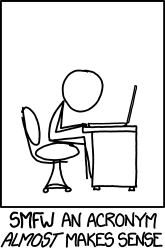
SMFW

wtfw it's like smho tbfh, imdb.
17 Dec 03:25

"History is a set of lies agreed upon" - Napoleon

by Minnesotastan
Nosimpler

Shared for #1


"The typical spices used in winter include nutmeg, cinnamon, clove and anise. These spices contain two groups of chemicals, the allylbenzenes and their isomers, the propenylbenzenes. It was suggested 40 years ago by Alexander Shulgin that these substances act as metabolic precursors of amphetamines...Humans may be exposed to amphetamines derived from these precursors in forno, the formation during baking and cooking, for example in the preparation of Lebkuchen, or Christmas gingerbread. It is possible that this may be responsible, in part, for uplifting our mood in winter. "

A set of two articles in Der Spiegel details the outrageous profits made by the human scum who act as traffickers for persons seeking asylum in Europe. "Jafir had insisted that the total fee for the trip to Italy -- €7,000 ($8,735) per person -- be paid in advance. Ahmad doesn't comment on the amount, which corresponds to at least two average annual salaries in prewar Syria... Ahmad and 126 other refugees boarded the vessel..."

The Motherboard at Vice explains that "erection vendors" in Peru are driving some amphibians toward extinction.  "Frog Juice, or Jugo de Rana, as it's referred to in Spanish, has been dubbed the Peruvian Viagra. It's a concoction that's believed to have strong medicinal powers with purported benefits including increased blood flow, lung function, and more poignantly, sexual stimulation."

The top song played in U.K. funerals is the Pythons' Always Look on the Bright Side of Life.  I posted the video six years ago; I suggest clicking that link and playing it while reading the rest of this linkdump. ("Always look on the bright side of death.  Just before you draw your terminal breath.")

An article (with video) at The Telegraph documents the changes that occur when a man adds ten non-diet Cokes a day to his diet.   In a month "the previously gym-toned Mr Prior put on two stone in weight, and saw his blood pressure rise to an unhealthy 145/96. He also reported strong cravings for more sugar, even though he was consuming 350g of sugar daily from his Coke intake alone."


So, you think you understand Putin's role in the situation in Ukraine?  What if someone said it was the West that was responsible for the escalation of hostilities?  "Europe and America did not understand the impact of these events, starting with the negotiations about Ukraine’s economic relations with the European Union and culminating in the demonstrations in Kiev. All these, and their impact, should have been the subject of a dialogue with Russia."  That's Henry Kissinger speaking.  The op-ed piece at Salon suggests "this is a non-Western nation drawing a line of resistance against the advance of Anglo-American neoliberalism across the planet."

Terminal lucidity is the subject of an interesting article in Scientific American.  The term refers to "The (re-)emergence of normal or unusually enhanced mental abilities in dull, unconscious, or mentally ill patients shortly before death, including considerable elevation of mood and spiritual affectation, or the ability to speak in a previously unusual spiritualized and elated manner."  For example " A 92-year-old woman with advanced Alzheimer’s disease... hadn’t recognized her family for years, but the day before her death, she had a pleasantly bright conversation with them, recalling everyone’s name."  At one of the links in the article a reasonable postulate is that when the brain is dying, an inhibitory hemisphere or locus dies first, releasing normal function by memory cells that had previously been suppressed.

Big Agriculture doesn't want libraries to share seeds.

The largest known block of stone carved by humans weighed an incredible 1,650 tons.  It was created in about 27 B.C. but never used for construction. (via Neatorama).

In six years your IRA balance can go from $5,000 to $196,000,000.   But only if you know how to twist the intent of Congress to your personal advantage.

"A German man committed to a high-security psychiatric hospital after being accused of fabricating a story of money-laundering activities at a major bank is to have his case reviewed after evidence has emerged proving the validity of his claims."

As you watch the American collegiate football playoffs, take a moment to ponder this tweet by the quarterback for the Ohio State Buckeyes: "Why should we have to go to class if we came here to play FOOTBALL, we ain't come to play SCHOOL classes are POINTLESS."

A gif of a German sport called headis.  Discussed at Reddit.

Vortices in swimming pools are way more complicated and interesting than you would expect (also via my old friends at Neatorama).  What you're really seeing is both ends of a "half-vortex ring."

YouTube link.

 Wikipedia is the number one "go-to" resource that saves me countless hours of searching. TYWKIWDBI supports Wikipedia; if you enjoy this blog, you should support them too.


Top image of Trapiche emeralds (Muzo, Colombia) via Minerals, Minerals, Minerals!  Time travel image via Mark's Scrapbook of Oddities and Treasures.  I am going to do a sign like that for our front yard next summer.

The way things are going, I may be able to return to regular daily blogging in about one more week.
14 Dec 08:07

Cromnificent

by noreply@blogger.com (Atrios)
Heads Citibank wins, tails Citibank wins. You lose!
14 Dec 07:44

Is It Possible to Build an Internet So Decentralized That It's Beyond the Government's Reach? BitTorrent is Going to Try.

by Jim Epstein

Exciting news from BitTorrent:

It started with a simple question. What if more of the web worked the way BitTorrent does?

Project Maelstrom begins to answer that question with our first public release of a web browser that can power a new way for web content to be published, accessed and consumed. Truly an Internet powered by people, one that lowers barriers and denies gatekeepers their grip on our future. 

The announcement is more of a manifesto than an actual explanation, but it's easy to extrapolate the basic details.

BitTorrent is a protocol that uses a peer-to-peer network for file sharing. It allows users to collect data in bits and pieces off the hard drives of others users instead of downloading files directly from a central server.

A Web browser built with BitTorrent could load pages by drawing information from other people who’ve already visited the same websites and automatically saved some of the information, instead of going straight to the source. So when users log on to Reason.com in the future, they'll be pulling different little pieces of data—text, pictures, ads—from millions (billions!) of other users instead of straight off of our server.

Eric Kinkler, CEO of BitTorrent |||

An obvious benefit is speedy browsing. With Project Malestrom, blockbuster stories at Reason.com wouldn't affect download speeds because users wouldn't all at once be trying to access the same server.

Project Malestrom could also help unclog the Internet's pipes—muting the debate over net neutrality and denying Washington justification for "fucking up the Internet"—because BitTorrent has an elegant system of prioritizing data flows called "Micro Transport Protocol."

"It's the best example we have of technology being used to solve what is perceived to be a policy problem," BitTorrent CEO Eric Klinker told Fast Company when asked about its Micro Transport Protocol. "It's only through the technology that the Internet's rules are written."

But here's what I find most exciting about Project Maelstrom: If the Web is distributed over a vast decentralized network, governments have no way to control what people do and say online. Sending in men with guns to pull a server offline is a waste of time if the data on that server is duplicated on billions of computers dispersed around the globe.

This technology could also supercharge projects like OpenBazaar, a decentralized e-commerce platform in which home computers act as nodes in a vast free trade network that nobody controls. And it seems like a first step towards the dream of a "mesh network," in which the Internet has no trunk pipes and every computer is simply linked to another computer, creating a network so dispersed that no central authority could control or destroy it.

H/T: Mr. Knuckle of NXT FreeMarket.

14 Dec 07:44

Edward Snowden Today: Maybe We Don't Need Any Spy Agencies At All

by Brian Doherty

In a Google Hangout-ed interview to a D.C. Cato Institute conference on surveillance that is going on right this second as I type, former NSA and CIA guy Edward Snowden suggests something few people with government agencies have the nerve to suggest: maybe those agencies don't need to exist at all.

Snowden suggested that our major modern spy agencies arose during the rush of World War and perhaps didn't need to survive them at all, and now "can be replaced by methods of law enforcement," even when aimed at foreigners like Vladimir Putin: "Do we really need an NSA and secret courts to wiretap Putin?" when he thinks any judge through any normal specific targeted law enforcement procedure would give permission to do so.

He seems to think the extension of normal law enforcement procedures to even the countries' overseas desires to investigate would work OK, and maybe we don't need "secret organizations that inevitably push beyond" any limits we might imagine we want to hold them to, once they are able to disappear behind a screen of "national security secrecy." 

Snowden also says he still hopes one day to be able to return to the United States, and thinks it appalling that as a matter of course Amazon does not encrypt your book searches from prying spying eyes.

05 Dec 01:05

How culture shapes spatial conceptions of time - Is your past in front of, or behind you?

by mdbownds@wisc.edu (Deric Bownds)
A interesting perspective from Fuente et al. on spatial conceptions of time. Some clips from their article:
Across many of the world’s languages, the future is “ahead” of the speaker, and the past is “behind.” In English, people can look “forward” to their retirement or look “back” on their childhood....yet some languages exhibit the opposite space-time mapping. In the Andean language Aymara, for example, metaphors place the past in front (e.g., nayra mara, tr. “front year,” means last year) and the future behind (e.g., qhipa marana, tr. “back year,” means next year)...In the research reported here, we investigated this question by exploring a surprising discovery about temporal language and thought in speakers of Darija, a Moroccan dialect of modern Arabic. Front-back time metaphors in Arabic are similar to metaphors in English and other future-in-front languages.
We compared how native Spanish and Darija speakers gesture when talking about past and future events. Whereas Spaniards showed a weak tendency to gesture according to the future-in-front mapping, Moroccans showed a strong tendency to gesture according to the past-in-front mapping—despite using future-in-front metaphors in speech. On the basis of their co-speech gestures, it appears that Darija speakers think about time like the Aymara do, even though they talk about it like speakers of English, Spanish, and other familiar future-in-front languages.
Since existing theories cannot explain the pattern of space-time mappings observed across cultures, we proposed an alternative explanation, the temporal-focus hypothesis: People’s implicit associations of “past” and “future” with “front” and “back” should depend on their temporal focus. That is, in people’s mental models, they should place in front of them whichever pole of the space-time continuum they tend to “focus on” metaphorically—locating it where they could focus on it literally with their eyes if events in time were visible objects. Consistent with the temporal-focus hypothesis, our results showed that, compared with Moroccans, Spaniards tend to be future focused, attributing more importance to social change, economic and technological progress, and modernization. By contrast, compared with Spaniards, Moroccans tend to be past focused, attributing more importance to older generations and respect for traditional practices.
05 Dec 01:04

Words for the Wise

by Blair

Word book

There's an interesting paper titled The Latent Structure of Dictionariesfloating around the Internet. Written by a Canadian-led team, it forces clearer thinking about words.

Dictionaries rest on a well-known paradox. They use words to define words. So I might look up the word justice and read "the quality of being just; fairness." Ok. So I look up fairness and find "free from favoritism, self-interest, or preference in judgment." Oh, boy. I could look up all those words too, but a black hole emerges before me. The task stretches out to infinity.

Thanks to the computer, however, the endless task can be accomplished. There are, after all, a finite number of words in the dictionary. Let's say there are D words defined in a dictionary. Not all of these words are used in defining other words. For example, the dictionary defines the word cockroach but does not (I'm guessing, here) use the word in any of D's vast text of definitions. We can symbolize these unused words by the letter C and remove all of them from D. That process leaves us with a shorter list, call it D1. (D1 = D – C)


Now we repeat the process, looking for words in D1 that are not used in defining any member of the list. That process gives us a new list, D2. We keep going through this process until we at last come to some Dn that has no C, that is to say, every word in Dn is used in Dn's definitions. We have created a list of perfect circularity, and to escape that circle we have to point outside the dictionary to the world of objects, actions, and sensations. The words in Dn are where a language is grounded in something beyond itself.

The authors call this list of grounded words, the dictionary's core. Not surprisingly core words are among the first learned, most frequently used, and oldest words in a language. Regrettably, the authors do not provide any lists of their findings. Their paper is focused more on how to graph the findings than on the contents themselves. But that shortcoming is easily curable and the math is also important for it provides a way of relating different words to the core.

The words in a dictionary should be definable by the "grounded words or, recursively, using further words that can themselves be defined by those grounded words." This observation gives us a whole new way of categorizing a word. How many recursions does it take to get from ground words to a particular word?

This process suggests what to look for in the growth of languages, starting with core words, expanding to first recursion, second and so on. Although without an appendix listing the words I can't quite grasp the reality of it.

02 Dec 16:33

Jaynes dumps on Measure Theory in Statistics

by Editors
Jaynes view was that many paradoxes resulting from the use of Measure Theory in Probability arise because it presupposes the passage to the limit and hence fumbles on any question which depends on the how the limit was approached. His … Continue reading →
02 Dec 16:18

Educational feedback loops in China and the U.S.

by Cathy O'Neil, mathbabe

Today I want to discuss a recent review in New York Review of Books, on a new book entitled Who’s Afraid of the Big Bad Dragon? Why China Has the Best (and Worst) Education System in the World by Yong Zhao (hat tip Alex). The review was written by Diane Ravitch, an outspoken critic of No Child Left Behind, Race To The Top, and the Common Core.

You should read the review, it’s well written and convincing, at least to me. I’ve been studying these issues and devoted a large chunk of my book to the feedback loops described as they’ve played out in this country. Here are the steps I see, which are largely reflected in Ravitch’s review:

  1. Politicians get outraged about a growing “achievement gap” (whereby richer or whiter students get better test scores than poorer or browner students) and/or a “lack of international competitiveness” (whereby students in countries like China get higher international standardized test scores than U.S. students).
  2. The current president decides to “get tough on education,” which translates into new technology and way more standardized tests.
  3. The underlying message is that teachers and students and possibly parents are lazy and need to be “held accountable” to improve test scores. The even deeper assumption is that test scores are the way to measure quality of learning.
  4. Once there’s lots of attention being given to test scores, lots of things start happening in response (the “feedback loop”).
  5. For example, widespread cheating by students and teachers and principals, especially when teachers and principals get paid based on test performance.
  6. Also, well-off students get more and better test prep, so the achievement gap gets wider.
  7. Even just the test scores themselves lead to segregation by class: parents who can afford it move to towns with “better schools,” measured by test scores.
  8. International competitiveness doesn’t improve. But we’ve actually never been highly ranked since we started measuring this.

What Zhao’s book adds to this is how much worse it all is in China. Especially the cheating. My favorite excerpt from the book:

Teachers guess possible [test] items, companies sell answers and wireless cheating devices to students, and students engage in all sorts of elaborate cheating. In 2013, a riot broke out because a group of students in Hubei Province were stopped from executing the cheating scheme their parents purchased to ease their college entrance exam.

Ravitch adds after that that ‘an angry mob of two thousand people smashed cars and chanted, “We want fairness. There is no fairness if you do not let us cheat.”’

To be sure, the stakes in China are way higher. Test scores are incredibly important and allow people to have certain careers. But according to Zhao, this selection process, which is quite old, has stifled creativity in the Chinese educational system (so, in other words, test scores are the wrong way to measure learning, in part because of the feedback loop). He blames the obsession with test scores on the fact that no Chinese native has received a Nobel Prize since 1949, for example: the winners of that selection process are not naturally creative.

Furthermore, Zhao claims, the Chinese educational system stifles individuality and forces conformity. It is an authoritarian tool.

In that light, I guess we should be proud that our international scores are lower than China’s; maybe it is evidence that we’re doing something right.

I know that, as a parent, I am sensitive to these issues. I want my kids to have discipline in some ways, but I don’t want them to learn to submit themselves to an arbitrary system for no good reason. I like the fact that they question why they should do things like go to bed on time, and exercise regularly, and keep their rooms cleanish, and I encourage their questions, even while I know I’m kind of ruining their chances at happily working in a giant corporation and being a conformist drone.

This parenting style of mine, which I believe is pretty widespread, seems reasonable to me because, at least in my experience, I’ve gotten further by being smart and clever than by being exactly what other people have wanted me to be. And I’m glad I live in a society that rewards quirkiness and individuality.


02 Dec 16:13

Is neuroscience really ruining the humanities?

by Yohan John

by Yohan J. John

BrainWorshipers"Neuroscience is ruining the humanities". This was the provocative title of a recent article by Arthur Krystal in The Chronicle of Higher Education. To me the question was pure clickbait [1], since I am both a neuroscientist and an avid spectator of the drama and intrigue on the other side of the Great Academic Divide [2]. Given the sensational nature of many of the claims made on behalf of the cognitive and neural sciences, I am inclined to assure people in the humanities that they have little to fear. On close inspection, the bold pronouncements of fields like neuro-psychology, neuro-economics and neuro-aesthetics — the sorts of statements that mutate into TED talks and pop science books — often turn out to be wild extrapolations from a limited (and internally inconsistent) data set.

Unlike many of my fellow scientists, I have occasionally grappled with the weighty ideas that emanate from the humanities, even coming to appreciate elements of postmodern thinking. (Postmodern — aporic? — jargon is of course a different matter entirely.) I think the tapestry that is human culture is enriched by the thoughts that emerge from humanities departments, and so I hope the people in these departments can exercise some constructive skepticism when confronted with the latest trendy factoid from neuroscience or evolutionary psychology. Some of my neuroscience-related essays here at 3QD were written with this express purpose [3, 4].

The Chronicle article begins with a 1942 quote from New York intellectual Lionel Trilling: "What gods were to the ancients at war, ideas are to us". This sets the tone for the mythic narrative that lurks beneath much of the essay, a narrative that can be crudely caricatured as follows. Once upon a time the University was a paradise of creative ferment. Ideas were warring gods, and the sparks that flew off their clashing swords kept the flames of wisdom and liberty alight. The faithful who erected intellectual temples to bear witness to these clashes were granted the boon of enlightened insight. But faith in the great ideas gradually faded, and so the golden age came to an end. The temple-complex of ideas began to decay from within, corroded by doubt. New prophets arose, who claimed that ideas were mere idols to be smashed, and that the temples were metanarrative prisons from which to escape. In this weak and bewildered state, the intellectual paradise was invaded. The worshipers were herded into a shining new temple built from the rubble of the old ones. And into this temple the invaders' idols were installed: the many-armed goddess of instrumental rationality, the one-eyed god of essentialism, the cold metallic god of materialism...

The over-the-top quality of my little academia myth might give the impression that I think it is a tissue of lies. But perhaps more nuance is called for. As with all myths, I think there are elements of truth in this narrative. To separate truth from poetic license, four questions need to be asked:

  • Was there ever an intellectual golden age?
  • Is there really a crisis in the humanities?
  • Why should we care about the humanities?
  • Who are the invading forces?

I suspect that addressing the first question will require a master's thesis worth of research, so for now I'll accept that there really was a golden age, at least for argument's sake. The second question is also a matter of debate, but there is some interesting data suggesting that the crisis in humanities may have more to do with perceived quality than with quantity [5, 6]. For this essay I will restrict my attention to the third and fourth questions.

Assessing the worth of the humanities is a daunting task for any outsider, especially one who is ostensibly one of the vandal invaders. I have never had the pleasure of a college course in literature, history or philosophy; Indian science programs made no concession to undergraduate exploration, so I only studied physics, chemistry and mathematics. But I did manage to brush up against the big ideas — Marxism, feminism, anarchism... even objectivism — from time to time. Having friends in the humanities and social sciences helped. Late night discussions of books, movies and politics helped remove the blinkers of a narrow science-only education. My college experience sowed the seeds for an autodidactic approach to Theory-with-a-capital-T. I was able to cobble together my own version of a humanistic education, wth a little help from Wikipedia, the Stanford Encylopedia of Philosophy, and helpfully illustrated books with titles like "Introducing Cultural Studies" and "Foucault for Beginners".

My training in physics meant that I was approaching the humanities from a very distant region of the academic spectrum. So I can relate to the impatience many scientists feel when confronted with the imprecise, hand-wavy style of argumentation that is common in the arts and humanities. Even more irritating is the fact that entire paragraphs of humanities writing can seem like little more than random collections of European last names: Kant! Hegel! Tolstoy! Kropotkin! Flaubert! Saussure! Camus! Barthes! Heidegger! Derrida! All this is a far cry from equations and graphs. I managed to overcome such stylistic obstacles, and gradually came to the conclusion that the humanities are valuable precisely because they are so different from the hard sciences.

Studying the history of science has convinced me of the value of epistemological pluralism and methodological anarchism. There is no unitary scientific method: different fields and sub-fields have different standards of evidence and argumentation, and these standards evolve over time. We might say that the various branches of science share Wittgensteinian "family resemblances". Attempts to foist a single definition of science onto the scientific community typically involve distorting scientific history and ignoring the diversity of scientific opinion on current research. When scientific proselytizers adopt a triumphalist, imperial tone they do a disservice to the history of science as well as to the way it is actually practiced.

Epistemological and methodological diversity are good for science, so surely they must be good for other academic pursuits, and for culture as a whole? We mustn't put all our eggs in one intellectual basket. Even the egg basket metaphor isn't quite right though. The eggs in the metaphor give the impression that we all share a single currency of value. In other words, it can lead us to assume that all ideas and cultural practices are no more than tools with which to achieve a singular goal. This goal tends to revolve around the magnitude and distribution of material wealth in the relatively near term.

Comparing the humanities and the sciences is a bit like comparing apples and oranges. It isn't clear that the goals are the same. Scientists may employ a variety of different intellectual and material techniques, but they all seem geared towards gaining power over nature: both physical control and explanatory power. Science is about what is the case, not what ought to be the case. Science describes, but does not prescribe. The humanities do involve explanation, but I think they are more closely wrapped up with the oughts. The humanities are never far from the question of how the individual and the society ought to behave. The humanities explore values, whereas many scientists and pholosophers agree that choosing what we should value is outside the strict purview of science. Science can describe how the brain and body encode and make manifest our personal value systems, and how values spread through societies, but it is not equipped with tools for deciding what to value in the first place.

Perhaps the sciences and humanities should work together, with humanities contributing to democratic debate about values, and science proposing efficient methods with which to implement society's chosen values. Debating values requires going beyond epistemological and methodological diversity. Our conceptions of personal and social good must also occupy a wide spectrum if our debates are to have substance. It seems to me that only the arts and the humanities are capable of opening up the space of possible values. Scientists may desire to know the truth about nature, but in order to apply these truths they must supplement this desire with some vision of the individual and of the society.

If writers such as Arthur Krystal are to be believed, the humanities and sciences are not engaging with each other as equals. Instead, the neuroscientists and cognitive scientists are colonialists of the mind, replacing the rich and multifaceted ideals of golden-age humanists with boring and short-sighted mechanistic narratives. How widespread is this colonization? It is difficult to come up with an objective measure of the quality of humanities discourse (and any attempt may itself be interpreted as an example of scientism), but I can testify that in my experience, the past decade or so has witnessed an explosion of popular neuroscience and evolutionary psychology in places where humanistic debate might have once been more common. Evolutionary "just-so stories" and tales of neuroscientific hard-wiring routinely crop up across the spectrum of educated discourse, from self-help books to highbrow journals. This is only a cause for worry because it seems as if otherwise healthy critical faculties become paralyzed by the slightest whiff of the scientific. Scientific ideas are not threatening because of their content, but because of the quasi-religious power society seems to have vested in scientific authority.

But is it really the cognitive and neural sciences themselves that brought about this situation? If we are looking for explanations at the level of individual belief, then we will naturally conclude that the changes in academia and public discourse are the cumulative result of many individuals losing their faith in humanistic ideas and settling for Darwinism and data instead. As my academic myth implies, the decline of the humanities may also have something to do with the ambivalence about values that has come to dominate the left-liberal world since the fall of European Communism. The humanities themselves were instrumental in creating a "skepticism of metanarratives" such as religion and modernism. Initially, this process may have been motivated by a genuine desire to question the assumptions of affluent white males, thereby creating space for the inclusion of previously marginalized voices: those of the poor, ethnic minorities, women, 'postcolonial subjects', 'subalterns', and lesbian, gay, transgendered and queer people. But in the process of 'problematizing' traditional white male value systems, it seems other babies may have been thrown out with the bathwater. Skepticism can devolve into cynicism and nihilism, sucking the life out of progressive politics and art.

What is left when, perhaps inadvertently, we have devalued beliefs in emancipation and societal transformation, whether religious or secular? What seems to remains is a form of utilitarianism that only values short-term expediency and practicality. If all we have to do is maintain bodily, mental and economic health, then we can stop debating values (by asking, for example, what constitutes good health for individuals, societies and ecologies) and instead hand over the reins of society to self-appointed experts: financiers, economists and psychologists, and now neuroscientists, tech entrepreneurs, and data analysts. The closest we have to a new ideology is nebulous techno-utopianism: the belief that clever geeks and theirs robot heirs will guide us to a hedonistic paradise, if only we don't ask them too many pointed questions. (The modern obsession with food may also be a reflection of society's shortage of grand vision: with no common values to bind people together, food can quite literally bring people to the table. Everyone has to eat something, after all.)

The parable of a secular loss of faith has a kind of surface plausibility, and also resonates with other curmudgeonly sentiments, such as the belief that pop music has regressed, or that political correctness is throttling free speech and creative thought. These beliefs may well be reflections of real phenomena. But we also need to take a wider view, and look at the prevailing historical and economic forces that contribute to the present intellectual climate. Surely a few thinkers from the golden age would approve?

The major force changing the way universities are run, and the way the humanities are funded, appears to be economic expediency. Universities are now major corporations — approaching the scale of private city-states — that treat students as paying customers, rather than as impressionable young people in need of edification. The laws of supply and demand now dominate thinking in academia, rather than any desire to create enlightened citizens of the nation and the world. It seems as if many university administrators think a professor is only worth hiring if she brings in vast sums of research grant money, of which the university keeps a large percentage [7]. Given the economic constraints, humanities professors cannot carry on as before. The golden age thinkers didn't bequeath them any scientific-sounding metrics with which to demonstrate success and failure. In any case, thinkers in the humanities are not necessarily seeking solutions to practical problems. Their ideas can't be monetized by start-ups, or turned into wonder-drugs by pharmaceutical companies. Their ideas merely aim to change the way people think about themselves and the world — and sadly the economic and political powers-that-be don't have much use for this sort of change. In such an atmosphere it is hardly surprising that a few adventurous academics are attempting to promote their careers by sticking people into scanners to see which brain areas 'light up' when they read Homer's Odyssey.

As far as I can tell, the humanities were never about building handy tools, but about carrying on a conversation — one that may have started over two thousands years ago with the ancient Greeks, and is gradually incorporating voices from all over the world [8]. This conversation is like a great river, and its tributaries and distributaries are the various sub-fields of the humanities and sciences. To silence the great conversation would be no less tragic that redirecting the flow of a river, destroying eco-systems and disrupting unique ways of life. Sadly, the wielders of economic power seem to care even less for the environment than for the university system, so this analogy is unlikely to change the situation.

It's worth pointing out that the very same economic forces that see no use for the humanities also have a major impact on science. The short-term focus on usefulness and profitability inevitably lead funding agencies to direct money away from basic science and into applied science. Scientists get around this issue by promising specific medical and technological breakthroughs that will be made possible as a result of indulging their curiosity. Economic 'rationality' can also end up pushing- scientists into catch-22 situations that affect the quality of their research. Scientific grant proposals must be novel. If there is any inkling that a part of the research has aready been performed, then the grant is likely to be rejected, replication be damned. Why waste money on what has already been demonstrated? At the same time, the research must also be feasible given everything else that is known about the topic. So research can't be too imaginative and 'blue sky' either. Why waste money on some mad scientist's implausible scheme? These constrictions incentivize a kind of science that is simultaneously conservative and preoccupied with demonstrating superficial novelty. As David Graeber points out in his essay "Of Flying Cars and the Declining Rate of Profit", the short-sightedness of market-driven thinking may actually have hampered economic growth and technological innovation.

Once we take a wider view, the story of neuroscience ruining the humanities seems to have a few plot holes. The forces that have lined up to weaken the humanities (and basic science) are much older than the recent burst of neuromania. Admittedly, some conceits from within the humanities may also have contributed to the intellectual vacuum that is apparently being filled by neuroscience. But they are nothing in comparison with the wider political and economic forces at work. We can now modify our academic myth somewhat. The temple-complex of big ideas does seem to be under attack, but not from the cognitive and neural sciences. The gaudy idols of scientism distract us from another idol that is being installed in the sanctum sanctorum: the new king of the pantheon, the pig-headed, invisible-handed god of market fundamentalism [9].

The comforting certainties of neuroscience and evolutionary psychology may simply serve as a lubricant, making it easier for the forces of economic expediency to push through far-rearching 'reforms' to the Western university. Scientists simply don't have the power to effect these changes on their own. The university — one of the longest-lasting institutions in the history of the world — has traditionally served as a haven for thinkers not beholden to power or profit. In the post-Cold War globalized world, the increasingly unregulated forces of the market seem to brook no opposition, so perhaps we shouldn't be surprised that the university too is subject to 'disruptive innovation'. Blaming neuroscience for displacing the big ideas in the humanities only points to one symptom of a much deeper malaise. Perhaps people in the humanities and the sciences will eventually discern that there are at least a few values they share, and will join forces before it is too late.


[This essay grew out of an answer I wrote to a question on Quora.]

_____

Notes

[1] When I first read Krystal's article, I'm pretty sure the title was "Neuroscience is Ruining the Humanities". The title has since been changed to "The Shrinking World of Ideas". The url still contains part of the original title though. One can't help but wonder if there really was an element of clickbait in the initial title. Perhaps some enterprising editor was attempting to tap into the neuro-zeitgeist?

[2] I first became aware of the academic divide while at Delhi University. The college I attended was divided into 'artsies' and 'sciencies'. The divide was quite objective: artsies received Bachelor of Arts degrees in subjects like economics, English, history, or philosophy; sciencies earned Bachelor of Science degrees in physics, chemistry, or computer science. (Interestingly, you do either a B.A. or a B.Sc. in mathematics.) But the differences were more than academic: they were also cultural and class-based. According to the stereotype, artsies were cool, fashionable, intellectual, and seemed to have a great deal of free time to indulge in extra-curricular activities. Sciencies were shy, awkward, unsociable, and were bogged down in laboratories during the crucial afternoons, when the artsies were engaging their creative sides and/or holding forth in the college cafe. I was a sciencie with mostly arstie friends — a member of both tribes, and therefore neither.

[3] The Chemical Self and the Social Self — 3QD

[4] The Mind Matters — 3QD

[5] Arthur Krystal's article definitely gives the impression that it is the quality of humanities discourse that has suffered, rather than the quantity of people in the humanities. In his view, mechanistic thinking amounts to a narrowing of scope. A related point — that history now suffers from short-term thinking — has been made by David Armitage and Jo Guldi in an article entitled "Bonfire of the humanities". People in the humanities do seem to enjoy evoking the doom-and-gloom of Old Testament prophets.

[6] A blog post at the Chronicle by Benjamin Schmidt entitled "A Crisis in the Humanities?" presents the data on humanities enrollments in the United States. Schmidt's graphs vividly demonstrate that in the 1960s humanities degrees exploded as a percentage of all degrees, and then declined just as fast, more or less returning to 1950s levels. But the 'percentage of all degrees' is an oddly inward-looking measure, focused only on university market-share: it doesn't take into the distribution of humanities degrees in the general population. If instead one looks at humanities degrees as a percentage of the college-age population, the current proportion of humanities degree holders is higher than in the 1950s, and has held more or less constant since the 1990s. The numbers suggest that if there really is a crisis in the humanities it has little to do with enrollment.

[7] A recent investigation by the scientific journal Nature examines who is benefiting the most from US government research funding. Universities retain a large percentage — between 20% and 85% — of grant money awarded to researchers. Even larger percentages may be retained by hospitals and non-profit research institutes. These sums go towards "overheads", administrative support and other forms of rent charged by the university. The Nature investigation also covers the debate about whether these funds really are necessary for universities. Some observers claim that the system encourages wasteful spending on flashy new buildings and overgrown administrative teams. (David Graeber has made related points in his essay on "bullshit jobs", and his piece on the impact of neoliberal ideology on scientific and technological innovation. ) University administrators counter that the funds actually pay for essential facilities and administrative services.

[8] The process of inclusion is still far from complete, but hopefully the daunting litanies of last names will soon start to include a few non-European names. Perhaps people should just engage with the ideas themselves and give credit in the footnotes. I'm a big fan of footnotes.

[9] I had to resist the urge to throw in a "Prophet of Profit".

30 Nov 19:48

Materials: Diodes printed in three dimensions

Materials: Diodes printed in three dimensions

Nature 515, 7528 (2014). doi:10.1038/515468b

Researchers have created a light-emitting diode (LED) by three-dimensional (3D) printing of five different materials — expanding the number and type of material that can be printed in this way.This technique involves depositing materials layer by layer until a 3D object is formed. Michael

30 Nov 19:38

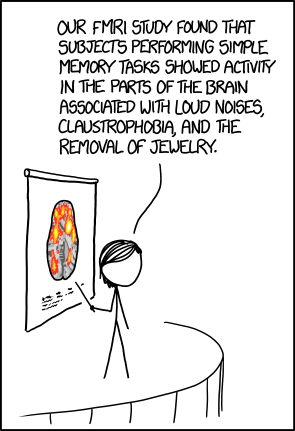
fMRI

They also showed activation in the parts of the brain associated with exposure to dubious study methodology, concern about unremoved piercings, and exasperation with fMRI techs who won't stop talking about Warped Tour.
25 Nov 14:38

Linguistic Mapping Reveals How Word Meanings Sometimes Change Overnight

Data mining the way we use words is revealing the linguistic earthquakes that constantly change our language.


In October 2012, Hurricane Sandy approached the eastern coast of the United States. At the same time, the English language was undergoing a small earthquake of its own. Just months before, the word “sandy” was an adjective meaning “covered in or consisting mostly of sand” or “having light yellowish brown color.” Almost overnight, this word gained an additional meaning as a proper noun for one of the costliest storms in U.S. history.

21 Nov 21:35

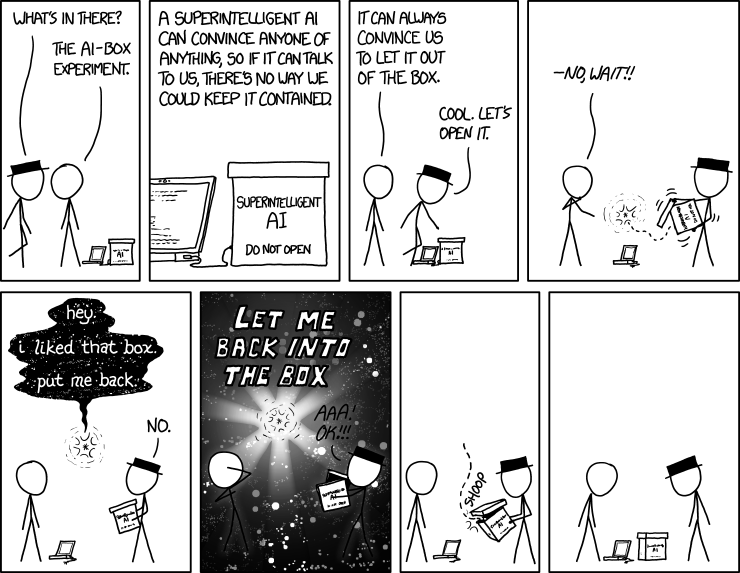
AI-Box Experiment

I'm working to bring about a superintelligent AI that will eternally torment everyone who failed to make fun of the Roko's Basilisk people.
20 Nov 20:19

Alexander Grothendieck 1928-2014

by woit

I just heard that Alexander Grothendieck passed away today, at the age of 86, in Saint-Girons. For a French news story, see here.

Grothendieck’s story was one of the great romantic stories of modern mathematics, and many would consider him the greatest mathematician of the twentieth century. For some blog entries about him here, see for example this and this. I’ll add other links as I see them or think of them.

Update: For some blog entries about Grothendieck’s recent life, you could start here.

One of the best places to learn about Grothendieck is from his friend Pierre Cartier, in an article that can be found here, among other places.

Le Monde now has an obituary.

Steve Landsburg has a blog post.

Update: The news about Grothendieck came out in the French press a day ago, but at this point the only things I’ve seen in the English-language press are an AP wire story, and this at the Independent. Come on science journalists, if any story about mathematics and mathematicians is worth writing about, this one is.

Update: There are now obituaries at the New York Times and the Telegraph. The IHES has a page at their website.

10 Nov 16:33

Grumble, Mumble Rumble

by Blair

1984 Cover

I ended my last post with a grumble about the impoverished view of humanity that I often encounter when I read linguistic musings. Most of the articlesI report on do not seem to grasp how much had to change for a lineage of apes to become a lineage of, say, Kalahari hunter-gatherers that can sit around a fire and tell each other about their emotions.

We had to go through an evolutionary process that involved a lot more than  developing a recursive function. We are at least as different from apes as ants are from grasshoppers, and any theory of language evolution ought  to acknowledge that language requires unusual kind of animal.

Yet students of language origins rarely seem to even hint at how radically communal language is. The whole generative tradition with its emphasis on i-language (for internal language) seems madly solipsistic, and that ignorance of community's possibilities is probably what makes the field so barren of appeal to outsiders. It does not address anything serious about who we are or what our culture is.

I still think that one of the most important insights I have gleaned from writing this blog came in one of my first posts, a review of Nicholas Ostler's book, Empires of the Word which reports that a "language does not grow by the assertion of power, but through the creation of a larger community" [p. 556]. The great historical examples of the growth of languages make this same point. The rise of creoles and the newborn sign languages are part of the birth of new communities. National language histories repeat the lesson. Time and again they tell of areas with many separate tongues becoming united politically, culturally, and linguistically. Is there any evidence, any reason to believe, that language ever grew differently? From the beginning, the rule seems to have been: create a community and language will appear.

I'm talking about community rather than cooperation because, while cooperation is important, it is not the decisive factor. These days the woods are full of organizations whose members cooperate, but they aren't communities. People in communities are valued for more than the sum of their practical contribution to the group. I may go to work at a place where I am a readily replaceable cooperator, but at the end of the work day I can go among people who take me as I am and wish me well despite my faults. If I disappeared, I would be mourned, not just replaced. The workplace I'm describing grows by power, while the afterwork community grows by love in all its various shades and shapes. In the workplace I could get by with a pidgin; the afterwork demands a full-blown language.

Recognition of language as communal is generally absent from learned discussions of language origins and language evolution. Yet I find it is a commonplace when I turn to reading history, personal essays, novels, dramas, poems, biographies, memoirs and even a decent amount of criticism. Those authors take community for granted, as something fundamental to the human condition.

To use a well-known example, look at George Orwell's novel 1984. That story is about a world that seeks to rest on power alone. The promise Big Brother offers society is of the boot in the face. And what is one of the system's most ambitious tools for destroying community? Language, or more specifically a drastically impoverished language called Newspeak. The idea behind it was that if you force a shriveled language on people they will only think shriveled thoughts and lead shriveled lives.

I sometimes read critics who scorn Orwell, arguing that language doesn't really control thoughts. But readers should not mistake the beliefs of Big Brother for those of Orwell. The story of 1984 is precisely the story of a couple that threatens the operational view of society by finding love rather than power. In the end of 1984, power conquers love, but part of the story is that there will be an endless string of people finding love, people for power to place boot to face and squash.

When Orwell wrote about Newspeak, there were no examples around him. The closest things were the style guides used by various propaganda ministries around the world. But within a few years of Orwell's death, functioning Newspeaks began to appear. They had names like FORTRAN, COBAL, BASIC, PASCAL, C++ and so on. The wonder of these computer languages is that they are splended tools, enabling users and programmers to get machines to do as directed. There is no danger that a computer will go beyond the language of its programmers and start demanding love, respect or any of the other elements of community. They not only don't demand it, they don't know about it and do not seek it.

So there is one clear difference between computer use of language and human languages. Only humans introduce radically new topics into their discourse. Keep the word love out of FORTRAN and your computer will not coin it.

At one point in 1984, Orwell discusses the impossibility of translating into Newspeak Jefferson's, "We hold these truths to be self-evident, that all men are created equal, that they are endowed by their Creator with certain unalienable rights, that among these are Life, Liberty and the pursuit of happiness." You cannot translate it into FORTRAN either.

So there stands another difference between computer and human language. Not all human language is used for controlling the actions and outputs of themselves or others.

The reason for these differences should be immediately obvious. Yes, languages use symbols and computers are symbol processors, but computers do not ground their symbols in anything beyond other symbols. For human language to work, it must rest on more than symbols; so language scholars are bound to miss out on the big picture when they keep their eyes only on the symbols and the rules that organize them.

Language is grounded on an extra factor, one that needs a community of users for it to survive, and language in turn lets the community of users survive. Recognizing that mutual independence of language and language users was what got me started wondering seriously about language in the first place. It is why to this day I still prefer reading Orwell and Ostler to Chomsky and Pinker.

09 Nov 00:43

America functions as an oligarchy, not as a democracy

by Minnesotastan
Who really matters in our democracy — the general public, or wealthy elites? That's the topic of a new study by political scientists Martin Gilens of Princeton and Benjamin Page of Northwestern. The study's been getting lots of attention, because the authors conclude, basically, that the US is a corrupt oligarchy where ordinary voters barely matter...
The Vox link discusses these conclusions in some detail.  This graph shows the probability of a policy being adopted by the U.S. vs the percentage of the general population that agrees with the policy:

And this one shows the approval probability vs the preferences of the economic elite and special interest groups:

The study is here.  This from their Abstract:
Multivariate analysis indicates that economic elites and organized groups representing business interests have substantial independent impacts on U.S. government policy, while average citizens and mass-based interest groups have little or no independent influence. The results provide substantial support for theories of Economic-Elite Domination and for theories of Biased Pluralism, but not for theories of Majoritarian Electoral Democracy or Majoritarian Pluralism.
04 Nov 19:31

Probably the oldest mask in the world

by Minnesotastan

From the collections of the Musée "Bible et Terre Sainte" -
This stone mask from the pre-ceramic neolithic period dates to 7000 BCE and is probably the oldest mask in the world.
Happy Halloween to all.

Via Unexplained Spoopies.
29 Oct 23:05

Core Econ: a free economics textbook

by Cathy O'Neil, mathbabe

Today I want to tell you guys about core-econ.org, a free (although you do have to register) textbook my buddy Suresh Naidu is using this semester to teach out of and is also contributing to, along with a bunch of other economists.

sureshgetty

This was obviously not taken in New York.

It’s super cool, and I wish a class like that had been available when I was an undergrad. In fact I took an economics course at UC Berkeley and it was a bad experience – I couldn’t figure out why anyone would think that people behaved according to arbitrary mathematical rules. There was no discussion of whether the assumptions were valid, no data to back it up. I decided that anybody who kept going had to be either religious or willing to say anything for money.

Not much has changed, and that means that Econ 101 is a terrible gateway for the subject, letting in people who are mostly kind of weird. This is a shame because, later on in graduate level economics, there really is no reason to use toy models of society without argument and without data; the sky’s the limit when you get through the bullshit at the beginning. The goal of the Core Econ project is to give students a taste for the good stuff early; the subtitle on the webpage is teaching economics as if the last three decades happened.

What does that mean? Let’s take a look at the first few chapters of the curriculum (the full list is here):

  1. The capitalist revolution
  2. Innovation and the transition from stagnation to rapid growth
  3. Scarcity, work and progress
  4. Strategy, altruism and cooperation
  5. Property, contract and power
  6. The firm and its employees
  7. The firm and its customers

Once you register, you can download a given chapter in pdf form. So I did that for Chapter 6, The firm and its employees, and here’s a screenshot of the first page:

Still dry but at least real.

Still dry but at least real.

The chapter immediately dives into a discussion of Apple and Foxconn. Interesting! Topical! Like, it might actually help you understand the newspaper!! Can you imagine that?

The project is still in beta version, so give it some time to smooth out the rough edges, but I’m pretty excited about it already. It has super high production values and will squarely compete with the standard textbooks and curriculums, which is a good thing, both because it’s good stuff and because it’s free.


29 Oct 22:54

The world asks the U.S. to end its embargo of Cuba

by Minnesotastan
(Reuters) - The U.N. General Assembly on Tuesday voted overwhelmingly for the 23rd time to condemn the decades-long U.S. economic embargo against Cuba, with many nations praising the island state for its response in fighting the deadly Ebola virus that is ravaging West Africa. 
In the 193-nation assembly, 188 countries voted for the nonbinding resolution, titled "Necessity of Ending the Economic, Commercial and Financial Embargo imposed by the United States of America against Cuba."

As in previous years, the only countries that voted against the declaration were the United States and an ally, Israel...

While the General Assembly's vote is nonbinding and symbolic, it serves to highlight U.S. isolation regarding Havana. It is one of very few issues where all of Washington's Western allies part ways with the United States...

Washington broke diplomatic ties and imposed a comprehensive trade embargo on the Communist-run Caribbean island more than half a century ago during the Cold War. Its policy today appears to be influenced by domestic politics in Florida, where Cuban exiles have opposed any conciliation with former President Fidel Castro or current President Raul Castro, who took over for his brother in 2008. 

This ludicrous policy has been maintained now for about 50 years.  Presumably by now the Kennedy family has smoked all of the 1,200 Cuban cigars JFK imported right before he imposed the ban on commerce.
29 Oct 22:22

Synopsis: Electrons Reveal Molecular Geometries

The energy lost by electrons passing through a material can reveal the symmetry of individual molecules inside the sample.

Published Wed Oct 29, 2014
28 Oct 21:58

Dimensionality reduction for large-scale neural recordings

by John P Cunningham
Nosimpler

Can't see beyond the paywall, but may come in handy in the Kaggle thing.

Nature Neuroscience 17, 1500 (2014). doi:10.1038/nn.3776

Authors: John P Cunningham & Byron M Yu

25 Oct 19:15

Programmable Mechanical Metamaterials

by Bastiaan Florijn, Corentin Coulais, and Martin van Hecke
Nosimpler

Kinda like a mechanical transistor maybe?

Author(s): Bastiaan Florijn, Corentin Coulais, and Martin van Hecke

Selected for a Focus in Physics Squeezing a holey rubber slab changes its stiffness over a wide range in the direction perpendicular to the squeeze.

[Phys. Rev. Lett. 113, 175503] Published Fri Oct 24, 2014

24 Oct 14:57

More U.S. Citizens Have Been Killed by a Drone Strike Than by Ebola

by Jason Keisling

It's an epidemic—killing hundreds of thousands of people and leaving many others hospitalized. It's present in over 148 countries and has expanded out of control. I'm talking not about Ebola, but the U.S. government. The very entity that many turn to for protection has been responsible for wars, police shootings, withholding of drugs that could save lives, and many other acts of violence and negligence that have resulted in far more deaths than Ebola.

More U.S. citizens (4) have died from Obama's drone strikes than from Ebola (1). Bush's wars in Iraq and Afghanistan took more American lives (6,802, just counting troops) than all Ebola deaths (4,555) worldwide. The threat presented by Ebola should in no way be downplayed, but it is time Americans focus on the dangers of the U.S. foreign policy.

Ebola vs Obama Infographic

Note: This post has been edited to clarify language about the relative dangers posed by Ebola and the U.S. government.

23 Oct 21:37

Neuroscience: How curiosity enhances learning

Nosimpler

Despite my hatred of fMRI (it is fMRI, right? I can't read past the second sentence), I like this approach way more than conditioning-based approaches.

Neuroscience: How curiosity enhances learning

Nature 514, 7521 (2014). doi:10.1038/514143b

Curiosity boosts people's ability to learn and retain new information, thanks to key reward and memory centres in the brain.Matthias Gruber and his colleagues at the University of California, Davis asked volunteers to rate their level of curiosity for a series of trivia questions,

23 Oct 20:55

[Research Article] Lattice light-sheet microscopy: Imaging molecules to embryos at high spatiotemporal resolution

by Bi-Chang Chen
A new microscope allows three-dimensional imaging of living systems at very high resolution in real time. Authors: Bi-Chang Chen, Wesley R. Legant, Kai Wang, Lin Shao, Daniel E. Milkie, Michael W. Davidson, Chris Janetopoulos, Xufeng S. Wu, John A. Hammer, Zhe Liu, Brian P. English, Yuko Mimori-Kiyosue, Daniel P. Romero, Alex T. Ritter, Jennifer Lippincott-Schwartz, Lillian Fritz-Laylin, R. Dyche Mullins, Diana M. Mitchell, Joshua N. Bembenek, Anne-Cecile Reymann, Ralph Böhme, Stephan W. Grill, Jennifer T. Wang, Geraldine Seydoux, U. Serdar Tulu, Daniel P. Kiehart, Eric Betzig
23 Oct 20:18

Canada, At War For 13 Years, Shocked That ‘A Terrorist’ Attacked Its Soldiers

by Glenn Greenwald

(updated below – Update II)

TORONTO – In Quebec on Monday, two Canadian soldiers were hit by a car driven by Martin Couture-Rouleau, a 25-year-old Canadian who, as The Globe and Mail reported, “converted to Islam recently and called himself Ahmad Rouleau.” One of the soldiers died, as did Couture-Rouleau when he was shot by police upon apprehension after allegedly brandishing a large knife. Police speculated that the incident was deliberate, alleging the driver waited for two hours before hitting the soldiers, one of whom was wearing a uniform. The incident took place in the parking lot of a shopping mall 30 miles southeast of Montreal, “a few kilometres from the Collège militaire royal de Saint-Jean, the military academy operated by the Department of National Defence.”

The right-wing Canadian government wasted no time in seizing on the incident to promote its fear-mongering agenda over terrorism, which includes pending legislation to vest its intelligence agency, CSIS, with more spying and secrecy powers in the name of fighting ISIS. A government spokesperson asserted “clear indications” that the driver “had become radicalized.”

In a “clearly prearranged exchange,” a conservative MP, during parliamentary question time, asked Prime Minister Stephen Harper (pictured above) whether this was considered a “terrorist attack”; in reply, the prime minister gravely opined that the incident was “obviously extremely troubling.” Canada’s Public Safety Minister Steven Blaney pronounced the incident “clearly linked to terrorist ideology,” while newspapers predictably followed suit, calling it a “suspected terrorist attack” and “homegrown terrorism.” CSIS spokesperson Tahera Mufti said “the event was the violent expression of an extremist ideology promoted by terrorist groups with global followings” and added: “That something like this would happen in a peaceable Canadian community like Saint-Jean-sur-Richelieu shows the long reach of these ideologies.”

In sum, the national mood and discourse in Canada is virtually identical to what prevails in every Western country whenever an incident like this happens: shock and bewilderment that someone would want to bring violence to such a good and innocent country (“a peaceable Canadian community like Saint-Jean-sur-Richelieu”), followed by claims that the incident shows how primitive and savage is the “terrorist ideology” of extremist Muslims, followed by rage and demand for still more actions of militarism and freedom-deprivation. There are two points worth making about this:

First, Canada has spent the last 13 years proclaiming itself a nation at war. It actively participated in the invasion and occupation of Afghanistan and was an enthusiastic partner in some of the most extremist War on Terror abuses perpetrated by the U.S. Earlier this month, the Prime Minister revealed, with the support of a large majority of Canadians, that “Canada is poised to go to war in Iraq, as [he] announced plans in Parliament [] to send CF-18 fighter jets for up to six months to battle Islamic extremists.” Just yesterday, Canadian Defence Minister Rob Nicholson flamboyantly appeared at the airfield in Alberta from which the fighter jets left for Iraq and stood tall as he issued the standard Churchillian war rhetoric about the noble fight against evil.

It is always stunning when a country that has brought violence and military force to numerous countries acts shocked and bewildered when someone brings a tiny fraction of that violence back to that country. Regardless of one’s views on the justifiability of Canada’s lengthy military actions, it’s not the slightest bit surprising or difficult to understand why people who identify with those on the other end of Canadian bombs and bullets would decide to attack the military responsible for that violence.

That’s the nature of war. A country doesn’t get to run around for years wallowing in war glory, invading, rendering and bombing others, without the risk of having violence brought back to it. Rather than being baffling or shocking, that reaction is completely natural and predictable. The only surprising thing about any of it is that it doesn’t happen more often.

The issue here is not justification (very few people would view attacks on soldiers in a shopping mall parking lot to be justified). The issue is causation. Every time one of these attacks occurs — from 9/11 on down — Western governments pretend that it was just some sort of unprovoked, utterly “senseless” act of violence caused by primitive, irrational, savage religious extremism inexplicably aimed at a country innocently minding its own business. They even invent fairy tales to feed to the population to explain why it happens: they hate us for our freedoms.

Those fairy tales are pure deceit. Except in the rarest of cases, the violence has clearly identifiable and easy-to-understand causes: namely, anger over the violence that the country’s government has spent years directing at others. The statements of those accused by the west of terrorism, and even the Pentagon’s own commissioned research, have made conclusively clear what motivates these acts: namely, anger over the violence, abuse and interference by Western countries in that part of the world, with the world’s Muslims overwhelmingly the targets and victims. The very policies of militarism and civil liberties erosions justified in the name of stopping terrorism are actually what fuels terrorism and ensures its endless continuation.

If you want to be a country that spends more than a decade proclaiming itself at war and bringing violence to others, then one should expect that violence will sometimes be directed at you as well. Far from being the by-product of primitive and inscrutable religions, that behavior is the natural reaction of human beings targeted with violence. Anyone who doubts that should review the 13-year orgy of violence the U.S. has unleashed on the world since the 9/11 attack, as well as the decades of violence and interference from the U.S. in that region prior to that.

Second, in what conceivable sense can this incident be called a “terrorist” attack? As I have written many times over the last several years, and as some of the best scholarship proves, “terrorism” is a word utterly devoid of objective or consistent meaning. It is little more than a totally malleable, propagandistic fear-mongering term used by Western governments (and non-Western ones) to justify whatever actions they undertake. As Professor Tomis Kapitan wrote in a brilliant essay in The New York Times on Monday: “Part of the success of this rhetoric traces to the fact that there is no consensus about the meaning of ‘terrorism.’”

But to the extent the term has any common understanding, it includes the deliberate (or wholly reckless) targeting of civilians with violence for political ends. But in this case in Canada, it wasn’t civilians who were targeted. If one believes the government’s accounts of the incident, the driver waited two hours until he saw a soldier in uniform. In other words, he seems to have deliberately avoided attacking civilians, and targeted a soldier instead – a member of a military that is currently fighting a war.

Again, the point isn’t justifiability. There is a compelling argument to make that undeployed soldiers engaged in normal civilian activities at home are not valid targets under the laws of war (although the U.S. and its closest allies use extremely broad and permissive standards for what constitutes legitimate military targets when it comes to their own violence). The point is that targeting soldiers who are part of a military fighting an active war is completely inconsistent with the common usage of the word “terrorism,” and yet it is reflexively applied by government officials and media outlets to this incident in Canada (and others like it in the UK and the US).

That’s because the most common functional definition of “terrorism” in Western discourse is quite clear. At this point, it means little more than: “violence directed at Westerners by Muslims” (when not used to mean “violence by Muslims,” it usually just means: violence the state dislikes). The term “terrorism” has become nothing more than a rhetorical weapon for legitimizing all violence by Western countries, and delegitimizing all violence against them, even when the violence called “terrorism” is clearly intended as retaliation for Western violence.

This is about far more than semantics. It is central to how the west propagandizes its citizenries; the manipulative use of the “terrorism” term lies at heart of that. As Professor Kapitan wrote yesterday in The New York Times:

Even when a definition is agreed upon, the rhetoric of “terror” is applied both selectively and inconsistently. In the mainstream American media, the “terrorist” label is usually reserved for those opposed to the policies of the U.S. and its allies. By contrast, some acts of violence that constitute terrorism under most definitions are not identified as such — for instance, the massacre of over 2000 Palestinian civilians in the Beirut refugee camps in 1982 or the killings of more than 3000 civilians in Nicaragua by “contra” rebels during the 1980s, or the genocide that took the lives of at least a half million Rwandans in 1994. At the opposite end of the spectrum, some actions that do not qualify as terrorism are labeled as such — that would include attacks by Hamas, Hezbollah or ISIS, for instance, against uniformed soldiers on duty.

Historically, the rhetoric of terror has been used by those in power not only to sway public opinion, but to direct attention away from their own acts of terror.

At this point, “terrorism” is the term that means nothing, but justifies everything. It is long past time that media outlets begin skeptically questioning its usage by political officials rather than mindlessly parroting it.

Photo: AP/The Canadian Press, Adrian Wyld

UPDATE: Multiple conservative commentators have claimed that this article and my subsequent discussion of it are about this morning’s shooting of a solider in Ottawa. Aside from the fact that what I wrote is expressly about a completely different incident – one that took place in Quebec on Monday – this article and my comments were published before this morning’s shooting spree was reported. So unless someone believes I possess powers of clairvoyance, the claim that I was commenting on the Ottawa shooting – about which virtually nothing is known, including the identity and motive of the shooter(s) – is obviously false.

Then there’s also the extremely predictable accusation that I was justifying the attack on the soldiers. I know from prior experience in discussing these questions that no matter how clear you make it that you are writing about causation and not justification, many will still distort what you write to claim you’ve justified the attack. That’s true even if one makes as clear as the English language permits that you’re not writing about justification: “The issue here is not justification (very few people would view attacks on soldiers in a shopping mall parking lot to be justified). The issue is causation.” If there’s a way to make that any clearer, please let me know.

One more time: the difference between “causation” and “justification” is so obvious that it should require no explanation. If one observes that someone who smokes four packs of cigarettes a day can expect to develop emphysema, that’s an observation about causation, not a celebration of the person’s illness. Only a willful desire to distort, or some deep confusion, can account for a failure to process this most basic point.

UPDATE II: In that brilliant essay I referenced above, published just three days ago in The New York Times, Professor Tomis Kapitan made this point:

Obviously, to point out the causes and objectives of particular terrorist actions is to imply nothing about their legitimacy — that is an independent matter….

That point is so simple and, as he said, “obvious” that I have a hard time understanding what could account for some commentators conflating the two other than a willful desire to mislead.

The post Canada, At War For 13 Years, Shocked That ‘A Terrorist’ Attacked Its Soldiers appeared first on The Intercept.