Shared posts

21 Oct 15:32

Cosmological networks. (arXiv:1310.6272v2 [gr-qc] UPDATED)

by Marian Boguna, Maksim Kitsak, Dmitri Krioukov

Networks often represent systems that do not have a long history of studies in traditional fields of physics, albeit there are some notable exceptions such as energy landscapes and quantum gravity. Here we consider networks that naturally arise in cosmology. Nodes in these networks are stationary observers uniformly distributed in an expanding open FLRW universe with any scale factor, and two observers are connected if one can causally influence the other. We show that these networks are growing Lorentz-invariant graphs with power-law distributions of node degrees. These networks encode maximum information about the observable universe available to a given observer.

20 Oct 18:45

Greece to Test Minimum Guaranteed Income Program

by Elizabeth Nolan Brown

Greek Labour Minister Yiannis Vroutsis announced yesterday that the country will be testing a "minimum guaranteed income" (MGI) measure for Greek citizens living in poverty. The country's current social welfare system is inefficient and incomplete, said Vroutsis, but the MGI "is the pillar of the social solidarity of tomorrow."

The pilot program will be implemented in 13 municipalities for six months. Participating individuals will receive 200 euros per month, plus an additional 100 euros per adult in the household and 50 euros per child.

Some version of a minimum guaranteed income plan—also called a basic income guarantee (BIG) or negative income tax—has been gaining tepid but bipartisan support in America. The proposal has managed to capture the imaginations of conservatives, progressives, and libertarians alike, although each tend to lend support for different reasons and envision a different finished product. The appeal from a conservative or libertarian perspective is that a basic income guarantee program could replace our current bloated, labyrynthian, work-disincentivizing welfare scheme (including everything from food stamps to unemployment benefits to Social Security) with one program that costs less, runs more smoothly, and empowers individuals to use benefits how they, not federal officials, see fit. 

This is not the income program that Greece is implementing. For one thing, Greece's program is designed solely for people with little to no income; the mimimum income plans en vogue here tend to involve a no-strings attached cash benefit for all Americans, regardless of income. And while proposals here—at least from the libertarian and conservative camps—hinge on eliminating other, function-specific social welfare programs, Greek leaders seem to view the MGI as an additional pillar of the country's welfare scheme. Greek Vice-President Evangelos Venizelos stressed that the MGI was "the minimum, it is not enough." 

20 Oct 15:08

American Forces Found 5,000 Chemical Weapons In Iraq—Just Not the Ones the Bush Administration Claimed Were There

by Peter Suderman

There were thousands of chemical weapons in Iraq, some of which harmed Americans, according to a lengthy new investigative report in The New York Times—and the public, members of Congress, and even members of the military were misled about their existence. Nor were they the chemical weapons that the Bush administration said the U.S. was going after when it attempted to justify the military operation that became the Iraq War. 

According to the report, American troops and Iraqi allies found roughly 5,000 chemical weapons in various forms, including a single depository of about 2,400 warheads, between 2004 and 2011. In six separate instances, American troops or allies were wounded by the weapons. The New York Times managed to get in touch with 17 American troops, as well as seven Iraqi cops, and talk to them about the experience. The military says there were at least a few more who were injured by the hushed-up chemical arms, but won't say exactly how many. 

These were not products of the active, ongoing chemical weapons program that the Bush administration claimed existed and had to be stopped when it first made the case for war in Iraq. All the weapons were all more than a decade old by the time they were discovered. Most were made in the 1980s, and every single one of them had been created before 1991. 

The Times says flatly that "the discoveries of these chemical weapons did not support the government’s invasion rationale."

Their existence was a closely kept secret, even within the government. As the Times notes:

Since the outset of the war, the scale of the United States’ encounters with chemical weapons in Iraq was neither publicly shared nor widely circulated within the military. These encounters carry worrisome implications now that the Islamic State, a Qaeda splinter group, controls much of the territory where the weapons were found.

The American government withheld word about its discoveries even from troops it sent into harm’s way and from military doctors. The government’s secrecy, victims and participants said, prevented troops in some of the war’s most dangerous jobs from receiving proper medical care and official recognition of their wounds.

Soldiers who were aware of the discoveries were ordered to keep quiet about them, and even to mislead Congress about what they knew. "'Nothing of significance’ is what I was ordered to say," retired Army Major Jarrod Lampier tells the Times. Lampier was on site when the biggest chemical weapons dump, containing 2,400 warheads, was found.  

The secrecy compounded the dangers posed by the weapons, creating a cascade of failures:  

In case after case, participants said, analysis of these warheads and shells reaffirmed intelligence failures. First, the American government did not find what it had been looking for at the war’s outset, then it failed to prepare its troops and medical corps for the aged weapons it did find.

Why didn't the government reveal their existence? Possibly because they were embarassed that they were wrong, or perhaps because in some cases the U.S. and some of its Western allies had played a role in designing or creating the weapons in the first place:

Participants in the chemical weapons discoveries said the United States suppressed knowledge of finds for multiple reasons, including that the government bristled at further acknowledgment it had been wrong. “They needed something to say that after Sept. 11 Saddam used chemical rounds,” Mr. Lampier said. “And all of this was from the pre-1991 era.”

Others pointed to another embarrassment. In five of six incidents in which troops were wounded by chemical agents, the munitions appeared to have been designed in the United States, manufactured in Europe and filled in chemical agent production lines built in Iraq by Western companies.

All in all, it looks like the revelation of another colossal failure in what is already widely recognized as a colossal failure of a war. (But hey, if at first you don't succeed, try and try again.)

20 Oct 13:55

Big Data’s Disparate Impact

by Cathy O'Neil, mathbabe

Take a look at this paper by Solon Barocas and Andrew D. Selbst entitled Big Data’s Disparate Impact.

It deals with the question of whether current anti-discrimination law is equipped to handle the kind of unintentional discrimination and digital redlining we see emerging in some “big data” models (and that we suspect are hidden in a bunch more). See for example this post for more on this concept.

The short answer is no, our laws are not equipped.

Here’s the abstract:

This article addresses the potential for disparate impact in the data mining processes that are taking over modern-day business. Scholars and policymakers had, until recently, focused almost exclusively on data mining’s capacity to hide intentional discrimination, hoping to convince regulators to develop the tools to unmask such discrimination. Recently there has been a noted shift in the policy discussions, where some have begun to recognize that unintentional discrimination is a hidden danger that might be even more worrisome. So far, the recognition of the possibility of unintentional discrimination lacks technical and theoretical foundation, making policy recommendations difficult, where they are not simply misdirected. This article provides the necessary foundation about how data mining can give rise to discrimination and how data mining interacts with anti-discrimination law.

The article carefully steps through the technical process of data mining and points to different places within the process where a disproportionately adverse impact on protected classes may result from innocent choices on the part of the data miner. From there, the article analyzes these disproportionate impacts under Title VII. The Article concludes both that Title VII is largely ill equipped to address the discrimination that results from data mining. Worse, due to problems in the internal logic of data mining as well as political and constitutional constraints, there appears to be no easy way to reform Title VII to fix these inadequacies. The article focuses on Title VII because it is the most well developed anti-discrimination doctrine, but the conclusions apply more broadly because they are based on the general approach to anti-discrimination within American law.

I really appreciate this paper, because it’s an area I know almost nothing about: discrimination law and what are the standards for evidence of discrimination.

Sadly, what this paper explains to me is how very far we are away from anything resembling what we need to actually address the problems. For example, even in this paper, where the writers are well aware that training on historical data can unintentionally codify discriminatory treatment, they still seem to assume that the people who build and deploy models will “notice” this treatment. From my experience working in advertising, that’s not actually what happens. We don’t measure the effects of our models on our users. We only see whether we have gained an edge in terms of profit, which is very different.

Essentially, as modelers, we don’t humanize the people on the other side of the transaction, which prevents us from worrying about discrimination or even being aware of it as an issue. It’s so far from “intentional” that it’s almost a ridiculous accusation to make. Even so, it may well be a real problem and I don’t know how we as a society can deal with it unless we update our laws.


13 Oct 04:03

Entanglement of distinguishable quantum memories

by G. Vittorini, D. Hucul, I. V. Inlek, C. Crocker, and C. Monroe

Author(s): G. Vittorini, D. Hucul, I. V. Inlek, C. Crocker, and C. Monroe

Time-resolved photon detection can be used to generate entanglement between distinguishable photons. This technique can be extended to entangle quantum memories that emit photons with different frequencies and identical temporal profiles without the loss of entanglement rate or fidelity. We experime...


[Phys. Rev. A 90, 040302(R)] Published Fri Oct 10, 2014

06 Oct 17:06

Penrose Tilings as Jammed Solids

by Olaf Stenull and T. C. Lubensky

Author(s): Olaf Stenull and T. C. Lubensky

The elastic and vibrational properties of randomized Penrose tilings - lattices exhibiting 5-fold symmetry - are shown to be similar to those of jammed sphere systems.

[Phys. Rev. Lett. 113, 158301] Published Mon Oct 06, 2014

03 Oct 04:39

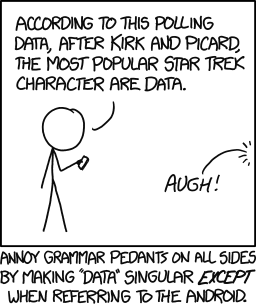
Data

If you want to have more fun at the expense of language pedants, try developing an hypercorrection habit.
02 Oct 16:23

Notices of the AMS is killing it

by Cathy O'Neil, mathbabe

I am somewhat surprised to hear myself say this, but this month’s Notices of the AMS is killing it. Generally speaking I think of it as rather narrowly focused but things seem to be expanding and picking up. Scanning the list of editors, they do seem to have quite a few people that want to address wider public issues that touch and are touched by mathematicians.

First, there’s an article about how the h-rank of an author is basically just the square root of the number of citations for that author. It’s called Critique of Hirsch’s Citation Index: A Combinatorial Fermi Problem and it’s written by Alexander Yong. Doesn’t surprised me too much, but there you go, people often fall in love with new fancy metrics that turn out to be simple transformations of old discarded metrics.

Second, and even more interesting to me, there’s an article that explains the mathematical vapidness of a widely cited social science paper. It’s called Does Diversity Trump Ability? An Example of the Misuse of Mathematics in the Social Sciences and it’s written by Abby Thompson. My favorite part of paper:

Screen Shot 2014-10-01 at 8.57.17 AM


Oh, and here’s another excellent take-down of a part of that paper:

Screen Shot 2014-10-01 at 9.02.00 AM


Let me just take this moment to say, right on, Notices of the AMS! And of course, right on Alexander Yong and Abby Thompson!


28 Sep 17:26

Palmer's amaranth - a "superweed"

by Minnesotastan

Excerpts from an Associated Press article published in the somewhat-agriculture-oriented StarTribune:
A weed strong enough to stop combines and resist many herbicides has been confirmed in South Dakota for the first time, raising concerns it could spread and cut deeply into crop production in the Upper Midwest — one of the few areas it hadn't yet invaded.

The threat from palmer amaranth is so great that officials in North Dakota have named it the weed of the year, even though it has yet to be found in the state.

"If you think you find plants — kill it!" North Dakota State University Extension Weed Specialist Rich Zollinger said. "Don't even think. Just kill it."..

The weed some officials refer to as "Satan" has moved into the Midwest from cotton country, and was discovered in western Iowa soybean fields last year. It's native to desert regions of the southwest U.S. and northern Mexico... The plants can grow as tall as 7 feet, each one producing as much as a million seeds. Its stems can grow as thick as baseball bats...

"The big concern is, in Southern states, it has developed — quickly — resistance to a considerable amount of herbicides," Johnson said.
And a more measured viewpoint from the Wikipedia entry:
Amaranthus palmeri is a species of edible flowering plant in the amaranth genus. It has several common names, including Palmer's amaranth, Palmer amaranth, Palmer's pigweed, and carelessweed. It is native to most of the southern half of North America...

The leaves, stems and seeds of Palmer amaranth, like those of other amaranths, are edible and highly nutritious. Palmer amaranth was once widely cultivated and eaten by Native Americans across North America, both for its abundant seeds and as a cooked or dried green vegetable. Other related Amaranthus species have been grown as crops for their greens and seeds for thousands of years in Mexico, South America, the Caribbean, Africa, India, and China. The plant can be toxic to livestock animals...

Palmer amaranth is considered a threat most specifically to the production of genetically modified cotton and soybean crops in the southern United States because in many places, the plant has developed resistance to glyphosate.
Photo by FireFlyForest, via Eat The Weeds.
28 Sep 00:56

How to make beer a natural monopoly?

by Tyler Cowen

Bruges is trying something different:

The Belgian city of Bruges has approved plans to build a pipeline which will funnel beer underneath its famous cobbled streets.

Locals and politicians were fed up with huge lorries clattering through the cobbled streets and tiny canal paths of the picturesque city and decided to connect the De Halve Maan brewery to a bottling factory 3.2km (two miles) away.

It is estimated that some 500 trucks currently motor through Bruges each year on their way to the brewery, which is a famous tourist attraction.

Now they will be kept out of the city limits, as the pipe pumps 1,500 gallons of beer per hour. Construction is set to begin next year.

“The beer will take 10 to 15 minutes to reach the bottling plant,” said brewery CEO Xavier Vanneste. “By using the pipeline we will keep hundreds of lorries out of the city centre. This is unique in the brewing industry with exception of one German brewery that has installed a similar system.”

There is more here, and for the pointer I thank Samir Varma.

24 Sep 15:04

Let's have a lead party!

by Minnesotastan
The front cover shows Dutch Boy, carrying his paint bucket, being greeted by a toy lead soldier, a shoe, a plate and a light bulb. The back cover features a hand that has made a broad brush stroke with the admonition "'Save the surface and you save all'; Paint & Varnish"... The first page shows the Dutch Boy talking to the lead soldier; it is followed by 14 images--7 in color and 7 in outline--of items that use lead. Items include a light bulb (lead glass), shoes and baseballs (lead in the rubber), and a bullet (entirely made of lead). Each outlined image was to be filled in using the complementary color image at its side as a guide.
Text via The Ethical Adman, where there is additional information; image via Sweet Dreams.
21 Sep 17:46

The Economics of Prison Gangs

by Jesse Walker
Nosimpler

The article is really good, but rational choice theory is still bullshit.

A very interesting Atlantic article about prison gangs devotes a lot of attention to the work of David Skarbek, a graduate of George Mason's economics program who now teaches at King's College London. Here are some excerpts:

Your guide."Prison is set up so that most of the things a person wants to do are against the rules," Skarbek says. "So to understand what's really going on, you have to start by realizing that people are coming up with complicated ways to get around them." Prison officials have long known that gangs are highly sophisticated organizations with carefully plotted strategies, business-development plans, bureaucracies, and even human-resources departments—all of which, Skarbek argues, lead not to chaos in the prison system but to order....

Prison, Skarbek claims, is the ultimate challenge for a rational-choice theorist: a place where control of the economic actors is nearly total, and where virtually any transaction requires the consent of the authorities. The Soviets had far less control over their people's economic activity than prison wardens do over the few dollars available for prisoners' commissary purchases. Both settings have given rise to alternate currencies and hidden markets. Most famously, cigarettes have become the medium of exchange in many prisons. But when they are banned, other currencies take their place. California inmates now use postage stamps....

Can't a man get some sleep?What's astonishing to outsiders, Skarbek says, is that many aspects of gang politics that appear to be sources of unresolvable hatred immediately dissipate if they threaten the stability of prison society. For example, consider the Aryan Brotherhood—a notoriously brutal organization whose members are often kept alone in cells because they tend to murder their cell mates. You can take the Brotherhood at its word when it declares itself a racist organization, and you can do the same with the Black Guerrilla Family, which preaches race war and calls for the violent overthrow of the government. But Skarbek says that at lights-out in some prisons, the leader of each gang will call out good night to his entire cellblock. The sole purpose of this exercise is for each gang leader to guarantee that his men will respect the night’s silence. If a white guy starts yelling and keeps everyone awake, the Aryan Brothers will discipline him to avoid having blacks or Hispanics attack one of their members. White power is one thing, but the need to keep order and get shut-eye is paramount.

There's much more, including an argument that "prison gangs are the courts and sheriffs for people whose business is too shady to be able to count on justice from the usual sources." Read the rest here. Buy Skarbek's book The Social Order of the Underworld here. See him describe the world's freest prison here. Peruse Reason's special incarceration issue here.

18 Sep 13:15

Well Then

by noreply@blogger.com (Atrios)
Not even sure what to say about this.
Obama administration officials repeatedly threatened the family of murdered journalist James Foley that they might face criminal charges for supporting terrorism if they paid ransom to the ISIS killers who ultimately beheaded their son, his mother and brother said this week.
17 Sep 00:19

Neuromodulators Produce Distinct Activated States in Neocortex

by Castro-Alamancos, M. A., Gulati, T.

Neocortical population activity varies between deactivated and activated states marked by the presence and absence of slow oscillations, respectively. Neocortex activation occurs during waking and vigilance and is readily induced in anesthetized animals by stimulating the brainstem reticular formation, basal forebrain, or thalamus. Neuromodulators are thought to be responsible for these changes in cortical activity, but their selective cortical effects (i.e., without actions in other brain areas) on neocortical population activity in vivo are not well defined. We found that selective cholinergic and noradrenergic stimulation of the barrel cortex produces well differentiated activated states in rats. Cholinergic cortical stimulation activates the cortex by abolishing synchronous slow oscillations and shifting firing to a tonic mode, which increases in rate at high doses. This shift causes the sensory thalamus itself to become activated. In contrast, noradrenergic cortical stimulation activates the cortex by abolishing synchronous slow oscillations but suppresses overall cortical firing rate, which deactivates the thalamus. Cortical activation produced by either of these neuromodulators leads to suppressed sensory responses and more focused receptive fields. High-frequency sensory stimuli are best relayed to barrel cortex during cortical cholinergic activation because this also activates the thalamus. Cortical neuromodulation sets different cortical and thalamic states that may serve to control sensory information processing according to behavioral contingencies.

12 Sep 14:57

What is the purpose of a poem?

by Andrew
Nosimpler

hee hee... "the academic entertainer Slavoj Zizek"

OK, let’s take a break from blogging about economics. OK, I haven’t actually been blogging so much about econ lately, but it just happens that I’m writing this on 19 July, a day after poking a stick into the hornet’s nest by posting “Differences between econometrics and statistics: From varying treatment effects to utilities, economists seem to like models that are fixed in stone, while statisticians tend to be more comfortable with variation” (which in turn was on auto-post as I’d written it a couple months earlier).

As is often the case, I’m on the blog to procrastinate: in this case, my colleagues and I are preparing a new course and there’s tons of important work to be done. I’m getting tired of reading comments on economics and empiricism and so I scooted over to Basbøll’s blog and kicked off a brief comment thread about the academic entertainer Slavoj Zizek. At first I was going to post and continue that discussion here, but I don’t give too poops about Slavoj Zizek, so I followed Basbøll’s blogroll link to “Stupid Motivational Tricks” and right away found something interesting.

The something interesting that I found was a post by Jonathan Mayhew about someone who’s the poet laureate of North Carolina. I had no idea that an individual state would have a poet laureate but it seems like a good idea, a quite reasonable nearly cost-free thing to do, indeed it would be cool to have all sorts of official state art. In reading the post I was mildly irritated by Mayhew’s use of “NC” as a generic replacement for “North Carolina.” The abbreviation is fine in some contexts but I founn it a bit jarring to read, “The literary community of NC . . .” On the other hand, it’s just a goddam blog so I don’t know what I’m supposed to be expecting.

But I’m getting completely off the point here. What happened is that Mayhew quoted a couple of mediocre passages from poems by two of North Carolina’s poet laureates (apparently they just had a changing of the guard).

Mayhew’s reactions gave me some thoughts of my own regarding the purpose of poetry. I’ll first copy what he wrote and then give my reflections.

Mayhew quotes from the previous laureate:

“Joan and I were in Raleigh together
for the first time to take the tour
for new vista volunteers
at North Carolina’s Central Prison…”

and then shares his reaction:

Ouch. It’s fine to use seemingly plain language, etc… but no rhythm, nothing going on in the language. This kind of writing just causes physical pain to me.

Then he quotes from the recent laureate:

“I’m grateful for my car, he says,
voice raspy with hard living.
Tossed on the seat, a briefcase
covered with union stickers,
stuffed with unemployment forms,
want ads, old utility bills,
birth certificate, school application
papers for the skinny ten-year-old
sitting beside him who loves baseball…”

This he characterizes as worse than the first poem (“not much worse,” though), but I don’t quite understand where this ranking is coming from, given that he follows up with, “More is going on in her language, actually. It’s not exactly good, but it’s salvageable, with some concreteness there at least.”

I assume that we can all agree, though, that it’s hard to judge either poem, or either poet, by these short excerpts. Both excerpts radiate mediocrity but of course a bit of mediocrity can do the job in the context of a larger message. I’m pretty sure that, for almost any major poet, you could without much difficulty find passages that, if shown to me in isolation, would not sparkle and could indeed look a bit like hackwork. I mean, sure, “voice raspy with hard living” sounds cliched, but who among us does not grab a cliche from time to time. For all we know from this excerpt, the use of the cliche is part of the point in establishing the narrator’s voice.

OK, let me be clear here. I’m not trying to get all contrarian on you and praise these two poets. I have no problem giving Mayhew the benefit of the doubt, I’ll assume he read a bit by each of them and with these excerpts is giving something of a true sense of these poems’ style and content. So I will accept (until convinced otherwise) that these poets are indeed mediocre.

What is the purpose of a poem?

And this brings us to today’s topic. The thing that bothers me about Mayhew’s post (even though I have a feeling I’d agree with him 100% about the strengths and weaknesses of these poems, and I wouldn’t be surprised if we share many tastes about and attitudes toward literature) is the implicit attitude that I see there, which I feel I’ve seen in other discussions of poetry, which is that the purpose of a poem is to be wonderful.

Huh? “The purpose of a poem is to be wonderful.” That seems like a reasonable statement, no? Who could disagree with that?

To see my problem with this statement (which, to be fair, Mayhew never said, but which I see as implicit in his post), consider the related question, “What is the purpose of a novel?” Or, for that matter, what is the purpose of a research article? Or what is the purpose of a song?

My point is that I think it’s a bad attitude to think that the purpose of a poem is to be wonderful. It’s insulting to poetry to give it such a narrow range. A poem is a sort of song without music and, as such can have many different purposes.

OK, procrastination successful. An hour spent, now time for bed.

The post What is the purpose of a poem? appeared first on Statistical Modeling, Causal Inference, and Social Science.

12 Sep 00:14

Slow Death by Many Mosquito Bites. (arXiv:1409.2907v1 [physics.data-an])

by S. Redner, O. Bénichou

We study the dynamics of a single diffusing particle (a "man") with diffusivity $D_M$ that is attacked by another diffusing particle (a "mosquito") with fixed diffusivity $D_m$. Each time the mosquito meets and bites the man, the diffusivity of the man is reduced by a fixed amount, while the diffusivity of the mosquito is unchanged. The mosquito is also displaced by a small distance $\pm a$ with respect to the man after each encounter. The man is defined as dead when $D_M$ reaches zero. At the moment when the man dies, his probability distribution of displacements $x$ is given by a Cauchy form, which asymptotically decays as $x^{-2}$, while the distribution of times $t$ when the man dies asymptotically decays as $t^{-3/2}$, which has the same form as the one-dimensional first-passage probability.

11 Sep 17:31

Watch Each of the Last Four U.S. Presidents Announce That We're Bombing Iraq

by Peter Suderman

Did last night's primetime presidential speech announcing expanding authorization for airstrikes in Iraq and Syria feel kind of familiar? Like you've heard it before?

That's probably because you have. You've been hearing for more than two decades, from presidents on both sides of political aisle. At this point, bombing Iraq is practically a American presidential tradition. 

And, via the magic of YouTube and The Huffington Post's Sam Stein, you can watch every president back to the first George Bush announce a new plan to launch military strikes in Iraq. 

Here's George H.W. Bush in January 1991 announcing that "air attacks are already underway against military targets in Iraq." 

Here's President Bill Clinton in December 1998 announcing a mission, along with British forces, to "strike military and security targets in Iraq." 

Here's President George Bush (the second one) in March 2003 announcing that American forces, with help from coalition partners, "are in the early stages of military operations to disarm Iraq."

And here's President Obama, last night, describing U.S. airstrikes and other military operations designed to "degrade and ultimately destroy" ISIS in Iraq and Syria.

Ah, memories. 

(Credit for these finds goes to to Sam Stein of The Huffington Post, who last night rounded up these clips on his Twitter feed.) 

11 Sep 17:30

Trigger Warnings a Threat to Academic Freedom, Says AAUP

by Robby Soave

Moby DickThe American Association of University Professors came out strongly against trigger warnings in the classroom, calling them "a current threat to academic freedom."

The AAUP's statement firmly denounces mandatory use of trigger warnings. Administrators must not require teachers to "warn" students about potentially objectionable material, the organization wrote:

The presumption that students need to be protected rather than challenged in a classroom is at once infantilizing and anti-intellectual.  It makes comfort a higher priority than intellectual engagement and... it singles out politically controversial topics like sex, race, class, capitalism, and colonialism for attention.  Indeed, if such topics are associated with triggers, correctly or not, they are likely to be marginalized if not avoided altogether by faculty who fear complaints for offending or discomforting some of their students.  Although all faculty are affected by potential charges of this kind, non-tenured and contingent faculty are particularly at risk.  In this way the demand for trigger warnings creates a repressive, “chilly climate” for critical thinking in the classroom.

The statement clarifies that professors may freely choose to account for their students' sensibilities if they wish, but should not feel required to do so. Even so, voluntary use of trigger warnings may prove "counterproductive to the educational experience," according to the AAUP:

There are reasons, however, for concern that even voluntary use of trigger warnings included on syllabi may be counterproductive to the educational experience.   Such trigger warnings conflate exceptional individual experience of trauma with the anticipation of trauma for an entire group, and assume that individuals will respond negatively to certain content.  A trigger warning might lead a student to simply not read an assignment or it might elicit a response from students they otherwise would not have had, focusing them on one aspect of a text and thus precluding other reactions.

The full statement is a praiseworthy defense of academic freedom and unrestricted speech in higher education. Kudos to the AAUP for standing up for its members' rights.

Hat tip: The Huffington Post

06 Sep 20:35

Flying Foxes

by noreply@blogger.com (Atrios)
A friend who just visited Australia was telling me about "flying foxes" last night. Giant bats! Sounded terribly frightening! What's next, Australia, egg laying mammals with duck bills and a crippling poison? Miniature spiders with deadly venom? Floating sacks of deadly jelly? Poison centipedes of unusual size?

But the "flying foxes" are actually really cute. They're just puppies with wings. They don't have echolocation. They basically have the diet of bees. Well, big bees, anyway (and not the crazy Australian bees).


(ht for general idea to Margafret)
03 Sep 01:38

Secular chaos [Astronomy]

by Lithwick, Y., Wu, Y.
In the inner solar system, the planets’ orbits evolve chaotically, driven primarily by secular chaos. Mercury has a particularly chaotic orbit and is in danger of being lost within a few billion years. Just as secular chaos is reorganizing the solar system today, so it has likely helped organize it...
02 Sep 19:18

Great Job, Internet!: Cows are also fans of Lorde’s “Royals”

by Kayla Reed

While each cow is her own woman, it’s hard not to stereotype when almost all cattle herd toward the sound of brass instruments. And we know this not because we’re farmers, but because there are a few videos out there already. Still, the newest one from YouTube user Farmer Derek Kingenberg has inevitably gone viral. The trombone player comfortably plops in a lawn chair and begins to play Lorde’s “Royals,” and slowly but surely dozens of cows appear on the horizon and gather closely to listen. That’s not to stereotype and say that all cows listen to Lorde, though, because some of them may have thought it was “Weird Al” Yankovic’s “Foil.”

[via Laughing Squid]

01 Sep 20:57

"Swatting" explained

by Minnesotastan

Militarized local SWAT teams can be tricked by hackers into raiding homes of innocent people.  The Vice video above illustrates the problem, which is also discussed at Salon:
“The caller claimed to have shot two co-workers, held others hostage, and threatened to shoot them,” the Littleton Police Department said in a statement. “He stated that if the officers entered he would shoot them as well.”

What the cameras captured is a perilous new prank known as “swatting,” or making a false report to get the SWAT team to invade a rival gamer’s space. As evidenced by the Vice News report below, this can involve disguising the caller identity and making some potentially life-threatening claims.
29 Aug 18:31

Gilian Tett gets it very wrong on racial profiling

by Cathy O'Neil, mathbabe

Last Friday Gillian Tett ran a profoundly disturbing article in the Financial Times entitled Mapping Crime – Or Stirring Hate? (hat tip Marcos Carreira), which makes me sad to say this given how much respect I normally have for her regarding her coverage of the financial crisis.

In the article, Tett describes the predictive policing model used by the Chicago police force, which told the police where to go to find criminals based on where people had been arrested in the past.

Her article reads like an advertisement for racist profiling. First she deftly and indirectly claims the model is super successful at lowering the murder rate without actually coming out and saying so (since she actually has only correlative evidence):

And when Weis launched the programme in early 2010, together with a clever policeman-cum-computer expert called Brett Goldstein, it delivered impressive results. In the first year the murder rate fell 5 per cent and then continued to tumble. Indeed by the summer of 2011 it looked as if Chicago’s annual death toll would soon drop below 400, the lowest since 1965. “The homicide rates for that summer were just crazy low compared to what we had been,” Weis observes.


But then, following his departure from the force, the programme was wound down in late 2011. And, tragically, the murder rate immediately rose again.

Here’s the thing, it’s really hard to actually know why murder rates go up and down. In New York City we’ve been using Stop & Frisk as the violent crime rates have been steadily lowering in this city (and many others), and for a long time Bloomberg took credit for that through the Stop & Frisk practice. But when Stop & Frisk rates went down, murder rates didn’t shoot up. Just saying. And that’s ignoring how reliable the police data is, which is another issue. Let’s take a look at her evidence for a longer time frame:

She's talking about that small uptick at the end.

She’s talking about that small uptick at the end, which to the naked eye could well be statistical noise.

The reason I’m pointing out her bad statistics is that she needs them to set up the following, truly disturbing paragraphs (emphasis mine):

But while racism is rightly deemed unacceptable, computer programs pose more subtle questions. If a spreadsheet forecast has a racial imbalance, is this likely to reinforce existing human biases, or racial profiling? Or is a weather map of crime simply a neutral tool? To put it another way, does the benefit of using predictive policing outweigh any worries about political risk?


Personally, I think it does. After all, as the former CPD computer experts point out, the algorithms in themselves are neutral. “This program had absolutely nothing to do with race… but multi-variable equations,” argues Goldstein. Meanwhile, the potential benefits of predictive policing are profound.

No, Gillian Tett, there is no such thing as a neutral tool. No algorithm focused on human behavior is neutral. Anything which is trained on historical human behavior embeds and codifies historical and cultural practices. Specifically, this means that the fact that black Americans are nearly four times as likely as whites to be arrested on charges of marijuana possession even though the two groups use the drug at similar rates would be seen by such a model (or rather, by the people who deploy the model) as a fact of nature that is neutral and true. But it is in fact a direct consequence of systemic racism.

Put it another way: if we allowed a model to be used for college admissions in 1870, we’d still have 0.7% of women going to college. Thank goodness we didn’t have big data back then!

This is very scary to me, when even Gillian Tett, who famously predicted the financial crisis in 2006, can be fooled. We clearly have a lot of work to do.


29 Aug 17:34

Space ethics to test directed panspermia. (arXiv:1407.5618v3 [physics.pop-ph] UPDATED)

by Maxim A. Makukov, Vladimir I. shCherbak
Nosimpler

sssPACE ETHICS

The hypothesis that Earth was intentionally seeded with life by a preceding extraterrestrial civilization is believed to be currently untestable. However, analysis of the situation where humans themselves embark on seeding other planetary systems motivated by survival and propagation of life reveals at least two ethical issues calling for specific solutions. Assuming that generally intelligence evolves ethically as it evolves technologically, the same considerations might be applied to test the hypothesis of directed panspermia: if life on Earth was seeded intentionally, the two ethical requirements are expected to be satisfied, what appears to be the case.

25 Aug 21:34

"Music" heard on the back side of the moon

by Minnesotastan
During a podcast of No Such Thing as a Fish, the elves mentioned in passing a "symphony" heard by astronauts on the far side of the moon.  Today I found the following at Above Top Secret:
Most of us Conspiracy Researchers will recall the case of Apollo 10 Astronauts : Tom Stafford, Gene Cernan and John Young discussing the “outer-spacey” music they head while on the far side of the moon. This music happened during the LOS (loss of signal) period that occurred while the communications between themselves and mission control were temporarily unavailable due to their position behind the moon. Gene Cernan is the first to hear the music (in the LM) and the transcripts shows that he radios John Young in the CSM to confirm he is hearing the same thing. John young then replies “Yea, I got it too…….and see who was outside?” Not only does JY confirm he hears it, but look at his following statement, “and see who is outside” ! Now who could be “outside” the space vessels?! More importantly John Young is inferring that there may be a connection between the “music” and “who is outside” of their crafts. After a few minutes of dialogue regarding the mission Gene Cernan brings up the topic again, “boy, that sure is strange music” in which John Young replies “ Were going to have to find out about that. Nobody will Believe us.”

During their next orbit of the dark side the “music” RETURNS. Addressing Tom Stafford this time Gene Cernan asks “You hear music Tom? That crazy whistling?” In which Tom Stafford replies “I can hear it.” Gene replies “that’s really weird” and Tom replies “it is.” Further on Gene AGAIN brings up the subject by stating “Listen to eerie music”. They even continue random dialogue regarding the music and how eerie and weird it was, and that nobody is going to believe them. 
More at the link, where you can access Apollo 10 transcripts and experiences by other astronauts.  Here is one possible explanation:
There hasn't ever really been an "official" explanation of these sounds (described as whistling and buzz-saw sounds). But most scientists offer that it could be attributed to either radio interference in the lander or perhaps an artifact of the Sun's solar wind.
Since the most prominent example of this sound was when the Apollo 15 astronauts were on the far side of the Moon, it could be suggested that the Moon's gravity was gravitationally focusing the Sun's wind (a mix of high energy charged particles) onto the capsule. That interaction would created electromagnetic distortions, which could produce sounds inside the capsule.
25 Aug 17:07

Banana Republics and Bad Apples Abroad

by Scott Beauchamp
Photo by Bradley Gordon

Photo by Bradley Gordon

Last month, quietly overshadowed by a summer of celebrity deaths and violent instability in the Middle East, the Eleventh Circuit Court of Appeals dismissed a lawsuit against the American produce company Chiquita. Filed on behalf of over 4,000 Colombians, the suit alleged that Chiquita financed and provided logistical support for United Self-Defense Forces of Colombia, a violent right-wing militia known primarily for the murder and kidnapping of leftists during Colombia’s civil war.

Chiquita already admitted to doing as much in 2007 when they pleaded guilty to giving the AUC (the Spanish acronym for United Self-Defense Forces of Colombia), a terrorist organization, almost $2 million to smooth its operations in the country. In other words, Chiquita hired a private army to do whatever it deemed necessary in the name of “protection” so that it could make more money.

After acknowledging they had conducted financial transactions with a terrorist organization, Chiquita agreed to a $25 million settlement as part of a plea agreement. According to the Justice Department, between 1997 and 2004 (the years in which the United States government officially designated AUC as a terrorist organization), Chiquita had made $1.7 million in payments to AUC through its Colombian subsidiary Banadex.

Fernando Aguirre, then CEO of Chiquita, classified the payments as extortion. He claimed that the company was paying for the safety of its employees in a chaotic and war-torn environment. In fact, it was integral to the plea agreement that Chiquita should claim that the company never directly paid for security services.

The “we were the real victims here” attitude was eventually repudiated by Chiquita company internal memos gathered through an FOIA request by the George Washington University Law School and the Digital National Security Archive. According to Michael Evans, the director of the National Security Archive’s Colombia documentation project:

These extraordinary records are the most detailed account to date of the true cost of doing business in Colombia. Chiquita’s apparent quid pro quo with guerrillas and paramilitaries responsible for countless killings belies the company’s 2007 plea deal with the Justice Department. What we still don’t know is why U.S. prosecutors overlooked what appears to be clear evidence that Chiquita benefited from these transactions.

In other words, Chiquita paid militias, who killed or kidnapped the people standing in their way of their profits—mostly union leaders, students, and relatively powerless farmers. By 2003, Banadex in Colombia was Chiquita’s “most profitable operation.” That’s what Chiquita got in return for its investment in AUC.

All this being known, why was the most recent suit thrown out? Well, you can blame our über business-friendly Supreme Court for their narrowest-of-narrow way of implementing something called the Alien Tort Statute.

In theory, the ATS allows citizens living in other countries to sue Americans for committing human rights abuses. But a precedent set by the Supreme Court last year in Kiobel v. Royal Dutch Petroleum makes it inordinately difficult to bring these kinds of suits forward. Using the logic of Kiobel, the Eleventh District Appellate Court threw out the Chiquita case because the crimes that occurred abroad did not “touch and concern” the United States, as the decision states. Still, assuming that that’s true (and we should not be not convinced that it is), of what value would such a narrowly defined ATS be? It hardly seems like a deterrent to corporations subsidizing violence at all.

The Chiquita suit is emblematic of a huge legal loophole, but it isn’t an isolated incident. American companies often use the rest of the Western hemisphere as their lawless playground, while U.S. law provides little to no legal recourse for the people who live there. Coca-Cola, for instance, has become a favored cause for college-age activists in America to rally around in the past decade; “the new Nike,” as some have labeled it. The “Killer Coke” movement has focused on the killing of eight workers—one a prominent union leader—by right-wing mercenaries at a Coke bottling factory in Colombia, allegedly at the behest of the company itself.

The incident led to a 2001 lawsuit filed by the United Steel Workers of America and the International Labor Rights Fund on behalf of the workers against Coca-Cola, alleging that the company “hired, contracted with, or otherwise directed paramilitary forces.” The case was eventually dismissed, but an official New York City fact-finding delegation did corroborate the workers’ story in 2004. The delegation found evidence to support Coca-Cola being at least partially responsible for kidnap, torture, and murder. In all, they found at least 179 instances of human rights violations by Coca-Cola in Colombia.

Even more recent than the cases in Colombia, and maybe scarier to Americans by virtue of proximity, is the case of Wells Fargo Bank working in tandem with Mexican drug cartels. Wachovia, purchased by Wells Fargo in 2008, admitted its guilt in laundering as much as $420 billion for the cartels. At least in this case they were punished, even if it was just a slap on the wrist, with a $160 million fine for violating the Bank Secrecy Act. $420 billion is a lot of money to be kept secret. One can only imagine how much weaponry, ammo, bribes, and assassinations it could pay for.

Although the numbers involved are shocking, the crime isn’t anything new. American capital has been used to finance the violent repression of democratic movements in America for at least as long as there has been a global economy to manipulate. The United Fruit Company, for example, had a record of subsidizing brutal regimes and lobbying for the suppression of populist action. Their stranglehold on Central America is legendary, fictionalized in literature by writers such as Gore Vidal and Gabriel García Márquez, and even earning the moniker “el pulpo,” or “the octopus,” in popular vernacular.

It shouldn’t come as a surprise that United Fruit’s intervention in the inner workings of Central American governments is where the term “Banana Republic” originates. Two of United Fruit Company’s most legendary exploits (a term meant literally in these cases), were its involvement with the 1954 coup in Guatemala and the 1928 “Banana Massacre” in which the United Fruit Company successfully lobbied the Colombian government to violently suppresses a labor strike. United Fruit Company eventually merged with AMK in 1970 to become United Brands Company. United Brands was transformed in 1984 into, you guessed it, Chiquita Brands International. The more things change, etcetera.

So what does this all add up to? We have Chiquita paying off murderers. We have Coca-Cola doing the same. We have Wachovia helping to finance the brutality of drug cartels. And we have a recorded legacy of this kind of thing going back before the Second World War. It adds up to more than just a trend, more than a series of random events, and it should compel us to demand more than piecemeal corrective actions like “fixing” the Alien Tort Statute. Instead, we should be shocked into the recognition of how global capitalism actually operates.

These aren’t “bad apples.” This is the heart of it. As a resident of Gabriel García Márquez’s fictional town of Macondo says after his home is wrecked by the greed of an international fruit corporation, “Look at the mess we’ve got ourselves into just because we invited a gringo to eat some bananas.”


[This post has been updated to correct the spelling of Colombia. Our apologies to both South Carolina and South America.]

22 Aug 19:30

"Siri, where should I bury my roommate?"

by Minnesotastan

A young man in Florida is accused of murdering his roommate (details at The Telegraph).  Evidence at his trial will include information retrieved from his PDA (screencap above).
The Siri device, which had been accessed via Facebook, allegedly responded with the question: "What kind of place are you looking for? Swamps. Reservoirs. Metal foundries. Dumps."..

Detectives who accessed Bravo's phone found that he had used the flashlight facility for 48 minutes on the day of Aguilar's disappearance. 
18 Aug 19:15

Best of both worlds: promise of combining brain stimulation and brain connectome.

by Luft CD, Pereda E, Banissy MJ, Bhattacharya J
Nosimpler

Borg LOL

Best of both worlds: promise of combining brain stimulation and brain connectome.

Front Syst Neurosci. 2014;8:132

Authors: Luft CD, Pereda E, Banissy MJ, Bhattacharya J

Abstract
Transcranial current brain stimulation (tCS) is becoming increasingly popular as a non-pharmacological non-invasive neuromodulatory method that alters cortical excitability by applying weak electrical currents to the scalp via a pair of electrodes. Most applications of this technique have focused on enhancing motor and learning skills, as well as a therapeutic agent in neurological and psychiatric disorders. In these applications, similarly to lesion studies, tCS was used to provide a causal link between a function or behavior and a specific brain region (e.g., primary motor cortex). Nonetheless, complex cognitive functions are known to rely on functionally connected multitude of brain regions with dynamically changing patterns of information flow rather than on isolated areas, which are most commonly targeted in typical tCS experiments. In this review article, we argue in favor of combining tCS method with other neuroimaging techniques (e.g., fMRI, EEG) and by employing state-of-the-art connectivity data analysis techniques (e.g., graph theory) to obtain a deeper understanding of the underlying spatiotemporal dynamics of functional connectivity patterns and cognitive performance. Finally, we discuss the possibilities of using these combined techniques to investigate the neural correlates of human creativity and to enhance creativity.

PMID: 25126060 [PubMed]

18 Aug 19:01

The Impact of Jury Race in Criminal Trials

by Alex Tabarrok

In a great paper, The Impact of Jury Race in Criminal Trials, Shamena Anwar, Patrick Bayer and Randi Hjalmarsson exploit random variation in the jury pool to estimate the effect of race on criminal trials. The authors have data from nearly 800 trials in two Florida counties. On any given day, a jury pool is randomly drawn from a master list based on driver’s licenses. On some days, the pool of about 30 people contains some black members and on other days, purely for random reasons, it does not. The voir dire process–>For every $1 spent on legal aid, the savings can range from $1.60 to $30.removals, excuses and challenges–whittles down the jury pool to 6 jury members with typically 1 alternate.

The authors have data on the race, gender, and age of each member of the jury pool as well as each member of the ultimate jury. The authors also know the race and gender of the defendant and the charges. What the authors discover is that all white juries are 16% more likely to convict black defendants than white defendants but the presence of just a single black person in the jury pool equalizes conviction rates by race. The effect is large and remarkably it occurs even when the black person is not picked for the jury. The latter may not seem possible but the authors develop an elegant model of voir dire that shows how using up a veto on a black member of the pool shifts the characteristics of remaining pool members from which the lawyers must pick; that is, a diverse jury pool can make for a more “ideologically” balanced jury even when the jury is not racially balanced.

The author’s results show not only that blacks and whites are treated differently depending on the composition of the jury pool but also that random variation in the jury pool adds to the variability of sentences holding race constant. Like is not treated as like. The results also suggest that we don’t need racial quotas to increase fairness. We can increase fairness and reduce variability in a racially neutrally way by expanding the size of juries. Six-person juries have become common because they are cheap(er) but a return to twelve person juries would reduce the variability of sentences and greatly equalize conviction rates across race.

15 Aug 20:43

ICM2014 — Bhargava laudatio

by gowers

I ended up writing more than I expected to about Avila. I’ll try not to fall into the same trap with Bhargava, not because there isn’t lots to write about him, but simply because if I keep writing at this length then by the time I get on to some of the talks I’ve been to subsequently I’ll have forgotten about them.

Dick Gross also gave an excellent talk. He began with some of the basic theory of binary quadratic forms over the integers, that is, expressions of the form ax^2+bxy+cy^2. One assumes that they are primitive (meaning that a, b and c don’t have some common factor). The discriminant of a binary quadratic form is the quantity b^2-4ac. The group SL_2(\mathbb{Z}) then acts on these by a change of basis. For example, if we take the matrix \begin{pmatrix}2&1\\5&3\end{pmatrix}, we’ll replace (x,y) by (2x+y, 5x+3y) and end up with the form a(2x+y)^2+b(2x+y)(5x+3y)+c(5x+3y)^2, which can be rearranged to
(4a+10b+25c)x^2+(4a+11b+30c)xy+(a+3b+9c)y^2
(modulo any mistakes I may have made). Because the matrix is invertible over the integers, the new form can be transformed back to the old one by another change of basis, and hence takes the same set of values. Two such forms are called equivalent.

For some purposes it is more transparent to write a binary quadratic form as
\begin{pmatrix}x&y\end{pmatrix}\begin{pmatrix}a&b/2\\b/2&c\end{pmatrix}\begin{pmatrix}x\\y\end{pmatrix}.
If we do that, then it is easy to see that replacing a form by an equivalent form does not change its discriminant since it is just -4 times the determinant of the matrix of coefficients, which gets multiplied by a couple of matrices of determinant 1 (the base-change matrix and its transpose).

Given any equivalence relation it is good if one can find nice representatives of each equivalence class. In the case of binary quadratic forms, there is a unique representative such that -a<b<a<c or 0\leq b\leq a\leq c. From this it follows that up to equivalence there are finitely many forms with any given discriminant. The question of how many there are with discriminant D is a very interesting one.

Even more interesting is that the equivalence classes form an Abelian group under a certain composition law that was defined by Gauss. Apparently it occupied about 30 pages of the Disquisitiones, which are possibly the most difficult part of the book.

Going back to the number of forms of discriminant D, Gauss did some calculations and stated (without proof) the formula

\displaystyle \sum_{|D|<T}H(D)\sim\frac\pi{18}T^{3/2}

There was, however, a heuristic justification for the formula. (I can’t remember whether Dick Gross said that Gauss had explicitly stated this justification or whether it was simply a reconstruction of what he must have been thinking.) It turns out that the sum on the left-hand side works out as the number of integer points in a certain region of \mathbb{R}^3 (or at least I assume it is \mathbb{R}^3 since the binary form has three coefficients), and this region has volume (\pi/18)T^{3/2}. Unfortunately, however, the region is not convex, or even bounded, so this does not by itself prove anything. What one has to do is show that certain cusps don’t accidentally contain lots of integer points, and that is quite delicate.

One rather amazing thing that Bhargava did, though it isn’t his main result, was show that if a binary quadratic form represents all the positive integers up to 290 then it represents all positive integers, and that this bound is best possible. (I may have misremembered the numbers. Also, one doesn’t have to know that it represents every single number up to 290 in order to prove the result: there is some proper subset of \{1,2,\dots,290\} that does the job.)

But the first of his Fields-medal-earning results was quite extraordinary. As a PhD student, he decided to do what few people do, and actually read the Disquisitiones. He then did what even fewer people do: he decided that he could improve on Gauss. More precisely, he felt that Gauss’s definition of the composition law was hard to understand and that it should be possible to replace it by something better and more transparent.

I should say that there are more modern ways of understanding the composition law, but they are also more abstract. Bhargava was interested in a definition that would be computational but better than Gauss’s. I suppose it isn’t completely surprising that Gauss might have produced something suboptimal, but what is surprising is that it was suboptimal and nobody had improved it in 200 years.

The key insight came to Bhargava, if we are to believe the story he tells us, when he was playing with a Rubik’s cube. He realized that if he put the letters a to h at the vertices of the cube, then there were three ways of slicing the cube to produce two 2\times 2 matrices. One could then do something with their determinants, the details of which I have forgotten, and end up producing three binary quadratic forms that are related, and this relationship leads to a natural way of defining Gauss’s composition law. Unfortunately, I couldn’t keep the precise definitions in my head.

Here’s a fancier way that Dick Gross put it. Bhargava reinvented the composition law by studying the action of SL_2(\mathbb{Z})^3 on M=\mathbb{Z}^2\otimes\mathbb{Z}^2\otimes\mathbb{Z}^2. The orbits are in bijection with triples of ideal classes (I_1,I_2,I_3) for the ring R=\mathbb{Z}[(D+\sqrt{D})/2] that satisfy I_1.I_2.I_3=1. That’s basically the abstract way of thinking about what Bhargava did computationally.

In this way, Bhargava found a symmetric reformulation of Gauss composition. And having found the right way of thinking about it, he was able to do what Gauss couldn’t, namely generalize it. He found 14 more integral representations on objects like M above, which gave composition laws for higher degree forms.

He was also able to enumerate number fields of small degree, showing that the number of fields of degree n and discriminant less than D grows like c_n|D|. This Gross described as a fantastic generalization of Gauss’s work.

I spent the academic years 2000-2002 at Princeton and as a result had the privilege of attending Bhargava’s thesis defence, at which he presented these results. It must have been one of the best PhD theses ever written. Are there any reasonable candidates for better ones? Perhaps Simon Donaldson’s would offer decent competition.

It’s not clear whether those results would have warranted a Fields medal on their own, but the matter was put beyond the slightest doubt when Bhargava and Shankar proved a spectacular result about elliptic curves. Famously, an elliptic curve comes with a group law: given two points, you take the line through them, see where it cuts the elliptic curve again, and define that to be the inverse of the product. This gives an Abelian group. (Associativity is not obvious: it can be proved by direct computation, but I don’t know what the most conceptual argument is.) The group law takes rational points to rational points, and a famous theorem of Mordell states that the rational points form a finitely generated subgroup. The structure theorem for Abelian groups tells us that for some d it must be a product of \mathbb{Z}^d with a finite group. The integer d is called the rank of the curve.

It is conjectured that the rank can be arbitrarily large, but not everyone agrees with that conjecture. The record so far is held by the curve

y^2 + xy + y = x^3 - x^2 +
31368015812338065133318565292206590792820353345x +
302038802698566087335643188429543498624522041683874493
555186062568159847

discovered by Noam Elkies (who else?) and shown to have rank 19. According to Wikipedia, from which I stole that formula, there are curves of unknown rank that are known to have rank at least 28, so in another sense the record is 28, in that that is the highest known integer for which there is proved to be an elliptic curve of rank at least that integer.

Bhargava and Shankar proved that the average rank is less than 1. Previously this was not even known to be finite. They also showed that at least 80% of elliptic curves have rank 0 or 1.

The Birch–Swinnerton-Dyer conjecture concerns ranks of elliptic curves, and one consequence of their results (or perhaps it is a further result — I’m not quite sure) is that the conjecture is true for at least 66% of elliptic curves. Gross said that there was some hope of improving 66% to 100%, but cautioned that that would not prove the conjecture, since 0% of all elliptic curves doesn’t mean no elliptic curves. But it is still a stunning advance. As far as I know, nobody had even thought of trying to prove average statements like these.

I think I also picked up that there were connections between the delicate methods that Bhargava used to enumerate number fields (which again involved counting lattice points in unbounded sets) and his more recent work with Shankar.

Finally, Gross reminded us that Faltings showed that for hyperelliptic curves (a curve of the form y^2=p(x) for a polynomial p — when p is a cubic you get an elliptic curve) the number of rational points is finite. Another result of Bhargava is that for almost all hyperelliptic curves there are in fact no rational points.

While it is clear from what people have said about the work of the four medallists that they have all proved amazing results and changed their fields, I think that in Bhargava’s case it is easiest for the non-expert to understand just why his work is so amazing. I can’t wait to see what he does next.


Update. Andrew Granville emailed me some corrections to what I had written above, which I reproduce with his permission.

A couple of major things — certainly composition was much better understood by Dirichlet (Gauss’s student) and his version is quite palatable (in fact rather easier to understand, I would say, than that of Bhargava). It also led, fairly easily, to re-interpretation in terms of ideals, and inspired Dedekind’s development of (modern) algebraic number theory. Where Bhargava’s version is interesting is that

1) It is the most extraordinarily surprising re-interpretation.

2) It is a beautiful example of an algebraic phenomenon (involving group actions on representations) that he has been able to develop in many extraordinary and surprising directions.

2/ 66% was proved by Bhargava, Skinner and Wei Zhang and goes some way beyond Bhargava/Shankar, involving some very deep ideas of Skinner (whereas most of Bhargava’s work is accessible to a widish audience).