Shared posts

08 Apr 12:09

"Gayness is built into Batman."

by Minnesotastan
After all, if a character isn’t written as gay, then that character can’t possibly be gay, right? We all agree on that? Good, then we can move on to more important matters, and…

… Sorry? Was there a comment in the back?

… Yes, you, Grant Morrison, writer of several Batman comics (Arkham Asylum, JLA, Batman, Batman Inc.) over the course of the past three decades? You had something you wish to add? Something you said to Playboy magazine in 2012?
Gayness is built into Batman.
… Um.
Batman is VERY, very gay.  
OK great super helpful thanks for that—
Obviously as a fictional character he’s intended to be heterosexual…
Yes! My point! THANK you. Now—
… but the whole basis of the concept is utterly gay.
You can read more at a very interesting article at Slate.
07 Apr 03:21

Taking Jury Nullification a Step Further

by Jesse Walker

The New Hampshire House of Representatives recently approved a bill requiring judges to tell juries they have a right not to convict a defendant if they feel that would be unjust, even if they think he's guilty. Writing in the Washington Post today, Glenn Reynolds calls for taking the idea a step further:

Stop: Hammer time!The New Hampshire legislation is good, but in my opinion it doesn't go far enough. Juries should be empowered to punish the prosecution when they feel the prosecution is abusive or malicious....

I think we should give prosecutors some skin in the game. Let juries be informed that they may refuse to convict if they think a conviction is unjust—and, if that happens, let the defendants' attorney fees and other costs be billed to the government. Also, let juries be informed that, if they believe the prosecution itself was malicious or unfair, they can make that finding—in which case the defendants' costs should come out of the prosecutor's budget. (If you want to get even tougher, you could provide that the prosecutors involved should be disqualified from law practice for a year or stripped of their immunity from civil suit. But I'm not sure we need to go that far.)

Read the rest here. For more from Reynolds on reining in abusive prosecutions, go here.

03 Apr 20:48

Why Democrats can't regain control of the House

by Minnesotastan
Even if a Democrat wins the presidency -
Why not put another beloved, big story in play and consider whether the House might flip? There is one very good reason: It is not going to happen.

One hesitates to call anything impossible during a campaign season that has upended so much historical wisdom. Nevertheless, this is impossible. But if we’re going to have seven more months of debating whether the Democrats have even the tiniest chance of capturing the House, it is important to understand all the politics and recent history which explains why it’s off the table, even if Trump leads the GOP into an epic rout at the presidential level...

...how sophisticated the GOP redistricting operation was in 2010 and 2011 — and how it has made our politics more extreme both in the House and in many state legislatures. It was different, perhaps historically so, thanks to driven GOP strategists determined to take full advantage of redistricting, new mapping and demographic technologies that made it easier than ever to craft unbeatable GOP majorities, and the wave of post-Citizens United dark money which helped fund it. They called it REDMAP, for Redistricting Majority Project, and did it ever live up to its name...

This Pennsylvania district, the 7th [inset at right], explains a lot if you want to understand just how precisely mapmakers did their work after 2010. Every one of these lines — described by some as Donald Duck kicking Goofy — exists to draw specific Republicans into this district, and to make as many surrounding districts as Republican as possible. Then, mapmakers packed so many Democrats into Chaka Fattah’s Philadelphia district that he won with more votes than any congressman in the country in 2012...

Let’s keep all of these numbers and the reality of these maps in mind when talking about the prospect of Democratic control over the next few months. Any piece or cable news discussion on this topic that does not include REDMAP or understand how the 2011 redistricting was different and more advanced than any that came before isn’t just missing part of the story. It’s missing the entire story, and engaging in punditry as fantasy.
29 Mar 15:17

Water use in the United States

by Minnesotastan

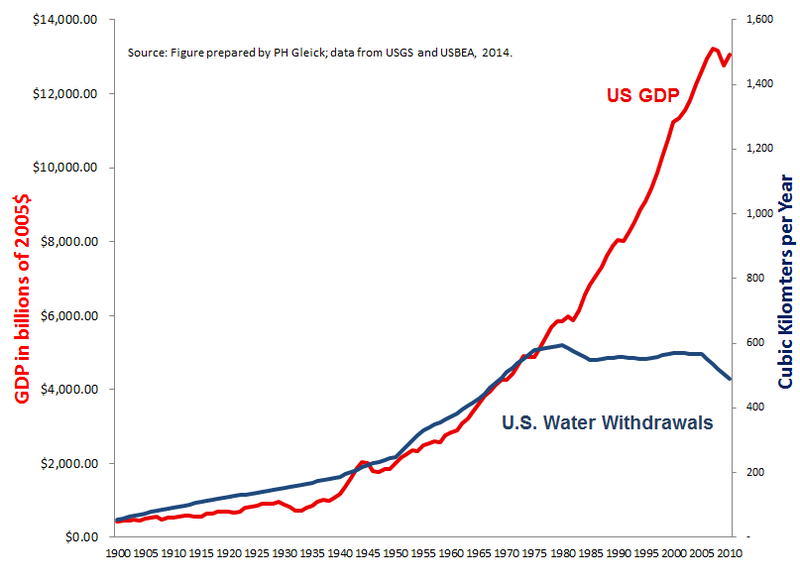
A remarkable (and counterintuitive) graph -
The US economy keeps expanding and the population keeps growing. But we actually use less water now for all purposes than we did back in 1970. That includes freshwater for our showers and toilets. It includes farm irrigation. It also includes withdrawals of both fresh and saline water to cool our fossil fuel and nuclear power plants.

The underlying data comes from a new report by the US Geological Survey, which notes that water for power plants (45 percent) and irrigation (33 percent) still made up most water withdrawals in the US as of 2010. But use in both of those areas has been declining over time.
More at Vox, including an explanation of "withdrawal" vs. "consumption."
22 Mar 23:18

Nixon Invented the Drug War to Decimate Hippies and Black People, Former Adviser Confesses

by Robby Soave

NixonPresident Richard Nixon launched the War on Drugs for one specific reason: to decimate his perceived political enemies—the anti-war left, and black people. 

That's according to an anecdote in a lengthy cover story for Harper's, in which journalist Dan Baum recounts an interview he conducted with John Erlichman, a former Nixon staffer who was jailed for one year due to his involvement in the Watergate scandal. Unprompted, Erlichman confessed the true purpose of federal drug prohibition: 

“You want to know what this was really all about?” he asked with the bluntness of a man who, after public disgrace and a stretch in federal prison, had little left to protect. “The Nixon campaign in 1968, and the Nixon White House after that, had two enemies: the antiwar left and black people. You understand what I’m saying? We knew we couldn’t make it illegal to be either against the war or black, but by getting the public to associate the hippies with marijuana and blacks with heroin, and then criminalizing both heavily, we could disrupt those communities. We could arrest their leaders, raid their homes, break up their meetings, and vilify them night after night on the evening news. Did we know we were lying about the drugs? Of course we did.” 

The dastardly plan failed only in the sense that Nixon ultimately lost—a victim of his criminal behavior and utter lack of scruples. But the War on Drugs certainly brought ruin, poverty, and crime to minority communities, cost the nation outrageous sums of money, and expanded the scope of the federal government's oppressive power. This was not done for any noble public purpose—it was a political gambit, nothing more. 

The road to hell may be paved with good intentions, but it's not only paved with good intentions.

19 Mar 21:30

The Most Common Prime Gaps

by john
MathML-enabled post (click for more details).

Twin primes are much beloved. But a computer search has shown that among numbers less than a trillion, most common distance between successive primes is 6. It seems this goes on for quite a while longer…

MathML-enabled post (click for more details).

… but Andrew Odlyzko, Michael Rubinstein and Marek Wolf have persuaded most experts that somewhere around x=1.7427×10 35x = 1.7427 \times 10^{35}, the most common gap between consecutive primes less than xx switches from 6 to 30:

  • Andrew Odlyzko, Michael Rubinstein, and Marek Wolf, Jumping champions, Experimental Mathematics 8 (1999), 107–118.

This is a nice example of how you may need to explore very large numbers to understand the true behavior of primes.

They give a sophisticated heuristic argument for their claim—not a rigorous proof. But they also checked the basic idea using Maple’s ‘probable prime’ function. It takes work to check if a number is prime, but there’s a much faster way to check if it’s probably prime in a certain sense. Using this, they worked out the gaps between probable primes from 10 3010^{30} and 10 30+10 710^{30}+10^7. They found that there are 5278 gaps of size 6 and just 5060 of size 30. They also worked out the gaps between probable primes from 10 4010^{40} and 10 40+10 710^{40}+10^7. There were 3120 of size 6 and 3209 of size 30.

So, it seems that somewhere between 10 3010^{30} and 10 4010^{40}, the number 30 replaces 6 as the most probable gap between successive primes!

Using the same heuristic argument, they argue that somewhere around 10 45010^{450}, the number 30 ceases to be the most probable gap. The number 210 replaces 30 as the champion—and reigns for an even longer time.

Furthermore, they argue that this pattern continues forever, with the main champions being the ‘primorials’:

2 2

2⋅3=6 2 \cdot 3 = 6

2⋅3⋅5=30 2 \cdot 3 \cdot 5 = 30

2⋅3⋅5⋅7=210 2 \cdot 3 \cdot 5 \cdot 7 = 210

2⋅3⋅5⋅7⋅11=2310 2 \cdot 3 \cdot 5 \cdot 7 \cdot 11 = 2310

etc.

17 Mar 02:54

Police Looking for Suspects Who Challenged Teens to a Rap Battle. That's It.

by Lenore Skenazy

RapImagine a world where a brief encounter between young people and strangers does not automatically warrant police involvement—or a news report.

Now imagine you were in central Massachusetts yesterday where the behavior described in the story below—strangers inviting teens to a rap battle—took place, in broad daylight. Would you call the cops? The TV stations? Would you beg “anyone with credible information about the incident” to call, as if there’d been a mugging, or murder?

The 2016 answer is yes, as this story from WCVB attests. I’m reprinting it in its entirety in case you might otherwise assume I’m leaving out some salient details, like, “all the young men had guns,” or, “a small amount of heroin exchanged hands,” or even, “the driver appeared to be Kanye West.”

BOSTON —Police in central Massachusetts are warning residents to be on the lookout for men who may be challenging passersby to a rap battle.

Charlton police said a black SUV with two or three men in their late teens or early 20s inside, pulled up to three young teenage boys on Dresser Hill Road at about 3 p.m. on Saturday.

One of the men — described as having brown hair and a pale complexion, wearing a gray T-shirt, gray pants and open-toed sandals — got out of the vehicle and started rapping while the other men asked the boys if they wanted to “spit some bars” with them.

When the boys declined, the SUV drove off.

“Although this was suspicious behavior and frightening to the boys, nothing made this appear to be an attempted abduction,” Charlton police posted on Facebook.

Anyone with credible information about the incident is asked to call 508-248-2250.

Phew! That was a close one. Certainly the last thing we want to see kids doing is bursting into song.

So, Charlton citizens, you’ve been warned: Suspiciously musical young men are out there. Let’s bring them in for questioning, before they become a one-van rhyme wave.

17 Mar 02:54

"There will come soft rains..."

by Minnesotastan
There will come soft rains and the smell of the ground,
And swallows circling with their shimmering sound;
And frogs in the pools, singing at night,
And wild plum trees in tremulous white,
Robins will wear their feathery fire,
Whistling their whims on a low fence-wire;
And not one will know of the war, not one
Will care at last when it is done.
Not one would mind, neither bird nor tree,
If mankind perished utterly;
And Spring herself, when she woke at dawn,
Would scarcely know that we were gone.
--- Sara Teasdale (1884-1933)
Found while re-reading Ray Bradbury's The Martian Chronicles.  I find it interesting that Sara Teasdale gave voice to this postapocalyptic scenario twenty-five years before the invention of nuclear weapons.
12 Mar 20:21

Best Not To Have One

by noreply@blogger.com (Atrios)
Both the Donald and Bernie get shit for supposedly not having appropriate "foreign policy teams." The Foreign Policy Community in DC is really where the Very Serious People live. They're the deep state, and if you say the wrong thing Fred Hiatt will let them plant an op-ed about how unserious you are. They're the nexus of the security state, the military industrial complex, and international oligarchs. Big War, Big Finance, Big Exploitation, Big Tax Avoidance, Big Assholes.

Not saying that one should be ignorant about foreign affairs, just that one should not take advice from the Very Serious People who for some reason are in charge of dispensing it. Not clear they know anything about anything anyway.
12 Mar 03:46

Obama Administration to Expand Unconstitutional Warrantless NSA Spying on Americans

by Ronald Bailey

NSADomesticSpyingSpy agency officials and lawyers are putting together a new set of rules that will allow the National Security Agency to share whatever information it garners from its extensive electronic surveillance efforts about American citizens with other law enforcement agencies, reported the New York Times a couple of weeks ago. No warrants needed.

This expansion of domestic surveillance is particularly galling coming from the administration of a man who declared in 2007:

This [Bush] administration also puts forward a false choice between the liberties we cherish and the security we provide. I will provide our intelligence and law enforcement agencies with the tools they need to track and take out the terrorists without undermining our Constitution and our freedom. That means no more illegal wiretapping of American citizens. No more national security letters to spy on citizens who are not suspected of a crime. No more tracking citizens who do nothing more than protest a misguided war. That is not who we are. And it is not what is necessary to defeat the terrorists. The FISA court works. The separation of powers works. Our Constitution works. We will again set an example for the world that the law is not subject to the whims of stubborn rulers, and that justice is not arbitrary.

The Massachusetts ACLU blog Privacy SOS explains how the new rules being promulgated by the Obama administration imperil Americans' privacy and their Fourth Amendment rights:

What does this rule change mean for you? In short, domestic law enforcement officials now have access to huge troves of American communications, obtained without warrants, that they can use to put people in cages. FBI agents don’t need to have any “national security” related reason to plug your name, email address, phone number, or other “selector” into the NSA’s gargantuan data trove. They can simply poke around in your private information in the course of totally routine investigations. And if they find something that suggests, say, involvement in illegal drug activity, they can send that information to local or state police. That means information the NSA collects for purposes of so-called “national security” will be used by police to lock up ordinary Americans for routine crimes. And we don’t have to guess who’s going to suffer this unconstitutional indignity the most brutally. It’ll be Black, Brown, poor, immigrant, Muslim, and dissident Americans: the same people who are always targeted by law enforcement for extra “special” attention.

Former Reason editor, now at the Washington Post, Radley Balko adds:

This basically formalizes what was already happening under the radar. We’ve known for a couple of years now that the Drug Enforcement Administration and the IRS were getting information from the NSA. Because that information was obtained without a warrant, the agencies were instructed to engage in “parallel construction” when explaining to courts and defense attorneys how the information had been obtained. If you think parallel construction just sounds like a bureaucratically sterilized way of saying big stinking lie, well, you wouldn’t be alone. And it certainly isn’t the only time that that national security apparatus has let law enforcement agencies benefit from policies that are supposed to be reserved for terrorism investigations in order to get around the Fourth Amendment, then instructed those law enforcement agencies to misdirect, fudge and outright lie about how they obtained incriminating information — see the Stingray debacle. This isn’t just a few rogue agents. The lying has been a matter of policy. We’re now learning that the feds had these agreements with police agencies all over the country, affecting thousands of cases.

Over at The Week, reporter Ryan Cooper offers this terrifying headline: "Think the NSA is scary now? Wait till Donald Trump controls it."

Some days I fear for my country.

07 Mar 15:54

[Research Article] Spiking neurons can discover predictive features by aggregate-label learning

by Robert Gütig
The brain routinely discovers sensory clues that predict opportunities or dangers. However, it is unclear how neural learning processes can bridge the typically long delays between sensory clues and behavioral outcomes. Here, I introduce a learning concept, aggregate-label learning, that enables biologically plausible model neurons to solve this temporal credit assignment problem. Aggregate-label learning matches a neuron’s number of output spikes to a feedback signal that is proportional to the number of clues but carries no information about their timing. Aggregate-label learning outperforms stochastic reinforcement learning at identifying predictive clues and is able to solve unsegmented speech-recognition tasks. Furthermore, it allows unsupervised neural networks to discover reoccurring constellations of sensory features even when they are widely dispersed across space and time. Author: Robert Gütig
03 Mar 17:31

Protesting Donald Trump is Now a Federal Crime

by Anthony L. Fisher

The Orwellian-named "free speech zones" Protected by the Federal Restricted Buildings and Grounds Improvement Acton college campus and political rallies are nothing new to regular readers of Reason, and suppressing political dissent with the brute force of government has been a feature of the American system since shortly after 9/11/01, when the Secret Service and local law enforcement entities began confining demonstrators to "protest zones." 

What might be a surprise is the fact that quietly and right under our noses in 2012, Congress nearly unanimously passed H.R. 347 (a.k.a. the Federal Restricted Buildings and Grounds Improvement Act) which makes it a federal crime punishable by up to 10 years in prison to "willfully and knowingly" enter a restricted area or to engage in "disorderly or disruptive conduct" that in any way impedes "government business or official functions."

Signed into law by President Obama, this supposed tweak of a pre-existing law effectively criminalized protest of any person under the protection of the Secret Service, a select group which includes both major parties' front-runners for the presidential nomination. During the general election, the nominees of both parties are automatically assigned Secret Service protection, but Hillary Clinton, as a former first lady, is entitled to a Secret Service detail for the rest of her life, and Donald Trump has had a detail assigned to him since last November. 

Dahlia Lithwick and Raymond Vasvari wrote in Slate that "the law makes it easier for the government to criminalize protest. Period." They also assert the words "disorderly" or "disruptive" could be defined down to mean almost anything with regards to "impeding government business."

And it's not just presidential campaign events where free speech is so severely restricted: 

Today, any occasion that is officially defined as a National Special Security Event (NSSE) calls for Secret Service protection. NSSE’s can include basketball championships, concerts, and the Winter Olympics, which have nothing whatsoever to do with government business, official functions, or improving public grounds. Every Super Bowl since 9/11 has been declared an NSSE.

Now that Donald Trump's staff is having local police forcibly remove protesters from campaign events before they even speak, the question has to be asked: Why are the police cooperating with such requests?

In this video, the expelled group of almost exclusively black demonstrators outside the Valdosta State University (VSU) arena tell an officer that they are students of the school and paid to attend the event.

The officer replies, "This is your college campus but this part has been rented out." Another officer tells them he has no idea what the group supposedly did to disrupt the event (and no video evidence has yet emerged showing they did anything except dress in black and wait for the event to start), but that the Trump staff asked that they be removed and that they are free to protest in a designated free speech zone far from the event itself. 

In a letter to the VSU community, interim university president Cecil P. Staton conceded that the removal of the students was "disturbing," but passed the buck entirely by stating that "this was not a VSU sponsored event, but a private function."

In defending the suppression of the basic right of free expression of his students by government forces, Staton added:

The Trump campaign, together with the Secret Service and other law-enforcement officials, had responsibility for such decisions, not VSU. As we reminded the campus via email last Friday, current federal law (HR 347) does not allow for protesting of any type in an area under protection by the Secret Service.

Last month, days before the New Hampshire primary, I reported from the GOP debate in Manchester, where Republican demonstrators and anti-Trump protesters were confined to a "free speech zone" on an icy hill more than a mile from the assembled media. Read the article here or watch the video below.

01 Mar 16:00

Discrete Analysis launched

by gowers

As you may remember from an earlier post on this blog, Discrete Analysis is a new mathematics journal that runs just like any other journal except in one respect: the articles we publish live on the arXiv. This is supposed to highlight the fact that in the internet age, and in particular in an age when it is becoming routine for mathematicians to deposit their articles on the arXiv before they submit them to journals, the only important function left for journals is organizing peer review. Since this is done through the voluntary work of academics, it should in principle be possible to run a journal for almost nothing. The legacy publishers (as they are sometimes called) frequently call people naive for suggesting this, so it is important to have actual examples to prove it, and Discrete Analysis is set up to be one such example. Its website goes live today.

We have decided to splash out and use a publishing platform called Scholastica. Scholastica was founded in 2011 by some University of Chicago graduates who wanted to disrupt the current state of affairs in academic publishing by making it very easy to create electronic journals. I say “splash out” because they charge $10 per submission, whereas there are other ways of creating electronic journals that are free. But we have got a lot for that $10, as I shall explain later in this post, and the charge compares favourably, to put it mildly, with the article processing charges levied by more traditional publishers. (An example: if you have had an article accepted by the Elsevier journal Advances in Mathematics, the price you need to pay to make that article open access is $1500; the same amount of money would cover 100 submissions to Discrete Analysis. I didn’t say 150 because there are some small further costs we incur, such as a subscription to CrossRef, which enables us to issue DOIs to our articles.) Most importantly, we do not pass on even this $10 charge to authors, as we have a small fund that covers it.

Now that we have been handling submissions for almost six months, we have been forced to make decisions that leave us with a rather clearer idea about what the scope and standards of the journal are. As far as the scope is concerned, we want to be reasonably broad. For example, the analysis in the paper by Tuomas Hytönen, Sean Li and Assaf Naor is not really discrete in any useful sense, but we judged it to have a similar spirit to the kind of papers that fit the title of the journal more obviously by treating discrete structures using analytic tools. Our rough policy is that if a paper is good enough, then we will not be too worried about whether it has the right sort of subject matter, as long as it isn’t in an area that is completely foreign to the editorial board.

As for the quality, we have been surprised and gratified by the high standard of submissions we have received, which has allowed us to set a high bar, turn away some perfectly respectable papers, and establish Discrete Analysis as a distinctly good journal.

That is an important part of our mission, because we want to show that the cheapness of running the journal is completely compatible with high quality. And that does not just mean mathematical quality. One thing I hope you will notice is that the journal’s website is far better designed than almost any other website of a mathematics journal. This design was done by the Scholastica team for no charge (I think they see it as an investment, since they would like to attract more journals to their platform), and it satisfies various requirements I felt strongly about: for example, that it should be attractive to look at, that one should be able to explore the content of the journal without undue clicking and loading of new pages, and that it would be able to handle basic LaTeX. But it has other features that I did not think of, such as having an image associated with each article (which seems pointless until you actually look at the site and see how the image makes it easier to browse and more tempting to find out about the article) and making the site work well on your phone as well as your laptop. If you compare it with, say, the website of Forum of Mathematics, Sigma, it’s like comparing a Rolls Royce with a Trabant, except that someone has mischievously exchanged the price tags. (Let me add here that there are many good things about Forum of Mathematics. In particular, its editorial practices have been a strong influence on those of Discrete Analysis. And it is far from alone in having an unimaginative and inconvenient website.)

Since I am keen to promote the arXiv overlay model, I was also particularly concerned that Discrete Analysis should not be perceived as “just like a normal journal, but without X, Y and Z”. Rather, I wanted it to be better than a normal journal in important respects (and at least equal to a normal journal in all respects that anyone actually cares about). If you visit the website, you will notice that each article gives you an option to click on the words “Editorial introduction”. If you do so, then up comes a description of the article (not on a new webpage, I hasten to add), which sets it in some kind of context and helps you to judge whether you might want to go ahead and read it on the arXiv.

There are at least two reasons for doing this. One is that if the website were nothing but a list of links, then there would be a danger that it would seem a bit pointless: about the only reason to visit it would be to check that when an author claims to have been published by us, then that is actually true. But with article descriptions and a well-designed website, one can actually browse the journal. Browsing is something I used to enjoy doing back when print journals were all that there were, but it is quite a lot harder when everything is electronic. (Some websites try to interest you in related content, but it seems to be chosen by rather unsophisticated algorithms, and in any case is not what I am talking about — I mean the less focused kind of browsing where you stumble on an interesting paper that neither you nor an algorithm based on your browsing history would ever have thought of looking at.)

A second reason is that having these introductions goes a small way towards dealing with a serious objection to the current system of peer review, which is that a great deal of valuable information never gets made public. As an editor, I sometimes get to read very interesting information that puts a submitted article into a context that I didn’t know about. All the reader of the journal gets is one bit of information: that the article was accepted rather than rejected. (One could argue that it isn’t even one bit, since we do not learn which articles have been rejected.) Of course, under cover of privacy and anonymity, referees can also make remarks that one would not want to make public, but with article descriptions we don’t have to. We can simply write the descriptions using information from the article itself, prior knowledge, remarks made by the referees, remarks made by editors, relevant facts discovered from the internet, and so on. And how this information is selected and combined can vary from article to article, so the reader won’t know whether any particular piece of information was part of a referee’s report.

Thus, Discrete Analysis is offering services that other journals do not offer. Here’s another one. Suppose you submit an article to Discrete Analysis and we accept it. The next stage is for you to submit a revision to arXiv, taking account of the referee’s comments. Once that’s done, we make sure we have an editorial introduction and appropriate metadata in place, and publish it. But what if at some later date you suddenly realize that there is a shorter and more informative proof of Lemma 2.3? With the conventional publishing system, that’s basically just too bad: you’re stuck with the accepted version.

In a way that’s true for us too. The version that’s accepted becomes what people like to call the version of record, so that when people refer to your paper there won’t be any confusion about what exactly they are referring to. (This is important of course, though in my view the legacy publishers massively exaggerate its importance.) However, being an arXiv overlay journal allows us to reach a much more satisfactory compromise between having a fixed version of record and allowing updates. If you follow the link from the journal webpage to the article and the article has subsequently been updated, the arXiv page you link to will inform you that the version you are looking at is not the latest one. So without our having to do anything, since it happens automatically with the arXiv, readers get the best of both worlds. As an example, here is the arXiv page for a version of a preprint by Bourgain and Demeter (not submitted to Discrete Analysis). As you’ll see, the information that it is not the latest version is clearly highlighted in red.

Another feature of Discrete Analysis, but this one it shares with other purely electronic journals, is that we are not artificially constrained by the need to fill a certain number of pages per year. So you will not hear from us that we receive many more good articles than we can accept, or that your article, though excellent, is too long — we just have a standard we are aiming for and will accept all articles that we judge to reach it.

So if you have a good paper that could conceivably be within our scope, then why not submit it to us? Your paper will have some very good company (just look at the website if you don’t believe me). It will be properly promoted on a website that embraces what the internet has to offer rather than merely being a pale shadow of a paper journal. And you will be helping, in a small way, to bring about a change to the absurdly expensive and anachronistic system of academic publishing that we still have to put up with.

01 Mar 15:41

Vermont Senate Approves Legal Pot as Governor Cheers

by Jacob Sullum

Last week the Vermont Senate approved a bill that would legalize marijuana for recreational use in that state, authorizing the licensing and regulation of commercial producers and retailers. If the state House of Representatives follows suit, Vermont will be the first state to legalize marijuana through the legislature rather than the voting booth. Gov. Peter Shumlin, a Democrat, supports legalization and is expected to sign the bill if it passes the House, where its prospects are uncertain.

Like the legalization initiatives approved by voters in four other states, the Vermont bill, which passed the Senate by a vote of 17 to 12, would allow adults 21 or older to possess up to an ounce of marijuana. Unlike most of those initiatives, it would not allow home cultivation. State-licensed growers and merchants could begin operating in 2018. The state would collect a 25 percent excise tax on marijuana, and pot stores would initially be barred from selling edibles. The bill creates a commission to study the possibility of allowing home cultivation and edible sales in the future.

"I want to thank the Senate for their courage in voting to end the failed War on Drugs policy of marijuana prohibition," Shumlin said after the Senate vote. "With over 80,000 Vermonters admitting to using marijuana on a monthly basis, it could not be more clear that the current system is broken. I am proud that the Senate took lessons learned from states that have gone before us, asked the right questions, and passed an incredibly thoughtful, common-sense plan that will bring out of the shadows an activity that one in seven Vermonters engage in on a regular basis. The shadows of prohibition have prevented our state from taking rational steps to address marijuana use in our state. This bill will allow us to address those important issues by driving out illegal drug dealers, doing a better job than we currently do of keeping marijuana out of the hands of underage kids, dealing with the drugged drivers who are already driving on our roads, addressing treatment, and educating Vermonters to the harmful effects of consuming marijuana, alcohol, and cigarettes." 

A recent Vermont Public Radio poll found that 55% of Vermonters support legalization, with just 32% opposed. The Marijuana Policy Project, which welcomed last week's vote, is backing a similar effort in Rhode Island. Unlike the Vermont bill, a Rhode Island bill introduced on February 11 would allow home cultivation and sale of marijuana edibles. Voters in five other states—Arizona, California, Maine, Massachusetts, and Nevada—are expected to see legalization initiatives on their ballots in November. Activists in at least four states—Florida, Ohio, Idaho, and Arkansas—hope to legalize marijuana for medical use this year.

[This post originally appeared at Forbes.com.]

29 Feb 21:40

Toward Deeper Understanding of Neural Networks: The Power of Initialization and a Dual View on Expressivity

by Igor


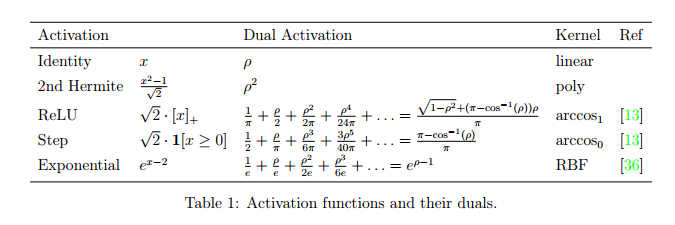
We develop a general duality between neural networks and compositional kernels, striving towards a better understanding of deep learning. We show that initial representations generated by common random initializations are sufficiently rich to express all functions in the dual kernel space. Hence, though the training objective is hard to optimize in the worst case, the initial weights form a good starting point for optimization. Our dual view also reveals a pragmatic and aesthetic perspective of neural networks and underscores their expressive power.


Join the CompressiveSensing subreddit or the Google+ Community or the Facebook page and post there !
Liked this entry ? subscribe to Nuit Blanche's feed, there's more where that came from. You can also subscribe to Nuit Blanche by Email, explore the Big Picture in Compressive Sensing or the Matrix Factorization Jungle and join the conversations on compressive sensing, advanced matrix factorization and calibration issues on Linkedin.
29 Feb 17:31

The Real Power of Cash Is Its Anonymity

by Nick Gillespie

Note: Corrected cost of a hit of acid at 5:54 P.M.!

In USA Today, Glenn Reynolds of Instapundit discusses the mad drive by former Treasury Secretary Larry Summers (and many other bright boys) to get rid of large-denomination currency notes.

What is a $100 bill worth now, compared to 1969? According to the U.S. Inflation Calculator online, a $100 bill today has the equivalent purchasing power of $15.49 in 1969 dollars. Likewise, in 1969, a $100 bill had the equivalent purchasing power of $645.55 in today’s dollars.

So even if we brought back the discontinued $500 bill, it wouldn’t have the purchasing power today that a $100 bill had in 1969, when larger denominations were discontinued. And carrying around a $100 bill today is basically like carrying around a $20 in 1969. As The New York Times put it after Summers' announced his plan, "Getting rid of big bills will make it harder for criminals to do business and make it easier for law enforcement to detect illicit activity. ...There is no need for large-denomination currency."

To which Reynolds notes two things. First, inflation!

Reading this got me to thinking: What is a $100 bill worth now, compared to 1969? According to the U.S. Inflation Calculator online, a $100 bill today has the equivalent purchasing power of $15.49 in 1969 dollars. Likewise, in 1969, a $100 bill had the equivalent purchasing power of $645.55 in today’s dollars.

So even if we brought back the discontinued $500 bill, it wouldn’t have the purchasing power today that a $100 bill had in 1969, when larger denominations were discontinued. And carrying around a $100 bill today is basically like carrying around a $20 in 1969.

Second, anonymity!

Cash has a lot of virtues. One of them is that it allows people to engage in voluntary transactions without the knowledge or permission of anyone else. Governments call this suspicious, but the rest of us call it something else: Freedom.

I'm less taken with the inflation argument, not because inflation doesn't matter but because overall purchasing power proceeds apace, thanks to technological innovation and gains in productivity. When you think of all the great crap that's available to virtually everyone in today's world, I'd much rather be middle class today than upper-middle-class in 1969. Somewhere on this page is a picture of some hippies selling LSD at Woodstock for $1.00 a hit (the brown acid cost less, I'm sure). That would be around $65 today $6.50 today, according to a straight-up inflation calculation. But as numerous folks on Twitter informed me, to the extent that acid is still around, it doesn't cost anywhere near that much and is probably better quality (thanks drug war, for nothing but human misery!).

The anonymity argument strikes me as more meaningful, and not because I'm an international drug dealer or collector of rhino horns or anything like that. The right to do what you want without being tracked and followed or subject to someone else's accounting—that's a pretty good right and it's one worth preserving or at least thinking through fully before getting rid of it. Privacy isn't about hiding bad stuff. It's about, well, privacy. And in many cases, as Reynolds notes, freedom flourishes in private settings and does less well in forced public settings.

Read the full article.

Related vid: Is Bitcoin the great libertarian hope or has it been co-opted by Wall Street?

25 Feb 04:42

U.S. Reps Seek to End Money Bail in America

by Elizabeth Nolan Brown

One of the lesser talked-about tragedies of the U.S. criminal justice system is how disruptive an arrest on even the most minor charges can be if someone doesn't have the money to pay bail. A team of freshman representatives in the U.S. House are now seeking to change that, with the "No Money Bail Act of 2016." Introduced Wednesday, the legislation would eliminate the use of money bail in the federal justice system, as well as encourage states to stop using money bail as a pretrial release condition by barring those that do from certain Department of Justice (DOJ) grants. 

"We cannot both be a nation that believes in freedom and equal justice under the law, yet at the same time, locks up thousands of people solely because they cannot afford bail," said Rep. Ted Lieu (D-Calif.), sponsor of the bail-reform bill, in a statement. "We cannot both be a nation that believes in the principle of innocent until proven guilty, yet incarcerate over 450,000 Americans who have not been convicted of a crime."

"Many people decide to plead guilty purely to get out of jail because they cannot afford bail," Lieu continued. "America should not be a country where freedom is based on income. We are better than this."

According to DOJ's Office for Access to Justice (ATJ), roughly 60 percent of the people in U.S. jails are pretrial defendants, up from 50 percent in 1996 and 40 percent in 1986.

"Bail, like many aspects of the criminal justice system, changed in the 1980s and 1990s in ways that policy makers only now see as deeply troubling," said ATJ Director Lisa Foster in a speech earlier this month. Citing a 1965 University of Pennsylvania Law Review article titled "The Coming Constitutional Crisis in Bail," Foster complained that we have known about this problem for more than 60 years and yet done little to nothing to remedy it. 

But Foster thinks the country is at a "tipping point" on bail reform, finally. "The Justice Department has been actively advocating bail reform in the states for many years," she said.

Lieu's co-sponsors on the No Money Bail Act are Reps. Bonnie Watson Coleman (D-N.J.), Brenda Lawrence (D-Mich.), and Ruben Gallego (D-Arizona). Coleman said the current bail system has "debilitating costs for our communities and our budgets." Lawrrence called it a "misuse of resources" and "a massive drain on valuable tax dollars."

Some Americans have been held in jail "for days, weeks, months, and even years before their cases are heard," said Lawrence. And "people stuck in jail while awaiting trial face far greater pressure to accept plea bargains. With each day they are denied bail, they face a greater risk of losing their jobs, custody of their children, and other rights that, ironically, can be later used against them in court." 

According to ColorofChange.org director Rashad Robinson, black Americans face 35 percent higher bail than whites do when held on the same charges. Robinson noted that Sandra Bland and Kalief Browder both died in jail "because of their inability to afford bail." 

The No Money Bail Act is endorsed by the American Civil Liberties Union (ACLU), The Pretrial Justice Institute, The Drug Policy Alliance, The Sentencing Project, The National Legal Aide & Defender Association, and the National Association of Pretrial Services Agencies (NAPSA). NAPSA head Penny Stinson said her association has long opposed the current bail system becayse "money bail inherently discriminates against the poor and removes the decision about actual release from custody from the court to profit-motivated entities." It "has no place in an evidence-based pretrial system." Jo-Ann Wallace of the National Legal Aide & Defender Association hopes the bill will emphasize "the critical place of bail reform within the broader criminal justice reform movement."  

23 Feb 20:22

Joe Biden in 1992: No SCOTUS Nominations 'Until After the November Election Is Completed'

by Damon Root

The death of Justice Antonin Scalia has ignited a political firestorm over the future of the U.S. Supreme Court. Within hours of Scalia's demise, President Barack Obama took to the airwaves, vowing "to nominate a successor in due time." The GOP-controlled Senate, Obama insisted, must then "fulfill its responsibility to give that person a fair hearing and a timely vote."

Does the Senate actually have any such responsibility? Not according to a 1992 speech by then-Senate Judiciary Committee Chairman Joseph Biden (D-Del.), who maintained that the president should "not name a nominee until after the November election is completed." In Biden's view, if a Supreme Court vacancy occurs "once the political season is underway, and it is, action on a Supreme Court nomination must be put off until after the election campaign is over." According to Biden, if a president "presses an election year nomination, the Senate Judiciary Committee should seriously consider not scheduling confirmation hearings on the nomination until ever—until after the political season is over." Take a wild guess about what political party happened to control the White House when Sen. Biden made those remarks.

Not surprisingly, Biden is now scrambling to disown his previous statements and undo the damage he has done to the Obama administration's case in the current SCOTUS showdown. To make matters worse for the Obama White House, Biden is not the only prominent Democrat whose tune has changed. In 2006 a virtual who's who of leading Senate Democrats, including Biden, Harry Reid, John Kerry, Hillary Clinton, and even Barack Obama himself, all voted to filibuster Republican Supreme Court nominee Samuel Alito in a failed attempt to delay and derail Alito's confirmation. Not exactly a shining example of what Obama now refers to as a "fair hearing and a timely vote."

To be sure, the Republican Party also has some consistency problems of its own in this area. "The Senate has a Constitutional obligation to vote up or down on a President's judicial nominees," declared President George W. Bush in 2004 (a position now mirrored by President Obama). Bush's statement came in response to the successful Democratic filibuster of some 20 of his judicial nominees, including individuals whose names were first submitted by Bush to the Senate back in 2001.

Constitutionally speaking, President Bush and President Obama are both wrong. Yes, the Constitution says the president "shall nominate...judges of the Supreme Court." And yes, Obama has every right—and every reason—to try and replace Scalia with a justice of his own choosing. But any such nomination is contingent on the "advice and consent" of the Senate. And whether the president likes it or not, the Senate is no mere rubber stamp. If a majority of Senators possess the political will to block, delay, or reject the president's Supreme Court nominee, then those Senators have the constitutional right to do so.

20 Feb 21:38

Nobody Could Have Predicted

by noreply@blogger.com (Atrios)
Doing nothing was not an option, so it's good we did something. You know, other than massive humanitarian aid or refugee resettlement.
ISTANBUL — American proxies are now at war with each other in Syria.

Officials with Syrian rebel battalions that receive covert backing from one arm of the U.S. government told BuzzFeed News that they recently began fighting rival rebels supported by another arm of the U.S. government.
18 Feb 16:05

Discrete mathematics and Big Data: summary

by Peter Cameron

This is my summary of the symposium held on 15–17 February 2016 in St Andrews.

I will give a few thoughts of my own, followed by my take on some of the
things we have heard over the course of the symposium. It is my own
take, but I make no apology: if I misrepresented a speaker, maybe they should
have explained it more clearly!

The interdisciplinary nature of the symposium meant that there were many
times when people in the audience asked for more detail from speakers. I
have not attempted to record this.

Rather than try to draw out general lessons from the very different talks we
heard, I have recorded many details about dealing with big data in various
contexts, so you can draw your own conclusions.

The combinatorial explosion

How many semigroups (sets with associative binary operation) of order n,
up to isomorphism?

The numbers as n runs from 0 to 9 are 1, 1, 5, 24, 188, 1915, 28634, 1627672, 3684030417, 105978177936292.

These numbers are not just evaluations of a formula: essentially the objects must be generated and counted.

Also, future generations of semigroup theorists might need to check the list to test a conjecture or look for a particular property.

So we have to store this data in accessible form.

There are many areas of discrete mathematics where this issue arises!

Open Research Data: UK Concordat

Here are some extracts from the document, my emphases.

  • Research Data are quantitative information or qualitative statements collected by researchers in the course of their work by experimentation, observation, interview or other methods.
  • The Concordat applies to all fields of research.
  • Principle 3: Data must be curated so that they are accessible, discoverable and useable.
  • Principle 8: Data supporting publications should be accessible by the publication date and should be in a citeable form.
  • Data underlying publications should be retained for 10 years from collection, creation or generation of the research results.

Example: The Atlas of Finite Group Representations

This site contains a large amount of data on a collection of almost simple groups. It has information on 716 groups in 5215 permutation or matrix representations, some rather large.

For example, E8(5) has order about 2.10173 and is generated by two 248×248 matrices over the field GF(5).

Sitting at my desk, running my favourite computer algebra program GAP, I can type

> RequirePackage("atlasrep");

and then

> G:=AtlasGroup("E8(5)");

and generators of the group are downloaded ready for me to explore. Similarly for the other seven hundred groups in the database.

In my view this is a paradigm for big data in discrete mathematics!

Arieh Iserles

The 19th century was the century of steam, the 20th of the internal combustion engine, or of electricity. Will the 21st be the century of data science? Arieh claimed that the correct answer would be information, the organisation of data and its use to transform our lives.

Data science is not just mathematics: it includes topics such as machine learning, image analysis, network analysis and signal processing, but also such non-mathematical aspects as data fusion and curation, natural language processing, legal and ethical aspects, and social science.

The areas of mathematics most relevant to data science are statistics, computation and optimization, applied and computational harmonic analysis, PDEs, and inverse problems.

As individual mathematicians, we should not flock to data science, but continue to do what we are excited about. But heads of department must be aware of funding opportunities and ensure that experts in data science are appointed.

His model of data science is a bicycle wheel. The experts work at the hub; the rim is the entire university; and the spokes are the communication channels.

(I have met this model before. At the Isaac Newton Institute in Cambridge in
2011, John Stufken used it to describe the relationship between theoretical
statisticians and scientists who need statistics: essentially the same
example, but John thinks of spokes as people who are comfortable both in the
hub and at the rim, who can apply the latest theoretical developments to real
problems.)

In short, this is a great opportunity for mathematics!

Igor Rivin

Igor began with the notion that discrete mathematicians generate data out of their heads (in the case of Gauss, the first data scientist), or, nowadays, their computers, rather than from experiment or observation; but the principles are the same.

As a case study, he described zeolites, hydrated aluminosilicate minerals which now have many industrial uses, from catalysts in the petrochemical industry to cat litter. The number of naturally occurring zeolites is in the hundreds, but vast numbers can be generated by computer; so many, that generating them and searching for those with interesting properties is infeasible. Can we correlate chemical properties of zeolites with their graph-theoretic properties, and so direct the search?

Igor told us the cautionary tale of Doug Lenat who, in the 1970s, started using
computers to generate mathematical concepts, and whose name has now given
us the unit for measuring bogusity (the microlenat).

A database of potential zeolites is at https://www.hypotheticalzeolites.net.

V. Anne Smith

Anne was filling in at quite short notice, and told us about Bayesian network analysis of genetic, neural and ecological data.

(It is not so surprising that genomics is connected with discrete mathematics. Eric Lander, the lead scientist on the Human Genome Project, did his doctorate in Oxford on coding theory.)

Anne reminded us that not all “big data” are equally useful. Many observations on a few variables: good. A few observations on each of many variables: not so good!

A Bayesian network describes non-independence between variables: A and B are non-independent if P(A|B)≠P(A), and the influence of B on A is mediated through C if P(A|B,C)=P(A|C). Bayesian networks are always directed acyclic graphs.

There are algorithms which produce a Bayesian network from a given collection of data. For genetic networks involving mRNA, how much of the network can you reconstruct, and how much is wrong? These questions depend sensitively on the amount of data available. A surprising fact to the audience was that, although mRNA produces protein, the mRNA-protein correlations are quite poor.

The methods work much better for neural data, for example, female zebra finches hearing male song; the reconstructed networks agree well with what is known from anatomical studies.

Patric Østergård

Like most discrete mathematicians, Patric had not thought much about Big Data until this meeting gave him the opportunity to step back and reflect.

The problems he works on form a hierarchy: existence; counting (all, or up to equivalence); classification (a description of all objects); and characterization (understanding the objects).

One achievement was the classification of Steiner triple systems on 19 points (there are 11084874829 of them). They were able to store the compressed data in 39GB (about three bytes per system), but in this form the data is not searchable. By a 72-bit hash function encoding, they produced a 63GB version of the data, which they were able to use to show that any system can be reached from any other by cycle switching.

The graph is so large that the computer cannot hold the entire thing. We have what he called a big implicit graph, where if we are at a vertex we can find one (or maybe all) adjacent vertices, and we can test whether two vertices are adjacent. “Think global, act local.”

He then told us about his work with Leonard Soicher on the putative McLaughlin geometry. This is an example where the program crunches a huge amount of data, but the answer is likely to be one bit (he guesses “no”).

Rosemary Bailey

Rosemary reminded us that, for the result of data collection to be useful, it is necessary to think beforehand about how it is done (and this is where design of experiments comes in).

Statisticians are trained to think that nearly equal replication is crucial, whereas biologists learn that it is important to compare everything to controls. We were shown an example arising in trials of new seed varieties where the best design (minimizing the sum of variances of estimators of treatment differences) shifts from one of these paradigms to the other by a sequence of steps or phase changes as we change the precise number of varieties being tested and assumptions about blocking.

Several earlier speakers mentioned Laplacian eigenvalues, which are also important in discussion of experimental design, where they give us the efficiency factors. Should we think of a huge experiment as an approximation to a manifold?

The design of experiments for large numbers of varieties with very small average replication is still challenging!

Charo del Genio

Charo was also here at quite short notice.

Suppose that observation or experiment has given us a certain network. (He gave an example from the early days of the spread of the AIDS virus, involving people’s sexual contacts.) How special is that network? For example, how typical are parameters such as its average distance, among other networks with similar properties? (For mathematicians, a network is just a graph, possibly directed.)

His approach is to generate random networks sharing the appropriate properties, which can be compared with the network we are actually looking at. What kinds of properties are appropriate? He mentioned earlier work on choosing a random network with specified vertex degree sequence.

His recent work involves the joint degree matrix, which gives us (for each alpha$ and $\beta$) the number of edges between vertices of degree α and vertices of degree β. He showed us how to check the consistency of the JDM, and if it is consistent, how to choose a random network with this JDM.

The question of how to deal with errors in the observed network (a notorious problem in the case of self-reported sexual contacts), or small failures of the degree sequence or JDM to satisfy the necessary conditions, provoked a lively (but inconclusive) discussion.

Also unclear were the hypothesis testing aspects: is the observed network significantly different from a typical one?

Simon Dobson

The title of Simon’s talk was “A complex cocktail of networks and reality”. He described modelling the transport systems in London and New York as multiplexes (multilayer networks, pairs of networks linked at certain nodes) made up of streets and metro. The first phase looked just at the topology of the networks, and explored shortest paths (in terms of time, assuming a ratio β between one’s speed on the street or in the metro). The data is available from Open Streetmap, but needs cleaning before use.

More recent work involves looking at actual flows, using, for example,
Oyster Card data from the London Tube.

These networks are far from random, having grown up with many geographical and human constraints. For example, assortativity – the tendency of nodes of high degree to link to other nodes of high degree – influences the spread of epidemics.

This led to a discussion of the Plague, and why (though it still exists, as do rats and fleas), we have not had an epidemic for a long time. (This investigation is hampered by gaps in the historical data.)

Simon dreams of a project called “Fake Scotland” which would simulate the growth of Scotland, based on such constraints.

He ended with a quote from Alexander Solzhenitsyn, First Circle:

Topology! The stratosphere of human thought! In the twenty-fourth century it might possibly be of use to someone …

Manish Parashar

Manish began by describing experiments which produce large quantities of data. The Square Kilometre Array will generate an exabyte of data a day by 2020. All branches of knowledge are becoming data-rich. This raises important problems in management and analysis of data.

But all this pales when compared to the amount of data which can be produced by simulation on the latest generation of supercomputers. As we approach exascale science, a machine will need a dedicated power station just to keep it running. (My colleague’s response to this was “No wonder these facilities depend not on the National Science Foundation, but on the Department of Energy …”)

But there is a huge problem here. Processing speeds have increased enormously, but speeds of data movement have not kept pace. So it is now impossible for a modern supercomputer to save all the data it produces running a simulation! Some data is described as WORN (“write once, read never”).

The solution that Manish and his collaborators are working on involves processing the data either in situ or in transit. Multi-core nodes can have some cores producing the data, and others analysing it or constructing visualisations. Another use of local processing is to compress the data so less has to be moved. A further idea is to send the code to where the data is rather than vice versa.

This led to an interesting discussion. Arieh Iserles as devil’s advocate proposed the thesis that high-performance computing is the enemy of algorithm development, for various reasons: the architectures of these machines make innovative algorithms difficult to run, and the programmers find it easy to be lazy and use the methods they know.

As a general point, with the growth of simulation science, problems of reproducibility arise. As Manish said, software is now critical for the reproducibility of science.

(I couldn’t avoid the feeling that as the amount of data grows, the signal-to-noise ratio plummets.)

Franz Király

Franz departed from his prepared talk on a technical aspect of machine learning in order to address the question “What is data science?”

He began with an uncontroversial definition of data, but when he described the scientific method as

observation → hypothesis → prediction → experiment → cycle,

many members of the audience objected. In the end we were not going to solve a problem that has been open for millennia, so Franz was allowed to proceed.

The talk quickly specialised to machine learning, supervised or unsupervised. How to measure quantitatively the goodness of a model? This is only defined relative to the data that is being analysed. Given a measure of goodness, we can compare our model; we should compare it to a random guess, and to state-of-the-art or simple models, to see how we are doing.

Ke Yi

By contrast, Ke gave us a nice technical talk about algorithms for sampling from a dataset. We assume that we can’t cope with the totality of data, and we wish to sample efficiently.

The oldest such result, on random sampling from a data stream, is reservoir sampling. We wish to maintain a random sample of s elements from a data stream. We must start by choosing the first s. If we have a sample from n items, and the (n+1)$st arrives, we keep it with probability s/n$; if we keep it, we discard an existing item (all equally likely). Simple enough, but Ke pointed out that more than half of the proofs of correctness on the first page of a Google search are deficient.

He went on to random sampling from distributed streams, range queries, and from data distributed over many nodes, where we want to reduce the amount of communication required.

Jon McLoone

Jon, from Wolfram, told us how to make data science techniques available to a wider audience. One of the key things is keeping the walls as low as possible: rather than cutting-edge programming, the goal is accessibility. All options must have sensible defaults so that the user can progress without worrying about setting them; and since data might be in any format, the translation should just work.

Everything in Mathematica, be it a number, string, picture, database, or program, is a symbolic object. There is no typing in the language because everything has the same type.

Part of the talk was a practical version of Franz Király’s talk. When Franz asked about model evaluation, Jon was able to show him a long list of options hiding behind a submenu for the experienced user.

This is not big data; but if it gets a new generation of people interested in capturing and analysing data and producing and deploying the results, it’s good for the subject.

Chris Williams

Chris began wearing the hat of his involvement with the EPSRC-funded Centre for Doctoral Training in Data Science in Edinburgh, and moved on to his involvement with intensive care monitoring in a Glasgow hospital.

Data science lies at the intersection of mathematics and statistics, hacking skills, and substantive expertise. If the first element is lacking, we are in a danger zone!

Data science has to deal with questions of scale, fusion of data sources, structure discovery, trust, and ease of use.

We heard about deep learning, a popular topic with students now, but not the answer to all problems in data science.

Clincal data from patients in intensive care (heartrate, blood pressure, etc.) is monitored, of course. But various artefacts affect the data: some is administered by hospital staff (e.g. taking a blood sample, suctioning the lungs), some is caused by the monitoring equipment (e.g. damped trace, blockage in the blood pressure monitoring line). The system they have developed is good at detecting some of these such as damped trace (and so reduces false alarms), but not yet good enough for general use.

Rob Ghrist

Rob talked about the use of algebraic topology (specifically persistent homology) in the analysis of certain datasets.

I don’t have space here to give a course on algebraic topology, which he described as “the most useful least used mathematics”. Our datapoints are often spatial, and we have edges joining certain points, triangles filling in certain triples, and so on. Over your favourite field, you take vector spaces with bases the points, edges, triangles, …, and define boundary maps between them reflecting the incidence structure. The quotient of the kernel of one map by the image of the next is a homology group. So these groups reflect geometric aspects of the data.

For example, H0 tells about connected components; H1, about cycles; H2, about hollows bounded by surfaces.

More important, they are functorial: maps between spaces induce maps between the homology groups. Maps between spaces may be given by, for example, changing the scale of measurement.

Now we can decompose homology into indecomposable components. These are described, as the parameter changes, by “barcodes” indicating the points at which they appear and disappear. Components which persist for a long time probably tell us about more interesting features of the data.

Rob mentioned three applications.

  • H0 measures persistent clustering, applicable to genetics, sports data, etc.
  • H1 measures holes in the coverage of sensor networks, and possibly detects whether an intruder can move around without being detected.
  • Higher homology has important recent applications in neural connections. The signatures of the dimensions of persistent homology groups in various ranks can distinguish random connections (as in a fly’s olfactory system) from geometric connections (as in a rat’s visual cortex).

New ideas with promise include using cohomology or sheaf theory, but this is not the place to describe them.

Robert Wilson

Rob began with context, a description of teaching and research as

“reality” → data → information → knowledge → wisdom.

These blend into one another without clear boundaries.

In his own field, group theory, the problem is to get information about groups from data giving generating permutations or matrices for the groups.

The Classification of Finite Simple Groups was probably the major achievement of 20th century mathematics. One of the groups is the Monster, a “sporadic” simple group of order about 1054 whose smallest permutation representation is on about 1020 points. A single generator for the group would take about 800 exabytes of storage! Matrices are better, since there is a representation by matrices of order 196882 over the field of two elements; one of these only takes about 5 gigabytes.

But these matrices are highly structured, and using the structure and group properties it was possible in the 1990s to fit the generators (and a program) onto a 1.44MB floppy disc.

More recent work has focussed on the idea that, for example, we can study permutation groups without using actual permutations: only a small amount of data in each permutation is actually required. In this way, the computer algebra system GAP can handle groups with big permutation representations (up to about 1018 points, so not quite large enough for the Monster yet).

Rob concluded by referring to the Atlas of Finite Group Representations, which I mentioned in my introduction. The Atlas is designed to be useful by ordinary algebraists with no special knowledge of how it was constructed.

Unfortunately, like all public services these days, its continued existence is under threat …

Summing up

  • There is a big difference between data generated by a problem in discrete mathematics and data from observation or simulation in science. We have great expertise in the first; can we transfer it to the second?
  • Producers of large amounts of data should be encouraged to process it in situ, since moving data is increasingly expensive and slow compared to processing it.
  • However the data is produced, there may be people with modest computers and no data science expertise who need to use it. We should store it in a form to make this straightforward.
  • It is good to step back sometimes and think about what we are doing. But it is not necessary to have a definition of our subject in order to do it.
  • On of the best features of an interdisciplinary meeting like this one is the contacts we have made with people in very different areas.
  • This is a great opportunity for mathematics, statistics and computer science to position themselves at the centre of the university and of the “knowledge economy”. We should grasp it!

16 Feb 20:14

Shit Is Fucked Up And Bullshit

by noreply@blogger.com (Atrios)
If only there was someone with executive authority to stop this stuff.
U.S. Marshals armed with automatic weapons arrested a Texas man for not paying a $1,500 student loan from three decades ago, he claims.

Paul Aker said he was surprised at his Houston-area home by seven people in combat gear.

"I was wondering, why are you here," he told Fox 26. "I am home, I haven't done anything."

Aker said he didn't receive any notice or warning about the loan, which he received in 1987.


12 Feb 23:57

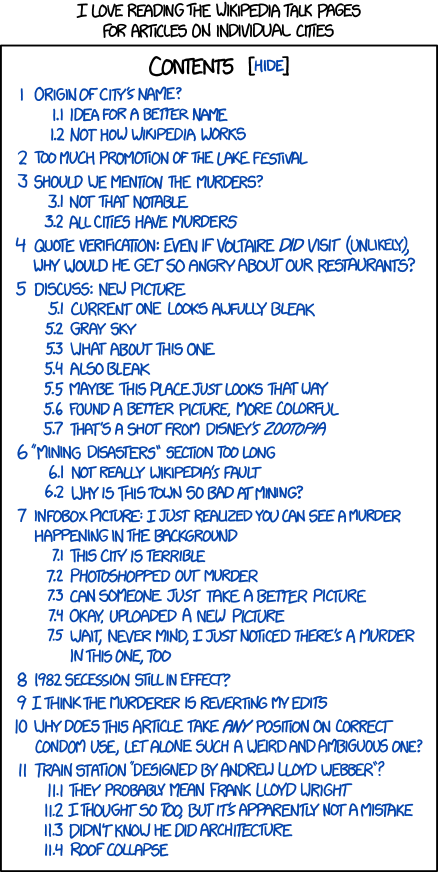
The Mount St. Mary’s story is just so terrible

by Cathy O'Neil, mathbabe

I’m sure many of you have heard the story that a tenured professor, as well as a non-tenured professor, were fired recently by the president, Simon Newman, of Mount St. Mary’s school in Maryland.

The short version: Newman, a private equity asshole, got confused as to where he was working and decided to fire anyone who disagreed with him, referring to disloyalty as the cause.

The specific “act of disloyalty” one of the professors made was to allow a student newspaper to report a (true) comment the president didn’t want made public, namely:

“This is hard for you because you think of the students as cuddly bunnies, but you can’t,” Mr. Newman is quoted as saying. “You just have to drown the bunnies.” He added, “Put a Glock to their heads.”

OK, gross and shocking.

But personally, I was even more disgusted by the story behind this story, namely his underlying plan to get rid of students for the sake of improving the college’s “retention rate” and thus its ranking on the US News & World Reports College rankings, that scourge of higher education.

The original article from the student newspaper explains Newman’s unfuckingbelievable plan. From the article:

Mount St. Mary’s University, like all colleges and universities in the U.S., is required by the federal government to submit the number of students enrolled each semester. The Mount’s cutoff date for the Fall 2015 semester was Sept. 25, and the number of students enrolled as of that date would be the number used to compute the Mount’s student retention.

Newman was obsessed with getting rid of students and revealed this in an email:

Newman’s email continued: “My short term goal is to have 20-25 people leave by the 25th [of Sep.]. This one thing will boost our retention 4-5%. A larger committee or group needs to work on the details but I think you get the objective.”

How was he going to achieve this number?

The president’s plan to “cull the class” involved using a student survey that was developed in the president’s office and administered during freshman orientation.

The survey was going to be given to students and started out by describing itself as “based on some of the leading thinking in the area of personal motivation and key factors that determine motivation, success, and happiness. We will ask you some questions about yourself that we would like you to answer as honestly as possible. There are no wrong answers.”

The actual plan for the results of the survey were a bit different – they would be used to help compile a list of students to get rid of before the deadline. Just so gross, and a wonderful example of how an algorithm can be used for good or evil. Please read the rest of the article, it’s amazing journalism.

Holy crap, people, this gaming of the US News & World Reports model has got to stop, this shit is nuts. And it makes me wonder how many other places are doing stuff like this and not getting caught. I mean, at least at this university the president was stupid enough to tell the professors the plan, right?


10 Feb 23:07

Diffusion of Ellipsoids in Bacterial Suspensions

by Yi Peng, Lipeng Lai, Yi-Shu Tai, Kechun Zhang, Xinliang Xu, and Xiang Cheng

Author(s): Yi Peng, Lipeng Lai, Yi-Shu Tai, Kechun Zhang, Xinliang Xu, and Xiang Cheng

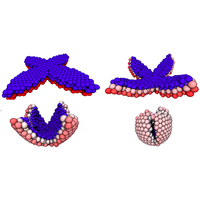
An ellipsoid immersed in a bacterial suspension diffuses slowest along its major axis and fastest along its minor axis, in contrast to predictions from Brownian motion.


[Phys. Rev. Lett. 116, 068303] Published Wed Feb 10, 2016

10 Feb 21:32

Linguistics: Languages have common structure

Linguistics: Languages have common structure

Nature 530, 7589 (2016). doi:10.1038/530133b

Many languages share a universal semantic structure that is independent of their speakers' culture, environment or how closely the languages are related.Hyejin Youn and Tanmoy Bhattacharya at the Santa Fe Institute in New Mexico and their colleagues studied the words for 22 universal concepts

09 Feb 10:39

Viewpoint: Extending an Alternative to Feynman Diagrams

by David A. Kosower

Author(s): David A. Kosower

A simplifying technique for calculating scattering amplitudes—the basis for predictions in particle physics experiments—has been extended to cover a class of effective quantum field theories.


[Physics 9, 15] Published Mon Feb 08, 2016

08 Feb 18:42

Bioresorbable silicon electronic sensors for the brain

by Seung-Kyun Kang

Bioresorbable silicon electronic sensors for the brain

Nature 530, 7588 (2016). doi:10.1038/nature16492

Authors: Seung-Kyun Kang, Rory K. J. Murphy, Suk-Won Hwang, Seung Min Lee, Daniel V. Harburg, Neil A. Krueger, Jiho Shin, Paul Gamble, Huanyu Cheng, Sooyoun Yu, Zhuangjian Liu, Jordan G. McCall, Manu Stephen, Hanze Ying, Jeonghyun Kim, Gayoung Park, R. Chad Webb, Chi Hwan Lee, Sangjin Chung, Dae Seung Wie, Amit D. Gujar, Bharat Vemulapalli, Albert H. Kim, Kyung-Mi Lee, Jianjun Cheng, Younggang Huang, Sang Hoon Lee, Paul V. Braun, Wilson Z. Ray & John A. Rogers

Many procedures in modern clinical medicine rely on the use of electronic implants in treating conditions that range from acute coronary events to traumatic injury. However, standard permanent electronic hardware acts as a nidus for infection: bacteria form biofilms along percutaneous wires, or seed haematogenously, with the potential to migrate within the body and to provoke immune-mediated pathological tissue reactions. The associated surgical retrieval procedures, meanwhile, subject patients to the distress associated with re-operation and expose them to additional complications. Here, we report materials, device architectures, integration strategies, and in vivo demonstrations in rats of implantable, multifunctional silicon sensors for the brain, for which all of the constituent materials naturally resorb via hydrolysis and/or metabolic action, eliminating the need for extraction. Continuous monitoring of intracranial pressure and temperature illustrates functionality essential to the treatment of traumatic brain injury; the measurement performance of our resorbable devices compares favourably with that of non-resorbable clinical standards. In our experiments, insulated percutaneous wires connect to an externally mounted, miniaturized wireless potentiostat for data transmission. In a separate set-up, we connect a sensor to an implanted (but only partially resorbable) data-communication system, proving the principle that there is no need for any percutaneous wiring. The devices can be adapted to sense fluid flow, motion, pH or thermal characteristics, in formats that are compatible with the body’s abdomen and extremities, as well as the deep brain, suggesting that the sensors might meet many needs in clinical medicine.

08 Feb 14:42

The Gandhi-Hitler Letters

by Beachcombing
Nosimpler

what

Love or hate Gandhi, and God knows there are plenty of reasons for both, there is something remarkable about this abortive correspondence between he and Hitler (see below the post): ‘correspondence’ might not be the right word as Hitler never wrote back. The first letter dates to late July of 1939 when the world was […]
08 Feb 13:50

The first wearable translator will be coming this summer

by Tyler Cowen

Language barriers while traveling the world may become a problem of the past with the advent of new technology. The latest craze in the tech world was recently unveiled at the 2016 Electronics Show: a wearable translator. The Japanese startup Logbar plans on releasing the portable translator called the “ili” this summer. The actual device looks like an Apple TV controller and is hung around your neck.

With the press of a button, the device is allegedly capable of simultaneous translation.

There is more here by David Grasso, including a video, from bold.global.

The post The first wearable translator will be coming this summer appeared first on Marginal REVOLUTION.

07 Feb 15:51

Rams Stiff St. Louis, Leave City with $144 Million Bill

by Alexis Garcia

St. Louis residents no longer have a football team, but that doesn’t mean they will get to stop paying for one. While the Rams won a vote in mid-January to relocate to Los Angeles, St. Louis taxpayers will still be responsible for making $144 million in debt and maintenance payments for the Edward Jones Dome. 

Lewis Reed, the St. Louis Board of Alderman president, has asked the NFL for money to help pay off the debt, but he seems unaware of how the multi-billion dollar league operates. 

As Reason has reported in the past, stadium financing is one way the NFL holds cities hostage—either pay for a state-of-the-art facility or lose the prestige of having a professional football team. This has resulted in often lopsided stadium deals that leave cities (and their taxpayers) burdened with much of the debt. 

As Reuters points out:

Across the country, cities have gotten stuck with substantial costs after sports teams leave or even move across town. Often, local governments must pay bonds, maintenance costs, or demolition fees after a team is gone.

Houston’s iconic Astrodome, once dubbed the Eighth Wonder of the World, sits empty a decade after the facility housed 25,000 evacuees of Hurricane Katrina and nearly 20 years after the Oilers left. The Detroit Lions’ former Silverdome in Pontiac, Michigan, was used sporadically after the team moved downtown in 2002, but shuttered for good when the inflatable roof was deflated.

St. Louis isn’t the only city that regrets its deal with the NFL. Reason’s Ed Krayewski wrote just a couple weeks ago that San Francisco residents are having buyer’s remorse after realizing that their agreement with the NFL to host a Super Bowl in exchange for a new stadium in Santa Clara, CA resulted in a $5.3 million bill for early lease termination. So why would any smart city want the NFL? Reason TV explored this question in the video below. 

06 Feb 01:11

Baby monitors can be hacked

by Minnesotastan

Predictably enough, accounts are now surfacing of voyeurs and griefers who are using these capabilities to spy on, and taunt babies.

Jay and Sarah, parents in San Francisco, couldn't figure out what their three-year-old meant when he said he was scared to sleep at night because the "phone" kept talking to him, but then one night Sarah walked by and heard a stranger's voice coming out of the monitor, saying, "Wake up little boy, daddy's looking for you."

When Sarah walked in the room, the camera's night-vision lens turned to examine her and the voice added, "look someone's coming into view." 
Further details and links at BoingBoing.

Word for the day:
A griefer is a player in a multiplayer video game who deliberately irritates and harasses other players within the game, using aspects of the game in unintended ways. A griefer derives pleasure primarily or exclusively from the act of annoying other users, and as such is a particular nuisance in online gaming communities, since griefers often cannot be deterred by penalties related to in-game goals.