ISTANBUL — American proxies are now at war with each other in Syria.
Officials with Syrian rebel battalions that receive covert backing from one arm of the U.S. government told BuzzFeed News that they recently began fighting rival rebels supported by another arm of the U.S. government.
Nosimpler
Shared posts
20 Feb 21:38
Nobody Could Have Predicted
by noreply@blogger.com (Atrios)
Doing nothing was not an option, so it's good we did something. You know, other than massive humanitarian aid or refugee resettlement.
18 Feb 16:05


Discrete mathematics and Big Data: summary
by Peter Cameron
This is my summary of the symposium held on 15–17 February 2016 in St Andrews.
I will give a few thoughts of my own, followed by my take on some of the
things we have heard over the course of the symposium. It is my own
take, but I make no apology: if I misrepresented a speaker, maybe they should
have explained it more clearly!
The interdisciplinary nature of the symposium meant that there were many
times when people in the audience asked for more detail from speakers. I
have not attempted to record this.
Rather than try to draw out general lessons from the very different talks we
heard, I have recorded many details about dealing with big data in various
contexts, so you can draw your own conclusions.
The combinatorial explosion
How many semigroups (sets with associative binary operation) of order n,
up to isomorphism?
The numbers as n runs from 0 to 9 are 1, 1, 5, 24, 188, 1915, 28634, 1627672, 3684030417, 105978177936292.
These numbers are not just evaluations of a formula: essentially the objects must be generated and counted.
Also, future generations of semigroup theorists might need to check the list to test a conjecture or look for a particular property.
So we have to store this data in accessible form.
There are many areas of discrete mathematics where this issue arises!
Open Research Data: UK Concordat
Here are some extracts from the document, my emphases.
- Research Data are quantitative information or qualitative statements collected by researchers in the course of their work by experimentation, observation, interview or other methods.
- The Concordat applies to all fields of research.
- Principle 3: Data must be curated so that they are accessible, discoverable and useable.
- Principle 8: Data supporting publications should be accessible by the publication date and should be in a citeable form.
- Data underlying publications should be retained for 10 years from collection, creation or generation of the research results.
Example: The Atlas of Finite Group Representations
This site contains a large amount of data on a collection of almost simple groups. It has information on 716 groups in 5215 permutation or matrix representations, some rather large.
For example, E8(5) has order about 2.10173 and is generated by two 248×248 matrices over the field GF(5).
Sitting at my desk, running my favourite computer algebra program GAP, I can type
> RequirePackage("atlasrep");
and then
> G:=AtlasGroup("E8(5)");
and generators of the group are downloaded ready for me to explore. Similarly for the other seven hundred groups in the database.
In my view this is a paradigm for big data in discrete mathematics!
Arieh Iserles
The 19th century was the century of steam, the 20th of the internal combustion engine, or of electricity. Will the 21st be the century of data science? Arieh claimed that the correct answer would be information, the organisation of data and its use to transform our lives.
Data science is not just mathematics: it includes topics such as machine learning, image analysis, network analysis and signal processing, but also such non-mathematical aspects as data fusion and curation, natural language processing, legal and ethical aspects, and social science.
The areas of mathematics most relevant to data science are statistics, computation and optimization, applied and computational harmonic analysis, PDEs, and inverse problems.
As individual mathematicians, we should not flock to data science, but continue to do what we are excited about. But heads of department must be aware of funding opportunities and ensure that experts in data science are appointed.
His model of data science is a bicycle wheel. The experts work at the hub; the rim is the entire university; and the spokes are the communication channels.
(I have met this model before. At the Isaac Newton Institute in Cambridge in
2011, John Stufken used it to describe the relationship between theoretical
statisticians and scientists who need statistics: essentially the same
example, but John thinks of spokes as people who are comfortable both in the
hub and at the rim, who can apply the latest theoretical developments to real
problems.)
In short, this is a great opportunity for mathematics!
Igor Rivin
Igor began with the notion that discrete mathematicians generate data out of their heads (in the case of Gauss, the first data scientist), or, nowadays, their computers, rather than from experiment or observation; but the principles are the same.
As a case study, he described zeolites, hydrated aluminosilicate minerals which now have many industrial uses, from catalysts in the petrochemical industry to cat litter. The number of naturally occurring zeolites is in the hundreds, but vast numbers can be generated by computer; so many, that generating them and searching for those with interesting properties is infeasible. Can we correlate chemical properties of zeolites with their graph-theoretic properties, and so direct the search?
Igor told us the cautionary tale of Doug Lenat who, in the 1970s, started using
computers to generate mathematical concepts, and whose name has now given
us the unit for measuring bogusity (the microlenat).
A database of potential zeolites is at https://www.hypotheticalzeolites.net.
V. Anne Smith
Anne was filling in at quite short notice, and told us about Bayesian network analysis of genetic, neural and ecological data.
(It is not so surprising that genomics is connected with discrete mathematics. Eric Lander, the lead scientist on the Human Genome Project, did his doctorate in Oxford on coding theory.)
Anne reminded us that not all “big data” are equally useful. Many observations on a few variables: good. A few observations on each of many variables: not so good!
A Bayesian network describes non-independence between variables: A and B are non-independent if P(A|B)≠P(A), and the influence of B on A is mediated through C if P(A|B,C)=P(A|C). Bayesian networks are always directed acyclic graphs.
There are algorithms which produce a Bayesian network from a given collection of data. For genetic networks involving mRNA, how much of the network can you reconstruct, and how much is wrong? These questions depend sensitively on the amount of data available. A surprising fact to the audience was that, although mRNA produces protein, the mRNA-protein correlations are quite poor.
The methods work much better for neural data, for example, female zebra finches hearing male song; the reconstructed networks agree well with what is known from anatomical studies.
Patric Østergård
Like most discrete mathematicians, Patric had not thought much about Big Data until this meeting gave him the opportunity to step back and reflect.
The problems he works on form a hierarchy: existence; counting (all, or up to equivalence); classification (a description of all objects); and characterization (understanding the objects).
One achievement was the classification of Steiner triple systems on 19 points (there are 11084874829 of them). They were able to store the compressed data in 39GB (about three bytes per system), but in this form the data is not searchable. By a 72-bit hash function encoding, they produced a 63GB version of the data, which they were able to use to show that any system can be reached from any other by cycle switching.
The graph is so large that the computer cannot hold the entire thing. We have what he called a big implicit graph, where if we are at a vertex we can find one (or maybe all) adjacent vertices, and we can test whether two vertices are adjacent. “Think global, act local.”
He then told us about his work with Leonard Soicher on the putative McLaughlin geometry. This is an example where the program crunches a huge amount of data, but the answer is likely to be one bit (he guesses “no”).
Rosemary Bailey
Rosemary reminded us that, for the result of data collection to be useful, it is necessary to think beforehand about how it is done (and this is where design of experiments comes in).
Statisticians are trained to think that nearly equal replication is crucial, whereas biologists learn that it is important to compare everything to controls. We were shown an example arising in trials of new seed varieties where the best design (minimizing the sum of variances of estimators of treatment differences) shifts from one of these paradigms to the other by a sequence of steps or phase changes as we change the precise number of varieties being tested and assumptions about blocking.
Several earlier speakers mentioned Laplacian eigenvalues, which are also important in discussion of experimental design, where they give us the efficiency factors. Should we think of a huge experiment as an approximation to a manifold?
The design of experiments for large numbers of varieties with very small average replication is still challenging!
Charo del Genio
Charo was also here at quite short notice.
Suppose that observation or experiment has given us a certain network. (He gave an example from the early days of the spread of the AIDS virus, involving people’s sexual contacts.) How special is that network? For example, how typical are parameters such as its average distance, among other networks with similar properties? (For mathematicians, a network is just a graph, possibly directed.)
His approach is to generate random networks sharing the appropriate properties, which can be compared with the network we are actually looking at. What kinds of properties are appropriate? He mentioned earlier work on choosing a random network with specified vertex degree sequence.
His recent work involves the joint degree matrix, which gives us (for each alpha$ and $\beta$) the number of edges between vertices of degree α and vertices of degree β. He showed us how to check the consistency of the JDM, and if it is consistent, how to choose a random network with this JDM.
The question of how to deal with errors in the observed network (a notorious problem in the case of self-reported sexual contacts), or small failures of the degree sequence or JDM to satisfy the necessary conditions, provoked a lively (but inconclusive) discussion.
Also unclear were the hypothesis testing aspects: is the observed network significantly different from a typical one?
Simon Dobson
The title of Simon’s talk was “A complex cocktail of networks and reality”. He described modelling the transport systems in London and New York as multiplexes (multilayer networks, pairs of networks linked at certain nodes) made up of streets and metro. The first phase looked just at the topology of the networks, and explored shortest paths (in terms of time, assuming a ratio β between one’s speed on the street or in the metro). The data is available from Open Streetmap, but needs cleaning before use.
More recent work involves looking at actual flows, using, for example,
Oyster Card data from the London Tube.
These networks are far from random, having grown up with many geographical and human constraints. For example, assortativity – the tendency of nodes of high degree to link to other nodes of high degree – influences the spread of epidemics.
This led to a discussion of the Plague, and why (though it still exists, as do rats and fleas), we have not had an epidemic for a long time. (This investigation is hampered by gaps in the historical data.)
Simon dreams of a project called “Fake Scotland” which would simulate the growth of Scotland, based on such constraints.
He ended with a quote from Alexander Solzhenitsyn, First Circle:
Topology! The stratosphere of human thought! In the twenty-fourth century it might possibly be of use to someone …
Manish Parashar
Manish began by describing experiments which produce large quantities of data. The Square Kilometre Array will generate an exabyte of data a day by 2020. All branches of knowledge are becoming data-rich. This raises important problems in management and analysis of data.
But all this pales when compared to the amount of data which can be produced by simulation on the latest generation of supercomputers. As we approach exascale science, a machine will need a dedicated power station just to keep it running. (My colleague’s response to this was “No wonder these facilities depend not on the National Science Foundation, but on the Department of Energy …”)
But there is a huge problem here. Processing speeds have increased enormously, but speeds of data movement have not kept pace. So it is now impossible for a modern supercomputer to save all the data it produces running a simulation! Some data is described as WORN (“write once, read never”).
The solution that Manish and his collaborators are working on involves processing the data either in situ or in transit. Multi-core nodes can have some cores producing the data, and others analysing it or constructing visualisations. Another use of local processing is to compress the data so less has to be moved. A further idea is to send the code to where the data is rather than vice versa.
This led to an interesting discussion. Arieh Iserles as devil’s advocate proposed the thesis that high-performance computing is the enemy of algorithm development, for various reasons: the architectures of these machines make innovative algorithms difficult to run, and the programmers find it easy to be lazy and use the methods they know.
As a general point, with the growth of simulation science, problems of reproducibility arise. As Manish said, software is now critical for the reproducibility of science.
(I couldn’t avoid the feeling that as the amount of data grows, the signal-to-noise ratio plummets.)
Franz Király
Franz departed from his prepared talk on a technical aspect of machine learning in order to address the question “What is data science?”
He began with an uncontroversial definition of data, but when he described the scientific method as
observation → hypothesis → prediction → experiment → cycle,
many members of the audience objected. In the end we were not going to solve a problem that has been open for millennia, so Franz was allowed to proceed.
The talk quickly specialised to machine learning, supervised or unsupervised. How to measure quantitatively the goodness of a model? This is only defined relative to the data that is being analysed. Given a measure of goodness, we can compare our model; we should compare it to a random guess, and to state-of-the-art or simple models, to see how we are doing.
Ke Yi
By contrast, Ke gave us a nice technical talk about algorithms for sampling from a dataset. We assume that we can’t cope with the totality of data, and we wish to sample efficiently.
The oldest such result, on random sampling from a data stream, is reservoir sampling. We wish to maintain a random sample of s elements from a data stream. We must start by choosing the first s. If we have a sample from n items, and the (n+1)$st arrives, we keep it with probability s/n$; if we keep it, we discard an existing item (all equally likely). Simple enough, but Ke pointed out that more than half of the proofs of correctness on the first page of a Google search are deficient.
He went on to random sampling from distributed streams, range queries, and from data distributed over many nodes, where we want to reduce the amount of communication required.
Jon McLoone
Jon, from Wolfram, told us how to make data science techniques available to a wider audience. One of the key things is keeping the walls as low as possible: rather than cutting-edge programming, the goal is accessibility. All options must have sensible defaults so that the user can progress without worrying about setting them; and since data might be in any format, the translation should just work.
Everything in Mathematica, be it a number, string, picture, database, or program, is a symbolic object. There is no typing in the language because everything has the same type.
Part of the talk was a practical version of Franz Király’s talk. When Franz asked about model evaluation, Jon was able to show him a long list of options hiding behind a submenu for the experienced user.
This is not big data; but if it gets a new generation of people interested in capturing and analysing data and producing and deploying the results, it’s good for the subject.
Chris Williams
Chris began wearing the hat of his involvement with the EPSRC-funded Centre for Doctoral Training in Data Science in Edinburgh, and moved on to his involvement with intensive care monitoring in a Glasgow hospital.
Data science lies at the intersection of mathematics and statistics, hacking skills, and substantive expertise. If the first element is lacking, we are in a danger zone!
Data science has to deal with questions of scale, fusion of data sources, structure discovery, trust, and ease of use.
We heard about deep learning, a popular topic with students now, but not the answer to all problems in data science.
Clincal data from patients in intensive care (heartrate, blood pressure, etc.) is monitored, of course. But various artefacts affect the data: some is administered by hospital staff (e.g. taking a blood sample, suctioning the lungs), some is caused by the monitoring equipment (e.g. damped trace, blockage in the blood pressure monitoring line). The system they have developed is good at detecting some of these such as damped trace (and so reduces false alarms), but not yet good enough for general use.
Rob Ghrist
Rob talked about the use of algebraic topology (specifically persistent homology) in the analysis of certain datasets.
I don’t have space here to give a course on algebraic topology, which he described as “the most useful least used mathematics”. Our datapoints are often spatial, and we have edges joining certain points, triangles filling in certain triples, and so on. Over your favourite field, you take vector spaces with bases the points, edges, triangles, …, and define boundary maps between them reflecting the incidence structure. The quotient of the kernel of one map by the image of the next is a homology group. So these groups reflect geometric aspects of the data.
For example, H0 tells about connected components; H1, about cycles; H2, about hollows bounded by surfaces.
More important, they are functorial: maps between spaces induce maps between the homology groups. Maps between spaces may be given by, for example, changing the scale of measurement.
Now we can decompose homology into indecomposable components. These are described, as the parameter changes, by “barcodes” indicating the points at which they appear and disappear. Components which persist for a long time probably tell us about more interesting features of the data.
Rob mentioned three applications.
- H0 measures persistent clustering, applicable to genetics, sports data, etc.
- H1 measures holes in the coverage of sensor networks, and possibly detects whether an intruder can move around without being detected.
- Higher homology has important recent applications in neural connections. The signatures of the dimensions of persistent homology groups in various ranks can distinguish random connections (as in a fly’s olfactory system) from geometric connections (as in a rat’s visual cortex).
New ideas with promise include using cohomology or sheaf theory, but this is not the place to describe them.
Robert Wilson
Rob began with context, a description of teaching and research as
“reality” → data → information → knowledge → wisdom.
These blend into one another without clear boundaries.
In his own field, group theory, the problem is to get information about groups from data giving generating permutations or matrices for the groups.
The Classification of Finite Simple Groups was probably the major achievement of 20th century mathematics. One of the groups is the Monster, a “sporadic” simple group of order about 1054 whose smallest permutation representation is on about 1020 points. A single generator for the group would take about 800 exabytes of storage! Matrices are better, since there is a representation by matrices of order 196882 over the field of two elements; one of these only takes about 5 gigabytes.
But these matrices are highly structured, and using the structure and group properties it was possible in the 1990s to fit the generators (and a program) onto a 1.44MB floppy disc.
More recent work has focussed on the idea that, for example, we can study permutation groups without using actual permutations: only a small amount of data in each permutation is actually required. In this way, the computer algebra system GAP can handle groups with big permutation representations (up to about 1018 points, so not quite large enough for the Monster yet).
Rob concluded by referring to the Atlas of Finite Group Representations, which I mentioned in my introduction. The Atlas is designed to be useful by ordinary algebraists with no special knowledge of how it was constructed.
Unfortunately, like all public services these days, its continued existence is under threat …
Summing up
- There is a big difference between data generated by a problem in discrete mathematics and data from observation or simulation in science. We have great expertise in the first; can we transfer it to the second?
- Producers of large amounts of data should be encouraged to process it in situ, since moving data is increasingly expensive and slow compared to processing it.
- However the data is produced, there may be people with modest computers and no data science expertise who need to use it. We should store it in a form to make this straightforward.
- It is good to step back sometimes and think about what we are doing. But it is not necessary to have a definition of our subject in order to do it.
- On of the best features of an interdisciplinary meeting like this one is the contacts we have made with people in very different areas.
- This is a great opportunity for mathematics, statistics and computer science to position themselves at the centre of the university and of the “knowledge economy”. We should grasp it!
Nosimpler likes this
16 Feb 20:14
Shit Is Fucked Up And Bullshit
by noreply@blogger.com (Atrios)
If only there was someone with executive authority to stop this stuff.
U.S. Marshals armed with automatic weapons arrested a Texas man for not paying a $1,500 student loan from three decades ago, he claims.
Paul Aker said he was surprised at his Houston-area home by seven people in combat gear.
"I was wondering, why are you here," he told Fox 26. "I am home, I haven't done anything."
Aker said he didn't receive any notice or warning about the loan, which he received in 1987.
12 Feb 23:57


The Mount St. Mary’s story is just so terrible
by Cathy O'Neil, mathbabe
I’m sure many of you have heard the story that a tenured professor, as well as a non-tenured professor, were fired recently by the president, Simon Newman, of Mount St. Mary’s school in Maryland.
The short version: Newman, a private equity asshole, got confused as to where he was working and decided to fire anyone who disagreed with him, referring to disloyalty as the cause.
The specific “act of disloyalty” one of the professors made was to allow a student newspaper to report a (true) comment the president didn’t want made public, namely:
“This is hard for you because you think of the students as cuddly bunnies, but you can’t,” Mr. Newman is quoted as saying. “You just have to drown the bunnies.” He added, “Put a Glock to their heads.”
OK, gross and shocking.
But personally, I was even more disgusted by the story behind this story, namely his underlying plan to get rid of students for the sake of improving the college’s “retention rate” and thus its ranking on the US News & World Reports College rankings, that scourge of higher education.
The original article from the student newspaper explains Newman’s unfuckingbelievable plan. From the article:
Mount St. Mary’s University, like all colleges and universities in the U.S., is required by the federal government to submit the number of students enrolled each semester. The Mount’s cutoff date for the Fall 2015 semester was Sept. 25, and the number of students enrolled as of that date would be the number used to compute the Mount’s student retention.
Newman was obsessed with getting rid of students and revealed this in an email:
Newman’s email continued: “My short term goal is to have 20-25 people leave by the 25th [of Sep.]. This one thing will boost our retention 4-5%. A larger committee or group needs to work on the details but I think you get the objective.”
How was he going to achieve this number?
The president’s plan to “cull the class” involved using a student survey that was developed in the president’s office and administered during freshman orientation.
The survey was going to be given to students and started out by describing itself as “based on some of the leading thinking in the area of personal motivation and key factors that determine motivation, success, and happiness. We will ask you some questions about yourself that we would like you to answer as honestly as possible. There are no wrong answers.”
The actual plan for the results of the survey were a bit different – they would be used to help compile a list of students to get rid of before the deadline. Just so gross, and a wonderful example of how an algorithm can be used for good or evil. Please read the rest of the article, it’s amazing journalism.
Holy crap, people, this gaming of the US News & World Reports model has got to stop, this shit is nuts. And it makes me wonder how many other places are doing stuff like this and not getting caught. I mean, at least at this university the president was stupid enough to tell the professors the plan, right?
10 Feb 23:07
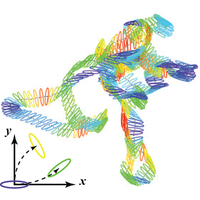
Diffusion of Ellipsoids in Bacterial Suspensions
by Yi Peng, Lipeng Lai, Yi-Shu Tai, Kechun Zhang, Xinliang Xu, and Xiang Cheng
Author(s): Yi Peng, Lipeng Lai, Yi-Shu Tai, Kechun Zhang, Xinliang Xu, and Xiang Cheng
An ellipsoid immersed in a bacterial suspension diffuses slowest along its major axis and fastest along its minor axis, in contrast to predictions from Brownian motion.
[Phys. Rev. Lett. 116, 068303] Published Wed Feb 10, 2016
10 Feb 21:32

Linguistics: Languages have common structure
Linguistics: Languages have common structure
Nature 530, 7589 (2016). doi:10.1038/530133b
Many languages share a universal semantic structure that is independent of their speakers' culture, environment or how closely the languages are related.Hyejin Youn and Tanmoy Bhattacharya at the Santa Fe Institute in New Mexico and their colleagues studied the words for 22 universal concepts
09 Feb 10:39
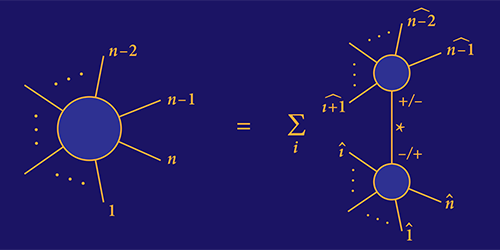
Viewpoint: Extending an Alternative to Feynman Diagrams
by David A. Kosower
Author(s): David A. Kosower
A simplifying technique for calculating scattering amplitudes—the basis for predictions in particle physics experiments—has been extended to cover a class of effective quantum field theories.
[Physics 9, 15] Published Mon Feb 08, 2016
08 Feb 18:42

Bioresorbable silicon electronic sensors for the brain
by Seung-Kyun Kang
Bioresorbable silicon electronic sensors for the brain
Nature 530, 7588 (2016). doi:10.1038/nature16492
Authors: Seung-Kyun Kang, Rory K. J. Murphy, Suk-Won Hwang, Seung Min Lee, Daniel V. Harburg, Neil A. Krueger, Jiho Shin, Paul Gamble, Huanyu Cheng, Sooyoun Yu, Zhuangjian Liu, Jordan G. McCall, Manu Stephen, Hanze Ying, Jeonghyun Kim, Gayoung Park, R. Chad Webb, Chi Hwan Lee, Sangjin Chung, Dae Seung Wie, Amit D. Gujar, Bharat Vemulapalli, Albert H. Kim, Kyung-Mi Lee, Jianjun Cheng, Younggang Huang, Sang Hoon Lee, Paul V. Braun, Wilson Z. Ray & John A. Rogers
Many procedures in modern clinical medicine rely on the use of electronic implants in treating conditions that range from acute coronary events to traumatic injury. However, standard permanent electronic hardware acts as a nidus for infection: bacteria form biofilms along percutaneous wires, or seed haematogenously, with the potential to migrate within the body and to provoke immune-mediated pathological tissue reactions. The associated surgical retrieval procedures, meanwhile, subject patients to the distress associated with re-operation and expose them to additional complications. Here, we report materials, device architectures, integration strategies, and in vivo demonstrations in rats of implantable, multifunctional silicon sensors for the brain, for which all of the constituent materials naturally resorb via hydrolysis and/or metabolic action, eliminating the need for extraction. Continuous monitoring of intracranial pressure and temperature illustrates functionality essential to the treatment of traumatic brain injury; the measurement performance of our resorbable devices compares favourably with that of non-resorbable clinical standards. In our experiments, insulated percutaneous wires connect to an externally mounted, miniaturized wireless potentiostat for data transmission. In a separate set-up, we connect a sensor to an implanted (but only partially resorbable) data-communication system, proving the principle that there is no need for any percutaneous wiring. The devices can be adapted to sense fluid flow, motion, pH or thermal characteristics, in formats that are compatible with the body’s abdomen and extremities, as well as the deep brain, suggesting that the sensors might meet many needs in clinical medicine.
08 Feb 14:42
The Gandhi-Hitler Letters
by Beachcombing
Nosimplerwhat
Love or hate Gandhi, and God knows there are plenty of reasons for both, there is something remarkable about this abortive correspondence between he and Hitler (see below the post): ‘correspondence’ might not be the right word as Hitler never wrote back. The first letter dates to late July of 1939 when the world was […]


08 Feb 13:50

The first wearable translator will be coming this summer
by Tyler Cowen
Language barriers while traveling the world may become a problem of the past with the advent of new technology. The latest craze in the tech world was recently unveiled at the 2016 Electronics Show: a wearable translator. The Japanese startup Logbar plans on releasing the portable translator called the “ili” this summer. The actual device looks like an Apple TV controller and is hung around your neck.
With the press of a button, the device is allegedly capable of simultaneous translation.
There is more here by David Grasso, including a video, from bold.global.
The post The first wearable translator will be coming this summer appeared first on Marginal REVOLUTION.
07 Feb 15:51

Rams Stiff St. Louis, Leave City with $144 Million Bill
by Alexis Garcia
St. Louis residents no longer have a football team, but that doesn’t mean they will get to stop paying for one. While the Rams won a vote in mid-January to relocate to Los Angeles, St. Louis taxpayers will still be responsible for making $144 million in debt and maintenance payments for the Edward Jones Dome.
Lewis Reed, the St. Louis Board of Alderman president, has asked the NFL for money to help pay off the debt, but he seems unaware of how the multi-billion dollar league operates.
As Reason has reported in the past, stadium financing is one way the NFL holds cities hostage—either pay for a state-of-the-art facility or lose the prestige of having a professional football team. This has resulted in often lopsided stadium deals that leave cities (and their taxpayers) burdened with much of the debt.
As Reuters points out:
Across the country, cities have gotten stuck with substantial costs after sports teams leave or even move across town. Often, local governments must pay bonds, maintenance costs, or demolition fees after a team is gone.
Houston’s iconic Astrodome, once dubbed the Eighth Wonder of the World, sits empty a decade after the facility housed 25,000 evacuees of Hurricane Katrina and nearly 20 years after the Oilers left. The Detroit Lions’ former Silverdome in Pontiac, Michigan, was used sporadically after the team moved downtown in 2002, but shuttered for good when the inflatable roof was deflated.
St. Louis isn’t the only city that regrets its deal with the NFL. Reason’s Ed Krayewski wrote just a couple weeks ago that San Francisco residents are having buyer’s remorse after realizing that their agreement with the NFL to host a Super Bowl in exchange for a new stadium in Santa Clara, CA resulted in a $5.3 million bill for early lease termination. So why would any smart city want the NFL? Reason TV explored this question in the video below.
06 Feb 01:11

Word for the day:
Baby monitors can be hacked
by Minnesotastan

Predictably enough, accounts are now surfacing of voyeurs and griefers who are using these capabilities to spy on, and taunt babies.Further details and links at BoingBoing.
Jay and Sarah, parents in San Francisco, couldn't figure out what their three-year-old meant when he said he was scared to sleep at night because the "phone" kept talking to him, but then one night Sarah walked by and heard a stranger's voice coming out of the monitor, saying, "Wake up little boy, daddy's looking for you."
When Sarah walked in the room, the camera's night-vision lens turned to examine her and the voice added, "look someone's coming into view."
Word for the day:
A griefer is a player in a multiplayer video game who deliberately irritates and harasses other players within the game, using aspects of the game in unintended ways. A griefer derives pleasure primarily or exclusively from the act of annoying other users, and as such is a particular nuisance in online gaming communities, since griefers often cannot be deterred by penalties related to in-game goals.
04 Feb 23:54

Black Lives Matter Activist Deray Mckesson Running for Baltimore Mayor
by Ed Krayewski
 Deray Mckesson, one of the Black Lives Matter activists behind Campaign Zero, a comprehensive set of police reform policies ranging from body cameras to union contracts, for which Campaign Zero launched a separate website, Check the Police, is running to be the Democratic nominee for mayor of Baltimore.
In an announcement made on Medium, Mckesson mostly stuck to his status as a “non-traditional candidate” and “son of Baltimore.” Mckesson was previously an educator and school administrator in Minneapolis and Baltimore.
Mckesson broadly sketched out his view of government, which should be “accountable to its people and… aggressively innovative in how it identifies and solves its problems.” Safety, wrote Mckesson, included more than policing and that transparency was a core pillar of government. Mckesson wants to make internal city school audits public, for example. He promised to release a policy platform in the coming weeks.
How closely Mckesson’s platform follows the proposals of Campaign Zero remains to be seen, but a Democratic candidate who aggressively engages the role of public unions in thwarting transparency and creating many of government’s biggest problems, from education to policing, would indeed be transformative. Even just an engagement of the role of police unions would be politically disruptive.
Mckesson’s background in public schools administration could go either way on whether he calls out the role teachers unions play in keeping bad teachers on the job, much like police unions keep bad cops on the job. Although there are more than a dozen other Democratic candidates, Mckesson is poised to expand the conversation in the race, with the potential to address issues usually ignored by mainstream candidates and introduce policy positions mainstream Democratic candidates are hesitant to take on because of entrenched party interests but that could appeal to a broad section of the electorate.
The frontrunner in the race, former mayor Sheila Dixon, says she’s never heard of Mckesson. "We all want the best for Baltimore," she told the Baltimore Sun. "There are 84 days left. I'm staying focused."
Another leading Democratic candidate, Nick Mosby, a councilman and husband of the state’s attorney prosecuting the officers involved in Freddie Gray’s death, previously committed to working with a bipartisan group on criminal justice and policing reforms. Mosby said he welcomed anyone into the raise but that he had a comprehensive plan for Baltimore. While it includes a plank that promises to “improve police transparency, require true community policing, combat addiction, and get body-worn cameras on officers within 100 days of taking office.” His platform doesn’t mention the role of union contracts in offering expansive job protections to officers like the one his wife is now prosecuting. And of course it doesn’t mention teachers unions or, for that matter, even charter schools.
The Sun talked to politics radio host Sean Yoes explained what he thought would be one of Mckesson's biggest hurdles in the race, older African-American women. "If the electorate consisted of celebrities who were politically conscious, then maybe he would have a chance," he said. "I suspect the vast majority of the most prolific voting bloc in Baltimore City do not know who he is. That's going to be problematic for him."
03 Feb 21:32

Photonic Maxwell’s Demon
by Mihai D. Vidrighin, Oscar Dahlsten, Marco Barbieri, M. S. Kim, Vlatko Vedral, and Ian A. Walmsley
Author(s): Mihai D. Vidrighin, Oscar Dahlsten, Marco Barbieri, M. S. Kim, Vlatko Vedral, and Ian A. Walmsley
Information derived from microscopic measurements of thermal states made using a few photons is used to extract macroscopic work.
[Phys. Rev. Lett. 116, 050401] Published Mon Feb 01, 2016
01 Feb 00:17

The Bill of Rights Wasn't That Radical
by Reason Staff

It is important to understand that the framers of the second U.S. constitution—the successor to the Articles of Confederation—did not intend for the complex governmental structure devised at the federal convention of 1787 to protect Americans' liberty directly, writes Sheldon Richman. Rather, the ultimate protector was to be the ruling elite. The purpose of the political process established in 1789 was to assure that the right sort of people would be selected to govern and the wrong sort would be weeded out.
The Bill of Rights—the 10 amendments adopted immediately after the new American government was put into operation—largely embodied uncontroversial traditional rights of Englishmen, writes Richman. This does not mean the Bill of Rights was worthless. To the extent it has worked to restrain government power, we should be grateful. But its presence eventually shifted attention from asking where in the Constitution a claimed power was specified to asking where in the Bill of Rights a claimed right was specified. And the effort to procure the Bill of Rights distracted from weightier matters and left the national government with its frighteningly broad powers largely intact.
27 Jan 22:56
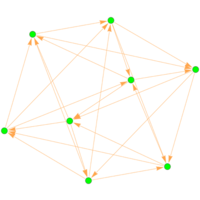
Permutation Symmetry Determines the Discrete Wigner Function
by Huangjun Zhu
Author(s): Huangjun Zhu
Underlying symmetries can be used to elucidate the structure and properties of the discrete version of the Wigner quasi-probability distribution function in phase space.
[Phys. Rev. Lett. 116, 040501] Published Tue Jan 26, 2016
Meichen_Yu likes this
24 Jan 15:28
Several perspectives on the valuation of outgroups.
by mdbownds@wisc.edu (Deric Bownds)
A recent issue of the Proceedings of the National Academy of Science has two relevant articles:
Keelah et al. show that Americans’ stereotypes about racial groups may actually reflect their stereotypes about these groups’ presumed home ecologies. Harsh and unpredictable (“desperate”) ecologies induce fast strategy behaviors such as impulsivity, whereas resource-sufficient and predictable (“hopeful”) ecologies induce slow strategy behaviors such as future focus.


Keelah et al. show that Americans’ stereotypes about racial groups may actually reflect their stereotypes about these groups’ presumed home ecologies. Harsh and unpredictable (“desperate”) ecologies induce fast strategy behaviors such as impulsivity, whereas resource-sufficient and predictable (“hopeful”) ecologies induce slow strategy behaviors such as future focus.
...when provided with information about a person’s race (but not ecology), individuals’ inferences about blacks track stereotypes of people from desperate ecologies, and individuals’ inferences about whites track stereotypes of people from hopeful ecologies. However, when provided with information about both the race and ecology of others, individuals’ inferences reflect the targets’ ecology rather than their race: black and white targets from desperate ecologies are stereotyped as equally fast life history strategists, whereas black and white targets from hopeful ecologies are stereotyped as equally slow life history strategists. These findings suggest that the content of several predominant race stereotypes may not reflect race, per se, but rather inferences about how one’s ecology influences behavior.And, Ginges et al. show that thinking from God's perspective decreases biased valuation of the life of a nonbeliever.
Religious belief is often thought to motivate violence because it is said to promote norms that encourage tribalism and the devaluing of the lives of nonbelievers. If true, this should be visible in the multigenerational violent conflict between Palestinians and Israelis which is marked by a religious divide. We conducted experiments with a representative sample of Muslim Palestinian youth (n = 555), examining whether thinking from the perspective of Allah (God), who is the ultimate arbitrator of religious belief, changes the relative value of Jewish Israelis’ lives (compared with Palestinian lives). Participants were presented with variants of the classic “trolley dilemma,” in the form of stories where a man can be killed to save the lives of five children who were either Jewish Israeli or Palestinian. They responded from their own perspective and from the perspective of Allah. We find that whereas a large proportion of participants were more likely to endorse saving Palestinian children than saving Jewish Israeli children, this proportion decreased when thinking from the perspective of Allah. This finding raises the possibility that beliefs about God can mitigate bias against other groups and reduce barriers to peace.Also, in the journal Psychological Science, Roets et al. consider the case of Singapore, which contradicts:
...numerous empirical studies that have consistently demonstrated the seemingly inextricable link between authoritarianism and negative attitudes about out-groups. Indeed, in the authoritarian mind, minorities are readily perceived as “bad, disruptive, immoral, and deviant” people who do not fit into society... However, what if authoritarians live in a society in which a very strong and established authority most explicitly endorses diversity and multiculturalism, thereby enforcing a social norm that is in direct opposition to authoritarians’ “natural” negative attitudes toward minorities? Over the past 50 years, the Singaporean government (run by the People’s Action Party) has been highly committed to regulating its ethnically diverse society and promoting multiculturalism through a variety of ingenious yet most consequential measures. A prime example is the imposition of strict ethnic quotas in public residential estates
They analyzed data from a questionnaire measuring authoritarianism that was completed by 249 Singaporean students (the target sample; and 245 Belgian students (the comparison group)...the Belgian control group showed the usual negative relationships between authoritarianism and multiculturalism and between authoritarianism and positive attitudes about out-groups, as found in all previous research. In the Singaporean sample, however, there were significant, positive relationships between authoritarianism and multiculturalism and between authoritarianism and positive attitudes about out-groups... [The] results demonstrate that when a strong authority explicitly and relentlessly endorses diversity and multiculturalism, such a perspective can be adopted even (and especially) by people who are intuitively most opposed to diversity.You might also note the comments of Aaron Wendland on the writings of Emmanuel Levinas, after World War II, on deep-seated and often irrational fear of the “other.”
Levinas’s antihistamine for our allergic reactions involves three things: an appeal to the “infinity” in human beings, a detailed description of face-to-face encounters and an account of a basic hospitality that constitutes humanity.
Yohan likes this
23 Jan 15:54
Billionaires for Billionaires
by noreply@blogger.com (Atrios)
Yah good luck with that.
Galled by Donald J. Trump’s dominance of the Republican field, and troubled by Hillary Clinton’s stumbles and the rise of Senator Bernie Sanders of Vermont on the Democratic side, Michael R. Bloomberg has instructed advisers to draw up plans for an independent campaign in this year’s presidential race.

16 Jan 08:12

There are only two types of fundamental laws that appear in contemporary theories. One type is deterministic, which means that the past entirely predicts the future. There is no free will in such a fundamental law because there is no freedom. The other type of law we know appears in quantum mechanics and has an indeterministic component which is random. This randomness cannot be influenced by anything, and in particular it cannot be influenced by you, whatever you think “you” are. There is no free will in such a fundamental law because there is no “will” – there is just some randomness sprinkled over the determinism.
In neither case do you have free will in any meaningful way.
These are the only two options, and all other elaborations on the matter are just verbose distractions. It doesn’t matter if you start talking about chaos (which is deterministic), top-down causation (which doesn’t exist), or insist that we don’t know how consciousness really works (true but irrelevant). It doesn’t change a thing about this very basic observation: there isn’t any known law of nature that lets you meaningfully speak of “free will”.
If you don’t want to believe that, I challenge you to write down any equation for any system that allows for something one could reasonably call free will. You will almost certainly fail. The only thing really you can do to hold on to free will is to wave hands, yell “magic”, and insist that there are systems which are exempt from the laws of nature. And these systems somehow have something to do with human brains.
The only known example for a law that is neither deterministic nor random comes from myself. But it’s a baroque construct meant as proof in principle, not a realistic model that I would know how to combine with the four fundamental interactions. As an aside: The paper was rejected by several journals. Not because anyone found anything wrong with it. No, the philosophy journals complained that it was too much physics, and the physics journals complained that it was too much philosophy. And you wonder why there isn’t much interaction between the two fields.
After plain denial, the somewhat more enlightened way to insist on free will is to redefine what it means. You might settle for example on speaking of free will as long as your actions cannot be predicted by anybody, possibly not even by yourself. Clearly, it is presently impossible to make such a prediction. It remains to be seen whether it will remain impossible, but right now it’s a reasonable hope. If that’s what you want to call free will, go ahead, but better not ask yourself what determined your actions.
A popular justification for this type of free will is insisting that on comparably large scales, like those between molecules responsible for chemical interactions in your brain, there are smaller components which may have a remaining influence. If you don’t keep track of these smaller components, the behavior of the larger components might not be predictable. You can then say “free will is emergent” because of “higher level indeterminism”. It’s like saying if I give you a robot and I don’t tell you what’s in the robot, then you can’t predict what the robot will do, consequently it must have free will. I haven’t managed to bring up sufficient amounts of intellectual dishonesty to buy this argument.
But really you don’t have to bother with the details of these arguments, you just have to keep in mind that “indeterminism” doesn’t mean “free will”. Indeterminism just means there’s some element of randomness, either because that’s fundamental or because you have willfully ignored information on short distances. But there is still either no “freedom” or no “will”. Just try it. Try to write down one equation that does it. Just try it.
I have written about this a few times before and according to the statistics these are some of the most-read pieces on my blog. Following these posts, I have also received a lot of emails by readers who seem seriously troubled by the claim that our best present knowledge about the laws of nature doesn’t allow for the existence of free will. To ease your existential worries, let me therefore spell out clearly what this means and doesn’t mean.
It doesn’t mean that you are not making decisions or are not making choices. Free will or not, you have to do the thinking to arrive at a conclusion, the answer to which you previously didn’t know. Absence of free will doesn’t mean either that you are somehow forced to do something you didn’t want to do. There isn’t anything external imposing on you. You are whatever makes the decisions. Besides this, if you don’t have free will you’ve never had it, and if this hasn’t bothered you before, why start worrying now?
This conclusion that free will doesn’t exist is so obvious that I can’t help but wonder why it isn’t widely accepted. The reason, I am afraid, is not scientific but political. Denying free will is considered politically incorrect because of a wide-spread myth that free will skepticism erodes the foundation of human civilization.
For example, a 2014 article in Scientific American addressed the question “What Happens To A Society That Does not Believe in Free Will?” The piece is written by Azim F. Shariff, a Professor for Psychology, and Kathleen D. Vohs, a Professor of Excellence in Marketing (whatever that might mean).
In their essay, the authors argue that free will skepticism is dangerous: “[W]e see signs that a lack of belief in free will may end up tearing social organization apart,” they write. “[S]kepticism about free will erodes ethical behavior,” and “diminished belief in free will also seems to release urges to harm others.” And if that wasn’t scary enough already, they conclude that only the “belief in free will restrains people from engaging in the kind of wrongdoing that could unravel an ordered society.”
To begin with I find it highly problematic to suggest that the answers to some scientific questions should be taboo because they might be upsetting. They don’t explicitly say this, but the message the article send is pretty clear: If you do as much as suggest that free will doesn’t exist you are encouraging people to harm others. So please read on before you grab the axe.
The conclusion that the authors draw is highly flawed. These psychology studies always work the same. The study participants are engaged in some activity in which they receive information, either verbally or in writing, that free will doesn’t exist or is at least limited. After this, their likeliness to conduct “wrongdoing” is tested and compared to a control group. But the information the participants receive is highly misleading. It does not prime them to think they don’t have free will, it instead primes them to think that they are not responsible for their actions. Which is an entirely different thing.
Even if you don’t have free will, you are of course responsible for your actions because “you” – that mass of neurons – are making, possibly bad, decisions. If the outcome of your thinking is socially undesirable because it puts other people at risk, those other people will try to prevent you from more wrongdoing. They will either try to fix you or lock you up. In other words, you will be held responsible. Nothing of this has anything to do with free will. It’s merely a matter of finding a solution to a problem.
The only thing I conclude from these studies is that neither the scientists who conducted the research nor the study participants spent much time thinking about what the absence of free will really means. Yes, I’ve spent far too much time thinking about this.
The reason I am hitting on the free will issue is not that I want to collapse civilization, but that I am afraid the politically correct belief in free will hinders progress on the foundations of physics. Free will of the experimentalist is a relevant ingredient in the interpretation of quantum mechanics. Without free will, Bell’s theorem doesn’t hold, and all we have learned from it goes out the window.
This option of giving up free will in quantum mechanics goes under the name “superdeterminism” and is exceedingly unpopular. There seem to be but three people on the planet who work on this, ‘t Hooft, me, and a third person of whom I only learned from George Musser’s recent book (and whose name I’ve since forgotten). Chances are the three of us wouldn’t even agree on what we mean. It is highly probable we are missing something really important here, something that could very well be the basis of future technologies.
Who cares, you might think, buying into the collapse of the wave-function seems a small price to pay compared to the collapse of civilization. On that matter though, I side with Socrates “The unexamined life is not worth living.”
Free will is dead, let’s bury it.
by Sabine Hossenfelder
I wish people would stop insisting they have free will. It’s terribly annoying. Insisting that free will exists is bad science, like insisting that horoscopes tell you something about the future – it’s not compatible with our knowledge about nature.
According to our best present understanding of the fundamental laws of nature, everything that happens in our universe is due to only four different forces: gravity, electromagnetism, and the strong and weak nuclear force. These forces have been extremely well studied, and they don’t leave any room for free will.There are only two types of fundamental laws that appear in contemporary theories. One type is deterministic, which means that the past entirely predicts the future. There is no free will in such a fundamental law because there is no freedom. The other type of law we know appears in quantum mechanics and has an indeterministic component which is random. This randomness cannot be influenced by anything, and in particular it cannot be influenced by you, whatever you think “you” are. There is no free will in such a fundamental law because there is no “will” – there is just some randomness sprinkled over the determinism.
In neither case do you have free will in any meaningful way.
These are the only two options, and all other elaborations on the matter are just verbose distractions. It doesn’t matter if you start talking about chaos (which is deterministic), top-down causation (which doesn’t exist), or insist that we don’t know how consciousness really works (true but irrelevant). It doesn’t change a thing about this very basic observation: there isn’t any known law of nature that lets you meaningfully speak of “free will”.
If you don’t want to believe that, I challenge you to write down any equation for any system that allows for something one could reasonably call free will. You will almost certainly fail. The only thing really you can do to hold on to free will is to wave hands, yell “magic”, and insist that there are systems which are exempt from the laws of nature. And these systems somehow have something to do with human brains.
The only known example for a law that is neither deterministic nor random comes from myself. But it’s a baroque construct meant as proof in principle, not a realistic model that I would know how to combine with the four fundamental interactions. As an aside: The paper was rejected by several journals. Not because anyone found anything wrong with it. No, the philosophy journals complained that it was too much physics, and the physics journals complained that it was too much philosophy. And you wonder why there isn’t much interaction between the two fields.
After plain denial, the somewhat more enlightened way to insist on free will is to redefine what it means. You might settle for example on speaking of free will as long as your actions cannot be predicted by anybody, possibly not even by yourself. Clearly, it is presently impossible to make such a prediction. It remains to be seen whether it will remain impossible, but right now it’s a reasonable hope. If that’s what you want to call free will, go ahead, but better not ask yourself what determined your actions.
A popular justification for this type of free will is insisting that on comparably large scales, like those between molecules responsible for chemical interactions in your brain, there are smaller components which may have a remaining influence. If you don’t keep track of these smaller components, the behavior of the larger components might not be predictable. You can then say “free will is emergent” because of “higher level indeterminism”. It’s like saying if I give you a robot and I don’t tell you what’s in the robot, then you can’t predict what the robot will do, consequently it must have free will. I haven’t managed to bring up sufficient amounts of intellectual dishonesty to buy this argument.
But really you don’t have to bother with the details of these arguments, you just have to keep in mind that “indeterminism” doesn’t mean “free will”. Indeterminism just means there’s some element of randomness, either because that’s fundamental or because you have willfully ignored information on short distances. But there is still either no “freedom” or no “will”. Just try it. Try to write down one equation that does it. Just try it.
I have written about this a few times before and according to the statistics these are some of the most-read pieces on my blog. Following these posts, I have also received a lot of emails by readers who seem seriously troubled by the claim that our best present knowledge about the laws of nature doesn’t allow for the existence of free will. To ease your existential worries, let me therefore spell out clearly what this means and doesn’t mean.
It doesn’t mean that you are not making decisions or are not making choices. Free will or not, you have to do the thinking to arrive at a conclusion, the answer to which you previously didn’t know. Absence of free will doesn’t mean either that you are somehow forced to do something you didn’t want to do. There isn’t anything external imposing on you. You are whatever makes the decisions. Besides this, if you don’t have free will you’ve never had it, and if this hasn’t bothered you before, why start worrying now?
This conclusion that free will doesn’t exist is so obvious that I can’t help but wonder why it isn’t widely accepted. The reason, I am afraid, is not scientific but political. Denying free will is considered politically incorrect because of a wide-spread myth that free will skepticism erodes the foundation of human civilization.
For example, a 2014 article in Scientific American addressed the question “What Happens To A Society That Does not Believe in Free Will?” The piece is written by Azim F. Shariff, a Professor for Psychology, and Kathleen D. Vohs, a Professor of Excellence in Marketing (whatever that might mean).
In their essay, the authors argue that free will skepticism is dangerous: “[W]e see signs that a lack of belief in free will may end up tearing social organization apart,” they write. “[S]kepticism about free will erodes ethical behavior,” and “diminished belief in free will also seems to release urges to harm others.” And if that wasn’t scary enough already, they conclude that only the “belief in free will restrains people from engaging in the kind of wrongdoing that could unravel an ordered society.”
To begin with I find it highly problematic to suggest that the answers to some scientific questions should be taboo because they might be upsetting. They don’t explicitly say this, but the message the article send is pretty clear: If you do as much as suggest that free will doesn’t exist you are encouraging people to harm others. So please read on before you grab the axe.
The conclusion that the authors draw is highly flawed. These psychology studies always work the same. The study participants are engaged in some activity in which they receive information, either verbally or in writing, that free will doesn’t exist or is at least limited. After this, their likeliness to conduct “wrongdoing” is tested and compared to a control group. But the information the participants receive is highly misleading. It does not prime them to think they don’t have free will, it instead primes them to think that they are not responsible for their actions. Which is an entirely different thing.
Even if you don’t have free will, you are of course responsible for your actions because “you” – that mass of neurons – are making, possibly bad, decisions. If the outcome of your thinking is socially undesirable because it puts other people at risk, those other people will try to prevent you from more wrongdoing. They will either try to fix you or lock you up. In other words, you will be held responsible. Nothing of this has anything to do with free will. It’s merely a matter of finding a solution to a problem.
The only thing I conclude from these studies is that neither the scientists who conducted the research nor the study participants spent much time thinking about what the absence of free will really means. Yes, I’ve spent far too much time thinking about this.
The reason I am hitting on the free will issue is not that I want to collapse civilization, but that I am afraid the politically correct belief in free will hinders progress on the foundations of physics. Free will of the experimentalist is a relevant ingredient in the interpretation of quantum mechanics. Without free will, Bell’s theorem doesn’t hold, and all we have learned from it goes out the window.
This option of giving up free will in quantum mechanics goes under the name “superdeterminism” and is exceedingly unpopular. There seem to be but three people on the planet who work on this, ‘t Hooft, me, and a third person of whom I only learned from George Musser’s recent book (and whose name I’ve since forgotten). Chances are the three of us wouldn’t even agree on what we mean. It is highly probable we are missing something really important here, something that could very well be the basis of future technologies.
Who cares, you might think, buying into the collapse of the wave-function seems a small price to pay compared to the collapse of civilization. On that matter though, I side with Socrates “The unexamined life is not worth living.”
14 Jan 15:45
"Christian atheism" explained
by Minnesotastan
Excerpts from a religion page archived in 2006 by the BBC:
Worship is a beneficial activity. Worship in a group is good way for a community to:
There are several more bullet points under these headings at the BBC.
Essentials of non-realistic Christianity
- Religion is about internal spiritual experiences, and that is all.
- There is no world other than the material world around us.
- There are no beings other than the living organisms on this planet or elsewhere in the universe.
- There is no objective being or thing called God that exists separately from the person believing in him.
- There is no 'ultimate reality' outside human minds either.
- We give our own lives meaning and purpose; there is nothing outside us that does it for us.
- God is a projection of the human mind.
- "God" is the way human beings put 'spiritual' ideals into a poetic form that they are able to use and work with.
- "God" is simply a word that stands for our highest ideals.
Worship and prayer
If there's no God out there, it might seem pointless to go to church, or to pray. Christian Atheists would disagree:Worship is a beneficial activity. Worship in a group is good way for a community to:
- communicate with each other
- share ideals and ideas
- explore the meaning and purpose of their individual lives, and the life of their community
Benefits of this form of belief
Those who who believe like this claim many advantages for it:- Humanity is forced to take responsibility for everything.
- Human beings are seen as powerful and able to do things for themselves.
- Religion no longer has to try to explain many difficult issues that go with believing in supernatural things.
- Religion is no longer in opposition to scientific progress.
There are several more bullet points under these headings at the BBC.
12 Jan 22:19
Ecology stereotypes override race stereotypes [Psychological and Cognitive Sciences]
by Williams, K. E. G., Sng, O., Neuberg, S. L.
Why do race stereotypes take the forms they do? Life history theory posits that features of the ecology shape individuals’ behavior. Harsh and unpredictable (“desperate”) ecologies induce fast strategy behaviors such as impulsivity, whereas resource-sufficient and predictable (“hopeful”) ecologies induce slow strategy behaviors such as future focus. We suggest that...
12 Jan 22:09

A Compositional Framework for Markov Processes
by john
Last summer my students Brendan Fong and Blake Pollard visited me at the Centre for Quantum Technologies, and we figured out how to understand open continuous-time Markov chains! I think this is a nice step towards understanding the math of living systems.
Admittedly, it’s just a small first step. But I’m excited by this step, since Blake and I have been trying to get this stuff to work for a couple years, and it finally fell into place. And we think we know what to do next. Here’s our paper:
- John Baez, Brendan Fong and Blake S. Pollard, A compositional framework for open Markov processes.
And here’s the basic idea….
Open detailed balanced Markov processes
A continuous-time Markov chain is a way to specify the dynamics of a population which is spread across some finite set of states. Population can flow between the states. The larger the population of a state, the more rapidly population flows out of the state. Because of this property, under certain conditions the populations of the states tend toward an equilibrium where at any state the inflow of population is balanced by its outflow.
In applications to statistical mechanics, we are often interested in equilibria such that for any two states connected by an edge, say ii and j,j, the flow from ii to jj equals the flow from jj to i.i. A continuous-time Markov chain with a chosen equilibrium having this property is called ‘detailed balanced’.
I’m getting tired of saying ‘continuous-time Markov chain’, so from now on I’ll just say ‘Markov process’, just because it’s shorter. Okay? That will let me say the next sentence without running out of breath:
Our paper is about open detailed balanced Markov processes.
Here’s an example:
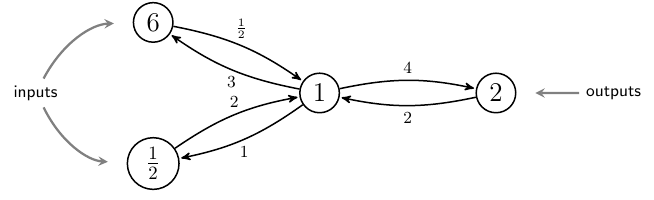
The detailed balanced Markov process itself consists of a finite set of states together with a finite set of edges between them, with each state ii labelled by an equilibrium population q i>0,q_i >0, and each edge ee labelled by a rate constant r e>0.r_e > 0.
These populations and rate constants are required to obey an equation called the ‘detailed balance condition’. This equation means that in equilibrium, the flow from ii to jj equal the flow from jj to i.i. Do you see how it works in this example?
To get an ‘open’ detailed balanced Markov process, some states are designated as inputs or outputs. In general each state may be specified as both an input and an output, or as inputs and outputs multiple times. See how that’s happening in this example? It may seem weird, but it makes things work better.
People usually say Markov processes are all about how probabilities flow from one state to another. But we work with un-normalized probabilities, which we call ‘populations’, rather than probabilities that must sum to 1. The reason is that in an open Markov process, probability is not conserved: it can flow in or out at the inputs and outputs. We allow it to flow both in and out at both the input states and the output states.
Our most fundamental result is that there’s a category DetBalMark{DetBalMark} where a morphism is an open detailed balanced Markov process. We think of it as a morphism from its inputs to its outputs.
We compose morphisms in DetBalMark{DetBalMark} by identifying the output states of one open detailed balanced Markov process with the input states of another. The populations of identified states must match. For example, we may compose this morphism NN:
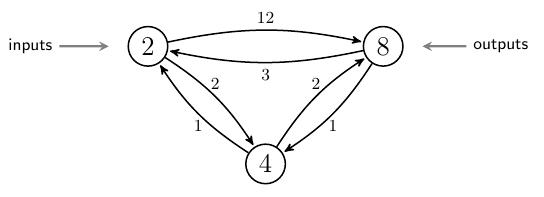
with the previously shown morphism MM to get this morphism M∘NM \circ N:
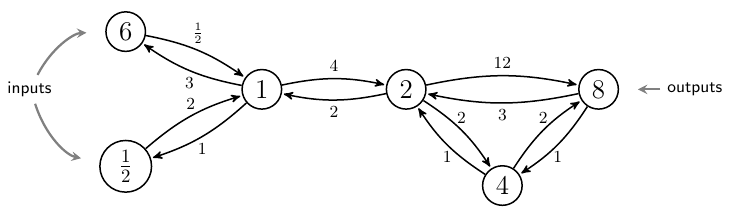
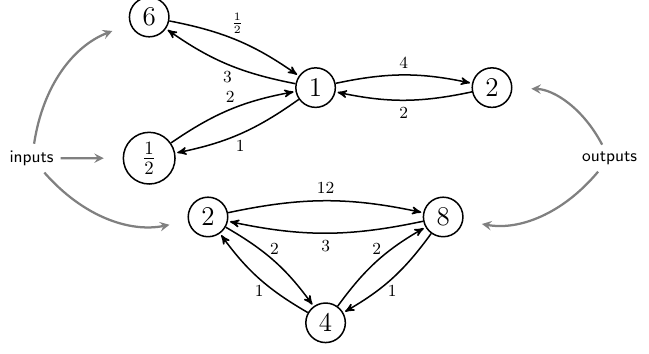
And here’s our second most fundamental result: the category DetBalMark{DetBalMark} is actually a dagger compact category. This lets us do other stuff with open Markov processes. An important one is ‘tensoring’, which lets us take two open Markov processes like MM and NN above and set them side by side, giving M⊗NM \otimes N:
The compactness is also important. This means we can take some inputs of an open Markov process and turn them into outputs, or vice versa. For example, using the compactness of DetBalMark{DetBalMark} we can get this open Markov process from MM:
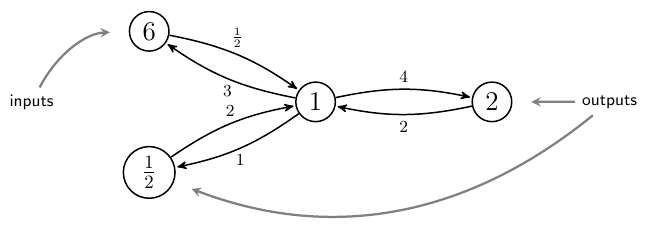
In fact all the categories in our paper are dagger compact categories, and all our functors preserve this structure. Dagger compact categories are a well-known framework for describing systems with inputs and outputs, so this is good.
The analogy to electrical circuits
In a detailed balanced Markov process, population can flow along edges. In the detailed balanced equilibrium, without any flow of population from outside, the flow along from state ii to state jj will be matched by the flow back from jj to i.i. The populations need to take specific values for this to occur.
In an electrical circuit made of linear resistors, charge can flow along wires. In equilibrium, without any driving voltage from outside, the current along each wire will be zero. The potentials will be equal at every node.
This sets up an analogy between detailed balanced continuous-time Markov chains and electrical circuits made of linear resistors! I love analogy charts, so this makes me very happy:
| Circuits | Detailed balanced Markov processes |
| potential | population |
| current | flow |
| conductance | rate constant |
| power | dissipation |
This analogy is already well known. Schnakenberg used it in his book Thermodynamic Network Analysis of Biological Systems. So, our main goal is to formalize and exploit it. This analogy extends from systems in equilibrium to the more interesting case of nonequilibrium steady states, which are the main topic of our paper.
Earlier, Brendan and I introduced a way to ‘black box’ a circuit and define the relation it determines between potential-current pairs at the input and output terminals. This relation describes the circuit’s external behavior as seen by an observer who can only perform measurements at the terminals.
An important fact is that black boxing is ‘compositional’: if one builds a circuit from smaller pieces, the external behavior of the whole circuit can be determined from the external behaviors of the pieces. For category theorists, this means that black boxing is a functor!
Our new paper with Blake develops a similar ‘black box functor’ for detailed balanced Markov processes, and relates it to the earlier one for circuits.
When you black box a detailed balanced Markov process, you get the relation between population–flow pairs at the terminals. (By the ‘flow at a terminal’, we more precisely mean the net population outflow.) This relation holds not only in equilibrium, but also in any nonequilibrium steady state. Thus, black boxing an open detailed balanced Markov process gives its steady state dynamics as seen by an observer who can only measure populations and flows at the terminals.
The principle of minimum dissipation
At least since the work of Prigogine, it’s been widely accepted that a large class of systems minimize entropy production in a nonequilibrium steady state. But people still fight about the the precise boundary of this class of systems, and even the meaning of this ‘principle of minimum entropy production’.
For detailed balanced open Markov processes, we show that a quantity we call the ‘dissipation’ is minimized in any steady state. This is a quadratic function of the populations and flows, analogous to the power dissipation of a circuit made of resistors. We make no claim that this quadratic function actually deserves to be called ‘entropy production’. Indeed, Schnakenberg has convincingly argued that they are only approximately equal.
But still, the ‘dissipation’ function is very natural and useful—and Prigogine’s so-called ‘entropy production’ is also a quadratic function.
Black boxing
I’ve already mentioned the category DetBalMark,{DetBalMark}, where a morphism is an open detailed balanced Markov process. But our paper needs two more categories to tell its story! There’s the category of circuits, and the category of linear relations.
A morphism in the category Circ{Circ} is an open electrical circuit made of resistors: that is, a graph with each edge labelled by a ‘conductance’ c e>0,c_e > 0, together with specified input and output nodes:
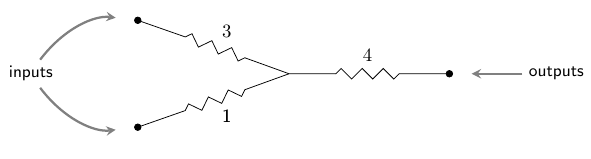
A morphism in the category LinRel{LinRel} is a linear relation L:U⇝VL : U \rightsquigarrow V between finite-dimensional real vector spaces UU and V.V. This is nothing but a linear subspace L⊆U⊕V.L \subseteq U \oplus V. Just as relations generalize functions, linear relations generalize linear functions!
In our previous paper, Brendan and I introduced these two categories and a functor between them, the ‘black box functor’:
▪:Circ→LinRel\blacksquare \colon {Circ} \to {LinRel}
The idea is that any circuit determines a linear relation between the potentials and net current flows at the inputs and outputs. This relation describes the behavior of a circuit of resistors as seen from outside.
Our new paper introduces a black box functor for detailed balanced Markov processes:
□:DetBalMark→LinRel \square \colon {DetBalMark} \to {LinRel}
We draw this functor as a white box merely to distinguish it from the other black box functor. The functor □\square maps any detailed balanced Markov process to the linear relation obeyed by populations and flows at the inputs and outputs in a steady state. In short, it describes the steady state behavior of the Markov process ‘as seen from outside’.
How do we manage to black box detailed balanced Markov processes? We do it using the analogy with circuits!
The analogy becomes a functor
Every analogy wants to be a functor. So, we make the analogy between detailed balanced Markov processes and circuits precise by turning it into a functor:
K:DetBalMark→Circ K : {DetBalMark} \to {Circ}
This functor converts any open detailed balanced Markov process into an open electrical circuit made of resistors. This circuit is carefully chosen to reflect the steady-state behavior of the Markov process. Its underlying graph is the same as that of the Markov process. So, the ‘states’ of the Markov process are the same as the ‘nodes’ of the circuit.
Both the equilibrium populations at states of the Markov process and the rate constants labelling edges of the Markov process are used to compute the conductances of edges of this circuit. In the simple case where the Markov process has exactly one edge from any state ii to any state j,j, the rule is this:
C ij=H ijq j C_{i j} = H_{i j} q_j
where:
- q jq_j is the equilibrium population of the jjth state of the Markov process,
- H ijH_{i j} is the rate constant for the edge from the jjth state to the iith state of the Markov process, and
- C ijC_{i j} is the conductance (that is, the reciprocal of the resistance) of the wire from the jjth node to the iith node of the resulting circuit.
The detailed balance condition for Markov processes says precisely that the matrix C ijC_{i j} is symmetric! This is just right for an electrical circuit made of resistors, since it means that the resistance of the wire from node ii to node jj equals the resistance of the same wire in the reverse direction, from node jj to node i.i.
A triangle of functors
If you paid careful attention, you’ll have noticed that I’ve described a triangle of functors:
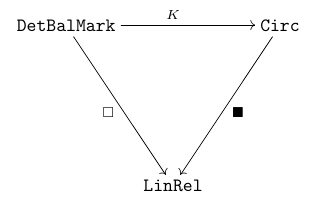
And if you’ve got the tao of category theory flowing in your veins, you’ll be wondering if this diagram commutes.
In fact, this triangle of functors does not commute! However, a general lesson of category theory is that we should only expect diagrams of functors to commute up to natural isomorphism, and this is what happens here:
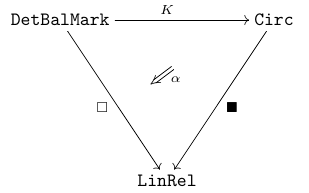
The natural transformation α\alpha ‘corrects’ the black box functor for resistors to give the one for detailed balanced Markov processes.
The functors □\square and ▪∘K\blacksquare \circ K are actually equal on objects. An object in DetBalMark{DetBalMark} is a finite set XX with each element i∈Xi \in X labelled a positive populations q i.q_i. Both functors map this object to the vector space ℝ X⊕ℝ X.\mathbb{R}^X \oplus \mathbb{R}^X. For the functor □,\square, we think of this as a space of population-flow pairs. For the functor ▪∘K,\blacksquare \circ K, we think of it as a space of potential-current pairs. The natural transformation α\alpha then gives a linear relation
α X,q:ℝ X⊕ℝ X⇝ℝ X⊕ℝ X\alpha_{X,q} : \mathbb{R}^X \oplus \mathbb{R}^X \rightsquigarrow \mathbb{R}^X \oplus \mathbb{R}^X
in fact an isomorphism of vector spaces, which converts potential-current pairs into population-flow pairs in a manner that depends on the q i.q_i. I’ll skip the formula; it’s in the paper.
But here’s the key point. The naturality of α\alpha actually allows us to reduce the problem of computing the functor □\square to the problem of computing ▪.\blacksquare. Suppose
M:(X,q)→(Y,r)M \colon (X,q) \to (Y,r)
is any morphism in DetBalMark.{DetBalMark}. The object (X,q)(X,q) is some finite set XX labelled by populations q,q, and (Y,r)(Y,r) is some finite set YY labelled by populations r.r. Then the naturality of α\alpha means that this square commutes:
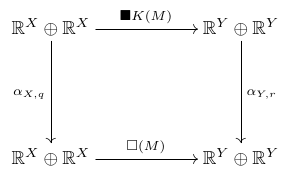
Since α X,q\alpha_{X,q} and α Y,r\alpha_{Y,r} are isomorphisms, we can solve for the functor □\square as follows:
□(M)=α Y∘▪K(M)∘α X −1 \square(M) = \alpha_Y \circ \blacksquare K(M) \circ \alpha_X^{-1}
This equation has a clear intuitive meaning! It says that to compute the behavior of a detailed balanced Markov process, namely □(f),\square(f), we convert it into a circuit made of resistors and compute the behavior of that, namely ▪K(f).\blacksquare K(f). This is not equal to the behavior of the Markov process, but we can compute that behavior by converting the input populations and flows into potentials and currents, feeding them into our circuit, and then converting the outputs back into populations and flows.
What we really did
So that’s a sketch of what we did, and I hope you ask questions if it’s not clear. But I also hope you read our paper! Here’s what we actually do in there. After an introduction and summary of results:
- Section 3 defines open Markov processes and the open master equation.
- Section 4 introduces detailed balance for open Markov processes.
- Section 5 recalls the principle of minimum power for open circuits made of linear resistors, and explains how to black box them.
- Section 6 introduces the principle of minimum dissipation for open detailed balanced Markov processes, and describes how to black box these.
- Section 7 states the analogy between circuits and detailed balanced Markov processes in a formal way.
- Section 8 describes how to compose open Markov processes, making them into the morphisms of a category.
- Section 9 does the same for detailed balanced Markov processes.
- Section 10 describes the ‘black box functor’ that sends any open detailed balanced Markov process to the linear relation describing its external behavior, and recalls the similar functor for circuits.
- Section 11 makes the analogy between between open detailed balanced Markov processes and open circuits even more formal, by making it into a functor. We prove that together with the two black box functors, this forms a triangle that commutes up to natural isomorphism.
- Section 12 is about geometric aspects of this theory. We show that linear relations in the image of these black box functors are Lagrangian relations between symplectic vector spaces. We also show that the master equation can be seen as a gradient flow equation.
- Section 13 is a summary of what we have learned.
Finally, Appendix A is a quick tutorial on decorated cospans. This is a key mathematical tool in our work, developed by Brendan in an earlier paper.
04 Jan 22:04
Perspectives on theory at the interface of physics and biology. (arXiv:1512.08954v1 [physics.bio-ph])
by William Bialek
Theoretical physics is the search for simple and universal mathematical descriptions of the natural world. In contrast, much of modern biology is an exploration of the complexity and diversity of life. For many, this contrast is prima facie evidence that theory, in the sense that physicists use the word, is impossible in a biological context. For others, this contrast serves to highlight a grand challenge. I'm an optimist, and believe (along with many colleagues) that the time is ripe for the emergence of a more unified theoretical physics of biological systems, building on successes in thinking about particular phenomena. In this essay I try to explain the reasons for my optimism, through a combination of historical and modern examples.
04 Jan 07:27
A jar of nuts with honey
by M Rule
Homeland security took something away from me today -- a jar of nuts with honey. I had bought the item at a Russian market several months ago as a birthday gift for my sister, who has been sick for a long time. The doctors think it's an autoimmune condition. Autoimmune diseases are insidious, and as varied as the antibodies that cause them. They say it might have been triggered by a virus.
04 Jan 07:25

Fermat’s Library
by Tyler Cowen
Here is Fermat’s Library:
Fermat’s Library is a platform for illuminating academic papers. Just as Pierre de Fermat scribbled his famous last theorem in the margins, professional scientists, academics and citizen scientists can annotate equations, figures and ideas and also write in the margins. Every week we send you a new paper annotated by the community.
Here is Fermat’s Library on John Nash on ideal money.
For the pointer I thank Ashok Rao.
The post Fermat’s Library appeared first on Marginal REVOLUTION.
M likes this
03 Jan 23:11

I must lead a sheltered life. I certainly was unaware of this development in childrearing:
Today I learned that "vagina speakers" exist
by Minnesotastan

I must lead a sheltered life. I certainly was unaware of this development in childrearing:
Pregnant women who like the idea of playing music to their unborn babies can now do so through a brand new gadget: a vaginal speaker.Or did I party too much on New Year's Eve and have woken up on April 1 ??
Spanish company Babypod has created a small pink device that can be inserted into the vagina just like a tampon.
But this ‘tampon’ doesn’t absorb blood. Instead, it turns a woman's vagina into a sound system – and connects it to her smartphone- transporting music up into the womb at a volume of 54 decibels (similar to a gentle conversation)...
The product was launched this month at ‘the first concert for foetuses ever held in the world’ - which took place in Spain. 2009 Eurovision singer Soraya serenaded ten pregnant women - all of who had Babypods in their vaginas - with Christmas carols.
31 Dec 02:17


Best of 2015: Data Mining Indian Recipes Reveals New Food Pairing Phenomenon
By studying the network of links between Indian recipes, computer scientists have discovered that the presence of certain spices makes a meal much less likely to contain ingredients with flavors in common. From February …
The food pairing hypothesis is the idea that ingredients that share the same flavors ought to combine well in recipes. For example, the English chef Heston Blumenthal discovered that white chocolate and caviar share many flavors and turn out to be a good combination. Other unusual combinations that seem to confirm the hypothesis include strawberries and peas, asparagus and butter, and chocolate and blue cheese.
31 Dec 02:14

Join the CompressiveSensing subreddit or the Google+ Community or the Facebook page and post there !
 Liked this entry ? subscribe to Nuit Blanche's feed, there's more where that came from. You can also subscribe to Nuit Blanche by Email, explore the Big Picture in Compressive Sensing or the Matrix Factorization Jungle and join the conversations on compressive sensing, advanced matrix factorization and calibration issues on Linkedin.


k-Means Clustering Is Matrix Factorization
by Igor
While we know this (see the Advanced Matrix Factorization Jungle Page.), Christian really wanted to get to the bottom of this in writing. Thank you !

This closed form solution makes it more like a subspace clustering algorithm, from the Jungle page
Subspace Clustering: A = AX with unknown X, solve for sparse/other conditions on X
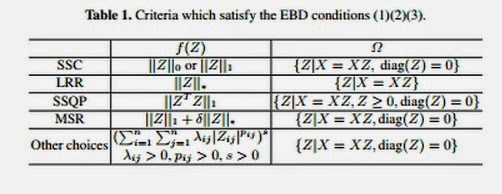
Here is the derivation: k-Means Clustering Is Matrix Factorization by Christian Bauckhage
We show that the objective function of conventional k-means clustering can be expressed as the Frobenius norm of the difference of a data matrix and a low rank approximation of that data matrix. In short, we show that k-means clustering is a matrix factorization problem. These notes are meant as a reference and intended to provide a guided tour towards a result that is often mentioned but seldom made explicit in the literature.Related:
- Sunday Morning Insight: Relax, no need to round: integrality of clustering formulations
- Sunday Morning Insight: Why You Should Care About Phase Transitions in Clustering
Liked this entry ? subscribe to Nuit Blanche's feed, there's more where that came from. You can also subscribe to Nuit Blanche by Email, explore the Big Picture in Compressive Sensing or the Matrix Factorization Jungle and join the conversations on compressive sensing, advanced matrix factorization and calibration issues on Linkedin.
Rdporto1 likes this
23 Dec 02:47

Rappers Killer Mike and T.I. Urge SCOTUS to Protect 1st Amendment Rights of Suspended High School Rapper
by Damon Root
 On December 1, 2014, the audience attending oral arguments at the U.S. Supreme Court got to enjoy a rare treat. Chief Justice John Roberts began reciting lyrics from the rap star Eminem. "Da-da make a nice bed for mommy at the bottom of the lake," Roberts said, quoting from the song "97' Bonnie & Clyde." "There goes mommy splashing in the water, no more fighting with dad."
Roberts' unusual performance came about in response to the case of Elonis v. United States. At issue was the prison sentence handed down to a self-described "aspiring rapper" who posted multiple violent revenge fantasies on Facebook, including accounts of him murdering his estranged wife and murdering his co-workers. In addition to those original compositions, Anthony Elonis also posted the Eminem lyrics later recited by the chief justice. In the end, the Supreme Court threw out Elonis' conviction.
Thankfully, it now appears as if the chief justice might get another opportunity to show off his rap skills. Yesterday a group of well-known rap artists, including Killer Mike, T.I., and Big Boi, joined an amicus brief urging the justices to hear the case of Taylor Bell v. Itawamba County School Board, an important First Amendment case out of Mississippi with rap music at its center. "The Government punished a young man for his art," the brief states, "and, more disturbing, for the musical genre by which he chose to express himself."
In 2011 Bell, then a high school senior, was suspended for "harassment, intimidation, or threatening other students and/or teachers" after he posted a rap song to Facebook and YouTube. The song irked school officials because it discussed the sexual misconduct charges leveled against two coaches by some of Bell's classmates.
To be sure, Bell's song does feature plenty of violent imagery and profane language—all standard stuff for this genre of music. And yes, some school officials got offended by the lyrical content. But so what? Bell wrote the song, recorded the song, and posted the song on his own time, entirely outside of school grounds. What's more, Bell never actually threatens anybody in the song, a fact that the school itself quietly conceded by never bothering to call the cops to investigate him. In effect, Taylor Bell was punished for exercising his First Amendment rights outside of school.
The Supreme Court should listen to Killer Mike and take the case.
Related: "Gov't Tried to Shut Down Rap in Straight Outta Compton, and They're Still Doing It"