Shared posts
Race and Attraction, 2009 – 2014
Steve DyerThis guy has a new book out and I want to read it RIGHT NOW
47 Portraits of People in Provincetown and a Chat with Photographer Emil Cohen: PHOTOS
Steve DyerShout out to this person I know, Emil! (He is technically my friend but he got engaged to someone I've crushed on for years and it's the mismatch of the century)
(this onehttp://towleroad.typepad.com/.a/6a00d8341c730253ef01b8d06743b3970c-500wi )
BY ANDY TOWLE
Towleroad spent several months this summer in Provincetown, Massachusetts. 'P-town', in addition to being the nation's historic LGBT resort destination, has also served as an enclave for writers and artists since the late 1800s and continues to attract creative types from all over the world who are drawn by the area's dramatic physical beauty, its numerous arts venues, and its colorful collection of tourists and townies.
One project we've had our eye on all summer is a photographic documentary series by Emil Cohen, who stationed himself each evening outside the Boatslip (where a daily and long-running 'Tea Dance' is held) and found hundreds of willing subjects to stand in front of his lens.
Emil (pictured, right, in self-portrait) sat down with me this week to share 47 of the portraits with Towleroad and discuss the process and inspiration behind his impressive project.
Who are you and how would you describe yourself as an artist?
My name is Emil Cohen and I'm a professional photographer. I received my MFA this past spring from The School of the Museum of Fine Arts in Boston, MA. As an artist, I find myself drawn to portraiture’s ability to capture the human experience.
What inspired you to start photographing people in Provincetown?
This past summer, my fiancé and I had a seasonal rental lined up for the summer, so I knew that the next project that I took upon myself would be shot in Provincetown and more specifically, be about Provincetown. The inspiration behind this particular project was mainly Richard Avedon's In The American West series. I proudly own an original copy of the book (a gem I discovered at Tim's Used Books on Commercial St.) and became inspired to create my own portrait series. I like to believe that people captured in Avedon’s work represent real, live individuals, not staged personas. That skill, to embody each person’s essence, is something that I strive to achieve in my own work every day.
Is portraiture your specialty?
Portraiture is indeed my specialty. I have always found myself drawn to photographing people, though sometimes photographing their environments provides further light on the subjects. Studying the work of Alec Soth, Claire Beckett, Matt Williams and Brian Schutmaat, has enhanced my understanding that a portrait can be more than just a photograph of a person.
Where did you find your subjects for this project and who are they?
My subjects are all volunteers. I set up my camera on the corner of Atlantic St and Commercial St and ask people if they'd like to participate in a photo series.
How many people did you photograph? Was it over the course of an entire summer, a few days?
I began shooting this project right after July 4th and have been photographing nearly every day so far. Without realizing it, doing this every day, I’ve captured over 200 people. What’s so unique is that each photograph represents a different person’s background, perspective, experience, life. What I’ve realized about this series is that it’s not only a portrait series, but also a chronology of a P-Town summer: From Bear week to Family week to Carnival and more.
How did you choose the setting?
The critical aspect of the setting was the continuous backdrop, akin to Avedon’s work In The American West. Having people stand in front of the same backdrop forces the viewer to concentrate solely on the person. To me, the storm shingles beautifully represent Provincetown and Cape Cod. Having each person stand in front of the same shingles helped identify the location of this project but also helps create a catalog of people, which as a whole, becomes a portrait of Provincetown itself.
Which are your three favorite portraits and why?
As each person approached the storm shingles in front of my camera, I provided the same simple instruction: "Be yourself." The three portraits I'm particularly drawn to are ones who fully understood my guidance. Specifically, Super Judge Judy, the two men in black singlets, and the young black man in the black tank top named Richard (all this page, click to enlarge). Super Judge Judy and Richard look directly into the viewers’ eyes and exude a level of self-confidence that strengthens the photo overall. With the Two Wrestlers, I particularly love how the gentleman on the right got lost in the moment and forgot that I was watching them. For these individuals, a mix of the P-Town atmosphere, and perhaps a few Tea Dance cocktails, helped lower their guards and elevate their presence in the photos.
What is it about Provincetown that makes it especially suitable for this type of project?
I love Provincetown’s ability to draw out the child from within. Each person, regardless of background, can be who they want, dress how they want, and act how they want. This level of curiosity, openness, and fun was more than a gift for me in this series. By beginning to capture the essence of this small town and its visitors, I’m excited to see this work develop into a portrait of the town itself.
Is there a Provincetown photographic tradition that you admire? Any other photographers?
While I don’t have a specific Provincetown photographic tradition in mind, the costumes and theme weeks certainly are a photographer’s dream. There are many photographers whose work I admire and turn to for influence. Irving Penn and Avedon are particularly strong inspirations. As are, Bruce Davidson, Gregory Crewdson, Renika Dykstra, Jess Dugan, and Collier Shore.
Did you give your subjects special instructions before photographing them?
Stand in front of the shingles and be yourself.
Do you plan to make this a tradition?
To me tradition isn’t something planned, but something that grows organically. Looking back on the project, Portraits in Provincetown is a chronology of portraits, encapsulating the summer of 2014 through a series of photos. Moving forward with the project, returning to the series would expand the idea that this project is an archive which continues to grow every summer. I would love to do such an ambitious project and in five, ten years, have this enormous volume of portraits taken throughout the years to archive Provincetown’s history, continuity, and change. We'll see. I do know one thing’s for sure: I’ll be coming back next summer with my fiancé! (wedding in P-Town anyone?)
Enjoy 44 photos from Cohen's 'Portraits in Provincetown', AFTER THE JUMP...
(you may recognize a few faces, especially near the end)
Visit Cohen's website here and his blog, A Minute for Minute here.
How To Become An Undetected Serial Killer
Steve Dyershe is so fucked up but most importantly she is RIGHT
 1. It has to be a stranger. It has to be. This is no time for settling old scores. This cannot be traced back to you in any way. You can’t see them during your daily routine; you can’t have mutual friends; you can’t live in the same county. You cannot research them online before you do it. Do you know how many killers get convicted who might have otherwise walked free because their goddamn browser history is full of “how to dispose of body” and “hire someone kill wife”? Don’t be one of them.
2. You have, roughly, a twelve-hour window to dispose of the body before the smells and sounds associated with decomposition and dismemberment start to give you away. Do you keep a small skin trophy? Do you carefully arrange the torso in a grassy meadow? These are deeply personal questions. For my money, you’re best off with a bone saw, a tarp, a lot of quicklime and twice as much bleach as you think you’ll need, as well as access to an empty house or warehouse with a large, preferably industrial-sized drain.
3. Pay for your materials in cash. Do not get a receipt. Do not buy them within a fifty-mile radius of your home or office. Use common sense. Have an alibi, but don’t go overboard. An overly elaborate lie has too many details you could potentially foul up. Keep it simple.
4. Alternately — if you want to make a bigger first impression or don’t think you can pull off disposing of a body in enough time — walk in, shoot twice, and walk out. Don’t move the body. Don’t touch anything. Even if you’re completely sure they’re dead, shoot them in between the eyes one more time, just in case.
5. Wash your clothes, then throw them away. Don’t throw them all away at once.
6. Resist the urge to write taunting letters to the police. That’s asking for trouble. Don’t send them cute little puzzles, don’t arrange the bodies of your victims in an interesting pattern, don’t write to the editor of the San Francisco Chronicle asking if he’s guessed your name yet.
7. Repeat this at least three more times, with a month-long “cooling off” period in between, in order to qualify in all fifty states.
8. Never, ever get drunk again. You will want to tell someone for the rest of your life — this is a completely natural response to having godlike power over the lives and deaths of others – and it will take much less alcohol than you think to lower your inhibitions long enough to answer the probing questions of that mysterious stranger sitting next to you at the bar in damning detail.
9. Don’t keep to yourself. Make sure you’re not the kind of person your neighbors would describe as “quiet” or “keeps to herself, mostly.” Don’t draw undue attention to yourself, obviously, but attend a neighborhood party or two. Remember your coworker’s birthdays. That sort of thing.
10a. If you must marry, keep your spouse in the dark. Do not attempt to recreate, on a non-fatal scale, the psychosexual games you play with your victims with your husband or wife, no matter how into it you think they’d be.
10b. Avoid bigamy. Many a serial killer has been brought low by the desire to maintain multiple spouses in various parts of the country. This is like sending Al Capone to prison for tax evasion: a sheer waste.
11. Don’t bring your serial killing into the house. No murder basements, no secret murder castles, no murder foyers. Keep your home a murder-free zone.
12. Never talk to any of your friends about current events. They will bring up the rash of disappearances that have plagued your corner of the state lo these several years, and you will start smiling into your drink and asking them leading questions until one of them says What are you trying to say exactly and you say Nothing, nothing and then one of them who’s never really liked you calls it in and everything falls apart and you might have well just murdered everyone you knew and sent a pictogram signed in your own blood to the local sheriff’s department. This is a long game. It’s not over until you die peacefully in your own bed, never breathing a word about your crimes to the family that loves and doesn’t know you.
Read more How To Become An Undetected Serial Killer at The Toast.


The View From Your Window Contest: Winner #221

A reader asks:
Is this a speed test this week?!
Not for everyone:
The Florida Panhandle? This is somewhere south of the Mason-Dixon Line.
Another heads west:
Definitely on the West Coast with a temperate climate that allows both exposed plumbing and palm trees. I could find nothing about “Zone’s” other than it’s a tech company and also a catering firm on the East Coast. The rounded blue roofs look like they may cover platforms for a lite-rail system. It might be San Francisco, but I’ll bet on Portland, Oregon.
Just south, actually:
We’re in the US (“Private Property, No Parking” signs on the fence). The combination of cloudy skies, tightly packed buildings, tightly packed cars, and sparse palm trees screams Southern California to me, and particularly reminds me of the Pacific Beach neighborhood in San Diego.
Another gets closer:
Los Angeles? Boy, I could be totally wrong about this, but it looks so much like an early painting of Richard Diebenkorn’s.
One key clue led to hundreds of correct entries:
Thanks for the ridiculously easy contest. It’s a good opportunity to let the incorrect guessers know that they need an eye exam.
Another explains:
A building in the distance labeled either “Zane’s” or “Zone’s.” I’d searched these terms, along with words like restaurant, gym, store, and nightclub by themselves with little success. Once I deduced it was in California, I searched, “zanes california” and found this: It’s a restaurant located in Hermosa Beach, California.
Correct! A happy rookie:
OH MY GOD I ACTUALLY GOT ONE! Have tried several times in the past, but always
ended giving up relatively quickly and lamenting the apparent futility of it all. Never even bothered submitting a guess. Now I know this isn’t the trickiest one in the world. No doubt I will be one of dozens to get it (or at least get the building right). No matter. To me, it is huge.
This picture screams SoCal. After that, the two biggest clues are the sign in the background and the building with the curved chimney. I decided to focus on the sign. And, after a fruitless search for “Zone’s” in various search engines and databases, I realized the “o” was an “a.” Zane’s. So a simple “Zane’s SoCal” led me to Hermosa Beach. After that, focusing on finding two blue houses side by side, Google Street View walked me to the Sea Sprite Motel and Apartments.
Thanks for the great work and for picking one us mere mortals had a fighting chance at!

Playing the contest is like Nintendo, it seems:
It finally happened. Dozens of such VFYW contests and humbled each time, until now. The best analogy I can think of takes me back to playing Super Mario Brothers on the original NES as a child. I could get to the final level, but time and time again I’d fail to best the evil boss at the end to save the princess. And then, one fateful day, it all came together. Perhaps through sheer luck, or maybe by logging enough hours to hone my skills, I made it through King Koopa and rescued Princess Peach.
My reward? A brief thank-you from that ungrateful princess. Then, the option to get sent off on a new quest altogether!! What the hell? Mario had risked fire-spewing lava and defeated a series of mutant reptiles, and all he gets is a mere “thanks” and an invitation for more life-risking adventures?! I’d assume if you get the title of “princess” one’s family could offer a little more in the tangible reward department.
I digress.
This view is from the Sea Sprite Motel (& Apartments) in Hermosa Beach, CA. It’s taken from the top floor, but I cannot tell which unit. Interestingly enough, the view from the other side of the building would be of the Pacific Ocean.
Fortunately, in the last 25 years I have learned to enjoy the satisfaction of a job completed as reward unto itself.
Another agrees:
Husband: “But if it’s that easy, won’t everyone else guess that too? You won’t win.”
Me: “Yes, but it’s not about winning, it’s just exciting to get one right!”
A detailed visual walkthrough:
Using the awnings in the midfield of vision, and the blue house with small parking lot, it can be traced back to the second floor of Sea Sprite Motel and Apartments at 1016 The Strand. Because the window doesn’t seem to have a horizontal split, I am going with the window with the vertical split, circled below.
The map view is below showing the hotel, the building with the curved awnings, and Zane’s in the background:
Here is the view from the alley looking at the small parking lot and the tan building in the rear with the darker blue house behind that:


Another rags on LA:
The vague location came to me immediately. It was the general seaside atmospherics – the low cloudy sky of the Los Angeles beach areas that I grew to know years ago when I lived out there. Hunter Thompson once called it “the shitmist,” but I never thought of it that way. That gentle overcast was just a relief from the usual relentless sun.
Another reader looks to Hollywood:
This one might be a gimme for movie and TV buffs, since all kinds of things are shot in Hermosa Beach, given its proximity to LA. John Cusack ate in a diner across the street in Steven King’s 1408 and the Sea Sprite is visible through the windows behind him:
It also starred in a pool party scene from Gilmore Girls:
And, bizarrely, in a scene from Monk set in San Francisco but shot 400 miles to the south and photoshopped into the Bay Area via a digital Bay Bridge:
This is an obvious fraud, since there are only 2-3 days per year one might throw a pool party next to the Bay Bridge. In SF, everyone in that scene would be hypothermic.


And you can’t have LA without pulp:
Marlowe crawled back to consciousness and tried to remember what it was that Zane had told him last night just before somebody put his lights out. Who was it swung the sap? Eddie Mars’ boys? They were waiting for him outside that steakhouse, the one on the corner of Pier and Hermosa Avenues, where he’d dropped in to get the lowdown from the kid (not the one looking for the black bird, the other one).
The bar there was nice and dim and they poured a decent gimlet, but still Marlowe hadn’t been ready to believe that it could be this easy. “Hell,” he reflected, “that dame didn’t need a private dick. Type ‘Zane’s California’ in any search engine and she gets the motherload. It’s Hermosa Beach, not Santa Monica or Hollywood, but this is still Raymond Chandler country: sunburnt stucco and palm trees.”
It took nothing to retrace steps from the steakhouse to the Sea Sprite Motel at 1016 The Strand and to wait there for the hard guys to make their next move. “Next time I’ll get a window facing the beach,” he thought. “The surf’s loud enough, you might as well get to see it.”

Another player finally found a way to incorporate a teen soap opera into a contest entry:
Palm trees. California! But WHERE in California?? Oh no!
It’s in times of need just like this that I humbly turn to the “World’s Greatest Compendium of Locations where The O.C. was Filmed“. And, as always, TWGCOLWTO.C.WF puts the competition to shame. What you need to know about the Sea Sprite Motel at 1016 The Strand, Hermosa Beach, CA:
- A cheap motel where pornographer Lance Baldwin stays.
- Episode 16 (of season 2), when Sandy Cohen goes to the blackmailer Lance’s apartment to try to negotiate the ransom for the porno tape which Julie made when she was young. We see it again later when, after Julie has confessed her sordid past to Caleb, Caleb also goes to Lance’s apartment at the Sea Sprite motel and shows him the extortion money. But after getting his hands on the tape, Caleb double-crosses Lance, takes back the $500,000 cash, and has two thugs beat Lance up.
I have no idea what room, but let’s say … 12, because my research indicates that’s where all the shit went down:
And I choose to believe that our photo submitter was this guy:


Readers truly went to extraordinary lengths to distinguish themselves this week:
Since you will undoubtedly have lots of correct answers, I better up my game, here’s more info:
Trivia: Dizzy Gillespie, Tito Puente and Mose Allison stayed there, as did Ice Capades performers.
Personal Connection: I’ve now spoken to the
desk clerk on the phone, as I called the hotel to ask for the room number of my guess. Sounds like quite a few Dishheads are calling and even stopping by to scout it out! End unit is #17, my guess is #16, he said some folks were guessing #15. Pretty certain the right answer is the window I indicated in my original post which I now know is in room #16.
Given the apparent on-site investigations, I expect the winner will provide at least one of the following: (a) a picture of themselves at the window posing with the motel’s owner and/or (b) a DJI drone video fly-through out the window showing the view, circling over the hotel for some areal footage, ending with a stunning sunset shot over Hermosa Beach (roll credits).
Another shares a story from their eventful stay at the Sea Sprite:
My wife and three young kids stayed at the Sea Sprite for July 4th in 1998. We had just moved to California and wanted to see the fireworks (and we did not drive on the Jewish sabbath, thus the need for a local hotel – as well as local parking). We did not realize that the Strand in Hermosa Beach was a central vortex for 20-somethings gone wild. We survived the interesting cultural experience, and my wife’s car survived the partying that occurred in the parking lot and everywhere else.
The problem surfaced when we drove just a few short miles home. Our other car was stolen off our street in Redondo Beach. So I called the Redondo Beach police and told them that my car was stolen. The officer replied, “Why do you think that your car was stolen?” I replied, “I went to where it was parked, and it is no longer there!” Without missing a beat, he replied, “In the police business, that is what we call a clue.”
Turns out, it was just taken for a joy ride. About ten days later, as another Redondo Beach police officer was writing a second ticket for illegal parking, they gave me a call and said if I could pick it up in the next 20 minutes, they would tear up the tickets. And so it was.
A visual entry:

There’s also a good jazz scene in town:
The VFYW this week looked immediately familiar, as this is an area I have spent a lot of time visiting over the years. As a certifiable jazz nut, I have spent a lot of time just down the block at the famous Lighthouse Cafe, arguably the home and birthplace for the type of “cool” jazz that defined the “West Coast” jazz as opposed to the hard bop made famous in New York and locales further east. While the Lighthouse is now a venue for a wide range of musical styles, it was made most famous during the 60s and later years as a fantastic venue to hear the very best West Coast jazz musicians:
Another reader:
I finally know what Chini must feel like. This was a five-minute window, and it only took five minutes because I was working out which of the windows it must have been taken from. In fact, my nine year old took one look and told me to start looking in California. I found myself frustrated that it wasn’t more difficult, seeing as how I planned to devote a full day to the search. Crazy, eh? I get frustrated when I can’t find it, and frustrated when I do. Madness, this.
And here’s the Chini, the myth, the almost-screwed-up-this-week legend:
So the only real trick with this one is how you read the store sign at left. If you read it properly, as “Zane’s,” you were a four-second Google search away from finding the right spot. If, like some people I know real well, you looked at it on your iPhone and thought it said “Zone’s” you instead spent a nice chunk of time searching for a business that doesn’t exist. Epic. Chini. Fail. Thankfully, the uber LA-ness of the scene and the Bank of America sign rescued me later on Saturday.
This week’s view comes from Hermosa Beach and looks northeast along a heading of 38.99 degrees from the second floor of the Sea Sprite Motel, most likely room 16. As an aside, kudos to your viewer for picking a motel straight out of my Jersey Shore childhood. Most Dish readers stay at posh hotels and fancy B&B’s. Nice to see someone kicking it old school for once.

A tie-breaking idea:
Since this week’s contest features such an easy clue, I think the winner should be the person who guesses nearest to the number of correct entries. 162!
More than twice that actually. In fact, here is a relatively accurate pie chart for this week’s guesses:

And as is usually the case in an incredibly easy contest like this one, our winner comes from our prestigious list of winless guessers of difficult contests from the past:
Sea Sprite Motel, back of the building, second floor looking northeast, second room from the south end of the building. Got it from the Zane’s restaurant sign, which I mistook for Zone’s. It’s either room 16 or 17. I’m going with 16 based on the angles.
Congrats! From the reader who submitted the view:
Looking east from the third floor bathroom window of room 16, Sea Sprite Motel, Hermosa Beach, California. Here’s another view from the motel:

Lastly, a reader figures out our dastardly plan:
So, I’ve never entered a VFYW contest before, because I never really had any clue how to start. I always counted myself lucky if I guessed the right continent. And since I figured this out, I’m sure virtually everyone did. But now you’ve got me hooked. There go my Saturdays.
See you then! Until then, see if you can spot your entry in this comprehensive collage:


A Complete Guide to Today's Apple Event


 Developing…
The post A Complete Guide to Today's Apple Event appeared first on The Awl.
gayinsect: im pretty sure bromance is the perfect example of how embarrassingly fragile masculinity...
im pretty sure bromance is the perfect example of how embarrassingly fragile masculinity is. you know what a female bromance is called? a friendship
knowyourmeme: Hodor crab.
Steve Dyerdid you guys know hodor isn't in this season
(neither is bran)

August Never Ends
Steve DyerA dramatic reinterpretation of all of the gchats between me and Cherv.
 INT. OFFICE — DAY
In the gleaming, unblemished offices of an internet media company, located in a revitalized industrial district now home to seed-funded start-ups, dozens of young people sit in front of computers. The computers seem angry; the office looks like the inside of a soda can. A calendar reads “August 15.”
DEREK sits in front of one of these computers. He’s wearing a collared shirt and jeans. He tried to wear a denim jacket once, but he felt like a cowboy, in a bad way.
Derek is talking to GWYN, who he would like to sleep with, but also respects, as a person.
DEREK: It’s horrible.
GWYN: Yeah.
DEREK: It’s all so horrible.
GWYN: Yeah.
DEREK: The Internet is like a garbage can.
GWYN: I guess so.
DEREK: I feel like I’m always putting garbage in a garbage can.
GWYN: I’m going to go get Sun Chips.
DEREK: Can you grab me a seltzer?
GWYN: Sure.
Gwyn leaves. Derek turns to face his computer. TweetDeck blinks back at him.
Derek had a dream about TweetDeck the night before. He tried to have sex with it.
In the send box of TweetDeck, Derek types: “August needs to end.” He clicks send. The tweet is favorited nine times, once by an editor Derek admires and once by a girl he is in love with, although he’s never met her. No retweets.
Derek reaches for his seltzer, but it isn’t there yet.
GUS rolls up in his chair, which has wheels on the bottom so that Gus can roll up to Derek in it. Gus is dressed exactly the same as Derek is. This is a figure of speech, usually, but today, it was embarrassing: they were dressed exactly the same.
GUS: Man, August fucking does need to end.
DEREK: Seriously. I mean, it was enough with the war.
GUS: And then the domestic thing.
DEREK: And now this celebrity thing. It’s like August decided it was going to overwhelm us with shit.
GUS: No joke. It’s a deluge of shit.
DEREK: Apres August, no deluge. Of shit.
GUS: What?
DEREK: Nothing.
GUS: Can’t wait for this month to be over, dude.
DEREK: Halfway there. And then everything changes.
GUS: Thank God.
INT. DIVE BAR — EVENING
Gus, Gwyn, and Derek are sitting at a high-top in a bar downtown, next to a building that used to be a tenement but now contained rich people. They’re drinking beers. A chalkboard behind the bar says, AUGUST 31. Below that, it says SPECIALS. Below that, it says NOTHING.
GWYN: Can’t believe it’s almost September.
DEREK: I’m not sure I could’ve made it any longer.
GUS: I know. By the beginning of this week, it was just like… this month has to end. Or else, I will die. I will die.
DEREK: It felt like it got worse, too, didn’t it? Like, by Tuesday, I was already saying the week had to end. By Wednesday, I was saying the day had to end at like, 9:30 a.m. I wasn’t even in the office yet.
GWYN: Today I said an hour had to end, and it hadn’t started.
GUS: Whatever. It’s all behind us. In September, everything changes.
DEREK: So, like, is the Oracle running late, or what?
GUS: Yeah, sorry, he texted me and said he’d be here in a few. Apparently the L train got stuck crossing into Manhattan.
GWYN: Fucking L.
DEREK: Cool. Should we grab him a beer, or?
GUS: I don’t know what he likes. We can ask when he gets here.
Just then, THE ORACLE walks in through the front door. He’s wearing boots and Warby Parker eyeglasses. He joins the other three.
ORACLE: Jesus, sorry guys.
DEREK: No worries, man.
GWYN: It happens.
ORACLE: I pride myself on being timely.
GUS: Really, don’t worry about it. You want a beer?
ORACLE: Sure. Whatever you’re drinking.
Gus goes to the bar. The Oracle sits and rubs his eyes.
ORACLE: So. You guys want to know some shit?
DEREK: Let’s wait for Gus, it would be kind of lame to start without him.
ORACLE: No, you’re right.
GWYN: So like, how’d you get into…
ORACLE: Clairvoyance?
GWYN: Yeah, wasn’t sure what the word was.
ORACLE: Right, you’d think it’d be “oracling,” or, you know.
Derek and Gwyn both laugh.
ORACLE: But seriously, God told me to.
GWYN: That’s cool.
Gus returns with two beers.
ORACLE: All right. Let’s get down to business. What do you guys want to know.
GUS: First off, thanks so much for coming to talk to us…
ORACLE: Let’s not make a big thing about it.
GUS: Sure. OK. Well, August sucked, right? It sucked.
DEREK: Yeah, you know, the war, and the domestic thing, and the celebrity thing.
GWYN: Just the worst. So we were wondering, tomorrow’s September. The month is over. Everything changes. EVERYTHING. And we want to know what September’s going to be like. Figured we’d plan ahead.
The Oracle stares at them for a few seconds.
ORACLE: What?
DEREK: What do you mean what.
ORACLE: What?
GUS: What’s September going to be like?
ORACLE: It’s going to be the same. Why the fuck wouldn’t it be?
GWYN: But August is over.
ORACLE: You think just because the month is over, everything’s going to not suck?
DEREK: Yes.
GUS: Exactly.
ORACLE: Everything sucks because everything sucks. That doesn’t change because the fucking month is over.
DEREK: But the war?
GUS: And the domestic thing?
GWYN: And the celebrity thing?
ORACLE: Those don’t even affect you guys!
DEREK: I think they affect everyone.
ORACLE: They affect a lot of people way more than they affect you.
GUS: So.
ORACLE: Well, September’s going to be exactly the fucking same, because time is an illusion and you’re all obsessed with the symptoms, not the actual problems. So stop moping.
DEREK: Christ.
GUS: That’s a fucking bummer.
The Oracle turns to Gwyn.
ORACLE: So how long have you lived in New York?
INT. MEDIA OFFICE — DAY
Derek sits at his computer. He’s wearing a sweater over his collared shirt. Gus is wearing a denim jacket. He looks like a fucking cowboy.
A calendar reads “September 10.”
Derek opens TweetDeck. Last night, he dreamed that he and Tweetdeck had had sex, and then Tweetdeck was emotionally unavailable.
In the send box of TweetDeck, Derek types, “Man, I am so over September.” He clicks send. He gets seven favorites. The girl who he’s in love with retweets it.
Derek opens a new DM.
Kevin Lincoln is a writer in Los Angeles. Photo by Paul McCoubrie.
0 CommentsHacking ‘Kim Kardashian: Hollywood’ for Unlimited Money Made Me Lose My Moral Compass
Steve Dyerchris
 “Kim Kardashian: Hollywood” was introduced to my iPhone earlier this summer after my already-addicted friend told me that I had to play it “to get a good laugh.” Let me be clear, we both love the Kardashians unironically; love their unabashed business tactics, their penchant for body-con dresses, their general candor and their adorable, growing flock of children. I could write a dissertation in defense of the entire K-empire if someone would permit me to.
So, I played the game fair, square and free of spending any real-life money, played it slow and steady for weeks until I got to the A list.
For those who don’t how it works, here’s a primer:
You start at the bottom, the E list, and through charming various industry professionals and seducing romantic prospects and buying lots of things, you work your way up; the only way you can effectively climb the ladder is by having a full store of these little cute lightning bolts of energy, which can be regained by purchasing with coins, which need to be purchased with real life money. So: no real-life money, no ability to buy energy. The free way to gain energy is to wait around for it to restock, every few hours, which is tedium at its finest. Though I was consistently low on cash (basic currency) and K-coins (rare, more-valuable currency), I reached my goal of good clean social ascension. The only motivations that kept me wanting to play after making the A list were the far-away dreams of a) adopting Charlie the cat off the streets of downtown L.A., and b) buying a goddamn jumpsuit because I will always fall for a jumpsuit. These things cost more K-coins than I had time to wait around for, being that I have a real-life full-time job (or, if we want to get technical, a summer internship…).
The fact that the cat and the jumpsuit were full-fledged, legitimate dreams of mine is crazy, I know, but it seemed pressing at the time. Very pressing. So pressing that I hacked the system (after carefully following the instructions in a Daily Dot piece, “The complete guide to hacking the Kim Kardashian app” and downloaded a brand new game pre-loaded with billions of dollars in cash (188,888 billion to be exact) and infinite K-coins. The numbers in my cash and K-coin deposits literally ran off the screen. Below is a chronological, real-time account of life as a bazillionaire powerbitch avatar named Manda (I figured I could drop the “A” and live a generally-cooler existence) and the tailspin it sent IRL-Amanda into:
I. Here I am on level six after less than an hour. I left my fair game on level 13. I feel dirty but excited. Upon first downloading, I felt like the universe was expanding and giving me a giant hug. I deserved this. Got the cat and the jumpsuit, what else can I get? Everything. Veruca Salt-ing out right now. Stopped double tapping because who needs the extra cash on the floor. Buying 50-coin bags of energy. Charmed some weirdos I bumped into at Panino. We will see if the destination is really sweeter than the journey.

Closing my eyes to really absorb the wonder of this lurex (I’m pretending it’s gold lurex) jumpsuit
II. Also I’ve noticed that because of my new, pricey clothing, none of my dates are putting down my outfits, instead telling me I look great. So sorry my old standby of no-cost white baby tee and jeans wasn’t cutting it in the pre-hack game. Also, I got furnishings for the Hollywood condo and bought a freaking Range Rover and I can drive places instead of taking the bus like a mere peasant. Also, Bernard the boxer is adorable and gives free energy, not that I need it anymore. And this time at Lif nightclub, I finally threw the drink in Willow’s face. Do-overs are satisfying. And I got the floral sleeve tattoo which I would have never done in the fair game and it actually looks sick and inspires me to get a real one. Also, isn’t it rich that with infinite energy you can conquer the world, except that energy can only be bought with time or money? So basically infinite money means world conquer, faster.

My pre-hack game uniform, and my pre-hack abysmal amounts of energy/cash/K-coins
III. A bit unclear about the consistency of key characters. Like Jordan Borschtalk, a realtor of So Chic boutique, who is obviously Jewish. Was he selling this place the previous game? I don’t think he was. I would have remembered him as a fellow Jew. There are no Jews in the Kardashian real-life world except Scott Disick, right? And after the talk with Jordan, I got denoted from the D to E list for threatening Willow and getting bad press, but I came back in no time with a 5-star photoshoot and a new look: choppy bob and leather pants.
IV. I find myself on a date with a nice B list promoter who tells me he likes himself better when he’s with me instead of the usual, “That’s what you’re wearing!!?? You couldn’t dress up more for me?” as a standard greeting. And I find myself blown away by the luxury of wining and dining this nice man and not worrying about money or energy or being ugly. Also, he’s blond and I’m not really a blond type, but it’s time to expand the horizons. I’ve taken off my sleeve tattoo (thank god I didn’t start a real one; I am too indecisive for such commitments). I would, however, wear a temporary sleeve tat if they made really beautiful ones with realistic botanical illustrations.

Hey, thanks for that genuine compliment, you sweet, be-scarved promoter man
V. Something weird happened the first night of the new game, I got to the C list, went to bed, woke up and opened the game and got to the B list after a few short appearances, and then after a barrage of twitter updates for a good five minutes, I got to the A list with no effort or jobs done whatsoever. It was a glitch I think, possibly because I had been going to so many gigs in a row that it crashed the system and then registered them all at once. So here I am. I own a plexiglass helicopter in addition to the array of fancy cars parked in my garages across the globe. Helicopter. No model/socialite owns a helicopter IRL—they just ride other people’s, right? Am I a model/socialite in this game? I can’t think of another more accurate title, though I’d rather be another profession like some of the other token characters, i.e., “biochemist” or “novelist”; then it wouldn’t be a real game though, so I get it, I get it. Also I actually love this casting couch jab with the Brandon Marlo (lol) dude who hits on Manda in his creepy hotel suite by the airport. Casting bed, ahem. I wonder if Kim has experienced this a lot.
VI. Now that I’m all A list and the number one player and have no real goals anymore (after two whole days of hard work), my favorite thing is dating around and seeing what big milestones my dates bring up, like being exclusive and getting keys to apartments, and so on. In the first, pre-hack game, I couldn’t afford to date multiple people in a row, but now I do and let me tell you, I so appreciate the recognition of sexual fluidity. I told Kim initially that I liked dudes when she wanted to set me up on a date (actually, thank you for even asking, Kim, that’s great of you!), but I’m now seeing a guy and a gal and they’re both into me. This is basically a pass to experiment with my sexuality in a guilt-free way, as I am a young person in a real-life monogamous and hetero relationship, but was never going to fully rule out anything before getting into said relationship. There are a few woulda-coulda-shouldas that cross my mind every now and then. The girl I date is all bronzy-skinned with bright red hair, quirky glasses and a cool downtown vibe, but on the D list, and I think she’s a promoter, a job of which I still don’t even really know the definition, even with half the characters running around like, “Hi, I’m a promoter!” She keeps telling me she’s going to write sonnets about how I look tonight. So she’s a promoter with a passion for the Bard, I love that. The guy I date is on the A list like me, with bleached spikes like Guy Fieri (the blondest breed there is) and a smart black blazer that I bought him because I quite enjoy being a sugar mama and it really makes him look nicer regardless of his poor hair choices. He’s a set designer, which harkens back to my real-life high school soft spot for tech boys in drama club.
VII. A bit more on sexuality, via hair; this game allows me to cycle through just about every hairstyle imaginable, and one of my favorites is the Mia Farrow-ish/Anne Hathaway-ish crop. I feel the need to pair this hair with softer, stereotypically-feminine outfits (e.g., slouchy pastel pink sweater, jeans and pointed heels, or lavender high-low maxi with the deep V, large earrings always), and I never stepped back to wonder why. Was I afraid of looking too masculine? I would definitely gravitate towards the femmy, bejeweled look if I ever chopped my hair off in real life, and I hate that my fear of fully breaking down gender norms is so ingrained that I can’t even avoid it in alternate realities. I can be a heteroflexible non-monogamist, but I can’t freaking cut my hair without succumbing to society’s rulebook?
VIII. Now, when I pass people in the real-life streets of midtown Manhattan with their array of ridiculous outfits, I think, “wow, they’re just like the randos on the streets in the game. He could be a paparazzo outside Chateau Nuit. She could be a fan wanting an autograph in London. He could be a waiter in Punta Mita.” People have turned into cartoons. Or the cartoons have turned into people? Art imitating life imitating art, all that high-dea crap—it starts to be a constant thought for me on my speed-walk to the train home. Reality is whatever you immerse yourself in.
IX. I feel like I’ve also been more upset about the impending post-college job search (T-minus 4 to 6 months) because this game lets me be a freaking star and all I need to succeed is two fingers for tapping and ambition. And that sounds like I’m in the porn industry, which I wouldn’t even cross off the list, because I know it would be very empowering if done with the right people. Again, the woulda-coulda-shouldas attack. But I am so young! I have a lifetime of potential pornographic endeavors to involve myself in, on the side of my burgeoning magazine journalism career, of course.
X. A bracelet that my real-life boyfriend bought me for my birthday broke today at real-life work and I emailed customer service of the store it’s from and they gave me a credit in the amount of the bracelet, a number of which I was not aware of until now: X amount of dollars. Nothing on the store website costs X amount of dollars except teeny midi rings and a ceramic sheep pendant. If I buy anything I actually want, I have to put out the rest of the money and I am very strapped for cash and can’t gift myself anything. This makes me a selfish awful person—to resent the boyfriend and the store’s website when they both did nothing wrong, and yet, that’s exactly what I’m doing. There have been many expensive, beautiful gifts that I’ve put together for him, for every single holiday, birthday and most recently, his graduation. All gifts that I never once questioned spending amounts of money all greater than X dollars on, because as long as I could swing it, I would. I would pick up extra shifts at my campus job at the library, do lots of psych studies, avoid frequenting the Whole Foods salad bar for a month at a time. He deserved, deserves it all. I am an asshole, but I think I might have a point?
XI. What I want to know is this: Is the game just bringing up a point I’ve known already and chosen to ignore, or is it making me turn into a covetous brat? My materialistic urges are stronger than ever, but that is pretty typical for back to school time when I prep for a half-year of Chicago hibernation by acquiring lots of sweaters and new, non-salted ankle booties. I have been bemoaning my poorly-stipended internship and faltering bank account, but I have not asked my parents for a dime. They are housing me and feeding me this summer, after all. So, yeah, I can’t afford the things I covet and deserve and dog-ear in all the September fashion mags I buy for lunchtime entertainment (they’re educational, it’s my industry!). Most grown adults can’t afford this stuff either, though. The “deserve” reasoning is flawed and awful, we all deserve everything we want, but we can’t have it all because that would be ridiculously wasteful and take all the fun out of coveting for selves and giving to others. After having and giving it all, we’d have to wait around for new things and remain flatly sated in the interim, like those flounder fish that burrow under the sand until fresh and tasty plankton float by. Boring rich fish people.
XII. But Manda can have everything she wants! The baseball bomber coatdress and pearl studs and turquoise loafers and sleeve tat and the sexy dates and crazy restaurant bills and a singing career with a splash of TV and movie-acting and business-owning. It still is mildly fun to play “Kim Kardashian: Hollywood” in little spurts, though now, the only true moments of excitement come when some new clothing items become available upon leveling up. That, and the prospect of further-expanding your fanbase, which I believe has no number limit. These are the only goals left once you’ve hit the tippy-top. OoOOOH, another 75,000 people who know my name, OoOOOH, another variation of a body-con sleeved black dress! But it is, of course, a more beautiful body-con sleeved black dress. I wonder if H&M makes a knockoff of this dress, because it would be a great day-to-night transitional piece.

THE body-con sleeved black dress of level 15, my absolute favorite
XIII. I have not touched the game in a few days. Three days. Mind is quieter. Real-life bank account also coincidentally a bit fuller due to my latest paycheck that has not been spent on fall clothing. Magazines still dogeared to bits, though tucked away in the peaceful darkness of my bag. Floating lightning bolts, silver coins and wads of cash still flicker inside my eyelids when I concentrate hard enough.
Amanda Glickman is finishing up her undergrad in writing and gender studies at Northwestern University. Check her out at amandaglickman.tumblr.com
1 Commentsiraffiruse: Some people might feel sorry for themselves in this...

Some people might feel sorry for themselves in this situation
Puppy don’t care
Puppy’s got stuff to do
Puppy’s got places to be
Puppy’s got people to bark at and things to sniff.
@SamuelMoen and the Surreal Jokes That Work Better on Twitter
Steve Dyerknow this guy in real life. He is chatty and sweaty.

@SamuelMoen just finished his master's in architecture at Harvard but says he didn't mean to. “Aside from Twitter,” Moen, who lives in Boston, told me, “my only major creative outlets are writing brutally honest Craigslist furniture ads and writing approximately one paragraph of a million spec script ideas and then going to get Sour Patch Kids and eating them until my tongue turns raw and sheds.” I asked Moen to expand upon three of his tweets, and he talked to me about the “summer camp friends” you meet on Twitter, favorite themes to explore and revisit in his tweets, and the kinds of jokes that work better online (all of them).
I want a gym where they let you push big appliances off a cliff
— Sam (@SamuelMoen) July 6, 2012
Moen: The idea of CrossFit appeals to me because I have always loved flipping over tractor tires. But what CrossFit doesn't offer is immediate catharsis. So, why not haul a fridge or a broken water heater out to the old quarry and just throw them off the side and hear that satisfying crunch of metal. It's also an excellent core and shoulder workout.
How did you first get into Twitter, and have you noticed the way you use it change over time?
Like many, I wanted a venue to complain and Twitter was supposed to be that. But you end up being followed by more strangers than friends and most of your friends don't really get Twitter anyway. So instead you stand in awe at people like Rob Delaney who can say whatever they want and it's funny and they access a level of immediate gratification that you lack. Eventually, you can access this, too, only to realize that you never needed it to begin with, Wizard of Oz style. But if anything it teaches you to look for humor in the unusual. The usual has been done and only people who like to say "bazinga" are going to laugh at a joke about comic sans.
What are some of your favorite things (formats, topics, etc) to do in tweets?
I avoid formats. There are too many formats and not enough fresh takes on them. That's why I stick to idiosyncratic observations. But I do have my favorite subjects that I like to hit back on time and again: my encounters with goat-blood-thirsty, violent chupacabras that do not reciprocate my affection; the frailty of Nancy Reagan; my organ clone who is at once my key to living longer as well as a huge loser/nuisance; destroying over and over a Claire's Accessories with medieval war machinery; you know, stuff like that! I call them "volleyball teams" after Bridger Winegar's long-running, adversarial volleyball team antics. But essentially it's a joke about something specific that you (and probably only you) found funny so you just do it over and over again until it's simply woven into the fabric of your persona and becomes more of a long game than a short punchline.
I feel nothing when you call me Big Papa — Sam (@SamuelMoen) July 28, 2014
Let's face it: depression is IN. How better to sell it than embedding it in everyone's favorite Biggie line? Venerated rap line + depression = tapping into the millennial zeitgeist.
What are your favorite and least favorite things about tweeting?
Favorite things? All the "summer camp friends" you meet. Those people who you've barely talked to directly, if at all, but with who you've developed mutual respect and admiration for the way you both express yourself or the odd thoughts that you both have. It's incredibly comforting to have concrete evidence that you and I are not that weird and if we are that weird then at least we aren't alone.
Least favorite? Topical humor. Current events are but a long game of musical chairs where 100,000 people are vying for ten chairs so when the music stops, they all tell themselves they had one of the ten jokes first and none of the jokes are funny to begin with because we're already exhausted by the inescapability of whatever topical thingy spurred the joke land-grab. Hard pass.
One thing I like about your tweets is how you incorporate images and do so kind of frequently, which I don't see all that often. What gave you that idea?
I enjoy the humor to be found in very banal things so most of the images I put up are things I find in my occasional sweeps through Tumblr. Most of them are just funny in and of themselves for whatever uncomfortable aesthetic they have. But others I've started pulling out for running series such as images of the Cheshire Cat grin of Giada DeLaurentiis and whatever hyperspecific thoughts might be running through that oversized head. It feels more organic when I hit on fun modes of visual jokes like that when I realize I'm not trying to make a specific audience laugh or put anyone down, just use them as a prop for banality.
Frodo, Sam, Merry and Pip sit around having an ale at the Green Dragon. Frodo smiles warmly at the others "You guys, I'm totally the Carrie"
— Sam (@SamuelMoen) May 20, 2012
There's literally a scene like this at the end of Return of the King once they've returned to Hobbiton and I say, without hesitation: Pip is the Samantha, as he's a huge bimbo. Merry is the Miranda, since he, of all of them, has his shit together. Sam is Charlotte, knowing he wants a family in the future and how he tends to take things way too seriously. Then there's Frodo who's a curly-haired narcissist with a propensity for needing help but turning it away every time it's offered. And they all nod and smile at each other because they know. Sex and the City character comparisons can be undertaken with any group of four people. Here: try with the Ninja Turtles. Make up reasons. It doesn't matter.
Can you think of jokes that work better on Twitter than in person?
I haven't come across a joke yet that didn't translate better on Twitter. That's also because, in person, I'm not very funny in general. Just chatty and sweaty.
Anything surreal pretty much is only going to work on Twitter. People read and process surreal images in their own way and sometimes your dictation limits how it forms for them. And I've tried many a-time to convince someone of the hilarity of a surreal idea that must be elaborated upon more and more in order for them to then pretend to laugh. So I guess one of the beautiful things about Twitter is people can't really ask questions. You take it for what it is. If you didn't get it the first time around, you won't get it if someone explains it to you because by then no one is amused.
Jenny Nelson is a writer living in Brooklyn.
0 CommentsMental Health Break
Steve DyerGuys, if you watched that dog video earlier, watch the second video from the other perspective

Photo
Steve Dyeri think about this a lot and it's the only reason i want to get famous

hitlervevo: my social studies teacher once told us “human beings are the most selfish of all. even...
my social studies teacher once told us “human beings are the most selfish of all. even when someone dies, you shed tears only because they are no more around to provide you with whatever they had been for so long”
and it has been 3 years since she said this and this is still what i think about at night
Take Time
Steve Dyerthe internet is Over
This weekend, millions of internet users scrambled at once to see photos of naked celebrities. These photos had been accessed and published without their subjects' consent. Media outlets, whose institutional assessments concluded that publishing copies of these photos would be the wrong choice, but accustomed to the realities of the internet circa 2014, had to find ways to address this issue. Mostly, at first, there was a lot of writing around the photos, which coyly provided enough information for people to contextualize and then eventually find them. Then there was real reporting about where the images came from, about the people who acquired them, about technology and about the victims. The story was quickly advanced.
But a phenomenon like this generates an enormous surplus of attention, much more than news can meet. In such a situation the internet's craving for sex and humiliation is effectively infinite. This throws the ᴄᴏɴᴛᴇɴᴛ industry into a frantic generative mode, initiating a full-spectrum stress test on par with a natural disaster or a war. This weekend was a consumption bonanza, a historic seller's market for ᴄᴏɴᴛᴇɴᴛ. It was no time for mere reports and analysis, no, that would never be enough. It was Take Time.
Take Time, the internet's evolutionary defense against attention surplus, can be large or small, quick or long. A simple form of Take Time is the post-gaffe rush, which usually looks something like this, and occurs over a period of a few hours:
Hacked? EPA Office of Water tweets about Kardashian AppEPA tweet about Kim Kardashian confuses and entertains the Internet
Kim Kardashian App Takes Over Environmental Protection Agency's Twitter
EPA Office of Water Is Caught Playing Kim Kardashian Mobile Game
Kim Kardashian App Takes Over Government Agency's Twitter Account
There were dozens more of these stories, all about a single tweet, from virtually every outlet that publishes news. And they served their purpose admirably: They left no attention on the table. They represent "we should have something on this" news impulse stripped to its barest form, left unspoken and carried out as a matter of course. Endless minimalist Takes, obviously duplicative from the producer's side but not necessarily from the other, all drawing energy from a single glowing unit of information.
A: If we acknowledge the Object, people will acknowledge us.
B: But the Object… it just… is….
A: You must harness it. You must find a way to turn your gaze… into… a Take…
The dimensions of Celebrity Nude Take Time stretched conventional Take models to the limit (but did not contradict them). The readings were off the charts. The levels were going crazy. This weekend, through a sleepy holiday, the Takes began to materialize. It was as if the Takes had been snatched directly from writers' brains at the moment of conception by some unauthorized agent, and then posted, raw, onto the internet (this agent, however, seemed to target men). People who didn't previously know they were Take generators, much less Celebrity Nude Take generators found themselves typing, asserting, publishing, delivering fresh Takes in newsy glossolalia.
B, dazed: Did I… is that Take.. mine?
A: Yes…. yes. It is beautiful.
Take creators might have caught themselves saying things like "that, my friends, is why you never take nude photos of yourself," or "just a reminder that, actually, sex is natural." There were Takes on privacy and gender and consent and free speech issued with and without conviction. Everyone with an outlet—or, really, everyone, since the great democratization of Take distribution tools coaxed previously private Takes out from bars and dining rooms and into the harsh sunlight—found themselves under the spell of that horrible force that newspaper columnists feel every week, the one that eventually ruins every last one: the dreadful pull of a guaranteed audience.
A flood came, a wide river of nudes cut through the desert, and bustling cities of Takes rose along its banks. Where there was once nothing, there was now something.
Some Takes were good Takes, some were bad Takes. One common method for generating Takes is, and was, to push two existing Takes together and see if they stick. Some Takes were probably convincing and even vital, but in the fog of Take Time it became impossible to tell. Most takes, regardless of character, were rewarded as confused clicks, aimed at, and fueled by the existence of, nearby nonconsensual pornography, took the shape of any new volume they were given.
Clicks gathered in orderly lines to be gunned down or imprisoned by rolling Takes, mounted Takes, airborne Takes. They died confused and aroused, guilty and disgusted. There were conventional Takes, banned Takes, nuclear Takes. By Tuesday, few could even remember what they were scrolling for.
A Take Time of this magnitude spares only the silent and disengaged. Any new Take issued during the diminished but ongoing Celebrity Nude Take Time, including this Take, may still be construed and dismissed as a Celebrity Nude Take.
When Celebrity Nude Take Time is finally over, the best Takes will be excavated and christened Ideas. Ideas are Takes that can be referred to in the future without embarrassment, or which could be presented to their subjects without shame.
The rest will never be spoken of again.
5 CommentsWhen people who work in finance are talking shop
Steve DyerThe only reason I like working in finance is that it means I don't have to make small talk with strangers for more than 4 sentences.
"And what do you do?"
"I work in quantitative finance"
"....okay bye"

Watch a 22-Minute Behind-the-Scenes 'Mulaney' Preview
Steve DyerKAY
Mulaney's premiere on Fox is a month away, but in the meantime the network released the above 22-minute preview featuring some clips from the show as well as behind-the-scenes interviews with Mulaney, Lorne Michaels, Martin Short, Nasim Pedrad, Seaton Smith, Zack Pearlman, and Elliott Gould. The preview is heavy on clips of Mulaney's standup and light on clips of what he calls the "throwback sitcom" format, but at least we know now that Andre is acceptably annoying because he's a weed dealer.
0 CommentsThe Short Shrift, Ctd
Steve DyerAm I old and crochety enough for this to by my one (JUST ONE) MRA issue? (serious question)
by Dish Staff

A reader writes:
I enjoyed Phoebe’s commentary regarding Jezebel’s Disney character nude-rendering piece. However, I don’t agree with the generalized notion that women are purported, or at least depicted, to not care about men’s looks. I think Phoebe slightly underplays the spectatorial role of women that women have obtained in hetero-normative dating. The height thing is a real thing; in my experience, it’s the most likely deal breaker to be found on most online dating websites (it’s certainly the most verbalized one). Perhaps online dating contains a different dynamic than dating in general, but the general gawking, ogling and just plain fantasizing about ideal men and their bodies types seems rather abundant at this point.
Another:
Your post interrupted my work and dragged me out of my “Andrew’s on vacation” lethargy and back into Post Mode. Women and men’s height: really? You’re shocked that women are interested, concerned – no – even fixated on height?
I’m a whopping 5′ 6″ (plus a 1/2″ on a good day).
It’s never bothered me, and I’ve been extremely happily married for 22 years to an incredible, beautiful, powerful, successful woman, but … I oh so remember my high school-college-pre-marriage days of dating. Do you know how many times I was told to my face that I wasn’t tall enough? How many times I was set up on dates only to see the woman’s face fall when she met me saw and I wasn’t (much) taller than her? How many female friends said they would never date men their height or shorter, that is was “weird,” and lived by the mantra of “TALL, dark, and handsome?” (BTW: I’m considered good looking, smart, and have a terrific sense of humor, so it’s not that I’m a hideous looking asocial troll. Just for the record!)
There are SO many women who worry about a man’s height, who want someone to be taller than they are even when wearing heels, who worry what their friends will think. Ah! There it is. If it’s true that only a minority of women really insist on taller men, then I’m sure there is a larger, sizable group that is concerned about what other women would think of them dating someone who was “short.” (I’m not going to address the “Daddy” thing, as I have no idea if needing a “Big, strong man” is related to daddy-fixation or not.)
And, I have to ask you: how many times do you see women walking hand-in-hand with men on the street and yet towering over them? Like the idea that no one complains about Harrison Ford’s love interest being in her 30s while he is in his 70s – it may be wrong, but no one complains about the “law” that men must be taller than their women. Sorry, but it’s way too common to be a “fetish.” It’s more the rule I believe.
And another:
As a 5’10” straight guy who is single and looking, I think the issue isn’t that women prefer tall men to short men. The issue is what women consider “short.” I saw a recent study that found that 80% of women prefer a man who is 6 feet tall or taller. Well, only 15% of men in the US are that height. Do the math.
Let’s look at male sex symbols who aren’t tall enough for most girls by that standard: George Clooney, Johnny Depp, Brad Pitt, Matt Damon, Daniel Craig, Sam Worthington, James Franco, Colin Farrell, Jeremy Renner, Zac Efron, Joseph Gordon-Levitt, Tom Hardy, Taylor Lautner, Joaquin Phoenix, Orlando Bloom, and Mark Wahlberg – just to name a handful of sub-6 foot “shorties.” And throw in the actor whom many consider the most beautiful man who ever lived: Paul Newman, a sad 5’10”. And that little wimp, Steve McQueen, also 5’10”. And that midget, James Dean, at 5’8″. And all of The Beatles.
I blame the Internet. 6 feet is a nice round number for your online search preferences. At 5’10” (average male height in the US), it never occurred to me that my height could be an obstacle for me – after all, I look down at as many guys as I look up at – until I started online dating. Suddenly a number was put on my height for all to see, and that little 2-inch gap between me and 6 feet apparently makes me far less of a man to the female height-shamers, many of whom probably wouldn’t consider my height an issue if we met in person rather than online.
For a lot more reader input on the subject, check out the long Dish thread, “The Bias Against Short Men“.
(Screenshot from an OKCupid profile)

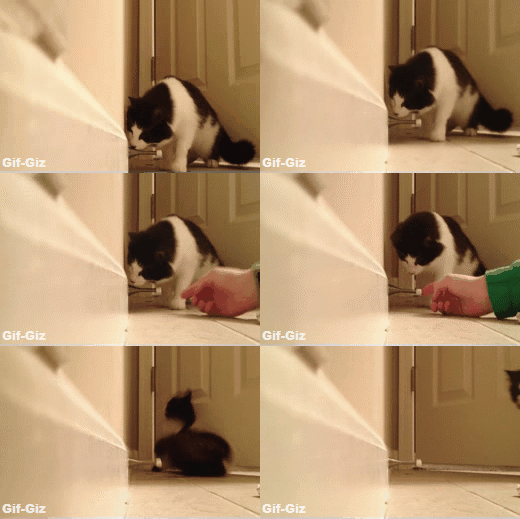









Cat Entertains Himself With Head-Mounted Laser Pointer [via...
Steve Dyeromg anne
Acting French
Steve Dyernational treasure forever
I spent the majority of this summer at Middlebury College, studying at l’École Française. I had never been to Vermont. I have not been many places at all. I did not have an adult passport until I was 37 years old. Sometimes I regret this. And then sometimes not. Learning to travel when you’re older allows you to be young again, to touch the childlike amazement that is so often dulled away by adult things. In the past year, I have seen more of the world than at any point before, and thus, I have been filled with that juvenile feeling more times then I can count—at a train station in Strasbourg, in an old Parisian bookstore, on a wide avenue in Lawndale. It was no different in Vermont where the green mountains loomed like giants. I would stare at these mountains out of the back window of the Davis Family Library. I would watch the clouds, which, before the rain, drooped over the mountains like lampshades, and I would wonder what, precisely, I had been doing with my life.
I was there to improve my French. My study consisted of four hours of class work and four hours of homework. I was forbidden from reading, writing, speaking, or hearing English. I watched films in French, tried to read a story in Le Monde each day, listened to RFI and a lot of Barbara and Karim Oeullet. At every meal I spoke French, and over the course of the seven weeks I felt myself gradually losing touch with the broader world. This was not a wholly unpleasant feeling. In the moments I had to speak English (calling my wife, interacting with folks in town or at the book store), my mouth felt alien and my ear slightly off.
And there were the latest developments, the likes of which I perceived faintly through the French media. I had some vague sense that King James had done something grand, that the police were killing black men over cigarette sales, that a passenger plane had been shot out the sky, and that powerful people in the world still believed that great problems could be ultimately solved with great armaments. In sum, I knew that very little had changed. And I knew this even with my feeble French eyes, which turned the news of the world into an exercise in impressionism. Everything felt distorted. I understood that things were happening out there, but their size and scope mostly eluded me.
Acquiring a second language is hard. I have been told that it is easier for children, but I am not so sure if this is for reasons of biology or because adults have so much more to learn. Still, it remains true that the vast majority of students at Middlebury were younger than me, and not just younger, but fiercer. My classmates were, in the main, the kind of high-achieving college students who elect to spend their summer vacation taking on eight hours a day of schoolwork. There was no difference in work ethic between us. If I spent more time studying than my classmates, that fact should not be taken as an accolade but as a marker of my inefficiency.
They had something over me, and that something was a culture, which is to say a suite of practices so ingrained as to be ritualistic. The scholastic achievers knew how to quickly memorize a poem in a language they did not understand. They knew that recopying a handout a few days before an exam helped them digest the information. They knew to bring a pencil, not a pen, to that exam. They knew that you could (with the professor’s permission) record lectures and take pictures of the blackboard.
This culture of scholastic achievement had not been acquired yesterday. The same set of practices had allowed my classmates to succeed in high school, and had likely been reinforced by other scholastic achievers around them. I am sure many of them had parents who were scholastic high-achievers. This is how social capital reinforces itself and compounds. It is not merely one high achieving child, but a flock of high achieving children, each backed by high-achieving parents. I once talked to a woman who spoke German, English and French and had done so since she was a child. How did this happen, I asked? “Everyone in my world spoke multiple languages,” she explained. “It was just what you did.”
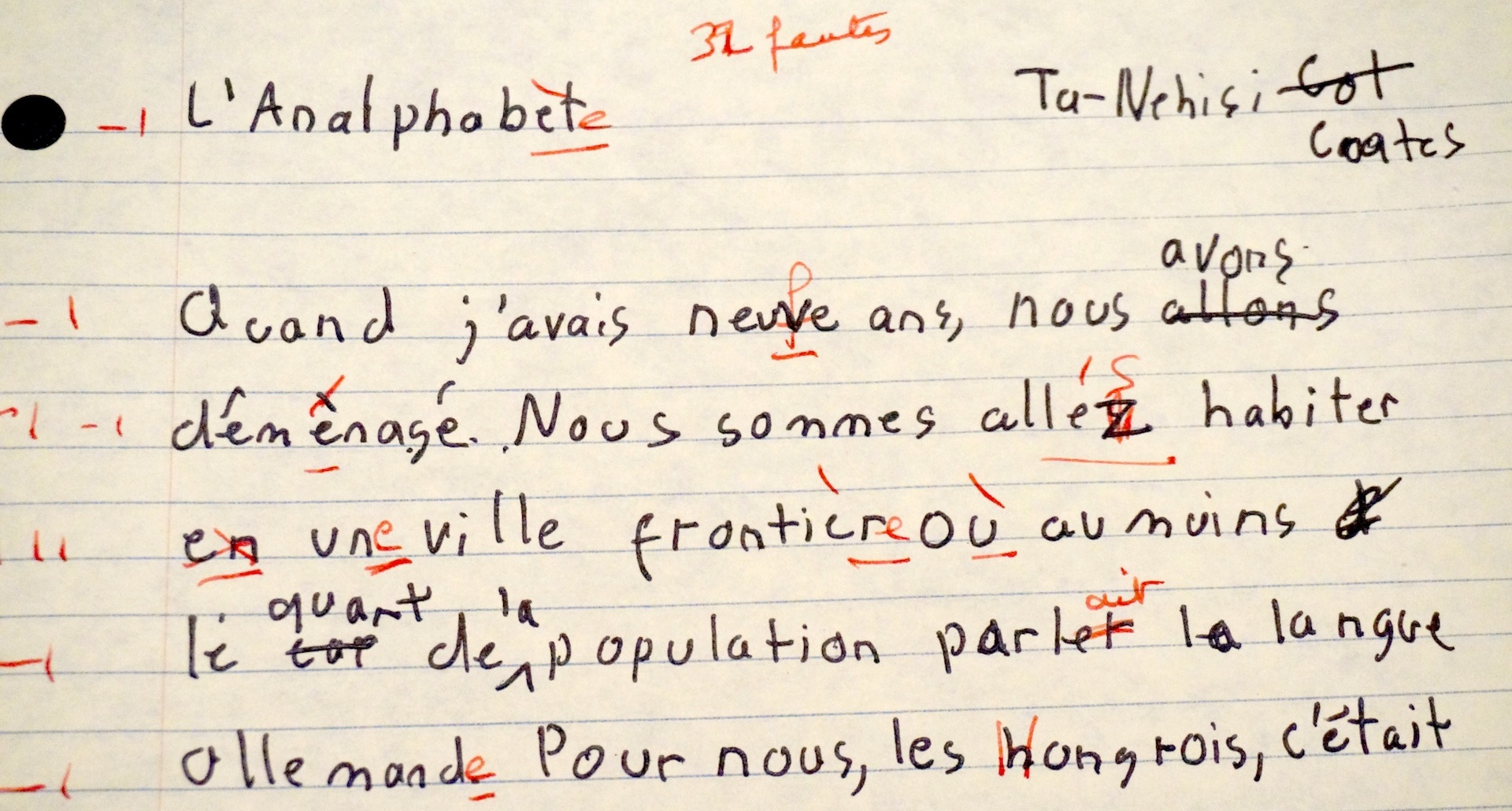
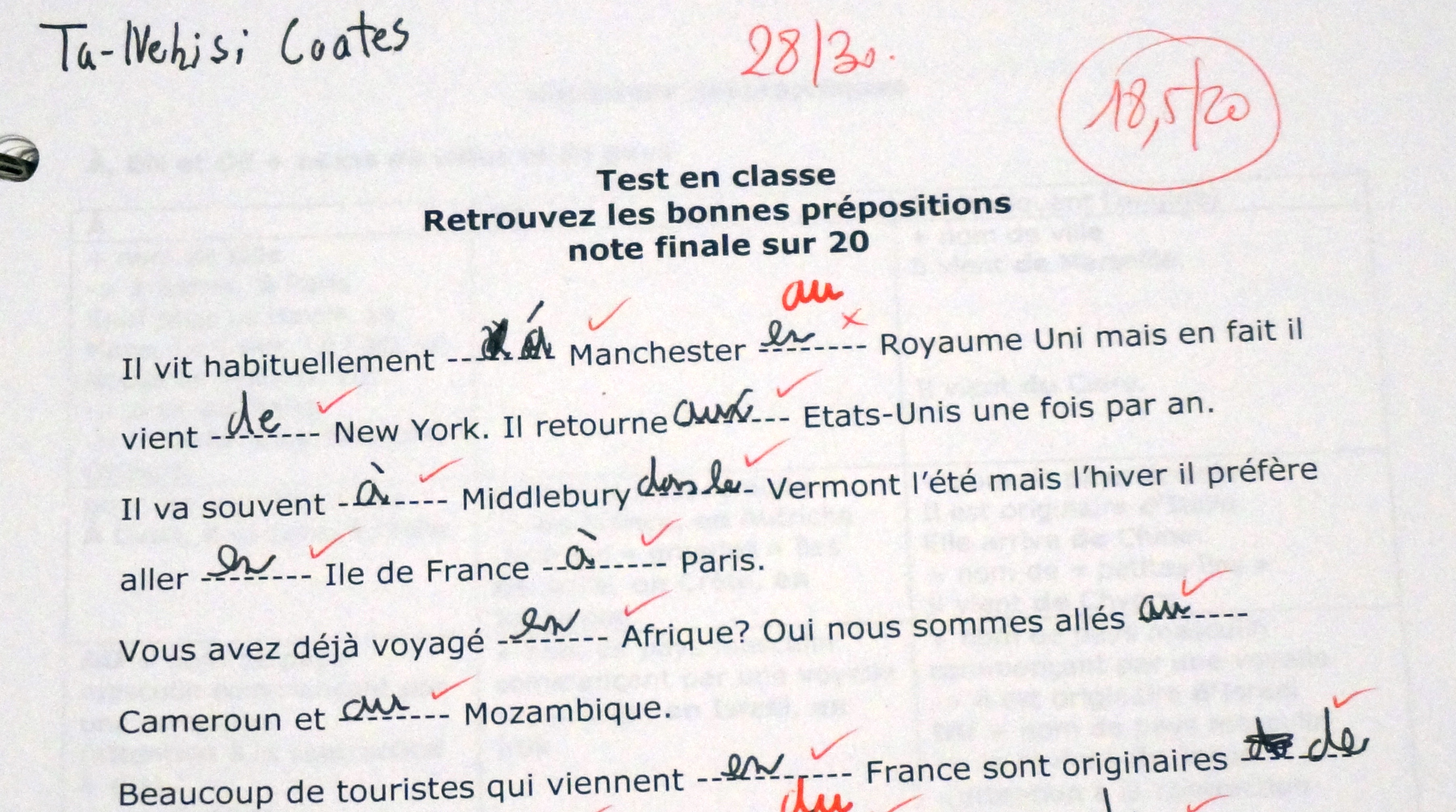
There were five tiers of French students, starting with those who could barely speak a word and scaling upward to those who were pursuing a master’s degree. I was in the second tier, meaning I could order a coffee, recount a story with some difficulty, write a short note (sans verb and gender agreement), and generally understand a French speaker provided he or she talked to me really slowly. The majority of people I interacted with spoke better, wrote better, read better, and heard better than me. There was no escape from my ineptitude. At every waking hour, someone said something to me that I did not understand. At every waking hour, I mangled some poor Frenchman’s lovely language. For the entire summer, I lived by two words: “Désolé, encore.”
Compared with my classmates on the second tier, my test scores were on the lower end. Each week, in my literature class, we were responsible for the recitation of some French poems (Baudelaire, Verlaine, Lamartine) from memory, and each day we had to recite a stanza. This sort of exercise may well be familiar to readers of The Atlantic, but the rituals required to master it were totally new to me. I had never been a high-achieving student. Indeed, during my 15 or so years in school, I was a remarkably low-achieving student.

There were years when I failed the majority of my classes. This was not a matter of my being better suited for the liberal arts than sciences. I was an English minor in college. I failed American Literature, British Literature, Humanities, and (voilà) French. The record of failure did not end until I quit college to become a writer. My explanation for this record is unsatisfactory: I simply never saw the point of school. I loved the long process of understanding. In school, I often felt like I was doing something else.
Like many black children in this country, I did not have a culture of scholastic high achievement around me. There were very few adults around me who’d been great students and were subsequently rewarded for their studiousness. The phrase “Ivy League” was an empty abstraction to me. I mostly thought of school as a place one goes so as not to be eventually killed, drugged, or jailed. These observations cannot be disconnected from the country I call home, nor from the government to which I swear fealty.
For most of American history, it has been national policy to plunder the capital accumulated by black people—social or otherwise. It began with the prohibition against reading, proceeded to separate and wholly unequal schools, and continues to this very day in our tacit acceptance of segregation. When building capital, it helps to know the right people. One aim of American policy, historically, has been to insure that the “right people” are rarely black. Segregation then ensures that these rare exceptions are spread thin, and that the rest of us have no access to other “right people.”
And so a white family born into the lower middle class can expect to live around a critical mass of people who are more affluent or worldly and thus see other things, be exposed to other practices and other cultures. A black family with a middle class salary can expect to live around a critical mass of poor people, and mostly see the same things they (and the poor people around them) are working hard to escape. This too compounds.
Now, in America, invocations of culture are mostly an exercise in awarding power an air of legitimacy. You can see this in the recent remarks by the president, where he turned a question about preserving Native American culture into a lecture on how we (blacks and Native Americans) should be more like the Jews and Asian Americans, who refrain from criticizing the intellectuals in their midst of “acting white.” The entire charge rests on shaky social science and the obliteration of history. When Asian Americans and Jewish Americans—on American soil—endure the full brunt of white supremacist assault, perhaps a comparison might be in order.
But probably not. That is because fences are an essential element of human communities. The people who patrol these fences are generally unkind to those they find in violation. The phrase “getting above your raising” is little more than anxious working-class border patrolling. The term “white trash” is little more than anxious ruling-class border patrolling. I am neither an expert in the culture of Jewish Americans nor Asian Americans, but I would be shocked if they too were immune. Some years ago I profiled the rapper Jin. As the first Asian-American rapper to secure a major label contract, he often found himself enduring racist cracks from black rappers abroad and the prodding of fence-patrollers at home. “’Yo, what is this? You really think you’re black, Jin?” he recalled his parents saying. “Bottom line—you’re not black, Jin.’”
Pretending that black people are unique—or more ardent—in their fence-patrolling, and thus more parochial and anti-intellectual, serves to justify the current uses of American power. The American citizen is free to say, “Look at them, they criticize each other for reading!” and then go about his business. In that sense it is little different than raising the myth of “black on black crime” when asked about Ferguson.
I will confess to having very little experience with fence-patrolling, and virtually none with the idea that if you are holding a book, you are “acting white.” The Baltimore of my youth was a place where white people rarely ventured. It would not have occurred to anyone I knew to associate reading with white people because very few of us knew any. And I read everything I could find: A Wrinkle In Time, David Walker’s Appeal, Dragon’s of Autumn Twilight, Seize The Time, Deadly Bugs and Killer Insects, The Web of Spider-Man. I had a full set of Childcraft. I loved the volume Make and Do. I had a full set of World Book encyclopedias. I used to pick up the fat “P” edition, flip to a random page, and read for hours. When I was just 6 years old, my mother took me to the Enoch Pratt Free Library on Garrison Boulevard and enrolled me in a competition to see which child could read the most books. I read 24 that summer, far outdistancing the competition. My mother smiled. The librarian gave me candy. I was very proud.
For carrying books in black neighborhoods, in black schools, around black people, I was called many things—nerd, bright, doofus, Malcolm, Farrakhan, Mandela, sharp, smart, airhead. I was told that my “head was too far in the clouds.” I was told that I was “going to do something one day.” But I was never called white. The people who called me a nerd were black. The people who said I was going to “do something one day” were also black. There was no one else around me, and no one else in America then cared. This was not just true of me, it was true of most black children of that era who were then, and are now, the most segregated group in this country. Segregation meant many of us had to rely on traditions closer to home.
And at home I found a separate culture of intellectual achievement. This is the tradition of Carter G. Woodson, Frederick Douglass, and Malcolm X. It argues for education not simply as credentialism or certification, but as a profound act of auto-liberation. This was the culture of my childhood and it gave me some of the greatest thrills of my youth.
I was a boy haunted by questions: Why do the lilies close at night? Why does my father always say, “I can dig it"? And who really killed the dinosaurs? And why is my life so unlike everything I see on TV? That feeling—the not knowing, the longing for knowing, and the eventual answer—is love and youth to me. And I have always preferred libraries to classrooms because the wide open library is the ultimate venue for this theater. This culture was reinforced by my parents, and the politically conscious parents around me, and their politically conscious children. The culture was so strong that it could be regarded as a kind of social capital. It was so old that it could also be regarded as a legacy. This legacy is more responsible for my presence in these august pages than any other. That is because a good writer must ultimately be an autodidact and take a dim view of credentials. My culture failed to make me into a high-achieving student. It succeeded at making me into a writer.
I have never had much of an urge to brag about this. I have always known that in failing to become a scholastic achiever, I forfeited knowledge of certain things. (A mastery of Augustine comes to mind.) But what I did not understand was that I had also forfeited a culture, which is to say a tool kit, a set of pins and tumblers that might have unlocked the language which I so presently adore.
Scholastic achievement is sometimes demeaned as the useless memorization of facts. I suspect that it has more to offer than this. If you woke my French literature professor at 2 a.m., she could recite the deuxième strophe of Verlaine’s “Il Pleure Dans Mon Coeur.” I suspect this memorization, this holding of the work in her head, allowed her to analyze it and turn it over in ways I could only do with the text in front of me. More directly, there is no real way for an adult to learn French without some amount of memorization. French is a language that obeys its rules when it feels like it. There is no unwavering rule to tell you which nouns are masculine, or which verbs require a preposition. Memory is the only way through.
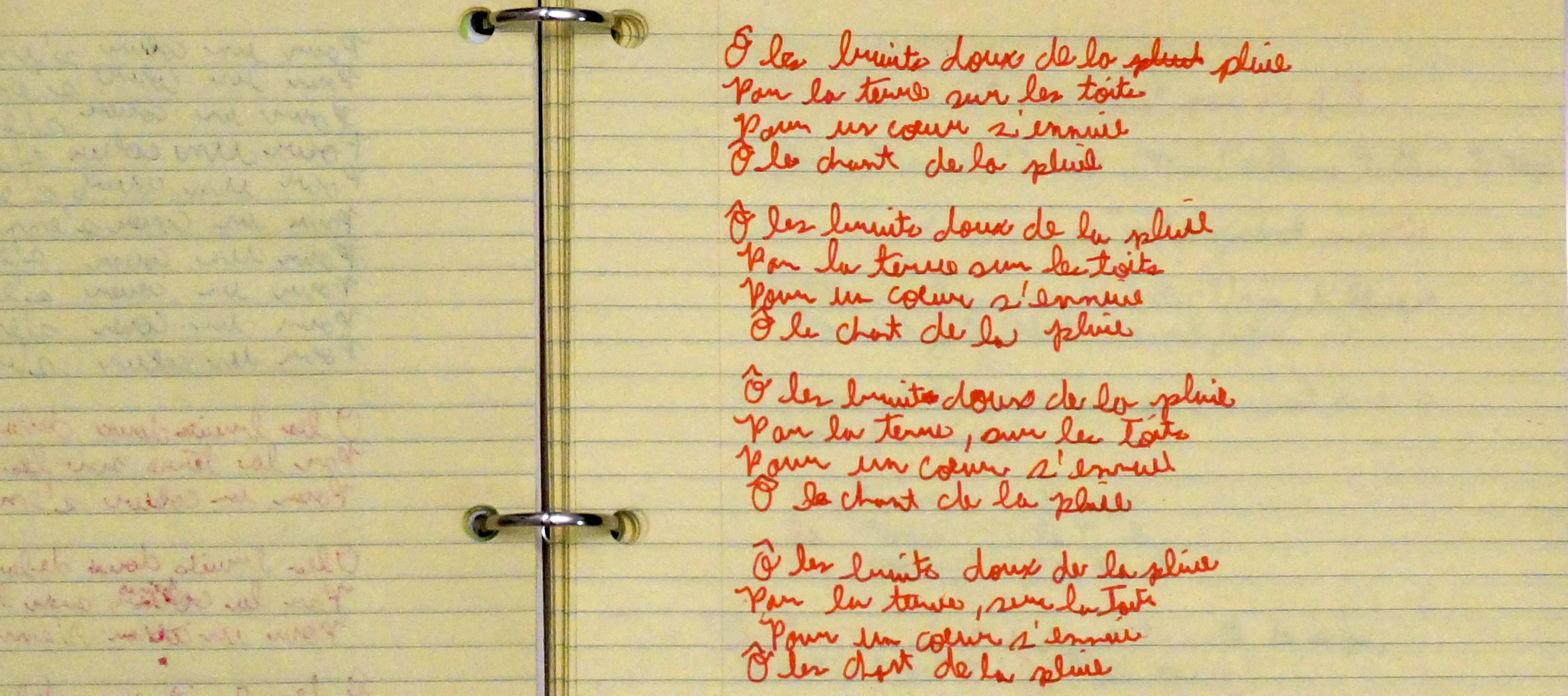
At Middlebury, I spent as much time as I could with the master’s students, hovering right at the edge of overbearing. On average, I understood 30 percent of what was being said. This was, of course, the point. I wanted to be reminded of who I was. I wanted to be young again, to feel that old thrill of not knowing. It is the same feeling I had as a boy, wondering about the lilies and dinosaurs, listening to “The Bridge Is Over,” wondering where in the world was Queens.
And I was ignorant. I felt as if someone had carried me off at night, taken me out to sea, and set me adrift in a life-raft. And the night was beautiful because it held all the things I would never know, and in that I saw my doom—the time when I could learn no more. Morning, noon, and evening, I sat on the terrace listening to the young master’s students talk. They would recount their days, share their jokes, or pass on their complaints. They came from everywhere—San Francisco, Atlanta, Seattle, Boulder, Hackensack, Philadelphia, Kiev. And they loved all the things I so wanted to love, but had not made time to love—Baudelaire, Balzac, Rimbaud. I would listen and feel the night folding around me, and the ice-water of youth surging through me.
One afternoon, I was walking from lunch feeling battered by the language. I started talking with a young master in training. I told her I was having a tough time. She gave me some encouraging words in French from a famous author. I told her I didn’t understand. She repeated them. I still didn’t understand. She repeated them again. I shook my head, smiled, and walked away mildly frustrated because I understood every word she was saying but could not understand how it fit. It was as though someone had said, “He her walks swim plus that yesterday the fight.” (This is how French often sounds to me.)
The next day, I sat at lunch with her and another young woman. I asked her to spell the quote out for me. I wrote the phrase down. I did not understand. The other young lady explained the function of the pronouns in the sentence. Suddenly I understood—and not just the meaning of the phrase. I understood something about the function of language, why being able to diagram sentences was important, why understanding partitives and collective nouns was important.
In my long voyage through this sea of language, that was my first sighting of land. I now knew how much I didn’t know. The feeling of discovery and understanding that came from this was incredible. It was the first moment when I thought I might survive the sea.

My personal road to this great feeling, to these discoveries, to Middlebury, was not the normal one. I was raised among people skeptical of a canon that had long been skeptical of them. I needed some independent sense of myself, of my cultures and traditions, before I could take a mature look at the West. I wanted nothing to do with Locke because I knew that he wanted little to do with me. I saw no reason to learn French because it was the language of the plunderers of Haiti.
I had to be a nationalist before I could be a humanist. I had to come to understand that black people are not merely the victims of the West, but its architects. The philosophes started the sentence and Martin Luther King finished it. The greatest renditions of this country’s greatest anthems are all sung by black people—Ray, Marvin, Whitney. That is neither biology nor a mistake. It is the necessary cosmopolitanism of a people, viewing America from the basement and thus forced to take their lessons when they get them—absorbing, reinterpreting, refining, creating.
Now it must never be concluded that an urge toward the cosmopolitan, toward true education, will make people stop hitting you. The inverse is more likely. In the early 19th century, the Cherokee Nation was told by the new Americans that if its members adopted their “civilized” ways, they would soon be respected as equals. This promise was deeply embedded in the early 19th century approach to this continents indigenous nations.
“We will never do an unjust act towards you. on the contrary we wish you to live in peace, to increase in numbers, to learn to labor, as we do,” Thomas Jefferson said. “In time you will be as we are; you will become one people with us; your blood will mix with ours; & will spread, with ours, over this great Island. Hold fast then, my Children, the Chain of friendship, which binds us together; & join us in keeping it forever bright & unbroken.”
The Cherokee Nation—likely for their own reasons—embraced mission schools. Some of them converted to Christianity. Other intermarried. Others still enslaved blacks. They adopted a written Constitution, created a script for their language and published a newspaper, The Cherokee Phoenix, in English and Cherokee. Thus the Native Americans of that time showed themselves to be as able to to integrate elements of the West with their own culture as any group of Asian or Jewish American. But the wolf has never much cared whether the sheep were cultured or not.
“The problem, from a white point of view,” writes historian Daniel Walker Howe, “was that the success of these efforts to ’civilize the Indians’ had not yielded the expected dividend in land sales. On the contrary, the more literate, prosperous, and politically organized the Cherokees made themselves, the more resolved they became to keep what remained of their land and improve it for their own benefit.”
Cosmopolitanism, openness to other cultures, openness to education did not make the Cherokee pliant to American power; it gave them tools to resist. Realizing this, the United States dropped the veneer of “culture” and “civilization” and resorted to “Indian Removal,” or The Trail of Tears. The plunder was celebrated in a popular song:
All I want in this creation
Is a pretty little wife and a big plantation
Away up yonder in the Cherokee nation.
The Native Americans of this period found that America’s talk of trading culture for rights was just a cover. In our time, it is common to urge young black children toward education so that they may be respectable or impress the “right people.” But the “right people” remain unimpressed, and the credentials of black people, in a country rooted in white supremacy, must necessarily be less. That great powers are in the business of using "respectability" and "education" to ignore these discomfiting facts does not close the book. You can never fully know. But you can walk in the right direction.
The citizen is lost in the labyrinth constructed by his country, when in fact straight is the gate, and narrow must always be the way. When I left for Middlebury, I had just published an article arguing for reparations. People would often ask me what change I expected to come from it. But change had already come. I had gone further down the unending path of knowing, deeper into the night. I was rejecting mental enslavement. I was rejecting the lie.
I came to Middlebury in the spirit of the autodidactic, of auto-liberation, of writing, of Douglass and Malcolm X. I came in ignorance, and found I was more ignorant than I knew. Even there, I was much more comfortable in the library, thumbing through random histories in French, than I was in the classroom. It was not enough. It will not be enough. Sometimes you do need the master’s tools to dismantle his house.
This article was originally published at http://www.theatlantic.com/features/archive/2014/08/acting-french/375743/

Stop Saying “Officer-Involved Shootings”
Steve DyerThis guest blogger is so sassy, what a great choice to stir pots (I think he started at Wonkette IIRC)
by Alex Pareene

Let’s talk about “officer-involved shootings.” That is the formal term, used by seemingly all American local news broadcasts, for when a cop shoots someone. Instead of saying “‘Cops’ crew member killed by police officer,” the headline is, “‘Cops’ crew-member killed after officer-involved shooting.” (It just sort of happened, after that shooting.) There is also “police involved shooting,” a term I first noticed being used by the local New York evening news team last May.
These terms are terrible and journalists should not use them. They are cop-speak. Local news reporters love nothing more than adopting cop-speak, because local news is built on manufacturing fear of crime and venerating of police officers, but both of these terms fail the crucial test of actually being coherent explanations of what happened. Of course police would invent an obfuscatory euphemism for when they shoot people – they would be fools not to try to come up with a nice way of saying “we killed someone” – but the press’ job is supposed to be to translate those euphemisms into plain English.
“Officer-involved shooting” absolves the person who actually pulled the trigger of responsibility, turning the shooting into an apparently inevitable act. The officer was just involved! As Natasha Lennard at Vice News puts it:
The phrase “police-involved shooting” is a careful construction, which, like the criminal justice system more broadly, tends to point blame away from cops. It is code for “the cops shot someone.”
To a reporter, “officer-involved shooting” should sound as grating to the ear as “bear-involved large mammal attack.”
The two terms, now ubiquitous, appear to be very successful modern coinages. Neither phrase seems to have been in usage at all before the 1970s. Usage of “officer involved shooting” soared during the 1980s and 1990s, with “police involved shooting” not catching on until the 2000s.

Where did the term come from? The LAPD has, for years, produced an annual “Officer Involved Shooting” report (NYT) and has had an “officer involved shooting unit” since 1987 or earlier. I wouldn’t be surprised if the phrase made its way into the press’ lexicon via former LAPD chief (and racist paramilitary policing pioneer) Daryl Gates, a man who rarely shied from television cameras. (If anyone knows the actual origin of the phrase, please let us know: dish@andrewsullivan.com)
The International Association of Chiefs of Police, by the way, publishes “Officer-Involved Shooting guidelines” (pdf). The guidelines aren’t about how not to shoot someone, but more about what to do once you have shot someone. The entire document is sort of incredible in its careful consideration of the emotional and mental state of the officer, and its complete silence on the status of the person the officer actually shot. For example:
Following a shooting incident, officers often feel vulnerable if unarmed. If an officer’s firearm has been taken as evidence or simply pursuant to departmental policy, a replacement weapon should be immediately provided as a sign of support, confidence, and trust unless there is an articulable basis for deviating from this procedure. Officers should be kept informed of when their weapon is likely to be returned. Care should be taken to process and collect evidence from the officer as soon as practicable to provide an opportunity to change into civilian clothing.
It is vital that you give the officer his gun back as soon as possible, or else he might feel bad, about shooting someone.
I can’t say this definitively, because, as we’ve learned this month, there is no national database of police shootings, but American cops seem to shoot other people far more often than people shoot cops. The number of police killed by firearms peaked in the early 1970s, and has steadily declined since. It hasn’t cracked 100 officers in any year over the last decade. Meanwhile, around 400 people a year are killed in “justifiable police homicides,” according to the only official numbers available for police homicides. (And that report doesn’t even pretend to be a complete account of everyone killed by police officers.) “Police involved shooting” may not be quite as obfuscatory a phrase as it was designed to be, simply because the majority of American shootings “involving” cops seem to be shootings by cops.
(Photo: Montgomery County police officers qualifying at their indoor shooting range in Rockville, Maryland on August 23, 2007. For story on ammunition rationing due to the war in Iraq. By James M. Thresher/The Washington Post/Getty Images.)

The View From Your Window Contest: Winner #220
Steve DyerWe didn't get it at all. I was looking in Malaysia and the Philippines [did you ever notice the double p in that word??] for like an hour and a half on Sunday.
by Chas Danner & Chris Bodenner

A reader sees the Far East:
Aberdeen Fishing Village, Southern edge of Hong Kong Island, China.
A much more detailed entry:
My guess is that this a view of the Mediterranean coast of Peniscola, Spain. Several factors lead me to draw this conclusion. The piece of land appears to be a peninsula because part of it juts out farther than the rest, creating two inlets of water. The water is almost certainly the salt-water ocean, as indicated by the crashing waves and decreasing water level on the shoreline. The leaves of the trees in the center and top left corner of the image suggest there are palm trees, which do, in fact, grow in Peniscola.
Peniscola has a peninsula and the Serra D’Irta mountain range behind it. The intense blue of the water and golden color of the sand in the image very closely resemble the colors of the coast of where the Mediterranean Sea borders Spain. The architecture of the buildings along the coast – the salmon colored rooftops and white stone – are also extremely similar in appearance to images of buildings on the coast of Peniscola. In comparing an image of the Peniscola peninsula to this view, the architectural style of buildings, mountain range, and vegetation including palm trees in the two photographs appear to be very similar. One difference, however, is that the view from the window has more vegetation such as heavy tree growth and fewer houses. I believe the photographs were taken from different angles and in different points along the coast. The view from the window is more distant from the main hub of houses, possibly closer to the mountains and more isolated.
Another finds a loophole:
You’ve ruined every one of my Saturdays for over a year now with your obscure locales, wild goose chases and Google Street View shenanigans. But finally, I can say with absolute certainty where this photo is located – my balcony:
Yee-haw, gimme my book.

Another reader is thinking the south of France:
I took one look at that picture and the words from a song in the early-1960s British Musical Stop The World – I Want To Get Off popped from my lips:
Give me half a chance
In the South of France
To make my pitch
And I’ll be dirty, rotten, stinkin’ filthy rich.Of course I’m probably whole continents off from where this actually is, but now I should get out the vinyl and listen to the original cast recording for the first time in decades since it’s going to be going through my head all afternoon anyway.
A whole continent off, sadly. An eagle-eyed player notes an essential clue for amateur hotel reviewers:
Wherever it is, they are automatically going to lose a star on Trip Advisor. Why can’t building staff take care of all those annoying dead bugs in webs on the outside of the windows?
Another finds the view within:
Green mountains, white beaches, palm trees … I’ve never been there but this is how I imagine the Caribbean Sea.
Wrong coast. Another try:
Catalina Island, California.
Wrong country, but the following reader nails the right one:
In April our cruise ship docked at the port of the Pacific beach resort village of Santa Cruz Huatulco, Oaxaca State, Mexico. The coast line there has several small bays, each with a cluster of resort hotels and condos. Every thing looks new and fresh and clean, all perfect for the comfort of the turista. I couldn’t make an exact match from the Google satelite images, but my educated guess is the Huatulco coast.

A few other readers guessed Acapulco, but the following reader remembers the view, even after four decades and the march of Mexico’s progress:
There are some immediate dead giveaways that this view is of the Pacific coast of Mexico: the vaguely Moorish, white-stucco hotel turrets, the white-painted trunks of the palm trees, the golden sand, the nearby mountain range, the banana trees, the little turista-jaunt boats anchored just off shore, and the multiple bays. We are looking at the Tesoro Manzanillo resort in Manzanillo. I have no idea from what window.
But allow me a Dishian digression. In 1970, while on Christmas break from college, I drove with two other girlfriends from San Antonio down the Gulf Coast, stopping in Veracruz and then on through the Isthmus of Tehuantepec to Oaxaca. We foolishly scored grass everywhere we went, bought embroidered blouses, got very tan, drank fresa con leche, dallied with cute boys, and endured the rudimentary toilets of Pemex stations all to the soundtrack of the recently released Plastic Ono Band:
Ah, youth. In Oaxaca we asked the locals where we should go on the West Coast that was beautiful but not touristy. “Manzanillo,” they said. Four years later Las Hadas opened, the prototype for all other Moorish-turreted Manzanillan resorts and put the little fishing village on the map. Asi es la vida.
A previous winner notes:
Manzanillo hosts the fleet of Mexico’s Navy Region 6 and the city is home to the only statue of Snoopy outside the United States. Both of which, sadly, are in the opposite direction from this view out of Villa Las Cumbres.
Another reader:
This is the first contest where I recognized the subject of the photo. Years ago my wife and I traveled to the state of Colima, in which Manzanillo is located, to visit her sister. She arranged a two-night stay for us at Las Hadas Resort, also on the Peninsula de Santiago, where we enjoyed very inexpensive accommodations in exchange for sitting through a hard-sell time share “opportunity”! Las Hadas, being the location for the Blake Edwards film “10” which popularized white-girl cornrows, showed that film nightly in the guest rooms.
Meanwhile, Chini figures that many were frustrated by this week’s view:
Between the holiday and US Open tickets I was hoping for a quick hunt this weekend and we got just that. Unfortunately, it probably made some view-hunters miserable. Finding this view is all about using small clues to locate an otherwise generic resort. If you did it right (as I’m guessing a ton of folks did) this one was a near insta-find. But if you misinterpreted them you could spend hours searching Hawaii, Indonesia or the like.
This week’s view comes from the shores of Manzanillo, Mexico:
The pic was taken next to a potted plant at the top of a staircase in the main hallway of the Villa Las Cambres bed and breakfast and looks north by northwest along a heading of 332.75 degrees over Ascencia harbor.

Another has a pic of that potted plant:
I spent a good amount of time Saturday afternoon scanning the coast of the Dominican Republic, Haiti and Jamaica. Eventually I gave up on the Caribbean because most of the large resorts didn’t really have fishing boats close in, and there weren’t that many places with mountains that large close to the sea.
I switched my focus to smaller peninsulas along the Pacific coast of Mexico, and a few minutes later found the Santiago Peninsula in Manzanillo, Mexico. We are looking down at the Tesoro Manzanillo resort from a rental house called Villa Las Cumbres. Helpfully, they have a Facebook page with quite a few photos.
Along the top floor (just inside the front door?), there are two large windows:
A view from the street level provides a view through the right window, which is close but too far right.
So that leaves us with the left window. I tried to find a decent exterior view, but the best I could get is a crop of a wide angle Panoramio photo from way, way down on the beach:
This week’s picture was taken by someone standing on the landing, through the window highlighted below. Quick and dirty Photoshop reenactment created with help from Shutterstock:
Good contest – not so hard to find the location, but getting the window was a bit tricky because the geography made street view useless.


This week’s winner was last week’s runner up and another veteran player from our list of long-suffering Correct Guessers:
This week’s picture was taken in Manzanillo, Mexico, from the northwest side of Villa Las Cumbres B&B (43 Avenida de los Riscos). Here is the window, on the 2nd floor:
A tough one, at least for me. It was fairly easy to tell that this was probably some tropical
American country; the obvious clue to follow afterwards was the hotel in Moorish-Mediterranean style in the bottom right corner of the picture, but for some reason it took me nowhere at first. A Tesoro – “treasure”– so is named the resort – a little hard to unearth.

From the view’s submitter, a contest veteran himself:
I was pleasantly surprised to see my window submission show up as this week’s contest. I don’t get to travel much, and when I saw this view I knew it would make a good contest.
Here’s some more detail about the location: The shot was taken from the entry hall of a rental vacation home at Avenida de los Riscos 43, Manzanillo, Mexico. The property is also called Villa Las Cumbres (House of the Summits). Every year, we take a trip with my kids and my brother’s kids to a beach somewhere, usually Oregon, Washington or Texas. We call it the “Cousins’ Trip” and this year we splurged and went out of the country to Manzanillo. I’d never been to the Pacific coast of Mexico before and it was breathtaking. We managed to luck out and find this house that sleeps 10 on AirBnB the day before and the views were spectacular.
Above is a shot of the house from the beach, with the window highlighted. My only regret is that I have to wait until next week to solve a contest.


The Economics Of Superhero Flicks
Steve DyerCherv! Book club?!
by Dish Staff
Erika Olson recommends Harvard Business School professor Anita Elberse’s Blockbusters: Hit-Making, Risk-Taking, and the Big Business of Entertainment:
Her statistics-driven approach shows that no matter what facet of the entertainment industry you’re talking about – and no matter how contrary to common sense it may seem – those who make the biggest financial investments in a select few products are actually taking the least risky path to success. Perhaps that’s why 40 (!!!) big-budget superhero movies will be hitting theaters between now and 2020. Or why 1998 was the last year that stand-alone (versus sequel/trilogy/universe) films made up the majority of an annual “top-ten highest-grossing movies” list. In 2011, the entire top 12 were franchise titles.
Now, as Scott Tobias of The Dissolve recently pointed out, it’s not like “blockbuster” always equates to “awful.” But for anyone who still enjoys – or wants to make – an indie or otherwise original film, Elberse’s findings are important to understand.

Article: 5 Tips To Fuck Good
Steve Dyerso done with clickhole
Don’t Knock Weird Science
Steve Dyerduck dicks = autoshare
by Dish Staff
That’s Josie Glausiusz’s takeaway after reading a paper published earlier this year by Patricia Brennan, an evolutionary biologist who’s received federal funding for her research into the sexual anatomy of ducks (a subject explored in the hilarious video from Ze Frank seen above):
Brennan and her colleagues explain … that many people believe the federal government should fund only applied science designed to “cure disease, develop renewable energy, or improve agriculture.” They may not understand that the scientific process is “convoluted and unpredictable,” or that it takes a great deal of basic science work before its application leads to significant health or economic benefits. Another problem, Brennan told me, is that many people “have absolutely no idea how science is funded and how little money we actually get for it.” In fact, as she notes, the percentage of the overall budget that Congress allocates to science “has declined from 2.91 to 2.77 percent of our GDP between 2009-2011 (and that percentage includes the science budget for the Department of Defense, which is about half of all our research budget).” For comparison, 19 percent of the U.S. budget, or $643 billion, was allocated for defense and “security-related international activities” in 2013.
She and her colleagues cite a number of technologies inspired by esoteric evolutionary innovations. Examples include Geckskin, “a reusable, glue-free adhesive pad” invented after decades of research on the soft hairs coating gecko toepads, which enables the lizards to walk upside down; and widespread use of an enzyme called Taq polymerase—first isolated in 1965 from a bacterium surviving in hot springs in Yellowstone National Park—to replicate short strings of DNA. That enzyme has brought “vast benefits” to medicine, agriculture, and the criminal justice system, they say. Brennan’s own research could lead to improved understanding of hypospadias, a birth defect that causes malformation of the penis in baby boys.

Auto-Admiration?
Steve Dyerfucked up tbh
by Dish Staff
Jesse Bering reviews research suggesting that not only can people accurately match dogs’ faces to their owners, but also that “our faces also bear an uncanny resemblance to the frontend views of our automobiles.” Participants in a study were given a picture of a car and asked to rank its possible owners on a scale of 1 to 6:
[T]he authors suspected that the judges in their study would be able to match cars
with their correct owners above chance levels. And that’s what they found. “The real owner was in fact assigned rank 1 most frequently,” they write, “and rank 6 least frequently.” This proved true regardless of the subjects’ sex and age. There were an equal number of male and female judges, and they ranged widely in age—from 16 to 78 years. In case the sheer bizarreness of these data hasn’t quite registered, let me put it to you more bluntly: The average person can detect a physical similarity in the “faces” of cars and their owners. …
Implied in these results is the startling fact that most car owners are unwittingly purchasing cars that look like them. If that’s the case, figured [researchers Stefan] Stiegar and [Martin] Voracek, then is it possible that judges can even take it one step further, matching dogs to their masters’ cars? After all, we know now that it’s not a myth: dogs really do look like their owners. And since we choose both cars and dogs that physically resemble us, shouldn’t our dogs and our cars look alike too? Here, frankly, the data just get weird. Nevertheless, they’re genuine. In their third and final study, the authors added 36 portraits of dogs into the mix. Half of these were of purebreds, and the others were mutts. In a twist to the previous studies, a new group of judges saw an image of a car (again, either the front, side, or rear view) and beneath that, six individual dogs. Subjects ranked each dog on the likelihood of its master being the owner of the car shown. Amazingly, the participants were able to pull this feat off as well.

Meanwhile, Laura Bliss considers the oddly human attachments people form to their vehicles:
To many of us, [cars] are beloved, person-like companions. More than 70 percent of respondents to a recent AutoTrader survey were at least “somewhat” if not “very attached” to their cars, with 36 percent describing their vehicle as “an old friend.” In another study, nearly half of all drivers assigned a gender to their cars, and about one-third actually name them.
For many car-owners, emotional attachment can also come hand-in-hand with socio-economic mobility. For example, there’s research that suggests for certain low-income families, owning a car is linked to the ability to live in neighborhoods with lower poverty rates and lower health risks, as well as higher neighborhood satisfaction and stronger chances of employment.
Car-owners often assign human-like attributes to our cars, too. A 2006 study found significant differences between how participants understood their own personality and how they described their cars’. And in that same AutoTrader report, more than a quarter said they felt “sad” when they thought about parting ways with their internally combusting pal.

