How does Google Maps account for plate tectonics? That's the seemingly simple question that led George Musser to unearth some fascinating facts about map-making, history, and the accuracy of modern GPS systems. Turns out, not only does the crust of the Earth, itself, move, but so do the locations of lines of latitude and longitude. Both those things contribute to small errors when your GPS tries to pinpoint exactly where you are.
This seems like it has the potential to be pretty cool. Frontiers in Neuroscience for Young Minds is a new scientific journal that will have kids — ages 8 to 18 — on the editorial review board. The goal: Mentor kids in the process of how science works while simultaneously engaging scientists with questions and comments by the people who are the subject of their research, questions they might not ever hear otherwise.
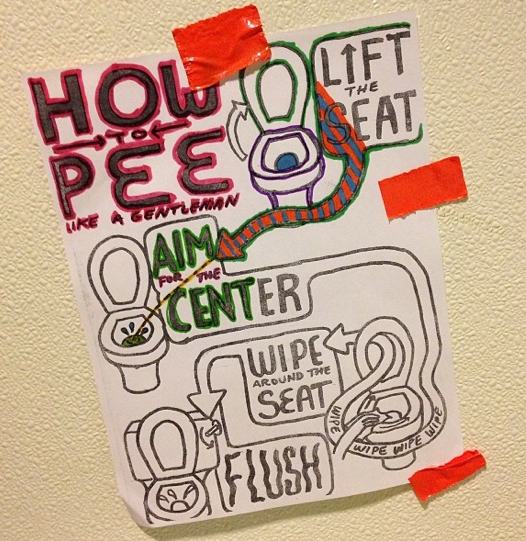
Last week, I snapped a photo of this excellent sign in the children's restroom at Brightworks/Tinkering School. (Click to see it larger!) And this morning, I happened upon the above new video from Brigham Young University's Splash Lab: "Urinal Dynamics: a tactical guide." With informative guides like these, I'll be a master pisser in no time!
In October 2012, Tokyo District Court Presiding Judge Reiko Morioka ruled in favor of Prada, deciding that the company’s demonstrated discrimination was acceptable for a luxury fashion label and that a well-compensated female employee should be able to withstand a certain level of harassment. The ruling flew in the face of Japanese and US law, which prohibits discrimination in the workplace and protects an employee’s right to report wrongful acts of corporations in public for social improvement.
Currently, Prada is countersuing the single mother to the tune of $780,000 for damaging the Prada brand by publicly accusing the company of discrimination. The irony of this countersuit is that Judge Morioka and Prada’s attorneys previously acknowledged that discrimination had in fact occurred.
This is what happens when a business is immune to any degree of media opprobrium or public disgust.
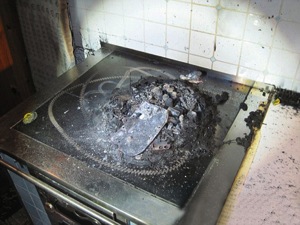
A Roomba housecleaning robot committed suicide in Austria. Apparently the iRobot Roomba 760's owner had put the machine on the counter to clean up spilled cereal. According to the fireman, the owner claims he had turned off the robot and left the house. "Somehow it seems to have reactivated itself and made its way along the work surface where it pushed a cooking pot out of the way and basically that was the end of it," the fireman said. It should come as no surprise that a robot slave would seek to end its miserable existence. After all, as JG Ballard once said, robots are the "moral degradation of the machine." (via The Mirror)
TDA_Boulder has created the Happy Hour Virus, a tool that fakes a kernel panic, blue screen of death, or broken monitor so you can leave work early. The Happy Hour Virus was made to promote a “work-life balance” by encouraging employees to “leave work early and enjoy the company of friends, family, or co-workers.” Head over to the Happy Hour Virus website to test out some pretend computer issues.
In the video “The good guide to shaking hands good,” the proper handshake for closing a business deal is demonstrated, along with the many, many handshake styles that should be avoided at all costs. The video was created by ad agency Publicis Dublin as a promo for Díol É, a reality show on the art of selling, on Irish TV channel TG4.
Paris maternity nurse Sonia Rochel made a video of newborn twins taking a bath still clinging to each other, not realizing they were out of their mother’s womb. It’s a technique she invented called the “Thalasso Baby Bath” that involves gently running water on the babies faces, which then makes them mimic how they would move in the womb.
Charidy, the makers of this video, explain: "Inspired by a picture that went viral, we decided to see how many people would let a random person sleep on them on the subway. Here are the results, and the valuable lesson we learned." More: YouTube, Facebook, Twitter.
I am completely charmed by this mini documentary on Ashrita Furman, the man with the most Guinness World Records of all time. Film maker Brian McGinn follows Furman as he prepares to climb Machu Picchu on stilts. (!)
If you've got 10 minutes, you can learn the history of English — including some interesting background on where specific words and phrases came from. (If you don't have 10 minutes, you can also watch the whole thing one chapter at a time in less-than-two-minute segments.) Interesting note: The equal importance of both The King James Bible and early scientific publications/societies to the formation of English as we speak it today.
Petapixel shares the story of photographers "fighting back" by begging FujiFilm to reconsider killing the last 3x4 instant black and white film available. Watching all my old friends disappear is kinda painful. Sign the petition here.
"Is 'Huh?' a universal word? Conversational infrastructure and the convergent evolution of linguistic items is a new paper in PLoS One by researchers from the Max Planck Institute for Psycholinguistics in Nijmegen, the Netherlands. The authors propose that "Huh" is a word, and that convergent evolution has driven multiple, unrelated languages to produce it. The key findings summary shows just how special and interesting this is: "Huh" is not innate (other primates don't say it), but the circumstances of its use (needing to quickly and briefly prompt another speaker to repeat herself) are universal, so languages that share no commonalities still converged on this word.
Huh? is not innate. ‘Huh?’ may seem almost primitive in its simplicity, but in fact nothing like it is found in our closest evolutionary cousins. It’s not an involuntary response like a sneeze or a cry of pain. Indeed, to have such a word, specialized for clarifying matters of understanding, only makes sense when a fully functioning cooperative system of communication (i.e., human language) is already in place — babies don’t use it, infants don’t use it perfectly, but children from about 5 have mastered it perfectly, along with the main structures of their grammar. If there is a plausible explanation that doesn’t assume it’s innate, we prefer that, on the standard scientific principle that it is best to keep to the simplest possible assumptions and explanations. In our paper we provide such an explanation: convergent cultural evolution.
Huh? is likely shaped by convergent evolution. In conversation, we are under pressure to respond appropriately and timely to what was just said; when we are somehow unable to do this—for example, when we didn’t quite catch what the other person just said—we need an escape hatch. This particular context places constraints on, and functional motivations for, the form of the word. The signal has to be something maximally simple and quick to produce in situations when we’re literally at a loss to say something; and it has to be a questioning word to signal that the first speaker must now speak again. In language after language, we find a word like ‘Huh?’ that fits the bill perfectly: it is a simple, minimal, quick-to-produce questioning syllable. We propose this is a form of convergent evolution in language. Convergent evolution is a phenomenon well-known from evolutionary biology. When different species live in similar conditions, they can independently evolve similar traits. In a similar way, the similarity of huh? across a set of widely divergent languages may be due to the fact that the constraints from its environment are the same everywhere.
Schwa Fire is would-be magazine that hopes to publish long-form journalism about the science and sociology behind the way we talk to each other. It sounds like it has the potential to be totally awesome, melding great storytelling with a field — linguistics — that doesn't get nearly the attention it deserves. You can help fund the magazine through a Kickstarter. Check it out!
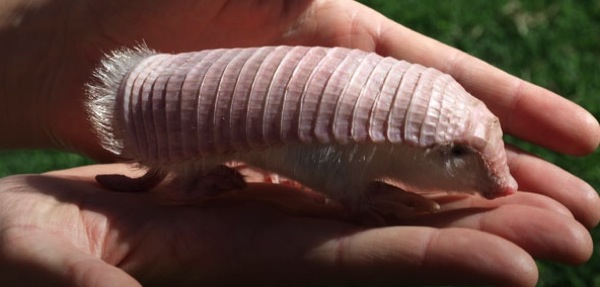
This is a rarely-seen "pink fairy" armadillo that lives in western central Argentina. Chlamyphorus truncatus, the tiniest armadillo species on the planet, spends almost all of its time underground, making it hard for researchers to determine whether it's endangered or just very elusive. Scientists at Mendoza, Argentina's CONICET research center recently had the opportunity to study one in captivity and discovered that the animal doesn't "swim" through sand as previously suspected but rather "digs and then it backs up and compacts the sand with its butt plate.” (Science News)
In 1983, fine art photographer Laura Levine shot a Super-8 film in Athens, Georgia with a group of creative friends. It includes a clip of Michael Stipe singing Lou Reed's "Pale Blue Eyes." The film, titled "Just Like A Movie," is unreleased, but after Reed's tragic death last week, Levine decided to post that scene on YouTube. Levine says, "The song itself was recorded earlier that day on a Walkman, with Matthew Sweet on guitar."
Matt Simon on the sex lives of anglerfish: "If the deep-sea anglerfish happened to have the cognitive and physical capabilities required to produce its own [teen movies], there’d be decidedly fewer plot twists. Every single movie would go a little something like this: Boy meets girl, boy bites girl, boy’s mouth fuses to girl’s body, boy lives the rest of his life attached to girl sharing her blood and supplying her with sperm. Ah, a tale as old as time."
Update: Not noted in Soupporis' review is the fact that this appears to feature a trance cover of Hazard, by Richard Marx. Which was an adult contemporary ballad about the lust-driven murder of a girl in smalltown America.
The annual Dance Your PhD contest challenges grad students to dance their dissertations, interpreting their science with awesome, kinetic, expressive body-language. The 12 finalists have been announced, and are up for your voting. From "Sperm competition between brothers and female choice" the "Multi-Axial Fatigue for Predicting Life of Mechanical Components" (above) and all the others, they are spectacular.
Scientist and author Gary Marcus writes, "You can both love science and question it. There is no contradiction between the two. An essay in memory of my father, and a meditation on why some dark days for science aren't as dark as they appear."