The concept of road diets is an alternate approach to dealing with road congestion that’s gained popularity in recent years. The typical solution to heavy traffic on roads is to widen them with more travel lanes. The problem is such an approach can induce demand and instead of two lanes of traffic jam, you get four lanes going nowhere.1
Instead, with a road diet approach, you might turn a four-lane road into three lanes: two travel lanes and a turn lane in the middle.
Realizing these unintended outcomes, some localities implemented a type of road diet: reconfiguring the four lanes (two in each direction) into three (one each way plus a shared turn lane in the middle). The change dramatically reduced the number of “conflict points” on the road-places where a crash might occur. Whereas there might be six mid-block conflict points in a common four-lane arterial, between cars turning and merging, there were only two after the road diet.
Likewise, at an intersection, eight potential conflict points became four after a road diet.
The result was a much safer road. In small urban areas (say, populations around 17,000, with traffic volumes up to 12,000 cars a day), post-road diet crashes dropped about 47 percent. In larger metros (with populations around 269,000 and up to 24,000 daily cars), the crash reduction was roughly 19 percent. The combined estimate from all the best studies predicted that accidents would decline 29 percent, on average, after a four-to-three-lane road diet — DOT’s reported figure.
Pedestrian and bike usage tends to increase as well (b/c that extra street can be converted to bike lanes or sidewalks), speeding decreases, and car travel times are largely unaffected. This quick video by Jeff Speck shows four different approaches to road dieting:
Braess’ paradox or Braess’s paradox is a proposed explanation for a seeming improvement to a road network being able to impede traffic through it. It was discovered in 1968 by mathematician Dietrich Braess, who noticed that adding a road to a congested road traffic network could increase overall journey time, and it has been used to explain instances of improved traffic flow when existing major roads are closed.
The paradox may have analogues in electrical power grids and biological systems. It has been suggested that in theory, the improvement of a malfunctioning network could be accomplished by removing certain parts of it.
(thx, david)
Update: A street in Oakland recently underwent a road diet: two of five lanes were converted into protected bike lanes. The result is an increase in biking and pedestrian use, a decrease in collisions, a decrease in speeding, and an increase in business along the street.
Along nine blocks of Oakland’s Telegraph Avenue, biking is up 78 percent since protected bike lanes were installed. Walking is up 100 percent - maybe because, thanks to the single lane of through traffic in each direction, the pedestrian yield rate doubled in the mornings and tripled in the afternoons.
Meanwhile, the number of traffic collisions fell 40 percent. Retail sales in a district that has sometimes struggled are up 9 percent, thanks in part to five new businesses.
And the median car speed is now the speed limit: 25 mph. As usual on such projects in urban areas, the main effect of removing a car passing lane was not to jam traffic, only to prevent irresponsible drivers from weaving between lanes in order to get to the next stoplight more quickly.
Luigi Butera and John List have examined how cooperation is impacted on by uncertainty — and not just any uncertainty but Knightian uncertainty where outcomes cannot easily be described by a probability distribution. They examine a situation where experimental subjects are contributing to a public good whose returns are uncertain and where individuals may or may not hold information regarding those returns. What this means is that individuals do not know whether people are not contributing because of free riding or because their do not have high information regarding the quality of the public good they are contributing too. In some sense, you might think this might make free riding issues even worse for, if you have a draw that suggests the public good has a high return and you know that others have differing information, you may not be confident they will follow you and contribute. In other words, you may anticipated more free riding which causes cooperation to unravel faster. The alternative view is that if you have no information and observe some cooperation, that might signal that they know something you don’t. But even there, for full rational agents, why cooperate when you don’t have to. If I had to guess before reading the abstract of this paper, my guess is that uncertainty makes things worse. We saw instances of this in a public good game instituted by Stephen King that I outlined in Information Wants to be Shared; problems that were alleviated by crowd funding models that provided more information.
As it turns out Butera and List find that uncertainty increases cooperation.
We show that our results are unlikely driven by confusion, since cooperation when noisy signals are publicly observed is inversely correlated with the informativeness of the signals. Otherwise said, as we reduce uncertainty, cooperation decreases. In the limiting case where public signals fully resolve uncertainty, cooperation rates revert back to those observed in the baseline. We argue that the presence of Knightian uncertainty fosters conditional cooperation by generating ambiguity around the determinants of players’ payoffs. When the returns from public goods contributions are perfectly observed, any reduction in payoffs can only be attributed to other players free-riding. When the exact quality of a public good is unobserved however, lower returns from a public good may be driven in part by a lowerthan-expected quality of the good itself. While uncertainty has no effect on the Nash 1 equilibrium outcome, it does affect decisions of conditional cooperators who may become more tolerant to payoffs’ reductions, effectively limiting the “snowball effect” of free-riding on conditional cooperation. An alternative and related explanation is that the presence of uncertainty facilitates cooperation among betrayal averse individuals (Bohnet et al. 2008, Aimone and Houser 2012).
This is an interesting result and certainly suggests that there is more interesting theoretical work to be done. Another possible reason for the result may be that uncertainty interacts with certain behavioural tendencies of agents (something that Peter Landry and I have theorised about).
Now on to the “you won’t believe what happened next part.” This experimental finding is surprising. Actually very surprising. And usually this poses an issue because many people may not believe the result and wonder if it is the result of an abberation. Replications will assist this but as many have noted (see for instance the discussion in Scholarly Publishing and its Discontents) those studies do not receive the scientific kudos relative to their value in establishing the potential truth of something. So our authors here have a conundrum. They have anticipated, correctly, that their finding will be discounted because it is surprising. And they have also anticipated that there is little incentive for independent replication. In other words, there is a break down in cooperation in the production of science.
One option may be to add uncertainty to the mix and see what happens but we still don’t know for sure that that is a thing. The other is what they chose to do:
This paper proposes and puts into practice a novel and simple mechanism that allows mutually beneficial gains from trade between original investigators and other researchers. In our mechanism, the original investigators, upon completing their initial study, write a working paper version of their study. While they do share their working paper online, they do however commit not to submit it to any journal for publication, ever. The original investigators instead offer co-authorship of a second paper to other researchers who are willing to independently replicate the experimental protocol in their own research facilities.2 Once the team is established, but before beginning replications, the replication protocol is pre-registered at the AEA experimental registry, and referenced in the first working paper. This is to guarantee that all replications, both successful and failed, are properly accounted for, eliminating any concerns about publication biases. The team of researchers composed by the original investigators and the other scholars will then write and coauthor a second paper, which will reference the original unpublished working paper, and submit it to an academic journal. Under such an approach, the original investigators accept to publish their work with several other coauthors, a feature that is typically unattractive to economists, but in turn gain a dramatic increase in the credibility and robustness of their results, should they replicate. Further, the referenced working paper would provide a credible signal about the ownership of the initial research design and idea, a feature that is particularly desirable for junior scholars. On the other hand, other researchers would face the monetary cost of replicating the original study, but would in turn benefit from coauthoring a novel study, and share the related payoffs. Overall, our mechanism could critically strengthen the reliability of novel experimental results and facilitate the advancement of scientific knowledge.
In other words, in response to a problem of breakdown in cooperation they have proposed a fairly standard solution — integration. Basically, they have offered to sell a share of the kudos they would receive if the study is successfully replicated to those who are replicating the study.
From the perspective of a reader, this paper both offers an experiment (with results) and the proposes another for which the results are yet to be determined. It will be very interesting to see how it works out.
But I have a question. If a replication is done, it will be a little surprising given that this paper is already out there so the true allocation of kudos can only be partially transferred. And so if that is the case, won’t they have to offer another experiment with a surprising result coupled with their new mechanism in order for the kudos allocation experiment to be replicated? And if that is so, when will this end?
Urban rail transit investments are expensive and irreversible. Since people differ with respect to their demand for trips, their value of time, and the types of real estate they live in, such projects are likely to offer heterogeneous benefits to residents of a city. Using the opening of a major new subway in Seoul, we contrast hedonic estimates based on multivariate hedonic methods with a machine learning approach that allows us to estimate these heterogeneous effects. While a majority of the "treated" apartment types appreciate in value, other types decline in value. We explore potential mechanisms. We also cross-validate our estimates by studying what types of new housing units developers build in the treated areas close to the new train lines.
“In elementary school, the kids who are really well-liked and who are nice are also the kids who are popular,” said Amanda Rose, a psychology researcher at the University of Missouri. “But in middle school, this starts to change.” By the time high school starts, there are two kinds of popularity: There are the well-liked students, and then there is the emergence of a new group, which researchers call the high-status students — these are the ones who dominate their social groups, who are perhaps voted to the homecoming court, or are captain of the soccer team.
This distinction — between status and likability — is especially important in understanding the alpha girl over her teenage-boy counterpart. Alpha boys tend to be aggressive in physical ways, starting fights or pushing each other around, while alpha girls are more likely to act in relationally aggressive ways, spreading rumors or using the silent treatment. ...
For girls, “the more aggressive you are, the less likable you will be. But it will make you more popular,” said Mitch Prinstein, a psychologist at the University of North Carolina at Chapel Hill and the author of the upcoming book Popular: The Power of Likability in a Status-Obsessed World. “For boys, a lot of them can be [high-status] and also well-liked at the same time. But that is so not the case for girls. The correlation between likability and status approaches zero for girls.” Alpha girls are admired and feared, but they’re not often liked. ...
For teenagers, as you’ll no doubt recall, their peers’ opinions mean everything. Their parents’ opinions, on the other hand, means nothing — less than nothing. The farther they can get from anything adults approve of, the better. ...
Hence the allure of the alpha girl. High-status teenagers, the research suggests, tend to behave in ways adults find inappropriate, which other teenagers find exhilarating. ... They skip class, they dabble in drugs, they go to parties. They are, in a word, cool. ...
One might assume, as I did, that your high school’s alpha girl grew up to be the office alpha girl, too. But every researcher I talked to said the opposite; several of them, for that matter, pointed me toward a fascinating study led by Allen and published in 2014 in the journal Child Development, titled: “What ever happened to the ‘cool’ kids?” For that paper, Allen and his colleagues interviewed a group of teenagers — including the “high-status” ones, otherwise known as the popular kids — when they were seniors in high school, and then tracked them down and reinterviewed them ten years later. “And a decade later,” Allen tells me, “they’re not doing so well. They’re doing less well in romantic relationships, they’re more likely to have problems with alcohol use and criminal behavior.”
I asked Kottke.org readers if they had ever seen, heard, or read something on the web that literally changed their lives.
Fourteen people said no. Sixteen said maybe. Thirty-eight people said yes. These are some of their answers. Everyone is anonymous. Some said more than others.
Four different people listed pages from Metafilter:
Encountering the Gifted Self Again, For the First Time “made me realise that I’m not just a weirdo, but all of my “quirks” actually fit together under a label, and that has made me understand myself about 10000x better.”
”Violet Blue’s writing, which lead to me realizing sex is a much deeper and more interesting topic than mainstream news coverage would have me believe.”
“The website MathPuzzle. It was the first time a website caught my attention and I corresponded with the owner/webmaster, and it opened me up to the online and offline community of puzzlers around the world. Working as a puzzle author got me through college and helped me establish a name for myself.”
“Jeph Jacques’s Questionable Content, particularly how he dealt with suicide, depression, and the concept of people from different backgrounds so elegantly. I like to think it increased (and continues to increase) my empathy in the world.”
Université du Québec à Chicoutimi: “In 2005 I was trying to get information on how to study abroad for a year. Everything I read was on the Internet, and I then spent 9 months between 2006 and 2007 in Chicoutimi, Quebec.”
Pixel Envy. “Not pandering. Started reading Kottke, DF, and Metafilter, and realized that I could try doing the same thing. I’ve had a modicum of success since, and met a bunch of really cool people as a result.”
The authors are Andrew McAfee and Erik Brynjolfsson, and the subtitle is Harnessing Our Digital Future. Arguably McAfee and Brynjolfsson have become America’s leading authors of business/management books (with an economic slant). This one is due out June 27, I am eager to read it.
Back in Gyeongju, Kim had the spy arrested, tortured, and executed…The rest of Kim’s story, as far as we know it, is true: He conquered Baekje in 660 and Goguryeo in 668 with the help of the Tang armies, then had to give the Tang the Manchurian half of Goguryeo.
Modern nationalist historians have criticized Silla for relying on China’s help in the first place, saying it set a historical pattern whereby Koreans instinctively call on outside powers to help solve internal problems.
Xerox PARC was one of the most influential technology companies of the past 50 years. Among the technologies invented and/or developed there include Ethernet, laser printers, the modern mouse-controlled GUI, and WYSIWYG text editing. On Quora, former PARC researcher Alan Kay shared the principles under which research at the company operated; here are the first five:
1. Visions not goals
2. Fund people not projects — the scientists find the problems not the funders. So, for many reasons, you have to have the best researchers.
3. Problem Finding — not just Problem Solving
4. Milestones not deadlines
5. It’s “baseball” not “golf” — batting .350 is very good in a high aspiration high risk area. Not getting a hit is not failure but the overhead for getting hits. (As in baseball, an “error” is failing to pull off something that is technically feasible.)
As the human population grows, so does its footprint. To map these changes, researchers often turn to satellite imagery, because government-collected data can be infrequent and outdated. In particular, nighttime light images can offer a wealth of information about human activity. In fact, as CityLab’s Richard Florida has written, more than 3,000 studies since 2000 have used nighttime lights as a proxy for all sorts economic activities.
But nighttime maps aren’t perfect. “If you need to figure out how large a city is and where the boundary of a city ends, lights will spread, and a city will look too large relative to its actual size,” says Amit Khandelwal, director of the Chazen Institute for Global Business at Columbia Business School. And there’s another problem: Satellite sensors have a saturation point that limits their ability to distinguish between different levels of light. That means an extremely bright place like Midtown Manhattan may appear to be equally bright as other parts of New York, even though it has more activity.
To find a better way, Khandelwal teamed up with economists and geographers at Columbia University, Arizona State University, and the Big Pixel Initiative at University of California San Diego. Together, they created the “Worldwide: Mapping Urbanization” campaign, an effort to track urbanization through daytime imagery and looking specifically at where the built environments lay, pixel by pixel. And they’re asking the public to help. “The basic idea behind this project is to use daytime images in combination with nighttime light to refine the measure of where people are located around the globe,” Khandelwal tells CityLab.
Built-up areas today cover 2.5 times the landmass they covered in 1975. Yet little research has been done to map where these areas lie—and essentially where the human footprint extends to. So Khandelwal’s team hopes to fill in that gap.
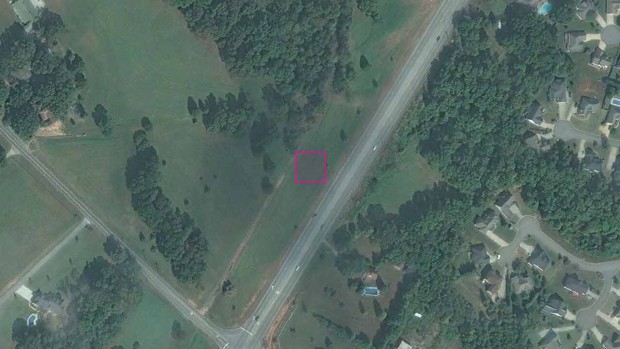
The campaign launched last week through the crowdsourcing site Tomnod, where contributors can help researchers identify objects and places in satellite images. In each round of this project, users are given a random image with a pink box in the center. They’re asked a simple question: is more or less than 50 percent of the space inside that box built? That is, are there more buildings and sidewalks as opposed to grass and bodies of water. The location of the image is purposely hidden so people will focus just on the what they see inside the box and use their best judgment to determine whether there is a human-made structure.
Khandelwal’s team wouldn’t be the first to focus on the human population through the lens of the built environment. Last October, during the momentous UN Habitat III conference, the European Commission’s Joint Research Center launched a comprehensive open database looking at the past 40 years of human settlements via some 12.4 billion satellite images.
But Khandelwal’s team isn’t just looking into the past. “We think humans do a pretty good job of [identifying the built environment],” he says, “but they just can't do it for the millions and millions of points across the globe.”
His team is trying to develop machine-learning methods that could change the way cities are mapped. The hope is to get hundreds, even thousands, of mapping enthusiasts to participate over the next month. Their responses will be fed into an algorithm that will boost its accuracy in predicting what area is considered “built up.” Down the line, the researchers hope to train the algorithm to predict things like how “economically vibrant” a city is or how much wealth is in an area based on, say, the type of structure recorded in the image.
Khandelwal says the experiment is starting with a small sample of 20,000 images of India and the U.S., taken in 2014. Eventually, as the team adds more images to the campaign, the system will help researchers track the movement of people in real time. And it’s not all about cities: They also want to identify rural areas and villages where structures are made not with concrete and steel, but with wood, mud, and so forth.
"Our goal is really to produce a map that is global in nature,” Khandelwal tells CityLab, adding that he imagines there could be significant academic and policy implications for the project when it’s complete.
So, for example, if a highway or railway is built, policy and urban planners can track how the geography of a city expands or gets reshaped as a result of that. Economists, on the other hand, “are very interested in how activity is distributed across space,” he says. “So our hope is to put the data into the public domain and people can start asking questions about how stuff affects where people are living.”
A worthy tribute to Kenneth Arrow, “one of the transcendent minds in the history of economics”. Arrow’s Impossibility Theorem changed the way we think about democracy; his co-authored General Equilibrium Theory changed the way we think about markets. He made major contributions to the study of decision-making under uncertainty, imperfect information, and the economics of knowledge. He brought “unprecedented precision to the logical foundations of social science”
A brief history of Google Books. “At the birth of the project, in 2002, as Larry Page and Marissa Mayer set out to gauge how long it might take to Scan All The Books, they set up a digital camera on a stand and timed themselves with a metronome”. Fifteen years and 25 million books later, after titanic legal battles, the outcome is an astonishing achievement, a new Library of Alexandria, a game-changer for academia; in Google parlance, a true moonshot. So why does Google hide it away?
“Much activity is hidden away from view, but preliminary evidence suggests that sharing economy firms may already be leveraging their access to information about users and their control over the user experience to mislead, coerce, or otherwise disadvantage sharing economy participants.”
With Ryan Calo, D&S researcher Alex Rosenblat releases a new report detailing the newly-termed taking economy of Uber. In this paper, Calo and Rosenblat detail a part of the sharing economy of Uber that misleads consumers and how consumer protection law has been silent on the sharing economy.
Abstract is below:
Sharing economy firms such as Uber and Airbnb facilitate trusted transactions between strangers on digital platforms. This creates economic and other value and raises a set of concerns around racial bias, safety, and fairness to competitors and workers that legal scholarship has begun to address. Missing from the literature, however, is a fundamental critique of the sharing economy grounded in asymmetries of information and power. This Article, coauthored by a law professor and a technology ethnographer who studies the ride-hailing community, furnishes such a critique and indicates a path toward a meaningful response.
Commercial firms have long used what they know about consumers to shape their behavior and maximize profits. By virtue of sitting between consumers and providers of services, however, sharing economy firms have a unique capacity to monitor and nudge all participants — including people whose livelihood may depend on the platform. Much activity is hidden away from view, but preliminary evidence suggests that sharing economy firms may already be leveraging their access to information about users and their control over the user experience to mislead, coerce, or otherwise disadvantage sharing economy participants.
This Article argues that consumer protection law, with its longtime emphasis of asymmetries of information and power, is relatively well positioned to address this under-examined aspect of the sharing economy. But the regulatory response to date seems outdated and superficial. To be effective, legal interventions must (1) reflect a deeper understanding of the acts and practices of digital platforms and (2) interrupt the incentives of sharing economy firms to abuse their position.
Posted by Betsy Masiello, Director of Policy Research
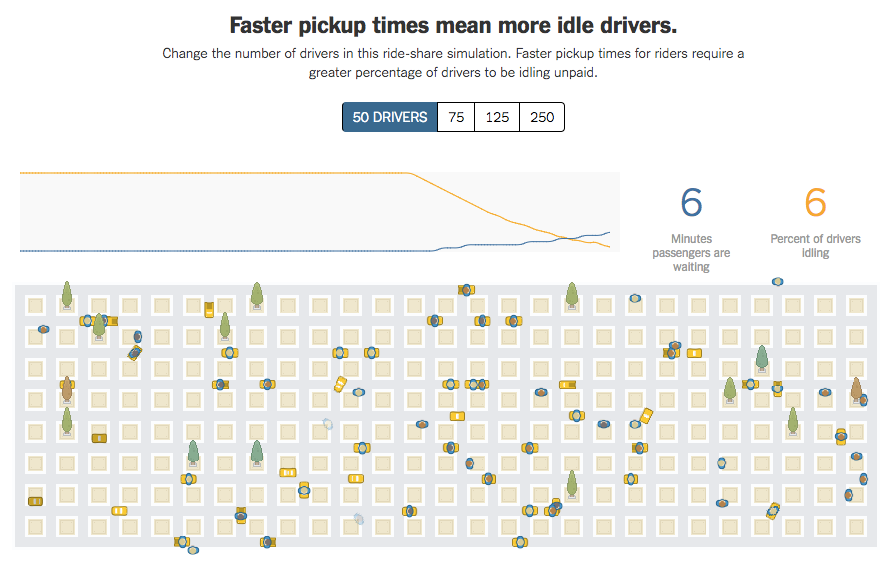
On Monday, the New York Times published an article with a simulation of a rideshare company that included the assertion that “faster pickup times for riders require a greater percentage of drivers to be idling unpaid”:
Source: New York Times
This is simply not true — and had the Times asked us whether it was, we would have explained the reality of what happens when Uber grows in a city: riders enjoy lower pick-up times and drivers benefit from less downtime between trips. It’s a virtuous cycle that is widely acknowledged in business and academia, and which is backed up by data.
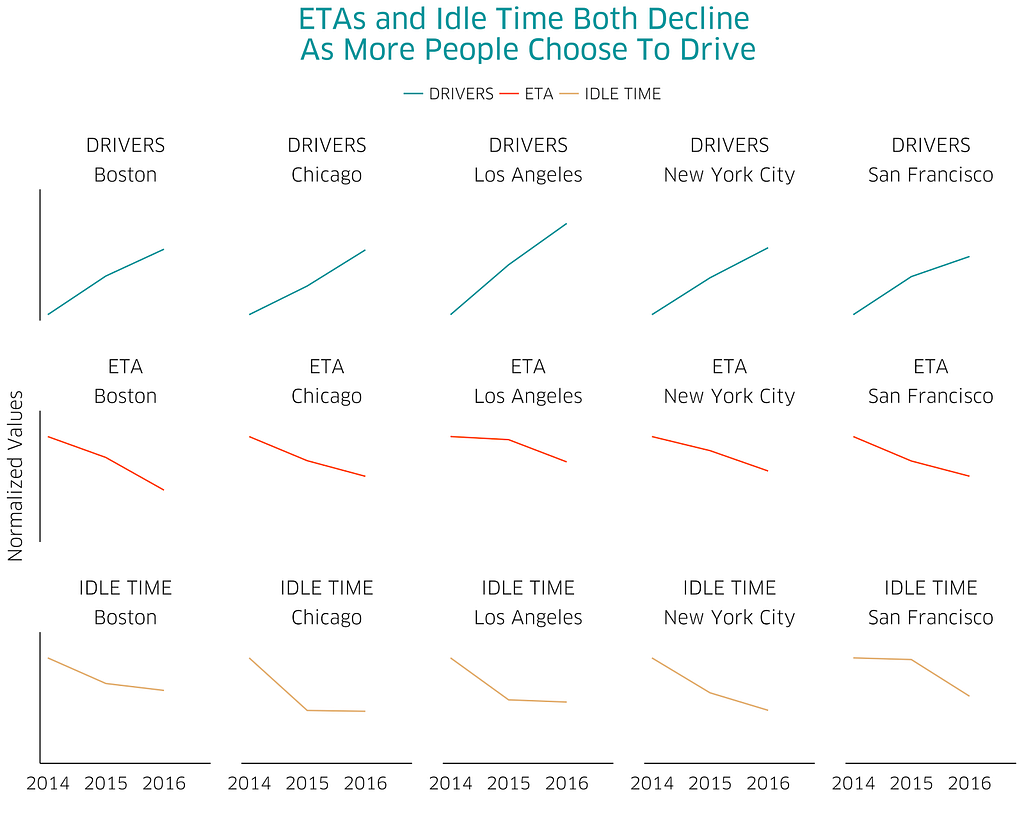
Graphic shows changes over time in the five largest US Uber markets. The same month each year (June) is shown to adjust for seasonality. “ETA” reflects the average wait time for a rider requesting a ride. “IDLE TIME” reflects the percentage of each hour spent signed into the app that a driver was not with a rider, and was calculated as the median across drivers. “DRIVERS” represents the number of active drivers per month in a city completing at least one trip a week. Numbers have been normalized for comparison.
How is this happening? First, as the number of passengers and drivers using Uber grows, any individual driver is more likely to be close to a rider. This means shorter pickup times and more time spent with a paying passenger in the back of the car. In addition, new features like uberPOOL and Back-to-Back trips have meant longer trips, while incentives to drive during the busiest times and in the busiest locations help keep drivers earning for a greater share of their time online. And that should be no surprise: drivers are our customers just as much as riders. So although the Times article suggests that Uber’s interest is misaligned with drivers’, the opposite is true: it’s in our interest to ensure that drivers have a paying passenger as often as possible because they’re more likely to keep using our app to earn money. (And Uber doesn’t earn money until drivers do.)
Maximizing the efficiency of cars on the road also helps cities use existing infrastructure more efficiently, while minimizing congestion. Indeed, research from 2016 showed that Uber was already more efficient than pre-existing on-demand options, and we’re excited about those trends getting better over time.
So how did the Times graphic get it so wrong? While it’s hard to know for sure as its assumptions are not laid out transparently, it appears to suffer from at least two flaws:
First, it appears to treat demand as fixed — in other words, there is a fixed quantity of riders in the simulation, no matter how good the service is. This cuts against a fundamental tenet of transportation economics: if you make a service more compelling and convenient, you attract more demand. Indeed, as our service quality has improved through lower wait times, we’ve seen the overall market grow. In some cities, Uber is now several times larger than the entire pre-existing taxi market.
Second, and more importantly, the simulation assumes that the number of drivers on the road is both fixed and set by Uber. Neither is true: drivers choose to start or stop driving on a regular basis, and will only drive with Uber if and when it makes sense for them. If we were able to impose a situation where 80% of drivers’ time was idle, drivers would leave the platform in droves to work with competitors — or leave ridesharing altogether. This is not reflected in the graphic, where it appears an all-powerful hand can fix the quantity of drivers on the road at any one time. In fact, recent research has confirmed that one enormous economic benefit of Uber to drivers is the value of schedule flexibility.
So what does it all mean? Happily, evidence to date has shown that all three things can happen simultaneously: we can grow the overall number of people who have access to work with Uber while reducing wait times for riders and reducing the amount of time drivers spend idling. That’s an exciting set of evidence for the future of on-demand transportation.
Here is from a new research paper by Christina Starmans, Mark Sheskin, and Paul Bloom:
…despite appearances to the contrary, there is no evidence that people are bothered by economic inequality itself. Rather, they are bothered by something that is often confounded with inequality: economic unfairness. Drawing upon laboratory studies, cross-cultural research, and experiments with babies and young children, we argue that humans naturally favour fair distributions, not equal ones, and that when fairness and equality clash, people prefer fair inequality over unfair equality.
As I said in a talk at Harvard Business School a few days ago, “if you hear the word “inequality,” the chance that what follows will be wrong is at least 3/4.”
The Summer Institute on Field Experiments (SIFE) is a highly selective and innovative program at the University of Chicago that brings together the brightest young economists in the world and companies interested in using rigorous field experiment methods and behavioral economics to design solutions to problems they face. Organization partners will share their business challenges, and the Institute’s academics help them to scientifically test new ideas and solutions. The third edition of SIFE will take place at the University of Chicago, July 9-13 2017.
For April Fool’s Day, Reddit launched a little experiment. It gave its users, who are all anonymous, a blank canvas called Place.
The rules were simple. Each user could choose one pixel from 16 colors to place anywhere on the canvas. They could place as many pixels of as many colors as they wanted, but they had to wait a few minutes between placing each one.
Over the following 72 hours, what emerged was nothing short of miraculous. A collaborative artwork that shocked even its inventors.
From a single blank canvas, a couple simple rules and no plan, came this:
There is drama. An epic war between Germany and France. And of course Dickbutt.
Then 4chan gets involved, trying to turn the entire canvas black: The Void.
Take, for example, the part of the canvas right in the center. Almost since the very beginning, it had been one of the most contested areas on the map. Time and again, Creators had tried to claim the territory for their own. First with icons. Then with a coordinated attempt at a prism.
But the Void ate them all. Art after art succumbed to its ravenous appetite for chaos.
And yet, this was exactly what Place needed. By destroying art, the Void forced Placetions to come up with something better. They knew they could overcome the sourge. They just needed an idea good enough, with enough momentum and enough followers, to beat the black monster.
Recently I went to a (very good) conference. As a number of us got off the train and waited near the platform for a ride, we immediately recognized each other as belonging to the same event, even though we had not met each other before. We were short and tall, male and female, and of varying races, but still we all had “that look”; I leave it as an exercise for the reader to consider what that means.
It occurred to me that many conferences could try to be more diverse. No, I am not referring to gender or race or ethnicity, although that may be true as well. I am referring to personality types and life experiences. Perhaps each conference should have at least one or two people who are not driven to succeed, not the member of any elite group, and not assured of their standing in the world.
What then to select for? I wondered whether each conference ought not to invite a hitchhiker or two. Think about hitchhikers, at least as a group on average:
1. They are mobile and not so set in their ways. They do not evaluate everything in terms of its efficacy and productivity.
2. They are adventurous and willing to engage with strangers.
3. They have not sunk their assets into expensive homes or fancy cars.
4. They wish to see the world and have a minimum amount of restlessness, maybe more.
5. Superficially it may seem that hitchhikers are “stupider than average,” but I suspect relative to their demographics they are smarter than average.
6. They do not schedule their lives so very tightly.
7. Since the late 1970s, fewer people engage in hitchhiking, and this raises their intrinsic interest. They are trying to resurrect a dying form of social capital, still prevalent mainly in Cuba and Eastern Europe.
8. The groups skews male, but I wonder if any more so than conference attendees more generally.
Most of all, hitchhikers probably have some time to spare. Send out a car, and offer them a ride and a conference. Toss in $500 if need be. They still will be cheaper than reimbursing the travel costs for most of your guests. Furthermore, when it comes to “getting back,” they can, um…hitch a ride.
If you wish, give them the right to shout out “You must be on drugs!’ or “I wouldn’t give you a ride!” at least once each conference, without fear of being ejected or otherwise shamed.
Again, here is a video on hitchhikers. They are perhaps the least likely guests to complain about the conference accommodations.
He first describes how his life has gotten better. And then attributes it to the below actions. My favorite is #6.
Movement. Sure, having an exercise habit, but also just physically altering my state when I am not functioning well gets things working more often than not. Weights, cardio, yoga, but also just walking and sit stand desk ($30 from Ikea parts).
Info triaging. Reading many things at a coarser level and prioritizing more ruthlessly based on what seems valuable, alive. This is a rather pithy description for something of such vast value. It is probably worth a post. (huge ht to Alex Ray for finally finally convincing me to actually do this.)
Developing exobrain systems that work for me in a pleasant rather than onerous, virtue based way. eg I use workflowy, pomodoros, and konmarie like systems a lot. I find many other systems for organizing my priorities to be unpleasant, so I don’t use them. Note I said organize my priorities, I don’t use such systems in order to try to make myself work. Once I stop thinking of these as ‘productivity systems’ I started getting tons of value out of them. That frame is propaganda for an internal fight that it’s better to get a ceasefire on rather than developing ever more powerful weapons for.
Noticing negative self talk and not putting up with it. Internal parts that are motivated to get something can engage respectfully with other parts/values or they can be ignored. This got more subtle as I got better at it. I went from noticing explicitly violent internal moves (yelling, shaming, etc.) to noticing that parts use things like hypnotic binding, misleading choice of words to frame issues etc. Your parts are as smart as you because they are you. (sometimes they seem smarter because systems arrived at via selection don’t have to stick to a particular abstraction level the way explicitly planned ones do)
Internalizing the core framework of coherence therapy and Immunity to Change by Kegan: that your current bugs/negative emotions/etc. are trying to help you and if you don’t acknowledge the important job they are doing any fighting you do against them likely won’t work. Or in other words, akrasia is self healing unless you figure out the ways your current coping strategies are helping you get your needs met and you find alternate ways.
I don’t know what to call this one that won’t induce an eye roll. To paraphrase Lama Yeshe: ‘I am not telling you to help others as some sort of virtuous commandment. I am saying that from a 100% selfish standpoint you should try out focusing on the needs of others. Try it for 3 weeks, and honestly evaluate if your life is better. If not, you never have to do it again. But it will likely be impossible not to notice how much better things go when you get in the habit of keeping a lookout for ways you can assist others in their positive goals. No one is telling you to give up your critical faculties and be taken advantage of. And you’ll find that your paranoia was unwarranted.’ I’ll note that if you are secretly keeping a tally of how people owe you you are not doing the thing. This might be semi-involuntary and take conscious effort to drop. Others might be wary as they suspect you of angling for some advantage. Let them in on the secret that you are being selfish. Those you genuinely enjoy helping and those you don’t will work itself out naturally.
My attention span has improved dramatically as a result of significantly reduced use of super stimuli (news feeds, video games, pornography, super stimulating foods, hero’s journey fiction, hyper attention grabbing style music, frequency of hamster pellet checks (fb, email, messaging, etc.), video binging) and the resulting free time is shocking.
Schematizing everything. This is an improvement not to normal mental tools but to the mental toolbox. Collecting schematic workflows that other tools can be plugged in to for specific tasks. There are far fewer of these and they assist in the mental availability of the correct mental tools because they have what Eugene Gendlin calls a ‘specific’ or ‘sharp’ blank. ie a blank that knows what it is looking for (what was that word? no that’s not it etc.). Ever wonder why you can remember thousands of words but not 100 mental tools? Because you have a rich associational web for your words (connotation space) but not one for mental tools. This starts fixing that. The sooner you start the better.
Rituals make your life more like Groundhog Day. Mainly used for the meta-habits of setting intentions around other habits and doing reflection. A morning and evening routine is very worth it. It will repeatedly fail, you have to keep iterating so it fits your current life.
Climbing out of the valley of bad meta of believing if I just installed the correct set of mental tools and habits that things would magically fall into place at some indeterminate point in the future. Realizing that I can’t use the outputs of other people’s processes as my process (as you would be doing if you tried to instantiate this list as a set of processes rather than using it as inspiration to examine your own life more closely)
Meta: carefully investigating motivation, prioritizing, meaning, the concept of ‘carefully investigating’, goals, systems, mental tools, mental states, search strategies, what counts as an explanation, tacit vs explicit, procedural vs declarative, and others.
Here are Romeo’s other posts on LessWrong. Thanks to Andy McKenzie for the pointer.
Cognitive biases are systematic ways in which people deviate from rationality in making judgements. Wikipedia maintains a list such biases and one example is survivorship bias, the tendency to focus on those things or people which succeed in an endeavor and discount the experiences of those which did not.
A commonly held opinion in many populations is that machinery, equipment, and goods manufactured in previous generations often is better built and lasts longer than similar contemporary items. (This perception is reflected in the common expression “They don’t make ‘em like they used to.”) Again, because of the selective pressures of time and use, it is inevitable that only those items which were built to last will have survived into the present day. Therefore, most of the old machinery still seen functioning well in the present day must necessarily have been built to a standard of quality necessary to survive. All of the machinery, equipment, and goods that have failed over the intervening years are no longer visible to the general population as they have been junked, scrapped, recycled, or otherwise disposed of.
Buster Benson recently went through the list of biases and tried to simplify them into some sort of structure. What he came up with is a list of four conundrums — “4 qualities of the universe that limit our own intelligence and the intelligence of every other person, collective, organism, machine, alien, or imaginable god” — that lead to all biases. They are:
1. There’s too much information.
2. There’s not enough meaning.
3. There’s not enough time and resources.
4. There’s not enough memory.
The 2nd conundrum is that the process of turning raw information into something meaningful requires connecting the dots between the limited information that’s made it to you and the catalog of mental models, beliefs, symbols, and associations that you’ve stored from previous experiences. Connecting dots is an imprecise and subjective process, resulting in a story that’s a blend of new and old information. Your new stories are being built out of the bricks of your old stories, and so will always have a hint of past qualities and textures that may not have actually been there.
For each conundrum in Benson’s scheme, there are categories of bias, 20 in all. For example, the categories that related to the “not enough meaning” conundrum are:
1. We find stories and patterns even in sparse data.
2. We fill in characteristics from stereotypes, generalities, and prior histories whenever there are new specific instances or gaps in information.
3. We imagine things and people we’re familiar with or fond of as better than things and people we aren’t familiar with or fond of.
4. We simplify probabilities and numbers to make them easier to think about.
5. We project our current mindset and assumptions onto the past and future.
Benson’s whole piece is worth a read, but if you spend too much time with it, you might become unable to function because you’ll start to see cognitive biases everywhere.
In March 1933, a unified Germany held its last relatively free election before WWII. Hitler had already become Chancellor but he held one last election, seeking a mandate under which to rule. This map shows which areas of Germany supported the Nazi Party most strongly.
However, it’s also important to note that while the Nazis won the most seats in 1933, they did not win a majority of them or the popular vote.
Support varied widely across the country. It was highest in the former Prussian territories in the north-east of Germany (with the exception of Berlin) and much weaker in the west and south of the country, which had, up until 1871, been independent German states.
Across Germany as a whole, the Nazis won 43.91% of the popular vote and got 44.51% of the seats. This made them by far the largest party in the German Reichstag, but still without a clear majority mandate.
I know history doesn’t repeat itself, but this sure is rhyming like Kanye.
A friend asked me via email if I’d be open to introducing him to another busy friend of mine. He then wrote:
If you are willing, and feel you could recommend a meeting with sincerity, then I’d be most grateful for an introduction. And if you have the slightest hesitation, please do nothing. In my mind, the latter choice is the default, so please know I have zero expectations.
I really liked the way he put this. It feels very low pressure. I’m going to start using the phrase “If you have the slightest hesitation, please do nothing….please know I have zero expectations.”
As Snapchat (SNAP) nears its IPO, analysts have been pouring over its public documents. Ben Thompson found this interesting bit:
Our strategy is to invest in product innovation and take risks to improve our camera platform. We do this in an effort to drive user engagement, which we can then monetize through advertising. We use the revenue we generate to fund future product innovation to grow our business.
In a world where anyone can distribute products instantly and provide them for free, the best way to compete is by innovating to create the most engaging products. That’s because it’s difficult to use distribution or cost as a competitive advantage—new software is available to users immediately, and for free. We believe this means that our industry favors companies that innovate, because people will use their products.
We invest heavily in future product innovation and take risks to try to improve our camera platform and drive long-term user engagement. Sometimes this means sacrificing short-term engagement to introduce products, like Stories, that might change the way people use Snapchat. Additionally, our products often use new technologies and require people to change their behavior, such as using a camera to talk with their friends. This means that our products take a lot of time and money to develop, and might have slow adoption rates. While not all of our investments will pay off in the long run, we are willing to take these risks in an attempt to create the best and most differentiated products in the market.
Snapchat’s strategy is not to try and build a level of control that will insulate it from future competition. Instead, it is focussed on execution where it tries to continually “get ahead and stay ahead.” Thompson calls this the Gingerbread Man strategy after the famous nursery rhyme.
I have written about the distinction between execution and control before (complete with pictures). As it happened, today, my first academic paper on this topic (co-authored with Scott Stern of MIT), was released by the NBER today. A shorter version is coming out in the American Economic Review Papers and Proceedings in May. The paper shows that an execution strategy can, under certain circumstances, be more profitable than a control strategy. This is in contrast to the usual supposition that control is superior to execution — after all, aren’t barriers to entry better whenever you can get them?
The answer is not quite. It costs money to build walls — especially for entrepreneurs. Moreover, the money must be spent early in the piece. By contrast, with execution, you can get to market more quickly and also run experiments that can save you from costly mistakes. Ask Segway what it is like to take your time, build a big plant and launch prior to any market validation.
Thompson notes that Snapchat is taking a play out of the Apple book. I agree. I have always thought of Apple as a company that generally competes on the merits and has few entry barriers. Wall Street has apparently also thought that and continued to discount Apple stock relative to its earnings. Why? Because barriers to entry are things it can point to while innovative capabilites based only on a track record are less tangible. Thompson suggests Snapchat may face a little of that Apple medicine.
One issue that makes it hard to evaluate a start-up as opposed to Apple is, of course, the track record issue. Snapchat may be pursuing execution but they haven’t quickly executed on profitability. Anyone can say they are executing but actually doing it is another matter. Snapchat hasn’t proven itself out yet. It also is popular amongst teenagers which for me is not a good but a bad thing. Nonetheless, the overall strategy of Snapchat, at least, does have economic validity.
Professor Arrow was widely hailed as a polymath, possessing prodigious knowledge of subjects far removed from economics. Eric Maskin, a Harvard economist and fellow Nobel winner, told of a good-natured conspiracy waged by junior faculty to get the better of Professor Arrow, even if artificially. They all agreed to study the breeding habits of gray whales — a suitably abstruse topic — and gathered at an appointed date at a place where Professor Arrow would be sure to visit.
When, as expected, he showed up, they were talking out loud about the theory by a marine biologist — last name, Turner — which purported to explain how gray whales found the same breeding spot year after year. As Professor Maskin recounted the story, “Ken was silent,” and his junior colleagues amused themselves that they had for once bested their formidable professor.
Well, not so fast.
Before leaving, Professor Arrow muttered, “But I thought that Turner’s theory was entirely discredited by Spencer, who showed that the hypothesized homing mechanism couldn’t possibly work.” --Michael Weinstein, NYT, on an insatiable love of knowledge
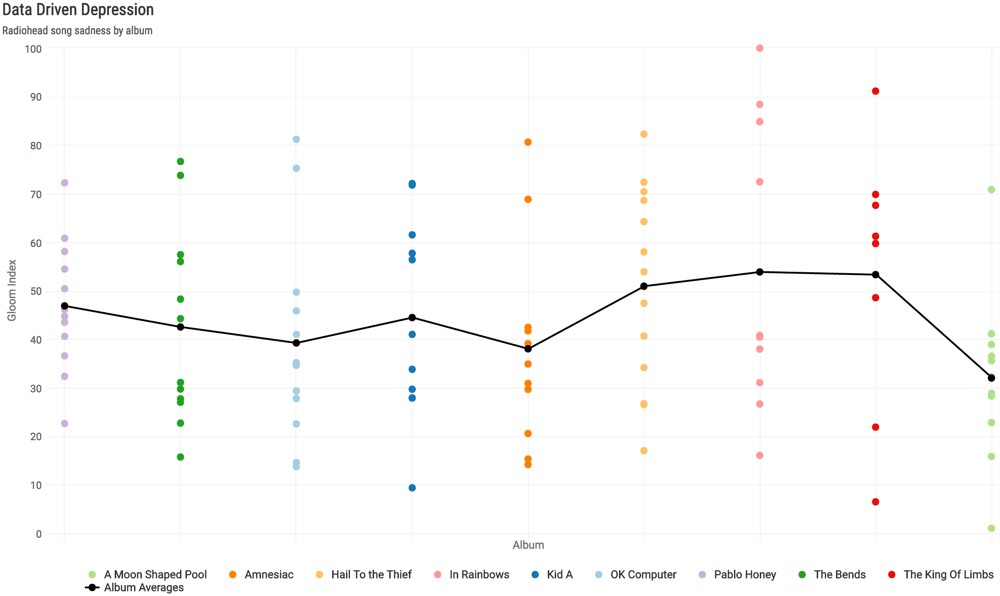
Radiohead is data scientist Charlie Thompson’s favorite band and he recently employed his professional skills to determine Radiohead’s most depressing songs and albums. Using data from Spotify and Genius, he analyzed and weighted how sad each song sounded musically and the sadness of the lyrics.
While valence serves as an out-of-the box measure of musical sentiment, the emotions behind song lyrics are much more elusive. To find the most depressing song, I used sentiment analysis to pick out words associated with sadness. Specifically, I used tidytext and the NRC lexicon, based on a crowd-sourced project by the National Research Council Canada. This lexicon contains an array of emotions (sadness, joy, anger, surprise, etc.) and the words determined to most likely elicit them.
Unsurprisingly, True Love Waits is Radiohead’s saddest song and Moon Shaped Pool its saddest album. You can play with this interactive chart to see all of the results. I thought Videotape would score lower on the Gloom Index…along with True Love Waits, it’s my go-to Radiohead song for wallowing in the darkness of my life. (via @RichardWestenra)
Some economists have cited the experience of the prestigious Royal Society of Arts (RSA), which offered honorary and cash awards, as proof of the efficacy of innovation prizes. The Society initially was averse to patents and prohibited the award of prizes for patented inventions. This study examines data on several thousand of these inducement prizes, matched with patent records and biographical information about the applicants. The empirical analysis shows that inventors of items that were valuable in the marketplace typically chose to obtain patents and to bypass the prize system. Owing to such adverse selection, prizes were negatively related to subsequent areas of important technological discovery. The RSA ultimately became disillusioned with the prize system, which they recognized had done little to promote technological progress and industrialization. The Society acknowledged that its efforts had been “futile” because of its hostility to patents, and switched from offering inducement prizes towards lobbying for reforms to strengthen the patent system. --Zorina Khan, NBER Working Paper 23042, on the strength of the second-best
Reuters editor-in-chief Steve Adler wrote a message to staff called “Covering Trump the Reuters Way.” After noting that “Reuters is a global news organization that reports independently and fairly in more than 100 countries, including many in which the media is unwelcome and frequently under attack,” he lays down some do’s and do-not-do’s1:
Do’s:
—Cover what matters in people’s lives and provide them the facts they need to make better decisions.
—Become ever-more resourceful: If one door to information closes, open another one.
—Give up on hand-outs and worry less about official access. They were never all that valuable anyway. Our coverage of Iran has been outstanding, and we have virtually no official access. What we have are sources.
—Get out into the country and learn more about how people live, what they think, what helps and hurts them, and how the government and its actions appear to them, not to us.
—Keep the Thomson Reuters Trust Principles close at hand, remembering that “the integrity, independence and freedom from bias of Reuters shall at all times be fully preserved.”
Don’ts:
—Never be intimidated, but:
—Don’t pick unnecessary fights or make the story about us. We may care about the inside baseball but the public generally doesn’t and might not be on our side even if it did.
—Don’t vent publicly about what might be understandable day-to-day frustration. In countless other countries, we keep our own counsel so we can do our reporting without being suspected of personal animus. We need to do that in the U.S., too.
—Don’t take too dark a view of the reporting environment: It’s an opportunity for us to practice the skills we’ve learned in much tougher places around the world and to lead by example - and therefore to provide the freshest, most useful, and most illuminating information and insight of any news organization anywhere.
These are good rules. (That one about giving up on access and hand-outs is downright fire.) They’re particularly good rules for a place like Reuters, that has a specific style, tradition, and role in the news ecosystem.
But they’re not necessarily good rules for everybody. Different news organizations are going to need to fill different roles in the ecosystem, different spaces on the multiple axes of personal, political, intellectual, and business commitments. If Gawker were still here in its full glory, Nick Denton could write up “Covering Trump the Gawker Way” and it would probably be a totally different but equally valuable list of guidelines.
The other thing news organizations (and other companies too) will need to figure out in L’Age D’Trump are their commitments to their staff. Reporters and media organizations need legal protections so they can’t be prosecuted as criminals or sued by proxy billionaires for doing their job; but they also need to be able to talk freely about how to do their job and balance all of those commitments for themselves without being shown the door.
The pressure is going to be coming from a lot of directions, not always the obvious ones. When the stakes are this high, and the conditions this uncertain, it helps to allay as many uncertainties as possible. When the shit goes down, you need to know who’s going to have your back.