Shared posts

28 Aug 12:18

What Uber Drivers Say About Uber

by Mimi Kirk

When Katie Wells hired a babysitter one night in 2014, she was astounded when the sitter ordered an Uber to go home. It was raining, but the sitter’s house was only five blocks away. Wells, a visiting scholar at George Washington University in Washington, D.C., wanted to know more. She wondered: Who were these people who were willing to drive such a short distance, and for so little money?

Wells teamed up with fellow GWU researcher Declan Cullen and Kafui Attoh, a professor of urban studies at the City University of New York, to find out more about Uber drivers. The researchers were particularly interested in discovering the extent to which economic inequality was a condition for the rise of Uber, and in turn whether gig jobs would affect a household’s economic stability. A grant from the Ewing Marion Kauffman Foundation allowed the team to explore these questions via surveys and 40 in-depth interviews with drivers in the Washington, D.C., area. This is, according to the researchers, one of the first studies about the rideshare industry to draw from interviews with drivers themselves. (We’ve excerpted some of the drivers’ responses below.)

This fall, Wells and her colleagues will release the first of three papers based on this research. CityLab sat down with Wells to learn about the study, the drawbacks of driving for Uber, and what cities can do to protect the rights of rideshare workers.  

Uber’s website attracts drivers with the line, “Drive when you want, earn what you need.” What are the benefits and costs of such flexibility?

We found that the cost of that flexibility is significant. Uber promises a lucrative job based on a flexible schedule, but drivers are basically responsible for all of the costs of running a car service. They have to pay for the car, insurance, cleaning, and whatever else comes up, while Uber retains control over the compensation. And if a driver is sick and unable to work, or gets in an accident, there are no protections in place.
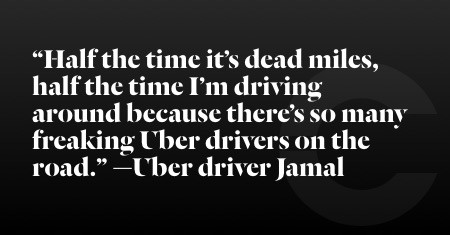
In addition, many of the drivers we interviewed conform to when Uber wants them to drive. Uber raises or lowers its pricing based on an algorithm that’s linked to supply and demand. So though Uber says you can drive whenever you want, drivers often only work from, say, 7 a.m. to 11 a.m. or from 3 p.m. to 8 p.m., because fares are too low at other times. Even then, drivers can have a hard time finding riders; those “dead miles” and “dead hours” cut into their earnings, and are hard to anticipate. Getting to decide one’s own schedule seems like a red herring because a driver ends up ceding control over the things that matter most.

Are drivers aware of how Uber works, and the particular pitfalls?

Drivers generally don’t have a full picture of the system—and can’t, because Uber limits access to a lot of the information or makes it difficult for drivers to digest. For instance, the majority of drivers we interviewed weren’t sure how much commission Uber takes for each ride, or whether Uber takes its booking fee before or after the commission. And these drivers didn’t have a strong sense about whether they need commercial rideshare insurance—which they do. The problem is not just that Uber has a lot of fine print. The rules about fares, bonuses, and fees are constantly changing.

It was shocking, but understandable, that drivers didn’t really understand how much they were earning. It’s a laborious process to figure what you need in terms of coverage, what you’re making, and, most importantly, your expenses. There were uncomfortable moments in our interviews when we asked drivers about their earnings. After we would go through a list of expenses, some drivers realized that they were making only a little more than minimum wage.

You and your colleagues also found that Uber encourages its drivers to take out car loans that are comparable to subprime mortgages.

Uber needs more and more drivers, so it will take drivers without cars. Uber offers drivers loans at high interest rates. And, if a driver can’t lease a car that way, Uber directs would-be drivers to Enterprise Rent-a-Car, which leases cars at even higher rates with even lower credit barriers. Parallels to the subprime mortgage industry are useful, as these drivers don’t have a lot of information about the purchase of their car—much in the same way that first-time homeowners weren’t really sure what they were buying. Uber creates a debt-to-work pipeline. The drivers are taking on significant financial risks to get the chance to earn a wage.

We spoke to one woman who had taken out one of these leases. Not long after she started paying for the loan, she had trouble earning enough through Uber to make her payments or pay for groceries. She eventually returned the car, and believes she is worse off financially as a result.
Being a taxi driver can be a precarious undertaking, but driving for Uber is riskier. Can you explain?

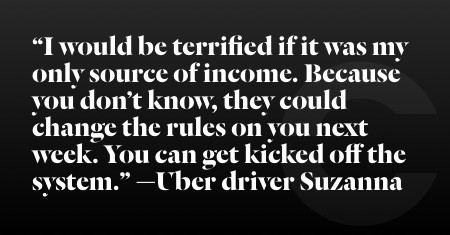
There are some similarities between taxi and Uber drivers in that they are both independent contractors, but the difference in how they are regulated is stark. Every city has legislation around taxi drivers, which is there to protect public safety as well as help make it possible for drivers to earn a living. For instance, cities limit the number of taxi drivers that can be on the road at any one time, and they limit the number of hours in a row that a taxi driver can work. Uber is exempt from these kinds of regulations. And it shows: One of the Uber drivers we spoke to fell asleep at the wheel after working 16 hours straight.

What can be done to make rideshare companies better employers?

The biggest thing is for Uber to recognize their drivers as employees so that they are entitled to workers’ compensation, sick days, and the like—just like any employee. But this is also the least likely thing to happen in the near future. Other fixes would involve allowing drivers, whether or not they’re recognized as employees, to address problems in courts, rather than requiring arbitration, and in union actions. Seattle has started to go down this road by allowing drivers to form associations and, hopefully, build bargaining power.

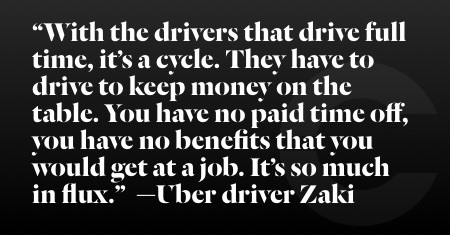
A more likely path to improvement will be a crackdown on the subprime auto leasing. Getting rid of these practices would dramatically affect the chances of financial success for Uber drivers, because it would make the costs of leases more legible. Until these things happen and the working conditions of Uber are addressed, cities should not partner with Uber for any public transit provision unless they want to underwrite poor-paying jobs. Workers should also be very careful about driving for rideshare platforms—Uber or otherwise.
What’s your advice for Uber passengers?

If you can’t find a co-operative taxi company, get in the Uber as soon as it shows up. The drivers don’t start earning a wage until you actually enter the car. Tip big, and in cash. And skip the ultra-cheap Uber Pool option, which makes it even harder than it already is for drivers to scrape together a decent wage.

20 Aug 08:20

A new answer to why developing country firms are so small, and how cellphones solve this problem

by David McKenzie
Much of my research over the past decade or so has tried to help answer the question of why there are so many small firms in developing countries that don’t ever grow to the point of adding many workers. We’ve tried giving firms grants, loans, business training, formalization assistance, and wage subsidies, and found that, while these can increase sales and profits, none of them get many firms to grow.

These interventions typically assume that firms face enough demand that if they produce more, or more efficiently, they can sell their products. This might be a reasonable assumption in many urban areas, but in more remote areas, the biggest constraint might just be limited effective market size. A very cool new paper by Rob Jensen and Nolan Miller proposes this explanation in the context of the Kerala boat-building industry, and shows that the introduction of cellphones allowed consumers to learn more about non-local firms, enabling high quality firms to start expanding and gaining market share, while low quality firms exit.

Setting
The setting is coastal fishing villages in two districts of Kerala, where the authors conducted a complete census of all boat-building firms every 6 months for 6 years between January 1998 and January 2004. At baseline, there were 143 boat-building firms. These firms were small, with an average of 2.2 workers and a maximum size of 4 workers. No firm supplied more than 1.3% of the whole market across the two districts, but each firm had a very large share of their local market – basically there was a single boat-builder in each village, from whom almost everyone purchased their boats.

The main dimension of quality is life expectancy of the boats. The authors convincingly argue that this is hard for potential buyers to easily ascertain when considering new suppliers – they can learn about the quality of the boat builder in their village from personal experience and that of other fisherman in the village, but would find it hard to tell whether a boat would last 4 years versus 5 years just on sight when considering non-local builders.

The authors are very thorough in measuring quality – they use 4 different measures, including surveys of fisherman on previous boats owned, the use of independent auditors that worked for a government boat insurance program, surveying fisherman on how long their local builder’s boats last, and a regression-based skill residual measure. They show there is much more variation in quality than in price – the average boat lasts 4 to 5 years, and the best boats last 3 to 4 years more than the worst, whereas there is only a 15% price difference between the least and most expensive boat.

The natural experiment
The authors use the same natural experiment as used by Jensen (2007) in his paper on how the spread of mobile phones led fishermen to start searching for better prices for their catches and so selling outside of their local markets for the first time. It uses the gradual roll-out of cellphone coverage in this part of India at the turn of the century to provide an exogenous reduction in information costs.

The causal chain from mobile phone introduction to changes in firm size and productivity
The authors set out a clear causal chain, and show very clearly the correlation between mobile phone roll-out and each of these links. What is particularly nice is that these can be seen very clearly graphically, as well as in the regressions.

Step 1: when mobile phones come in, fisherman start selling their catch non-locally. This was established in Jensen’s previous paper, and is shown here. Before, 95% of fisherman sell their catch in the local market, and this falls to around 60% when mobile phones come in.

Step 2: Fisherman visiting different markets learn more about the non-local boat market. The authors survey fisherman about boat builders they know of, and how long they think the boats last. They are more accurate for their local builder than for non-local builders. But when mobile phone comes in, their average error on non-local builders declines, and their estimates converge to those of locals in these markets.

Step 3: Fisherman start to buy boats non-locally. This is not directly shown  - I guess because boats are rare purchases for fisherman and they only take a sample of 15 fisherman each time period, they don’t have enough information on the consumer side to document this. Rob confirmed to me that data frequency is an issue here, but thinks there may be more they can say on this.

Step 4: High quality builders gain market share and grow, and low quality builders lose market share, and possibly exit.
Boat-building runs in families, and the authors claim the number of firms had been stable over time in the run-up to mobile phone introduction. Then when mobile phones came in, the number of boat building firms fell from 59 to 23 in region I, and from 48 to 19 in region II, whereas they stayed the same in region III where phones weren’t introduced (see Figure).
Exert from Figure 3: the number of boat-building firms falls after mobile phones are introduced in region II, but stay stable over time in region III where cellphones weren’t introduced.

They show this exit is concentrated in low-quality firms – each additional year of baseline quality reduces the likelihood of exit by 6 percentage points.

Market share then grows for the good firms, and falls for the bad. By the final survey round, several firms had captured 4 to 7 percent of the total market, and a firm at the 75th percentile of quality had gained 2 percentage points in market share. These firms with higher baseline quality then grow in size, with the mean employment per firm at the end of 5 workers greater than the maximum of 4 workers observed in any firm at baseline.

Step 5: greater firm size allows specialization and productivity growth
The number of boats being produced in the region was fairly constant over time – better quality here did not lead to an increase in total demand. However, this same number of boats is now produced by fewer firms, using 28-40 percent fewer workers, and 34-35 percent less capital, meaning a dramatic increase in productivity. In another example of nice measurement, the authors asked about worker’s time allocation to the 11 most time-intensive tasks in these firms. At baseline, the average worker performed about 7-8 of these tasks. Within two years of the phones entering, the average worker is only performing about three tasks – the owners focus more on the most skill-intensive tasks of finishing and fastening, as well as customer relations and management and supervision, while newer employees specialize in less skilled tasks such as cutting, obtaining inputs and cleaning up.

Consumers also gain – the price of boats increases 12%, but boat life expectancy increases 1.3 years (31%), so the cost per boat year falls.

Summing up
This is a very clearly argued and convincing paper. As well as contributing to the gains from opening up to trade literature, it is a nice example of how “demand-led” growth can be an effective way of helping firms to grow (see also Atkin et al, 2017). However, while it shows that consumer information can be a barrier to growth, it does raise questions about why better marketing efforts can’t solve these problems. The authors have several footnotes about how the lack of warranties, guarantees, and consumer review websites like Yelp or companies like Consumer Reports make it hard for firms to signal quality. Rob notes to me that it may be much harder to overcome this information barrier for infrequently purchased expensive durable products than for less expensive goods where quality can be noticed relatively quickly upon purchase. Thinking about market interventions that can help solve these problems seems an important area for future work.
 
12 Aug 09:06

Why does new money like bling and old money like discreetness?

by James Choi
[A] puzzling aspect of conspicuous consumption [is that] it is often subtle, in the sense that it is difficult for others to observe and recognize. Handwrought silverware only signals wealth to dinner guests. Someone who wishes to signal his wealth as clearly as possible can do better: acknowledging this puzzle, Bagwell and Bernheim (1996) suggest publishing “tax returns or audited asset statements”.

We argue that people engage in subtly conspicuous consumption to simultaneously signal wealth and social capital. Here, social capital is about connectedness—a measure of the relationships that enable access to potentially valuable resources through social interaction...

Consider the following example. Adam is wealthy and socially well-connected. He can distinguish himself from less wealthy individuals by consuming costly status goods; for example, he might purchase an expensive car to drive around town. However, if Adam seeks to demonstrate that he is well-connected as well as wealthy, his consumption choice also has to distinguish him from wealthy, poorly-connected individuals. Thus, a better option might be buying an expensive painting to display in his living room. His guests, observing the painting, and noting that only Adam’s guests ever observe it, infer that he is well-connected because using this painting as a signal of his type is cost-effective only if Adam’s parties are attended by people who Adam seeks to impress. ...

Conventional wisdom often associates loud consumption with the nouveau riche: those who have recently become wealthy. On the other hand, subtle consumption is associated with old money: those whose families have been wealthy for generations. Our interpretation is that old-money types possess large amounts of social capital, as they have been able to develop social connections over time, whereas the nouveau riche, who acquired wealth only recently, have accumulated little social capital. ...

Many forms of cultural knowledge, such as appreciation of music, art or wine, qualify as subtle status goods in our theory: they (i) are costly to acquire, and (ii) being tacit in nature, can only be recognized through extensive social interaction. ... Taking the perspective that cultural capital serves as a subtle good relative to material status goods, our model predicts that individuals with high social capital prefer cultural consumption, whereas people with low social capital favour material status goods.
--Juan Carlos Carbajal, Jonathan Hall, and Hongyi Li, "Inconspicuous Conspicuous Consumption," on subtle status symbols versus bling
06 Aug 02:08

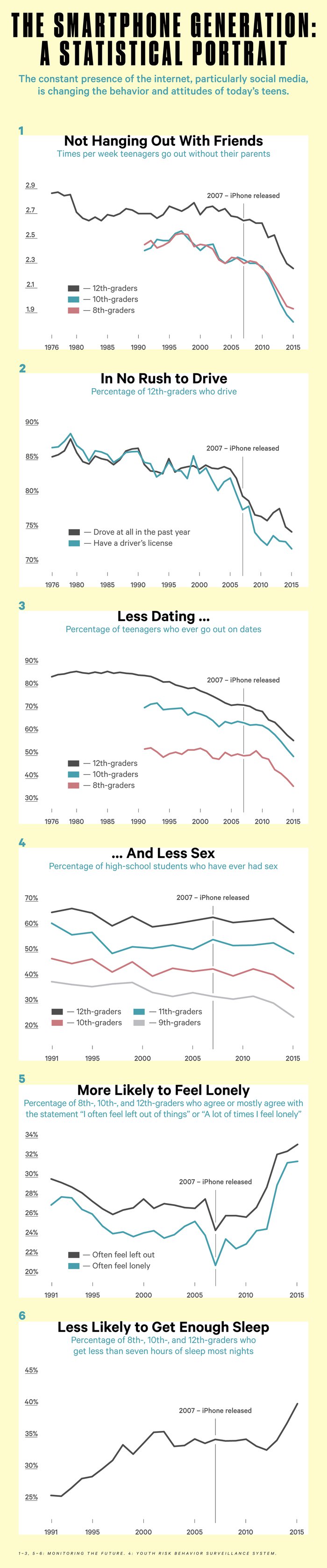
The teenage mental health crisis

by James Choi

--Jean Twenge, The Atlantic, on the costs of dropping out of IRL
03 Aug 12:39

The Subtle Art of Not Giving a F*ck

by Jason Kottke

From an excerpt of Mark Manson’s book The Subtle Art of Not Giving a F*ck:

The desire for more positive experience is itself a negative experience. And, paradoxically, the acceptance of one’s negative experience is itself a positive experience.

Those two sentences are a pretty good way to sum up the human experience. As an exercise, think about how the world’s major religions and philosophies are attempts to help people manage these desires and acceptance.

Tags: books   Mark Manson   The Subtle Art of Not Giving a F*ck
26 Jul 06:06

What is it like to be white?

by Jason Kottke

Here’s Fran Lebowitz talking about race in the US in a 1997 Vanity Fair interview:

The way to approach it, I think, is not to ask, “What would it be like to be black?” but to seriously consider what it is like to be white. That’s something white people almost never think about. And what it is like to be white is not to say, “We have to level the playing field,” but to acknowledge that not only do white people own the playing field but they have so designated this plot of land as a playing field to begin with. White people are the playing field. The advantage of being white is so extreme, so overwhelming, so immense, that to use the word “advantage” at all is misleading since it implies a kind of parity that simply does not exist.

It is now common — and I use the word “common” in its every sense — to see interviews with up-and-coming young movie stars whose parents or even grandparents were themselves movie stars. And when the interviewer asks, “Did you find it an advantage to be the child of a major motion-picture star?” the answer is invariably “Well, it gets you in the door, but after that you’ve got to perform, you’re on your own.” This is ludicrous. Getting in the door is pretty much the entire game, especially in movie acting, which is, after all, hardly a profession notable for its rigor. That’s how advantageous it is to be white. It’s as though all white people were the children of movie stars. Everyone gets in the door and then all you have to do is perform at this relatively minimal level.

Additionally, children of movie stars, like white people, have at — or actually in — their fingertips an advantage that is genetic. Because they are literally the progeny of movie stars they look specifically like the movie stars who have preceded them, their parents; they don’t have to convince us that they can be movie stars. We take them instantly at face value. Full face value. They look like their parents, whom we already know to be movie stars. White people look like their parents, whom we already know to be in charge. This is what white people look like — other white people. The owners. The people in charge. That’s the advantage of being white. And that’s the game. So by the time the white person sees the black person standing next to him at what he thinks is the starting line, the black person should be exhausted from his long and arduous trek to the beginning.

(via @amirtalai)

Tags: Fran Lebowitz   interviews   racism
25 Jul 13:11

How did you know you’d found your person?

by Jason Kottke

Laura Olin recently asked the readers of the Everything Changes mailing list how they knew they’d found the person they wanted to spend the rest of their lives with. Some of the responses might, well, is anyone chopping onions in here?

I first began dating my now husband back in the fall of 2008. It was only a couple of years after my father had passed away from lung cancer and the anniversary of his death was particularly difficult in those early years of heart aching loss as one might imagine. I warned him when the date was nearing because I wouldn’t be myself in the undertow of sadness that would take me. Fast forward a couple of years into our relationship, we had moved in together and shared our Google calendars with each other to make making plans and tracking things easier for the both of us (I would make plans without consulting him or have dinner with friends and forget to tell him and he’d have no idea where I was…whoops!). I was scrolling through into June to make some camping reservations and came across a note on June 26th on his calendar. He had made a note that just had my name and the words “Dad day”. That’s when I knew he was my person. He had marked down my sad day to be there for me. He has shown me in the almost 9 years we’ve been together so many other thoughtful ways he cares about me, but that was the moment.

I was only going to share one story but:

I have had two persons in my life; my late husband, and my best friend. I met my best friend one day in college; I hardly knew her, though I knew of her. For some reason, she wandered into my dorm room one afternoon, and burst into tears. She’d just had an abortion. I remember that I looked at her and thought, she’s my best friend forever. It was like a thunderbolt. She says something similar happened to her. We later discovered our dads had gone to the same high school in Cleveland, and that she and I had been born in the same hospital in Columbus, two months to the day apart, even though I then moved 2500 miles away from that town. We now work together and have for ten years. I think we’ll probably form a commune in Maine in twenty years and be together till the end.

My late husband…well, I was in Chicago, and struggling with whether to move to New York. I liked Chicago and didn’t want to leave, but my boyfriend at the time really wanted to go. But I woke up one more morning and just knew: If I move to New York, my life will change. So I did, and eighteen months after that, I got a call from a man named Peter, who needed to make a hire at his newspaper. We met at Grand Central and while I didn’t yet know he was going to be my husband, while I wasn’t even especially attracted to him physically, I was crazily attracted to him as a human being. I came home that night and told myself: I have to find a way to work for this man. I did. Two years later we were together, and we belonged to each other for 17 years. He died four years ago. His last week in the hospital, he held my hand and said, “You’re my person.”

So many onions.

Tags: crying at work   Laura Olin
25 Jul 13:07

Samatha Meditation Practice

by Ben Casnocha

During both my 10 day silent meditation retreats, there were moments where I felt a deep calm, my mind got very bright, and I possessed an ability to control my attention in a way that seemed totally profound. I don’t think my experience constituted a state of jhana — how the Buddha referred to blissed out, immersive, “absorbed” states of mind. I was probably experiencing “access concentration“, a precursor to the jhanic states; in any case, those minutes of absorption were utterly memorable for me. I remember returning to my dorm room afterwards, late at night, and lying in bed thinking to myself: I have a new superpower.

Like many beginner meditators who experience momentary states of profound absorption and stillness, I have foolishly quested after that state in subsequent meditation sessions. On my second 10 day retreat, I craved the state of ultra concentration that I felt during my first retreat. I intently sat late at night in the meditation hall. And then, as I felt my mind ease into a deeper stillness, I told myself, “Here it comes. Here it comes. Is this it? Is this what happened to me last time?” See ya later, still lion mind. Hello, monkey mind. On my 3 day residential retreat, I never entered deep concentration, probably because of this mental chatter around wanting it.

I think I could use more practice at stabilizing the mind — without the questing and excessive effort — before I go deeper on practicing insight meditation. So I’m going to focus more on samatha over the next year or so. The samatha concentration practice involves stabilizing, unifying, and collecting the mind into what the Buddha called samadhi, or a state of concentration. With a clear and collected mind, you can begin to discern more subtle sensations, and begin to more clearly perceive the truths about your mind and reality.

I recently attended a one day retreat at Spirit Rock on samatha practice. The teacher distinguished samatha from vipassana. Samatha practice is like trying to stabilize a pair of binoculars and getting them into focus. Vipassana is looking through the binoculars in order to observe reality as it actually is.

Throughout the day, we practiced basic relaxation. “Release tension in your body. Now release a little more,” the teacher said, as we scanned each part of the body.

With total relaxation, you can begin to quiet the mind, and focus on an object of concentration — in our case, the breath. The anapanana practice of studying the breath can become quite a granular analysis. For example, we practiced:

  • Noticing whether breath is long or short
  • Noticing the beginning of the breath, the middle part of the breath, the end of the breath
  • Focusing on spot underneath nostril where breath enters
  • Counting breaths up to 10 and then starting again at 1

On the Goenka retreats, you spend the first three days doing nothing but breath awareness, so I have some practice at it. But I never understood how object-awareness connects to broader vipassana practice until now. To deepen my understanding, I’m taking an online class at Spirit Rock on concentration/samatha practice, with 8 hours of video lectures.

I want to thank a blog reader who wrote me a very helpful comment/email last year in response to my blog post about my awareness + wisdom retreat. He helped me explore the difference between samatha and vipassana. After some gentle corrections, he included this line of encouragement at the end: “Not many people have gotten as far as you have with meditation and Buddhism. You also ask good questions and have good insights. You should definitely keep up your practice. It is a rare gift.”

As I get older, praise from others does less and less for me, in terms of emotional impact. This one was different. I’ve been exploring Buddhism and meditation seriously now for about six years and the deeper I go, the more I realize the complexities of the practice. The complexity can be daunting. Hearing encouragement a year ago made a difference to me. So, thank you to Tracy. And thank you for alerting to me to the prospective benefits of a more focused concentration practice.

22 Jul 12:19

Autism On A Rainy Day | Naoki Higashida | Literary Hub | 20th July 2017

On growing up with autism. “I asked my mother how she identified rain by the sound alone. She told me: ‘Well, that sound is the sound of rain, and when it starts raining, we bring in the washing’. What remains a mystery is how to infer that it’s raining purely from the noise. Even if I could identify the source of rain-noise, making the jump from the thought, ‘It’s raining!’, to bringing in the laundry, would be out of the question. I’d be too occupied just sitting there, entranced”
22 Jul 11:03

How To Think Like An Economist | J. Bradford DeLong | Grasping Reality | 15th July 2017

“A large part of economics involves a unique way of thinking about the world that is closely linked with the analytical tools economists use, and that is couched in a particular technical language and a particular set of data. While one can get a lot out of sociology and political science courses without learning to think like a sociologist or a political scientist (because of their focus on institutional description), it is not possible to get much out of an economics course without learning to think like an economist”
19 Jul 14:04

They want help designing a crowdsourcing data analysis project

by Andrew

Michael Feldman writes:

My collaborators and myself are doing research where we try to understand the reasons for the variability in data analysis (“the garden of forking paths”). Our goal is to understand the reasons why scientists make different decisions regarding their analyses and in doing so reach different results.

In a project called “Crowdsourcing data analysis: Gender, status, and science”, we have recruited a large group of independent analysts to test the same hypotheses on the same dataset using a platform we developed.

The platform is essentially Rstudio running online with few additions:

· We record all executed commands even if they are not in the final code

· We ask analysts to explain these commands by creating semantic blocks explaining the rationale and alternatives

· We allow analysts to create graphical workflow of their work using these blocks and by restructuring them

You can find the more complete experiment description here. Also a short video tutorial of the platform.

Of course this experiment is not covering all considerations that might lead to variability (e.g. R users might differ from Python users), but we believe it is a step towards better understanding how defensible, yet subjective analytic choices may shape research results. The experiment is still running but we are likely to receive about 40-60 submissions of code, logs, comments, and explanations of decisions made. We are also collecting various information about analysts like their background, methods they usually use and the way they operationalized the hypotheses.

Our current plan is to analyze the data from this crowdsourced project using inductive coding by splitting participants into groups that reached similar results (effect size and direction). We then plan to identify factors that can explain various decisions as well as explain the similarities between participants.

We would love to receive any feedback and suggestions from readers of your blog regarding our planned approach to account for variability in results across different analysts.

If anyone has suggestions, feel free to respond in the comments.

The post They want help designing a crowdsourcing data analysis project appeared first on Statistical Modeling, Causal Inference, and Social Science.

18 Jul 09:04

Earnings Safeguards for Rideshare Drivers

by Uber Under the Hood

by Curtis Scott, Head of Insurance

Demand for independent work is on the rise. According to the McKinsey Global Institute, roughly one in six people would prefer independent flexible work over a traditional nine-to-five job. Moreover, with around 15 million people in the US experiencing unemployment or underemployment, on-demand work like Uber presents new opportunities for more Americans to earn a living on their own terms.

However, flexible work comes with tradeoffs. Independent workers forego traditional benefits like workers compensation for control over their time and schedule, and purchasing comparable insurance on the private market can be prohibitively expensive at all rungs of the economic ladder.

While working with Uber can be empowering, being your own boss does not need to come at the expense of income security. At a basic level everyone should have the option to protect themselves and their loved ones against rare and unforeseen work accidents that prevent them from earning a living. This protection should be optional yet affordable, flexible but dependable.

That is why Uber is working closely with Aon to pilot an insurance product, Driver Injury Protection, that allows drivers to access peace of mind for a few cents per mile directly through the Uber app.

The new product provides Uber driver-partners the option to obtain coverage for medical expenses, disability payments and a survivors benefit resulting from a covered accident. Drivers who elect to enroll are protected for injuries while online, en route and on-trip in connection with the Uber app; however the premium of $0.0375 a mile is calculated and charged only for miles travelled while on-trip.

https://medium.com/media/e2f04635473a83e8cbf9f1993f7ddb57/href

Importantly, the accident medical expense benefit provides coverage to a maximum of $1 million, with no deductible or co-pay. Driver enrollment in this insurance coverage is completely optional. To help drivers take advantage of this option and remove financial barriers to enrollment, drivers will earn more per-mile in states where Driver Injury Protection is available, as displayed in their partners.uber.com portal.

This new product features usage-based pricing on a per mile basis. This provides important and affordable protections to ensure stability and security for participants in the on-demand economy, while preserving the flexibility of on-demand driving.Deductions are clearly shown in the Uber app.

For complete coverage terms, conditions and exclusions, Uber drivers can visit the program’s website.

While the Driver Injury Protection insurance offered to Uber’s driver-partners is first-of-its-kind, it is the latest example of “benefits” designed primarily for independent workers. In the US, Uber’s partnership with Betterment enables drivers to contribute to their retirement savings, while 150,000 drivers have been able to access health coverage through Stride Health.

Drivers can also file their taxes and claim returns through our partnerships with Stride, TurboTax and H&R Block, cashout their earnings instantly with Instant Pay, and receive discounts on fuel and other operational expenses.

Outside of the US, Uber is also working on protection options for drivers who use the app. For example, in the UK in April, we announced a partnership with the Association of Independent Professionals and the Self-Employed (IPSE), giving drivers access to, amongst other things, sickness and injury coverage, occupational accident coverage, and accidental death or permanent total disablement coverage.

With Uber, people can get work at the push of a button. Ensuring that this work provides opportunity and security for our drivers is core to our business. It is why we will continue to look at innovative options and strategies that support our drivers to access and take advantage of independent work.


Earnings Safeguards for Rideshare Drivers was originally published in Uber Under the Hood on Medium, where people are continuing the conversation by highlighting and responding to this story.

18 Jul 08:23

Romantic kissing doesn't exist in 54% of human cultures

by James Choi
...a recent article in American Anthropologist by Jankowiak, Volsche and Garcia questions the notion that romantic kissing is a human universal by conducting a broad cross cultural survey to document the existence or non-existence of the romantic-sexual kiss around the world.

The authors based their research on a set of 168 cultures compiled from eHRAF World Cultures (128 cultures) as well as the Standard Cross Cultural Sample (27 cultures) and by surveying 88 ethnographers (13 cultures). The report’s findings are intriguing: rather than an overwhelming popularity of romantic smooching, the global ethnographic evidence suggests that it is common in only 46% (77) of the cultures sampled. The remaining 54% (91) of cultures had no evidence of romantic kissing. In short, this new research concludes that romantic-sexual kissing is not as universal as we might presume.

The report also reveals that romantic kissing is most common in the Middle East and Asia, and least common of all among Central American cultures. Similarly, the authors state that “no ethnographer working with Sub-Saharan African, New Guinea, or Amazonian foragers or horticulturalists reported having witnessed any occasion in which their study populations engaged in a romantic–sexual kiss”, whereas it is nearly ubiquitous in northern Asia and North America. ...

Overall, we found that the perception of romantic kissing in non-kissing societies ranges from simple disinterest or amusement to total disgust.

Among the indigenous Tapirapé people of Central Brazil, Wagley (1977) found that “couples showed affection”, but “kissing seems to have been unknown”. He explains,
When I described it to them, it struck them as a strange form of showing physical attraction … and, in a way, disgusting.
...

Across the Pacific Ocean in Melanesia, Bronislaw Malinowski’s (1929: 330) classic account describes the impression of kissing among Trobriand Islanders, who were equally bemused by the foreign custom:
The natives know, however, that white people “will sit, will press mouth against mouth–they are pleased with it.” But they regard it as a rather insipid and silly form of amusement.
The Tsonga people of Southern Africa are also openly disgusted by the practice: “Kissing was formerly entirely unknown… When they saw the custom adopted by the Europeans, they said laughingly: “Look at these people! They suck each other! They eat each other’s saliva and dirt!” Even a husband never kissed his wife” (Junod 1927: 353-354).
--Yale Human Relations Area Files on surprisingly non-universal behaviors. HT: Megan McArdle
18 Jul 08:18

Why Is Blackmail A Crime? | Eugene Volokh | Volokh Conspiracy | 6th July 2017

“It’s clear why we criminalise extortion by threat of violence (pay me or I’ll burn down your business): It’s a threat to do something that you have no right to do. But in the threat, ‘Pay me $10,000 or I’ll reveal that you had an affair’, all components are legal: He is free to pay you $10,000. You are free to reveal that he had an affair. Yet combine them together as a conditional threat and it’s a crime. The fact that so much legal and commonplace behavior is very similar to blackmail causes practical problems”
18 Jul 08:17

It Takes A Theory To Beat A Theory | Andrew Lo | Evonomics | 7th July 2017

“Financial markets don’t follow economic laws. Financial markets are a product of human evolution, and follow biological laws instead. The same basic principles that determine the life history of a herd of antelope also apply to the banking industry. We aren’t rational actors with a few quirks in our behavior — instead, our brains are collections of quirks. These quirks are the products of brain structures whose main purpose isn’t economic rationality, but survival”
30 Jun 04:08

Existence Proof

Real analysis is way realer than I expected.
29 Jun 01:12

Disrupt The Citizen | Nikil Saval | n+1 | 27th June 2017

The case against Uber and Lyft; against their presumed right to disrupt settled legal and social systems; and against the ease with which they hire lobbyists to legitimise and normalise their self-interest. “What Plouffe and the ride-sharing companies understand is that, under capitalism, when markets are pitted against the state, the figure of the consumer can be invoked against the figure of the citizen. Consumption has in fact come to replace our original ideas of citizenship”
24 Jun 12:23

A Raging Battle Over Kohl’s Legacy | Melanie Amann et al | Der Spiegel | 23rd June 2017

Enthralling glimpse of the underside of German politics. Helmut Kohl’s widow tussles with Angela Merkel and CDU grandees for control of Kohl’s political legacy — including hundreds of private files covering German unification. “Those who had the chance to visit him during his final years experienced a man who had mellowed with age and appeared to have made peace with the world. The petty desire for revenge that had driven him for so many years had transferred to his wife”
24 Jun 12:22

Non-stinky kimchi?

by James Choi
If Western consumers on a health kick can be convinced to drink yeasty, probiotic tea and tart, cultured yogurt, then why wouldn’t they be up for spicy pickled cabbage fermented with garlic for months on end?

Well, that’s the goal of South Korean scientists at the World Institute of Kimchi on Kimchi Street in Kimchi Town, on the outskirts of the southern city of Gwangju.

“We are trying to globalize kimchi,” said Ha Jae-ho, head of the institute, describing it as a “functional food.” ...

Even among kimchi-loving Koreans, many have separate kimchi fridges to stop the dish from tainting other food. If they keep it in their regular fridge, it goes into a vault-like box.

For this reason, scientists are trying to increase the good bacteria — especially the lactic acid that gives kimchi its probiotic qualities — and decrease the bad parts, namely the smell so pungent it can take days to work its way out a person’s pores. ...

In labs at the institute, scientists are working on the distinctive fumes, at least. “We’re trying to engineer the smell out of kimchi,” said Lee Mi-ae, a white-coated researcher. “But it’s difficult because the smell is linked to the flavor of the kimchi.”
--Anna Fifield, Washington Post, on creating a culinary abomination
22 Jun 11:26

Learning To Live With Starlings | Lyanda Lynn Haupt | TED Ideas | 20th June 2017

A 19C Bronx pharmacist and Shakespeare aficionado called Eugene Schieffelin decided to bring every bird mentioned in the works of Shakespeare to Central Park. Based on a single reference to a starling in Henry IV he purchased 80 of the birds in 1890, had them shipped to the US, and released them on a snowy March day. Genetic research leads ornithologists to believe that all of the hundreds of millions of “despised” starlings in North America are descendants of Schieffelin’s birds
22 Jun 09:41

Why did Amazon buy Whole Foods? World domination.

by Jason Kottke

Amazon’s New Customer is a really great analysis by Ben Thompson of Amazon’s strategy and why Amazon bought Whole Foods: they purchased a new customer for Amazon infrastructure, not a retailer. Early on in the piece, Thompson lays this one on us:

Amazon’s goal is to take a cut of all economic activity.

No qualifiers. All economic activity. In the world. Sort of a Dutch East India Company for the internet age. Thompson explains how they’re going to do it and why fresh food is such a strategic hole for them.

As you might expect, given a goal as audacious as “taking a cut of all economic activity”, Amazon has several different strategies. The key to the enterprise is AWS: if it is better to build an Internet-enabled business on the public cloud, and if all businesses will soon be Internet-enabled businesses, it follows that AWS is well-placed to take a cut of all business activity.

On the consumer side the key is Prime. While Amazon has long pursued a dominant strategy in retail — superior cost and superior selection — it is difficult to build sustainable differentiation on these factors alone. After all, another retailer is only a click away.

This, though, is the brilliance of Prime: thanks to its reliability and convenience (two days shipping, sometimes faster!), plus human fallibility when it comes to considering sunk costs (you’ve already paid $99!), why even bother looking anywhere else? With Prime Amazon has created a powerful moat around consumer goods that does not depend on simply having the lowest price, because Prime customers don’t even bother to check.

This, though, is why groceries is a strategic hole: not only is it the largest retail category, it is the most persistent opportunity for other retailers to gain access to Prime members and remind them there are alternatives. That is why Amazon has been so determined in the space: AmazonFresh launched a decade ago, and unlike other Amazon experiments, has continued to receive funding along with other rumored initiatives like convenience store and grocery pick-ups. Amazon simply hasn’t been able to figure out the right tactics.

When I heard about the Whole Foods deal, the first thing I thought about was Amazon Go. The company has been trying to experiment with different retail environments, but without the proper scale, it doesn’t make a lot of sense. Whole Foods gives them a chance to develop their fresh food delivery infrastructure at scale…so that they can offer it to other customers just like they do with AWS.

P.S. Whenever I think about Amazon as a business, I recall this 2012 post by Eugene Wei on Amazon’s low-margin strategy. I suspect Thompson’s post will join it in my thoughts.

Tags: Amazon   Ben Thompson   business   economics   Whole Foods
18 Jun 14:41

How to apologize properly

by Jason Kottke

Apologizing is as simple as saying “I’m sorry”, right? Well, not quite. In a piece by Katie Heaney for Science of Us, here are the six components of an apology from Beth Polin:

1. An expression of regret — this, usually, is the actual “I’m sorry.”
2. An explanation (but, importantly, not a justification).
3. An acknowledgment of responsibility.
4. A declaration of repentance.
5. An offer of repair.
6. A request for forgiveness.

So no ifs or buts — “I’m sorry if you were offended” is not an apology. Neither is “I’m sorry we missed our appointment but I had to drop off my dry cleaning on the way” or any other statement that’s actually just a counterargument to an accusation of fault. Don’t use the passive voice either: “mistakes were made” is a classic non-apology.

In my experience, a particularly critical component to apologizing is the “this won’t happen again” part. When you do something repeatedly and apologize each time, those are not really apologies. If you do this, you’re pretty clearly acknowledging that your relationship to the person you’re “apologizing” to is not as important to you as the behavior in question. Either stop apologizing for your behavior or work on changing it.

Tags: Beth Polin   how to   Katie Heaney   lists
18 Jun 14:39

If you can’t explain something in simple terms, you don’t understand it

by Jason Kottke

Feynman Blackboard

In the early 1960s, Richard Feynman gave a series of undergraduate lectures that were collected into a book called the Feynman Lectures on Physics. Absent from the book was a lecture Feynman gave on planetary motion, but a later finding of the notes enabled David Goodstein, a colleague of Feynman’s, to write a book about it: Feynman’s Lost Lecture. From an excerpt of the book published in a 1996 issue of Caltech’s Engineering & Science magazine:

Feynman was a truly great teacher. He prided himself on being able to devise ways to explain even the most profound ideas to beginning students. Once, I said to him, “Dick, explain to me, so that I can understand it, why spin one-half particles obey Fermi-Dirac statistics.” Sizing up his audience perfectly, Feynman said, “I’ll prepare a freshman lecture on it.” But he came back a few days later to say, “I couldn’t do it. I couldn’t reduce it to the freshman level. That means we don’t really understand it.”

John Gruber writes the simple explanations are the goal at Apple as well:

Engineers are expected to be able to explain a complex technology or product in simple, easily-understood terms not because the executive needs it explained simply to understand it, but as proof that the engineer understands it completely.

Feynman was well known for simple explanations of scientific concepts that result a in deeper understanding of the subject matter: e.g. see Feynman explaining how fire is stored sunshine, rubber bands, how trains go around curves, and magnets. Critically, he’s also not shy about admitting when he doesn’t understand something…or, alternately, when scientists as a group don’t understand something. There’s the spin anecdote above and of his explanation of magnets, he says:

I really can’t do a good job, any job, of explaining magnetic force in terms of something else you’re more familiar with, because I don’t understand it in terms of anything else you’re more familiar with.

Feynman was also quoted as saying:

I think I can safely say that nobody understands quantum mechanics.

Pretty interesting thing to hear from a guy who won a Nobel Prize for explaining quantum mechanics better than anyone ever had before. Even when he died in 1988 at the end of a long and fruitful careeer, a note at the top of his blackboard read:

What I cannot create, I do not understand.

Tags: Apple   books   David Goodstein   Feynman’s Lost Lecture   John Gruber   physics   Richard Feynman   science   The Feynman Lectures on Physics
18 Jun 14:37

What bullets do to bodies

by Jason Kottke

Emergency room doctor Leana Wen writes in the NY Times about what bullets do to human bodies.

Early in my medical training, I learned that it is not the bullet that kills you, but the damage from the bullet. A handgun bullet enters the body in a straight line. Like a knife, it damages the organs and tissues directly in its path, and then it either exits the body or is stopped by bone, tissue or skin.

This is in contrast to bullets from an assault rifle. They are three times the speed of handgun bullets. Once they enter the body, they fragment and explode, pulverizing bones, tearing blood vessels and liquefying organs.

Earlier this year, Jason Fagone wrote a much longer piece on the same topic for HuffPost.

“As a country,” Goldberg said, “we lost our teachable moment.” She started talking about the 2012 murder of 20 schoolchildren and six adults at Sandy Hook Elementary School. Goldberg said that if people had been shown the autopsy photos of the kids, the gun debate would have been transformed. “The fact that not a single one of those kids was able to be transported to a hospital, tells me that they were not just dead, but really really really really dead. Ten-year-old kids, riddled with bullets, dead as doornails.” Her voice rose. She said people have to confront the physical reality of gun violence without the polite filters. “The country won’t be ready for it, but that’s what needs to happen. That’s the only chance at all for this to ever be reversed.”

She dropped back into a softer register. “Nobody gives two shits about the black people in North Philadelphia if nobody gives two craps about the white kids in Sandy Hook. … I thought white little kids getting shot would make people care. Nope. They didn’t care. Anderson Cooper was up there. They set up shop. And then the public outrage fades.”

I think about this tweet all the time:

In retrospect Sandy Hook marked the end of the US gun control debate. Once America decided killing children was bearable, it was over.

Tags: guns   Jason Fagone   Leana Wen   medicine
05 Jun 13:26

These nine cognitive psychology findings all passed a stringent test of their replicability

by BPS Research Digest
Abstract brain gear
“These results represent good news for the field of psychology”

By Christian Jarrett

The failure to reproduce established psychology findings on renewed testing, including some famous effects, has been well-publicised and has led to talk of a crisis in the field. However, psychology is a vast topic and there’s a possibility that the findings from some sub-disciplines may be more robust than others, in the sense of replicating reliably, even in unfavourable circumstances, such as when the participants have been tested on the same effect before.

A new paper currently available as a preprint at PsyArXiv has tested whether this might be the case for nine key findings from cognitive psychology, related to perception, memory and learning. Rolf Zwaan at Erasumus University Rotterdam and his colleagues found that all nine effects replicated reliably. “These results represent good news for the field of psychology,” they said.

The researchers tested hundreds of participants on Amazon’s Mechanical Turk survey website. Whichever cognitive effect they were tested on, each participant completed the test twice (either with the exact same stimuli or new versions), to see whether it made any difference to their behaviour or responses if they already had experience of the experiment.

In fact, all the effects in question were replicated on all occasions, whether on the first or second testing, and regardless of whether the specific stimuli – such as the words or pictures involved – were familiar or completely new.  The nine cognitive effects that showed this robustness were:

  • The Simon Effect: Participants had to press computer keys to indicate as fast as possible the colour of a on-screen circle. They were faster to respond if the appropriate keyboard key was on the same side of space as the circle they were responding to. This facilitatory effect of “stimulus-response” consistency is important for the design of human-machine interfaces.
  • The Flanker Task: Participants had to press the correct keyboard key as fast as possible to indicate whether a target stimulus was a vowel or consonant. Participants were faster to respond if the target was surrounded by distracting letters associated with the same response (e.g. a target vowel surrounded by irrelevant, distracting vowels), as opposed to being surrounded by distractors associated with a different response (e.g. a vowel surrounded by consonants). The task shows how we can’t help but process irrelevant information to a certain degree.
  • Motor Priming: Participants had to press the appropriate keyboard key as fast as possible in response to left- or right-facing arrows flashed on-screen. Preceding arrows (known as a prime) gave advance warning of which way the target arrows would point: sometimes these primes were accurate, which led to faster performance, as you’d expect; if the primes pointed the wrong way, they slowed performance. Crucially, some of the primes were “masked” to make them subliminal (i.e. not consciously visible), in which case the effects were reversed, with primes pointing the wrong way leading to faster responses. The finding shows how information that’s not consciously perceived can affect our behaviour, and that it can have an opposite effect when subliminal than when consciously perceived.
  • Spacing Effect: Participants were presented with dozens of words in sequence, with some of the words shown more than once in quick succession (i.e. the repetitions appeared close together in the sequence, known as “massing”); the repetition of other words was spread out in the sequence with other words appearing in-between (known as “spacing”). Tested on their memory for the words later, participants showed superior memory for the spaced words than the massed words, a basic phenomenon of memory that has important implications for learning and study.
  • False Memories: Participants were shown sequences of words of related meaning. Tested on their memory of the words later, participants were more likely to mistakenly say that a new word of similar meaning had been present in the earlier sequence than a new word with a meaning unrelated to the earlier list. This is a basic demonstration of the fallibility of memory and how easy it is to feel like we’ve experienced something before when we haven’t.
  • Serial Position Effect: Participants were challenged to remember lists of twenty words. They later showed better memory for words that appeared near the beginning and end of the lists.
  • Associative Priming: Participants had to indicate as fast as possible whether target words flashed on-screen were real words or non-words. They were faster to identify target real words if they’d been preceded by a word (a “prime”) of related meaning, consistent with the idea that activation spreads through networks of related information in the mind.
  • Repetition Priming: Presented with lists of words, some more common than others, participants had to indicate as fast as possible whether each word was a real word or a non-word. Some lists were repeated. Participants were faster to make their judgments when re-tested on a word shown earlier, and this priming effect was more pronounced for less common words – a finding that shows an interesting interaction between short-term memory (based on a recent encounter of a word) and long-term memory (based on how common the word is).
  •  Shape simulation: Participants were shown successive pairs of sentences and pictures. For each picture they had to say whether the object it presented had featured in the preceding sentence. Participants were quicker to respond correctly to picture-sentence matches when the orientation of the object was similar in both cases – for example, if the sentence “The ranger saw the eagle in the sky” was followed by an image of a flying eagle as opposed to a perched eagle. The finding shows how we automatically represent the visual images implied by sentences we’ve read.

Zwaan and his colleagues said these positive findings are particularly encouraging, at least for cognitive psychology, because an increasing amount of research on memory and perception is now conducted online via Amazon Mechanical Turk and other survey websites. Also, the fact that these psychological phenomena held up even when the same participants were tested for a second time shows that they reflect fundamental, unchanging aspects of how our minds work. “It appears that these tasks are so constraining that they encapsulate behaviour from contextual variation and even from recent relevant experiences to yield highly reproducible effects,” the researchers said.

Some Psychological Effects Replicate Even Under Potentially Adverse Conditions

Christian Jarrett (@Psych_Writer) is Editor of BPS Research Digest


03 Jun 03:27

Can technology reshape the world of work for developing countries?

by Luc Christiaensen
 
 Sarah Farhat / World Bank
Automation, connectivity, and innovation will together determine how world of work will look in both developed and developing countries.​ (Photo: Sarah Farhat / World Bank)

The Future of Work was not only the first topic of this year’s G20 Labor and Employment Ministerial Meeting, it's also white hot in today’s blogosphere. Yet most pieces portray a developed world perspective with an emphasis on robots, and how they are taking the jobs away, and skills development as the key policy response. But what does the rapid technological change mean for global poverty and inequality? How does it affect the world of work in developing countries?

To address this question, it is useful to distinguish three different ways through which digital technology affects the world of work: automation, connectivity, and innovation. They change the cost of labor versus capital, the cost of transacting, the potential for economies of scale and market competition, and the speed of innovation. Together this will determine how and where goods are produced and services provided and thus what the world of work will look like, in developed and developing countries alike.


Automation

Let’s start with automation, which replaces human effort with machine effort, at an increasing speed and scale. For example, the stock of robots in the U.S. and Western Europe increased fourfold between 1993 and 2007. And one more robot per thousand workers is estimated to reduce the employment to population ratio by about 0.18-0.34 percentage points, and wages by 0.25-0.5 percent. Automation is undoubtedly the most direct, and also the most talked about way through which technology affects employment, especially in developed countries.

In middle- and lower-income countries, the direct effects of automation on the demand for labor may still be limited for some time, as firms there are slower to adopt digital technologies. Yet, at least some workers and firms are already using such technologies, which help them become more productive. There are furthermore indications that this may also be leading to polarization of their labor markets, as in OECD countries, putting upward pressure on inequality within countries.
 
More importantly however, are likely the indirect consequences. If the labor-scarce countries of the Western world continue developing and adopting labor-saving technologies, firms may find it more profitable to produce goods at home using machines rather than workers in low-wage countries. Reshoring of tasks and work back to the advanced economies threatens to disrupt labor markets in the developing world. It would also prematurely close the door to formal wage job creation in export-led manufacturing sectors in low-income countries with a huge youth bulge, as in much of Sub-Saharan Africa. With 50 percent of the world’s extreme poor today in Sub-Saharan Africa (and a predicted 66 percent by 2030), this poses a tremendous challenge, both for Africa and the world.


Connectivity

Technology is also changing the cost of transactions. Access to markets and resources, due to improved connectivity, helps firms grow and create jobs, or attract work to new markets that are more competitive. The power of lowering transaction costs for job generation and better earnings is especially pertinent in low and middle-income countries. Here, the cost of transacting is often obstructively high, preventing farms and firms from expanding to supply both domestic and external markets. One well documented example is how mobile phones are already easing farmers’ access to market information and improving their income. Another example is the internet-based tractor renting platform, "Hello Tractor" in Nigeria, which enables smallholders to capture the productivity increases from mechanization without needing to have the scale. In urban contexts, car-sharing services like Uber link riders with underutilized drivers.

Yet, while disruptive technologies often weaken the market power of long-standing incumbents, they also create new oligopolies when there are significant economies of scale from increased use of services. The World Development Report 2016 shows for example that many internet-based markets—such as web searches, mobile payments, or online bookstores— are dominated by a few firms. Given that most platforms are developed in high- or middle-income countries, developing nations could potentially face the risk of becoming increasingly subject to the market power of foreign companies.


Innovation

Technology has changed not only how we produce (robots) and connect (Twitter, SMS, WhatsApp or Skype), but also allows more humans to create and test new objects and ideas, reducing the costs and risks of innovation, and product development, also in developing countries. Computer animation has created 80,000 jobs in India for example (even though also displacing traditional animator jobs). Drone technology helps deliver blood to remote hospitals in Rwanda, and 3D printing will help provide spare parts on demand, where demand volumes are small and access difficult.

Technology will certainly change the world of work in new and exciting ways, also in low- and middle-income countries. Above all, it will do so in different and unexpected ways: the outcomes will be much less predictable than the popular discourse lets on. In the end, they will depend on the complex interaction of how each of these channels affect the economic forces that drive the organization and location of production and work, i.e. the relative price of labor and capital, the cost of transacting, the economies of scale and market competition. Irrespectively, facilitating more widespread technology adoption within low and middle-income countries will be key response to reduce extreme poverty and prevent global inequality from rising.

The next blog will present how these technological developments can change not only the number of jobs, but also their quality and distribution.
 
This blog post is part of a series that highlights four topics – the future of work, employment for women, integration of migrants in the labor market, ensuring decent work in supply chains – in anticipation of the G20 Leaders’ Summit.
 
Follow the World Bank Jobs Group on Twitter @wbg_jobs.
 
 
29 May 08:18

An Introduction To Economics | Arnold Kling | Askblog | 26th May 2017

“Economics is focused on human interaction in the production and exchange of goods and services. Political science explores human interaction in the exercise of government power. Sociology explores human interaction in the maintenance of status hierarchies and social norms. Psychology and anthropology explore more fundamental aspects of human interaction, often with a focus on small groups. Economics is most useful in studying large-scale societies”
24 May 06:57

Who shares in the European sharing economy?

by Hernan Winkler
Data on the sharing economy (Uber, Airbnb and so on) are scarce, but a recent study estimates that the revenue growth of these platforms has been dramatic. In the European Union (EU), the total revenue from the shared economy increased from around 1 billion euros in 2013 to 3.6 billion euros in 2015. While this estimate may equal just 0.2% of EU GDP, recent trends indicate a continued, rapid expansion.

This is important, as the sharing economy has the potential to bring efficiency gains and improve the welfare of many individuals in the region.

This can also generate important disruptions.

While online platforms represent a small fraction of overall incomes, the share of individuals participating in these platforms is large in many European countries. For example, roughly 1 in 3 people in France and Ireland have used a sharing economy platform, while at least 1 in 10 have in Central and Northern Europe (see figure below).

At the same time, the share of the population that has used these platforms to offer services and earn an income is also significant, reaching 10% or more in France, Latvia, and Croatia. This means that at least one out of every ten adults in these countries worked as a driver for a ride-sharing platform such as Uber, rented out a room of his or her house using a peer-to-peer rental platform such as Airbnb, or provided ICT services through an online freelancing platform such as Upwork, to name a few examples.

Source: Own estimates based on data from Flash Eurobarometer 438, March 2016.
As mentioned above, the sharing economy can bring efficiency gains, by enabling individuals to use assets that would otherwise be idle. It can also bring environmental benefits, since assets can be shared by multiple users and thereby fewer resources are needed to make them. Moreover, the system of ratings and reviews helps lower information asymmetries by creating a mechanism to penalize bad performers and to reward good ones.

Evidence on the impact of the sharing economy on economic outcomes is still scarce. However, Cramer and Krueger (2016) find that Uber drivers spend a much larger share of the driving time and drive more miles with a passenger in the car than do taxi drivers. The authors argue that Uber is more efficient because:
  1. The use of Internet and smartphones allows for a much better matching of drivers and passengers than the outdated technology used by taxis
  2. Inefficient taxi regulations in some cities allow taxi drivers to drop off passengers outside their license area, but do not allow them to pick up another passenger there
  3. Uber’s flexible labor supply and prices allow for a better matching of supply and demand during high and low demand periods. Evidence for Airbnb also shows important benefits for consumers, as the platform’s additional competition helps bring down hotel rates.
In our recent report, Reaping Digital Dividends, we also look at the disruptions that the sharing economy can bring, noting that any policy recommendation would need to factor in this reality as well.

First, online freelancing – a version of the sharing economy - poses important challenges to existing labor market regulations as it is rarely governed by legal contracts. For example, in a sample mostly composed of Russians and Ukrainians, only about 12% of online freelancers had a full legal contract with their counterparts.

Moreover, many of them may not even have access to unemployment benefits, health insurance, or a pension, and will face higher risks of falling into poverty in old age or when facing negative shocks.

Second, while the sharing economy may bring economic inclusion, it can also contribute to economic disparities. In Europe, there are important gender, age, and skill gaps in the sharing economy. For example, while only about 10% of unskilled individuals have used sharing economy platforms, 27% of their skilled counterparts have done so.

Third, as is the case with international trade and general technological change, the sharing economy creates adjustment costs, especially for displaced workers who do not have the skills to find a new job or who made significant investments in their previous occupation such as taxi drivers.

Do these risks outweigh the benefits of the sharing economy? Since new technologies always find a way to breach barriers, our report argues that policies designed to facilitate the transition of displaced workers toward new jobs and to adapt labor market institutions to the new forms of work may prove to be more effective for economic development than regulatory measures to prevent inevitable changes.
20 May 11:42

Future-Proofing Transportation: The Missing Opportunity For Our Cities

by adminofnewcities

Congestion is made of people. Today nearly every medium-sized to large city in the United States is facing a traffic crisis. People are moving into city centers in droves. The number of people who live in cities is projected to rise to nearly six billion by 2050, up from the current 3.5 billion people (or around 50% of the world’s population).

In the U.S., many of these centennial urban areas are now struggling to figure out how to add mass transit into a city designed first for horses and later for cars. And cities pursuing smart growth density are actually creating even more congestion as they add vertical density without the ability to add roadways.

The focus on transportation has remained stubbornly on providing relief for the suburban commute with rapid bus, rail, autonomous vehicles — all technologies that are literally grounded and constrained by the existing footprint of a city. So while users increasingly want the predictable trip time shown on their Uber app, these technologies promise much but ultimately run at the pace of existing traffic.

It turns out in order to get the greatest benefit from autonomous vehicles, one needs roads but there is nowhere left to build them. But what if we considered alternative modes of transportation that future-proof our transit needs?

My advice, look up. There is a lot of wasted space up there.

© argodesign

Things are Looking Up

This picture explains why there are currently over a dozen public proposals floating around the U.S. attempting to tackle transit woes with automated, overhead transportation. Overhead transportation literally takes us off the road and allows us to take advantage of underutilized urban space above our roadways. Like the subway, it allows for the addition of capacity without displacing existing supply. But it does so with a much more attainable profile of routing, cost and construction.

Overhead transportation literally takes us off the road and allows us to take advantage of underutilized urban space above our roadways.

There are existing overhead transport systems world wide and proposals are gaining traction in the U.S. and starting to be taken more seriously in cities like Brooklyn as a viable mass transit alternative.

So what alternative modes of transportation should your city be evaluating?

Mode #1: Urban Cable

In North America we’re less familiar with urban cable as a transit solution primarily because we only ever experience its cousin, the ski lift.

Urban cable is a 10-person aerial cable car riding in a continuous loop on a cable supported by towers. Every few seconds cable cars, or gondolas, slow for loading and unloading across a level deck where commuters get on and off to continue with their day. Systems deploy in lines like a subway in the sky that can hop over rivers, freeways and pretty much anything else.

An urban cable line very quietly carries the equivalent of 50 buses per hour, per direction, in continuous operation and with no schedule. It does all of this without displacing existing road capacity and the cost is reasonable when compared to the cost of subways or surface rail.

It’s worth noting that South and Central America have been deploying urban cable systems with success for years. And not just tourism lines either, but fully operational mass transit systems. For instance La Paz, Bolivia, is the Unicorn of Mass Transit. La Paz has three lines that have carried 44 million passengers in the first 2 years of operation. The system runs entirely off of the fare box and the city is planning to have a total of 16 lines by 2030.

And there are multiple proposals being considered all across the United States. The East River Skyway project in Brooklyn has received a lot of attention in lieu of the planned shutdown of a major train line. As has my vision for transportation in Austin called The Wire.

Mode #2: Personal Rapid Transit

Personal Rapid Transit, or PRT, is one of the most sustainable, clean technology transportation solutions, combining elevated guideways and pod-like cars.

Powered by batteries instead of fossil fuel and operated by computers, PRT systems don’t impact any existing infrastructure, instead they weave above what already exists. They have a storied past, but the modern PRTs offer a clean and straightforward way to bring driverless transportation to mass transit.

As a system it functions like a horizontal elevator. Cars await your arrival, you board then they take you to your chosen stop on the loop. In many ways, PRTs were the first autonomous vehicle. The most recent one in operation is at London’s Heathrow Airport, which launched its 2.4-mile track in 2011.

PRTs are being looked at again by entrepreneurs like Richard Garriott because of their ability to solve congestion problems in urban areas without impacting taxpayers or having to build expensive new infrastructure. Companies like ULTra and Taxi 20004 have ready-to-build systems for sale.

PRT systems show promise to route passengers within dense districts like a university campus, airport, or commercial district.  PRTs can handle the kind of twists and turns one might need to navigate those kinds of spaces.

Finished 500m tube installation at DevLoop © Hyperloop One

Mode #3: Hyperloops

Elon Musk’s famous high-speed ground transport system, Hyperloop, is slowly becoming a reality thanks to two main companies: Hyperloop One and Hyperloop Transportation Technologies.

The design calls for people to board pods that are whisked through a vacuum-sealed tube from Point A to B — think the pneumatic tubes at a bank drive-through. It will transform city-to-city relationships with speedy routes at airline speeds. Imagine getting from L.A. to San Francisco in 30 minutes.

Our team at argodesign decided to explore what the Hyperloop experience would be like for travelers when the concept first debuted in 2013. Since then as the technology has evolved, more concepts for the design of Hyperloop have come out.

While not an inner-city transit solution, it is worth noting it solves land use problems by existing in the second story. California is quickly finding out how expensive it is to place high speed rail on the surface. In my home state of Texas, a major intercity transportation initiative combining road and rail, known as the Trans Texas Corridor, ultimately failed as it could not negotiate the issues of capturing so much eminent domain.

Land has a long memory in Texas and many a family farm or ranch could not forget the painful results when their land was divided by freeways. However, Hyperloop will not divide such land. It will just place pylons in it. In that way it will have no more impact than the thousands of windmills that have been welcomed onto the ranches of Texas for years.

Mode #4: Monorails

No conversation about overhead transport would be complete without the Monorail. Apart from being at the center of a great episode of the Simpsons, it is technically in a category known as People Movers. Like the Simpsons episode, the Detroit People Mover is referred to as more of an expensive joke than a viable solution but much of that is related to the overall weight of that system, the politics of its creation and the general decline of Detroit itself which actually has a positive effect on traffic congestion.

Outside of Detroit, monorails have seen a lot more success in cities like Shanghai and Mexico City for the same reason other overhead transit technologies are successful: they capture routes normally unattainable at a much lower cost.

Cable drawn trains like these are much lighter and therefore can have a similar profile to PRT. They have a limited range but a high capacity.  They are great for connecting medical or shopping districts.

Ironically, Detroit also has one of these successful modern People Movers. It is light enough to run quietly on an air cushion. So quietly, in fact, that it runs its ¼ mile route at 30 mph inside the terminal building at the Detroit International Airport.

Mode #5: Drones

Amazon is working on its famous delivery drones, which could free up a lot of space taken up by big brown trucks. But would you use one as a cab?  A person who flies drones in the film industry recently told me knowing what I know about drones I would never get in one.  But Chinese company Ehang plans to bring Autonomous Passenger Drones to Dubai the summer of 2018.

Who knows, maybe an Autonomous Ambulance Drone will not be far behind. All joking aside, considering that quad copter drones were a curiosity a decade ago, it is probably time for city policymakers to consider them if future-proofing transportation is a priority.

Future-Proofed Transport is Multimodal

Future-proofing transportation around our cities is critical, especially in areas where new highways or rail systems are too expensive or impossible to fit. And while self-driving cars and ridesharing services could help reduce the need for parking, they still contribute to congestion, they’re less accessible to lower income groups and, ultimately, they will run no faster nor more predictably than the traffic around them.

We need more technologies than our roads, trains, buses, and bikes can offer. More importantly, we need to expand our thinking around what technologies qualify as solutions. We won’t solve a modern problem with 200-year-old thinking. The key to future-proofing how we get around isn’t finding a single new technology, it is using many technologies in innovative ways to create new transit routes without displacing existing supply. Overhead transit will play a big part in this new driverless future.

Yet with all of the overhead transportation proposals vying to solve our transportation problems, funding may end up being the biggest bottleneck. Even though overhead transportation technology often deploys at half the cost, matching funds are important – not just for the funds themselves, but for the validation that comes with them.

Currently the policy agenda in the United States is focused on commuter congestion at the city level. Good circulators like PRTs and urban cable could break the siege, creating a circulator in the dense core of a city. The end results benefit neighborhood residents and commuters by taking local trips off the road. And with the new administration’s stance on infrastructure, it will be interesting to see what impact this has on a shift in policy.

Despite these barriers, the consensus of transportation enthusiasts is that whoever develops the first overhead transit solution in the United States will dramatically change the landscape for others that follow. And there will be others.

Now it’s just a question of who will be first.

The post Future-Proofing Transportation: The Missing Opportunity For Our Cities appeared first on NewCities.

20 May 00:00

“The Stale Tenement Air of Married Life”

by Ben Casnocha

Great opening paragraphs in this review of Joshua Ferris’s story collection:

It is late on a spring afternoon in Brooklyn. Sarah sits on her balcony, sipping a glass of wine, gazing down at the neighbors laughing on their brownstone stoops. A mystical sort of breeze arrives, one of “maybe a dozen in a lifetime,” tickling the undersides of leaves and Sarah, too, who now finds herself restless with longing for something new, for anything but the same old thing. Her husband comes home. “What should we do tonight?” she asks. “I don’t care,” Jay says. “What do you want to do?”

As most battered and seaworthy veterans of relationships eventually know, this is not the best response to a mate who feels herself to be in a sudden existential quandary, who, anointed by a breeze, is looking for something more than just another late-night superhero movie and familiar takeout sandwich. Bad though a spouse may be who dictates the marital laws, equally awful is the passive partner who simply goes along for every ride.

In that vexed, trembling fashion begins “The Breeze,” one of several standout stories in Joshua Ferris’s new collection, “The Dinner Party,” a magnificent black carnival of discord and delusion. Richard Yates once published a collection called “Eleven Kinds of Loneliness.” With 11 stories of its own, “The Dinner Party” might comparably have been titled “Eleven Kinds of Crazy.” Coupledom, in particular, is shown to be a nearly hallucinatory proposition, involving those alternative realities commonly known as husband and wife, who suffer veiled and separate lives side by side, breathing in squalid proximity “the stale tenement air of married life,” as Ferris puts it.