Li Dahua
Shared posts
Reversible Laser-Induced Bending of Pseudorotaxane Crystals
Supramolecular amphiphiles based on cyclodextrin and hydrophobic drugs
DOI: 10.1039/C6TB03272A, Paper
Herein we report a novel "supra-prodrug-type" superamphiphile design: via a redox-sensitive self-immolative linker, a hydrophobic drug molecule was labeled with an azobenzene moiety, which was designed to be capped by a hydrophilic cyclodextrin (CD) molecule.
The content of this RSS Feed (c) The Royal Society of Chemistry
Effect of Structural Modifications on the Self-Assembly of Oligoprolines Conjugated with Sterically Demanding Chromophores
Abstract
Conjugates between oligoprolines and sterically demanding perylene monoimides (PMIs) form hierarchical supramolecular self-assemblies. The influence of the length and stereochemistry at the attachment site between the peptide backbone and the chromophore on the self-assembly properties of the conjugates was explored. Comparison between oligoprolines bearing 4R- or 4S-configured azidoprolines (Azp) for the conjugation with the PMIs revealed that diastereoisomers with 4R configuration guide the self-assembly consistently better than conjugates with 4S configuration. Elongating the peptide chain beyond nine proline residues or introducing structural “errors”, by altering the absolute configuration of one stereogenic center at the outside of the functionalizable oligoproline helix, lowered the efficacy of self-assembly significantly, both in solution phase and in the solid state. The results showed how subtle structural modifications allow for tuning the self-assembly of chromophores and provided further design principles for the development of peptide–chromophore conjugates into nanostructured materials.
Length and orientation matters: The length and stereochemistry of conjugates between oligoprolines and sterically demanding perylene monoimides can be used to tune their supramolecular assembly properties (see figure). Structural errors are tolerated in the best performing conjugates.
Self-assembly and mechanochromic luminescence switching of trifluoromethyl substituted 1,3,4-oxadiazole derivatives
DOI: 10.1039/C6TC02924H, Paper
Stimuli responsive luminescence switching, liquid crystalline and gelation properties of 1,3,4-oxadiazole derivatives were investigated.
The content of this RSS Feed (c) The Royal Society of Chemistry
Quinacridone-based [small pi]-conjugated electronic materials
DOI: 10.1039/C6TC03621J, Review Article
The structural modification of quinacridone, a widely used industrial pigment, produced a series of fascinating organic electronic materials that were used in OLEDs, OSCs and OFETs.
The content of this RSS Feed (c) The Royal Society of Chemistry
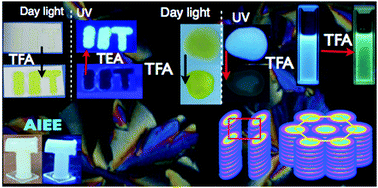
Multifunctional hexacatenar mesogen exhibiting supergelation, AIEE and its ability as a potential volatile acid sensor
DOI: 10.1039/C6TC03963D, Communication
Hexacatenar columnar liquid crystal exhibiting gelation, AIEE and acid sensing behavior.
The content of this RSS Feed (c) The Royal Society of Chemistry
Use of Bromine and Bromo-Organic Compounds in Organic Synthesis
Pillar-Shaped Macrocyclic Hosts Pillar[n]arenes: New Key Players for Supramolecular Chemistry
A Dual-Responsive Bola-Type Supra-amphiphile Constructed from a Water-Soluble Calix[4]pyrrole and a Tetraphenylethene-Containing Pyridine Bis-N-oxide
Fabrication of fluorescent nanoparticles based on AIE luminogens (AIE dots) and their applications in bioimaging
DOI: 10.1039/C6MH00060F, Review Article
This review outlines the fabrication methods and bioimaging applications of the fluorescent nanoparticles based on AIE luminogens (AIE dots).
The content of this RSS Feed (c) The Royal Society of Chemistry
Triple-stimuli-responsive nanocontainers assembled by water-soluble pillar[5]arene-based pseudorotaxanes for controlled release
DOI: 10.1039/C6TB00459H, Paper
Working mechanism of triple-stimuli-responsive nanocontainers: alkaline, acid and Zn2+ stimuli can open the advanced supramolecular nanovalves.
The content of this RSS Feed (c) The Royal Society of Chemistry
Light- and Heat-Triggered Reversible Linear–Cyclic Topological Conversion of Telechelic Polymers with Anthryl End Groups
Improved in vivo tumor therapy via host-guest complexation
DOI: 10.1039/C5TB02611C, Paper
A decomposable and intracellular pH-responsive drug delivery system by immobilizing a water-soluble pillar[5]arene onto hollow mesoporous nanoparticles through host-guest complexation was successfully prepared and its application in controlled drug delivery in vitro and in vivo was also investigated.
The content of this RSS Feed (c) The Royal Society of Chemistry
A stable tetraphenylethene derivative: aggregation-induced emission, different crystalline polymorphs, and totally different mechanoluminescence properties
DOI: 10.1039/C6MH00025H, Communication
Two crystalline polymorphs of TMPE (Cp-form and Cc-form) exhibit totally different mechanoluminescence properties.
The content of this RSS Feed (c) The Royal Society of Chemistry
Temperature-dependent shape-responsive fluorescent nanospheres for image-guided drug delivery
DOI: 10.1039/C6TC00122J, Paper
Nanospheres work similar to Hoberman spheres that undergo significant temperature-induced shape changes revealing large pores (holes) through which drugs released.
The content of this RSS Feed (c) The Royal Society of Chemistry
Review on the Raman spectroscopy of different types of layered materials
DOI: 10.1039/C5NR07205K, Review Article
Raman spectroscopy continues to stimulate the explorations on different types of layered materials.
The content of this RSS Feed (c) The Royal Society of Chemistry
Nanochemistry and Nanomedicine for Nanoparticle-based Diagnostics and Therapy
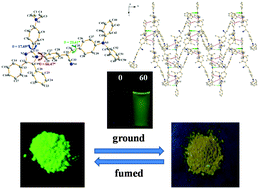
An ESIPT fluorophore with a switchable intramolecular hydrogen bond for applications in solid-state fluorochromism and white light generation
DOI: 10.1039/C5TC04290A, Paper
Acid/base-switched solid-state fluorochromism and excitation-wavelength-dependent fluorescence color tuning have been demonstrated using an ESIPT fluorophore with a switchable intramolecular hydrogen bond.
The content of this RSS Feed (c) The Royal Society of Chemistry
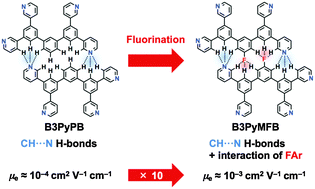
A series of fluorinated phenylpyridine-based electron-transporters for blue phosphorescent OLEDs
DOI: 10.1039/C5TC03879K, Paper
A series of fluorinated phenylpyridine-based electron-transport materials were developed and the influence of fluorine atom(s) on molecular orientation and mobility was investigated.
The content of this RSS Feed (c) The Royal Society of Chemistry
Supramolecularly assisted modulations in chromophoric properties and their possible applications: an overview
DOI: 10.1039/C5TC03321G, Review Article
Macrocyclic host assisted modulations in the fluorescence and acid-base properties of organic chromophoric dyes and their possible applications are reviewed comprehensively.
The content of this RSS Feed (c) The Royal Society of Chemistry
Phenothiazine and carbazole substituted pyrene based electroluminescent organic semiconductors for OLED devices
DOI: 10.1039/C5TC03690A, Paper
Two new solution processable pyrene based electroluminescent organic semiconductors (PY-PH & PY-CA) and their OLED performance reported.
The content of this RSS Feed (c) The Royal Society of Chemistry
Self-assembled micelles of PEG-poly(disulfide carbamate amine) copolymers for intracellular dual-responsive drug delivery
DOI: 10.1039/C5TB01770J, Paper
Self-assembled nanomicelles based on biodegradable poly(carbamate) copolymers are applicable for pH and redox dual-responsive release of doxorubicin (Dox) and cancer chemotherapy.
The content of this RSS Feed (c) The Royal Society of Chemistry
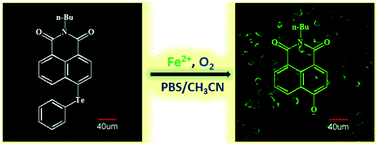
A turn-on fluorescent chemodosimeter based on detelluration for detecting ferrous iron (Fe2+) in living cells
DOI: 10.1039/C5TB02090E, Paper
A turn-on fluorescent probe with high selectivity is developed for imaging supplementary Fe2+ in living cells.
The content of this RSS Feed (c) The Royal Society of Chemistry
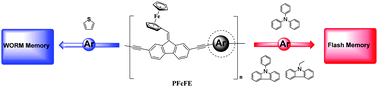
Ferrocene-containing poly(fluorenylethynylene)s for nonvolatile resistive memory devices
DOI: 10.1039/C5TC03042K, Paper
The memory behaviours of the prepared ferrocene-containing poly(fluorenylethynylene)s (PFcFE) can be easily tuned by changing the chemical structures of the embedded aromatic building blocks.
The content of this RSS Feed (c) The Royal Society of Chemistry
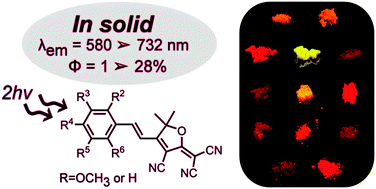
Solid state red biphotonic excited emission from small dipolar fluorophores
DOI: 10.1039/C5TC03465E, Paper
Dyes emitting in the solid state in the red or near-infrared range are much sought after for application in bioimaging especially if the long emission wavelength can be combined with two-photon excitation to provide unique contrast and penetration depth.
The content of this RSS Feed (c) The Royal Society of Chemistry
Aggregation-induced emission enhancement and mechanofluorochromic properties of [small alpha]-cyanostilbene functionalized tetraphenyl imidazole derivatives
DOI: 10.1039/C5TC03348A, Paper
Twisted tetraphenyl imidazole derivatives functionalized by [small alpha]-cyanostilbene possess aggregation-induced emission enhancement and mechanochromic luminescence properties.
The content of this RSS Feed (c) The Royal Society of Chemistry
The evolution of 'sol-gel' chemistry as a technique for materials synthesis
DOI: 10.1039/C5MH00260E, Review Article
Open Access
  This article is licensed under a Creative Commons Attribution 3.0 Unported Licence.
From its initial use to describe hydrolysis and condensation processes, the term 'sol-gel' is now used for a diverse range of chemistries.
The content of this RSS Feed (c) The Royal Society of Chemistry
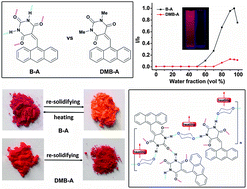
Enhanced AIE and different stimuli-responses in red fluorescent (1,3-dimethyl)barbituric acid-functionalized anthracenes
DOI: 10.1039/C5TC03629A, Paper
Two structurally simple and red light-emitting AIE luminogens, (1,3-dimethyl)barbituric acid-functionalized anthracenes (B-A and DMB-A), were designed and synthesized.
The content of this RSS Feed (c) The Royal Society of Chemistry
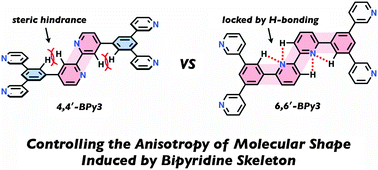
Synthesis, properties, and OLED characteristics of 2,2[prime or minute]-bipyridine-based electron-transport materials: the synergistic effect of molecular shape anisotropy and a weak hydrogen-bonding network on molecular orientation
DOI: 10.1039/C5TC03737A, Communication
We investigated the synergistic effect of molecular shape anisotropy and intermolecular hydrogen-bonds in the BPy derivatives on molecular orientation towards OLEDs.
The content of this RSS Feed (c) The Royal Society of Chemistry
Integration of aggregation-induced emission and delayed fluorescence into electronic donor-acceptor conjugates
DOI: 10.1039/C5TC03588K, Communication
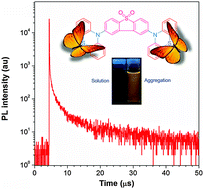
Aggregation-induced emission and delayed fluorescence are observed simultaneously for the luminogens with an electron-donor and acceptor framework.
The content of this RSS Feed (c) The Royal Society of Chemistry