14 Sep 11:02
by Amandine Cadiau, Ji Sun Lee, Daiane Damasceno Borges, Paul Fabry, Thomas Devic, Michael T. Wharmby, Charlotte Martineau, Damien Foucher, Francis Taulelle, Chul-Ho Jun, Young Kyu Hwang, Norbert Stock, Martijn F. De Lange, Freek Kapteijn, Jorge Gascon, Guillaume Maurin, Jong-San Chang, Christian Serre

On page 4775, J.-S. Chang, C. Serre, and co-workers design and synthesize a new scalable hydrophilic metal–organic framework material built up from a bio-renewable linker named MIL-160, showing outstanding water-sorption properties, as highlighted by a comparison with the benchmark of each family of porous solids envisaged so far for applications in adsorption-driven heat pumps and chillers.
11 Sep 17:35
Dalton Trans., 2015, Advance Article
DOI: 10.1039/C5DT02758F, Frontier
Christian Reus, Thomas Baumgartner
The last five years have seen a huge advance in organophosphorus chemistry with respect to compounds with strong chromic responses to external stimuli. This Frontier article briefly summarizes these trends in order to especially highlight the broad versatility of phosphole-based scaffolds in chromic materials.
To cite this article before page numbers are assigned, use the DOI form of citation above.
The content of this RSS Feed (c) The Royal Society of Chemistry

08 Sep 19:44
Chem. Commun., 2015, 51,14789-14792
DOI: 10.1039/C5CC05850C, Communication
Ganggang Chang, Bin Li, Hailong Wang, Zongbi Bao, Taner Yildirim, Zizhu Yao, Shengchang Xiang, Wei Zhou, Banglin Chen
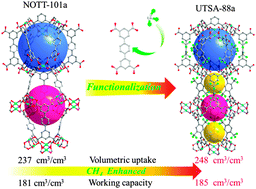
A novel NbO-type metal-organic framework UTSA-88a with polarized trifluoromethyl groups exhibits a notably high methane storage capacity of 248 cm3 (STP) cm-3 and a working capacity of 185 cm3 (STP) cm-3.
The content of this RSS Feed (c) The Royal Society of Chemistry

02 Sep 12:30
by Dominique Miesel, Alexander Hildebrandt, Marcus Korb, Dieter Schaarschmidt and Heinrich Lang

Organometallics
DOI: 10.1021/acs.organomet.5b00520

02 Sep 12:30
by Jiawei Chen, Didier A. Murillo Parra, Roger A. Lalancette and Frieder Jäkle

Organometallics
DOI: 10.1021/acs.organomet.5b00577

02 Sep 05:42
by Soonsang Hong, Md. Rumum Rohman, Jiangtao Jia, Youngkook Kim, Dohyun Moon, Yonghwi Kim, Young Ho Ko, Eunsung Lee, Kimoon Kim
Abstract
The porphyrin boxes (PB-1 and PB-2), which are rationally designed porous organic cages with a large cavity using well-defined and rigid 3-connected triangular and 4-connected square shaped building units are reported. PB-1 has a cavity as large as 1.95 nm in diameter and shows high chemical stability in a broad pH range (4.8 to 13) in aqueous media. The crystalline nature as well as cavity structure of the shape-persistent organic cage crystals were intact even after complete removal of guest molecules, leading to one of the highest surface areas (1370 m2g−1) among the known porous organic molecular solids. The size of the cavities and windows of the porous organic cages can be modulated using different sized building units while maintaining the topology of the cages, as illustrated with PB-2. Interestingly, PB-2 crystals showed unusual N2 sorption isotherms as well as high selectivity for CO2 over N2 and CH4 (201 and 47.9, respectively at 273 K at 1 bar).

Find a way: A new strategy for synthesis of shape-persistent organic cages based on porphyrins through rational design is reported. The size of cavities and windows of the organic cages can be modulated using different sized building units while maintaining the topology of the cages.
02 Sep 05:41
by Renhao Dong, Martin Pfeffermann, Haiwei Liang, Zhikun Zheng, Xiang Zhu, Jian Zhang, Xinliang Feng
Abstract
The rational construction of covalent or noncovalent organic two-dimensional nanosheets is a fascinating target because of their promising applications in electronics, membrane technology, catalysis, sensing, and energy technologies. Herein, a large-area (square millimeters) and free-standing 2D supramolecular polymer (2DSP) single-layer sheet (0.7–0.9 nm in thickness), comprising triphenylene-fused nickel bis(dithiolene) complexes has been readily prepared by using the Langmuir–Blodgett method. Such 2DSPs exhibit excellent electrocatalytic activities for hydrogen generation from water with a Tafel slope of 80.5 mV decade−1 and an overpotential of 333 mV at 10 mA cm−2, which are superior to that of recently reported carbon nanotube supported molecular catalysts and heteroatom-doped graphene catalysts. This work is promising for the development of novel free-standing organic 2D materials for energy technologies.

Standing up: The Langmuir–Blodgett method can be used to prepare two-dimensional supramolecular polymer (2DSP) sheets from nickel bis(dithiolene) complexes at the air–water interface (see figure). These free-standing single-layer sheets, which are 0.7–0.9 nm thick and square millimeters in area, showed excellent electrocatalytic activities in the hydrogen evolution reaction from water.
22 Aug 08:04
by Letian Dou, Yongsheng Liu, Ziruo Hong, Gang Li and Yang Yang

Chemical Reviews
DOI: 10.1021/acs.chemrev.5b00165

20 Aug 19:53
by Weigang Zhu, Renhui Zheng, Yonggang Zhen, Zhenyi Yu, Huanli Dong, Hongbing Fu, Qiang Shi and Wenping Hu

Journal of the American Chemical Society
DOI: 10.1021/jacs.5b05586

19 Aug 05:51
by M. Rajeswara Rao, Hayden T. Black and Dmitrii F. Perepichka

Organic Letters
DOI: 10.1021/acs.orglett.5b02009

18 Aug 06:16
by Mie Højer Larsen, K. N. Houk and A. Stephen K. Hashmi

Journal of the American Chemical Society
DOI: 10.1021/jacs.5b05773

17 Aug 18:03
by Michael Giese, Markus Albrecht and Kari Rissanen

Chemical Reviews
DOI: 10.1021/acs.chemrev.5b00156

15 Aug 20:36
Chem. Commun., 2015, 51,15035-15038
DOI: 10.1039/C5CC04753F, Communication
Prerna Joshi, Raman Vedarajan, Noriyoshi Matsumi
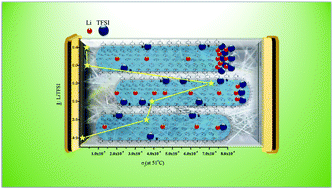
We report the synthesis of a crystalline cyclic organoboron compound that shows an anomalous Li-ion conduction behaviour with specific composition and method of insertion of a Li salt.
The content of this RSS Feed (c) The Royal Society of Chemistry

15 Aug 20:35
Chem. Commun., 2015, 51,14989-14991
DOI: 10.1039/C5CC06209H, Communication
Oliver T. Wilcox, Alexandra Fateeva, Alexandros P. Katsoulidis, Martin W. Smith, Corinne A. Stone, Matthew J. Rosseinsky
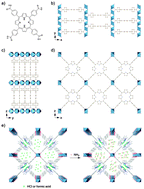
A porphyrin-based metal-organic framework is shown to be structurally stable towards acid loading using either hydrochloric or formic acid.
The content of this RSS Feed (c) The Royal Society of Chemistry

15 Aug 19:55
by Kan Takahashi, Shun Ito, Kosuke Nakamoto, Yasutomo Ito and Yoshihito Ueno

The Journal of Organic Chemistry
DOI: 10.1021/acs.joc.5b01132

14 Aug 20:39
Dalton Trans., 2015, Advance Article
DOI: 10.1039/C5DT01918D, Paper

Open Access
Robin J. Blagg, Elliot J. Lawrence, Katie Resner, Vasily S. Oganesyan, Thomas J. Herrington, Andrew E. Ashley, Gregory G. Wildgoose
Three B{C6H3(CF3)2}3 isomers have been studied, ortho-substituents quench FLP H2 cleavage via steric blocking and electron donation to the boron centre.
To cite this article before page numbers are assigned, use the DOI form of citation above.
The content of this RSS Feed (c) The Royal Society of Chemistry

14 Aug 20:38
Dalton Trans., 2015, 44,16052-16060
DOI: 10.1039/C5DT02356D, Paper
Rajneesh Misra, Thaksen Jadhav, Bhausaheb Dhokale, Shaikh M. Mobin
Two organoboron based fluorophores pyrazabole 3 and BODIPY 4 have been designed and synthesized by the Pd-catalyzed Sonogashira cross-coupling reaction and successfully employed for fluoride and cyanide ion sensing.
The content of this RSS Feed (c) The Royal Society of Chemistry

14 Aug 20:37
Chem. Sci., 2015, 6,6373-6378
DOI: 10.1039/C5SC02224J, Edge Article
Open Access
Masaki Yamamura, Daigo Hongo, Tatsuya Nabeshima
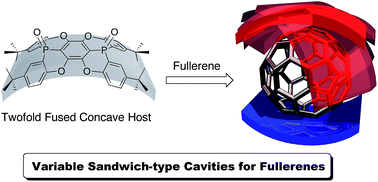
Concave host by fusion of two phosphorus atoms affords variable sandwich-type cavities for guest fullerene, C60 or C70.
The content of this RSS Feed (c) The Royal Society of Chemistry

14 Aug 20:36
Chem. Sci., 2015, 6,6468-6481
DOI: 10.1039/C5SC01830G, Edge Article
Open Access
Julien B. Kelber, Naitik A. Panjwani, Di Wu, Rafael Gomez-Bombarelli, Brendon W. Lovett, John J. L. Morton, Harry L. Anderson
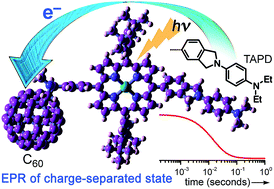
The powerful electron donor tetraalkylphenylenediamine (TAPD) facilitates photo-induced electron transfer, even in a frozen solvent at 10 K, generating a long-lived spin-polarized charge separate state which can be observed by EPR.
The content of this RSS Feed (c) The Royal Society of Chemistry

14 Aug 20:33
by Fang Ge, Gerald Kehr, Constantin G. Daniliuc, Christian Mück-Lichtenfeld and Gerhard Erker

Organometallics
DOI: 10.1021/acs.organomet.5b00668

14 Aug 15:37
by Kai Landskron
Abstract
Herein, the concept of macrocyclic weakly coordinating anions (M-WCAs) is introduced. Synthetic methodologies are described how to access M-WCAs by thermodynamically controlled self-assembly in high yields, in particular through condensation and alkyne metathesis reactions. The anticipated properties and applications of M-WCAs in solid state and in solution are discussed, specifically for gas storage and separation, homogeneous and heterogeneous catalysis, and as liquid and solid electrolytes.

A flavor of the weak: Macrocyclic weakly coordinating anions, synthesized by thermodynamically controlled self-assembly in high yields, are a fascinating new concept offering many new opportunities for electrolyte systems, catalysis, and gas storage and separation.
13 Aug 18:31
by Douglas W. Stephan

Journal of the American Chemical Society
DOI: 10.1021/jacs.5b06794

07 Aug 22:05
by Jaehyun Lee and Jongwook Park

Organic Letters
DOI: 10.1021/acs.orglett.5b01793

07 Aug 10:20
by Andreas Feldmann, Gerald Kehr, Constantin G. Daniliuc, Christian Mück-Lichtenfeld, Gerhard Erker
Abstract
The vicinal P/B frustrated Lewis pair (FLP) Mes2PCH2CH2B(C6F5)2 undergoes 1,1-carboboration reactions with the Me3Si-substituted enynes to give ring-enlarged functionalized C3-bridged P/B FLPs. These serve as active FLPs in the activation of dihydrogen to give the respective zwitterionic [P]H+/[B]H− products. One such product shows activity as a metal-free catalyst for the hydrogenation of enamines or a bulky imine. The ring-enlarged FLPs contain dienylborane functionalities that undergo “bora-Nazarov”-type ring-closing rearrangements upon photolysis. A DFT study had shown that the dienylborane cyclization of such systems itself is endothermic, but a subsequent C6F5 migration is very favorable. Furthermore, substituted 2,5-dihydroborole products are derived from cyclization and C6F5 migration from the photolysis reaction. In the case of the six-membered annulation product, a subsequent stereoisomerization reaction takes place and the resultant compound undergoes a P/B FLP 1,2-addition reaction with a terminal alkyne with rearrangement.

The vicinal P/B frustrated Lewis pair (FLP) Mes2PCH2CH2B(C6F5)2 undergoes 1,1-carboboration reactions with Me3Si-substituted enynes to give ring-enlarged functionalized C3-bridged P/B FLPs. These serve as active FLPs in the activation of dihydrogen to give the respective zwitterionic [P]H+/[B]H− products.
07 Aug 06:19
by En-Long Zhou, Chao Qin, Peng Huang, Xin-Long Wang, Wei-Chao Chen, Kui-Zhan Shao, Zhong-Min Su
Abstract
A stable metal–organic framework pillared by Keggin-type polyoxometalate, Cu6(Trz)10(H2O)4[H2SiW12O40]⋅8 H2O (Trz=1,2,4-triazole) (1), has been prepared under hydrothermal condition. The 2D layer structure with a 22-member ring was formed by Cu2+ ions, which are connected with each other via the Trz ligands on the ab plane. Thus, the 2D layers are further interconnected through Keggin polyoxoanions to generate a 3D porous network with a small 1D channel. Moreover, the presence of polyoxoanions make it exhibit selective adsorption of water and proton-conducting properties. Additionally it showed efficient intrinsic peroxidase-like activity, providing a simple and sensitive colorimetric assay to detect H2O2.

Squaring up: A highly stable polyoxometalate-pillared metal–organic framework, which has been prepared by a hydrothermal method (see figure), exhibits selective adsorption of water, proton-conducting properties, and efficient intrinsic peroxidase-like activity, providing a simple and sensitive colorimetric assay for the detection of H2O2.
07 Aug 06:12
Chem. Soc. Rev., 2015, 44,8484-8575
DOI: 10.1039/C5CS00424A, Review Article
Xiaolong Yang, Guijiang Zhou, Wai-Yeung Wong
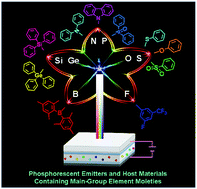
The crucial roles played by the non-metallic main group elements in tuning the properties of both hosts as well as phosphorescent emitters for high-performance phosphorescent OLEDs are highlighted.
The content of this RSS Feed (c) The Royal Society of Chemistry

03 Aug 12:55
Chem. Commun., 2015, 51,14513-14515
DOI: 10.1039/C5CC05368D, Communication
Holger Braunschweig, Ivo Krummenacher, Lisa Mailander, Florian Rauch
A route to novel O,N,B-containing eight-membered rings, which represent a new structural motif in heterocyclic chemistry, was developed by ring expansion of boroles with nitrones.
The content of this RSS Feed (c) The Royal Society of Chemistry

01 Aug 22:12
by Yuichiro Tokoro, Kengo Sugita, Shin-ichi Fukuzawa
Abstract
Ruthenium-catalyzed annulation of 1-naphthylsilanes with internal alkynes afforded silaphenalenes through cleavage of the C![[BOND]](http://onlinelibrarystatic.wiley.com/undisplayable_characters/00f8ff.gif) H bond at the 8-position of the naphthalene. [RuH2(CO){P(p-FC6H4)3}3] efficiently catalyzed the reaction. The use of 1-naphthyldiphenylsilane as a substrate resulted in a better yield of the annulation product compared to the use of silanes with alkyl groups on the silicon atom. Internal alkynes with both aryl and alkyl groups were tolerated in this reaction.
H bond at the 8-position of the naphthalene. [RuH2(CO){P(p-FC6H4)3}3] efficiently catalyzed the reaction. The use of 1-naphthyldiphenylsilane as a substrate resulted in a better yield of the annulation product compared to the use of silanes with alkyl groups on the silicon atom. Internal alkynes with both aryl and alkyl groups were tolerated in this reaction.

Annulation rather than hydrosilylation: A ruthenium catalyst favored annulation products rather than hydrosilylation products in the reaction of 1-naphthylsilanes and alkynes. The annulation proceeded with selective cleavage of the CH bond at the 8-position of naphthalene. Substrate scope revealed that substituents on the silicon atom played a crucial role and the phenyl group helped to increase the yields.
01 Aug 22:10
by Sebastian Scholz, Denis Kondakov, Björn Lüssem and Karl Leo

Chemical Reviews
DOI: 10.1021/cr400704v

01 Aug 22:09
by Di Wu, Zhao Chen, Yufeng Zhang, Jing Zhang, Sheng Hua Liu and Jun Yin

The Journal of Organic Chemistry
DOI: 10.1021/acs.joc.5b01341