13 Aug 18:38
by Soji Shimizu , Ai Murayama, Takuya Haruyama, Taku Iino, Shigeki Mori, Hiroyuki Furuta , Nagao Kobayashi
Abstract
A series of symmetric and asymmetric benzo[c,d]indole-containing aza boron dipyrromethene (aza-BODIPY) compounds was synthesized by a titanium tetrachloride-mediated Schiff-base formation reaction of commercially available benzo[c,d]indole-2(1H)-one and heteroaromatic amines. These aza-BODIPY analogues show different electronic structures from those of regular aza-BODIPYs, with hypsochromic shifts of the main absorption compared to their BODIPY counterparts. In addition to the intense fluorescence in solution, asymmetric compounds exhibited solid-state fluorescence due to significant contribution of the vibronic bands to both absorption and fluorescence as well as reduced fluorescence quenching in the aggregates. Finally, aggregation-induced emission enhancement, which is rare in BODIPY chromophores, was achieved by introducing a nonconjugated moiety into the core structure.

Old dyes with new tricks: A series of symmetric and asymmetric benzo[c,d]indole-containing aza-BODIPY dyes were synthesized. In addition to the hypsochromic shift of absorption and fluorescence compared to their BODIPY counterparts, solid-state fluorescence through asymmetrization and aggregation-induced emission enhancement through introduction of a nonconjugated moiety into the core structure were achieved (see figure).
haozi and -1 others like this
07 Aug 06:18
by Paul Aillard, Pascal Retailleau, Arnaud Voituriez, Angela Marinetti
Abstract
This paper reports on the development of an efficient synthesis of enantiopure phospha[6]helicenes through a [2+2+2] alkyne cyclotrimerization reaction. The corresponding gold complexes proved to be highly efficient both in terms of catalytic activity and enantioselectivity in [2+2] and [4+2] cycloaddition reactions. Furthermore, in the presence of an external nucleophile, such as water or alcohols, the tandem cyclization/addition reactions take place in high yields and excellent diastereo- and enantioselectivities.

Enantiopure phospha[6]helicenes are easily synthesized through a [2+2+2] alkyne cyclotrimerization reaction. The corresponding gold complexes proved to be highly efficient both in terms of catalytic activity and enantioselectivity in [2+2], [4+2] cycloadditions and tandem cyclization/addition reactions.
06 Aug 21:09
Chem. Commun., 2015, 51,13313-13316
DOI: 10.1039/C5CC04928H, Communication
Gerard Tobin, Steve Comby, Nianyong Zhu, Rodolphe Clerac, Thorfinnur Gunnlaugsson, Wolfgang Schmitt
The structure-type of a Ho(III)-based MOF can be varied using a range of different lanthanide ions to tune the photophysical properties and produce ligand-sensitised near-infrared and visible light emitters.
The content of this RSS Feed (c) The Royal Society of Chemistry

06 Aug 21:08
Chem. Commun., 2015, 51,14844-14847
DOI: 10.1039/C5CC05427C, Communication
Philipp Biegger, Manuel Schaffroth, Kerstin Brodner, Olena Tverskoy, Frank Rominger, Uwe H. F. Bunz
Reduction of bis(benzothiadiazole) by LiAlH4/CuI gives diethynylated diaminobenzoquinoneimine. This building block accesses novel targets in a one-step condensation reaction with different orthoquinones, resulting in unexpected rearrangement products. The compounds are characterized by their photophysical and electrochemical data as well as quantum chemical calculations.
The content of this RSS Feed (c) The Royal Society of Chemistry

24 Jul 13:10
by Qingkai Qi, Jingyu Qian, Xiao Tan, Jibo Zhang, Lijuan Wang, Bin Xu, Bo Zou, Wenjing Tian

Turn-on and color-tuned piezochromic luminescence of acridonyl-tetraphenylethene(AD-TPE) with high-contrast is obtained by B. Xu, W. Tian, and colleagues in response to external mechanical stimuli. The results on page 4005 indicate that the unique behavior is driven by a switching of the excited state in solid state from localized excited (LE) state to intramolecular charge transfer (ICT) state under mechanical stimuli, which will inspire a new approach to realize the piezochromic luminescent materials and give a new insight into the nature of the piezochromic behavior.
22 Jul 15:26
by Minghua Liu, Li Zhang and Tianyu Wang

Chemical Reviews
DOI: 10.1021/cr500671p

22 Jul 15:23
by Viorel Cîrcu, Yann Molard, Maria Amela-Cortes, Ahmed Bentaleb, Philippe Barois, Vincent Dorcet, Stéphane Cordier
Abstract
New clustomesogens (i.e., metal atom clusters containing liquid crystalline (LC) materials) have been obtained by grafting neutral cyanobiphenyl (CB)- or cholesteryl-containing tailor-made dendritic mesomorphic triphenylphosphine oxide ligands on luminescent (M6Cli8)4+ octahedral cluster cores (M=Mo, W). The LC properties were studied by a combination of polarizing optical microscopy (POM), differential scanning calorimetry (DSC), and X-ray powder diffraction analyses. While the organic ligands showed various mesophase types ranging from nematic, SmA columnar (SmACol), SmA, and SmC phases, it turned out that the corresponding clustomesogens formed layered phases (SmA) over a wide range of temperatures that depend on the nature and density of mesogenic groups employed. Intrinsic luminescence properties of the cluster precursors are preserved over the entire range of LC phase existence.

Clustomesogens are metal atom clusters containing liquid crystalline materials. They have been obtained by grafting neutral cyanobiphenyl- or cholesteryl-containing tailor-made dendritic mesomorphic triphenylphosphine oxide ligands on luminescent (M6Cli8)4+ octahedral cluster cores (M=Mo, W).
21 Jul 10:15
Dalton Trans., 2015, 44,13947-13954
DOI: 10.1039/C5DT01339A, Paper
Pranila B. Thale, Pravin N. Borase, Ganapati S. Shankarling
Novel boron fluorine complex molecules were designed and synthesized using the maleimide core moiety.
The content of this RSS Feed (c) The Royal Society of Chemistry

21 Jul 10:15
Dalton Trans., 2015, 44,14063-14070
DOI: 10.1039/C5DT01525A, Paper
Shuwen Gong, Qingsong Liu, Xiaoqing Wang, Bo Xia, Zhipeng Liu, Weijiang He
Four benzothiazole-ketoiminate-based organoboron complexes were demonstrated to show aggregation-induced emission, a large Stokes shift and high quantum yield in the solid-state, which were rationalized through X-ray crystal analysis, and electronic structure calculations.
The content of this RSS Feed (c) The Royal Society of Chemistry

14 Jul 06:52
by Vivian Wing-Wah Yam, Vonika Ka-Man Au and Sammual Yu-Lut Leung

Chemical Reviews
DOI: 10.1021/acs.chemrev.5b00074

14 Jul 06:52
by Lydia C. Gilday, Sean W. Robinson, Timothy A. Barendt, Matthew J. Langton, Benjamin R. Mullaney and Paul D. Beer

Chemical Reviews
DOI: 10.1021/cr500674c

13 Jul 18:06
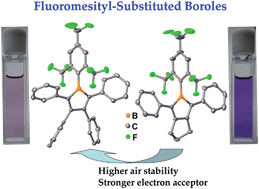
Chem. Sci., 2015, 6,5922-5927
DOI: 10.1039/C5SC02205C, Edge Article

Open Access
Zuolun Zhang, Robert M. Edkins, Martin Haehnel, Marius Wehner, Antonius Eichhorn, Lisa Mailander, Michael Meier, Johannes Brand, Franziska Brede, Klaus Muller-Buschbaum, Holger Braunschweig, Todd B. Marder
Boroles with a fluoromesityl group on the B atom have greatly improved air stability compared to their mesityl analogues.
The content of this RSS Feed (c) The Royal Society of Chemistry

09 Jul 10:52
Chem. Soc. Rev., 2015, 44,7128-7154
DOI: 10.1039/C5CS00292C, Review Article
N. Rangnekar, N. Mittal, B. Elyassi, J. Caro, M. Tsapatsis
The latest developments in zeolite and MOF membranes are reviewed, with an emphasis on synthesis techniques. Industrial applications, hydrothermal stability, polymer-supported and mixed matrix membranes are some of the aspects discussed.
The content of this RSS Feed (c) The Royal Society of Chemistry

06 Jul 21:42
by Zhengsong Hu, Zongyang Li, Kang Zhao, Rongqiang Tian, Zheng Duan and François Mathey

Organic Letters
DOI: 10.1021/acs.orglett.5b01604

28 Jun 14:31
by Martin Quernheim, Florian E. Golling, Wen Zhang, Manfred Wagner, Hans-Joachim Räder, Tomohiko Nishiuchi, Klaus Müllen
Abstract
The longitudinal extension of cycloparaphenylenes (CPP) towards ultrashort carbon nanotubes (CNTs) is essential for the solution based bottom-up synthesis of CNTs. Herein, the longitudinal extension of the CPP skeleton by the introduction of hexaphenylbenzene units towards polyarylated [n]CPPs is described. Further, the applicability of the Scholl reaction to selectively form graphenic sidewalls is demonstrated. The ring size and substitution patterns of the polyarylated [n]CPPs were varied to overcome strain-induced side reactions during the oxidative cyclodehydrogenation and cyclic para-hexa-peri-hexabenzocoronene trimers ([3]CHBCs) were selectively obtained. This concept is envisioned as an access to ultrashort carbon nanotubes subject to the condition that further benzene rings with the right connectivity will be inserted.

All that it′s cutout to be: Polyarylated [n]cycloparaphenylenes are intermediates on the way to ultra-short carbon nanotubes (CNT). Different polyarylated [n]CPPs can be prepared and their oxidative cyclodehydrogenation leads to CPPs that are cutouts from CNTs.
28 Jun 14:30
by Pangkuan Chen, Xiaodong Yin, Nurcan Baser-Kirazli, Frieder Jäkle
Abstract
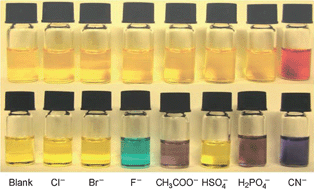
A facile and versatile approach was developed to access ambipolar boron-containing macrocycles. Two examples of new conjugated cyclic motifs are presented with carbazole moieties as donors and borane moieties as acceptors embedded into the ring system. They were first predicted using computational methods. Possible targets with appropriately shaped π-conjugated bridges that minimize the overall ring strain were identified and their geometry was optimized by DFT methods. The synthetic demonstration was then accomplished using organometallic condensation reactions under high dilution conditions. The resulting monodisperse macrocycles provide important insights into the design principles necessary for the preparation of new unstrained macrocycles with interesting optical and electronic characteristics. The current research also offers a more general approach to conjugated ambipolar B/N macrocycles as a promising new family of (opto)electronic materials.

Changing shapes: Guided by theoretical calculations, the conjugated fluorene bridges or the borane moieties in a strained tetramer are partially replaced with carbazoles, resulting in hybrid macrocycles with new shapes and sizes. These macrocycles are ambipolar and show interesting emission characteristics and anion response, including anion-triggered geometry changes.
23 Jun 05:45
Chem. Soc. Rev., 2015, 44,4212-4227
DOI: 10.1039/C4CS00179F, Tutorial Review
Philip A. Gale, Claudia Caltagirone
This Tutorial Review provides a short survey of anion sensing by small molecule anion receptors, molecular ensembles and chemodosimeters.
The content of this RSS Feed (c) The Royal Society of Chemistry

23 Jun 05:45
Chem. Soc. Rev., 2015, 44,4185-4191
DOI: 10.1039/C4CS00280F, Highlight
Min Hee Lee, Jong Seung Kim, Jonathan L. Sessler
Quantitative determination of specific analytes is essential for a variety of applications ranging from life sciences to environmental monitoring.
The content of this RSS Feed (c) The Royal Society of Chemistry

20 Jun 16:42
by Hui Chen, Yu Feng, Guo-Jun Deng, Zhi-Xiong Liu, Yan-Mei He, Qing-Hua Fan
Abstract
A new highly efficient and versatile poly(benzyl ether) dendritic organogelator HPB-G1 with 2-(2′-hydroxyphenyl)benzoxazole (HPB) at the focal point has been designed and synthesized. HPB-G1 can form stable organogels toward various apolar and polar organic solvents. Further studies revealed that intermolecular multiple π–π stacking interactions are the main driving forces for the formation of the organogels. Notably, dendron HPB-G1 exhibited a significantly enhanced emission in the gel state in contrast to weak emission in solution. Most interestingly, these dendritic organogels exhibited multiple stimuli-responsive behaviors upon exposure to environmental stimuli, including temperature, sonication, shear stress, and the presence of anions, metal cations, acids/bases, thus leading to reversible sol–gel phase transitions.

Smart fluorescence: A highly efficient and versatile dendron with 2-(2′-hydroxyphenyl)benzoxazole at the core that can form stable organogels with various apolar and polar organic solvents has been developed. These fluorescent dendritic organogels exhibit gelation-induced enhanced fluorescence emission and multiple stimuli-responsive behaviors (see figure).
19 Jun 17:14
by Juncong Jiang and Omar M. Yaghi

Chemical Reviews
DOI: 10.1021/acs.chemrev.5b00221

19 Jun 17:14
by Weikang Xiao, Zhiqun He, Sonia Remiro-Buenamañana, Rebecca J. Turner, Min Xu, Xiao Yang, Xiping Jing and Andrew N. Cammidge

Organic Letters
DOI: 10.1021/acs.orglett.5b01444

hailul and -1 others like this
18 Jun 18:24
by William A. Maza, Roberto Padilla and Amanda J. Morris

Journal of the American Chemical Society
DOI: 10.1021/jacs.5b03071

16 Jun 22:11
by Kang-Da Zhang, Stefan Matile
Abstract
Multicomponent surface architectures are introduced that operate with three different dynamic covalent bonds. Disulfide exchange under basic conditions accounts for the growth of π stacks on solid surfaces. Hydrazone exchange under acidic conditions is used to add a second coaxial string or stack, and boronic ester exchange under neutral conditions is used to co-align a third one. The newly introduced boronic ester exchange chemistry is compatible with stack and string exchange without interference from the orthogonal hydrazone and disulfide exchange. The functional relevance of surface architectures with three different dynamic covalent bonds is exemplified with the detection of polyphenol natural products, such as epigallocatechin gallate, in competition experiments with alizarin red. These results describe synthetic strategies to create functional systems of unprecedented sophistication with regard to dynamic covalent chemistry.

Designer architectures: Disulfide exchange under basic conditions, hydrazone exchange under acidic conditions, and boronic ester exchange at neutral pH values are combined to build multicomponent functional surface architectures using dynamic covalent chemistry. TSA/TSR=templated stack addition/release.
15 Jun 06:55
by Leen E. E. Broeckx, Alberto Bucci, Cristiano Zuccaccia, Martin Lutz, Alceo Macchioni and Christian Müller

Organometallics
DOI: 10.1021/acs.organomet.5b00281

13 Jun 21:19
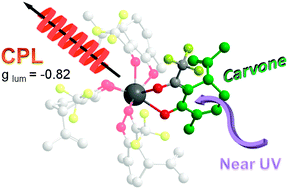
Chem. Commun., 2015, 51,11903-11906
DOI: 10.1039/C5CC04283F, Communication
Francesco Zinna, Claudio Resta, Sergio Abbate, Ettore Castiglioni, Giovanna Longhi, Placido Mineo, Lorenzo Di Bari
A diketonate based on carvone provides a chiral Eu complex with high circularly polarized luminescence in the solid state.
The content of this RSS Feed (c) The Royal Society of Chemistry

13 Jun 06:59
by Kuangda Lu, Chunbai He and Wenbin Lin

Journal of the American Chemical Society
DOI: 10.1021/jacs.5b04069

12 Jun 20:57
by Xiao-Ye Wang, Akimitsu Narita, Xinliang Feng and Klaus Müllen

Journal of the American Chemical Society
DOI: 10.1021/jacs.5b05056

12 Jun 06:17
by Susana Ibáñez, Antonio Guerrero, Macarena Poyatos, Eduardo Peris
Abstract
A rational synthetic procedure for the preparation of a series of pyrene-based neutral and dicationic bis-azole compounds is reported. The method allows the tailored design of pyrene-based azoles with different substituents at the nitrogen atoms of the heterocycles, for which the relative conformation of the resulting bis-azoles can be easily controlled. The bis-azoliums were used for the preparation of the related diplatinum complexes by reaction with [{Pt(ppy)(μ-Cl)2}2] (ppy=2-phenylpyridinate). The X-ray molecular structure of one of the resulting compounds, a diplatinum(II) bis(N-heterocyclic carbene) complex, is described. Studies on the photophysical properties of all new species are described. The emission of the bis-azole-based compounds seems to be independent of their substitution patterns, which basically indicates that physical properties such as solubility, melting point, and viscosity can be fine-tuned while maintaining the luminescence properties. Finally, the energies associated with the HOMO and LUMO levels suggest that this family provides versatility to match the energy levels of a wide range of host materials, which is important for the preparation of organic light-emitting devices.

Tailored azoles: A series of pyrene-based neutral and dicationic bis-azolium compounds with different substitution patterns was obtained. The bis-azolium compounds were used for the preparation of PtII complexes bearing the 2-phenylpyridinate ligand. The photophysical properties of all of the resulting compounds were evaluated; they show a wide range of HOMO and LUMO levels (see figure) suitable for matching with various host materials.
11 Jun 18:53
by Oliver Langmar, Carolina R. Ganivet, Annkatrin Lennert, Rubén D. Costa, Gema de la Torre, Tomás Torres, Dirk M. Guldi
Abstract
A route is reported for the synthesis of two electron-accepting phthalocyanines featuring linkers with different lengths as sensitizers for p-type dye-sensitized solar cells (DSSCs). Importantly, our devices based on novel nanorod-like CuO photocathodes showed high efficiencies of up to 0.191 %: the highest value reported to date for CuO-based DSSCs.

The longer the better: Novel electron-accepting zinc phthalocyanines with different linker lengths performed well in combination with nanorod-like CuO electrodes in p-type dye-sensitized solar cells. A particularly high efficiency of 0.191 % was observed with a photosensitizer containing a carboxyethynyl anchor (see picture; R is a branched alkyl group).
10 Jun 16:36
Dalton Trans., 2015, 44,10914-10917
DOI: 10.1039/C4DT02445A, Communication
Rong-Mei Wen, Song-De Han, Guo-Jian Ren, Ze Chang, Yun-Wu Li, Xian-He Bu
A new 3D luminescence LnMOF was synthesized using a tripodal flexible zwitterion ligand which takes a chair-shaped configuration. The compound displays highly selective luminescence sensing of the Fe3+ ion and nitrobenzene.
The content of this RSS Feed (c) The Royal Society of Chemistry