10 Nov 11:14
Chem. Soc. Rev., 2015, Advance Article
DOI: 10.1039/C5CS00543D, Review Article
Vikas S. Padalkar, Shu Seki
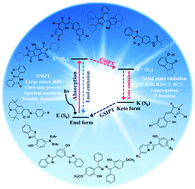
The state-of-the-art of ESIPT-inspired solid state emitters and their photophysical properties and applications in recent 5 years were systematically reviewed.
To cite this article before page numbers are assigned, use the DOI form of citation above.
The content of this RSS Feed (c) The Royal Society of Chemistry

10 Nov 07:12
Chem. Commun., 2015, Advance Article
DOI: 10.1039/C5CC08853D, Communication
Qitao Tan, Huanhuan Chen, Huaida Xia, Bingxin Liu, Bin Xu
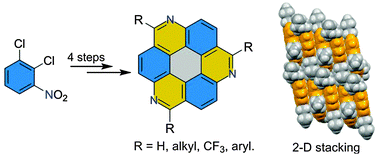
The parent 1,5,9-triazacoronene and its derivatives bearing various substituents were concisely synthesized, which are promising candidates for emissive and electron-transport materials.
To cite this article before page numbers are assigned, use the DOI form of citation above.
The content of this RSS Feed (c) The Royal Society of Chemistry

09 Nov 22:24
Chem. Soc. Rev., 2016, 45,922-953
DOI: 10.1039/C5CS00725A, Review Article
Andrew M. Priegert, Benjamin W. Rawe, Spencer C. Serin, Derek P. Gates
A survey of the state-of-the-art in the development of synthetic methods to incorporate p-block elements into polymers is given.
The content of this RSS Feed (c) The Royal Society of Chemistry

06 Nov 11:31
by Hai-Tao Feng, Jia-Bin Xiong, Yan-Song Zheng, Biao Pan, Chun Zhang, Lei Wang and Yongshu Xie

Chemistry of Materials
DOI: 10.1021/acs.chemmater.5b03765

06 Nov 11:30
Dalton Trans., 2016, 45,6032-6043
DOI: 10.1039/C5DT03854E, Paper

Open Access
Robin J. Blagg, Trevor R. Simmons, Georgina R. Hatton, James M. Courtney, Elliot L. Bennett, Elliot J. Lawrence, Gregory G. Wildgoose
Nine homo- and hetero-tri(aryl)boranes related by stepwise aryl substitutions, are studied for H2 cleavage as part of an FLP, and comparative Lewis acidity/electrochemical measurements discussed.
The content of this RSS Feed (c) The Royal Society of Chemistry

06 Nov 11:29
by Martin Pfeffermann, Renhao Dong, Robert Graf, Wojciech Zajaczkowski, Tatiana Gorelik, Wojciech Pisula, Akimitsu Narita, Klaus Müllen and Xinliang Feng

Journal of the American Chemical Society
DOI: 10.1021/jacs.5b09638

03 Nov 22:41
Dalton Trans., 2016, 45,4218-4223
DOI: 10.1039/C5DT03466C, Paper
Tao Song, Jiancan Yu, Yuanjing Cui, Yu Yang, Guodong Qian
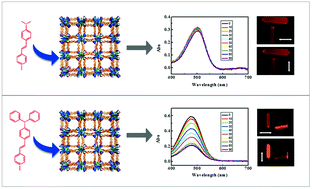
Two series of cationic dyes have been encapsulated in the 1D channel of MOFs, and the tunable second order nonlinear optical properties of these MOF[superset]dye materials were observed.
The content of this RSS Feed (c) The Royal Society of Chemistry

02 Nov 22:49
by Ju Mei, Nelson L. C. Leung, Ryan T. K. Kwok, Jacky W. Y. Lam and Ben Zhong Tang

Chemical Reviews
DOI: 10.1021/acs.chemrev.5b00263

31 Oct 09:41
by Alexander Szentkuti, Jai Anand Garg, Olivier Blacque and Koushik Venkatesan

Inorganic Chemistry
DOI: 10.1021/acs.inorgchem.5b01762

30 Oct 16:41
Chem. Commun., 2015, Advance Article
DOI: 10.1039/C5CC08168H, Communication
Hai-Yang Li, Hong Xu, Shuang-Quan Zang, Thomas C. W. Mak
A novel crystalline Europium-organic framework (Eu-MOF) incorporates chirality and viologen, thereby combining photochromism, photo-modulated luminescence, photoswitchable NLO and piezoelectric properties.
To cite this article before page numbers are assigned, use the DOI form of citation above.
The content of this RSS Feed (c) The Royal Society of Chemistry

30 Oct 16:39
Dalton Trans., 2015, Accepted Manuscript
DOI: 10.1039/C5DT03591K, Paper
Julien Rodriguez, Isabelle Beurroies, Marie-Vanessa Coulet, Paul Fabry, Thomas Devic, Christian Serre, Renaud Denoyel, Philip L. Llewellyn
A thermodynamic study of the structural large-pore (LP) to narrow pores (NP) transition in various Metal Organic Frameworks (MOFs) is presented. First, the pressure induced transition at constant temperature is...
The content of this RSS Feed (c) The Royal Society of Chemistry

30 Oct 16:38
Dalton Trans., 2015, Accepted Manuscript
DOI: 10.1039/C5DT03854E, Paper
Open Access
Robin Joseph Blagg, Trevor R. Simmons, Georgina R. Hatton, James M. Courtney, Elliot L. Bennett, Elliot J Lawrence, Gregory G Wildgoose
A series of homo- and hetero-tri(aryl)boranes incorporating pentafluorophenyl, 3,5-bis(trifluoromethyl)phenyl, and pentachlorophenyl groups, four of which are novel species, have been studied as the acidic component of frustrated Lewis pairs for...
The content of this RSS Feed (c) The Royal Society of Chemistry

30 Oct 08:14
by Dennis L. Ashford, Melissa K. Gish, Aaron K. Vannucci, M. Kyle Brennaman, Joseph L. Templeton, John M. Papanikolas and Thomas J. Meyer

Chemical Reviews
DOI: 10.1021/acs.chemrev.5b00229

29 Oct 16:05
by Daniel H. Friese, Alexander Mikhaylov, Maciej Krzeszewski, Yevgen M. Poronik, Aleksander Rebane, Kenneth Ruud, Daniel T. Gryko
Abstract
A combined experimental and theoretical study of the two-photon absorption (2PA) properties of a series of quadrupolar molecules possessing a highly electron-rich heterocyclic core, pyrrolo[3,2-b]pyrrole, is presented. In agreement with quantum-chemical calculations, large 2PA cross-section values, σ2PA≈102–103 GM (1 GM=1050 cm4 s photon−1), are observed at wavelengths of 650–700 nm, which correspond to the two-photon allowed but one-photon forbidden transitions. The calculations also predict that increased planarity of this molecule through removal of two N-substituents leads to further increase in the σ2PA values. Surprisingly, the most quadrupolar pyrrolo[3,2-b]pyrrole derivative, containing two 4-nitrophenyl substituents at positions 2 and 5, demonstrates a very strong solvatofluorochromic effect, with a fluorescence quantum yield as high as 0.96 in cyclohexane, whereas the fluorescence vanishes in DMSO.

Nitro can shine: The strongly electron-donating character of pyrrolo[3,2-b]pyrroles, combined with the quadrupolar nature of derivatives, makes it possible to maximize two-photon absorption (S0-S3 or S0-S5 transitions) at λ≤700 nm, while maintaining reasonable values of cross-section. Unprecedented solvatofluorochromism of the 2,5-bis(4-nitrophenyl) derivative has no parallel among known dyes (see figure).
29 Oct 06:18
by Lena Hahn, Friedrich Maaß, Tim Bleith, Ute Zschieschang, Hubert Wadepohl, Hagen Klauk, Petra Tegeder, Lutz H. Gade
Abstract
A detailed study on the effects of core halogenation of tetraazaperopyrene (TAPP) derivatives is presented. Its impact on the solid structure, as well as the photophysical and electrochemical properties, has been probed by the means of X-ray crystallography, UV/Vis and fluorescence spectroscopy, high-resolution electron energy loss spectroscopy (HREELS), cyclic voltammetry (CV), and DFT modeling. The aim was to assess the potential of this approach as a construction principle for organic electron-conducting materials of the type studied in this work. Although halogenation leads to a stabilization of the LUMOs compared to the unsubstituted parent compound, the nature of the halide barely affects the LUMO energy while strongly influencing the HOMO energies. In terms of band-gap engineering, it was demonstrated that the HOMO–LUMO gap is decreased by substitution of the TAPP core with halides, the effect being found to be most pronounced for the iodinated derivative. The performance of the recently reported core-fluorinated and core-iodinated TAPP derivatives in organic thin-film transistors (TFTs) was investigated on both a glass substrate, as well as on a flexible plastic substrate (PEN). Field-effect mobilities of up to 0.17 cm2 Vs−1 and on/off current ratio of >106 were established.

A detailed study on the effects of core halogenation of tetraazaperopyrene (TAPP) derivatives is presented. Its impact on the solid structure, as well as the photophysical and electrochemical properties, has been probed by the means of X-ray crystallography, UV/Vis and fluorescence spectroscopy, high-resolution electron energy loss spectroscopy, cyclic voltammetry, and DFT modeling (see scheme).
28 Oct 20:16
Chem. Commun., 2015, 51,17627-17629
DOI: 10.1039/C5CC08421K, Communication
Liwei Yan, Linghong Shen, Mingqian Lv, Wenkun Yu, Jie Chen, Shuang Wang, Xiaofang Fu, Zhongbin Ye
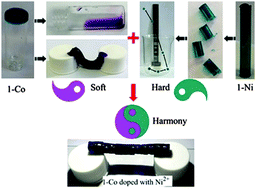
Supramolecular heterometallic gels with synergistic properties were prepared for the first time using ligand 1 with both Co2+ and Ni2+, and their macroscopic self-healing has been achieved by improving the unfavorable viscoelasticity of each monometallic gel.
The content of this RSS Feed (c) The Royal Society of Chemistry

28 Oct 20:16
Chem. Commun., 2015, Accepted Manuscript
DOI: 10.1039/C5CC08213G, Feature Article
P Thilagar, Sanjoy Mukherjee
In recent times, luminescent materials with tunable emission properties have found applications in almost all aspects of modern material sciences. Any discussions on the recent developments of luminescent materials would...
The content of this RSS Feed (c) The Royal Society of Chemistry

24 Oct 01:16
by Atsushi Nakagawa, Eri Sakuda, Akitaka Ito and Noboru Kitamura

Inorganic Chemistry
DOI: 10.1021/acs.inorgchem.5b01626

22 Oct 19:33
by Chunli Li, Longlong Wu, Wan Xu, Jinsheng Song, Jianwu Shi, Panpan Yu, Yuhe Kan and Hua Wang

The Journal of Organic Chemistry
DOI: 10.1021/acs.joc.5b01910

22 Oct 19:32
by Yosuke Niko, Shunsuke Sasaki, Kaishi Narushima, Dharmendar Kumar Sharma, Martin Vacha and Gen-ichi Konishi

The Journal of Organic Chemistry
DOI: 10.1021/acs.joc.5b01987

hailul and -1 others like this
22 Oct 15:47
by Alena S. Kalyakina, Valentina V. Utochnikova, Ivan S. Bushmarinov, Ivan V. Ananyev, Igor L. Eremenko, Daniel Volz, Franziska Rönicke, Ute Schepers, Rik Van Deun, Alexander L. Trigub, Yan V. Zubavichus, Natalia P. Kuzmina, Stefan Bräse
Abstract
Highly luminescent, photostable, and soluble lanthanide pentafluorobenzoates have been synthesized and thoroughly characterized, with a focus on EuIII and TbIII complexes as visible emitters and NdIII, ErIII, and YbIII complexes as infrared emitters. Investigation of the crystal structures of the complexes in powder form and as single crystals by using X-ray diffraction revealed five different structural types, including monomeric, dimeric, and polymeric. The local structure in different solutions was studied by using X-ray absorption spectroscopy. The photoluminescence quantum yields (PLQYs) of terbium and europium complexes were 39 and 15 %, respectively; the latter value was increased almost twice by using the heterometallic complex [Tb0.5Eu0.5(pfb)3(H2O)] (Hpfb=pentafluorobenzoic acid). Due to the effectively utilized sensitization strategy (pfb)−![[RIGHTWARDS ARROW]](http://onlinelibrarystatic.wiley.com/undisplayable_characters/002192.gif) TbEu, a pure europium luminescence with a PLQY of 29 % was achieved.
TbEu, a pure europium luminescence with a PLQY of 29 % was achieved.

Luminescent lanthanides: A series of highly luminescent, photostable, and soluble lanthanide pentafluorobenzoates have been synthesized and characterized, with a special focus on EuIII and TbIII complexes as visible emitters and NdIII, ErIII, and YbIII complexes as IR emitters (see figure). Powder and single-crystal X-ray diffraction data showed five different structural types, including monomeric, dimeric, and polymeric.
22 Oct 15:46
by Xinggui Gu, Hong Wang, Jesse Roose, Zikai He, Yue Zhou, Yongli Yan, Yuanjing Cai, Heping Shi, Yilin Zhang, Herman H. Y. Sung, Jacky W. Y. Lam, Qian Miao, Yongsheng Zhao, Kam Sing Wong, Ian D. Williams, Ben Zhong Tang
Abstract
We present a nitrogen-containing polycyclic aromatic hydrocarbon (N-PAH), namely 12-methoxy-9-(4-methoxyphenyl)-5,8-diphenyl-4-(pyridin-4-yl)pyreno[1,10,9-h,i,j]isoquinoline (c-TPE-ON), which exhibits high quantum-yield emission both in solution (blue) and in the solid state (yellow). This molecule was unexpectedly obtained by a three-fold, highly regioselective photocyclodehydrogenation of a tetraphenylethylene-derived AIEgen. Based on manifold approaches involving UV/Vis, photoluminescence, and NMR spectroscopy as well as HRMS, we propose a reasonable mechanism for the formation of the disk-like N-PAH that is supported by density functional theory calculations. In contrast to most PAHs that are commonly used, our system does not suffer from entire fluorescence quenching in the solid state due to the peripheral aromatic rings preventing π–π stacking interactions, as evidenced by single-crystal X-ray analysis. Moreover, its rod-like microcrystals exhibit excellent optical waveguide properties. Hence, c-TPE-ON comprises a N-PAH with unprecedented luminescent properties and as such is a promising candidate for fabricating organic optoelectronic devices. Our design and synthetic strategy might lead to a more general approach to the preparation of solution- and solid-state luminescent PAHs.

Unprecedented luminescence: A luminescent nitrogen-containing polycyclic aromatic hydrocarbon (N-PAH) has been synthesized from a vinylene-based AIEgen by a photocyclodehydrogenation reaction with unexpected regioselectivity. The N-PAH exhibits excellent optical properties both in solution and in the solid state (see figure).
22 Oct 15:45
by Anh Thy Bui, Alexei Grichine, Sophie Brasselet, Alain Duperray, Chantal Andraud, Olivier Maury
Abstract
An original samarium(III) complex based on a triazacyclononane platform functionalized with a charge-transfer antenna chromophore exhibited optimized brightness and was successfully used as an emissive species for two-photon microscopy experiments in both the visible and near-infrared spectral ranges.

Wide-range imaging: An original samarium(III) complex based on a triazacyclononane platform functionalized with a charge-transfer antenna chromophore exhibits optimized brightness and can be successfully used as an emissive species for two-photon microscopy experiments in both the visible and near-infrared (NIR) spectral ranges (see figure).
22 Oct 08:20
by Shumao Cui
Article
Phosphorene is one of a growing number of 2D materials with high potential for device applications. Here, the authors report a sensor composed of phosphorene nanosheets, showing a high sensitivity to NO 2 in dry air and also demonstrate that the sensitivity depends on the nanosheet thickness.
Nature Communications doi: 10.1038/ncomms9632
Authors: Shumao Cui, Haihui Pu, Spencer A. Wells, Zhenhai Wen, Shun Mao, Jingbo Chang, Mark C. Hersam, Junhong Chen

21 Oct 08:22
by Wei-long Dong, Lin Wang, Hui-min Ding, Lu Zhao, Dong Wang, Cheng Wang and Li-Jun Wan

Langmuir
DOI: 10.1021/acs.langmuir.5b02412

21 Oct 06:06
by Tobias Wöhrle, Iris Wurzbach, Jochen Kirres, Antonia Kostidou, Nadia Kapernaum, Juri Litterscheidt, Johannes Christian Haenle, Peter Staffeld, Angelika Baro, Frank Giesselmann and Sabine Laschat

Chemical Reviews
DOI: 10.1021/acs.chemrev.5b00190

21 Oct 06:05
by Jian-Shen Feng , Song-Song Bao, Min Ren, Zhong-Sheng Cai, Li-Min Zheng
Abstract
Two pairs of enantiomeric compounds with formulas (S)- or (R)-Co3(ppap)2(4,4′-bpy)2(H2O)2⋅4 H2O [(S)-1 or (R)-1], (S)- or (R)-Co3(ppap)2(4,4′-bpy)2(H2O)2⋅3 H2O [(S)- or (R)-2), and related racemic compound Co3(ppap)2(4,4′-bpy)2(H2O)2⋅4 H2O (rac-3; 4,4′-bpy=4,4′-bipyridine, H3ppap=3-phenyl-2-[(phosphonomethyl)amino]propanoic acid) are reported. Compounds 1 and rac-3 show identical three-dimensional framework structures, whereas compounds 2 have two-dimensional layer structures. Compounds 1 and 2 are catenation isomers, formation of which is controlled solely by the pH of the reaction mixtures, whereas the formation of isomeric compounds 1 and rac-3 is controlled purely by the chirality of the phosphonate ligand. The magnetic properties of fully dehydrated (S)-1, (S)-2, and rac-3 are highly dependent on both structure and chirality.

Five isomeric compounds (S)- or (R)-Co3(ppap)2(4,4′-bpy)2(H2O)2⋅4 H2O, (S)- or (R)-Co3(ppap)2(4,4′-bpy)2(H2O)2⋅3 H2O, and racemic Co3(ppap)2(4,4′-bpy)2(H2O)2⋅4 H2O (4,4′-bpy=4,4′-bipyridine, ppapH3=3-phenyl-2-[(phosphonomethyl)amino]propanoic acid) are reported, the formation of which is controlled by the pH of the reaction mixture or by the chirality of the phosphonate ligand (see figure). Their magnetic properties were studied.
16 Oct 21:09
Chem. Commun., 2015, 51,17676-17679
DOI: 10.1039/C5CC07532G, Communication
Xiusheng Lian, Dian Zhao, Yuanjing Cui, Yu Yang, Guodong Qian
A near infrared luminescent metal-organic framework thermometer Nd0.577Yb0.423BDC-F4 has been realized and shows excellent sensitivity in the physiological temperature range.
The content of this RSS Feed (c) The Royal Society of Chemistry

16 Oct 14:31
by Andrea C. Uptmoor, Jan Freudenberg, S. Thimon Schwäbel, Fabian Paulus, Frank Rominger, Felix Hinkel, Uwe H. F. Bunz
Abstract
Two different conjugated microporous polymers (CMPs) based on tetrakis(4-ethynylphenyl)stannane as the repeating unit were synthesized and their BET surfaces and thermal properties were investigated. The first direct method to elucidate the molecular structure of the organic linkers between the tin centers by digestion of the CMP is described. Selective cleavage of the tin–carbon bonds with chloroacetic acid afforded the isolated bridging units and provided insight into the surprisingly varied chemical composition of these networks.

Burn your bridges: Two different conjugated microporous polymers (CMPs) based on tetrakis(4-ethynylphenyl)stannane as the repeating unit were synthesized and characterized. Selective cleavage of the tin–carbon bonds with chloroacetic acid affords the isolated bridging units, thereby providing insight into the structure of the organic linkers and the surprisingly varied chemical composition of these networks.
16 Oct 13:38
by M. Hassan Beyzavi, Nicolaas A. Vermeulen, Ashlee J. Howarth, Samat Tussupbayev, Aaron B. League, Neil M. Schweitzer, James R. Gallagher, Ana E. Platero-Prats, Nema Hafezi, Amy A. Sarjeant, Jeffrey T. Miller, Karena W. Chapman, J. Fraser Stoddart, Christopher J. Cramer, Joseph T. Hupp and Omar K. Farha

Journal of the American Chemical Society
DOI: 10.1021/jacs.5b08440