16 Oct 21:22
by Azusa Hamaguchi, Tsuyoto Negishi, Yu Kimura, Yoshinori Ikeda, Kazuo Takimiya, Satria Zulkarnaen Bisri, Yoshihiro Iwasa, Takashi Shiro

High-mobility short-channel organic thin-film transistors fabricated using a dinaphtho[2,3-b:2′,3′-f]thieno[3,2-b]thiophene (DNTT) precursor (5,14-N-phenylmaleimide DNTT, endo-isomer-rich fraction) and polystyrene (PS) blends are reported. The DNTT grains are “single-crystal”-like and the field-effect mobility of the devices ranges up to 4.7 cm2 V−1 s−1. The PS layer functions as a hydrophobic passivation layer on the Si/SiO2 substrate.
16 Oct 21:11
by Meiting Zhao, Yixian Wang, Qinglang Ma, Ying Huang, Xiao Zhang, Jianfeng Ping, Zhicheng Zhang, Qipeng Lu, Yifu Yu, Huan Xu, Yanli Zhao, Hua Zhang

A facile surfactant-assisted bottom-up synthetic method to prepare a series of freestanding ultrathin 2D M-TCPP (M = Zn, Cu, Cd or Co, TCPP = tetrakis(4-carboxyphenyl)porphyrin) nanosheets with a thickness of sub-10 nm is developed. As a proof-of-concept application, some of them are successfully used as new platforms for DNA detection. The Cu-TCPP nanosheet-based sensor shows excellent fluorescent sensing performance and is used for the simultaneous detection of multiple DNA targets.
16 Oct 15:00
Dalton Trans., 2015, 44,18923-18936
DOI: 10.1039/C5DT02976G, Paper
Joseph A. Macor, Jessie L. Brown, Justin N. Cross, Scott R. Daly, Andrew J. Gaunt, Gregory S. Girolami, Michael T. Janicke, Stosh A. Kozimor, Mary P. Neu, Angela C. Olson, Sean D. Reilly, Brian L. Scott
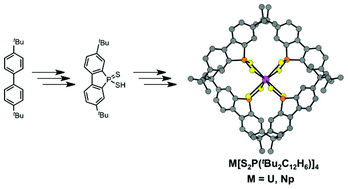
New members of the dithiophosphinic acid family of potential actinide extractants were prepared: heterocyclic 2,2[prime or minute]-biphenylenedithiophosphinic acids.
The content of this RSS Feed (c) The Royal Society of Chemistry

16 Oct 14:59
Dalton Trans., 2015, Advance Article
DOI: 10.1039/C5DT03466C, Paper
Tao Song, Jiancan Yu, Yuanjing Cui, Yu Yang, Guodong Qian
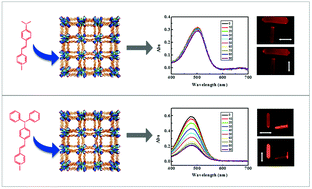
Two series of cationic dyes have been encapsulated in the 1D channel of MOFs, and the tunable second order nonlinear optical properties of these MOF[superset]dye materials were observed.
To cite this article before page numbers are assigned, use the DOI form of citation above.
The content of this RSS Feed (c) The Royal Society of Chemistry

16 Oct 14:14
by Long Zhang, Yue-Jian Lin, Zhen-Hua Li and Guo-Xin Jin

Journal of the American Chemical Society
DOI: 10.1021/jacs.5b08826

14 Oct 20:28
by Hai-Qun Xu, Jiahua Hu, Dengke Wang, Zhaohui Li, Qun Zhang, Yi Luo, Shu-Hong Yu and Hai-Long Jiang

Journal of the American Chemical Society
DOI: 10.1021/jacs.5b08773

14 Oct 14:41
by Chen Wang, Qing-Wen Xu, Wei-Ning Zhang, Qian Peng and Cui-Hua Zhao

The Journal of Organic Chemistry
DOI: 10.1021/acs.joc.5b02038

14 Oct 14:18
Chem. Soc. Rev., 2015, 44,8904-8939
DOI: 10.1039/C5CS00364D, Review Article
Jianzhang Zhao, Kejing Xu, Wenbo Yang, Zhijia Wang, Fangfang Zhong
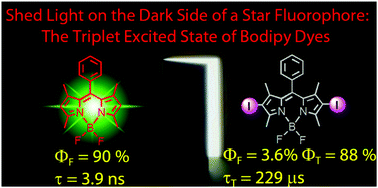
The accessing of the triplet excited state of one of the most popular fluorophores, boron-dipyrromethene (Bodipy), was summarized.
The content of this RSS Feed (c) The Royal Society of Chemistry

13 Oct 18:51
by Yoshimitsu Sagara, Shogo Yamane, Masato Mitani, Christoph Weder, Takashi Kato
The possibility to change the molecular assembled structures of organic and organometallic materials through mechanical stimulation is emerging as a general and powerful concept for the design of functional materials. In particular, the photophysical properties such as photoluminescence color, quantum yield, and emission lifetime of organic and organometallic fluorophores can significantly depend on the molecular packing, enabling the development of molecular materials with mechanoresponsive luminescence characteristics. Indeed, an increasing number of studies have shown in recent years that mechanical force can be utilized to change the molecular arrangement, and thereby the optical response, of luminescent molecular assemblies of π-conjugated organic or organometallic molecules. Here, the development of such mechanoresponsive luminescent (MRL) molecular assemblies consisting of organic or organometallic molecules is reviewed and emerging trends in this research field are summarized. After a brief introduction of mechanoresponsive luminescence observed in molecular assemblies, the concept of “luminescent molecular domino” is introduced, before molecular materials that show turn-on/off of photoluminescence in response to mechanical stimulation are reviewed. Mechanically stimulated multicolor changes and water-soluble MRL materials are also highlighted and approaches that combine the concept of MRL molecular assemblies with other materials types are presented in the last part of this progress report.

Mechanoresponsive luminescence exhibited by molecular materials is an emerging topic in materials science. The background of this research field is described, and the concept of “luminescent molecular domino”, turn-on/off behavior, multicolor changes, and water-soluble mechanoresponsive luminescent materials are reviewed. Approaches to covalently attach such materials to other materials are also introduced.
13 Oct 18:45
by Xiang-Yuan Yang, Wee Shan Tay, Yongxin Li, Sumod A. Pullarkat and Pak-Hing Leung

Organometallics
DOI: 10.1021/acs.organomet.5b00787

13 Oct 14:01
by Ayan Dhara, Florian Beuerle
Abstract
Boron–nitrogen dative bonds provide a suitable motif for reversible, yet strong and directed interactions, leading to the highly efficient self-assembly of small organic building blocks into supramolecular cage structures. A bipyramidal [2+3] assembly, as the first example of a supramolecular cage mediated by B![[BOND]](http://onlinelibrarystatic.wiley.com/undisplayable_characters/00f8ff.gif) N dative bonds that exists as a discrete species in solution, is quantitatively obtained from a tribenzotriquinacene-based trisboronate ester and 1,4-diazabicyclo[2.2.2]octane. Thermodynamic equilibria of cage formation are investigated by isothermal titration calorimetry and fully reversible cage opening can be observed at elevated temperatures.
N dative bonds that exists as a discrete species in solution, is quantitatively obtained from a tribenzotriquinacene-based trisboronate ester and 1,4-diazabicyclo[2.2.2]octane. Thermodynamic equilibria of cage formation are investigated by isothermal titration calorimetry and fully reversible cage opening can be observed at elevated temperatures.

Cage creation: Boron–nitrogen dative bonds mediated the formation of supramolecular cages with bipyramidal shapes (see figure). Fully reversible assembly and disassembly could be achieved with changes in temperature.
11 Oct 19:02
Chem. Commun., 2015, 51,16561-16564
DOI: 10.1039/C5CC06389B, Communication
Niall P. Kenny, Kamalraj V. Rajendran, Declan G. Gilheany
A method is reported for the phosphoryl bond cleavage of O-alkyl phosphinates, phosphinothioates and certain phosphonamidates to furnish the corresponding P(III) borane adducts.
The content of this RSS Feed (c) The Royal Society of Chemistry

11 Oct 19:00
Chem. Commun., 2015, 51,16944-16947
DOI: 10.1039/C5CC06921A, Communication
Shohei Kato, Yuma Serizawa, Daisuke Sakamaki, Shu Seki, Yoshihiro Miyake, Hiroshi Shinokubo
We have succeeded in the diversity-oriented synthesis of tetrathia[8]circulenes by sequential C-H borylation and annulation from cyclic tetrathiophene.
The content of this RSS Feed (c) The Royal Society of Chemistry

11 Oct 18:59
Chem. Commun., 2015, 51,16924-16927
DOI: 10.1039/C5CC07187A, Communication
Guangfu Li, Wei Guan, Shuang Du, Dongxia Zhu, Guogang Shan, Xiaojuan Zhu, Likai Yan, Zhongmin Su, Martin R. Bryce, Andrew P. Monkman
Efficient aggregation-induced-phosphorescent-emission (AIPE) of an ionic Ir(III) complex occurs when the counterion (PF6-) is exchanged specifically by ClO4- in aqueous media. As a result, a rapid, highly selective "turn-on" phosphorescent response to ClO4- is observed in aqueous media.
The content of this RSS Feed (c) The Royal Society of Chemistry

11 Oct 18:57
by Quan-Guo Zhai, Ni Bai, Shu’ni Li, Xianhui Bu and Pingyun Feng

Inorganic Chemistry
DOI: 10.1021/acs.inorgchem.5b01611

11 Oct 18:56
by Subhadip Goswami, Russell W. Winkel and Kirk S. Schanze

Inorganic Chemistry
DOI: 10.1021/acs.inorgchem.5b01767

11 Oct 11:19
by Daniel Schmidt, Martin D. Hager, Ulrich S. Schubert
The global energy demand is increasing at the same time as fossil fuel resources are dwindling. Consequently, the search for alternative energy sources is a major topic worldwide. Solar energy is one of the most promising, effective and emission-free energy sources. However, the energy has to be stored to compensate the fluctuating availability of the sun and the actual energy demand. Photo-rechargeable electric energy storage systems may solve this problem by immediately storing the generated electricity. Different combinations of solar cells and storage devices are possible. High efficiencies can be achieved by the combination of dye-sensitized solar cells (DSSC) and capacitors. However, other hybrid devices including DSSCs or organic photovoltaic systems and redox flow batteries, lithium ion batteries and metal air batteries are playing an increasing role in this research field. This Progress Report reviews the state of the art research of photo-rechargeable batteries based on organic solar cells, as well as storage modules.

Recent developments in the investigation of solar rechargeable electric energy storage systems are reviewed. Details of operation and performance are provided for organic hybrid devices of different solar cell types (e.g., dye sensitized solar cells or bulk heterojunction solar cells) and several energy storage systems (e.g., supercapacitors, redox flow batteries or metal air batteries).
11 Oct 10:49
by Jingmin Zhou, Huanhuan Li, Huan Zhang, Huimin Li, Wei Shi, Peng Cheng

A new bimetallic lanthanide metal-organic framework [Eu0.5Tb1.5(FDA)3] (H2FDA = 2,5-furandicarboxylic acid) exhibits high-sensitivity luminescent sensing of mixtures of organic compounds and can work over a large range of volume ratios. The self-calibrating behavior of this color-gradient luminescent sensor is presented for the first time.
11 Oct 10:47
by Xiaoyun Chai, Xiaoyan Cui, Baogang Wang, Fan Yang, Yi Cai, Qiuye Wu, Ting Wang
Abstract
Phosphorus has been successfully fused into a classic rhodamine framework, in which it replaces the bridging oxygen atom to give a series of phosphorus-substituted rhodamines (PRs). Because of the electron-accepting properties of the phosphorus moiety, which is due to effective σ*–π* interactions and strengthened by the inductivity of phosphine oxide, PR exhibits extraordinary long-wavelength fluorescence emission, elongating to the region above 700 nm, with bathochromic shifts of 140 and 40 nm relative to rhodamine and silicon-substituted rhodamine, respectively. Other advantageous properties of the rhodamine family, including high molar extinction coefficient, considerable quantum efficiency, high water solubility, pH-independent emission, great tolerance to photobleaching, and low cytotoxicity, stay intact in PR. Given these excellent properties, PR is desirable for NIR-fluorescence imaging in vivo.

Good PR: Phosphorus-substituted rhodamine (PR; see figure) exhibits extraordinary long-wavelength fluorescence emission, elongating to the region above 700 nm, with bathochromic shifts of 140 and 40 nm relative to rhodamine and Si-rhodamine, respectively. This behavior is ascribed to the electron-accepting character of the phosphorus moiety. Hence, PR displays superior characteristics for in vivo fluorescence imaging.
11 Oct 10:44
by Zhuo-Wei Wang, Min Chen, Chun-Sen Liu, Xi Wang, Hui Zhao, Miao Du
Abstract
A unique AlIII-based metal–organic framework (467-MOF) with two types of square channels has been designed and synthesized by using a flexible tricarboxylate ligand under solvothermal conditions. 467-MOF exhibits superior thermal and chemical stability and, moreover, shows high CO2 sorption selectivity over H2, with a selectivity, based on the ideal adsorbed solution theory (IAST) of approximately 45 at 273 or 293 K. Furthermore, its solvent-dependent photoluminescence makes it an applicable sensor in the detection of nitrobenzene explosives through fluorescence quenching.

Ready, willing, and stable: A unique AlIII-based metal–organic framework (MOF) material based on a flexible tricarboxylate ligand has been synthesized. The MOF shows exceptional stability and potential applications as a selective adsorbent and nitrobenzene sensor.
11 Oct 10:43
by Bernd Kohl, Frank Rominger, Michael Mastalerz
Abstract
Organic molecules of intrinsic microporosity (OMIMs) are structurally constructed to not pack tightly. Consequently, only weak interactions between OMIM molecules can occur, which is the reason that almost all OMIMs have been described and investigated in their amorphous states. For the same reason it is very difficult to grow single crystals of OMIMs for X-ray structural analysis. Here we describe four different polymorphs of an OMIM that was before only described in the amorphous state.

Not too frustrated! Organic molecules of intrinsic microporosity (OMIMs) are constructed to not pack by strong interactions (the so-called frustrated packing). One example is given which shows how frustration can be circumvented and how to obtain single-crystal X-ray structures with large intrinsic pore volumes.
08 Oct 07:33
by Kunbing Ouyang, Wei Hao, Wen-Xiong Zhang and Zhenfeng Xi

Chemical Reviews
DOI: 10.1021/acs.chemrev.5b00386

08 Oct 07:33
by Shuai Chen, Paul Slattum, Chuanyi Wang and Ling Zang

Chemical Reviews
DOI: 10.1021/acs.chemrev.5b00312

06 Oct 06:45
by Olga Trukhina, Marc Rudolf, Giovanni Bottari, Takeshi Akasaka, Luis Echegoyen, Tomas Torres and Dirk M. Guldi

Journal of the American Chemical Society
DOI: 10.1021/jacs.5b06454

05 Oct 21:34
by Pravas Deria, Diego A. Gómez-Gualdrón, Wojciech Bury, Herbert T. Schaef, Timothy C. Wang, Praveen K. Thallapally, Amy A. Sarjeant, Randall Q. Snurr, Joseph T. Hupp and Omar K. Farha

Journal of the American Chemical Society
DOI: 10.1021/jacs.5b08860

01 Oct 22:02
by Sven Wiesner, Arne Wagner, Olaf Hübner, Elisabeth Kaifer, Hans-Jörg Himmel
Abstract
Tetranuclear, intensely blue-coloured CuI complexes were synthesised in which two Cu2X3− units (X=Br or I) are bridged by a dicationic GFA (guanidino-functionalised aromatic) ligand. The UV/Vis spectra show a large metal-to-ligand charge-transfer (MLCT) band around 638 nm. The tetranuclear “low-temperature” complexes are in a temperature-dependent equilibrium with dinuclear CuI “high-temperature” complexes, which result from the reversible elimination of two CuX groups. A massive thermochromism effect results from the extinction of the strong MLCT band upon CuX elimination with increasing temperature. For all complexes, quantum chemical calculations predict a small and method-dependent energy difference between the possible electronic structures, namely CuI and dicationic GFA ligand (closed-shell singlet) versus CuII and neutral GFA ligand (triplet or broken-symmetry state). The closed-shell singlet state is disfavoured by hybrid-DFT functionals, which mix in exact Hartree–Fock exchange, and is favoured by larger basis sets and consideration of a polar medium.

Colorful copper: A massive charge-transfer band is switched on by CuX (X=Br, I) addition to a dinuclear CuI complex with bridging dicationic tetrakisguanidine ligands.
01 Oct 22:02
by Jan Freudenberg, Frank Rominger, Uwe H. F. Bunz
Abstract
The synthesis of five novel distyrylbenzene (DSB) derivatives, featuring a central tetraphenylbenzene core, is reported. The targets show aggregation-induced emission (AIE), which, however, is substituent-dependent. For the pure hydrocarbon and derivatives that do not carry (+M) or (−M) substituents, classic AIE behavior is observed, that is, the DSBs are non-fluorescent in solution, but are highly fluorescent in cold matrices, upon aggregate formation in poor solvents and in the solid, crystalline state. If aldehyde or dibutylamino groups are attached in the para-position of the DSB unit, non-classic AIE-phores result. These are fluorescent both in dilute solution as well as in the solid state. Prolonged irradiation of the targets leads to benzotetraphene derivatives by a double cyclization.

Aggregate to shine: Proper substitution of tetraphenyldistyrylbenzenes allows the tuning of their aggregation-induced emission properties. Virtually non-fluorescent in solution, derivatives with smaller π-systems exhibit tremendous fluorescence turn-on in cold matrices, upon aggregate-formation in poor solvents and in the solid, crystalline state. Prolonged irradiation leads to the selective formation of benzotetraphene derivatives.
01 Oct 21:58
by Volker Strauss, Ricarda A. Schäfer, Frank Hauke, Andreas Hirsch and Dirk M. Guldi

Journal of the American Chemical Society
DOI: 10.1021/jacs.5b07896

01 Oct 16:48
by Benjamin G. Janesko, Henry C. Fisher, Mark J. Bridle and Jean-Luc Montchamp

The Journal of Organic Chemistry
DOI: 10.1021/acs.joc.5b01618

01 Oct 16:46
by Yu-Dong Yang, Chuan-Cai Fan, Brett M. Rambo, Han-Yuan Gong, Li-Jin Xu, Jun-Feng Xiang and Jonathan L. Sessler

Journal of the American Chemical Society
DOI: 10.1021/jacs.5b07308