15 Mar 07:46
Chem. Soc. Rev., 2015, 44,1318-1330
DOI: 10.1039/C4CS00151F, Tutorial Review
Xian Chen, Denfeng Peng, Qiang Ju, Feng Wang
This tutorial review highlights recent advances in the development of upconversion core-shell nanoparticles to cater for biological and energy applications.
The content of this RSS Feed (c) The Royal Society of Chemistry

07 Mar 07:54
by Quentin Benito, Isabelle Maurin, Thibaut Cheisson, Gregory Nocton, Alexandre Fargues, Alain Garcia, Charlotte Martineau, Thierry Gacoin, Jean-Pierre Boilot, Sandrine Perruchas
Abstract
Luminescent mechanochromic materials are particularly appealing for the development of stimuli-responsive materials. Establishing the mechanism responsible for the mechanochromism is always an issue owing to the difficulty in characterizing the ground phase. Herein, the study of real crystalline polymorphs of a mechanochromic and thermochromic luminescent copper iodide cluster permits us to clearly establish the mechanism involved. The local disruption of the crystal packing induces changes in the cluster geometry and in particular the modification of the cuprophilic interactions, which consequently modify the emissive states. This study constitutes a step further toward the understanding of the mechanism involved in the mechanochromic luminescent properties of multimetallic coordination complexes.

A glowing report: The unusual mechanochromic luminescence properties of the studied copper iodide cluster result from local disruption of the crystal packing, which induces changes in the cluster geometry, thereby modifying the emissive properties (see figure).
07 Mar 07:53
by Yanbing Yang, Peixu Li, Shiting Wu, Xinyang Li, Enzheng Shi, Qicang Shen, Dehai Wu, Wenjing Xu, Anyuan Cao, Quan Yuan
Abstract
Mesoporous carbon (m-C) has potential applications as porous electrodes for electrochemical energy storage, but its applications have been severely limited by the inherent fragility and low electrical conductivity. A rational strategy is presented to construct m-C into hierarchical porous structures with high flexibility by using a carbon nanotube (CNT) sponge as a three-dimensional template, and grafting Pt nanoparticles at the m-C surface. This method involves several controllable steps including solution deposition of a mesoporous silica (m-SiO2) layer onto CNTs, chemical vapor deposition of acetylene, and etching of m-SiO2, resulting in a CNT@m-C core–shell or a CNT@m-C@Pt core–shell hybrid structure after Pt adsorption. The underlying CNT network provides a robust yet flexible support and a high electrical conductivity, whereas the m-C provides large surface area, and the Pt nanoparticles improves interfacial electron and ion diffusion. Consequently, specific capacitances of 203 and 311 F g−1 have been achieved in these CNT@m-C and CNT@m-C@Pt sponges as supercapacitor electrodes, respectively, which can retain 96 % of original capacitance under large degree compression.

Hybrid sponge: A rational strategy was developed by using a carbon nanotube (CNT) sponge as a 3D network template to fabricate hierarchical porous CNT@m-C@Pt core–shell hybrid structures (see picture: blue CNTs, green m-C (mesoporous carbon), silver Pt nanoparticles). These hybrid sponges show promising applications as high-performance flexible supercapacitor electrodes.
07 Mar 07:50
by Zafar Mahmood, Kejing Xu, Betül Küçüköz, Xiaoneng Cui, Jianzhang Zhao, Zhijia Wang, Ahmet Karatay, Halime Gul Yaglioglu, Mustafa Hayvali and Ayhan Elmali

The Journal of Organic Chemistry
DOI: 10.1021/jo502899p

06 Mar 14:58
Chem. Soc. Rev., 2015, 44,4415-4432
DOI: 10.1039/C4CS00365A, Review Article
Graham R. C. Hamilton, Suban K. Sahoo, Sukanta Kamila, Narinder Singh, Navneet Kaur, Barry W. Hyland, John F. Callan
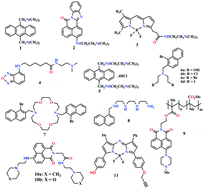
Luminescent sensors and switches continue to play a key role in shaping our understanding of key biochemical processes, assist in the diagnosis of disease and contribute to the design of new drugs and therapies.
The content of this RSS Feed (c) The Royal Society of Chemistry

02 Mar 15:01
Chem. Soc. Rev., 2015, 44,2087-2107
DOI: 10.1039/C4CS00326H, Tutorial Review
Congcong Zhang, Penglei Chen, Wenping Hu
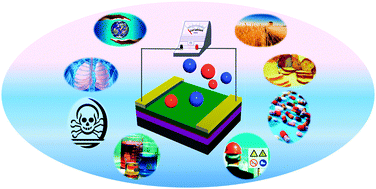
This tutorial review reports the recent progress on OFET gas sensors, including their working principle, and protocols for high-performance sensing.
The content of this RSS Feed (c) The Royal Society of Chemistry

28 Feb 17:11
Dalton Trans., 2015, 44,6348-6352
DOI: 10.1039/C5DT00489F, Communication
M. Venkateswarulu, Avijit Pramanik, Rik Rani Koner
With the aid of a rotational C3-symmetric tricarboxytriphenylamine based ligand, a new Cd-MOF was synthesized and characterized by various spectroscopic techniques as well as by single-crystal X-ray diffraction analysis.
The content of this RSS Feed (c) The Royal Society of Chemistry

27 Feb 08:45
by Zhenyu Zhang, Houyu Zhang, Chuanjun Jiao, Kaiqi Ye, Hongyu Zhang, Jingying Zhang and Yue Wang

Inorganic Chemistry
DOI: 10.1021/ic502815q

27 Feb 08:44
by François-Xavier Coudert

Chemistry of Materials
DOI: 10.1021/acs.chemmater.5b00046

26 Feb 20:16
by Bartosz Szyszko, Agata Białońska, Ludmiła Szterenberg, Lechosław Latos-Grażyński
Abstract
The incorporation of a phenanthrene moiety into a porphyrin framework results in the formation of a hybrid macrocycle—phenanthriporphyrin—merging the structural features of polycyclic aromatic hydrocarbons and porphyrins. An antiaromatic aceneporphyrinoid, adopting the trianionic {CCNN} core, is suitable for the incorporation of a phosphorus(V) center to form a hypervalent organophosphorus(V) derivative.

PAH–porphyrins: Phenanthriporphyrin, an antiaromatic hybrid macrocycle, merges structural facets of polycyclic aromatic hydrocarbons and porphyrins. The {CCNN} core of this aceneporphyrinoid involves phenanthrene carbon atoms which coordinate a hypervalent organophosphorus(V) center. Atom colors: C=gray; N=blue; O=red; H=white; P=purple.
25 Feb 23:36
by Reiner Sebastian Sprick, Jia-Xing Jiang, Baltasar Bonillo, Shijie Ren, Thanchanok Ratvijitvech, Pierre Guiglion, Martijn A. Zwijnenburg, Dave J. Adams and Andrew I. Cooper

Journal of the American Chemical Society
DOI: 10.1021/ja511552k

25 Feb 21:02
Chem. Soc. Rev., 2015, 44,2508-2528
DOI: 10.1039/C4CS00311J, Review Article
Damien Herault, Duc Hanh Nguyen, Didier Nuel, Gerard Buono
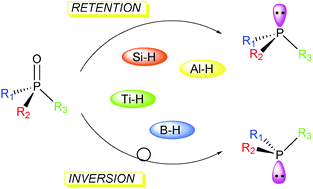
In this review, we summarise all the methods of phosphine oxide reduction and discuss their mechanistic aspects.
The content of this RSS Feed (c) The Royal Society of Chemistry

25 Feb 08:45
Dalton Trans., 2015, 44,12338-12348
DOI: 10.1039/C4DT04034A, Paper
Matthias Schmid, Pascual Ona-Burgos, Sophie M. Guillaume, Peter W. Roesky
The {CH(PPh2[double bond, length as m-dash]NSiMe3)(PPh2[double bond, length as m-dash]S)}- ligand has been used for the synthesis of divalent and trivalent rare-earth borohydride complexes. These compounds enable the ring-opening polymerization (ROP) of [varepsilon]-caprolactone (CL) and trimethylene carbonate (TMC).
The content of this RSS Feed (c) The Royal Society of Chemistry

25 Feb 08:44
Dalton Trans., 2015, 44,5957-5960
DOI: 10.1039/C4DT03785E, Communication
Jian-Jun Liu, Ying-Fang Guan, Chen Jiao, Mei-Jin Lin, Chang-Cang Huang, Wen-Xin Dai
A panchromatic hybrid crystal of anionic iodoplumbate nanowires and J-aggregated protonated naphthalene diimides has been formed through charge-assisted anion-[small pi] and lone pair-[small pi] interactions.
The content of this RSS Feed (c) The Royal Society of Chemistry

25 Feb 08:43
by Ying-Pin Chen, Yangyang Liu, Dahuan Liu, Mathieu Bosch and Hong-Cai Zhou

Journal of the American Chemical Society
DOI: 10.1021/ja5103579

24 Feb 17:48
by Danielle M. Zurcher and Anne J. McNeil

The Journal of Organic Chemistry
DOI: 10.1021/jo502915w

20 Feb 19:41
Chem. Soc. Rev., 2015, 44,4203-4211
DOI: 10.1039/C4CS00334A, Highlight
Brian Daly, Jue Ling, A. Prasanna de Silva
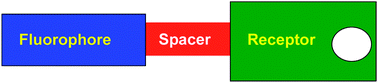
A fluorophore can be combined with a receptor according to a molecular engineering design in order to yield fluorescent sensing and switching devices.
The content of this RSS Feed (c) The Royal Society of Chemistry

19 Feb 01:49
by Jun Xuan, Ting-Ting Zeng, Jia-Rong Chen, Liang-Qiu Lu, Wen-Jing Xiao
19 Feb 01:48
by Marta Dal Molin, Quentin Verolet, Saeideh Soleimanpour, Stefan Matile
Abstract
This article assembles pertinent insights behind the concept of planarizable push–pull probes. As a response to the planarization of their polarized ground state, a red shift of their excitation maximum is expected to report on either the disorder, the tension, or the potential of biomembranes. The combination of chromophore planarization and polarization contributes to various, usually more complex processes in nature. Examples include the color change of crabs or lobsters during cooking or the chemistry of vision, particularly color vision. The summary of lessons from nature is followed by an overview of mechanosensitive organic materials. Although often twisted and sometimes also polarized, their change of color under pressure usually originates from changes in their crystal packing. Intriguing exceptions include the planarization of several elegantly twisted phenylethynyl oligomers and polymers. Also mechanosensitive probes in plastics usually respond to stretching by disassembly. True ground-state planarization in response to molecular recognition is best exemplified with the binding of thoughtfully twisted cationic polythiophenes to single- and double-stranded oligonucleotides. Molecular rotors, en vogue as viscosity sensors in cells, operate by deplanarization of the first excited state. Pertinent recent examples are described, focusing on λ-ratiometry and intracellular targeting. Complementary to planarization of the ground state with twisted push–pull probes, molecular rotors report on environmental changes with quenching or shifts in emission rather than absorption. The labeling of mechanosensitive channels is discussed as a bioengineering approach to bypass the challenge to create molecular mechanosensitivity and use biological systems instead to sense membrane tension. With planarizable push–pull probes, this challenge is met not with twistome screening, but with “fluorescent flippers,” a new concept to insert large and bright monomers into oligomeric probes to really feel the environment and also shine when twisted out of conjugation.

Lobsters, flippers, disorder, tension, and potential: The origins of the concept of mechanosensitive membrane probes—from fishmarket and scuba diving to the chemistry of vision, mechanochromic organic materials, and mechanosensitive channels—are briefly reviewed (see scheme).
18 Feb 21:05
by Yue-Biao Zhang, Hiroyasu Furukawa, Nakeun Ko, Weixuan Nie, Hye Jeong Park, Satoshi Okajima, Kyle E. Cordova, Hexiang Deng, Jaheon Kim and Omar M. Yaghi

Journal of the American Chemical Society
DOI: 10.1021/ja512311a

17 Feb 11:52
Chem. Sci., 2015, 6,2553-2558
DOI: 10.1039/C4SC03115F, Edge Article

Open Access
Cristina Hermosa, Benjamin R. Horrocks, Jose I. Martinez, Fabiola Liscio, Julio Gomez-Herrero, Felix Zamora
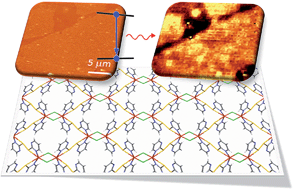
The red emission on isolated 2d-mof flakes with areas of square microns and molecular thicknesses (from single up to ca. 50 layers) has been characterized. Free-standing flakes have also been produced and their mechanical and optical properties studied.
The content of this RSS Feed (c) The Royal Society of Chemistry

17 Feb 11:38
by Partha Malakar, Edamana Prasad
Abstract
Self-assembly of AB2 and AB3 type low molecular weight poly(aryl ether) dendrons that contain hydrazide units were used to investigate mechanistic aspects of helical structure formation during self-assembly. The results suggest that there are three important aspects that control helical structure formation in such systems with acyl hydrazide/hydrazone linkage: i) J-type aggregation, ii) the hydrogen-bond donor/acceptor ability of the solvent, and iii) the dielectric constant of the solvent. The monomer units self-assemble to form dimer structures through hydrogen-bonding and further assembly of the hydrogen-bonded dimers leads to macroscopic chirality in the present case. Dimer formation was confirmed by NMR spectroscopy and by mass spectrometry. The self-assembly in the system was driven by hydrogen-bonding and π–π stacking interactions. The morphology of the aggregates formed was examined by scanning electron microscopy, and the analysis suggests that aprotic solvent systems facilitate helical fibre formation, whereas introduction of protic solvents results in the formation of flat ribbons. This detailed mechanistic study suggests that the self-assembly follows a nucleation–elongation model to form helical structures, rather than the isodesmic model.

How will it gel? The J-type aggregation propensity, hydrogen-bond donor/acceptor ability of solvents, as well as the polarity of the medium have been identified as the main factors that control the self-assembly of helical structures by poly(aryl ether) based dendron derivatives with acyl hydrazone/hydrazide units.
17 Feb 11:36
by Kuntal Manna, Teng Zhang, Francis X. Greene and Wenbin Lin

Journal of the American Chemical Society
DOI: 10.1021/ja512478y

16 Feb 11:47
Chem. Commun., 2015, 51,4985-4988
DOI: 10.1039/C5CC00681C, Communication
Thomas M. McDonald, Eric D. Bloch, Jeffrey R. Long
A methodology utilizing a thermogravimetric analyzer to monitor propane uptake following incremental increases of the temperature is demonstrated as a means of rapidly identifying porous materials and determining the optimum activation conditions of metal-organic frameworks.
The content of this RSS Feed (c) The Royal Society of Chemistry

12 Feb 12:51
Dalton Trans., 2015, 44,5746-5754
DOI: 10.1039/C4DT03794D, Paper
Lu Zhai, Wen-Wei Zhang, Xiao-Ming Ren, Jing-Lin Zuo
Nine isostructural lanthanide MOFs based on 1,1[prime or minute]-ethynebenzene-3,3[prime or minute],5,5[prime or minute]-tetracarboxylate ligand capable of emitting from the visible to near-infrared wavelengths have been synthesized and characterized in detail.
The content of this RSS Feed (c) The Royal Society of Chemistry

12 Feb 00:38
by Chuandong Dou, Zicheng Ding, Zijian Zhang, Zhiyuan Xie, Jun Liu, Lixiang Wang
10 Feb 01:55
by Thiago Teixeira Tasso, Taniyuki Furuyama, Nagao Kobayashi
Abstract
Dinitriles bearing aggregation-induced emission (AIE)-active moieties [tetraphenylethylene (TPE) or diphenylphenanthrene (DPP)] were prepared. Compounds 4 (TPE-linked) and 8 (DPP-linked) showed considerably redshifted emission resulting from their large Stokes shifts and also strong fluorescence in the aggregated and solid states. Pure E and Z stereoisomers of both dinitriles were easily separated, and their isomerization equilibria and fluorescence properties were investigated. In addition to their pronounced AIEE behavior, 4 and 8 also showed various reversible chromic responses to external stimuli, namely, solvato-, piezo-, vapo-, and thermochromism, which make them potential candidates for smart materials.

What it takes to shine: Dinitriles bearing tetraphenylethylene (TPE) or diphenylphenanthrene (DPP) units showed distinct aggregation-induced emission (AIE) and various reversible chromic responses to external stimuli (solvato-, piezo-, vapo-, and thermochromism), depending on the isomer conformation and number of rotatable phenyl rings in the molecule.
09 Feb 16:49
by Ananya Dutta, Kyoungmoo Koh, Antek G. Wong-Foy, Adam J. Matzger
Abstract
Design and synthesis of porous solids employing both reversible coordination chemistry and reversible covalent bond formation is described. The combination of two different linkage modes in a single material presents a link between two distinct classes of porous materials as exemplified by metal–organic frameworks (MOFs) and covalent organic frameworks (COFs). This strategy, in addition to being a compelling material-discovery method, also offers a platform for developing a fundamental understanding of the factors influencing the competing modes of assembly. We also demonstrate that even temporary formation of reversible connections between components may be leveraged to make new phases thus offering design routes to polymorphic frameworks. Moreover, this approach has the striking potential of providing a rich landscape of structurally complex materials from commercially available or readily accessible feedstocks.

Teamwork saves the day when coordination chemistry and covalent bond formation can both occur in a single material. A balance between the incubation time of the organic components and solvent decomposition/base formation governs the competition between the two processes and determines the phase outcome. Even the temporary formation of reversible connections between components can be leveraged to make new phases.
07 Feb 09:53
by Hyeong-Ju Kim, Dong Ryeol Whang, Johannes Gierschner, Chong Han Lee, Soo Young Park
Abstract
Highly efficient red–green–blue (RGB) tricolor luminescence switching was demonstrated in a bicomponent solid film consisting of (2Z,2′Z)-2,2′-(1,4-phenylene)bis(3-(4-butoxyphenyl)acrylonitrile) (DBDCS) and (2Z,2′Z)-3,3′-(2,5-bis(6-(9H-carbazol-9-yl)hexyloxy)-1,4-phenylene)bis(2-(3,5-bis(trifluoromethyl)phenyl)acrylonitrile) (m-BHCDCS). Reversible RGB luminescence switching with a high ratiometric color contrast (λem=594, 527, 458 nm for red, green, and blue, respectively) was realized by different external stimuli such as heat, solvent vapor exposure, and mechanical force. It was shown that Förster resonance energy transfer in the bicomponent mixture could be efficiently switched on and off through supramolecular control.

Reversible red–green–blue luminescence switching with a high ratiometric color contrast (λem=594, 527, 458 nm for red, green, and blue, respectively) was realized by different external stimuli such as heat, solvent-vapor exposure, and mechanical force. It was shown that Förster resonance energy transfer in a bicomponent mixture could be efficiently switched on and off through supramolecular control.
06 Feb 16:27
by Fan Bu, Erjing Wang, Qian Peng, Rongrong Hu, Anjun Qin, Zujin Zhao, Ben Zhong Tang
Abstract
Multiple intramolecular motions consume the excited-state energy of luminogenic molecules upon photoexcitation and lower the emission efficiency. The low frequency rotational motion of aromatic rings can be facilely restricted by steric constraint in the condensed phase, but the high frequency bond stretching motion can hardly be suppressed by aggregation. In this work, three phosphorus-containing heterocycles, 1,2,3,4,5-pentaphenylphosphole-1-oxide (PPPO), 1,2,3-triphenylphosphindole-1-oxide (TPPIO), and 1,2,3-triphenylphosphindole (TPPI), were synthesized and characterized. Their optical properties, crystal-packing manners, electronic features, and fluorescence dynamics were systematically investigated, and theoretical calculations were performed to decipher structure–property relationships. The results reveal that these luminogens are weak emitters in solutions but show strong emission in aggregates, exhibiting obvious aggregation-induced emission (AIE) features. The aggregation-insensitive stretching motion, which is dominant in PPPO, is lowered in TPPIO, enabling TPPIO to fluoresce much more efficiently than PPPO in aggregates. The stretching motion is even more lowered in TPPI, but its relatively planar conformation suffers emission quenching due to strong π–π stacking interactions in aggregates. Therefore, a twisted molecular conformation consisting of a rigid stator and a rotatable periphery is demonstrated to be a rational design for more efficient AIE luminogens.

Keep the balance: 1,2,3-Triphenylphosphindole-1-oxide (see scheme, right) with a rigid central stator and flexible peripheral phenyl rotors fluoresces more efficiently than 1,2,3,4,5-pentaphenylphosphole-1-oxide (left) in the solid state, due to the greatly lowered stretching motion by a ring-fused strucutre.
haozi and -1 others like this






![[BOND]](http://onlinelibrarystatic.wiley.com/undisplayable_characters/00f8ff.gif) P bond formation reaction of diarylphosphine oxides with aryl iodides was achieved by combining nickel catalysis and visible-light-induced photoredox catalysis. This dual-catalytic reaction showed a broad substrate scope, excellent functional group tolerance, and afforded the corresponding products in good to excellent yields. Compared with the previously reported use of photoredox/nickel dual catalysis in the construction of C
P bond formation reaction of diarylphosphine oxides with aryl iodides was achieved by combining nickel catalysis and visible-light-induced photoredox catalysis. This dual-catalytic reaction showed a broad substrate scope, excellent functional group tolerance, and afforded the corresponding products in good to excellent yields. Compared with the previously reported use of photoredox/nickel dual catalysis in the construction of C



![[LEFTWARDS ARROW]](http://onlinelibrarystatic.wiley.com/undisplayable_characters/002190.gif) N unit. The replacement makes the resulting polymer transform from an electron donor into an electron acceptor, and is proven by fluorescence quenching experiments and the photovoltaic response. This work not only provides an effective approach to tune the LUMO/HOMO energy levels of conjugated polymers, but also uses organic boron chemistry as a new toolbox to develop conjugated polymers with high electron affinity for polymer optoelectronic devices.
N unit. The replacement makes the resulting polymer transform from an electron donor into an electron acceptor, and is proven by fluorescence quenching experiments and the photovoltaic response. This work not only provides an effective approach to tune the LUMO/HOMO energy levels of conjugated polymers, but also uses organic boron chemistry as a new toolbox to develop conjugated polymers with high electron affinity for polymer optoelectronic devices.


