19 Feb 18:12
by Matthias Lehmann, Markus Hügel
Abstract
Star-shaped oligophenylenevinylene (OPV) mesogens are shape-persistent and possess formally large void space. A mesogen with three styrene repeating units packs densely in a columnar helical arrangement. Attachment of one fullerene through a short spacer results in an exceptional increase of the mesophase stability. X-ray scattering and modeling evidence a triple-helical arrangement in which the fullerene perfectly fills the void space between the arms of the star mesogen.

Come into my arms: Stilbenoid star-shaped mesogens pack densely, in helical structures that have a short correlation length, in columnar liquid-crystal phases. Attaching a fullerene guest to the interior of the star fills the void space between the arms and considerably increases the mesophase stability by approximately 70 °C. The stabilization is the result of the formation of a fullerene triple helix.
14 Feb 18:34
by Yan-Mei Xing, Lei Zhang and De-Cai Fang

Organometallics
DOI: 10.1021/om501239n

08 Feb 10:15
by Darpandeep Aulakh, Juby R. Varghese and Mario Wriedt

Inorganic Chemistry
DOI: 10.1021/ic5026813

07 Feb 19:12
Dalton Trans., 2015, 44,5331-5337
DOI: 10.1039/C4DT02594F, Paper
Christi L. Whittington, Lukasz Wojtas, Wen-Yang Gao, Shengqian Ma, Randy W. Larsen
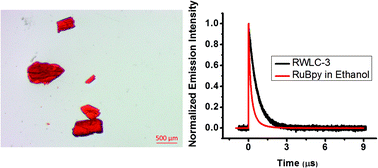
It has now been demonstrated that Ru(II)tris(2,2[prime or minute]-bipyridine) (RuBpy) can be utilized to template the formation of new metal organic framework (MOF) materials containing crystallographically resolved RuBpy clusters with unique photophysical properties.
The content of this RSS Feed (c) The Royal Society of Chemistry

05 Feb 08:44
Chem. Sci., 2015, 6,2016-2021
DOI: 10.1039/C5SC00051C, Edge Article

Open Access
Michael H. Holthausen, Rashi R. Hiranandani, Douglas W. Stephan
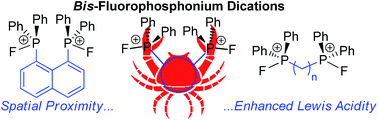
A series of electrophilic bis-fluorophosphonium dications dervied from diphosphines with naphthalene- and (oligo)methylene-linkers is presented. The resulting Lewis acidity is demonstrated to depend on the spatial proximity between the P moieties as evidenced in several Lewis acid catalyzed transformations.
The content of this RSS Feed (c) The Royal Society of Chemistry

05 Feb 08:42
by Xin Zhou, Songyi Lee, Zhaochao Xu and Juyoung Yoon

Chemical Reviews
DOI: 10.1021/cr500567r

05 Feb 08:29
by Qipu Lin, Xianhui Bu, Aiguo Kong, Chengyu Mao, Xiang Zhao, Fei Bu and Pingyun Feng

Journal of the American Chemical Society
DOI: 10.1021/jacs.5b00076

05 Feb 08:29
by Honghan Fei and Seth M. Cohen

Journal of the American Chemical Society
DOI: 10.1021/ja5126885

03 Feb 18:04
by Natalie Hammer, Tatyana E. Shubina, Jean-Paul Gisselbrecht, Frank Hampel and Milan Kivala

The Journal of Organic Chemistry
DOI: 10.1021/jo502605e

30 Jan 06:27
by Miguel Martínez-Calvo, Oxana Kotova, Matthias E. Möbius, Alan P. Bell, Thomas McCabe, John J. Boland and Thorfinnur Gunnlaugsson

Journal of the American Chemical Society
DOI: 10.1021/ja511799n

zkevin and -1 others like this
30 Jan 06:26
by Sarah S. Park, Eric R. Hontz, Lei Sun, Christopher H. Hendon, Aron Walsh, Troy Van Voorhis and Mircea Dincă

Journal of the American Chemical Society
DOI: 10.1021/ja512437u

29 Jan 06:52
by Gang Li, Wei-Wei Xiong, Pei-Yang Gu, Jun Cao, Jia Zhu, Rakesh Ganguly, Yongxin Li, Andrew C Grimsdale and Qichun Zhang

Organic Letters
DOI: 10.1021/ol503575t

29 Jan 06:32
by Elodie Heyer, Pauline Lory, Jérôme Leprince, Mathieu Moreau, Anthony Romieu, Massimo Guardigli, Aldo Roda, Raymond Ziessel
Abstract
The preparation of highly water-soluble and strongly fluorescent diketopyrrolopyrrole (DPP) dyes using an unusual taurine-like sulfonated linker has been achieved. Exchanging a phenyl for a thienyl substituent shifts the emission wavelength to near λ=600 nm. The free carboxylic acid group present in these new derivatives was readily activated and the dyes were subsequently covalently linked to a model protein (bovine serum albumin; BSA). The bioconjugates were characterized by electronic absorption, fluorescence spectroscopy and MALDI-TOF mass spectrometry, thus enabling precise determination of the labeling density (ratio DPP/BSA about 3 to 8). Outstanding values of fluorescence quantum yield (30 % to 59 %) for these bioconjugates are obtained. The photostability of these DPP dyes is considerably greater than that of fluorescein under the same irradiation conditions. Remarkably low detection limits between 80 and 300 molecules/μm2 were found for the BSA bioconjugates by fluorescence imaging with a epifluorescence microscope.

All-in-one solution! A simple but very effective synthetic strategy to make diketopyrrolopyrrole (DPP) dyes water-soluble and highly fluorescent in aqueous media for bioconjugation to proteins is presented. Bovine serum albumin-DPP conjugates with unprecedentedly high quantum yields were obtained, thus enabling detection of minute amounts of fluorescent proteins through epifluorescence microscopy.
27 Jan 22:45
Chem. Commun., 2015, 51,6257-6274
DOI: 10.1039/C5CC00175G, Feature Article
Aude Escande, Michael J. Ingleson
The incorporation of boron into the core structure of fused polycyclic aromatics generates compounds with highly attractive properties. This feature article summarises the recent key developments in this field.
The content of this RSS Feed (c) The Royal Society of Chemistry

27 Jan 22:44
Dalton Trans., 2015, 44,4765-4772
DOI: 10.1039/C5DT00042D, Paper
Jaewoo Kwak, Nguyen Van Nghia, Junseong Lee, Hyoseok Kim, Myung Hwan Park, Min Hyung Lee
Introduction of a phosphine oxide group into a triarylborane significantly enhances the Lewis acidity of the boron center, the extent of which increases additively with the number of phosphine oxide groups.
The content of this RSS Feed (c) The Royal Society of Chemistry

27 Jan 07:05
by Xiang Zhao, Xianhui Bu, Quan-Guo Zhai, Huy Tran and Pingyun Feng

Journal of the American Chemical Society
DOI: 10.1021/ja512137t

26 Jan 19:33
Chem. Commun., 2015, 51,3359-3362
DOI: 10.1039/C4CC09439E, Communication
Tristan Butler, William A. Morris, Jelena Samonina-Kosicka, Cassandra L. Fraser
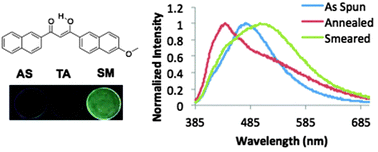
Solvatochromism and aggregation-induced emission were investigated for methoxy-substituted dinaphthyl diketone solutions and solid-state properties, including reversible mechanochromic luminescence, were explored for films.
The content of this RSS Feed (c) The Royal Society of Chemistry

26 Jan 19:33
Chem. Commun., 2015, 51,4528-4543
DOI: 10.1039/C4CC09206F, Feature Article
Seth C. Rasmussen, Sean J. Evenson, Casey B. McCausland
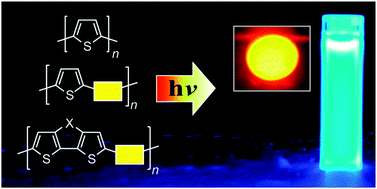
An overview of fluorescent thiophene-based materials and their applications, highlighting in particular the various methods employed to achieve highly emissive materials.
The content of this RSS Feed (c) The Royal Society of Chemistry

23 Jan 06:25
by Ning Huang, Xiong Chen, Rajamani Krishna, Donglin Jiang
Abstract
Ordered open channels found in two-dimensional covalent organic frameworks (2D COFs) could enable them to adsorb carbon dioxide. However, the frameworks’ dense layer architecture results in low porosity that has thus far restricted their potential for carbon dioxide adsorption. Here we report a strategy for converting a conventional 2D COF into an outstanding platform for carbon dioxide capture through channel-wall functionalization. The dense layer structure enables the dense integration of functional groups on the channel walls, creating a new version of COFs with high capacity, reusability, selectivity, and separation productivity for flue gas. These results suggest that channel-wall functional engineering could be a facile and powerful strategy to develop 2D COFs for high-performance gas storage and separation.

Efficient CO2 capture is achieved by converting a conventional two-dimensional covalent organic framework (COF) to an outstanding CO2 capture material with large capacity and high selectively. The nanopore walls are chemically engineered with functional groups in a controlled manner to enhance interactions with CO2, leading to the development of a new general way to design COFs for gas storage and separation.
郭增静, 刘佳 and 3 others like this
22 Jan 17:06
by Mahesh S. Deshmukh, Ashok Yadav, Rakesh Pant and Ramamoorthy Boomishankar

Inorganic Chemistry
DOI: 10.1021/ic502207f

22 Jan 17:05
Chem. Soc. Rev., 2015, 44,1922-1947
DOI: 10.1039/C4CS00254G, Review Article
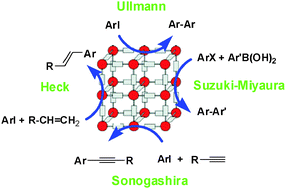
Amarajothi Dhakshinamoorthy, Abdullah M. Asiri, Hermenegildo Garcia
This critical review aims to illustrate the recent developments in the field of C-C and C-X (X = O, N) coupling reactions promoted by metal-organic frameworks.
The content of this RSS Feed (c) The Royal Society of Chemistry

22 Jan 17:03
Chem. Sci., 2015, 6,1910-1916
DOI: 10.1039/C4SC03278K, Edge Article
Open Access
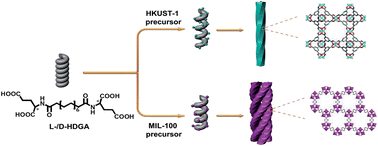
Hui Wang, Wei Zhu, Jian Li, Tian Tian, Yue Lan, Ning Gao, Chen Wang, Meng Zhang, Charl F. J. Faul, Guangtao Li
Here we report on the use of a self-assembled organic object to template the first example of a nanoscale metal-organic framework (MOF) with a helical morphology.
The content of this RSS Feed (c) The Royal Society of Chemistry

21 Jan 21:59
by Jihye Park, Dawei Feng and Hong-Cai Zhou

Journal of the American Chemical Society
DOI: 10.1021/ja5123528

21 Jan 19:11
by Kyuho Lee, Joshua D. Howe, Li-Chiang Lin, Berend Smit and Jeffrey B. Neaton

Chemistry of Materials
DOI: 10.1021/cm502760q

21 Jan 08:01
by Bin Sun, Ming Wang, Zhichao Lou, Mingjun Huang, Chenglong Xu, Xiaohong Li, Li-Jun Chen, Yihua Yu, Grant L. Davis, Bingqian Xu, Hai-Bo Yang and Xiaopeng Li

Journal of the American Chemical Society
DOI: 10.1021/ja511443p

19 Jan 22:18
by Daniel Geiß, Marius I. Arz, Martin Straßmann, Gregor Schnakenburg, Alexander C. Filippou
Abstract
An experimental and theoretical study of the first compound featuring a Si![[DOUBLE BOND]](http://onlinelibrarystatic.wiley.com/undisplayable_characters/00f8fe.gif) P bond to a two-coordinate silicon atom is reported. The NHC-stabilized phosphasilenylidene (IDipp)SiPMes* (IDipp=1,3-bis(2,6-diisopropylphenyl)imidazolin-2-ylidene, Mes*=2,4,6-tBu3C6H2) was prepared by SiMe3Cl elimination from SiCl2(IDipp) and LiP(Mes*)SiMe3 and characterized by X-ray crystallography, NMR spectroscopy, cyclic voltammetry, and UV/Vis spectroscopy. It has a planar trans-bent geometry with a short Si
P bond to a two-coordinate silicon atom is reported. The NHC-stabilized phosphasilenylidene (IDipp)SiPMes* (IDipp=1,3-bis(2,6-diisopropylphenyl)imidazolin-2-ylidene, Mes*=2,4,6-tBu3C6H2) was prepared by SiMe3Cl elimination from SiCl2(IDipp) and LiP(Mes*)SiMe3 and characterized by X-ray crystallography, NMR spectroscopy, cyclic voltammetry, and UV/Vis spectroscopy. It has a planar trans-bent geometry with a short Si![[BOND]](http://onlinelibrarystatic.wiley.com/undisplayable_characters/00f8ff.gif) P distance of 2.1188(7) Å and acute bonding angles at Si (96.90(6)°) and P (95.38(6)°). The bonding parameters indicate the presence of a SiP bond with a lone electron pair of high s-character at Si and P, in agreement with natural bond orbital (NBO) analysis. Comparative cyclic voltammetric and UV/Vis spectroscopic experiments of this compound, the disilicon(0) compound (IDipp)SiSi(IDipp), and the diphosphene Mes*PPMes* reveal, in combination with quantum chemical calculations, the isolobal relationship of the three double-bond systems.
P distance of 2.1188(7) Å and acute bonding angles at Si (96.90(6)°) and P (95.38(6)°). The bonding parameters indicate the presence of a SiP bond with a lone electron pair of high s-character at Si and P, in agreement with natural bond orbital (NBO) analysis. Comparative cyclic voltammetric and UV/Vis spectroscopic experiments of this compound, the disilicon(0) compound (IDipp)SiSi(IDipp), and the diphosphene Mes*PPMes* reveal, in combination with quantum chemical calculations, the isolobal relationship of the three double-bond systems.

An NHC-stabilized phosphasilenylidene was obtained from SiCl2(IDipp) (IDipp=1,3-bis(2,6-diisopropylphenyl)imidazolin-2-ylidene) and LiP(Mes*)(TMS) (Mes*=2,4,6-tBu3C6H2). The compound was characterized by various experimental and theoretical methods and compared with those of the isolobal congeners (IDipp)SiSi(IDipp) and Mes*PPMes*.
19 Jan 17:56
Dalton Trans., 2015, 44,3717-3719
DOI: 10.1039/C4DT03972F, Communication
Lili Wang, Zhihua Wang, Qiuyan Wang, Zheng Duan, Francois Mathey
A multi-step synthesis of the title compound has been devised.
The content of this RSS Feed (c) The Royal Society of Chemistry

17 Jan 19:44
Chem. Soc. Rev., 2015, 44,4192-4202
DOI: 10.1039/C4CS00391H, Highlight
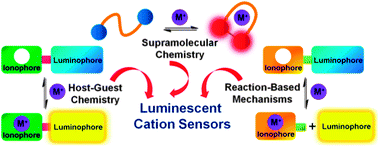
Margaret Ching-Lam Yeung, Vivian Wing-Wah Yam
This highlight provides a brief overview on luminescent cation detection strategies derived from a wide variety of organic and organometallic architectures, including those based on the ion-receptor complementarity, integrated with the extension of the concept of supramolecular chemistry and those using the irreversible analyte-specific reactions.
The content of this RSS Feed (c) The Royal Society of Chemistry

17 Jan 08:36
by Yongfei Zeng, Ruyi Zou, Zhong Luo, Huacheng Zhang, Xin Yao, Xing Ma, Ruqiang Zou and Yanli Zhao

Journal of the American Chemical Society
DOI: 10.1021/ja510926w

16 Jan 23:30
by Lu Gan, Thomas L. Groy, Pilarisetty Tarakeshwar, Shobeir K. S. Mazinani, Jason Shearer, Vladimiro Mujica and Anne K. Jones

Journal of the American Chemical Society
DOI: 10.1021/ja509779q