Shared posts

19 Feb 18:05

Waissbluth dice que la familia de Piñera es impecable “excepto por cierto pariente síndico y su íntimo Choclo Délano que le falló majestuosamente”

by El Mostrador

El fundador de la ONG Educación 2020, Mario Waissbluth expresó una dura crítica al ex Presidente Sebastián Piñera quien en una entrevista publicada ayer por revista Capital fue puesto en el escenario de que alguien de su familia hiciera algo similar al fallido negocio de Natalia Compagnon y Sebastián Dávalos y en ese contexto Piñera aseguró que “mi familia no me falló”. La frase fue calificada por el gobierno como “inapropiada”, además fue criticada por dirigentes oficialistas y generó una fuerte ofensiva desde las redes sociales
Precisamente desde su perfil de facebook para ironizar con las palabras de Piñera en un posteo titulado “Piñera incombustible y teflonizado” que comenzó afirmando que el ex Mandatario tiene razón, “su familia es, hasta donde lo sé, impecable, excepto por un cierto pariente síndico”, escribió.

“Pero su frescura, para variar, no tiene límites. Omitió decir que su íntimo miembro del círculo de hierro Choclo Délano le falló majestuosamente, que su ministro Longueira está formalizado, que su Ministro Golborne dejó la embarrada, que su MINVU también, y que su propio tejado de vidrio es altamente quebradizo: el Banco de Talca, su fideicomiso “tuerto”, sus contratos forward con Penta, sus empresas con facturas a SQM, el pago de bonos a sus ejecutivos de Chilevisión por empresas que donaron a su campaña del 2009, las manipulaciones de la información censal, los anuncios grandilocuentes y mentirosos, y tantas más que ya no me acuerdo”, reconoció Waissbluth.
Después, el ingeniero escribió la parte más sombría de su texto. “De corazón les digo. Si queremos iniciar un rescate ético, para recuperar la confianza en Chile, lo peor que nos podría ocurrir es la reelección de Piñera. No se trata de que sea miembro de una coalición u otra, ni por sus ideas políticas. Se trata de que la señal ética sería fatal, por más legislaciones de transparencia que se adopten”, aseguró.

A juicio de Waissbluth autor de tres libros entre ellos “Tejado de Vidrio: Cómo recuperar la confianza en Chile”, el ex Presidente Piñera “siempre vivirá con su vicio irredento de especular financiera y políticamente, de ir constantemente transitando por la difusa frontera entre lo correcto y lo incorrecto, estirando el elástico al máximo”, afirmó.

Waissbluth, que fue militante del Mapu reconoció que “hago votos porque su coalición escoja un candidato presidencial un poco más transparente. Chile, por sobre todo, necesitará de un nuevo Presidente(a) impecable, del color que sea”.


14 Feb 18:21

Delving into Divers: “Waltz of the 101st Lightbourne”

by princepsfemina

Description of Series:

Rachel and Melissa are going through Divers song by song.

We want to work through our initial analyses with slightly informal and conversational essays with each other. But If you ever want to join in on these conversations or contribute, let us know!

———————

Rachel and I tackled “Waltz of the 101st Lightbourne” separately and this entry in our “Delving into Divers” series is not as much of a conversation as our other entries. But I know we will probably tackle this song again in the future, once our brains are less on fire, and we can possibly do a redux of sorts with “Waltz.” We also especially want to hear what our readers think about this one, too! So, please reblog with commentary, submit commentary, ask us questions! This is such a massive song. We love it.

Melissa:

Before I begin, a confession: I almost cried trying to figure out “Waltz of the 101st Lightbourne” over three hours after a long day of teaching. But it was also so much fun. My brain was on fire, but it was fun. As I was analyzing this song, it was helpful to me to refer to readings on time travel and the multiverse and what Joanna has said about this song in interviews. I was very invested in trying to figure out the narrative line by line, verse by verse, and then overall. I want to share what I learned about the fourth dimension, time travel, and the multiverse and then do a reconstruction of what I think the song’s narrative is, before I even start talking about its themes (particularly the engendering of Space and Time) in much depth. Hopefully our readers find this helpful!

Humans, in our reality, have successfully conquered the three spatial dimensions of nature. The three wars the narrator discusses in “Waltz’s” first verse could be actual wars, but the wars also refer to the figurative conquering of the three dimensions, the fourth “war” being the conquering Time (the war that was “carelessly” done). We (meaning the humans outside of Joanna’s foray into sci-fi) have not conquered the fourth dimension of Time. This means that we are always in the present with the past always behind us and the future always ahead of us. If humans acquired the ability to manipulate and control the fourth dimension as the humans in “Waltz” do, that means that Time has, in effect, become spatial (as if it has coordinates), it is almost flat, and the present, past, and future can be viewed as always happening at once. There is constant tension in Divers between Time and Space. From the very first song, there is emphasis on the difference of “wherever you are” and “when are you from.” The three dimensions versus the fourth. As I will explain below, this tension is very gendered.

But “Waltz” becomes even more complicated because these humans have not just conquered the fourth dimension, but in doing so they have gained the ability to traverse the multiverse. The multiverse hypothesizes that there could be infinite universes, and that if there are infinite universes, one of these alternate universes inevitably would be very much like the other, maybe even a copy. Within such an eerily similar universe, there could be another Earth and another human race. When 101st Lightbourne Elite leave their Earth (for the 101st time?), they are looking for another “Earth.” They are looking for simulacreage: land to exploit on Earth lookalikes. The tragedy and horror of the song lies in the fact that they do not realize the real consequences of the multiverse and their access to it. They could be going to an “Earth” that is very similar, in every way, to theirs (although, I am not convinced Highlands Earth is an exact copy). Meaning they could go to an “Earth” with the same level of technology, not one less advanced. Or an Earth, like Highlands, could come to them because of their own understanding of technology. As the 101st Lightbourne Elite go out to colonize, they too can be colonized by the New Highlands Light Infantry. If you are invading an almost replica of “Earth,” they could also be in the process of invading you. (N.B. The “stack of slides” image we see in the penultimate verse of the song is a visualization of the flattening of time and also a visualization of the multiverse.)

The 101st Lightbourne Elite’s Earth has been devastated by invasion(s) and this has prompted them to develop and use technology to Time Travel to look for another “Earth.” (They could have possibly been invaded by other “Earths.”) The entire song is told from the perspective of one narrator—whom I believe to be a woman (see below)—who witnesses the departure of the 101st and awaits their arrival back home. Her lover, John (which, as Rachel brilliantly suggested previously, could be a version of John Purroy Mitchel; naming is very specific on Divers and it is no coincidence that there is a John in “Waltz”), is one of the men who has left to go to Highlands Earth. She begins to recount in the first verse how and why humans turn to Time Travel and the multiverse and by the second verse, she knows it is a mistake and that it can only lead to death, destruction, and misery. She describes how humans came to understand that “Time is taller than space is wide” meaning that their access to time travel has opened them up to infinite possibilities for terrestrial colonization (quite a cynical comment from Joanna that Time Travel is used solely for this purpose). They are not restricted to their three dimensions on their Earth any longer but have access to many Earths. In the fourth verse, she describes what it was like before the humans on her Earth could control and manipulate Time. Before that, they could board the “ship” of Time (so to speak) and be “lashed to [its] prow,” but not steer it. They were constantly bound to the present (“Before you and I ceased to be Now”). But Time Travel has made Time spatialized in that they are now “right here” in “inches and miles” and not “years.” “Now” means something very different when temporal boundaries have been collapsed. Because of their understanding of Time Travel “a new sort of coordinate awoke.” Time to them has become a “tenant,” but one which is in “the war between [them] and [their] ghosts.” When Time flattens, your past is always with you, your ghosts, but this line could also forecast the war they will have with their Highlands “copies,” the regret they will experience once they realize what they have done.

The fifth verse is troubling to me and I sense there could be a shift in the narrator. But here’s what I think (for now): this verse is still from our woman in waiting, but she is possibly envisioning what Highlands Earth looks like and also is possibly omniscient about it in a way. But it reads to me more like she hopes that Highlands is an earlier version of her Earth, still in a “Golden Age,” an earlier version of her Earth, but then it becomes clearer later in the song that Highlands is just as advanced, just as desperate, and possibly just as destroyed as her Earth. She wants it to be “pristine” and “unfelled” and maybe we do, too, but I do not think we ever truly see Highlands: only the men they sent from the New Highlands Light Infantry. I do not think we see her version of Earth either, or at least directly. We see in her dreams that her Earth is ruined (“I had a dream that I walked in the garden/Of Chabot, and those telescope ruins”).

When she awakes from the dream, a war “in eternal return and repeat” has begun. The infinite regress. They are fighting a version of themselves and they will do so forever…because multiverse. The New Highlands Light Infantry actually expect the 101st Lightbourne to be on their own Earth (“Calling, ‘Where in the hell are the rest of your fellow/ One Hundred-One Lightborne Elite?’/ stormed in the New Highland Light Infantry”). They expect them there because the invasion’s happened before and it will happen again. Or it’s possible that they expected them to be there because they are them (and I must say this very possibility is too much for my tiny brain and I have been trying to avoid this concept my entire essay, a horrifying twinning effect).

In the penultimate verse, the narrator calls out to John hoping that this looping reality of invasion can somehow cease. There is now regret in humanity’s knowledge that “Time is taller than space is wide.” And then finally, in the last verse we learn that the 101st Earth will never be able to escape their current circumstances. Their Earth will always be destroyed, they will have the same “round desert island” before them. The narrator will always wonder what has happened to John, and John will always be going to the Highlands to colonize (“Have they drowned, in those windy highlands?/ Highlands away, my John”). (And maybe from the perspective of every version of Earth, the “other” Earth is always the Highlands.)

And now that I have gone through the song verse by verse, I want to explain how I believe this song demonstrates the engendering of Time and Space (something I have been hinting at in my previous pieces on Divers and finally feel I can go wild with). The narrator of “Waltz” must wait on her version of Earth as her male lover, John, goes to Highlands Earth, travelling through Time to arrive there. She is the sci-fi Penelope sending off her Odysseus. The woman in “Waltz” is fixed to a location, a Space, she is immobilized while the man can move, be active, transcend boundaries, and even control Time. I think this is also the case in “Sapokanikan” as John Purroy Mitchel leaves his wife behind before he boards his plane and transcends the Earth, this is the case in “Divers,” while a woman waits on the shore, remembering and a man dives into water and crosses boundaries, creating culture and memory. Time vs. Space, rather than just Immobilization vs. Crossing/Creation of Boundaries, however, is more prominent in “Anecdotes.” (There is reason that “Anecdotes” and “Waltz” were my immediate favorites: they are so connected). I have the sense the person—who wants to stop time in “Anecdotes,” who can travel through Time with his bird army/army made up of people named after birds, who wants to get back to his family—is a man (although I consistently used the pronoun “they” to refer to the narrator in my response to the song). It may be because of the World War I imagery in “Anecdotes,” the very traditional imagery of “family” at the end of the song, but that gender hunch and my gender hunch for “Waltz” is ultimately founded in my belief that Newsom is exploring a Barthian principle (found in A Lover’s Discourse, 1979) on Divers. In literature Man is often shown to be active and moving, while Woman is often shown to be immobile and attached to a place (e.g., as we have seen, men go to war, women wait). If we expand this beyond Barthes’ immediate words and also add in a little Simone De Beauvoir and The Second Sex, it, to me, means that Man is transcendent and Woman is immanent, it means that Man in a way creates memory and Woman is the repository of memory, and it means that Man is Time (something constantly moving) and Woman is Space (something fixed). In “Waltz,” our female narrator can comment on the motives, apparatuses, and consequences of Time Travel, but she can never control Time herself as she is fixed to the Earth. All she can do is watch her Earth’s dissolution through endless and cyclical copy wars as John always leaves for the Highlands.

Rachel:

Melissa’s incredible research into and analysis of “Waltz of the 101st Lightborne” is probably one of my favorite things that has ever been posted on Blessing all the Birds. Her insight into fifth dimensional existence and the multiverse sheds so much light on the themes of both the song and the album. My own analysis focuses on the imagery of the song and on the literal narrative of the work. After reading Melissa’s piece, however, I have such a richer appreciation of the song, that I almost feel the need to revisit my entire piece. For the sake of my sanity, I will probably hold off on that for the time being, although I anticipate revisiting this song many, many times before I fully understand this album as a whole. Eternal return and repeat and all that jazz.

~~~

Waltz begins on the “eve of the last of the Great Wars.” The identity of the wars, as well as the identity of the enemy, are left ambiguous, although the reference to “Great War” calls to mind World War I (and our hero, John Purroy Mitchel, who departed for the “Western front” so many years ago). Regardless, we know that there have been a total of four wars. The fourth Great War is the focus of this song and a battle fought for control and colonization of Time, the last remaining dimension.

It is a doomed war from the beginning. Our narrator concedes, it was “carelessly done” and “a mistake.” There is a sense permeating the album that any attempts to control either Time or Space are futile—that the quest to colonize both will only end in the inevitable: Death. This is clear in the narrator’s observation that the “clouds draped like a flag across the backs of the fleet,” calling to mind the image of military funerals and the customary flag draped across the casket. The Hundred First Lightborne Elite, in their attempt to circumvent the inevitability of Time (and mortality), are reminded horrifically of nature’s cruelty—that nature itself is Death.

The speaker of the poem, who seemingly speaks for all humanity, recounts the moment that mankind realized the potential to colonize Time, after having already colonized Space and realized its “limits.” The opportunity in Time is characterized as “unlimited simulacreage to colonize.” Of course, “simulacreage” is an example of Joanna’s beautiful relationship to words and her ability to choose just the right one. If the right one does not exist in our lexicon? She will create one! The philosophical implications of this word are huge and play into the repeated motif on the album of doubles/twins/mirrored images/mirrored light. I hope to explore these ideas more in a future piece.

The speaker goes on to lament a time where mankind did not have such control of Time, when we were “lashed to the prow of a ship you may board, but not steer.” Thankfully, we have put Time in its place, making it “just another poor tenant” in the “war between us and our ghosts.” In other words, Time has become a pawn in humankind’s attempts to escape mortality and the inevitability of Death.

There are many references in Waltz to sites along the western coast of North America—the Bering Strait, the Golden Gate bridge, the mention of Chabot, the Great Divide (which, in addition to being a common term for the barrier between life and death, is also the most significant continental divide, separating the west from the east at a geological level). I’m interested in these references not only because they help formulate the album’s specific geography, but because they represent multiple things to me. First, the focus on divisions and barriers, as well as the bridging of those divisions, is important to me. The Bering Strait and the Golden Gate are both bridges, in a sense. This idea of division is explored further in Divers, where the division is one along gendered lines. Secondly, the west has always represented the dreams of Manifest Destiny, the movement west to find pristine lands and form new settlements. The allusion to figures like Chabot (Anthony Chabot, who went west to develop innovations in the mining industry, the water industry, and who is also the namesake of a telescope at the Chabot Space and Science Center), recalls the innocent optimism of the 101st, of John Purroy Mitchel and of all the other soldiers who enter wars that cannot be won, as no war can.

The song is a tragic one. As we have known from the beginning, our brave soldiers are doomed. We soon learn, as a new brigade marches in (The New Highland Light Infantry), that the 101st have all been lost. Bravery and heroism are both short lived, quickly replaced by the next wave of brave and heroic souls.

The mournful conclusion of the song, with its sampling of the traditional folk piece “Lowlands Away,” reinforces the notion that time is forever repeating itself, that what has happened in the past will happen again in the future, that the bravery of John Purroy Mitchel and others like him, will forever drive us towards better and brighter futures, but that we are all doomed to “drown in those windy highlands.”

12 Feb 16:45

The Top 10 Most Inhuman Henry Kissinger Quotes

by Fred Branfman, AlterNet
Ten quotes illustrate his megalomania and indifference to the deaths of untold numbers of civilians.

Henry Kissinger's quote released by Wikileaks, "The illegal we do immediately; the unconstitutional takes a little longer," likely brought a smile to his legions of elite media, government, corporate and high society admirers. Oh that Henry! That rapier wit! That trademark insouciance! It is unlikely, however, that the descendants of his more than 6 million victims in Indochina, and Americans of conscience appalled by his murder of non-Americans, will share in the amusement. His illegal and unconstitutional actions had real-world consequences: the ruined lives of millions of Indochinese innocents in a new form of secret, automated U.S. executive warfare. (Read Branfman's extended related essay on Kissinger.)

Kissinger has a history of saying outrageous things that reveal a dark callousness and hostility to the lives of innocent civilians. Here's a sampling: 

Top 10 Kissinger Quotes
 
1. Soviet Jews: “The emigration of Jews from the Soviet Union is not an objective of American foreign policy. And if they put Jews into gas chambers in the Soviet Union, it is not an American concern. Maybe a humanitarian concern.” (link)

2. Bombing Cambodia: “[Nixon] wants a massive bombing campaign in Cambodia. He doesn't want to hear anything about it. It's an order, to be done. Anything that flies or anything that moves.” (link

3. Bombing Vietnam: "It's wave after wave of planes. You see, they can't see the B-52 and they dropped a million pounds of bombs ... I bet you we will have had more planes over there in one day than Johnson had in a month ... each plane can carry about 10 times the load of World War II plane could carry."  (link)

4. Khmer Rouge: “How many people did (Khmer Rouge Foreign Minister Ieng Sary) kill? Tens of thousands? You should tell the Cambodians (i.e., Khmer Rouge) that we will be friends with them. They are murderous thugs, but we won’t let that stand in the way. We are prepared to improve relations with them. Tell them the latter part, but don’t tell them what I said before.” (Nov. 26, 1975 meeting with Thai foreign minister)

5. Dan Ellsberg: “Because that son-of-a-bitch—First of all, I would expect—I know him well—I am sure he has some more information---I would bet that he has more information that he’s saving for the trial.  Examples of American war crimes that triggered him into it…It’s the way he’d operate….Because he is a despicable bastard.” (Oval Office tape, July 27, 1971)

6. Robert McNamara: “Boohoo, boohoo … He’s still beating his breast, right? Still feeling guilty. ” (Pretending to cry, rubbing his eyes.)

7. Assassination:  “It is an act of insanity and national humiliation to have a law prohibiting the President from ordering assassination.” (Statement at a National Security Council meeting, 1975)

8. Chile: “I don't see why we need to stand by and watch a country go communist due to the irresponsibility of its people. The issues are much too important for the Chilean voters to be left to decide for themselves.” (link)

9. Illegality-Unconstitutionality“The illegal we do immediately. The unconstitutional takes a little longer.” (from March 10, 1975 meeting with Turkish foreign minister Melih Esenbel in Ankara, Turkey)

10. On His Own Character: “Americans like the cowboy … who rides all alone into the town, the village, with his horse and nothing else … This amazing, romantic character suits me precisely because to be alone has always been part of my style or, if you like, my technique.” (November 1972 interview with Oriana Fallaci)


Related Stories

12 Feb 16:39

Martin Shkreli’s Middle School Report Card by Rachel Klein

Math

Martin seems to have a natural love of, if not a talent for, mathematics. He does have a strange habit of adding zeros at the ends of numbers, “to make them hella bigger” (his words not mine). When I try to explain to him that adding these zeros actually markedly changes the equation at hand and will, in almost all cases, throw off the final answer and, in some cases, make a solution impossible, he twirls his pencil and smirks at me and says, “It’s my world and you’re just a dancing monkey, chump.” I don’t quite know what Martin means by this, but I get the gist, and I don’t like it. Also, Martin insists you can divide by zero, which is patently false.

Grade: C

Art

Martin has a very high level of confidence in art class. Unfortunately, that confidence is wildly misplaced. He cannot draw very well at all, and flat-out refuses to paint because he “doesn’t like the way it smells.” When I suggested the other day that his giraffe looked more like a dog he smirked at me and said “It’s a giraffe if I say it’s a giraffe,” which, while an interesting philosophical claim, did not make the dog he was drawing actually look any more like a giraffe. I recommend Martin attempt to do the assignments I give him rather than just keep drawing dogs, which seems to be the only thing he ever does in class. Please contact me if you have questions or concerns or have ideas for how I might get him to actually participate in a constructive way in class and not just keep drawing shitty dogs.

Grade: B-

English

It has been an interesting challenge to have Martin in class this year. While other students often try to mask the fact that they have not completed the reading for class by putting their heads down or answering some of the more intuitive, easier discussion questions, Martin’s aggressive participation seems to be unaffected by whether or not he has read the book, which he seems never to have done. He will, in fact, often offer intricate responses to my questions, complete with made-up character names and absolutely incorrect plot points (the other day he claimed that “Atticus Bunch” was an astronaut sent to space to kill a race of “poor, dirty old people” (his words, not mine) who lived on Mars. This, of course, is an incorrect summary of To Kill a Mockingbird). I get the sense that he simply enjoys hearing the sound of his own voice, and also that he has no shame.

Grade: C-

History

As you know, Appleton Middle School teaches American History through a progressive lens, taking many of our lessons from Howard Zinn’s Young People’s History of the United States. While most of the students seem to be enjoying this approach, Martin has resisted this reading of history, claiming in the first lesson that Columbus was just “gettin’ what was his” and throughout the course he has maintained that the native tribes were “cruisin’ for a bruisin’” (his words, not mine). While we appreciate students expressing alternate views in class, Martin’s statements make the other students feel unsafe. Is there a good time for us to have a phone chat about how to work together to help Martin not be so very awful?

Grade: B-

Science

Martin flatly denies the existence of gravity, claiming it is by sheer will that he keeps himself rooted to the earth, and that the solar system revolves not around the sun as was scientifically proven by Copernicus in the 15th century, but around him, Martin Shkreli. I would love to be able to sit down and talk about where Martin is getting these ideas, as it will be impossible for him to grow, as a scientist or really as a human being in any meaningful way, while he continues to harbor these narcissistic and wholly incorrect views of the universe. Also why does his face always look like he’s peeing his pants just to spite everyone else in the room?

Grade: F

Physical Education

Young Martin has the tenacity and energy of a world-class athlete with absolutely none of the natural skill or necessary work ethic. What he lacks in ability and focus he makes up for in just slamming into the other kids until they acquiesce. When they start to cry, he simply smirks and runs away. If he were bigger or had any physical acumen I’d recommend he be a football linebacker, but as it stands, I assume he will have mastered some important skills for fending off attackers in prison, should he ever end up there, which there seems to be a good chance of, because he literally cheats at every game we play, including that game where you lift up the parachute all together and run underneath it, in which there are no winners and the point is for everyone to have fun. He is truly a terrible child, and I weep for a future when he is an adult with money and power.

Grade: C

09 Feb 01:41

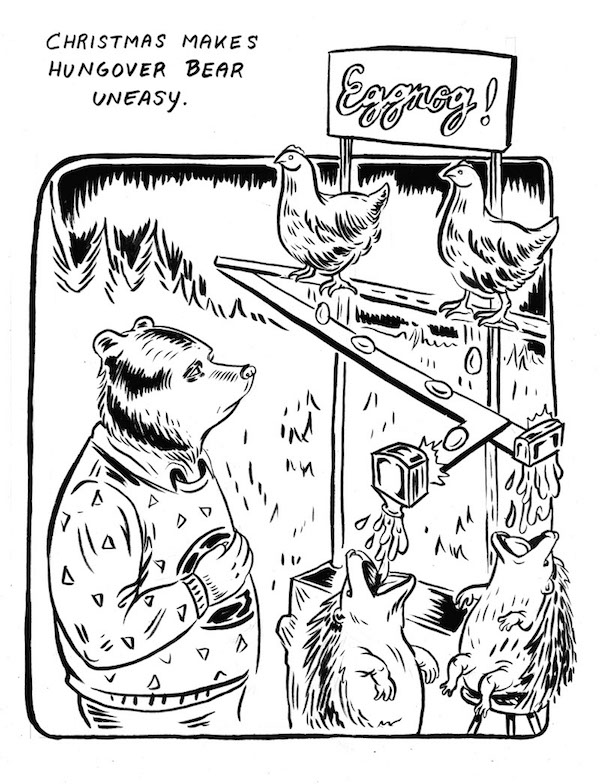
Hungover Bear and Friends: Aspire to More by Ali Fitzgerald

- -

- -

06 Feb 03:18

Get a Good Look at What to Expect From Samantha Bee's Full Frontal

by Kelly Faircloth

Samantha Bee’s Full Frontal just dropped another preview segment, this one dedicated to women and their trials with Veterans Affairs. Taken with all the previous clips, we’re starting to get a good sense of what the show will look like, in advance of Monday’s premiere. (We already know they have one of the most diverse writers’ rooms in late night, too.)

Read more...


04 Feb 21:41

[Video] La explicación más didáctica del TPP: con kiwis papas y berenjenas

by El Mostrador
El diputado Giorgio Jackson es uno de los parlamentarios que se opone a ratificar controvertido pacto. Su equipo el año pasado hizo este video para saber por qué puede perjudicar a Chile


04 Feb 21:26

Interest in New Noam Chomsky Documentary Has Grown So Large That Even the NY Times Ran a Review—and Praised It! (VIDEO)

by Alexandra Rosenmann, AlterNet
In 'Requiem for the American Dream,' Chomsky addresses the vast gulf of inequality in America.

In the new documentary Requiem for the American Dream, produced and directed by Peter Hutchison, Kelly Nyks and Jared P. Scott, Noam Chomsky argues that the collapse of American democratic ideals and the rise of the 1% means that the American dream is harder than ever to achieve. And unlike during the Great Depression, there seems to be no end in sight to this class struggle. 

“The effect of the concentration of wealth is to yield concentration of power. [Therefore] the very fact of inequality has a corrosive, harmful effect on democracy," Chomsky states.

Chomsky was raised in an American middle-class immigrant family in the 1930s. Filmmakers use interviews with Chomsky and archival video from the 1950s onward to illustrate the golden age of American history, as Chomsky calls it. The average worker was able to buy a home, a car and live a life of relative comfort. Upward class mobility was not only aspirational, but achievable.

The widening wage gap, he claims, is "a result of over 30 years of a shift in social and economic policy, completely against the will of the population.” Today, young families are slightly wealthier than their parents were three decades ago, according to a recent BMO Economics Report. However, millennials need to pay more to get their foot in the door and are accumulating debt loads about 260% higher than their parents did at their age. 

"It goes back to the founding of the country. If you read the debates at the Constitutional Convention, James Madison, the main framer, said the major concern of society has to be to protect the minority of the opulent against the majority," Chomsky says. 

The New York Times, which historically tends to ignore Chomsky, ran a prominent review in its Arts section, going so far as to praise the film and callingRequiem a "well-paced and cogent seminar." Reviewer Daniel Gold writes, "citing Aristotle, Adam Smith and James Madison, among others, he melds history, philosophy and ideology into a sobering vision of a society in an accelerating decline. He never raises his voice in this easy-listening jeremiad. 'There’s nothing surprising about this,' he repeats gently in describing what he sees as a 40-year trend of government bent to the will of the superrich at the expense of everyone else. 'That’s what happens when you put power in the hands of a narrow sector.'"

Requiem for the American Dream is now playing in select cities.


Related Stories

27 Jan 17:49

Please Don’t Get Murdered at School Today by Kimberly Harrington

Do you have everything? Homework? Lunch? Field trip money?

I love you.

I remember that one of the Sandy Hook parents said that they took comfort in the fact that they had seen their child off to school that morning — you know that morning — and said, “I love you.” So before their first grader was gunned down in her classroom, she knew that she was loved. I bet they all did though.

But just in case, I love you.

We’ve talked about all kinds of scary things, like I’ve told you never to get into a car with anyone you don’t know and don’t ever believe that an adult needs your help finding a puppy or a kitten. Also: no one will ever give you a free iPad or Legos from their car, that’s just not how the world works.

But for some reason, amidst all the talk of stranger danger and pedophiles, cancer and dying, and me sheepishly asking your friends’ parents if they have a gun in the house, we haven’t really talked about one of the scariest things of all. Those lockdown drills you’re always having at school? No one’s being straight with you about those. They’re to prepare you in case someone decides to come into your school and murder you, your friends, your principal, the secretaries, and teachers before killing himself (it’s pretty much always a him). Sorry about that.

I love you.

I know that may sound scary, but what you need to remember is that this country was founded on freedom. And that includes the freedom of all people (sane, crazy, whatever) to have unchallenged access to guns that are capable of executing at least 20 first graders or 12 moviegoers or 9 of the faithful at a church service or even a baby asleep in her car seat. This is very, very important in terms of staying true to the principles and spirit upon which this country was founded. Just ask the Internet.

I love you.

Also: I think the real victims here are the politicians, how can they be expected to do what’s morally right when they lost their way, not to mention their souls, so very long ago? These politicians — most of whom have children, grandchildren, maybe even great grandchildren of their own — have no qualms about walking past grief-stricken parents who clutch photos of their murdered children to their chests and telling them in so many words, “You don’t have to go home but you can’t cry here.”

They have to know, deep down, that what they’re doing is wrong and the world certainly knows that what they’re doing is wrong but they put their suits on like it’s any other job or maybe they’re convinced that they’re righteous people doing God’s work. But they are no more doing God’s work than the ones who have pulled the trigger over and over again.

And again.

And yet again.

Ad infinitum.

I love you.

I’m sorry, I wish I had better news. But let’s keep our sympathies where they belong — with the powerful and the armed. With those who feel threatened in the face of the most toothless efforts to hold back the bloodshed and those who believe scary monster stories about their guns being taken away. Let’s face it, it would be easier to take away the ocean or the stars. Did you know that there are more guns than people in this country? That means everyone in your class already has a gun with their name on it, so to speak. Maybe mention that at share time.

I love you.

You could also tell your class that sometimes when I hear a lot of ambulances and fire trucks go by, sirens filling the air with panic, I pay close attention to whether they’re heading in the direction of your school. And if they are, I check Twitter and our town hashtag and the fire department account to see if anyone’s mentioned your school. When I get the all clear I think, “Someone else’s tragedy today, suckers!”

And sometimes I wonder, what if one or both of you gets murdered at school? How will I ever forgive myself for sending you there? You know, to school. But do you want to know what makes me feel better? The fact that you could be massacred pretty much anywhere these days! Such a relief, right? So off you go!

I love you.

Yes I know, I know, you’re going to be late. Just to wrap up, our country has chosen to shift all of the weight regarding your safety away from our lawmakers and gun manufacturers and instead put it squarely on the shoulders of your principal and teachers. These people who kneel down on the first day of school so they’re just as tall as you. These people who shake your hand and say, “Good morning!” and help you rehearse for the spring concert and take you on field trips to see different rock formations — they are now in charge of keeping you from getting murdered. Which really is the least they can do for all that money they make.

I love you.

Oh hey, quick reminder, tell your teacher that I’ll be picking you up at 2 o’clock for your dentist appointment.

And please don’t get murdered at school today.

I love you.

21 Jan 05:57

Consumidores coludidos: la gente se organiza contra el poder económico

by Alejandra Carmona

Mucho antes que la Fiscalía Nacional Económica pidiera investigar a los supermercados por colusión, Jorge Bravo (38) ya había sacado algunas cuentas: comprar junto a un grupo de vecinos le regalaba –en algunas oportunidades– hasta un ahorro del 40%.

Este porcentaje es solo una de las luces que le han indicado a Jorge que va por buen camino. La comunidad Juntos Compremos se inició hace 5 años con la idea de hacer frente a la máquina de consumo que enfrenta a los ciudadanos a interesadas cadenas de distribución y, por supuesto, a alimentos que no apuntan necesariamente a mejorar la salud. “Hace 5 años, cuando esto partió, estábamos con más gente en una charla sobre ecoaldeas y ahí empezamos a reflexionar respecto a cómo hacer comunidad en estos tiempos y en la ciudad… por problemas como el sobreprecio, el cómo tratan los supermercados a los proveedores, por ejemplo. Ahí nació la idea de comprar juntos”.

Juntos Compremos es un grupo que posee una lista de 400 inscritos, aunque mensualmente se abastecen 60 familias. La idea es que así, en grupo, consiguen precios mucho más convenientes y también pueden acceder a vendedores sin intermediarios. También hay productos que no están en los supermercados; así también se rompe el sistema que han levantado estos, en torno a su negocio donde también hay marcas que se convierten en vacas sagradas.

La cosa funciona así: cualquiera puede ingresar a la página www.juntoscompremos.cl, pinchar los productos que se despliegan y sumarlos a un carrito. Después de la selección, se paga y posteriormente, en un encuentro que se realiza mensualmente, se hace entrega de la caja con la mercadería comprada. Juntos compremos tiene dos puntos para entregar las compras: una casa en la calle Lastarria y una sede que les prestó la Municipalidad de Ñuñoa, en Macul con Grecia.

También se puede completar una encuesta e ingresar datos personales para ayudar con el proyecto en alguno de los aspectos que se necesitan: traslados, embalaje, etc. “En todo caso, no es obligación tener un rol activo, tú puedes simplemente comprar”, dice Jorge. Por ahora se trata de una agrupación de vecinos trabajando para conformar una cooperativa que tiene como primera meta, en 2016, abrir un almacén cooperativo que aún no posee lugar fijo, pero que quizás podría levantarse en el Barrio Italia.

Si uno va al link de la página, encuentra, por ejemplo, tallarines a $337, huevos a $77 o stevia –de la de verdad, no la que venden las grandes cadenas, que solo posee un porcentaje mínimo de la planta– a poco más de 3 mil pesos.

En Juntos Compremos –lo mismo que en otras iniciativas de este tipo– la idea es que los conceptos que se balbucean en divagaciones, se conviertan en carne y se lleven a la práctica: comercio justo, economía solidaria, consumo responsable y sustentabilidad.

Consumo consciente

Estos conceptos no solamente dan vueltas por Santiago. En regiones, pequeñas iniciativas han dado paso a la venta y compra de verduras y frutas sin necesidad de un intermediario.

Hace un año, en la comuna de San Vicente de Tagua Tagua (Sexta Región), funciona Kulko, una agrupación de agricultores que se conocieron gracias a un programa de la municipalidad vinculado a Indap. Alguna vez trabajaron convencionalmente, pero hace 4 o 5 años descubrieron la agroecología, es decir, olvidar los tóxicos y trabajar la tierra de forma sustentable.

Laura Hernández (33), técnica en agricultura ecológica, es una de las gestoras de este proyecto y cuenta que Kulko funciona “como una plataforma para que ellos promocionen sus productos”. Como un supermercado pagaría estos productos según sus reglas y los agricultores viven amarrados al vaivén de quienes los distribuyen, ellos utilizan un formato que no necesita a las grandes cadenas. “Trabajamos con cadenas cortas de comercialización y sin intermediarios, porque tampoco se busca lucrar con los alimentos. Para ellos también es importante trabajar sin agrotóxicos, porque saben lo que este tipo de agricultura ha provocado en la salud de las personas”, cuenta Laura.

coludidos kulko

Además de las ventas que tradicionalmente hacen cada semana, Kulko participa de diferentes iniciativas, como en el caso de esta foto: “El mercado de la tierra”.

Delfín Toro (50), agricultor de Kulko, tiene la tierra en su línea genética. Sus padres y abuelos se dedicaron a lo mismo, pero él, hace unos años, decidió probar usando abonos y preparados sin tóxicos. “Los supermercados exigen certificación orgánica, cobran 350 mil pesos por 4 meses, pero cuando la conversación es directa con los compradores, ellos saben de dónde vienen sus productos. Hay confianza. Me gusta poder vender así mis zapallos italianos, papas, moras, acelgas de colores… prefiero este circuito corto porque es literalmente del campo a su mesa. Los consumidores pueden pagar por adelantado, pero los supermercados incluso uno o dos meses después”, cuenta Delfín.

Al igual que Juntos Compremos, Kulko funciona gracias a Internet. Cada semana se publican los productos disponibles en una página de Facebook. Los consumidores eligen y hacen el pedido. Estos se hacen con 24 horas de anticipación, porque solo una o dos horas antes de la entrega se cortan las hortalizas. “No es lo mismo que comprar en un súper… La gente tiene que empezar a potenciar lo local y de paso volvernos a reencantar con la comida”, dice Laura. Ellos entregan las canastas en el centro de San Vicente cada semana.

En la lista de Kulko, por ejemplo, la lechuga cuesta $400 y los pepinos $200.

Adiós al intermediario

Descubrir cómo han aumentado los precios en Chile en los últimos cinco años enrabia a cualquiera. Si a eso se suman las colusiones y las condiciones unilaterales que imponen los actores tradicionales del mercado, el resultado es más ira o proyectos alternativos que permitan saltarse el abuso. Este último es el camino que escogió Claudia Cossio, una de las gestoras de Huellas Verdes, un sistema de agricultura compartida.

Claudia Cossio también apunta a la desesperanza que provoca en los agricultores el trato de las grandes cadenas: “El trabajo de los supermercados es ganar plata, una economía de escala. Ellos van a Estados Unidos, por ejemplo, y ven si pueden conseguir naranjas más baratas y, si es así, el productor chileno se queda con su cosecha y compran allá… Me consta que muchas veces un agricultor vende su lechuga a $90 y nosotros la compramos a $1.000. Acá hay dos que se llevan la plata: el intermediario y el que comercializa. El agricultor no gana plata, entonces lo que falla es más profundo… es la construcción social de una soberanía alimentaria”.

“Esto produce un fiato mucho mayor entre el consumidor y el pequeño agricultor, porque este último es el eslabón más vulnerable de la cadena productiva, el que está presionado por la inmobiliarias para vender el terreno, el que no tiene posibilidad de fijar precios”, dice sobre este sistema de economía solidaria que partió el 2011.

Rolando Rojas, un agricultor de Colina, les arrendó las dos hectáreas de su parcela que explotaba convencionalmente, para trabajar de manera ecológica y sin preocuparse de si vendía toda su producción, si negociaba un buen precio o se quedaba con excedentes que nadie comería.

Huellas verdes funciona así: se debe comprar una membresía de $330.000 anuales –que se pagan en seis cuotas–. Aproximadamente, $6.800 a la semana. Eso asegura que sea un trabajo colectivo donde el agricultor nunca pierda, pero también se asumen los riesgos de temporadas de buenas y malas épocas. Se cosecha dos veces a la semana y hay dos puntos de entrega: Santiago y Providencia. Eso da derecho a una canasta de entre 7 y 12 productos semanales. Esa cuota da la posibilidad de que las familias tengan la seguridad de que en su mesa hay alimentos sin agrotóxicos y conozcan al agricultor y el campo de donde vienen sus productos.

coludidos parcela Colina

Rolando Rojas, un agricultor de Colina, le arrendó a Huellas Verdes las dos hectáreas de su parcela que explotaba convencionalmente, para trabajar de manera ecológica y sin preocuparse de si vendía toda su producción, si negociaba un buen precio o se quedaba con excedentes que nadie comería.

Claudia explica que a veces quizás es más riesgoso para un consumidor, pero también es coherente con lo que pasa en la tierra misma. Se comparten riesgos y beneficios.

Claudia Cossio también apunta a la desesperanza que provoca en los agricultores el trato de las grandes cadenas: “El trabajo de los supermercados es ganar plata, una economía de escala. Ellos van a Estados Unidos, por ejemplo, y ven si pueden conseguir naranjas más baratas y, si es así, el productor chileno se queda con su cosecha y compran allá… Me consta que muchas veces un agricultor vende su lechuga a $90 y nosotros la compramos a $1.000. Acá hay dos que se llevan la plata: el intermediario y el que comercializa. El agricultor no gana plata, entonces lo que falla es más profundo… es la construcción social de una soberanía alimentaria”.

Eliminar a los intermediarios fue también la idea de La Canasta, una agrupación de consumidores que nació el año 2010 en Peñalolén. Pablo Santander, uno de los gestores, cuenta que la componen 130 personas –algunas más activas que otras– y que otra de las apuestas era contar con alimentos más saludables. “Buscamos el trato con el productor y queremos también que los productores se organicen en colectivos preocupados de la alimentación saludable, libre de pesticidas”, dice Pablo y resume cómo opera la organización: hay quienes hacen pedidos semanalmente; otros aisladamente. Existe una administradora, que recibe un sueldo, y recibe pedidos vía web. El día de la entrega, hay un turno creado por los socios. La idea es que todos puedan colaborar”, cuenta.

Coludidos la canasta

Periódicamente se realizan asambleas abiertas a todos los socios de La Canasta. Ahí se tratan cuestiones que afecten o interesen a la cooperativa.

Sin embargo, al igual que en la mayoría de las iniciativas de consumidores organizados, no solo se apunta a la calidad del alimento sino también a burlar un sistema que, a la vez, se ha burlado de todos. “Nosotros también buscábamos una política de precios justos. En ese sentido la colusión de los supermercados nos parece inaceptable y buscamos ser una alternativa a estos”, comenta Pablo.


20 Jan 18:13

Tired of Dudes Asking for Nudes? Throw Them Off the Scent With a Photo of a Loading Photo

twitter,nudes,social media,dating

Submitted by: (via jwzayn)

20 Jan 15:43

Overheard in a Retirement Community, 2070 AD by Gareth Watkins

Blake b.1987: “My tattoo is faded now, but you can make out the letters — that there were letters. See, there’s the ‘N’ from ‘FUN’ It says ‘I HAD FUN ONCE. IT WAS AWFUL.’ And there’s a picture of a cat.”

- -

Jerica b. 1985: “I told them, I said, you don’t need to biopsy it and they said, ‘Well, who has a tattoo on their finger?’ And I tried to tell them, I said, ‘It’s a little mustache, see, you put it up to your lip and you have a little mustache.’ But they insisted. So they take a sample and a couple of seconds later they’re like all, ‘Welp, it’s not a cancer’ and I’m like, ‘No the s-word.’ Then they write me up for oppositional-defiant conduct.”

- -

Nirvana b. 1992: “’On fleek.’ It meant when… when…”

- -

Mason b. 1983: “And bacon. We’d put it on everything. We didn’t know what it was doing to us. Nobody did. You can see, from my waist down, it’s a lot of tubes. That there is my stomach, one of them, and this tube is supposed to be a pancreas.”

- -

Kaylee b. 1988: “One of my grandkids, 7Adam I think, gave me a datacube of all my old Instagrams. This was… it was long before that thing people can do now, with the… I was quite the big shot in my day. 17,000 followers. And here, here I am saying ‘Artisan Toast at the Red Door’ then this little symbol here then ‘blessed.’ After all this time I can still recall that it was burnt. Practically charcoal.”

- -

Blake b. 1987: “And this one here, it’s just a blue and green smear now, but in the summer of twenty fifteen this tattoo was getting me to the ‘Chill’ part of ‘Netflix and chill.’ That was what we used to call it, you know, when we would — I don’t know the word you use for it now — copulate.”

- -

Kyle b. 1989: “You’d take a picture of a cat, you’d take any picture, didn’t have to be your cat, and you’d put a caption over it. In text. White and black letters.”

- -

Nirvana b. 1992: “When somebody’s game was ‘On point’ they were… I think it was where…”

- -

Mason b. 1983: “Pulled pork. There was a time, I think sometime in the tens, when we’d put pulled pork in everything. Nobody thought to ask what it do to people in the long term, over generations. And quinoa. Today you’d be arrested.”

- -

Cassidy b. 1986: “And I remember I cried. I cried so hard. They were at a wedding. And his wife was pregnant. Then ‘the Lannisters send their regards.’ I can’t even — can we just stop for a moment?”

- -

Blake b. 1987: “This scar, this was the only tattoo I had removed, back in the ‘40s. I got it in the twenty-tens and it was a rasher of bacon. Once we found out I couldn’t walk down the street with it in good conscience, I got rid of it. I would have been strung up.”

- -

Joshua b. 1989: “And if somebody criticized these games, well what we’d do is we’d call the police in their town and we’d say that they were terrorists or some such, and the SWAT team would come. You have to understand that back then you just couldn’t say that “video games,” that was what we called them, were sexist. So we’d call SWAT teams on them. It was funny until somebody died.”

- -

5Sarah b. 2051: “Grandpa ate a lot of unregistered pig-substance. Multiple-source verified. Eighty-six percent cumulative damage according to subject-expert verification. Subjective: you can still see slight brain activity if you play Deafheaven loud enough.”

- -

Miles b. 1984: “I remember when ten dollars would get you a whole bar of Mast Brothers chocolate. Twenty dollars and you could see a movie. You couldn’t touch it or smell it or be any of the characters. You just got to look at it.”

- -

Brandon b. 1985: “For eight hours at a time you’d just sit there, just watching, then it would ask you: ‘Do you want to continue watching The Mindy Project?’”

- -

Cassidy b. 1986: “9-11 was bad but… they were at a wedding, and Walder Frey had shared bread and salt with them. This has triggered me. I’m sorry.”

- -

Nirvana b. 1992: “The nurses say that I don’t remember much because of somebody named Molly. But ‘On fleek’, that was… I think it was Snapchat.”

- -

Blake, b.1987: “The angry cat, the sad cat, I don’t know what it was called, it had a disease. And its name was… I remember it being something “-ableist.” But we all loved that cat.”

- -

Brandon b. 1985: “I remember when the Internet was just on computers.”

- -

Kaylee b. 1988: “I remember when this was all above water.”

19 Jan 08:16

Jakarta and terrorism’s top dogs

by Zachary Abuza, Guest Contributor
5540855a

A terrorist fires at police in Jakarta.

The latest terrorist attack in Southeast Asia is an attempt to create new leadership among the region’s militants. And, as Zachary Abuza writes, in the bid for the top role, the attacks may escalate. 

The attack in Jakarta that killed eight and wounded 25 should have been no surprise.

Since 2014, the Islamic State of Iraq and the Levant (ISIL or ISIS to others) has increased their base of support across Southeast Asia and revitalised terrorist networks that had been in disarray.

Many point to the similarities between this attack and the recent attacks in Paris; barricade-style assaults, in which a few gunmen swarm into an area, kill as many civilians as possible before confronting responding security forces.

The attraction of this type of attack is clear: it requires low technical sophistication, often without any IEDs whatsoever, a limited amount of small arms training and a lot of testosterone. It requires little skill or even training. The barriers to entry are low, the opportunity to inflict a large number of casualties at the place of choosing is high, and the ability to garner media attention to your cause is, likewise, very high.

Jakarta was a case in point, a handful of men, with little training and very old weapons, were able to cause mass casualties and engage security forces in a two-hour standoff.  The quick response of the security forces prevented what could have been a much larger tragedy.

But one should recall, this was not a mere emulation of Paris. The large Jemaah Islamiyah (JI) cell that was broken up in 2010 had a camp in Aceh to train for the same style of attack, first embraced by the Lashkar e-Taiba in Mumbai in November 2008. Indeed, one of the four militants killed in the Jakarta attack, Sunakim, had previously been arrested for training in that camp.

This style of attack will become a ready tool in the toolbox in Southeast Asia. Most Southeast Asian militants who fight with ISIS are front-line troops, with nothing more than small arms training. And for those who are unable to travel to Iraq and Syria due to proactive policing, these attacks can still be adopted, with some degree of success.

But it will not be the only tactic. There have been four IED plots disrupted in Malaysia, including an attempted suicide bombing late last week. In March 2015, a returnee from Syria tried to detonate a chlorine bomb in a Jakarta shopping mall. There is a danger in preparing for only the last type of attack.

There has and will continue to be much ink spilled on what the attack in Jakarta means. Was it an IS attack, or merely an IS-inspired attack?  For me, the attack is significant for one reason, and one reason only; it is as an attempt to create a new leadership for Southeast Asian militancy.

JI was systematically taken apart following the 9/11 attacks on the United States and the October 2002 Bali bombing. JI perpetrated attacks in 2002, 2003, 2004, 2005, 2007 and 2009.  But each attack ended up weakening the group and each arrest garnered more intelligence.  There were well over a 1,000 arrests across Southeast Asia.

More importantly, those arrests led to intense factional debates within the organisation. Malaysian bomb-maker Dr Azahari bin Hussin was frustrated with the slow pace of attacks, roughly one a year, and wanted to increase the tempo, with more, though smaller suicide attacks, as happened in Bali in 2005. His protégé, Noordin Mohammad Top, doubled down on the al-Qaeda line of targeting the “far enemy” until his death in 2009. Abu Dujana and others weren’t morally opposed to those attacks, but saw them as counterproductive in the current context, and pushed for a resumption of sectarian conflicts in Sulawesi and the Malukus. Neither side was able to garner enough support or effectively execute their strategy and both were taken apart by Indonesian security forces.

Dulmatin and Umar Patek tried to bridge the divide in 2010, with the Aceh cell that wanted to launch frequent, low cost, low tech barricade style attacks. But security forces broke up their cell, arresting or killing over 125 people in early to mid-2010, including the leadership, and their financier Abu Bakar Ba’asyir, once JI’s amir, or spiritual leader. From that point on, JI ceased to being an organisation with any centralised leadership.

This development mirrored debates within al-Qaeda, between Osama bin Laden, who wanted a centralised organisation, and Musab al-Suri, who saw that as being a strategic weakness. He argued that al-Qaeda should be nothing more than an ideology to inspire self-radicalised groups. And while he was correct in arguing that a formal organisation was a strategic weakness, the reality was that small cells and lone wolves were never more than the sum of all parts.

And that was particularly true in Southeast Asia.

By 2010, the pieces of the JI organisation and affiliated groups and charities remained divided over strategy and tactics, ego, limited resources and the impossibility of reconstituting itself under intense dragnets by security forces that had accumulated vast intelligence and knowledge, and were working with one another more effectively.

There were many successor organisations or splinters, but they varied greatly in terms of their capabilities, size and ability to engage in sustained violence. Some, such as the Eastern Indonesian Mujahideen (MIT), under the leadership of Sentoso, remain consistently lethal though geographically contained.

More importantly, each group has tried and failed to assume the leadership mantle and unify disparate organisations. And that’s where ISIL comes into play.

Although more Southeast Asians joined al-Nusra at first, recruitment into ISIL has grown, owing to the latter’s control of resources and territory, as well as its slick propaganda and, until recently, battlefield successes.

ISIL reinvigorated and revitalised dormant terrorist networks, charities and social organisations. It allowed militants to travel overseas, gain combat experience and, more importantly, organise.

Many groups across the region have pledged bai’at (allegiance) to ISIL, including the Abu Sayyaf, Anshaur al Khalifah and the Bangsamoro Islamic Freedom Fighters in the Philippines, and the Jemaah Ansharut Tauhid (JAT) and MIT in Indonesia.

Some did so for opportunistic reasons, others to garner media attention or in the hopes of gaining financial support from ISIL. In the case of the Abu Sayyaf, the spectre of beheadings of captives was seen as a way of raising the psychological pressure to command higher ransoms.

And yet, these groups remain largely autonomous and divided. However, the growth in stature of the Bahasa-speaking company of ISIL, Katibah Nusantara, is changing that. Indonesians Bahrun Naim and Malaysian Muhammad Wanndy Mohamad Jedi, founding members of Katibah Nusantara, are using the group as the nucleus of a new leadership.

While their battlefield success against Kurdish Peshmerga or the recent suicide attacks that killed more than 30, including 12 Iraqi police, both by Malaysians, are important, they need to act at home to begin to consolidate power. That’s why the attack in Jakarta is so important.

Bahrun Naim; the 'mastermind' behind the recent Jakarta terror attack.

Bahrun Naim; the ‘mastermind’ behind the recent Jakarta terror attack.

In the terrorism literature, there is a concept of “outbidding”. While we may be aghast at attacks against innocent civilians, or the beheadings of captives, they resonate deeply in the jihadist milieu. They are a source of empowerment.

More significantly they are a way to prove your leadership through actions. And for someone to garner the attention of both Southeast Asia’s militants as well as ISIL leadership, one must command a sustained campaign of violence. Nothing else, including fiery oration by known ISIL clerics such as the incarcerated Abdurrahman Aman, matters.

The Jakarta bombing was not just an attack against civilians or meant to discredit the Indonesian government or an act of revenge for the concerted campaign against MIT. Nor was it merely revenge for the arrest of some 11 suspects who were planning a wave of sectarian attacks against the small Christian and Shia communities in December. This attack was a move to make Katibah Nusantara the new leadership within Southeast Asian jihadist circles.

But the logic of “outbidding” is that because of the zero sum competition between ISIL cells and al-Qaeda, as well as an alphabet soup of other groups, there must be more violence to stay relevant.  This is an ideological battle to be the vanguard organisation in Southeast Asia. But deeds speak far louder than words.

Zachary Abuza is a professor at the National War College where he focuses on Southeast Asian politics and security issues. Read his report, “Joining the New Caravan: ISIS and the Regeneration of Terrorism in Southeast Asia”, here.

11 Jan 15:07

Hungover Bear and Friends: Voluntary Grace by Ali Fitzgerald


10 Jan 18:37

This Twitter Battle Between Very Lonely Luke and Emo Kylo Ren Takes the Cake

news-star-wars-emo-kylo-ren-very-lonely-luke-twitter-parody

This might be the best Star Wars related hit to pop up on the internet subsequent to the movie's recent debut. Beautiful things happened when the parody accounts for 'Emo Kylo Ren' and 'Very Lonely Luke' collided to exchange blows.

Submitted by: (via DrForester)

08 Jan 22:22

Beatriz Sánchez: “En el “otro Chile” hay chiquillos que se educan por 500 mil pesos, ellos son los hijos de los que se coluden”

by El Mostrador

“En el “otro Chile” hay chiquillos que se educan por 500 mil pesos mensuales. Ellos son los hijos de los que se coluden robándole todos los meses a las familias que no pueden pagar otra educación. Da rabia”, es una de las frases con la que la periodista Beatríz Sánchez reflejó la rabia contenida y acumulada por la ciudadanía ente los distintos casos de colusión y la desigualdad en nuestro país.

La periodista intenta descifrar “¿Qué le pasa a un país que no puede canalizar esa rabia?” y ¿Qué le pasa a un país que se llena de rabia?”.

Lea la columna completa publica en Publimentro:

“¿Qué pasa si no sacamos la rabia? ¿Qué pasa cuando esa rabia se acumula por semanas, por meses, por años? ¿Qué le pasa a un país cuando no puede canalizar su rabia?

Esta semana nos enteramos de una nueva colusión. Esta vez son los supermercados. Antes fueron el papel de limpiar, el asfalto, las navieras, buses interurbanos, las farmacias etc. Pero si no se hubiesen coludido, la actual concentración de muchos de estos sectores les hace posible “matar” a la competencia, maltratar a sus proveedores pequeños y no considerar a sus clientes. Da rabia.

Hace sólo unos días se conoció el resultado de la PSU. El 70% de los alumnos de colegios municipales no superó los 500 puntos. Reciben una subvención un poquito superior a los 60 mil pesos mensuales. En el “otro Chile” hay chiquillos que se educan por 500 mil pesos mensuales. Ellos son los hijos de los que se coluden robándole todos los meses a las familias que no pueden pagar otra educación. Da rabia.

Vimos hace una semana las diferencias de arancel en las carreras universitarias. ¿Qué puede justificar que una misma carrera valga el doble en una u otra universidad? ¿Cómo es que una universidad privada que lucra, gasta más en publicidad de lo que gasta otro plantel completo -que no lucra- en pagar a sus profesores?¿Por qué hoy todos financiamos el lucro en la educación? Da rabia.

Hoy nos enteramos que los parlamentarios tienen la posibilidad de créditos blandos en el mismo Congreso, ayer supimos que ocupan las millas extras de los vuelos comprados con plata fiscal en viajes personales y privados, antes que gastan millones y millones de pesos en bencina, antes de eso que se les paga un viático por ir a trabajar, antes que se enviaban mails con quienes los financiaban para acordar leyes y antes que recibieron financiamiento trucho (no sabemos cuántos) para salir elegidos. Da rabia.

Cuando el 70% gana hasta 426 mil pesos y las pensiones en un 95% no pagan más de 150 lucas. Cuando el salario mínimo no saca a una persona de la línea de la pobreza. Cuando estos mismos que se coluden, pagan a miles de sus trabajadores ese salario mínimo. Da rabia.

El 89% de los que hoy están presos son pobres. ¿Sólo los pobres cometen delitos? Claramente, con todo lo dicho anteriormente, no. Sin embargo, en el Congreso se apuran por legislar una ley corta antidelincuencia para el que roba un celular en la calle y el ladrón de “cuello y corbata”, ese “emprendedor” que se colude, paga una multa y sigue viviendo su vida sin sobresaltos. Seguimos acumulando rabia.

Y después nos preguntamos porque luego de marchas o celebraciones llega una turba a destrozar todo lo que encuentra. O porque no podemos detener la evasión del Transantiago. O como es que nadie participa de los procesos electorales. O porque los niveles de desconfianza son de los más altos de toda América Latina. ¿Cuánta rabia hay allí? ¿Qué le pasa a un país que se llena de rabia? ¿Qué le pasa a un país que no puede canalizar esa rabia?”.

*Columna “La Rabia”, de Betriz Sánchez, publicada en Publimetro.


08 Jan 05:49

Un diplomático sin diplomacia: el caso del embajador chileno en Filipinas acusado de maltrato laboral

by Ximena Pérez Villamil
Natalie Gomez Dunker

HIJO DE PUTA

Desde que llegó como embajador de Chile a Filipinas, en julio de 2014, Luis Fernando Lillo Benavides se caracterizó por actitudes de maltrato laboral y discriminación hacia los funcionarios locales.

Estas han sido denunciadas en distintas instancias, por ejemplo, a través de una carta (escrita en inglés) enviada al canciller Heraldo Muñoz, el 15 de octubre, firmada por cinco empleados filipinos de la embajada, de los cuales Lillo despidió a dos, que ejercían como contadoras. Acusan un “trato inhumano y degradante” y describen que, desde su arribo a la Embajada, “hemos sentido el desprecio hacia Filipinas y su población”. Afirman que Lillo cree que los trabajadores filipinos del sector público y privado son “negligentes” por no ofrecerle “un tratamiento cinco estrellas”, dado que él se encuentra representando a la Presidenta de Chile. (Ver archivo)

Siete meses antes, en marzo de 2015, los empleados plasmaron por escrito sus quejas en la encuesta de clima laboral que, desde hace un año, elabora la nueva Unidad de Clima Laboral de la Cancillería. A raíz de eso, el 23 de octubre se realizó, ante dos psicólogas de la Unidad de Clima Laboral del Ministerio de Relaciones Exteriores una videoconferencia en la que los tres funcionarios filipinos que siguen en la misión chilena expusieron las situaciones vejatorias a las que los somete el embajador. Por separado, los dos diplomáticos chilenos que trabajan en la misión chilena ratificaron los dichos de los empleados locales, pero no firmaron la carta dirigida al canciller Muñoz, debido a que en el Servicio Diplomático el superior, en este caso, el cuestionado embajador, es el que evalúa su desempeño, lo que afecta su desarrollo profesional.

“El Canciller y el subsecretario están informados, pues evaluar y mejorar clima laboral es una obligación que emana de un instructivo presidencial”, aseguró el Ministerio de Relaciones Exteriores.

Lillo fue llamado a informar a Chile, es decir, a dar explicaciones por estos hechos, a pesar de que se avecinaba la visita de Estado de la Presidenta Michelle Bachelet a Filipinas para asistir a la Cumbre de la APEC, el 18 y 19 de noviembre. Su ausencia fue motivo de comentarios en el medio diplomático; incluso llegó a oídos de altos funcionarios del gobierno filipino.

El embajador permaneció casi dos meses en Chile, ya que el primer llamado -entre el 30 de octubre y 23 de noviembre– se prorrogó hasta el 1 de diciembre y luego hasta el 1 de enero. Pero, sorpresivamente, con fecha 30 de diciembre, se informó a la Embajada de Chile en Filipinas que al embajador se le acortó retroactivamente la última prórroga del llamado a informar hasta el 21 de diciembre.

La Cancillería explicó que la extensión es una atribución de la autoridad que puede ser modificada tantas veces como se requiera y que así ocurrió con la resolución exenta 4029 que acortó el plazo del llamado a informar.

Carta de sacerdote misionero chileno

Funcionario de carrera con casi 40 años de servicio, Lillo suele referirse despectivamente a los empleados filipinos, tildándolos de “incompetentes, no saber pensar y no estar capacitados para ocupar los cargos que tienen”. Así lo detalla el sacerdote misionero chileno Luis Eduardo Zapata Fuenzalida, párroco de la diócesis de Caloocan, Manila, en una carta a la Presidenta Bachelet, fechada el 30 de octubre. (Ver archivo)

“Movido en conciencia por el bien y el honor de mi Patria, conociendo la motivación de usted por ayudar a los más débiles y su lucha por la igualdad de todos, le escribo esta carta de modo urgente, ya que me parece que debe estar informada antes de su llegada a Filipinas de una situación que requiere de inmediata solución”, comienza su misiva el sacerdote de la congregación del Verbo Encarnado, quien trabaja en los barrios más pobres de Manila y ha recibido siempre ayuda de los funcionarios de la Embajada de Chile en Filipinas, con los que ha creado lazos de amistad y confianza.

Menciona que cuando el embajador Lillo se enoja con el personal local les reduce la hora de almuerzo a 15 minutos y los obliga a comer de pie en un recinto que sirve de cocina. “A modo castigo los deja hasta las ocho o nueve de la noche”, cuando el horario de trabajo es de 8 a 14 horas por el calor. “De los cinco choferes que ha tenido la embajada, a uno de ellos no lo dejó ir al entierro de su padre, lo que en la cultura filipina constituye un insulto para la familia del fallecido”.

Cuenta que como hasta esa fecha los empleados no recibieron respuesta a su carta al canciller, lo invitaron a conversar. “Los escuché detenidamente por casi dos horas y me enteré de detalles que me parecieron inaceptables y que podrían ser causa de escándalo cuando son realizados por cualquier empleador y que son mucho más graves cuando son realizados por el embajador que representa a la República de Chile”.

Menciona que cuando el embajador Lillo se enoja con el personal local les reduce la hora de almuerzo a 15 minutos y los obliga a comer de pie en un recinto que sirve de cocina. “A modo castigo los deja hasta las ocho o nueve de la noche”, cuando el horario de trabajo es de 8 a 14 horas por el calor. “De los cinco choferes que ha tenido la embajada, a uno de ellos no lo dejó ir al entierro de su padre, lo que en la cultura filipina constituye un insulto para la familia del fallecido”.

Esta carta la elaboró para la avanzada presidencial que fue a preparar la visita de Estado de la Presidenta a Filipinas. Antes de la llegada de Bachelet, el canciller Muñoz se reunió con todo el personal de la embajada –filipinos y chilenos–, comprometiéndose a tomar medidas y a iniciar una investigación sumaria. Esta se encuentra en curso, pero el expediente es secreto, informó la Cancillería.

Filipinas es relevante para Chile, ya que es uno de los socios fundadores de la Asociación de Naciones del Sudeste Asiático (ASEAN) y ambos países iniciaron las conversaciones para un futuro Acuerdo de Libre Comercio.

Denuncias en Comisión de DD.HH.

Los comentarios despectivos y discriminatorios, que manifiesta públicamente en sus momentos de enojo, incluyen frases como “este país de mierda”, “la gente es estúpida e ignorante”, “esto se debe a la falta de educación y de comida”, “ustedes nunca van a avanzar por su mentalidad”.

Lillo fue denunciado por el personal filipino ante el Ministerio del Trabajo de su país por violar las leyes laborales y ante la Comisión de Derechos Humanos de Filipinas por atentados a la dignidad del personal, pero como la Embajada de Chile goza de inmunidad de jurisdicción o diplomática, no podría ser juzgada por organismos locales.

Coincidiendo con estas denuncias, el sueldo de los funcionarios filipinos se duplicó a partir del pasado 1 de diciembre, desde US$500 a $1.000 en promedio.

Ex embajador en Siria y Nueva Zelanda, durante su última estadía en Chile las secretarias de Dirección de Medio Oriente y África presentaron una denuncia por acoso laboral, pero no hubo sumario. Y cuando fue trasladado a la Dirección de Política Multilateral también se generaron conflictos con los funcionarios.

Este lunes 4 de enero Lillo cumplió 65 años, pero como el cese de funciones de un embajador es una facultad de la Presidenta de la República, no implica que jubile inmediatamente al alcanzar esa edad, aclaró la Cancillería.


29 Dec 17:11

9 Spices That May Save Your Life

by Larry Schwartz, AlterNet
Can cinnamon prevent diabetes? Just maybe.

If salt and pepper are all you are using to put some zip in your food, you are not only missing out on adding flavor to your meals, but maybe opportunities for a healthier, longer life. While spices may have begun as a way to enhance the taste of otherwise bland meats and vegetables (boiled mutton only went so far, we’re guessing), the ancients in China and the Far East used many of the spices medicinally for centuries. And it seems they were on to something. 

"There have been many recent studies validating the historic habit of using spices for health benefits,'' Donna Tainter, author of Spices and Seasonings: A Food Technology Handbook, told the website SixWise.com. Modern science has indeed shown that many of the spices in your kitchen are beneficial to your health and potent disease fighters. A study released this past summer in BMJ, which studied almost 500,000 people in China over a four-year period, concluded that people who spiced up their food reduced their risk of premature death by 14% versus those who ate non-spicy food. 

Here are nine ingredients in your kitchen cabinet that can improve your health.

1. Oregano.

Oregano is good for a lot more than sprinkling on your slice of pizza. Rich in phytonutrients, it packs more antioxidant power per gram than oranges, apples or blueberries. Oregano also contains two compounds, thymol and carvacrol, that have strong antibacterial activity. A study in Mexico found oregano to be more effective against an intestinal parasite than the commonly prescribed drug tinidazol. Other studies have shown oregano to have effective anti-inflammatory properties, and ointments made from oregano decrease bacterial infection and help post-surgical wounds heal faster.

2. Red hot chili peppers (including cayenne pepper).

Hot peppers contain the ingredient capsaicin, a powerful anti-inflammatory that helps reduce pain. The hotter the pepper, the more the capsaicin. In addition to pain relief, hot peppers have been shown to help clear nose and lungs of excess mucus, making them an effective treatment for colds and other respiratory illnesses. Interestingly, while consuming hot peppers might be thought to worsen the condition of anyone suffering from stomach ulcers, the opposite is true. Because of their anti-bacterial properties and mucus thinning abilities, hot peppers actually help heal gastric ulcers (which are actually caused by a bacteria the peppers help eradicate). For anyone looking to lose a little weight, a research study at Purdue University found that when capsaicin reaches the gut level, it curbs the appetite and increases the core temperature, resulting in calories being burned faster. 

3. Cinnamon.

Not only is cinnamon a powerful antioxidant, its anti-microbial activity can also stop the proliferation of bacteria, fungi and yeast. This tasty spice can prevent blood clots and maybe even cardiovascular disease. A 2003 study showed that one to six grams of cinnamon a day can help control blood sugar in type 2 diabetes sufferers, while also lowering LDL (bad) cholesterol and overall cholesterol levels. A 2004 study indicated that cinnamon might also prevent insulin resistance, even in a high-fructose diet.

4. Ginger.

The next time you’re feeling nauseated, you might want to reach for some ginger. Its active compound, gingerol, in addition to relieving motion sickness, morning sickness from pregnancy and nausea, also relaxes blood vessels, stimulates blood flow and relieves pain. In use for over 2000 years as a medicinal, ginger is a potent anti-inflammatory and high in antioxidant activity.

5. Turmeric.

If there is a “super” spice in this group, turmeric might take the title. The active ingredient in the spice, curcumin, which gives it its bright yellow color, has been found to be as effective an anti-inflammatory as drugs like hydrocortisone or Motrin. Turmeric can be helpful in battling Crohn’s disease, ulcerative colitis, rheumatoid arthritis, and maybe even cancer, heart disease and Alzheimer’s disease. 

6. Sage.

Sage is not just for turkey stuffing anymore. It is a potent antioxidant and anti-inflammatory, and may be effective in battling rheumatoid arthritis, bronchial asthma and other inflammatory diseases. Further, in a 2003 study, subjects given sage oil had improved memory versus placebo subjects. 

7. Parsley.

Another powerful antioxidant, parsley also appears to have anti-cancer properties, due to a compound in it called myristicin. In animal studies, parsley has been shown to inhibit the formation of cancerous tumors, particularly lung tumors. It also appears to be effective in neutralizing the effects of cigarette smoke and smoke from charcoal grills. Throw in vital nutrients like vitamin C, vitamin A and folic acid, and it is clear that parsley is useful for much more than plate decoration. And if that’s not enough, the chlorophyll in parsley will deodorize bad breath. 

8. Coriander.

People with type 2 diabetes might consider adding coriander to their spice rack. A study in 2011 showed that the spice may help regulate blood sugar and cholesterol. Coriander has additionally been shown to have anti-anxiety properties, making it an excellent sleep aid for anxiety sufferers.

9. Garlic.

What a fortunate coincidence that one of most loved spices also happens to be one of our healthiest. Perhaps the most popular medicinal spice in the world, garlic and its main active ingredient, allicin, has been shown to be an effective combatant against heart disease, high cholesterol and high blood pressure. Not only that, its antimicrobial properties make it nature’s antibiotic. To top it all off, garlic may be effective in warding off dementia and Alzheimer’s disease.


Related Stories

29 Dec 16:48

Someone Calculated How Much Money We've Fictionally Wasted Saving Matt Damon

how much money have we wasted saving matt damon in movies

I think it's time to let Matt Damon die, y'all.

According to Quora user Kynan Eng's calculations, if all of Matt Damon's characters were real, we would have already spent nearly a trillion dollars trying to save him:


Courage Under Fire (Gulf War 1 helicopter rescue): $300k
Saving Private Ryan (WW2 Europe search party): $100k
Titan AE (Earth evacuation spaceship): $200B
Syriana (Middle East private security return flight): $50k
Green Zone (US Army transport from Middle East): $50k
Elysium (Space station security deployment and damages): $100m
Interstellar (Interstellar spaceship): $500B
The Martian (Mars mission): $200B
TOTAL: $900B plus change

What is it about Matt Damon's face that makes people want to keep him safe? Apparently his movies have only grossed $2.7B, so he's not even close to pulling his own fake weight.

matt damon leave him there

Submitted by: (via Quora)

Tagged: matt damon , movies , celeb , money
29 Dec 16:45

Araucanía

by malaimagen

28 Dec 08:21

In search of truth and justice: a tribute to Benedict Anderson

by Francis Loh Kok Wah, Guest Contributor
Floh Anderson 2

Francis Loh Kok Wah (left) with former teacher and friend, Ben Anderson.

Benedict R O’G Anderson (1936-2015)

Author of Imagined Communities, Doyen of Southeast Asian Studies and Scholar-activist

Benedict R O’G Anderson, one of the most respected scholars of Southeast Asian studies passed away in his sleep on Saturday, 12 December 2015 in Indonesia. Anderson had gone to Jakarta for the launch of his latest book which had been translated into Indonesia. With a friend, he journeyed to Surabaya and then to a place on the city’s outskirts which he loved dearly. He spent what turned out to be his last night in a hotel in that place. He was 79 years old.

He was best known as the author of Imagined Communities: Reflections on the Origin and Spread of Nationalism, an instant classic which was translated into more than two dozen languages. Two other highly acclaimed recent books of his were The Spectre of Comparisons: Nationalism, Southeast Asia and the World, and The Age of Globalisation (originally published as Under Three Flags).

He was elected to the American Philosophical Society in 2009, the oldest learned society in the United States founded by Benjamin Franklin. He was awarded the Fukuoka Asian Cultural Prize in 2000 and received the Association for Asian Studies Award for Distinguished Contributions to Asian Studies, the association’s highest honours, in 1998. There were many more awards and accolades for this great intellect.

Anderson’s biography, first published in Japanese due to proddings from Japanese scholars who wanted to know more about his intellectual background and formation, was translated recently and will be published by Verso in July 2016 as A Life without Boundaries. The titles and contents of these books capture the spirit of his life and his work which while focused on Southeast Asia also connected the region to the rest of the globe, explaining the popularity of his writings throughout all parts of the world. He was a true polyglot who excelled in the Indonesian, Javanese, Tagalog and Thai languages, and read Dutch, German, French, Spanish and Russian.

Benedict Anderson was an Irish citizen who was born in Kunming, China in 1936. He spent the Pacific War years in California before relocating to Ireland where he spent much of his youth. He studied the Classics in Cambridge University.

Deciding that he wanted to study Asia, ‘out of curiosity’ as he once said, he enrolled in Cornell University in 1958. He conducted fieldwork in Indonesia in the early 1960s which led to the completion of his path-breaking study Java in a Time of Revolution: Occupation and Resistance 1944-1946, which explored in detail the role of youth in the Indonesian revolution, reminding social scientists the world over about the radicalism that youth always embodies. But it was also a study which highlighted that the revolution was incomplete, a theme that he returned to when explaining the ills of post-Suharto Indonesia.

Even before his book was published, Anderson was recruited to teach in Cornell where he was to remain for his entire academic career. He held the Aaron L Binenkorb Professor of International Studies chair and was Director of Cornell’s Southeast Asian Program and the Modern Indonesia Project too. For decades, he served as Editor of Indonesia, the Cornell-based academic journal devoted to the study of that country, which he co-founded back in 1966.

Anderson’s Imagined Community and his other works which have largely focused on Southeast Asia have been taught and debated for decades, in different parts of the world and in various languages. He has been praised for his originality of thought, for being able to understand a problem or issue from the inside as well as outside points-of-view, for his use of a wide range of sources written in different languages, as well as the unwritten and unspoken, for his accurate and lively translations of Indonesian and Thai writings into English, and for his own elegant writing style. No doubt, his writings will continue to be read and deliberated on in the future, even with his passing.

In search of truth and justice
However, I wish to discuss an aspect of Anderson’s work which is less often highlighted, not especially evident to most of his readers. This great intellect was also committed to a scholarship in search of truth and justice.

For me, such a commitment was honed due to his close association with George McT Kahin who was his teacher and mentor, then his colleague, in Cornell. Kahin’s own classic, the landmark Nationalism and Revolution in Indonesia was a highly detailed, compelling, first-person account of the 1948-49 Indonesian revolution against Dutch colonialism. The book ‘exerted a powerful scholarly and ethical-political hold’ on his generation of Southeast Asianists, Benedict Anderson (1998: 18) had stated.

Recalling his first years in Cornell, Anderson (2003: 10) intimated:

I arrived at Cornell in the waist-high snow of January 1958, excited in a naïve way, yet with no serious intention of staying beyond a year. But the place itself, and Kahin’s teaching on Indonesia, on Southeast Asia generally, as well as on American policy in Asia, soon had me hooked. I realised that I wanted to follow in his footsteps, both scholarly and political.

With pride and respect I reckon, Anderson had pronounced Kahin as ‘the earliest and most prominent Southeast Asianist critic of American intervention in Indochina’. For shortly after the first American troops were sent to Danang, Vietnam in March 1965 by President Johnson (thus opening the floodgates which led to the presence of 485,600 American troops by December 1967), a day-long national teach-in was to be held simultaneously at over 100 American colleges in mid-May 1965, the highlight of which was to be a nationally broadcasted debate in Washington between Kahin and McGeorge Bundy, Johnson’s National Security Advisor.

Although the latter suddenly withdrew from the debate, nonetheless, Kahin was able to use the opportunity to debunk the ‘domino theory’ and deny that the cause of the war was an invasion of Vietnam by ‘Communist China’. He demanded more transparency and information on the war which was leading to increasing numbers of young men being drafted to fight in Vietnam.

Throughout the 1960s and into the early 1970s, Kahin continued to research, write and speak out against the war in Vietnam; its escalation which led to the Pentagon and CIA’s involvement and support for the military in Cambodia; which also resulted in Sihanouk’s ousting. An early criticism of US policy appeared in The United States in Vietnam (co-authored with John Lewis). In later years, Kahin published his masterly Intervention: How America became involved in Vietnam where these developments which he had warned about and protested against have been carefully documented, thanks to access to official and classified documents once the war was over.

Floh anderson 10

Making Indonesia: Essays on Modern Indonesia was presented to Kahin by his former students including Anderson. In the Foreword, the editors Daniel Lev and Ruth McVey reflected on ‘the moral character’ of Kahin’s work which was ‘informed consistently by an unequivocal concern for both truth and justice…evident in his research on the Indonesian revolution and on the intervention of the United States in Vietnam, Indonesia, and elsewhere in Southeast Asia…’.

Many students probably had come to Cornell because they were attracted to the Southeast Asia Program that Kahin had co-founded, and the Modern Indonesia Project which he had started. However, by the time they graduated, they had learnt that scholarship could not be divorced from politics, that they ought to seek truth and justice, and should also ‘speak truth to power’, like their mentor. Anderson and his fellow students shared a common affection and deep respect for their teacher.

Benedict Anderson’s own writings are imbued with this search for truth and justice. He, too, had been critical of political oppression and American intervention in Southeast Asia in his academic writings and also in the public domain, not without consequences for his career.

Following the military takeover of Indonesia on 1 October 1965, which was followed by a massive bloodbath of an estimated 600,000 to one million people who were accused of being communists or had pro-communist sympathies, Anderson and two other colleagues (Ruth McVey and Frederick Bunnell) had written the 162-page ‘Cornell Paper’ released anonymously in 1966.

Drawing upon vast resources of Indonesian newspapers held at Cornell’s library and classified Foreign Broadcast Information Service reports, also stored in Cornell, they had challenged the Indonesian military’s claim, which the US administration was also informing the American public, that the military takeover was sparked by the so-called Gestapu, a power grab led by the Partai Komunis Indonesia (PKI).

Rather, Anderson and colleagues had argued, it was ‘an internal military affair’ spearheaded by colonels in the province of Central Java, though involving some low-level PKI members. It made no sense for the PKI to conduct a power grab when it was already doing so well by resorting to the ‘peaceful road’ to socialism, the authors had argued. ‘To undertake violence would have involved pitting itself against a vastly superior military force and might have thrown the President into alliance with the military’.

Although there were suspicions among the Indonesian military and the US establishment that Anderson had been involved in the writing of the document, he managed to enter Indonesia in 1967. That short visit had allowed him to verify that the Indonesia which he loved so much had been transformed, and the leftist contacts he once interviewed for his research had been killed or disappeared.

With another former Cornell student, Herb Feith, he had the opportunity to attend the trial of Sudisman, the general secretary of the PKI, who was ultimately sentenced and killed. A transcript of Sudisman’s speech before he was sentenced was smuggled out from Court and after it was translated by Anderson was published in 1975 as a 28-page pamphlet titled: Analysis of Responsibility with a lengthy introduction by Anderson.

Meanwhile, in 1971, the Cornell Paper had been released as A Preliminary Analysis of the October 1, 1965, Coup in Indonesia with the names of Anderson, McVey and Bunnell. In April 1972 when he tried to enter Indonesia again, he was expelled. It was not until 26 years later, after Reformasi and the ousting of Suharto that Anderson was able to set foot on Indonesian soil again, in December 1998. Indeed, George Kahin too had been banned from Indonesia, though for a shorter period.

From Indonesia to Thailand, to Philippines, to Imagined Communities
Banned from entering Indonesia, Anderson spent his 1974 sabbatical in Bangkok instead, then in political ferment after the overthrow of the military there on 14 October, 1973, following a popularly supported student uprising. Anderson had started Thai language studies in Ithaca prior to his sabbatical and began to return to that country regularly to conduct research and write about contemporary Thai politics thereafter.

When war broke out between ‘fraternal socialist countries’ Cambodia, Vietnam and China in 1978-79, Anderson also began to reflect over their causes. His study led him to investigate the origin of ‘imagined communities’ called nations, and the spread of the nationalism that they spawned. His younger brother Perry Anderson, the editor of New Left Review was instrumental in directing his attention here, and had encouraged him in the endeavour.

In the late 1980s, he had shifted his research focus again, on to the Philippines. Learning Tagalog and teaching himself to read Spanish, he plunged into a detailed study of Jose Rizal, the father of Filipino nationalism and his writings. Contrary to existing studies, Anderson argued in a new book Under Three Flags the influence of anarchism on the anti-colonial imagination including Rizal’s, especially during his years in exile in Spain.

Hence Anderson’s major works include not only Imagined Communities and works on Indonesian politics like Java in a Time of Revolution; Language and Power: Exploring Political Cultures in Indonesia; and Violence and the State in Suharto’s Indonesia.

His research and writings also produced accounts of the bloody military coup in Thailand in 1976; of the relationship between violence and politics in Thailand in the 1980s; of the ‘old oligarchy’ and cacique democracy in the Philippines; many of these appearing in his The Spectre of Comparisons: Nationalism, Southeast Asia and the World. There was also In the Mirror: Literature and Politics in Siam in the American Era and reflections on ‘colonial cosmopolitanism’ as captured in Menjadi Tjamboek Berdoeri.

Hence the ban from entering Indonesia saw Anderson acquiring new languages and broadening the scope of his research interests over a period of some 40 years! Meanwhile, he continued to teach in Cornell.

His enormous contribution to Southeast Asian studies and later, his reputation as the author of Imagined Communities attracted graduate students – from the US, Japan, Australia, Europe and Southeast Asia – as before, with one major difference. Whereas previously he had attracted students who wanted to write their PhD dissertations on Indonesia, beginning from the late 1970s, his students included those who wanted to write their PhD thesis on other countries in Southeast Asia too.

Still others wanted to study nationalism, beyond Southeast Asia. To honour and thank their teacher on his retirement, some of these students contributed towards a festschrift: Southeast Asia over Three Generations. It is quite clear from the articles in the volume (as well as from the trajectory of their careers) that they had imbibed ‘the inseparability of politics and scholarship’ which Anderson had learnt from his own mentor (Anderson, 1998: 19).

Missing Scholar-Activists?
I recall when I was a student in Cornell in the late 1970s that Anderson’s commitments had included not just teaching and supervising us. Now and again, he would leave the ivory tower to play the scholar-activist or the public intellectual.

He had testified on the subject of East Timor under Indonesia occupation to two US Congress sub-committees, and had spoken publicly on many occasions against the brutality of the Thai military in the 1976 coup. There was also a document prepared for the United Nations on Decolonisation in East Timor. I recall, too, meticulous preparation of comprehensive ‘Fact Sheets’ on these events, as if to say ‘speak truth to power’, which had been distributed widely.

After he had retired from Cornell, Anderson began spending a part of the year annually in the region. From his home in Thanom Pinklao, Bangkok, he travelled to conduct research and to give talks throughout the region, but especially in Indonesia after he was allowed in December 1998 to re-enter the country, following Reformasi there.

He was a much sought after speaker and constantly asked to share his thoughts on political and other developments throughout Southeast Asia, indeed, the entire East Asian region. In the case of Indonesia, he often called for courage to seek truth and justice about the past, particularly the 1965-66 massacres there. For him much of today’s political and social ills there are a result of the incompleteness of the Indonesian Revolution.

FLoh anderson 13

In the course of this role as public intellectual cum scholar-activist, Anderson was invited to be keynote speaker at the 10th anniversary of the Asian Public Intellectuals (API) Programme, a celebration held in Manila in 2009. The API Programme offered some 20 to 30 fellowship awards each year to Southeast Asian and Japanese academics and activists to pursue comparative research in another Southeast Asian country.

The three main themes for the API program had been: changing identities, the quest for social justice and grappling with globalization. The Fellows and the Programme was geared towards ‘the betterment of society’ Applicants could either be young or senior activists or scholars. Anderson was quite excited by the challenge to engage with a conference of some 300 public intellectuals from throughout the region. To prepare his key note address, he had perused ten years’ worth of reports by the API Fellows.

Alas, he was disappointed. In his keynote, he had lamented the ‘missing public intellectual’. For in spite of the occurrence during the previous decade of ‘the most colossal and global economic crisis since the Great Depression of the 1930s’, which had begun with the 1997-98 regional financial meltdown, initially accompanied ‘by an outburst of reformist politics’, but ultimately ‘ending depressingly with the entrenchment of oligarchies in Indonesia, the Philippines, Thailand and Malaysia’, ‘what struck me’ he had observed ‘…was the relative invisibility of all this turmoil’ in the papers he read (Anderson, 2012: 44) . He decried that there was ‘no new Renato Constantino, Pramoedya Ananta Tur, or Sulak Sivaraksa’ among the API Fellows.

Rather than addressing the critical issues of the day – rising authoritarian rule, continuous human rights abuses, worsening socio-economic inequalities and environmental degradation — the API Fellows, he claimed, had focused on rather specific problems faced by particular communities and groups. Perhaps the major achievement of the API program was that it enabled the Fellows to learn about neighbouring situations and to network with their counterparts in the region who shared the same concerns. There was little evidence of the ‘betterment of society’. Still less the emergence of a new generation of Southeast Asian public intellectuals!

For Anderson, this decline of the traditional public intellectual had to do with two profound changes. First, the professionalisation of the local universities resulted in academics specialising in particular disciplines, and writing for one another rather than for the public. As well, the universities to which they were attached were state controlled encouraging them, as civil servants, to align with the political elites who could offer them promotions, recognition and status.

Moreover, to supplement their meager incomes, some began to consult for government, to align themselves to foreign foundations or to media moguls which resulted in research and reports on specific development-related projects. There occurred little independent research, writing and questioning of the broader issues of development policies, the socio-economic and environmental consequences of those policies, and of the political orientation of the regimes in charge of those development policies (Anderson 2012: 44).

Second, Anderson had highlighted the changing culture of national elites and the ways they made use of the state to maintain their hegemony. He was particularly concerned with how the political elites had transformed the universities into institutions that prioritised the training and production of professional-commercial graduates in fields like management, economics, engineering, IT who could be useful for the development effort (Anderson, 2012: 48). A consequence of this thrust had been the sidelining of the humanities and the social sciences, as well as an erosion of a culture of serious writing and reading. Apparently, Anderson was criticizing the ‘technocratic turn’ that has occurred in the educational programmes throughout the region.

Consequently, Anderson had argued, there were hardly any serious works by local academics on the major issues of the day, and especially of the political dominance of the so-called ’veto groups’ and the ruling oligarchs, either for fear of the dire consequences, or because the academicians had been co-opted into the mind-set of the political elites.

Drawing from my experience as Director of the 2009/2010 API Regional Workshop, I agree with Anderson’s critical observations. Put simply, although the quality of the research work produced by the API Fellows was laudable, nonetheless, there was a disconnect between these studies of specific problems and issues to a broader study of overall development policies driven by neo-liberal globalisation, of the structural societal changes occurring, and of the re-emergence of undemocratic rule in the region. Simply put, the small pictures were not adequately connected to the big picture.

This was a major indictment of the API Programme. I think Anderson had intended to say that one does not and cannot produce public intellectuals via a Fellowship Program! Not long after, ostensibly because of funding difficulties and after a period of internal auditing, the API programme was restructured. In December 2014, SEASREP (Southeast Asian Studies Regional Exchange Program) Foundation, yet another organisation funding regional research, organised a workshop ‘The Role of Public Intellectuals in Southeast Asia’ to evaluate Anderson’s lament of ‘the invisible public intellectual’.

My concern here is not to report on the deliberations in the workshop which I participated in; I wish only to stress how seriously Anderson’s critical observations were taken by a substantial part of the would-be public intellectual community in Southeast Asia — for such was Anderson’s reputation as a scholar-activist.

Concluding with Penang
I cannot say that I have kept in very close touch with Ben since I left Ithaca in 1979. However, with access to the email nowadays, keeping in touch has been made easier. Nonetheless, unlike for his former students and colleagues in Indonesia, Thailand, Philippines and Japan, I had not had much opportunity to interact with Ben face-to-face. For he had not incorporated Malaysia — whose ethnic-based politics he found particularly distasteful — directly into his scope of research.

However, because he had spent his winter months in Bangkok, an hour’s flight away from Penang, I had some occasion to visit him. In April 2004 I was invited to speak alongside him in an international forum: ‘Statesman or Manager? Image and Reality of Leadership in Southeast Asia’ held in Chulalongkorn University. In Spring 2005, he participated in a regional workshop I had organised in Bangkok on ‘Peacemaking in Southeast Asia’. And in December 2011, he had attended an ARENA (Asian Regional Exchange for New Alternatives) Congress event, also in Bangkok, upon my invitation.

But there was also a Penang connection. In early 2003, quite unexpectedly, Ben had enquired about the possibility of visiting Penang to conduct some research on his ‘roots’. His father, he intimated, had been born in Penang in 1893. I followed up on his enquiry and after some dead-ends discovered in the Pinang Gazette and Straits Chronicle, a four-page broadsheet published during colonial times, a one-line item announcing that Captain Francis Anderson had been blessed with a son’s birth at Lomond, up in Penang Hill. Within a few weeks, Ben was in Penang and we were trekking to the said colonial-era bungalow.

Ben, his brother and his sister already knew that grandfather Francis was the Deputy Colonial Engineer. Poring over the microfilms of the Pinang Gazette in the library of Universiti Sains Malaysia to which I was attached, we discovered that he had been in charge of all works and construction in Penang Island and parts of the surrounding mainland. He had worked on the reservoir in the Botanical Gardens and was responsible for re-designing the long delayed Penang Harbour Improvement Scheme.

Floh Anderson 5

His proposal was more ambitious and included extending the on-going construction of the Swettenham Pier, building the Church Street Ghaut Wharf, dredging the harbour and related reclamation works. He had been an ex-officio member of the Municipal Commission and had served as acting chairman whenever the Resident was away. The Pinang Gazette printed detailed reports of all the Commission’s public meetings, so that from its pages one could learn a great deal of what grandfather Anderson did and had said. Before returning to England, he had acted as Colonial Engineer and was sworn in as a member of the Executive Council of the Straits Settlements.

We also discovered that Francis Anderson, subsequently, had built his own bungalow called ‘Gracedieu’, which Ben shared was also the name of a family estate a few miles from the city of Waterford, in southeastern Ireland. From his mother he had learnt that his father’s line had ‘been cheated out of inheriting the place’. ‘A real tropical fantasy’, Ben had commented. Alas, the Penang Hill bungalow that grandfather Anderson built had since been torn down and a newer brick bungalow now stands in its place.

My last communication with Ben was in late October 2015 via the email. I had shared with him about my recent visits to Burma where I had been conducting workshops and training sessions on federalism which he was rather excited about. I enquired when he would be in Bangkok again so that I could visit him on my next trip to Burma. He had replied that he was leaving the United States in early November and had a tight schedule over the next two months: two weeks in Manila to help a friend move into his new house; 10 days in Bangkok; then another 10 days in Jakarta, presumably for the book launch. He was keen to come to Penang to conduct some follow-up archival work on his grandpa. So we agreed to meet in early Spring, and maybe visit Burma.

Unexpectedly, a week later, I received from a Penang friend who had helped Ben and me to track down Lomond and Gracedieu in 2003, a digital version of an old photograph. It showed a European couple with a child taken in front of the Lomond bungalow. It was tentatively dated ‘before 1893’. Might the man be Captain Francis Anderson? I forwarded the photograph to Ben who replied immediately.

The photo is definitely my military grandfather and my grandmother. The child is definitely my father. He was the only one of the children who was born in Penang. And when she was ready to give birth they had to summon a doctor whose only way was to ride up [Penang Hill] on a horse…My father was born definitely in the year of 1893. I hope this spring I can go to Penang to persuade the library to scan in the local newspaper for the speeches and reports while he was in the Council.

That email was posted on 30 October. Thereafter he must have been busy travelling from his house in Freeville, outside Ithaca in upstate New York, to Manila, to Bangkok, to Jakarta for the book launch, to Surabaya enroute to this special place on its outskirts that Ben reportedly loved. It was where Ben would breathe his last. So, Ben will not be coming to Penang in Spring after all. Instead he has begun another journey.

Selamat Jalan my dearest teacher and friend. Terima kasih daun keladi.

Francis LOH Kok Wah was Professor of Politics in Universiti Sains Malaysia, Penang (1979-2012). He received his PhD in Government and Southeast Asian Studies from Cornell University in 1980. His dissertation was supervised by Ben Anderson and George Kahin. He is currently president of Aliran (www.aliran.com), a multiethnic human rights NGO, also devoted to social education, based in Penang. He contributed to the festschrift to his teacher.


References

Anderson, Benedict (1972) Java in a Time of Revolution, Ithaca New York: Cornell University Press

________________ (1983) Imagined Communities: Reflections on the Origins and Spread of Nationalism, London: Verso

________________ (1990) Language and Power: Exploring Political Cultures in Indonesia, Ithaca New York: Cornell University Press

________________ (1998) The Spectre of Comparisons: Nationalism, Southeast Asia and the World, London; Verso

________________ (2001) ‘George McT Kahin’, Southeast Asia Program Bulletin [Cornell University], Fall-Winter, pp. 2-3.

________________(ed.) (2002) Violence and the State in Suharto’s Indonesia, Ithaca, New York, Cornell University Southeast Asia Program.

________________ (2003) ‘Selective Kinship’ the Dublin Review, No 10, Spring, pp. 5-29.

________________ (2003) ‘Lomond and Gracedieu’. In Penang Heritage Trust Newsletter Issue No 79, May-June, pp.17-19.

________________ (2007) The Age of Globalisation [originally published as Under Three Flags in 2005], London: Verso

________________ (2012)‘Public Intellectuals’ In Khoo Boo Teik and Tatsuya Tanami (eds) Asia: Identity, Vision and Position, Tokyo: The Nippon Foundation, pp 44- 53.

________________ (2012) ‘Colonial Cosmopolitanism’. In Zawawi Ibrahim (ed.) Social Science and Knowledge in a Globalising World, Petaling Jaya: Persatuan Sains Sosial Malaysia, pp. 371-88.

________________ and Ruchira Mendiones (editors and Translators) (1985) In the Mirror: Literature and Politics in Siam in the American Era, Bangkok: Editions Duang Kamol

Djati, Arief W and Ben Anderson (eds.) (2010) Menjadi Tjamboek Berdoeri: Memoar Kwee Thiam Tjing, Jakarta: Komunitas Bambu

Kahin, George McT (1952) Nationalism and Revolution in Indonesia, Ithaca, New York: Cornell University Press.

_________________(1967) The United States in Vietnam, New York: Bell (with John Lewis)

_________________ (1986) Intervention: How United States became involved in Vietnam, New York: Knopf

________________ (1995) Subversion as Foreign Policy: The Secret Eisenhower and Dulles Debacle in Indonesia, New York: New Press (with Audrey Kahin)

________________ (2006), Southeast Asia: A Testament, London: RoutledgeCurzon.

Lev, Daniel and Ruth McVey (eds) (1996) Making Indonesia: Essays on Modern Indonesia in Honor of George McT. Kahin, Ithaca, New York: Cornell University Southeast Asia Program

Sherman, Scott (2001) ‘A Return to Java’ Linguafranca vol 11, no 7, October, in www.linguafranca.com/print/0110/feature.html accessed 19 Oct 2001.

Siegel, James T and Audrey R Kahin (eds) (2003) Southeast Asia over Three Generations: Essays presented to Benedict R O’G Anderson, Ithaca New York: Cornell University Southeast Asia Program

Sudisman (1975) Analysis of Responsibility Defence speech, translated with an Introduction by Benedict Anderson, North Melbourne: The Works Co-operative Ltd.

14 Dec 15:23

Hungover Bear and Friends: See the Whole Staircase by Ali Fitzgerald

- -

- -

- -

11 Dec 15:19

Noam Chomsky: How the West's Response to Paris Attacks Will Backfire

by Noam Chomsky, The Real News Network
10 Dec 14:51

What Heterosexual Men Think During Sex by Devorah Blachor

During the first kiss

She’s done a good job here above her upper lip. Does she bleach or tweeze or thread, I wonder? Or is this a laser job? Can you believe they can actually destroy the roots with strong beams of light? Science! Wait a minute — I can see some foundation caught in the whitened hair. Definitely a bleacher. That’s cool. I’m not a fascist or anything. As long as I can pretend that she doesn’t have any hair there, I’m totally ok with that. This is making me feel good after what happened at work today.

During the French kiss

I’m really enjoying the shape of her eyebrows. She doesn’t over-pluck like Marlene Dietrich or go too bushy like Keira Knightly. Just the perfect amount of eyebrow pencil and not too much of an arch either — she’s made it look so natural even though she’s clearly applied some gel and used a spoolie to even out the color. This is just really turning me on. I can’t even remember what Doug said to me about fucking up the Watkins account.

During foreplay

Shit. What’s that hair doing on her knee? She missed a spot. I can’t believe it! How hard could it be to shave every strand of hair from your knee? Maybe she doesn’t even use a razor. Maybe she’s bought one of those torture contraptions that removes the hair at the follicle level because she thinks she can get away with not shaving every day. What a cheat. And that one solitary hair is so ugly. What a turnoff. Why is this taking her so long? How the hell was I supposed to know that Fred Watkins cancelled his stop-loss order? Am I going to get fired?

During intercourse

Oh God. Absolutely no pigment spotting on her upper thigh. Wow, she must be so serious not to even use a depilatory. Oh yeah, electrolysis is so fucking hot, that oh yeah, that needle injecting those micro pulses of electricity into her skin. I feel so good and I’m sure that she, oh yes, yes, that she only uses professional electrologists accredited by the American Electrology Association and, oh sweet Jane, that makes me feel so fucking good. There is no Fred Watkins or Doug or money or fear of being penniless and dying alone in this beautiful hairless universe.

During orgasm

Oh, oh, oh, oh, oh, thin bikini-line strip, oh my God, she’s done the perfect sculpting job down here and oh shit, it must have hurt so much because the bulb of the vaginal hair is larger than the pore it was yanked from but oh yes, I’ve heard women cry but just having that strip of hair instead of the full bush is making everything right with the world whereas I would have never been able to get to this stage of arousal with a normal amount of pubic hair and I’m transcending time and space because there are no ingrowns or bumps or redness which means she’s probably exfoliated the area before waxing and applied a calming cream which is so sensible of her and oh yeah, yeah, yeah, and she’s also bought a pricey serum for afterwards and this woman is saving my life by giving me this perfect moment of grace because she spends a half hour of her life every week spreading her legs and lying on her back in a butterfly position so some stranger can spread hot wax on the most sensitive spot on her body and then pull the strip off like a bandaid or if she’s lucky she only has to do it every two weeks and, yes yes yes yes yes yes YES YES YES YES she does it even though it increases her risk of STIs AAAAHHHHHGGGgghgggslllmmhhh…

09 Dec 20:23

A Disabled Veteran Has the Best Reaction To Everyone Expecting Him To Be Racist Now

social media win Disabled Veteran reacts to expectations that he's racist

Submitted by: (via Chris Herbert)

Tagged: racism , veterans , disabled , facebook , win
08 Dec 15:14

Air Force Whistleblowers Risk Prosecution to Warn Drone War Kills Civilians, Fuels Terror

by Amy Goodman, Democracy Now!
The four drone war veterans risk prosecution by an administration that has been unprecedented in its targeting of government whistleblowers

Has the U.S. drone war "fueled the feelings of hatred that ignited terrorism and groups like ISIS"? That’s the conclusion of four former Air Force servicemembers who are speaking out together for the first time. They’ve issued a letter to President Obama warning the U.S. drone program is one of the most devastating driving forces for terrorism. They accuse the administration of lying about the effectiveness of the drone program, saying it is good at killing people—just not the right ones. The four drone war veterans risk prosecution by an administration that has been unprecedented in its targeting of government whistleblowers. In a Democracy Now! exclusive, they join us in their first extended broadcast interview.


TRANSCRIPT

This is a rush transcript. Copy may not be in its final form.

JUAN GONZÁLEZ: Since the Paris attacks one week ago, France has escalated bombings of Syria, and the U.S. has vowed an intensification of its war on the Islamic State. With only a small number of U.S. special forces on the ground, Iraq and Syria have become new fronts in a global drone war that has launched thousands of strikes in Pakistan, Afghanistan, Yemen and Somalia.

But now an unprecedented group is calling for the drone war to stop. In an open letter to President Obama, four U.S. Air Force servicemembers who took part in the drone campaign say targeted killings and remote control bombings fuel the very terrorism the government says it’s trying to destroy. The four whistleblowers write, quote, "We came to the realization that the innocent civilians we were killing only fueled the feelings of hatred that ignited terrorism and groups like ISIS, while also serving as a fundamental recruitment tool similar to Guantanamo Bay. This administration and its predecessors have built a drone program that is one of the most devastating driving forces for terrorism and destabilization around the world."

They continue, saying, quote, "We witnessed gross waste, mismanagement, abuses of power, and our country’s leaders lying publicly about the effectiveness of the drone program. We cannot sit silently by and witness tragedies like the attacks in Paris, knowing the devastating effects the drone program has overseas and at home."

AMY GOODMAN: On top of the toll on civilian victims, the letter also addresses the personal impact of waging remote war. All four say they have suffered PTSD and feel abandoned by the military they served, with some now homeless or barely getting by. The letter brings together the largest group of whistleblowers in the drone war’s history. Three of the signatories operated the visual sensors that guide U.S. Predator drone missiles to their targets. Two are speaking out for the first time; three in a TV broadcast, they’ve never done it before. The other two have previously raised their concerns about the drone program, including in the documentary, Drone. The film, premiering in New York City and Toronto today, reveals how a regular U.S. Air Force unit based in the Nevada desert is responsible for flying the CIA’s drone strike program in Pakistan.

BRANDON BRYANT: We are the ultimate voyeurs, the ultimate peeping Toms. I’m watching this person, and this person has no clue what’s going on. No one’s going to catch us. And we’re getting orders to take these people’s lives.

MICHAEL HAAS: You never know who you’re killing, because you never actually see a face. You just have a silhouette. They don’t have to take a shot. They don’t have to bear that burden. I’m the one that has to bear that burden.

P.W. SINGER: There’s always been a connection between the world of war and the world of entertainment. The military has invested in creating video games that they’re using as recruiting tools.

UNIDENTIFIED: War is an unbelievably profitable business.

CHRIS WALLACE: The drones have been terrifically effective. They’ve taken out a lot of the al-Qaeda leadership. It’s cheap. It doesn’t involve putting troops on the ground.

PRESIDENT BARACK OBAMA: I believe the United States of America must remain a standard-bearer in the conduct of war. That is what makes us different from those whom we fight.

UNIDENTIFIED: United States is violating one of the most fundamental rights of all: the right to life.

UNIDENTIFIED: There’s a large number of innocent civilians who are being killed, and that has to be reported.

CHRIS WOODS: The majority of the secret drone strikes that have taken place have, we have always understood, been carried out by the Central Intelligence Agency.

BRANDON BRYANT: There is a lie hidden within that truth.

AMY GOODMAN: The trailer for the documentary Drone, premiering today in New York City and Toronto. In speaking out together, the four former servicemembers risk prosecution under the Espionage Act by an administration that’s waged an unprecedented campaign against government whistleblowers. They also set their sights on a cornerstone of President Obama’s national security policy just as it threatens to escalate in the aftermath of the Paris attacks. After being elected to office on a platform of Iraq War opposition and a vow to bring the troops home, President Obama has quietly expanded the drone war far beyond its size and lethality under President George W. Bush.

Today, in this Democracy Now! exclusive, these four war whistleblowers join us in their first extended broadcast interview. We’re joined by Brandon Bryant and Michael Haas, who have spoken out to a certain extent before, both former sensor operators for the U.S. Air Force Predator program. Stephen Lewis, a veteran of the U.S. Air Force, is also a former sensor operator for the Air Force Predator program and this week is speaking out for the first time. Also going public for the first time is Cian Westmoreland, a former Air Force technician who helped build a station in Afghanistan used to relay drone data.

But first, I want to turn to Jesselyn Radack, national security and human rights director at the Government Accountability Project, former ethics adviser to the U.S. Department of Justice. As an attorney, she is representing several former drone operators, including this group of four young men who are speaking out today.

Jesselyn Radack, how much do they risk in speaking out on Democracy Now! today?

JESSELYN RADACK: They’re taking an enormous and very brave public risk in speaking out. I have clients in the national security and intelligence communities who have done nothing more than tell the truth about some of America’s darkest secrets, like torture and secret surveillance—and now, in this case, drones—and those clients, a number of them, have been prosecuted under the Espionage Act—and Edward Snowden, of course, another one, is living in exile—not because they’ve done anything wrong or even revealed classified information, which they’re not here to do today, but because they have embarrassed the U.S. government. All of these men—a number of them, half of them, have complained internally, to no avail. They have gone through internal channels.

And we’re hoping that today, by going public, that this will have more of an influence in the debate, because somehow there’s a complete disconnect between these terrorist attacks in Paris and elsewhere and the fact that the drone program has fueled ISIS and al-Qaeda and a number of terrorist groups, and that really needs to be addressed.

JUAN GONZÁLEZ: And I’d like to ask Brandon Bryant—we’ve had you on Democracy Now! a couple of years ago, and these guys here worked with you, as well. Could you talk about the decision to come out as a group, how you came to that and why at this particular point?

BRANDON BRYANT: Well, you know, when I first started talking out about my experiences, it was more to get a bunch of stuff off my chest and to actually try to come clean with what I have done and reveal what exactly is going on. And I’m actually really honored to be with these gentlemen right here, is that I trust them. And this is their decision to come out, and I’m here to support them, because I’ve already been doing this for three years, and it’s time that we just get a bigger coalition of people together to attack this issue.

AMY GOODMAN: Why did you sign this letter? And what are you calling on President Obama to do?

BRANDON BRYANT: We want the president to have more transparency in this issue, and we want the American people to understand exactly what’s being done in their name. And I think that all this fear and hatred that keeps going on is just out of control, and we need to stop it somewhere.

JUAN GONZÁLEZ: Michael Haas, I wanted to ask you, in terms of your experience in the drone program and the culture that the military basically allowed to flourish in the drone program, you’ve talked about how your fellow servicemembers talked about the children that they were targeting, as well.

MICHAEL HAAS: Yes, the term "fun-sized terrorists" was used to just sort of denote children that we’d see on screen.

AMY GOODMAN: What was it?

MICHAEL HAAS: "Fun-sized terrorists."

AMY GOODMAN: "Fun-sized terrorists"?

MICHAEL HAAS: Yes. Other terms we’d use would be "cutting the grass before it grows too long," just doing whatever you can to try to make it easier to kill whatever’s on screen. And the culture is—that mentality is very much nurtured within the drone community, because these—every Hellfire shot is sort of lauded and applauded, and we don’t really examine who exactly was killed, but just that it was an effective shot and the missile hit its target.

AMY GOODMAN: When did you start to have questions?

MICHAEL HAAS: Shortly after I became an instructor and I started to see how much the mentality had shifted since I had been in. And the 11th hadn’t really changed how they had trained their sensor operators from a basic-level standpoint.

AMY GOODMAN: The 11th is?

MICHAEL HAAS: The basic training squadron up at Creech. They train all the sensor operators.

AMY GOODMAN: This is at Creech in Nevada.

MICHAEL HAAS: Yes.

JUAN GONZÁLEZ: And you were a video game addict as you were growing up. Can you talk about this whole impact of sort of the video game approach to war?

MICHAEL HAAS: The thing that makes the gamers a prime target for this job field is that ability to just multitask and do a lot of things subconsciously and just sort of out of reflex. And you don’t really even have to think about it, which is, you know, paramount to doing this job. But a lot of it is getting used to just seeing something on screen, killing it and then going about your business as though you don’t really—you don’t really pay it a second thought. It was just an objective to be completed.


Related Stories

08 Dec 15:03

List: Woman Facts by Sandra Newman

A woman is born with all the exclamation points she will use in her lifetime.

- -

When cornered by a predator, a woman can swell to three times her normal size, but won’t because it is unladylike.

- -

In pre-modern times, sightings of women by sailors gave rise to myths about mermaids. In fact, the woman is not even a fish.

- -

Behind men’s backs, all women speak French.

- -

The “period” is a myth devised by the 1810 Ladies’ Secret Conclave. Tampons actually serve to prevent the genie from escaping.

- -

If you stare at a woman for over a minute without protective lenses, you will go insane.

- -

Whenever a man leaves a room full of women, all the women sigh dramatically and mutter, “Not man enough!”

- -

You can sometimes find tiny, luminous women growing under rotting logs. In the South, these are called “Huckabee wives.”

- -

Take a woman onto your palm. Blow gently on her feathers and she will uncurl and show you her belly. If it has a pink plus sign, she is pregnant.

- -

You may think the woman is invincible. No: If you steal a woman’s earrings, she becomes as helpless as a man.

- -

It is unlucky to bring a woman on board a ship unless you ask her politely not to sing to the kraken.

- -

In Norway, it is considered bad luck to kill a woman that is found in the home. Instead, in a ritual originating in pre-Christian times, the family will bake her a “woman-cake” and marry her to their household spider.

- -

Contrary to urban legend, the woman is not interested in hearing about your day.

- -

When it is time for a woman to lay her egg, she separates herself from the coven and heads off into the wilderness alone. Making her way across hundreds of miles of forbidding territory, she finally comes to the ocean, where she digs a hole at the water’s edge. Here she burns all the photographs of the lying prick who made her pregnant.

- -

Once women who lived unconventional lives were seized as witches and burned. Now people just say to them, “You look tired.”

- -

Large numbers of women can be caught by baiting a trap with a crying infant. Though only one woman may fall into the trap, hundreds of others will gather to criticize everything she does with the child.

- -

If you are concerned you may be a woman, take off your clothes and stand in front of a mirror. If you see a penis and testicles, you are probably a man. If the ghost of a giant on horseback forms behind you, you are a woman.

07 Dec 19:41

Infographic: Why are bees facing extinction?

They pollinate one third of the food we eat and are crucial to our ecosystem. We look at the causes of bee losses.
07 Dec 19:38

Catholics Have The Best Sense of Humor

Catholics Have The Best Sense of Humor

Submitted by: (via Heidi Freidmann)

Tagged: catholics , dogs , heaven , funny
03 Dec 00:39

You Won't Be Able to Look Away From This Adorable Video About How to Calm a Crying Newborn

Pediatrician Dr. Robert Hamilton shares a secret of the trade in how to calm a crying baby.  He suggests that you hold them at a 45 degree angle and shake, shake, shake their booty.  

Who knows why it works? Maybe the baby is too confused to cry any more when someone suddenly starts wiggling their butt around. If you're a parent of a newborn, this video may be lifesaving. Even if you're not it's worth the watch for the calming ambiance and adorable, tiny humans. 

Submitted by: (via Robert Hamilton)

Tagged: baby , cute , parenting , Video