Shared posts

07 Dec 19:01

Letter from America: Happy 130th birthday to English ‘soccer’

by admin

A ‘soccer’ lesson

(Or … A few words from the States on the most contentious of words)   PDF here to read offline

.

Steve HBy Steve Hendricks

6 December 2015

This month marks the 130th anniversary of one of the most traumatic events in British football. Lay historians may think I’m referring to the English Football Association’s decision in 1885 to allow professional players into the game. I’m not. That decision ceased to be controversial almost as soon as it was made, when fans realized they’d rather watch the David Silvas of the day than the lads at Eton on break from their Latin declensions. Also, the FA made that decision in July.

No, the trauma I refer to is the first recorded use, in writing, in December 1885, of the word soccer — or, as the writer styled it, “Socker”, double quotes and all — to describe what till then had been called Association football. (1)

Only moderately controversial at the time, soccer has since become one of the great sources of rage in the Anglophone game, just behind the performance of any English men’s national side of the last generation.

We Americans know this because you Britons roundly abuse us for calling the world’s game by the wrong name. Or, as one erudite analyst put it in a letter ‘To All Americans': “It seems that almost every American can’t understand that there is no sport called soccer …. its [sic] FOOTBALL!” (2)

Or, per another helpful critic: “Soccer. Sawker. I feel dumber just saying it.” (3)
Soccer refs1

And that’s only half the controversy. The other half is a tussle, in admittedly gentler tones, among historians, etymologists, and trivia buffs about just how soccer was coined.

These divisions between and within our two great nations pain me. That’s why today, on this 130th anniversary of the word’s first use, I’m offering up a gesture of Anglo-American goodwill not seen since we took the Wright-Phillips brothers off your hands (not just one brother, I remind you, but both): I’m going to get to the bottom of it all.

One thing that is not in dispute, no matter how deeply it wounds those who think soccer a cheap American neologism (as I myself did for quite some time), is that the word originated in Victorian England. Indeed, nick the surface of soccer, and it bleeds the bluest of English blue, having been gestated in a few of the posher public schools and universities.

The scholars at those seats of learning considered it the greatest fun to snip the ends off words and tack on the suffix ‘-er’, which says something about how hard it must have been to come by fun in an English public school after you had lashed the new boy a dozen times. Thus did a freshman become a fresher, a sickroom a sicker, exercise ekker, and breakfast brekkers. Oxford was so rife with the insufferable ending that it is now known as “the Oxford -er”—not that Oxonians invented it.

The editors of the Oxford English Dictionary, no doubt happy to cast the blame elsewhere, say the -er came to Oxford by way of Rugby School during the Michaelmas term of 1875. That, however, is a bit of a slight to Rugby because the -er had been in wide use at Harrow since at least 1863, when it was recorded that Harrovians called the Duck Puddle, their swimming hole, the Ducker and their peculiar brand of football footer (4).

Soccer refs2

Surely Old Harrovians brought their -er with them to Oxford well before the Old Rugbeians brought theirs during the uncannily precise Michaelmas term of 1875. (5) (That precision is wobbly at best, based as it is on a single unattributed, unexplained line in a thin history of Oxford published half a century after the Michaelmas in question.) (6)

But even Harrow doesn’t deserve all the blame. Since at least the 18th century, some Britons had been calling a potato a  tater and a pinafore a pinner. (A pinafore, incidentally, which is to say an apron pinned down the forefront of a dress, gives us the pinny that soccer players put on over their game shirts when warming up. Since learning this fact, I can’t help but see Luis Suarez covered in flour and readying to bite into a man-shaped pie every time he puts on his pinny.) In short, my English friends, the rot was societal.

As you will perhaps have gathered, it was the Oxford -er that turned the two main branches of English football—Association football and Rugby football—into soccer and rugger. It’s easy enough to see how Rugby became rugger, but it’s not at all clear what would drive a fellow to lift the soc from Association and change its sound from /sohsh/ to /sock/ before adding the er. In fact, it’s unintuitive enough that some astute observers, like Peter Seddon, whose 2004 book  Football Talk chronicles the language of the sport (7), have suggested that soccer surely arose from the fact that players sock the ball or that they do so with a sock-covered foot.
Soccer refs3

The only trouble with such hypotheses is that not one historical document has emerged to support them. If to sock were indeed the origin, you’d expect boys to use the verb in the school periodicals where “socker” and “soccer” first appear. But search those sheets as you may—they are The Oldhallian (the unfortunately named journal of the Old Hall School, where that first instance of “Socker” was used in December 1885), The Carthusian (“soccer”, October 1886) (8), The City of London School Magazine (“Soccer”, November 1886) (9), The Oxford Magazine (“Socker”, February 1887) (10), and  Lancing College Magazine (“Soccer”, June 1887) (11) — and you will find boys kicking and punting, dribbling and crossing, firing and shooting, passing and placing, but never socking. Slang dictionaries of the era make clear that the foremost meaning of sock for public schoolboys was refreshment, especially one obtained outside of school; to sock was to snack or to treat someone to a snack. (12)
Soccer refs4

Happily, the road from Association football to soc and thence to soccer is not as shadowy as it first appears. For one thing, when Oxonians and other students converted a word to -er slang, they usually hacked it down to one essential syllable, which needn’t have been the first.

This, I’m relieved to report, is why we Americans today play soccer rather than asser, although anyone who has watched the excremental play of Major League Soccer might wonder whether the latter name would have been a better fit. Additionally, the students didn’t much care if their extracted syllable kept its original sound. Thus an aspiring joker at Oxford could have a look at unattached student (the term for a student not attached to one of the university’s residential colleges), pull out the tach, turn its flat /a/ into an /aw/, switch out the ch for a sh, stitch on the er, and end up with tosher.

In similar happy-go-lucky fashion, Jesus College became Jaggers, the Prince of Wales became Pragger Wagger, and a wastepaper basket a wagger pagger bagger. The wit knew no end. As it happens, changing /s/ sounds like the c in association and the s in Jesus to hard sounds like /k/ and /g/ also came pretty naturally to other English speakers of the age, as one Professor Robert Hausmann demonstrated in 1976 in a scholarly paper about how bicycle was truncated to bike instead of bice. The process, he informs us, is known as “velar hardening”. (13)

The chap who coined soccer, however, might not have had to harden his own velar. An earlier abbreviation of association might have done that for him. Although today we abbreviate the word to assn., in days gone by it was assoc’n. or assoc. At first, football writers ignored these abridgements even though it meant they had to make frequent use of the cumbersome “Association football” to make clear they weren’t writing about Rugby football. Only in 1879, sixteen years after Association football was codified, did the Eton College Chronicle and Cambridge Review decide enough was enough and start lightly peppering their copy with “Assoc. Rules”,  “Assoc. Cup Ties”, and the “Assoc. University” team. (14) Naturally, you would pronounce “Assoc.” as /Ay-sock/ or /As-sock/. Just six years later, “Socker” turned up at Oxford — voila!
Soccer refs5

I should explain that it turned up at Oxford, not Old Hall, because although it was first printed in The Oldhallian, it was penned at Oxford. The penner was an anonymous Old Hall alumnus (who, were there any justice in the world, would be called an Old Oldhallian but instead is a mere Old Hallian, or so say the killjoys at the school) who had alighted at Exeter College, Oxford, and was sending back dispatches on university doings to his old schoolmates. In his letter of December 1885, after wishing Old Hallians who had gone to Cambridge “every success notwithstanding their bad choice”, he reported that the ’Varsity lost to Aston Villa in what “was pre-eminently the most important ‘Socker’ game played in Oxford this term”—a phrase remarkable not only for the first use of soccer but for the last use, so far as scholars of the field have determined, of preeminently important to describe a game played at Oxford.Wreford-Brown
It would make for a tidy story if I could tell you that shortly after “Assoc. football” arose at Cambridge and Eton in 1879, the term popped up at Oxford, followed by “Socker” in 1885. But “Assoc. football” has yet to be found in any Oxford papers between 1879 and 1885. That deficiency is probably a mere quibble. The robust intercourse between Eton, Cambridge, and Oxford makes it not only plausible but probable that someone brought the abbreviation to Oxford and a later someone made the short hop from “Assoc.” to “soccer”.

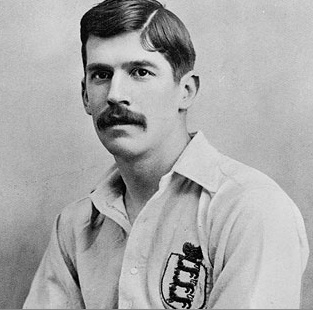
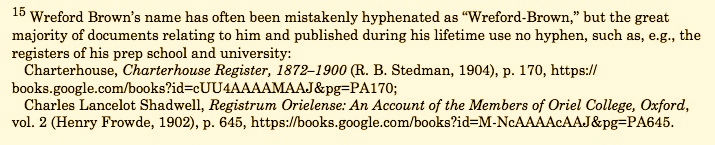
As it happens, there is a tale about that later someone and his hop. The story goes that Charles Wreford Brown, above right (15), an Old Carthusian at Oxford, was breakfasting in the dining hall of Oriel College one morning when a friend asked, “Wreford, will you come and have a game of Rugger after brekker?”
Soccer refs6

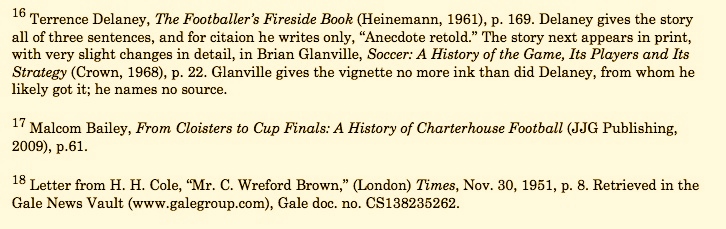
“No, thank you,” our man replied, before adding waggishly, “I’m going to play a game of Soccer.” (16)

The vignette is attractive to those who know a bit of history because Wreford Brown was no footballing dilettante but rather a father of the modern English game. After distinguishing himself at center-half for both Charterhouse and Oxford, he went on to a magnificent career with Corinthian FC, an amateur team so formidable they once filled out an entire English national side, which he captained more than once. He also seems to have been just an all-around good bloke. Once, when his team committed a blatant penalty, he ordered his goalkeeper to step aside and give the opposing player a free net to shoot at. Another time, having been wrongly awarded a penalty kick, he put the ball intentionally wide. (17)

He cut a fine cricketer too and in later life was one of England’s top chess players, although apparently not a calm one: at the British championships of 1933, he had to withdraw after two games (one win, one draw) upon having a heart attack. (18) At his death in 1951 he was a lifetime vice-president of the English FA, involved to the last in selecting the national side.
Soccer refs7

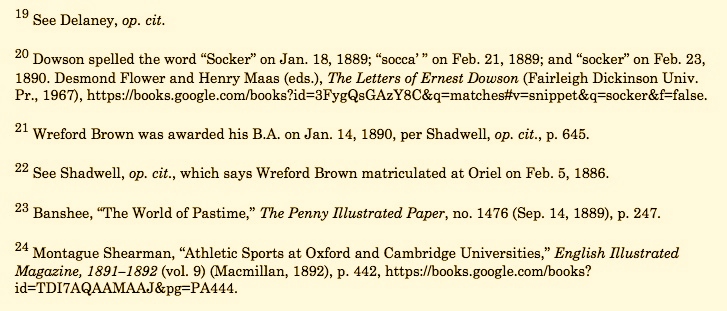
Skeptical minds, however, have long had their suspicions about the Wreford Brown origin story, partly because during his 85 years no one seems to have heard him tell it. Not until a decade after his death, three-quarters of a century after the supposed event, did it surface in all of three unsourced sentences in Terrence Delaney’s 1961 compendium The Footballer’s Fireside Book. (19)

The anecdote could persist for the next fifty-odd years in part because during that time it was thought that soccer was first committed to the page in 1889 (in letters by the poet Ernest Dowson, who first spelled it “Socker”, then “socca’ ”, and finally “socker”). (20) The year 1889 was at the tail end of Wreford Brown’s Oxford days, (21) which meant the timing was right for him to have coined the word. But the quaint apocrypha was undone by the cruelly practical Hathi Trust and Google Books, whose mass digitization of historic documents led to the discovery, last year, of “Socker” in 1885. Since Wreford Brown didn’t get to Oxford until 1886, (22) he couldn’t have made up the word—and so he becomes just another old man whomperjawed by technology.

Whoever coined the word, it wasn’t quick to stick. General periodicals shunned soccer for years, and when they eventually came round—London’s Penny Illustrated Paper seems to have had the honor of being the first, in 1889 (23) — they did so with all the joy of a footman picking up a chamber pot. A report in the English Illustrated Magazine in 1892, for example, noted that a freshman at Oxford could expect to be asked on arrival “whether his game is ‘Rugger’ or ‘Socker,’ by which barbaric terms he has by this time learnt that the games of Rugby Union and Association football are intended.” (24)
Soccer refs8

But soccer’s two syllables, compared to Association football’s seven, would prove too useful in distinguishing the sport from rugby. In time, the grating association with the Oxford -er fell away, and what was left was a byname not just shorter but punchier (literally in this case, thanks to the homophone sock) and perhaps a little more fun than football. Football, after all, even without the bland modifier Association, is merely descriptive: a game played with foot and ball. Your ancestors took to soccer, I suspect, for about the same reason their ancestors took to Geordie notwithstanding the literalists who went in for Novocastrian.

Soccer’s ascent began in earnest in the 1930s. A study of UK footballing books found that while almost none of their titles used the word soccer in preference to football before 1934, every one of them did in 1962. (25) That year, it must be said, was somewhat aberrant, but of 97 books on the sport in the 1960s, 55 went with soccer, 42 with football. And it wasn’t just sportswriters doing it.

Footballing greats John Charles, Jimmy Hill, and Matt Busby titled their autobiographies, respectively and just a touch immodestly, King of Soccer (1957), Striking for Soccer (1961), and Soccer at the Top (1973). This is not to say that soccer enjoyed universal currency. The Times of London, that guardian of stuffiness, used soccer instead of football in just 13 percent of articles during the peak year for soccer in its pages, 1980. (The percentage excludes references to the American game).

At roughly the same time, soccer was peaking in the rest of Britain too—or, better said, was being cast down a dark well, so sheer and sudden was the decline. By 2008, the last year for which Stefan Szymanksi, a professor at the University of Michigan, ran the numbers, soccer’s use in the Times had fallen to 3 percent. By 1998, the last year for Szymanksi’s data on books, soccer’s share of titles plummeted to 19 percent; it has no doubt dwindled to a smidge and a smudge since.

Soccer refs9

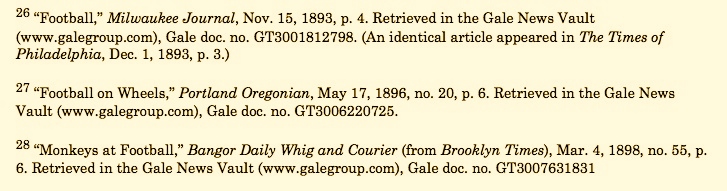
The cause of soccer’s downfall was, ironically, its very popularity—not in Britain, mind you, but in the States. The problem took some time to emerge. Like you, we Yanks didn’t take to soccer right away. It first showed up on our side of the Atlantic (so far as we know) in 1893 in the Milwaukee Journal, which reprinted some deathless epigrams from the London Truth on the difference between “Rugger” and “Socker”. (26) Of Socker, the poet sang:

Not so rough this game, admitted,

Milder form of dislocation;

Accidental kicks or bruises —

All one needs is embrocation.

It doesn’t get any funnier even after you look up embrocation. Over the next decade, we hardly used soccer, although, felicitously, one of those uses was in a story about the English fad of playing soccer on roller skates in barns (“nothing can be more amusing than the efforts of the players to avoid overrunning the ball and colliding with the walls”) (27) and another was in an article about South African monkeys who played the game (“They Likewise Play Cricket, But Not According to Rule”). (28) Apt foreshadowings, these, of the place soccer would occupy in American culture.
Soccer refs10

But if soccer didn’t thrive in America, soccer eventually did—and for precisely the same reason it did in Britain: for its concise, punchy way of separating the game from the nation’s other form of football. (The irony, I trust, will not be lost on even the dimmest soccer-phobes.) This was fine with you lot and probably would have remained so for all time had our soccer remained penny ante.

But as the 20th century wore on, more and more of us listened to your protestations that Association football was superior to American football, and when a critical mass of us saw how right you were, we sired a sad little starveling called the North American Soccer League. It expired after just sixteen years, in 1984, but before its decease the league’s New York Cosmos made an astonishing addition to their roster: Pelé.

Even in 1975, in the dusk of his career, the great Brazilian had a lot of magic in his cleats. (Cleats, by the way, is another word we got from you—Middle English, cletes—but that you now give us grief for using. That, however, is another story.)

Throughout Pelé’s couple of years with the Cosmos, the world was treated to clip after clip of the wonders he was conjuring in the American soccer league.

(The video below is ‘Once in a lifetime: the extraordinary story of the New York Cosmos’, and is highly recommended. Depending on where you are located in the world, this may be geo-blocked. If that’s the case, and you’re interested in watching, try your local YouTube or get it on DVD).

Contemporaneously, the U.S. men’s team began their slow transformation from abomination to that particular species of mediocrity capable of a good run. We became the Tottenham of world soccer: not much in anyone’s thoughts but impossible to ignore entirely. Then in the 1990s we hosted two World Cups. We won the women’s and have dominated their half of the world game ever since—and in the bargain have done girls everywhere a world of good by showing what happens when you don’t discriminate against them. Sometimes we Americans live up to our professed values.

The long and the short of the foregoing is that for forty years Britons have been hearing at least occasionally and sometimes more than occasionally about American soccer. And you will only hear more now that Major League Soccer has become a refuge for your cast-offs—a role, I am proud to say, that carries forward one of the noblest parts of our history. Might I gently suggest, however, that when our forebears offered to take in your tired and huddled masses, the wretched refuse from your teeming shores, the homeless and tempest-tost yearning to breathe free, they didn’t really mean Liam Ridgewell.

You Brits, alas, haven’t welcomed our interest in your sport as openly as we’ve welcomed your washed-up sportsmen. Your reluctance, I concede, is somewhat understandable. Who, after all, wants his or her national sport tainted by a breed of people who barely know how to play the game and, worse, belch up morons by the million who mock it as duller and sissier than the armored tedium that is American football? The (thankfully) late Republican Congressman, failed vice-presidential nominee, and draft-dodging quarterback Jack Kemp went so far as to declaim on the floor of the House, “I think it is important for all those young out there, who someday hope to play real football, where you throw it and kick it and run with it and put it in your hands, a distinction should be made that football is democratic, capitalism, whereas soccer is a European socialist [sport].” (29)

Many younger Britons, hearing soccer time and again in such contexts and unaware of the nativity and long domestic use of the word, understandably came to see in it just one more locust in the unyielding and unyieldingly tawdry plague that is American culture.

Soccer refs11

So you dumped soccer. Had your revolt stopped there—had you settled for cutting off your nose to spite our face—all might have been fine enough. But it didn’t stop there. Your understandable anti-Americanism opened a septic vein from which vitriol first trickled, then flowed, and now gushes in a torrent that sweeps away fact and reason before it—a sadly common progression for many a justifiable anti-Americanism, whether in Camden Town or Kandahar.

Thus can an otherwise intelligent journalist (to pick just one from the legion) write, and his editors find fit to print: “Association football began its conquest of the world, and eventually everyone came to call the most ubiquitous game in the world football. And that was that. Except it wasn’t, because for reasons that are not immediately apparent, the Americans decided to invent a meeker, idiotic version of rugby, which they called American football.” (A good line this, which I plan to use at the next interminable Super Bowl party I am forced to attend.) “And for that reason, what they should call football they call soccer. And as only Americans can, they have steadfastly refused to obey the rules of things. They always have an air of faint surprise that the rest of the world does not call it soccer.” (30)
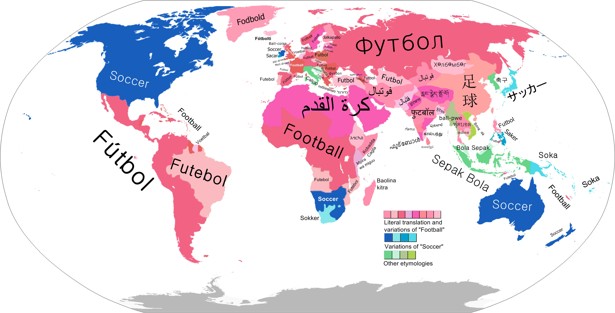
What the world calls it

What the world calls it

In fact, the rest of the world—the rest of the Anglophone world anyway—calls it soccer. Canada, South Africa, Australia, New Zealand, and a goodly share of Ireland do. In South Africa, even the Afrikaners call it sokker, and in Canada, the Québécois, who loathe every other English word, use soccer unmodified by so much as a circumflex. Britain is alone among the world’s major English-speaking countries in banishing the term. In fact, wipe us 320 million Americans off the map (a tempting thought, I know), and the world would still have more than 100 million soccer-inclined speakers in the above five countries. Rather puts your 64 million football-inclined speakers in perspective, what? Toss the United States back in, add countries where English isn’t spoken but where soccer reigns supreme (as in Japan, which uses sakkaa) or where soccer has parity with football (as in the Philippines, where it’s saker), (31) and the world’s soccer speakers number more than half a billion. Truly the sun never sets on the British linguistic empire.

Soccer refs12

Lamentably, the word’s global reach may not last. The salvos you have fired at soccer have been the shots heard round the world. In recent years, the Australian and New Zealand soccer federations have meekly fallen in behind you (a longstanding fault of those nations, despite our having shown them a better path in 1776) and renamed their game football. (32)

This is especially imbecilic in Australia, where the most popular sport (33) is already called football. Japan is so cowed by your censure that they call their sport football to the outside world (“Japan Football Federation”, the official English name) while maintaining soccer internally (“Nihon Sakkaa Kyokai”, the official Japanese name).

This woeful trend will likely only accelerate because as soccer declines in Britain and the less courageous parts of the Commonwealth, it is becoming associated with something even worse than Americanism: oldness. Soccer is now the game your granddaddy played—a game, as one Anglophone put it, regrettably evocative of “skimpy satin shorts”, “black and white truncated icosahedron balls”, and “the dreadful Soccer Sunday” of 1990s Welsh TV. Football, by contrast, speaks of “a classier, more substantial brand of the game”. (34)
Soccer refs13

Grim times, these. Nevertheless, I can offer a grain of hope to enlightened Britons—to the cultured few among you who esteem soccer for its simple, sprightly utility, its proud English heritage, and, in late years, its charming underdog struggle against the newly snobbish football.

The succor I extend is this: We Americans will keep your tradition alive. We will continue to use soccer, no matter the world’s opprobrium. We are good at this. We have had practice. And later, in a future perhaps quite remote, when Britons of refinement have shown their countrymen the error of their ways, and your nation is ready to have its word back, we will give it to you as freely as a Tom Cruise blockbuster.

In return we ask only that, next time, you send a single Agüero instead of two Wright-Phillipses.

.

Steve Hendricks is the author, most recently, of A Kidnapping in Milan: The CIA on Trial. He watches Manchester City and FC Barcelona from Boulder, Colorado. Visit his website.

.

More on soccer (or search for anything else in box at top right)

Follow SPORTINGINTELLIGENCE on Twitter

LinkedIn Twitter Yahoo Messenger Share/Bookmark
07 Dec 13:59

Fortuna Düsseldorf player made to referee girls’ game after sexist remark

by Guardian sport
• Kerem Demirbay told official ‘women have no place in men’s football’
• Bundesliga 2 club dished out their own punishment for 22-year-old

Fortuna Düsseldorf came up with a novel way of teaching a young player a lesson when the German club made the midfielder Kerem Demirbay referee a girls’ football match on Saturday as punishment for making a sexist comment towards a female match official.

Related: Hitz and miss: Augsburg keeper apologises for sabotaging penalty spot

Continue reading...
07 Dec 13:58

Arsenal pay tribute to lifelong fan killed on his way to Sunderland match

by Guardian sport
Timmy the Tooth

WHAT???

• Ernie Crouch, 90, was blown by gust of wind into a bus
• Crouch attended his first Arsenal match in 1934

Arsenal have paid tribute to a 90-year-old supporter who died after he was blown by the wind into a bus on his way to Saturday’s match against Sunderland.

Ernie Crouch, who attended his first Arsenal match in 1934, is believed to have been caught by a gust of wind and blown into the road near Finchley Central station. He was attended to by emergency services but later died of his injuries.

Continue reading...
05 Dec 18:19

Photo

Timmy the Tooth

Kit Duncan


04 Dec 20:49

Fifa official paid £6.6m bribe - FBI

Timmy the Tooth

Hmm... who could that be? Everyone else has been arrested...

A high-ranking Fifa official is identified by the FBI as a suspect in a £6.6m bribe paid in return for votes for the 2010 World Cup.
03 Dec 22:59

Knit Wit: 17 Fantastically Weird Fiber Art Creations

by Steph
[ By Steph in Art & Sculpture & Craft. ]

weird knits my boyfriend

Imagine your grandmother presenting  you with a knitted facehugger, dwarven helm or a life-sized boyfriend pillow for your birthday instead of a scratchy wool scarf. The world of knits goes far beyond beginner’s patterns for sweaters and caps, occasionally encompassing entire rooms or covering military tanks. This collection of weird knitted and crocheted things might even inspire you to break out a pair of needles yourself.

Facehugger Mask
weird knits facehugger

Well, isn’t that cute. It’s a cozy little alien face hugger, just like you always wanted.

Brutal Knitting by Tracy Widdess
weird knits brutal

weird knits brutal 2

weird knits brutal 3

weird knits brutal 5

‘Brutal Knitting’ is a fitting name for this ongoing project by artist Tracy Widdess, which stretches the craft far beyond its humble origins of warmth and practicality. Her highly unusual knit works include some of the most bizarre hats you’ve ever seen, and a replica of the Lament Configuration puzzle box from Hellraiser.

The World’s Cutest Penguin Sweaters
weird knits penguin sweaters

weird knits penguin sweaters 2

weird knits penguin sweaters 3

Australia’s oldest man, 109-year-old Alfred Date, put his 80 years of knitting experience to work to create the world’s cutest sweaters for a bunch of oil-covered penguins after a spill on the Australian Phillip Island. The sweaters keep the penguins from ingesting toxins and prevent water from getting trapped under their oily feathers, which can cause them to freeze.

Gimli’s Dwarven Helm
weird knits dwarven helm

“The helm I based directly on the helm that Gimli wears in the Lord of the Rings movies, the beard was my own design with massive creative input from my brother,” says DeviantArt member SadDaysCrochet of this creation.

My Knitted Boyfriend
weird knits my boyfriend 2

weird knits boyfriend 3

If it’s a little lonely in your bed, but you don’t have the patience that a real flesh-and-blood boyfriend requires, there’s a solution. ‘My Knitted Boyfriend’ can be worn like a terrifying bodysuit by a real person, or stuffed to create a life-sized man-shaped pillow.

Surreal Knitted Room by Olek
weird knits room oleksiak

weird knits room oleksiak 2

The fiber artist known as ‘Olek,’ who’s responsible for yarn bombing practically every surface you can think of, knitted an entire gallery space for a piece called ‘Keith Meets Arch of Hysteria,’ a tribute to artists Keith Haring, Annie Leibovitz and Louise Bourgeois.

Next Page - Click Below to Read More:
Knit Wit 17 Fantastically Weird Fiber Art Creations


Want More? Click for Great Related Content on WebUrbanist:

Rock n’ Knit: Low-Tech Chair-Powered Hat Factory

Rocking-Knit by students at Switzerland's ECAL university is a rocking chair that knits red beanie caps as you rock, making you part of a low-tech hat factory. Click Here to Read More »»


Knit Wit: More Of Olek’s Amazing Crochet Art

When it comes to knit graffiti, yarn bombing or urban knitting, NYC-based artist and crochet queen Agata Oleksiak (known as Olek) has got it all sewn up! Click Here to Read More »»


Yarn Bomb Bus: Knitted Double Decker Cruises Around London

Has there ever been a cozier-looking bus cruising around the streets of London than this neon yarn-bombed double decker dubbed the No. 7up? The beverage brand ... Click Here to Read More »»


Share on Facebook

[ By Steph in Art & Sculpture & Craft. ]

[ WebUrbanist | Archives | Galleries | Privacy | TOS ]


03 Dec 20:29

Video


02 Dec 19:04

Mostly Uninformative Infographics: About the Election Cycle by Cecilia Esther Rabess

Timmy the Tooth

Brilliant again!

- -

- -

- -

- -

- -

- -

- -

- -

02 Dec 14:34

Night House: Artist Cloaks Suburban Home Facade in Starry Skies

by Urbanist
Timmy the Tooth

CHICAGO

[ By WebUrbanist in Art & Installation & Sound. ]

night house suburban intervention

House painting is such time-consuming and meticulous work just to get a single color on a facade; perhaps next time you could clad your home in printed image of the night sky instead.

night house looking up

night house in making

For the Night House, Chicago artist Kate McQuillen covered a suburban house with a contiguous skyscape of nighttime space images digitally printed on weatherproof styrene panels.

night house poster project

The project was funded by sales of a screenprinted poster and created as part of the Terrain Biennial, an Oak Park-based international exhibition of yard, balcony and porch interventions.

night house glowing stars

night house screenprinted wall

Like some kind of suburban camouflage, the covered sections of the home start to disappear against the backdrop of the sky at the right times of early evening and morning. Read also: The Night House, a poem by Billy Collins.


Want More? Click for Great Related Content on WebUrbanist:

Perfect Pitch: Impossibly Starry City Skies in Blackest Night

There is simply no way to see the starry skies above the typical urban metropolis - but one photographer has found a way to simulate the stunning potential ... Click Here to Read More »»


Suburban Intervention: Homes Altered, Then Set Ablaze

For the last two years, artist Ian Strange has traveled the East Coast of the United States, painting suburban homes in shocking shades of red and black, and ... Click Here to Read More »»


Secret Skies: See Starry Nights Normally Hidden by City Lights

With the rise of urbanization, an estimated 80% of the world population has never seen the Milky Way – and while rural dwellers see thousands of stars on ... Click Here to Read More »»


Share on Facebook

[ By WebUrbanist in Art & Installation & Sound. ]

[ WebUrbanist | Archives | Galleries | Privacy | TOS ]


02 Dec 13:48

Cookie Science: Why Cream Butter and Sugar?

by Bravetart
Timmy the Tooth

LOOL how to cream butter.

HA HA HA


Does your cookie recipe call for creaming the butter by beating it with sugar? Just how important is that step, and how do you know if you're doing it right? We break down the science of creaming and explain exactly how to do it. Read More
01 Dec 20:06

Water Bed: Tow an Amphibious Mobile Shelter Behind Your Bike

by Urbanist
[ By WebUrbanist in Boutique & Art Hotels & Travel. ]

mobile water bed

Combining the cheap convenience of a hostel with the outdoor access of a tent, this wheeled micro-dwelling can be carted behind a bicycle then lowered into the water for a night of floating fun.

wheeled bike nomadic

bike bed trail

Created by Royal College of Art (RCA) graduate Daniel Durnin, the shelter features a watertight bottom, canvass walls and operable wood-framed fenestration for viewing and circulation.

water bed on wheels

water bed nomadic

The tent-on-the-water approach renders urban lakes, rivers and streams suddenly more accessible, creating alternative campgrounds that take up no space on land. It is designed with city’s like Durnin’s own (London) in mind, places where waterways are more prevalent than unused grounds.

water tent floating

bike bed in water

“I hope that the work will reawaken our connection with nature using the waterways as a catalyst and restore balance to the more networked living space that we now inhabit, not just in London but across the globe,” says Durnin.


Want More? Click for Great Related Content on WebUrbanist:

Bike Tire Tent: Compact Travel Shelter Wraps Inside Wheels

For the cycling nomad, this design uses space you never knew you had, and helps free up room in front-of-handlebar baskets or on above-back-tire racks for ... Click Here to Read More »»


Modified Water Bike: Inventor Commutes San Francisco Bay

Both the first person to bike across the San Francisco Bay and over the Hudson River is great, but being able to skip traffic jams and cycle to work over the ... Click Here to Read More »»


H2O to Go: Bike Bottle Makes Water from Thin Air as You Cycle

Using air flow and solar energy, this ingenious device creates up to 16 ounces (a half-liter) per hour of drinkable water via condensation as you ride, ... Click Here to Read More »»


Share on Facebook

[ By WebUrbanist in Boutique & Art Hotels & Travel. ]

[ WebUrbanist | Archives | Galleries | Privacy | TOS ]


28 Nov 04:05

VIDEO: Luol Deng's Premier League predictions

Timmy the Tooth

WHOA... Zombie Deng?

NBA superstar and Arsenal fan Luol Deng gives his predictions for this weekend's Premier League fixtures.
28 Nov 03:40

Mathieu Valbuena ‘deeply disappointed’ by Karim Benzema over ‘sex tape plot’

by Kim Willsher in Paris
Timmy the Tooth

This is the strangest story in sport.

• ‘When you insist that I meet someone … hmmm,’ says Lyon midfielder
• ‘I’ve never known of anyone willing to destroy a video for free’

Mathieu Valbuena has spoken for the first time about how Karim Benzema allegedly encouraged him to pay blackmailers demanding money for a sex tape.

Valbuena’s fellow France international has been mis en examen – the French equivalent of being charged – accused of being part of the extortion plot.

Continue reading...
28 Nov 03:14

Weekend Reading: Kima Cargill on Food Psychology

by Marion
Timmy the Tooth

Kima is faculty at UW Tacoma.

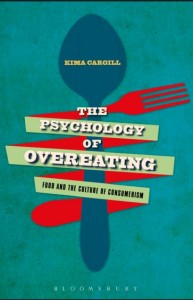
Kima Cargill.  The Psychology of Overeating: Food and the Culture of Consumerism.  Bloomsbury, 2015.

Capture

I did a blurb for this one:

Psychologist Kima Cargill takes a tough, critical look at today’s consumerist culture from the perspective of research as well as of observations drawn from her clinical experience with patients struggling with weight issues. To stop overeating in today’s food environment means finding effective ways to counter the many moral, political, economic, and social imperatives to consume. The ideas in this book should inspire readers to think of obesity in an entirely different way—more as the result of a consumerist society than of individual weakness.

27 Nov 21:02

Xherdan Shaqiri: Why the 'Alpine Lionel Messi' is loving life in Stoke

by Jason Burt
Timmy the Tooth

My guess is it's the french fries and ketchup.

Fat fucker.

Exclusive interview: Xherdan Shaqiri explains why a 'flip flap' against Chelsea proves he is getting back to his best


27 Nov 20:58

Why angry shouting men are a fading force on our children’s touchlines | Barney Ronay

by Barney Ronay
Timmy the Tooth

Where has "Bad Angry Shouting Football Man" gone? To Twitter, the blogs, and comments sections in general.

The great junior football archetype – the hectoring wannabe coach – still stalks our parks but in a gentrifying game where the best are whisked away by academies he is a dying breed

If you have any involvement in junior football in England – coaching, parenting, standing around feeling sad and stricken – you will be familiar with The Respect Barrier. A flimsy, hopeful plastic awning pegged out along the touchline, the Respect Barrier is part of a long-standing Football Association campaign to improve the touchline “behaviour” of those who watch. It’s there every week up and down the country: a suggestion, a reminder, the stewarding equivalent of standing around in your pyjamas politely clearing your throat while the local tearaways buzz around doing wheelies on your front lawn.

“Fuck off back behind the fucking Respect Barrier!”: this, offered up by the coach of an under-11 team, is the best, and indeed only, acknowledgement of the Respect Barrier’s existence I’ve heard during the last couple of years of watching my sons play junior football, a world that seems both very familiar and profoundly altered since my own days playing in the same south London leagues.

Continue reading...
27 Nov 18:02

A 14-Year-Old Just Solved A Rubik’s Cube In Under Five Seconds

by Oliver Roeder
Timmy the Tooth

I solved a Rubix Cube. Not sure what's so special about this.

roeder-rubikcube-1-highres

Fourteen-year-old Lucas Etter is now the Roger Bannister of the Rubik’s cube. On Saturday, Etter became the first person to solve a Rubik’s cube in less than five seconds under sanctioned competitive conditions. That’s the kind of breakthrough that Bannister made in 1954 when he became the first person to run a mile in less than four minutes. Etter’s time was 4.90 seconds, 0.35 seconds better than the record-holder going into Saturday’s competition, Collin Burns.14 The chart above shows the progression of the official world record, according to the World Cube Association.



In these competitions, the colorful cubes are randomly scrambled according to a computer program, and a solver has 15 seconds to inspect a cube before racing to spin it back to its organized state. The first official record — 22.95 seconds — was set at the first world championship, held in 1982 in Hungary, home country of the cube’s inventor, Erno Rubik. But speed cubing went into hibernation for two decades, until the next world championship was held in 2003. From there, the record has fallen precipitously, thanks to innovations like the Fridrich method, the Petrus system and even “cube lube.”

If you’re curious what it looks like to solve a Rubik’s cube in less than five seconds, here’s video of Etter’s feat, which occurred at a tournament in Clarksville, Maryland.

26 Nov 15:58

Photo

Timmy the Tooth

Damnit, David.


24 Nov 17:47

Eff You: Sleek & Superior Bicycle Defies Global Racing Rules

by Urbanist
Timmy the Tooth

Awesome bike.

[ By WebUrbanist in Technology & Vehicles & Mods. ]

rule breaking bike

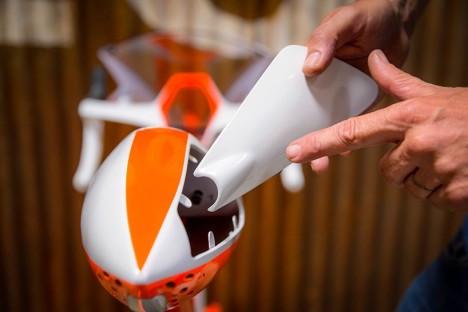
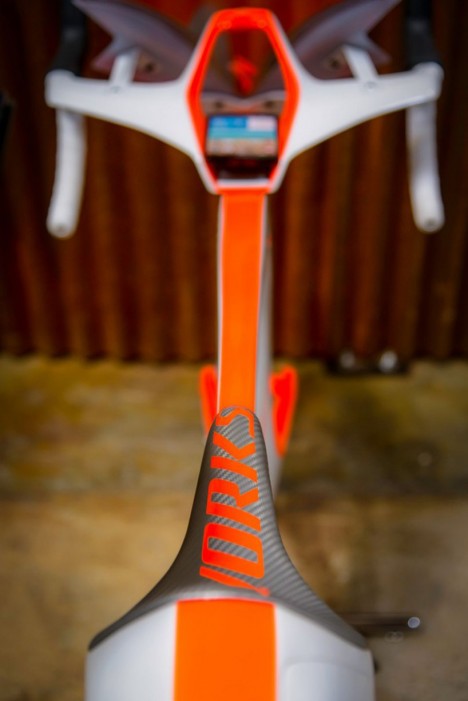
This stunning concept bike breaks from conventions set by international racing authorities to bring riders a vastly improved cycling experience, from enhanced aerodynamics and speed assists to smartphone functionality and storage space.

specialized custom bike

Creative Director at Specialized, Robert Egger, designed  fUCI (a jab at the UCI, or: Union Cycliste Internationale) as a functional and physical critique: “The UCI really caters to a very small population, but there’s so many other people out there who couldn’t care less about the UCI,” he explains. “They don’t follow the racing and they don’t even know all the limitations that are put on bikes for the UCI riders. So, my feeling was let’s design a bike for someone who really just wants to go fast on a road bike.”

specialized iphone slot

Wheels are supposed to be the same size, but differently-sized ones in this model help riders get up to high speeds more quickly. An added motor assist works like a turbo on a sports car, something completely accepted in that vehicular realm but unusual on bikes, “so just like when you ride the turbo and you put your foot on the pedal and it lurches forward, the same thing here.”

smart bike powered wheel

“This little motor will get the flywheel up to speed so when you’re stopped at a stop sign, or when you’re starting out of your garage in the morning, this’ll be that burst of power to get the flywheel up and running.”

smart bike seat storage

The shape is dramatic and impressive, but also pragmatic; it facilitates, for example, clever seat storage space for odds and ends (like keys or wallets) or potential essentials like spare tires and tubes.

front slot

A slot in front, protected by an aerodynamic mud and wind guard, lets you put your smart device in place for navigation, too.

e bike full model

e bike helmet protection

The goal of this project is in part to raise awareness of what bikes can be when stripped of the rules people think are common sense but are really tied to the limited and specialized world of racing. The hacks in this case enhance functionality on various fronts and, frankly, produce a much more awesome-looking ride, too.


Want More? Click for Great Related Content on WebUrbanist:

Bizarre Bicycle! Fliz Fits Like a Harness to Help You Run

This highly unusual bicycle has no pedals or seat; it straps over you like a harness to help you run faster than you ever could on your own. Click Here to Read More »»


All-in-One Bicycle Helmet: Sleek Integrated Lights & Signals

Incredible design is not just about looking good (which this does) or working well (which this does), but weaving these solutions neatly together. Click Here to Read More »»


Unstealable Bike: Theft-Proof Bicycle Frame Doubles as Lock

If you are sick of worrying about your bike being stolen or taking a lock with you wherever you go, this design will solve both of those every problems faced ... Click Here to Read More »»


Share on Facebook

[ By WebUrbanist in Technology & Vehicles & Mods. ]

[ WebUrbanist | Archives | Galleries | Privacy | TOS ]


24 Nov 17:38

Fifa 'seeking Platini life ban'

Timmy the Tooth

SHOCKING: Blatter's FIFA seeking life ban for his closest rival.

Fifa vice-president Michel Platini could be facing a life ban from football, according to his lawyer.
23 Nov 20:42

List: The Evolution of “Netflix and Chill.” by Elana Spivack

Timmy the Tooth

I was just talking to someone about this. Weird.

Fuck?

Hunt and fuck?

Watch fire and fuck?

Use wheel and fuck?

Self-flagellation and pray?

Avoid plague and discuss chastity?

Gladiator fight and converse?

Toil the fields and commiserate?

Magic lantern and regale each other with riveting conversation?

Talkies and chew the fat?

“Abbott and Costello” and make whoopee?

Drive-in and leave room for Jesus?

Movies and hook up?

Mix tapes and gab?

The latest Madonna CD and chillax?

Whatever’s on TV and catch up?

VHS tapes and shoot the breeze?

DVDs and chat?

YouTube and hang?

TiVo’d Top Chef and relax?

Netflix and chill?

Immersive virtual reality and connect?

Space flight and seek intimacy?

Trans-universal travel and desperately try to remember how to awaken human emotion?

Fuck?

22 Nov 16:19

Meal of Worms: Kitchen Farm for Growing Edible Insects at Home

by Urbanist
Timmy the Tooth

Gives the phrase "grubbin" a whole new meaning.

[ By WebUrbanist in Design & Products & Packaging. ]

insect meal worms

Helping you grow and harvest edible mealworms right on your kitchen counter, the world’s first desktop-sized insect hive aims to aid a rebranding of an unpopular but nutrient-rich source of protein.

edible insect farm

The Livin Farm by Katharina Unger and Julia Kaisinger is just a few two feet tall and contains eight shelves for housing mealworms at various stages of growth, from egg and pupae to beetle.

meal worm diagram

The pupae mature in the top drawer, turning into egg-laying beetles. The eggs in turn fall through holes in the floor and grow into worms.

insect feeding time

The key to the whole operation is a customized micro-climate within the case as well as a fan, filter and ventilation system. The insects themselves can subsist on vegetable scraps and other kitchen waste.

insect in salad

insect food protien

A button on the box vibrates the operation, separating insects from waste automatically rather than the conventional and less appealing way: sorting by hand. These are chilled in the bottom drawer for storage or can be frozen before being minced and boiled into meals.

meal worm benefits

Each harvest yields a few hundred grams with protein amounts roughly equivalent to similar weights of meat. The inputs are where the real savings is: less space, water and energy are needed for this system to work.

livin kitchen farm

insect kitchen counter

If the ‘yuck factor’ seems tough to overcome, consider for a moment the foods that have become popular over time across cultures, including the rise of sushi (raw fish and seaweed) in the United States and elsewhere.


Want More? Click for Great Related Content on WebUrbanist:

Fungi Farm Prototype Turns Waste Plastic into Edible Treats

Breaking down one of the most difficult types of trash, this incredible working incubator turns sterilized plastic remnants into nutritional biomass humans ... Click Here to Read More »»


Steampunk Flea: Mechanical Insects by Dimitry Valchev

Spark plugs, kitchen strainers, springs and other random metal parts come together into a ‘steampunk flea’ that looks like it could jump away at ... Click Here to Read More »»


Growing Up: NYC Rooftop Farm Supports 1,200,000 Pounds of Soil

Brooklyn Grange is behind the two largest rooftop soil farms in the world, together growing 50,000 pounds of organic produce per year from 108,000 combined ... Click Here to Read More »»


Share on Facebook

[ By WebUrbanist in Design & Products & Packaging. ]

[ WebUrbanist | Archives | Galleries | Privacy | TOS ]


20 Nov 17:46

FDA approves genetically modified salmon, and it won’t be labeled

by Marion
Timmy the Tooth

Don't eat farmed salmon.

The FDA has just approved AquAdvantage’s genetically engineered (GMO) Atlantic salmon.  The salmon will not have to be labeled as GMO.

The FDA has spent at least four years coming to this decision.  In previous posts, I’ve discussed.

What more to say?  Only that federal agencies are tone deaf about the GMO issue.

The FDA thinks that just because it judges the salmon safe to it, that automatically makes it acceptable to the public.

But as anyone who knows anything about risk communication can tell you, even if the salmon is safe to eat, the public may not want it for a host of other reasons.

The decision not to label the salmon, is also tone deaf.  The FDA bases its decision on its decision that genetic modification is not material, meaning that the GMO fish has a similar nutrient composition to wild or other farm-raised salmon.

But the FDA requires labeling of plenty of other non-material processes: made from concentrate, previously frozen, and irradiated, for example.

As far as I can tell, the FDA has learned nothing about risk communication in the 20 years since it approved GMO foods for production and consumption.  The protests are already underway, some from members of Congress.

Politico Pro Agriculture quotes Senator Lisa Murkowski (Dem-AK):

“We have made no bones about the fact that this is wrong, not only for Alaska and our wild salmon stocks…but around the country,” she said, adding: “At a bare minimum people around this country need to know what they are serving their families when it comes to seafood.”

Murkowski said the draft labeling guidance released today fell short of what consumers need and plans to “continue the fight” against the fish.

This will be interesting to watch.

The FDA documents

News

Approval Documents

20 Nov 17:27

Why possession is no longer the key to success

Timmy the Tooth

Today possession is dead. Tomorrow possession will be king. The day after possession will be dead. Then possession will be king.

It has always been “nine tenths of the law”. To football purists, it is the key to success, with Brendan...
19 Nov 23:23

Cheerios for Protein?

by Marion

I laughed when I first saw the Cheerios box advertising Protein.  Protein is hardly an issue in U.S. diets—most Americans consume twice what they need—so this is clearly a marketing ploy.

Center for Science in the Public Interest (CSPI), however, was less amused.  Its scientists did the math and compared the protein to the amount in regular Cheerios.  They also looked at serving sizes.

  • Cheerios Protein: Protein 7 grams, Serving Size 55 grams
  • Cheerios regular: Protein 3 grams, Serving Size 28 grams

Hmm.  Not much difference, is there?

CSPI filed a formal complaint.

General Mills falsely and misleadingly markets Cheerios Protein to children and adults as a high protein, healthful alternative to Cheerios. In fact, Cheerios Protein has only a smidgen more protein per serving than Cheerios, or 4 grams, which is only 5% of the average American daily protein intake. Most of that 4 grams is attributable to differences in serving sizes: Cheerios Protein has a bigger, 55 gram serving size, whereas Cheerios uses a 27 gram serving size. Two hundred calories’ worth of Cheerios Protein has a mere 7/10th of a gram more of protein than 200 calories’ worth of Cheerios.

Even worse, they looked at sugars.

  • Cheerios Protein: 17 grams sugars
  • Cheerios regular: 1 gram

As CSPI puts it:

Rather than protein, the principal ingredient that distinguishes Cheerios Protein from Cheerios is sugar. Cheerios Protein has 17 times as much sugar per serving, as Cheerios, which General Mills does not prominently disclose. 8. General Mills charges a price premium for Cheerios Protein.

Oops.

Buzzfeed has a good discussion of this.

Caveat emptor (I seem to be saying this a lot lately).

19 Nov 23:20

Arc Kit: Design and Build Your Own Miniature Architecture

by Steph
Timmy the Tooth

That's pretty cool

[ By Steph in Design & Products & Packaging. ]

arc kit 1

A kit that combines the precision and detail of computer modeling with the physicality of Legos makes it possible to design and build any architectural structures you can dream up. With minimalist greyscale components that are significantly more refined than those found within actual Lego modern architecture sets, Arckit by Damien Murtagh can be used as a professional tool for architects or a fun toy for architecture hobbyists and enthusiasts.

arc kit 2 arc kit 3

Traditional model-making typically requires a lot of measuring, cutting and glueing, and once you set a piece in place, you’re stuck with it. Arckit’s snap-together system made of ABS plastic allows continuous modifications so you can really experiment. It’s a lot cheaper than purchasing 3D modeling software, without the steep learning curve. While it was initially designed for adult use only, it turns out that kids love it, too.

arc kit 4

arc kit 5 arc kit 6 arc kit 7

The modular system is at 1:48 scale and comes in three packages for structures measuring 60, 120 or 240 square meters. The 120-square-meter set has proved the most popular, offering over 385 pieces, a component tray, and a booklet explaining how to put it all together. Add-on components are also available, with extras including trusses, floating staircases and printable adhesive sheets so you can customize colors, textures and other imagery however you like.


Want More? Click for Great Related Content on WebUrbanist:

ARCKIT: Reusable Model-Making Blocks Built By & For Architects

Positioned between robust LEGO-style systems made for easy reuse and refined architectural models that are fragile but permanent, this modeling kit is both a ... Click Here to Read More »»


ZIG: Modular Furniture Lets You Build to Suit Your Space

Assemble rectangular furniture components like building blocks to create the exact arrangement of seating, tables and storage to suit your space and lifestyle. Click Here to Read More »»


WikiHouse: Open-Source DIY Architecture You Can Build

Design, 'print' and assemble your own WikiHouse using free open-source software and a local CNC mill to cut the parts, even iwith no prior building experience. Click Here to Read More »»


Share on Facebook

[ By Steph in Design & Products & Packaging. ]

[ WebUrbanist | Archives | Galleries | Privacy | TOS ]


19 Nov 19:56

Paris terror attacks: Football needs to erect a ring of steel

by Oliver Brown
Timmy the Tooth

We can't have a flaccid response. We must stand up. And if that means we need a ring of steel to help us stay erect, so be it.

#anycocklldo

Oliver Brown: The sport remains a target for Isil's warped propagandists and must take every possible step to prevent further attack


19 Nov 17:36

Premier League clubs honour Paris victims with La Marseillaise

Timmy the Tooth

WHAT???

On an unrelated note. Have you ever read the lyrics to the French National anthem? It's a call to arms. Talks about slitting throats and watering the fields with blood. I grew up thinking that the Star Spangled Banner was bloody but La Marseillaise is an abbatoir compared to our anthem. Anyway, I now return you to your boring ass lives.

-Pizza Rat.

The French national anthem will be played before every English top-flight game this weekend as an act of “solidarity and...
19 Nov 14:27

The Death of Comedy by Michelle Hauser

Timmy the Tooth

Kids these days.

“So a Jew, a Christian and a Muslim walk into a bar…”

“Stop, stop, stop!”

“What?”

“That’s not funny.”

“But I haven’t even done the joke yet.”

“Yeah, but it won’t be funny. There’s nothing funny about Jews and Christians and Muslims going places together, especially bars. Try something else.”

“OK… a lesbian and a tattooed millennial walk into a bar…”

“No, no, no!”

“What’s wrong with a lesbian and a tattooed millennial? You don’t even know where I’m going with this.”

“I don’t need to know where you’re going. If there’s a lesbian it won’t be funny — lesbians have never been funny. And millennials are super sensitive about their tattoos. Anyway you need to stop writing jokes about people in bars. Bar jokes are done. They’re just not funny anymore.”

“But all kinds of people go to bars. It’s a great place to put people from different backgrounds.”

“In real life, maybe, but not in jokes. Just put the joke someplace other than a bar.”

“OK… two guys are sitting on a park bench”

“Much better!”

“And the one guy says to the other guy…”

“Wait a minute — are they gay or straight?”

“They’re straight”

“Good. Are they Christians or Jews or what?”

“They’re atheists”

“Even better. This is going to be so funny now. I can feel it. OK, go ahead and make the joke.”

“Two straight atheists are sitting on a park bench…”

“Wait, it’s not a playground park is it?”

“What does it matter?”

“Two straight guys in a playground? Are you nuts? People might get the wrong idea; they could be pedophiles or something and there’s NOTHING funny about pedophiles.”

“Alright, alright… two straight atheists are sitting on a park bench near a winding path with no children in sight…”

“Good, good, go on…”

“…and the one guy says to the other guy…”

“Oh my God!”

“What?”

“I forgot to check, are the guys black or white?”

“They’re white, OK? Two blindingly white guys who only like women and don’t believe in God who’ve never even thought about messing with a kid, or going anywhere near a playground, are sitting on a park bench trying to make a fucking joke…”

“Whoa! You can’t say fuck anymore. Fuck’s not funny.”

“Since when?”

“Since last year, I think. It’s misogynistic or something. Just don’t say it.”

“…”

“What? What are you waiting for? Go on, make the joke.”

“No, I lost it.”

“Ah, don’t do that. You’re getting all stiff and tight — just loosen up and make the joke. Don’t over think it.”

“OK, here’s a different one, though. A bone-head comedian meets a politically correct asshole for a cup of coffee…”

“Now that’s a good set-up. You’re really getting the hang of it now!”

“You think?”

“Of course! Assholes are the funniest people alive!”

18 Nov 17:01

Ukraine through to Euro 2016 as Slovenia manage only a draw

by Press Association
Timmy the Tooth

Great story, overshadowed by events in France and England.

• Slovenia 1-1 Ukraine (Ukraine win 3-1 on aggregate)
• Cesar 11; Yarmolenko 90

Ukraine qualified for the 2016 European Championship after a nervy 1-1 draw in Slovenia saw them through 3-1 on aggregate, after the second-leg play-off on Tuesday.

Slovenia, who were in England’s qualifying group, had the perfect start at the Stadion Ljudski when the captain Bostjan Cesar headed in from close range after 11 minutes, when Valter Birsa’s cross was not cleared.

Continue reading...