Shared posts

16 Nov 22:14

FIFA PRESIDENTIAL RACE PROFILE: Tokyo Sexwale

by admin

Part of Sportingintelligence’s guide to the 2016 FIFA presidential election: HOME PAGE here

.

PROFILE: Tokyo Sexwale        

TokyoAge: 62.     Born:  Soweto, 5 March 1953

Twitter:  Not yet.     Website: www.tokyosexwale.com (unofficial – no official site)

Manifesto (PDF download):  Tokyo Sexwale manifesto.

Football background:  Organising Committee for 2010 World Cup, FIFA Committee on Racism & Discrimination, FIFA Media Committee, Chairman FIFA Monitoring Committee on Israel and Palestine.

Non-football background:  ANC activist and ex-prisoner of Robben Island. Former Premier of Gauteng Province. Former Minister for Human Settlements. Businessman (mining). Philanthropist.

Any corruption?  None confirmed. Some South African journalists have reported significant concerns with his business arrangements.

Allies: Lesotho, Mozambique, South Africa, Swaziland, Zimbabwe

Enemies: Other countries on the African continent.

Links to other candidates: Sexwale and Champagne have known each other since at least 2004. Champagne was another guest at Camp Beckenbauer (see below). There may well be a deal between the forces behind Sexwale and Sheikh Salman.

Football team: Bafana Bafana.

Latest news: 18 Nov 2015 Launched his election manifesto, with the headline item being that national teams should be allowed to have commercial shirt sponsors to raise money. Earlier: In his first major speech of his campaign, at the start of November in New York, he failed to impress. As one seasoned observer put it ‘in a rambling tumble of remarks stitched together with dutifully respectful references to Nelson Mandela he also made it clear that FIFA was not his main priority.’

.

PORTRAIT

Bonita MBy Bonita Mersiades

If name alone was all that counted, ‘Tokyo’ Sexwale – so nicknamed because of his love of karate – would be a lay-down misère for FIFA President in the court of social media public opinion.

But with his formidable pedigree as a member of Steve Biko’s Black Consciousness Movement in the 1970s, and subsequent 13-year incarceration on Robben Island, it’s clear that Tokyo Sexwale is more than a man with an unforgettable moniker.

He has also undertaken military officers’ training in the former Soviet Union and is still an Honorary Colonel in the South African Air Force; he earned a Commerce degree while at Robben Island and holds several honorary degrees; he is a major player in the South African diamond industry; is involved with bilateral business groups between South Africa and Russia and South Africa and Japan; has been a television personality on the South African version of The Apprentice; is a member of the Brookings Institution International Advisory Council; and is recognised as a major philanthropist. His philanthropy includes the Sexwale Family Foundation, the Nelson Mandela Foundation, the Robben Island Ex-Prisoners Trust and the Desmond Tutu Peace Trust.

To cap it off, Sexwale is a politician. He served in the Gauteng Provincial Government for four years from 1994, was a leading figure in the African National Congress from 1994 to 2010 and was Minister for Human Settlements in the Zuma Government from 2009 to 2013.

From all reports, Sexwale expected and wanted to go further in his political career. He was touted as a possible President of the African National Congress in 2007, before throwing his support behind Zuma, and was a candidate for Deputy President in 2012 coming third in a three-person race.

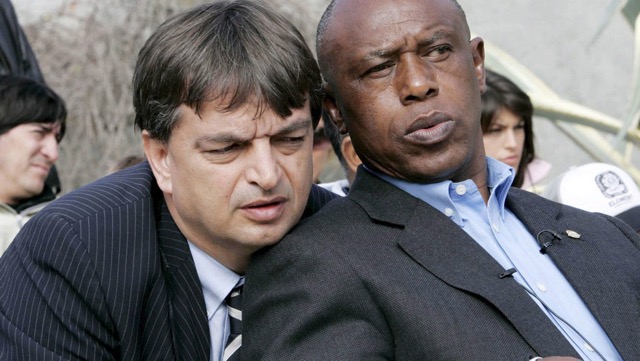
'Tokyo' (right) & Champagne, 2007

‘Tokyo’ (right) & Champagne, 2007

Sexwale caught the football bug as a child in Soweto where his father, Frank ‘Killer’ Sexwale, was vice-president of the Dube Golden Brothers side. At Robben Island, Tokyo was secretary-general of the recreation association that operated the Makana Football Association which was given honorary membership of FIFA in 2007. While still Chairman of his diamond mining company Mvelaphanda Holdings (sponsor of the second division Mvela League) and a non-executive director of Barclays Africa, Sexwale also served as a member of the 2010 World Cup Organising Committee from 2004 to 2010.

Continuing the narrative of his life, he launched FIFA’s ‘Say No to Racism’ campaign in 2006 along with Blatter and head of the 2006 Organising Committee, Franz Beckenbauer, whom he considers a friend. Today, Sexwale is a member of FIFA’s Global Task Force against racism and discrimination (a committee chaired by Jeffrey Webb until his arrest in May), its Media Committee and is Chairman of the FIFA Monitoring Committee on Israel and Palestine.

He is also the founder of Global Watch: Say No to Racism & Discrimination in All Sport that was launched, with the support of FIFA and other sporting organisations, in November 2014.

“Racism is a society problem. It’s like a monster that is trying now to infiltrate sporting fields. It’s not born out of the sporting field, but it can definitely destroy the field of sport. If we don’t stand up, if we allow racism to overpower sport, we will be doomed to existence in a hostile world,” he said at the time.

On paper, with his background as a freedom fighter, his experience as a politician, his lifelong commitment to eradicating racism, his business credentials and his knowledge of FIFA, Sexwale appears a strong candidate.

When he announced his candidacy, Sexwale focused on his business credentials.

“FIFA is broken and what is broken is the administration … I’ve administered organisations, banks, mining companies far larger than FIFA …. That’s the knowledge I want to bring. What has been broken in FIFA is the ability to follow money. Money has got traces, invoices. It has fingerprints, footprints, tracks. If it disappears, find out who was the last person to have it.”

Franz Beckenbauer thinks he’s the man for the job. Beckenbauer endorsed Sexwale’s run for the Presidency, describing him as ‘neutral’ and suggesting that he would be supported by the German Football Association (DFB).  

TS and FBA few weeks prior to announcing his candidacy, Sexwale was a guest at the annual Camp Beckenbauer where, amongst other things, the pair announced a strategic partnership between Camp Beckenbauer and the Nelson Mandela Foundation that Sexwale chairs. 

Sexwale has since been endorsed by another football man at Camp Beckenbauer, former Israeli national team player (and ex-PSG and New York Cosmos), Mordechai Shpigler. Beckenbauer’s close associate, Fedor Radmann, who helped bring the World Cup to Germany in 2006 and to South Africa in 2010 – but spectacularly failed to do so for Australia in 2022 – is one of Sexwale’s ‘strategy advisors’ as he navigates his way through the 209 members of the FIFA Congress.

Considering one of the corporate partners of Camp Beckenbauer is the Qatar-based International Centre for Sports Security (ICSS), it’s little wonder, therefore, that Sexwale turned-up in New York a few weeks later as one of the star attractions of the ICSS Securing Sport summit.

Those present were underwhelmed.

Veteran football journalist and FIFA-watcher, Keir Radnedge, said that it was clear FIFA was not Sexwale’s main priority.

“Sexwale did ramble round to address the FIFA crisis eventually, albeit as if something of an afterthought. He did so in generalisations and platitudes before concluding with – for the second time in a week – a misrepresentation of the stated case of the World Cup’s four US-headquartered sponsors,” wrote Radnedge for World Soccer.

According to the editor of World Football Insider, Mark Bisson: “Sexwale went off on a diatribe about sponsors’ activism in bringing FIFA change, saying threats by Coca-Cola, Budweiser and others to sever ties wasn’t the answer to fixing FIFA’s ills. Restating comments made on Monday, he said the unintended consequence was that sponsors were “virtually expelling” the president and having a say in appointing the next one.”

Instead, he praised the ‘more muted’ public statements of another of FIFA’s sponsors, adidas, which is also a sponsor of Camp Beckenbauer. A company with close and longstanding ties to FIFA, one of the other guest speakers at Camp Beckenbauer was the chief executive of adidas, Herbert Hainer.

Sexwale batted away the criticism of his performance in New York.

Like anyone in politics, he knows that the only poll that counts is the one on election day. But unlike real politics, what the media and the public think is immaterial in the ‘FIFA Way’ of doing business.

With his roll call of gold-plated supporters and advisors, expect Sexwale to be there or thereabouts on February 26 – unless a deal is done beforehand.

.

More on the FIFA presidential race

Follow SPORTINGINTELLIGENCE on Twitter

LinkedIn Twitter Yahoo Messenger Share/Bookmark
14 Nov 18:49

Cristiano Ronaldo: I want to retire with 'dignity', not in USA, Qatar or Dubai

by Guardian sport
Timmy the Tooth

I absolutely applaud this and hope he follows through. MLS fans should be ashamed that their sport is a retirement home for broken and failed athletes like Steven Gerrard and Frank Lampard.

  • Portuguese striker says he plans to play ‘six or seven more seasons’
  • Ronaldo, who turns 31 in February, wants to finish career at top club

Cristiano Ronaldo said on Thursday that he wants to end his career “with dignity” and not playing in “the United States, Qatar or Dubai”.

The Real Madrid and Portugal star, the subject of a new documentary that premiered on Monday in London, said in an interview on ITV’s The Jonathan Ross Show that he expected to play six or seven more seasons and hoped to finish his career at the highest level.

Continue reading...
14 Nov 17:29

José Mourinho must be more like Arsène Wenger

Timmy the Tooth

If Jose Mourinho turns out to be like Arsene Wenger I'm a Chinaman.

Do you hear that noise from Stamford Bridge? What noise? Exactly. Maybe it is just the lull of the international...
14 Nov 02:07

List: Teenage Slang: An Essential Guide for Anxious Parents by Ralph Jones

On fleek
ADJECTIVE
On top of one’s head. “Your hat is on fleek.” “Yes it is, correct.”

- -

Netflix and chill
INTRANSITIVE VERB
To load one’s Netflix and place the relevant device in a refrigerator for a period of 24-36 hours, most commonly in the summer months, in order to benefit from the resultant ‘chill’ of the machine on one’s lap.

- -

YOLO
ACRONYM
“Yoko Ono’s Looking Old.” Today’s teens say this frequently, seemingly blasé about the damage it is continuing to inflict on the 82-year-old’s self-esteem.

- -

’Ship
INTRANSITIVE VERB
To shatter one’s hip in at least two places.

- -

Two girls one cup
NOUN
A beautiful ritual in which a pair of young women are tasked with constructing the most elaborate drinking receptacle possible in under 35 minutes.

- -

Bromance
NOUN
An intense relationship between two male bees.

- -

Twerk
INTRANSITIVE VERB
To drink a pint of tea while engaged in the duties associated with one’s werk.

- -

Werk
NOUN
Full-time professional employment consisting of at least 35 weekly hours.

- -

Cray
ADJECTIVE
Good at badminton. “Your mum is super cray.” “I know, she’s been playing for quite some time now. She might go professional.” “I hope she does.”

- -

Tinder
NOUN
A homemade farming device manufactured by combining a trowel and a cinder block.

- -

Feels
NOUN
Small balls of nose mucus, widely shared on the street as a form of currency.

- -

Bae
NOUN
A brass spoon that teenagers use primarily to consume soup. “Pass me the bae for the chowder, Kimmy.”

- -

Booty
NOUN
A small boutique that sells pottery and Kenyan furniture.

- -

FML
ACRONYM
“Finding Merlin’s Lingerie.” A code within an acronym, used to describe the discovery of something humiliating. If one has ‘found Merlin’s lingerie’, one has unearthed a career-ending truth about Merlin.

- -

Truffle butter
NOUN
Heavy rain. “Urgh, I just stepped out of the office and got covered in truffle butter.”

- -

Turnt
ADJECTIVE
If a piece of bread has been toasted until severely burnt, it is turnt.

- -

IRL
ACRONYM
“I’m Richard Linklater.” Teens say this regularly on online chat forums when they are pretending to be Richard Linklater.

- -

Preach
INTRANSITIVE VERB
To compare something to a peach.

- -

Anaconda
NOUN
A large snake native to South America.

- -

#nofilter
ADJECTIVE
Really cool. “I love Nickelback. You know the best thing about them? They’re so #nofilter.”

- -

Shade
INTRANSITIVE VERB
To pick up the excrement of a small family dog.

- -

Can’t even
INFORMAL SLANG
To be comfortable carrying out arithmetic with odd numbers but unable to do so while carrying heavy machinery.

- -

AF
ACRONYM
Aggressive Fuchsia. A color increasingly popular with teenagers online.

- -

OMG
INFORMAL SLANG
Ohhhh, Marvin Gaye. An expression conveying the realization that the subject of the conversation, hitherto unclear, was Marvin Gaye.

- -

Lemon party
NOUN
A bowling game at the end of which the losing team have to throw lemons at the elderly until they knock someone over.

- -

Selfie
NOUN
An enormous orgy fueled principally by the consumption of gigantic quantities of Class A drugs.

13 Nov 21:42

Ounces and Grams: Why Mass Is Not the Best Way to List Ingredients

by J. Kenji López-Alt
Timmy the Tooth

This site has been ruined. This is 10,000 words to say "cooking isn't as precise as baking". Everyone fucking knows this. Anyone who doesn't know this is a numbskull. Fucking hell. OCD much?


In my book and on this site, we use a mix of volume and mass units in recipes. This can upset certain science-minded folk: Units of mass are inherently more precise than units of volume, so we ought to use the system of measurement that is most precise, right? Not only do I disagree with this perspective, I believe that more often than not, in cooking, using mass can actually lead to less consistent results. Here's why. Read More
12 Nov 17:15

Originally, when I die, I wanted to be cremated. Don’t see...

Timmy the Tooth

Bulldogs are so lazy. This one gave up walking for skateboarding.


Originally, when I die, I wanted to be cremated. Don’t see the point in shoving my body in box that’s placed in another box in the ground. Burn my body, grind up my bones, and dump a little bit of my ashes at every mom-and-pop soft service ice cream stand in America. That’s how I thought I wanted to be honored. NOT ANY MORE.

I want to be buried only so I can have a tombstone with a LCD screen playing this video in an infinite loop while a small hologram of me from the waist up is projected next to my tombstone watching this video, smiling, and giving a perpetual thumbs up at the majesty that is this clip.

Also, shut down the internet and all mass media. We will never create anything as pure and beautiful as this clip ever again. (Or, until someone tries to break the record.)

11 Nov 22:13

It's going to be okay.

by Matthew Inman
Timmy the Tooth

Go ahead and cry if you want.

11 Nov 16:35

World Cup 'bungs' appear rife - Dyke

Football Association chairman Greg Dyke questions whether any World Cup bid has been won without "a pile of bungs".
11 Nov 16:35

Franz Beckenbauer asked to explain signature allegedly found on draft contract with Fifa’s Jack Warner

by Owen Gibson
Timmy the Tooth

They are all going down.

• Contract said to have promised Warner friendly matches and tickets
• Beckenbauer was head of Germany’s 2006 World Cup committee

The pressure on Franz Beckenbauer over the 2006 World Cup bidding process has intensified, after the acting head of the German football federation called on him to explain a draft contract with the disgraced former Fifa official Jack Warner.

“We appeal to him to bring himself more closely into the explanation of what happened,” said Rainer Koch, one of the two caretaker presidents who this week took over the DFB following the resignation of Wolfgang Niersbach.

Continue reading...
11 Nov 16:32

US to ban heading for under-10s

Timmy the Tooth

The British comments on this are priceless.

US Soccer outlines plans to stop children aged 10 and under heading footballs after resolving a lawsuit with parents.
11 Nov 16:09

Signing ‘a hooligan’ and a Shankly team talk: how Clough set up Forest for title

by Daniel Taylor
Timmy the Tooth

The good ole days are always so good and ole.

The start of Nottingham Forest’s extraordinary journey from supposed relegation fodder to 1978 champions is told in this edited extract from I Believe in Miracles

In May 1977 the team found out they had won promotion in mid-air when Brian Clough and Peter Taylor took them on an end-of-season trip to Majorca

After training, it was a greasy spoon called McKay’s where the players usually congregated. For beers, they would head to the King John, a hundred yards down the hill from Nottingham railway station, or maybe the Pepper Mill or Uriah Heeps if it was shaping up to be a proper night out. Yet the most popular meeting place was always McKay’s. It was there where the players put the world to rights, tucking into the kind of unpretentious grub that never seemed such a big deal in the days before football opened its doors to nutritionists and sports scientists and the strange new world of pasta, green-leaf salads and mineral water. “Fourteen chip cobs,” became such a regular order that the owner, Bill, had to get in extra supplies of bread and potatoes.

Continue reading...
10 Nov 23:54

Muji Huts: 3 Minimalist Prefab Dwellings Starting at $25,000

by Urbanist
[ By WebUrbanist in Architecture & Houses & Residential. ]

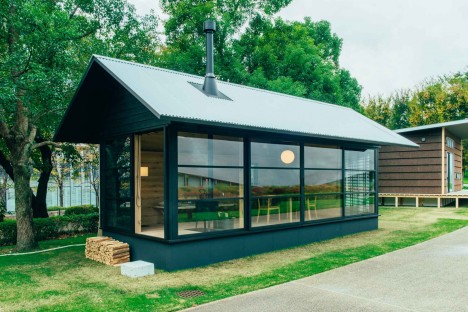
muji wood hut

Three designers contributing to the Muji Hut project have pitched their tent-, cottage- and cabin-inspired ideas for tiny retreats at Tokyo Design Week, each structure borrowing lessons in simplicity from Japanese housing traditions. The spaces are intentionally essential, featuring just what one needs to relax and enjoy natural surroundings and family gatherings.

muji hut glass

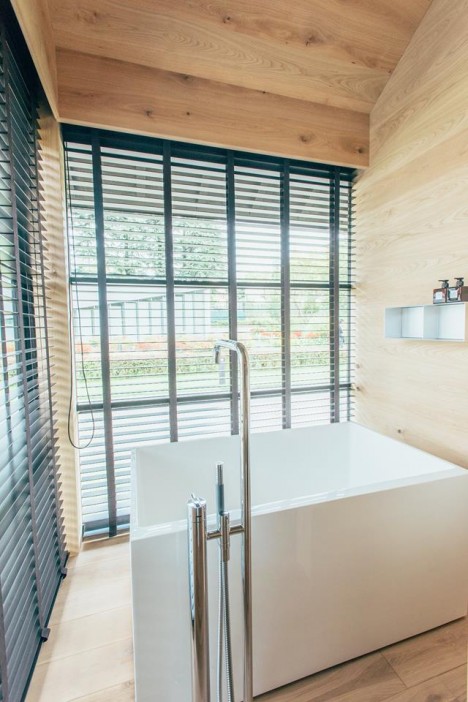
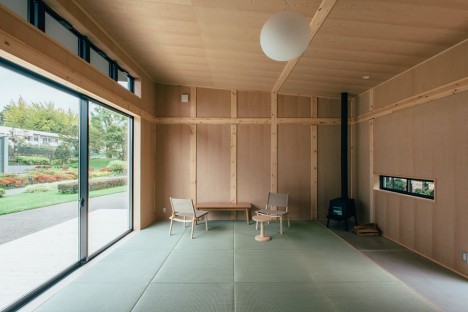
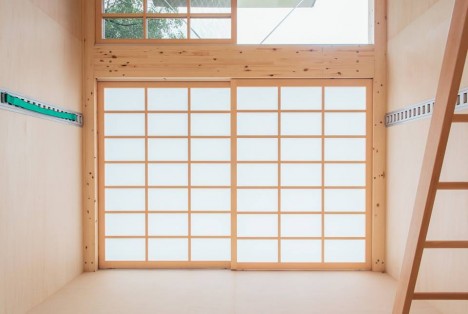
The Wooden Hut by Naoto Fukasawa is both open and cozy, with floor-to-ceiling windows, a soaking tub hidden behind a wall and a wood-burning stove to warm the interior. A wood-burning stove heats the interior, which is furnished with a cot, dining table and chairs, and kitchenette.

muji bathtub

“When I hear the word hut, I’m attracted,” says designer Naoto Fukasawa. It’s not quite a villa but not as simple as a tent. With a small hut you can burrow into the wilderness whenever you want.”

muji hut cork

The Cork Hut by Jasper Morrison has space for cooking, eating, gathering and sleeping, featuring a trim aesthetic with simple lines brought to life by variegated cork surfaces.

muji living room

“Whenever I think about going to the country for the weekend, I start imagining a small house with everything needed for a short stay,” says Jasper Morrison.

muji dining eating space

“The dream usually collapses when I think of the complexity of building a new house, but with this project I realized there was a chance to design such a house as a product rather than a one-off.”

muji two story

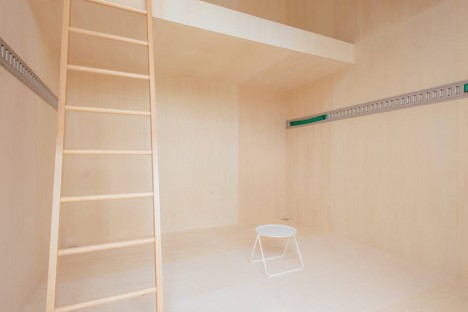
The Aluminum Hut by Konstantin Grcic has a small footprint to avoid the need for building permits. A ladder leads occupants up to sleeping lofts while flexible aluminum awnings protect it in transit.

muji panel doors

“The hut is just a space — it doesn’t have to be a fully functioning place for living,” says Grcic.

muji ladder space

“There doesn’t have to be water or electricity. It is just a space for doing something.” The trio of huts will go on sale soon, starting at approximately $25,000 USD.


Want More? Click for Great Related Content on WebUrbanist:

Pocket Tent: Tiny Prefab Home Inflates Itself with Body Heat

A brilliant application of material science toward simple living, this portable self-inflating structure folds up into a manageable miniature package but ... Click Here to Read More »»


Temporary Retrofit: Micro-Dwellings for Unoccupied Buildings

Designed for empty warehouses or buildings under construction, these material-light shelters provide functionality for liminal interiors either past their ... Click Here to Read More »»


Speedy Prefab: How a 9-Story Apartment Was Built in 5 Days

We see conceptual modular designs of this kind all of the time, but rarely such exquisite real-world proof of how fast construction can be in the age of ... Click Here to Read More »»


Share on Facebook

[ By WebUrbanist in Architecture & Houses & Residential. ]

[ WebUrbanist | Archives | Galleries | Privacy | TOS ]


10 Nov 23:01

Franz Beckenbauer in the spotlight over ‘contract’ with Jack Warner

Timmy the Tooth

They are all dirty.

Reminds me of that thing about lying with pigs.

Franz Beckenbauer is under pressure to explain his part in Germany’s 2006 World Cup scandal after the emergence of a...
05 Nov 19:36

Remi Garde vows to keep Aston Villa up

Timmy the Tooth

Keep your Garde up!

With a near constant half smile of amusement at the overall cynicism on display as he was unveiled to the...
05 Nov 17:25

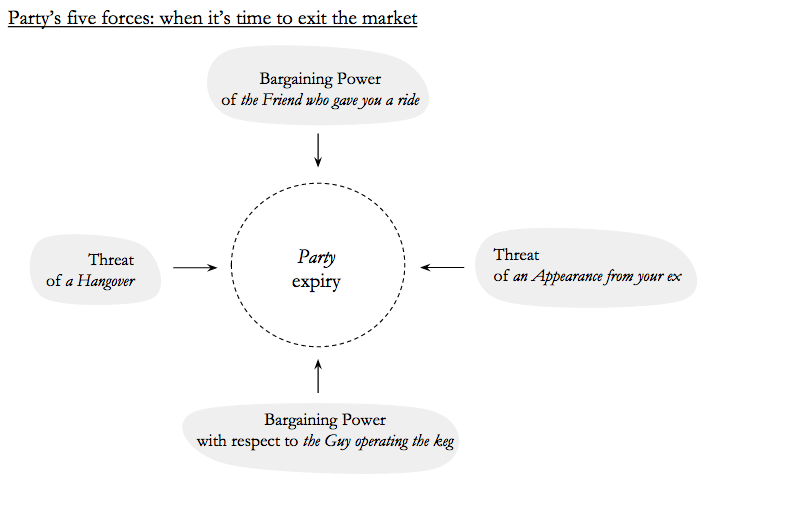
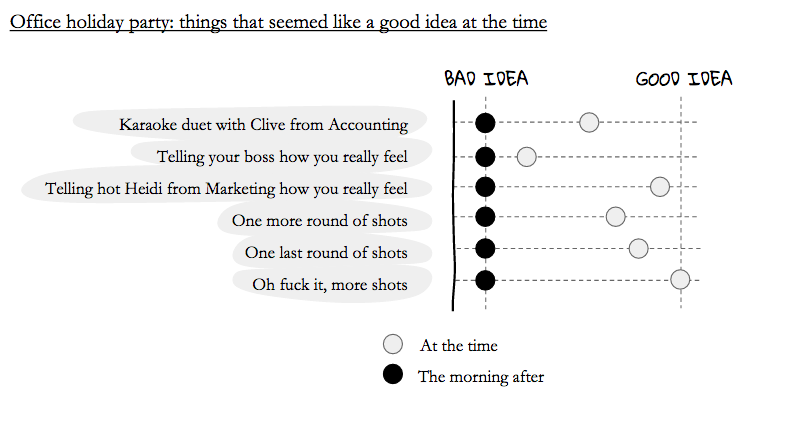
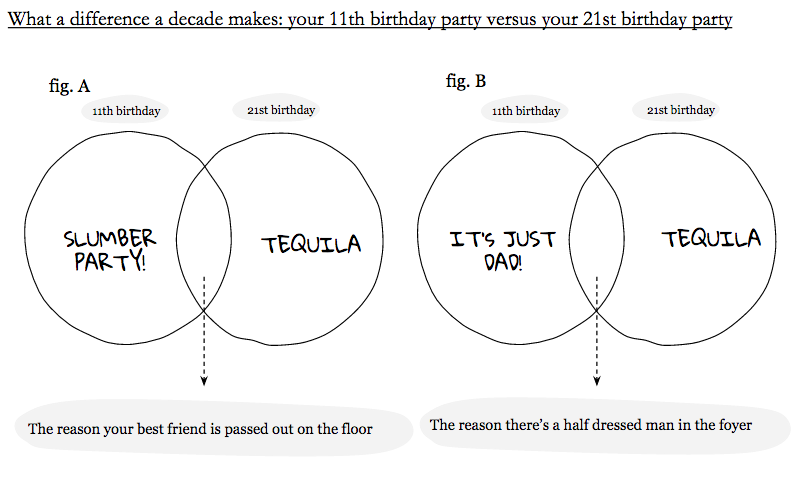
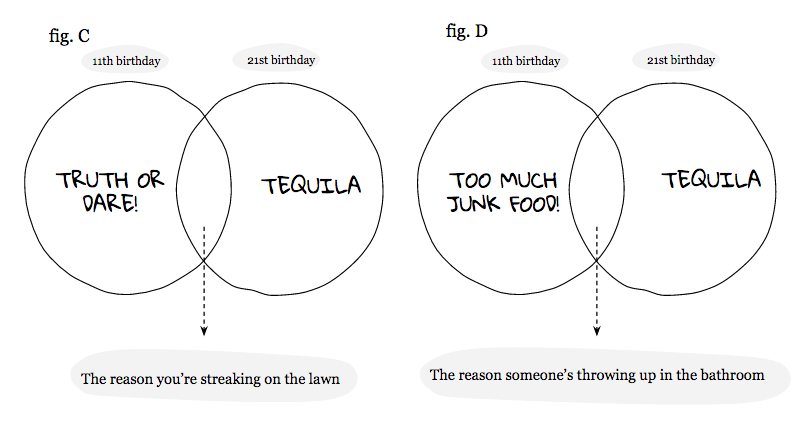
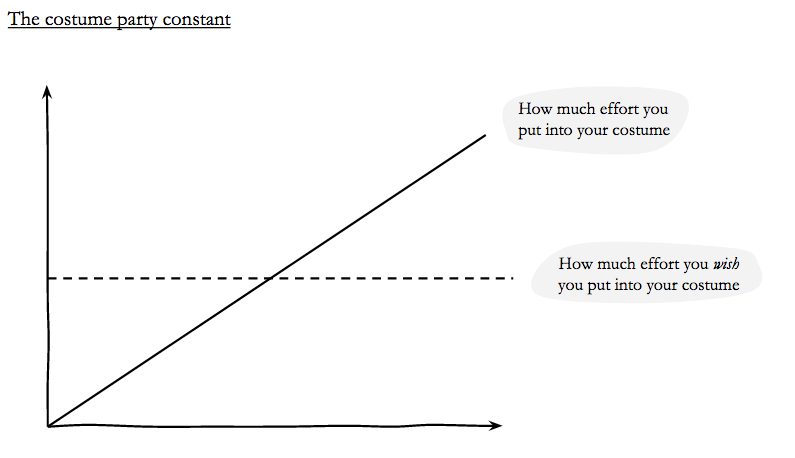
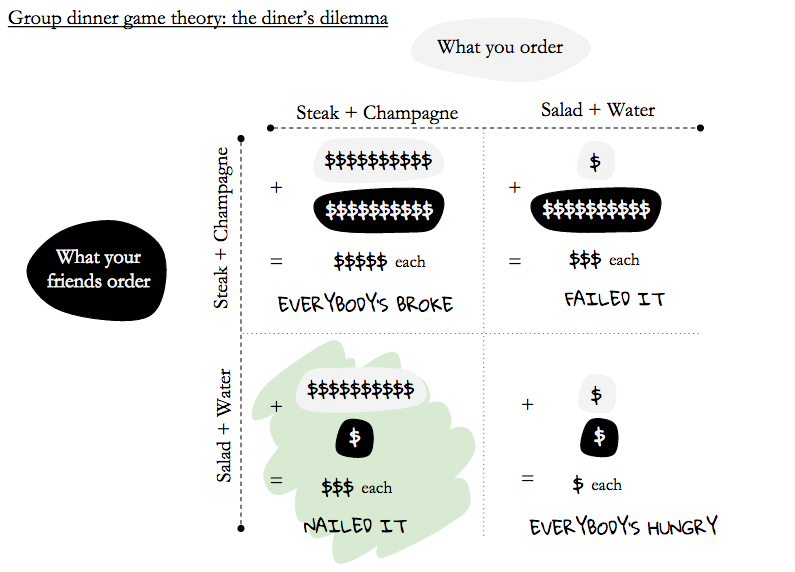
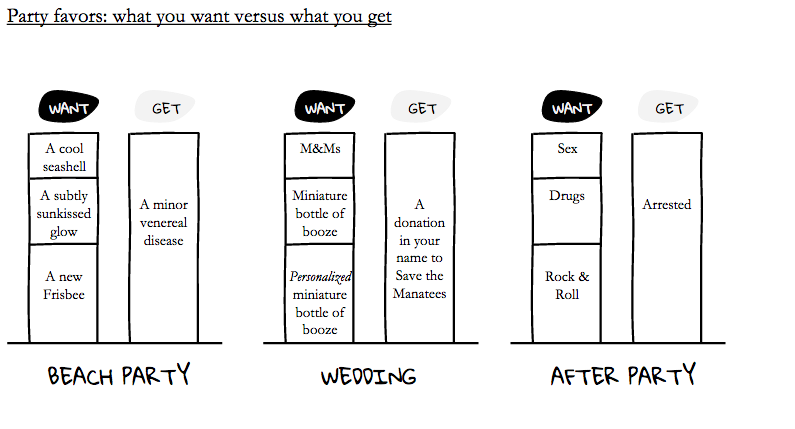
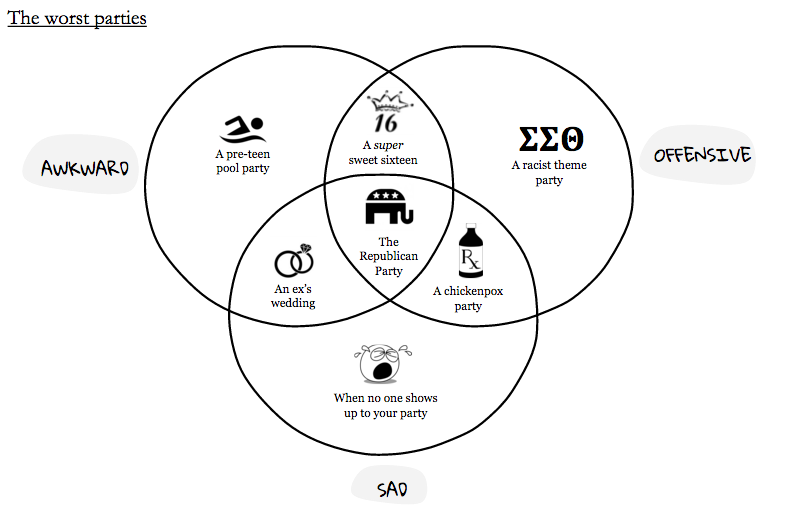
Mostly Uninformative Infographics: … About Parties by Cecilia Esther Rabess

Timmy the Tooth

The last graphic...

- -

- -


- -

- -

- -

- -

05 Nov 17:21

A Week of Radically Honest Pillow Talk by Stephen Statler

Timmy the Tooth

TRUE LOVE

MONDAY

HER: I notice that your towel stinks after one shower. I worry that if you stink that bad on the outside, you must stink on the inside, like you have a rotten soul. Does that sound weird?

HIM: No, not at all.

TUESDAY

HIM: Sometimes I come across women who aren’t as good looking or smart or funny as you, but I wish I could be with them, just because they’re not you. I think it would be okay if they were even cruel or hurt my feelings. It’s like, anybody but you, at any cost. Does that make sense?

HER: Sure it does.

WEDNESDAY

HER: You know how they say couples have heard all each other’s stories so many times they’re sick of them? I’m sick of everything you say now, even stuff I haven’t heard yet. It’s like I hate what you’re going to say even before you say it. Does that make sense?

HIM: That totally makes sense.

THURSDAY

HIM: More and more when I’m standing on the train platform, I think aboout throwing myself in front of the train. I think it’s mainly so I don’ t have to be your husband anymore. I know it would be painful, the train grinding me up, but it’s like it’d be worth it just to get away from you. Is that weird?

HER: No, that’s not weird at all.

FRIDAY

HER: The other night when we had sex, I could feel your bristly black belly hairs on my skin scratching me, and I wanted to fight back and scream rape. And then I fantasized that Roger from next door would come rescue me and I could cry in his arms and then we’d make love and I could finally enjoy having sex again. And then I felt really guilty.

HIM: Don’t feel guilty. I totally understand.

SATURDAY

HIM: It’s Saturday night — woo-hoo! I used to drink and chase girls. Being out on a Saturday night when anything could happen was electric, exciting. Now I watch you struggle not to fart on the sofa, and I think “Go ahead and fart. It couldn’t get any worse.”

HER: You want me not to struggle?

HIM: I do.

HER: I should just fart?

HIM: Please.

SUNDAY

HER: I think what it really is, is that monogamy becomes toxic over time. Plus it’s unnatural and maybe even immoral to begin with. How could I not hate you after 15 years? I’d be sick of Brad Pitt after 15 years, and you’d be sick of whoever…

HIM: Scarlett Johansen…

HER: Scarlett Johansen.

HIM: No, Blake Lively.

HER: Isn’t she kind of young? She could be your daughter.

HIM: OK, Scarlett Johansen.

HER: You’d be sick of Scarlett Johansen. And that’s just the way marriage is. Its only object is procreation and the continuance of the human race. We’re just biological pawns, stuck together in the service of the species.

HIM: Maybe you’re right. So what do we do?

HER: We could retreat further into our corners or get divorced and experience the same failure with a new partner…

HIM: Or I could put a sheet over my belly hair.

HER: Right! And let me get on top and don’t look at me and don’t make any noise and let me call you Roger.

HIM: I love you, Honey.

HER: I love you, Roger.

05 Nov 17:18

Gibbs Arsenal’s last man standing for England

by Arseblog News Hound
Gibbs England 700

And then there was one…

Arsenal’s injury crisis has taken its toll on England with Kieran Gibbs the only Gunner representative in Roy Hodgson’s latest squad for upcoming friendly games with Spain and France.

The left-back, who has lost his starting place at the Emirates to Nacho Monreal, will join up with the Three Lions for showdowns in Alicante and Wembley on the 13 and 17 November respectively.  After a ridiculously easy Euro 2016 qualification campaign they’ll no doubt be expecting a couple of sterner tests.

As has been well documented, our much-vaunted British core has been whittled down to the bare (in some cases cracked) bones in recent weeks and months with the likes of Jack Wilshere (ankle), Danny Welbeck (knee), Alex Oxlade-Chamberlain (hamstring), Danny Welbeck (knee) and Theo Walcott (calf) all sidelined by injury.

Welshman Aaron Ramsey (hamstring) will also miss his country’s game with Holland. Chuba Akpom and Calum Chambers will play for England under-21s against Bosnia-Herzegovina and Switzerland.

Anyway, good on Gibbs…we’re glad he’s, “Ah, ha, ha, ha, stayin’ alive, stayin’ alive.”

Sorry. Not sorry.

Full England squad

Goalkeepers: Jack Butland (Stoke City), Joe Hart (Manchester City), Tom Heaton (Burnley)

Defenders: Ryan Bertrand (Southampton), Gary Cahill (Chelsea), Nathaniel Clyne (Liverpool), Kieran Gibbs (Arsenal), Phil Jones (Manchester United), Chris Smalling (Manchester United), John Stones (Everton), Kyle Walker (Tottenham Hotspur)

Midfielders: Dele Alli (Tottenham Hotspur), Eric Dier (Tottenham Hotspur), Ross Barkley (Everton), Michael Carrick (Manchester United), Fabian Delph (Manchester City), Adam Lallana (Liverpool), James Milner (Liverpool), Jonjo Shelvey (Swansea City), Raheem Sterling (Manchester City)

Forwards: Harry Kane (ex-Arsenal), Wayne Rooney (Manchester United), Jamie Vardy (Leicester City)

05 Nov 17:18

Karim Benzema sex tape blackmail plot - what do we know

by Telegraph Sport
Timmy the Tooth

J'amaze

Real Madrid striker charged with "complicity in an attempt to blackmail" and conspiring to commit a criminal act, here's everything you need to know


05 Nov 17:03

Food + Science = Victory! A New Freakonomics Radio Episode

by Stephen J. Dubner
Timmy the Tooth

Decent episode

(photo: Andrea Nguyen)

(photo: Andrea Nguyen)

Our latest Freakonomics Radio episode is called “Food + Science = Victory!” (You can subscribe to the podcast at iTunes or elsewhere, get the RSS feed, or listen via the media player above.)

On the menu: A kitchen wizard and a nutrition detective talk about the perfect hamburger, getting the most out of garlic, and why you should use vodka in just about everything.

Below is a transcript of the episode, modified for your reading pleasure. For more information on the people and ideas in the episode, see the links at the bottom of this post. And you’ll find credits for the music in the episode noted within the transcript.

*     *     *

[MUSIC: Louis, “Rewind to Play” (from Louis)]

STEPHEN DUBNER: So what does it say, Kenji, that there are so many conventional wisdoms about something as basic as cooking food, which we’ve been doing for thousands of years, that are, if not wrong, at least kind of misguided? Isn’t that sort of strange?

J. KENJI LÓPEZ-ALT: It is strange. But I think it’s precisely because we’ve been doing it for so long and because everybody does it and it’s sort of an essential part of everyday life that I think it’s one of those things that rarely gets a sort of a second thought.

Today we’re going to give a lot of second thoughts — to what we eat and how we eat it.

LÓPEZ-ALT: My name is Kenji López-Alt. I’m the managing culinary director at seriouseats.com and I write about the science of food.

Uh-oh. “The science of food.” Doesn’t that sound kind of … unnatural?

LÓPEZ-ALT: I think a lot of people think of science as sort of the opposite of tradition or the opposite of natural. And really it’s not. Science is just a method, right? It’s a method of thinking about the world and it can be used for many different ends.

Alright, then! I’m on board. How about you? Would you like to know whether the secret of New York pizza really is the water? Would you like to know how Freakonomics Radio listeners do things in the kitchen? And would you like to know the true nutritional value of one of America’s favorite vegetables?

*     *     *

His full name is J. Kenji López-Alt. The “J.” is for James, his given first name. He’s always gone by Kenji but he didn’t want to totally lose the “James.” “Alt” is his last name; his father is of German descent. His mother is Japanese — that’s where the “Kenji” comes from. And the “López” is the last name of Kenji’s wife — she’s Colombian. When she and Kenji got married, they both became “López-Alt.”

J. Kenji López-Alt has just published a big, beautiful doorstop of a book.

LÓPEZ-ALT: It’s almost 1,000 pages, it’s pretty big.

[MUSIC: Soundstacks, “Stay Stomping”]

It’s called The Food Lab: Better Home Cooking Through Science. The first line: “I was never meant to be a food guy.”

LÓPEZ-ALT: I came from a family of scientists. My father is a microbiologist and my grandfather is an organic chemist. I had a very science- and math-heavy childhood. I was one of those kids that would wake up at 6:30 in the morning to go and watch Mr. Wizard on Nickelodeon. Still one of my favorite shows. And honestly, I think, on a conceptual level, everything I learned about basic science all the way through college I learned from  that show.

DUBNER: Really? You’re not joking?

LÓPEZ-ALT: I’m not joking. I’m not joking.

DUBNER: So you were way into science as a kid. Were you into food as a kid?

LÓPEZ-ALT: No. I mean, my family liked eating, but I was one of those kids who, you know, I hated fish until I was probably in my early 20s. When I went to college, I had no idea how to cook.

DUBNER: What would be a typical family Sunday night meal, let’s say?

LÓPEZ-ALT: Well, my mom is Japanese. She moved to the U.S. when she was a teenager. And so, her food is — she did all of the cooking at home for the most part. My dad would occasionally cook a special meal, you know, when he felt like cooking. He would cook a lot of Mexican or Chinese food, and those were always nice nights. But my mom cooked our daily food. It was always sort of a mix between Japanese food and Betty Crocker 1970s staples.

A lot of the recipes in The Food Lab nod toward those ’70s staples — but are improved upon, through science.

DUBNER: OK, so I’m about to make an assumption. Tell me if the assumption is right or totally wrong. As a kid, you were science-obsessed. You went to M.I.T. and at the beginning, studied biology. You come from a family of scientists. So, my assumption is that all of that got kind of baked into you to some degree, this kind of appreciation for — at least familiarity with — the scientific method. And then, when you fell in love with food and cooking, you naturally kind of parlayed the scientific method into the cooking method. Is that at all true? Or not?

LÓPEZ-ALT: Yeah, that’s very accurate. Remarkably accurate. I found, when I was working in restaurants, that I did have this sort of natural curiosity about why things work.

He first found his way into the kitchen during college. It happened by accident and also — important life lesson here — by lying.

LÓPEZ-ALT: The summer after my sophomore year, I decided I wanted to take the summer off from any kind of academic work because I was kind of getting burned out on biology. So I decided to go get a job as a waiter. I walked around Boston trying to find a job as a waiter and nobody wanted to hire me. And then, one of the restaurants I walked in to, they said they didn’t have any waiter positions available, but one of their prep cooks didn’t show up that morning and if I could hold the knife then I could have a job as a cook. And so, I lied and I said, “Yeah, I know how to use a knife.” And literally, I don’t think I’d ever cut anything with a chef’s knife in my life before.

[MUSIC: Mokhov, “Water Magic” (from Revel Revivial)]

He was hooked.

LÓPEZ-ALT: So, yeah, from the moment I stepped into the kitchen, I was like, this is the life for me.  This is great.

He did graduate from M.I.T.

LÓPEZ-ALT: I switched majors to architecture. So I finished with a degree in architecture, structural engineering.

But then he spent the next eight years working in a bunch of different Boston restaurants. But as López-Alt writes in The Food Lab, “I discovered that in many cases — even in the best restaurants in the world — the methods that traditional cooking knowledge teaches us are not only outdated but occasionally flat-out wrong.” This was, of course, his science background talking.

LÓPEZ-ALT: You know, why are we cooking it this way? Would it be better to cook it this way? And that’s something that is actually not very easy to work with when you’re in a restaurant because it’s such a fast-paced  environment; you don’t really have time to ask those questions or investigate them or answer them. That was also one of the reasons why I felt this desire to get out of restaurants and go into writing because I thought it would give me more time to actually think about these things and answer these questions that have been building up for so many years.

His first writing job was at Cook’s Illustrated magazine.

LÓPEZ-ALT: So, they have a big kitchen in Brookline, Massachusetts. It has like 30 ovens, 25 burners; it’s a big test kitchen. And that was pretty much perfect for me because they sell magazines by asking questions and spending the money and the time to answer them.

First at Cook’s Illustrated and later at Serious Eats, López-Alt began to refine a methodology:

LÓPEZ-ALT: The first step is always research. So, what I’ll do is I’ll go look to as many sources I can for the history of the dish, as many different recipes to see how different people are making it.

Then he starts to reinvent a recipe, or at least rethink it.

LÓPEZ-ALT: I try and find areas where I think there might be problems for home cooks or areas where I think it can be improved in efficiency.

Often this means taking a step backward — not thinking just in terms of ingredients and texture and flavor but scientific basics, like temperature.

LÓPEZ-ALT: There’s a difference between temperature and energy. And that’s a concept that I think a lot of people have a difficult time wrapping their heads around. But the really quick and easy way to demonstrate it is, if you think about a pot of water that’s boiling, the temperature of that water is 212 degrees Fahrenheit, 100 degrees Celsius. And if you stick your hand in there, you’re going to burn your hand. At the same time, you can have an oven at 212 degrees Fahrenheit or 100 degrees Celsius and you can stick your hand in there for like a minute and you’ll barely feel it. It can feel hot, but you’re not going to burn yourself. And the way this could bear itself out in cooking is, for instance, if you’ve been used to cooking your pizzas on a baking stone, which a lot of people have in their ovens, a stone is not particularly dense compared to, let’s say, solid metal. There are now things we call baking steels, which are solid sheets of steel that you heat up in your oven and they transfer energy to your pizza much, much faster than a stone can, even if they’re at the same temperature. So, you can have a steel at 450 degrees and a stone at like 550 degrees and the pizza that’s placed on the steel will  actually cook faster than the one that’s placed on the stone.

DUBNER: Tell me something I don’t know about the geometry of food. You refer to that a few times in your book. Why is that important? How should I think about it differently?

LÓPEZ-ALT: The geometry of food is important because one of the big things is surface-area-to-volume ratio.

DUBNER: Yes!

LÓPEZ-ALT:  I like to think about it this way, where if you’re looking at the edge of a piece of General Tso’s chicken. And say you’re looking at it from about two feet away. You try and trace the outline of that General Tso’s chicken and you say, “Alright, the perimeter of that piece of chicken is two inches.” And then you look at it a little bit closer and you see, you know what, I was just tracing a very rough outline. If I actually go in and fill in these little crags, now it’s more like two-and-a-quarter inches. And if you look even closer, you’ll see that maybe it’s more like two-and-a-half inches. And this is a phenomenon that geologists see with coastlines — that the further away you are, the smoother they seem and the shorter they are. But it’s important, because with a food like fried chicken you want it to be really, really crisp. And the more surface area you have, the more sort of little nooks and crannies you have, the crisper it’s going to feel in your mouth, the better sauce is going to cling to it. All those things. So crispy foods, you want them to be really craggly and have a very high surface-area-to-volume ratio.

DUBNER: Is there any instance — I’m sure there are — where more surface area is not better?

LÓPEZ-ALT: Yeah. If you want to, say, cook a prime rib roast for example, or even like a tenderloin steak that you want it to actually be in as compact, either as spherical or cylindrical shape as possible because that minimizes surface-area-to-volume ratio and that’s important because for things like that, the more surface area you have, the more it’s going to dry out while it’s cooking because there’s just more surface for moisture to escape from and the less evenly it’s going to cook. So that’s why, if you’re cooking a tenderloin steak or you’re roasting a whole tenderloin or prime rib, you generally want to tie it up a little bit so that it retains that nice cylindrical shape. And that, you know, it’s about more than just aesthetics. It actually reduces the surface area and thus keeps it, helps it retain juices and cook more evenly and better.

[MUSIC: Soulphonic Soundsystem, “Mr. Sparkle” (from Volume One)]

The underlying component of the Food Lab methodology is the same underlying component of most bench-science: experimentation.

LÓPEZ-ALT: For something like General Tso’s, for example, my big goal from the very beginning was to get the chicken to be as crusty and craggly as possible and to make sure that it developed a crust that would stay crispy even after you tossed it in this sort of gloopy sauce. So a lot of my testing for that recipe was with various types of breading and frying methods and how to really enhance that crispness.

DUBNER: Can you name a few of each — the breading and methods?

LÓPEZ-ALT: If you want to start with basics,  I tried dipping it in cornstarch. I tried dipping it in a cornstarch slurry followed by dried cornstarch. I tried using various mixes of cornstarch and wheat  flour. I tried potato starch. I tried tapioca starch. I tried doing sort of a southern style, like brining the chicken in Asian flavors with a little bit of buttermilk to tenderize it. I tried using eggs versus no eggs — many different things like that. The final recipe I ended up with uses some vodka in the batter, which is—

DUBNER: You’re fond of vodka for battering, yes?

LÓPEZ-ALT: I am. I use it in a few different things. Usually you use it when you want to develop crispness but also maintain the lightness, because vodka will help moisten a batter or a dough but it doesn’t develop gluten the way that water does, so it stays nice and light and doesn’t get tough. And the other thing that vodka does is it evaporates much faster than water does. It’s more volatile than water so when you put food that’s been dipped into a batter made with vodka into hot oil, that vodka really violently bubbles away very quickly. So that sort of lightens up the coating and it makes it much crisper.

DUBNER: Gotcha. So which of those coatings ended up winning?

LÓPEZ-ALT: I believe I did a mixture of vodka, corn starch and a little bit of wheat flour along with some soy sauce. So, the chicken gets dipped in that wet batter and then tossed in a dry starch mixture.

DUBNER: I’m just curious how, I guess, rigorous your experiments are. Would they pass muster in a science lab, for instance?

LÓPEZ-ALT: Sometimes. If there’s really a sort of deep question about cooking that people are very conflicted on, then I will actually do a really well-controlled experiment — double blind. So, for example, one of the ones I did a number of years ago was to answer the question whether New York pizza is really good because of the water. And people say it is. And you know, people use it as an excuse, a lot, for why they can’t make good pizza outside of New York. So for that one, actually, I did a full double-blind experiment where I got water — starting with perfectly distilled water and up to various levels of dissolved solids inside the water.

DUBNER: And New York has a high level, I assume, of dissolved solids?

LÓPEZ-ALT: Pretty high, yeah. Not the highest, but pretty high. So, I think I had six different water samples, ranging from very high to nothing, and I put them into numbered bottles and then I had an assistant — my wife — rearrange the numbers on the bottles. And then I passed the bottles onto a pizza chef in New York. So, I didn’t know what was in the numbered bottles. He didn’t know what was in the numbered bottles. I also doubled a couple of them up as a control to make sure that our testing panel was on point. And then I had a bunch of people — a mix of sort of amateurs and also sort of professional food writers — come and taste the pizzas blind. What we basically ended up finding was the water makes almost no difference compared to other variables in the dough. And yeah, that one, it’s a sort of silly premise. But it was a rigorously controlled test.   

[MUSIC: A Beautiful Curse, “It’s Come to This” (from A Scar is Born)]

DUBNER: Hey, as someone who lives in New York and eats pizza, I don’t think it’s a silly premise at all. I think that’s exactly what science is for.

*     *     *

DUBNER: It strikes me that everything we’re talking about, so far, is geared toward cooking for taste. Which makes perfect sense, because eating is incredibly pleasurable, in addition to being necessary. But then there’s a school of thought, small but growing, that says that one reason we’ve gotten into such nutritional trouble  is because we have had the luxury to eat for taste and that we stopped eating for nutrition. I’m just curious what your thoughts are there, because  your book is unapologetically about deliciousness. And when you write about making these super-creamy, cheesy au gratin potatoes, it’s like we’re going — it’s full monty. It’s as much cream as we can, as much butter as we can. And I love your celebration of that. On the other hand, you are doing this in an era when there’s a lot more focus on nutrition. I’m just curious how you balance that?

LÓPEZ-ALT: Well,  I’m one of these people who really thinks that it’s all about moderation. And from the way my book is written, you might think that I eat steak and potatoes every night, but the reality is actually really far from that. So, if I’m going to eat a hamburger, I want that to be the best damn hamburger I can make, right? So that’s where this idea that I’m going to try to perfect these foods, these comfort classics that people love — that you shouldn’t necessarily eat every day, but when you make them you want them to be really great. So, on a day-to-day basis, my wife and I stay mostly vegetarian; we eat a lot of fish, a lot of seafood. We both exercise. So,  you know, food can be delicious, but  it should also be sustaining at the end, and your health is not really worth that extra serving of burgers or extra serving of creamy potato casserole.

Coming up after the break: we go deeper into the delicious-versus-nutritious debate. Even a lot of the fruits and vegetables we eat are not very good for us. But first, a couple more kitchen tricks. Here’s Kenji LÓPEZ-ALT on scrambled eggs:

LÓPEZ-ALT: The one big thing with scrambled eggs, if you really want to improve them and you have a little bit of extra time in the morning, is if you salt your eggs while they’re raw, you know, a pinch of salt in the eggs while they’re raw, beat them up and let them sit for about 15 minutes, they’ll actually retain moisture a lot better than if you were to just cook them straight and salt them at the beginning.

He can also help out with your pie crust.

LÓPEZ-ALT:  If you use vodka in place of some of the water in your pie crust, it doesn’t make the pie boozy, but you end up with a dough that is much flakier and much lighter.

We also asked Freakonomics Radio listeners to tell us their kitchen tricks and hacks and superstitions.

JANE: Hi, my name is Jane, I’m 25 years old. I currently live in New York but I grew up in Taiwan. A culinary trick I learned growing up was that when boiling an egg, you can tell whether or not it’s fully cooked by trying to pick it up with chopsticks.

JOEL: Hi, my name is Joel from Melbourne, Australia. I’ve been told by my mom when preparing cucumbers, to cut off both ends of it and to rub it on the previously cut part and it will somehow remove the bitterness.

TIFFANY: Hi, this is Tiffany in Cupertino, California. My baking tip is that contrary to what Martha Stewart always said, you do not need to mix your salt and your baking soda into your flour in a separate bowl before you add it to the rest of your batter.

DAVID: This is David Lyons out of Denver, Colorado. And the culinary secret I learned from my wife, who is Korean, is to always soak rice before you cook it.  Once you start doing this way, there is no going back.

*     *     *

Not much is known about when humans began to cook food — although cooking is widely thought to have started long before agriculture. The earliest archaeological evidence of humans’ controlling fire — and possibly cooking — dates to roughly a million years ago. But the Harvard anthropologist Richard Wrangham argues that it started nearly a million years before that. He also argues that cooking is what made us human — that it allowed our prehistoric ancestors to spend less time and energy chewing raw foods; and that that energy could be directed toward growing the human brain. But that’s not the only reason to appreciate cooking. It releases nutrients in raw foods and often makes them more potent and easier to digest.

[MUSIC: Mokhov, “Unfold” (from Perfect Dream)]

JO ROBINSON: There are some foods — and kale and broccoli are two of them — that we absorb more of their cancer-fighting ingredients if we eat them raw. But most fruits and vegetables benefit from light cooking, either a sauté maybe in olive oil at low temperature or lightly steamed — less cooked than most people cook them. But the light steaming or gentle sauté breaks down cell walls, which makes more of the nutrients available to us. So, we’ll get three or four times more nutrients from a cooked carrot than from a raw one.

Let me introduce you to someone:

ROBINSON: My name is  and I’m an investigative journalist.

And she’s spent most of her career studying nutrition and food.  Unlike Kenji López-Alt, Jo Robinson was destined for her career path.

ROBINSON: It really came down to this amazing grandmother that I had who had a sense about food and wholesomeness, in 1910. She and a group of women were critical of the Agricultural Department for saying that we should be eating white bread instead of whole-wheat bread. And the thinking of the time — this was the food science of the time — was that all of that fiber and the bran and the germ were just roughage that we couldn’t digest well so it wasn’t good for us.  And this group also lobbied that Coca-Cola should not be sold.

Her grandmother very much influenced the way the family ate.

ROBINSON: So, more than other kids, we had whole grain. We ate nuts and seeds and brewer’s yeast and lots of fruits and vegetables. So, I just grew up with that as being normal.

As a kid, growing up Washington state — partly in Tacoma and partly in the Puget Sound wilderness — Jo Robinson would sometimes spend her allowance on Wonder Bread so she wasn’t the only one in school with a sandwich on homemade wheat bread. As an adult, she tries to sort out nutritional myths from reality.

ROBINSON: My job is to go into the scientific journals, find what I think is important for human health, and repackage it in a way that people can  first of all understand its importance, and then find, “what am I gonna pick in this grocery store? What am I going to pick in this farmer’s market?” So really it takes someone like myself to translate science into action steps.

Robinson’s latest book is called Eating on the Wild Side. It’s fascinating. Almost every page tells you something you don’t know about food, especially fruits and veg and herbs. And a lot of it goes back to that split between delicious and nutritious.

ROBINSON: Well, we humans are programmed, and have always been programmed, to prefer food that is high in carbohydrates, starches and sugar, and oil, because those kinds of nutrients were very poor in the wilderness. And we had to be motivated with these feel-good brain chemicals to go out and get them. And so, over time we just kept picking sweeter, fatter, richer, softer, less fibrous food, never knowing what we’re doing. And only now do we have the technology and the slowly accumulating wisdom to know how we should transform our food supply to make it optimum for human health.

In Robinson’s view, America has been guiltier than others.

ROBINSON: I don’t think Americans are stupid when it comes to food, nutrition and health. But what happened is all of these great food cultures of the countries that we came from got lost when we came here. And everything became homogenized. And then we became leaders in industrial agriculture, which has nothing to do with nutrition; it has to do with volume and with flavor.  So  the vast majority of food crops in this country, we’re growing them because they’re highly productive or disease-resistant. Those are the two criteria that farmers use, and agricultural schools use, to determine what varieties we’re going to eat. They’re not looking at food value.  So, other countries throughout the world tend to have more nutritious diets than we do. And then, we started breeding out all signs of bitterness because food manufacturers knew that about 25 percent of the population does not like bitter foods, in even low amounts. So, they’re not going to create something that 25 percent of their potential sellers are going to avoid. Just this taking away the bitterness took away a lot of the antioxidants.  All of those trends continued. So, we have a very bland, low-antioxidant, soft diet.

[MUSIC: Benny Hawes, “Lazy” (from Plucked Strings)]

Consider, for instance, one of the most popular vegetables in America.

ROBINSON: Overwhelmingly, people in this country eat iceberg lettuce. In fact half the people in this country have never eaten anything other than iceberg lettuce.

Now, let me clarify. Not that half the people have never eaten anything other than iceberg lettuce — but no other lettuce. Now, why is that?

ROBINSON: It’s a very productive lettuce — many, many tons of lettuce per acre. And it’s also a very mild-tasting lettuce and as a culture, we are pretty bitter-adverse. So, we like the fact that iceberg lettuce has kind of a watery crunch and doesn’t have a lot of flavor.  So it’s everywhere.

OK, so maybe iceberg isn’t one of those classy salad greens — arugula or mizuna or even just a romaine. But hey, it’s still a vegetable, right? Which means it’s still got a lot of nutritional value, right?

ROBINSON: Iceberg lettuce has fewer nutrients than any other lettuce in the store. In  fact, veterinarians don’t even recommend it as rabbit food because there’s not enough nutrients to support the health of rabbits.

To think productively about our nutritional present and future, Robinson began by looking to the past.

ROBINSON: I began to compare the food that we’re eating today with the wild diet that sustained us for about 98 percent of our evolution.  And it was so very clear that over time we have greatly diminished the nutrient content of our animal products and everything that we grow. For example, the antioxidant content of wild plants varies to 2-400x greater than the domesticated counterparts that we eat today.

Robinson believes, powerfully, in the value of antioxidants.

ROBINSON: Well the word “antioxidant” can tell a lot of the story. It’s against oxidation. And oxidation is just this chemical process where a molecule grabs an electron from another molecule , which sets up this chain reaction which can cause all kinds of destruction in every cell in our body.

As Robinson writes, “Plants can’t fight their enemies or hide from them so they protect themselves by producing an arsenal of chemical compounds that protect them” — from insects, disease, harsh weather, and sunlight. And many of those compounds function — for us, when we eat them — as antioxidants. The problem is that, as a result of many years of breeding food for taste and productivity, we’ve created a menu of modern fruits and vegetables that aren’t necessarily good for us.

ROBINSON: There are some fruits in particular that may be bad for our health. And that’s something that a lot of people just can’t believe.  But there’s this interesting study where some Italian* researchers took people — men actually, overweight men — who were at high risk for heart disease. And they decided to add a fruit a day to their diet, thinking that that would reduce their risk. And so they chose apples. You know, an apple a day keeps the doctor away. So these overweight men, prone to heart disease, divided into two groups. One continued their normal diet, one had their normal diet plus a Golden Delicious apple a day. And at the end of the study those men who were eating the Golden Delicious apple had higher levels of triglycerides, which are an independent predictor of heart disease, and the worst kind of cholesterol. And the problem with this particular variety of apple , it’s very high in fruit sugars, and it’s lower in antioxidants than many other varieties. So the health benefits in that variety are low, the sugar is high.

*Jo Robinson cited a study about the health benefits of Golden Delicious apples and mistakenly attributed it to Italian researchers. The study was conducted by Iranian researchers, not Italian researchers.

So you may think that eating any fruit or vegetable is good for you.

ROBINSON: But that’s certainly not true. Because the fruits and vegetables that most people pick in this country are extremely low in antioxidants. And that includes things like melons and sweet corn, white sweet corn and white potatoes and bananas, iceberg lettuce. They’re at the bottom of the totem pole when it comes to food values.

So what’s the solution?

ROBINSON: We need to find out what science is now telling us about the best varieties of fruits and vegetables to eat. And this is complicated science and it’s not widely adopted at this time. You’re not going to find the USDA saying, “Eat more of the cabbage family because it has glucosinolates in it” — which are cancer-fighting organisms. So, we really need to go outside of mainstream nutrition and agriculture to find what’s best for our health.

[MUSIC: Jetty Rae, “Freedom” (from Drowning in Grain)]

That’s the mission Jo Robinson is on. She advocates seeking out the less-sweet, less-homogenized version of whatever you’re already eating.

ROBINSON: The best thing that you can be eating in terms of true lettuces would be a red-leaf or dark green-leaf lettuce, with red-leaf lettuce far superior to the others.

A Granny Smith or Honeycrisp apple is better than a Golden Delicious — although heirloom varieties, Robinson writes, are generally much better than supermarket varieties. The very popular Russet Burbank potato has a lot of nutrients but also a very high glycemic index; on that front, red- and blue-fleshed potatoes are much better, but harder to find. And in this family of vegetables, sweet potatoes or yams, are the healthier choice. Berries are great – but, again the wilder, the better.

ROBINSON: There’s really nothing better for our health than wild berries. Wild berries tend to have from 2-10x more health-enhancing phytonutrients than our domesticated varieties.

And it’s not just choosing the better varieties of the foods we eat. It’s when we eat them.

ROBINSON: I do call this “Eat Me Now.”

“Eat me now” because why?

ROBINSON: When plants are harvested, we think that they’re dead. They’re not. They’re actually living until we eat them or cook them. And all the time they’re alive they’re burning up their own antioxidants to protect the fact that they’re still inhaling oxygen. But they’re not producing more antioxidants because you can’t do that once you’re harvested.  So you need to eat them the day you buy them or the next day, ideally. So, these are some of the things that you want to eat me now: spinach, asparagus, broccoli, artichokes, kale, green onions, mushrooms, parsley and cherries. And if you do that, you may get two, three, five, ten times more antioxidant than if you push them to the back of the refrigerator and remember or find them a week or two later.

Now, you might infer Robinson’s “eat me now” rule to also mean “eat me raw.” But she says the raw-food movement is misguided.

ROBINSON:  It’s difficult to find science to support the idea that we’re healthier eating raw produce than lightly cooked produce.

Where does the raw-food idea come from?

ROBINSON: Well, one of the claims is that if you cook things you destroy plant enzymes, and that’s true. And so, the thinking is we need these plant enzymes in order to digest our food; they’re gonna make us healthier. But plant enzymes are not created for our health. They’re for the plant’s health.

And what about canned vegetables? They must be less nutritious than fresh, right? In most cases, yes …

ROBINSON: But with tomatoes, canned tomatoes are actually better for us than a fresh, organic, locally harvested, heirloom tomato. Because the nutrient in tomatoes, which is proving to be supportive of heart-health, is called lycopene. And when lycopene is heated, it is transformed into a form that we find easier to absorb. And the best source of lycopene in the entire store is tomato paste. And you know people don’t like to hear that. How could that be? But in fact, science supports it.

[MUSIC: Abigail Stauffer, “Ducks” (from Where I’m Going)]

In scouring the scientific literature on what we eat and how we prepare it, Jo Robinson has come up with her own list of kitchen tricks. Unlike Kenji López-Alt’s work, which is meant to optimize taste, hers is meant to optimize nutrition. Garlic, for instance. A lot of us cook with garlic for flavor but also because of its reported healing properties. But heat can destroy those properties. There is, however, a simple trick to prevent this: after crushing or chopping the garlic, let it sit for at least 10 minutes before cooking it. That allows its health-promoting compound, allicin, to form.

As for the best way to cook most vegetables if you want to optimize their nutrition?

ROBINSON:  Many people are surprised to hear that steaming vegetables in the microwave is probably the best way to preserve nutrients. You want to destroy some of those enzymes that are getting rid of antioxidants as quickly as you can. And you want to cook the food for as short amount a time as possible. So, the microwave will do that for you. You just put it in a microwave steamer and cook it for just a couple of minutes and it’s done

*     *     *

LÓPEZ-ALT: if you’re happy with the way you’re cooking and you’re happy with the food, then there’s no real need to change it.

That’s Kenji López-Alt again.

LÓPEZ-ALT: But, if you could make your food slightly better or more efficient or taste better by  doing something a little bit different and someone else is willing to go and do the work to figure out what that different thing is, then I don’t see a reason why you wouldn’t want to change it.

In this regard, López-Alt and Jo Robinson are in precisely the same camp: using science to improve what we eat and how we eat it, wherever you fall on the spectrum of delicious versus nutritious. Presumably we’re all looking for some sane balance of the two. If you think about it, food is probably the single most important input that we control in terms of helping our bodies and minds function. So of course we should try to optimize its contribution to that end. On the other hand, life is short. And eating is a delight.

LÓPEZ-ALT: I have a very, sort of, “deliciousness first” approach to it.  If I’m going to eat a hamburger, I want it to be the best damn hamburger I can make.

OK, so how does Kenji López-Alt make the best damn hamburger? Well, he’s actually got a variety of burger recipes in his book. But the recipe, as with anything, is the easy part. The hard part is getting the science right. In this case, it begins with the salt.

LÓPEZ-ALT: So, what salt does when it interacts with meat is it’ll initially pull out liquid from the meat through osmosis, which we all learned in middle school science. It will pull out liquid and then that salt will sort of dissolve in that liquid,  and then what happens is it forms a kind of super-concentrated brine. And that brine will actually dissolve some of the muscle proteins, particularly a protein called myosin. This can affect meat in a couple of ways. So, particularly with ground meat, if you salt your ground meat, and you work the salt into it, it’ll dissolve this protein myosin. And then, once that protein is dissolved, it’ll cross-link to form a protein network that makes the meat sort of tighter and helps it retain moisture better. But at the same time it really drastically alters the texture. Any sausage maker will actually know this, that you’ll salt your meat probably a day in advance. Then, the next day, you’ll grind it and knead it all together like you’re making dough. And in fact, it is very much like you’re making dough, because you’re creating this sort of protein network that traps everything else in. And that’s what gives a sausage a sort of nice, springy, bouncy juicy texture. But, on the other hand, if you were to do this to hamburgers, you end up with burgers that are tough and rubbery. For a hamburger, I would recommend only salting the very outside of the burger after you’ve formed it. And actually, recently my colleague and I, we made a series of videos. And as part of one of these videos, we were talking about burgers — about this very effect — and we rented a baseball pitching machine that would throw hamburgers at the wall at 45 miles per hour. And you know, we tried it with two identical patties, one of them salted on the inside, one salted only on the outside. And we shot the whole thing in slow-motion. And you’ll see that salted hamburger kind of bounces off the wall like a rubber ball. It cracks a little bit, but it basically just bounces off, whereas the burger that has salt only on the outside kind of splatters. And you know, it’s something that you can  very easily taste in your mouth. A burger made with salted meat will be tough and one made with salt only on the outside will be tender and juicy, which is the way I want my burger to be.

DUBNER: I really want your job, I have to say.

LÓPEZ-ALT: It’s a pretty great job.

*     *    *

Freakonomics Radio is produced by WNYC and Dubner Productions. This episode was produced by Arwa Gunja. Our staff also includes Christopher Werth, Greg RosalskyJay CowitMerritt JacobKasia Mychajlowycz, Caroline English and Alison HockenberryIf you want even more Freakonomics, you can also find us on Twitter, Facebook and don’t forget, subscribe to this podcast on iTunes or wherever else you get your free, weekly podcasts.

Here’s where you can learn more about the people and ideas behind this episode:

  • PEOPLE
  • RESEARCH
  • ETC.
    • Watch J. Kenji López-Alt and journalist Katie Quinn put the scientific principles behind his cooking to the test.

04 Nov 23:49

Step-by-Step: How to Make Pecan Pie

by J. Kenji López-Alt
slideshow
Unlike other Thanksgiving pies, pecan pie doesn't require a par-cooked filling, and it can all be made with a single bowl. Just whisk together a gooey custard, pour it over chopped toasted pecans in a chilled pie shell, add some whole pecans on top, and bake it. Our illustrated step-by-step guide will take you through the process.

VIEW SLIDESHOW: Step-by-Step: How to Make Pecan Pie

04 Nov 19:03

Got Your Goat: Portable Drinking Horn Coffee Mug is Good to Go

by Urbanist
Timmy the Tooth

HA HA

Horny

[ By WebUrbanist in Design & Products & Packaging. ]

drinkinghorn

Its shape inspired by goats, the creatures that helped humans discovered coffee, this modern-day drinking horn is curved to make drinking easier and capped to let you take your java on the road.

goat mug to go

goat mug portable

Designed by desnahemisfera in cooperation with Equa, the Goat Story drinking device comes equipped with a leather holder to act as a heat barrier while walking or a stand while sitting.

goat mug

The travel-ready cup also comes with a short and long leather carrying strap, which can also be combined to form an even longer version.

goat mug office

goat mug travel

From its creators: “As easy as 1-2-3, your GOAT STORY coffee mug will be able to stand on your office desk and it will be at a hand´s reach all the time. Just take the handle off, turn it around, place the mug in it. Voila! The ergonomic shape will help you drink your coffee. Have we mentioned that it won’t fall over?”

goat mug for coffee

goat mug with holder

“It comes with a cross body strap, which lets you carry your business case in one hand while replying e-mails on your phone, in between sips. Also, you can use the shorter strap to attach it to your bag or carry it around your wrist and keep your hands free.”


Want More? Click for Great Related Content on WebUrbanist:

11 (More!) Creative & Clever Coffee & Tea Mug Designs

To give you some more options this collection of coffee and tea mugs features designs that are unique and practical at the same time. Click Here to Read More »»


Creative Tea & Coffee: 11 Cool Mugs for a Hot Cup o’ Joe

To provide some additional options for the newly addicted, this collection of coffee and tea mugs features designs that are unique and practical at the same ... Click Here to Read More »»


Brewed Fresh: 10 Hot Coffee-Centric Designs & Prototypes

Take a sip of some of the most innovative coffee-centric design prototypes. Sure, some are a bit green yet and perhaps worth roasting, but others are already ... Click Here to Read More »»


Share on Facebook

[ By WebUrbanist in Design & Products & Packaging. ]

[ WebUrbanist | Archives | Galleries | Privacy | TOS ]


04 Nov 18:28

Karim Benzema to remain in police custody over sex-tape blackmail case

by Kim Willsher in Paris
Timmy the Tooth

This is such a weird story. Benzema is a multi-millionaire. Why would he blackmail Mathieu Valbuena? Also, why would anyone care about a sex tape? My only thought is that it must have something on it that he doesn't want people to know, like either he's dressed in a Hitler uniform or maybe he's dressed like Sepp Blatter.

• Real Madrid striker will spend Wednesday night at police station in Versailles
• Former Liverpool striker Djibril Cissé was questioned in same case

The French international footballer Karim Benzema will remain in custody overnight after being questioned on Wednesday as part of an investigation into a blackmail case over a sex tape involving another player.

Benzema’s lawyer Sylvain Cormier told reporters that the Real Madrid forward would spend the night at a police station in Versailles.

Continue reading...
04 Nov 17:32

How to Make the Quickest, Easiest Vegetable Stock Ever

by Daniel Gritzer
Timmy the Tooth

Roast the veggies first for a stock with a little more flavor. Also, add some kombu and dried mushrooms in there FFS. Jayssus.


Stock-making is often an involved process, requiring, at the very least, a special shopping trip and some simmering time. But when you can't put in that kind of effort, this basic vegetable stock will work wonders. It's quick and easy, and far better than store-bought vegetable stock or a flavorless alternative like water. Read More
03 Nov 23:03

Sunken Ruins of Alexandria to be World’s First Underwater Museum

by Urbanist
Timmy the Tooth

AWESOME

[ By WebUrbanist in Architecture & Public & Institutional. ]

sunken egypt underwater museum

The Ministry of Antiquities in Egypt is planning to turn submerged ruins of ancient Alexandria into an underwater museum, allowing tourists access to 2,500 of subsurface stonework dating back to 365 AD.

sunken ruins

Plans or this ambitious intervention, designed by French architect Jacques Rougerie, were put on hold for years during a period of regional turmoil, but are now back on track. Fiberglass tunnels will connect waterfront galleries to underwater viewing areas where visitors can see the ruins in context.

The 270,000 square foot area in Alexandria Bay is protected by the UNESCO Convention on the Protection of the Underwater Cultural Heritage and includes the Lighthouse of Alexandria, one of the seven ancient wonders of the world. Much of the area was submerged in the Middle Ages due to earthquakes.

underwater museum

Part of the purpose of the project is to further protect the ruins, which are prominent targets for thieves and difficult to police without permanent surrounding infrastructure and round-the-lock eyes on the site.  “The museum will reshape the Arab region, as it will be the first of its kind in the world,” said Youssef Khalifa, chair of the Central Administration of Lower Egypt Antiquities. “Undoubtedly it will revive tourism and boost the Egyptian economy after a long recession.”


Want More? Click for Great Related Content on WebUrbanist:

Underwater City Ruins: 7 Submerged Wonders of the World

Some of these dramatic and recent finds of whole towns and cities have even caused scientists to question the history of human civilization. Click Here to Read More »»


Submerged Cities: 7 Underwater Wonders of the World

From the remains of Cleopatra's castle to the lost graves of towns inhabited a mere fifty years ago, these submerged wonders hide ruins under seas and rivers. Click Here to Read More »»


12 of the World’s Most Mysterious Monuments & Ruins

Marvels of engineering, vanishing civilizations and a granite guide to post-apocalyptic survival: these 12 monuments and ruins are mysterious and strange. Click Here to Read More »»


Share on Facebook

[ By WebUrbanist in Architecture & Public & Institutional. ]

[ WebUrbanist | Archives | Galleries | Privacy | TOS ]


03 Nov 22:52

Fifa scandal: Raids carried out at German Football Federation over 2006 World Cup

by Ben Rumsby
Timmy the Tooth

Dude, this competition has been bought and sold since the inception. How is this surprising anyone???

Homes of country's senior officials also searched with documents and hard drvies seized after allegations that Germany bought the World Cup


03 Nov 18:16

Cesc Fàbregas hits back at revolt rumours and claims ‘excellent’ relationship with José Mourinho

Timmy the Tooth

You know what's weird? I'm almost certain it was my twitter account that started this rumor.

Cesc Fàbregas has denied rumours that he led a dressing room revolt against José Mourinho. The Spain midfielder released a...
03 Nov 18:14

Interviews With People Who Have Interesting or Unusual Jobs: Matthew Moody Has Only Been Hit Twice by Golf Balls by Suzanne Yeagley

Q: What is your job?
A: I am currently a golf caddie. I’ve been doing it for four years.

Q: How often do you work?
A: Seven days a week. I work as much as I can because it’s a very weather-dependent job.

Q: Did you know how to play golf when you started being a caddie?
A: I’ve been playing golf since I was 11 years old.

Q: Who do you caddie for?
A: I deal with extremely rich, extremely white people. People that have a lot of money and this is their escape. A round of golf takes like four hours. They can turn their cell phones off. You’re not allowed to talk on cell phones while on the course.

Q: What do you do as a caddie? Just carry the clubs?
A: There are three types of caddies.

The first is VIP, like what I do. You’re a psychologist, a coach, and a physical laborer all at the same time. They ask me, “Should I use the seven iron or the eight iron?” The higher the number, the shorter the ball goes. So if you’re even thinking about that question, you go with the one that goes further.

The second type is a bag caddie, where everybody walks and I take two golfers and carry one bag on each shoulder. It’s approximately 70 pounds and the course is approximately seven miles in length so you have to be in good shape. I run a lot. It’s an extremely physical job.

Third is a fore caddie, where you always stay in front of them. The players are in the carts, and you have just stay up with the carts. Golf carts go 14 mph, which is like a four minute 22 second mile, and you have to stay ahead of them.

Q: If they’re taking a cart, why can’t you take a cart too?
A: I guess I would say, we’re not getting paid to take a cart.

You can’t argue with the money though. It’s around four and a half, maybe five hours of work and you get $250-$300 a day. And that’s seven days a week. It pays very well. Sometimes it doesn’t. It could be $80. It depends on the tips.

Q: How did you find this job?
A: I used to be a high school English teacher. I was helping one of my students look at labor gigs on Craigslist and golf caddie popped up. He applied but I also put in an application for myself. I started one day a week, but I realized I was making twice what I made as a teacher.

Q: Were you in good shape when you started working as a caddie?
A: I’ve always been in pretty good shape. I’m 5’9” and 140 pounds and have two percent body fat. I know this because I got nailed by a golf ball last week and they did x-rays and stuff.

Q: Where did you get hit?
A: It was a half inch from my right nipple. I don’t know how it would’ve felt if it hit my nipple.

Q: How many times have you been hit?
A: I’ve been hit twice in four years.

Q: Have you ever had clients that you couldn’t get along with?
A: Only twice I’ve had a problem. Twice in about 800 rounds.

One time I just walked off. I said, “Have a nice round, I’m done with you.” They were abusive… mean… like plantation slave-owner mean.

The other time I had a single woman come down. I deal with mostly men. I’ve seen people that are drunk or have smoked weed but she was high on something—I have no idea. LSD?

She didn’t have golf attire on. She came down in a red cocktail dress with a rented set of clubs. I did the first couple of holes. I asked her her name and she said, “Umm… Jenny.”

She had no bra, no panties, and her boobs were falling out of the sides of her dress. She kept saying, “Prince Harry is my fiancé. Can you go and find Prince Harry for me?”

I did an hour and a half and then I went to my boss and they took her off the course. Later that night she was wandering around the hotel looking for Prince Harry again.

Q: Does anything about the job bug you?
A: There are two things that piss caddies off.

One is when players think they’re better than they actually are. They’ll say things like, “I usually play so much better than this.” I’m like, “No you don’t.”

I’m good. When you play caddies, the caddies are almost always going to win. As a caddie, where you work you don’t have to pay to play.

The second thing that pisses caddies off: we know it’s dangerous to get in front of people who are hitting. Especially in the medium range, where you only have a few milliseconds to react. It makes me nervous when they’re 25 yards away and they’re saying, “Just hit!” A golf ball coming off the club is going out about 160 mph and they are made of a very hard rubber. The time it takes to go 50 yards is just not enough time to react.

I’ve been hit twice but the close calls are in the hundreds. I got hit in the leg, in the calf, last year, and I had a bruise the size of a pork chop.

When I got hit in the ribs, it was two weeks ago Friday, and it still hurts. And the ball really wasn’t moving that fast.

About a month ago I missed one that would’ve killed me. Went right by my ocular socket. It was probably going a hundred miles an hour. I heard it move past my face.

Q: How long will you keep doing this?
A: As long as my knees work for me. Though in January I’m moving to Tokyo.

03 Nov 18:08

José Mourinho: 'When you reach my level it's difficult to learn from others' – as it happened

by Ian McCourt
Timmy the Tooth

Good lord. He isn't special. Not at all. He's such a pretender it's not even funny.

The Chelsea manager, José Mourinho, and captain, John Terry, spoke to the press about the crisis at the club and how it can be fixed by those involved

And that is all from me. Keep on commenting below the line and keep on enjoying your day. Bye!

Related: John Terry: I’ll take criticism on the chin … but not from likes of Robbie Savage

And with that, JT was gone.

Continue reading...
02 Nov 18:57

Wayne Rooney declared 'missing' by Greater Manchester Police tweet

by Callum Davis
Official twitter account mocks the Manchester United captain's barren run of form


31 Oct 01:23

Step-by-Step: How to Make the Best Pie Crust

by J. Kenji López-Alt
Timmy the Tooth

Definitely trying this. Tonight.

slideshow
I've written rather extensively about the science of pie dough, so I won't bore you with another 5,000 words on the subject. Instead, I'll give you the short version of the story, followed by a full-on, step-by-step illustrated version you can follow along with in the kitchen. It's an essential holiday skill that everyone should have in their pocket.

VIEW SLIDESHOW: Step-by-Step: How to Make the Best Pie Crust