Shared posts

14 Mar 17:10

Game creation jam to be ruled by insane random game concept generator

by Rob Beschizza

Orteil42, creator of Cookie Clicker and Nested, has published a random game concept generator. The Insanity Game Jam, whereby one must implement one of machine's ideas, is to run April 1-4. The main rule? You have to uncheck the box on Orteil42's concept generator that guarantees "sanity" in its offerings.


Avoid your soul in a sandbox world.
A sim game where you discover the beauty of genetics and you hate every single minute of it.
A role-playing game where you rethink heroes until the end of the world.

The seed "Boing Boing" yields "A shooting game where you nuke eggs with a pickaxe," which sounds about right.


14 Mar 17:07

How to unhook all those apps with access to your data

by Rob Beschizza
Nick Bilton shows how to kick forgotten corporate eyes out of your Twitter, Facebook and Google accounts: "it’s time to start deleting." [NYT]


13 Mar 18:35

Youtube bids happy 25th to the Web by granting British spies mass-censorship power

by Cory Doctorow
The service will allow British security officials to censor videos "at scale" -- but not illegal videos, just material that "certainly is unsavoury and may not be the sort of material that people would want to see or receive." The new "super flaggers" will target jihadi radicalisation videos and, basically, anything they don't like. But what could go wrong? Thanks, Google!


13 Mar 18:10

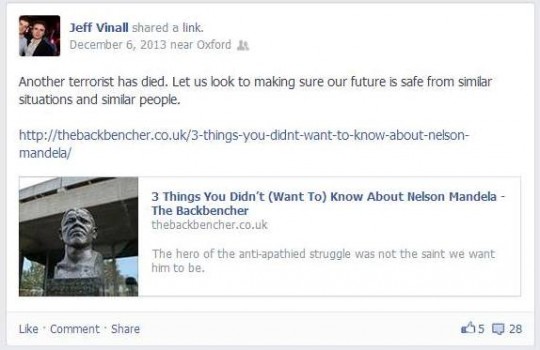
Young Oxford Conservatives leader abuses DMCA to censor reporting of his calling Mandela a "terrorist"

by Cory Doctorow


Jeff Vinall, a Conservative Party activist who is director of communications for the Oxford University Tories and is a second year law student at Brasenose College has abused the US Digital Millennium Copyright Act to censor a website that reproduced a posting from his Facebook account in which he called Nelson Mandela a "terrorist," shortly after Mandela's death.

Vinall sent a DMCA takedown notice to the hosts of the UK-based website Political Scrapbook after an initial demand to censor their reporting was declined. The DMCA is an American statute and notices issued under it have no standing in the United Kingdom; furthermore, it's clear that the brief quotation from Vinall qualifies as fair use under the American copyright law and fair dealing under English and Welsh copyright law.

In my opinion, Vinall is trying to have his cake and eat it too. I think he believes that Nelson Mandela was a terrorist, but he also believes that saying this aloud brings him and the party into disrepute. At the same time, I think he believes that repudiating his tasteless remarks will alienate a sizable number of Conservative supporters who also hated Mandela and cheered his death -- so using bullying, censorious tactics to suppress the reporting of his remarks is way for him to suppress news of the remarks without having to issue an insincere apology through gritted teeth that would disgust the party's reactionary wing.

However, the Streisand Effect is in full effect; The Oxford Tab has picked up the story and reproduced Vinall's remarks. They have spoken to Apartheid refugees, who expressed shock and horror at Vinall's callous remarks and his willingness to take the side of the totalitarian monsters who branded Mandela a terrorist and imprisoned him for a quarter-century.

The claims have upset some members of OUCA, with one South African member commenting to The Tab: “My family were removed from their homes due to the racist policies during Apartheid – calling Mandela a terrorist is not only deeply personally offensive, but it is also worrying that such a person is a candidate in an OUCA election.”

A student at Wadham, which ends every bop with “Free Nelson Mandela”, said to The Tab: “Wadham had historic close ties with Nelson Mandela, and I’m shocked that anyone could call him a terrorist. Mandela was a great man, and should be remembered as such.”

One senior member of OUCA commented to the Tab: “I have grave concerns about some of Jeff’s behaviour, he needs to understand that OUCA has to rapidly change if it’s ever going to be a proper Conservative society and not just a bunch of oddballs with unsavoury opinions.”

Oxford Tory Soc candidate Jeff Vinall calls Mandela a ‘terrorist’ [The Tab]

Jeff Vinall tries to gag Scrapbook after 'Mandela terrorist' claim [Political Scrapbook]

(Image: Jeff Vinall's Facebook update, used for critical and commentary purposes, without permission, as fair dealing [England/Wales] and fair use [USA])


13 Mar 18:01

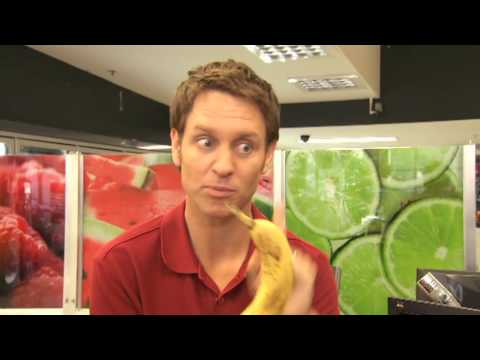
If the Grocery Were Like the Cable Company

by Miss Cellania

(YouTube link)

Your TV cable company has a business model that’s quite peculiar. Imagine if other businesses worked the same way. In this skit by Check Out ABC, the cable company is Foxtel in Australia, but the principle is the same here in the U.S. -via Viral Viral Videos

13 Mar 17:48

Getty's free image embedding comes at a price

by Rob Beschizza
The good news is that Getty is to allow free-of-charge use of many images. The bad news is that you have to use official embed code, inserting an iframe whose contents they maintain control over. The EFF's Parket Higgins points out that, just as with YouTube, Facebook, Google, and other third-party embedded services, the image is watching you, too:
These concerns might be mitigated by a strong privacy policy or some indication of what Getty intends to log and how it's going to use it. Unfortunately, we've gotten the opposite. A business development executive at Getty Images told The Verge that the company has "certainly thought about" monetizing user data, but has no specific plans. We spoke to a representative of Getty Images who said that at this time it does not collect information beyond what's necessary to store aggregate viewing numbers for individual images. That's commendable, but since that practice is significantly more privacy-protective than what the company claims in its general privacy policy—last updated in May 2012—it could change at any time. Best practices are to minimize the amount of data collected and held to meet a site's needs, but that's at odds with an incentive to collect-it-all and sort out what's needed later.

Here's the EFF's instructions for taking control of your browser. While Boing Boing is ad-supported, we also have an online shop where you may buy things. Apparently we have a special running on letter openers in the shape of a pickle.


13 Mar 17:46

Nothing: Seinfeld supercut with no people

by Cory Doctorow

Nothing is a supercut of scenes from Seinfeld in which no humans appear, creating a show that's not only about nothing, but also about no one. It's pretty great, especially once you get into the interior shots around 4:40.

BTW, I just checked and the Seinfeld box-set is still $59 on Amazon -- all 33 discs' worth.

Nothing (via Waxy)


12 Mar 20:21

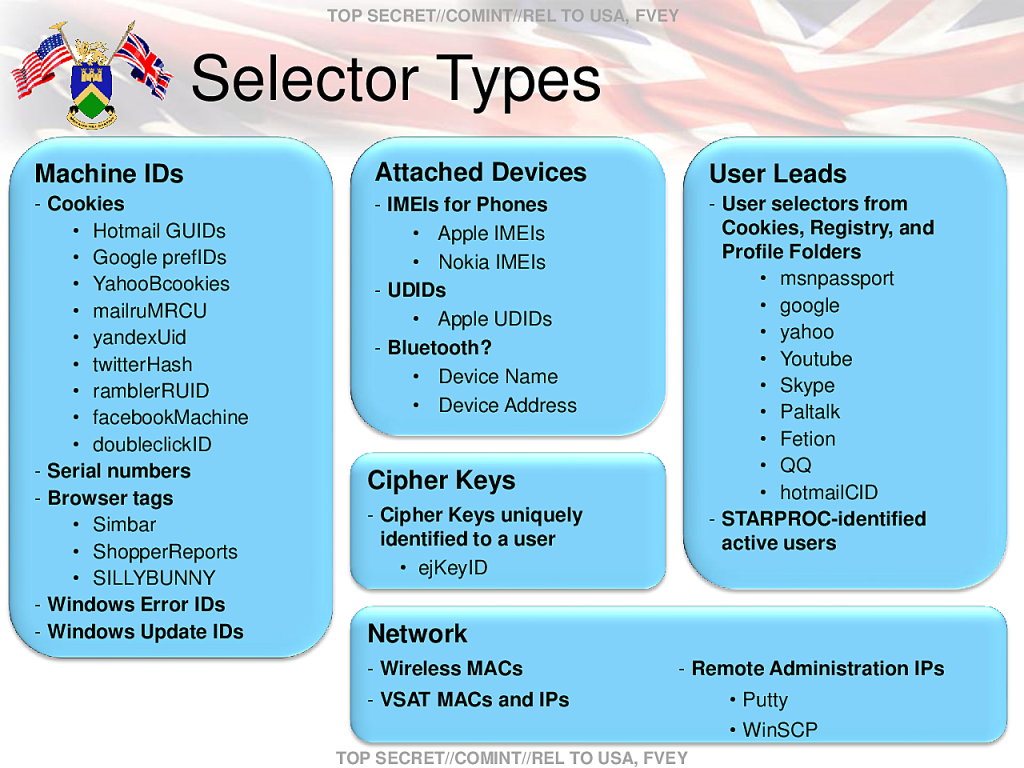
How the NSA plans to automatically infect "millions" of computers with spyware

by Cory Doctorow


A new Snowden leak, detailed in a long, fascinating piece in The Intercept, explains the NSA's TURBINE initiative, intended to automate malicious software infections. These infections -- called "implants" in spy jargon -- have historically been carried out on a narrow, surgical scale, targeted at people of demonstrated value to spies, due to the expense and difficulty of arranging the attacks.

But TURBINE, which was carried out with other "Five Eyes" spy agencies as part of the NSA's $67.6M "Owning the Net" plan, is intended to automate the infection process, allowing for "millions" of infections at once.

The article mentions an internal NSA message-board posting called "I hunt sys admins," sheds some light on the surveillance practices at the NSA. In the post, an NSA operative explains that he targets systems administrators at companies, especially telecoms companies, as a "means to an end" -- that is, infiltrating the companies' networks. As Glenn Greenwald and Ryan Gallagher point out, this admission shows that malware attacks are not targeted solely or even particularly at people suspected of terrorism or other crimes -- rather, they are aimed at the people who maintain the infrastructure of critical networks and systems to allow the NSA to control those systems.

The malware that TURBINE implants can compromise systems in a variety of ways, including hijacking computer cameras and microphones, harvesting Web-browsing history and email traffic, logging passwords and other keystrokes, etc.

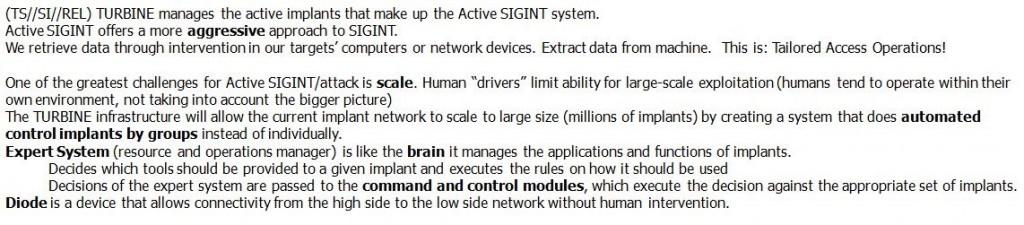
The implants being deployed were once reserved for a few hundred hard-to-reach targets, whose communications could not be monitored through traditional wiretaps. But the documents analyzed by The Intercept show how the NSA has aggressively accelerated its hacking initiatives in the past decade by computerizing some processes previously handled by humans. The automated system – codenamed TURBINE – is designed to “allow the current implant network to scale to large size (millions of implants) by creating a system that does automated control implants by groups instead of individually.”

In a top-secret presentation, dated August 2009, the NSA describes a pre-programmed part of the covert infrastructure called the “Expert System,” which is designed to operate “like the brain.” The system manages the applications and functions of the implants and “decides” what tools they need to best extract data from infected machines.

How the NSA Plans to Infect ‘Millions’ of Computers with Malware [Ryan Gallagher and Glenn Greenwald/First Look]


12 Mar 02:32

Canada and South Korea manage a free trade agreement without crazy copyright provisions

by Cory Doctorow

Michael Geist writes, "Canada and South Korea announced agreement on a comprehensive trade agreement earlier today. The focus is understandably on tariff issues, but the agreement also contains a full chapter on intellectual property (note that the governments have only released summaries of the agreement, not the full text, which is still being drafted). The IP chapter is significant for what it does not include. Unlike many other trade deals - particularly those involving the U.S., European Union, and Australia - the Canada-South Korea deal is content to leave domestic intellectual property rules largely untouched. The approach is to reaffirm the importance of intellectual property and ensure that both countries meet their international obligations, but not to use trade agreements as a backdoor mechanism to increase IP protections."

The decision to maintain existing domestic laws without pressuring the other country to conform to its approach illustrates that claims of the necessity for harmonized IP rules in trade agreement are simply untrue. A far more appropriate approach is to require consistency with international obligations.

In fact, the Canada - South Korea agreement may provide a model for many other countries that wish to include intellectual property provisions in their trade agreements but are content to require each party to meet international standards rather than the domestic rules of one of the parties. The U.S. and E.U. approach has been to export their rules to other countries, but Canada and South Korea have demonstrated that respect for domestic choices and compliance international obligations is a better alternative.

Canada - South Korea Trade Agreement Demonstrates Deals Possible Without Increasing IP Protections


11 Mar 18:10

Obama Between Two Ferns

by Alex Santoso

Forget the confrontation with Putin over Crimea! President Barack Obama faced his greatest challenge yet: an interview with comic Zach Galifianakis.

In this Funny or Die's series "Between Two Ferns," community organizer and President of the United States Barack Obama (SP?) traded barbs with Galifianakis while touting Obamacare.

There are many memorable lines, but my favorite is this one:

Galifianakis: "In 2013 you pardoned a turkey. What are you going to do in 2014?"

Obama: "We'll probably pardon another turkey. We do that every Thanksgiving. Was that depressing to you? Seeing a turkey taken out of circulation, a turkey you couldn't eat?"

*Obama trollface*

And where else have you seen anyone shushed the President?

11 Mar 17:36

Why lag sucks in online games

by Rob Beschizza
Bennett Foddy, creator of QWOP and Sportsfriends, explains why many recent indie games eschew online features in favor of old-fashioned local multiplayer. These twitchy, pixel-perfect retro game formulas just can't coexist with lag. [Polygon]


11 Mar 04:27

Murder Machines: Why Cars Will Kill 30,000 Americans This Year

by Miss Cellania

Car wrecks are the number one cause of death for Americans under 35. Every year, thousands of people die due to the traffic on America’s highways. But we’ve become used to the statistics, because they seem inevitable. After all, we use our cars so much, accidents just come with the territory. But it wasn’t always that way. Peter Norton, the author of Fighting Traffic: The Dawn of the Motor Age in the American City, tells us that a hundred years ago, when automobiles started to stake their territory on roads full of pedestrians and horses, they were seen as dangerous machines, operated by “vampire drivers” and death drivers.”

By the end of the 1920s, more than 200,000 Americans had been killed by automobiles. Most of these fatalities were pedestrians in cities, and the majority of these were children. “If a kid is hit in a street in 2014, I think our first reaction would be to ask, ‘What parent is so neglectful that they let their child play in the street?,’” says Norton.

“In 1914, it was pretty much the opposite. It was more like, ‘What evil bastard would drive their speeding car where a kid might be playing?’ That tells us how much our outlook on the public street has changed—blaming the driver was really automatic then. It didn’t help if they said something like, ‘The kid darted out into the street!,’ because the answer would’ve been, ‘That’s what kids do. By choosing to operate this dangerous machine, it’s your job to watch out for others.’ It would be like if you drove a motorcycle in a hallway today and hit somebody—you couldn’t say, ‘Oh, well, they just jumped out in front of me,’ because the response would be that you shouldn’t operate a motorcycle in a hallway.”

So what changed? Traffic was regulated by laws and by infrastructure, but the forces behind the system were careful not to demonize cars. After all, the auto industry, the fuel business, and the travel industry had a lot of money riding on the success of private passenger cars. These financial concerns changed our cities and highways to shape the attitudes we have about automobiles and traffic fatalities we have today. There was a lot involved in this transformation over the years, which you can read about at Collectors Weekly.

10 Mar 23:13

Awesome Dad Animates His Son into a Dragon Ball Video

by John Farrier

It took 6 months of work, but it was time well-spent. Robson Menezes dos Santos created a short animated feature showing his son in the Dragon Ball universe. The Portuguese-language video is embedded below. It features the same voice actors from the Portuguese-dubbed version of the show. There's a lengthy photo show in the middle. You can find the animated parts at the beginning and the 6:59 mark.


(Video Link)

10 Mar 22:21

War Drags You Out: World Political Figures Made into Drag Queens

by Alex Santoso
spriteleigh

I feel complicated about what this might mean for trans people.


Vladdy Pushin' (1952)

Inspired after attending a drag show for the first time, Saint Hoax decided to deconstruct the "recipe" of making an iconic queen and came up with the following:

1- Flamboyant name
2- Fierce persona
3- Defining outfits
4- Personalized hairdo 
5- A trademark feature
6- One hell of a PR team

Noting the similarity between that and what it takes to craft a political image, Saint Hoax decided to apply the techniques to do make-overs of some of the world's most famous (and infamous) political figures in the art series War Drags You Out:

I then realized that it takes that same exact effort to make a leader. 
A rush of images containing Hitler's mustache, Bin laden's headgear, Obama's campaigns, Saddam's narcism crossed through my mind. It got me thinking that behind every "great" man, there's a queen. 

Like drag queens, political/religious leaders are expected to entertain, perform and occasionally lip-sync a public speech.  But unlike drag queens, the fame hungry leaders don't know when to take their costumes off.


Hitleria Hysteria (1889 - 1945)


Madame O' Sane (1937 - 2006)


Georgia Buchette (1946)


Ossie B' (1957 - 2011)


Baricka O'Bisha (1961)


Kimmy Jungle (1983)

Check out the original post over at Saint Hoax - via Visual News

09 Mar 04:07

Public Prosecutor of Rome unilaterally orders ISPs to censor 46 sites

by Cory Doctorow


The Public Prosecutor of Rome has unilaterally ordered Italy's ISPs to censor 46 sites, and it appears the ISPs are complying, even though no complaint had been lodged against the sites, nor had any judge issued any order related to them. This doesn't bode well for the governance style of the new Prime Minister, Matteo Renzi, a young politician who is trying to set himself apart from the autocratic Berlusconi regime, which used tight media control as part of its corrupt governance strategy.

The blocking will be carried out on the orders of the Guardia di Finanza (GdF), a department under Italy’s Ministry of Economy and Finance tasked with dealing with financial crime, and will cover sites including mondotorrent, dopinatorrent, truepirates, filmxtutti, casacinema, watchfreemovies.ch and universfilms.

Interestingly, Sarzana adds that the case could have a novel twist, in that the police carried out the action on their own initiative.

“At present it seems that the action wasn’t carried out at the request of copyright owners associations,” the lawyer explains.

TF spoke with Enzo Mazzo of music industry group FIMI who confirmed that while there is yet no public announcement on the action, it was indeed carried out by the Fiscal Police from Rome with an order from the Public Prosecutor.

Italian Police Carry Out Largest Ever ‘Pirate’ Domain Crackdown [Andy/Torrentfreak]

(via Techdirt)

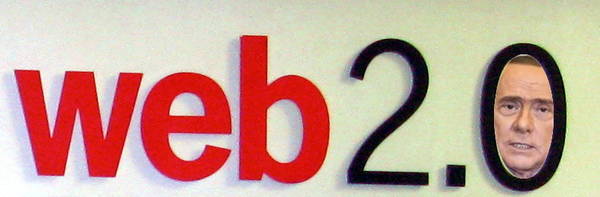
(Image: Thohir-Berlusconi, ora sara' scontro totale, a Creative Commons Attribution (2.0) image from calciostreaming's photostream/Web 2.0 conference/San Francisco, Nov 2008 - 01, a Creative Commons Attribution Share-Alike (2.0) image from yourdon's photostream)


09 Mar 01:27

Firefox OS and the unserved billions of the developing world

by Cory Doctorow

Last month, I wrote about the announcement of the $25 Firefox OS smartphone, aimed at developing world users who have never owned a smartphone and can't afford a high-end mobile device. An editorial by Pascal-Emmanuel Gobry describes how such a device could find an audience of billions, and spur a new ecosystem of developing world developers who make software that's geared not just to the Firefox OS platform, but also to the unique needs of people in the developing world.

The vision of Firefox OS is a contrast to the Zuckerberg plan to supply "Internet" to poor people in the form of an ad-subsidized, all-surveilling walled garden. As Susan Crawford says, "That's not the Internet -- that’s being fodder for someone else's ad-targeting business. That's entrenching and amplifying existing inequalities and contributing to poverty of imagination -- a crucial limitation on human life."

Asking whether the Internet is good or bad for freedom misses the point. It's clear that network technologies have the power to track and control their users, and the power to free and enrich them. The right question to ask is: "How do we get an Internet that does more for freedom?"

Firefox OS sounds like part of the answer.

What about developers? This might be the toughest nut to crack. Any company in mobile is already hard at work trying to keep up with iOS and Android, with scant time to devote to the runners-up. By definition, developing-world consumers have less money than rich-world consumers, and so they're going to be less attractive. But 3 billion people is still a big market, even if they are poor.

What's more, not all developers live in San Francisco or other rich-world tech hubs. Who will make apps for developing world customers? Developing world programmers, probably. When Android started eclipsing iOS's market share, Apple kept pointing out that iOS users spent a lot more money than Android users and therefore it still made sense to develop for iOS first -- until Android got too big to ignore.

Why Firefox -- yes, Firefox -- will become the mobile OS to beat [Pascal-Emmanuel Gobry/Citeworld]

(via /.)


08 Mar 16:46

Coffee DRM and the wider world of state spying and corporate control

by Cory Doctorow
Dan Gillmor's got more to say about the news that K-cups are getting coffee DRM and what it means in the wider world: "Just as the police and security agencies are racing deploy all new technologies to spy on everyone – whether the law permits it or not – private industry is racing to retain as much control as possible over the products and services it sells, and thereby control over us."


08 Mar 16:46

Random Teleporter Takes You Somewhere on Earth

by John Farrier

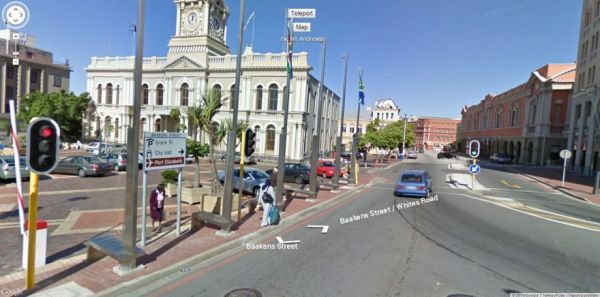
Jim Andrews's teleporter has a simple interface. You begin in the control room of the TARDIS (naturally). Click on the teleport button to go somewhere on Earth. You'll promptly see the nearest photo in Google's archive.

Andrews calls himself a "programmer-poet," so this device is a work of art. It's also a way to explore the world, albeit not in any particular order. His inspiration for the project was a game in which people are shown panoramic photos from around the world and are then invited to guess the locations. You can do the same thing with the teleporter. Just click on the Map button to see the location of each photo.

Dress in layers. You may end up in a hot desert or in the Antarctic interior.

-via David Thompson

07 Mar 21:21

Edward Snowden's magnificent testimony to the EU

by Cory Doctorow

NSA whistleblower Edward Snowden has submitted written testimony [PDF] to an EU committee investigating mass surveillance. Glyn Moody's Techdirt post gives a great tl;dr summary of the document, but you should really read it for yourself. It's ten single-spaced pages, but Snowden turns out to be an extremely talented writer who beautifully lays out his arguments, managing the trick of being dispassionate while simultaneously conveying the import of his subject matter.

Snowden makes the point that his testimony doesn't disclose anything that the press hasn't already published, but there's been so much that it's worth reviewing some of it. He directs our attention to something I'd missed: the NSA's Foreign Affairs Division (FAD) spends an extraordinary amount of time lobbying EU nations (and other countries) to change their laws so that the NSA can legally spy on everyone in the country. What's more, they cook these deals -- for example, they'll get German permission to listen in on everything by non-Germans and get a Danish deal that covers all the non-Danes, but since the Internet backbones traverse both countries, they can spy on Germans in Denmark and Danes in Germany. As Snowden says, "The surest way for any nation to become subject to unnecessary surveillance is to allow its spies to dictate its policy."

Snowden also reveals that before he blew the whistle on the NSA, he "reported these clearly problematic programs to more than ten distinct officials, none of whom took any action to address them." He says that he'd love EU asylum, but doesn't expect any country to have the backbone to stand up to the USA. And he is admirably unequivocal on his relationship with China and Russia: "I have no relationship with either government."

He reaffirms that good crypto is proof against spies, and describes his relationship with Russia's spooks:

Of course. Even the secret service of Andorra would have approached me, if they had had the chance: that's their job.

But I didn't take any documents with me from Hong Kong, and while I'm sure they were disappointed, it doesn't take long for an intelligence service to realize when they're out of luck. I was also accompanied at all times by an utterly fearless journalist [WikiLeaks' Sarah Harrison] with one of the biggest megaphones in the world, which is the equivalent of Kryptonite for spies. As a consequence, we spent the next 40 days trapped in an airport instead of sleeping on piles of money while waiting for the next parade. But we walked out with heads held high.

EU Testimony of Edward Snowden [PDF]


07 Mar 18:36

Bir-Bir-Bird Machine is the Wor-Wor-Word Machine

Submitted by: Unknown (via Beastpants)

Tagged: dj , birds , funny , weird , Video
07 Mar 18:31

Vine bans sexual content

by Rob Beschizza
Twitter's 6-second video-sharing platform, Vine, has banned sexual content. Depictions of "provocative" nudity, sex acts, clothed but "aroused" genitals, and "sexually graphic" artwork or animation is "not a good fit for our community," the company writes. [The Verge]


07 Mar 18:29

Jurassic Cats

by Miss Cellania

(YouTube link)

Run for your lives! No, hide and be really quiet! The cats are coming, and they’re as big as a dinosaur of some sort in this remix of Jurassic Park, featuring cats in the roles of the raptors. -via Buzzfeed

07 Mar 18:24

Netflix disables Chrome's developer console

by Cory Doctorow

When you watch Netflix videos in the Chrome browser, the service disables Chrome's developer console, a debugging and programming tool that gives you transparency and control over what your browser is doing. The Hacker News thread explains that this is sometimes done in order to stop an attack called "Self-XSS" that primarily arises on social media sites, where it can cause a browser to leak nominally private information to third parties. But in this case, the "Self-XSS" attack Netflix is worried about is very different: they want to prevent browser owners from consciously choosing to run scripts in the Netflix window that subvert Netflix's restrictions on video.

This is the natural outflow of the pretense that "streaming" exists as a thing that is distinct from "downloading" -- the idea that you can send a stream of bytes to someone else's computer without the computer being able to store those bytes. "Streaming" is at the heart of "rental" business models like Netflix's, and there's nothing wrong with the idea of rental per se. But the only way to attain "rental" with computers is to design computers so that their owners can't give them orders that the landlords disagree with. You have to change the computer and its software so that you can't see what it's doing and can't change what it's doing.

Your browser is a portal to your whole social life, your financial life and your work life, entrusted with the most potentially compromising secrets of your life. Anything that allows third parties to make it harder for you to figure out what the browser is doing, or to prevent it from doing something you don't want, should be a non-starter. As soon as a powerful entity like Netflix comes to depend on -- and insist on -- computers that owners can't control, that company is doing something wrong. Not because rentals are bad, but because taking away owner control from computers is bad.

This is why it's such a big deal that Netflix has convinced Microsoft, Apple, and Google to build user-controlling technology into their browsers, and why it's such a big deal that Microsoft, Apple, and Google have convinced the W3C to standardize this for all devices with HTML5 interfaces. Any time we allow the discussion to be sidetracked into "How can Netflix maximize its revenue by enforcing rental terms?" we're missing the real point, which is, "How can people be sure that their browsers aren't betraying them?"

Netflix disables use of the Chrome developer console (pastebin.com)


07 Mar 01:49

Get a wee degree in free from RIT

by Cory Doctorow
The Rochester Institute of Technology has announced America's "first minor in free and open source software and free culture." (Thanks, Stephen!)


07 Mar 00:28

The 2014 Academy Awards Meme Roundup

by Miss Cellania

Internet culture is invading the old world of TV more and more each day. I mentioned just the other day how people who’s been watching The Tonight Show since Johnny Carson took over for Jack Paar are now scratching their heads at Jimmy Fallon’s “hashtags” and “memes.” News programs are asking viewers to “Tweet” them. And the Academy Awards program last weekend was not only full of “selfies” and “photobombs,” but the celebrities in the auditorium were fully aware of such things, even more so than the average TV viewer. Or live TV viewer, that is. Many internet citizens caught the high points of the evening on DVR, YouTube, or even Twitter.

The Selfie Seen 'Round the World

Academy Awards host Ellen DeGeneres highlighted the Samsung Galaxy Note phone, which sponsored the show, by taking selfies with the seated celebrities. It’s the kind of thing that DeGeneres would do anyway. One selfie managed to pack in more than the usual number of movie stars.

When DeGeneres Tweeted the photo, the response was so immediate that Twitter went down for a short while. Within a few hours, it had become the most-retweeted Tweet ever, and within a day it garnered over three million retweets. And the parodies began immediately.

Matt Groenig of The Simpsons drew his version of the picture, with a wider angle showing what else was going on just outside the frame.

Brick artist Ochre Jelly (Iaian Heath) went to work immediately to enshrine the scene in LEGO bricks.

Everyone wanted to alter the picture just a little. Find some of the earliest Photoshop jobs in this roundup. My favorite was this scene from The Shining in which you will find some familiar faces -if you look hard enough. Bonus: this one also contains Jack Nicholson.

You can be in the picture, too! Here’s an application in which you can insert your own picture into the selfie. I tried it, but no matter how tiny a picture I uploaded, it was too big to fit in with the crowd. I’m sure there’s some kind of adjustment somewhere, because others have managed to make it work. The selfie shown here is from anabela.cruz.568

Adele Dazeem

The next most-talked-about meme from the Oscars was John Travolta introducing Idina Menzel when she sang “Let It Go.” He mangled the phonics of her name so badly that it came out “Adele Dazeem.” Billboard imagined how Travolta would pronounce other singers’ names.

Travolta’s name was properly misspelled all over the internet as Jorm Tramolta, Don Gibraltor, Travis Jarvolta, etc. And Slate invited you to “Travoltify” your own name, with generator that mangles the pronunciation appropriately. David Letterman offered a list of the Top Ten Ways to Mispronounce Idina Menzel

But the real winner of the flub was Adele Dazeem. The name that belongs to no one now has a Twitter account in which names are spelled any which way. And the musical If/Then appears to have replaced Idina Menzel with a new actress named Adele Dazeem

Someone even made up flyers to insert into the show programs, but it wasn’t the production’s management. And everyone else had a joke to make about it. 

Poor Leo

A lot of the buzz leading up to the Oscars was how Leonardo DiCaprio has made so many hit movies and has yet to win an Academy Award. Would this be his year? He was nominated (for the fourth time), but was not an odds-on favorite for the prize. No one was surprised when he didn’t win, but many were ready with the appropriate images for the internet.

See more of the viral images here.

Jennifer Lawrence Falls Again

Jennifer Lawrence is a wonderful actress and a good sport, but she doesn’t have great luck with evening gowns. Last year’s best Oscar meme was when she fell ascending the stairs to accept her Oscar. This year she managed to trip over her dress walking down the red carpet. Gifboom user ditzkoff, who uploaded this gif, captioned it “Jennifer Lawrence in Gravity 2.” Uproxx dubbed it the “Now-Annual ‘Jennifer Lawrence Trips At The Oscars’ GIF.” We can’t wait to see what dress causes her to do it again next year!

There are more (pizzas, photobombs, etc.), but these are the most popular memes to result from this year’s Academy Award ceremonies. And the images are still coming in thick and fast, because everyone’s comedian on the internet.
June 3, 2014 - 3:27pm
06 Mar 22:25

When David Cameron Calls, The Internet Answers

by Alex Santoso

I've been speaking to @BarackObama about the situation in Ukraine. We are united in condemnation of Russia's actions. pic.twitter.com/7Rk2k8iOIK

— David Cameron (@David_Cameron) March 5, 2014

When UK Prime Minister David Cameron posted on Twitter a photo of himself talking on the phone to President Barack Obama about the tense situation in Ukraine and looking super serious doing so, he inadvertently started a chain reaction of parody photos.

Comedian Rob Delaney jumped in:

.@David_Cameron@BarackObama Hi guys, I'm on the line now too. Get me up to speed. pic.twitter.com/xhmJG5KpxT

— rob delaney (@robdelaney) March 5, 2014

Then Sir Patrick Stewart came on board:

.@robdelaney@David_Cameron@BarackObama I'm now patched in as well. Sorry for the delay. pic.twitter.com/elLQcKcV3w

— Patrick Stewart (@SirPatStew) March 5, 2014

... and hilarity ensued, when more Twitter users piled on with #Davecalls

You'll have to speak up, I'm ironing. #davecalls#tweetlikecameronpic.twitter.com/sm7MybUhlS

— Ash Preston (@TheAshPreston) March 6, 2014

Right. @David_Cameron@BarackObama I've done the school run, so catch me up. #davecallspic.twitter.com/g0Pmuozyj8

— Alicia Léal-Brighty (@Honey_star) March 6, 2014

Yeahhh... I'd advise against that Dave. #davecallspic.twitter.com/uCSk0bNGyK

— lisa harker (@darkerharker) March 6, 2014

@SirPatStew@robdelaney@David_Cameron@BarackObama Ok, guys, thanks for holding. pic.twitter.com/ih36KWU3Tb

— Michael Moreno (@MacMoreno) March 5, 2014

Sorry, one more. RT @BurgessGBG: "Get me Osbourne, immediately!" #tweetlikecameronpic.twitter.com/nyAQ4d1Wh4

— Graham Linehan (@Glinner) March 5, 2014

I win. #tweetlikecameron (attn: @felix_cohen@glinner) pic.twitter.com/aT19B9AiTd

— Ryan Alexander (@rnalexander) March 5, 2014

. @OoTheNigerian Network is bad but keep talking. @SirPatStew@robdelaney@David_Cameron@BarackObamapic.twitter.com/vMLPqSV0H5

— ST (@seyitaylor) March 5, 2014

Hi Dave, on the line and ready to give you a pizza my mind...#davecallspic.twitter.com/OCMYvcAEX9

— JUST-EAT.co.uk (@JustEatUK) March 6, 2014

Batman took the call:

"Ukraine, you say" #davecallspic.twitter.com/yHyEStbgVX

— Mat Beal (@matbeal) March 5, 2014

Even the dog got in on the convo:

#davecallspic.twitter.com/YKevFPSIlW

— Eliot Andersen (@EliotAndersen) March 5, 2014

And it's now a game:

no. i will not stop. i haven't even started. #davecallspic.twitter.com/rJrb1LRrTf

— Caroline (@CarolineKent) March 6, 2014
06 Mar 16:22

Why DRM'ed coffee-pods may be just the awful stupidity we need

by Cory Doctorow


I've been thinking about the news that Keurig has added "DRM" to its pod coffee-makers since the story first started doing the rounds a couple of days ago. I've come to the conclusion that while the errand is a foolish one, and the company deserves nothing but contempt for such an anti-competitive move, that there might be a silver lining to this cloud. As I've written recently, there's not a lot of case-law on Section 1201 of the Digital Millennium Copyright Act (DMCA), the law that prohibits "circumventing...effective means of access control" to copyrighted works. In the past, we've seen printer companies and garage door opener manufacturers claim that the software in their devices was a "copyrighted work" and that anyone who made a spare part for their products was thus violating 1201. But that was 10 years ago, and it's been a while since there was someone stupid and greedy enough to try that defense.

I think Keurig might just be that stupid, greedy company. The reason they're adding "DRM" to their coffee pods is that they don't think that they make the obviously best product at the best price, but want to be able to force their customers to buy from them anyway. So when, inevitably, their system is cracked by a competitor who puts better coffee at a lower price into the pods, Keurig strikes me as the kind of company that might just sue. And not only sue, but keep on suing, even after they get their asses handed to them by successive courts. With any luck, they'll make some new appellate-level caselaw in a circuit where there's a lot of startups -- maybe by bringing a case against some spunky Research Triangle types in the Fourth Circuit.

Now, this is risky. Hard cases made bad law. A judge in a circuit where copyright claims are rarely heard might just buy the idea of copyright covering pods of coffee. The rebel forces that Keurig sues might be idiots (remember Aimster?). But of all the DRM Death Stars to be unveiled, Keurig's is a pretty good candidate for Battle Station Most Likely to Have a Convenient Thermal Exhaust Port.


06 Mar 16:14

Rob Ford's pitiable moment on Jimmy Kimmel

by Cory Doctorow

Toronto Mayor Rob "Laughable Bumblefuck" Ford flew to Los Angeles for an appearance on the Jimmy Kimmel show. What followed was more than a little awkward. Kimmel is a great pains to hide his dislike of Ford, but he's not entirely successful. The hardest part comes at the end, when Kimmel confronts Ford with the fact that he is an out-of-control alcoholic, whose blackouts, binges, abuse and dangerous behavior are putting him, the city, and the people he loves at risk. Ford's total denial is genuinely pitiable. Joey Davilla has a very thorough writeup of the appearance, with links to the other parts of the video.

Kimmel took a moment to wipe the sweat off Rob’s glistening forehead, some of which may have been nerves (perfectly normal, especially if you’re appearing on a live show watched by millions), and some of which may have been from being a massive guy with impulse control issues.

It gets more embarrassing in part 3, in which Kimmel shows a photo of the snack tray in Ford’s dressing room, showing the desserts having been devoured but the vegetable tray untouched, and then marched him to stage right to show him a selection of the videos that made him notorious and asked him to provide some context.

The most telling part of that final segment is the exchange in which Kimmel suggests that Ford seek some professional help. Ford will have none of it, and stays on his campaign message:

Kimmel: “If you are an alcoholic…if you’re drinking enough that you can try crack in your forties and you don’t remember it, maybe that’s something you might want to think about, you know, talking to somebody.”

Rob Ford’s red-faced interview on Jimmy Kimmel Live


06 Mar 15:52

Video explainer: why open spectrum matters, and why you're about to lose it

by Cory Doctorow

Harold Feld from Public Knowledge writes, "One of the hardest problems I face advocating for more open, shared 'unlicensed' spectrum is trying to explain exactly what 'spectrum' is and why decisions about it made by the Federal Communications Commission (FCC) matter. My organization, Public Knowledge, now has a two minute video animation 'Wireless Spectrum: How To Use It And Why You Might Lose It' that explains for those new to these issues. The video ties in to our effort to save the newest unlicensed spectrum, 'TV white spaces,' from being auctioned away to the biggest wireless companies. If you agree after watching the video that we need to protect and promote open spectrum as well as get more licensed spectrum to AT&T and Verizon, please click through to our petition."

Wireless Spectrum: How To Use It And Why You Might Lose It (Thanks, Harold!)


06 Mar 15:35

Massive security flaw in GNU/Linux crypto code

by Cory Doctorow

A major, critical security flaw in a key cryptographic program used by most flavors of GNU/Linux as well as other free/open operating systems has been reported. The bug, which appears in the Gnutls code, allows for undetectable man-in-the-middle attacks against affected systems. My operating system, Ubuntu, had an update waiting for it this morning that patched this. If you're running any flavor of Linux or BSD, you should immediately check for, and apply, any TLS patches offered through your distribution.

The bug is the result of commands in a section of the GnuTLS code that verify the authenticity of TLS certificates, which are often known simply as X509 certificates. The coding error, which may have been present in the code since 2005, causes critical verification checks to be terminated, drawing ironic parallels to the extremely critical "goto fail" flaw that for months put users of Apple's iOS and OS X operating systems at risk of surreptitious eavesdropping attacks. Apple developers have since patched the bug.

"It was discovered that GnuTLS did not correctly handle certain errors that could occur during the verification of an X.509 certificate, causing it to incorrectly report a successful verification," an advisory issued by Red Hat warned. "An attacker could use this flaw to create a specially crafted certificate that could be accepted by GnuTLS as valid for a site chosen by the attacker."

GnuTLS developers published this bare-bones advisory that urges all users to upgrade to version 3.2.12. The flaw, formally indexed as CVE-2014-0092, is described by a GnuTLS developer as "an important (and at the same time embarrassing) bug discovered during an audit for Red Hat." Debian's advisory is here.

Critical crypto bug leaves Linux, hundreds of apps open to eavesdropping [Dan Goodin/Ars Technica]