After discussing sexism in the refugee crisis, the Church, and financial systems, she went on to criticize her own industry for its deplorable lack of female film critics.
THIS IS A REALLY FUCKING EXCITING THING, BUT OF COURSE NOBODY SEEMS TO GIVE ENOUGH OF A FUCK ABOUT MESOPOTAMIAN SHIT TO ACTUALLY REPORT THIS ANYWHERE SOMEONE MIGHT SEE IT.
IT’S REALLY FUCKING COOL. TRUST US.
yesssssss
and I guess this makes the Gilgamesh fandom the winner in the contest of who had the longest time between updates…
Sometimes people use “respect” to mean “treating someone like a person” and sometimes they use “respect” to mean “treating someone like an authority”
and sometimes people who are used to being treated like an authority say “if you won’t respect me I won’t respect you” and they mean “if you won’t treat me like an authority I won’t treat you like a person”
and they think they’re being fair but they aren’t, and it’s not okay.
No, this is not “Can I touch your butt” in Elvish. This is “Can I touch your butt?” in English, transcribed using the letters of the Elvish alphabet. There is a difference.
In Elvish, the letters of the alphabet correspond to sounds, not to words. The above text spells it out using one symbol to represent one letter of the original English, which is incorrect:
c-a-n i t-o-u-c-h y-o-u-r b-u-t-t
If you really want to spell out an English phrase using the Elvish alphabet, you would do so phonetically, which would basically equate to one symbol per phoneme (sound):
c-a-n a-i t-u-ch y-o-r b-u-t
If you actually wanted to write “Can I touch your butt?” in Elvish, one (very rough) translation would be:
Annog nin daf pladan tele ci?
Which, in Sindarin Elvish, roughly translates to, “Would you give me permission to touch your rear?”
Written in tengwar (the Elvish alphabet), it would look like this:
After the widespread coverage of Michigan's abuse of juveniles inmates—including stories of kids being housed with adults who raped and abused them—the state has decided to make some changes. From Huffington Post:
Michigan lawmakers are expected to introduce 21 bills this week that address prison treatment and criminal justice practices for kids in the adult corrections system. Some measures would ban placing youth in adult jails and prisons altogether.
Michigan automatically charges 17-year-olds as adults, and one of the bills would raise that age to 18. Another bill asks judges to consider certain factors before removing a kid from the juvenile system including the crime, other programming options, and the child's culpability.
Another two bills, introduced by a Republican state rep, would ban the placement of children in adult jails and prisons and require that they are in juvenile facilities and that those facilities offer services and treatment.
There's also a bill that would "ensure that youth under 21 in segregation receive age-appropriate programming and exercise at least five days a week."
Michigan will begin to consider these bills in the near future. Regardless, it is good to see that legislators are finally paying attention to the abuse happening in state facilities. There may be hope, relief, and a slightly better life for kids imprisoned in Michigan, after all.
So a teacher in my friends’ class told them he had grounded his daughter for wearing make up at school, and turns out that the next day every single girl in class had slapped the brightest blood red lipstick they had and there was a line in the bathroom to apply knife sharp, enormous curves of winged eyeliner on everyone and they looked like a legion of warrior goddesses on their way to avenge their sister, so when the teacher came in the room his face just FELL and he kept avoiding the girls staring at him during class, so they started raising their hands and asking questions about the subject to force him to look at them, and if you don’t think girls are amazing when they get down to battle you are missing out on something glorious
Seattle and Minneapolis were the first two cities to do so in October 2014. Since then, seven more cities — including Lawrence, Kansas, on Tuesday, and Portland, Oregon, on Wednesday — and one county in Texas, as of Tuesday, have joined their ranks. There are several many reasons we shouldn’t honor Columbus.
LIKE there’s this whole thing in this book about how your brain grows stronger and healthier by practicing responding to stress in healthy ways, because if a stressor is predictable and you feel a sense of control over it, you habituate and stop reacting to it, but if it’s random and unpredictable you have the opposite response and become sensitized, so your reaction actually gets more and more extreme. (if you hear a loud noise at predictable intervals you’ll soon stop noticing or reacting, but if you hear it at random intervals you’ll become sensitive to it and anxious.) so one way to help people who have adverse reactions to reminders of trauma is to give them control over how they’re reminded of the trauma, because it helps the brain practice responding to stress in a safe way so you can habituate to the stress response.
which is why if someone tags something for a trigger and you still choose to look, it’s actually an act of healthy resistance against your reaction to that trigger (because it teaches your brain to habituate), but encountering something triggering in a random and unpredictable way actually increases your stress response and makes you more sensitive to the trigger. so people who are against trigger warnings because “you have to learn to cope” are actually taking away your tools for learning to cope, because encountering stressors in a way that further strips you of control over your trauma is never, ever helpful. it’s a lot of stuff i kind of knew but integrated and explained with more context and science
The developing world sees as many as 99% of newborn and maternal deaths worldwide. Baby Hero, a company which sells baby products, is trying to lower the odds: For every product sold, they send a neonatal survival kit, compact enough to fit in a ziplock bag, to poor mothers in need. Their plan takes Toms Shoes and Warby Parker a step further.
“Barack Obama was re-elected to the White House in 2012 by a margin of roughly 5 million votes. To mainstream conservatives this is unfortunate. But it’s also a fact. Not just a Democratic fact, but a small-d democratic one. The people spoke at the ballot box, and that voice cannot simply be annihilated. What’s more, there are a couple hundred years of government precedent and a written Constitution to guide the balancing of conflicting interests between the president and his party and the Congress and its majorities.
But the Ultra[-Right-Wing-Republican]s are not big on balance. Or, really, democracy. To them, Obama is not the duly elected president of the United States, the nation’s highest officer. He is an affront and an obstacle. Since he is not an archconservative Republican, and they so fervently wish that he were, they simply deem him illegitimate.
The Ultras are called “outsider” and “anti-establishment” and “anti-government.” And they are in various ways. But they are mostly anti-democratic. They reserve their greatest contempt for compromise, even with members of their own party. Compromise is the viscous stuff that enables diverse interests to be accommodated and government to function. It’s the stuff of American pluralism and representative democracy, fluid enough to carry multiple views but still sticky enough to make one of many.
The Ultras are at war with Democrats, with Republicans, with government itself. But mostly they are war with perhaps the greatest, if least heralded, of American political ideals: half-a-loafism. In a 50-50 nation, they don’t want small bites. They want it all. Never mind that they represent a rump of one party.”
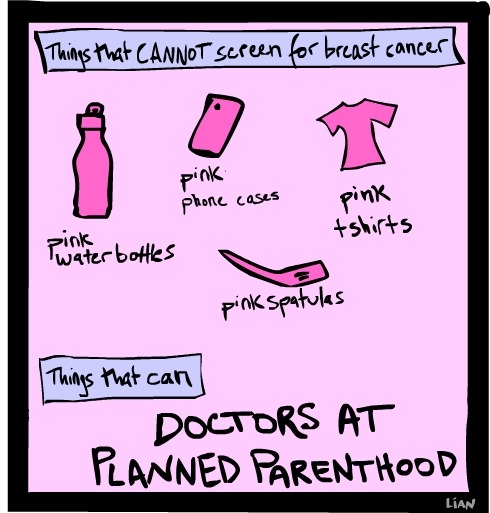
Things that cannot screen for breast cancer and things that can.
And for those who are yelling about PP not doing mammograms, “screenings” are not just mammograms. "Screenings" are also breast exams, which are the first line of defense. Those breast exams are done every time a woman has a pelvic exam, which she needs in order to get birth control or STI testing. Get it together. Semantics do not change the facts.
When a mass shooting occurs, we talk about gun control and mental health issues, but we never talk about toxic masculinity or male violence. Women have access to guns. Women suffer from mental health issues. So what’s the difference? Why can’t we talk about it in those terms?
“As debate rages over gun control, media portrayals of shooters, and other factors, one topic doesn’t get enough discussion, those who study mass shootings say: masculinity.”
In case you think toxic masculinity isn’t involved with these shooters, this headline is from YESTERDAY (TW for violence against women, gender violence):
“This amazing speech by Patrick Stewart is perfect for sharing during October’s Domestic Violence Awareness Month. A longtime outspoken advocate for survivors of domestic violence, renowned actor Patrick Stewart gave this touching impromptu speech about his own experience with domestic violence in response to a fan’s question about what non-acting work he’s most proud of. Stewart, who grew up in a home where his mother suffered frequent abuse from his father and has called violence against women the “single greatest human rights violation of our generation,” talked about his work with organizations that support victims of domestic violence, including the UK-based group Refuge
Stewart shared: “The work that I do in campaigns about violence towards women, particularly domestic violence, is something that grew out of my own childhood experience. I do what I do in my mother’s name, because I couldn’t help her then. Now I can.” He also added that he recently learned that his father suffered from Post Traumatic Stress Disorder due to WWII-related combat. After this discovery, he has begun to work with Combat Stress, an organization that helps combat veterans deal with their experiences in a healthy, non-abusive manner.
The exchange with the fan was especially touching because she shared that she had also experienced abuse and his speeches on the issue had helped her through her own “personal turmoil.” At the end of his response, Stewart came down from the stage to give her a hug and, as she later shared on her blog, told her “You never have to go through that again, you’re safe now.”
To watch the Stewart’s short speech and the moving exchange on YouTube, visit http://bit.ly/1kNqy1h
For resources for teens and their parents on how to approach dating in a healthy way and to learn about the signs of relationship abuse and how to get help, check out Loveisrespect, a collaboration of the National Dating Abuse Helpline and Break the Cycle, at http://www.loveisrespect.org”
when you can only manage to get yourself to say things like “no!” and “bathroom!” but the people around you want you to say “no thank you, thank you for the offer” and “may I use the bathroom please?” and keep telling you to rephrase what you’re saying when you can’t