Shared posts

16 Mar 01:15

Ben Carson's inspiring pro-Trump message: 'We're only looking at four years'

by rss@dailykos.com (Hunter)

Ben Carson has endorsed Donald Trump to be our new president. His logic is, as can be expected from such a brilliant Republican thinker, impeccable.

"Even if Donald Trump turns out not to be such a great president, which I don't think is the case, I think he's going to surround himself with really good people, but even if he didn't, we're only looking at four years as opposed to multiple generations and perhaps the loss of the American dream forever," Carson told Newsmax's Steve Malzberg.

An inspiring message, to be sure, and one that will no doubt make it into bumper-sticker form sooner or later. Trump ‘16: C’mon, How Bad Could It Be?

In other news, the Trump campaign has decided that Ben Carson isn't allowed to talk anymore.

16 Mar 00:57

The Monster in the Mirror: On Horror, Disability, and Loving Both at Once

by Emily Foster

The Girl Who Stood on a Grave by Stephen Gammell

One delirious summer night when I was nineteen, I went on a blind date with a man I met on Craigslist who was covered in beautiful tattoos from head to toe. About fifteen minutes after he picked me up from the barn where I worked, he began to get annoyed with my admittedly shallow and casual knowledge of the horror genre (he said in the ad that he wanted to meet ‘a Sherri Moon Zombie character,’ not a horror critic, but I digress). Now, I might technically be a horror fan, he began to explain to me, but no, I was not a very good one, and he was starting to feel like I’d lied to him.

It was then that I noticed he had a set of knuckle tattoos that originated during the Napoleonic Wars, and hoo boy.

Ten minutes later, I was walking back to my workplace via someone’s ditch-side lane, smoking a cigarette and trying to convince my friend on the phone that I was telling the truth about this disaster. I was one scary lady, he had told me, interrupting my very well researched Special Interest Monologue about Nelson’s Navy by slamming on the brakes and kicking me out of his car. Yep, I explained, that really happened that way, I started sperging about the Napoleonic Wars and he told me I was too scary and he drove me almost back to work and he kicked me out of the car.

God, I love horror stories.

I tell fictional ones, too, which may seem a little bizarre given that I’m a weird bathrobe lady who can’t always talk but who also has no problem with loud, profane public meltdowns (and can you please feed my critters this week I’m in a psych ward and I’ll explain when I’m out). The horror genre isn’t always, shall we say, kind to people like me. And yet, I find that I can’t talk about disability—can’t write about my own experiences with autism and comorbid mental illnesses, can’t tell fictional stories about disability—without incorporating elements of a genre that objectifies and vilifies disability so frequently.

It’s been a lifelong thing, my fixation with horror. Steven King’s It was the first real horror I ever encountered, seven years old and terrified of the Bumble in Rudolph the Red-Nosed Reindeer. It was also my first introduction to queer people, but that’s another article altogether. I’d re-read it later on when my brain could actually parse a whole novel, but what I remember from the seven-years-old reading were (1) the exact meaning of a few words I heard on the bus and (2) the concept of something terrifying, shapeshifting, formless—something that was going to beat the everliving hell out of you if you strayed off into the dark.

It wasn’t that I was to this point unafraid of the formless, the slimy, the alien—it was that I hadn’t considered up until now that you could voice fear itself as a topic of conversation. Fear is not encouraged in rural communities, as a general thing, and I was weirdly afraid. I was weirdly everything, especially weirdly afraid, to the point where teachers and strangers and relatives would remark that there was something wrong with me. It was hoped that this was all just me being a pain in the butt, that with discipline and determination I could be less weird. Being afraid, like screaming in public or ‘splaining to strangers or being too squirmy or getting too excited about my books or not excited enough about sports, was against the rules.

So, I guess, there was a thrilling novelty to the idea that you could intentionally just be scared and not have to pretend that you were just okay with the current developments happening around you. Goosebumps books and Scary Stories to Tell in the Dark were petrifying when I was small and very anxious, but they were fascinating. The desire to feel fear and the ability to feel it without consequence were just new and cool. There was a kind of decadence to the act of being anxious, and I still have a soft spot for that kind of kitschy, over-the-top spooky: heads rolling off, dead girls haunting drunk drivers with their bicycle bells, inevitable eyeball removal. I miss that kind of spooky.

I have a different relationship with the kind of spooky I rolled into as I got older—as I began to learn that I wasn’t the only kid who got whisked away to therapy appointments for Behavior, who got threatened with the State Hospital, whose peers suspected them of all kinds of unrealistic evil.

There’s a lot of learning that comes with a diagnosis. My first one was autism. The simple meaning of that diagnosis is that I have a hard time speaking, a hard time understanding speech, and a really hard time understanding tasks with a lot of steps. The less simple meaning of that diagnosis is a little harder to explain. Carrying on an unscripted conversation with me, for example, is kind of a wild ride. If I’m comfortable around you, I just won’t look at you. If I’m not comfortable, I’ll aim my twitchy Kylo Ren stare right between your eyes and shred whatever object I happen to have in my hands.

Whether I’m comfortable with you or not, some things remain constant: my speech is best described as ‘Boomhauer Uncensored.’ I monologue, loudly and rapidly, about things that fall under my Special Interests. I can’t really control when I laugh, how loud I speak, how fast I speak, and sometimes whether I can speak at all. As you can tell from the story that began this article, my decision-making and overall common sense are so far above par as to be incomprehensible to the average person and even myself. I have a bizarre memory for detail: without trying, I can recall a specific fact pattern a judge made note of in a ten-year-old case, or I can recall the exact board game some bare acquaintances were discussing among themselves five months ago. It took me a while to learn that the first use of my memory made me Unique and Different and Not Really Disabled At All, More Like Extra Super Abled—while the second use of it just made me a dangerous predator who was obviously doing these things deliberately so I could make people uncomfortable.

And I was one of the lucky ones. I was tiny, white, and cute, with rich parents and a Real Diagnosis and a clean criminal record. It was unpleasant to be shuffled from school to school. It was not remotely the same thing as being funneled from school to jail, or school to the State Hospital, or school to jail to Wilderness Torture Camp where they literally starve you into obedience in the desert in Utah—all while being told that there was nothing wrong with you, that the only disability you faced in your life was your attitude.

So, maybe it wasn’t weird that we all bonded over bad horror movies: Rob Zombie flicks, outlandish exploitation movies, Edgy Internet Horror of the worst varieties. Maybe it wasn’t weird that we spent all that time gossiping and bonding in musty basements while we watched insulting parodies of ourselves stalk and cackle across the jumpy TV screen. Maybe we liked that they confirmed our suspicions, confirmed the things we picked up from the conversations our parents and probation officers were having about us, confirmed the content of the books they brought home about kids like us.

There’s this idea, you see, that gets posited at the beginning of the $5.00 Walmart flick about the insane asylum, about the madman in the trailer in the big empty field. There’s this idea that makes it scary that the Sexy Innocent Heroines in Tight Shirts are trapped in an insane asylum, trapped in proximity to people who have Issues like you.

The idea is that reasonable people are unsettled by you. Reasonable people do not want to be around you. Something about your reality, your boring, pain-in-the-butt reality, is fundamentally scary enough that it’s kind of cliché.

If I’m going to talk about the cliché horror of my youth, I have to talk about Saw, because there was a whole thing about Saw if you were a pretentious high school kid. The thing about Saw was that it wasn’t really a horror movie, it was a gore movie. The thing about Saw was that it wasn’t deep. It wasn’t psychological. I mean, you had to watch Saw, because if there was one thing a tiny queer theater nerd needed it was the edgelord cred that came with watching Saw and munching your pizza rolls and being ‘meh’ about it, but you also had to acknowledge that Saw was Bad.

And Saw was Bad for the same reason that the cheapo horror movies that we brought home from Walmart were bad. It relied on cheap scares—reasonable people are afraid of mutilation with needles and saws and broken glass and that whole bathroom situation. Saw isn’t deep like gothic novels or House of Leaves or Junji Ito comics or all the other cool stuff we were finding as we got older and read more. Bad horror like Saw, you see, just kind of shows you things we already take for granted. Saw doesn’t do anything new.

The point I’m trying to make here, talking about Growing Up Mentally Ill while surrounded by all of this dollar store horror, is that the notion of disability has been worked over in the genre so much that it has become corny. Ability and Disability are consistently at stake in horror works, especially ones designed to have a broad or visceral appeal. And of course the Victorian Hangover pieces of my college years (eldritch tentacles, weird racism, beautiful waifish misunderstood badasses locked in asylums) appealed to our culture’s centralization of ability. Madness, vaguely yet garishly described madness that either leads to death or a life of misery, was the backbone of so many of those stories we held up as Sophisticated Fantasy and loved so uncritically. Is there any outcome worse than disability? A lot of popular horror really struggles to come up with an answer to that question.

It’s a little weird, then, the disabled horror fan’s fixation with a genre that so often dehumanizes us and posits us as worthy or justifiable targets of violence. So much horror depicts disability as an end, or a brief stop down on the way to it—or does it? How many times does the last shot of the horror flick show the monster surviving to lurk another day? How many Saw films did they even wind up making?

See, there’s a thing with surviving disability in horror. If you survive your monstrous, evil disability in a horror movie, if you come back, it is not because you have been accepted by the loving arms of your understanding community. It is because you are a force to be reckoned with. You are going to wreck someone’s day, and it’s going to take a lot of different protagonists over the course of several profitable sequels to defeat you. You, my friend, are One Scary Lady if you are surviving your grisly and justified demise at the end of a horror story. You might even get to redeem your dubious franchise.

I was out of college—and done trying to go to grad school—when I went to go see Insidious II in the theater. It a few days after I got out of the psych ward, with some friends I’d made during that little adventure. It wasn’t really a movie as it was a collection of ugly tropes flung haphazardly at a screen. Cheap scares, bad scares, offensive scares—we spent more time complaining about having paid for the movie than actually watching it.

We got out about midnight, in the middle of a rainstorm unlike anything we’d ever seen. There’s nothing quite like coming out of a mental hospital and into a 500-year flood, let me tell you. The parking lot that night was a lake; the streets were creeks, and the rivers were devouring the highways. Everything was so reflective, and so loud, and so much—and we were here. We were still the same people we were before everything went south. We had not been defeated, and we would be back for a sequel, and then another one. The movie ended, because horror stories must end like all stories do, but we were still here, running around unsupervised, talking about things that made our families Uncomfortable, laughing at things we were supposed to be taking very seriously if we didn’t want to go back. There was a reason, I think, we had gone to see a bad horror movie that night instead of a mediocre romance.

Now, I hope I’ve made it clear this whole time that I’m not really sold, shall we say, on the idea that disability is inherently horrific. If I (a cute little white girl who Western Society will coddle condescendingly no matter what) can see the threat posed to me by horror movie scaryotyping, then it’s safe to assume that the rest of the disabled community is even less amused by the genre’s treatment of disability.

But I do find it very satisfying to work with the idea that Disabled People are Creepy, to at least take the idea in my own clammy, flappy hands.

In the weeks since The Drowning Eyes came out, I’ve seen several readers express a degree of horror at a story element I’ll just refer to as The Eyeball Thing. There was no question as to whether the Eyeball Thing was unsettling—it’s the kind of thing that sticks around in your mind for a while after you ponder it. The question people have concerning the Eyeball thing is why. Why did I feel the need to include a horror element in this upbeat fantasy story? Why did the price of living with her powers have to be so grisly for my protagonist?

The simple answer is that I like writing characters who survive unsettling realities. I want to read and write about people who learn to cope and live and move on with lives that seem like they should make people uncomfortable. It is so very gratifying, as a person who unsettles, to write unsettling characters and unsettling experiences, to rejoice in our survival when so many narratives kill us off or make us safe and tidy again. After all, some of the best classic spooky stories end with learning you’ve been at home with the horror all along.

Top image from Scary Stories to Tell in the Dark; art by Stephen Gammell.

Emily Foster is a fantasy author, a science fiction gardener, and a pretty good maker of tuna casserole. Her debut novella The Drowning Eyes became available from Tor.com in January 2016.

16 Mar 00:21

buffytags: #how did you guys stop so many...

ThePrettiestOne

By not giving up
-Which is exactly why Buffy is nothing like me and also why I love her.

16 Mar 00:18

hotdaddy420: jetgreguar: i am so happy about this i am so...


hotdaddy420:

jetgreguar:

i am so happy about this

i am so about everything being said here and it makes me feel so warm and nice 

rebecca sugar is fucking great this makes me feel really fuzzy and happy and good just like the show im really glad she managed to get it on CN its really good im really glad that this show exists

16 Mar 00:17

sixpenceee: A gif showing human evolution. This is my favorite...


sixpenceee:

A gif showing human evolution. This is my favorite one. 

15 Mar 22:21

House Republican Chris Collins: People protesting Donald Trump are 'paid operatives'

by rss@dailykos.com (Hunter)
ThePrettiestOne

I would like some money...

What I like about this is that it's inconceivable to Republican House member Chris Collins that the American common rabble might simply not like Donald Trump. No, if some Americans don’t like reality television wart Donald Trump it can only mean there's a conspiracy afoot.

Rep. Chris Collins (R-NY), who last month became the first Congressman to endorse Donald Trump’s presidential candidacy, claimed on Tuesday that protesters at Trump’s campaign events are paid operatives working as part of the “Democrat playbook.”

Have I mentioned in the last twenty minutes that the entire Republican Party is, at this point, one big puddle of conspiracy theories? I believe I have. All right, Rep. Chris Collins, lay it out for us. Take us through that looking glass.

Oh—I should also mention here that Rep. Chris Collins has endorsed Donald Trump for the presidency, becoming the first House member to do so, so available evidence suggests the man is not the sharpest tool in the fish tank, or however that saying goes.

Cuomo asked whether Collins could prove that these protesters were paid organizers, rather than just the same progressive groups who often protest in different settings, even to Hillary Clinton. “There’s no question, these are paid protesters, these are not a bunch of college kids showing up because they’ve got an issue here or there.”

There are other ways to interpret frequent protests against Donald Trump, of course. The man has said one or two incendiary things over his campaign, the sort of things that tend to get decent people riled up.

15 Mar 17:27

(photo by bowlerhatbear)

ThePrettiestOne

Am best hunter!


(photo by bowlerhatbear)

15 Mar 17:21

fostertheory: sivsdotter: veliseraptor: god dammit loki why...

ThePrettiestOne

Loki, yes!


fostertheory:

sivsdotter:

veliseraptor:

god dammit loki why you gotta be like this

Drat.

Loki, no!

15 Mar 02:07

Justice Department asks cities not to use courts as ATMs

by rss@dailykos.com (Thandisizwe Chimurenga)

What the hell is going on with all these folks who have to be reminded to do what they’re supposed to do? In today’s episode of “Stop Doing That,” the Department of Justice has sent a letter to courts in municipalities across the U.S. reminding them not to go against the Constitution. They’re also being reminded not to ignore rulings from the Supreme Court. That’s the short of it. The long of it is that the Justice Department is reiterating that courthouses should be centers of justice and not revenue—and that sending people to jail for failure to pay fines and/or fees is not cool.

The letter reiterates that courts shouldn’t jail people who don’t pay fines and fees levied by the court without first determining whether they are able to pay. It says that courts should also consider options for those who can’t afford to pay the fines and fees that don’t include jail time. The letter mentions money bail schemes that result in poor people being jailed “solely because they cannot afford to pay for their release,” and condemns the use of arrest warrants or drivers license suspensions as a way to coerce people into paying. Those tactics make it more likely that the poor will be arrested, fined, and jailed simply because they couldn’t afford what they were charged with in the first place — while also making it likely they will miss work and fall further behind on payments. 

In some places, the letter notes, defendants can’t even start a judicial hearing until their debts are cleared, an “unconstitutional practice” that is “often framed as a routine administrative matter.” The letter also warns against the practice of using private companies to enforce debt collection or probation, allowing them to profit from discretionary fines tacked on top of what defendants owe courts.

Locking people up because they can’t pay fines or fees—effectively putting them into debtors prisons—used to be a thing but it has been ruled unconstitutional. Still, ThinkProgress reports that the practice has seen a resurgence in the last few years. The list of hardships that cascade upon individuals is daunting: More and more debt; repeated incarceration; loss of employment; and more.

The DOJ has also said it will provide funding via grants to those courts that want to change their evil ways and “test strategies to restructure the assessment and enforcement of fines and fees.”

15 Mar 01:31

Source ON BLAST LIFETIME ACHIEVEMENT AWARD UNLOCKED!


Source 

ON BLAST LIFETIME ACHIEVEMENT AWARD UNLOCKED!

image
15 Mar 01:31

Humans of New York’s Open Letter to Donald Trump Is Going...

15 Mar 01:28

Photo

ThePrettiestOne

Please, please, don't let the Brits be the ones to develop AI.


14 Mar 23:00

yxffmountain: timemachineyeah: tardis-stowaway: hydrogyne: thegeekyblonde: all i’m saying is if...

ThePrettiestOne

Libba Bray is a gift.

yxffmountain:

timemachineyeah:

tardis-stowaway:

hydrogyne:

thegeekyblonde:

all i’m saying is if an all-girls school crashed on the island in lord of the flies then they would’ve been off the island in a week

lord of the flies doesnt show the base human condition, it shows the base privileged straight white male condition, incredibly when i point this out people get kind of annoyed

Might I direct you to Beauty Queens by Libba Bray, a YA novel in which a plane full of teen beauty pageant contestants crashes on a deserted island.  Instead of descending into violent savagery, the girls are able to work together and become more truly themselves than they could in the patriarchal world outside.  They repurpose the tools of beauty into tools of survival (and some of them work to keep up their appearances too, because that’s what makes them feel happy, while others decide they’re done with all the pressure to be a certain sort of beautiful.)  They fight against evil corporations.  Beauty Queens is enthusiastically feminist.  (Never fear, the feminism is intersectional, exploring issues of race and sexuality as well as gender.)  Also, this book is HILARIOUS, not to mention surprisingly exciting!

Oh, look at this thing I’m going to add to my reading list.

srsly read Beauty Queens, one of the girls is trans!!!

14 Mar 22:00

echofades:

14 Mar 21:54

womennotobjects: refinery29: This powerful video shows the...


womennotobjects:

refinery29:

This powerful video shows the damage of objectifying women in less than three minutes

Gifs: WomenNotObjects

Thank you @refinery29 for spreading the word about the #WomenNotObjects movement! 🙌 Who will you stand up for? Show us with #IStandUp & #WomenNotObjects.

TW for violence against women, sexual assault, sexualized violence

14 Mar 19:50

thefairyknight: technoturian: thefairyknight: Just once I would like the mentor’s beautiful...

thefairyknight:

technoturian:

thefairyknight:

Just once I would like the mentor’s beautiful daughter to actually, sincerely hate the hero’s guts.

Like, not like ‘belligerent sexual tension’ hate his guts. Not ‘learn a valuable lesson about resentment and gets over it’ hate his guts. No, just straight up, 100%, wouldn’t-piss-on-you-if-you-were-on-fire, the-sound-of-your-name-makes-me-puke-a-little-in-my-mouth hate his guts.

And my entire kingdom for a story where she ‘helps’ him train and then goes and hands a detailed list of all of his weaknesses and strategies to his rival like ‘kick his fucking ass’.

Alternatively, how about the ‘hero’ is actually the villain, because it turns out that the mentor not trusting his own daughter’s capabilities enough to let her be the chosen one and instead granting phenomenal cosmic powers to the first rando farmboy who comes along actually wasn’t the smartest idea he’s ever had.

Yes this a good addition

14 Mar 19:47

jawnbaeyega: How long had Finn known Rey at the point where he decided her life was worth literally...

jawnbaeyega:

How long had Finn known Rey at the point where he decided her life was worth literally changing the course of his? A day? Maybe two?

Finn risked it all to defect from a fascist, genocidal regime that stole him from birth and raised him to kill. Finn was so intent on getting away from the First Order that not even a map to Luke Skywalker or the fight to balance the light and dark side of the Force could derail his mission to get as far away from the First Order as possible.

But Finn sees Rey kidnapped by the First Order and that’s enough. Suddenly the Outer Rim couldn’t be further from his mind and he’s plotting, planning, pursuing any way to break back into his personal hell to save her from it.

But here’s the thing – Finn quite literally risks it all: the mission, his life, the Resistance, to go back for Rey. Yet when he finds her, he doesn’t even take credit. “We came back for you,” he says. Because for Finn it is Rey’s question (“What are you doing here?”) and not his presence that is surprising. This is basic. It is expected. Finn goes back for people. It defines him.

Facing your own fear in order to prevent someone you care about from living that fear?

That’s what it means to be human.

That’s what it means to love.

That’s what it means to be Finn.

14 Mar 18:13

saintedphysician: “average person has a living wage” actualy just statistical error. minimum...

saintedphysician:

“average person has a living wage” actualy just statistical error. minimum wage is $7.25. capitalist georg, who lives in a mansion and gets over 10,000 dollars an hour, is an outlier adn should not have been counted

14 Mar 18:11

the44thpilot: cmnedark: led-sbian: my-patronus-is-a-computer: there’s no such thing as a stupid...

ThePrettiestOne

Most days it's Super ButtButt. But some days it's Brandon Sanderson.

the44thpilot:

cmnedark:

led-sbian:

my-patronus-is-a-computer:

there’s no such thing as a stupid reason not to kill yourself.

your school sells cookies on thursdays? your favorite band is coming out with a new album? you’re still saving up for that tattoo? there’s still five sodas in your fridge and it’d be a shame to let them go to waste? you want to see the season finale of that show you love? keep living.

your reasons don’t have to be big, if they mean anything to you then they’re good reasons.

Yes! Just make something to look forward to

Okay but this is honestly true.

One of the closest times I came to committing suicide was when I was home alone for the weekend a few years ago. The reason I didn’t?

No one else was there to feed the cat until Monday. 

That’s it. That’s all that saved me. 

See, this is such good advice, because it can put you in the frame of mind that you need to be in to combat depression. Even things that seem little, like, “My plant will die if I don’t water it,” or “I’m the only one that takes out the trash, anyways” are examples of how you’re needed and valuable, even appreciated.

There are people out there that need you and love you. Stay alive friend, because it is so worth it.

14 Mar 14:15

Star Wars: The Next Generation

by Stubby the Rocket

Star Wars Fan with Finn Action Figure

We don’t have much to say here, we just think this is sweet: John Boyega, Awesome Human, tweeted this picture of the future of Star Wars.

14 Mar 11:57

did-you-kno: A camera filming the northern lights in Manitoba...


did-you-kno:

A camera filming the northern lights in Manitoba accidentally captured a rare, closeup view of the world’s largest falcon. White gyrfalcon sightings aren’t common, because they usually roam the Arctic tundra, coastlines, and mountains. Source

14 Mar 11:55

jedipilotstorm: when they say that films led by women and people of color won’t be successful

jedipilotstorm:

when they say that films led by women and people of color won’t be successful

14 Mar 11:54

airagorncharda: captnhansolo: Zootopia (2016) dir. Byron...


airagorncharda:

captnhansolo:

Zootopia (2016) dir. Byron Howard and Rich Moore

It is so important to me that a kids movie had this conversation in it

This movie gave an entire generation of children a script for how to handle this issue. It showed marginalized kids that it’s okay to call people out, and gave them a script for how to do so firmly but with compassion

It also gave privileged kids a script for how to respond to being called out– which is to listen, have compassion, apologize, and never do the problematic thing again

It also managed to convey this to all the adults who brought their kids to the movies, and all the rest of us who just went because we wanted to

This scene is so important to me

13 Mar 23:31

mrdingo: This is the best photo ever taken of Terry Pratchett,...

13 Mar 23:18

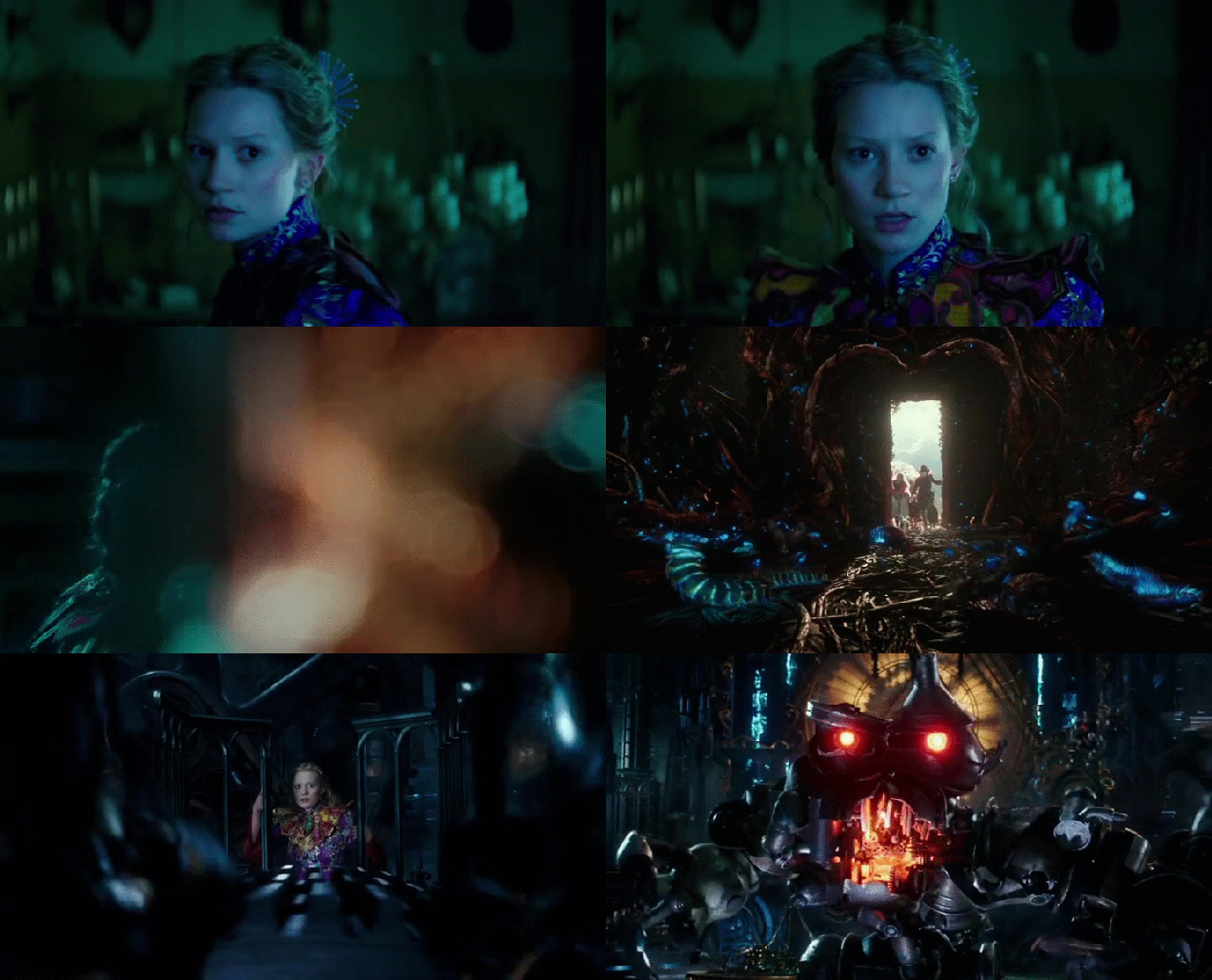
Disney Takes Credit For Today's Lost Hour In A New Alice Through The Looking Glass Trailer

by Andrew Liptak

Suffering through today’s shift in time? Disney’s taking the credit for it by releasing a new trailer for their upcoming sequel to 2010's Alice In Wonderland, Alice Through The Looking Glass.

Read more...


13 Mar 23:17

jacquez45: mediamattersforamerica: Spot-on. in case anyone...


jacquez45:

mediamattersforamerica:

Spot-on.

in case anyone has failed to notice that Obama is out of fucks and acting as his own anger translator these days 

13 Mar 23:15

songsabout-kay: @lucyeverleigh

13 Mar 23:12

"I look back on ‘Ghostbusters’ in a very fun way, but it’s got so many mixed feelings and emotions..."

I look back on ‘Ghostbusters’ in a very fun way, but it’s got so many mixed feelings and emotions attached to it. When I originally got the script, the character of Winston was amazing and I thought it would be career-changing. The character came in right at the very beginning of the movie and had an elaborate background: he was an Air Force major something, a demolitions guy. It was great. […] The night before filming begins, however, I get this new script and it was shocking.

The character was gone. Instead of coming in at the very beginning of the movie, like page 8, the character came in on page 68 after the Ghostbusters were established. His elaborate background was all gone, replaced by me walking in and saying, ‘If there’s a steady paycheck in it, I’ll believe anything you say.’ So that was pretty devastating.


- Ghostbusters’ Ernie Hudson on the painful what-if that still haunts him (via entertainmentweekly)
13 Mar 19:19

evilsupplyco: When a black cat crosses your path, say “thank you” and pet it if it is in the mood...

evilsupplyco:

When a black cat crosses your path, say “thank you” and pet it if it is in the mood for attention.

13 Mar 19:16

The legacy of Justice ‪Antonin Scalia

by candorville@gmail.com

db160216_ScaliaDead-arcamax

Justice Antonin Scalia’s legacy: Homophobia, the attack on affirmative action, the evisceration of the Voting Rights Act, the notion that black students would be better off at slower schools, the condoning of torture, the condoning of racial profiling of Latinos in Arizona, Bush v. Gore, the notion of Corporate Personhood, and the shredding of campaign finance reform. Not to mention the drastic limitations on women’s reproductive freedom in several states. Depending on your political persuasion, this is either a job well done, or a tragic legacy.

The post The legacy of Justice ‪Antonin Scalia appeared first on Darrin Bell.