Shared posts
William James

Top 10 Sites For You To Watch Documentaries Online Free
To watch documentaries online free, you can check out YouTube, Noobroom, Hulu and some other video sites as mentioned before, but which will bother you with action, crime, drama and some other movies.
So, if you would like to watch pure documentaries only, you can check out the following 10 sites:
1. Watch Documentary

The Watch Documentary site has over 8,000 documentaries, sorted in tens of categories and many series.
By the way, Watch Documentary supports Android devices and light off.
2. Top Documentary Films

On the Top Documentary Films site, there are thousands of free documentary movies, which you can filter by recently added, categories, editors' picks and so on.
3. The Documentary Network

Besides categories, The Documentary Network also sorts its documentaries by video lengths, locations, latest and tops.
Besides to watch, you can also submit your own documentaries.
4. Documentary Addict

On the Documentary Addict site, you can browse over 4,000 documentaries by searching their names, by categories, by popular, by random, or by recently added.
When watching a video, you can turn your screen light off.
5. Documentary Heaven

Besides to search, to browse and to comment on, Documentary Heaven is also available for you to discuss documentaries in its forum.
Although there are already thousands of documentary films, you can also submit some more.
6. Documentary Storm

On the Documentary Storm site, you can browse over 1,000 documentaries by categories, top 100, random or latest,
For every film, you can comment on it, as what you can do with all the other 9 sites.
7. Documentary Stream

With Documentary Stream, you can browse over 1,000 documentary films by categories, tags, likes, titles, comments, dates or views, and you can also submit your own documentaries.
Up till now, this site is ad free.
8. Documentary Tube

Documentary Tube sorts its documentaries by categories, tags, views and so on.
And you can filter those documentaries by titles, comments, views or some other ways in ascending or descending order.
9. Documentary Wire

On the Documentary Wire site, you can filter over 2,000 documentaries by categories, popular, random, etc.
After login, your activities will be tracked and showed on the site.
10. Culture Unplugged

Different from all the above 9 sites, which just or mostly collect documentaries from YouTube, DailyMotion, Sevenload and/or some other third-party video sites, Culture Unplugged offers documentaries by its users, including from their film festivals.
By the way, Culture Unplugged is available for iOS devices and ad free.
Among the above 10 sites, Watch Documentary, Top Documentary Films and Culture Unplugged are my favorite three, which ones are yours?
India's Aakash tablet in US pilot projects
After a few minutes on the Aakash, a five-year-old American kid proudly announced he had achieved Level 4 in an addition game. He'd started the day at Level 1. These poorer kids in North Carolina were already picking up skills they'd be learning in the next school year, which was unprecedented - they would usually start off the year at a disadvantage.
The world's cheapest Made-in-India tablet, nicknamed Aakash (sky), had promised to transform Indian education. Instead, the government project got mired in delays and controversies in India. Meanwhile, the $50 Aakash tablet was creating a buzz in a dozen countries, and in the United Nations, where it was showcased last November.
Now, the Aakash has just completed a pilot in the US state of North Carolina, with 100 units of the Android tablets deployed in summer camps for poorer schoolchildren (mostly under age 10) to help them prepare for next year's studies. And there are other projects under way, with 2,000 tablets - DataWind's Aakash-equivalent UbiSlate models - already deployed.
The man behind the North Carolina pilot is software entrepreneur Chris Evans. After hearing about the Aakash from Valley-based entrepreneur Vivek Wadhwa, Evans agreed to fund 100 tablets for the American non-profit Communities in Schools (CIS), which was running the summer camps in North Carolina. Evans is on the board of CIS. "(The richer kids) were already using smartphones and tablets at school," Evans says, "and I thought the Akash would be an affordable way to keep them in pace with their classmates and engaged with their studies."
Wadhwa is an evangelist for low-cost tablets. He has written extensively in the Washington Post, ForeignPolicy.com, and elsewhere, about their potential to transform education. He also saw the Aakash "as a way to force US tablet prices to drop - bring in some competition from abroad". Along the way, Wadhwa spoke about the Aakash to Lotus Corp founder Mitch Kapor, Obama's former CTO Aneesh Chopra, and to others including Evans, to bring them on board for different projects involving the low-cost tablets.
Copyright © 2013 Times Internet Limited. All rights reserved.

Behavioral economics in a men’s urinal
At a museum I noticed a peculiar design of a men’s urinal: there was a fly standing out against the white porcelain.

I suspected this was by design. It turns out to be a rather famous example of behavioral economics to reduce “spillage” by 80 percent.
From NY Times
THE flies in the men’s-room urinals of the Amsterdam airport have been enshrined in the academic literature on economics and psychology. The flies — images of flies, actually — were etched in the porcelain near the urinal drains in an experiment in human behavior.
Images of flies in airport urinals have taught a lesson about human behavior, says Richard Thaler, the behavioral economist. After the flies were added, “spillage” on the men’s-room floor fell by 80 percent. “Men evidently like to aim at targets,” said Richard Thaler of the University of Chicago, an irreverent pioneer in the increasingly influential field of behavioral economics.
In Nudge, Richard Thaler and Cass Sunstein note the urinal flies have become spotted worldwide:
Friends and others have reported seeing these flies all around the world, including Terminal 4 of New York’s John F. Kennedy airport, Moscow, Munich, Singapore, Seattle, and Detroit airports, Purdue University, the University of Colorodo, Broward Community College, and throughout Holland.
Given this research, it’s somewhat surprising that the urinal fly isn’t even more common. I have yet to see this design in any bar or pub, areas where a reduction in spillage would be a welcome reprieve.

Soren Kierkegaard
Congress to adopt left hand as its election symbol
New Delhi. In a move that has left all the political opponents baffled, Congress has submitted an application to the Election Commission of India requesting permission to use the left hand as a legitimate party symbol.
Congress was earlier using its right hand.
“This will silence all those who had been accusing Congress of not changing anything in the country,” party spokesperson Manish Tewari claimed, “This is a big ticket reform and will usher the nation into a new era.”
Tewari further disclosed that the ground breaking idea was proposed by party Vice President and youth icon Rahul Gandhi.
“Indians are 10% left-handed,” Rahul explained, “I mean, 10% of the Indians are left-handed. Not many parties have been taking care of this minority group, so we have taken a lead.”

The new election symbol of Congress party
When this Faking News reporter pointed out that it was just a token step and didn’t really mean anything, he was asked to leave the press conference. Later this reporter apologized and promised to take notes with his left hand for the rest of the presser.
Rahul Gandhi further claimed that a left hand as election symbol will also symbolize party’s left bias in policy matters, which should attract a clear and loud support from intellectuals like Amartya Sen.
“Our left hand too will be with the common man,” the young Gandhi clarified.
Party’s announcement was met with mixed reactions. While many “neutral” commentators on Twitter termed it as a historic step, leaders from the opposition termed it as another hogwash by the Congress.
“Congress should forget about the common man. Common man has is holding a broom in both the hands,” Aam Aadmi Party leader Arvind Kejriwal said.
“You know why they changed hand? Because their right hand was so dirty with corruption that they can’t go to people asking for vote using the same hand. And I am sure if they manage to win coming election, they will get back with right hand as party symbol,” Kejriwal further claimed.
A BJP leader claimed that Congress had paid a foreign brand consulting firm a whopping 300 crore rupees to get ideas on new symbol, and all they got was a mirror image of their earlier symbol.
“This is a new scam,” the BJP leader claimed. Party however refused to comment on reports that suggested that BJP too is thinking of changing its symbol.
Sources claim that BJP is considering adding a few more petals to its election symbol lotus flower. The party hopes to add a few NDA allies through this step.
Other parties too are mulling similar actions, sources say. There is speculation that BSP, which appeared to have peaked to its maximum potential in the last elections, is planning to change its election symbol to a baby elephant so that the party can grow fast.
Samajwadi Party too is considering the tri-cycle as its new symbol. It should be noted tri-cycle is easier to drive on sandy soil than a bicycle. Party denied that sand mafia was behind this move.
Possibly Related News:
- Congress leader claims party symbol is hand of Rajinikanth
- Congress to follow papal election process, white smoke from chimney to signal UPA-III
- Congress to make WhatsApp free forever for Indian youth
- Rahul Gandhi vows to marry if Congress is voted to power in Uttar Pradesh
- Gadkari to resign after Congress picks Rahul Gandhi to lead poll preparations
Narendra Modi reacts to PMO tweet on number of speeches by MMS
Earlier today Prime Minister’s Office tweeted that Dr. Manmohan Singh had given 1300 speeches since he took charge in 2004. This led to a new controversy:

Politics in the time of Twitter
Possibly Related News:
- Who viewed profiles of Narendra Modi, Rahul Gandhi, and Sonia Gandhi
- What new color should Manmohan Singh try for his turban?
- Narendra Modi to organize “Vibrant BJP” summit
- More pictures of Nitish Kumar and Narendra Modi together found
- Narendra Modi to support Nitish Kumar’s campaign against himself
Finland Writes History With Crowdsourced Copyright Law
 Since last year the Finnish public has had the option of suggesting the kind of laws they want to be governed under.
A recent modification of the national Constitution allows citizens to make legislative proposals for Parliament to vote on, providing they get 50,000 supporters within six months.
One of the submitted proposals, which calls for a fairer copyright law, just reached its goal one day before the voting deadline. This makes Finland the first country in the world in which legislators will vote on a copyright law that was drafted by citizens.
Termed “The Common Sense in Copyright Act,” the proposal wants to reduce penalties for copyright infringement, increase fair use, ban unfair clauses in recording contracts, and ease the ability for people to make copies of items they already own for backup and time-shifting purposes.
The decriminalization of file-sharing will also put a stop to house searches and online surveillance of suspected copyright infringers, not uncommon events in Finland.
Last year a house search resulted in international outrage when it was revealed that a police unit raided a 9-year-old girl and confiscated her Winnie the Pooh laptop after an allegation of sharing.
Now that the goal of 50,000 votes has been reached the copyright law proposal will be put to the vote in the Finnish Parliament. This is likely to take place early next year.
In the meantime, street artist Sampsa, who pushed the proposal forward together with the Finnish Electronic Frontier Foundation (Effi), continues to gather political support for the law, not just in Finland, but also in Europe and throughout the rest of the world.
“We’ve begun working closely with European Digital Rights members globally to ensure that when the vote hits the floor in 2014, the pressure is still on so copyright law will be changed forever,” Sampsa told TorrentFreak.
Open Ministry, the organization that coordinates the public proposals, notes that today’s success breaks with an old tradition where lobbyists draft copyright law. This counter-proposal is needed to restore the balance, they argue.
“Members of Parliament are quite open about the fact, that Copyright Laws are handed down to them from the international lobbyists. If we do not push back, they will keep on rubber-stamping harsh legislation and infringing on consumer rights,” Joonas Pekkanen, Chairman of Open Ministry, informs TorrentFreak.
Of course, even if the proposal reaches the goal, there’s no guarantee that the Parliament will sign it into law in its current form. However, for a country that has a voting population of just over four million, a proposal with direct support from 50,000 citizens can’t be easily ignored.
Source: Finland Writes History With Crowdsourced Copyright Law

World's largest building has fake sun and beach like the movie the Truman Show
It the world's biggest building measured by floor space. The Boeing Everett Factory in Everett, Washington has the largest volume, and the Aalsmeer Flower Auction Building in Aalsmeer, Netherlands, has the largest footprint.
The centrepiece of the building is a 5,000 m2 (54,000 sq ft) artificial beach, a giant 150 by 40 m (490 by 130 ft) screen will form the horizon and offer sunrises and sunsets. The beach has a deck platform for seating for 6000 people. A US football field is 120 yards (109.7 meters) long by 53.3 (49 meters) yards wide. So LED screen is about 30% bigger than an American football field.


The warm rays which beam down on to the 5,000sq m beach come from an artificial sun that shines 24 hours a day using Japanese-invented specialised lighting technology that heats as well as illuminates the Paradise Isle Oceanic Park.
It also produces perfect sunrises and sunsets on a sophisticated LED display. At 150m in length and 40m in height the screen is the largest of its kind in the world and projects an “endless horizon” – an idyllic backdrop against which to surf the artificial waves before a “beach” party on the 7,000sq m deck which skirts the 400m-long stretch of fake coastline.
The marine theme begins on the outside of the building which has walls of blue glass and a wavy roof which is inspired by “sailing seagulls and undulating waves”. In the lobby artificial sea breezes waft through the 18-storey atrium and an entire wall is taken up with an aquarium which houses ocean fish and coral reefs.
Read more »


With Free Pick Up & Quick Payment, RecommerceHub Will Make Selling Old Phones a Breeze
Online classifieds market in India is undoubtedly a crowded one. Selling second hand goods online is not a novelty either. However, a Bangalore based startup RecommerceHub, is cutting teeth in the Rs 5,000 cr second hand mobile sales market.
Selling a second hand phone online is a daunting task. You’d need to deal with too many calls and frivolous buyers. If you’d rather not go through all the trouble, RecommerceHub will be of use. All you need to do is tell them a few details about your phone online and walk with an instant quote. If you agree on the price, the folks from RecommerceHub will pick up the device at your doorstep and give you your money. No more haggling or rendezvous with buyers.
Started by an NextBigWhat alum, Srikanth Ch along with Rajesh Jampana, RecommerceHub addresses the problem of selling second hand mobile phones with a clear focus on better customer experience.
With door-to-door pickups, the company is trying to tackle one of the major pain points of Indian e-commerce i.e.Logistics. This logistics model is surely an added expense but it is also a unique selling point for the startup.
Metros such as Delhi,Mumbai etc can be the big potential markets but for now the service is available only in Bangalore and will be soon launched in Hyderabad. With the same customer experience and quality standards in mind ,venturing into other consumer electronic categories can be a game changer.
YNew, a startup based in Hyderabad does something similar. The startup floated by Sloyd Ventures Private Limited, is looking to create a franchise network across the country to buy and sell used gadgets and appliances. However, the company takes a physical store approach to second hand goods.
US based sites such as Gazelle that buy and sell second hand electronic goods have had great success. In 2013, Gazelle is looking at $100 mn in revenues.
How Does it Work?
 The three step process helps sellers go about their routine without having to spend time on selling the device. The startup makes sure that the devices are original and needs the seller to submit bills and an identification proof.
The firm has paid out over Rs 15 lakh to buy second hand phones from over 200 customers since its beginning in September 2012. RecommerceHub refurbishes the phone and sells it through retail channels.
Resale value of the phone is decided based on the brand of the phone, its age and condition. For instance, Blackberry phones have lower resale value but iPhone5,Samsung Galaxy Note 21 and Micromax Canvas 2 are in high demand.
Redesigned Window Stops Sound But Not Air, Say Materials Scientists

By exploiting some exotic acoustic techniques, researchers have built a window that allows the passage of air but not sound
Noise pollution is one of the bugbears of modern life. The sound of machinery, engines, neighbours and the like can seriously affect our quality of life and that of the other creatures that share this planet.
But insulating against sound is a difficult and expensive business. Soundproofing generally works on the principle of transferring sound from the air into another medium which absorbs and attenuates it.
So the notion of creating a barrier that absorbs sound while allowing the free of passage of air seems, at first thought, entirely impossible. But that’s exactly what Sang-Hoon Kima at the Mokpo National Maritime University in South Korea and Seong-Hyun Lee at the Korea Institute of Machinery and Materials, have achieved.
These guys have come up with a way to separate sound from the air in which it travels and then to attenuate it. This has allowed them to build a window that allows air to flow but not sound.
The design is relatively simple and relies on two exotic acoustic phenomenon. The first is to create a material with a negative bulk modulus.
A material’s bulk modulus is essentially its resistance to compression and this is an important factor in determining the speed at which sound moves through it. A material with a negative bulk modulus exponentially attenuates any sound passing through it.
However, it’s hard to imagine a solid material having a negative bulk modulus, which is where a bit of clever design comes in handy.
Kima and Lee’s idea is to design a sound resonance chamber in which the resonant forces oppose any compression. With careful design, this leads to a negative bulk modulus for a certain range of frequencies.
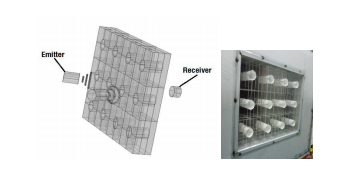
Their resonance chamber is actually very simple—it consists of two parallel plates of transparent acrylic plastic about 150 millimetres square and separated by 40 millimetres, rather like a section of double-glazing about the size of a paperback book.
This chamber is designed to ensure that any sound resonating inside it acts against the way the same sound compresses the chamber. When this happens the bulk modulus of the entire chamber is negative.
An important factor in this is how efficiently the sound can get into the chamber and here Kima and Lee have another trick. To maximise this efficiency, they drill a 50 millimetre hole through each piece of acrylic. This acts as a diffraction element causing any sound that hits the chamber to diffract strongly into it.
The result is a double-glazed window with a negative bulk modulus that strongly attenuates the sound hitting it.
Kima and Lee use their double-glazing unit as a building block to create larger windows. In tests with a 3x4x3 “wall” of building blocks, they say their window reduces sound levels by 20-35 decibels over a sound range of 700 Hz to 2,200 Hz. That’s a significant reduction.
And by using extra building blocks with smaller holes, they can extend this range to cover lower frequencies.
What’s handy about these windows is that holes through them also allow the free flow of air, giving ample ventilation as well.
The applications are many. Changing the size of the holes makes the windows tunable so they screen out only certain frequencies, the new designs have some interesting applications.
“For example, if we are in a combined area of sounds from sea waves of low frequency and noises from machine operating at a high frequency, we can hear only the sounds from sea waves with fresh air,” say Kima and Lee.
What’s more, they say the same idea should also work in water which could help in applications such as protecting marine animals from noise pollution.
A clever idea that tackles one of the increasingly common problems of modern living.
Ref: arxiv.org/abs/1307.0301: Air Transparent Soundproof Window
A Homeless Man’s Clever Use of Auction Theory

Click for high-resolution image. Original image from here
Text in image: “Which religion cares the most about the homeless?” (bowls with labels for various beliefs)
This image was posted on Reddit under the title When I passed him he proudly announced “The atheists are winning!”.
Many have focused on the premise of the question and discussed religion. But ignore that for now and focus on the contest in terms of game theory. What type of game is this?
It struck me there was a connection between this contest and auctions. Think about the people who give money as bidders, the homeless man as the auctioneer, and being called the “the most caring religion” as the prize.
The somewhat devious part is the specific rules of this auction. Unlike a typical auction on eBay or at Sotheby’s–where only the winner pays–there is a hitch to this auction. It is still the case that only one group wins the ultimate prize of being “the most caring,” but everyone who “bids” by giving money as a donation loses it regardless of the outcome.
In other words, this contest is an example of an all-pay auction.
What makes this idea so great? Typically the homeless man encounters apathetic pedestrians with little motivation to donate. The framing of charity as a contest changes the game. Not only does the contest attract attention, but it also tempts participants into a game where the inherent strategy is one-upmanship! That bodes well for over-bidding and increased donations.
The homeless man might have commented, “The atheists are winning!”, but I think we all know who the real winner of the game is.
Google To Launch Flight Search in India? OTAs Cry Scroogled!
It looks like Google, which recently launched product listing Ads in India, is going after air travelers next with the impending launch of their ‘Flight Search’.
According to a news report, the search giant will soon introduce Flight Search, a service which will let users book flights directly from Google without going to a travel website.
Flight Search, first launched in the US and then in parts of Europe, lets users compare fares offered by airlines and book tickets directly from airline websites. This could have an impact on flight aggregators such as Makemytrip, Yatra, Cleartrip and others.
In response, the aggregators are considering steps to protect their interests, including a possible complaint to the Competition Commission of India, (source). They claim discrimination by Google when it comes to search results for queries relating to online travel.
Online travel aggregators have other things to worry about as well. Travel agents, including online travel agents such as Cleartrip or Yatra and MakemyTrip, were in for a rude shock as the Supreme Court has banned collection of transaction fee on airline tickets in January this year. The court order has a direct impact on the margins of online players.
As we’d written earlier, big OTAs are facing growth challenges and smaller players are facing thinner margins. (Read: What’s NextBigWhat for Indian OTAs? Consolidation, we say)

Previously Google was sued by other companies in India for unfair practices by monopolising on their dominance over the internet. Last year Bharatmatrimony had moved to Competition Commission of India, citing discriminatory trade practices related to its AdWords program by Google.
In Europe, Google’s Flight Search is already in trouble with OTA such as Expedia and TripAdvisor filling antitrust complaints against the company with the European Commission for promoting rival services and disrupting fair competition in the online travel space.
Google Scroogling with Organic Search?
Google has been progressively trying to get people to spend more time on Google services. That’s natural for any web company. But some practices might be seen as anti competitive because of its dominant position as a search engine. Whatever it is, Google is playing a much bigger game than everybody else. A few examples will show you that the search giant wants to take it all.
1. Word Searches
Say you search for the meaning of liberation, earlier, Google would show you a bunch of search results from dictionary sites. But now? It just gives you the result. As users, we aren’t complaining because it saves us the hassle of going to another site. But all those dictionary sites? Well, guess they need to find something better to do now.
2. People/ Encyclopedia like searches
This is one of the most common type of searches online. Say you are looking for Benjamin Franklin or Mahatma Gandhi. Google gives it to you again. Just like in the case of word search. All those encyclopedia sites? Well, guess they’ll have to find something else to do now. Of course it gives you only a brief on what you are searching (and it’s powered by wikipedia), our guess is that it takes away a lot of traffic which would have otherwise gone to those sites.
3. Product Searches
Say you are looking for a phone? Or a camera? The recent with the launch of product listing Ad in India, users don’t have to visit price comparison sites to view the prices listed by various online retailers as Google lists them for you besides the search result. The effect on price comparison sites are yet to show.
The company which started with wanting users to spend as little time as possible on the search page, now doesn’t seem to want them anywhere else.
Nokia Asha 501 First Impressions: The Best Companion Phone You Can Buy

In early May, Nokia had a global launch in India much to the surprise to the world. It took the wraps off the Nokia Asha 501 which was the first phone to run on the all new Asha platform. Fast forward two months later and the phone which went on sale in Pakistan and Thailand last week is all set to Indian shelves this week. Priced at Rs 5,200 the phone has packed a lot into a new package which will make it the perfect companion phone.
We got our hands on the phone for a couple of hours and here is why we think the Nokia Asha 501 will be the perfect second phone.
Hardware

It brings the Lumia design language to this price point. Compare it to any other phone at the 5K price range and you going to think this is real premium quality stuff. It comes in a variety of colors and the back cover is interchangeable which will go real well with the college crowd. While you may not want to pull out the bright colors during a corporate meeting for the evening this is perfect. The soft touch matte finish plastic cover does not attract finger prints.
While others are trying to say bigger is better, the Nokia Asha 501 is very compact and weighs in at under 100 grams which makes it fit comfortably in your hands and more importantly won’t take much place in your pockets.
One thing everyone knows is they can trust the build quality of Nokia. The Nokia spokesperson threw the phone on the floor picked it up and continued using it like that did not even happen. Lovely to know that our Rs 5000 bucks is safe!
Screen
The 3 inch QVGA screen is the right size for this device and while it might not be the biggest screen, even watching a video on this is pretty comfortable. The brightness of the screen is good even though content on it is not crisp but is manageable. The capacitive screen is quite responsive but while using the double tap to unlock we realized the using the thumb did not work and we had to use our index finger.
Camera
The camera is a 3.15 MP camera that takes real good snaps at this resolution. Unfortunately there is no flash so indoor and low light snaps are not going to be great. While this camera might be at the low end of the megapixel race, Nokia says it is working to bring better camera in the Asha phones which are expected to be released later this year.
Software

While there was not much to complain with regards to the software on the old range of Asha phones powered by S40,it is great to see Nokia do a complete refresh and try to bring in more smart and UI features found on other smartphone operating systems to this price range as it looks to take on low cost Android phones.
The highlight of the new OS is Fastlane which keeps a track of all your activity and brings together everything in the past, the present and the future in one place. Your last 50 activities are stored smartly here for faster access. Using this we could see the way it could improve our productivity.
Apps
Well with all new platforms this is a point of concern. While it may not have the quality or quantity of apps present on iOS and Android and even of its bigger brother Windows Phone 8, there are already over thousand apps which are compatible with the the new Asha platform. Nokia is bundling around 45 apps with the phone which will keep you occupied for hours. For gaming enthusiasts there will be 40 games from EA Sports. While the quality of graphics may not be excellent, it does perform really well at this price point and we did not see any lag when we tried out Asphalt 6. When we tried this game on some low priced Android phones the experience was worse.
Battery
This is probably the most important reason why we are calling it the perfect companion phone. Nokia claims the battery will last 26 days on the dual SIM version.
Let’s face it. If you are using a smartphone and are a heavy user, the battery will not last a day no matter what you do. If you’re carrying this phone around you can be assured that when your primary phone battery dies out and unlike just carrying a feature phone you are going to be able to continue with email and catching up on social networks with this phone.
The Nokia Asha 501 is a 2G phone and does come with Bluetooth and Wifi also.
Nokia Asha 501: Price & Availability
The phone is priced at Rs 5,200 it is available online right now. The pricing is perfect for what the phone offers and we can definitely see ourselves picking up one as our second phone. It should be hitting retail shelves by the end of this week.

Specifications
- SIM: Micro SIM, Dual SIM, GSM + GSM, (Dual Standby)
- OS: Asha OS
- DISPLAY: 3-Inch CD, QVGA, 320 x 240 pixels
- CAMERA: 3.2 Megapixel, Digital 3x Zoom
- SIZE: 58×99.2×12.1 mm
- WEIGHT: 91 g
- BATTERY: 1200 mAh
- MEMORY AND STORAGE: Internal – 64 MB, expandable upto 32 GB
- CONNECTIVITY: GPRS, EDGE, WiFi, Bluetooth
Recommended Read: 10 Things About the Nokia Asha 501 and Asha Platform That You Need To Know
Online RTI Filing is easy; Needs Some Tweaking Though [Review]
The Indian government launched its online right to information portal in April this year. It’s aimed at simplifying the whole process. It only costs Rs 10 if you are above poverty line and is free if you are below poverty line. The workflow is easy and nearly 24 departments and ministries are on it already. To file an RTI, all you need to do is to register on www.rtionline.gov.in and follow the instructions.
However, there are a couple of things the government agency must fix.
User Experience
What strikes you at first is that the site makes you type in security captchas a few times more than necessary. The design is quite simple but serves the purpose. It makes you read and accept a long list of guidelines every time you want to submit a new application. This should ideally be a one time process.

Guidelines for RTI
Payment Methods

RTI Payment Options
There are only limited payment options on the site. For internet payment, one can use one of the six State Banks listed on the site whereas private banks such as HDFC and ICICI aren’t listed. It only supports debit/ ATM cards issued by the State Bank of India and doesn’t support any credit cards yet. This is a serious drawback.

RTI Payment Failed
Another drawback is that there is no way to complain or get your money back if the transaction fails. We tried it a couple of times here and lost Rs 20. It’s been more than 48 hours. No sign of refunds or acknowledgements yet and you can’t find a place on the website to to raise a refund request or a complaint.
Others Online RTI Websites
The government’s move is likely to impact most of the online RTI websites that have come up recently. Mainly because of the steep price difference between them and the government portal. For instance, websites such as Rtination charge Rs 150 per application because it costs them to send the RTI on post, pay payment gateway charges and other overheads. Onlinerti.com charges Rs 75 per request.
For people wanting to file RTI applications from overseas, the government website is not a good idea because of limited payment options. Private services like Rtination have better payment options. Onlinerti uses Instamojo for payments.
With third party websites, there is too much logistics involved. For instance, some sites send you a hard copy of the filed RTI application form which you need to sign and return the signed copy.
Man scolds his family members for low electricity bill, asks how he’ll dispose 500 notes now
A diamond merchant from the city was hoping to ‘settle’ a portion of his unaccounted income by paying his utility bills like electricity and water which Government is allowing till Dec 15th.
The post Man scolds his family members for low electricity bill, asks how he’ll dispose 500 notes now appeared first on Faking News.
How to Quickly Compose a New Email Message
Learn how to quickly compose a new mail message in your default email program directly from the address bar of any web browser.


 This story, How to Quickly Compose a New Email Message, was originally published at Digital Inspiration on 28/06/2013 under GMail, Mailto, Internet.
INDEPENDENT INDIA’S FIRST MARTYR FOR NATIONAL INTEGRATION
Today is 23rd June. Exactly sixty years ago, in 1953, on this day the country received from J & K State the heart-breaking news that Dr. Syama Prasad Mookerji was no more.
 I vividly remember how that night around 2.00 AM or so I got up from sleep when I heard the sound of someone wailing and weeping just outside our Jana Sangh office at Jaipur, and shouting at the top of his voice “Advani ji, they have killed our Dr. Mookerji !”. It was a local journalist who had got the news on his ticker and so, unable to restrain himself rushed to our office to share his sense of shock with me.
The news was a shock for millions. Earlier, during the year Dr. Syama Prasad’s newly launched party, the Bharatiya Jana Sangh, had had its first All India Session at Kanpur. I had the privilege of being one of the delegates from Rajasthan who attended this session. It was here that Dr. Mookerji had given to the thousands of delegates assembled at Phool Bagh this scintillating slogan - “Ek desh mein do pradhan, do nishan, do vidhan, nahin chalenge, nahin chalenge” (Ours is one country: we can’t have here two Presidents, two Flags, and two Constitutions.)
It was at Kanpur that the party resolved to launch its first nationwide movement – for the complete integration of Jammu and Kashmir State with India. Dr. Mookerji decided to lead the movement from the front – by personally defying the permit system introduced by Sheikh Abdullah. He also decided to go to different parts of the country to mobilize public opinion in support of the movement. In this pre-campaign rail tour of his, he asked Shri Vajpayee to accompany him.
I was at Kota, in Rajasthan, those days. When I learnt that Dr. Mookerji and Atalji were passing through Kota Junction, I met them at the station. I could never have imagined that that was destined to be the last time, I would be seeing this great founder of our party, Dr. Syama Prasad.
 On May 8, 1953, Dr. Mookerji left Delhi for Punjab en route to Jammu. At Amritsar, a massive crowd of over 20,000 gave him a rousing reception. His journey from Amritsar to Pathankot, and thence to Madhopur also was like a victory procession. Madhopur is a small town some twelve kms. away from the army cantonment of Pathankot. Madhopur is situated on the banks of the Ravi, the river that separates Punjab from Jammu and Kashmir State. Dr. Mookerji accompanied by Atalji boarded a jeep to cross the bridge over the Ravi in order to enter Jammu-Kashmir. Midway on the bridge, the jeep was halted by a posse of J&K policemen and Dr. Mookerji was asked whether he had a permit with him. Dr. Mookerji replied in the negative, and said that under the Indian Constitution every Indian citizen had a right to travel to any part of the country. When the police arrested him, he said to Vajpayeeji: “Please go back and tell the people that I have entered Jammu and Kashmir State without a permit, though as a prisoner.”
It is noteworthy that at Pathankot, senior police officials of Punjab had called on Dr. Syama Prasad and told him that they had instructions from the Punjab Government that even if Dr. Mookerji did not have a permit with him he may be allowed to go past Madhopur on to the bridge.
Evidently, this was a joint operation of the Union Government as well as the J&K State Government that Dr. Mookerji should be kept a prisoner in J&K State, and not in Punjab.
The upshot of this planned operation was a devastating calamity for the country. On June 23, 1953 the nation was shocked to learn that Dr. Mookerji, who had been kept in detention in a house at Srinagar had suddenly fallen ill, and after a brief illness had passed away !

 Dr. Bidhan Chandra Roy, Congress Chief Minister of West Bengal, Dr. Mookerji’s venerable mother Smt Jogomaya Devi, and many many more eminent citizens from all parts of the country flooded the Prime Minister’s office with telegrams, letters etc. expressing not just their shock and anguish but urging that an immediate enquiry be ordered as to how the tragedy had happened. The nation’s anguish elicited no response. The death of this titan remains a mystery till today. In other similar situations, a formal enquiry has almost invariably been instituted. But not in this case. One cannot say whether it was just criminal insensitivity, or actually a feeling of guilt !
***
However, the intense public indignation aroused by the passing away of Dr. Mookerji in suspicious circumstances triggered off a series of developments in the next few months which significantly promoted the process of national integration.
First and foremost, the permit system was abolished.
Until this time, neither the Supreme Court, nor the Election Commission, nor the Comptroller and Auditor General had any jurisdiction over Jammu and Kashmir State. The authority of these three constitutional bodies was extended to the State. Till then, the Chief Minister of the State was called the Prime Minister, and the Head of State the Sadar-e-Riyasat. In theory, thus, neither the President nor the Prime Minister of the Union had authority over the State.
Dr. Mookerji’s martyrdom brought about a change in this situation also. In the State Prime Minister became Chief Minister, Sadar-e-Riyasat became Governor, and the Union President and P.M.’s formal authority got extended to State also.
In a way, of the three strands in the inspiring slogan, two pradhans became one, and though two nishans continue still, the National Tricolour started flying in the State in a superior position.
Besides, two Prime Ministers became one, two Apex Courts became one, two Election authorities became one, two principal Auditors became one – all because of Dr. Syama Prasad’s sacrifice.
The country eagerly awaits the day when Art. 370 would be repealed, and the two vidhans also would become one !
L.K. Advani
New Delhi
23 June, 2013


Staying Anonymous Online: Screw You CMS, PRISM
 With the Indian government planning to monitor internet activities, and the American government mining for your data, staying private on the Internet is tough. But its not impossible. Here are a few things I’d recommend if you are looking to stay private online.
The basic funda to understand is that most online activity is tracked using your computer’s internet protocol address. The number is unique to each device connecting to the Internet. Every computer, will also have uniquely identifiable traces.
For example, a combination of the browser, location, version of operating system and other details can be used to isolate a machine connected to the internet.
Now, lets take a look at some practical ways to deal with the spies that rule us.
-
Masking your identity: Use a proxy server. The proxy server routes your connection through a different server thereby making it difficult to track your IP address. Most browsers also have proxy extension like ProxMate for Chrome, you can search the respective app stores and find them. You can google and find a lot of different sites that provide this service.
-
Browsing without a trace: Use a Virtual Private Network (VPN). A VPN is a private network that uses a public network (usually the Internet) to connect remote sites or users together. By using a VPN your IP address remains untraceable, as you will be accessing the internet through the VPN. Tunnelbear is a nice VPN service which comes for free.
-
Private Browsing. Using the private browsing modes like ‘Incognito browser’ in Chrome or ‘Private mode’ in Firefox. This method will help protect your private information and block websites from tracking your online behavior. The pages you visit in this mode are not usually recorded in your search history or cache, thereby preventing other users using the system to scan through your browsing history.
- Chrome and Opera: Ctrl+Shift+N
- Firefox, Internet Explorer: Ctrl+Shift+P
- For Safari, go to Safari > Private Browsing.
-
Communicate Anonymously. When you access your web-based email client use HTTPS, by adding an ‘S’ after the ‘http’ in the web address. Using HTTPS (HTTP-Secure) will add cryptographic protocols SSL/TLS (Secure Sockets Layer/Transport Layer Security) encryption to all of your communications. You could also use email clients that help you encrypt your e-mail.
-
Keeping emails anon: Use disposable e-mails. These services work by creating a temporary forwarding address that can be deleted later. All mails to this address will be forwarded to your real email address for a specified limit. When the limit is reached, the email address will be automatically deleted. All following mails rejected by the service. Mailinator is one such service you can try.
-
Searching in Private: To search for information privately, use search private search engines that keep your searches private unlike Google and other popular search engines. Try search engines like ixquick, Startpage, DuckDuckGo or goodsearch that don’t store your private data like IP address or cookies to begin with, thereby keeping your search private.
-
Keeping secure passwords: Try using passwords that are strong and not your name or date of birth. Passwords are the key to your online access. The more secure they are the more safe you are. Here are 3 password tips.
-
Keep them Alphanumeric.
-
Avoid dictionary words.
-
Use special characters.
Using any great tools for privacy? Leave a comment.
Corning’s Gorilla Glass Is Coming to Cars Next

The strong glass that is used in 1.5 billion consumer electronic devices worldwide could soon help make more fuel-efficient, quieter cars.
Corning’s durable Gorilla Glass is used to make screens on iPhones and other mobile devices; it can be found in 1.5 billion electronic devices today. But the next market for the lightweight material might be literally larger: replacing some of the standard glass used on the windows of automobiles.
Today, most carmakers are looking for ways to make lighter vehicles and improve fuel economy. Using Gorilla Glass would help reduce a vehicle’s weight and lower its center of mass, boosting fuel economy by up to a few percentage points depending on how much of the glass is used, according to Corning senior vice president Jeffrey Evenson, who was speaking after MIT Technology Review’s Mobile Summit in San Francisco today. Cars that use the material will also be quieter inside, he said. He expects at least one high-end auto maker to start selling cars that use some Gorilla Glass within the next year.
Automobiles might be a new application for an existing material, but Corning is also working on the next generation of its display materials for other markets. For example, Evenson said he hopes that Corning’s development-stage “antimicrobial” glass will be certified by the U.S. Environmental Protection Agency within the next few months. The material would initially be used in the health-care industry to keep device interactions more sanitary, but smartphones are also a possibility. “The bacteria are obliterated,” he says. “The number of germs on a smartphone exceeds the number of germs on a public toilet. We think there might be a bigger market.”
The most anticipated product on the horizon for Corning, however, is Willow Glass, a material that is flexible like plastic and as thin as a dollar bill but has the durability and stability of glass (see “Glass Manufacturing That Bends the Rules”). Evenson believes that Willow Glass could spur the creation of “hundreds of new products,” ranging from flexible displays that conform to the human body to new insulating layers in semiconductors that will help sustain the continued progress of Moore’s Law.

![562815_409978019027477_277028582322422_1381866_873563509_n_zpsba93a2a7[1]](http://lh5.ggpht.com/-7uZbjCpbAQU/UYNRjGjx37I/AAAAAAAAFiA/R2Q5dq-wvmU/s1600-h/562815_409978019027477_2770285823224%25255B1%25255D.jpg "562815_409978019027477_277028582322422_1381866_873563509_n_zpsba93a2a7[1]")
April 20, 2013

Maybe my favorite shirt design ever?

