Shared posts

27 Aug 03:40

Best friend turns deadly foe—India’s rabid street dogs are killing thousands every year

by Mary-Rose Abraham
They are everywhere.

A pile of puppies cower under a parked car. The men grab one, but two escape down the street, forcing them to give chase. Five scrappy adult shorthairs—of an indiscriminate breed commonly known as an ‘Indian dog’—appear from nowhere. Pointed ears pricked with curiosity, they howl as if sounding an alarm throughout the neighbourhood: the ‘catchers’ are here.

The catchers’ van travels the tree-lined, mostly residential streets to the next area. On the way, a couple of dogs seem to recognise the vehicle, either by sight or by smell. They bark and take chase. Each time the team catches a dog in one of its giant butterfly nets, the mutt twists and turns and howls, trying to escape.

This ritual repeats several times through the day across 50 square kilometres of the south Indian city of Bengaluru. The men, a team from the NGO Compassion Unlimited Plus Action (CUPA), are on a mission: to catch stray dogs, sterilise them and vaccinate them against rabies.

They catch ten dogs on this particular day. The dogs are taken to CUPA’s animal birth control centre, where they will be sterilised and have their ears clipped so they can be identified as having undergone the surgery. They will be vaccinated, then returned to their home on the streets.

“What people need to understand,” says Vijay Kumar, manager of the CUPA centre, “is that the animal birth control programme is as much about human welfare as it is for dogs.”

This is part of an ongoing—and some say uphill—battle to eliminate rabies from India. Around 59,000 people die from rabies every year, according to a 2015 study published in PLOS Neglected Tropical Diseases. The overwhelming majority are in Asia and Africa: India alone accounts for 20,847 deaths, more than one-third of the world’s total, giving it the highest incidence of rabies globally.

(ParkinParkin)

The rabies virus attacks the nervous system and causes humans who are infected to hallucinate, become aggressive and even fear water. When someone is bitten, it’s crucial to wash the wound immediately and vaccinate them as soon as possible. But this rarely happens in India. Instead, many people end up being improperly treated—for example, not receiving a full course of vaccinations after exposure. Others turn to herbs, spices or local remedies that have no effect.

The World Health Organization (WHO) wants to eliminate rabies from the South-East Asia region by the year 2020. It is a goal that India is unlikely to meet, public health experts say. For one thing, the actual number of rabies deaths in the country may be far higher than we know because of unreported or untreated cases.

 “Rabies will always be in India,” says Dr S N Madhusudana, a professor at Bengaluru’s National Institute of Mental Health and Neurosciences. “It will never go away.” 

What’s needed is an effort no less committed than it took for India to eliminate polio in 2014. But with rabies, the country doesn’t even know the extent of the disease. There is no requirement for doctors to report human infections, and no information on how widespread it might be among animals. In 2014, India’s government said it would set up a national rabies control programme, but at the time of writing it has only launched a pilot project in the northern state of Haryana to advise on managing the problem nationwide.

Meanwhile, the government leaves it to the local city authorities to carry out programmes for vaccinating stray dogs on the street. Most deal with the problem by hiring NGOs like CUPA. That leaves rural areas, where rabies strikes hardest, all but ignored.

“Rabies will always be in India,” says Dr S N Madhusudana, a professor at Bengaluru’s National Institute of Mental Health and Neurosciences who has studied the disease for three decades. “It will never go away.”

* * *

(ParkinParkin)

Four-year-old Bhuvan sits quietly in his mother’s lap at the clinic. Nearly all of the right side of his neck is an open wound, where a street dog grabbed hold of him and dragged him for four feet before his great-aunt Veena came out of the house screaming.

“That’s when the dog grabbed onto my face,” says Veena, her own right cheek imprinted with the faint outline of canine teeth. She later lost consciousness as she and Bhuvan were being driven to their local, rural hospital. A doctor there gave them each a dose of a therapeutic anti-rabies vaccine that will help stimulate their immune systems. It will take up to two weeks for their bodies to produce antibodies, but they also need to attack the virus immediately. That requires another, stronger form of medication only available 150 km further away at an anti-rabies clinic in the nearest city, Bengaluru.

Veena and Bhuvan travelled immediately, arriving at midnight at Kempegowda Institute of Medical Sciences. Despite appearances, their wounds aren’t severe. “These dog bites are milder,” says Dr D H Ashwath Narayana, the head of the hospital’s department of community medicine, surveying the torn flesh on Bhuvan’s neck. “I’ve seen far more severe bites.”

That morning, Narayana spends hours calling suppliers for two doses of the crucial treatment: rabies immunoglobulin, a concentrated solution of rabies antibodies. Two vials arrive just after noon.

Bhuvan is placed on a clinic bed, where an attendant holds him down as he writhes and tries to move away. A medical student begins a series of injections directly into the raw wounds on his neck. The immunoglobulin must penetrate the exact place where the dog bit into the flesh in order to neutralise the virus. As the boy screams in pain for his parents to help, his mother leaves the room, unable to bear her child’s cries. Next, a moaning Veena is injected seven times in the cheek and upper lip.

The disease develops when the rabies virus enters a person’s nervous system, but after the bite there is a window of opportunity to prevent that from happening. The rabies immunoglobulin binds to the rabies virus lodged in Veena and Bhuvan’s wounds, preventing it from entering their nerve endings. Meanwhile, the initial anti-rabies vaccine they were given at the local hospital continues its work, prompting their bodies to produce their own antibodies. Four more doses over a month help in that regard. With a full course of treatment, they have a chance that rabies will not develop. “The deeper the wound, the more danger that the virus goes into the nerves,” Narayana says. “In rabies, it is better to overtreat than undertreat.”

 Whatever immunoglobulin is available tends to concentrate in cities, leaving rural dog bite victims to either forego treatment or travel great distances to urban clinics. 

According to WHO, rabies immunoglobulin is undergoing a critical shortage worldwide. It is also prohibitively expensive for many victims in a country where 60% of the population lives on under $2 a day: Veena and Bhuvan paid close to Rs450 ($7) for each vial. In India, only three companies produce it, with relatively high manufacturing costs.

Rabies immunoglobulin is collected from the plasma of either humans or horses injected with the rabies vaccine. At a fraction of the cost of the human-derived type, horse immunoglobulin is the only kind available to most low-income countries. Yet, complying with India’s strict animal welfare laws can be expensive, according to Dr Anand Kumar, deputy managing director of Indian Immunologicals Ltd. The pharmaceutical firm is India’s largest producer of both human and animal rabies vaccines but stopped producing rabies immunoglobulin about a year ago. “We followed the guidelines strictly,” he says about the company’s stock of horses. “Complying with animal ethics was very expensive, so manufacturing costs became too high.”

Whatever immunoglobulin is available tends to concentrate in cities, leaving rural dog bite victims to either forego treatment or travel great distances to urban clinics. Bhuvan and Veena are among the lucky ones.

* * *

(ParkinParkin)

Two years away from retirement, Dr Madhusudana is still haunted by the death of a 21-year-old student who was once in his care. Like Bhuvan and Veena, she lived in a rural village, hours from Bengaluru, in the southern state of Karnataka. She had been washing dishes behind her home in May 2013 when she was bitten twice by a street dog. The girl was injected with the rabies vaccine, but her treatment ended there. She never received any immunoglobulin.

Without proper treatment, it can take anywhere from a few days to more than a year for rabies to develop. But when symptoms appear, the disease is invariably fatal. Two months after she was bitten, the student developed a fever for which her local doctor gave her sedatives. She lapsed into a coma and was brought to Bengaluru, where she was finally diagnosed with rabies and died 17 days later.

Rabies manifests in two ways: dumb rabies (also known as paralytic rabies) and furious rabies.

The two forms differ in the path the virus takes to reach the brain. In dumb rabies, the virus travels via motor nerves, damaging them in the process and leading to a slow progression from muscle paralysis to coma. This type accounts for 30% of rabies cases with at least 12 people worldwide known to have survived it.

‘Furious’ rabies—so called because of victims’ hyperactivity and agitation—is far more common. Its symptoms appear sooner than those of dumb rabies, as the virus travels from the nerve endings, along the spinal cord and to the brain. Beginning with fever, headache and a tingling feeling at the wound site, victims can become aggressive, start hallucinating and develop a marked fear of water, even shrinking from the sight of a glass filled with it. This is because rabies causes painful muscle spasms in the throat and larynx, and water can trigger the spasms. Death results from blocked airways, seizures or widespread paralysis. “Within three or four days, the victim is dead,” says Madhusudana. “It’s a pathetic, horrible death.”

Theoretically, no human should die from rabies in the 21st century. Rabies is one of the oldest diseases known to man—the earliest records of it stretch back to Ancient Egypt around 2300 BCE—and since the late 19th century we’ve had painful but effective treatments.

French scientist Louis Pasteur formulated the first vaccine in 1885 by injecting the rabies virus into rabbits, killing them, then drying the nerve tissues to weaken the virus. When he injected this into a nine-year-old boy bitten by a rabid dog, the child did not develop the disease.

 India is a country where many health professionals, let alone citizens, don’t know how to treat a dog bite properly. 

It is another, infamously painful, vaccine developed in 1911 that was synonymous with rabies treatment for years. David Semple, a British Army officer and immunologist who founded a branch of the Pasteur Institute in northern India, injected the rabies vaccine into the brain of a live sheep and goat. The animals were killed and their dried and churned brain tissue injected 14 times into the lower abdomen of people exposed to rabies—once for each of the lymph nodes associated with antibody production. Despite severe side-effects such as paralysis, the Semple treatment was used for most of the 20th century. It wasn’t until 1992 that the WHO advised against it, and even then India continued to use it until 2004.

Today’s rabies vaccines are grown in a lab, using cell cultures (in a process that’s very different to producing immunoglobulin in humans or horses). The virus is inactivated, purified, then administered by injection into the skin or deeper into muscles of the arm. Side-effects are far fewer, but this production is more expensive. The higher cost probably explains why the crude Semple vaccine was used for so long.

Worldwide, scientists are still researching new methods of treatment. But Madhusudana believes the focus, at least in India, should be elsewhere. We know enough about the virus to fight it, he says. What we aren’t doing is effectively using that knowledge to stop it: India is a country where many health professionals, let alone citizens, don’t know how to treat a dog bite properly.

“Research on rabies should not be the priority,” says Madhusudana. “All money should go to education and vaccination. All we need is to educate, educate, educate.”

(ParkinParkin)

At the Rani Sarala Devi School in Bengaluru—the school Madhusudana attended as a child—doctors are busy conducting a free vaccination clinic for children from families with low incomes.

“Our children are from the slum area,” says teacher R G Sudha, as more than 400 kids aged five to 13 line up dutifully to receive their shots. “They play with cats and dogs, and they don’t know [about rabies]. So many children have been bitten.”

Three doctors and two medical students are injecting each child in his or her arm. Some of the children are brave, gritting their teeth; some begin crying in line before receiving their shots. Each injection produces a raised swelling on the skin, with the pocked texture of an orange peel. The children will need two more injections over the next three weeks before they produce enough antibodies for full immunity.

If any of these children are then bitten by a dog with rabies, they will not need the painful immunoglobulin shots into their wounds because they will have already developed rabies antibodies. It’s a small consoling measure of certainty when dealing with a disease with an uncertain future in India.

Rabies is a zoonotic disease, meaning it developed in animals and jumped to humans. A variety of animals cause human infections, depending mostly on region. In the US, raccoons, bats and skunks are the most commonly reported rabid wildlife. In places like India—with its estimated 30 million stray dogs—dogs account for more than 95% of human transmissions in areas where they live in close contact with people.

Young children are particularly vulnerable. About one in 143 Indians are bitten by a dog at some point in their lives, according to the 2015 PLOS study (693 per 100,000 of the population), and the Global Alliance for Rabies Control says around half of the world’s rabies victims are children.

The WHO recommends pre-exposure vaccinations for everyone in rabies-endemic countries. India’s own Academy of Paediatrics also recommends children are vaccinated, but relatively few are ever immunised. People may not realise the extent of the danger—and the benefit of vaccination—or else cannot afford it. A three-dose anti-rabies vaccine course costs about Rs100 ($1.57), which is most of a day’s living allowance for many.

(ParkinParkin)

Madhusudana’s lab diagnoses at least one case of human infection every week. He has little hope that infections will stop given that India’s population is exposed to 17.4 million dog bites a year.

To truly eliminate rabies from India, animal health is key. “Elimination of human rabies is dependent on the elimination of dog rabies,” says the WHO in its strategic framework for eliminating the disease. Yet the extent of rabies infection in the country’s animals remains a mystery.

India has only one laboratory for diagnosing rabies in animals, located in Bengaluru at the Veterinary College of the Karnataka Veterinary, Animal and Fisheries Science University. It tests the brains of not only dogs but also cats, cattle, buffalo, goats and jackals. A forest official dropped off the decapitated head of a wolf recently.

Dr Shrikrishna Isloor runs the lab on the ground floor of the Veterinary College. Only he and three others have access to the core testing site, where animal tissues containing the live virus are handled. All four are vaccinated against rabies.

They are able to determine whether a specimen is infected with rabies within two hours of receiving a brain sample. It allows them to give crucial information to health professionals about whether treatment is needed. Did the animal have rabies in the first place? But many animals that attack are never caught, while countless others are never tested. The stray dog that attacked Bhuvan and Veena was quickly clubbed to death by neighbours and removed from the neighbourhood without any samples being taken, which meant the doctors had to assume the worst.

Isloor wants to see more testing centres set up across India, and he has started talking with scientists in other states. According to him, India won’t be able to control the disease without monitoring rabies rates in animals as well as humans. “Rabies doesn’t differentiate between humans and dogs. It should be a holistic effort,” he says. “To make [elimination of rabies by] 2020 happen, we have to work on a war footing.” Medical and veterinary communities must fight the battle on a united front.

In India, culling dogs is not allowed on humanitarian grounds. A 2001 Indian law details how dogs should be humanely caught, housed, sterilised and released back onto the street. Experts say culling isn’t very effective anyway, considering at least half of the patients with rabies were bitten by pet dogs.

 Don’t blame stray dogs for all the problems. 54% of rabies is due to irresponsible pet ownership. 

So the authorities turn to vaccinating not just the human population, but the dogs as well. If 70% of the dog population were vaccinated, that would be enough to contain the spread of the virus. According to the 2015 PLOS study, by 2010 India had vaccinated just 15% of its dogs. And vaccinations are not enough. The dogs must also be sterilised to make sure new animals—potential reservoirs for the virus—aren’t introduced into the community. At the time of writing, India has no national or state-wide plans in effect to make this happen.

Instead, says Dr Abdul Rahman, a Bengaluru-based veterinarian who heads the 55-nation Commonwealth Veterinary Association, India is limping along with a “knee-jerk programme of ad hoc projects”. Sterilisation efforts have “not made a dent in controlling rabies”, he says, although he does note that a few cities have been successful, including Jaipur, Chennai and Tirupati. In Bengaluru, the city municipal body confirms that there have been no reported rabies cases in dogs for the past four years.

But, says Rahman, unless the Animal Birth Control programme is undertaken on a serious note, as has been done in polio control, it won’t change rabies control. He says that he doesn’t blame the stray dogs for all the problems, however, and reiterates that 54% of rabies is due to irresponsible pet ownership.

So the dog catchers of Bengaluru keep at it. They roll out once again, this time aiming to catch dogs they’ve already sterilised and vaccinated once in order to give them the booster shot they need one year later. Once a dog is caught, the vaccine is quickly injected and a worker dabs bright blue paint onto the dog’s forehead, which helps them avoid re-injecting the same dogs.

The team from CUPA arrives in a poor neighbourhood, densely crowded with livestock and littered with dead rats and stagnant puddles. Barefoot children chase behind them, giggling ecstatically at the sight of grown men chasing dogs.

The 2015 PLOS study was part-funded by the Wellcome Trust, which publishes Mosaic. This story first appeared on Mosaic and is republished here under a Creative Commons licence.
26 Aug 18:21

The Reactionary Soul

by By Paul Krugman
Trump and what he means.
17 Aug 00:28

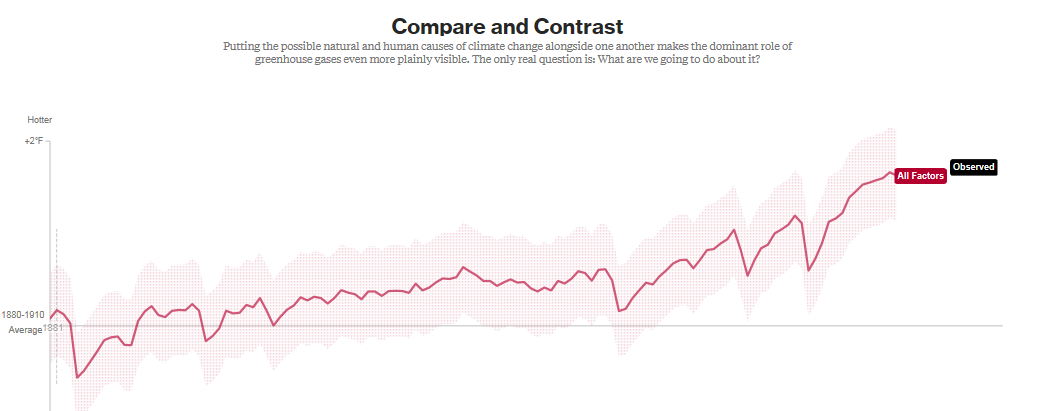
What’s Really Warming the World?

by Barry Ritholtz

Click to see breakdown of human factors.

Source: Bloomberg

15 Aug 06:02

How California Is Winning the Drought

Photo
Credit Jon McNaught

FOR California, there hasn’t ever been a summer quite like the summer of 2015. The state and its 39 million residents are about to enter the fifth year of a drought. It has been the driest four-year period in California history — and the hottest, too.

Yet by almost every measure except precipitation, California is doing fine. Not just fine: California is doing fabulously.

In 2014, the state’s economy grew 27 percent faster than the country’s economy as a whole — the state has grown faster than the nation every year of the drought.

California has won back every job lost in the Great Recession and set new employment records. In the past year, California created 462,000 jobs — nearly 9,000 a week. No other state came close.

The drought has inspired no Dust Bowl-style exodus. California’s population has grown faster even as the drought has deepened.

More than half the fruits and vegetables grown in the United States come from California farms, and last year, the third growing season of the drought, both farm employment and farm revenue increased slightly.

Amid all the nervous news, the most important California drought story is the one we aren’t noticing. California is weathering the drought with remarkable resilience, because the state has been getting ready for this drought for the past 20 years.

The future of water is going to be turbulent for all of us — not far away, but right where we live; not in some distant decade, but next month or next spring. A sense of water insecurity is coming to many places that have never had a water worry. Here’s what California’s scorching summer of 2015 is showing us: We know what to do. We just have to do it.

Cannon Michael, 43, is a sixth-generation farmer in California’s Central Valley, growing tomatoes, cotton, melons and wheat on 10,000 acres of dirt that were part of the holdings of his great-great-great grandfather Henry Miller, a rancher who was known as the “Cattle King.”

Mr. Michael returned to work the family farm in 1998, and has gradually transformed the mix of crops and how they are grown. In the past 10 years, he has spent $10 million installing drip irrigation on about half the land. When he grows tomatoes using drip hoses that squirt water right below where the plants emerge from the ground, he uses about 35 percent less water per acre than he would with traditional irrigation. But the plants produce more tomatoes — he says that he gets at least 70 percent more tomatoes per 1,000 gallons of water.

Continue reading the main story

Leave a question in the comments with this story or on the Times Opinion Facebook page for Charles Fishman about water conservation in California. He will respond to a selection next week.

Mr. Michael isn’t an isolated example. He’s part of a trend. Since 1980, the amount of California farmland watered by drip- or micro-irrigation has gone from almost nothing to nearly three million acres, 39 percent of the state’s irrigated fields. In perfect parallel, farmland that is flood-irrigated — using more water to produce less food — has fallen to about 3.5 million acres from more than six million.

California’s urban areas are also slowly transforming themselves. East of Los Angeles is a quietly innovative water district called the Inland Empire Utilities Agency, providing water for just under a million people.

The agency has an aggressive water recycling program, which cleans and resupplies 52 million gallons of water a day for an immediate second use, on farms, in factories and commercial laundries, in recharging the area’s groundwater.

And although it is dozens of miles from the Pacific Ocean, the agency also desalinates water. The Inland Empire sits over an aquifer that has been polluted by a legacy of careless agricultural and human habitation. The desalination process removes chemicals and salt, turning 35 million gallons a day of tainted brine into water at least as clean as tap.

Those techniques expand Inland Empire’s water supply without actually requiring any new water, and they represent the leading edge of an effort in Southern California toward “water independence.” In water terms, California is famously a kind of teeter-totter: Most of the water is in the north, most of the people are in the south, and the water flows to the people.

But across Southern California, the progress is quietly astonishing. The Metropolitan Water District of Southern California now supplies roughly 19 million people in six counties, and it uses slightly less water than it did 25 years ago, when it supplied 15 million people. That savings — more than one billion gallons each day — is enough to supply all of New York City.

California’s resilience is fragile. It won’t last another two years, it might not last another year.

And to say that the state is weathering the drought is not to trivialize the damage. This summer’s wildfires — which have killed one firefighter, have already burned more acreage to date than last year’s fires and have destroyed dozens of homes — are just one example.

Photo
Some California farmers have turned to drip irrigation to reduce their water use. Credit Citizens of the Planet/Education Images/UIG via Getty Images

In the town of East Porterville, in the central part of the state, the drinking wells began to go dry a year ago or more. Many residents rely on bottled water and water distributed at the fire station. Their taps, their toilets, their showers are dry — an astonishing level of deprivation in a state with great wealth.

Farm production numbers look good partly because prices for produce are high. Irrigation water, which comes from surface water sources mostly in the north, is allocated based on history, law and availability. Despite cuts of irrigation water of up to 100 percent, farmers have continued to get water, pumping it from aquifers under their land.

California is the only state in the nation that has never regulated groundwater — farmers are largely free to pump as much as they want, without even tracking what they use. In wet years, pumping well water is generally unnecessary and expensive. In dry years, it’s survival.

In 2014, California farmers were able to substitute groundwater for 77 percent of the irrigation water they did not receive. In 2015, farmers are increasing their pumping by an astonishing one billion gallons a day, but the irrigation cuts are so severe that they will replace only 71 percent of their water.

The farmers are saving themselves now, but they are inflicting long-term damage to the vast underground water supply that is really California’s only remaining water cushion.

What can we learn from California’s resilience in this drought? The first lesson goes back 20 years before it started, when cities began to put conservation measures in place — measures that gradually changed water use and also water attitudes. If cities look at the water they have — rainwater, reservoir water, groundwater, wastewater — as different shades of one water, they quickly realize that there’s no such thing as “storm water” or “wastewater.” It’s all water. You can start giving yourself new water sources quickly by cleaning and reusing the water you’ve already got.

California’s progress has been bumpy. The second lesson is that a drought starkly reveals water absurdities that need to be fixed, often urgently.

How can the largest agricultural economy in the country not require farmers to report how much water they use — and allow them to use groundwater without limit?

Photo
In Pleasanton, Calif., recycled water is part of the effort to fight the drought. Credit Justin Sullivan/Getty Images

How can the water-starved city of Los Angeles have an elaborate system of drains and pipes to collect the rain that does fall — often in brief, intense torrents — only to discard it in the Pacific instead of storing it?

How can it be that in Sacramento nearly half the homes have no water meters? Residents don’t know how much water they use and can’t see how much they conserve if they want to.

And the third lesson is how to use water insecurity to create its opposite. A drought like this one creates the opportunity to change things — even really big things — that couldn’t be changed without a sudden sense of vulnerability.

Last fall, prodded by Gov. Jerry Brown’s administration, the California Legislature passed a sweeping groundwater law, taking California from having the least regulated groundwater in the country to being a model. The concept is simple: No community will be allowed to pump more water from the underground aquifers than can refill those aquifers — either naturally, or with human help.

The law is so innovative, it will eventually remake water use across the state, and if other states pay attention, across the nation. The law could inspire new techniques for getting rainwater to refill overtaxed aquifers.

In a similarly future-focused move, San Francisco just passed an ordinance to require that new buildings of a certain size have on-site water recycling systems, and reuse their own wastewater. It’s the first city in the United States with such a requirement.

In May, the water district for all of Southern California decided to use the drought to change attitudes about lawns. It increased funding more than fivefold for a program that gives rebates to homeowners who replace their lawns with desert-appropriate landscaping. Las Vegas helped pioneer such “cash for grass” programs as a water-saving technique, removing 170 million square feet of turf — thousands of lawns — since 1999.

The response in Southern California, where $340 million was allocated for the program, stunned even experienced water managers. After five weeks, all the rebate money had been spoken for. The amount of turf set to be removed: about the same square footage that Las Vegas needed 16 years to take out.

For a century, California has pioneered innovations that have changed the way we all live. Without much fanfare, the state is doing that again, with water, moving to make standard what has been novel. A lawn landscaped with rocks and cactus instead of turf, morning coffee brewed matter-of-factly with recycled water, cities designed to return rainwater to the ground — these aren’t just symbols, they are how you handle water when you understand its value.

One of the wonderful ironies of water is that the more attention you pay to it, the less you have to worry about it. By the drought of 2045, the way California uses water will have been transformed again. Just as powerfully, the way ordinary Californians regard water will have been transformed. More than any water conservation practice in particular, it’s that attitude that will save the state — and the rest of us, as well.

15 Aug 05:53

A Simple Fix for Drunken Driving: Modest, Immediate Penalties

On Aug. 19, the U.S. National Highway Traffic Safety Administration begins its annual “Drive Sober or Get Pulled Over” campaign, running for three weeks through the Labor Day weekend—a time of year when drunken-driving fatalities typically surge. Over the past generation, we’ve made important progress against “driving under the influence,” but the numbers haven’t dropped much recently, and the problem still costs some 10,000 Americans their lives each year.

Members of Alcoholics Anonymous like to joke that when alcoholics get arrested for drunken driving enough times, it finally sinks in that they need to make a change in their life, so they quit…driving. The joke is directed at alcoholics themselves, but it also applies to the criminal justice system. Legislators and judges have responded to repeat drunken drivers by trying to eliminate their driving—through incarceration, license suspension, ignition locks and vehicle impoundment. Their approach has been to separate the drivers from their vehicles, not from their drinking habits.

A decade ago, as attorney general of South Dakota, Larry Long saw the need for a more direct approach and launched a program called “24/7 Sobriety.” I first encountered 24/7 Sobriety five years ago, and it confounded much of what I had learned in my years as an addiction-treatment professional.

On a clear South Dakota morning, I found myself in a Sioux Falls police station, waiting for more than a hundred repeat offenders to appear for court-mandated appointments. They had to blow into a breathalyzer to prove that they had not been drinking. I expected that many wouldn’t show up; I felt sure that many of those who did show up would be intoxicated—and the rest would be surly.

But every single offender trooped peacefully by, chatted briefly with a friendly officer, blew a negative test and went on his or her way. This was remarkable and new to me, particularly because it was almost absurdly simple.

Offenders in 24/7 Sobriety can drive all they want to, but they are under a court order not to drink. Every morning and evening, for an average of five months, they visit a police facility to take a breathalyzer test. Unlike most consequences imposed by the criminal justice system, the penalties for noncompliance are swift, certain and modest. Drinking results in mandatory arrest, with a night or two in jail as the typical penalty.

The results have been stunning. Since 2005, the program has administered more than 7 million breathalyzer tests to over 30,000 participants. Offenders have both showed up and passed the test at a rate of over 99%.

Inevitably, a few offenders try to beat the program by drinking just after a successful breathalyzer test, with the idea of not drinking too much before their next one. But people with repeat convictions for driving under the influence don’t excel at limiting themselves to “just a few beers.” They quickly learn that the best way to succeed in 24/7 Sobriety is to avoid alcohol entirely.

The benefits of the program aren’t just confined to road safety. In a 2013 paper in the American Journal of Public Health, Beau Kilmer of the Rand Corp. and colleagues found that counties using 24/7 Sobriety experienced not only a 12% drop in repeat drunken-driving arrests but also a 9% drop in domestic-violence arrests. Unlike interventions that only constrain drinking while driving, the removal of alcohol from an offender’s life also reduces the incidence of other alcohol-related crimes.

Why do repeat offenders change their behavior in response to relatively modest incentives? Stephen Higgins of the University of Vermont addressed this question in his pioneering work on the treatment of drug addiction. In a widely cited 1991 paper in the American Journal of Psychiatry, he showed that, although his patients continued using cocaine in the face of great harm to their families, livelihoods and physical health, they could still be induced to refrain from it when promised a small reward, like $10 for a negative urine test. The reward was relatively trivial, but it was unlike other potential consequences because it was both certain and immediate.

It turns out that people with drug and alcohol problems are just like the rest of us. Their behavior is affected much more by what is definitely going to happen today than by what might or might not happen far in the future, even if the potential future consequences are more serious.

The relative modesty of the penalties is also important for those imposing them: As a matter of due process, it is much simpler to hold a probationer overnight in the local jail than it is to send him or her to prison. From a practical viewpoint, states can’t afford to put every violator in prison, and offenders know that. But states can certainly hold them overnight in a jail cell for drinking, and offenders know that too.

24/7 Sobriety now tests over 2,000 South Dakotans a day at sites all over the state and has become a statewide program in neighboring North Dakota and Montana. Other cities in the U.S. and in the U.K. are trying it out as well, and it has drawn praise from federal officials.

Why hasn’t a program with such startling success been more widely adopted? Bureaucratic inertia is part of the problem, but I also suspect that 24/7 Sobriety faces resistance because it challenges some myths about drinking problems that my own field has done no small part to spread.

Among the most enduring of these myths is the idea that no one can recover from a drinking problem without our help. Treatment professionals save many lives that would otherwise be lost to addiction, but we are not the sole pathway to recovery. National research surveys have shown repeatedly that most people who resolve a drinking problem never work with a professional.

Some members of the addiction field can also be faulted for spreading an extreme version of the theory that addiction is a “brain disease,” which rules out the possibility that rewards and penalties can change drinking behavior. Addiction is a legitimate disorder, in which the brain is centrally involved, but as Dr. Higgins notes, “it is not akin to a reflex or rigidity in a Parkinson’s patient.”

In their haste to ensure that people who suffer from substance-abuse disorders are not stigmatized, some well-meaning addiction professionals insist that their patients have no capacity for self-control. Most people with alcohol problems do indeed struggle to make good choices, but that just means they need an environment that more strongly reinforces a standard of abstinence. 24/7 Sobriety does that.

—Dr. Humphreys is a professor of psychiatry at Stanford University and a former senior policy adviser in the White House Office of National Drug Control Policy. He has been an unpaid adviser to government officials interested in adopting 24/7 Sobriety

12 Aug 18:29

Read At Your Own Risk

by Dan Savage

ballimpactarea.jpg

A friend spotted this sign in a park and sent it to me at the exact same time I was working on this week's Savage Love. Coincidence? There are no coincidences.

[ Comment on this story ]

[ Subscribe to the comments on this story ]

11 Aug 21:25

Incenting Drug Dealers to Snitch on Each Other

by schneier

Local police are trying to convince drug dealers to turn each other in by pointing out that it reduces competition.

It's a comical tactic with serious results: "We offer a free service to help you eliminate your drug competition!" Under a large marijuana leaf, the flier contained a blank form encouraging drug dealers to identify the competition and provide contact information. It also asked respondents to identify the hours the competition was most active.
11 Aug 01:59

Bohr's trip about spin


The other day I was talking with a friend (yes, I have friends) about the way communication of ideas has changed. The Internet is the obvious advance, but what used to happen when an important new idea needed to be disseminated? As an example of how things used to be, I told him the story of Bohr's famous train trip.

In 1925, two students at the University of Leiden, Sem Goudsmit and George Uhlenbeck, realized that the fourth electron quantum number could be explained if the electron had spin. This was a radical idea (a point particle spinning?), and coming from students was doubly suspect. Physicists throughout Europe were excited yet skeptical. When Bohr was planning a trip from Cophenhagen to Leiden for a conference, it seemed an excellent opportunity to talk to the students to help understand if they were right.

In his book, Inward Bound, Abraham Païs narrates the story as told to him by Bohr twenty years later:

Bohr's train to Leiden made a stop in Hamburg, where he was met by Pauli and Stern who had come to the station to ask him what he thought about spin. Bohr must have said that it was very very interesting (his favorite way of expressing that something was wrong), but he could not see how an electron moving in the electric field of the nucleus could experience the magnetic field necessary for producing fine structure. (As Uhlenbeck said later: 'I must say in retrospect that Sem and I in our euphoria had not really appreciated [this] basic difficulty.') On his arrival in Leiden, Bohr was met at the train by Ehrenfest and Einstein who asked him what he thought about spin. Bohr must have said that it was very very interesting but what about the magnetic field? Ehrenfest replied that Einstein had resolved that. The electron in its rest frame sees a rotating electric field; hence by elementary relativity it also sees a magnetic field. The net result is an effective spin-orbit coupling. Bohr was at once convinced. When told of the factor of two he expressed confidence that this problem would find a natural resolution. He urged Sem and George to write a more detailed note on their work. They did; Bohr added an approving comment.
After Leiden Bohr traveled to Goettingen. There he was met at the station by Heisenberg and Jordan who asked what he thought about spin. Bohr replied that it was a great advance and explained about the spin-orbit coupling. Heisenberg remarked that he had heard this remark before but that he could not remember who made it and when. ... On his way home the train stopped at Berlin where Bohr was met at the station by Pauli, who had made the trip from Hamburg for the sole purpose of asking Bohr what he now thought about spin. Bohr said it was a great advance, to which Pauli replied: 'eine Neue Kopenhagener Irrlehre' (a new Copenhagen heresy). After his return home Bohr wrote to Ehrenfest that he had become 'a prophet of the electron magnet gospel.'

Sneakernet indeed, or perhaps Eisenbahnnet. The idea of the great physicist carrying precious nuggets of wisdom across Europe is romantic and poignant. It also shows how Bohr's insight, and the insight of his brilliant colleagues, did the peer review in real time in two train trips. Bohr, Pauli, Stern, Ehrenfest, Einstein, Heisenberg, Jordan, Pauli: What a peer review it was!

It is one of the greatest oversights of the Nobel committee that Goudsmit and Uhlenbeck were never rewarded. Their colleagues certainly understood the earth-shaking merit of their insight.


10 Aug 00:45

We’re still catching up to Perl

by Avdi Grimm

With very few exceptions, code written to run on any Perl released since 2000 (38 stable releases of Perl in that time period, eight of them major releases) runs without modification

That’s from a great little article by Chromatic about modern Perl in the latest issue of PragPub. The article goes in to discuss a number of other strengths of Perl, such as its strong community dedication to testing across numerous architectures, services for understanding package dependencies (that sound like they go beyond anything presently available for Ruby), and legendary standards of documentation.

It’s good to be reminded of things that other, more mature programming communities do well. I’m fond of pointing out that Perl had the best, most informative error message of any language ever. And Perl has been at the forefront in a lot of areas. Notably, as far as I’m aware it was the first language to take unicode integration seriously, and I would not be surprised if still has better support than any other programming system.

08 Aug 17:38

Mornings in America

by By Paul Krugman
Some are more equal than others.
07 Aug 06:01

Eating Spicy Food Linked to a Longer Life

by Nicholas Bakalar

Eating spicy food is associated with a reduced risk for death, an analysis of dietary data on more than 485,000 people found.

Study participants were enrolled between 2004 and 2008 in a large Chinese health study, and researchers followed them for an average of more than seven years, recording 20,224 deaths. The study is in BMJ.

After controlling for family medical history, age, education, diabetes, smoking and many other variables, the researchers found that compared with eating hot food, mainly chili peppers, less than once a week, having it once or twice a week resulted in a 10 percent reduced overall risk for death. Consuming spicy food six to seven times a week reduced the risk by 14 percent.

Rates of ischemic heart disease, respiratory diseases and cancers were all lower in hot-food eaters. The authors drew no conclusions about cause and effect, but they noted that capsaicin, the main ingredient in chili peppers, had been found in other studies to have antioxidant and anti-inflammatory effects.

“We need more evidence, especially from clinical trials, to further verify these findings,” said a co-author, Dr. Lu Qi, an associate professor of nutrition at the Harvard T.H. Chan School of Public Health, “and we are looking forward to seeing data from other populations.”


For more fitness, food and wellness news, “like” our Facebook page.

07 Aug 05:59

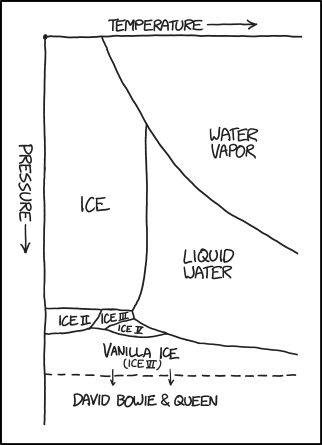
Water Phase Diagram

Vanilla Ice was produced in small quantities for years, but it wasn't until the 90s that experimenters collaborated to produce a sample that could survive at room temperature for several months.
04 Aug 23:52

Elizabeth Warren: "The Government Doesn't Perform Abortions. Period."

by Rich Smith

On Monday, the president of my heart, Elizabeth Warren, gave a full-throated defense of Planned Parenthood that made me jump out of my chair and start running around hooting and hollering. (Okay, actually I just started sending the link to a lot of people, but I was jumping out of my chair and running around emotionally.)

In case you've been out of it or distracted by Trump coverage for the last few weeks, Planned Parenthood, a nonprofit health clinic that serves millions of women each year, has been under attack.

Yesterday, Republicans tried to pass a bill in the Senate that would defund the clinic. That bill failed to pass. However, the fight to defend the health clinics, nearly half of which, as Warren says, are located in places where health care is hard to come by, is far from over. An hour ago, Jeb! told the crowd at the Southern Baptist Forum, "The next president should defund Planned Parenthood."

Major media outlets say the effort to cut funds to Planned Parenthood was spurred by heavily edited videos released over the last three weeks by the "Center for Medical Progress." The videos show two wide-eyed crusaders posing as fetal tissue procurement employees who try to catch doctors turning a profit from selling aborted fetal tissue.

In a speech given before the bill failed, Warren set the record straight with the flaming sword of her rhetoric and the cool clarity of her intelligence.

After mentioning the fact that Republicans tried to repeal Obamacare more than 50 times—many of them driven by the scandal that private insurers would have to cover contraception—and after mentioning the fact that, as she says, "over the last five years, Republican state legislatures have passed over 300 bills reducing abortion access," Warren says:

The Republican scheme to defund Planned Parenthood is not some sort of surprised response to a highly edited video. Nope. The Republican vote to defund Planned Parenthood is just one more piece of a deliberate, methodical, orchestrated right-wing attack on women's rights.

Oh, and:

Scheduling this vote during the week of a big Fox News presidential primary debate... isn't just some clever gimmick. This is an all-out effort to build support to take away a woman's right to control her own body and access to medical care she may need.

And, just so you know:

Most of the money Planned Parenthood receives from the government comes in the form of Medicaid patients... The same payments that any other doctor or clinic receives for providing cancer screenings or other medical exams. The rest of Planned Parenthood's federal funding comes from Title X that provides birth control to low-income and uninsured people. The same program the house Republicans voted to cut in June.

Finally, just to put an end, once and for all, to the notion that the government pays for abortions:

A vote today to defund Planned Parenthood is not a vote to defund abortions. It’s a vote to defund cancer screenings and birth control and basic health care for millions of women.

I'm going to go back to running around the room and hooting and hollering now. Emotionally.

[ Comment on this story ]

[ Subscribe to the comments on this story ]

04 Aug 23:48

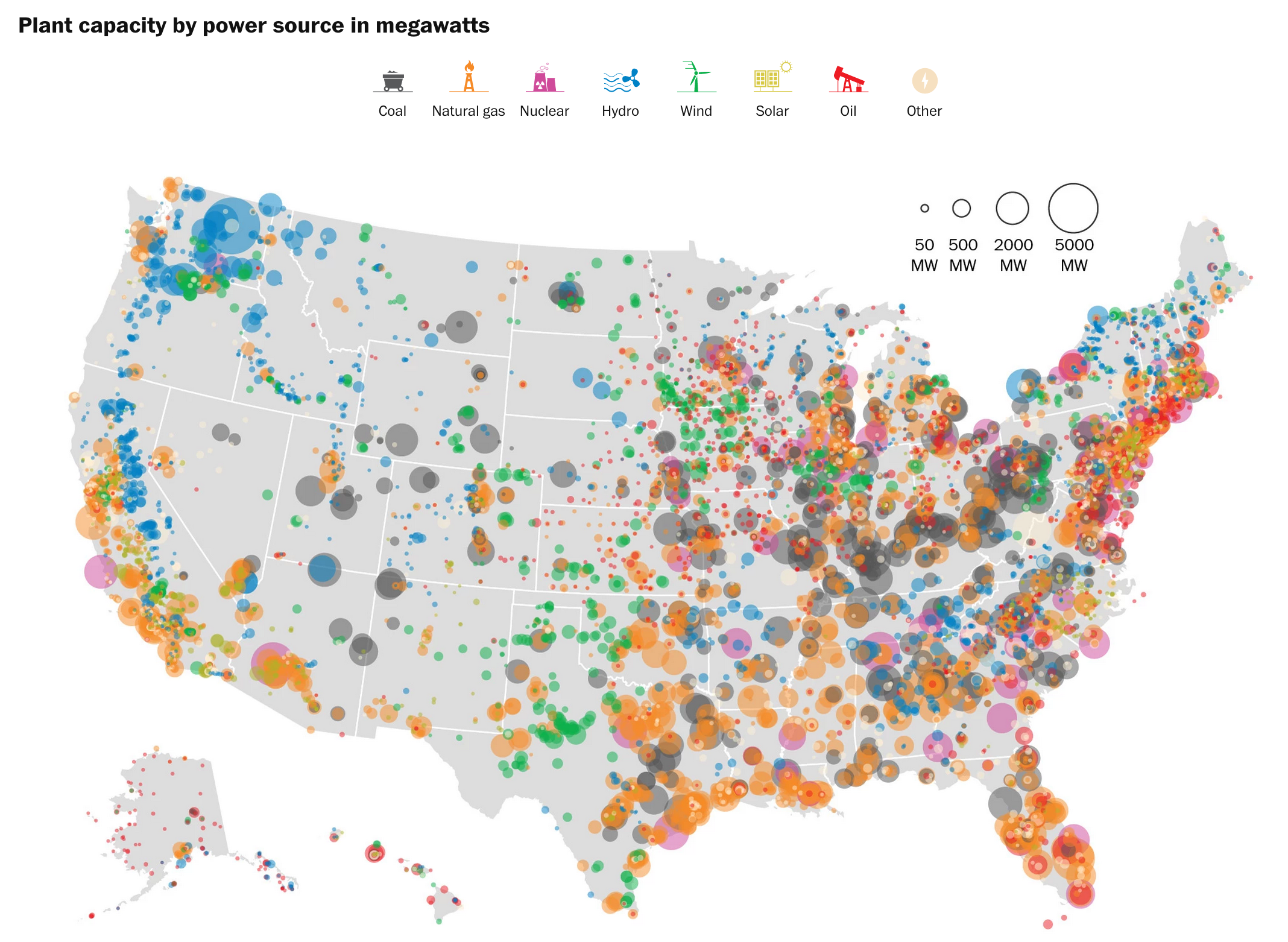
Plant Capacity by Power Source in Megawatts

by Barry Ritholtz


Source: Washington Post

04 Aug 23:04

Show HN: My SSH server knows who you are

Here's a fun PoC I built thanks to Ben's dataset.

I don't want to ruin the surprise, so just try this command. (It's harmless.)

ssh whoami.filippo.io  

For the security crowd: don't worry, I don't have any OpenSSH 0day and even if I did I wouldn't burn them on my blog. Also, ssh is designed to log into untrusted servers.

The server you will connect to is open source and written in Go, by the way!

For more silly PoCs follow me on Twitter.

04 Aug 17:05

Goldman: "What's Keeping the Kids at Their Parents' Homes?"

by Bill McBride
A few excerpts from a research note by Goldman Sachs economists David Mericle and Karen Reichgott: What's Keeping the Kids at Their Parents' Homes?
The share of 18-34 year-olds living with their parents rose about four percentage points (pp) during the recession and its aftermath, resulting in a few million extra "kids in the basement." This group accounts for the bulk of the recent shortfall in household formation and represents a potentially large pool of pent-up demand for homebuilding. While the share of young people living with their parents began to decline in 2014, the decline has stalled over the last six months ...

To what extent do current labor market conditions explain the elevated rate of young people living with their parents? ... We find that this current labor force status "composition effect" accounts for about 1.3pp, or roughly one-third of the "excess" kids living with their parents.
...
What accounts for the rest? Part of the explanation is likely that the legacy of the recession wears off only gradually ...

Three other factors might also have played a role. First, researchers at the New York Fed and the Fed Board have found evidence that rising student debt and poor credit scores have contributed to the elevated share of young people living with their parents. Second, the median age at first marriage has increased at a faster than usual rate since 2007 ... Third ... rent-to-income ratios are at historic highs, especially for young people. The future trajectory of these three factors is less clear, suggesting that the share of 18-34 year-olds living at home might not fully return to pre-recession rates.
...
What are the implications for the long-run homebuilding outlook? The pool of "excess" young people living at home is so large that even if only two-thirds ever move out and even if this process takes another decade, trend household formation would likely fall near the upper end of our 1.2-1.3mn forecast range. Combined with a 300k annual rate of demolitions, such a scenario would imply a trend demand for new housing units of about 1.6mn per year, well above the current sub-1.2mn run rate of housing starts. As a result, we continue to see plenty of upside for residential investment.
31 Jul 06:45

Open Letter to Microsoft’s CEO: Don’t Roll Back the Clock on Choice and Control

Satya,

I am writing to you about a very disturbing aspect of Windows 10. Specifically, that the update experience appears to have been designed to throw away the choice your customers have made about the Internet experience they want, and replace it with the Internet experience Microsoft wants them to have.

When we first saw the Windows 10 upgrade experience that strips users of their choice by effectively overriding existing user preferences for the Web browser and other apps, we reached out to your team to discuss this issue. Unfortunately, it didn’t result in any meaningful progress, hence this letter.

We appreciate that it’s still technically possible to preserve people’s previous settings and defaults, but the design of the whole upgrade experience and the default settings APIs have been changed to make this less obvious and more difficult. It now takes more than twice the number of mouse clicks, scrolling through content and some technical sophistication for people to reassert the choices they had previously made in earlier versions of Windows. It’s confusing, hard to navigate and easy to get lost.

Mozilla exists to bring choice, control and opportunity to everyone. We build Firefox and our other products for this reason. We build Mozilla as a non-profit organization for this reason. And we work to make the Internet experience beyond our products represent these values as much as we can.

Sometimes we see great progress, where consumer products respect individuals and their choices. However, with the launch of Windows 10 we are deeply disappointed to see Microsoft take such a dramatic step backwards.

These changes aren’t unsettling to us because we’re the organization that makes Firefox. They are unsettling because there are millions of users who love Windows and who are having their choices ignored, and because of the increased complexity put into everyone’s way if and when they choose to make a choice different than what Microsoft prefers.

We strongly urge you to reconsider your business tactic here and again respect people’s right to choice and control of their online experience by making it easier, more obvious and intuitive for people to maintain the choices they have already made through the upgrade experience. It should be easier for people to assert new choices and preferences, not just for other Microsoft products, through the default settings APIs and user interfaces.

Please give your users the choice and control they deserve in Windows 10.

Sincerely,

Chris Beard
CEO, Mozilla

Blog Post: Firefox for Windows 10: How to Restore or Choose Firefox as Your Default Browser

Blog Post: Safeguarding Choice and Control Online

22 Jul 18:45

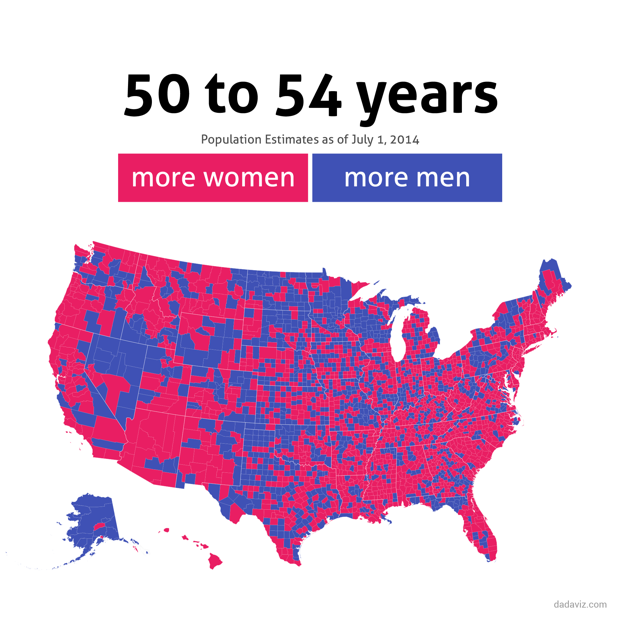
What We Can Learn About the Wage Gap by Mapping Where Men and Women Live

by Aria Bendix
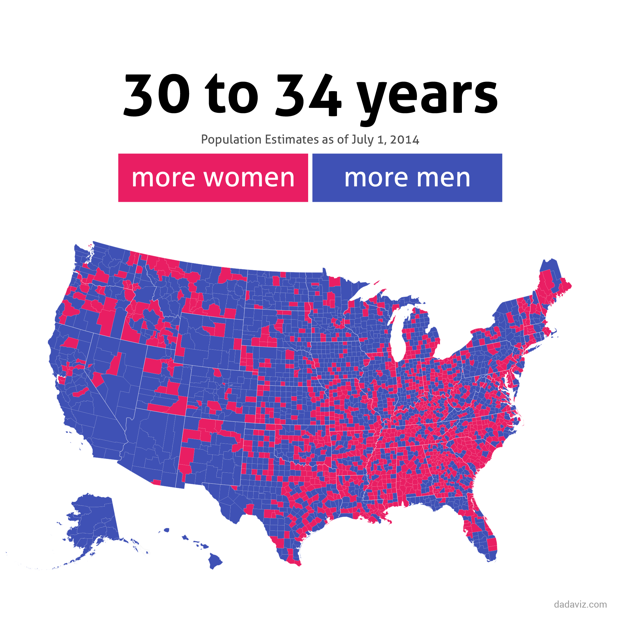
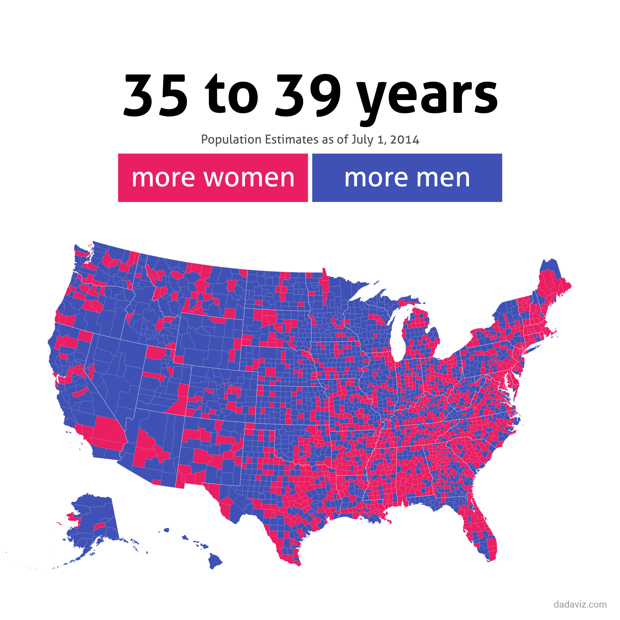
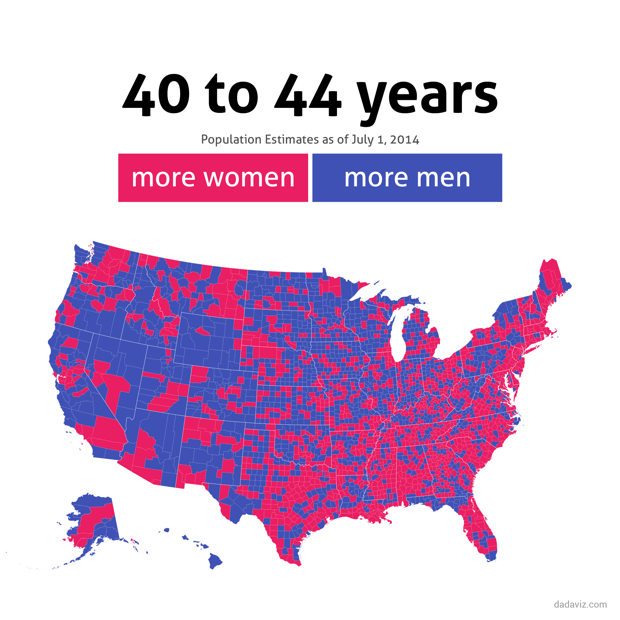
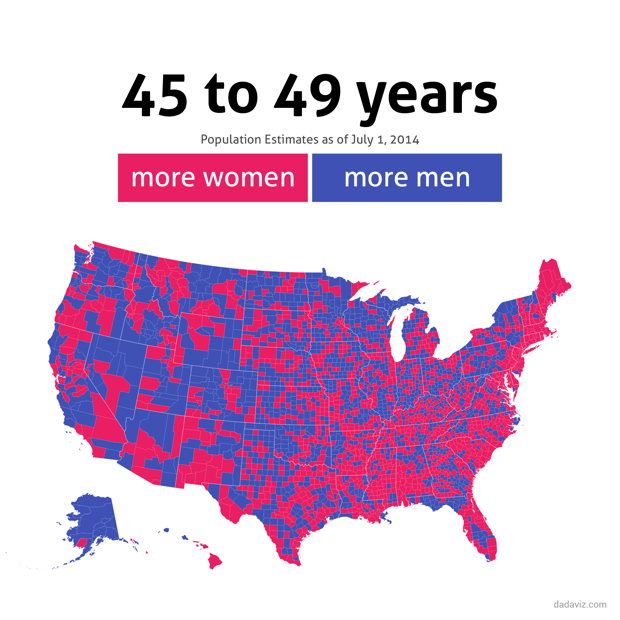
Image Jishai Evers, Dadaviz
Jishai Evers, Dadaviz

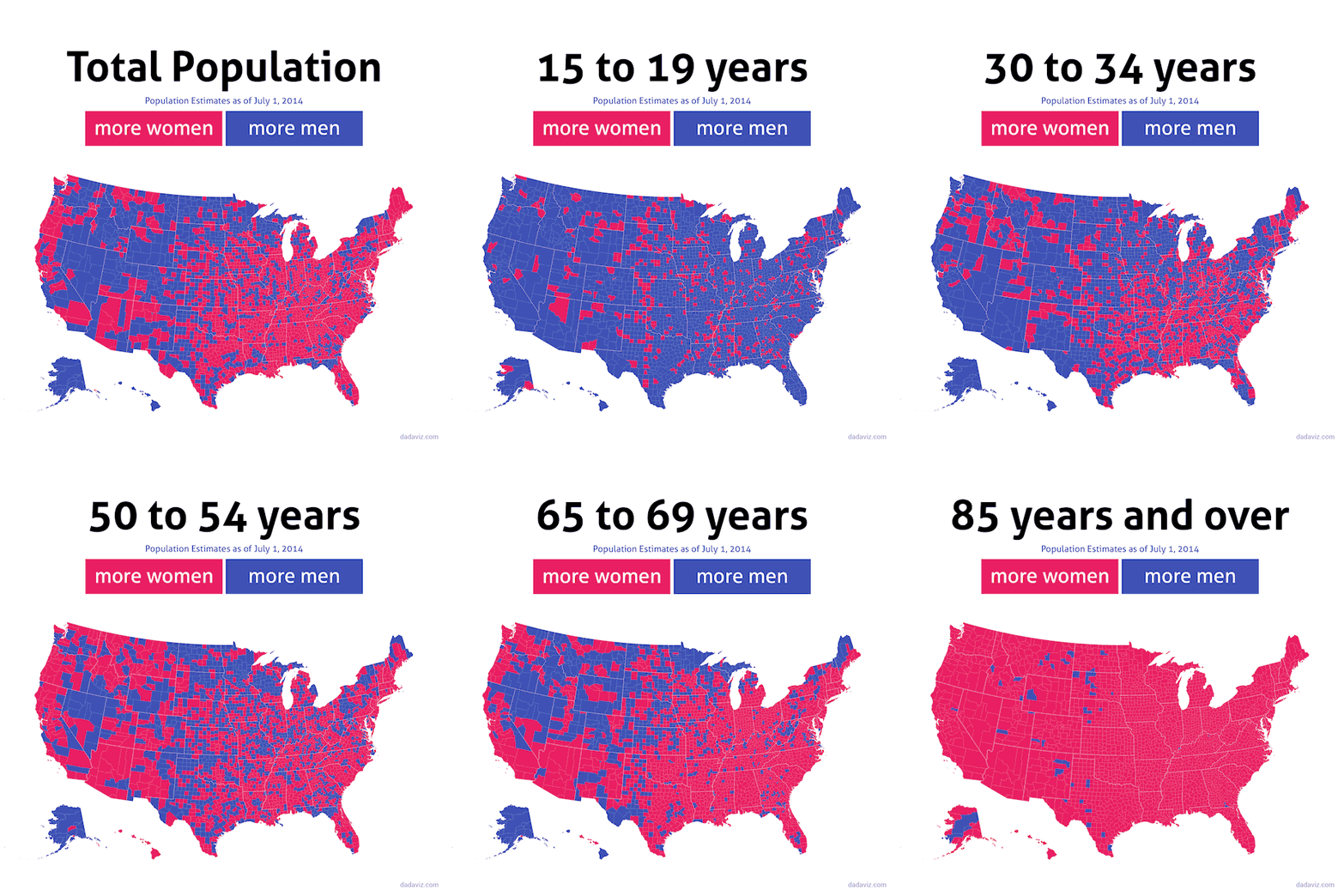
We’re all familiar with the fact that women comprise just over half of the U.S. population. We’ve lamented the statistics that a mere 17 percent of board members at Fortune 500 companies are women, or that women hold just under 9 percent of top management positions. We know the best states for women, the worst states for women, and all those in between. What we don’t often account for is the ever-shifting geography of the female population.

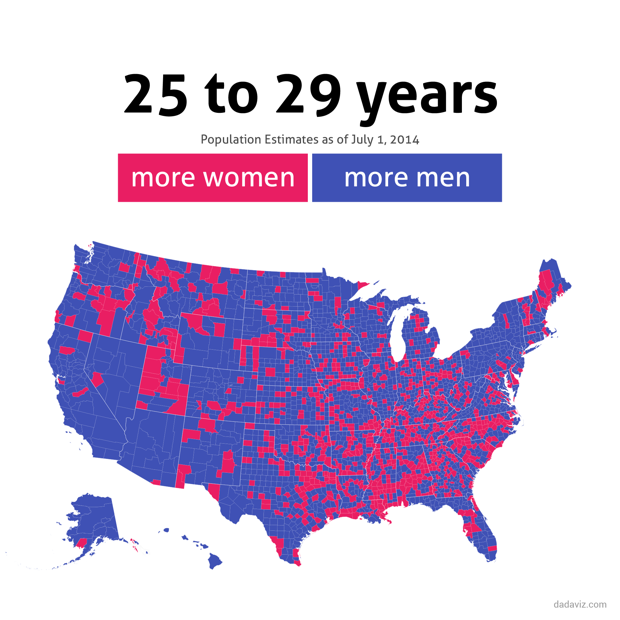
A new map from Dadaviz CEO Jishai Evers does just that. Using data from the 2010 U.S. Census, Evers maps the distribution of men and women across all counties in the U.S. based on age range. The maps start by tracking residents younger than age five and end with those age 85 and above. Counties with a higher female population are represented in pink, while those with a higher male population are represented in blue. The results clearly show that the number counties with more women increase and the number with more men decrease as each population grows older.  
This reversal in population demographics is no doubt attributed to the fact that women live longer than men—five to ten years longer, to be exact. And there’s plenty of research out there that explains why this may be.

But the Dadaviz maps are significant beyond what they tell us about life expectancy in the U.S., and have already sparked a lively debate on the internet, Evers says. After the maps were released, users on Reddit began to speculate as to why the female population seemed to migrate toward the East Coast as their age increased. Many thought it was perhaps the case that women were moving to places where more or better jobs were available, while men on average were more attracted to rural-type communities in the Midwest. Evers found no proof of either in his analysis of the U.S. Census data.

More working-age women seem to be populating the areas with lower wage gaps.

But while Evers’ map drew attention for its representation of the relationship between age and gender, it actually began as a way to illustrate inequality. Initially, Evers had wanted to explore the gender dynamics of his home city, Tel Aviv. “I wanted to look at inequality on a micro-level,” he says, “because it’s something that really touches a community.” But he soon became frustrated by what he felt was a lack of sophisticated census data for Tel Aviv, so he decided to examine the U.S. instead.

Although Evers’ mission was to chart geographic inequality, his data can also be used to track other issues of inequality plaguing our nation today. Take, for instance, a comparison of Dadaviz's maps with Slate's map of gender income inequality, which uses data from the same 2010 Census. According to the Slate map, the best cities for women in terms of income equality were Washington D.C., Dallas, San Francisco, Los Angeles, Austin, Santa Fe, New York, and Boston.

Let’s compare this to Dadaviz's map of the population distribution for women of prime working age (between 25-54). It would appear that the U.S. female population becomes increasingly concentrated in Texas and the East Coast as they age. Somewhere around ages 45-49, however, the gender distribution becomes scattered across the country.

With the exception of a few cities in California, the maps suggest that areas with more women of prime working age are also those with the least income inequality. On the whole, counties on the East Cast seem to have both a greater population of working women and a smaller gender pay gap.

In contrast, the Upper Midwest and Western regions of the U.S. seem to have both larger wage gaps and larger male populations. Wyoming, for instance, has the worst income inequality of any state (women make 56 cents for every dollar made by the average working man), and the second highest male population in the country.

Of course, there are exceptions to the rule. Nevada, for example, is one of the best states in terms of income equality, and also happens to have a consistently higher male population across most age brackets. All the same, it’s a curious coincidence that more working-age women seem to be populating the areas with lower wage gaps.

It’s also unclear what might be causing this relationship. Perhaps it’s the case that women have slowly migrated to certain areas in order to receive a better wage, or at the very least to be a part of a climate that is more accepting of women in the workplace. Or perhaps it’s the case that larger female populations have a louder collective voice in their demands for income equality, and therefore reap the benefits of their efforts in those counties or states.

Whatever the case may be, more working-age women seem to be living in areas where their potential earnings are higher. But that doesn’t mean there’s not plenty of room for improvement when it comes to the wage gap, which is still 22 percent on average across the country. After all, women shouldn’t have to wait until they’re 85 and all the men have died off to finally run the country.


22 Jul 18:42

A visit with David Goines: Berkeley’s legendary letterpress printer and lithographer

by Melati Citrawireja
David Goines in his Berkeley workshop. Photo: Melati Citrawireja

David Goines in his Berkeley workshop. Photo: Melati Citrawireja

In the second of a three-part series on expert craftspeople in Berkeley, Melati Citrawireja, a summer 2015 photography intern for Berkeleyside, visits St. Hieronymus Press, the workspace of David Lance Goines. (Read Citrawireja’s first story on Klaus-Ullrich Rötzscher and the Pettingell Book Bindery.)

You may recognize David Goines by his distinctive handlebar mustache and deep, chocolatey voice, or you may know him by his letterpress and lithography artwork. Several pieces that have awarded him widespread attention include a collaborative book with Alice Waters, the owner of Chez Panisse, called 30 Recipes Suitable for Framing, and posters for well-known Bay Area spots, like Acme Bread and UC Berkeley.

Curious to meet the man behind these beautiful pieces that I’ve seen my whole life when thumbing through cookbooks in the kitchen, I ask to visit his workspace and Goines politely invites me over.(...)

Read the rest of A visit with David Goines: Berkeley’s legendary letterpress printer and lithographer (1,291 words)


By Melati Citrawireja. | Permalink | 10 comments |
Post tags: Berkeley artisans, Berkeley business news, Berkeley craftspeople, David Lance Goines, Letterpress, Lithography, Melati Citrawireja, North Berkeley, St. Hieronymus Press

22 Jul 18:15

Career Advice for Engineers and Designers

These notes begin at defining a life goal, transition to thinking about a career, then whether you should join a startup, what company you should join, how to apply, and how to decide between offers/companies.

Given the significant proportion of time you spend on your career, it's worth some thought. This is an attempt at a deliberate understatement.

One "quick" hack to optimize your career: put in a lot of thought and think long term.

Step 0: What should I do with my life?

Here are some opinions. These aren't intended to provide an answer directly, but they may provoke you to think of an answer.

What is the goal of life?

Post by Albert Wenger, USV. Why Are We Here?

For me the very existence and possibility of human knowledge provides the answer to the question of why we are here and what we should try to accomplish in life. We should endeavor to contribute to knowledge. Given my definition this can mean a great many things, including teaching and making music and taking care of others. Anything that either adds to or reproduces knowledge is, so far, a uniquely human activity and why we are here (“adding” includes questioning or even invalidating existing knowledge).

Excerpt from Elon Musk by Ashlee Vance.

At around age fourteen, Musk had a full-on existential crisis. He tried to deal with it like many gifted adolescents do, turning to religious and philosophical texts. Musk sampled a handful of ideologies and then ended up more or less back where he had started, embracing the sci-fi lessons found in one of the most influential books in his life: The Hitchhiker's Guide to the Galaxy, by Douglas Adams. "He points out that one of the really tough things is figuring out what questions to ask," Musk said. "Once you figure out the question, then the answer is relatively easy. I came to the conclusion that really we should aspire to increase the scope and scale of human consciousness in order to better understand what questions to ask."

The teenage Musk then arrived at his ultralogical mission statement. "The only thing that makes sense to do is strive for greater collective enlightenment," he said.

Post by Om Malik

The moral of this story (told to me by Liam Casey of PCH International, who heard it in China) is that money and success aren’t everything, and that you need to know what you’re aiming for before beginning on an endeavor. We often get caught up in false ambition and forget why we wanted to do something in the first place. That lapse of memory costs us the joy of something that got us started.

Today it is easy to learn about starting a business. You can get practical advice and to-do lists at the click of a button. However, what you can’t get from others is the understanding about why you are doing what you are doing and toward what end. If only I had heard this story earlier, I would have made fewer — or perhaps different — mistakes.

Points from Vinod Khosla at the GSB (YouTube)

Most people won't take risks

Most people will watch Vinod's talk, and still not take risks

Take huge risks and do things that really matter

Excerpt from interview with Jeff Bezos

If a young person came to you for advice, "How do I make the most out of my life?" what would you say to them?

Do something you're very passionate about, and don't try to chase what is kind of the 'hot passion' of the day. I think we actually saw this. I think you see it all over the place in many different contexts, but I think we saw it in the Internet world quite a bit, where, at sort of the peak of the Internet mania in -- say 1999 -- you found people who were very passionate of something, and they kind of left that job and decided, "I'm going to do something on the Internet because it's almost like the 1849 Gold Rush in a way." I mean, you find that people -- if you go back and study the history of the 1949 Gold Rush you find that, at that time, everybody who was within shouting distance of California was -- you know, they might have been a doctor, but they quit being a doctor and they started panning for gold, and that almost never works. And, even if it does work, according to some metric, financial success, or whatever it might be, I suspect it leaves you ultimately unsatisfied. So, you really need to be very clear with yourself. And I think one of the best ways to do that is this notion of projecting yourself forward to age 80, looking back on your life, and trying to make sure you've minimized the number of regrets you have. That works for career decisions. It works for family decisions. I have a 14-month old son, and it's very easy for me to -- if I think about myself when I'm 80, I know I want to watch that little guy grow up, and so it's -- I don't want to be 80 and think, "Shoot! You know, I missed that whole thing, and I don't have the kind of relationship with my son that I wished I had," and so on and so on.

Another thing that I would recommend to people is that they always take a long-term point of view. I think this is something about which there's a lot of controversy. A lot of people -- and I'm just not one of them -- believe that you should live for the now. I think what you do is think about the great expanse of time ahead of you and try to make sure that you're planning for that in a way that's going to leave you ultimately satisfied. This is the way it works for me. There are a lot of paths to satisfaction and you need to find one that works for you.

What makes one happy?

Post from The Breakout List, Happiness science for breakout careers

Coherent story: Understand your life in terms of a coherent story. Seriously, attempt to write out the main points of a novel that may be written about your life.

Goals: Frame career goals in terms of relationships and generativity (leaving legacy and contributing to society), instead of wealth and achievement.

Virtues: Seek to work at companies with virtuous individuals. Wise, courageous, humane, just, temperate, and transcendent people.

Conditions: Avoid environments with uncontrollable noise, especially if the noise is variable. Seek a short commute. Seek a job where you can exercise some aspects of control, even if minute. Ensure that you mend conflicts in interpersonal relationships. I’d suggest learning active listening for that.

Seek flow: Clear challenges that fully engage you, where you have the skills to meet the challenge, and somehow get immediate feedback on how you are doing. Some programming tasks are especially suited to states of flow. Do tasks that engage your strengths.

Build relationships: Express gratitude to people who have helped you at work or in your career. Write gratitude letters. Join or start a group with coworkers or people from your industry that meets weekly or monthly to share an activity.

Reframe as a calling: In conjunction with point #1, try to see how your work fits into a worthy larger undertaking.

What does it take to be successful?

Excerpt from interview with Kobe Bryant by GQ

So how much are you willing to give up? Have you given up the possibility of having friends? Do you have any friends?

I have "like minds." You know, I've been fortunate to play in Los Angeles, where there are a lot of people like me. Actors. Musicians. Businessmen. Obsessives. People who feel like God put them on earth to do whatever it is that they do. Now, do we have time to build great relationships? Do we have time to build great friendships? No. Do we have time to socialize and to hangout aimlessly? No. Do we want to do that? No.We want to work. I enjoy working.

So is this a choice? Are you actively choosing not to have friends?

Well, yes and no. I have friends. But being a "great friend" is something I will never be. I can be a good friend. But not a great friend. A great friend will call you every day and remember your birthday. I'll get so wrapped up in my shit, I'll never remember that stuff. And the people who are my friends understand this, and they're usually the same way. You gravitate toward people who are like you. But the kind of relationships you see in movies—that's impossible for me. I have good relationships with players around the league. LeBron and I will text every now and then. KG and I will text every now and then. But in terms of having one of those great, bonding friendships—that's something I will probably never have. And it's not some smug thing. It's a weakness. It's a weakness.

Step 1: How should I think about my career?

On doing what's interesting

Excerpt from Poor Charlie's Almanack, by Charlie Munger (p. 450)

Another thing that I have found is that intense interest in any subject is indispensable if you're really going to excel in it. I could force myself to be fairly good in a lot of things, but I couldn't excel in anything in which I didn't have an intense interest. So to some extent you're going to have to do as I did. If at all feasible, you want to maneuver yourself into doing something in which you have an intense interest.

Post by David Lee, 'Follow Your Interest'

I found that a better - or more practical - heuristic is doing what interests you or piques your curiosity. Or generally, what just feels “right” for you. Not what you’re supposed to do - as dictated by peer pressure, family pressure, or self-inflicted pressure.

From a conversation with anon

I don't do any career goals or anything like that.

I try and do things that are a) interesting to me and b) that the world needs.

On career planning

Notes from Peter Thiel's class (hat tip to David Lee)

A good intermediate lesson in chess is that even a bad plan is better than no plan at all. Having no plan is chaotic. And yet people default to no plan. When I taught at the law school last year, I’d ask law students what they wanted to do with their life. Most had no idea. Few wanted to become law firm partners. Even fewer thought that they would actually become partner if they tried. Most were going to go work at law firms for a few years and “figure it out.”

That’s basically chaos. You should either like what you’re doing, believe it’s a direct plan to something else, or believe it’s an indirect plan to something else. Just adding a resume lines every two years thinking it will buy you options is bad. If you’re climbing a hill, you should take a step back and look at the hill every once in awhile. If you just keep marching and never evaluating, you may get old and finally realize that it was a really low hill.

One reason people may default to not thinking about the future is that they’re uncomfortable being different. It is unfashionable to plan things out and to believe that you have an edge you can use to make things happen.

The Thiel approach

What is valuable (to the world), and going to remain valuable over the next 10+ years?

What can I do (well), and maintain/improve my ability to perform at over the coming years?

What are other people not doing, and not going to start doing very soon?

Step 2: Should I join a startup?

Will I get rich?

Post by Chris Dixon, The ideal startup career path

As Aaron said, you shouldn’t think of joining a startup as just joining a company. You should think of it as joining the startup career path. This career path could mean starting a company as your first job. It could also mean working at a few startups and then starting a company. (In my view, if your goal is to start a company, it is mostly a waste of time to work anywhere but a startup – with the possible exception of a short stint in venture capital).

Maybe you will make some money working at a startup, but more importantly you will hopefully work for founders and managers who are smart and willing to mentor you and eventually fund or help you fund your startup.

On learning, or what you will get out of working at a startup

Notes from Peter Thiel's class (hat tip to Garry Tan)

We tend to massively underestimate the compounding returns of intelligence. As humans, we need to solve big problems. If you graduate Stanford at 22 and Google recruits you, you’ll work a 9-to-5. It’s probably more like an 11-to-3 in terms of hard work. They’ll pay well. It’s relaxing. But what they are actually doing is paying you to accept a much lower intellectual growth rate. When you recognize that intelligence is compounding, the cost of that missing long-term compounding is enormous. They’re not giving you the best opportunity of your life. Then a scary thing can happen: You might realize one day that you’ve lost your competitive edge. You won’t be the best anymore. You won’t be able to fall in love with new stuff. Things are cushy where you are. You get complacent and stall. So, run your prospective engineering hires through that narrative. Then show them the alternative: working at your startup.

Post by Kyle Tibbitts, Rate-of-learning: the most valuable startup compensation

The most valuable compensation for working at a startup as opposed to a “normal job” is a dramatically higher rate-of-learning (ROL).

Post by Mark Suster, Is it Time for You to Earn or to Learn?

My advice is often, “make sure that what you get out of working at this company is one or several of the following: a great network of talented excutives and VCs, more responsibility than your last job, specific industry or technical skills that will help you in what you do next, a chance to partner with companies that will increase your industry relationships, etc.” Learn now to earn later.

Should I start a company?

Post by Dustin Moskovitz, Good and Bad Reasons to Become an Entrepreneur

There are good reasons, and there are bad reasons.

Read the post if this is a topic you are thinking about.

Excerpt from interview with Jeff Bezos

What were your intentions when you left [graduated from] Princeton? What did you set out to do?

I toyed with the idea of starting a company and even talked to a couple of friends about starting a company, and ultimately decided that it would be smarter to wait and learn a little bit more about business and the way the world works. You know, one of the things that it's very hard to believe when you're 22 or 23 years old is that you don't already know everything.

Step 3: What company should I join?

Where should I definitely not work?

Excerpt from Poor Charlie's Almanack, by Charlie Munger (p. 233)

Three rules for a career:

1) Don't sell anything you wouldn't buy yourself

2) Don't work for anyone you don’t respect and admire

and 3) Work only with people you enjoy.

What is a good reason to join a startup?

Excerpt on Paul Buchheit in The Launch Pad by Randall Stross

In June 1999, he applied to Google, which then had only twenty-two employees. He was fairly certain that AltaVista would soon destroy the little startup, but he could see that Google had smart people and offered work that would let him learn something, and that’s all he was looking for. He told Jessica Livingston many years later, in Founders at Work, “It worked out well, but it wasn’t like I saw this company and said, ‘Oh, wow, this is going to succeed!’ I just thought it would be fun.”

Ed note: Paul joined Google as employee #23.

What stage should I be looking for?

Note: choice of company is more important than timing.

Post by Chris Dixon, The worst time to join a startup is right after it gets initial VC financing

The best time to join a company is at the very beginning – to found or co-found the company. The second best time is to join before venture financing. The third best time is when the company has started to ramp sales/traction – at that point your equity grant will be small but at least the company will have a much higher likelihood for success. The worst time, from my experience, is right after initial (Series A) VC funding.

Post by David Beisel, How to Find the Perfect Startup Job: Part I “Start with ‘When'”

I believe that there are three opportune times to join a startup:

1. As early as possible (or as you can stomach).

2. When the train has already left the station.

3. When there is a truly unique ability to learn, collaborate with specific people, or work in a special situation.

Should I work at a startup?

"Startup" means a lot of different things to a lot of different people.

Here, let's use startup to mean: a company that has not reached product-market fit in a big market or a small market that will soon be really big.

In that sense, companies like Slack and Zenefits are not startups.

Post by Marc Andreessen, Pmarca Guide to Career Planning: Part 3

When you are first starting your career, you should realize that raw startups are highly variable in terms of the experiences you will have. Some can be great, but many are very poorly managed and go nowhere. You will probably be better off going somewhere that’s already succeeding, gain skills and experience, and then go to a startup.

Picking which startup to join probably deserves its own post. However, in a nutshell, look for one where you understand the product, see how it might fit into a very large market, and really like and respect the people who are already there.

What kind of companies should I be looking for?

Post by Sam Altman, Advice for ambitious 19 year olds

If you join a company, my general advice is to join a company on a breakout trajectory. There are a usually a handful of these at a time, and they are usually identifiable to a smart young person. They are a very good risk/reward tradeoff. Such a company is almost certainly going to be successful, but the rest of the world isn’t quite as convinced of it as they should be. Fortunately, these companies love ambitious young people. In addition to the equity being a great deal (you might get 1/10th of the equity you’d get if you going a tiny new startup, but at 1/100th or 1/1000th of the risk), you will work with very good people, learn what success looks like, and get a W on your record (which turns out to be quite valuable). Spending a few years at a company that fails has path consequences, and working at an already-massively-successful company means you will learn much less, and probably work with less impressive people.

Post by Hunter Walk

If you’re graduating this spring and starting a career in tech, I’ve got one piece of advice: go work at a midstage startup (I’ll define that as B/C rounds of financing – eg Twilio, Stripe, Airbnb, Warby [as of 2014]). Here’s why:

3. The Early Team Still There and They’ll Be Your Tribe for Years: The founders and early team are still in place because there hasn’t been a liquidity event and the work is still exciting for them. These folks – plus your new peers – will most likely spend the next 20 years as your friends, managers, employees, VCs, cofounders, etc. Building a tight and high quality network early in your career is much more valuable than any fancy title or nearterm compensation. From folks a few years more experienced you’ll get mentorship and learn good habits.

Post by Andy Rachleff of Wealthfront

Again, see the note referring to the definition of a startup above.

Zenefits and Slack aren't really startups by this definition.

Andy advises joining companies in a similar stage to Facebook in 2006-7, roughly $50 million in revenue and growing quickly.

I prefer to see them take their first jobs after graduation at midsized companies with momentum, not startups, because they are the companies most likely to be big successes.

Conversation between Sheryl Sandberg and Eric Schmidt presented at HBS

Get on a rocket ship. When companies are growing quickly and they are having a lot of impact, careers take care of themselves. And when companies aren’t growing quickly or their missions don’t matter as much, that’s when stagnation and politics come in. If you’re offered a seat on a rocket ship, don’t ask what seat. Just get on.

Post by Elad Gil, Career Decisions

Factors to overeight:

1. Network

2. Market and Growth Rate

3. Optionality

4. Brand

Factors that don't matter as much as you think:

1. Role

2. Compensation

Bonus Points

If you plan to work in tech, move to Silicon Valley. The set of opportunities and networks out here are much stronger. If you do not go to Silicon Valley, go to New York.

Question on Quora, Should I work for Google/Facebook or Pinterest as a new grad?

At Pinterest I think we really do have a crack at becoming the next Google or Facebook, and I think it's much more exciting to help build the next big thing than just to join the already big thing. But you can't really go wrong whatever you decide -- and this decision is highly reversible :)

Question on Quora, As a new grad, should I work for Uber, Facebook/Google, or another startup as a software engineer?

Do I want to work at a big company that is more mature in their life cycle or a smaller company that is younger?

Do I care about what they make?

Did you get excited by the people who interviewed you?

Where will I learn the most?

If I joined a high-momentum company 12 months ago, does this mean I should quit and move to a new high-momentum company?

No.

With the rare exception that you previously hadn't put any thought into career decisions, and now want to think about the long game, join a company for the right reasons, and join the right company for you.

As a reminder, refer to Hunter's thoughts behind joining a mid-stage company:

3. The Early Team Still There and They’ll Be Your Tribe for Years: The founders and early team are still in place because there hasn’t been a liquidity event and the work is still exciting for them. These folks – plus your new peers – will most likely spend the next 20 years as your friends, managers, employees, VCs, cofounders, etc. Building a tight and high quality network early in your career is much more valuable than any fancy title or nearterm compensation. From folks a few years more experienced you’ll get mentorship and learn good habits.

Go find your tribe and stick with them.

Where can I discover good companies to join?

Check out Wealthfront's list.

Check out the portfolio lists of the best venture capitalists and angel investors.

Ask your smartest and best-networked friends.

Built a list, and then filter it down aggressively based on what you decide to be important.

Step 4: Filtering the list

Filtering your list does not mean removing companies you don't think will hire you.

This means (depending on which of the above advice you agree with):

  • Remove companies that aren't doing good for the world
  • Remove companies that aren't interesting to you
  • Remove companies where you wouldn't be working with great people

Always think about what you're optimizing for, but also don't ignore your heart if it is pushing you one way.

I heard a GP at a tier one venture capital firm say: "all bad career decisions I made with my head, all good ones I made with my heart."

How can I filter my list of companies, like an investor might?

Think about defensibility. Think about network effects. Think about how fast the market size is growing.

Post by Albert Wenger in 2010: Google Buying Groupon is a Flawed Idea

Second, Groupon’s business model does not seem super defensible. People who want deals will generally go look for them. And businesses that want to offer deals will do so on any channel that will let them. This suggests that the price for connecting a deal searching consumer with a deal offering business should get driven down quickly and that ultimately this will be a performance based market. Deal aggregation or search (e.g., Yipit) would seem to be a better model and one that fits more naturally with Google’s DNA.

Think about how fast revenues are growing, and be skeptical of what method is used to report revenue.

There's a big difference between revenue, booking, run rate, and so on.

Additionally, early revenue growth is not the be all end all of measures! Be skeptical of The Breakout List!

To prove that point, Zynga and Groupon had much faster revenue growth in year 1 and 2 than Google, Facebook, or Amazon did.

Researching companies

Ask friends and friends of friends.

You might have some luck researching salaries or what it's like to work at a company on Quora or Glassdoor.

How to ask friends about companies?

You should take the same approach used in good reference checks. It might seem harsh/blunt, but after all, this decision will end up impacting where you spend the majority of your waking life.

For example:

How would you rank this company relative to others you've worked at in terms of day to day enjoyment?

What is an example of something that makes you think the company is going to do really well?

When has something bad or frustrating happened at work? What happened?

Who are some of the other smartest people who work there? What is impressive about them?

See this post by Elad Gil and repurpose it for working out if your friends think their company is going to do well.

Step 5: Applying

How should I track my applications?

Use a simple Quip document or spreadsheet.

Are you a non-technical person?

Read these posts. Honestly, you should read them even if you are an engineer and the company is desperate for engineers. It never hurts to be better, especially at a startup.

Breaking Into Startups

How I Hustled to Get the Perfect Job

Shoot for the job you can’t get

What should my resume look like

Check out this. It's aimed at college students, but it's still very relevant.

Do it in LaTeX or at least use a nice looking font. At many places those things matter. Apple's Pages.app has some nice templates.

Should I try and wow them?

Yes. Especially if you tried and they didn't bite.

Some companies are more receptive to this than others, but at worst it will definitely get your application read.

Especially useful for non-tech roles at competitive companies, or for tech roles at super competitive companies.

See for example:

Katie Loves Airbnb (Katie currently works at Airbnb)

I'm ready to apply

Ask a friend who works there for an introduction, if possible.

Otherwise, go to their website and apply.

Alternatively, find anyone's email address and send an email to one person at the firm. Make sure you write this email as if they are a person! People often seem to forget that there's a person on the other end reading the email.. If it's a competitive position, there's no reason it shouldn't read more like a cold email to someone you want to meet than a random pitching of your resume. A good test: would you reply if you were busy as shit and worked there?

Write your email concisely. Assume they are really busy. Make it short. Then, have someone proof-read it, and make it shorter.

They didn't get back to me

Wait 10 days, and then apply again. Repeat.

Especially for smaller companies, many don't run tight recruiting funnels. They sometimes let candidates slip through the cracks.

You could just say: "Hi xyz, just wanted to ping. If there are no open roles, no worries, I would just love to know either way."

Just because they sometimes let candidates slip doesn't necessarily mean they are a bad company, by the way.

This is obviously a much smaller issue at larger companies, like Google and so on.

I'm really struggling. I don't have much experience, and I want to be able to work for a great company

A few ideas:

Build something interesting for the Hacker News or Product Hunt audience.

Put a note down the bottom that says "contact me here, I'm always interested in new opportunities". You could also write "please hire me," although that would be a little desperate.

Alternatively, reverse engineer the advice given to companies! As an example, you could look for companies hosting Meetups and attend (just chat with people, don't be desperate, like with dating!). Comment on their engineering blog posts with a response. Go to hackathons, and go to engineering conferences.

Step 6: Interviewing

There's enough on this elsewhere. Go search Quora.

If you really want a few suggestions, check out Guidelines For Interviewing At A Startup.

Step 7: Deciding

Firstly, avoid deciding before you need to. For example, say you have applied to two companies, and have an offer from one, but are waiting on the other. Don't stress out about the decision too much until you get the second offer!

Getting good data

Don't just trust what you see when you interview. Just because a firm has hard interviews, doesn't mean they have the best people! Many companies exploit this tendency to associate hard interviews with strong teams. It's sometimes true, but it's far from a guarantee.

Talk to people who work there. Have a drink with them, even. Try and get good honest opinions.

Give companies a chance

Here's a scenario. You have offers from company a, and company b. Company a told you some of their metrics, and they are doing extremely well. You love the team, the mission, and the product of both company a and b.

Company b didn't show you any metrics. You're thinking you're going to accept the offer from company a.

Wait! You didn't ask company b! Don't irrationally remove an option. If you're leaning one way because you lack information about another choice, seek out that information rather than discarding the choice.

Comparing salaries and equity

What are the typical amounts of equity offered to engineers by startups of different sizes?

Wealthfront Startup Salary & Equity Compensation

AngelList Salary Data

Understanding options and equity

Read the following:

(Not so) Scary terms in offer letters

I have a job offer at a startup, am I getting a good deal? Part 1: The offer

I have a job offer at a startup, am I getting a good deal? Part 2: The company

Understanding Equity Compensation and What it Means for Startup Employees

The Lemonade Stand: How to Value Your Private Shares

Valuing Employee Options

The one number you should know about your equity grant

Options

Employee Equity: The Liquidation Overhang

Focus on your share price, not your valuation

Decision exercise

When you ask other people what you should do, try and notice what you are hoping they will tell you to do!

Repeat steps 1-5.
Optionally, think like a VC.

Read Bill Gurley's thoughts on marketplaces. Gurley is a venture investor at Benchmark, where he led Benchmark's series A investment in Uber.

Read Sequoia Capital's notes on business plans and the elements of enduring companies.

Read Marc Andreessen on the only thing that matters for startups.

Read Sam Altman on the importance of companies attacking markets that are growing quickly.

Read Paul Graham to identify relentlessly resourceful founders.

Read Andy Rachleff on value hypotheses and growth hypotheses.

Read Peter Thiel and Michael Mauboussin on defensibility and moats.

Step 8: After getting hired

Doing well

If you're working as a PM (or just want to be a better customer facing dev), check out this guide to product management.

Post by David Teten, Top 9 Easy Career Hacks That Most People Don’t Do

I agree with Brad Feld: Most people flake. If you’re not a flake, you are far more likely be trusted, promoted, and funded. If you execute on the steps below, you’re well on your way to being a top quartile performer.

Post by Jason Calacanis, The most important piece of advice for folks starting their careers

Great CEOs obsess over their high performers. They like to talk to them, they like to mentor them and they like to challenge them. Once you prove yourself, it’s time to reap the benefit of being a hard worker with massive skills and the ability to learn new ones.

Learning

Post by Babak Nivi, AngelList new employee reading list

I do the onboarding for all new AngelList team members. Part of it is asking them to read the following (many candidates have read these before they even come in for an interview).

Maybe even read a few entrepreneur biographies. They'll help you understand how your CEO is (hopefully) thinking.

Try Made in America by the founder of Walmart or Elon Musk by Ashlee Vance, for example.

The long game

Post by Dave Zohrob, Don't put your career in stealth mode

Key takeaway: Once you get hired, make an effort to spread what you are learning and building.

I think this is a great point. If you occasionally blog about what you've been learning, or open source a small module, great things happen.

You become a more interesting person (at least in the context where most people will research you, i.e. online), and you contribute knowledge back to the world.

Of course, this can do great things five years down the track when you are thinking about your next move.

... I spent most of my time from 2007 through 2011 writing thousands of lines of code, powering apps used by millions of people.

Now, most of that code is dead. Thousands of hours of my life, literal years of work—gone.

Post by John Lilly, Go Long

Think about your tribe, and be aware that life is generally best played long.

It’s not transactional. It’s not about this funding round or that deal or this other distribution hack. It’s about making huge differences over a long period with the people in your crew, your tribe.

Otherwise, follow on Twitter.

20 Jul 17:28

The Economics of Sleep, Part 2 Full Transcript

by Freakonomics

This is a transcript of the Freakonomics Radio podcast “The Economics of Sleep, Part 2

[MUSIC: Ruby Velle & The Soulphonics, “Coming Home To You” (from It’s About Time)]

Stephen J. DUBNER: So are you saying right here and right now that you vow from today going forward, that for one week, that you’re going to do what? That you’re going to put all your screens outside of the bedroom at a certain time, let’s say? Is that what you’re…?

Lauren HALE: Absolutely.

DUBNER: On last week’s show – “The Economics of Sleep, Part 1” – we talked to Lauren Hale. She’s a sleep researcher at Stony Brook University. She told us that if you want to sleep well, you should avoid all screens for half an hour before going to bed. And yet she doesn’t.

HALE: I admit, I use screens at bedtime. I should not, but screens are enticing and relaxing.

DUBNER: But she promised to give it a try. For one week, she would not look at a single screen – no TV, no computer, no smartphone – between nine at night and seven in the morning.

HALE: The real challenge is try it for a week and see if you feel better, if you’re sleeping more, if you’re going to bed earlier, and see how you feel.

DUBNER: So how did it go?

HALE: It went great. I was shocked at how many times I wanted to check my phone, turn on the TV, go to the computer, any number of screens as they were all yelling out to me, but I held back and I slept so much better I can hardly believe it.

DUBNER: Now we should say that Hale is still fairly sleep-deprived: she’s got a newborn, and she wakes up during the night to nurse him. But what was most surprising about her no-screen experiment was when she got more sleep. Usually, when she wakes up for a 5:00 a.m. feeding, she stays up and gets right on her phone, answering e-mails and checking out what her friends have been posting online.

HALE: And the most interesting thing to me was I really expected that all of the gains in my sleep loss were going to come at the beginning of the night, because when we look at teenagers, that’s what we find. We find that kids and adolescents who use screens at night before bed, they go to bed later, they have a longer time until they fall asleep, and I expected the same of me. And I probably also experienced some of that. But the real benefits for me came in the morning because I set that 7:00 am screen time. And by forcing myself to stay away from screens after I do my morning nursing of my baby, I would just go right back to bed at 5:30, and sleep until he woke up at 7:00. And I’ll tell you, for the last six months, I would usually stay up once I woke up at 5:30. So this was a huge benefit to me. For the last week I’ve been getting at least an hour and a half more sleep because I wouldn’t allow myself to check email or log on to Facebook, or do anything like that until at least 7:00 in the morning. I extended my sleep. Pretty amazing.

DUBNER: So first of all – you’re welcome, Lauren Hale. Plainly I have a future as a sleep consultant. Let’s see, what other sleeping problems should we be fixing? In last week’s episode, we talked about the possible connection between poor sleep and poor health.

HALE: Cardiovascular disease. There’s associations with cancer.

DUBNER: We talked about how mushy sleep data can be, as it is often the result of self-reported surveys:

Diane LAUDERDALE: One approach people in surveys unfortunately often resort to is just giving an answer which they think will be a well-accepted answer to the person interviewing them.

DUBNER: And we looked into the racial gap in sleep and the wealth gap:

Dan HAMERMESH: The answer is very, very clear, those who earn more money per hour, who have better – what we call in economics, opportunity cost of working – they sleep less.

DUBNER: We also asked you about your sleep routine:

Anne HILDEBRAND: My name is Anne, and I cannot wear socks when I’m sleeping or else I get really thirsty at night.

DUBNER: So this week, in “The Economics of Sleep, Part 2,” we get more heavily into the actual economics part, as in what effect, if any, sleep has on how much money you make. Now, given what we’ve learned about mushy sleep data, how would you even begin to answer a question like that?

Matthew GIBSON: What we really need is something like an experiment for sleep. Almost as though we go out in the United States and force people to sleep different amounts and then watch what the outcome is on their wages.

DUBNER: And, yes, we’ll hear more of your sleep stories.

Alexandra NICOLAS: I’ve actually been keeping a spreadsheet on my sleep.

Adam HILL: Eating dinner late actually improves my sleep quality.

Mark ALLEN: What do I wear? Butt-naked is I think the American way of saying it.

[THEME]

ANNOUNCER: From WNYC: This is FREAKONOMICS RADIO, the podcast that explores the hidden side of everything. Here’s your host, Stephen Dubner.

[MUSIC: Chris Hanlin, “Wangs’s Groove”]

DUBNER: Since most of us sleep away roughly a third of our lives – a third of our lives! that’s nearly as much time as we spend with our screens – then surely sleep has been the focus of a great deal of economic research. Hasn’t it?

GIBSON: Economists have historically treated sleep as something to be ignored, something outside the realm of economics. People used to just subtract eight hours for sleep and then say, “We’re going to worry about the 16 hours that are left over.”

DUBNER: That’s Matthew Gibson. He is interested in the economics of sleep. When we spoke, he was finishing up his economics Ph.D. at the University of California-San Diego.

GIBSON: And I’ll be an assistant professor of economics at Williams College beginning in the fall.

DUBNER: Okay, three things to say about that. Number one, congratulations, Professor Gibson. Number two, for any Williams students taking econ with Professor Gibson in the fall – he will probably be paying a lot of attention to whether you fall asleep in class. And number three, Gibson was intrigued by the economics of sleep in part because so many brilliant and even radical economists had overlooked it.

GIBSON: Gary Becker – famous University of Chicago economist who looked at the economics of everyday life, things like the economics of marriage – even a very open-minded economist like that would tend to look at sleep and say, “When I think about time use, I’m going to ignore sleep. I’m going to concentrate on the decisions people make about the time when they’re awake. How much leisure do they take? And how much are they at the office?”

DUBNER: But then, along came Dan Hamermesh.

GIBSON: Hamermesh was the first to take sleep seriously as part of a time-use decision, to say, “Well wait. If I’m a worker, sleep isn’t just something I do automatically. I make choices about when I go to bed and when I get up and those have effects on the other time uses I engage in. Leisure, sports, television, work.”

DUBNER: Hamermesh is an economics professor – emeritus at the University of Texas, currently at Royal Holloway University of London. And how did he first get interested in sleep?

[MUSIC: Rebecca Coupe Franks, “Starting All Over” (from Starting All Over)]

HAMERMESH: This is a bit embarrassing. I was first interested in whether people who have higher wages and higher earnings opportunity engaged in less sexual activity, or engaged in more quick sexual activity. And the sad fact was that in those data where they did have time-diary time on sex, sex was a very rare activity. These were either monks, or nuns, or liars. I don’t know which. And for that reason I said, well let’s think of something bigger, which is sleep, which in fact is the most common activity in terms of time spent that humans engage in.

DUBNER: In 1989, Hamermesh and a colleague named Jeff Biddle published a paper called “Sleep and the Allocation of Time.” Using data from a time-diary survey from 1975, they wanted to know if high wage earners slept more or less.

HAMERMESH: That was the crucial question. And we found that in fact they slept less, those who had better earnings opportunities.

DUBNER: The researchers found that for every extra hour that people worked, they slept roughly 10 fewer minutes per night. If you’re an economist, you’d file this finding in the “opportunity cost” folder.

HAMERMESH: Indeed, when this research was first written up in 1989, the headline was “Sleep, Why Bother? It Costs Too Much.” And the argument being there, that if you have other things to do with your time like make money, you’ll sleep less. The crucial point is sleep is not entirely biological; it responds to incentives. That’s the interesting economic point.

DUBNER: There are, of course, limits. Sleep, being a biological imperative, can’t simply be eliminated in pursuit of more money.

HAMERMESH: We have a theory. It says sleep has a cost, it also has a benefit. In other words, at some point, even though I could be making a lot of money, the extra money doesn’t matter very much to me. And if I don’t sleep enough, it’s going to wind up hurting my productivity and my eventual earnings ability. So one has to trade off these two things, one against the other. The net effect will be that the people with lots of opportunities will sleep less, but not so hugely less that they hurt those opportunities.

GIBSON: When I have a poor night of sleep, I feel like a wreck.

DUBNER: That, again, is Matthew Gibson.

GIBSON: I do believe it affects my performance, and also, I’m just frankly a much better human when I get eight hours than when I get six.

DUBNER: So Gibson takes sleep seriously. He gets to bed by 10 at night, wakes up at 6. He does use his smartphone, but not the way Lauren Hale used to use it.

GIBSON: I have one of these goofy apps on the iPhone that plays rain sounds. I run that all night. I end up sharing rooms with other economists at conferences sometimes and there’s always this awkward moment when I say, “Do you care if I play the iPhone rain sound tonight?” I think most people would be reluctant to reveal their true feelings. I usually get a funny look followed by assent.

DUBNER: Gibson wanted to build off the Hamermesh research, showing that high earners sacrifice some sleep time, and answer a related question: how would getting more, or better, sleep affect your earnings? He teamed up with Jeffrey Shrader, another Ph.D. candidate at UC-San Diego. In a perfect world, they decided, they would run a giant sleep experiment.

GIBSON: Almost as though we go out in the United States and force people to sleep different amounts and then watch what the outcome is on their wages. And it turns out that ever since we’ve put time zones into place, we’ve basically been running just that sort of giant experiment on everyone in America.

DUBNER: And you thought that time zones were actually useful somehow! Well, they are, but Gibson and Shrader realized their experimental value too. First, a quick primer on American time zones.

[MUSIC: The Jaguars, “The Swagger” (from My Generation)]

GIBSON: So, if you do what everyone does, and go first to Wikipedia, it will tell you all about Railroad Standard Time, which was instituted in the U.S. in 1883 and once the railroads got on this bandwagon, the federal government rather quickly followed. Before that each local area kept its own idiosyncratic time. So if you journeyed any appreciable distance and showed up in the town’s square, it might have behooved you to look at the clock outside the bank or the clock on the town hall to say, “Hey, what time is it for people in this town?”

DUBNER: Today, there are four time zones in the continental U.S. – Eastern, Central, Mountain and Pacific. And in each one, sunset happens roughly one hour earlier in the eastern edge of the time zone than the western edge. Consider two places like Huntsville, Alabama – which is near the eastern edge of the Central Time Zone – and Amarillo, Texas, near the western edge of the Central zone.

GIBSON: Amarillo is the birthplace of my illustrious co-author Jeff Shrader.

DUBNER: So even though Amarillo and Huntsville share a time zone, the sun sets about an hour later in Amarillo, according to the clock, and since the two cities are at roughly the same latitude as well, they get roughly the same amount of daylight too. Just to make sure we had this right, we called the mayor of Huntsville, Tommy Battle. This was back in May.

Tommy BATTLE: Usually, sunset is around 7:30 right now.

DUBNER: By the height of summer, sunset would be close to eight o’clock. Whereas over in Amarillo, some 900 miles west of Huntsville, well, we couldn’t get hold of the mayor there so we called another Amarilloan, Marsha Shrader.

Marsha SHRADER: I am the mother of Jeffrey Shrader, who is studying economics at the moment.

DUBNER: Shrader, you’ll remember, is Matthew Gibson’s co-author.

SHRADER: And I live in Amarillo, Texas. We get a lot of sunshine here. The sun rises very, very early and sets around 9 o’clock, maybe a few minutes before nine.

DUBNER: So you’ve got two cities on either end of a time zone, roughly the same size – just under 200,000 people each – where, according to the clock time, sunset is an hour apart. Now, what good is that to a pair of economists interested in sleep research?

GIBSON: Well, it turns out that the human body, our sleep cycle responds more strongly to the sun than it does to the clock. So people who live in Huntsville and experience this earlier sunset go to bed earlier.

DUBNER: And the people of Amarillo go to bed quite a bit later. You can see this in data from the American Time Use Survey.

GIBSON: If we just plot the average bedtime for people as a function of how far east they are within a time zone, we see this very nice, clean nice straight line with earlier bedtime for people at the more eastern location.

DUBNER: Now, this is purely anecdotal, but Mayor Tommy Battle in Huntsville says this sounds about right.

BATTLE: I’m an early-to-bed person. I’m 9:30 to 10:00, I’m in bed.

DUBNER: And Marsha Shrader, in Amarillo.

SHRADER: Normally, I will get to bed by midnight or a little bit before midnight. Just the last couple of weeks, I can’t make myself go to bed before 2 o’clock in the morning.

DUBNER: But since Huntsville and Amarillo are in the same time zone, people start work at roughly the same time, which means alarm clocks go off at roughly the same time.

GIBSON: That means if you go to bed earlier in Huntsville, you sleep longer.

[MUSIC: Russell L. Howard III, “Keep The Groove”]

DUBNER: Gibson and Shrader found a significant difference in sleep duration between Huntsville and Amarillo.

GIBSON: If I dose you, the person in Huntsville, with a one-hour-earlier sunset time, how much more do you sleep? And the answer is, something like an hour per week. And this is what I mean when I say, “It’s like we’ve been running a giant experiment.” We’ve effectively been giving different locations in America different bedtimes based on where they are east to west within a time zone.

DUBNER: Gibson says he found the same effect in all time zones in the U.S., and it’s been identified in other countries, including Germany.

GIBSON: The question then is, does that have any impact? We have this variation in sleep that is clean, that is like an experiment, but does it actually change economic outcomes? If I compare the wages of people in Huntsville to wages of people on the western edge of the time zone, what change in wage does that difference in sunset produce?

DUBNER: So now Gibson and Shrader plugged in wage data for Huntsville vs. Amarillo and other pairs of cities that had a similar sleep gap.

GIBSON: And we find that permanently increasing sleep by an hour per week for everybody in a city, increases the wages in that location by about 4.5%.

DUBNER: Four and a half percent – that’s a pretty good payout for just one extra hour of sleep per week. If you get an extra hour per night, Gibson and Shrader discovered – here, let me quote you their paper: “Our main result is that sleeping one extra hour per night on average increases wages by 16%, highlighting the importance of restedness to human productivity.” Sixteen percent, really?

HAMERMESH: That seems huge to me.

DUBNER: That’s Dan Hamermesh again. He read an early copy of the paper.

HAMERMESH: I thought it was huge when I saw it, and I really wonder about that. It just seems too, too big. Much too big to be credible.

GIBSON: I think that’s a reasonable reaction, right? We all have some prior number floating around our heads about what that number should be and for me, and for most people to whom I’ve spoken about this paper, that 16% number is quite high.

DUBNER: High enough that, if all else were equal, you might think about moving to a place like Huntsville if you lived in a place like Amarillo because you’ll get more sleep and make more money. For what it’s worth, the median income in Huntsville is substantially higher than in Amarillo, although it might be reckless to pin that whole difference on sleep. We did ask Marsha Shrader in Amarillo what she made of her son’s findings.

SHRADER: I’m terribly disappointed and feeling very ripped off. I think Amarillo’s per capita income is rather low on the national scale, but I never would have thought it was anything correlated with time zones. That explains a lot. I never earned more than $20,000 as a teacher.

DUBNER: The paper does note, however, that with higher incomes in a city come higher real-estate prices. As they write: “Our wage effects are fully offset by increased home prices.”

GIBSON: And so workers don’t have an incentive to move in response to those sunset doses.

DUBNER: That said, Gibson was surprised by the magnitude of their results. A 16% income boost from one more hour per night of sleep. That’s a bigger boost than you’d expect from one additional year of education! But if you start feeling skeptical, he says, just think about the huge negative effects from sleep deprivation.

[MUSIC: Sonogram, “The Closer You Come, The Further You Are” (from How We Saw Tomorrow)]

GIBSON: So beginning about 10 or 15 years ago, we started to see experiments in medical school where they would subject people to levels of sleep that are closer to real-world sleep deprivation – six hours a night, maybe four hours a night for periods from 7-21 days, 1-3 weeks. And they found very, very large effects on task performance, on these lab type of tasks.

DINGES: Right away you see the cognitive effects.

DUBNER: David Dinges is a professor of psychology and psychiatry at the University of Pennsylvania.

DINGES: Attention becomes unstable, we have trouble thinking fast, cognitive processing speed is markedly reduced. Short-term memory begins to fail. We can’t hold things in our memory as well as when we’re full alert.

DUBNER: Dinges and his colleagues have conducted several important sleep trials over the years:

DINGES: The less sleep we gave people at night, so if went from seven or eight hours a night down to six or five, the more we got this cumulative rate of build-up of these deficits. They got worse every day. When the sleep got very short, down to four hours or three hours, they got worse every day very rapidly and very dramatically. So there was a dose-response function. The less sleep you got chronically, the more rapidly you deteriorated. So the two things you see first are you cannot sustain attention for very long. You try to compensate by then becoming impulsive. So what happens with, paradoxically with chronic sleep restriction is people will be slow to respond, or lapse. And then they’ll be overly impulsive and maybe talk or interact a lot, and then suddenly be out of it again. And that instability in attention is the hallmark of sleep loss. But very close behind it, and equivalent to it, is your cognitive processing speed. You simply cannot think as fast and solve a problem as quickly when you’re sleep-deprived as when you’re not sleep-deprived.

DUBNER: So you can think of a number of ways that lack of sleep could translate into working worse, or working more sloppily, or less productively, and add up to such big income gains for people who sleep more. Matthew Gibson again.

GIBSON: One reason in all likelihood that it’s big is it reflects these spillovers across workers – the fact that if you’re more productive and we work in the same office, you help make me more productive. There also may be some really long-run effects on how places develop because of the permanently higher sleep in a location. So you might think, for example, if you own an IT company and you’re at the eastern edge of a time zone, your workers are permanently more productive because they sleep more. That might lead you to invest more in computers with which those workers can produce goods or services.

[MUSIC: The Civil Tones, “Slinky” (from City Stoopin’)]

DUBNER: Okay, so there’s pretty compelling evidence that an extra measure of sleep can pay off. But, coming up after the break, if you’re going to get, say, seven hours of sleep, does it matter when you get them? We look at some research that suggests the early bird really does get the worm.

Jens BONKE: You could call it a premium for getting up early in the morning.

DUBNER: But first, as promised, here are some of your sleeping habits:

Spencer ROTHFUSS: My name is Spencer Rothfuss. I’m 16 years old and live in Omaha Nebraska. I sleep fully dressed in the next day’s clothes so I’m ready to go in the morning.

ALLEN: My name is Mark Allen. I’m calling from North Queensland in Australia. What do I wear? Butt-naked is I think the American way of saying it.

NICOLAS: Hi, my name is Alexandra Nicolas, and currently I am based in Montgomery, Alabama. I’ve actually been keeping a spreadsheet on my sleep, which is super-nerdy. But I have times when I went to sleep when I woke when I actually got out of bed, how many alarms were required to make me get out of bed.

HILL: Hi my name is Adam Hill, and eating dinner late actually improves my sleep quality.

BATTLE: I’m Tommy Battle, mayor of the city of Huntsville, Alabama. I’ve been mayor for seven years now, and all my habits are my wife’s habits because she turns on the fan, and I never would have a fan on. But she also has it down to about meat locker temperature in the room, and I cover up real heavy.

Rebecca MILLER: This is Rebecca Miller, and I live in Pleasant Grove, Utah. In high school or college I would work the graveyard shift and so I would sleep in a closet sometimes and wrap like a shirt around my head so that I would convince my body that I was sleeping at night when really it was the day time.

Kecia WALDSCHMIDT: My name is Kecia Waldschmidt and I have always been teased that I look like I’m dead when I’m sleeping. I sleep on my back with my arms folded across my chest, straight as an arrow.

[UNDERWRITING]

ANNOUNCER: From WNYC: This is FREAKONOMICS RADIO. Here’s your host, Stephen Dubner.

[MUSIC: Richard Ames, “Contemplation”]

CHILD (Singing): Good morning. Hello. It’s nice to see you, daddy.

DUBNER: Are you a morning person?

CHILD (Singing): Good morning. Good morning. Good morning.

DUBNER: Do you greet the day with a smile, ready to get things underway?

Christopher WERTH: What do you want to do?

CHILD: Daddy, I want to wake up.

DUBNER: That’s Camille, two years old, and her father, Christopher Werth. He’s one of the producers on our show. Camille likes to get up around 6:00 a.m.

CHILD: Yeah!

DUBNER: Dad wouldn’t mind getting up a bit later.

WERTH: Big yawn.

DUBNER: But let’s face it, getting up early is good training for the rest of your life. School, work, all those things that start in the morning.

BONKE: Society is structured in way that it favors morning-type people more than evening-type people.

DUBNER: That’s Jens Bonke. He’s an economist and a senior researcher at the Rockwool Foundation in Copenhagen. He studies things like time use and family economics. If you are a night owl, he says – staying up late and getting up late – it can feel like the world, with its morning start times, is against you.

BONKE: And for that reason I said, well if the morning-type people are favored, they might also be more productive and they might earn more than evening-type people.

DUBNER: In other words, after reading the work of Dan Hamermesh and others about how the amount of sleep we get has an economic effect, he wondered about the effect of when you sleep.

BONKE: And that was what I decided to investigate. And my assumption was that there might be a relationship between when you sleep and how much you earn.

DUBNER: First, he needed to separate the population into early birds and night owls. The

ideal way to do that, he decided, would be to map everyone’s genes. Bonke says we all have a distinct gene that influences our chronotype – that is, a given person’s proclivity for waking up early or late. But it would have been way too expensive to gene-map the entire population of Denmark, which, granted, is pretty small, about five-and-a-half million people. So he turned to a Danish time-use survey that covers more than 10,000 people, a rather exhaustive time-use survey.

[MUSIC: Two Dark Birds; “Pie Eyed” (from Songs For the New)]

BONKE: We have a lot of information on every Dane in this country here.

DUBNER: One issue with sleep data is that when people wake up during the week isn’t necessarily representative of their true chronotype. Even night owls have to get up for work.

BONKE: So what I did was to say well, what happens to people during the weekend?

DUBNER: On the weekend, he figured, your true sleep nature emerges. Early birds would still get up early and night owls would revert to staying up and sleeping late. Once he was able to separate the early birds from the night owls in the data, he compared their incomes.

BONKE: There was a significant differential in the sense that morning-type people earn 4 or 5 percent more than evening-type people.

DUBNER: Four to five percent more for the early risers! And that’s controlling for family background, education level, and so on. Bonke believes the reason for this is pretty simple: if you’re a morning person, you wake up on time feeling rested, since your body naturally told you to go to bed earlier. He found that early risers get a bit more sleep overall. Night owls, meanwhile spend their lives sort of posing as early birds – getting up early (because they have to) but staying up late (because that’s what their chronotype dictates). That doesn’t seem fair, does it – to get punished in the workforce because of your night-owl genes? So what should be done? Bonke argues that more flexibility in the workplace – even in the very pace of the day – would be a big help. The good news is that, in Denmark at least, that’s been happening. Danish companies used to enforce strict office hours, and Danish law used to prevent a lot of businesses from being open when a lot of people might like them to be open.

BONKE: You couldn’t do shopping most places after 2:00 p.m. on Saturdays until Monday morning, and at most workplaces, you had to be there from 8 o’clock in the morning to 4 o’clock in the afternoon.

DUBNER: But that’s been changing. Employers are more flexible; shopping laws have been liberalized. All of which makes it easier to be a night owl. And Bonke claims to have found evidence in the data that this really has paid off for night owls. Remember, he recently found that early birds make 4 to 5 percent more than night owls. He compared this result with the same data from ten years ago.

BONKE: And there I could see that the premium for getting up early has decreased considerably over this period.

DUBNER: A decade ago, early birds earned 10 to 12 percent more than night owls. So the payoff for getting up early – or, if you prefer to look at it from the other side, the penalty for being a night owl – has more than halved in a relatively short time. This trend – that increased flexibility in society helps certain people prosper – might explain another finding in his data: that the wage difference between early and late risers is higher for men than for women.

BONKE: The fact is that at least the Danish labor market, but probably on most labor markets, many more women have flexible working hours and part-time work, so they can find a more appropriate time of the day to work than it’s possible for men.

[MUSIC: Vicki Hansen, “India Upbeat”]

DUBNER: So there would seem to be compelling evidence, on a lot of dimensions, that sleep really matters. For how much we earn, how we make decisions, how we feel – and, in the long run, how long we live. If you live in a rich country like the U.S., or Denmark, it’s natural to think about how sleep can help us improve a few percentage points here and there. But think about how big the sleep gains could be in a developing country. This is Chennai, the sixth-largest city in India.

Heather SCHOFIELD: Which actually means it’s huge. It’s actually bigger than Chicago or L.A. So it’s a lot of people packed into a fairly small space.

DUBNER: Heather Schofield is a development economist with the Center for Global Development, in Washington D.C, and she’s at the University of Pennsylvania. These days, she spends much of her time in Chennai.

SCHOFIELD: And everybody honks a lot. Because it’s kind of a way of telling people where you are on the road and that you’re coming. So it’s pretty much constant auto horns all the time.

DUBNER: So you can imagine that sleep conditions in Chennai – with a lot of density, noise, poverty – are not quite optimal. Schofield says a lot of families live in nothing more than an eight-by-ten-foot room.

SCHOFIELD: So there will be three or four other people in this eight-by-ten room trying to sleep at night. Any time anyone rolls over they probably wake up everybody else. It’s incredibly hot. Chennai is a city where the average high temperature is 90 to 95 degrees throughout the entire year. There’s no air conditioning. Maybe there’s a fan if you’re lucky. You’re probably sleeping on a hard, concrete floor. Most likely you don’t even have a mattress or a pillow, because it’s hard to afford those goods. In addition, it’s probably very loud. There are dogs barking. There are auto horns going at all hours. And if that weren’t enough to make it really hard to sleep, there are probably mosquitos there as well. It’s a very tropical climate. So they’re in there buzzing around your head, biting you, making you itchy. It’s actually, it’s just an incredibly difficult environment to sleep in.

DUBNER: Development experts have been trying to help poor countries for decades. The sexiest prescriptions are often big, complicated, top-down projects. More recently, nutrition and education have been in vogue.

SCHOFIELD: These other things like sleep, which somehow just haven’t entered into the popular belief as being important – maybe because it’s not obvious that the poor would sleep worse, or maybe because it’s not kind of immediate that it actually has these productivity effects, which is exactly why we’re trying to study it and really understand what those implication are.

DUBNER: Okay, so how do you study that? Schofield and her colleagues are currently running a randomized control trial in Chennai with about 250 people. They all work in jobs that require repetitive data tasks, like entering captchas.

SCHOFIELD: You know, you get a picture that looks a little fuzzy.

DUBNER: And you have to decipher it and type out AB52 or RGB7Y, whatever it is.

SCHOFIELD: So that is actually, the reason they use them is because it’s hard for computers to do that. So they actually need a human to generate the correct answer so that they can check your answer when you enter it as well.

[MUSIC: Human Factor, “Melancholy Morning”]

DUBNER: The people who double-check your captcha entry earn two to four dollars per day. Schofield wants to learn if improving their sleep will help them earn more money.

SCHOFIELD: Basically we’ll conduct a lottery and half the people in the study will be given things to help them sleep better at night. So we’ll give them a mat to sleep on, something like a camping mat, which makes the surface softer. We’ll give them a pillow so their neck isn’t as stiff. We’ll give them a light sheet and a fan to help keep the mosquitos away. They’ll also get an eyeshade and ear-plugs to help deal with the light and the noise. In addition to that, we’ll also ask them to take a nap in the office every day. They have that choice whether or not they want to. But there will be a very pleasant environment where they can go where it’s cool and comfortable and take 20 or 30 minutes just to rest because there’s actually pretty good evidence from work here in the U.S. and in other developed countries that short naps of 20 or 30 minutes can actually really improve your cognitive performance and your ability to kind of focus.

DUBNER: Running this experiment with people who do data-entry for a living makes it pretty easy to measure any change in productivity.

SCHOFIELD: So we can see everything that you do in doing your work. You know, are you…how many data points are you entering, when are you doing them, how quickly are you doing them, how accurate are you? And you work is compensated according to how much and how well you do. So if people improve their work either in terms of quantity or quality that’ll actually play out in their earnings. We’ll see their earnings increase as well.

DUBNER: It’s too early to tell what this research will yield. But to Heather Schofield, experimenting with sleep was a no-brainer. She used to see people she knew – rickshaw drivers who’d been involved in earlier studies, for instance – falling asleep in the broiling sun.

SCHOFIELD: If people are tired enough to be sleeping in the middle of the street in the 100-degree heat with trucks going by, it’s pretty hard for them to be as productive as possible in the labor force. So you know, if we can help improve their sleep, our hypothesis is that it will actually very much improve the ability to both work longer and work harder and work better. You know, improve their performance on the job in quite a variety of different ways. And more broadly to just improve the choices that they’re able to make.

DUBNER: Doing this research has made Schofield more aware of her own sleep deficits – she’s constantly flying back and forth between India and the U.S. – and how hard it can be to get enough sleep.

SCHOFIELD: It’s this constant battle, because I know from all the stuff that we’re doing and all the research we’re reading from other people that tells you all these things, the cognitive costs that it come with that I should be doing much better on, but it’s also a constant tension. It’s one of those things where there are a lot of other constraints on your time, and so I’m very aware of it, but it doesn’t always make it easy to change. But I have also realized that there are a lot of things potentially I could do to help myself sleep better at night, even if I’m not going to spend more time in bed.

DUBNER: For example: she bought a pair of high-end ear plugs and learned the best technique for putting them in.

SCHOFIELD: This is going to sound ridiculous but imagine reaching your opposite arm over your head and then pulling up on your ear while you put the earplug in. That actually helps expand the ear canal a little bit so that the ear plug actually gets kind of well-settled in there so that when it expands it fills the space, so it actually blocks the noise much more effectively.

[MUSIC: Jeff Thall, “Sad Loop”]

DUBNER: Oh my goodness – that works great! I also happen to wear earplugs when I sleep. I don’t want to chance my eight hours to some random garbage truck or car alarm. So thanks for the earplug tip, Heather. For some more sleep tips, we turned to Dan Pardi.

Dan PARDI: I’m the CEO of a company called Dan’s Plan.

DUBNER: Dan’s Plan is a sort of health consultancy in northern California. Pardi does research with some scientists and he works with a lot of people who are trying to optimize their sleep. For just about everyone, the goal is pretty simple.

PARDI: So you want to wake refreshed and feel alert all day every day. “Cool. How do I do that?”

DUBNER: He recommends that you start with a personal sleep experiment.

PARDI: So instead of waking by an alarm clock, or by any sort of external means, you want to give yourself enough time in bed to wake upon its own volition. So the body wakes itself up and not by something else. And see, you know, how much time is that? See how much time you need on average. Write it down. And having that number, that time in your mind clearly established, is a very, very good thing.

DUBNER: You need to do this for a few weeks, and now you can start planning for how long you need to spend in bed. Consistency is important.

PARDI: And so, if you’re used to going to bed at midnight and getting up at 8:00, your body is primed to get really robust REM sleep around 4:00, 5:00, 6:00 in the morning. And so, when you shift that, then you’re not going to get as good of sleep as you would like.

DUBNER: If you’re not sleeping well, if you find yourself exhausted during the middle of the day, Pardi thinks this may be caused by how you are receiving, and processing, light.

PARDI: So light is very important for our health. Light enters into the eye and it will communicate with a part of the brain, not the visual cortex, but another part of the brain that is referred to as the Master Clock. The scientific name is the suprachiasmatic nucleus. It’s in the hypothalamus. And that part of the brain is keeping track of what time of day it is, to say, “Okay, it’s this time of day. Do this type of activity.” And so, all of the body runs on these clocks. So it knows what to do when. Two hundred years ago, 90% of the United States was agrarian. So we were outside all day tilling the fields, getting a lot of sun exposure. And as the sun went down, the tone and the intensity of light would change, and that stimulates some darkness hormones, which facilitate the occurrence of sleepiness, which could then, you know, ushers in sleep. So now we spend 90% of our time indoors. That’s a huge shift. And the intensity of light indoors is surprisingly different than the intensity of light outdoors.

DUBNER: The result is that we often don’t get enough light during the day but, paradoxically, too much at night.

PARDI: Now, we can artificially manipulate our light environment to evening and that’s through room light and high definition televisions and screens and then that gives a daytime signal to the brain at night. And what ends up happening is those rhythms then become desynchronized. And we’re basically creating a state of minor, perpetual jet lag by the way that we live, by having mis-timed lighting.

DUBNER: So what you want to do, Pardi says, is re-synch those rhythms. How does he do it? He has stopped wearing sunglasses. He gets outside as much as he can, even if it’s just to make a phone call. And at night, he keeps the lights dim. He also wears a special pair of yellow-tinted glasses that filter out the kind of blue light that’s emitted by artificial lights, including screens.

PARDI: And what that means is that I can see, but I’m not telling my brain that it’s day. And the reason of that is when blue light is entering in the eye, it will suppress the release of melatonin. And most people know melatonin as a sleepiness hormone. It’s actually a darkness hormone. It has a modest soporific or sleep-inducing effect, but it’s not very strong, but what it does is it tells the body that it’s night. And the big benefit of that is that I wake up much more refreshed the next day. I am ready to go and I function pretty well all day long.

DUBNER: He makes it sound so easy, doesn’t he? Of course, none of this takes into account the horn-honking of Chennai or that ready-to-go two-year-old:

CHILD (Singing): Good morning. Good morning.

DUBNER: Or any of the other sleep-interrupters that all of us encounter:

Maren MONTALBANO: My husband’s not in town, and I never, I never sleep well when he’s not here.

[MUSIC: Glenn Gould, “Goldberg Variations BWV 988-14” (from Bach: Goldberg Variations)]

DUBNER: But it’s nice to see that people like Dan Pardi – and Heather Schofield and Matthew Gibson and Lauren Hale – are treating sleep so seriously. It’s interesting, as obsessively as we measure so many things in society, especially our outcomes – health, wealth , education, productivity – we seem to spend a relatively small amount of time and effort really trying to understand how the inputs, the things we control, affect those outcomes. Yeah, there are a lot of things beyond your control. But in terms of what you eat and drink; what kind of activities you do (or don’t) do – and in terms of how much you sleep – well, those are in your hands alone. After hearing from all these sleep experts the past two episodes, I’m convinced we’d all be better off it we paid a little bit more attention to sleep, learned about it, and thought up ways to help more people get more of it, and better quality sleep. If we find out that engaging with your smartphone 30 minutes before bedtime really is that bad – well, let’s just shut off the internet every night at 11:00, how’s that? Alright, that’s probably not a very good solution. When I think of famous sleep aids in history, I think of the Goldberg Variations, which to mind is one of the most sublime pieces of music on the planet. They were written by Bach, purportedly as a commission from a Russian ambassador who had trouble sleeping, and he wanted some sophisticated lullabies, to be played by his personal keyboardist, Johann Gottlieb Goldberg, right outside the ambassador’s bedroom. Now, these facts have been disputed, but it is hard to dispute the quality of the Variations themselves, especially when played by someone like Glenn Gould. So perhaps the least we could do, in our collective pursuit of better sleep, is require that from this day forth, every podcast episode in the world shall conclude with a bit of the Goldberg Variations. Hey, sorry to wake you but, on the next Freakonomics Radio, we put our FREAK-Quently Asked Questions to Aziz Ansari, the comedian, actor, and now author. One more thing: if you want to read a transcript for this or any other episode of Freakonomics Radio – just go to Freakonomics.com, where you’ll find a blog post for every episode. And those transcripts also include information about the music you hear in our episodes, like the Goldberg Variations. And you can leave us comments there, letting us know what you think, and you can also reach us on Twitter, Facebook, and elsewhere. Alright, I’ll shut up now. Sweet dreams.

CREDITS

This is a transcript of the Freakonomics Radio podcast “The Economics of Sleep, Part 2

16 Jul 23:11

Forget Tiny Houses—It's Time for Tiny Artist Studios

by Sarah Goodyear
Image Courtesy Esther Robinson and Guy Buckles
The ArtBuilt Mobile Studio near the Queens Museum. (Courtesy Esther Robinson and Guy Buckles)

The little building with corrugated tin siding and brown wood accents sits on a trailer hitch in the shadow of the Queens Museum in Flushing Meadows-Corona Park, right near the magnificent World’s Fair Unisphere. The door is open, revealing a tidy, welcoming space filled with screen-printed textiles and photographs. It’s a hot and humid day, but the interior is cool and inviting thanks to an air conditioner that only has to run a few minutes at a time, because the little structure is so well-insulated.

In the doorway, broom in hand, is Esther Robinson, one of the people responsible for this appealing structure. “Come on in,” she says. “We’re just sweeping.” It’s an impossible invitation to resist. And that is part of the point.

You’ve probably heard of the tiny house movement. This petite studio on wheels, designed by Robinson’s collaborator Guy Buckles, is the first iteration of what they hope will be the tiny studio movement. The ArtBuilt Mobile Studio represents a joint effort of their organizations, ArtHome and ArtBuilding, which have both been working for many years to help artists achieve two elusive kinds of stability: financial independence, and space to live and work.

The ArtBuilt Mobile Studio is a very small step—150 square feet, to be exact—toward a new way of reaching those goals. The materials that went into it cost $13,000 off the shelf. It can run on grid power, biodiesel, or solar, and its ultra-efficient heating and cooling systems are integrated. It can be towed by a regular pickup truck. And, as Robinson points out, it can be easily moved out of the way of a natural disaster, such as a flood, and just as easily brought back.

Esther Robinson and Guy Buckles on the steps of the ArtBuilt Mobile Studio near the Queens Museum. (Reya Sehgal)

Obsessed with tiny houses

Robinson says the idea for the nomadic studio came from two intersecting preoccupations of hers. First, like a lot of people, she is obsessed with tiny houses and spends hours online looking at different models, fantasizing about the possibilities they present. Second, she is regularly thinking about how artists are displaced from their workspaces, especially in a hotly contested real estate market such as New York’s. The spark of the mobile studio concept arose when she learned that a group of artists were being kicked out of their studios in Industry City, the enormous complex in Brooklyn’s Sunset Park that is now being developed for “21st-century businesses.”

She and Buckles also drew inspiration from the food trucks that are proliferating around the world. There are lots of people, they realized, who can use flexible, mobile spaces—to create artwork, to deliver social services, to start small businesses. So they decided to build a prototype themselves.

They made it happen with help from the Philadelphia-based Village of Arts and Humanities, in a vacant lot in a tough North Philly neighborhood. “People liked it so much, it didn’t even get tagged,” says Buckles. Then, this summer, they partnered with the Queens Museum and got permission from the New York City Parks Department to bring the studio to Flushing Meadows-Corona Park, putting the concept into action.

“You can have an idea of something that’s in conversation with the built environment, but you can’t know what’s going to happen until it’s there,” says Robinson. “It’s been an incredibly moving experience to have people in our space.”

The People's Paper Co-op Residency in Philadelphia. (Courtesy Esther Robinson and Guy Buckles)

Artists in tiny residency

At the Queens Museum site, two artists were granted residencies in the mobile studio this summer. The first, who finished up his stint on July 15, was Patrick Rowe, who works with a multigenerational collective called Mobile Print Power. Rowe used the ArtBuilt studio to create what he calls the People’s Design Laboratory, inviting passersby inside to draw pictures of the things they care about inside the sprawling park, which is one of the city’s most-used and least-funded.

The pictures and the ideas that flowed from them were turned into screen-printed designs, which will be incorporated into wayfinding signs to help people navigate the park—pointing toward destinations as mundane as bathrooms and as ethereal as the rainbow that appears in late afternoon at the Unisphere’s fountains.

Rowe says the turnout has been incredibly gratifying, with people of all ages entering the space to share their ideas and knowledge of the park. His group usually operates from a pushcart in public plazas and other outdoor spaces, and this experience is very different. “We don’t get to engage with people on a constant basis,” says Rowe. “In this room, we found our interactions were a lot more intimate.”

Making opportunities like that possible is the whole idea behind the ArtBuilt enterprise. “We’re trying to find effective and affordable ways for artists to work,” says Buckles. “Being here has been completely amazing. It has so exceeded our expectations.”

At the Queens Museum studio, Patrick Rowe created the People’s Design Laboratory, where passersby could draw pictures of the nearby sprawling park. (Courtesy Esther Robinson and Guy Buckles)

Not a project—a movement

The next artist to inhabit the studio is Matthew Jensen, whose work focuses on reinterpreting the urban landscape. In the fall, the ArtBuilt studio will be heading back to Philadelphia for more adventures.

Robinson says she hopes cities can facilitate the permitting process for structures like this, so the idea can be scaled up. Mobile studios, she says, can easily take advantage of small, vacant pieces of land in two different kinds of urban environments: those where real estate is extremely valuable, and those where disinvestment has led to abandonment.

In high-rent places like New York, she says, the forgotten spaces under elevated highways and train tracks are one possibility. Even the most enterprising developers can’t build there. And in cities with lots of vacant lots, the mobile studios could be a quick and easy way of bringing services, businesses, or art into a neighborhood with few amenities.

“Our strongest belief is that artists will innovate and make things possible,” says Robinson. “I really see this as more of a movement than a project.”


15 Jul 22:08

Why Tap-and-Go Transit Fares Are Kind of a Big Deal

by Eric Jaffe
Image MasterCard News / Flickr
MasterCard News / Flickr

Provided they have an iPhone 6 and can actually figure out how to set up Apple Pay, Transport for London riders can now cover their fares on trains and buses with a tap of their smartphone. That’s a nice step forward for merry old England, but the truth is it’s just the latest development in a bigger push toward contactless fare payment on transit systems around the world. Fare cards are on the outs. The future is literally touch-and-go.

It’s not just busy travelers who stand to gain from the convenience—transit agencies and even city mobility networks at large are expected to benefit, too. CityLab recently spoke about the big-picture upsides of new fare technology with Will Judge of MasterCard, who has the great title of Head of Transit Centre of Excellence and came to the card company after years working on touch fare payment at TfL. He pointed out three big benefits:

1. Reduced operating costs

Judge says it’s typical for transit agencies to spend 10-15 cents in collection costs for every dollar they see in fares. That’s a big share of total operating expenses. Some of that sum is unavoidable, but in the past a lot of it—Judge estimates 30 percent—has been directly connected with ticketing transactions. Things like staffing fare booths, processing tickets, maintaining and loading kiosks, and providing payment information to travelers all add up.


CityFixer

CityFixer image

Solutions for an Urbanizing World


As more riders pay tap-and-go fares via Apple Pay, credit cards, or specialty transit cards, those collection costs go down. “You see real savings on those,” says Judge. That’s money that can be reinvested back into the system in the form of better service.

2. Reduced ridership barriers

For transit enthusiasts, one of the great things about visiting a new city is learning the local train or bus system. But plenty of tourists prefer to show up and get on their way as quickly as possible. Contactless payment methods—especially global ones like smartphones or credit cards—get cities closer to a universal fare system that eliminates one more barrier to ridership.

Judge gives the example of travelers who show up into London’s St. Pancras Station on the Eurostar. If they want to ride the Tube from there they need to go stand in line and acquire a fare card. With something like Apple Pay, that step gets removed. “If we all used the same cards in multiple cities, that would take a big step towards making the experience consistent, predictable, and less intimidating,” he says.

3. Reduced passenger congestion

An even broader benefit that’s doable with existing technology but becomes easier with touch-and-go fares is demand management across an entire transit system. Say a city wants to reduce passenger crowding by encouraging subway riders to take the train outside peak hours—something Singapore recently did, to great success. A fare technology that’s linked to an individual bank account, as is the case with Apple Pay or credit cards, can provide direct rebates or discounts. Ultimately cities could partner with retailers or big companies to incentivize transit travel via cash deals or commuter benefits programs.


13 Jul 19:07

The Really Big One

The next full-margin rupture of the Cascadia subduction zone will spell the worst natural disaster in the history of the continent.
The next full-margin rupture of the Cascadia subduction zone will spell the worst natural disaster in the history of the continent. Credit Illustration by Christoph Niemann; Map by Ziggymaj / Getty

When the 2011 earthquake and tsunami struck Tohoku, Japan, Chris Goldfinger was two hundred miles away, in the city of Kashiwa, at an international meeting on seismology. As the shaking started, everyone in the room began to laugh. Earthquakes are common in Japan—that one was the third of the week—and the participants were, after all, at a seismology conference. Then everyone in the room checked the time.

Seismologists know that how long an earthquake lasts is a decent proxy for its magnitude. The 1989 earthquake in Loma Prieta, California, which killed sixty-three people and caused six billion dollars’ worth of damage, lasted about fifteen seconds and had a magnitude of 6.9. A thirty-second earthquake generally has a magnitude in the mid-sevens. A minute-long quake is in the high sevens, a two-minute quake has entered the eights, and a three-minute quake is in the high eights. By four minutes, an earthquake has hit magnitude 9.0.

When Goldfinger looked at his watch, it was quarter to three. The conference was wrapping up for the day. He was thinking about sushi. The speaker at the lectern was wondering if he should carry on with his talk. The earthquake was not particularly strong. Then it ticked past the sixty-second mark, making it longer than the others that week. The shaking intensified. The seats in the conference room were small plastic desks with wheels. Goldfinger, who is tall and solidly built, thought, No way am I crouching under one of those for cover. At a minute and a half, everyone in the room got up and went outside.

It was March. There was a chill in the air, and snow flurries, but no snow on the ground. Nor, from the feel of it, was there ground on the ground. The earth snapped and popped and rippled. It was, Goldfinger thought, like driving through rocky terrain in a vehicle with no shocks, if both the vehicle and the terrain were also on a raft in high seas. The quake passed the two-minute mark. The trees, still hung with the previous autumn’s dead leaves, were making a strange rattling sound. The flagpole atop the building he and his colleagues had just vacated was whipping through an arc of forty degrees. The building itself was base-isolated, a seismic-safety technology in which the body of a structure rests on movable bearings rather than directly on its foundation. Goldfinger lurched over to take a look. The base was lurching, too, back and forth a foot at a time, digging a trench in the yard. He thought better of it, and lurched away. His watch swept past the three-minute mark and kept going.

Oh, shit, Goldfinger thought, although not in dread, at first: in amazement. For decades, seismologists had believed that Japan could not experience an earthquake stronger than magnitude 8.4. In 2005, however, at a conference in Hokudan, a Japanese geologist named Yasutaka Ikeda had argued that the nation should expect a magnitude 9.0 in the near future—with catastrophic consequences, because Japan’s famous earthquake-and-tsunami preparedness, including the height of its sea walls, was based on incorrect science. The presentation was met with polite applause and thereafter largely ignored. Now, Goldfinger realized as the shaking hit the four-minute mark, the planet was proving the Japanese Cassandra right.

For a moment, that was pretty cool: a real-time revolution in earthquake science. Almost immediately, though, it became extremely uncool, because Goldfinger and every other seismologist standing outside in Kashiwa knew what was coming. One of them pulled out a cell phone and started streaming videos from the Japanese broadcasting station NHK, shot by helicopters that had flown out to sea soon after the shaking started. Thirty minutes after Goldfinger first stepped outside, he watched the tsunami roll in, in real time, on a two-inch screen.

In the end, the magnitude-9.0 Tohoku earthquake and subsequent tsunami killed more than eighteen thousand people, devastated northeast Japan, triggered the meltdown at the Fukushima power plant, and cost an estimated two hundred and twenty billion dollars. The shaking earlier in the week turned out to be the foreshocks of the largest earthquake in the nation’s recorded history. But for Chris Goldfinger, a paleoseismologist at Oregon State University and one of the world’s leading experts on a little-known fault line, the main quake was itself a kind of foreshock: a preview of another earthquake still to come.

Most people in the United States know just one fault line by name: the San Andreas, which runs nearly the length of California and is perpetually rumored to be on the verge of unleashing “the big one.” That rumor is misleading, no matter what the San Andreas ever does. Every fault line has an upper limit to its potency, determined by its length and width, and by how far it can slip. For the San Andreas, one of the most extensively studied and best understood fault lines in the world, that upper limit is roughly an 8.2—a powerful earthquake, but, because the Richter scale is logarithmic, only six per cent as strong as the 2011 event in Japan.

Cartoon
“Perhaps I’ve said too much.”Buy the print »

Just north of the San Andreas, however, lies another fault line. Known as the Cascadia subduction zone, it runs for seven hundred miles off the coast of the Pacific Northwest, beginning near Cape Mendocino, California, continuing along Oregon and Washington, and terminating around Vancouver Island, Canada. The “Cascadia” part of its name comes from the Cascade Range, a chain of volcanic mountains that follow the same course a hundred or so miles inland. The “subduction zone” part refers to a region of the planet where one tectonic plate is sliding underneath (subducting) another. Tectonic plates are those slabs of mantle and crust that, in their epochs-long drift, rearrange the earth’s continents and oceans. Most of the time, their movement is slow, harmless, and all but undetectable. Occasionally, at the borders where they meet, it is not.

Take your hands and hold them palms down, middle fingertips touching. Your right hand represents the North American tectonic plate, which bears on its back, among other things, our entire continent, from One World Trade Center to the Space Needle, in Seattle. Your left hand represents an oceanic plate called Juan de Fuca, ninety thousand square miles in size. The place where they meet is the Cascadia subduction zone. Now slide your left hand under your right one. That is what the Juan de Fuca plate is doing: slipping steadily beneath North America. When you try it, your right hand will slide up your left arm, as if you were pushing up your sleeve. That is what North America is not doing. It is stuck, wedged tight against the surface of the other plate.

Without moving your hands, curl your right knuckles up, so that they point toward the ceiling. Under pressure from Juan de Fuca, the stuck edge of North America is bulging upward and compressing eastward, at the rate of, respectively, three to four millimetres and thirty to forty millimetres a year. It can do so for quite some time, because, as continent stuff goes, it is young, made of rock that is still relatively elastic. (Rocks, like us, get stiffer as they age.) But it cannot do so indefinitely. There is a backstop—the craton, that ancient unbudgeable mass at the center of the continent—and, sooner or later, North America will rebound like a spring. If, on that occasion, only the southern part of the Cascadia subduction zone gives way—your first two fingers, say—the magnitude of the resulting quake will be somewhere between 8.0 and 8.6. Thats the big one. If the entire zone gives way at once, an event that seismologists call a full-margin rupture, the magnitude will be somewhere between 8.7 and 9.2. That’s the very big one.

Flick your right fingers outward, forcefully, so that your hand flattens back down again. When the next very big earthquake hits, the northwest edge of the continent, from California to Canada and the continental shelf to the Cascades, will drop by as much as six feet and rebound thirty to a hundred feet to the west—losing, within minutes, all the elevation and compression it has gained over centuries. Some of that shift will take place beneath the ocean, displacing a colossal quantity of seawater. (Watch what your fingertips do when you flatten your hand.) The water will surge upward into a huge hill, then promptly collapse. One side will rush west, toward Japan. The other side will rush east, in a seven-hundred-mile liquid wall that will reach the Northwest coast, on average, fifteen minutes after the earthquake begins. By the time the shaking has ceased and the tsunami has receded, the region will be unrecognizable. Kenneth Murphy, who directs FEMA’s Region X, the division responsible for Oregon, Washington, Idaho, and Alaska, says, “Our operating assumption is that everything west of Interstate 5 will be toast.”

In the Pacific Northwest, everything west of Interstate 5 covers some hundred and forty thousand square miles, including Seattle, Tacoma, Portland, Eugene, Salem (the capital city of Oregon), Olympia (the capital of Washington), and some seven million people. When the next full-margin rupture happens, that region will suffer the worst natural disaster in the history of North America. Roughly three thousand people died in San Francisco’s 1906 earthquake. Almost two thousand died in Hurricane Katrina. Almost three hundred died in Hurricane Sandy. FEMA projects that nearly thirteen thousand people will die in the Cascadia earthquake and tsunami. Another twenty-seven thousand will be injured, and the agency expects that it will need to provide shelter for a million displaced people, and food and water for another two and a half million. “This is one time that I’m hoping all the science is wrong, and it won’t happen for another thousand years,” Murphy says.

In fact, the science is robust, and one of the chief scientists behind it is Chris Goldfinger. Thanks to work done by him and his colleagues, we now know that the odds of the big Cascadia earthquake happening in the next fifty years are roughly one in three. The odds of the very big one are roughly one in ten. Even those numbers do not fully reflect the danger—or, more to the point, how unprepared the Pacific Northwest is to face it. The truly worrisome figures in this story are these: Thirty years ago, no one knew that the Cascadia subduction zone had ever produced a major earthquake. Forty-five years ago, no one even knew it existed.

Cartoon
“I’ll do what everybody does—sell this startup just before we have to hire a female employee.”Buy the print »

In May of 1804, Meriwether Lewis and William Clark, together with their Corps of Discovery, set off from St. Louis on America’s first official cross-country expedition. Eighteen months later, they reached the Pacific Ocean and made camp near the present-day town of Astoria, Oregon. The United States was, at the time, twenty-nine years old. Canada was not yet a country. The continent’s far expanses were so unknown to its white explorers that Thomas Jefferson, who commissioned the journey, thought that the men would come across woolly mammoths. Native Americans had lived in the Northwest for millennia, but they had no written language, and the many things to which the arriving Europeans subjected them did not include seismological inquiries. The newcomers took the land they encountered at face value, and at face value it was a find: vast, cheap, temperate, fertile, and, to all appearances, remarkably benign.

A century and a half elapsed before anyone had any inkling that the Pacific Northwest was not a quiet place but a place in a long period of quiet. It took another fifty years to uncover and interpret the region’s seismic history. Geology, as even geologists will tell you, is not normally the sexiest of disciplines; it hunkers down with earthly stuff while the glory accrues to the human and the cosmic—to genetics, neuroscience, physics. But, sooner or later, every field has its field day, and the discovery of the Cascadia subduction zone stands as one of the greatest scientific detective stories of our time.

The first clue came from geography. Almost all of the world’s most powerful earthquakes occur in the Ring of Fire, the volcanically and seismically volatile swath of the Pacific that runs from New Zealand up through Indonesia and Japan, across the ocean to Alaska, and down the west coast of the Americas to Chile. Japan, 2011, magnitude 9.0; Indonesia, 2004, magnitude 9.1; Alaska, 1964, magnitude 9.2; Chile, 1960, magnitude 9.5—not until the late nineteen-sixties, with the rise of the theory of plate tectonics, could geologists explain this pattern. The Ring of Fire, it turns out, is really a ring of subduction zones. Nearly all the earthquakes in the region are caused by continental plates getting stuck on oceanic plates—as North America is stuck on Juan de Fuca—and then getting abruptly unstuck. And nearly all the volcanoes are caused by the oceanic plates sliding deep beneath the continental ones, eventually reaching temperatures and pressures so extreme that they melt the rock above them.

The Pacific Northwest sits squarely within the Ring of Fire. Off its coast, an oceanic plate is slipping beneath a continental one. Inland, the Cascade volcanoes mark the line where, far below, the Juan de Fuca plate is heating up and melting everything above it. In other words, the Cascadia subduction zone has, as Goldfinger put it, “all the right anatomical parts.” Yet not once in recorded history has it caused a major earthquake—or, for that matter, any quake to speak of. By contrast, other subduction zones produce major earthquakes occasionally and minor ones all the time: magnitude 5.0, magnitude 4.0, magnitude why are the neighbors moving their sofa at midnight. You can scarcely spend a week in Japan without feeling this sort of earthquake. You can spend a lifetime in many parts of the Northwest—several, in fact, if you had them to spend—and not feel so much as a quiver. The question facing geologists in the nineteen-seventies was whether the Cascadia subduction zone had ever broken its eerie silence.

In the late nineteen-eighties, Brian Atwater, a geologist with the United States Geological Survey, and a graduate student named David Yamaguchi found the answer, and another major clue in the Cascadia puzzle. Their discovery is best illustrated in a place called the ghost forest, a grove of western red cedars on the banks of the Copalis River, near the Washington coast. When I paddled out to it last summer, with Atwater and Yamaguchi, it was easy to see how it got its name. The cedars are spread out across a low salt marsh on a wide northern bend in the river, long dead but still standing. Leafless, branchless, barkless, they are reduced to their trunks and worn to a smooth silver-gray, as if they had always carried their own tombstones inside them.

What killed the trees in the ghost forest was saltwater. It had long been assumed that they died slowly, as the sea level around them gradually rose and submerged their roots. But, by 1987, Atwater, who had found in soil layers evidence of sudden land subsidence along the Washington coast, suspected that that was backward—that the trees had died quickly when the ground beneath them plummeted. To find out, he teamed up with Yamaguchi, a specialist in dendrochronology, the study of growth-ring patterns in trees. Yamaguchi took samples of the cedars and found that they had died simultaneously: in tree after tree, the final rings dated to the summer of 1699. Since trees do not grow in the winter, he and Atwater concluded that sometime between August of 1699 and May of 1700 an earthquake had caused the land to drop and killed the cedars. That time frame predated by more than a hundred years the written history of the Pacific Northwest—and so, by rights, the detective story should have ended there.

Cartoon
Buy the print »

But it did not. If you travel five thousand miles due west from the ghost forest, you reach the northeast coast of Japan. As the events of 2011 made clear, that coast is vulnerable to tsunamis, and the Japanese have kept track of them since at least 599 A.D. In that fourteen-hundred-year history, one incident has long stood out for its strangeness. On the eighth day of the twelfth month of the twelfth year of the Genroku era, a six-hundred-mile-long wave struck the coast, levelling homes, breaching a castle moat, and causing an accident at sea. The Japanese understood that tsunamis were the result of earthquakes, yet no one felt the ground shake before the Genroku event. The wave had no discernible origin. When scientists began studying it, they called it an orphan tsunami.

Finally, in a 1996 article in Nature, a seismologist named Kenji Satake and three colleagues, drawing on the work of Atwater and Yamaguchi, matched that orphan to its parent—and thereby filled in the blanks in the Cascadia story with uncanny specificity. At approximately nine o’ clock at night on January 26, 1700, a magnitude-9.0 earthquake struck the Pacific Northwest, causing sudden land subsidence, drowning coastal forests, and, out in the ocean, lifting up a wave half the length of a continent. It took roughly fifteen minutes for the Eastern half of that wave to strike the Northwest coast. It took ten hours for the other half to cross the ocean. It reached Japan on January 27, 1700: by the local calendar, the eighth day of the twelfth month of the twelfth year of Genroku.

Once scientists had reconstructed the 1700 earthquake, certain previously overlooked accounts also came to seem like clues. In 1964, Chief Louis Nookmis, of the Huu-ay-aht First Nation, in British Columbia, told a story, passed down through seven generations, about the eradication of Vancouver Island’s Pachena Bay people. “I think it was at nighttime that the land shook,” Nookmis recalled. According to another tribal history, “They sank at once, were all drowned; not one survived.” A hundred years earlier, Billy Balch, a leader of the Makah tribe, recounted a similar story. Before his own time, he said, all the water had receded from Washington State’s Neah Bay, then suddenly poured back in, inundating the entire region. Those who survived later found canoes hanging from the trees. In a 2005 study, Ruth Ludwin, then a seismologist at the University of Washington, together with nine colleagues, collected and analyzed Native American reports of earthquakes and saltwater floods. Some of those reports contained enough information to estimate a date range for the events they described. On average, the midpoint of that range was 1701.

It does not speak well of European-Americans that such stories counted as evidence for a proposition only after that proposition had been proved. Still, the reconstruction of the Cascadia earthquake of 1700 is one of those rare natural puzzles whose pieces fit together as tectonic plates do not: perfectly. It is wonderful science. It was wonderful for science. And it was terrible news for the millions of inhabitants of the Pacific Northwest. As Goldfinger put it, “In the late eighties and early nineties, the paradigm shifted to ‘uh-oh.’ ”

Goldfinger told me this in his lab at Oregon State, a low prefab building that a passing English major might reasonably mistake for the maintenance department. Inside the lab is a walk-in freezer. Inside the freezer are floor-to-ceiling racks filled with cryptically labelled tubes, four inches in diameter and five feet long. Each tube contains a core sample of the seafloor. Each sample contains the history, written in seafloorese, of the past ten thousand years. During subduction-zone earthquakes, torrents of land rush off the continental slope, leaving a permanent deposit on the bottom of the ocean. By counting the number and the size of deposits in each sample, then comparing their extent and consistency along the length of the Cascadia subduction zone, Goldfinger and his colleagues were able to determine how much of the zone has ruptured, how often, and how drastically.

Thanks to that work, we now know that the Pacific Northwest has experienced forty-one subduction-zone earthquakes in the past ten thousand years. If you divide ten thousand by forty-one, you get two hundred and forty-three, which is Cascadia’s recurrence interval: the average amount of time that elapses between earthquakes. That timespan is dangerous both because it is too long—long enough for us to unwittingly build an entire civilization on top of our continent’s worst fault line—and because it is not long enough. Counting from the earthquake of 1700, we are now three hundred and fifteen years into a two-hundred-and-forty-three-year cycle.

It is possible to quibble with that number. Recurrence intervals are averages, and averages are tricky: ten is the average of nine and eleven, but also of eighteen and two. It is not possible, however, to dispute the scale of the problem. The devastation in Japan in 2011 was the result of a discrepancy between what the best science predicted and what the region was prepared to withstand. The same will hold true in the Pacific Northwest—but here the discrepancy is enormous. “The science part is fun,” Goldfinger says. “And I love doing it. But the gap between what we know and what we should do about it is getting bigger and bigger, and the action really needs to turn to responding. Otherwise, we’re going to be hammered. I’ve been through one of these massive earthquakes in the most seismically prepared nation on earth. If that was Portland”—Goldfinger finished the sentence with a shake of his head before he finished it with words. “Let’s just say I would rather not be here.”

Cartoon
“This heat is killing me. Let’s get a drink in Little Antarctica.”July 20, 2009Buy the print »

The first sign that the Cascadia earthquake has begun will be a compressional wave, radiating outward from the fault line. Compressional waves are fast-moving, high-frequency waves, audible to dogs and certain other animals but experienced by humans only as a sudden jolt. They are not very harmful, but they are potentially very useful, since they travel fast enough to be detected by sensors thirty to ninety seconds ahead of other seismic waves. That is enough time for earthquake early-warning systems, such as those in use throughout Japan, to automatically perform a variety of lifesaving functions: shutting down railways and power plants, opening elevators and firehouse doors, alerting hospitals to halt surgeries, and triggering alarms so that the general public can take cover. The Pacific Northwest has no early-warning system. When the Cascadia earthquake begins, there will be, instead, a cacophony of barking dogs and a long, suspended, what-was-that moment before the surface waves arrive. Surface waves are slower, lower-frequency waves that move the ground both up and down and side to side: the shaking, starting in earnest.

Soon after that shaking begins, the electrical grid will fail, likely everywhere west of the Cascades and possibly well beyond. If it happens at night, the ensuing catastrophe will unfold in darkness. In theory, those who are at home when it hits should be safest; it is easy and relatively inexpensive to seismically safeguard a private dwelling. But, lulled into nonchalance by their seemingly benign environment, most people in the Pacific Northwest have not done so. That nonchalance will shatter instantly. So will everything made of glass. Anything indoors and unsecured will lurch across the floor or come crashing down: bookshelves, lamps, computers, cannisters of flour in the pantry. Refrigerators will walk out of kitchens, unplugging themselves and toppling over. Water heaters will fall and smash interior gas lines. Houses that are not bolted to their foundations will slide off—or, rather, they will stay put, obeying inertia, while the foundations, together with the rest of the Northwest, jolt westward. Unmoored on the undulating ground, the homes will begin to collapse.

Across the region, other, larger structures will also start to fail. Until 1974, the state of Oregon had no seismic code, and few places in the Pacific Northwest had one appropriate to a magnitude-9.0 earthquake until 1994. The vast majority of buildings in the region were constructed before then. Ian Madin, who directs the Oregon Department of Geology and Mineral Industries (DOGAMI), estimates that seventy-five per cent of all structures in the state are not designed to withstand a major Cascadia quake. FEMA calculates that, across the region, something on the order of a million buildings—more than three thousand of them schools—will collapse or be compromised in the earthquake. So will half of all highway bridges, fifteen of the seventeen bridges spanning Portland’s two rivers, and two-thirds of railways and airports; also, one-third of all fire stations, half of all police stations, and two-thirds of all hospitals.

Certain disasters stem from many small problems conspiring to cause one very large problem. For want of a nail, the war was lost; for fifteen independently insignificant errors, the jetliner was lost. Subduction-zone earthquakes operate on the opposite principle: one enormous problem causes many other enormous problems. The shaking from the Cascadia quake will set off landslides throughout the region—up to thirty thousand of them in Seattle alone, the city’s emergency-management office estimates. It will also induce a process called liquefaction, whereby seemingly solid ground starts behaving like a liquid, to the detriment of anything on top of it. Fifteen per cent of Seattle is built on liquefiable land, including seventeen day-care centers and the homes of some thirty-four thousand five hundred people. So is Oregon’s critical energy-infrastructure hub, a six-mile stretch of Portland through which flows ninety per cent of the state’s liquid fuel and which houses everything from electrical substations to natural-gas terminals. Together, the sloshing, sliding, and shaking will trigger fires, flooding, pipe failures, dam breaches, and hazardous-material spills. Any one of these second-order disasters could swamp the original earthquake in terms of cost, damage, or casualties—and one of them definitely will. Four to six minutes after the dogs start barking, the shaking will subside. For another few minutes, the region, upended, will continue to fall apart on its own. Then the wave will arrive, and the real destruction will begin.

Among natural disasters, tsunamis may be the closest to being completely unsurvivable. The only likely way to outlive one is not to be there when it happens: to steer clear of the vulnerable area in the first place, or get yourself to high ground as fast as possible. For the seventy-one thousand people who live in Cascadia’s inundation zone, that will mean evacuating in the narrow window after one disaster ends and before another begins. They will be notified to do so only by the earthquake itself—“a vibrate-alert system,” Kevin Cupples, the city planner for the town of Seaside, Oregon, jokes—and they are urged to leave on foot, since the earthquake will render roads impassable. Depending on location, they will have between ten and thirty minutes to get out. That time line does not allow for finding a flashlight, tending to an earthquake injury, hesitating amid the ruins of a home, searching for loved ones, or being a Good Samaritan. “When that tsunami is coming, you run,” Jay Wilson, the chair of the Oregon Seismic Safety Policy Advisory Commission (OSSPAC), says. “You protect yourself, you don’t turn around, you don’t go back to save anybody. You run for your life.”

The time to save people from a tsunami is before it happens, but the region has not yet taken serious steps toward doing so. Hotels and businesses are not required to post evacuation routes or to provide employees with evacuation training. In Oregon, it has been illegal since 1995 to build hospitals, schools, firehouses, and police stations in the inundation zone, but those which are already in it can stay, and any other new construction is permissible: energy facilities, hotels, retirement homes. In those cases, builders are required only to consult with DOGAMI about evacuation plans. “So you come in and sit down,” Ian Madin says. “And I say, ‘That’s a stupid idea.’ And you say, ‘Thanks. Now we’ve consulted.’ ”

These lax safety policies guarantee that many people inside the inundation zone will not get out. Twenty-two per cent of Oregon’s coastal population is sixty-five or older. Twenty-nine per cent of the state’s population is disabled, and that figure rises in many coastal counties. “We can’t save them,” Kevin Cupples says. “I’m not going to sugarcoat it and say, ‘Oh, yeah, we’ll go around and check on the elderly.’ No. We won’t.” Nor will anyone save the tourists. Washington State Park properties within the inundation zone see an average of seventeen thousand and twenty-nine guests a day. Madin estimates that up to a hundred and fifty thousand people visit Oregon’s beaches on summer weekends. “Most of them won’t have a clue as to how to evacuate,” he says. “And the beaches are the hardest place to evacuate from.”

Those who cannot get out of the inundation zone under their own power will quickly be overtaken by a greater one. A grown man is knocked over by ankle-deep water moving at 6.7 miles an hour. The tsunami will be moving more than twice that fast when it arrives. Its height will vary with the contours of the coast, from twenty feet to more than a hundred feet. It will not look like a Hokusai-style wave, rising up from the surface of the sea and breaking from above. It will look like the whole ocean, elevated, overtaking land. Nor will it be made only of water—not once it reaches the shore. It will be a five-story deluge of pickup trucks and doorframes and cinder blocks and fishing boats and utility poles and everything else that once constituted the coastal towns of the Pacific Northwest.

To see the full scale of the devastation when that tsunami recedes, you would need to be in the international space station. The inundation zone will be scoured of structures from California to Canada. The earthquake will have wrought its worst havoc west of the Cascades but caused damage as far away as Sacramento, California—as distant from the worst-hit areas as Fort Wayne, Indiana, is from New York. FEMA expects to coördinate search-and-rescue operations across a hundred thousand square miles and in the waters off four hundred and fifty-three miles of coastline. As for casualties: the figures I cited earlier—twenty-seven thousand injured, almost thirteen thousand dead—are based on the agency’s official planning scenario, which has the earthquake striking at 9:41 A.M. on February 6th. If, instead, it strikes in the summer, when the beaches are full, those numbers could be off by a horrifying margin.

Wineglasses, antique vases, Humpty Dumpty, hip bones, hearts: what breaks quickly generally mends slowly, if at all. OSSPAC estimates that in the I-5 corridor it will take between one and three months after the earthquake to restore electricity, a month to a year to restore drinking water and sewer service, six months to a year to restore major highways, and eighteen months to restore health-care facilities. On the coast, those numbers go up. Whoever chooses or has no choice but to stay there will spend three to six months without electricity, one to three years without drinking water and sewage systems, and three or more years without hospitals. Those estimates do not apply to the tsunami-inundation zone, which will remain all but uninhabitable for years.

How much all this will cost is anyone’s guess; FEMA puts every number on its relief-and-recovery plan except a price. But whatever the ultimate figure—and even though U.S. taxpayers will cover seventy-five to a hundred per cent of the damage, as happens in declared disasters—the economy of the Pacific Northwest will collapse. Crippled by a lack of basic services, businesses will fail or move away. Many residents will flee as well. OSSPAC predicts a mass-displacement event and a long-term population downturn. Chris Goldfinger didn’t want to be there when it happened. But, by many metrics, it will be as bad or worse to be there afterward.

On the face of it, earthquakes seem to present us with problems of space: the way we live along fault lines, in brick buildings, in homes made valuable by their proximity to the sea. But, covertly, they also present us with problems of time. The earth is 4.5 billion years old, but we are a young species, relatively speaking, with an average individual allotment of three score years and ten. The brevity of our lives breeds a kind of temporal parochialism—an ignorance of or an indifference to those planetary gears which turn more slowly than our own.

This problem is bidirectional. The Cascadia subduction zone remained hidden from us for so long because we could not see deep enough into the past. It poses a danger to us today because we have not thought deeply enough about the future. That is no longer a problem of information; we now understand very well what the Cascadia fault line will someday do. Nor is it a problem of imagination. If you are so inclined, you can watch an earthquake destroy much of the West Coast this summer in Brad Peyton’s “San Andreas,” while, in neighboring theatres, the world threatens to succumb to Armageddon by other means: viruses, robots, resource scarcity, zombies, aliens, plague. As those movies attest, we excel at imagining future scenarios, including awful ones. But such apocalyptic visions are a form of escapism, not a moral summons, and still less a plan of action. Where we stumble is in conjuring up grim futures in a way that helps to avert them.

That problem is not specific to earthquakes, of course. The Cascadia situation, a calamity in its own right, is also a parable for this age of ecological reckoning, and the questions it raises are ones that we all now face. How should a society respond to a looming crisis of uncertain timing but of catastrophic proportions? How can it begin to right itself when its entire infrastructure and culture developed in a way that leaves it profoundly vulnerable to natural disaster?

The last person I met with in the Pacific Northwest was Doug Dougherty, the superintendent of schools for Seaside, which lies almost entirely within the tsunami-inundation zone. Of the four schools that Dougherty oversees, with a total student population of sixteen hundred, one is relatively safe. The others sit five to fifteen feet above sea level. When the tsunami comes, they will be as much as forty-five feet below it.

In 2009, Dougherty told me, he found some land for sale outside the inundation zone, and proposed building a new K-12 campus there. Four years later, to foot the hundred-and-twenty-eight-million-dollar bill, the district put up a bond measure. The tax increase for residents amounted to two dollars and sixteen cents per thousand dollars of property value. The measure failed by sixty-two per cent. Dougherty tried seeking help from Oregon’s congressional delegation but came up empty. The state makes money available for seismic upgrades, but buildings within the inundation zone cannot apply. At present, all Dougherty can do is make sure that his students know how to evacuate.

Some of them, however, will not be able to do so. At an elementary school in the community of Gearhart, the children will be trapped. “They can’t make it out from that school,” Dougherty said. “They have no place to go.” On one side lies the ocean; on the other, a wide, roadless bog. When the tsunami comes, the only place to go in Gearhart is a small ridge just behind the school. At its tallest, it is forty-five feet high—lower than the expected wave in a full-margin earthquake. For now, the route to the ridge is marked by signs that say “Temporary Tsunami Assembly Area.” I asked Dougherty about the state’s long-range plan. “There is no long-range plan,” he said.

Dougherty’s office is deep inside the inundation zone, a few blocks from the beach. All day long, just out of sight, the ocean rises up and collapses, spilling foamy overlapping ovals onto the shore. Eighty miles farther out, ten thousand feet below the surface of the sea, the hand of a geological clock is somewhere in its slow sweep. All across the region, seismologists are looking at their watches, wondering how long we have, and what we will do, before geological time catches up to our own. ♦

Sign up for the daily newsletter.Sign up for the daily newsletter: the best of The New Yorker every day.

10 Jul 17:52

Hack.chat – A minimal, distraction-free chat application

by AndrewBelt

README.md

hack.chat screenshot

Server

  • git clone https://github.com/AndrewBelt/hack.chat.git
  • cd hack.chat
  • npm install
  • npm start

Client

  • cd client
  • npm install -g less jade http-server
  • make
  • http-server

Change the "motd" in client.js to your liking, and go to http://127.0.0.1:8080.

06 Jul 22:23

A Quick Puzzle to Test Your Problem Solving

by DAVID LEONHARDT and YOU
A short game sheds light on government policy, corporate America, and why no one likes to be wrong.


06 Jul 18:26

The Trojan Finger

by Barry Ritholtz

Via Twitter:

Angela _500

27 Jun 02:42

June 26: Avoid contact with toxic algae found in north Lake Washington - King County

by kingcounty
Public Health recommends avoiding contact with toxic algae, which was found in northern parts of Lake Washington. Toxic algae can be dangerous for people and pets.
26 Jun 04:33

The Unix Philosophy

The ‘Unix philosophy’ originated with Ken Thompson's early meditations on how to design a small but capable operating system with a clean service interface. It grew as the Unix culture learned things about how to get maximum leverage out of Thompson's design. It absorbed lessons from many sources along the way.

The Unix philosophy is not a formal design method. It wasn't handed down from the high fastnesses of theoretical computer science as a way to produce theoretically perfect software. Nor is it that perennial executive's mirage, some way to magically extract innovative but reliable software on too short a deadline from unmotivated, badly managed, and underpaid programmers.

The Unix philosophy (like successful folk traditions in other engineering disciplines) is bottom-up, not top-down. It is pragmatic and grounded in experience. It is not to be found in official methods and standards, but rather in the implicit half-reflexive knowledge, the expertise that the Unix culture transmits. It encourages a sense of proportion and skepticism — and shows both by having a sense of (often subversive) humor.

Doug McIlroy, the inventor of Unix pipes and one of the founders of the Unix tradition, had this to say at the time [McIlroy78]:

(i) Make each program do one thing well. To do a new job, build afresh rather than complicate old programs by adding new features.

(ii) Expect the output of every program to become the input to another, as yet unknown, program. Don't clutter output with extraneous information. Avoid stringently columnar or binary input formats. Don't insist on interactive input.

(iii) Design and build software, even operating systems, to be tried early, ideally within weeks. Don't hesitate to throw away the clumsy parts and rebuild them.

(iv) Use tools in preference to unskilled help to lighten a programming task, even if you have to detour to build the tools and expect to throw some of them out after you've finished using them.

He later summarized it this way (quoted in A Quarter Century of Unix [Salus]):

This is the Unix philosophy: Write programs that do one thing and do it well. Write programs to work together. Write programs to handle text streams, because that is a universal interface.

Rob Pike, who became one of the great masters of C, offers a slightly different angle in Notes on C Programming [Pike]:

Rule 1. You can't tell where a program is going to spend its time. Bottlenecks occur in surprising places, so don't try to second guess and put in a speed hack until you've proven that's where the bottleneck is.

Rule 2. Measure. Don't tune for speed until you've measured, and even then don't unless one part of the code overwhelms the rest.

Rule 3. Fancy algorithms are slow when n is small, and n is usually small. Fancy algorithms have big constants. Until you know that n is frequently going to be big, don't get fancy. (Even if n does get big, use Rule 2 first.)

Rule 4. Fancy algorithms are buggier than simple ones, and they're much harder to implement. Use simple algorithms as well as simple data structures.

Rule 5. Data dominates. If you've chosen the right data structures and organized things well, the algorithms will almost always be self-evident. Data structures, not algorithms, are central to programming.[9]

Rule 6. There is no Rule 6.

Ken Thompson, the man who designed and implemented the first Unix, reinforced Pike's rule 4 with a gnomic maxim worthy of a Zen patriarch:

When in doubt, use brute force.

More of the Unix philosophy was implied not by what these elders said but by what they did and the example Unix itself set. Looking at the whole, we can abstract the following ideas:

  1. Rule of Modularity: Write simple parts connected by clean interfaces.

  2. Rule of Clarity: Clarity is better than cleverness.

  3. Rule of Composition: Design programs to be connected to other programs.

  4. Rule of Separation: Separate policy from mechanism; separate interfaces from engines.

  5. Rule of Simplicity: Design for simplicity; add complexity only where you must.

  6. Rule of Parsimony: Write a big program only when it is clear by demonstration that nothing else will do.

  7. Rule of Transparency: Design for visibility to make inspection and debugging easier.

  8. Rule of Robustness: Robustness is the child of transparency and simplicity.

  9. Rule of Representation: Fold knowledge into data so program logic can be stupid and robust.

  10. Rule of Least Surprise: In interface design, always do the least surprising thing.

  11. Rule of Silence: When a program has nothing surprising to say, it should say nothing.

  12. Rule of Repair: When you must fail, fail noisily and as soon as possible.

  13. Rule of Economy: Programmer time is expensive; conserve it in preference to machine time.

  14. Rule of Generation: Avoid hand-hacking; write programs to write programs when you can.

  15. Rule of Optimization: Prototype before polishing. Get it working before you optimize it.

  16. Rule of Diversity: Distrust all claims for “one true way”.

  17. Rule of Extensibility: Design for the future, because it will be here sooner than you think.

If you're new to Unix, these principles are worth some meditation. Software-engineering texts recommend most of them; but most other operating systems lack the right tools and traditions to turn them into practice, so most programmers can't apply them with any consistency. They come to accept blunt tools, bad designs, overwork, and bloated code as normal — and then wonder what Unix fans are so annoyed about.

Rule of Modularity: Write simple parts connected by clean interfaces.

As Brian Kernighan once observed, “Controlling complexity is the essence of computer programming” [Kernighan-Plauger]. Debugging dominates development time, and getting a working system out the door is usually less a result of brilliant design than it is of managing not to trip over your own feet too many times.

Assemblers, compilers, flowcharting, procedural programming, structured programming, “artificial intelligence”, fourth-generation languages, object orientation, and software-development methodologies without number have been touted and sold as a cure for this problem. All have failed as cures, if only because they ‘succeeded’ by escalating the normal level of program complexity to the point where (once again) human brains could barely cope. As Fred Brooks famously observed [Brooks], there is no silver bullet.

The only way to write complex software that won't fall on its face is to hold its global complexity down — to build it out of simple parts connected by well-defined interfaces, so that most problems are local and you can have some hope of upgrading a part without breaking the whole.

Rule of Clarity: Clarity is better than cleverness.

Because maintenance is so important and so expensive, write programs as if the most important communication they do is not to the computer that executes them but to the human beings who will read and maintain the source code in the future (including yourself).

In the Unix tradition, the implications of this advice go beyond just commenting your code. Good Unix practice also embraces choosing your algorithms and implementations for future maintainability. Buying a small increase in performance with a large increase in the complexity and obscurity of your technique is a bad trade — not merely because complex code is more likely to harbor bugs, but also because complex code will be harder to read for future maintainers.

Code that is graceful and clear, on the other hand, is less likely to break — and more likely to be instantly comprehended by the next person to have to change it. This is important, especially when that next person might be yourself some years down the road.


Never struggle to decipher subtle code three times. Once might be a one-shot fluke, but if you find yourself having to figure it out a second time — because the first was too long ago and you've forgotten details — it is time to comment the code so that the third time will be relatively painless.

 
-- Henry Spencer  

Rule of Composition: Design programs to be connected with other programs.

It's hard to avoid programming overcomplicated monoliths if none of your programs can talk to each other.

Unix tradition strongly encourages writing programs that read and write simple, textual, stream-oriented, device-independent formats. Under classic Unix, as many programs as possible are written as simple filters, which take a simple text stream on input and process it into another simple text stream on output.

Despite popular mythology, this practice is favored not because Unix programmers hate graphical user interfaces. It's because if you don't write programs that accept and emit simple text streams, it's much more difficult to hook the programs together.

Text streams are to Unix tools as messages are to objects in an object-oriented setting. The simplicity of the text-stream interface enforces the encapsulation of the tools. More elaborate forms of inter-process communication, such as remote procedure calls, show a tendency to involve programs with each others' internals too much.

To make programs composable, make them independent. A program on one end of a text stream should care as little as possible about the program on the other end. It should be made easy to replace one end with a completely different implementation without disturbing the other.

GUIs can be a very good thing. Complex binary data formats are sometimes unavoidable by any reasonable means. But before writing a GUI, it's wise to ask if the tricky interactive parts of your program can be segregated into one piece and the workhorse algorithms into another, with a simple command stream or application protocol connecting the two. Before devising a tricky binary format to pass data around, it's worth experimenting to see if you can make a simple textual format work and accept a little parsing overhead in return for being able to hack the data stream with general-purpose tools.

When a serialized, protocol-like interface is not natural for the application, proper Unix design is to at least organize as many of the application primitives as possible into a library with a well-defined API. This opens up the possibility that the application can be called by linkage, or that multiple interfaces can be glued on it for different tasks.

(We discuss these issues in detail in Chapter 7.)

Rule of Separation: Separate policy from mechanism; separate interfaces from engines.

In our discussion of what Unix gets wrong, we observed that the designers of X made a basic decision to implement “mechanism, not policy”—to make X a generic graphics engine and leave decisions about user-interface style to toolkits and other levels of the system. We justified this by pointing out that policy and mechanism tend to mutate on different timescales, with policy changing much faster than mechanism. Fashions in the look and feel of GUI toolkits may come and go, but raster operations and compositing are forever.

Thus, hardwiring policy and mechanism together has two bad effects: It makes policy rigid and harder to change in response to user requirements, and it means that trying to change policy has a strong tendency to destabilize the mechanisms.

On the other hand, by separating the two we make it possible to experiment with new policy without breaking mechanisms. We also make it much easier to write good tests for the mechanism (policy, because it ages so quickly, often does not justify the investment).

This design rule has wide application outside the GUI context. In general, it implies that we should look for ways to separate interfaces from engines.

One way to effect that separation is, for example, to write your application as a library of C service routines that are driven by an embedded scripting language, with the application flow of control written in the scripting language rather than C. A classic example of this pattern is the Emacs editor, which uses an embedded Lisp interpreter to control editing primitives written in C. We discuss this style of design in Chapter 11.

Another way is to separate your application into cooperating front-end and back-end processes communicating through a specialized application protocol over sockets; we discuss this kind of design in Chapter 5 and Chapter 7. The front end implements policy; the back end, mechanism. The global complexity of the pair will often be far lower than that of a single-process monolith implementing the same functions, reducing your vulnerability to bugs and lowering life-cycle costs.

Rule of Simplicity: Design for simplicity; add complexity only where you must.

Many pressures tend to make programs more complicated (and therefore more expensive and buggy). One such pressure is technical machismo. Programmers are bright people who are (often justly) proud of their ability to handle complexity and juggle abstractions. Often they compete with their peers to see who can build the most intricate and beautiful complexities. Just as often, their ability to design outstrips their ability to implement and debug, and the result is expensive failure.


The notion of “intricate and beautiful complexities” is almost an oxymoron. Unix programmers vie with each other for “simple and beautiful” honors — a point that's implicit in these rules, but is well worth making overt.

 
-- Doug McIlroy  

Even more often (at least in the commercial software world) excessive complexity comes from project requirements that are based on the marketing fad of the month rather than the reality of what customers want or software can actually deliver. Many a good design has been smothered under marketing's pile of “checklist features” — features that, often, no customer will ever use. And a vicious circle operates; the competition thinks it has to compete with chrome by adding more chrome. Pretty soon, massive bloat is the industry standard and everyone is using huge, buggy programs not even their developers can love.

Either way, everybody loses in the end.

The only way to avoid these traps is to encourage a software culture that knows that small is beautiful, that actively resists bloat and complexity: an engineering tradition that puts a high value on simple solutions, that looks for ways to break program systems up into small cooperating pieces, and that reflexively fights attempts to gussy up programs with a lot of chrome (or, even worse, to design programs around the chrome).

That would be a culture a lot like Unix's.

Rule of Parsimony: Write a big program only when it is clear by demonstration that nothing else will do.

‘Big’ here has the sense both of large in volume of code and of internal complexity. Allowing programs to get large hurts maintainability. Because people are reluctant to throw away the visible product of lots of work, large programs invite overinvestment in approaches that are failed or suboptimal.

(We'll examine the issue of the right size of software in more detail in Chapter 13.)

Rule of Transparency: Design for visibility to make inspection and debugging easier.

Because debugging often occupies three-quarters or more of development time, work done early to ease debugging can be a very good investment. A particularly effective way to ease debugging is to design for transparency and discoverability.

A software system is transparent when you can look at it and immediately understand what it is doing and how. It is discoverable when it has facilities for monitoring and display of internal state so that your program not only functions well but can be seen to function well.

Designing for these qualities will have implications throughout a project. At minimum, it implies that debugging options should not be minimal afterthoughts. Rather, they should be designed in from the beginning — from the point of view that the program should be able to both demonstrate its own correctness and communicate to future developers the original developer's mental model of the problem it solves.

For a program to demonstrate its own correctness, it needs to be using input and output formats sufficiently simple so that the proper relationship between valid input and correct output is easy to check.

The objective of designing for transparency and discoverability should also encourage simple interfaces that can easily be manipulated by other programs — in particular, test and monitoring harnesses and debugging scripts.

Rule of Robustness: Robustness is the child of transparency and simplicity.

Software is said to be robust when it performs well under unexpected conditions which stress the designer's assumptions, as well as under normal conditions.

Most software is fragile and buggy because most programs are too complicated for a human brain to understand all at once. When you can't reason correctly about the guts of a program, you can't be sure it's correct, and you can't fix it if it's broken.

It follows that the way to make robust programs is to make their internals easy for human beings to reason about. There are two main ways to do that: transparency and simplicity.


For robustness, designing in tolerance for unusual or extremely bulky inputs is also important. Bearing in mind the Rule of Composition helps; input generated by other programs is notorious for stress-testing software (e.g., the original Unix C compiler reportedly needed small upgrades to cope well with Yacc output). The forms involved often seem useless to humans. For example, accepting empty lists/strings/etc., even in places where a human would seldom or never supply an empty string, avoids having to special-case such situations when generating the input mechanically.

 
-- Henry Spencer  

One very important tactic for being robust under odd inputs is to avoid having special cases in your code. Bugs often lurk in the code for handling special cases, and in the interactions among parts of the code intended to handle different special cases.

We observed above that software is transparent when you can look at it and immediately see what is going on. It is simple when what is going on is uncomplicated enough for a human brain to reason about all the potential cases without strain. The more your programs have both of these qualities, the more robust they will be.

Modularity (simple parts, clean interfaces) is a way to organize programs to make them simpler. There are other ways to fight for simplicity. Here's another one.

Rule of Representation: Fold knowledge into data, so program logic can be stupid and robust.

Even the simplest procedural logic is hard for humans to verify, but quite complex data structures are fairly easy to model and reason about. To see this, compare the expressiveness and explanatory power of a diagram of (say) a fifty-node pointer tree with a flowchart of a fifty-line program. Or, compare an array initializer expressing a conversion table with an equivalent switch statement. The difference in transparency and clarity is dramatic. See Rob Pike's Rule 5.

Data is more tractable than program logic. It follows that where you see a choice between complexity in data structures and complexity in code, choose the former. More: in evolving a design, you should actively seek ways to shift complexity from code to data.

The Unix community did not originate this insight, but a lot of Unix code displays its influence. The C language's facility at manipulating pointers, in particular, has encouraged the use of dynamically-modified reference structures at all levels of coding from the kernel upward. Simple pointer chases in such structures frequently do duties that implementations in other languages would instead have to embody in more elaborate procedures.

(We also cover these techniques in Chapter 9.)

Rule of Least Surprise: In interface design, always do the least surprising thing.

(This is also widely known as the Principle of Least Astonishment.)

The easiest programs to use are those that demand the least new learning from the user — or, to put it another way, the easiest programs to use are those that most effectively connect to the user's pre-existing knowledge.

Therefore, avoid gratuitous novelty and excessive cleverness in interface design. If you're writing a calculator program, ‘+’ should always mean addition! When designing an interface, model it on the interfaces of functionally similar or analogous programs with which your users are likely to be familiar.

Pay attention to your expected audience. They may be end users, they may be other programmers, or they may be system administrators. What is least surprising can differ among these groups.

Pay attention to tradition. The Unix world has rather well-developed conventions about things like the format of configuration and run-control files, command-line switches, and the like. These traditions exist for a good reason: to tame the learning curve. Learn and use them.

(We'll cover many of these traditions in Chapter 5 and Chapter 10.)


The flip side of the Rule of Least Surprise is to avoid making things superficially similar but really a little bit different. This is extremely treacherous because the seeming familiarity raises false expectations. It's often better to make things distinctly different than to make them almost the same.

 
-- Henry Spencer  

Rule of Silence: When a program has nothing surprising to say, it should say nothing.

One of Unix's oldest and most persistent design rules is that when a program has nothing interesting or surprising to say, it should shut up. Well-behaved Unix programs do their jobs unobtrusively, with a minimum of fuss and bother. Silence is golden.

This “silence is golden” rule evolved originally because Unix predates video displays. On the slow printing terminals of 1969, each line of unnecessary output was a serious drain on the user's time. That constraint is gone, but excellent reasons for terseness remain.


I think that the terseness of Unix programs is a central feature of the style. When your program's output becomes another's input, it should be easy to pick out the needed bits. And for people it is a human-factors necessity — important information should not be mixed in with verbosity about internal program behavior. If all displayed information is important, important information is easy to find.

 
-- Ken Arnold  

Well-designed programs treat the user's attention and concentration as a precious and limited resource, only to be claimed when necessary.

(We'll discuss the Rule of Silence and the reasons for it in more detail at the end of Chapter 11.)

Rule of Repair: Repair what you can — but when you must fail, fail noisily and as soon as possible.

Software should be transparent in the way that it fails, as well as in normal operation. It's best when software can cope with unexpected conditions by adapting to them, but the worst kinds of bugs are those in which the repair doesn't succeed and the problem quietly causes corruption that doesn't show up until much later.

Therefore, write your software to cope with incorrect inputs and its own execution errors as gracefully as possible. But when it cannot, make it fail in a way that makes diagnosis of the problem as easy as possible.

Consider also Postel's Prescription:[10] “Be liberal in what you accept, and conservative in what you send”. Postel was speaking of network service programs, but the underlying idea is more general. Well-designed programs cooperate with other programs by making as much sense as they can from ill-formed inputs; they either fail noisily or pass strictly clean and correct data to the next program in the chain.

However, heed also this warning:


The original HTML documents recommended “be generous in what you accept”, and it has bedeviled us ever since because each browser accepts a different superset of the specifications. It is the specifications that should be generous, not their interpretation.

 
-- Doug McIlroy  

McIlroy adjures us to design for generosity rather than compensating for inadequate standards with permissive implementations. Otherwise, as he rightly points out, it's all too easy to end up in tag soup.

Rule of Economy: Programmer time is expensive; conserve it in preference to machine time.

In the early minicomputer days of Unix, this was still a fairly radical idea (machines were a great deal slower and more expensive then). Nowadays, with every development shop and most users (apart from the few modeling nuclear explosions or doing 3D movie animation) awash in cheap machine cycles, it may seem too obvious to need saying.

Somehow, though, practice doesn't seem to have quite caught up with reality. If we took this maxim really seriously throughout software development, most applications would be written in higher-level languages like Perl, Tcl, Python, Java, Lisp and even shell — languages that ease the programmer's burden by doing their own memory management (see [Ravenbrook]).

And indeed this is happening within the Unix world, though outside it most applications shops still seem stuck with the old-school Unix strategy of coding in C (or C++). Later in this book we'll discuss this strategy and its tradeoffs in detail.

One other obvious way to conserve programmer time is to teach machines how to do more of the low-level work of programming. This leads to...

Rule of Generation: Avoid hand-hacking; write programs to write programs when you can.

Human beings are notoriously bad at sweating the details. Accordingly, any kind of hand-hacking of programs is a rich source of delays and errors. The simpler and more abstracted your program specification can be, the more likely it is that the human designer will have gotten it right. Generated code (at every level) is almost always cheaper and more reliable than hand-hacked.

We all know this is true (it's why we have compilers and interpreters, after all) but we often don't think about the implications. High-level-language code that's repetitive and mind-numbing for humans to write is just as productive a target for a code generator as machine code. It pays to use code generators when they can raise the level of abstraction — that is, when the specification language for the generator is simpler than the generated code, and the code doesn't have to be hand-hacked afterwards.

In the Unix tradition, code generators are heavily used to automate error-prone detail work. Parser/lexer generators are the classic examples; makefile generators and GUI interface builders are newer ones.

(We cover these techniques in Chapter 9.)

Rule of Optimization: Prototype before polishing. Get it working before you optimize it.

The most basic argument for prototyping first is Kernighan & Plauger's; “90% of the functionality delivered now is better than 100% of it delivered never”. Prototyping first may help keep you from investing far too much time for marginal gains.

For slightly different reasons, Donald Knuth (author of The Art Of Computer Programming, one of the field's few true classics) popularized the observation that “Premature optimization is the root of all evil”.[11] And he was right.

Rushing to optimize before the bottlenecks are known may be the only error to have ruined more designs than feature creep. From tortured code to incomprehensible data layouts, the results of obsessing about speed or memory or disk usage at the expense of transparency and simplicity are everywhere. They spawn innumerable bugs and cost millions of man-hours — often, just to get marginal gains in the use of some resource much less expensive than debugging time.

Disturbingly often, premature local optimization actually hinders global optimization (and hence reduces overall performance). A prematurely optimized portion of a design frequently interferes with changes that would have much higher payoffs across the whole design, so you end up with both inferior performance and excessively complex code.

In the Unix world there is a long-established and very explicit tradition (exemplified by Rob Pike's comments above and Ken Thompson's maxim about brute force) that says: Prototype, then polish. Get it working before you optimize it. Or: Make it work first, then make it work fast. ‘Extreme programming' guru Kent Beck, operating in a different culture, has usefully amplified this to: “Make it run, then make it right, then make it fast”.

The thrust of all these quotes is the same: get your design right with an un-optimized, slow, memory-intensive implementation before you try to tune. Then, tune systematically, looking for the places where you can buy big performance wins with the smallest possible increases in local complexity.


Prototyping is important for system design as well as optimization — it is much easier to judge whether a prototype does what you want than it is to read a long specification. I remember one development manager at Bellcore who fought against the “requirements” culture years before anybody talked about “rapid prototyping” or “agile development”. He wouldn't issue long specifications; he'd lash together some combination of shell scripts and awk code that did roughly what was needed, tell the customers to send him some clerks for a few days, and then have the customers come in and look at their clerks using the prototype and tell him whether or not they liked it. If they did, he would say “you can have it industrial strength so-many-months from now at such-and-such cost”. His estimates tended to be accurate, but he lost out in the culture to managers who believed that requirements writers should be in control of everything.

 
-- Mike Lesk  

Using prototyping to learn which features you don't have to implement helps optimization for performance; you don't have to optimize what you don't write. The most powerful optimization tool in existence may be the delete key.


One of my most productive days was throwing away 1000 lines of code.

 
-- Ken Thompson  

(We'll go into a bit more depth about related ideas in Chapter 12.)

Rule of Diversity: Distrust all claims for “one true way”.

Even the best software tools tend to be limited by the imaginations of their designers. Nobody is smart enough to optimize for everything, nor to anticipate all the uses to which their software might be put. Designing rigid, closed software that won't talk to the rest of the world is an unhealthy form of arrogance.

Therefore, the Unix tradition includes a healthy mistrust of “one true way” approaches to software design or implementation. It embraces multiple languages, open extensible systems, and customization hooks everywhere.

Rule of Extensibility: Design for the future, because it will be here sooner than you think.

If it is unwise to trust other people's claims for “one true way”, it's even more foolish to believe them about your own designs. Never assume you have the final answer. Therefore, leave room for your data formats and code to grow; otherwise, you will often find that you are locked into unwise early choices because you cannot change them while maintaining backward compatibility.

When you design protocols or file formats, make them sufficiently self-describing to be extensible. Always, always either include a version number, or compose the format from self-contained, self-describing clauses in such a way that new clauses can be readily added and old ones dropped without confusing format-reading code. Unix experience tells us that the marginal extra overhead of making data layouts self-describing is paid back a thousandfold by the ability to evolve them forward without breaking things.

When you design code, organize it so future developers will be able to plug new functions into the architecture without having to scrap and rebuild the architecture. This rule is not a license to add features you don't yet need; it's advice to write your code so that adding features later when you do need them is easy. Make the joints flexible, and put “If you ever need to...” comments in your code. You owe this grace to people who will use and maintain your code after you.

You'll be there in the future too, maintaining code you may have half forgotten under the press of more recent projects. When you design for the future, the sanity you save may be your own.

26 Jun 03:59

How Ada Lovelace and Charles Babbage Invented the World’s First Computer

by Maria Popova
by Maria Popova

The story of how an improbable pair forever changed our horizons of the possible.

In 1843, Ada Lovelace — the only legitimate child of the poet Lord Byron — translated a scientific paper by Italian military engineer Luigi Menabrea titled Sketch of an Analytical Engine, adding seven footnotes to it. Together, they measured 65 pages — two and half times the length of Menabrea’s original text — and included the earliest complete computer program, becoming the first true paper on computer science and rendering Lovelace the world’s first computer programmer. She was twenty-seven.

About a decade earlier, Lovelace had met the brilliant and eccentric British mathematician Charles Babbage who, when he wasn’t busy teaming up with Dickens to wage a war on street music, was working on strange inventions that would one day prompt posterity to call him the father of the computer. (Well, sort of.) The lifelong friendship that ensued between 18-year-old Lovelace and 45-year-old Babbage sparked an invaluable union of software and hardware to which we owe enormous swaths of modern life — including the very act of reading these words on this screen.

The unusual story of this Victorian power-duo is what graphic artists and animator Sydney Padua explores in the immensely delightful and illuminating The Thrilling Adventures of Lovelace and Babbage: The (Mostly) True Story of the First Computer (public library), itself a masterwork of combinatorial genius and a poetic analog to its subject matter — rigorously researched, it has approximately the same footnote-to-comic ratio as Lovelace’s trailblazing paper. The footnote, after all, is proto-hypertext linking one set of ideas to another, and in these analog hyperlinks, Padua draws on an impressive wealth of historical materials — from the duo’s scientific writings and lectures to Lovelace’s letters to Babbage’s autobiography to various accounts by their contemporaries.

Padua begins at the beginning, with Lovelace’s unusual upbringing as the daughter of Lord Byron, a “radical, adventurer, pan-amorist, and poet,” and Anne Isabella Millbanke, a “deeply moral Evangelical Christian and prominent anti-slavery campaigner.”

Determined to shield young Ada from any expression of her father’s dangerous “poetical” influence, her mother instructed the young girl’s nurse:

Be most careful always to speak the truth to her … take care not to tell her any nonsensical stories that will put fancies into her head.

She wasn’t spared the Victorian era’s brutal control mechanisms of women’s minds and bodies. Padua footnotes:

Ada’s upbringing was strict and lonely. She was given lessons while lying on a “reclining board” to perfect her posture. If she fidgeted, even with her fingers, her hands were tied in black bags and she was shut in a closet. She was five years old.

But the best control strategy for the disorderly tendencies of the poetical mind, it was determined, was thorough immersion in mathematics — which worked, but only to a degree.

Lovelace was eventually introduced to Babbage by the great Scottish mathematician, science writer, and polymath Mary Somerville — for whom, incidentally, the word “scientist” was coined.

And so one of history’s most paradigm-shifting encounters took place.

Implicit to the story is also a reminder that genius is as much the product of an individual’s exceptional nature as it is of the culture in which that individual is nourished. Genius leaps from the improbable into the possible — the courage of the leap is the function of individual temperament, but the horizons of possibility are to a large extent determined by the culture and the era.

Lovelace lived in an age when it was not only uncommon but even discouraged for women to engage in science, let alone authoring scientific paper themselves. In another illuminating footnote, Padua quotes from Babbage’s autobiography, capturing Lovelace’s dance with this duality of possibility and limitation perfectly:

The late Countess of Lovelace informed me that she had translated the memoir of Menabrea. I asked why she had not herself written an original paper on a subject with which she was so intimately acquainted? To this Lady Lovelace replied that the thought had not occurred to her.

And yet groundbreaking thoughts that hadn’t occurred to others did occur to Lovelace.

So immersed was Lovelace in her computational poetics that her contemporaries described her as rather “poetical in her appearance,” which, for those unversed in Victorian euphemism, Padua translates to mean “depressed-looking and extremely badly dressed.” Her mind operated on a level so far beyond the ordinary as to be barely graspable by common imaginations. Padua explains in another footnote:

In an age before the mathematization of logic (Boole’s Foundational laws of Thought was still ten years away) this was a truly extraordinary leap of imagination — it is difficult, maybe, for us in our computerized age to grasp how extraordinary. Babbage had not thought beyond calculating numbers with his machine, but he loved what he called “admirable and philosophic view of the Analytical Engine” — “The more I read your Notes the more surprised I am at them and regret not having earlier explored so rich a vein of the noblest metal.”

Lovelace herself spoke to that fruitful cross-fertilization of the poetic, the philosophical, and the scientific in her famous proclamation in a letter to her mother penned shortly before her footnote masterwork:

You will not concede me philosophical poetry. Invert the order! Will you give me poetical philosophy, poetical science?

In the remainder of The Thrilling Adventures of Lovelace and Babbage, layered and wonderful in its totality, Padua goes on to chronicles the power-duo’s tragicomic demo of the Analytical Engine for Queen Victoria, explores how their different temperaments mapped onto the complementary archetypes of the inventor and the entrepreneur — Babbage was the obsessive and perfectionistic tinkerer, Lovelace the one with the fail-forward startup spirit — and delivers a thoroughly unsynthesizable range of enchantment and elucidation. Complement it with Lovelace’s spirited letter on science and religion, then revisit these lovely illustrated biographies of great minds.

Thanks, Michelle

Donating = Loving

Bringing you (ad-free) Brain Pickings takes hundreds of hours each month. If you find any joy and stimulation here, please consider becoming a Supporting Member with a recurring monthly donation of your choosing, between a cup of tea and a good dinner.

You can also become a one-time patron with a single donation in any amount.

Brain Pickings has a free weekly newsletter. It comes out on Sundays and offers the week’s best articles. Here’s what to expect. Like? Sign up.

Share on Tumblr