Shared posts

26 Jun 22:11

How mosquitos deal with getting hit by raindrops

This, in case you were wondering, is a mosquito.

Picture of a drawing of a mosquito

Drawing by Robert Krulwich

 
This is a raindrop.
 

Picture of a drawing of a blue raindrop

Drawing by Robert Krulwich

And here’s a puzzle. Raindrops aren’t mosquito friendly. If you’re a mosquito darting about on a rainy day, those drops zinging down at you can be, first of all, as big as you are, and, more dangerously, they’re denser. Water is heavy, so a single raindrop might have 50 times your mass, which means that if one hits you smack where it hurts (between your wings) …

Picture of a mosquito being hit by a drop of water

Photograph by Tim Nowack

… you should flatten like a pancake. A study says a mosquito being hit by a raindrop is roughly the equivalent of a human being whacked by a school bus, the typical bus being about 50 times the mass of a person. And worse, when it’s raining hard, each mosquito should expect to get smacked, grazed, or shoved by a raindrop every 25 seconds. So rain should be dangerous to a mosquito. And yet (you probably haven’t looked, but trust me), when it’s raining those little pains in the neck are happily darting about in the air, getting banged—and they don’t seem to care. Raindrops, for some reason, don’t bother them.

Picture of a drawing of mosquitos flying through the air, dodging large blue raindrops

Drawing by Robert Krulwich

Why not? Why aren’t the mosquitoes getting smooshed?

How Mosquitoes Survive Raindrops

Well, in 2012 David Hu, a professor of mechanical engineering at Georgia Tech, became interested in this problem and decided to pelt some airborne laboratory mosquitoes with water droplets while filming them with a high-speed camera—4,000 to 6,000 frames a second instead of the usual 24. That way he could watch them in super slow motion and figure out what they’re doing when they’re out in the rain. He published his findings in a 2012 paper that I’m going to describe here in “executive summary” form. (His video, by the way, is waiting for you below, so you can see what he saw for yourself.)

What he found is that most of the time anopheles mosquitoes don’t play dodgeball with the raindrops. They do get hit but usually off center, on their long gangly legs, which splay out in six directions. The raindrop can set them rolling and pitching, but they recover quickly—within a hundredth of a second. But even in the worst case, where the mosquito gets slammed right between the wings—a dead-on collision, because the mosquito is so light compared to the heavy raindrop …

Picture of a drawing of a mosquito clinging onto a falling raindrop as it descends through the air

Drawing by Robert Krulwich

… it doesn’t offer much resistance, and the raindrop just barrels along with the mosquito suddenly on board as a passenger. Had the raindrop slammed into a bigger, slightly heavier animal, like a dragonfly, the raindrop would “feel” the collision and lose momentum. The raindrop might even break apart because of the impact, and force would transfer from the raindrop to the insect’s exoskeleton, rattling the animal to death.

But because our mosquito is oh-so-light, the raindrop moves on, unimpeded, and hardly any force is transferred. All that happens is that our mosquito is suddenly scooped up by the raindrop and finds itself hurtling toward the ground at a velocity of roughly nine meters per second, an acceleration which can’t be very comfortable, because it puts enormous pressure on the insect’s body, up to 300 gravities worth, says professor Hu.

Picture of a drawing of a mosquito inside a raindrop, falling through the air

Drawing by Robert Krulwich

300 Gs is a crazy amount of pressure. Eric Olsen, at his blog at Scientific American, says a jet pilot accelerating out of a loop-de-loop experiences “only about nine gravities (88/m/squared).” One imagines his cheeks all splayed, his face squishy, but hey, that’s a soft-skinned human. We’ve got mosquitoes here. Their heads are harder. They have exoskeletons. Sudden accelerations don’t hurt as much, but what mosquitoes should fear, what they do fear, are crash landings. The ground is a lot harder than a mosquito.

Picture of a drawing of a mosquito being squished by a large blue raindrop

Drawing by Robert Krulwich

So what a mosquito has to do is get off that raindrop as quickly as possible. And here comes the best part: In most direct hits, Hu and colleagues write, the insect is carried five to 20 body lengths downward, and then, rather gracefully—maybe helped by a dense layer of wax-coated, water-repellent hairs—gets up and “walks” to the side, then steps off into the air, almost like a schoolchild getting off of a bus (albeit a fast-moving bus hurtling toward its doom). It does this almost matter-of-factly, like it’s no big deal. A mosquito, Hu writes, “is always able to laterally separate itself from the drop and recover its flight.” Always. (Unless the raindrop hits them too close to the ground.) If you want to see this for yourself, take a look at Hu’s video.


Video by David Hu and Andrew Dickerson

The moral here, should we need one, is that if you’re a mosquito on a rainy day, the place to be is high off the ground, and if you’re a human who worries about mosquito safety (not a big group, I know), you can move on. They solved this one roughly 90 million years ago.

Picture of a drawing of a mosquito with its arm around a raindrop, as though they were friends

Drawing by Robert Krulwich

23 Jun 20:13

Why Young, Vegetarian, Non-Smoking Indians Are Struggling With Heart Disease

by Ranjan Sinha

Why Young, Slim, Vegetarian, Non-Smoking Indians Are Struggling With Coronary Artery Disease, Heart Attacks, and Diabetes

Most of us have heard that we should eat less fat and ghee, skip the junk food, pass on the soft drinks, and lace up our running shoes regularly to keep our hearts strong, bodies slim, and our blood sugar regulated. What you may not know is that if you are of South Asian descent (from India, Pakistan, Sri Lanka, Bangladesh, Afghanistan, Bhutan, Maldives, or Nepal), you have an increased risk of developing heart disease, a big unhealthy gut, and type 2 diabetes, regardless of your other risk factors. That’s right—even if you are a slim, vegetarian, non-smoker with low cholesterol and average blood pressure, simply being Indian puts you at risk for these conditions.

Kaiser Permanente, a large health maintenance organization (HMO) in the US, found an alarmingly high rate of hospitalization for heart disease among its Indian patients in Northern California—almost 4 times higher than Caucasian patients and 6 times higher than Chinese patients. This was probably not due to over diagnosis or over treatment, because Kaiser is a conservative HMO that only recommends expensive procedures to the most high-risk cases.

  1. Indians have a 50-400% higher rate of heart disease and diabetes than other populations, regardless of geographic location.
  2. While most people think of heart disease as a “man’s disease,” Indian women have an equally high disease rate as Indian men.
  3. Being vegetarian doesn’t seem to protect Indians in the same way that it protects those of other ethnicities. Vegetarian Indians have a similar rate of heart disease and diabetes as non-vegetarians.
  4. Being slim doesn’t protect Indians, either. Heart disease and diabetes occur in Indians who have a normal BMI.
  5. In a study of Indian doctors, most of whom were aware of the traditional cardiovascular risk factors, one in ten had documented heart disease.

One of the most disconcerting facts is that even the young and seemingly healthy Indians aren’t immune from having a heart attack or developing diabetes. About one half of Indian men who have a heart attack are 50 years old or younger, and one quarter are 40 or younger.

The numbers are startling and conclusive—Indians are uniquely at risk for serious and potentially deadly chronic conditions. The question is, WHY?

Traditional Risk Factors for Heart Disease and Type 2 Diabetes

Traditional risk factors for heart disease include:

  • Smoking
  • Obesity
  • High blood pressure
  • High total cholesterol
  • Low physical activity
  • Low high-density lipoprotein (HDL) cholesterol
  • Pre-diabetes

Traditional risk factors for type 2 diabetes include:

  • Obesity
  • A sedentary lifestyle
  • A sugar-heavy diet
  • High blood pressure
  • Pre-diabetes

The Indian/South Asian Risk Factor

Over the last 15 years, leading institutions like the Stanford South Asian Translational Heart Initiative (Ssathi); the South Asian Heart Center (SAHC) at El Camino Hospital; University of California, San Francisco and Northwestern University, which are participants in the “Mediators of Atherosclerosis in South Asians Living in America” (MASALA) study; and the Prevention & Awareness for South Asians (PRANA) program at Palo Alto Medical Foundation, have begun to unearth unique South Asian risk factors that may have genetic underpinnings. For example, when compared to Caucasians, South Asians more often have a specific protein mutation that is associated with insulin resistance. In addition, their risk of heart disease at any cholesterol level is twice that of other ethnicities. Multi-disciplinary research has uncovered additional genetic and lifestyle-related risk factors that are particularly relevant in the South Asian population, including:

  1. High amounts of Lipoprotein(a), or LP(a). LP(a) is a type of LDL cholesterol, which is commonly thought of as the “bad” cholesterol. LP(a) is even more dangerous than LDL cholesterol and is strongly linked with heart disease. Your LP(a) level is largely genetically determined. LP(a) levels tend to be higher in South Asians than in Caucasians.
  2. High amounts of homocysteine. Homocysteine is an amino acid that your body produces, and it is strongly associated with an increased risk of heart disease. Unlike LP(a), your homocysteine level is largely related to what you eat. South Asians tend to have high levels of homocysteine compared to other ethnicities.
  3. High levels of high-sensitivity C-reactive protein (hs-CRP). High hs-CRP levels are associated with both heart disease and diabetes. Studies have found higher hs-CRP levels among South Asians than other populations. Like homocysteine, high hs-CRP levels are likely related to lifestyle factors, like abdominal obesity and being physically inactive.
  4. Abdominal obesity. Many South Asians have a normal BMI, slim arms and legs, and a large belly. This is called abdominal obesity, and it’s more strongly associated with heart disease and diabetes than BMI. South Asians can develop diabetes with just a small amount of abdominal obesity. Plus, even those without abdominal obesity often have internal, hidden fat that covers their organs and contributes to chronic conditions.
  5. Metabolic Syndrome. If you have three or more of the following five criteria, you have metabolic syndrome: abdominal obesity, high triglyceride levels, low HDL levels, pre-hypertension, or pre-diabetes. Having metabolic syndrome puts you at high risk for heart disease and diabetes. One third of South Asians have metabolic syndrome.


These five risk factors are potent players in the South Asian health crisis. Even without any of the traditional risk factors, high levels of LP(a), homocysteine, or hs-CRP can increase your heart disease risk by a factor of two. Many South Asians have elevated LP(a) and homocysteine, which increases their risk of heart disease by a factor of 30! These factors also seem to intensify the dangers of the traditional cardiac risk factors, like having low HDL or high blood pressure.

In short, South Asians have a hereditary susceptibility to heart disease and diabetes. That genetic predisposition can interact with and amplify common lifestyle risk factors, like being physically inactive and eating an inflammatory diet, putting South Asians at a dangerously high risk.


So what can you do?

If you are South Asian, don’t feel discouraged!

The good news is that most of these risk factors can be effectively managed with nutrition, exercise, stress reduction, adequate sleep, and medical interventions when necessary. Personally, I was told fourteen years ago that I needed open-heart surgery. Instead of going under the knife, I chose to manage my serious cardiac risk using NUTRITION, regular moderate exercise, and meditation. I have been healthy ever since.

Avoid the Nutritional Whitewash

Your metabolism is unique. Understand it! The first step towards health is to understand your metabolic risk factors, which you can find out through a simple blood draw. If you live in the Bay Area, you can set up a screening at South Asian Heart Center (SAHC) at El Camino Hospital. These results will help determine the nutritional regimen you need to follow to lower your risk. There is increasing evidence that mapping/personalizing your nutrition to your metabolic markers is key to counteracting these chronic conditions in Indians and South Asians. Despite your genetic susceptibility, your health can still benefit dramatically from lifestyle changes.

You are not what you eat – you are what your body does with what you eat. In the blog posts to come, we’ll tell you more about these chronic conditions and also explain what you should and shouldn’t be eating to optimize your health, based on your personal risk factors. After all, we believe that your diet is one of the most powerful tools available to you for decreasing your risk of these conditions. You may not be able to control your genes, but you can control your food.

Stay Informed, Stay Healthy!

23 Jun 17:33

When the robots take our jobs, America will need to learn to respect the unemployed

by Ezra Klein

Pete is a 30-something software engineer who has been unemployed for years. He keeps himself busy writing a blog where he tells people how he scrapes by on basically no money: biking everywhere, never buying coffee, never eating out, making his own home repairs. He ekes out a bit of extra income making furniture for friends, but it's nothing near a viable business. Poor guy.

Mr. Money Mustache is a 30-something software engineer who has been retired for years. He writes a wildly popular blog where he tells people how to retire early and live on basically no money: bike everywhere, make your own coffee, stop eating out, figure out how to fix a toilet. He has elevated frugality into a status competition — and he is winning it. His followers call themselves Mustachians. He has been interviewed by every media outlet you can think of (including Vox). ABC News says he is "living the dream." His motto? "Financial freedom through badassery." Helluva guy.

As you've probably already guessed, Pete is Mr. Money Mustache. But the difference between the two ways of looking at his life isn't just a trick. There's economic research showing that when the long-term unemployed retire, they become happier — even though nothing about their situation has changed.

I found myself thinking a lot about Mr. Money Mustache and the unemployment/retirement difference after reading Derek Thompson's exploration of a post-work world.

Thompson is trying to imagine a world in which automation and outsourcing have replaced tens of millions of jobs — and no new jobs have risen in their place. He is trying to imagine a world in which there is plenty of prosperity, but not much work. He considers all the usual alternatives — hobbies, a guaranteed basic income, the wonderful promise of leisure — but finds them wanting:

When I think about the role that work plays in people’s self-esteem—particularly in America—the prospect of a no-work future seems hopeless. There is no universal basic income that can prevent the civic ruin of a country built on a handful of workers permanently subsidizing the idleness of tens of millions of people.

He notes that for all the complaints people make of their work, unemployment is typically experienced as a psychic and social trauma:

Time-use surveys show that jobless prime-age people dedicate some of the time once spent working to cleaning and childcare. But men in particular devote most of their free time to leisure, the lion’s share of which is spent watching television, browsing the Internet, and sleeping. Retired seniors watch about 50 hours of television a week, according to Nielsen. That means they spend a majority of their lives either sleeping or sitting on the sofa looking at a flatscreen. The unemployed theoretically have the most time to socialize, and yet studies have shown that they feel the most social isolation; it is surprisingly hard to replace the camaraderie of the water cooler.

Most people want to work, and are miserable when they cannot. The ills of unemployment go well beyond the loss of income; people who lose their job are more likely to suffer from mental and physical ailments. "There is a loss of status, a general malaise and demoralization, which appears somatically or psychologically or both," says Ralph Catalano, a public-health professor at UC Berkeley. Research has shown that it is harder to recover from a long bout of joblessness than from losing a loved one or suffering a life-altering injury.

Which brings me back to Mr. Money Mustache. How much of the trauma of unemployment comes from the weight of society's disapproval, the shame that comes when a friend of a friend asks, "And what do you do?"

One of the hardest things about imagining a post-work world is imagining the social value put on non-work. But you can see hints of how transformative it is even now. In Timothy Ferriss's runaway bestseller The 4-Hour Workweek, he frames his advice as a manual for joining the New Rich. What separates the New Rich from the Old Rich? Mainly that the new rich barely do any work, and they don't much care about money. "Gold is getting old," Ferriss writes. "The New Rich (NR) are those who abandon the deferred-life plan and create luxury lifestyles in the present using the currency of the New Rich: time and mobility."

In other words, rather than working hard now to enjoy a lavish retirement in the future, the New Rich figure out how to retire now and work hard never.

If all this seems a bit soaked in economic privilege, well, of course it is. The New Rich, in Ferriss's book, outsource much of their work to call centers in India. The extreme early retirement movement that Mr. Money Mustache leads works best for people who have a high-paying job in their 20s and so can sock away hefty savings quickly and then live off the interest.

But that's actually not the most interesting kind of privilege being employed here. What these efforts suggest is that people who begin with social status can figure out ways to carry that social status into a post-work lifestyle. Saying "I'm unemployed" is very different than saying "I retired at 32, and it's amazing." The question is, can someone who doesn't start with much social status — Ferriss is a Princeton graduate, Mr. Money Mustache an ex-software engineer — manage the same trick?

This is one of the questions that will decide whether a post-work world becomes a dystopia. Does whatever replaces work get branded more like unemployment or more like extreme retirement? What happens when you tell someone you just met on Tinder that you don't have a full-time job, but you really love hiking?

I am not worried that a post-work world can't be a good world. I am just worried that it won't be — that guilt-free early retirement will be a luxury reserved for people who can get good jobs, and denied to people who can't. But there is, in this, some optimism to be found looking backward. As Thompson writes:

As late as the mid-19th century, though, the modern concept of "unemployment" didn’t exist in the United States. Most people lived on farms, and while paid work came and went, home industry—canning, sewing, carpentry—was a constant. Even in the worst economic panics, people typically found productive things to do. The despondency and helplessness of unemployment were discovered, to the bafflement and dismay of cultural critics, only after factory work became dominant and cities swelled.

18 Jun 06:00

Make Me a Match Full Transcript

by Freakonomics

[MUSIC: Greg Ruby, “Someone Told Me Your Secret” (from The Rhythm Runners)]

Al ROTH: Okay, I’m Al Roth and I’m a professor of economics at Stanford.

Stephen J. DUBNER: For many years, Roth had taught economics at Harvard. But he and his wife, who’s a human-factors engineer, had relocated.

ROTH: We had just moved into our new apartment. We had moved to Stanford in September of 2012.

DUBNER: Shortly thereafter, on October 15th, something memorable happened.

ROTH: And my wife woke up around three in the morning and said, “The phone’s ringing.” And I woke up and it wasn’t ringing anymore. We had one phone at that point and it was in her office, which was downstairs. So I said, “It’s not ringing,” and went back to sleep. And she went down and got the phone and it started ringing again. It turns out it’s a good thing they call you back, they don’t go down their list. And it was the Nobel Committee.

DUBNER: Roth, half-asleep, was informed that he, along with Lloyd Shapley, had won the Bank of Sweden Prize in Economic Sciences in Memory of Alfred Nobel — also known as the Nobel Prize in Economics.

DUBNER: Did you think you had a chance? Um…

ROTH: You know, it’s hard to answer that humbly. So I knew that I was on the big list of people who, if I won a Nobel Prize, it wouldn’t cause the Nobel committee to be embarrassed. The newspapers the next day would not say “Craziness in Stockholm.” But there are many, many people in that category. So indeed, we had- we were asleep. We were not waiting for a call. And it’s an interesting call because one of the things they’re concerned about — they have a lot of experience with this — is convincing you that it’s not a prank. So the person who first spoke to me said, you know, “Congratulations. You’ve won the Nobel Prize.” And then he said, “And I’m here with six of my colleagues and two of them know you and they’re going to talk to you now.”

DUBNER: To persuade you that this is for real.

ROTH: Right.

DUBNER: Either that, or a very elaborate prank.

ROTH: Exactly. But they call you up and say, “So in half an hour this is going to happen. Get ready.” And, you know, I took a shower and got dressed, which was a good thing, because there wasn’t the opportunity to do that again all day.

DUBNER: And what was the rest of the day like then?

ROTH: Well, so at five minutes to, someone calls you back and again, they’re still I guess concerned that you shouldn’t appear confused on the phone. So what she said was, “Point your browser to the Nobel site and you will see your name being announced and then we will come on the line and have a press conference by telephone.” So by the time that happened, I was ready and then the Stanford press office, fortunately descended on our house at 4:00 am and started fielding calls from journalists, and you know they’d say, “Professor Roth is ready now. Are you ready?” And I’d get the phone and I’d get, you know, five questions from someone and I would speak to many, many people. And apparently I mostly answered them very, very seriously, but I told a joke or two that I hadn’t intended to tell. But people would say to me, “Oh, I heard you on NPR. You said something a little odd.” But–and then there was a press conference, and then at 11:00 I had a class. So people seemed a little surprised but that’s how we ended the press conference. That this was a surprise and it was a Monday and I teach on Mondays.

DUBNER: Word had travelled to your students by then, I assume?

ROTH: It had. There was Champagne in the classroom.

DUBNER: Very nice. Yeah.

DUBNER: So what kind of work did Al Roth do to land a Nobel Prize in Economics? Well, it’s not the kind of work that typically wins a Nobel. He has helped people who need a kidney transplant find a donor. He’s helped new doctors find their first jobs. He’s helped high-school students in New York City find the right high school – even though Roth himself, who grew up in New York City, dropped out of high school.

ROTH: I was, you know, a poor ungrateful student who didn’t appreciate what my teachers were trying to do for me. You should tell all your listeners they should complete high school.

[THEME]

ANNOUNCER: From WNYC: This is FREAKONOMICS RADIO, the podcast that explores the hidden side of everything. Here’s your host, Stephen Dubner.

[MUSIC: Slink Moss Explosion, “Bad Bad Blues” (from Slink Moss Explosion)]

DUBNER: I recently visited Palo Alto, California, home to Stanford University – and a few others things — to talk with Al Roth. He was, as you’ve heard, a high-school dropout. But don’t worry, he did go on to college – many, many years of college. Not finishing high school isn’t the only odd thing about Al Roth as a Nobel laureate. Consider this: even though he won the prize in economics, and even though he’s a professor of economics, he is not technically an economist.

ROTH: I mean, my degrees are in engineering. And, you know, I wrote a paper once, a manifesto of market design called “The Economist as Engineer,” so I think of myself as something like an engineer. I’d like to be an engineer.

DUBNER: “A manifesto of market design” Roth calls it. The Nobel Committee’s citation noted his “theory of stable allocations and the practice of market design.” So what is market design, and why can it win you a Nobel Prize?

ROTH: Market design is an ancient human activity. You know, when you look at a distribution of stone tools around the Middle East and Europe, you find that long before the invention of agriculture, stone tools were moving thousands of miles from where they were quarried and made. And that’s a sign that there were markets for stone tools. There were ways to meet and trade things and we don’t really know much about those markets. But the stone tools, which are very durable, are evidence that markets are older than agriculture. But the Stone Age men who traded those stone tools and weapons had to make markets somehow. They had to make them safe. They had to feel confident that they could bring the things that they would trade for those stone tools and not be robbed by guys with stone axes who would take their stuff. And that’s been a big part of market design for a long time is making markets safe. Today we think about fraud and identity theft and securing your credit card. But there was a time when kings thought about securing the roads against highwaymen so you wouldn’t be waylaid on your way to and from the market. So if I were the king of England and I wanted to have markets in England, I had to make sure that the roads were safe to get to the markets.

DUBNER: Al Roth has written a book – a really wonderful book, I should say – called Who Gets What — and Why: The New Economics of Matchmaking and Market Design. If market design is, as Roth says, an “ancient human activity,” why does someone like him need to get involved? After all, we’re told that markets generally organize themselves – there are sellers and buyers, supply meeting demand, with price being the glue that holds it all together. In this regard, the invention of money was a big breakthrough.

ROTH: Barter is very hard because you need a double coincidence of wants. You need to find someone who has what you want and who wants what you have.

DUBNER: Right, you happen to have salt, I happen to have wool, and we each want what the other wants, or we find a third party.

ROTH: Right. Well, so finding the third party starts getting you involved in other things. And, of course, money is a great market-design invention for helping you find third parties because you can sell what you have for money and then go look for what you want.

DUBNER: But there are some transactions – entire realms of transactions, really – where money cannot do what it does in a typical market. Where, for whatever reason, supply is not allowed to naturally meet demand with price as the arbiter. And that’s where someone like Al Roth comes in handy. The economist as engineer. Because these atypical markets have to be set up differently, they have to be helped along. This is called a “matching market.”

ROTH: Matching markets are markets where money, prices don’t do all the work. And some of the markets I’ve studied, we don’t let prices do any of the work. And I like to think of matching markets as markets where you can’t just choose what you want even if you can afford it, you also have to be chosen. So job markets are like that, getting into college is like that. Those things cost money, but money doesn’t decide who gets into Stanford. Stanford doesn’t raise the tuition until supply equals demand and just enough freshmen want to come to fill the seats. Stanford is expensive but it’s cheap enough that a lot of people would like to come to Stanford, and so Stanford has this whole other set of market institutions. Applications and admissions and you can’t just come to Stanford, you have to be admitted.

DUBNER: Or think about this problem, which Al Roth has worked on directly: what is the best way for hospitals to hire newly minted doctors, and for those doctors to find the most appropriate hospital for them to work in? The current system is called the National Resident Matching Program:

ROTH: So I got involved in helping it during a crisis in the 1990s. But you have to go back to the 1900s to understand how doctors get jobs. And the 1900s is around the time when the medical degrees as we know them, the MD degree, became the dominant medical degree. In about 1900, that’s when internships began. So instead of graduating from medical school and immediately beginning to “practice medicine,” as we say-

DUBNER: A word that’s always bothered me.

ROTH: Yes.

DUBNER: You should be good at it by now.

ROTH: The first job- the standard first job for medical graduates became what was called an internship, and is today called a residency. And that’s a job where you work at a hospital and you take care of patients under the supervision of a more experienced attending physician. And it’s a giant part of the professional education of doctors. So it’s very important to doctors where they get their internship and residency. And it’s very important to hospitals because the interns and residents are a very important part of the labor force of a hospital.

DUBNER: As Roth tells it, there was an arms race between hospitals for the best future doctors. They began grabbing medical students earlier and earlier – sometimes two years before graduation.

ROTH: And when you try hiring people two years in advance, it’s hard to tell who the good doctors will be. It’s also hard for the doctors to tell what kind of jobs they want.

DUBNER: So the medical schools intervened. In 1952, they created the National Resident Matching Program.

ROTH: They developed a marketplace that has a form that has survived ‘til today, although my colleagues and I have helped modify it since then. And what that form was…you go on interviews and you find out the salary and the working conditions of the various jobs that you might be offered and then, instead of working the phones and maybe getting an offer that says you have to take it — yes or no right now on the phone — what you do is you consider in advance which jobs you would like and you submit a rank order preference. This would be my first choice of the jobs I’ve interviewed at. Here’s my second choice. Here’s my third. And the jobs do the same thing, the hospital residency programs do the same thing. And then a match is made in a centralized clearinghouse.

DUBNER: By the 1990s, this system was showing strain. Some people thought the hospitals had too much leverage over the residents. Also: by now, there were a lot more female medical students, some of whom had a significant other who was also a medical student – and such a couple typically wanted to get a residency in the same hospital, or at least the same region. But the matching program couldn’t handle that kind of request. So those candidates might opt out. In 1995, Al Roth was asked to help write an algorithm that could fix these problems. The algorithm worked well and it now matches more than 20,000 applicants each year.

DUBNER: It sounds as though this works pretty well according to most people involved, yes? Most people involved in this scenario are pretty happy with how it works, correct?

ROTH: Well, labor markets are stressful for everyone. So I think you are overstating how happy people are with the labor market. But I think it works pretty well.

DUBNER: I mean in the medical residency matching particularly. Or at least an improvement over what was before?

ROTH: It’s a vast improvement.

DUBNER: But here’s my question for you really is this, broader labor markets. If we consider the medical residency matching program relatively successful to what preceded it, at least, why is it not used more widely in the labor markets?

ROTH: Well, the medical market is an easier one to coordinate than many markets because just about everyone becomes available at the same time when they graduate from medical school and they all start their jobs therefore about the same time in July. So it’s a market that can easily move people all at the same time. Whereas many markets, think about the market for journalists, they might be hired at different moments and jobs might become available and need to be filled and not be able to wait for you to consider many jobs.

DUBNER: Yeah, but you and your colleagues are pretty brilliant and you have mathematical backgrounds. I would think you could deal with rolling admissions, is that right? For all the talk about how modern labor markets have so many mismatches in them — so many people doing jobs that they don’t really want to be doing, so many corporations with all these theoretically qualified people out there not being able to find the people to fill them without going through- going to a lot of trouble. I mean, hiring practice has become more and more complicated it seems as one way to address the matching problem. But it seems as though your complicated mathematical foundation might provide, ironically, a simpler way to address that problem.

ROTH: So I’m not sure that’s true. Again, one of the special things about residency positions is, although they’re very different at different places, they’re sort of similar to each other. If you’re thinking about should you be a journalist or an airplane pilot or a chef, you are dealing with very different jobs with very different employers. And one of the things that we do in the medical match is we make all the jobs available at the same time that allows you to consider them, to have preferences over them. That’s hard to do if you’re thinking about being a chef or an auto mechanic.

DUBNER: Sure. I’m curious to know, what’s a market or scenario that you’ve looked at before that you thought, “Boy, I would love to help fix that one,” but either haven’t had a shot or maybe tried and failed?

ROTH: Well, the markets for new lawyers might fall into that category and certainly the most- the fanciest job that top graduates of elite law schools get is a lot like a medical residency. It’s a clerkship with an appellate judge. That market is presently in the kind of situation that the doctor market was around 1940, where jobs are being contracted far before law school graduation. And probably a dozen times in the last 30 years, the lawyers have tried to fix this with things like setting dates before which you shouldn’t hire and things like that, but it turns out it’s hard to make rules that judges have to follow. Judges are a law unto themselves, and they break the rules. They cheat. If you know someone who’s in law school now who wants a clerkship, they’re probably going to get an offer sometime in their second year. You know, so the middle of their second year and a half before they are ready to graduate.

DUBNER: And what would it take for you to have the authority to get in there and redo that market?

ROTH: Well the question is, is there a desire for judges to coordinate in a way that would control the market? And so far there hasn’t been.

DUBNER: So you can win all the Nobel Prizes you want and there’s a limit to your power nonetheless.

ROTH: There is.

[MUSIC: Tallboy 7, “Electro Acoustic”]

DUBNER: As complicated as it may seem to match future lawyers or doctors with their employers, consider an even more complicated match: a person who will die unless they can get a kidney transplant.

Ruthanne LEISHMAN: You can’t buy a kidney. You can’t pay for somebody’s college education to get a kidney. You can’t buy them a car. It’s illegal in the United States to obtain a kidney through any kind of valuable consideration.

DUBNER: That is Ruthanne Leishman.

LEISHMAN: I’m the program manager for the kidney-paired donation program at the United Network for Organ Sharing.

DUBNER: The United Network for Organ Sharing, or UNOS maintains the registry of all the people in the U.S. who need an organ transplant. According to the National Kidney Foundation, out of the roughly 123,000 people awaiting an organ transplant, more than 100,000 of them, roughly 80 percent, need a kidney.

LEISHMAN: We don’t have enough supply of kidneys available. And so the list is ever-growing, but the number of kidneys available for transplant is pretty stagnant.

DUBNER: It’s estimated that 12 people die each day in the U.S. while waiting for a life-saving kidney transplant. And that’s because, as Leishman says, the demand for kidneys keep rising — but the supply hasn’t risen to meet it. Why is that? Consider where most donated organs come from. They primarily come from cadavers – from people who have died but who’ve died under just the right circumstances – from a brain trauma, for instance — to allow their still-functioning organs to be harvested for transplant.

LEISHMAN: Only about 1% of the population who die are actually able to donate their organs.

DUBNER: So if you need a heart transplant, let’s say, you are waiting for a cadaver organ. But a kidney is different from a heart. Why’s that? Because humans are born with two kidneys – and yet we really need only one. Which means that in a country like the U.S. with a few hundred million people, there are potentially a few hundred million spare kidneys out there. When someone has kidney failure, typically both their kidneys fail, so they are left with zero healthy kidneys. Whereas the typical healthy person has a perfectly good spare. So while it might seem that there’s a massive demand for donated kidneys – remember, there are more than 100,000 people on the list – the fact is that the potential supply is really massive. Here’s Al Roth again:

ROTH: If you’re healthy enough, you can remain healthy with just one. And that means if someone you love is dying of kidney disease, you can give him a kidney and save his life.

DUBNER: If you happen to be a match.

ROTH: If you happen to be a match. And that’s where kidney exchange comes in.

[MUSIC: Scott Hallgren, “Milonga” (from Tango – Jazz (live in Studio C))]

DUBNER: Ah, kidney exchange. Because remember, unlike some markets, where price is allowed to let demand meet supply, organ donation is a market that doesn’t allow money. As a society, we’ve decided it isn’t right to reimburse people for donating an organ – although I should say, some economists have argued that we should rethink that. But for now at least, kidney donation is reliant on altruism. Which, judging by the backlog of kidney patients waiting for an organ, isn’t working so well. And that’s why Al Roth got involved.

ROTH: People often ask me how I got involved in kidney transplantation and I think the romantic thing that they’re hoping I’ll say is that I knew someone who was ill or that I was ill, but that isn’t the case at all. I entered through the mathematics.

DUBNER: Coming up on Freakonomics Radio: how Al Roth and his comrades used mathematics to save lives:

LEISHMAN: We have about 600 kidney paired donation transplants a year right now in the United States. In 2000 we had 2.

DUBNER: And: Al Roth’s greatest hope for his new book, Who Gets What – and Why:

ROTH: My hope is that this book will help you to see markets in new ways. So may I take you to dinner to celebrate the completion of this book?

[UNDERWRITING]

ANNOUNCER: From WNYC: This is FREAKONOMICS RADIO. Here’s your host, Stephen Dubner.

[MUSIC: Seks Bomba, “Fresh Perked” (from Somewhere in This Town)]

DUBNER: Al Roth – high-school dropout, Nobel laureate, author of the book Who Gets What – and Why – began working on organ donation more than 40 years ago, as it turned out.

ROTH: So in 1974, in Volume 1 Number 1 of the Journal of Mathematical Economics, Herb Scarf and Lloyd Shapley, with whom I eventually shared a Nobel Prize, wrote an article about how to trade indivisible goods when you couldn’t use money.

DUBNER: And this was a theoretical argument? Entirely, yes?

ROTH: Entirely theoretical. And sort of whimsically they said, “Let’s call the object houses.” And let’s suppose everyone has a house and people have preferences over houses and they can trade houses but they can’t use money. All you can do it barter. You can say, “I’ll trade my house for yours.” Or you can do it among three people, you know, “I’ll give you my house and you give someone your house and he gives me his house.” That’s all you can do. How would trade work? So they wrote a paper about that. And I had just gotten my Ph.D. in 1974 when this article came out and I read the article and I thought, “What an interesting problem to think about: how to trade without money.” So I wrote some articles about that too with Andy Postlewaite, and–.

DUBNER: Still theoretical or did you touch-

ROTH: Entirely theoretical. We were talking about how to trade houses, and of course, no one trades houses without money. I can tell you, I’ve just bought a house in California and money played a role. But it’s, you know, the way economists learn about things, the way mathematical economists learn about things is a little bit the way children learn about things. You find toys to play with and then by playing with the toys you gain experiences that might help you with other things. So this is a toy. This toy model that allows you to think about the question of how to trade goods when you can’t use money and when you can’t divide the good. You can’t say, “You have a big house and I have a little house, so just give me half of your house for my house,” you know. You say, “Houses are indivisible, we have to trade.”

[MUSIC: Dorian Charnis, “Cubano”]

DUBNER: In 1982, Roth took a teaching job at the University of Pittsburgh – which happened to have an excellent medical center with a prominent organ-transplant program. Roth began thinking about kidneys from the perspective of supply and demand. Again, there’s a seemingly huge demand for donated kidneys – but in fact a much, much larger supply of potential kidneys for donation, since healthy people have two, but only need one. So let’s say that your spouse, or sibling, or parent needs a kidney transplant. You could voluntarily undergo surgery to give up one of yours – if, that is, you happen to be a biological match.

ROTH: If you aren’t a match, then you’re healthy enough to give someone a kidney but you can’t give the person you love a kidney. So there they are with an indivisible object that we had been calling houses. But now, call it a kidney. And here are these incompatible patient donor pairs and they have an indivisible object and it’s against the law to buy and sell kidneys for transplantation. So all of a sudden this toy model that we’d been playing with that didn’t make a lot of sense for houses because we use money for houses made sense for kidneys.

DUBNER: Was there a light bulb moment for you where you saw that the kidney was the, you know, concrete version of what had been discussed in this model or no?

ROTH: Again, I’d like to say that there was but there wasn’t.

DUBNER: Were you looking for something to plug in to that model?

ROTH: I was looking for a teaching tool. I was teaching the model and my students would say, “This is an interesting model, but isn’t it a little silly. We use- here in Pittsburgh, we use money for houses, professor.” And I’d say, “Yes, yes but this is a toy model. You should study it.” But there we were in Pittsburgh and we had all these transplants going on and I said, “Well, supposing it’s kidneys.” So we talked about kidney exchange without my ever thinking it would become a practical thing. I was not seeking to design kidney exchange. But in 1998, I moved to Boston to teach at Harvard and in 2000 the first kidney exchange in the United States was done in New England.

DUBNER: That’s an exchange between “incompatible patient-donor pairs” as Al Roth calls them – two couples, let’s say, with the healthy member of each couple agreeing to give a kidney to the needy member of the other couple. The first kidney-paired exchange ever took place in South Korea in 1991; the first U.S. exchange, that Roth mentioned, happened at Rhode Island Hospital, in Providence.

ROTH: And it was covered in the press, it was an unusual thing. And there I was, I had notes about kidney exchange. So with a former student of mine from Pittsburgh who was visiting at Harvard, Utku Ünver, I said to him, “Look at this. There’s kidney exchange. Let’s give a class-” I was teaching a market design class, “Let’s give a class on how we would do kidney exchange.” And–

DUBNER: Meaning this one had happened without your help and you looked at this and thought, “Hey, if this is happening on a small scale, we can maybe-“

ROTH: We can help organize it. We have played all these years with toy models. We know how to organize on a large scale trade among people dealing with indivisible goods when you can’t use money. We know a lot about this.

DUBNER: Several other economists began thinking about the problem.

ROTH: And eventually we wrote a paper about how to organize kidney exchange if you weren’t too worried about logistical problems. So we hadn’t yet talked to doctors. We hadn’t yet talked to surgeons. Although-

DUBNER: Like where the kidney needs to be at what-

ROTH: Right-

DUBNER: And what the preparation is for surgery and so on.

ROTH: And how hard it is to do big exchanges compared to little exchanges. So we sent the paper to all the surgeons we could think of and only one answered. It was Frank Delmonico.

DUBNER: Ah, that’s a good one to have answered then, as it turns out.

ROTH: Absolutely. He was the director of the New England Organ Bank and he came to lunch and he and I have been colleagues on kidney exchange and on other things for more than a decade now. But we helped him build the New England Program for Kidney Exchange.

[MUSIC: Arian Saleh, “Better in Blue” (from The Cobblestone EP)]

DUBNER: One person that Delmonico hired at the New England Program for Kidney Exchange, or NEPKE, was Ruthanne Leishman, who helped set up their kidney-paired donation program. Remember, the Rhode Island transplant had already happened, in 2000.

LEISHMAN: But that was just done manually looking at the blood types of the donors and the candidates. And then in 2004, we started working with Al and using his optimization program.

DUBNER: The idea behind using Al Roth’s algorithm was to make it so transplant centers could simply enter the medical and demographic data on potential organ donors and recipients, type in a few keystrokes, and then – voila! – it would produce a match.

LEISHMAN: It would really be impossible to do this by hand because of the number of antibodies that we’re talking about and the number of people that we’re talking about and we really need a computer to look at it. Not just to do any kind of matching, but really to optimize the matching.

DUBNER: Matching a potential kidney donor is harder than it sounds. Not only does any given person have one of four major blood types but we also each have our own stew of antibodies and antigens. We’re born with a certain amount of inherited antigens; but when our bodies encounter foreign antigens, we develop antibodies that battle them. This can happen during a blood transfusion, for instance. That’s was the case with a Minnesota woman named Julie Parke.

Julie PARKE: What really happened was I broke my leg about, I don’t know, five, eight years ago and unbeknownst to me they gave me a blood transfusion during it. And that just changed a bunch of antigens and antibodies, enough so that Ray no longer was going to be a match for me.

DUBNER: Ray is Julie’s husband, Ray Book. They’ve been married for 24 years.

Ray BOOK: Julie and I went to high school together, didn’t know each other, had one date when we were freshmen at the University of Minnesota. I told her I’d get back to her and at our 20-year class reunion I got back to her.

DUBNER: Julie and Ray have one daughter and three grandchildren. Julie has been a Type 1 diabetic since she was 8 years old.

PARKE: And it basically, you know, has caused all my medical issues over the years.

DUBNER: Julie got her first kidney transplant when she was 35. It came from a deceased donor.

PARKE: And it lasted me quite a while, and that was great, like 26-plus years. And then that one for whatever reason was failing. So, all of a sudden I needed another one.

DUBNER: Ray’s blood type is O, which means he’s a universal donor.

PARKE: We were kind of going down that road thinking he’d be able to donate to me someday.

DUBNER: But after that blood transfusion, Julie was told by her doctors that Ray was no longer a match. In Julie’s body, Ray’s kidney would have failed. Ruthanne Leishman is familiar with Julie’s case:

[MUSIC: Tallboy 7, “Underwater Dreamer”]

LEISHMAN: She had a lot of antibodies. 94% was her antibody level, which means basically she only matches with about 6% of the population.

DUBNER: So if Julie went the route that got her her first donated kidney, it likely would have taken a long time to get another one. Given her particulars, one doctor told her, she could wait five years or more – years which, as Leishman describes, are hard on anyone with kidney failure.

LEISHMAN: And then they’re waiting on dialysis and then three days a week, they go into a dialysis unit to have their blood cleared of the toxins that the kidney usually removes, or they’re at home at night doing home peritoneal dialysis, and so that’s a nightly ritual for people. And it makes it difficult to work. It makes people tired. It makes people sicker, so when they do get a transplant they may not be in the best health anymore, so it’s challenging.

DUBNER: But Julie had the good fortune to be enrolled in a kidney-exchange program. And her chances were greatly increased because her husband Ray was offering to donate one of his kidneys to someone – anyone – since he wasn’t a match with Julie. This is what’s known as being a “paired donor,” meaning that Ray was offering his kidney under the condition that his wife would receive a kidney donated by someone who was a match with her.

BOOK: I wanted to help my wife in any way that I could, so I went out and got tested. All the information went into the computer. We just put it out there into the network and thank god there’s a network like that and the algorithm obviously worked.

DUBNER: And it worked fast.

PARKE: You know, I went on dialysis November 1st. They called me around Christmas time and told me, “Looks like we got something on the schedule here, but you’ve got to heal this wound you’ve got on your foot.” So I spent the month of January in bed. So anyway, that was January and then we had the transplant February 5th. So, you know, it wasn’t- it certainly wasn’t five years or more.

DUBNER: The kidney-exchange landscape has changed. There have been consolidations – NEPKE, for instance, has been dissolved under a push to create a national program. And the numbers have grown. Last year, for instance, there were just over 17,000 kidney transplants in the U.S. About one-third of those came from living donors – not all from kidney-paired donation, but still: that’s a lot. As Al Roth points out, in one respect it’s even more than it sounds:

ROTH: So what that means is that in the United States, we now have more living donors than we have deceased donors because deceased donors give two kidneys and living donors only give one. So there are more living donors than deceased donors, but more deceased donor transplants than living donor transplants. But the growth possibilities would be in the living donor transplantation because everyone has two kidneys.

DUBNER: The growth possibilities are substantial not only because the matching algorithm is successful but, perhaps because it’s so successful, it has allowed for another kind of kidney donor to enter the program. Ray Book, you’ll remember, was a paired donor; but there’s also room for what’s called a non-directed donor. Ruthanne Leishman again:

LEISHMAN: Somebody who comes into the computer program without a recipient. They don’t know anybody who needs a kidney transplant. They just want to donate to somebody and help somebody. Well they come into the program and they match with a recipient whose donor matches with another recipient, whose donor matches with another recipient, and this can go on and on. And so instead of that nondirected donor helping just one person receive a transplant, they can help 2, 3, 5, 10, 30, 60 people receive a transplant as we go down the line in the chain.

DUBNER: It was one of these incredibly generous people – a non-directed donor — who wound up giving Julie Parke a new kidney.

LEISHMAN: This chain started with a woman named Jodi.

Jodi SHEAKLEY- WRIGHT: Hello. My name is Jodi Sheakley-Wright.

DUBNER: Jodi Sheakley-Wright is 42 years old. At the time, she was living in Charlotte, North Carolina.

SHEAKLEY-WRIGHT: In May 2012, I was working as a telephonic health coach for a company in Dallas, TX, and I worked from home in Charlotte. I had a client who needed to lose 20 pounds so that he could donate a kidney to his sister. And I knew nothing about organ donation at the time. And at first I wanted to do some Internet research to determine how his lifestyle might change after the surgery, as well as what he could expect to do pre-op in order to prepare for the procedure. In my research, I came across something called kidney-paired donation. Wasn’t really familiar with that at first, but I had also seen around the same time an episode of Grey’s Anatomy. It’s actually season 5, episode 5 if you’re interested in checking that out, but it’s about paired donation. And at first, when I had seen it on Grey’s Anatomy, I wasn’t really sure if it was a Hollywood thing or if it really existed. So I did some more research and sure enough it was a real thing and I wasn’t looking to donate, but kind of sat back and thought, “You know, I’m at a place in my life where I think that I’m healthy enough. I work out of my house. I’m financially stable, and this is something that I could do.”

DUBNER: She began working with the transplant center at Piedmont Hospital in Atlanta. She went through a long series of physical and psychological tests.

SHEAKLEY-WRIGHT: They wanted to know if I had considered all of the factors why I should not donate. First and foremost, I was asked to make a few minor lifestyle changes, or at least I felt like they were minor. But things like they didn’t want me to do any death-defying stunts, like ride motorcycles or jump out of airplanes. I had already jumped out of an airplane so that was okay. But with one kidney, you kind of have to take a little bit more care. So basically, you know, they wanted to make sure that I was sure about donating one of my kidneys, because I really only have one to donate. I need the other one to survive and you know, they really want you to think about things like, are you going to be okay with the decisions that your recipient makes? Meaning that once you give this kidney up, it’s not mine to direct how it’s used anymore. And I was really okay with that. That’s the recipient’s call. I’m giving a gift.

DUBNER: After passing her tests, Sheakley-Wright’s information was entered into the computer program used by the kidney-paired donor system, and the algorithm went to work on her data. It quickly found a match – Julie Parke, in Minnesota. Less than two months later, it was surgery day.

[MUSIC: The Mackrosoft, “The Immortality Project” (from Antonio’s Giraffe)]

SHEAKLEY-WRIGHT: My surgery was in Atlanta. First thing in the morning. And once they removed my kidney, it’s put in a well, Styrofoam container and it’s put on a commercial flight and was flown to Minneapolis.

LEISHMAN: Her kidney is actually put on a plane and flown to Minnesota, where it is transplanted into Julie.

PARKE: I think I went in about four in the afternoon, something like that.

LEISHMAN: Julie’s husband, the same day, is having his kidney recovered at a hospital in Minnesota.

BOOK: It was a very emotional time. I told my kidney, “Go, do a good job and take care of somebody.” And I shed some tears.

SHEAKLEY-WRIGHT: So Ray’s kidney at the same time that my kidney was flying from Atlanta to Minneapolis, his was flying from Minneapolis to Atlanta for the second recipient in the chain to receive her kidney.

DUBNER: So Ray Book donated his kidney as a paired-donor so that his wife, Julie Parke, could get a kidney from a stranger, the non-directed donor, Jodi Sheakley-Wright. And who got Ray’s kidney?

BOOK: We did find out that it was a woman who got my kidney, so. And she was in the next room, next to the woman who was donating to Julie.

SHEAKLEY-WRIGHT: Now my recovery room in Atlanta was next door to Ray’s recipient’s recovery room. And I’m, you know, I had the respect enough not to barge in there and introduce myself; although I have to be honest, I really wanted to. All I know about her is that she’s doing well.

DUBNER: That recipient had also come into the kidney exchange with someone willing to give her a kidney – but she wasn’t a match.

LEISHMAN: So this person in Georgia who received Ray’s kidney, her daughter the same day went to the operating room and donated her kidney. And that kidney stayed right there in the same hospital and went to somebody on the deceased donor waitlist who didn’t have a living donor available to them.

DUBNER: So this one act of kindness by Jodi Sheakley-Wright…

PARKE: Who donated out of the goodness of her heart. She didn’t even have anyone she was donating for.

DUBNER: This one act had a multiplier effect.

LEISHMAN: So what Jodi did by entering the program without a recipient attached to her–she was able to unlock matches that otherwise wouldn’t have been possible.

DUBNER: It also wouldn’t have been possible without the algorithm created by Al Roth and his colleagues.

LEISHMAN: It’s saving a lot of lives. We have about 600 kidney-paired donation transplants a year right now in the United States. In 2000 we had 2. We would have stayed doing 2 or 4 or 6 a year without the algorithm.

SHEAKLEY-WRIGHT: The entire process is incredible. I don’t have that much knowledge about algorithms. It’s been a little while since high school and college so I’d have to revisit some of my math skills, but I do know that it’s amazingly complex and just to match blood types and antibodies. And especially knowing that at this time there are almost 124,000 people in need of an organ. So how somebody begins to sift through all that is beyond me.

DUBNER: But, thankfully, it’s not beyond everyone. Al Roth again:

ROTH: This is about exchange. It’s called kidney exchange. There’s real exchange going on. So when I started talking to surgeons they didn’t automatically think of economists as fellow members of the helping profession. But when I talk about it nowadays, I say, “exchange.” That’s what economists study. Of course this is a subject for economists. But initially many people found it odd that economists were getting involved in organizing surgeries.

DUBNER: You write in the book, or maybe hint in the book, that all this work that you and others have done to try to solve this problem, will hopefully be obviated one day not too long from now, when there’s either medical treatment, or perhaps artificial organs, yeah?

ROTH: Oh I hope so. I think that your grandchildren, and maybe mine, they’ll just be appalled. They’ll say to you, “So Grandpa, tell me again. You used to cut the organ out of a dead person and sew it into a sick person and that was modern medicine?” And we’ll have to say to them, “Yeah yeah. We were proud and lucky to be able to do that. It saved lots and lots of lives.”

DUBNER: And even more antediluvian, perhaps, would be the notion that you would have had to create this complicated way to get a living donor to match with a donor, yes?

ROTH: So my hope is that stem-cell technologies will allow you to grow a new kidney the way you grew the ones you had originally. But we’re far from that now. And while that may eventually happen, everyone who has end-stage renal disease today, will be dead by that time. So our responsibility is to try to take care of the people who are sick today, even though there will be better ways to take care of them in the future.

DUBNER: What’s it feel like to have played a role in helping redesign, I don’t know if you call this a market, it is a market, yes?

ROTH: I call it a market. I mean, it’s not a market where money plays a role, but it’s exchange and you want to get efficient exchange. You want to get as many and as good quality transplants as you can, so absolutely it’s a market.

DUBNER: So there are a bunch of people out there who are alive who would not have been alive had not you and others working with you done what you’ve done. What’s that feel like?

ROTH: Well, many others. It feels good, but economics in general does good things for people. So I think that it may be an illusion to say, “Here we are saving lives. Isn’t that great?” And it is great, but imagine all the other good things that markets do. You know, the economy has been immensely productive. We all live much, much longer than people like us lived even a hundred years ago. And this has to do with the rapidly increasing prosperity that the world experiences because of the way markets work. So the big job of economists, of market designers, is to help that process along. It’s been going along for many, many centuries without the help of economists, but it goes by trial and error and maybe we can reduce some of the errors and make some of the trials go more quickly and more fruitfully.

DUBNER: Your- the last chapter in your book is called “Free Markets and Market Design.” Do you happen to have a copy with you?

ROTH: I don’t but I remember it.

DUBNER: I’m glad you do. I do have a copy. I’d like you to read then, if I may pass you the book, the first two, the first two paragraphs there.

ROTH: “Thinking about the design of markets gives us a new way of looking at them, noticing them, and understanding them. My hope is that this book will help you to see markets in new ways. So may I take you to dinner to celebrate the completion of this book?”

DUBNER: Okay, that’s great. So Al, you interested in continuing this conversation over a bit of dinner, then?

ROTH: That sounds like a great idea.

[MUSIC: Studio Nine Productions, “New Orleans Funky Jazz” (from Michael Nickolas and Carl Carter)]

DUBNER: Okay, Al, you have any ideas for where we can go grab a bite then?

ROTH: Well, we could go to California Avenue. There’s a thick market for restaurants there.

DUBNER: We didn’t really get into that. What do you mean by a “thick market”?

ROTH: Lots of restaurants and lots of people who like to eat at them.

DUBNER: And thickness is good in a market because why?

ROTH: Well, if we didn’t have reservation–which I know that you did make…

DUBNER: Did I? Did I?

ROTH: Someone in your office made a reservation. But if we didn’t have a reservation, the advantage of thick market is we could just walk down California Avenue and open doors and say, “Do you have room for two guys at this hour?” And we’d eventually get to one.

DUBNER: Okay, let’s go.

[HEAR DOOR OPEN]

DUBNER: We went to a nice place in Palo Alto, on California Avenue, called Spalti. Northern Italian.

DUBNER: Al, you interested in something to drink?

ROTH: Uh, yeah–so we’re gonna split a half bottle of the Santa Margarita.

DUBNER: We can order food as well.

ROTH: I’ll have the salmon please.

DUBNER: Chicken Marsala. Thank you very much

[MUSIC: Texas Gypsies, “Maxwell Swing” (from Café Du Swing)]

MAN: Salmon?

DUBNER: Salmon here.

MAN: Some pepper?

DUBNER: I’d love some pepper. Please. Thank you… You wrote about something that was so fascinating to me, it was just a tiny little aside, I just wanted to ask you not about it per se, but what it’s like to do the kind of work you do and the things you learn about these fields where you’re coming from outside. So when you’re writing about organ transplantation you wrote that if let’s say a husband and wife, if a spouse needs a kidney and the other one is willing to donate and they might be physiologically, blood type, tissue type, they might be compatible, but if they’ve had children there might be a higher chance of rejection because of the proteins intermingle or something during…It sounded made up to me, but I believe you because you’re a Nobel laureate. So…

ROTH: So one of the things that could stop you from taking my kidney is that you might have antibodies, pre-formed antibodies against some of my proteins. So if you have antibodies against my proteins then your immune system is waiting to attack my proteins if they show up in my kidney, for instance. But mostly you shouldn’t have antibodies against human proteins that you don’t have. You have to be exposed to those proteins to develop antibodies. So the chance that, so if I didn’t know my blood type, the chance that you could take my kidney is somewhat over 50 percent. But the chance that my wife could take my kidney is only about 30 percent. And the reason is we’re parents, and in the course of childbirth, not pregnancy, but childbirth, my wife, my wife’s immune system might have been exposed to some of the proteins that our boys inherit from me. And if so, her immune system might have developed antibodies that would now be prepared to attack my kidney if it should appear. So for parents, husbands donating to wives is harder than other donations.

DUBNER: And I assume that is just one of many strange, interesting, fascinating things you learn in your work about realms that you knew, right, nothing coming in?

ROTH: Market design is an outward facing part of economics, which means that we’re always learning new things. Economics is about almost everything that people do, which means that the nice thing about being an economist is it means that we can learn things from almost anyone. And of course you have to learn a lot about kidney surgery to be able to help surgeons organize surgeries. You have to learn a lot about medical practice and education in order to help organize labor markets for doctors. You have to learn a lot about New York City’s schools to be able to help high schools do their admissions process.

[MUSIC: Teddy Presberg, “$4/Gal” (from Outcries From A Sea Of Red)]

DUBNER: And that learning is a chain of its own, like the kidney-donor chain that Al Roth and others helped create, and which is saving lives. And as Al Roth and people like him continue to learn, they pass that knowledge along to people like you and me, making all of us a bit wiser, a bit more curious, a bit better off every day.

DUBNER: Cheers!

ROTH: Cheers!

CREDITS

18 Jun 04:42

How an Indian City Emerged From a Plague and Became a Public Health Leader

by Patralekha Chatterjee
Image Patralekha Chatterjee
Urmil Kumar Vyas is one of nearly 500 health workers who pay Surat residents regular visits checking for malaria and immediately treating those who test positive. (Patralekha Chatterjee)

SURAT, India—“I don’t have to go to the gym,” says Urmil Kumar Vyas with an impish smile. “Don’t you think climbing 400 steps is enough exercise for a day?”

Vyas and I are wending our way toward a high-rise building in one of the wealthier zones of Surat, a city of 5 million in western India about five hours north of Mumbai. Vyas is a primary health worker in the Surat Municipal Corporation’s Vector Borne Diseases Control Department. He has spent 21 years on the job, and has seen his share of sickness and death. But his energy and sense of humor remain intact.


More From

Citiscope

Vyas joined the city workforce in 1994, the year Surat exploded onto the front pages of newspapers worldwide in the aftermath of a virulent plague. More than 50 people died. Hundreds of thousands more, including migrant workers, fled the city out of fear; businesses across the city shut down.

The spread of the disease was soon controlled. But the plague raised serious concerns about the city’s public health infrastructure, and the capacity of the local government to manage the city.

How Surat used the 1994 plague as a catalyst for improving local administration is a well-known story in India. Two government officials, S.R. Rao and S. Jagadeesan, who served as Surat's municipal commissioners in quick succession in the mid- and late-1990s, overhauled trash collection and street cleaning, enforced hygiene standards in food establishments and upgraded slums with paved streets and toilets. These and other changes turned Surat from a filthy, flood-prone, disease-ridden city to one of the cleanest in the country today. Despite rapid population growth, cases of mosquito-borne parasitic diseases such as filariasis and malaria are steadily declining.

Knowing what to do to stop an epidemic is not enough. Constant vigilance and execution is everything.

What is less known is how Surat sustains the initiatives. And that, in the wake of the recent Ebola outbreak in West Africa, is an instructive story for city leaders across the developing world. As rapid urbanization strains fragile city health systems, knowing what to do to stop an epidemic is not enough. Constant vigilance and execution is everything.

Following Vyas on his daily rounds offers valuable insights into Surat’s successful strategies. Every morning, the 43-year-old health worker sets out on his motorcycle, like other mosquito warriors of this city on the banks of the river Tapti. For those engaged in mosquito and larvae surveillance, the drill is always the same—ring the doorbell, check if there is someone at home with fever, look for uncovered pots, containers, vases, air-coolers— anywhere standing water is likely to create a fertile mosquito breeding site.

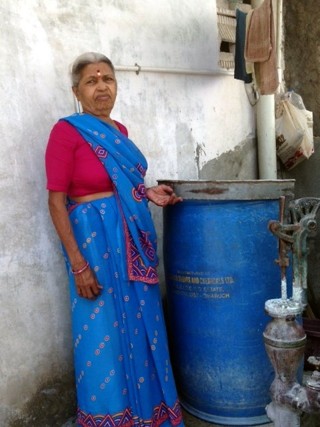
A resident of one of Surat’s poorer neighborhoods shows a health inspector that her water drum is covered, a key step in preventing malaria. (Patralekha Chatterjee)

As we enter the high rise, we take the stairs. Vyas visits about 150 homes a day; it takes too long to use the elevator, he says. In his black satchel, Vyas carries disposable syringes and a box full of rapid diagnostic kits. Anyone complaining of fever is tested on the spot for malaria and get a preliminary diagnosis within ten minutes. If they test positive, they are immediately given anti-malarial medicines. This rapid process is known as “radical treatment.” The blood samples are tested once again in the laboratory and positive cases are meticulously followed up to ensure patients stick to the treatment plan.

Malaria is not unique to Surat, of course, nor is disease surveillance. But as Vyas puts it: “Most other municipal corporations start doing door-to-door disease surveillance only when there is an outbreak. We do it round the year. There is strict monitoring.” According to the 2014 annual report of the city’s Vector Borne Diseases Control Department, inspectors tested more than 2.3 million potential breeding spots last year.

All the hard work is paying off. The block of flats we visit is in a neighborhood once infamous as a malaria hotspot. Now, Vyas says, the cases are down by almost 70 percent during the peak malaria season between June and October. Vyas' colleagues do the same work every day in the poor neighborhoods surrounding the area. Infectious diseases know no class barriers, and if malaria breaks out in one neighborhood it can easily spread to others.

Emphasis on prevention

Vyas plays one small but important role in Surat’s public health infrastructure, which is an unusually robust one for Indian cities. And it is growing.

Unlike many Indian cities, where municipal corporations or local bodies hardly play a role in health care, the Surat Municipal Corporation maintains a fairly extensive network of 41 urban health centers, two major public hospitals, and a number of maternity homes. The Corporation also runs mobile medical clinics, and established a medical college and a teaching hospital in 2000. Surat also has more than 500 private hospitals and more than 1,300 private dispensaries where people can buy medicines.

While Surat’s successes are notable, its challenges are also mounting. By one measure, Surat is the world’s fourth-fastest growing city. A rapid influx of migrants seeking work in the signature industries here—textiles and diamond polishing—is putting new strains on the health system. About 40 percent of the city’s residents live in slums. While some diseases have declined, they can easily come raging back if health authorities let down their guard.

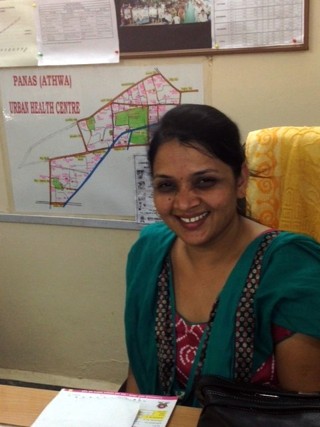
Dr. Arpita Patel, medical officer of Athwa (Panas) Urban Health Centre, says Surat is well positioned for the challenge. “We do active and passive surveillance,” Patel says. “We not only have the door-to-door teams, we also offer instant diagnosis for those who walk into this place. Teams of health workers fan out to slums and construction sites. There is a lot of word-of-mouth publicity along with posters and banners.”

Dr. Arpita Patel of Athwa (Panas) Urban Health Centre, one of 41 clinics that form a big part of Surat’s public health infrastructure. (Patralekha Chatterjee)

Patel says Surat has been successful in reinventing itself because there was political will and resources. Since Rao’s time, Surat has had a run of effective municipal leaders, an active business community and a citizenry that is proud of their city’s status as one of India’s best-managed places. Unlike most local governments in India, the Surat Municipal Corporation, or SMC, is well-staffed and not cash-strapped. Property tax collections are strong, as property owners see the benefits of paying their taxes promptly. Corporation employees are permanent, not temporary, and salaries are paid on time.

What lessons does Surat offer for urban public health policy makers at a time when the fear of pandemics is very real?

Dr. Hemant Desai, the city’s deputy commissioner for health and hospitals, says the key is being proactive about disease—not reactive, as Surat was during the plague outbreak.

“Our emphasis is on prevention.”

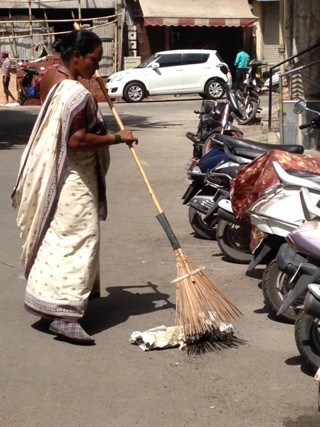
“Our emphasis is on prevention,” Desai says. “In 1994, I was a medical officer in the SMC. Then came the plague. Commissioner S.L. Rao took over in 1995 and initiated radical changes. He himself took eight to 12 rounds of the city inspecting if everything was in place. The SMC under him also mapped the filth-spots. Dust bins were installed. The solid waste management system was revamped. There was a timetable for garbage collection and municipal sweepers were each given a beat. Above all, there was supervision and stern action against those who flouted rules. Those who littered were heavily penalized.”

Surat’s prevention approach means employing a small army of people like Urmil Kumar Vyas to do the everyday work of checking on people, administering medicines and collecting data that can help health officials see outbreaks before they become evident in hospitals.

“Without manpower, nothing would have been achieved,” says Keshav Vaishnav, head of the city’s Vector Borne Diseases Control Department. “Surat has 489 surveillance workers. Once every fortnight, they visit every home in the city checking for not only malaria, but dengue, chikungunya, filariasis. Most other corporations lag in surveillance, data, human resources.”

Private-sector cooperation

According to Vaishnav, a key element to Surat’s success is close coordination with private medical practitioners, hospitals, and laboratories. In most Indian cities, private medical practitioners and institutions are very important service providers and their effective participation in the disease surveillance system is critical for good data.

“We have a good rapport with the municipal corporation,” says Dr. Jayant Shah, a local family physician. “It is a give-and-take relationship. We provide them with data. Cases of specific diseases are notified to the corporation. And in turn, the corporation also keeps us in the loop about disease trends. We have regular meetings with the Corporation’s health department. We get to know about new treatment and protocols.”

The partnership of various associations of doctors and pharmacists with the city’s health department was formally established under the Urban Malaria Project, which ran from 1997 to 2000 with support from the British Department for International Development.

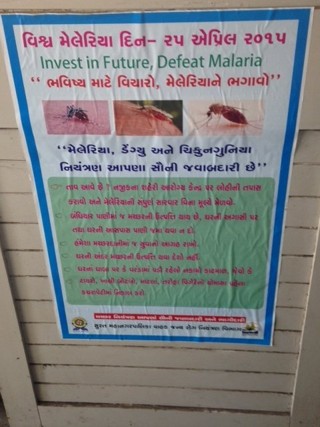
Posters warning of malaria risks are one part of Surat’s fight against disease. (Patralekha Chatterjee)

“What you really need is the coming together of a champion, state support, and a demanding public,” says G.K. Bhat, chairman of Taru Leading Edge, a consultancy. Taru Leading Edge does work on disaster reduction and response, water, sanitation and hygiene, and partnered with the Rockefeller Foundation to make Surat part of its Asian Cities Climate Change Resilience Network. Surat is also part of Rockefeller’s 100 Resilient Cities initiative. (Disclosure: Citiscope receives funding from the Rockefeller Foundation.)

“Diseases are the net effects of poor maintenance and bad urban services,” Bhat says. “In Surat, the disease surveillance system has been ramped up. Roads have been widened. The drainage system was fixed. Residents of Surat feel a sense of pride in their city. And you can see the results. Filariasis has disappeared. Malaria is down because of intense focus on mosquito breeding control. Water quality has improved because of monitoring. Even after Rao left, Surat got the best administrators as municipal commissioners.”

New institutions

Dr. Vikas Desai is old enough to remember when Surat was a small fraction of its current size and has lived through most of its modern-day health crises.

“I grew up in a Surat which had open drains,” she recalls. “In the late ‘50s, Surat got underground drainage. A small unit for filariasis control was set up within the municipal corporation. In 1985, Surat was hit by one of the worst bouts of malaria. The disease persisted in the late eighties and early nineties. Then came the plague in 1994. I was then with the public health department of the local medical college. Each night, I used to get phone calls from panic-stricken residents of the walled city. Doctors started leaving.”

Now, Desai is the Technical Director of the Urban Health and Climate Resilience Center. The center was launched in March 2013 as the latest health-related climate change project by ACCCRN—and the first of its kind in Asia. The center conducts research on how climate change is impacting health and patterns of disease—for example, dengue fever used to be a seasonal phenomenon in Surat and many other tropical cities but now is becoming less predictable. The center also plays an advocacy role with policy makers and does training and capacity-building work locally. The Center is an initiative of the Surat Climate Change Trust, an organization that brings together business leaders, policymakers and scientists, with the Surat Municipal Corporation as the main stakeholder.

Street sweepers keep Surat one of India’s cleanest cities. (Patralekha Chatterjee)

Like others, Vikas Desai pays fulsome tribute to Surat’s turnaround man, the legendary municipal commissioner Rao. The micro-planning and systems that he put in place has created the public health infrastructure we see today. How has it been sustained? “All Rao’s successors feel compelled to live up to his high standards,” she says with a big smile. “The public is more aware now.”

Paradoxically, Desai says, flooding that ravaged Surat in 2006 gave a further boost to the city’s disease surveillance system. Surat used the crisis to improve the system. “In 2013, floods struck Surat once again,” she says. “But because of the surveillance system, we knew when leptospirosis broke out in the walled city. After the 2006 floods, we started working on disease maps of vulnerable places. As a result, the death rate from leptospirosis in 2013 was half of what it was in 2006.”

Today, Surat is not resting on its laurels. Now, with the UHCRC in the city, it is taking the lead in studying the relationship between climate variability and human health in urban settings. One key focus area is heat stress. As heatwaves continue to sear India, and the death toll from the latest one crosses 2,500, it is easy to see how Surat will inform contemporary urban health debates in times to come.

I asked SMC’s Hemant Desai if one can summarize Surat’s recipe for success in just a few words. Pat comes the answer. “Political will, funds and micro-planning. That is what it took to turn the city around,” he says. “But there is no room for complacency. We have to sustain what we have achieved.”

This story originally appeared on Citiscope, an Atlantic partner site.


17 Jun 18:37

Improve Posture and Reduce Back Pain with a Quick Breathing Exercise

by Melanie Pinola

Improve Posture and Reduce Back Pain with a Quick Breathing Exercise

A researcher who studied the posture of people who experience virtually no back pain offers us a few exercises to get that pain-free life ourselves. One involves a simple breathing exercise, another asks us to clench our butts.

Esther Gokhale found that villagers in Ecuador, Portugal, and West Africa had differently shaped spines compared to Americans: J-shaped rather than S-shaped spines. She was able to eliminate her back pain—and that of her clients—by working to get the spine into that J shape.

She shares some of the exercises for better posture and less back pain on NPR. The breathing exercise is the easiest and you’ll likely notice a difference right away:

Lengthen your spine: Adding extra length to your spine is easy, Gokhale says. Being careful not to arch your back, take a deep breath in and grow tall. Then maintain that height as you exhale. Repeat: Breathe in, grow even taller and maintain that new height as you exhale. “It takes some effort, but it really strengthens your abdominal muscles,” Gokhale says.

Another strategy is to squeeze your glute muscles (or buttocks muscles, particularly the gluteus medius, which is high up on your bum) when you walk, since those muscles support your lower back. As a bonus, you might also end up with a more shapely butt.

Check out the NPR article for more tips on improving your posture and getting rid of back pain.

Lost Posture: Why Some Indigenous Cultures May Not Have Back Pain | NPR

Photo by Bigstock.

16 Jun 15:31

A Year Under The Sun: Solar Review

by Homebrew Husband

We just passed the one year anniversary of our solar power system going live. How do things look after a full year? Pretty good.

First some numbers, then let’s talk about how we got there.

When A&R Solar installed our system, they estimated it would produce 5,200 kWh of electricity per year. Based on past usage, that should have offset 39% of our consumption.


image001

When we went forward with the installation, we also set ourselves the goal of reducing our ridiculous electrical use as much as possible, hoping that we could even live entirely within what we produced.

Overall, we did okay. Over a full year, we ended up producing enough electricity to offset 74% of our consumption, about twice what was forecast.

solar_table

Some of that came from cutting our consumption and some from our system producing better than 25% more electricity than estimated.

We had a clear, warm summer in 2014 and that helped production. Some calculations with the data at the UW Department of Atmospheric Sciences show that for the twelve months I’m looking at, we got about 8% more insolation than usual.

Conservative bidding and an awesome installation job from our friends at A&R Solar also helped. One of the reasons we selected A&R was that they bid conservatively and avoided giving us pie-in-the-sky production figures (something we liked about them).

Now as for our part, I feel pretty good about a 33% reduction in our electricity consumption, yet I know we can do better. 2014-2015 was an outlier year in many ways because of the recipe testing for the book.

So, what worked? What didn’t? What did we learn and can we do better over the next year?

What worked

  • Hand-washing dishes when possible (each dishwasher load uses about 1 kWh)
  • Avoiding our electric clothes dryer when possible (each load uses about 3 kWh)
  • Opting for “quick wash” cycles doing laundry or when we did run the dishwasher (this can reduce the electricity consumed by a load anywhere from 25-50% plus often save on water.
  • Being careful about “keep warm” options on the rice cooker and coffee pot and crock pot.
  • Not doing stupid things like brewing a pot of coffee and forgetting about it until the next morning or microwaving some leftovers and never eating them.
  • Replacing our grow-lights with more energy efficient versions and being more aggressive about getting plants outside when they are ready.
  • Replacing almost all of our interior lights with LEDs.
  • Planning ahead so we can defrost goods in the fridge rather than firing up the microwave.
  • Consolidating our two deep freezes into just one.
  • Better management of our central heat (it is gas, but the fan still consumes several hundred Watts) in the morning, letting the house warm up naturally during spring and fall mornings rather even though it is a little chilly until the sun comes up.
  • In general, being more conscious of our non-critical electrical loads like computers, TVs, stereos, and turning them off when not in use.

What was hard

  • While recipe testing for the book, lots of dishwasher and dryer discipline went by the wayside. When you’re cooking twelve things in one day, you’ll take all of the mechanical support you can get!
  • Maintaining routines that make it possible to do things like line drying laundry – it just isn’t possible to do five loads to dig out of a backlog of dirty clothes without running the dryer.
  • Lights can still be a major consumer, especially in the locations we haven’t yet upgraded to LEDs. These tend to be closets and our guest room and the like – rarely used rooms but also rooms it is easy to forget you’ve left a light on in.
  • Bored kids during winter break make for a lot of movies, lights left on, batches of cookies, and pots of coffee…
  • Sometimes you’ve just got to do what you’ve got to do…firing up a 300 Watt heat lamp to help brood ducklings might be a few kWh per day, but such is the price for…well…ducklings.

Trying To Do Better

There’s still lots of room for us to home in on electrical loads we don’t need. I’ve just gotten my own Kill-A-Watt (which we’ve used before to track some power hungry demons) so we can keep zeroing in on zombie loads and hidden consumers.

We’ve gone through another round of swapping out our few remaining incandescent bulbs for LEDs as the cost of this technology keeps dropping.

We’re still sorting out some of the overall conservation/cost impact of some of our choices, too. Just how much more water and gas do we use by hand-washing dishes? It’s all well and good to cut down on electrical use, but what if doing so increases natural gas use? Energy is a complex trade-space and we’re still figuring it out.

Our very lifestyle imposes some energy demands we’re still working on. Both Erica and I work primarily from home, so it’s very unusual for the whole family to walk out the front door at 8 am and return at 6 pm. Similarly, things like grow lights, brooder lights, a deep-freeze, and a pump for the pond filter all require power. We could further reduce our electrical consumption without these things, but only at the cost of other things we value.

Tradeoffs. Always tradeoffs.

In general, almost all of this energy conservation stuff comes down to being mindful and having your routines together.

If life is a scattershot mess, then you’re going to forget that bowl of chili in the microwave, need to run the dryer at 6am because you’ve no clean work shirts, break down and run the dishwasher because the sink is piled high with dinner plates.

The latter half of 2014 was a challenge in this regard. I’ve already plead the excuse of recipe testing, and you can see how dramatically that spiked our energy use when you look at the January “lull” in the chart below. That represents time when Erica wasn’t actively testing for the book.

annotated_solar

Our goal this year is to move further towards that goal of living entirely within the electricity we produce.

Overall, going solar has been a great experience. These sunny days are helping us “pay off” the electricity we tapped off the grid over the grey months of fall and winter and soon we’ll be putting some in the bank against against this winter. If you’re in the Seattle area and are considering “going solar” we heartily recommend A&R Solar – and if you tell them you came from Northwest Edible Life, we’ve arranged for you to get a discount of up to $500 on an installed system.

09 Jun 21:41

“Thank You” in Hindi and English Mean Very Different Things

I have been living in the United States for more than a decade, and I now say thank you about 50 times a day. Most of the time, I do it without thinking. I say thank you to the bus driver who takes me from point A to point B along with 20 other people. He usually can’t even hear me. I say thank you to the cashier at the coffee shop. I say thank you to the stranger who holds the door open for me at a restaurant. I say thank you to my wife and my 5-year-old daughter several times a day for various things: turning the volume of the television down or up, flicking the light switch on or off, asking me if I want to eat something or do something with them.

When I first moved to the United States, all this took some getting used to. I didn’t know I was supposed to thank someone who took my money for something I bought at a store. I didn’t know I was supposed to thank people when they asked how I was doing (and almost everyone who walks by me says “Hyadoin” to me). I had no idea how I was supposed to respond to the police officer who gave me a speeding ticket and then said, “Thanks, and have a good day.”


Related Story

Why Americans Call Soccer 'Soccer'


I grew up in the northern Indian city of Lucknow, in a culture in which saying thank you is not done lightly. I learned to say thank you in English in elementary school, and when I thanked anyone, I said it in English, which was less awkward and more casual than doing so in Hindi. I reserved my thanks for those who had done huge favors for me. And I rarely thanked my friends or classmates. When I did, they either smiled quizzically at me or interpreted the act as a kind of joke—a playful way to practice English. I’ve never thanked my parents for anything. In the Hindi language, in everyday gestures and culture, there is an unspoken understanding of gratitude.

Saying dhanyavaad, or “thank you” in Hindi, would almost be sarcastic. It seems inadequate. When I thank anyone in Hindi, I make sure to look the person in the eye. Saying dhanyavaad to someone without looking at him or her is just as good as not saying it at all. As a kid, I never heard anyone my age say thank you in Hindi. I did hear my father say dhanyavaad to people his age, but he did it as sincerely as possible, with his hands joined in front of his chest in the solemn gesture of namaste. He wasn’t just thanking someone for something, but asking for an opportunity to return the favor. That’s how I came to understand expressions of gratitude.

In America, by contrast, saying thank you often marks an end to the transaction, an end to the conversation, an end to the interaction. It is like a period at the end of a sentence. Only in the United States have people offered thanks for coming to their homes or parties. Initially I was surprised when people thanked me for visiting their house when they were the ones who’d invited me, but then I learned that, “Thank you for coming to my home” actually meant, “It’s time for you to get out of my house.”

Saying thank you in Hindi is more like joining a cycle of exchange, creating the possibility of a new relationship.

After moving to America, it took me several years to say thanks to people without actually meaning it. Putting “thank you” on the tip of my tongue, ready to escape at a moment’s notice, rather than extracting it from the depths of my heart, was one of the hardest language lessons I had to learn in the United States.

Now, when I travel to India, I often offend people by saying thank you to them. On a recent trip home, I was invited to my uncle’s house for dinner. He’s been a father figure to me, teaching me many things and advising me at every step of my life. As a kid, I spent more time at his home, and ate more lunches there, than at my parents’ place. That day, I made the mistake of telling him, in English, “Thank you for inviting me” before leaving his house, realizing the import of my words only after they had left my mouth. He didn’t respond, but I saw his expression turn sour. He was filled with disgust. I couldn’t even apologize for thanking him. The damage was done.

In India, people—especially when they are your elders, relatives, or close friends—tend to feel that by thanking them, you’re violating your intimacy with them and creating formality and distance that shouldn’t exist. They may think that you’re closing off the possibility of relying on each other in the future. Saying dhanyavaad to strangers helps initiate a cycle of exchange and familiarity. But with family and friends, dhanyavaad can instead chill relations because you are already intimate and in a cycle of exchange. And few things can be more painful than ending a relationship.

Thank you for reading this essay. Let me assure you that I really mean it, but also that I mean no offense. Dhanyavaad.

03 Jun 04:51

Five Big New Hires at the UW Art School

by Jen Graves

Michael Swaine mends things. Hes the new Akio Takamori at UW.
Michael Swaine mends things. He's the new Akio Takamori at UW.

The students who begin art school at the University of Washington next year will find themselves in a changed program. Today, UW announced five new faculty hires, in photomedia, sculpture (called "3D4M"), art history, industrial design, and human-computer interaction design. At least three of the positions replace longtime professors whose presences shaped what it meant to get an education in art at UW: Akio Takamori, Paul Berger, and Pat Failing.

And the incomers are:

Adair Rounthwaite, an art historian most recently at McGill University in Montreal, who specializes in contemporary participatory, performance, and feminist art;

Michael Swaine, a ceramicist most recently at California College of the Arts in San Francisco, who recently attracted the attention of CBS for his mending project in the Tenderloin.
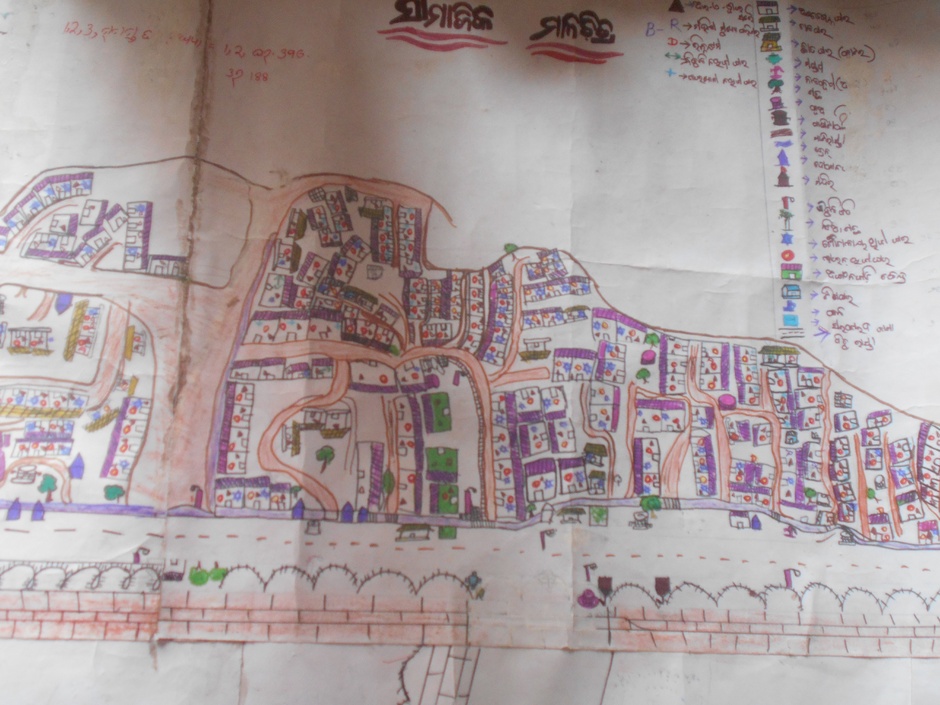
•The elusive and yet somehow theatrical Aaron Flint Jamison (and here), Portland-based artist and founder of Yale Union who takes the photo media position.

Jason Germany, an industrial designer from the University of Oregon.

Justin Hamacher, who, before this, worked in Silicon Valley for a design company that helped start-ups and Fortune 100 companies by "championing users and advocating for sensible aesthetics and ease of use in the technological space" (he also plays in a self-described post-punk/punk band called Biography of Ferns).

That was a mouthful. I'm working on getting to know more about these new profs and their intentions in the coming days, if they'll agree to interviews with me. Here's hoping.

From Aaron Flint Jamisons installation at Open Satellite in 2011. Jamison is the new Paul Berger.
From Aaron Flint Jamison's installation at Open Satellite in 2011. Jamison is the new Paul Berger.

[ Comment on this story ]

[ Subscribe to the comments on this story ]

28 May 22:17

Berkeley rental rates skyrocket, causing headaches for students and those on middle incomes

by Gill South
An apartment for rent on Spruce Street. Photo by Melati Citrawireja

An apartment for rent on Spruce Street. Photo by Melati Citrawireja

This is the second in a Berkeleyside series on housing. Read our first story on short term rentals.

The heated economy has pushed Berkeley rental rates significantly higher this past year, a jump of anywhere from 10% to 30.9%, depending on which study you look at, forcing some students to double and triple up in mini-dorm-like situations, and middle-class workers to stretch to meet their rents.

At the same time, technology workers and those in finance or other well-paying professions are snapping up luxury apartments that can cost from $2,500 a month for a studio to $5,400 for a three-bedroom, two-bath pad.

“The problem is that we are an extremely desirable community,” said Mayor Tom Bates. “With high rents in San Francisco a lot of people choose to be here. As a consequence we have huge demand.”(...)

Read the rest of Berkeley rental rates skyrocket, causing headaches for students and those on middle incomes (2,071 words)


By Gill South. | Permalink | 94 comments |
Post tags: Bay Area real estate, Berkeley Central, Berkeley Housing Element, Berkeley real estate, Berkeley Rent Stabilization Board, Berkeley rental market, Berkeley rentals, Cal Rentals, Colisha Church, Elaine Perkins, Greystar, Hillside Village Apartments, Library Gardens Apartments, Nick Traylor, Telegraph Commons Apartments, The Varsity, Zillow Rent Index

22 May 21:44

Police Reports Illustrated: "Crimestoppers" Start Crime

by Callan Berry

PRI_5_17_15_pt1.jpg

PRI_5_17_15_pt2.jpg

PRI-5-17-15-pt3.gif

PRI-5-17-15-pt4.gif

PRI_5_17_15_pt5.jpg

(Here's a link to the Q13 article.)

[ Comment on this story ]

[ Subscribe to the comments on this story ]

02 Mar 17:40

Better Headphones On Sale, Build a New PC, and More Deals

by Shep McAllister, Commerce Team

We've got a pair of great headphone deals for you today. First up, the AKG Bluetooth On-Ears were a Wirecutter alternate pick, and have solid user reviews on Amazon. They normally sell for around $300. [AKG K 845BT Bluetooth Wireless On-Ear Headphones, $250]

Read more...


20 Feb 10:14

Kids in India Are Sparking Urban Planning Changes by Mapping Slums

by Sam Sturgis
Image Courtesy of Humara Bachpan
Hand-drawn maps such as this are winding up on the desks of urban planners across India. (Courtesy of Humara Bachpan)

Every kid likes to draw. But in India, young people living in slums are using their sketching skills to spur urban change.

As part of a broader civic campaign centered on "child clubs," groups of children are creating detailed "social maps" of their marginalized neighborhoods to voice their concerns about public space, as first reported in Citiscope, a CityLab partner site.

Since 2011, UNICEF has been encouraging kids to use mobile technology and open data to map environmental and health issues near their homes. But that technology isn't available to everyone. Instead, much of the child-led mapping campaign sweeping India today relies on old-school topography materials—paper and a rainbow-spectrum of markers.

Teams of young mappers and adult facilitators spend roughly 45 days traversing their slums. They learn the shape of their neighborhood, how streets interconnect (or don't), and the the density of homes there. This information becomes the map's skeleton. Then, they fill in the specifics. They stake out what's needed through the eyes of children—where underserved public areas could become play spaces, where trash bins could be added in an area they regularly see littered with filth. Their ideal neighborhood is drawn and detailed onto the map. Then, after it's complete, leaders from the child clubs present their work to local officials.

Young mapmakers sketch out the changes they would like to see in their communities. (Courtesy of Humara Bachpan)
(Courtesy of Humara Bachpan)

"What they make is their dream aspirational map," Aishwarya Das Pattnaik, a staff member of Humara Bachpan, the organization leading the campaign, says.

Humara Bachpan has been advocating for child-led development since 2012. It has organized mapping campaigns in a handful of major urban centers, including Mumbai, Delhi, and Hyderabad. (According to Citiscope, approximately 325 child clubs have been established across the country, with plans to expand.) The initiative mixes activism with adolescent fun; new friendships are made, hands are covered in ink, and leadership and planning skills are nurtured. But this is also serious work, as the long-term health of India's slums may depend on these maps. As Das Pattnaik notes, children can pinpoint community needs that go unnoticed by adults.

She cites the example of public sanitation infrastructure, which is a glaring concern for the 65 million urbanites—that's about eight times the population of New York City—that live in slums across India. To combat sanitation woes, the scale of public toilets needs to dramatically grow. But if the bottoms of young slum dwellers don't fit on the new toilet seats, the improvement to public health is marginal. "A child could easily fall into the toilet," Das Pattnaik told me. On many of the child maps, therefore, dots appear indicating where child-specific public toilets should go.

(Courtesy of Humara Bachpan)

The value of child-led mapping, however, is not restricted to dreaming of a modern cricket pitch or other public utilities (although that's evidently important). Generally speaking, people living in slums operate on the peripheries of Indian society—geographically and socio-economically. Exclusion is magnified even further when you're a child.

Urban planning in India operates as a de-facto gerontocracy, I was told by Dharitri Patnaik, India representative of the Bernard van Leer Foundation, which funds child-development programs. "Most of the time children are never considered as citizens. They're considered as future citizens," Patnaik explains. By coming to the table with a surrogate development proposal—the map—children demonstrate analytical capabilities. In turn, government officials have to take them more seriously.

Yet, no one likes being told how to do their job, especially by children. Won't urban-planning officials go on the defensive if their work is so candidly indicted, with colored markers no less?

(Courtesy of Humara Bachpan)

But those involved contend that the government has been duly responsive to the children's maps. Preeti Prada, Humara Bachpan's national campaign coordinator, told me by email about a young mapmaker in the city of Bhubaneswar. Children in one neighborhood felt unsafe going to "tuition classes"—nighttime schooling popular in India—because the route was dimly lit. A 12-year-old girl responded by drawing a map of the area and, ultimately, earned an audience with the local ward representative to present it. According to Prada, the ward official is actively working to make the area safer by improving light utilities.

At times, India's urban future is depicted through an apocalyptic lens. Already, 25 percent of all urbanites in India live in close quarters in slums, according to a 2011 government report. And by 2028, India is expected to overtake China as the world's most populous country—likely meaning more impoverished settlements. But only broad predications can be drawn from such data. Human activism, on the other hand, is a better indication of reality. Regardless of whether these child maps lead to more equitable urban development or not, it's indicative of a young Indian generation coming to the fore with a keen awareness of disparity—who are eager to correct it.


24 Jan 16:30

Rooftop Solar Increases a Home's Selling Price Across Multiple Markets

On Monday, the U.S. Department of Energy's Lawrence Berkeley National Laboratory released a report showing that homes with solar panels typically sell for $15,000 greater than those without solar...

-- Read more on ScientificAmerican.com
22 Dec 20:46

What 2,000 Calories Looks Like

Even as restaurants talk about smaller portions, they continue to serve a full day's worth of calories in a single meal — or even a single dish.


08 Oct 04:42

Marriage

People often say that same-sex marriage now is like interracial marriage in the 60s. But in terms of public opinion, same-sex marriage now is like interracial marriage in the 90s, when it had already been legal nationwide for 30 years.
07 Oct 20:51

Slow Steaming and the Supposed Limits to Growth

by By Paul Krugman
Energy is just another input.
06 Oct 22:38

Dutch Designers Just Made Your Market Look Sorry

by Kriston Capps

Last week, Queen Máxima of the Netherlands opened the Markthal Rotterdam, the nation's first covered market hall. It's an achievement by the brainy Dutch design firm MVRDV, a signature building that the press has already taken to calling the Horseshoe. It's a big architectural achievement—but it's also in part a product of Dutch law.

Markthal Rotterdam is a combined market hall and housing project. The development comprises 228 apartment units and 100 market stalls, in addition to a supermarket, retail space, and parking. A vast mural along the market's ceiling (by Dutch artists Arno Coenen and Iris Roskam) transforms the building's cavity into a welcoming public space.

(MVRDV)

Yet for all its whimsy, the Markthal project conforms to some of the strictest building-design laws in all of Europe. Navigating restraints regarding sanitation and daylighting, MVRDV answered with a seemingly effortless design translation of these regulations.

"New laws in the Netherlands require covered areas for traditional open air meat and fish markets due to new hygienic constraints," reads the firm's website. In other words, traditional open-air food markets aren't really allowed by law in the Netherlands.

(MVRDV)

Strictly speaking, this market space isn't open at all: On each end of the cavernous hall is a single-skin glazed cable net façade. Think of it as a tennis racket strung with energy-efficient glass panels. The transparent walls are designed to withstand heavy storms, making a year-round market possible; and according to MVRDV, the façade system is the largest of its kind in Europe.

The open-air market design in turn informed the shape of the apartments. As in all EU nations, constructions in the Netherlands comports to certain standards set forth by the Energy Performance of Buildings Directive. But Dutch law goes further, specifying the amount of daylight that certain rooms and buildings should receive.

(MVRDV)

To meet the requirements—and to neatly tie the residential program of the building to the market—the kitchens and dining rooms of all the apartments face inward into the market hall. Those spaces don't specifically require daylight under Dutch law. The rooms that do are located on the outside of the building.

(MVRDV)

The Markthal is one of a number of new projects that has been cast as an effort to turn Rotterdam into—in the words of the Office of Metropolitan Architecture—the first Dutch city to "go Asiatic." De Rotterdam is another example: OMA's own "vertical city" on the harbor turns its back on the past, embracing a denser and more urban vision for the city.

(MVRDV)

The forward-looking design for the Markthal is as much a product of Dutch regulation as it is an accomplishment of Dutch design. Not everyone will share Queen Máxima's enthusiasm for the fast, aggressive, and unsentimental scope of new architecture in Rotterdam. But a triumph over rigid regulation—even the kind meant to make life and living better in the city—is something everybody can appreciate.

(MVRDV)


30 Sep 18:50

Make Your Own Instant Noodle Cups for Healthier, Tastier Lunches

by Melanie Pinola

Make Your Own Instant Noodle Cups for Healthier, Tastier Lunches

Do you love cup of soup and instant ramen as much as we do ? Then good news: Here's a DIY way to get your noodles fix while also upgrading it to be more delicious and packed with fresh ingredients.

Read more...


26 Sep 19:42

Margaret Harris released from Harborview

Margaret Harris — who was in a car crash last month that killed her 68-year-old husband Steven Harris and 16-year-old Taylor Griffith — has been released from the intensive care unit at Harborview Medical Center in Seattle.
03 Sep 23:46

What would our homes look like if designed around how we use them?

by David Friedlander
UCLA group tracks family movements and finds we don't use the space we have.
03 Sep 23:45

The sharing economy comes home in Cohousing

by Lloyd Alter
Copper Lane, a cohousing project in London, shows how design by committee doesn't have to look like a camel.
31 Aug 16:24

Retiring: Increasingly, Retirees Dump Their Possessions and Hit the Road

by By DAVID WALLIS
More retired Americans are getting rid of their homes and traveling, with 360,000 of them receiving Social Security benefits at foreign addresses.


29 Aug 05:09

Some residents concerned about 166th Ave. project

The City of Redmond’s construction project on 166th Avenue Northeast has some residents concerned about whether the changes will actually improve things along the road.
27 Aug 17:46

Dog missing after crash that killed former Redmond chief

by Jennifer Sullivan