Article URL: https://nation.maps.arcgis.com/apps/Cascade/index.html?appid=de7f932e3a1d494f9c9d9a67fb0de646
Comments URL: https://news.ycombinator.com/item?id=15203446
Points: 609
# Comments: 326
Article URL: https://nation.maps.arcgis.com/apps/Cascade/index.html?appid=de7f932e3a1d494f9c9d9a67fb0de646
Comments URL: https://news.ycombinator.com/item?id=15203446
Points: 609
# Comments: 326
Fun set of rules: click for interactive graphic Source: Your Logical Fallacy Is
The post Your Logical Fallacy Is… appeared first on The Big Picture.

Daniel Kammen, UC Berkeley professor of Energy and Director of the Renewable and Appropriate Energy Lab, has publicly resigned his role as State Department science envoy. The U.S. Science Envoy Program, an outreach initiative started by the Obama administration, sends top scientists abroad to promote the country’s commitment to science and technology as tools for diplomacy; envoys typically serve for one year. Ever the overachiever (Go Bears!), Kammen embelished his resignation letter on Wednesday with an acrostic message. See if you can spot it in his letter below.
Mr. President, I am resigning as Science Envoy. Your response to Charlottesville enables racism, sexism, & harms our country and planet. pic.twitter.com/eWzDc5Yw6t
— Daniel M Kammen (@dan_kammen)August 23, 2017
This isn’t the first time Professor Kammen has been critical of the administration. In June, Kammen, who is said to be in discussions with Jerry Brown about starting a climate change research institute, talked to CALIFORNIA about the administration’s resistance to climate action.
“He’s been steadily chipping away [at greenhouse gas emission standards], so walking away from Paris doesn’t mean much in terms of impacts,” Kammen says. “In any case, the signatories aren’t going to meet their targets [keeping global temperature rises to “well below” two degrees Celsius above pre-Industrial Revolution numbers, with a goal of no more than 1.5 degrees Celsius]. What withdrawal does establish is that the U.S. is no longer a major player in climate change response and policy, and that will affect where the investments go. China has just invested [more than] $300 billion in clean energy. Ultimately, that’s going to translate to about a trillion dollars in lost job opportunities for the United States.”
R.P. Adityayes, a public good should be free and financed by those who pollute more per capita and make public space no longer non-rival (ie. car on a road)

Interesting: click for complete graphic Source: Bloomberg
The post Lyft’s Experiment with Charging for Free Parking appeared first on The Big Picture.
 Seattle architect Mike Eliason describes what he learned about their housing policies.
Small but passionate, the cohousing movement in the United States is growing.
With 163 communities located around the country and many others in development, the Danish import that arrived here a quarter century ago is gaining ground. The concept is a powerful tool for community building: residents have private homes but share common spaces where they can socialize and eat together, and they manage the complex jointly, often making decisions by consensus. It provides a clear framework for bridging different viewpoints and lifestyles, and the proximity of homes and cozy vibe encourage people to lean on one another.
That structure would seem to make cohousing an ideal vehicle for bringing together diverse groups of people—something that’s sorely needed in today’s extremely polarized environment. After all, what better way for people to get truly comfortable with one another than by living in very close proximity?
Except it hasn’t worked out that way. Despite its potential, the cohousing movement is overwhelmingly un-diverse: 95 percent of cohousers are white, 82 percent identify as Democrats, and 66 percent hold a graduate degree, according to a 2011 study conducted by Angela Sanguinetti, a researcher at the University of California, Davis.
“The joke around cohousing is, ‘[Yeah,] we have diversity in our neighborhood—we have Subarus that are three different colors,’” says Alan O’Hashi, a Boulder, Colorado, cohousing resident who leads cultural competency workshops.
A big reason for the homogeneity is, unsurprisingly, money. Most cohousing groups start from scratch, first finding other like-minded individuals and then locating land, designing the community, and identifying a builder—and putting up funds all along the way. That can make it a surprisingly expensive endeavor, with end products that can cost $500,000 per unit. “You really have to have a lot of money to develop anything,” says Alice Alexander, who recently stepped down as executive director of the Cohousing Association.
Part of the answer, then, to the quandary of how to make cohousing more diverse is to find a way to make it cheaper.
Architect Charles Durrett, the father of the American cohousing movement—he and his wife Kathryn McCamant brought the concept here after discovering it in Denmark—says cohousing doesn’t have to be expensive; he describes developments in the Bay Area and Napa Valley that were inexpensive to build. “We design from the back end, depending what you can afford,” says Durrett. “When there’s not a lot of resources, we have to be super creative.”
But he and his wife are extremely experienced in finding ways to save money. Architects and developers who are less familiar with the cohousing model instead frequently align with public or private institutions to reduce prices.
The organization Partnerships for Affordable Cohousing is focused on facilitating those alliances, and a handful of groups have had some success. Petaluma Avenue Homes in Sebastapol, California, was an early pioneer, using low income housing tax credits and city and county funding to create 45 affordable rental units based on a cohousing model. Sawyer Hill Ecovillage took advantage of a Massachusetts law that lets developers override zoning laws in areas with less than 10 percent affordable housing; the increased density allowed them to save money and subsequently price a quarter of their units at reduced levels. And Prairie Hill, a cohousing development under construction in Iowa City, has cobbled together tax credit funding, a grant from a nonprofit organization, and a private gift to provide 15 small units for under $200,000 and offer down payment assistance for a few buyers.
Those are all good ways to lower the cost, says David Berto, a housing consultant in Enfield, Connecticut. But because housing officials are still largely unaware of cohousing, talking to them directly could also bear fruit for cohousing communities. “I can tell you that towns like the concept of cohousing once they understand it,” says Berto. “My experience is that when they understand it, they really are in a position to help figure it out.”
It turns out, though, that reducing the price of cohousing is only part of the battle to diversify it. That’s what the folks behind Rocky Corner in Bethany, Connecticut, found. Determined to make their soon-to-be constructed community accessible to a wide range of people, the group was able to designate a third of its units affordable, with prices as low as $170,000 for a three-bedroom house, thanks to increased density and a grant from the state Department of Housing.
But that hasn’t been enough to attract a genuinely mixed crowd, says Dick Margulis, a Rocky Corner member. “We’ve done lots of outreach in all kinds of venues. But the people who end up saying, ‘Yeah, I want to buy a house,’ tend to be less diverse than any of us would like.” Margulis suspects that some non-white, lower-income people might already have a strong sense of community in their lives from extended family or religious institutions and therefore don’t need to create it.
In fact, Robert Boyer, a professor at the University of North Carolina at Charlotte, has done research (not yet published) showing that cohousing appeals to a wide range of demographic groups. But actually bringing them in is another issue. That might be due in part to the level of risk around investing in a cohousing community, a process that typically takes years without a guaranteed payoff. Or it might be about individuals’ ability to focus on buying a home, rather than finding a job or helping relatives.
And there may be a question of familiarity. Crystal Farmer, an organizer of the Charlotte Cohousing Community, says that when her group brainstormed about priorities, they listed safety, good schools, and proximity to stores, which in Charlotte generally means majority-white areas. “Maybe not everyone’s comfortable in white neighborhoods,” says Farmer, who is black.
It’s also possible that while cohousing groups think they’re open and welcoming, the message they convey in person and on their website says something different. “People want diversity, but they want Obama as their neighbor: they want diversity that’s more like them,” says O’Hashi, the cultural competency trainer in Boulder. That is, the residents of cohousing communities may not be prepared for the very real cultural differences that can lie between people of different income levels or ethnicities.
In response, O’Hashi—who is Japanese-American and says he’s the only non-white person in his cohousing community—recommends that cohousers examine their preconceptions and reactions toward otherness. Maybe a cohousing group won’t succeed in bringing in a wider range of people immediately, but it’s a starting point.
The United States has deeper social divides than Denmark that must be taken into account if cohousing is to appeal to a broad swath of the population. The potential to powerfully bring people together is still there.
Article URL: http://ncase.me/trust/
Comments URL: https://news.ycombinator.com/item?id=14864183
Points: 393
# Comments: 72


Typography matters, and not just for design nerds.
Besides providing a drastically different aesthetic experience from website to website, it can also help readers identify the brands they trust, and the news they can rely on. But in an online world overwhelmingly dominated by the English language, India’s many regional languages make up a miniscule part of the available content. So, their scripts rarely receive the kind of attention that the English script does.
Since 2013, though, a Mumbai-based typography collective has been working to change this, crafting modern typefaces for Indic scripts, be it Gujarati, Gurmukhi, Tamil, or Telugu.
Ek Type, a team of 15 calligraphers, researchers, and academics, was founded by type designers Girish Dalvi, Noopur Datye, and Sarang Kulkarni. While Dalvi studied at the Indian Institute of Technology Bombay, Datye and Kulkarni are alumni of the Sir J J Institute of Applied Art, Mumbai. So far, the collective has created six free, Unicode-compliant, and open source fonts that are available for anyone in the world to download via Google. These include everything from playful bubble letters to rounded styles. And true to the company’s name (ek means “one” in many Indian languages), each font is designed to work in different Indic scripts.
“At Ek Type we try to design multiple scripts at the same time, with multiple designers working simultaneously on separate scripts,” Kulkarni told Quartz. “This ensures that each script maintains its individuality, while being part of a larger family.”
The Baloo font, for instance, is available in 10 Indic scripts, including Malayalam, Kannada, and Odia, as well as a Latin script. It’s been used in over 5,000 websites around the world, according to Google Fonts. Meanwhile, Ek Type’s Mukta Devanagari and Latin font is used on communications from the prime minister’s office, and has been featured on some 45,000 websites.
Ek Type also designs custom fonts and logos, often used in the offline regional branding campaigns of companies such as Coca-Cola, Vodafone, and Flipkart. Some of their fonts are used by regional-language newspapers and television channels, too. But in each and every iteration, there’s one focus: the fonts have to accurately represent the visual grammar of different Indic scripts, which is something the designers at Ek Type believe non-native speakers can miss out on.
“…each script has a structure, texture, rhythm, and peculiarities that form the visual grammar that is unique to that script,” Kulkarni explained. “…many countries are looking at Indian fonts, and what we personally see is that they are not doing justice to the script grammar. They’re very good in terms of design or technology but when it comes to authenticity of (the) Indian script, that is lacking,” he added.
Over the years, Ek Type has been trying to raise awareness about Indian typography among local students and design enthusiasts, holding talks and workshops, besides publishing calligraphy manuals, through its non-profit organisation Aksharaya. This was also the motivation behind making most of their fonts available to anyone.
“The reason we open-sourced our fonts was that when we started off, it wasn’t available readily for us. We had to do a lot of trial and error,” co-founder Noopur Datye explained. Now, emerging designers have a resource to develop Indic typefaces of their own, she said.
Ek Type isn’t the only company in the field, though. One pioneer, Ahmedabad-based Indian Type Foundry, has been at it since 2009. Founded by National Institute of Design alumnus Satya Rajpurohit, the company has created over 200 retail and custom fonts that have been bought by big brands such as Apple and Samsung, among others.
But with the market poised to explode, it’s certainly a case of the more, the merrier.

I have a soft spot for interesting biological security measures, especially by plants. I've used them as examples in several of my books. Here's a new one: when tomato plants are attacked by caterpillars, they release a chemical that turns the caterpillars on each other:
It's common for caterpillars to eat each other when they're stressed out by the lack of food. (We've all been there.) But why would they start eating each other when the plant food is right in front of them? Answer: because of devious behavior control by plants.
When plants are attacked (read: eaten) they make themselves more toxic by activating a chemical called methyl jasmonate. Scientists sprayed tomato plants with methyl jasmonate to kick off these responses, then unleashed caterpillars on them.
Compared to an untreated plant, a high-dose plant had five times as much plant left behind because the caterpillars were turning on each other instead. The caterpillars on a treated tomato plant ate twice as many other caterpillars than the ones on a control plant.
Article URL: http://www.bbc.co.uk/programmes/articles/5LCB3rN2dWLqsmGMy5KYtBf/puzzle-for-today
Comments URL: https://news.ycombinator.com/item?id=14709590
Points: 380
# Comments: 83
Article URL: https://www.socialcooling.com/
Comments URL: https://news.ycombinator.com/item?id=14585882
Points: 383
# Comments: 185
 Built as an extension for a local high school, this new urban space blends into its tree-lined surroundings.
Article URL: https://hackernoon.com/for-inclusive-culture-maybe-less-is-more-87b663662cea
Comments URL: https://news.ycombinator.com/item?id=14538074
Points: 325
# Comments: 263
Minnesota is the latest state to be hit by a measles outbreak originating from children whose parents chose not to vaccinate them. The state has tracked 76 cases so far, and it could be on its way to the front lines of the fight for mandatory vaccination.
Lawmakers who want to implement stricter vaccination rules could look to California, where a 2014 measles outbreak at Disneyland inspired a bill barring parents who don’t vaccinate their children for religious or ideological reasons from sending those children to public school. The measure faced significant opposition from anti-vaccination activists, but its sponsor attributed its success to two powerful allies: a compelling mathematical model and vocal support from pro-vaccine parents. The bill went into effect last summer, and vaccination rates have since rebounded.46

Measles is a highly contagious and potentially deadly viral infection. Although the MMR vaccine that prevents it is quite effective, some children — including those with pre-existing health conditions, like cancer or compromised immune systems, and those who are younger than 6 months old — cannot receive it. These vulnerable populations rely on herd immunity to protect them. When vaccination levels reach a critical threshold — 83 percent to 94 percent for measles — the high concentration of immune people squelches the spread of the disease, preventing it from reaching large numbers of unprotected people.
The trouble with getting vaccination rates to this critical threshold is that people lack scientific understanding, said University of Bristol professor Stephan Lewandowsky, who studies how prior beliefs influence the acceptance of scientific facts. The concepts of herd immunity and exponential growth are difficult for most people to grasp, Lewandowsky said. What people don’t intuit on their own is that an average person with the measles is likely to infect 12 to 18 others in an unvaccinated population, meaning that the number of measles cases increases more than tenfold with each fresh round of infection, so what starts as an isolated case can rapidly become a full-blown epidemic. Normally, herd immunity puts up roadblocks that keep each new case from being converted into others — if most people are immune, the disease fizzles out before encountering new potential hosts — but with something as contagious as measles, it doesn’t take many parents opting out of immunization before this critical protection mechanism becomes ineffective.
“If you don’t know how high the level of coverage has to be in order to get herd immunity, then people might legitimately think, ‘Ah, well, we throw in a few exceptions to keep the religious people quiet,’” Lewandowsky said. “If it were seatbelts or something then it might not be a bad idea, but vaccination is special because of the need to have this incredibly high coverage to get herd immunity.”
When making the case for mandatory vaccination, simply presenting people with the facts may not convince them and could even backfire, Lewandowksy said. People tend to dig in deeper when presented with information that contradicts their worldview. To reverse people’s beliefs, it’s more helpful to provide an explanatory model, he said.
That method helped in California. Pediatrician and state Sen. Richard Pan introduced Senate Bill 277 in 2015 and went looking for a way to explain the importance of mandatory vaccination. He stumbled across a model that depicts how an epidemic unfolds when herd immunity is lost. The model, a graphical outbreak simulator called FRED (Framework for Reconstructing Epidemiological Dynamics) Measles, was developed at the University of Pittsburgh’s Public Health Dynamics Laboratory, which is directed by Mark Roberts.
FRED Measles demonstrates that if 20 percent of schoolchildren aren’t vaccinated, a single isolated case of measles can rapidly erupt into an epidemic. The FRED platform allowed researchers to build a simulation of human interaction dynamics, Roberts said, wherein virtual people in 116 million households across the country live, work and socialize according to data synthesized from the U.S. Census.
The FRED Measles model can be used to visualize infectious disease dynamics in any county,47 so Pan could show his fellow senators exactly how an outbreak would play out in their own backyards.
“There was something about showing a movie of your hometown that people relate to,” said Don Burke, dean of the school of public health at the University of Pittsburgh. It was his idea to break the model down by county.
Lewandowsky said that making the simulation relevant to where you live taps into a well-established principle of cognitive psychology called “construal theory.” When a problem feels local, Lewandowsky said, people are more likely to be proactive.
When former California state Sen. Marty Block first laid eyes on the bill, he said, he was concerned that making vaccination a prerequisite for attending public school would limit access to education. After watching a simulated outbreak unfold among his constituency, however, Block said his sense of duty to protect public health overwhelmed his other concerns.
“If people decide to put themselves in harm’s way as a knowing decision, it bothers me still, but that may be their right,” Block said. “When I saw the simulation, it was clear that they were putting others in harm’s way. That’s when it became to me a very important thing for the government to legislate.”
Opponents of California’s bill also predicted that if it became law, vaccination rates would remain the same while school enrollment would drop. But the opposite turned out to be true, Pan said. After the law went into effect in 2016, vaccination rates hit an all-time high — and school enrollment increased, according to the California Department of Public Health.
“Most parents are on the fence,” Pan said. “It’s not because they don’t believe in vaccines; they’re nervous about them. And so what happened is that the law pushed them off the fence, and they got their kids immunized.”
The legislation appears to have changed behavior, and Lewandowsky said attitudes will likely follow suit. When a new law requires people to change the way they act, they tend to vociferously decry the change at first, but opposition often evaporates as years pass and the new behavior becomes the status quo. Lewandowsky said that attitudes toward bans on indoor smoking had followed this pattern, for example.
But could the model convince lawmakers in other states? It’s hard to say. Most states still allow parents to exempt their children from vaccination for religious reasons, and more than a dozen of those — including Minnesota — also allow philosophical exemptions. Last year, Roberts reached out to 20 or 30 legislators in states trying to tighten vaccine exemption laws. He explained how FRED Measles could help proponents of these bills to make their case and even offered to travel to the legislators’ states to present the model in person. To his surprise, he didn’t gin up much interest.
Pan said the onus for changing vaccination laws cannot be on legislators alone — grassroots organization among pro-vaccine parents is also essential. While 88 percent of U.S. adults believe that the benefits of vaccination outweigh the risks, they are generally not passionately outspoken about the belief, Pan said.
FRED Measles could be useful to parent-led movements too — its original intent was to target the public, Burke said. To that end, he and his colleagues made the simulation available online and aimed to make it user-friendly and even smartphone compatible. Burke’s colleagues sent the link to Twitter-famous figures in hopes of reaching the widest possible audience.
But Lewandowsky thinks the problem with public engagement on health policy is not that people don’t have access to information, but that 99 percent of people aren’t paying attention.
“Data is certainly very important, but data by itself can’t carry the day,” Pan said. “What carries the day is parents being mobilized and activated. That’s how we were successful in California.”
CORRECTION (June 16, 2 p.m.): An earlier version of this article incorrectly said that 88 percent of U.S. parents think the benefits of vaccines outweigh the risk — it is 88 percent of all U.S. adults.
CORRECTION (June 21, 11:45 a.m.): A previous version of this article misstated the role Mark Roberts played in developing FRED Measles. He directed the lab, not the project.


Article URL: https://blogs.msdn.microsoft.com/bharry/2017/05/24/the-largest-git-repo-on-the-planet/
Comments URL: https://news.ycombinator.com/item?id=14411126
Points: 1037
# Comments: 387
Article URL: http://www.bbc.com/travel/story/20170511-the-indian-village-addicted-to-chess
Comments URL: https://news.ycombinator.com/item?id=14363772
Points: 305
# Comments: 144
Fifty years after the U.S. Supreme Court struck down laws against interracial marriage, interracial couples are more common than ever before—especially in cities.
That’s a finding from a new report from the Pew Research Center looking at the state of interracial marriage today. Overall, there has been a dramatic increase in interracial marriage. In 2015, 10 percent of all married Americans were married to someone of a different race or ethnicity. That’s up from just 3 percent in 1980. Seventeen percent of all weddings performed in 2015 were interracial, up from 7 percent in 1980.
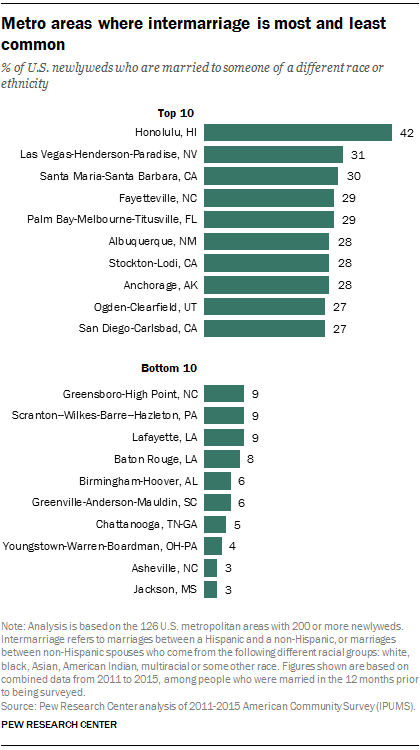
In cities, those figures are even higher. In 2015, 18 percent of new marriages in metropolitan areas were interracial, compared with 11 percent of newlyweds outside of metropolitan areas. The rates were highest in Honolulu (42 percent), Las Vegas (31 percent), and Santa Barbara (30 percent). Intermarriage is rarest in metro areas in southern states (Alabama, Louisiana, Georgia and the Carolinas), as well as two metro areas in Pennsylvania. Jackson, Mississippi, and Asheville, North Carolina, tie at 3 percent for the lowest share of intermarried newlyweds.
Intermarriage is increasingly common in part due to changing attitudes concerning race, and in part to the growing share of Asian-American and Hispanic people in the United States. Rates have steadily increased since 1967, when the Supreme Court’s Loving v. Virginia ruling barred states from outlawing interracial marriage.
Although 11 percent of white newlyweds are now married to someone of a different race or ethnicity, white people are still the least likely of all major racial or ethnic groups to intermarry. Black newlyweds, meanwhile, have seen the most dramatic increases of any group, from 5 percent in 1980 to 18 percent today.
The gap between metropolitan and non-metropolitan areas, however, “is driven entirely by whites,” according to the report. “Hispanics and Asians are more likely to intermarry if they live in non-metro areas.” For black people, urban living doesn’t seem to make a difference: their intermarriage rates hang steady at 18 percent in metropolitan and non-metropolitan areas alike. The interactive map accompanying the report shows the huge variation in intermarriage rates across the U.S. by metro area.
When it comes to explaining this urban-rural divide, there are many possible factors. Public perception of intermarriage might play a part: 45 percent of adults in urban areas say that “more people of different races marrying each other is a good thing for society,” the study reports. Thirty-eight percent of those in suburban areas say the same. Only 24 percent of people living in rural areas agreed with that statement.
Differences in racial composition of metropolitan and non-metropolitan populations may also account for some of the gap: 83 percent of newlyweds in non-metro areas are white, compared to 62 percent in metro areas. Hispanics and Asians, on the other hand, make up 26 percent of newlyweds in metro areas and only 10 percent in non-metro areas—and they’re much more likely than white people to marry outside their ethnic groups.
“Part of it is about numbers,” says Pew senior researcher Gretchen Livingston, a co-author of the report. “The pool of potential spouses in urban areas in the U.S. tends to be a bit more diverse in terms of race and ethnicity than the pool in rural areas, so that fact in and of itself can increase the likelihood of intermarriage.”
Livingston cites the example of Honolulu, where 42 percent of newlyweds are intermarried and the population is 42 percent Asian, 20 percent white, and 9 percent Hispanic. “If you look at the breakdown of the marriage market there, it really is such a mix, with no racial or ethnic group counts for more than half of the pool,” she says.
Las Vegas and Santa Barbara follow a similar pattern. That suggests the importance of the diversity of the marriage market, but at the other end of the spectrum, Livingston says, “the story is not as clear.”
One one hand, Asheville, North Carolina, where only 3 percent of newlyweds are intermarried and 85 percent of the population is white, fits with the idea that diversity—or lack thereof—drives intermarriage rates. “But on the other hand, Jackson, Mississippi, is relatively diverse, there are relatively high shares of both whites and blacks in the marriage market, yet intermarriage is quite low there, at 3 percent,” Livingston says. “I can’t know for sure what explains that, but we do know that acceptance of intermarriage does tend to be lower in the South and in the Midwest, and I suspect that might be playing a role there.”
R.P. Adityathe last line is gold

It used to be the desirable homes were those in the hills with killer views. Increasingly, however, buyers are looking for convenience and walkability in the flats.
The post Head from the hills: Oakland, Berkeley flatlands gaining popularity appeared first on Berkeleyside.