
R.P. Aditya
Shared posts
23 Oct 20:49
Fixes: How to Really Help Children Abroad
by TINA ROSENBERG
For Americans who volunteer to serve the poor in foreign orphanages, there are many better ways in which to do good than working directly with the children.

22 Oct 16:53
Unsavory Truth: A peek at chapter 4
by Marion
I just got an advance copy of my new book about food company sponsorship of nutrition research and its effects on public health—to be published next week on October 30.

To get a taste (sorry) of the book, here are the first two pages of chapter 4. If you would like to read the Sugar Association’s letter to me and my reply, I’ve included links to them after this excerpt.


Want to read the rest of the letter and my reply?
- Letter from the Sugar Association Attorney – Sugar Association 3/27/02
- Response to the Sugar Association – Marion Nestle 4/5/02
21 Oct 16:49
Ask HN: What do you do in your 1-on-1s with your direct reports?
by ankurvjy
Specifically in the context of engineering management, how frequently do you have 1-on-1s with your direct reports, how do you structure them, and what have you found to work and not work well?
Comments URL: https://news.ycombinator.com/item?id=18264245
Points: 403
# Comments: 150
12 Oct 05:32
Advice From a Formerly Lonely College Student
by EMERY BERGMANN
Last fall, I made a viral video about having trouble making friends. Here’s what I’ve learned.

08 Oct 22:31


The Go Curry Cracker 2017 Taxes
by Go Curry Cracker

Here it is folks, the post exactly 3 of you have been waiting for… our 2017 tax return. Just in time for the October 15th deadline.
It’s an interesting one this year; 2017 is the first time we claimed the Foreign Earned Income Exclusion (FEIE) which allowed us to once again have income in excess of $100,000 and pay $0 in income tax.
Details on the FEIE were difficult to come by, and examples either lacking or confusing, so this FEIE example is for posterity.
Gross Income and Adjustments
We had multiple streams of income again this year: interest of both the taxable and tax-free varieties, qualified dividends, non-qualified dividends, long term capital gains, blog earnings, and book royalties. We also did a sizable Roth IRA conversion.
This is how it all looks on the 1040.

Some noteworthy things this year:
- Total taxable income without the FEIE was $113,563. Adjusted Gross income minus FEIE was $109,140, a few hundred dollars below the limit for full value of CTC.
- Dividends are up 5%+ over 2016, so still growing faster than inflation. (Dear corporate America, take it easy.)
- Business income nearly doubled over 2016. Blog income is up significantly (details here) and Winnie received the first royalties from her book. (Chinese only.)
- I prioritized Roth IRA conversions over Cap Gain harvesting.
To determine Adjusted Gross Income we have two adjustments to make, one for self-employment taxes and the other for self-employed health insurance.

A deduction for self-employment taxes sounds nice, but it means we paid $7,644 in employment taxes on blog and book income (Line 57.)
Going forward, SE taxes could be eliminated by operating through an overseas corp. Still, the potential ROI on these additional social security contributions is not terrible.
Taxes and Credits
For deductions, we use only the standard deduction and personal exemptions. For our family of three filing MFJ (married filing jointly) deductions total $24,850. I sometimes refer to this as the 0% tax bracket.
Adjusted Gross Income minus our deductions yields Taxable Income (Line 43) of $38,590

Determining total tax due involves multiple worksheets, which all comes to a head on the Foreign Earned Income Tax Worksheet, shown below.
If 100% of our income was from a job then we would be looking at a tax burden of $12,546 (Line 4a.)
Since part of our income is from qualified dividends and capital gains, this is reduced to $7,725 on the Schedule D tax worksheet, not shown (Line 4c.)
With the Foreign Earned Income Exclusion, total tax burden is reduced to $1,799 (Line 6.) That is a reduction of $5,926 from the FEIE (Line 5.)
Not bad!

The calculated tax burden then bubbles up to Line 44 on the 1040.
Tax credits reduce tax due dollar for dollar, and we have 3 of them.
Foreign Tax Credit (from VXUS) (Line 48): -$292 (reduced from $617 on Form 1116)
Childcare Tax Credit (Line 49): -$507
Child Tax Credit (Line 52): -$1,000
Total: $1,799
With tax due of $1,799 and tax credits of $1,799, we have a total Federal Income Tax burden of $0 (Line 56.)
In addition, we both made contributions to Roth IRAs: $792 to mine, and $3,782 to Winnie’s, and a full contribution to my Roth solo 401k of $18,000. All of these contributions are fully tax free going in and fully tax free going out.
The Foreign Earned Income Exclusion / Form 2555
Because our tax home is outside the US, we had foreign earned income, and we passed the Physical Presence Test, we qualify for the FEIE. The Foreign Earned Income Exclusion can be claimed individually by both spouses. We chose to claim if for Go Curry Cracker income, but not for Winnie’s blog or book income. This ensured we both had earned income for the Child and Dependent Care Tax Credit, and also allowed full deduction of our self-employed health insurance expenses.
Form 2555 is used to determine the amount of the FEIE. It’s a long form, so I edited out the empty content.
(This is as TurboTax fills out the 2555. Per the letter of the documentation, all math should start with Gross Revenue not Net Profit, but the results are the same.)
Go Curry Cracker gross revenue in 2017 was $56,524, well below the 2017 FEIE value of $102,100.
Business expenses were $5,650 plus $847 for business use of our home. This brings net profit of $50,027.
The IRS considers any income earned on US soil to be non-foreign earned income, so we need to make an adjustment. We were in the US 33 days this year, primarily for vacation but I also spent a few hours hosting meet-ups, 1 each in NYC, Philadelphia, Minneapolis, and San Francisco. There was zero revenue generated at these meet ups, but some minor expenses like food, beer, and Uber transport.
4 meet-ups on 4 different days is as close to 4 work days as I’m going to get. 4 work days is 1.7% of total annual work days (52 weeks * M-F minus 10 Holidays and 10 Vacation days.) Therefore, 1.7% of profit could be considered earned on US soil. 1.7% * 50,027 = $850. Thus, total foreign earned income = $49,177.
Some of the deductions allowed in figuring AGI are related to this foreign earned income, namely core business expenses and 1/2 of the self-employment tax deduction. Business expenses were $5,650. The SE tax on $49,177 is $6,948. Half of that is $3,474. Subtracting this from total foreign earned income yields allowed FEIE of $45,703.
An FEIE amount of $45,703 appears on Line 21 of the 1040. As shown on the Foreign Earned Income Tax Worksheet above, this reduced total tax by $5,926.
Our 2017 FEIE is similar to Example #2 in the post To FEIE or not to FEIE.
Learning, Always Learning
Every time I do our taxes I learn something new. This was the first year using the FEIE, so I learned and unlearned a great deal. And for better or worse, my inquisition led to the discovery of errors on a friend’s tax return which resulted in them firing their CPA (sorry, not sorry.)
A great example of lessons learned is I had severely overestimated the amount of Roth IRA conversion I could do in 2017. I originally converted $24,042 (Line 15a) and later recharacterized all but $12,700 of it. (Only half wrong!)
What led to such a large error? Beginner mistakes.
- I didn’t think I would have to claim some income as earned on US soil
- I wasn’t able to take full credit for foreign taxes paid on International investment income (credit reduced by $325 on Form 1116.)
- I didn’t realize I would lose deduction of SE taxes paid on excluded income
- I didn’t connect the dots that I couldn’t double dip on deducting FEIE and business expenses
These errors resulted in an interesting marginal tax rate situation.
Regular income was in the 15% tax bracket, so an extra dollar of income was taxed at 15%.
This pushed another dollar of qualified dividend income into taxable space, at a tax rate of 15%.
Child tax credit was started to phase out at rate of 5%.
Since I was also playing with Schedule C deductions, I was also adding income with SE tax of 15.3%.
All together I was seeing marginal tax rates of ~60%. Not good! (But not as bad as the 367,000% marginal rate @DataPK made me aware of in this tweet thread.)
tfw the US tax code gives you an effective marginal rate of 45%
(will make that ~0, but still… do they know how to make #taxes fun or what?)— Go Curry Cracker! (@GoCurryCracker) May 17, 2018
Fortunately, it was easily remedied, and now I’m ready for 2018 when a recharacterization is no longer allowed. Knowledge is power, which is one of the big reasons why I always do our own taxes. (And yet… I’ll make new mistakes next year.)
Closing Thoughts
2017 was another great tax year, where we had over $100,000 in taxable income and paid zero income tax. That makes 5 years in a row.
While paying zero income tax we were also able to contribute ~$5k to Roth IRAs and $18k to Roth solo 401k. Zero tax today and zero tax forever. A bit of Roth Conversion and Cap Gain Harvesting mean lower taxes in the future too.
One day soon we should decide if we will ever setup a forever home in the US… if not, GCC needs to become a Belize Corp to eliminate SE taxes. In the mean time I’ll continue to pay all estimated taxes with new credit cards to get more free trips.
The FEIE makes things a little more complicated, but it is worth understanding this powerful tool and taking steps to qualify if it will benefit you.
See All of Your Accounts in One Place
Track your net worth, spending, asset allocation, and portfolio performance with free financial tools from Personal Capital.
The post The Go Curry Cracker 2017 Taxes appeared first on Go Curry Cracker!.
06 Oct 21:26
Yuki Kawauchi Is Distance Running’s Elite Oddball
by JERÉ LONGMAN
Kawauchi, the Boston Marathon winner, is known as Citizen Runner and combines racing with a government job. He is about to compete in his ninth marathon of the year. Most top runners do two.

06 Oct 21:06
The Dutch Reach: A No-Tech Way to Save Bicyclists’ Lives
by TANYA MOHN
This simple change in the way you get out of your car can save lives — of cyclists, drivers and passengers. Here’s how to do it, and why it’s so effective.

06 Oct 05:26
A Good Appetite: Indian Cooks Embrace the Instant Pot
by MELISSA CLARK
The electric pressure cooker is well suited for many Indian dishes, and a slew of new cookbooks are seizing on its popularity.

28 Sep 05:16
Art Review: Firebrands Who Forged a New Art for a New India
by JASON FARAGO
Asia Society presents the first United States exhibition of the Progressives Artists’ Group, the avant-garde painters of post-independence Mumbai, in decades.

28 Sep 05:16
Hundreds of Cases a Day and a Flair for Drama: India’s Crusading Supreme Court
by JEFFREY GETTLEMAN, HARI KUMAR and KAI SCHULTZ
As the country’s politics have veered to the right and become increasingly divisive, the justices have often acted as a progressive counterweight.

26 Sep 05:04
Giving Malaria a Deadline
by NICHOLAS WADE
With a new genetic tool, scientists move a step closer to eradicating mosquitoes and the deadly diseases they carry.

16 Sep 03:55
Eliud Kipchoge Is the Greatest Marathoner, Ever
by SCOTT CACCIOLA
The reigning Olympic champion has won an unheard-of eight straight marathons. Can he capture the world record Sunday in Berlin?

16 Sep 03:40
When Your Child Believes Meat Is Murder
by JULIE HALPERT
Advice about health and dinner-table diplomacy for parents of vegetarian kids.

14 Sep 04:35

A whale of a tale
by Jordan Rice
Scientists looking for tiny particles off the coast of Italy stumble upon a much bigger research subject.
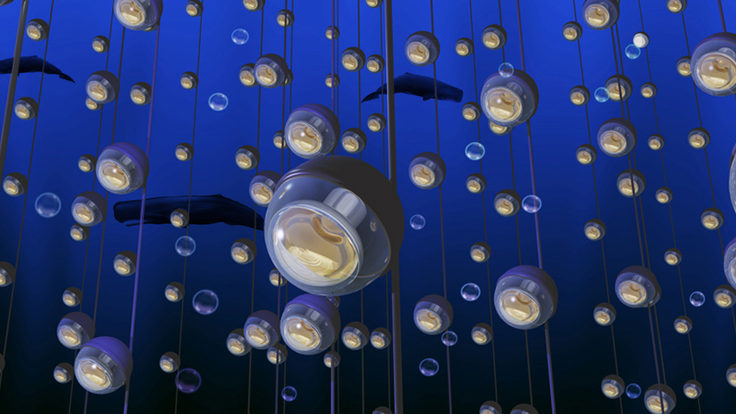
About 60 miles off the southernmost tip of Sicily, in the deepest section of the Mediterranean Sea, strange objects seem to grow. About every 330 feet, you’ll find few cables anchored to the seafloor, each pulled by a buoy close to half a mile straight up and strung with 18 glass spheres.
The spheres, each of which is a little bigger than a basketball, make up a gigantic, underwater particle detector. This is ARCA, a prototype for the even larger, planned KM3NeT detector.
ARCA was built to help scientists detect neutrinos, mysterious particles that are always passing through us and only rarely interact. But when they first fired up their prototypes in 2005, scientists discovered something else.
Recording neutrinos
When a neutrino hits a molecule in the Mediterranean, it releases charged particles that pass through the water faster than the speed of light—that is, faster than the speed of light through water. The result is a burst of light—the visual equivalent of a sonic boom, on a very small scale. It’s called Cherenkov radiation, the same blue glow released in a nuclear reactor.
The glass globes strung along the bottom of the sea are full of photosensors that pick up these blue flashes and record how they move through the water. It’s the same concept used in the IceCube neutrino detector, made up of similar spheres positioned throughout a section of Antarctic ice.
Unlike IceCube, though, the sea-faring KM3NeT and its prototypes cannot count on its detector parts staying perfectly still. It must monitor their locations, which it does through acoustic sensors on the spheres themselves and their anchors.
Those acoustic sensors make recordings, which the scientists decided to use to investigate what sorts of phenomena might affect their detectors.
A week after switching on the first recording station in 2005, KM3NeT scientist Giorgio Riccobene was listening to the sounds of the sea. He heard the familiar crashing of the waves, the pattern of the rain and the noisy clacking of ships. But there was also a strange clicking sound.
“I had no idea what these signals could be,” Riccobene says.
Inhabitants of the deep
He sent the recording to colleague Gianni Pavan, a professor at the University of Pavia. Pavan was surprised at what he heard. The clicks were the calls of sperm whales, an endangered species thought to have left the Mediterranean years before.
Sperm whales use sound not only as a way to probe their surroundings, but also as a way to communicate. The whales make different sounds when performing different activities, such as diving, hunting or socializing. The sounds produced when the whales are socializing, called “codas,” vary depending on their region in the world, similar to a dialect.
Using the acoustic data from KM3NeT, scientists were able to track the sperm whales they found, monitoring what they were doing, where they were in the sea, and how many there were. They could even determine the size and gender of each one. They have identified hundreds of the creatures hiding in the deep.
“KM3NeT has provided a great infrastructure for studying the sperm whales,” says Virginia Sciacca, a research fellow at the Italian National Research Council and marine ecologist who worked on the KM3NeT collaboration studying the acoustic noise. “I think it makes a big difference having these interdisciplinary collaborations, especially for monitoring the deep sea.”
Since 2005, Riccobene and his team have continued to monitor the whales using audio sensors of KM3NeT and of other experiments deployed off the Sicilian Coast. Colleagues located at the University of St. Andrews in Scotland, Woods Hole Oceanographic Institution in Massachusetts, and the National Research Council in Italy use the audio data to research all types of marine life. Collaborating with the Italian Institute of Geophysics and Volcanology in 2012, they discovered fin whales in the area as well.
The KM3NeT ARCA experiment is scheduled to start running end of 2019, reach the size of 1/10th of IceCube in 2020, and be completed before 2025. But to those studying the Mediterranean’s sea life, the experiment has already proven its worth.
14 Sep 02:45


Dick
by Nicholas Gurewitch
The post Dick appeared first on The Perry Bible Fellowship.
Sean Murphy likes this
11 Sep 21:50
Build a better Bookshelf
by huydotnet
Article URL: https://huytd.github.io/build-a-better-bookshelf.html
Comments URL: https://news.ycombinator.com/item?id=17948237
Points: 307
# Comments: 64
R.P. Aditya likes this
03 Sep 18:28
The Getaway: Your Next Trip? It’s Written in the Stars
by ELAINE GLUSAC
Resorts, parks and attractions in the United States, Canada, Mexico and beyond are expanding the galaxy of what has become known as astrotourism.

03 Sep 00:53
Who’d Be on Your Spaceship? A School Exercise Backfires in Ohio
by CHRISTINA CARON
Children were asked to decide life or death for a group that included a gay athlete, an Asian orphan and a racist police officer.

02 Sep 02:29
Diagnosis: She Had a Long and Strange Rash on Her Arm. What Was It?
by LISA SANDERS M.D.
It didn’t hurt, but the woman wasn’t sure whether the streak on her arm was harmless or potentially dangerous.

31 Aug 19:06
How Modern Medicine Has Changed the Supreme Court
by DHRUV KHULLAR and ANUPAM B. JENA
Longer lives, longer terms and tougher nomination fights, as well as a premium on youth.
31 Aug 18:57
Why You Should Tell Your Co-Workers How Much Money You Make
by TIM HERRERA
It’s unlawful for private sector employers to prohibit employees from discussing wages and compensation. Take advantage of that protection.

21 Aug 21:58
Minecraft Global Warming
by nsporillo
Article URL: https://github.com/nsporillo/GlobalWarming
Comments URL: https://news.ycombinator.com/item?id=17803396
Points: 521
# Comments: 125
R.P. Aditya likes this
21 Aug 21:58
How Ants Avoid Traffic Jams
Ants have a lesson for humans on how to be more productive: Less is more. Here’s the ingenious trick the insects deploy for maximizing efficiency.
21 Aug 21:56
Clues to Your Health Are Hidden at 6.6 Million Spots in Your DNA
by GINA KOLATA
With a sophisticated new algorithm, scientists have found a way to forecast an individual’s risks for five deadly diseases.

19 Aug 05:02
Happy Children Do Chores
by KJ DELL’ANTONIA
Helping run a household gives kids an awareness of the needs of others.

19 Aug 04:59
The Saturday Profile: Empowering Teenage Girls in a Traditional Village and Across Morocco
by MARJORIE OLSTER
Maryam Montague, a former humanitarian aid worker turned social entrepreneur, is inspiring girls to stay in school in a place where many drop out at puberty to marry.

17 Aug 21:42
The Costs of Motherhood Are Rising, and Catching Women Off Guard
by CLAIRE CAIN MILLER
College-educated women in particular underestimate the demands of parenthood and the difficulties of combining working and parenting, new research shows.

17 Aug 21:23
The Akrasia Effect: Why We Don’t Follow Through on What We Set Out to Do
by melling
Article URL: https://jamesclear.com/akrasia
Comments URL: https://news.ycombinator.com/item?id=17765184
Points: 374
# Comments: 140
15 Aug 21:59
Markov Chains Explained Visually (2014)
by aogl
Article URL: http://setosa.io/ev/markov-chains/
Comments URL: https://news.ycombinator.com/item?id=17766358
Points: 771
# Comments: 68