Terry Blas is the illustrator and writer behind the autobiographical comics “Ghetto Swirl” and “You Say Latino.” Terry’s work has appeared in the comics Steven Universe, The Amazing World of Gumball, Adventure Time, and Rick and Morty. His first graphic novel, Dead Weight: Murder at Camp Bloom, is a murder mystery set at a weight-loss camp. His second graphic novel, Hotel Dare, is an all-ages sci-fi/fantasy/adventure inspired by his childhood memories of Mexico.
As more places face a scarcity of fresh water, desalination is seen as a possible answer. But energy and financial requirements limit how widely it can be used.
Capitalism is great at making people want things they don’t need.
And of course this is what we should expect from a system that runs on production and consumption. Companies make and sell products and those products have to be consumed by as many people as possible — that’s what makes the whole thing work.
So it’s not surprising that businesses do everything they can to convince people to buy whatever they’re selling. But what happens when marketing becomes active manipulation? More precisely, what happens when companies use science and technology not only to refine our pleasures but to engineer addictive behaviors?
A 2019 book by University of North Florida historian and addiction expert David T. Courtwright, called The Age of Addiction: How Bad Habits Became Big Business, tries to answer these questions in a fascinating history of corporate America’s efforts to shape our habits and desires.
What we have is something Courtwright calls “limbic capitalism,” a reference to the part of the brain that deals with pleasure and motivation. As our understanding of psychology and neurochemistry has advanced, companies have gotten better at exploiting our instincts for profit. Think, for example, of all the apps and platforms specifically designed to hijack our attention with pings and dopamine hits while harvesting our data.
We’ve always had some form of limbic capitalism, Courtwright says, but the methods are much more sophisticated now and the range of addictive behaviors are much wider than they used to be. I spoke to Courtwright about the problems this has created, why the battle against limbic capitalism is seemingly endless, and if he thinks we’re destined to live in a consumerist dystopia.
A lightly edited transcript of our conversation follows.
Sean Illing
“Limbic capitalism” is a strange phrase at the center of your book. What does it mean and why should people be aware of it?
David T. Courtwright
Well, limbic capitalism is just my shorthand for global industries that basically encourage excessive consumption and even addiction. In fact, you could make that even stronger and say not only do they encourage it but now they’ve reached the point where they’re actually designing it.
Sean Illing
And where does that word “limbic” come from?
David T. Courtwright
It’s a reference to the limbic region of your brain, which is the part of your brain that deals with pleasure, motivation, long-term memory, and other functions that are crucial for survival. You couldn’t live without your limbic system and you couldn’t reproduce without it, and that’s why it has evolved. And yet that same system is now susceptible to hijacking by corporate interests in a way that actually works against your long-term survival prospects. That’s the paradox.
Sean Illing
How is it hijacked?
David T. Courtwright
The short answer is that companies offer products that will produce a burst release of dopamine in a way that conditions and ultimately changes the brain and develops certain addictive behaviors, which is to say behaviors that are harmful. Now, people have always peddled products that are potentially addictive. But what’s happened in the last 100 years or so is that more of these commercial strategies come from highly organized corporations that do very sophisticated research and find more ways to market these addictive goods and services.
Sean Illing
It seems to me that capitalism runs on the addictions of consumers, has always run on the addictions of consumers, and therefore this isn’t all that revelatory.
David T. Courtwright
I hear this sort of point all the time, and my answer is that it’s not quite right. I make a distinction between ordinary capitalist enterprises like companies that sell people rakes or plows or nails or whatever — there’s absolutely nothing wrong with that, and, in fact, the free market is very good at distributing those goods. It’s a force for human progress.
But I think of limbic capitalism as capitalism’s evil twin, a really cancerous outgrowth of productive capitalism. There is a certain class of brain-rewarding products that lead to a form of pathological learning that we call addiction, and it’s that branch of capitalism that is especially dangerous.
So I’m not anti-capitalism, but I am calling attention to a certain species of capitalism that cultivates addictive behavior for profit.
Sean Illing
What sort of industries or products are we talking about? Who traffics in limbic capitalism?
David T. Courtwright
If you’d asked that question half a century ago I would’ve said we’re mainly talking about alcohol, tobacco, and other drugs. But in the last 20 or 25 years, there’s been a big expansion of the concept of addiction. So now we don’t just speak about addiction to drugs, we speak about addiction to pornography, to computer games, to social media, to food, to all kinds of things.
What happens in the last few decades is an explosion of technological innovation and mass production and mass marketing and, most recently, the rise of the internet, which has really accelerated the process and opened up new spaces for limbic capitalists to both grab our attention and sell us more products.
Limbic capitalism in the age of digital technology is truly a whole new ballgame.
Sean Illing
The point about digital technology seems especially important. Everyone who has a smartphone in their pocket, everyone who uses social media, everyone participating in the digital game is, one way or another, a prisoner of limbic capitalism. Every time we hear that ping from a like or a retweet, we get that dopamine hit. If that’s not an addiction, I don’t know what is.
David T. Courtwright
That actually gets at a very interesting question: Is it the internet and [related] devices that are addictive, or is it the content of the internet that’s addictive? I think it’s both.
You have traditional commercial vices like pornography, or alcohol, or drugs that are available through the internet, but you also have internet-linked mobile devices that themselves come to function almost like gambling machines, where you’re constantly getting dinged. You’re constantly getting messages, you’re concerned about likes, you’re wondering about the latest post, you have this fear of missing out.
And this is key: You’re not just responding to these devices, you’re anticipating them. That’s another thing about addictive behaviors: they don’t simply provide reward, they also provide conditioning. Smartphone technologies arguably accomplish this better than any device or product in human history.
It’s a perfect example because it captures several features of a limbic capitalist enterprise, both historically and in terms of its current manifestation. So number one, limbic capitalists target the young. This is probably the most politically sensitive aspect of limbic capitalism. The idea of vaping, the idea of a harm-reduction smoking replacement device for confirmed devices is great — who could object to that?
But as the product has developed, especially since Juul came along, there’s been more and more of an emphasis on the youth market. Which is what we’ve always seen from Big Tobacco and Big Alcohol: the youth are your best customers because they’ll be around the longest.
It’s about more than just delivering the product, though. One of the discoveries I made is that when you look at the history of potentially addictive pleasures, there’s a tendency to blend vices and experiences in ways that increase the addictive qualities of products. Las Vegas is a great example of this. Vegas is not just about gambling; it’s a place where you can booze it up, it’s about nightclubs and big spectacles and all the dazzling amusements — everything is wrapped up in a big hedonic package.
Sean Illing
I’d love to know how you distinguish the manufacture of new demands with the satisfaction of demands that already exist.
David T. Courtwright
That’s a very interesting question. Eating is not a manufactured demand. You have to eat to survive, but you don’t have to eat highly processed food that stimulates the release of dopamine in a way that alters your mood and gives you a rush.
What we’ve done is we’ve taken things like sugar or salt that were once comparatively scarce and valuable commodities and made these things massively available. So once you get the ingredients that are capable of producing brain reward, then it’s just a matter of designing products that will essentially maximize that brain reward.
So again, the demand, “I’ve got to eat something,” was always there, but what the processed food industry does, because it’s so competitive, is create products that will provide the calories and nutrients in ways that act like mood-altering drugs. And that’s where the line between simple marketing and limbic capitalism lies.
Sean Illing
Sure, everyone needs to eat, but not everyone needs to tweet or buy 13 pairs of sunglasses or own a closet of products that add nothing to their life apart from marking their identity and status for other people. These are the sorts of manufactured demands I had in mind, and they’re harder to pin down than our appetite for things like booze or junk food.
David T. Courtwright
Ten years ago I would’ve agreed with you. I would’ve said nobody really needs to tweet, nobody needs a Facebook page. But there are what I call opt-in and opt-out technologies.
Once upon a time, the internet and internet access were opt-in technologies. In other words, you adopted these things, you learned how to use them. But now I think we’ve reached the point where they’ve become opt-out technologies, where you’re going to have to do something radical or unusual like go off the grid or throw away your smartphone to escape it.
Once you’re in an environment where you’ve got to have this device, you’re in an environment where you will be constantly exposed to what the policy analyst Jonathan Caulkins calls “temptation goods.” You may have a firm resolution to use your smartphone just for email, or just to check the New York Times, or for a handful of other more or less straightforward functions, but sooner or later the convenience of these other devices and other apps will creep up on you and then you’ll become enmeshed in all of it.
Another way to say this is that as consumers we swim in a sea with sharp hooks everywhere. Fifty years ago, the main hooks were drugs like alcohol and tobacco. Those were the primary addictive threats. And now there’s been this tremendous multiplication of hooks in our consumerist sea.
Sean Illing
You end the book on an optimistic note, but I have to say, the problem seems insoluble to me. American capitalism is extremely good at undercutting threats. I feel like the most likely scenario is a consumerist dystopia propped up by a whole range of new and widespread addictions.
Feel free to talk me off the ledge.
David T. Courtwright
Well, one of the strikes against limbic capitalism is that when it goes after children, which it has to do to find replacement users, that eventually becomes an issue and it leads to serious pushback. There are really good examples of campaigns against limbic capitalist products like cigarettes that, if not quite successful, at least fought the industry to a standstill.
I’d also say that ridicule is an effective weapon. I mean, think about what happened to the tobacco industry both in the United States and in Australia when the lies of the industry were exposed by some very aggressive activists who used ridicule and satire as effective tools.
And we have tax policy, we have potential structural limitations, we have lawsuits and big class action cases that pose serious problems for American limbic capitalists. We’re already seeing these sorts of actions against the opioid industry, for example, and that’s encouraging.
So it’s not quite true that we don’t have tools to fight back, but you’re right — it’s an uphill battle.
This article was originally published on October 17, 2019.
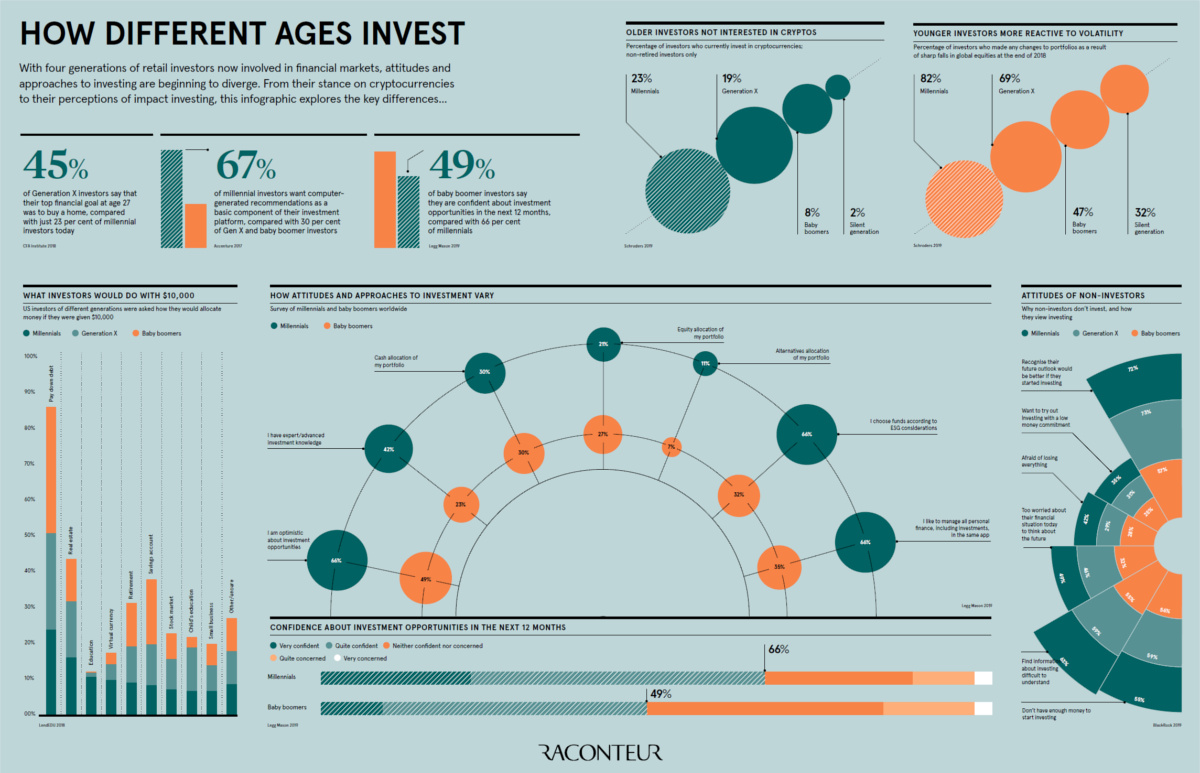
“Every generation thinks about investing a little differently.
This is partially due to the fact that each cohort finds itself on a distinct leg of life’s journey. While boomers focus on retirement, Gen Zers are thinking about education and careers. As a result, it’s not surprising to find that investment objectives can differ by age group.
However, there are other major reasons that contribute to each unique generational view. For example, what major world events shaped the mindset of each generation? Also, what role did culture play, and how do things like economic cycles factor in?”
As students all over the world begin new school terms, German pupils’ experiences are rooted in special rites and a philosophy that teaches independence.
A Seattle council member is proposing that a six-block area of the city’s Capitol Hill neighborhood be transformed into a Barcelona-style “Superille” or “Superblock.”
These clusters of blocks — in which car traffic is mostly curtailed — have become hugely popular in the Spanish city, transforming residential districts by creating walkable, child-friendly neighborhoods with welcoming public spaces.
Council Member Teresa Mosqueda thinks that superblocks would work well in her district, so she is urging that Seattle pilot the model in a six-block area of Capitol Hill between between Pine and Union between 12th and Broadway. Vehicle traffic would be routed around the area, sparing residents living on the interior blocks the noise, pollution and danger of interaction with traffic.
Mosqueda said she would take up the idea after the election in November, when she hopes it will receive the support it needs in the council, Margo Vansynghel at Capitol Hill Blog reported.
Of course, Seattle, a national leader on street design, is already experimenting with a similar idea. The city calls its experiment “home zones.” It is offering $350,000 in grants for neighborhoods that want to try traffic calming within “a grid of arterial streets.”
By all accounts, the Superilles experiment in Barcelona has been a huge success, as David Roberts at Vox has detailed. On some of the city’s earliest Superblocks, bike trips rose by 30 percent and walking jumped 10 percent. The blocks make urban life quieter and more peaceful and sociable by creating a space for gathering and play, as the photo above shows.
Barcelona eventually hopes to expand them to cover the entire city.

/cdn.vox-cdn.com/uploads/chorus_asset/file/15986155/Vox_The_Highlight_Logo_wide.jpg)
/cdn.vox-cdn.com/uploads/chorus_asset/file/19287082/01_Latinx_cover_flat.png)
/cdn.vox-cdn.com/uploads/chorus_asset/file/19287083/Latinx_01_flat.png)
/cdn.vox-cdn.com/uploads/chorus_asset/file/19287084/Latinx_02_flat.png)
![[In] Spanish ... all nouns are either masculine or feminine. Some people just say these are “gendered languages.” ... In Spanish, there are two words for “the.” El is the masculine form of “the.” La is the feminine form of “the.”](https://cdn.vox-cdn.com/thumbor/5VuI_NYDQCEvxrjjNfg9v7tgypQ=/800x0/filters:no_upscale()/cdn.vox-cdn.com/uploads/chorus_asset/file/19287085/Latinx_03_flat.png)
/cdn.vox-cdn.com/uploads/chorus_asset/file/19287087/Latinx_04_flat.png)
/cdn.vox-cdn.com/uploads/chorus_asset/file/19287088/Latinx_05_flat.png)
/cdn.vox-cdn.com/uploads/chorus_asset/file/19287089/Latinx_06_flat.png)
/cdn.vox-cdn.com/uploads/chorus_asset/file/19287090/Latinx_07_flat.png)
![... And then I discovered a Mexican drag competition on YouTube called Las Mas Draga! When welcoming the contestants, ... [the host] replaced every gendered vowel with an E.” “Bienvenides a todes!” It blew my mind! It was inclusive and easy to pronounce!](https://cdn.vox-cdn.com/thumbor/UrLDMfgOTbebiRBi5M70YdZjJDo=/800x0/filters:no_upscale()/cdn.vox-cdn.com/uploads/chorus_asset/file/19287091/Latinx_08_flat.png)
/cdn.vox-cdn.com/uploads/chorus_asset/file/19287094/Latinx_09_flat.png)


 Christina Animashaun/Vox
/cdn.vox-cdn.com/uploads/chorus_asset/file/19270373/Courtwright_Cover.jpg) Harvard University Press
Harvard University Press



 Skylight manufacturer Velux says we need more light and fresh air.




 A Seattle council member is proposing that a six-block area of the city’s Capitol Hill neighborhood be transformed into a Barcelona-style “Superille” or “Superblock.”
These clusters of blocks — in which car traffic is mostly curtailed — have become hugely popular in the Spanish city, transforming residential districts by creating walkable, child-friendly neighborhoods with welcoming public spaces.
Council Member Teresa Mosqueda thinks that superblocks would work well in her district, so she is urging that Seattle pilot the model in a six-block area of Capitol Hill between between Pine and Union between 12th and Broadway. Vehicle traffic would be routed around the area, sparing residents living on the interior blocks the noise, pollution and danger of interaction with traffic.
Mosqueda said she would take up the idea after the election in November, when she hopes it will receive the support it needs in the council, Margo Vansynghel at
A Seattle council member is proposing that a six-block area of the city’s Capitol Hill neighborhood be transformed into a Barcelona-style “Superille” or “Superblock.”
These clusters of blocks — in which car traffic is mostly curtailed — have become hugely popular in the Spanish city, transforming residential districts by creating walkable, child-friendly neighborhoods with welcoming public spaces.
Council Member Teresa Mosqueda thinks that superblocks would work well in her district, so she is urging that Seattle pilot the model in a six-block area of Capitol Hill between between Pine and Union between 12th and Broadway. Vehicle traffic would be routed around the area, sparing residents living on the interior blocks the noise, pollution and danger of interaction with traffic.
Mosqueda said she would take up the idea after the election in November, when she hopes it will receive the support it needs in the council, Margo Vansynghel at 