R.P. Aditya
Shared posts
These High-Flying Geese Are ‘the Astronauts of the Bird World’

A Gambler Who Cracked the Horse-Racing Code (2018)
Article URL: https://www.bloomberg.com/news/features/2018-05-03/the-gambler-who-cracked-the-horse-racing-code
Comments URL: https://news.ycombinator.com/item?id=20865312
Points: 346
# Comments: 211
Is Dying at Home Overrated?

India’s Amazing Art Hub
In mid-December, right after my year-long music tour ended, I decided to stay in motion. I headed to Kochi, a city in the South Indian state of Kerala, where an art biennial was about to open.
I had no idea what to expect, but was pleasantly surprised to find that most of the artists were names I’d never heard of, and that with a few exceptions, most of them came from the southern hemisphere. This was art that was not being made for me or my ilk, though some of it I liked very much. And though some of the artists have indeed shown internationally, none of the big art stars that often dominate these types of events were represented. I’d wager quite a few have never been shown in the Global North.

I took this as a sign that Kerala was cultivating an arts scene that is not only creatively vibrant, but that Indian cities might be able to financially support creativity enough so that artists there can make a living and not be forced to head north. The gatekeepers of the art world have traditionally resided in places like New York, London, Berlin, Hong Kong and Miami. But what if what is happening in Kerala is an example of a wider trend?
Kochi-Muziris Biennial
Kochi is on the tip of a peninsula, a bit like a small version of San Francisco. Across the bay are tall offices and a city that sprawls for miles, but Kochi has preserved much of its historical architecture. Here’s a school group that was taking the ferry here from the mainland for an afternoon outing—my new bike pals. (I had a bike too, of course.)

This town was a trading center for the spices that grew up and down the Malabar Coast, so of course, the Dutch, Portuguese and English all laid claim to this place at one time or another. The spice warehouses these colonizers built line much of the waterfront, and a few abandoned ones served as the venues for this art event. I could easily bike from one venue to another.
Though this biennial was in Kerala most of the commercial Indian galleries are in larger cities—Delhi, Mumbai and Kolkata (formerly Calcutta)—but this is a nicer place to visit. In a sense, it’s like a southern version of the Venice Biennale in that Venice itself is a draw for visitors. There is a funky tourist aspect here—in many cases the exhibition spaces are “as is,” slightly cleaned up, but far from the ubiquitous pristine white boxes in Northern art events.

The Kochi-Muziris Biennial was started in 2012 by two Indian artists from Kerala at the suggestion of the Kerala arts minister. The state government gave some support, but the organizers still had to scrounge a bit, and to fill the gaps a few Indian businesses stepped up—even crowdfunding was used. Today, it’s the largest contemporary art fair in Asia, so they claim. The Indian artist Anita Dube was the curator this year. Some days it is free for all, so a lot of curious locals of all walks of life stroll in and take an avid interest.
What stood out for me?
I loved the embroideries by artist Bapi Das, based out of Kolkata, where he works part-time as a rickshaw driver. The embroideries often feature the view from the rickshaw…but heightened, edited, filtered. Many of them are left on the frame where they are made.
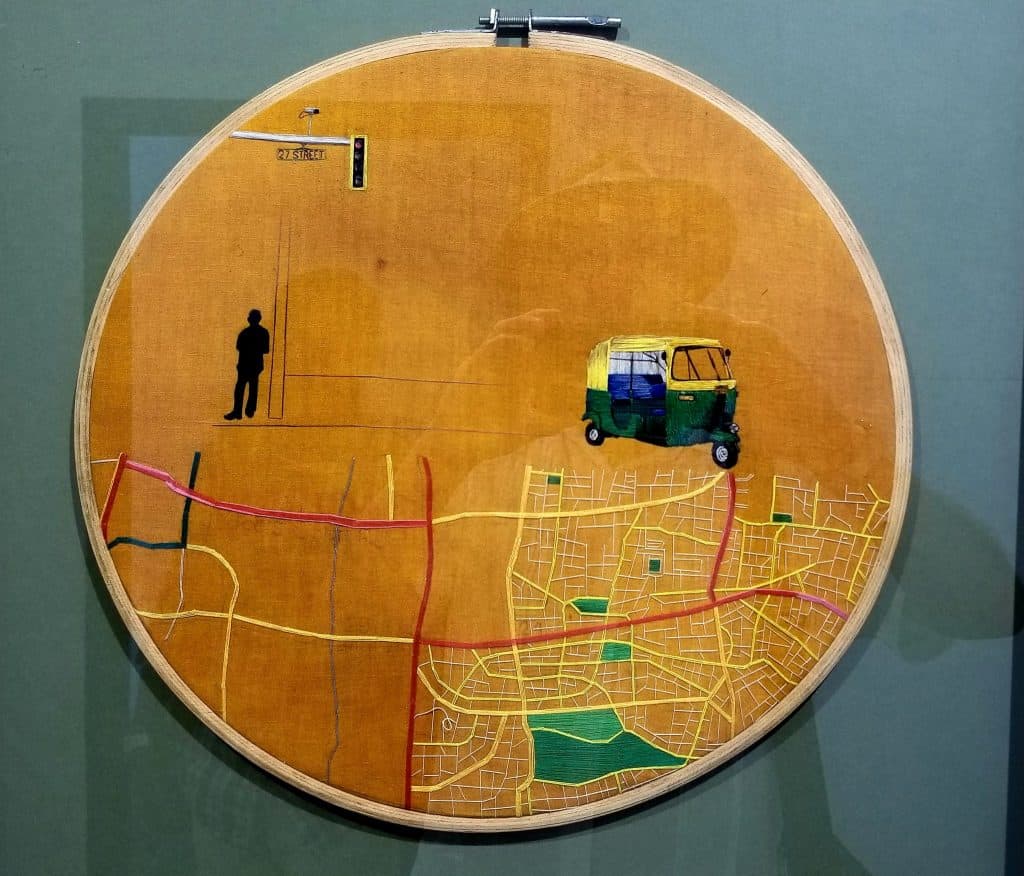
When you jump in a rickshaw your driver might be a great artist, a poet, a musician, or a community organizer.

Chitra Ganesh is an artist based in a multicultural city named Brooklyn. She references Indian mythological comics (I picked some up at a local temple — photo below) but she takes that genre someplace else.
The dusky firebrand on the cover of the comic below has been hitting the skin lightener a little too much, it seems to me!

Below is a piece by South African artist Sue Williamson. She made t-shirts printed with the bills of sale of enslaved people, including children, from Malabar Coast, the part of India I was in. She discovered the bills of sale in Cape Town, as the slaves were sent there by the Dutch East India Company in the 17th century. The child on the bill of sale below was 10 years old.

After many washings the printed images fade away, which is the artist’s intention… a sort of “truth and reconciliation” via t-shirts.

The Indian artist Vipin Dhanurdharan (below) is from Kochi. He walks around his neighborhood and does portraits of the folks he encounters as he shares a meal with them. Sometimes he makes dinners of local dishes for both locals and for folks visiting the Biennial. He does LOTS of these portraits—I think there were three rooms full.

So, Kochi, though not a strong art market itself, might serve as a showcase that helps Indian and other artists to be seen, and encourage the other parts of that ecology—the galleries, collectors, institutions, government—that are based more often in larger Indian cities to appreciate what is happening on the subcontinent.
India’s art dealers are optimistic about younger potential buyers who are comfortable with technology, such as StoryLTD, an online-only, fixed-price, no-reserve e-commerce art sales site. The traditional gallery route might not be the only way to go—there are about 20 commercial contemporary galleries in Mumbai, and a growing number of collectors, but that is not quite enough to support a sustainable homegrown scene just yet.
There is evidence that other places, like Indonesia and Lagos, Nigeria, might be achieving this, or are getting very close. I’ll explore those in later installments of this story collection.
This story is part of a collection called Art is Everywhere: Stories of artists making a living in unexpected places. Read more here.
The post India’s Amazing Art Hub appeared first on Reasons To Be Cheerful.
Our Bicycle Future
The decade-long proliferation of art and architecture biennials should make any conscientious traveler ask oneself, “Wow, what’s my carbon footprint as I traverse the globe to digest all this content?” From the comfort of home, no fossil fuels required, I virtually stumbled upon an exhibition whose specificity is to be admired: Bicycle Architecture Biennale (BAB).
Biennials are not known for their coherence, but the folks who organized this one (they go by the moniker BYCS and are a multi-pronged social enterprise based in Amsterdam, of course) have kept theirs laser-focused on built-environment solutions for cycling. Advocacy for cycling is often a mismatched marriage of policy wonks and community activists. But by cleverly framing their collection of concepts as a “biennale,” BYCS has managed to attract the interest of both—plus major engineering and architecture firms, as well as Dutch members of Congress.
BYCS describes itself as a collective of Bicycle Futurists, perhaps an homage to the early 20th century art movement Futurism, which valued constant motion and progress. And in its pursuit of progress, BYCS is not shy: 50 by 30. Fifty percent of all city trips will be by bike by 2030.
How all those cyclists will move about is the concern of BAB. This year’s biennial is only the second iteration and projects were selected from a global open call. Representing nine countries, the 15 chosen projects were organized into three themes: Routes, Connections and Destinations. All but four are built architecture, and there is none more impressive than the bike garage at Holland’s Utrecht Centraal railway station.
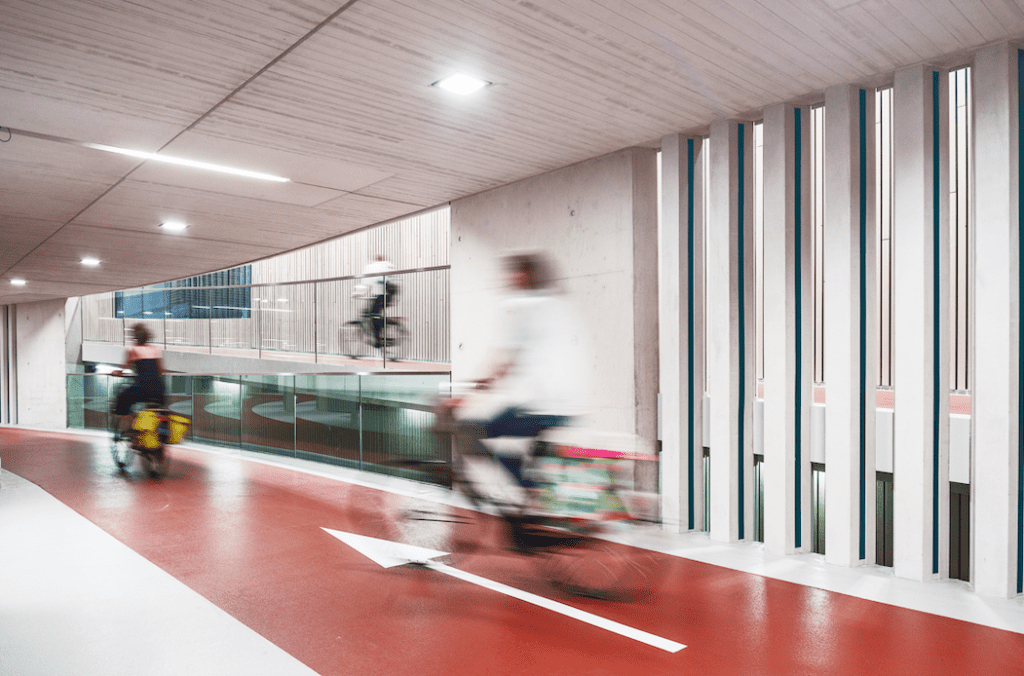
From Louis Kahn to Zaha Hadid to Herzog & deMueron, architects have always had a fetish for parking garages, which offer the opportunity to transform the banal into something extraordinary. Now, they can scratch that itch in a greener, more sustainable typology: the bicycle garage. Located under the city’s main transit hub, Utrecht’s bicycle garage is the world’s largest. Ector Hoogstad Architects is the Rotterdam studio responsible for this light-filled and fluid facility of concrete, steel and wood. It boasts three levels, digital wayfinding signage, one-way traffic, free parking for the first 24 hours, service points for repairs and parts, and most importantly, easy access to railway station platforms and buses. That the garage is constantly filled to capacity speaks to its success, and indicates that commuters are choosing cycling in combination with public transportation.
Projects like this have changed the very fabric of life in the Netherlands. When we think of that country, we have a perception that bicycles have always been part of its DNA. But that’s not the case. Homegrown activism catalyzed by an inordinate number of vehicle deaths in the 1970s transformed a nation once seduced by cars into one where almost half of all people commute by bike. Today, only 15 percent of the trips into Utrecht’s center are made by car. Car ownership is decreasing among the younger generation. Behaviors are changing.
Most encouragingly, this is a city that is designing its infrastructure first and foremost for the pedestrian and the cyclist. In some cases, it’s about material like red, low-friction tarmac, which provides cyclists a smoother ride as well as a color demarcation, implying that these roads for bikes are equal to streets for cars. In other instances, the city has rerouted cars to go around a canal while bicycle-only bridges cut across, making cycling the faster mode of travel. Most impressively, Utrecht’s historic city moat, which was converted in the 1970s into a 12-lane motorway, has since been returned to its original state of water, grass and trees hugged by bike lanes.
As Utrecht brings a holistic urbanist approach to integrating the bicycle into every aspect of the city’s infrastructure, how do we evaluate my second-favorite BAB project, Cycling through Water? Located in Limburg, Belgium, this popular and attractive weekend proposition is a pathway that cuts down into and across a large pond, putting water at eye level. Yet, I had a nagging feeling that this minimalist inverted cycle path by Lens°ass Architects is more rarefied folly than true solution.
I contacted Lee Feldman, a cofounder of BYCS, to lodge my concern. Can this kind of architecture really change recreational bikers into cycling commuters? Lee is patient and, like a good lawyer, he lays out his argument.
“As the earth warms, any activity that reduces our carbon emissions is a win,” he begins. (It is said that Dutch people cycle so much, it is equivalent to planting 54 million trees a year). In less than three years, 500,000 cyclists have experienced Cycling through Water. Engaging half a million riders on a sojourn of delight beyond function creates a new mindset. If the landscape can be transformed to encourage and reward usage, this, in theory, should result in more riders.
But the project had a more concrete impact, too. Its creation sped up the roll-out of a conservation plan for the forest and ponds surrounding it, resulting in improved water quality and an expanded amphibian habitat. This ripple effect makes a strong case for towns and cities to implement phased urban/rural planning. Often grand infrastructure schemes go by the wayside because there is too much to digest. Break them up into smaller morsels and focus on the sexy—a bike lane that glides through water whose success then begets environmental improvements for the entire ecosystem.
Lee cites three more recent initiatives: France by Bike, a comprehensive source for ecological tourism; a disused railroad track with tunnels repurposed for bikes along the Ligurian Sea in Northern Italy; and Shimanami Kaido, an expressway designed to include cyclists exploring the Japanese islands in the Seto Inland Sea. Lee contends that these pastoral journeys “encourage, either directly or indirectly, a divestment in cars, oil and gas.” As it turns out, Belgium and Japan crack the top-ten list of countries with the most bicycles per capita.
And then there is the money. How often have we been told that if we can link a do-gooder cause to good economics, we can move the needle? “When local or regional governments allocate resources and value cycling destinations, the overall effect is generating additional tourist dollars and making cycling more mainstream and desirable,” says Lee. Limburg, touted as a “Bicycle Paradise”—in connection with the Cycling through Water project, which is itself part of the Limburg Cycle Network—has seen a surge of tourism in the last decade. The best indicator for increased cycling is the steadily growing global market for bikes. In 2018, we spent $47 billion on bicycles and the forecast for 2025 is $75 billion.
Concurrently, if we lean into cycling as a recreational activity, we normalize bikes as an alternative to cars. Lee continues: “Let’s look at our work habits. We are obsessed with time optimization, flexible working hours, co-working spaces, re-localization of mom and pop shops, placemaking and urban planning geekdom. As individuals, we value health and fitness, new experiences, virtue signaling, self-branding, Instagrammable content and pop-up retail. When I examine these cultural trends, it all points to recreational riders becoming regular commuters.”
As the Bicycle Architecture Biennale embarks on its tour to Rome, Auckland and Santiago, you sense an oncoming shift. Having designed both bicycles and bike parks, Bjarke Ingels Group and Julien De Smedt (JDSA) lead the charge of a new generation of architects devoted to cycling and sustainable mobility. And these designers have a partner in crime, Bicycle Futurists. Their leader, Lee Feldman, offers, “Let’s stop calling projects like Cycling through Water follies, because I see them as very positive signals.”
I will indeed.
This story is part of a collection called Changing Behavior: Stories about learning to grow in ways that benefit society. Read more here.
The post Our Bicycle Future appeared first on Reasons to be Cheerful.
How Many Humps on a Camel? In Kazakhstan, It’s Complicated

Should Work Be Passion, or Duty?

The Dignity of Disabled Lives

José Andres on the American food system
I ran across an interview with the chef José Andres in Departures, the luxury goods magazine. Sprinkled among the ads for things I can’t imagine ever buying is a Q and A with Andres who, in addition to running a lot of restaurants, founded World Central Kitchen to feed people hit by disasters.
Adam Sachs asked the questions. Here is the one that got my attention.
Q: If you could change one thing in the American food system, what would it be?
JA: First, we need to diversify the crops the government supports through subsidies. We need to help small farmers across America grow more fruit, more vegetables. And then put those fruits and vegetables into the school-lunch program and hire more veterans and train them to be cooks and work in those school kitchens, one rural school at a time, so that we are employing our veterans, giving our children better nutrition, which leads to better studies and a better future in the process. Right now we are investing in subsidies that go to just a few grains like corn. It’s making America unhealthy, and it’s making America less safe, because without a diversity of crops one day we will have a big problem with our food production.
The entire interview is worth a read.
I’m an Andres fan.
Overlooked No More: Elizabeth Rona, Pioneering Scientist Amid Dangers of War

The Mask I Wear on the Weekends

The Unspeakable Cost of Parenthood
Dear Tech Workers, U.S. Service Members Need Your Help

Exploring Lebanon’s Green Side

India’s Widows, Abused at Home, Have Sought Refuge in This Holy City for Centuries

A Taste of Home for California’s Punjabi Truck Drivers

Why Doctors Still Offer Treatments That May Not Help

How Many Triangles Are There? Here’s How to Solve the Puzzle
The Education of Elizabeth Warren

Indian Cities Are Becoming Urban Heat Islands
This June, about two-thirds of India experienced heat-wave conditions. Indian cities witnessed unusually high temperatures, which caused a spike in heat-related deaths. Although India is no stranger to heat waves, in recent years they have become more frequent, more intense, and of longer duration. This is partly because of the urban heat island effect.
An urban heat island is an area that is substantially warmer than its suburban and rural surroundings. This warming effect depends on various factors—a city’s weather conditions, its geophysical characteristics, and the heat from its buildings, vehicles, and inhabitants. The effect is more severe at night than in the daytime, and intensifies during heat waves. It can operate on different scales: It might occur around a single building, in a neighborhood, or citywide.
Due to the phenomenon, the gap between the daytime maximum temperature and the nighttime maximum temperature in major cities has been declining over the years. Or, in other words, hot cities are not only getting hotter, but retaining more heat after dark.
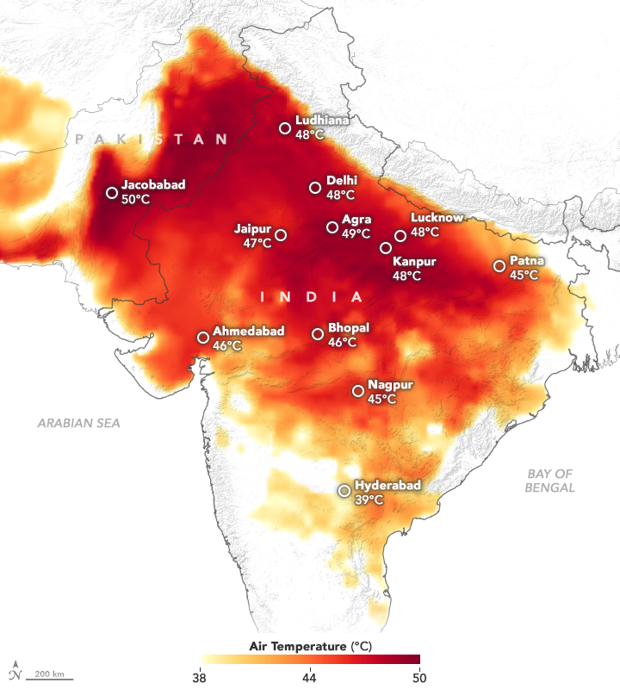
India has been urbanizing at a very fast rate, a trend that is expected to continue in the future. At present, there are 59 urban agglomerations of more than 1 million people in the country. That number is expected to rise to 78 by 2035.
Rapid urbanization is resulting in dramatic land-use changes. Over the past four decades, the built-up area in Delhi increased by 30.6 percent, while cultivated areas decreased by 22.8 percent and dense forest by 5.3 percent. Mumbai, the financial capital of India, became almost entirely paved and concretized in the span of 40 years. In Kolkata, vegetated areas decreased from 33.6 percent of the city to 7.4 percent between 1980 and 2010. In Chennai, the built-up area tripled between 1991 and 2016, while vegetation decreased by 12 percent.
The Energy and Resources Institute, a research nonprofit based in Delhi, found in 2017 that many fast-growing cities in India have been undergoing the heat island phenomenon, some more quickly than others. (Delhi is already dotted with heat islands.) Urban development—often unplanned and in violation of local zoning laws—and the associated reduction in evapotranspiration are main drivers.
“Covering soil with concrete or asphalt prevents water from evaporating from the soil,” said Mark Jacobson, a professor of civil and environmental engineering at Stanford University. “Since evaporation is a cooling process—it takes energy to evaporate water—reducing evaporation warms the ground. In addition, urban surfaces tend to absorb more sunlight than do soil or vegetated surfaces and convert that sunlight to heat. Thus, it is not a surprise that urbanization in India turns many cities to heat islands,” Jacobson said.
Other contributing factors are sick bodies of water, pollution, and economic activity relying on dirty sources of energy. Black carbon aerosol, or soot—from vehicular emissions and the burning of coal and wood for cooking in poor households (especially in urban slums)—absorbs large amounts of solar radiation, trapping heat.
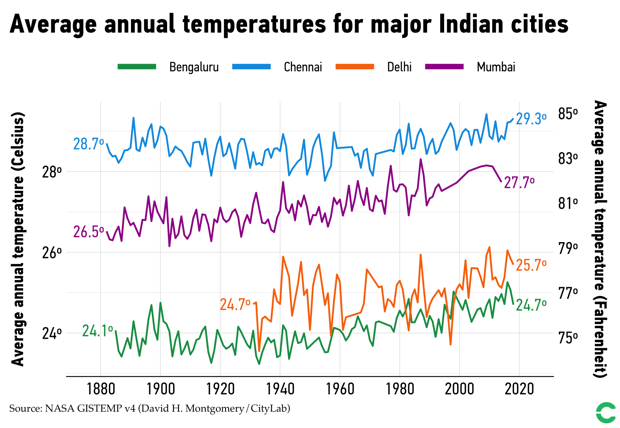
Using an array of global climate models, researchers at MIT found that, in many densely populated cities in India, heat waves are likely to breach the survivability threshold by the end of the century. The threshold is a wet-bulb temperature of 35 degree Celsius (95 degrees Fahrenheit)—a combined metric of humidity and temperature at which a few hours of exposure can cause death in even very fit people. Urban heat islands will further exacerbate thermal risks from global warming, particularly affecting the health of the roughly 24 percent of India’s urban population living in slums. Even more vulnerable are the country’s 1.8 million homeless people.
“Adding just a degree or two to a heat wave in an already vulnerable region like India can be the difference between life and death,” said Jeremy Pal, a professor of civil engineering and environmental science at Loyola Marymount University, who has authored several research papers on heat waves in South Asia.
Even if global warming is held below 2 degrees Celsius, there is likely to be a significant increase in deadly heat waves, causing many megacities to become heat-stressed. Urban heat islands can affect the severity and duration of heat waves. Death rates during heat waves are often much higher in cities than in their outlying areas, because of the effect.
Growth in air conditioning as temperatures rise compounds the problem. It leads to more greenhouse-gas emissions because India continues to rely heavily on fossil-fuel sources for electricity generation. And as urban heat islands become more intense, the use of water as well as electricity is likely to go up. That will worsen already acute water shortages in Indian cities.
In addition to the other risks to the urban population, urban heat islands also degrade the quality of air and water. Increased energy demand (for cooling) means more air pollution from power plants and more carbon emissions. Higher surface temperatures also lead to ozone formation. When water flows over hot roofs and paved surfaces, that water heats up before it reaches bodies of water, affecting the health of local ecosystems as well as increasing evaporation.
Can the intensity of urban heat islands be checked? Even amid ongoing global warming, targeted strategies could help.
Indian cities could switch to lighter-colored paving or porous green roads and cool roofs, to reflect more solar radiation. (After a severe 2010 heat wave, the city of Ahmedabad implemented a Heat Action Plan, including a cool-roofs program; research has shown this plan has prevented thousands of deaths.) Cities could increase their share of tree cover, which is significantly lower than what’s required to maintain an ecological balance.
People in urban areas could be encouraged to grow climbing plants and curtains of vegetation outside their windows. Greenbelts around cities, for wind paths, would allow the passage of exhaust heat from urban air conditioners and automobiles. Finally, air-quality standards should be enforced rigorously and continuously—not just when air pollution reaches hazardous levels.
Why All of Our Games Look Like Crap
Article URL: https://jeff-vogel.blogspot.com/2019/08/why-all-of-our-games-look-like-crap.html
Comments URL: https://news.ycombinator.com/item?id=20765521
Points: 749
# Comments: 536
How to Help Your Child Study
Inside India’s Messy Electric Vehicle Revolution

Elizabeth Warren’s campaign is coming to Cascadia; will hold 08/25 Seattle town hall

Want to engage with one of the leading Democratic candidates for President of the United States? Here’s your chance! Senator Elizabeth Warren of Massachusetts is bringing her burgeoning presidential campaign to the Pacific Northwest this weekend. Her campaign has announced that the centerpiece of the trip will be a Sunday afternoon town hall in downtown Seattle at the WaMu Theater.
The event is free to attend, but registration is requested.
Here are the details:
Seattle Town Hall with Elizabeth Warren
Sunday, August 25, 2019
WaMu Theater
800 Occidental Ave S
Seattle, WA 98134Doors open at 12:15 PM. Event starts at 2:15 PM.
Warren is the third Democratic contender to visit Seattle (not counting Washington State Governor Jay Inslee, who calls Cascadia home). Vice President Joe Biden had a couple of closed door fundraisers here a few months ago, and South Bend Mayor Pete Buttigieg held a fundraiser at The Showbox a few weeks ago.
Neither Biden nor Buttigieg held events that were free to attend.
Warren’s town hall, on the other hand, does not have an admission fee. Warren says her objective is to run a grassroots-oriented campaign that is powered by people instead of armies of lobbyists and the welathy interests they work for.
NPI is planning to cover the town hall here on The Cascadia Advocate as well as In Brief. If you go, pack your patience, as lines could be long.
The post Elizabeth Warren’s campaign is coming to Cascadia; will hold 08/25 Seattle town hall is from the NPI's Cascadia Advocate.
Show HN: Saag as a Service – macronutrient-portioned Indian spinach curry
Article URL: https://saag.pashi.com/#hn
Comments URL: https://news.ycombinator.com/item?id=20725311
Points: 301
# Comments: 168


