Shared posts

06 Mar 21:20

Uber Alles

mkalus shared this story from Rolandt shared items on The Old Reader (RSS).

We are in the twilight years of car culture. Few young people associate the car with freedom the way their parents and grandparents did. That sort of freedom — of open roads that can take you where the crowds aren’t — has never scaled. The romantic Americana of Route 66 has been replaced by the daily gridlock of overbuilt highways. Not only is commuting by car the source of many environmental ills — recent revelations that car companies have been hiding their products’ actual tailpipe emissions from regulators suggests they are worse than we knew — it produces a set of social problems that leave people feeling isolated and angry. Despite many improvements in car and road safety in the past few decades, the number of car-related fatalities has stayed relatively steady since 1975, hovering between 30,000 and 50,000 a year.

The car has become the opposite of liberating: a dangerous and expensive hassle that has reshaped the landscape in its image, creating isolation and dependency for everyone, with or without one. Families must maintain a fleet of vehicles to complete ordinary tasks within a suburban landscape designed to keep everyone marooned in individualized convenience. Instead of having life’s necessities within walking distance of neighborhoods or public transportation, there are unmaintained sidewalks amid endless tracts of ranch houses and big-box stores surrounded by huge parking lots.

The car has become the opposite of liberating: a dangerous and expensive hassle that has reshaped the landscape in its image

Cars themselves are no longer portals to the unknown, to be customized at the owner’s discretion; they are festooned with elaborate electronics that preclude the possibility of home repair, let alone modification, and they are equipped with monitoring devices that make them fully trackable (and susceptible to being hacked). When young adults get to drive the family car, they are still under the parental thumb, having their speed governed and their location monitored remotely.

As car culture has become more obviously stultifying, some have begun to romanticize train travel — the kind seen in onscreen evocations of the 1950s, or remembered from trips abroad: clean, dignified transit that is easy to navigate and implicitly on time. Even the U.S.’s dangerously derelict passenger-rail service is now represented as an ideal setting for writerly repose: For three years Amtrak offered a residency program for writers who wanted to be inspired by a transcontinental train ride. Like fresh produce or regular access to a doctor, the material benefits and dignity-conferring potential of trains has been restricted to a select few, even though these same benefits multiply when more have access to them. Trains should be the great equalizer, letting everyone get to where they need to go, but in the U.S. they are becoming cosmopolitan status markers.

At the other end of the spectrum from the train is the bus. In a 2009 U.S. Department of Transportation survey, Los Angeles commuters ranked big diesel-electric commuter trains as the most desirable form of transit, with light rail, a category that includes subways and fixed-rail streetcars, right below them. At the very bottom was the humble bus. One might expect that bus rapid transit systems — conventional bus service modified to work more like light rail, with dedicated lanes and station-side ticketing — would be more popular, but they ranked barely above ordinary buses. When researchers asked why bus rapid transit ranked below light rail “even though they are essentially the same mode at approximately the same level of investment,” respondents chalked it up to “perceptions of other riders.” Though they function almost exactly like streetcars, bus rapid transit is stigmatized precisely because they serve a larger swath of the population. “Bus-based public transit in the United States,” the L.A. study concluded, “suffers from an image problem.”

That image problem — which, as will be explained below, stems from the deliberate association of buses with poverty and racialized minorities — informs the way Lyft and Uber have chosen to introduce their own versions of what is essentially conventional bus service. Lyft describes its “Shuttle” as the option to “ride for a low fixed fare along convenient routes, with no surprise stops.” Uber calls its service a “Pool.” Alison Griswold, writing at Quartz, notes that the path taken by the bus mentioned in Uber’s blog post announcing the service “is almost identical to the route traversed by the M101 bus in New York City.”

Uber and Lyft are not the first organizations to proactively brand their fleet of vans in such a way that they are not associated with the 30-foot long vehicles run by city or regional authorities. Colleges and universities often operate “shuttles,” and anyone can rent a “trolley” with arched windows and faux-antique wood benches for weddings or corporate events. American cities like Washington, D.C., and Baltimore also run “circulators” among local attractions and corporate districts, often financed by business improvement districts that select the stops, schedules, and routes to maximize their attractiveness for tourists and office workers and minimize their usefulness to the poor.

Why the euphemisms for “bus”? These transparent efforts at rebranding may seem like innocent or silly word games, but they speak to the perpetuation of a racist, classist history that has shaped the infrastructure of cities and helped stratify the life chances of people living in them. In an L.A. Times profile of Logan Green, Lyft’s co-founder and chief executive, he is described by a childhood friend as “a power user of public transportation. He’s one of the only people I know who knew how to take a bus in L.A.” After college, Green became the youngest member of the Santa Barbara Metropolitan Transit District’s board of directors. There he learned that many people — perhaps because, like his friend, they do not know anyone who uses the service — don’t like to see tax money diverted to public transit.

Since their invention, ride-hailing platforms have been under fire for facilitating discrimination. For instance, a multicity study in 2016 found that black riders waited longer for rides and drivers with black-sounding names faced twice as many canceled ride requests. But the popularity of these platforms has also had a detrimental impact on public transit, causing a similarly discriminatory harm. The euphemistic language platforms are now using suggests this is not coincidental, but part of the same project: to attract riders away from public transportation and further discredit it to pave the way for transit’s full reprivatization. Indeed, some cities have seen a dropoff in ridership as the platforms compete directly for middle-class riders, placing an additional strain on public systems. It also puts pressure on organized labor as well, as ride-hailing apps replace a heavily unionized transit workforce with private contractors — 30 percent of whom, in a 2018 study, were found to actually lose money after expenses. Under the auspices of app-driven convenience, city bus service can be reborn under new names, reoriented toward the goal of profit rather than equal access.


To understand the symbolism of the city bus, we must first look at its predecessor, the electric streetcar, which dominated mass transit in the early 20th century. Since it was introduced before the mass marketing of automobiles, streetcar service — unlike the bus service that would come to replace it — did not develop in the car’s shadow as a subordinate alternative. It was state-of-the art transportation technology that every passenger could ride for the same low fare. Nearly everyone rode it.

In 1887, a former Navy officer named Frank Julian Sprague operated the first commercially viable electric streetcar system in Richmond, Virginia. By 1903, the U.S. had over 30,000 miles of electrified rail. Streetcars became, as the historian George W. Hilton wrote, “one of the most rapidly accepted innovations in the history of technology,” much as ride-hailing apps would encircle the globe in a similar time span. And also like ride-hailing companies, the rising streetcar industry was ruthlessly competitive. In Crabgrass Frontier, Kenneth T. Jackson describes the corporate consolidation: “In Philadelphia 66 different street railway companies were incorporated between 1854 and 1895. By the latter year, most of them had combined to form the giant Union Traction Company.”

Under the auspices of app-driven convenience, city bus service can be reborn under new names, reoriented toward profit rather than equal access

The popularity of streetcars would reach its zenith in the early 1920s. After that, ridership declined slowly but profitability fell off a cliff. Streetcar lines were operated by private companies who signed decades-long leases with local governments that dictated fare prices, service frequency, and maintenance requirements. But these agreements meant that fares stayed at a few cents even as repair costs ballooned. Many contracts even stipulated that streetcar companies pay part of the cost of street repairs. As the 20th century progressed, this would mean streetcar operators would be paying for the infrastructure of their main competition.

In the span of 60 years the U.S. built and dismantled the biggest streetcar network in the world. The conventional telling of this history has it that the streetcar could not compete with the Model T. But that presumes that the car’s self-evident superiority made it America’s destiny. In fact, cars were reviled in towns and cities, where they disrupted crowded streets and brought a surge in pedestrian deaths. Political cartoonists often depicted cars as vengeful gods or chariots for the angel of death. A 1907 issue of Puck ran a cartoon of cars circling a flame labeled “speed madness” with a caption that read: “The moths and the flame.”

As historian Peter D. Norton explains, car companies had to stave off the anti-auto backlash with PR. They mounted a campaign called Motordom: a series of national ads and advocacy campaigns run through local motor clubs that blamed pedestrians and careless drivers for fatalities rather than cars themselves. From this view, cars weren’t a social incongruity that threatened the way of life people knew; they were the inevitable future, an evolutionary step toward greater individual freedom. Getting in the way of a car, the campaign suggested, was to impede progress itself, and to own a car was a solemn responsibility in pursuit of a better world.

By the end of the 1920s, the car’s reputation as an agent of progress was more or less secured. Then the lobbying commenced: The American Road Builders Association was formed in 1943. By the 1950s, according to Jackson, “it had become one of the most broad-based of all pressure groups, consisting of the oil, rubber, asphalt, and construction industries; the car dealers and renters; the trucking and bus concerns; the banks and advertising agencies that depended upon the companies involved; and the labor unions.” It helped persuade the federal government to use public money to widen and pave streets. Its crowning achievement was installing Lucius D. Clay, a member of General Motors’ board of directors, as the head of a 1954 presidential committee to study the need for a national highway system. This was like making an arsonist the fire chief. President Dwight Eisenhower would eventually sign the interstate highway act into law, establishing a non-transferable pool of money to build and maintain highways. Through eminent domain, the government bulldozed Black, Jewish, Asian, and Hispanic enclaves to erect elevated expressways that would let predominantly white men drive more expediently from their jobs downtown to their suburban homes. In a sad bit of historical irony, city leaders clamored for highway exits to be built in their towns, mistaking it for a fire hose of money when it was, in fact, a siphon.


The rise of the automobile transformed the conception of American democracy itself. Historian Cotten Seiler calls this car-based worldview the “republic of drivers,” a sort of automotive take on the Habermasian public sphere, “a political imaginary of anonymity and autonomy that finds expression in practices and landscapes of automobility.” From drive-ins and fast food to the less tangible feeling that you could traverse the continent on a gleaming highway, to participate in American culture was to be a driver.

The car was, indeed, a liberating force for many people, including African Americans, ameliorating the isolation of those who lived in rural areas and offering an alternative to Jim Crow transit companies. (The Montgomery Bus Boycott targeted not only a racist southern municipal government but also a for-profit transit company based in Detroit — GM’s National City Line.) But as the urban environment was rebuilt to accommodate the automobile, the ideology of what cars could do and whom they were meant to do it for came into sharper focus.

As cars became more widely employed, they became more instrumental in reproducing the white supremacist society that produced them. To deny nonwhites the agency and autonomy cars could bring, media outlets began to depict black people as intellectually incapable of operating motor vehicles. “Representations of African-Americans as technologically incompetent,” observes historian Kathleen Franz, discussing the interwar years, “reinforced a belief in white superiority at a time when the white middle class was feeling the threat of cultural fragmentation and blacks had started gaining middle class status.” In part based on these racist representations, many auto insurers refused to cover black motorists. Without insurance, drivers typically had to provide proof they could cover the cost of an accident.

Even if black drivers could clear these hurdles, they would have a hard time taking long journeys. Most roadside businesses up until the Civil Rights Act of 1964 refused to serve them. Even the National Park Service, according to Franz, announced to rangers in 1922 that “while colored people could not be openly discriminated against, they should be told that the parks have no facilities for taking care of them.” Black motorists organized against this discrimination, publishing The Negro Motorist Green Book from 1936 to 1957, which listed motels, restaurants, gas stations, and other services that would serve black people.

But the hurdles to black car ownership, combined with the explicitly racist home ownership laws of the suburbs, helped establish conditions in which car ownership was experienced not just as freedom, but as whiteness.


As the auto was finding its ideological place in American society, automakers were moving against the already pinched streetcar companies. In Asphalt Nation, Jane Holtz Kay reports that from 1932 to 1949, General Motors “would help persuade 100 electric systems in more than 45 cities to scrap their street rails.” GM, along with Mack Truck, Standard Oil, Firestone, and Phillips Petroleum formed its own streetcar company, National City Lines, that bought up failing lines and, rather than maintain them, slowly converted them to buses. And when these bus companies began to fail, municipal governments started buying them to bring them under public ownership and to preserve their service.

From funding propaganda to shift social norms about who belonged in the street, to reconfiguring the regulatory environments that determined what made for a financially viable use of the right of way, GM remade American geography in its own image, destroying streetcar companies and the reputation of public transportation along the way. Some historians and legal scholars find that framing too conspiratorial. Urban studies scholar Martha Bianco, for instance, argues in this discussion paper that “the failure of public policy should be assigned as much blame — if not more than — the machinations of the diesel-bus industry for the substitution of inferior motor buses” for streetcars. Regulatory agencies’ modernization requirements, she argues, saddled transit companies with unmanageable debt and hampered their ability to adapt.

It’s true that the regulatory requirements dictated that mass transit be both cheap and well-maintained. It may not have been a conspiracy, but it was a grand example of the state’s preference for private sector profit and racial segregation over general public welfare. Had the federal government offered long-term financial support for public transit like they had for the highways, things might have been different. Instead, the emerging patchwork of public transit authorities had to reach for the short-term survival offered by cheap buses, which would prove susceptible to fluctuating gas prices and increasing car traffic, instead of the long-term public planning of electric streetcar systems.

With white flight to the suburbs fully under way and local tax receipts falling, city leaders appealed to the federal government for help in modernizing the streets and rails that were left behind. What they got was a temporary fix: The Housing Act of 1961 authorized a series of federal loans but offered little else. Without reoccurring funds, the new public transportation authorities began life in debt and hemorrhaging money.

These sabotaged municipal bus systems were part of a larger set of systemic failures faced by cities throughout the 1960s and ’70s, what came to be known as the “urban crisis.” The abandonment of cities by white people and their capital sent city governments into an economic tailspin. Police were dispatched to control rather than protect urban ghettos, and when black and brown people took to the streets to demand basic services, the media portrayed their anger as the reason for rather than a reaction to the dysfunction of the city.

Deindustrialization’s impact on blue collar workers is often depicted as a white working-class problem, but as Michelle Alexander writes in The New Jim Crow, it hit black families earlier and harder because before jobs went overseas, they went to the suburbs:The growing spatial mismatch of jobs had a profound impact on African Americans trapped in ghettos. A study of urban black fathers found that only 28 percent had access to an automobile. The rate fell to 18 percent for those living in ghetto areas.” In 1970 over 70 percent of black men living in cities held blue collar jobs, by 1987 it had fallen to 28 percent. Transportation policy reiterated these conditions.

The bus is an afterthought, a mark of shame; neither a status symbol like the car nor a truly shared form of transportation as the streetcar had been

While the auto was being framed as the vehicle of white freedom and individual success, the bus — in transit systems typically administered by a syndicate of companies who benefited directly from private automobile ownership and later perpetually underfunded local governments —  represented, by contrast, the failure to achieve self-sufficiency. The bus is an afterthought, a mark of shame precisely because it is neither a status symbol like the car nor a truly shared form of transportation as the streetcar had been.

Obtaining a car was necessary to gain access to the spoils of America’s postwar wealth. For everyone else there was the bus, whose mainstream introduction as a public utility coincided with cities’ fiscal insolvency and thus became inextricably linked with poverty and government mismanagement. This is the “image problem” that Uber and Lyft are now trying to navigate when they brand their own bus-like services.


The racialized history of the bus is a uniquely American story, but the U.S. is adept at exporting its culture to the rest of the world. That is at least part of the reason that, when Enrique Peñalosa, the mayor of Bogotá, Colombia, began a mass transportation initiative, he made a point to give the bus rapid transit system a brand: TransMilenio, which he talks about in liberatory terms. In a lecture at Portland State University, he showed a slide of a congested highway with bumper-to-bumper cars next to dedicated buses zipping along in dedicated lanes, calling it a “powerful symbol of democracy.” When a bus full of people of all walks of life zooms past a “$100,000 car, that’s democracy at work,” he says.

Modes of transportation don’t merely move people from place to place, but they tell a story about riders and their society. How you get to work may imply something about your buying habits and social class to advertisers, but public transit groups individuals into broader collectives. They offer not individual anonymity and autonomy but group subjectivity and social welfare.

Not so with Lyft and Uber, whose business models rely on collecting data on individuated users and using that data to not only plan routes but to segregate riders into service tiers. The Financial Times describes Uber as the “most lossmaking private company in tech history,” with negative cash flow in the billions. Like the overleveraged streetcar companies that operated their lines at a loss in anticipation of riders buying the surrounding real estate that the companies were also selling, Uber still loses money every time someone uses their service. It is assumed that, like Amazon, these companies will become profitable once they achieve massive economies of scale and enjoy near-monopoly rates. But as financial analyst Hubert Horan has observed, “in the hundred years since the first motorized taxi, there has been no evidence of significant scale economies in the urban car service industry.”

If scale can’t save them, maybe dividing and conquering the market could. Rather than offer similar services to as many people as possible, we may see history repeat itself, as competing syndicates of automobile manufacturers, ride-hailing companies, and data analysis firms reorganize the transportation status hierarchy to include different-size vehicles driven by human and machine chauffeurs. Uber and Lyft have already begun to partner with automakers to test self-driving vehicles, thus opening the door for the same cast of characters that made up Motordom and the American Road Builders Association to remake U.S. transportation again. Exactly how the new symbology of status takes shape — does driving your own car have more or less status than having a robot driver? — is inconsequential to the overall effect: the maintenance and exploitation of race- and class-based hierarchies for profit.

This effort to articulate social hierarchies has fueled the bus-but-not-a-bus services. Ride-hailing companies are offering a rebranded experience of bus riding that might attract a more affluent clientele than the conventional bus while also cutting costs and increasing per-mile revenue. The services could also be funded through targeted ads, like the ones described late last year in an Atlantic article:

Picture a not-too-distant future where a trip across town is available to anyone who will spend 15 minutes in McDonald’s on the way. Not a fast-food fan? Then for you it’s Starbucks, a bookstore, the game parlor. Rides with a child stop at the Disney store, while teenage girls are routed via next decade’s version of Zara and H&M. Unlike today’s UberPool, with its roundabout routes and multiple passenger pickups, “UberFree” [the article’s imaginary service of the future] features tailor-made routes and thoughtfully targeted stops.

It goes on to imagine an algorithm-fueled streetcar experience where real estate agents advertise homes for sale and politicians drive voters to economically depressed sections to paint their opponents as bad for business. In this way ride-hailing companies will doubly profit from discriminating among its users, mining data from the poorest and selling identity back to them in the form of something that could be called Featured Destinations.

The specter of the bus always comes after the meteoric rise and crash of a new transportation technology — in this case, ride hailing as we know it

Ride-hailing services’ anti-bus branding indicates that they want to continue selling segregation as a kind of freedom as their forebears did. As affluent whites rediscover their love of the city and suburban housing prices fall, ride-hailing companies are well positioned to offer an algorithmically powered ride through what sociologist Douglas Massey calls an emerging “mosaic of segregation.” This new urban geography is defined by enclaves that are defined by not only race and income but education level and political ideology as well. Social media scholars may be divided on the significance of “filter bubbles,” but urban geographers are unanimous in noting how we have sorted ourselves physically into like-minded cloisters. Physical segregation is a prerequisite for administering poverty to racial minorities in such a way that it is easily ignorable by white society. The sorting power of algorithmic transit will drive this phenomenon further, not hedge it.


To say that Uber and Lyft are reinventing the bus is actually much more frighteningly accurate than detractors probably intend. The specter of the bus, it seems, always comes after the meteoric rise and subsequent crash of a new popular transportation technology — in this case, ride hailing as we know it. In its place we might find a new array of buses, privately and publicly owned, that will execute new and more precise means of segregation. And here we should think of “bus” not as a high-capacity vehicle making scheduled stops, but as a racialized transit mode that is stigmatized so that some will seek to escape it —a transportation system socially constructed to shame some users and enhance the value of consuming some other, more profitable option.

If the mid-20th century saw the rise of the republic of drivers, then the early 21st century will be marked by a new republic of riders. Whereas the republic of drivers derived its ideological allure from longstanding myths of American individualism, the republic of riders will leverage the same nation’s equally fabricated story of attainable luxury: that Americans live the biggest and best lives that money can buy.

The degree to which services like UberPool and Lyft Shuttle are beneficial to the common person’s flourishing will be determined by political fights over their time-saving and dignity-conferring potentials. If these services and whatever grow out of them remain dedicated to creating profit from segregation, then we will repeat our racist transportation history. If we collectively demand that these new services be equitably distributed such that everyone can afford them and be proud to be seen riding them, then we will have achieved something much greater. We will know if the reign of the republic of riders is just if any rider can proudly say, “I took the bus today.”


This essay is part of a collection on the theme of PRIVATIZATION. Also from this week, Natasha Young on robot caregivers.

06 Mar 21:18

The Mystery of the Slow Downloads

by Cabel
mkalus shared this story from Panic Blog.

A few months ago, a complaint started popping up from users downloading or updating our apps: “Geez, your downloads are really slow!”

If you work in support, you probably have a reflexive reaction to a complaint like this. It’s vague. There’s a million possible factors. It’ll probably resolve itself by tomorrow. You hope. Boy do you hope.

Except… we also started noticing it ourselves when we were working from home. When we’d come in to the office, transfers were lightning fast. But at home, it was really, seriously getting hard to get any work done remotely at all.

So, maybe there was something screwy here?

The Video

Before digging in, here’s this story in convenient summarized video form, if you’d prefer!

Now on to the details.

The Test

The Panic “network topology” is actually very simple. The Panic web servers have a single connection to the internet via Cogent. We colocate our own servers, rather than using AWS or any other PaaS, and we also don’t currently use a CDN or any other cloud distribution platform.

So, if something is making our downloads slow, it ought to be pretty easy to do some analysis and figure out why, or at least where.

We wanted to know three things:

  • How fast can people download from our website?
  • How fast can people download from a “control” website that’s not on our network?
  • What are people using for their internet provider?

We made an extremely simple test page that transfers 20MB of data from our server to the browser, then sends the user to run the same script on the control server, which we chose to host with Linode. (The Linode server is located in Fremont, CA, the closest we could find to us here in Portland.)

We tweeted the link out, and data started pouring in…

The Results

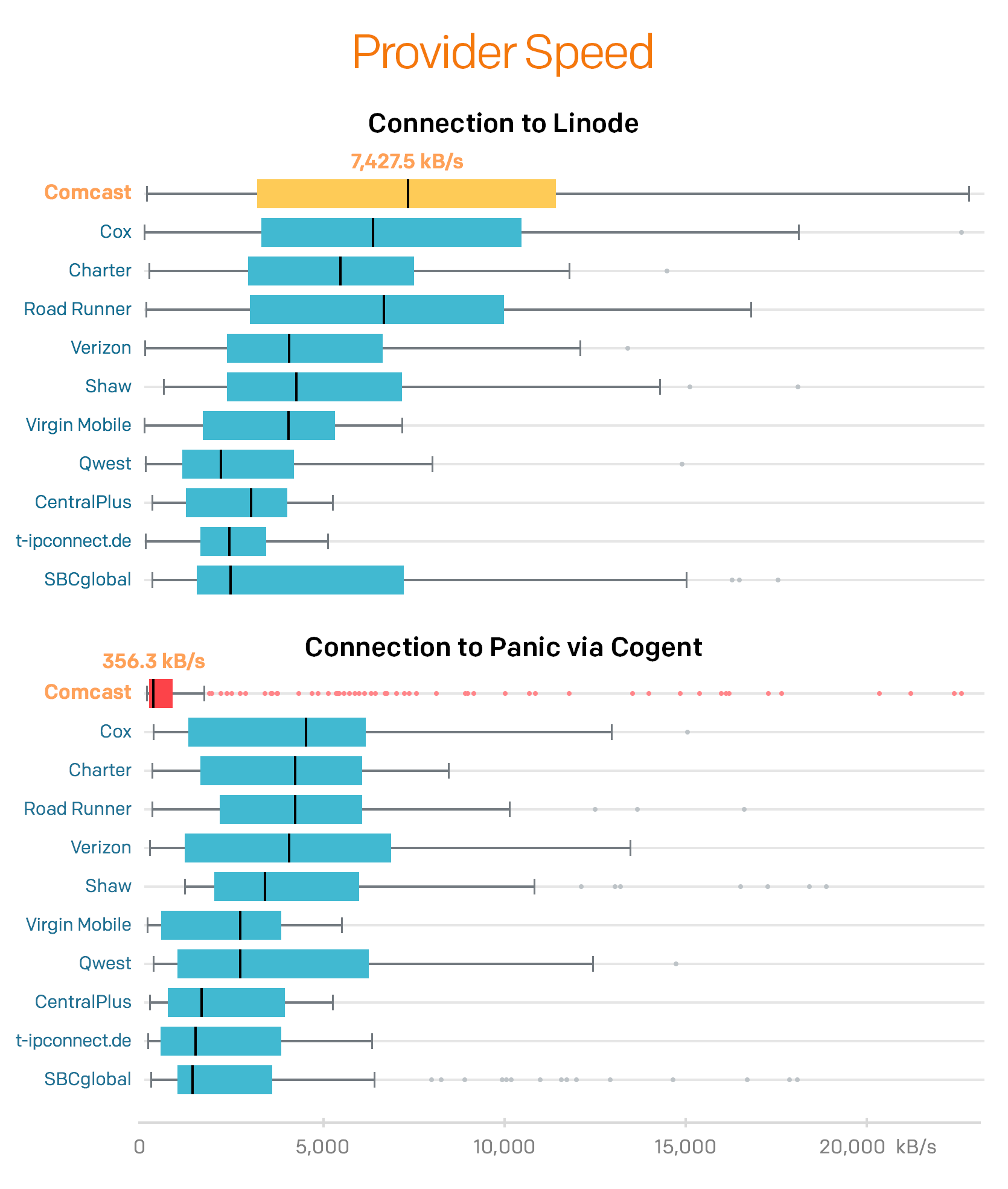
Here’s what we got back, comparing how fast our users could download from our control server through Linode, and from our own servers through Cogent:

Graph comparing transfer speeds between servers

(There are 1,645 samples in our target range, after filtering out TLDs with fewer than 10 occurrences, and we’ve done a box plot, which shows a spread of all the data points.)

Well, well, well. It doesn’t take statistical genius to see one glaring outlier — and that was Comcast, with download speeds often being as low as 300 kilobytes/second. And you’ll never guess what provider is used by virtually every Panic employee when they work from home? Yeah, Comcast. There is, in fact, no other cable ISP available to Portland residents.

But, before jumping to conclusions, there was something else that was weird with the Comcast data: a huge number of outliers, way more outliers than any other provider. See all those red dots on the graph, ranging from very slow to very fast?

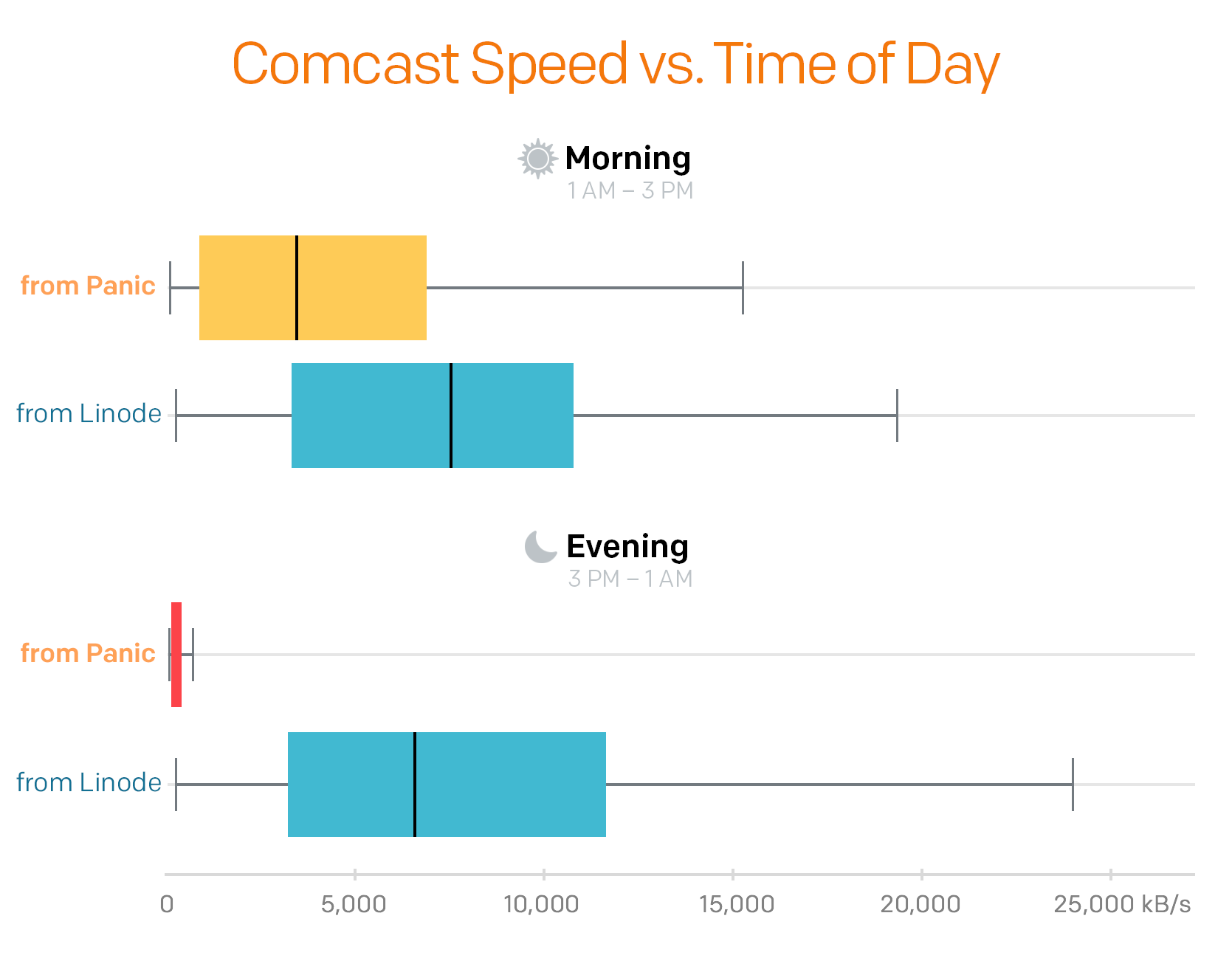
The answer to that mystery was solved when we plotted out Comcast data across different times of the day…

Graph of Comcast transfer speeds in the morning versus the evening

Nuts. The problem reports we’d been hearing were indeed a real thing.

Our downloads really were slow — but seemingly only to Comcast users, and only during peak internet usage times. Something was up.

At first we thought, maybe Comcast bandwidth is just naturally more congested in the evening as people come home from work and begin streaming Netflix, etc. But that didn’t explain why the connections to our Linode control server from Comcast, during the exact same time windows for each tester, were downloading with good speeds.

We wondered, is Comcast intentionally “throttling” Cogent customers? And if so, why?

The Why

Peering.

Major internet pipes, like Cogent, have peering agreements with network providers, like Comcast. These companies need each other — Cogent can’t exist if their network doesn’t go all the way to the end user, and Comcast can’t exist if they can’t send their customer’s data all over the world. One core tenet of peering is that it is “settlement-free” — neither party pays the other party to exchange their traffic. Instead, each party generates revenue from their customers. Cogent generates revenue from us. Comcast generates revenue from us at home. Everyone wins, right?

After a quick Google session, I learned that Cogent and Comcast have quite a storied history. This history started when Cogent started delivering a great deal of video content to Comcast customers… content from Netflix. and suddenly, the “peering pipe” that connects Cogent and Comcast filled up and slowed dramatically down.

Normally when these peering pipes “fill up”, more capacity is added between the two companies. But, if you believe Cogent’s side of the story, Comcast simply decided not to play ball — and refused to add any additional bandwidth unless Cogent paid them. In other words, Comcast didn’t like being paid nothing to deliver Netflix traffic, which competes with its own TV and streaming offerings. This Ars Technica article covers it well. (How did Netflix solve this problem in 2014? Netflix entered into a business agreement to pay Comcast directly. And suddenly, more peering bandwidth opened up between Comcast and Cogent, like magic.)

We felt certain history was repeating itself: the peering connection between Comcast and Cogent was once again saturated. Cogent said their hands were tied. What now?

The Fix

There was only one last hope: get Comcast to fix it. I know, like we were somehow going to convince this 200 billion dollar corporation to add more capacity to their interconnection with Cogent. If I asked you to rate the possibility of that actually happening on a scale of “no” to “never”, you’d probably pick “come on man are you serious”, right?

But after a lifetime of being a “hey, it’s worth a shot” guy, I had to try. I did a real quick Google search for Comcast corporate contacts and found a person who seemed like they were involved in network operations PR, and I fired off a quick e-mail explaining the situation to Comcast.

And then, the craziest thing happened…

They wrote back quickly. Not only that, but they were on it. We set up a phone call. They took us seriously, they wanted to know the backstory, they wanted to know what our customers were seeing, and they were going to talk to the right people — they even e-mailed Cogent to connect with the right person in peering over there.

And pretty soon a call came back with a definitive-sounding statement: “Give us 1 to 2 weeks, and if you re-run your test I think you’ll be happy with the results.”

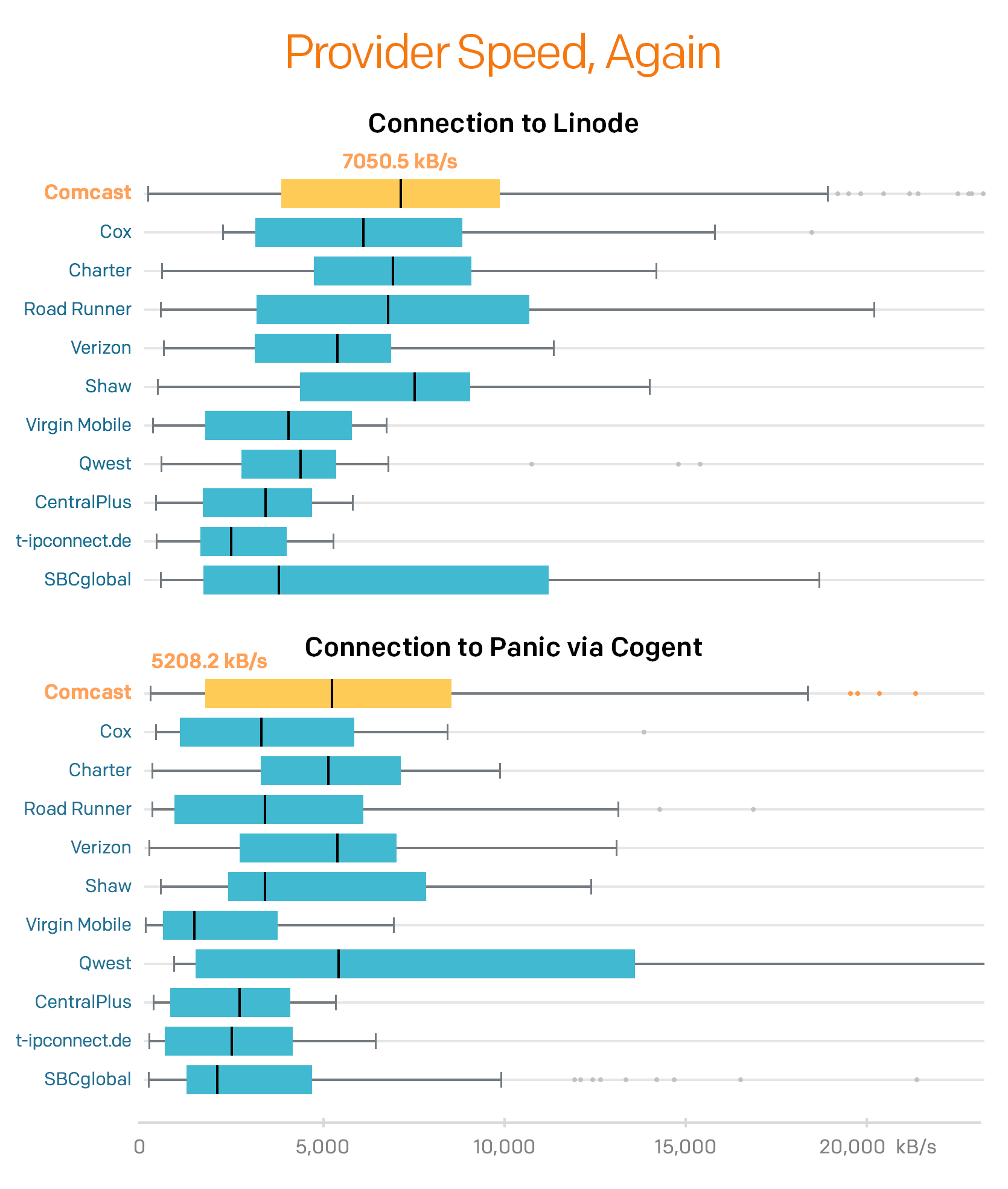
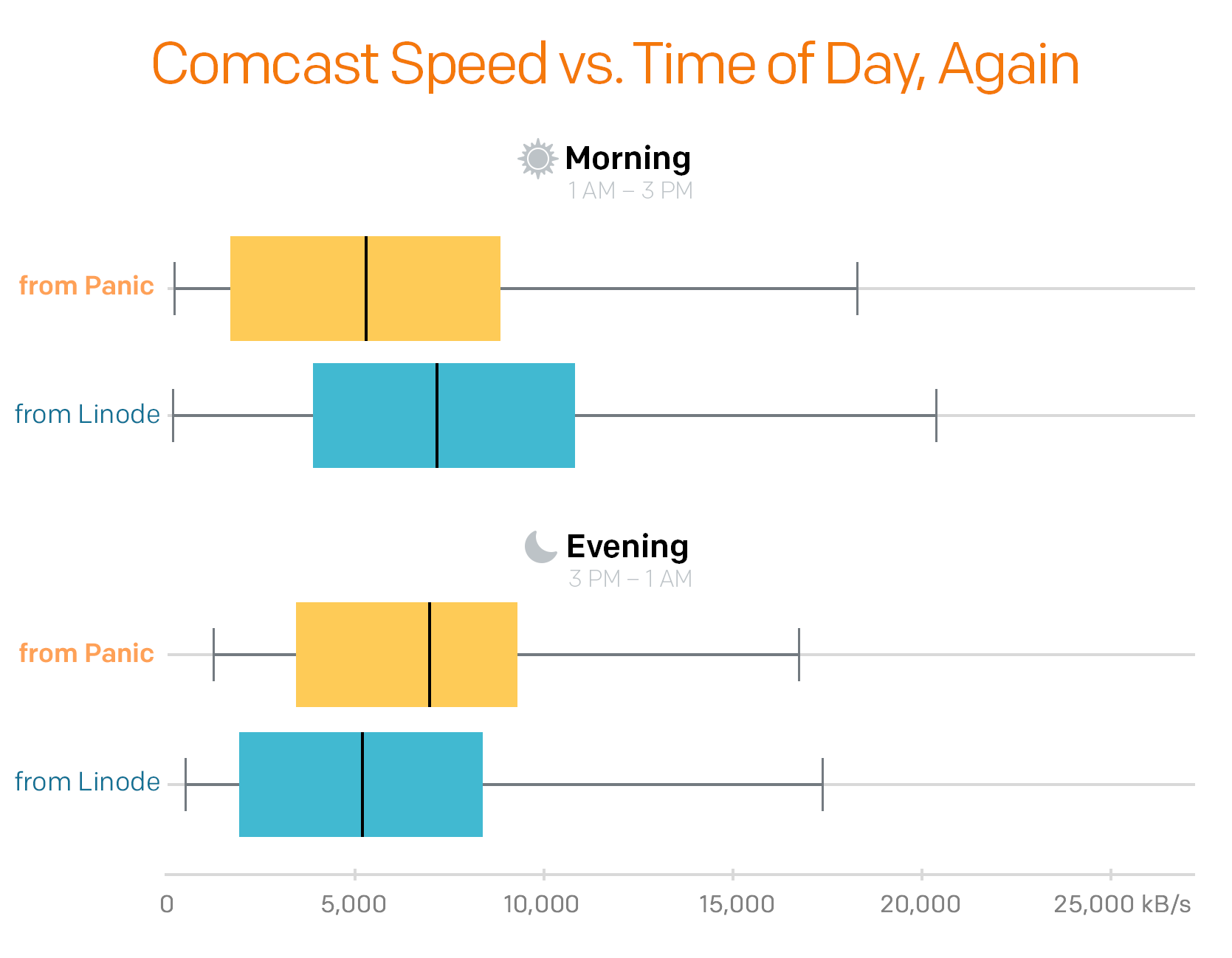
Sure enough, we waited two weeks, had our users re-run the speed test, and wouldn’t you know it…

Graph comparing transfer speeds of different ISPs

Graph comparing Comcast transfer speeds at different times of day

…the problem was essentially gone. Comcast really did fix it. We were now able to measure our Comcast download speeds in megabytes/second instead of kilobytes.

According to Comcast, two primary changes were made:

  1. Comcast added more capacity for Cogent traffic. (Exactly as we suspected, the pipe was full.)
  2. Cogent made some unspecified changes to their traffic engineering.

Here’s where I have to give Comcast credit where credit is due: they really did care about this problem, and they really did work quickly to make it go away.

(One weird thing, though: I was so prepared for a total Comcast dead-end, so sure that Comcast would never even reply, let alone help, that this incredibly positive outcome made me feel suspicious: why me? Why was I able to get this corrected with an e-mail when Cogent couldn’t?

It felt like there was no way this should have worked. If I had to guess, I’d say it’s simple: in the middle of a serious ongoing debate over net neutrality, the last thing Comcast wanted to look like was a network-throttling bad guy in this blog post. But then again, maybe I’m still being too cynical — maybe they just saw a problem they hadn’t noticed and fixed it. (But really, did they really not notice that pipe was full until I asked? Surely there are network monitoring tools?) Frankly, I have to stop thinking about it, because I’ll never know. But no matter the reason, I’m very grateful: thanks for listening to us, Comcast.)

What Does This All Mean

I’d summarize it as follows:

  • The internet is fragile — and that’s pretty scary.

And while this story amazingly had a happy ending, I’m not looking forward to the next time we’re stuck in the middle of a peering dispute between two companies. It feels absolutely inevitable, all the more so now that net neutrality is gone. Here’s hoping the next time it happens, the responsible party is as responsive as Comcast was this time.

Check Our Work

All of our data, our data analysis scripts, and more, is available at this GitHub repository. You can even click the button in the readme and it will take you to a running JupyterHub notebook where you can play with the data yourself, live in your browser. If you find any insights, or mistakes, please let us know.

06 Mar 21:17

Drupal hooks vs Drupal events

by Dries

Jonathan Daggerhart wrote a fantastic tutorial on Drupal 8's events system. I especially liked the comparison to Drupal's traditional hook system. When reading Jonathan's tutorial, I couldn't help but think how useful it would be to integrate it into Drupal's official documentation.

06 Mar 21:16

Why Is Brooklyn Barbecue Taking Over the World?

mkalus shared this story from Munchies.

After sitting down at the restaurant Pork in Barcelona, a long menu describing different preparations of pork is set before me. There is charcuterie made from Iberian pigs, various types of dry-aged sausages and chorizos, and slow cooked and grilled pork. Everything is sold by weight. There are also hanging Edison bulbs and the beer, brewed in conjunction with a cult brewer in Liverpool, is served by the jar or by growler. There are butcher knife tap handles in front of white subway tiles. After the waitress explains the menu to me, she says a restaurant in New York was the inspiration.

"In Brooklyn?" I ask.

She nods.

"Fette Sau?"

She nods again. I'm not surprised. This is the third time I've heard this in a year.

Fette Sau in Brooklyn. All photos by the author.

While I live in North Brooklyn and go to Fette Sau fairly regularly, is this right? Barbecue's Southern roots and finest pitmasters are a long way from New York, even though the city has grown by leaps and bounds in terms of its barbecue pedigree in recent years. Especially in Brooklyn. It's almost impossible to walk between Bedford Avenue and the East River without sniffing mesquite smoke. Since Fette Sau opened in 2007, nearly a dozen others have followed, several with pitmasters recruited from Central Texas or Kansas City. There's the excellent BrisketTown down the street from Fette Sau and Mighty Quinn's, who slings brisket or pulled pork sandwiches from a stand at Smorgasburg (as well as in a newer sit-down spot in Manhattan). There's Hometown Bar-B-Que in Red Hook, Fletcher's in Gowanus, and many others. The décor, for the most part, fits with a wider Brooklyn theme of details like subway tiles, exposed brick walls, Edison light bulbs and lengthy lists of craft beer and small batch bourbons. Brooklyn pitmasters tend to be less traditional than their counterparts in the South. They don't really follow any single barbecue philosophy and aren't so focused on beef brisket, like most of Texas tends to be. They may include items like house-cured pastrami or pork ribs or burnt ends. Most use heritage animals—free-range and hormone free—from small family farms within the region.

But now it's spreading, very quickly and without warning, to every fucking corner of the world. The barbecue being assimilated in places like Colombia, Spain, Panama, Sweden, England, and Japan (and even other parts of the US) is not the killer 'cue from fabled Texas BBQ cities like Lockhart or Austin. Or even the pork-centric versions with sauce in the southeast. It's an adapted form of Southern barbecue from Brooklyn. And it all looks like it came straight out of Williamsburg.

BBQ at Pork in Barcelona

"It's a little frustrating, to be perfectly honest," said Joe Carroll, who founded Fette Sau. While he's opened up a second location in Philadelphia and has an eye towards Europe, he's been contacted to open up branches in the Philippines and even Tel Aviv. "I think they just got fed up with dealing with us and said 'Fuck it,' and started doing it on their own."

"I think we started a wave of a more modern, urban, non-traditional BBQ," he said. When they launched, Carroll didn't have a BBQ background and wasn't interested in following the footsteps of the Carolinas, Memphis, or Texas. "That's not where my heart was," he said. He grew up in Northern New Jersey and wanted to create something that relates to the area.

"Ordering by weight is something done in Central Texas, but it is also something they do at New York delis," he said. "Even our rub has espresso in it. I mean what's more New York than that?"

Fette Sau's BBQ

It really doesn't matter where the hell I go now. There's a barbecue restaurant that reminds me of North Brooklyn. This doesn't have to be a bad thing though.

In Panama City I met up with one of town's top chefs, Mario Castrellón, best known for his restaurant, Maito, which has helped launch a wider Panamanian food revolution. Last year he opened up the BBQ-themed Humo after visiting Fette Sau. His is not the typical BBurg set up, rather the restaurant is set in a cool, canal-style house, though it does have butcher shop art on the walls and a list of whiskies and craft beers. He has created something of his own Panamanian style of barbecue where he smokes brisket with native nance wood and incorporates other native, non-traditional items like octopus or smoked queso fresco on to the menu, which relies on set dishes rather than being sold by weight. You would be pressed to find someone that didn't enjoy their experience there and it fits perfectly in Panama City, which is already inflected with global influences.

Humo in Panama

"Brooklyn BBQ is more stylish, more loose," he said. "It lets you break from traditional Texas or Kansas City BBQ. It's more of a blend of every style, which lets you play around with every recipe rather than following a straight-up traditional recipe."

Last year I walked into La Fama—which calls itself the first Southern North American BBQ restaurant in Bogota —where the strings of Edison bulbs, picnic table style seating, and exposed brick walls had me second guessing exactly where I was. My mind was officially blown when I learned the restaurant even hired Tom Mylan and Brett Young from cult butcher shop The Meat Hook in Williamsburg to help them set up and create their own style of Colombian BBQ.

"The whole La Fama experience was so weird and awesome," said Mylan. "We ended up there by chance. They came through the shop and struck up a conversation with Sara, our GM, and one thing lead to another until we were doing a tasting for them on my partner Brent's deck a few months later—and the next thing we knew, we were on a plane."

When they arrived, they realized that Colombia had no hickory or post oak or mesquite. There was no kosher salt. There was no brown sugar for the rub. The beef was not even the same species. They had to improvise. For instance, my favorite cut there was the morrillo, which I have definitely not seen in Brooklyn. It's the hump of the most typical cow in Colombia. They smoke it and sell it by weight along with brisket and pork ribs.

"It was all Bos indicus with the hump and the floppy ears, a tropical breed of cattle called zebu with no intramuscular fat…except in the hump, which is why we chose to use the hump instead of brisket. It was a BBQ guys wet dream: spider-webbed with fat, compact, and honestly the best cut to make beef BBQ with I've ever seen."

Humo in Panama

Few would argue that the barbecue being served in Brooklyn is better than in Texas, so why is a Kings County adaptation that is already a bastardized adaptation the one that is furthering the cause?

"BBQ here [in Brooklyn] can be whatever you want it to be and your BBQ place can look like whatever you want it to look like," says Mylan. "In the last ten years Brooklyn has really loved taking something with a long tradition elsewhere and fucking with that trope, whether you're talking the dive bar, soul food, French bistro, Mexican cantina, diner, or BBQ. Results are variable and some things perhaps are better left unmolested, but, through Brooklyn (and NYC in general), a pathological desire to rework these tropes has given the rest of the world carte blanche to fuck with things like BBQ as well, and adapt that type of food to the local diners preferences."

I wonder what would happen if someone tried to imitate the inimitable Aaron Franklin in Buenos Aires, calling their brisket "Austin-style." Would there be outrage? Cries of heresy? Maybe it is just that the Brooklyn brand is already so exploited that no one really gives a shit anymore?

This post originally appeared on MUNCHIES in June 2014.

06 Mar 21:15

These Weeks in Firefox: Issue 33

by kit

Highlights

Context menu for Top Sites section in Activity Stream

Screenshot of new

Friends of the Firefox team

Project Updates

Add-ons

Activity Stream

  • Highlights include “Saved to Pocket” cards with more caching heuristics incoming.
  • Reevaluating approach for about:preferences move to incorporate Fluent.

Browser Architecture

Lint

Policy Engine

Performance

Privacy/Security

Screenshot of new

Search and Navigation

Address Bar & Search

Places

More

Sync / Firefox Accounts

Test Pilot

  • Incoming: theme creator experiment shipping soon; tab split experiment exploring a rewrite. Both experiments set to launch in Q2.
  • Outgoing: Cliqz, Voice Fill, Snooze Tabs, Min Vid graduating Q1.
  • Min Vid SHIELD study launching soon.
  • Screenshots:
    • Usage steady at 2.8M MAU, 62M+ shots as of today.
    • Lots of bug fixes exported into the tree recently (bug 1436218); another release landing in 60, pending QA (bug 1440524).
    • ICYMI: rad Screenshots article on Firefox blog last week (bug filed to put that YouTube video on the screenshots homepage 🙂
    • Lo-fi user research happening this week on discoverability & onboarding.
    • Annotations shipping soon: edit, highlight, & draw on uploaded shots
    • Here’s a usage graph, now with all the shot types:

Graph of Screenshots usage, with breakdowns by event type

Web Payments

06 Mar 21:15

You Gotta Read This

by noreply@blogger.com (BOB HOFFMAN)

I was sitting at my desk doing whatever the hell it is a creative director does, when my associate creative director walked in.

"You gotta read this," he said.

"What is it?"

"A letter from a copywriter."

"We don't need a copywriter," I said.

"I know. But you gotta read this."

So I read it. By the end of reading the letter we were both laughing out loud and had invited the writer in for an interview. In the fullness of time, she became the chief creative and president of our agency.

Recently, a friend asked me to critique a cover letter he was writing for a job application. The letter was perfectly fine. It stated its case nicely, it was well-written, and it was articulate. But it was indistinguishable from a hundred other letters the prospective employer was likely to get.

My advice to him was this: Someone's going to open this letter and do one of two things - put it in a file with all the other letters or bring it to one of her colleagues and say, "you gotta read this."

If she puts it in the file you still have a chance of getting the job. If she takes it to a colleague and says, "you gotta read this" your chances just tripled.

Today, it is said, we do a lot less reading than we used to. I don't know if that's true. But one thing I do know, ironically we do a lot more writing. All day long we are writing emails, decks, texts, ads, tweets (god help us), content (god double-extra help us), strategies... some of us poor bastards even write blog posts. And most of it is crap.

That's okay because most of the time it doesn't need to be anything other than crap. But once a day or once a week or once in a while you have to write something really important. I'm sure there are a thousand somber posts on LinkedIn telling you how to write something really important. It's all bullshit.

There is only one objective you should have when writing something really important. You want one person to take it to another person and say, "you gotta read this."

06 Mar 21:14

Vico

by Rui Carmo

At the time of this writing, Vico is an evolving programmers’ editor with vi key bindings and support for TextMate bundles.


05 Mar 22:48

How to Rands

by rands

Hi, welcome to the team. I’m so glad you are here at $COMPANY.

It’s going to take a solid quarter to figure this place out. I understand the importance of first impressions, and I know you want to get a check in the win column, but this is a complex place full of equally complex humans. Take your time, meet everyone, go to every meeting, write things down, and ask all the questions – especially about all those baffling acronyms and emoji.

One of the working relationships we need to define is ours. The following is a user guide for me and how I work. It captures what you can expect out of the average week working with me, how I like to work, my north star principles, and some of my, uh, nuance. My intent is to accelerate our working relationship with this document.1

Our Average Week

We’ll have a 1:1 every week for at least 30 minutes no matter what. This meeting discusses topics of substance, not updates. I’ve created a private Slack channel for the two us of to capture future topics for our 1:1s as well as to provide a handy historic record of what we’ve discussed. When you or I think of a topic, we dump it in that channel.

We’ll have a staff meeting with your peers every week for 60 minutes no matter what. Unlike 1:1s, we have a shared document which captures agenda topics for the entire team. Similar to 1:1s, we aren’t discussing status at this meeting, but issues of substance that affect the whole team.

You can Slack me 24 hours a day. I like responding quickly.

If I am traveling, I will give you notice of said travel in advance. All our meetings still occur albeit with time zone considerations.

I work a bit on the weekends. This is my choice. I do not expect that you are going to work on the weekend. I might Slack you things, but unless the thing says URGENT, it can always wait until work begins for you on Monday.

North Star Principles

Humans first. I believe that happy, informed, and productive humans build fantastic product. I optimize for the humans. Other leaders will maximize the business, the technology, or any other number of important facets. Ideological diversity is key to an effective team. All perspectives are relevant, and we need all these leaders, but my bias is towards building productive humans.

Leadership comes from everywhere. My wife likes to remind me that I hated meetings for the first ten years of my professional career. She’s right. I’ve wasted a lot of time in poorly run meetings by bad managers. As an engineer, I remain skeptical of managers even as a manager. While I believe managers are an essential part of a scaling organization, I don’t believe they have a monopoly on leadership, and I work hard to build other constructs and opportunities in our teams for non-managers to effectively lead.

I see things as systems. I reduce all complex things (including humans) into systems. I think in flowcharts. I take great joy in attempting to understand how these systems and flowcharts all fit together. When I see large or small inefficiencies in systems, I’d like to fix them with your help.

It is important to me that humans are treated fairly. I believe that most humans are trying to to do the right thing, but unconscious bias leads them astray. I work hard to understand and address my biases because I understand their ability to create inequity.

I heavily bias towards action. Long meetings where we are endlessly debating potential directions are often valuable, but I believe starting is the best way to begin learning and make progress. This is not always the correct strategy. This strategy annoys those who like to debate.

I believe in the compounding awesomeness of continually fixing small things. I believe quality assurance is everyone’s responsibility and there are bugs to be fixed everywhere… all the time.

I start with an assumption of positive intent for all involved. This has worked out well for me over my career.

Feedback Protocol

I firmly believe that feedback is at the core of building trust and respect in a team.

At $COMPANY, there is a formal feedback cycle which occurs twice a year. The first time we go through this cycle, we’ll draft a proposed set of OKRs for you for the next review period. These are not product or technology OKRs; these are professional growth OKRs for you. I’ll send you these draft OKRs as well as upward feedback from your team before we meet so you can review beforehand.

In our face-to-face meeting, we’ll discuss and agree on your OKRs for the next period, and I’ll ask for feedback on my performance. At our following review, the process differs thusly: I’ll review you against our prior OKRs, and I’ll introduce new OKRs (if necessary). Rinse and repeat.

Review periods are not the only time we’ll exchange feedback. This will be a recurring topic in our 1:1s. I am going to ask you for feedback in 1:1s regularly. I am never going to stop doing this no matter how many times you say you have no feedback for me.

Disagreement is feedback and the sooner we learn how to efficiently disagree with each other, the sooner we’ll trust and respect each other more. Ideas don’t get better with agreement.

Meeting Protocol

I go to a lot of meetings. I deliberately run with my calendar publicly visible. If you have a question about a meeting on my calendar, ask me. If a meeting is private or confidential, its title and attendees will be hidden from your view. The vast majority of my meetings are neither private nor confidential.

My definition of a meeting includes an agenda and/or intended purpose, the appropriate amount of productive attendees, and a responsible party running the meeting to a schedule. If I am attending a meeting, I’d prefer starting on time. If I am running a meeting, I will start that meeting on time. If it’s not clear to me why I am in a meeting, I will ask for clarification on my attendance.

If you send me a presentation deck a reasonable amount of time before a meeting, I will read it before the meeting and will have my questions at the ready. If I haven’t read the deck, I will tell you.

If a meeting completes its intended purpose before it’s scheduled to end, let’s give the time back to everyone. If it’s clear the intended goal won’t be achieved in the allotted time, let’s stop the meeting before time is up and determine how to finish the meeting later.

Nuance and Errata

I am an introvert and that means that prolonged exposure to humans is exhausting for me. Weird, huh? Meetings with three of us are perfect, three to eight are ok, and more than eight you will find that I am strangely quiet. Do not confuse my quiet with lack of engagement.

When the 1:1 feels over, and there is remaining time I always have a couple of meaty topics to discuss. This is brainstorming, and the issues are usually front-of-mind hard topics that I am processing. It might feel like we’re shooting the shit, but we’re doing real work.

When I ask you to do something that feels poorly defined you should ask me for both clarification and a call on importance. I might still be brainstorming. These questions can save everyone a lot of time.

Ask assertive versus tell assertive. When you need to ask me to do something, ask me. I respond incredibly well to ask assertiveness (“Rands, can you help with X?”). I respond poorly to being told what to do (“Rands, do X.”) I have been this way since I was a kid and I probably need therapy.

I can be hyperbolic but it’s almost always because I am excited about the topic. I also swear sometimes. Sorry.

I love to start new things but I often lose interest when I can mentally see how the thing is going to finish which might be weeks or month the thing is actually done. Sorry. I’m getting better at this.

If I am on my phone during a meeting for more than 30 seconds, say something. My attention wanders.

Humans stating opinions as facts are a trigger for me.

Humans who gossip are a trigger for me.

This document is a living breathing thing and likely incomplete. I will update it frequently and would appreciate your feedback.


  1. Speculation: there is an idea in this document that you’d like your manager to do. Thesis: Just because I have a practice or a belief doesn’t mean it’s the right practice or belief for your manager. Suggestion: Ask your manager if they think my practice or belief is a good idea and see what happens. Feedback is a gift. 
05 Mar 22:47

Skype will be optimized for devices running Android 4.0.3 to 5.0

by Dean Daley

Microsoft-owned video chat service Skype has announced that it will start rolling out an update aimed at optimizing its Android app for devices running Android 4.0.3 Ice Cream Sandwich to Android 5.0 Lollipop worldwide.

Skype will push out an update in the coming weeks that aims to make the app lighter on both disk and memory consumption.

According to Skype, this update will allow for greater speeds and better audio and video quality on lower-end Android handsets. Additionally, the update will increase performance in weak network conditions.

Anyone interested in trying out the latest version of Skype for Android today can sign up for the Skype Insiders Program.

Source: Skype 

The post Skype will be optimized for devices running Android 4.0.3 to 5.0 appeared first on MobileSyrup.

05 Mar 22:47

Getting rear ended in Belgrade

by Ton Zijlstra

This afternoon I worked with my Serbian-Dutch colleague Vid on designing a study to estimate open data potential in Serbia. After a quick chat with one of his colleagues I grabbed a taxi from down-town Belgrade joining the evening rush hour traffic back to my hotel across the river. As we queued to get onto the highway towards the bridge another car bumped into us from behind. Although it basically was without much speed, it was still good I was wearing my seat belt in the back. My driver did not speak any English, which is about the same as the amount of Serbian as I can command. So while I was asking him what was going to happen, he said something along the lines ‘sorry police’ and got on his radio. In Serbia all traffic incidents need to involve the police. After his short radio conversation he said something to me in Serbian that I did not understand and gestured, which I intuitively took to mean he had just radioed another cab for me. Then he got on the phone, with what sounded like the police, as he mentioned the road we were on and started spelling his name. While he was on the phone another cab from the same company weaved its way through the traffic jam (that we ourselves were partly causing), and stopped 2 lanes away. I smiled sympathetically to the clearly unhappy driver that rear ended us, and shook the cab drivers hand and wished him well after his phone call to the police. I hopped skipped and jumped across the two slow moving adjacent lanes and got into the second taxi, swiftly leaving the scene of the incident. With just a minor delay I returned to the hotel.

05 Mar 22:45

Analysts, the Dunning-Kruger Effect, and the Gartner Hype Cycle

by Josh Bernoff

A little knowledge is dangerously misleading. That’s the message of the Dunning-Kruger effect, in which ignorant people think they’re smart. It’s the message of the Gartner Hype Cycle, in which people get overenthusiastic about new technologies. And it’s the reason that analysts, over and over again, get overenthusiastic about whatever’s new. In 1999, the psychologists … Continued

The post Analysts, the Dunning-Kruger Effect, and the Gartner Hype Cycle appeared first on without bullshit.

05 Mar 22:45

Koodo increases cost of BYOD, Tab Small, Tab Large rate plans by $5

by Sameer Chhabra
koodo mobile

Telus flanker brand Koodo seems to have increased its rate plan prices by $5 CAD.

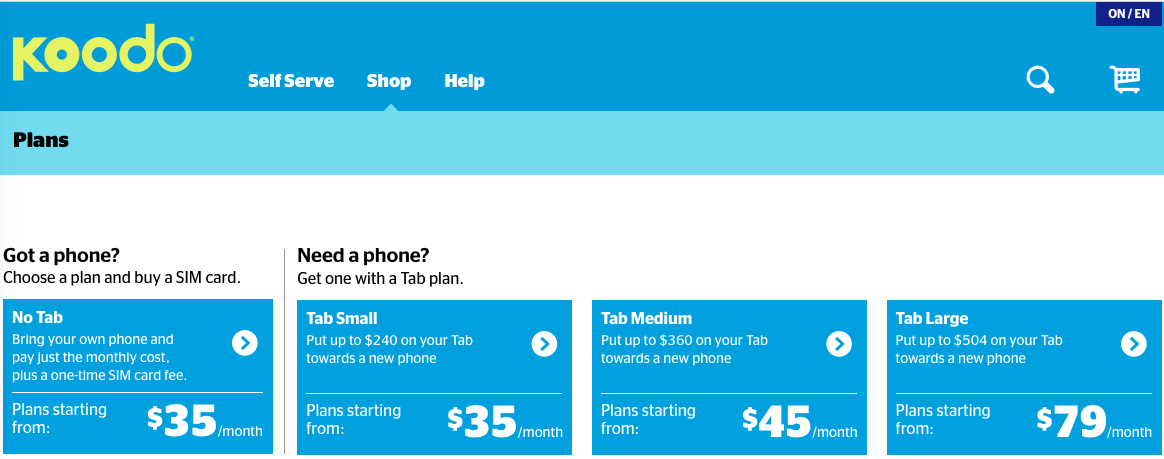
When customers visit Koodo’s website, they’ll notice that the cost of a bring-your-own-device (BYOD) plan, as well as the base costs of Tab Small, and Tab Large plans, has increased by $5.

Interestingly enough, the cost of a Tab Medium plan remains unchanged.

Unlimited Canada-wide calling that was present on some BYOP plan has now been eliminated, while unlimited Canada-wide calling is now only exclusive to Tab Large plans and some pay-per-use data plans.

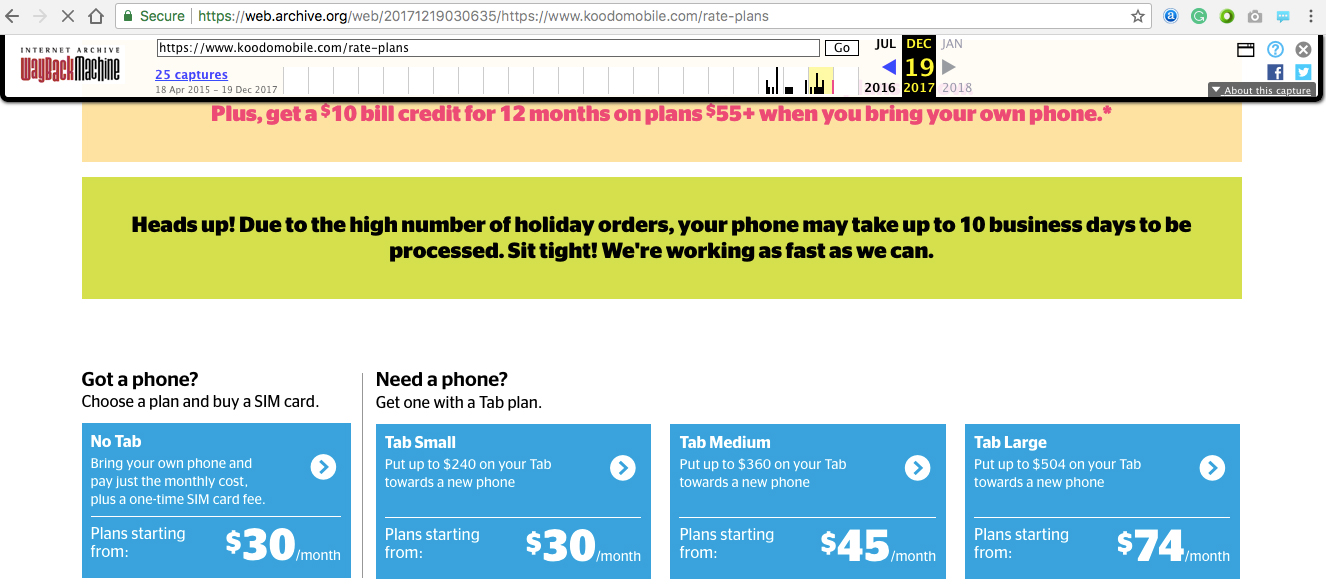
Checking the Internet Archive’s Wayback Machine reveals that, as of December 19th, 2017, all of the aforementioned Koodo plans — excluding the Tab Medium plan, of course — cost $5 cheaper than they cost as of March 5th, 2018.

A Telus spokesperson explained to MobileSyrup that these price changes are not a “$5 increase of the old suite, rather this is a new suite with new data options.”

“Koodo communicated an end date of end of day yesterday on all promo plans that we had in market last week,” Telus said.

“Koodo is now offering new promo plans with some new data buckets to choose from to help meet the wants and needs of our customers.”

Update 05/03/2018 (4:46pm ET): Story updated with comment from Telus.

The post Koodo increases cost of BYOD, Tab Small, Tab Large rate plans by $5 appeared first on MobileSyrup.

05 Mar 22:45

Slack vs Watson Workspace Load Times

by Volker Weber

They are both built using Electron. I have no idea what IBM is doing here.

Update: Not as terrible on the Mac as on Windows. So this may be fixable. Version 1.0.53 on both Mac and Windows.

05 Mar 22:45

Qihoo 360’s short video app caught red-handed stealing content and more

by Nicole Jao
Qihoo 360’s new video streaming platform Kuaishipin (快视频 translated roughly to ‘fast video’) issued an official apology on Weibo to Bilibili creators today over the recent content theft allegations, our sister site TechNode Chinese is reporting. Kuaishipin, launched by the Chinese internet security company Qihoo 360 last November, is a video streaming platform for 1-3 minute […]
05 Mar 22:44

Apple will embrace or abandon self-driving vehicle technology within the next two years, says reports

by Brad Bennett
Apple car header from twitter user @idiggapple

Rumours have been swirling for years that Cupertino computing giant Apple is working on a self-driving car, and analysts now predict that the company will either be in or out of the self-driving car market within the next two years.

In report obtained by AppleInsider, Robert Cirha — part of investment firm Guggenheim’s securities technology, media and telecommunications research team — said that Apple is a company with very strong virtually integrated control. As a result, it’s unlikely that Apple would sell modular AI to third-parties, meaning that the company will likely either commit and build a car, or scrap the entire project.

If Apple does make a car, it will put the company in competition with the likes of Tesla and other car manufactures, leapfrogging Google’s self-driving car technology that works by attaching itself to existing vehicles rather than attaching to a vehicle specifically manufactured by Google.

Building a full car would follow Apple’s design philosophy, allowing the company to control both the vehicle’s hardware and software. This strategy would also likely result in Apple running into obstacles in terms of finding manufacturing partners.

This analysis makes sense for a few reasons, because many car manufacturers already invest money to establish their own self-driving tech. Toyota recently announced plans to spend $2.8 billion USD to develop its own self-driving software.

It seems like car manufacturers are not in the market to adopt self-driving technology from other companies, but are aiming to develop the underlying technology that powers autonomous vehicles.

The AppleInsider report is at odds with a recent report from Bloomberg, which says that Apple has scaled back its plans to supply third-party vehicle manufacturers with Cupertino’s own self-driving technology.

Both of these reports state that Apple is working on something in the car space, though the tech giant still hasn’t confirmed that it’s working on an automotive project.

Source: The VergeAppleinsider, Reuters 

Photo credit: Twitter user @idiggapple

The post Apple will embrace or abandon self-driving vehicle technology within the next two years, says reports appeared first on MobileSyrup.

05 Mar 19:32

Lessons From Spotify

by Ben Thompson

The two dominant business models for venture-backed startups are advertising for consumer-focused companies, and Software-as-a-Service (SaaS) for business-focused ones. On one level, these business models are quite different: the former gives away software for free with the hope of convincing a third party to pay for access to users; the latter charges some portion of users directly. The underlying economics of both, though, are more similar than you might think — indeed, both are very much in line with venture-backed startups of the past.

Venture Outcomes

Silicon Valley is, unsurprisingly given the name, built on silicon-based computer chips, and that goes for Silicon Valley venture capital, as well. Silicon-based chips have minimal marginal costs — sand is cheap! — but massive fixed costs: R&D on one hand, and the equipment to actually make the chips on the other. And while those two costs live on different parts of the income statement — the latter is a cost of revenue that impacts gross margins, while the former is “under the line” and an operational cost that only impacts overall profitability — the fundamental economic rationale for taking on venture capital is the same: spend a lot of money up-front to develop and build a product, and take advantage of minimal marginal costs to make it up in volume.

You can see how this model translated perfectly to software: marginal costs were even lower, and an even greater percentage of costs were R&D. Companies needed lots of money to get started, but those that succeeded could generate returns that vastly exceeded the amount of investment. This is certainly the case for today’s business models.

Advertising-based consumer companies spend huge amounts on R&D building products that appeal to users, although usually not a lot on sales and marketing to acquire users; consumer companies that break through to the scale necessary to support advertising rely on viral network effects. Where the sales and marketing spend comes is in courting advertisers; however, the most valuable consumers companies of all — the super-aggregators — generate the same sort of network effects allowing them to add advertisers in a scalable way as well.

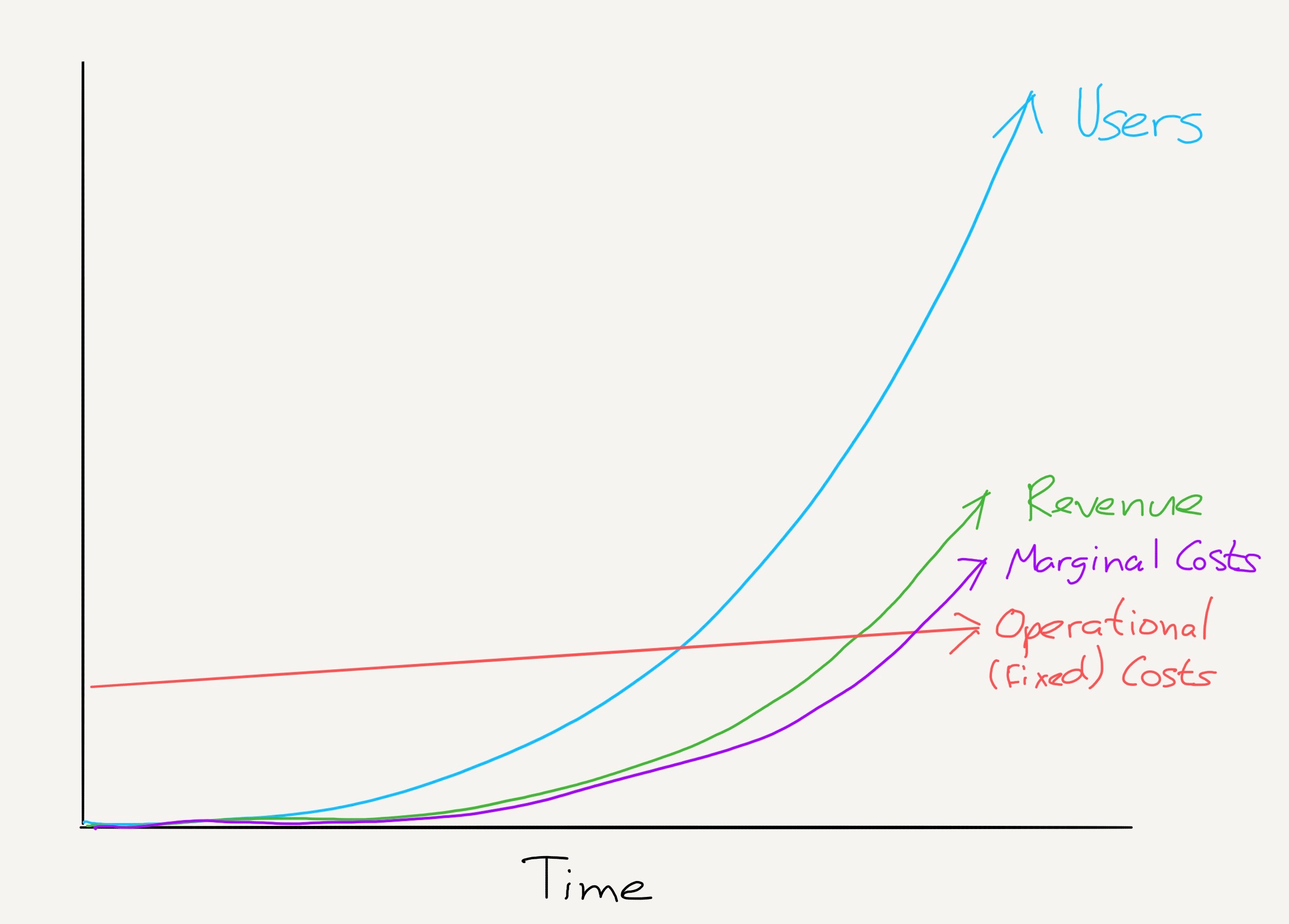
This produces the ideal venture outcome: a company where users and revenue grow far more quickly than costs.

Graph of a Venture Company's Costs

Again, this is possible because there are minimal marginal costs — more users are not necessarily more expensive. Of course fixed costs grow over time, but they only grow linearly — earning ever-increasing revenue on a relatively stable cost basis is the definition of scale.

SaaS businesses have the same sort of profile — the big difference is that revenue comes from users, and thus sales and marketing expenses are spent on gaining said users, not advertisers, but minimal marginal costs are the common thread.

Spotify’s Operational Costs

In The Business of SaaS, one of the guides offered by Stripe Atlas, Patrick McKenzie writes:

Margins, to a first approximation, don’t matter. Most businesses care quite a bit about their cost-of-goods-sold (COGS), the cost to satisfy a marginal customer. While some platform businesses (like AWS) have material COGS, at the typical SaaS company, the primary source of value is the software and it can be replicated at an extremely low COGS. SaaS companies frequently spend less than 5~10% of their marginal revenue per customer on delivering the underlying service.

This allows SaaS entrepreneurs to almost ignore every factor of their unit economics except customer acquisition cost (CAC; the marginal spending on marketing and sales per customer added). If they’re quickly growing, the company can ignore every expense that doesn’t scale directly with the number of customers (i.e. engineering costs, general and administrative expenses, etc), on the assumption that growth at a sensible CAC will outrun anything on the expenses side of the ledger.

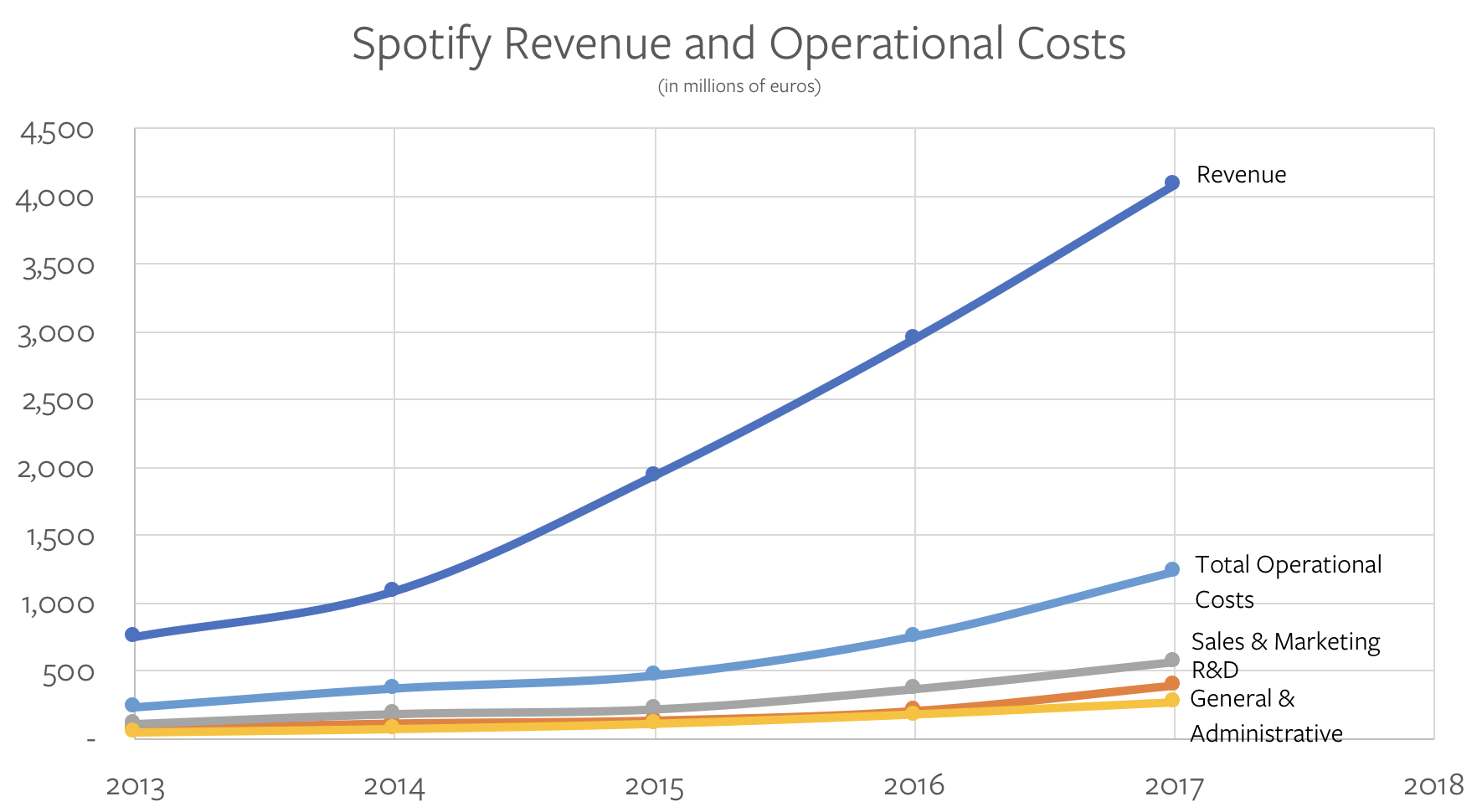
In other words, operational costs don’t matter in the long run, which is good news for Spotify, a venture-backed company with definite SaaS characteristics that filed for a direct listing last week. Spotify has increased monthly active users by 43% over the last three years and revenue by 448% over the last five; its fixed costs have largely tracked revenue:

SPOTIFY REVENUE AND FIXED COSTS (IN MILLIONS OF EUROS)
Revenue R&D (% Rev) S&M (% Rev) G&A (% Rev) Total (% Rev)
2013 746 73 (10%) 111 (15%) 42 (6%) 226 (30%)
2014 1,085 114 (11%) 184 (17%) 67 (6%) 365 (34%)
2015 1,940 136 (7%) 219 (11%) 106 (5%) 461 (26%)
2016 2,952 207 (7%) 368 (12%) 175 (6%) 750 (25%)
2017 4,090 396 (10%) 567 (14%) 264 (6%) 1,227 (30%)

This looks like a well-managed SaaS company:

Spotify Revenue and Operational Costs

There’s just one problem: Spotify’s marginal costs.

Spotify’s Marginal Cost Problem

It is not exactly groundbreaking analysis to note that Spotify has significant marginal costs — specifically, the royalties it pays the music industry (not just record labels but also songwriters and publishers). Those are represented by Spotify’s Cost of Revenue:

Spotify Revenue and Cost of Revenue

Spotify negotiated new deals with the record labels last summer that resulted in lower royalty rates in exchange for guaranteed subscriber growth and the ability for the labels to make some releases exclusive to Spotify’s paid tier; you can see those lower rates reflected in Spotify’s increased margins.

Spotify’s Missing Profit Potential

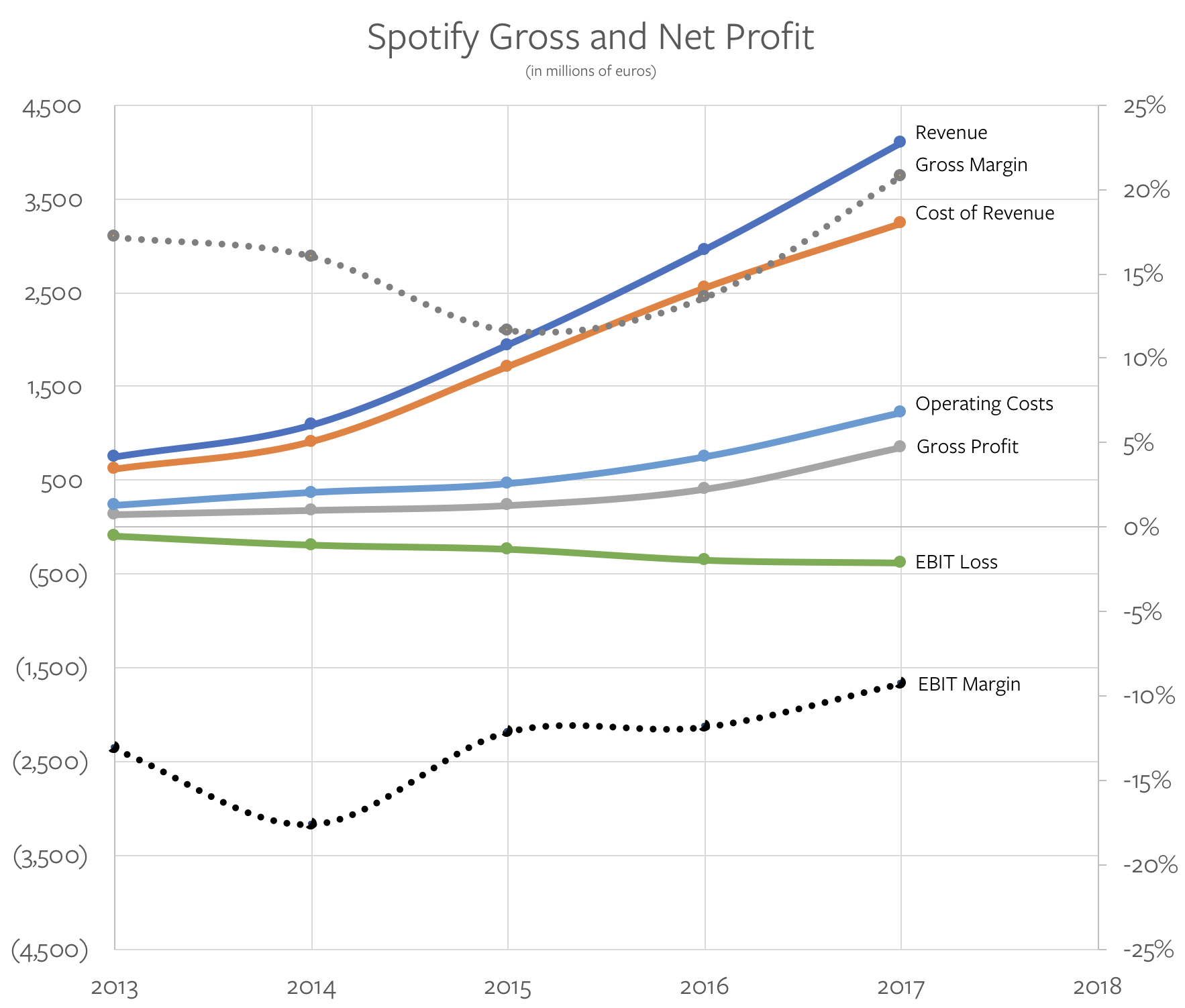
That, though, is precisely the problem: Spotify’s margins are completely at the mercy of the record labels, and even after the rate change, the company is not just unprofitable, its losses are growing, at least in absolute euro terms:

Spotify Gross and Net Profit

Moreover, it seems highly unlikely Spotify’s Cost of Revenue will improve much in the short-term: those record deals are locked in until at least next year, and they include “most-favored nation” provisions, which means that Spotify has to get Universal Music Group, Sony Music Entertainment, Warner Music Group, and Merlin (the representative for many independent labels), which own 85% of the music on Spotify as measured by streams, to all agree to reduce rates collectively. Making matters worse, the U.S. Copyright Royalty Board just increased the amount to be paid out to songwriters; Spotify said the change isn’t material, but it certainly isn’t in the right direction either.

That leaves two options:

  • Most obviously Spotify could try and lower its operational costs. This, though, is harder than it might seem for two reasons: first, Spotify is already a pretty frugal company; Dropbox, for example, which filed its S-1 the same week, spends 77% of revenue on operational costs as compared to Spotify’s 30%.
  • Spotify could grow its revenue without increasing its operational costs. How, though, will it grow revenue if it cannot increase its spending on R&D and Sales & Marketing? The typical pattern for non-social network companies is for Sales & Marketing to grow less efficient over time, which means it would need to increase as a percentage of revenue, not decrease (and remember, Spotify can’t afford to miss its growth numbers or its royalty rates go up).

There is one more possibility: Spotify could one day cut out the labels altogether — the idea certainly makes sense on a conceptual level. Spotify is in one sense an aggregator, in that it increasingly controls access to music listeners, and to the company’s credit, it has demonstrated the ability to exercise power via its control of music discovery and popular playlists.

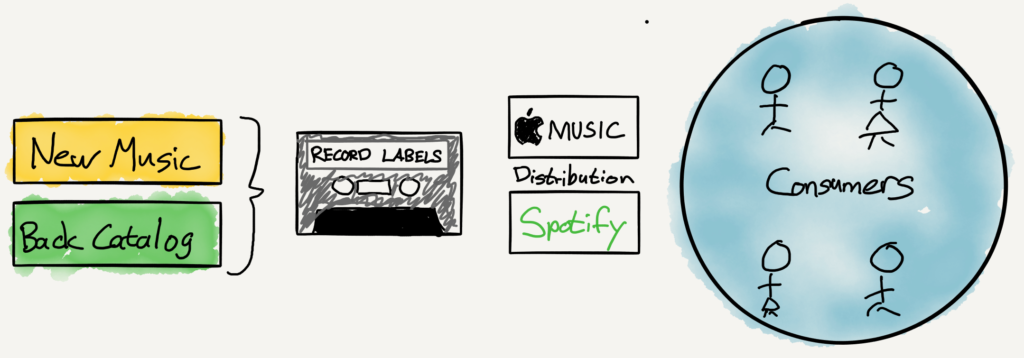
The problem is that the music labels, as I wrote in The Great Unbundling, have been strengthened by Spotify as well:

The music industry, meanwhile, has, at least relative to newspapers, come out of the shift to the Internet in relatively good shape; while piracy drove the music labels into the arms of Apple, which unbundled the album into the song, streaming has rewarded the integration of back catalogs and new music with bundle economics: more and more users are willing to pay $10/month for access to everything, significantly increasing the average revenue per customer. The result is an industry that looks remarkably similar to the pre-Internet era:

Notice how little power Spotify and Apple Music have; neither has a sufficient user base to attract suppliers (artists) based on pure economics, in part because they don’t have access to back catalogs. Unlike newspapers, music labels built an integration that transcends distribution.

Spotify is an impressive product and company, and CEO Daniel Ek and team deserve credit for reaching this point. Being a true aggregator, though, means gaining power over supply; Spotify doesn’t have that — the company doesn’t even have control over its marginal costs — and it’s hard to see where the profits come from.

Lessons from Spotify

The power of the record labels and the resultant linkage of Spotify’s marginal costs to its overall revenue certainly makes Spotify a unique case compared to most zero marginal cost venture-backed companies:

Graph of Company with Marginal Costs Linked to Revenue

It’s worth noting, though, that Spotify is hardly the only well-known startup that has its cost of revenue linked to total revenue — at least from a certain perspective. Over the last few years there has been a third model of startup that has emerged: the so-called sharing economy, or Assets-as-a-Service (AaaS). When you spend $10 on an Uber or Lyft ride, around $7 goes to the driver; when you spend $100 on an Airbnb, $85 goes to the host,1 and so on and so forth.

This isn’t how these companies necessarily keep their books, to be clear: the top line number should exclude whatever is paid out to the driver or host etc. When thinking about how these companies should be managed, though, the situation isn’t much different than Spotify. Specifically:

  • AaaS companies can’t assume that operational expenses are “free”, because gross marginal costs are going to eat up a huge portion of gross revenue growth.
  • AaaS companies should focus Sales & Marketing spending on increasing demand, and allow demand to draw supply. Doing it the other way — spending Sales & Marketing to increase supply in the hope of drawing demand — may make sense competitively, but it is a disaster financially, as the company is basically spending to increase its costs (imagine if Spotify were paying millions to court the record labels!)
  • AaaS companies that can’t lower their operational costs or grow revenue relatively faster than Sales & Marketing will be left rolling the dice on eliminating marginal costs entirely. Granted, self-driving cars or owned-and-operated apartments may both be more viable than getting rid of the record labels, but it still seems a better bet to become far more disciplined when it comes to operational costs.

I still believe in a future where Everything is a Service, and there’s no question that creating networks for everything will need a lot of venture capital. And make no mistake — there will continue to be capital available, because a network, once made, absolutely offers the sort of scalable revenue generation that makes generating significant profits an inevitability.

To that end, it is surely Spotify’s hope that the streaming market ends up being so big that the company’s low gross margin in percentage terms ends up large in absolute ones; even then those profits will come from operational excellence and efficient customer acquisition, not simply top-line growth.

  1. Minus service fees to cover payment processing
05 Mar 19:31

Der Plömp hat einen neuen Akku

by Volker Weber

IMG 2521

Unser Dyson DC30 wird liebevoll Plömp genannt, nach dem Geräusch, das er macht, wenn man den roten Schieber betätigt, der den Deckel des Staubbehälters freigibt. Beinahe sieben Jahre ist er alt und nun hat langsam der Akku schlapp gemacht. Das äußerte sich so, dass der Motor wie mit Intervallschaltung lief. Der Akku hatte zwar noch viel Spannung, lieferte aber nicht mehr genug Strom. Also habe ich bei Amazon nach Ersatzakkus gesucht und dann schließlich den billigsten gekauft. 28 statt 70 Euro, 2000 statt 1300 mAh. Das Gehäuse ist matt statt glänzend und das sieht sogar besser aus. Jetzt macht der Plömp wieder wüüüüüüüüüüh.

Die Akkus sind beim DC30 mit einem Tastendruck austauschbar und auch außerhalb aufzuladen. Man kann also auch mehr als einen kaufen, wenn die Kapazität nicht ausreicht. Geräte wie der DC30 taugen übrigens nur als Handstaubsauger, nicht aber um die ganze Bude zu saugen. Da empfehle ich immer noch den DC62 oder die Nachfolger V6 bis V8. Unser Hund wechselt zweimal im Jahr das Fell. Einmal von Januar bis Juni und das zweite Mal von Juli bis Dezember. Ich bin also gewissermaßen Staubsaugerexperte.

More >

05 Mar 19:31

Polite blogpost

by russell davies

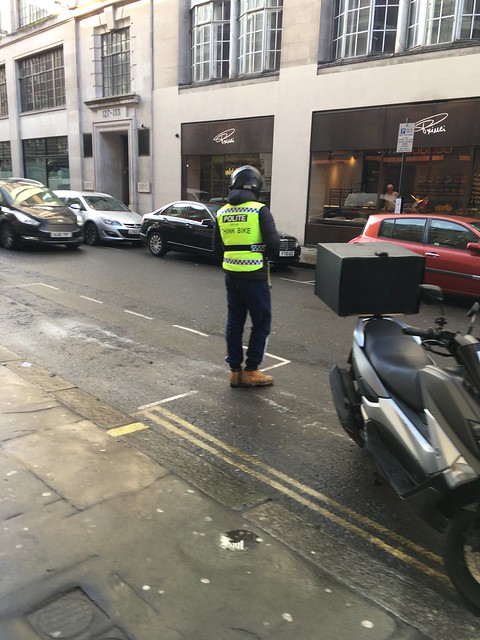
POLITE

Yesterday's newsletter. With bonus picture for the RSS crew...

I've long been fascinated by the Polite Notice signs you see, written in a semi-official font, trying to trick the quick glancer into thinking it is, in fact, a Police Notice. I remember seeing them a lot at the seaside when I was growing up in the 70s. People trying to stop tourists from parking in front of their garage.

Are there other examples of wide-spread societally-sanctioned punning? I hope so but I can't think of any.

Clearly, though, now, for many people, that original deceptive purpose is lost and they imagine that's just what you have to write on a notice. Like writing Dear Someone at the beginning of an email. And that maybe if it says Polite Notice then it will be seen as Polite. 

I was out for coffee this morning and I saw a moped rider who'd taken this to the next level. He was wearing a hi-viz jacket with POLITE written on the back in a bold police-y font. Apparently these are quite common. This approach seems more likely to actually achieve something - it'll get drivers to slow down in that reflexive way that seems to work for cardboard police officers.

It also conjured up the obvious ultimate end-state, people driving round in cars with checks and hi-viz markings, lights on the top and POLITE emblazoned on the side.

I might do that myself.


05 Mar 19:31

Digital Transformation: The Vision Thing

by MichaelE

In a previous post, we introduced three broad and important concepts—vision, alignment, and execution—and the 10 core digital transformation dimensions that fall into these areas. Here, we’ll dig into vision.

When we talk about vision in the context of digital transformation, we consider how an organization has the right mindset to achieve digital transformation, and whether leaders understand the scope and core concepts involved. It encompasses the following dimensions: Platform, APIs, Outside-In, and Ecosystem.

Platform

Modern businesses are agile: they combine and recombine software to repackage their core capabilities for new use cases, interaction models, and digital experiences. Legacy IT architectures and traditional systems integration techniques can’t achieve this kind of speed. A platform approach is required. Enterprises build platform capabilities by creating APIs that empower developers to leverage core systems and data to build new services and products.

Apigee customer Magazine Luiza, one of the top retailers in Brazil, has leveraged its API platform in numerous ways. In June 2016, for example, the brand launched a new digital marketplace that enables third parties to sell under the Magazine Luiza banner, with new participants entering the ecosystem via Magazine Luiza’s API platform.

This approach means the company incurs virtually no marginal cost to add new marketplace customers. Magazine Luiza’s marketplace dramatically expanded the company’s e-commerce capabilities, supplanting a legacy sales and distribution system that supported only 35,000 SKUs. As of late 2017, the marketplace offered over 1 million SKUs.

Magazine Luiza’s other platform initiatives include an ecosystem of mobile apps that enable new services, from an app for in-store associates that provides real-time inventory information and enables customers to pay on the spot to a logistics app that coordinates hundreds of delivery contractors across Brazil.

APIs

Modern, RESTful/JSON APIs are the backbone of a digital transformation. They encourage developer productivity by providing both programming flexibility and an intuitive, accessible interface for accessing core systems. Leading digital businesses typically recognize APIs as strategic assets—to be designed and managed as products that empower developers.

If an enterprise treats APIs as middleware—as a way to do systems integration or to expose assets—it can undermine virtually all of its digital transformation efforts.

Sophisticated organizations monetize their APIs by packaging them for the needs of different developers. When Apigee customer AccuWeather began designing APIs for individual external developers, for example, it recognized that some developers would need up-to-the-minute weather information, which would generate billions of API calls, whereas others would prefer daily forecasts, which impose a much lower data overhead. The company customized multiple API packages to let developers purchase according to their needs.

Outside-In

Successful digital businesses adopt an outside-in perspective that focuses on how customers and partners experience the brand. Our most successful customers are typically also those most fanatical about exceptional customer experiences.

Organizations that master this dimension use analytics to understand the needs of both customers and the developers translating APIs into experiences for those customers. Armed with this information, companies can produce a more relevant set of APIs and offer apps and experiences that seamlessly cut across product, service, and internal organizational boundaries.

Ecosystem

As the preceding examples demonstrate, digital ecosystems enable companies to focus on their strengths while relying on developers, partners, and other ecosystem participants for the infrastructure and services that turn those strengths into fully-featured digital experiences, expand the reach of those strengths, generate more demand, and facilitate entry into adjacent businesses.

This enables enterprises to distribute demand generation and value creation across potentially infinite digital networks. In many situations, it can also create network effects that cause momentum in one part of the ecosystem to spread elsewhere, creating the conditions for non-linear growth.

Competitive businesses recognize that ecosystem strategies are diverse—that a business doesn’t always need the gravitational center of an ecosystem to be successful. Often, rather than attempting to build a platform on the scale of Android or Facebook or attempting to be the central platform for an industry, companies grow simply by partnering with other ecosystem participants to expand their reach.  

APIs can enable ecosystem participation by enabling companies to combine and recombine software and data without friction—but only if those APIs are designed and managed for this purpose, with developer and partner ease-of-use in mind.

Pitney Bowes, for example, has expanded its ecosystem by offering productized APIs to developers via its Commerce Cloud, as mentioned above. The company also leverages the Android operating system for its SendPro C-Series of all-in-one mailing, shipping, and tracking solutions, opening the devices up to the ecosystem of Android developers.

It will soon launch an online marketplace, built with Google Cloud’s Orbitera platform, to deliver apps built around its services. These ecosystems of external software, infrastructure, and developers have combined with the company’s internal strengths in shipping, logistics, and technology to open new revenue opportunities that arguably wouldn't have been available without an ecosystem approach.

Coming up, we’ll delve into the next important digital transformation concept: alignment. And for more on these topics, check out the eBook, “The Digital Transformation Journey: Chart Your Path with Apigee Compass.

05 Mar 19:29

Tinderbox: Analyze, Organize, and Visualize Your Best Ideas [Sponsor]

by John Voorhees

Tinderbox is a powerful Mac app that stores and organizes your notes, plans, and ideas, bringing order and understanding to the vast amounts of information collected when you’re working on a big project. Whether that’s writing a book, creating course materials, planning a wedding, or just managing your day-to-day life, Tinderbox helps impose structure on your data.

The app acts as a personal content assistant giving you the tools you need to discover connections and relationships between your notes that you might otherwise miss. Best of all, Tinderbox adapts to the way you work. You can use mind maps with shapes, colors, and links to surface connections between ideas, or one of many other tools like outlines, word clouds, timelines, and dashboards. Each is a powerful way to gain new insights and perspectives on your ideas.

Tinderbox also has agents and rules, which are fantastic automation tools that can do things like surface a series of tasks coming due soon or a particular topic you're tracking. The options are only limited by your imagination.

Tinderbox works beautifully with other apps and platforms too. Connect the app to Apple’s Notes app, and notes you enter on your iOS devices or Mac can be automatically categorized in Tinderbox. The app also works with other apps like Evernote, DEVONthink Pro, and Dropbox.

Eastgate, the maker of Tinderbox, has a very special deal just for MacStories readers. Use this link to save $53 on Tinderbox – that’s over 20% off the usual price.

Our thanks to Tinderbox for supporting MacStories this week.


Support MacStories Directly

Club MacStories offers exclusive access to extra MacStories content, delivered every week; it's also a way to support us directly.

Club MacStories will help you discover the best apps for your devices and get the most out of your iPhone, iPad, and Mac. Plus, it's made in Italy.

Join Now
05 Mar 19:29

Apple rumoured to release lower-cost MacBook Air this spring

by Patrick O'Rourke
MacBook Air

Apple’s MacBook Air has remained pretty much the same for a number of users, especially in terms of price.

While the laptop’s design was once industry changing, it’s beginning to show its age in 2018. In the face of the tech giant’s sometimes frustrating but great-looking USB-C MacBook Pro (or even the iPad Pro, for that matter) $1,199 CAD is a steep asking price for a device that’s multiple years old at this point.

That said, it looks like that could change, and soon, if there’s truth to new rumours. According to often-reliable KGI analyst Ming-Chi Kuo — who has an impressive track record when it comes to Apple leaks and rumours — Apple is reportedly working on a version of its MacBook Air with a “lower price tag” that it will release at some point this spring.

With this update, it’s unlikely that Apple will completely redesign the MacBook Air. The last spec update to the aging laptop was back in June 2017, and even then all Apple did was add an older processor to the device. What would be great to see is Apple moving beyond the Air’s 1,440 x 900 pixel display, or even a processor update of some sort.

It’s likely that the bulk of the change when it comes to this new rumoured version of the Air will be a more affordable price tag.

Source: Appleinsider, 9to5Mac

The post Apple rumoured to release lower-cost MacBook Air this spring appeared first on MobileSyrup.

05 Mar 19:29

Amazon stops selling Google-owned Nest smart home products

by Brad Bennett
Nest Cam IQ

Amazon has rekindled its feud with Google by refusing to sell newer smart home products that are made by Google-owned Nest.

Google and Amazon have never been the best of friends, and it seems Amazon has put more strain on the relationship.

According to a report from Business Insider Amazon’s retail team called Nest late in 2017 to tell them that Amazon would no longer be selling the newest products by Nest.

Citing that the order came from the top and had nothing to do with the quality of the product, it seems this move is an attempt for Amazon to better sell its smart home products.

In retaliation, Nest decided to pull all of its products from Amazon saying it wanted to sell all of its products together in the same space or none at all.

Amazon has pulled Google products from its online store before. In 2015 it stopped selling the Chromecast and Apple TV because they didn’t have support for Amazon’s streaming video platform, Prime Video.

This discrepancy was rectified in December 2017 when Amazon.com started selling both of the video products again. Curiously though, it seems the Apple TV is still unavailable on the Canadian Amazon store.

Amazon has also been making moves in the smart home space with its recent purchase of smart doorbell maker Ring, along with other purchases of companies like Cloud cam and Blink that make products to compete with Nest.

As of March 5th, you can still buy the third generation Nest thermostat, the nest smoke alarm, the indoor cam and the outdoor cam on Amazon.ca sold directly from Nest, but Business Insider reports said that once stock runs out, it won’t be refilled.

Source: Business Insider, Engaget

The post Amazon stops selling Google-owned Nest smart home products appeared first on MobileSyrup.

05 Mar 19:29

VR Cinema: Keep Trying

by Michael Mace
After two and a half nonstop hours of watching VR "cinema" this weekend, I reached two conclusions:
--My head hurt, and
--This stuff is not yet ready for prime time

The setting was Cinequest, Silicon Valley's quirky independent film festival. This year it added a VR "experience," with eight half-hour VR programs you could watch, at ten bucks a pop. I chose five of them. They were a diverse selection: Big-budget Hollywood movie excerpts done up in VR, independent animation, what appeared to be game trailers, and some live action shorts.

I came in with high expectations: I've always been fascinated by 3D computing, and my first experience with an Oculus Rift was close to a religious event. So I was excited to see Cinequest's "new and amazing worlds" in which "you don't just watch, you actually experience these movies all around you," as the program put it.

Cinequest is a cool organization and they put on a great show. They're a nonprofit, staffed heavily by volunteers, and I applaud them for trying this experiment. But mostly what the VR experience showed is that our technology, and VR cinema itself, isn't yet living up to the hype.

That's not too surprising – we're still in the very early days of this new platform, and my experience with every new platform is that you get a lot of weird experiments while people work out what they can do with it. Based on what I saw at Cinequest, VR cinema is still in the weird stage. Below I'll give you details on each of the shorts I experienced, but here's a summary:

The technology needs more work. When you came into the VR room, the staffers equipped you with a Samsung Gear VR headset with a Galaxy smartphone and a pair of wireless earphones, and told you how everything worked. So right off the bat, this wasn't a movie-like experience; you don't just sit down and watch. The staffers did a very good job of teaching people and maintaining the devices (more on that below), but it was still confusing. The most puzzling part was that there were volume controls on both the headset and the earphones, and you had to turn them both to max in order to hear the content.

The on-screen interface was familiar because I'd played with a Rift before, but as soon as I started my first program I had problems. The video was running at about five frames a second, and the sound seemed way out of sync with the images. After several minutes of futzing around with the controls, I gave up and called over one of the staffers. He explained that the Galaxy smartphones used in the headsets were getting overloaded by all the video files, and had to be restarted regularly. He rebooted my system, a procedure I had to do two more times in the two and a half hours.

Now the video was running at good speed, and I was very pleased that I didn't experience any lag when I moved my head. But the images were grainy, far more so than either a film or television show. The color palette seemed to be limited as well – the live action videos looked washed out, peoples' faces were monochrome, and in dark scenes there was noticeable pixelation. It reminded me of watching an old pre-hi-def color TV.

None of the programs were as immersive as a good movie. In movies we have almost a century of experience in how to tell a story visually. VR is different enough that we need a new set of best practices. For example:

--The camera was sometimes in odd positions. In one film, you appear to be sitting in the passenger seat of a car, but squashed down about a foot above the seat so you're looking up at the characters and can't see out of the front of the car. Instead you have a panoramic view of the world's largest car stereo.

--You don't know where to look. In some of the films I ended up looking in the wrong direction and missed important action.

--Whiplash. One of the films featured a tense discussion between two actors, one on your right and one on your left. You had to whip your head back and forth to follow their interaction. That got old really fast.

--The seams get in the way. Live action VR is filmed with multiple cameras pointing in different directions. The edges between the camera images are blended so you don't usually notice them. But occasionally a character would step into the border between them and his head or some other important body part would disappear.

--It's hard to do closeups. There's a very fine art to the way a film communicates human interaction, a subtle rhythm of closeups, reaction shots, etc. A VR film can't jump your perspective around that way – you'd feel like you're being teleported all over the room. So your perspective tends to stay in one or two places for the duration of a scene, which makes it feel a bit like watching surveillance camera footage. Instead of being in the story, you feel like you're spying on it.

Add these issues to the resolution and color problems, and often I found myself paying more attention to the technology than to the story.

The rules of storytelling still apply. In some of the films, the script and storytelling were awful. No amount of great technology can compensate for awkward dialog and a lack of conflict. Ironically, the worst offender in this area was one of the big-budget Hollywood productions. You'd think they would know better.

I doubt that cinema is the killer app for VR. Even if all of the problems above were solved, I came away doubting that cinema experiences will be the thing that pushes VR into the mainstream. For me, the thing that makes VR special is its eerie sense of presence, the feeling that you're actually in another place even though you know you're not. The VR films gave me almost no sense of presence, which surprised me. I felt like I was in a wraparound Imax theater (with bad image quality), rather than being transported to a different place.

I think the problem is that in a movie your point of view has to be controlled in order to tell you a story. The movie pushes you around – sometimes gently, sometimes forcefully, but almost always you have no control. I think the ability to move around is an important part of the sense of presence in VR. Without it, the whole experience was much less compelling. I think I'd prefer to watch a conventional movie; the resolution is better, and you don't get a headache from the headset shoving your glasses into your face.


What it means: Keep looking

VR today reminds me of the early days of multimedia: We're seeing some interesting bits and pieces, but they're more like curiosities than finished products. I think we'll need a lot more experimentation, and better hardware, before VR will be ready to take off in the mainstream.

Multimedia software came of age in 1993 when Cyan released Myst, the first software title to fluidly merge the large storage of CD-ROMs with high-quality graphics, sound, and interesting experiences. Along with a couple of other popular titles, it created a whole multimedia industry in the 1990s. If we've found the Myst-equivalent for VR, I didn't see it at Cinequest.


Details on the programs

Speed Kills. VR scenes from an upcoming movie starring John Travolta. A movie about speedboats and drug runners ought to be gripping in VR, but this was the weakest program of the bunch. The scenes (which didn't fit together into a narrative whole) were mostly tedious: Travolta feeding a horse, Travolta hitting on a waitress, Travolta talking to a guy in a restaurant. To make it worse, they inserted credits and titles between every scene. So the whole thing felt like a bad commercial.

La Camila. This is a cute animated story with lovely colors, and it was obviously a work of love for the people involved. Unfortunately, the character models were surprisingly primitive. My expectations have been skewed by Pixar, and it was jarring to see people and animals that look like a bunch of linked sausages bouncing like marionettes. Unfortunately, about 2/3 of the way through the program I accidently restarted it while adjusting my headset, and I couldn't get the video to fast forward to where I'd been. So I moved on.

The Humanity Bureau. More movie excerpts, these from an upcoming Nicolas Cage movie. Much better structured than Speed Kills, but I was distracted by some very strange camera angles. There were some good outdoor sequences, but when the story moved indoors I felt the surveillance camera effect very strongly.

The Recall. A VR experience based on a 2017 alien abduction film featuring Wesley Snipes. Stilted and confusing. It reminded me of the Geico commercial parodying horror films. This is the one where I missed a lot of the action because I was looking in the wrong direction, but the things I did see were unintentionally amusing rather than scary.

Boxes. Much better thought-out than the movie excerpts, this is a live action short in which a young man cleans out the home of his late parents, and reminisces about his childhood in a series of flashbacks. A nice story well told, but I don't think it gained much from the VR.

Volt: Chain City. A frantic four minute animated chase with Star Wars-style speeders plunging through a landscape of wreckage. Hello motion sickness.

Women on the Move. A sweet live-action story about a woman in Niger who has high hopes for her granddaughter. It was an interesting visit to a village in Africa, and the VR did give me a good view of the homes and streets of the village. But I didn't feel like I was there, probably because I couldn't move around on my own.

Doctor X: Pale Dawn. Dinosaurs chasing a dune buggy. Even more dizzying than Volt.

Hutong in Live. A love letter to the Hutong lifestyle in Beijing, this one was interesting because it mixed animation and video. Unfortunately, the animation was very limited – the models were low res, you could only move between predetermined spots, and your perspective jumped from place to place rather than moving smoothly. Other than the 3D, it reminded me of a QuickTime title from 1992. I think it would have been much more successful if it had recreated a hutong and allowed you to move through it freely.

Meeting Rembrandt: Master of Reality. An animated interaction with Rembrandt. Nice idea but not very engaging. It felt like an explanatory video you'd see in a museum.

Ultraman Zero VR. Campy but fun: A guy in a monster suit attacks a scale model of Tokyo, and is defeated by a guy in a superhero suit. It was kind of fun to be between the monster and giant superhero, with both of them towering over me. But they still looked like a couple of guys in suits, and the novelty wore off quickly. If I were an Ultraman aficionado I probably would have been more charmed.


What do you think? Have I missed the point? Is there a killer title I should have watched? I'm interested in your comments.

Copyright 2013 Michael Mace.
05 Mar 19:25

"We need to find ways to give our brains a break…. At work, we’re intensely analyzing..."

“We need to find ways to give our brains a break…. At work, we’re intensely analyzing...
05 Mar 19:25

After Dying Light

I’ve been noodling around with Dying Light, an (more-or-less) open-world first-person zombie apocalypse game.

On my iMac Pro, it’s impressively immersive, and the immersivity itself is a ton of fun. In a way, that’s all the fun: as big foreign town filled with hostile monsters ready to chase you. There are lots of good narrative hooks here, but the designers don’t use them or don’t see them; the stories you get are mostly pretty dull. But, still, there’s a whole city there, one that doesn’t suffer terribly from repetitively reused elements.

I thought that that point of zombies was twofold. First, the engine’s tendency to get walking slightly wrong doesn't cross into the uncanny valley if that’s where you start. Monsters walk monstrously. And second, superhero games where you mow down legions are (slightly) less awful if the legions are irredeemable. And that’s the point of the zombie. The problem here is that the designers are also really interested in detailed gore and that good old ultra-violence. I’m not. And there's something deeply, deeply disturbing to me about pummeling (among others) young women of color with a baseball bat, even if those young women of color want to eat your character’s brains.

A show-stopper for me is that the game is built with chokepoint missions, and some of those missions involve doing extraordinary feats at great heights, all realistically depicted with extra vertigo thrown in. I hated that — enough that I said to myself, “this is supposed to be fun and it’s not required reading.” Ouch. It’s the only time I remember where I actually wanted a cheat code. (Oddly, there doesn't seem to be one!)


So, what do I want to play that’s not loathsome, reasonably open, and that offers this kind of adrenalin-spiked immersion? Email me.

05 Mar 19:25

Uber Alles

by David A. Banks

We are in the twilight years of car culture. Few young people associate the car with freedom the way their parents and grandparents did. That sort of freedom — of open roads that can take you where the crowds aren’t — has never scaled. The romantic Americana of Route 66 has been replaced by the daily gridlock of overbuilt highways. Not only is commuting by car the source of many environmental ills — recent revelations that car companies have been hiding their products’ actual tailpipe emissions from regulators suggests they are worse than we knew — it produces a set of social problems that leave people feeling isolated and angry. Despite many improvements in car and road safety in the past few decades, the number of car-related fatalities has stayed relatively steady since 1975, hovering between 30,000 and 50,000 a year.

The car has become the opposite of liberating: a dangerous and expensive hassle that has reshaped the landscape in its image, creating isolation and dependency for everyone, with or without one. Families must maintain a fleet of vehicles to complete ordinary tasks within a suburban landscape designed to keep everyone marooned in individualized convenience. Instead of having life’s necessities within walking distance of neighborhoods or public transportation, there are unmaintained sidewalks amid endless tracts of ranch houses and big-box stores surrounded by huge parking lots.

The car has become the opposite of liberating: a dangerous and expensive hassle that has reshaped the landscape in its image

Cars themselves are no longer portals to the unknown, to be customized at the owner’s discretion; they are festooned with elaborate electronics that preclude the possibility of home repair, let alone modification, and they are equipped with monitoring devices that make them fully trackable (and susceptible to being hacked). When young adults get to drive the family car, they are still under the parental thumb, having their speed governed and their location monitored remotely.

As car culture has become more obviously stultifying, some have begun to romanticize train travel — the kind seen in onscreen evocations of the 1950s, or remembered from trips abroad: clean, dignified transit that is easy to navigate and implicitly on time. Even the U.S.’s dangerously derelict passenger-rail service is now represented as an ideal setting for writerly repose: For three years Amtrak offered a residency program for writers who wanted to be inspired by a transcontinental train ride. Like fresh produce or regular access to a doctor, the material benefits and dignity-conferring potential of trains has been restricted to a select few, even though these same benefits multiply when more have access to them. Trains should be the great equalizer, letting everyone get to where they need to go, but in the U.S. they are becoming cosmopolitan status markers.

At the other end of the spectrum from the train is the bus. In a 2009 U.S. Department of Transportation survey, Los Angeles commuters ranked big diesel-electric commuter trains as the most desirable form of transit, with light rail, a category that includes subways and fixed-rail streetcars, right below them. At the very bottom was the humble bus. One might expect that bus rapid transit systems — conventional bus service modified to work more like light rail, with dedicated lanes and station-side ticketing — would be more popular, but they ranked barely above ordinary buses. When researchers asked why bus rapid transit ranked below light rail “even though they are essentially the same mode at approximately the same level of investment,” respondents chalked it up to “perceptions of other riders.” Though they function almost exactly like streetcars, bus rapid transit is stigmatized precisely because they serve a larger swath of the population. “Bus-based public transit in the United States,” the L.A. study concluded, “suffers from an image problem.”

That image problem — which, as will be explained below, stems from the deliberate association of buses with poverty and racialized minorities — informs the way Lyft and Uber have chosen to introduce their own versions of what is essentially conventional bus service. Lyft describes its “Shuttle” as the option to “ride for a low fixed fare along convenient routes, with no surprise stops.” Uber calls its service a “Pool.” Alison Griswold, writing at Quartz, notes that the path taken by the bus mentioned in Uber’s blog post announcing the service “is almost identical to the route traversed by the M101 bus in New York City.”

Uber and Lyft are not the first organizations to proactively brand their fleet of vans in such a way that they are not associated with the 30-foot long vehicles run by city or regional authorities. Colleges and universities often operate “shuttles,” and anyone can rent a “trolley” with arched windows and faux-antique wood benches for weddings or corporate events. American cities like Washington, D.C., and Baltimore also run “circulators” among local attractions and corporate districts, often financed by business improvement districts that select the stops, schedules, and routes to maximize their attractiveness for tourists and office workers and minimize their usefulness to the poor.

Why the euphemisms for “bus”? These transparent efforts at rebranding may seem like innocent or silly word games, but they speak to the perpetuation of a racist, classist history that has shaped the infrastructure of cities and helped stratify the life chances of people living in them. In an L.A. Times profile of Logan Green, Lyft’s co-founder and chief executive, he is described by a childhood friend as “a power user of public transportation. He’s one of the only people I know who knew how to take a bus in L.A.” After college, Green became the youngest member of the Santa Barbara Metropolitan Transit District’s board of directors. There he learned that many people — perhaps because, like his friend, they do not know anyone who uses the service — don’t like to see tax money diverted to public transit.

Since their invention, ride-hailing platforms have been under fire for facilitating discrimination. For instance, a multicity study in 2016 found that black riders waited longer for rides and drivers with black-sounding names faced twice as many canceled ride requests. But the popularity of these platforms has also had a detrimental impact on public transit, causing a similarly discriminatory harm. The euphemistic language platforms are now using suggests this is not coincidental, but part of the same project: to attract riders away from public transportation and further discredit it to pave the way for transit’s full reprivatization. Indeed, some cities have seen a dropoff in ridership as the platforms compete directly for middle-class riders, placing an additional strain on public systems. It also puts pressure on organized labor as well, as ride-hailing apps replace a heavily unionized transit workforce with private contractors — 30 percent of whom, in a 2018 study, were found to actually lose money after expenses. Under the auspices of app-driven convenience, city bus service can be reborn under new names, reoriented toward the goal of profit rather than equal access.


To understand the symbolism of the city bus, we must first look at its predecessor, the electric streetcar, which dominated mass transit in the early 20th century. Since it was introduced before the mass marketing of automobiles, streetcar service — unlike the bus service that would come to replace it — did not develop in the car’s shadow as a subordinate alternative. It was state-of-the art transportation technology that every passenger could ride for the same low fare. Nearly everyone rode it.

In 1887, a former Navy officer named Frank Julian Sprague operated the first commercially viable electric streetcar system in Richmond, Virginia. By 1903, the U.S. had over 30,000 miles of electrified rail. Streetcars became, as the historian George W. Hilton wrote, “one of the most rapidly accepted innovations in the history of technology,” much as ride-hailing apps would encircle the globe in a similar time span. And also like ride-hailing companies, the rising streetcar industry was ruthlessly competitive. In Crabgrass Frontier, Kenneth T. Jackson describes the corporate consolidation: “In Philadelphia 66 different street railway companies were incorporated between 1854 and 1895. By the latter year, most of them had combined to form the giant Union Traction Company.”

Under the auspices of app-driven convenience, city bus service can be reborn under new names, reoriented toward profit rather than equal access

The popularity of streetcars would reach its zenith in the early 1920s. After that, ridership declined slowly but profitability fell off a cliff. Streetcar lines were operated by private companies who signed decades-long leases with local governments that dictated fare prices, service frequency, and maintenance requirements. But these agreements meant that fares stayed at a few cents even as repair costs ballooned. Many contracts even stipulated that streetcar companies pay part of the cost of street repairs. As the 20th century progressed, this would mean streetcar operators would be paying for the infrastructure of their main competition.

In the span of 60 years the U.S. built and dismantled the biggest streetcar network in the world. The conventional telling of this history has it that the streetcar could not compete with the Model T. But that presumes that the car’s self-evident superiority made it America’s destiny. In fact, cars were reviled in towns and cities, where they disrupted crowded streets and brought a surge in pedestrian deaths. Political cartoonists often depicted cars as vengeful gods or chariots for the angel of death. A 1907 issue of Puck ran a cartoon of cars circling a flame labeled “speed madness” with a caption that read: “The moths and the flame.”

As historian Peter D. Norton explains, car companies had to stave off the anti-auto backlash with PR. They mounted a campaign called Motordom: a series of national ads and advocacy campaigns run through local motor clubs that blamed pedestrians and careless drivers for fatalities rather than cars themselves. From this view, cars weren’t a social incongruity that threatened the way of life people knew; they were the inevitable future, an evolutionary step toward greater individual freedom. Getting in the way of a car, the campaign suggested, was to impede progress itself, and to own a car was a solemn responsibility in pursuit of a better world.

By the end of the 1920s, the car’s reputation as an agent of progress was more or less secured. Then the lobbying commenced: The American Road Builders Association was formed in 1943. By the 1950s, according to Jackson, “it had become one of the most broad-based of all pressure groups, consisting of the oil, rubber, asphalt, and construction industries; the car dealers and renters; the trucking and bus concerns; the banks and advertising agencies that depended upon the companies involved; and the labor unions.” It helped persuade the federal government to use public money to widen and pave streets. Its crowning achievement was installing Lucius D. Clay, a member of General Motors’ board of directors, as the head of a 1954 presidential committee to study the need for a national highway system. This was like making an arsonist the fire chief. President Dwight Eisenhower would eventually sign the interstate highway act into law, establishing a non-transferable pool of money to build and maintain highways. Through eminent domain, the government bulldozed Black, Jewish, Asian, and Hispanic enclaves to erect elevated expressways that would let predominantly white men drive more expediently from their jobs downtown to their suburban homes. In a sad bit of historical irony, city leaders clamored for highway exits to be built in their towns, mistaking it for a fire hose of money when it was, in fact, a siphon.


The rise of the automobile transformed the conception of American democracy itself. Historian Cotten Seiler calls this car-based worldview the “republic of drivers,” a sort of automotive take on the Habermasian public sphere, “a political imaginary of anonymity and autonomy that finds expression in practices and landscapes of automobility.” From drive-ins and fast food to the less tangible feeling that you could traverse the continent on a gleaming highway, to participate in American culture was to be a driver.

The car was, indeed, a liberating force for many people, including African Americans, ameliorating the isolation of those who lived in rural areas and offering an alternative to Jim Crow transit companies. (The Montgomery Bus Boycott targeted not only a racist southern municipal government but also a for-profit transit company based in Detroit — GM’s National City Line.) But as the urban environment was rebuilt to accommodate the automobile, the ideology of what cars could do and whom they were meant to do it for came into sharper focus.

As cars became more widely employed, they became more instrumental in reproducing the white supremacist society that produced them. To deny nonwhites the agency and autonomy cars could bring, media outlets began to depict black people as intellectually incapable of operating motor vehicles. “Representations of African-Americans as technologically incompetent,” observes historian Kathleen Franz, discussing the interwar years, “reinforced a belief in white superiority at a time when the white middle class was feeling the threat of cultural fragmentation and blacks had started gaining middle class status.” In part based on these racist representations, many auto insurers refused to cover black motorists. Without insurance, drivers typically had to provide proof they could cover the cost of an accident.

Even if black drivers could clear these hurdles, they would have a hard time taking long journeys. Most roadside businesses up until the Civil Rights Act of 1964 refused to serve them. Even the National Park Service, according to Franz, announced to rangers in 1922 that “while colored people could not be openly discriminated against, they should be told that the parks have no facilities for taking care of them.” Black motorists organized against this discrimination, publishing The Negro Motorist Green Book from 1936 to 1957, which listed motels, restaurants, gas stations, and other services that would serve black people.

But the hurdles to black car ownership, combined with the explicitly racist home ownership laws of the suburbs, helped establish conditions in which car ownership was experienced not just as freedom, but as whiteness.


As the auto was finding its ideological place in American society, automakers were moving against the already pinched streetcar companies. In Asphalt Nation, Jane Holtz Kay reports that from 1932 to 1949, General Motors “would help persuade 100 electric systems in more than 45 cities to scrap their street rails.” GM, along with Mack Truck, Standard Oil, Firestone, and Phillips Petroleum formed its own streetcar company, National City Lines, that bought up failing lines and, rather than maintain them, slowly converted them to buses. And when these bus companies began to fail, municipal governments started buying them to bring them under public ownership and to preserve their service.

From funding propaganda to shift social norms about who belonged in the street, to reconfiguring the regulatory environments that determined what made for a financially viable use of the right of way, GM remade American geography in its own image, destroying streetcar companies and the reputation of public transportation along the way. Some historians and legal scholars find that framing too conspiratorial. Urban studies scholar Martha Bianco, for instance, argues in this discussion paper that “the failure of public policy should be assigned as much blame — if not more than — the machinations of the diesel-bus industry for the substitution of inferior motor buses” for streetcars. Regulatory agencies’ modernization requirements, she argues, saddled transit companies with unmanageable debt and hampered their ability to adapt.

It’s true that the regulatory requirements dictated that mass transit be both cheap and well-maintained. It may not have been a conspiracy, but it was a grand example of the state’s preference for private sector profit and racial segregation over general public welfare. Had the federal government offered long-term financial support for public transit like they had for the highways, things might have been different. Instead, the emerging patchwork of public transit authorities had to reach for the short-term survival offered by cheap buses, which would prove susceptible to fluctuating gas prices and increasing car traffic, instead of the long-term public planning of electric streetcar systems.

With white flight to the suburbs fully under way and local tax receipts falling, city leaders appealed to the federal government for help in modernizing the streets and rails that were left behind. What they got was a temporary fix: The Housing Act of 1961 authorized a series of federal loans but offered little else. Without reoccurring funds, the new public transportation authorities began life in debt and hemorrhaging money.

These sabotaged municipal bus systems were part of a larger set of systemic failures faced by cities throughout the 1960s and ’70s, what came to be known as the “urban crisis.” The abandonment of cities by white people and their capital sent city governments into an economic tailspin. Police were dispatched to control rather than protect urban ghettos, and when black and brown people took to the streets to demand basic services, the media portrayed their anger as the reason for rather than a reaction to the dysfunction of the city.

Deindustrialization’s impact on blue collar workers is often depicted as a white working-class problem, but as Michelle Alexander writes in The New Jim Crow, it hit black families earlier and harder because before jobs went overseas, they went to the suburbs:The growing spatial mismatch of jobs had a profound impact on African Americans trapped in ghettos. A study of urban black fathers found that only 28 percent had access to an automobile. The rate fell to 18 percent for those living in ghetto areas.” In 1970 over 70 percent of black men living in cities held blue collar jobs, by 1987 it had fallen to 28 percent. Transportation policy reiterated these conditions.

The bus is an afterthought, a mark of shame; neither a status symbol like the car nor a truly shared form of transportation as the streetcar had been

While the auto was being framed as the vehicle of white freedom and individual success, the bus — in transit systems typically administered by a syndicate of companies who benefited directly from private automobile ownership and later perpetually underfunded local governments —  represented, by contrast, the failure to achieve self-sufficiency. The bus is an afterthought, a mark of shame precisely because it is neither a status symbol like the car nor a truly shared form of transportation as the streetcar had been.

Obtaining a car was necessary to gain access to the spoils of America’s postwar wealth. For everyone else there was the bus, whose mainstream introduction as a public utility coincided with cities’ fiscal insolvency and thus became inextricably linked with poverty and government mismanagement. This is the “image problem” that Uber and Lyft are now trying to navigate when they brand their own bus-like services.


The racialized history of the bus is a uniquely American story, but the U.S. is adept at exporting its culture to the rest of the world. That is at least part of the reason that, when Enrique Peñalosa, the mayor of Bogotá, Colombia, began a mass transportation initiative, he made a point to give the bus rapid transit system a brand: TransMilenio, which he talks about in liberatory terms. In a lecture at Portland State University, he showed a slide of a congested highway with bumper-to-bumper cars next to dedicated buses zipping along in dedicated lanes, calling it a “powerful symbol of democracy.” When a bus full of people of all walks of life zooms past a “$100,000 car, that’s democracy at work,” he says.

Modes of transportation don’t merely move people from place to place, but they tell a story about riders and their society. How you get to work may imply something about your buying habits and social class to advertisers, but public transit groups individuals into broader collectives. They offer not individual anonymity and autonomy but group subjectivity and social welfare.

Not so with Lyft and Uber, whose business models rely on collecting data on individuated users and using that data to not only plan routes but to segregate riders into service tiers. The Financial Times describes Uber as the “most lossmaking private company in tech history,” with negative cash flow in the billions. Like the overleveraged streetcar companies that operated their lines at a loss in anticipation of riders buying the surrounding real estate that the companies were also selling, Uber still loses money every time someone uses their service. It is assumed that, like Amazon, these companies will become profitable once they achieve massive economies of scale and enjoy near-monopoly rates. But as financial analyst Hubert Horan has observed, “in the hundred years since the first motorized taxi, there has been no evidence of significant scale economies in the urban car service industry.”

If scale can’t save them, maybe dividing and conquering the market could. Rather than offer similar services to as many people as possible, we may see history repeat itself, as competing syndicates of automobile manufacturers, ride-hailing companies, and data analysis firms reorganize the transportation status hierarchy to include different-size vehicles driven by human and machine chauffeurs. Uber and Lyft have already begun to partner with automakers to test self-driving vehicles, thus opening the door for the same cast of characters that made up Motordom and the American Road Builders Association to remake U.S. transportation again. Exactly how the new symbology of status takes shape — does driving your own car have more or less status than having a robot driver? — is inconsequential to the overall effect: the maintenance and exploitation of race- and class-based hierarchies for profit.

This effort to articulate social hierarchies has fueled the bus-but-not-a-bus services. Ride-hailing companies are offering a rebranded experience of bus riding that might attract a more affluent clientele than the conventional bus while also cutting costs and increasing per-mile revenue. The services could also be funded through targeted ads, like the ones described late last year in an Atlantic article:

Picture a not-too-distant future where a trip across town is available to anyone who will spend 15 minutes in McDonald’s on the way. Not a fast-food fan? Then for you it’s Starbucks, a bookstore, the game parlor. Rides with a child stop at the Disney store, while teenage girls are routed via next decade’s version of Zara and H&M. Unlike today’s UberPool, with its roundabout routes and multiple passenger pickups, “UberFree” [the article’s imaginary service of the future] features tailor-made routes and thoughtfully targeted stops.

It goes on to imagine an algorithm-fueled streetcar experience where real estate agents advertise homes for sale and politicians drive voters to economically depressed sections to paint their opponents as bad for business. In this way ride-hailing companies will doubly profit from discriminating among its users, mining data from the poorest and selling identity back to them in the form of something that could be called Featured Destinations.

The specter of the bus always comes after the meteoric rise and crash of a new transportation technology — in this case, ride hailing as we know it

Ride-hailing services’ anti-bus branding indicates that they want to continue selling segregation as a kind of freedom as their forebears did. As affluent whites rediscover their love of the city and suburban housing prices fall, ride-hailing companies are well positioned to offer an algorithmically powered ride through what sociologist Douglas Massey calls an emerging “mosaic of segregation.” This new urban geography is defined by enclaves that are defined by not only race and income but education level and political ideology as well. Social media scholars may be divided on the significance of “filter bubbles,” but urban geographers are unanimous in noting how we have sorted ourselves physically into like-minded cloisters. Physical segregation is a prerequisite for administering poverty to racial minorities in such a way that it is easily ignorable by white society. The sorting power of algorithmic transit will drive this phenomenon further, not hedge it.


To say that Uber and Lyft are reinventing the bus is actually much more frighteningly accurate than detractors probably intend. The specter of the bus, it seems, always comes after the meteoric rise and subsequent crash of a new popular transportation technology — in this case, ride hailing as we know it. In its place we might find a new array of buses, privately and publicly owned, that will execute new and more precise means of segregation. And here we should think of “bus” not as a high-capacity vehicle making scheduled stops, but as a racialized transit mode that is stigmatized so that some will seek to escape it —a transportation system socially constructed to shame some users and enhance the value of consuming some other, more profitable option.

If the mid-20th century saw the rise of the republic of drivers, then the early 21st century will be marked by a new republic of riders. Whereas the republic of drivers derived its ideological allure from longstanding myths of American individualism, the republic of riders will leverage the same nation’s equally fabricated story of attainable luxury: that Americans live the biggest and best lives that money can buy.

The degree to which services like UberPool and Lyft Shuttle are beneficial to the common person’s flourishing will be determined by political fights over their time-saving and dignity-conferring potentials. If these services and whatever grow out of them remain dedicated to creating profit from segregation, then we will repeat our racist transportation history. If we collectively demand that these new services be equitably distributed such that everyone can afford them and be proud to be seen riding them, then we will have achieved something much greater. We will know if the reign of the republic of riders is just if any rider can proudly say, “I took the bus today.”


This essay is part of a collection on the theme of PRIVATIZATION. Also from this week, Natasha Young on robot caregivers.

05 Mar 19:25

PRIVATIZATION

by Real Life

Capitalism perpetually depends, as Rosa Luxemburg wrote in The Accumulation of Capital, on territories “outside itself” to remain stabilized. It must find new markets for its products, new raw materials to exploit, and new sources of labor. As capitalism has increasingly saturated the globe, these territories have become inward domains, and capitalists look to wring labor out of creative drives, the play of bodies, and friendships. Aspects of everyday life that were once “outside” capital and commodification are being assimilated as well: no spare capacity should be untapped, no social interaction should be untracked.

Privatization — another word for this quest for new territory — has two faces. The more obvious, conventional one is the selloff of public assets to private interests, as when civic and social infrastructure are turned over to profit-motivated companies presumed to be incentivized to be more competent: the sale of public lands to miners and oil and gas companies; the auction of radio-wave spectrums to tech companies and telecoms; the devolution of social security into 401(k) accounts. But the other face has begun to show itself more brazenly: new communication technologies transform private emotional processes, relationships, moments into economic resources, forms of labor or social, human, or cultural capital. Privacy itself has become privatized. And the means for this — the “smart” devices, the sorting algorithms, the clouds of big data — can be kept deliberately opaque in their functioning, trade secrets to assure continued profitability.

Technology is an ancient category that expresses itself in the ways humans find to do things. It is becoming more and more remote from “tech,” which in the popular imagination now stands for something more like magic, never to be really “unboxed,” rather than the mundane means by which we make the world function. That purported magic is invoked implicitly or explicitly to authorize all kinds of corporate takeover. The physical devices and algorithms mining data out of our privacy keep more to themselves than ever.

Old arguments for privatization would point to the state’s lack of competition. Given how tech companies seem intent on scaling to infinity, it is tempting to view their style of privatization as a synonym for monopolization. Increasingly there are fewer alternatives to their reach, or the particular character of their services, how corporate oversight transforms the social problems it claims to “solve,” becoming a pretense for reassigning what was once an issue to be tackled collectively to a matter of individual responsibility, while preserving the value of fixed capital. Some prison interface technology, for example, relieves prison infrastructure, not inmates or their families. Rather than function as a forum for addressing social concerns, the state becomes an instrument of brutality, placed in corporate hands. Technological “innovation” weaves the two together into a strain of inhumanity capable of exploiting both intimacy and suffering.

This week we look at how privatization manifests in two traditionally public services: transportation and health care.

In “Uber Alles,” David A. Banks writes about Uber and Lyft’s apparent reinvention of public bus service under their banners of their own corporate euphemisms. The reason for the word games is to reinforce the association of “bus” and public transit provision with racialized poverty, and private transportation — even when it functions exactly the same as buses — as a profitable extension of white flight.

Natasha Young in “Care Package” writes about the possibilities of automated caregiving: on one hand, new health care technologies present an alternative to a stopgap system that lets many — both those it serves and those it employs — fall through its cracks; on the other, it offloads an essential human needs to nonhuman entities, merely animating pre-existing moral failures.

It’s not inconceivable that more of us will become comfortable with increased privatization of public utilities. We’ll imagine we can choose to spend our money on the services we want, for ourselves, while seeing less tax money going to “the undeserving.” But the more public institutions are offloaded to corporations with no stake in human well-being, and private, human processes are mined and monetized by those corporations, the more societies will become less capable of coping with the structural threats and instabilities we face. Not all of us are customers, and none will escaped being consumed.

Featuring:

“Uber Alles,” by David A. Banks

“Care Package,” by Natasha Young


Thank you for your consideration. Visit us next week for Real Life’s upcoming installment, OUTER SPACE, featuring “frontiers” and space junk.

05 Mar 19:25

Netflix renews ‘Black Mirror’ for another season

by Bradly Shankar
Black Mirror San Junipero Yorkie and Kelly

Black Mirror has been renewed for a fifth season on Netflix.

The announcement was made in a short teaser video posted to Twitter showing snippets of some of the hit sci-fi anthology series’ most critically-acclaimed episodes. The teaser ends with the words ‘Be Right Back,’ a reference to the season two episode of the same name.

Netflix hasn’t revealed any details on the season, like when it will begin streaming or how many episodes it will contain. However, it’s worth nothing that Season 3, which debuted on Netflix on October 21st, 2016, contained six episodes, as did Season 4, which premiered on December 29th, 2017.

Episodes in previous seasons have explored the dangers of artificial intelligence, social media, dating apps and helicopter parenting, among other topics.

Which tech-related subject matter would you like to see series creator Charlie Brooker tackle next? Let us know in the comments.

Image credit: IMDB

The post Netflix renews ‘Black Mirror’ for another season appeared first on MobileSyrup.

05 Mar 19:25

Google rumoured to launch first Android P developer preview in mid-March

by Igor Bonifacic

Google will release the first Android P developer preview later this month, according to perennial leaker Evan Blass.

Blass shared the news in an early morning tweet at the start of the weekend.

With March 14th as the official Pi Day, most are assuming Google will release the preview on that day to take advantage of the branding opportunity. The company did something similar when it revealed Oreo as Android 8.0’s official name during last year’s solar eclipse.

It’s currently not known what Android P’s official dessert-themed name is, though all things considered, Pie is likely a good bet at this point.

According to past reports, Android 9.0 will add official support for camera notches and multiscreen devices. Google is also expected to add a feature that will prevent idle apps from accessing a device’s camera and microphone. Additionally, a feature that automatically blocks suspected spam numbers is reportedly in development.

One thing the upcoming OS won’t include is a system-wide dark mode, at least according to one developer.

In any case, we’ll likely learn Android P’s feature set soon enough.

Source: Evan Blass

The post Google rumoured to launch first Android P developer preview in mid-March appeared first on MobileSyrup.

05 Mar 19:25

Here are the changes to Canadian carrier rate plans this week [March 5 – March 11]

by Ian Hardy
bell

There are over 30 million wireless subscribers in Canada and if you’re in the market to switch carriers, then you’ll want to know about the latest promotions and cell phone rate plan changes. You can find all those changes and additions below in a simple, easy to read chart.

Every week MobileSyrup will post the latest weekly rate plan deals. You can also check out our MobileSyrup’s rate plan calculator for details on plans, as well as to find the right plan for you.

Keep in mind that rate plans are always subject to change and that we’ll do our best to keep this list updated as accurately as possible.

Canadian carrier rate plan changes this week

7-Eleven Speakout

New:

  • Free SIM Card + $25 Bonus Airtime with $100 Top-up
  • End of the following campaign: 1GB FREE with 1GB 30-Day Value Plan

Ongoing

  • $20 off any phone with $50+ voucher purchase

Bell

New

  • Samsung Galaxy S9 and S9+ in pre-order + up to $150 trade-in credit

Ongoing

  • Free Samsung Galaxy Tab E with Samsung Galaxy Note8 / S8 / S8+
  • 2GB Bonus on 10GB Share plan (main regions)
  • 1GB Bonus on 5GB data option in Saskatchewan
  • 2GB Bonus on 6GB data options in Manitoba
  • Up to 2GB on data option in Quebec
  • $100 Trade-in Credit with selected phone
  • Save $10/month with every additional line on a Share plan (all regions)

Chatr

Ongoing

  • $10 monthly credit for 8 months if you sign up for an auto-pay plan

Cityfone

Ongoing

  • Double your minutes, texts and data + 50% off for 3 months on select plans
  • 10% off with BYO phone

Eastlink

Ongoing

  • Save an extra $5 per month when you add a line to your Data Plus Plan
  • Receive up to 2 GB of Bonus Worry-Free Data on select plans.

Fido

New

  • $150 trade-in bonus on the Samsung Galaxy S9 or S9+
  • Removed Data Talk and Text plans (only left Data, Talk & Text Pulse plans) (main regions)
  • New Extra Large tab available with 5GB/10GB Data, Talk & Text Pulse plans (main regions)
  • New 1GB Data, Talk & Text Pulse plan starting at $50/month with BYO (main regions)

Freedom Mobile

Ongoing

  • $5/month off in credits on the $25 and $30 Home basic plans
  • $10/month off for 20 months on Big Gig or Big Gig + Everywhere Canada plans for customers who BYO phone (in-store only)
  • $10/month off for 10 months on Home 40 plan for customers who BYO phone (in-store only)

Koodo Mobile

New

  • New $25 / $65 prepaid plan with 250MB / 2GB
  • $5 off $40 prepaid plan

Ongoing

  • 1GB Bonus data with the $55 prepaid plan
  • Up to $100 Bonus Gift on selected phones
  • Prepaid Offers: $20 Activation Bonus with Prepaid phones + Free 100 Minutes Talk booster add-on + 10% off with automatic top-ups

Bell MTS

Ongoing

  • 2GB bonus on 6GB data options
  • $30 Airtime credit on Prepaid phones

PC Mobile

Ongoing

  • Bonus points with smartphone purchase on a 2-year contract

Petro-Canada

Ongoing

  • 75 Minutes bonus on the Base plan

Public Mobile

Ongoing

  • Bonus data on select plans
  • Save $2 with AutoPay Rewards

Rogers

New

  • $150 trade-in bonus on the Samsung Galaxy S9 or S9+
  • Increased pricing for all Smartphone plans (main regions/MB/SK)
  • Removed 300 Local minutes Share Everything plans and added Unlimited Local minutes option for 10GB+ Share Everything plans (main regions)
  • New 15GB Share Everything plan (main regions)
  • $150 trade-in credit with Samsung S9 and S9+ with 2-year contract (in-store)
  • $20 monthly discount on additional lines with 2-year Smart Tab (main regions)

Ongoing

  • 2GB Bonus Data on 10GB plan (main regions)
  • 2GB Bonus Data offer on 6GB Share Everything plans (MB)
  • 7GB limited-time Share Everything plan (QC)
  • 2GB Bonus Data on 10GB and 14GB Share Everything plans (QC)
  • $10 monthly discount on additional lines with 2-year or No Tab (MB/QC/SK)
  • $200 off for customers switching from SaskTel
  • $100 off for customers switching from another carrier (MB only)

SaskTel

Ongoing

  • $20 Prepaid bonus
  • $150 trade-in bonus on the Samsung Galaxy S9 or S9+

Telus

New

  • $150 trade-in bonus on the Samsung Galaxy S9 or S9+
  • Upgrade all prepaid plans

Ongoing

  • 1GB Bonus with the 15GB plan (MB)
  • 1GB bonus with the 10GB plan (SK)
  • 2GB Bonus Data on all Your Choice plan (QC)
  • Save $10/month (QC and SK) or $5/month (other regions) when adding a family member to a Shareable plan

Videotron

Ongoing

  • Up to $26 off plans with BYO phone

Virgin Mobile

New

  • $150 trade-in bonus on the Samsung Galaxy S9 or S9+
  • New limited time plans with some extra data

The post Here are the changes to Canadian carrier rate plans this week [March 5 – March 11] appeared first on MobileSyrup.