website: http://githawk.com/
The best iOS app for issue & PR management on [[Github]]. Emoji reaction support. Open source.
website: http://githawk.com/
The best iOS app for issue & PR management on [[Github]]. Emoji reaction support. Open source.

Tony Bates points to this article looking at the future of digital schooling. The provocative illustration tells us what to watch for: "Worried skeptics can point to studies showing that online learning may stunt reading growth." Against the sceptics, we note that last year "teens averaged 7 hours a day on their screens—more time than they spent in class." But how to make it work, especially given dismal engagement figures? "Make lectures as interesting as blockbusters." As well, as Bates suggests, "use videos in one of at least thirty five ways that wouldn’t be possible in a physical classroom." None of this is bad, but it underlined to me the distinction between "digital schooling" and "online learning".
Web: [Direct Link] [This Post]
Slack is a really useful communications tool for groups. The next time I run a MOOC I will use Slack (or an open source equivalent if I find one that works as well). This article looks at how Slack the company uses Slack the tool. Some lessons: signify consensus with an emoji. Slack uses the shrimp to do this (with the result that 'shrimp' has become a verb at Slack). Other emoji can be used for other tags. Slack also uses automation tools as much as possible. For example, "if you want to test something with these external participants, you can submit a request using Workflow Builder."
Web: [Direct Link] [This Post]Today is Name Your Computer Day. I name my computing devices after minor characters in the Hitchhiker's Guide to the Galaxy series. Sometimes it leads to confusion, like the time someone wanted to AirDrop me a photo and wondered why it was going to a device named Anjie and not "Richard's iPhone". For each of my devices over the years, from VPSes to laptops to external hard drives (I named the two partitions of one hard drive Oolon and Coluphid) to handheld devices, I've given them a name that Douglas Adams dreamed up. I plan on always reserving Slartibartfast for wireless routers. I'm never going to name something Trillian out of deference to both the character and the instant messaging software, and I somewhat regret naming an iPod Nano Ford Prefect, because that was a major character. (Same goes for Arthur Dent and Zaphod Beeblebrox, which I've never used.) I often recycle names, but will never do so for an iPhone or laptop. Those will always get new names. I keep a list of devices I've named over the years on my Notes site.
In university, I read an article that suggested science names and classifies things in order to have a sense of control over them, and that the ethos can be traced to the biblical desire for humans to have dominion over nature. There's a little bit of that at play when I name my computers, though only in the sense that the names I give them is the only part that I know for sure I can control about them. I just want to honour the memory of someone who himself loved computers about as much as I do.
Skype started out as a peer to peer VoIP tool. Microsoft who now own Skype turned it into a centralised thing, with unfettered access for the US intelligence services, and further diluted the Skype name with Skype for Business which isn’t Skype at all (and doesn’t interact with ‘consumer’ Skype).
Today on the back text of a book I just bought I came across an endorsement by one of Skype’s founders, and I thought back to the conversation we once had in his living room. That made me ask myself the question:
Are there currently any VoIP software tools for individuals that work peer to peer as Skype was originally envisioned?
Now it maybe an easy question with an obvious answer, and I know there are standards for it out there. But are there any applications out there that implement P2P VoIP? If not, why not? Shouldn’t there be, as when Microsoft subverted Skype, they left a niche didn’t they?
I Lived Through A Stupid Coup. America Is Having One Now
If, like me, you have been avoiding the word "coup" since it feels like a clear over-reaction to what's going on, I challenge you to read this piece and not change your mind.
Via Harper Reed
In the oil industry it is common to have every meeting start with a ‘safety moment’. One of the meeting’s participants shares or discusses something that has to do with a safe work environment. This helps keep safety in view of all involved, and helps reduce the number of safety related incidents in oil companies.
Recently I wondered if every meeting in data rich environments should start with an ethics moment. Where one of the participants raises a point concerning information ethics, either a reminder, a practical issue, or something to reflect on before moving on to the next item on the meeting’s agenda. As I wrote in Ethics as a Practice, we have to find a way of positioning ethical considerations and choices as an integral part of professionalism in the self-image of (data using) professionals. This might be one way of doing that.

The Glif was my first iPhone mount. This is actually my second. The first one fit the iPhone 4 and 4S, which started my journey as an iPhone photographer. This one fit the iPhone 5, and therefore the 5S and SE.

It holds on nicely to a corner of an iPhone, can be used as a desk stand and be mounted on a tripod. Today I remembered how much I like this simple tool. And then it hit me. What if ...
Ladies and Gentlemen, The Glif on an iPhone 12 Pro:
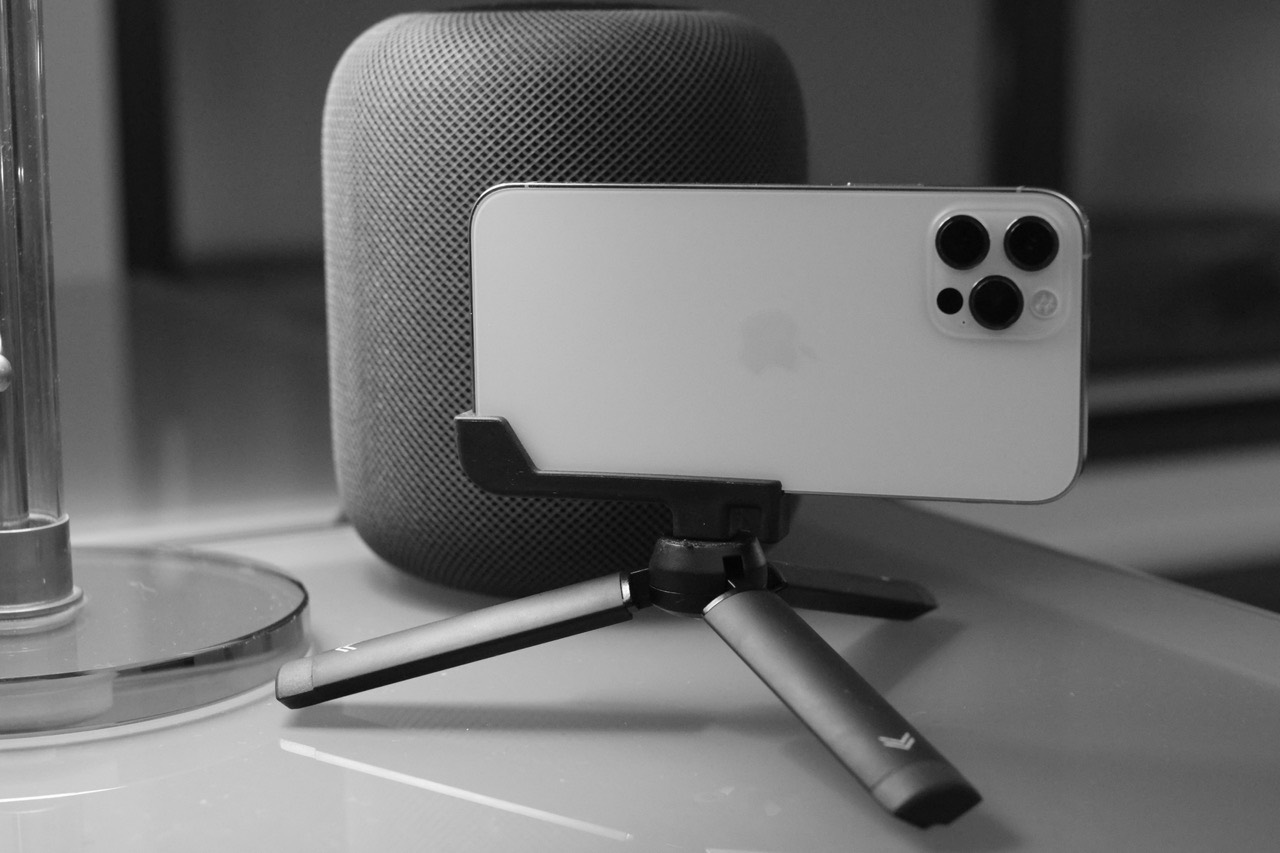

That was the old Glif. This is the new one.
First of all, don’t get me wrong, I love each of the three photo services reviewed here. I’ve been a long-time user of both Google Photos and Flickr. I’ve put a ton of time into these tools, and I’d like to share my thoughts in case it helps anyone else decide what to do now.
Google Photos was my favorite photo service. Until now I’ve been hopelessly optimistic about its potential. Even though I’m leaving it behind, it’s got a lot going for it. It’s seamlessly integrated with your Google account, has the best user interface and iOS/Android apps.
But as you probably already know, Google decided to remove its best feature; free unlimited high-quality uploads. Soon, you’ll need to buy a Google One subscription if you want more than 15Gb of storage.
For people like me who shoot and upload unreasonable amounts of photos, even 2TB isn’t enough. I’d need to pay for at least the 10TB plan, which would cost $50/month. Not only is this unaffordable for most of us, I see two other major problems with Google Photos:
I’m not opposed to paying for good services, I’m actually paying for several. But, if you pay for a photo service, I think you expect to at least be able to reorder albums.
But most importantly, I don’t want to lock myself into an infinite cycle of increasing storage costs. For those reasons alone, it doesn’t make any sense for me to invest time and resources into Google Photos.
That said, if Google decided to offer a paid plan with unlimited storage at a reasonable price, I would probably stay.
— @dflieb
SmugMug is probably the best photo service out there. It has the best organizing and sharing tools, a great user interface, and pro features like the ability to sell photos, attach a domain, or even edit the CSS & HTML.
But, it lacks one crucial ingredient: community.
Yes, you can technically search across public photos on SmugMug, and leave comments. But, it’s not built around an iconic brand or community where you can follow people, like Instagram or Flickr. Instead, individual photographers use SmugMug as a tool to showcase and sell photos to clients. It’s much harder for your content to be seen, found, or easily followed by others.
Also, licensing photos under Creative Commons is now the main purpose of my photography and I can’t do that with SmugMug.
Flickr isn’t perfect, but I think it’s the best offering and choice:
Since acquiring Flickr, SmugMug has already improved the service immensely. They’ve decoupled from Yahoo, moved photos to AWS, fixed many problems and added new features. Even if the comparison is unfair, it feels like SmugMug has done more for Flickr in 2 years than what Google has done with Google Photos in 5 years. And I’m sure SmugMug will continue to improve Flickr by addressing the minor design/interface issues.
This is the best and worst of times to be a photographer. We have so many tools at our disposal. Yet, many of the best services are changing, and are becoming exploitive. Instagram has replaced its notifications tab with a shopping tab. Google pulled a great bait-and-switch.
Meanwhile, SmugMug has remained faithful to their customers for 18 years and that’s why I really want Flickr to succeed. They actually care about photography, and photographers. I hope you too, will join us on the good side of the Internet! :)
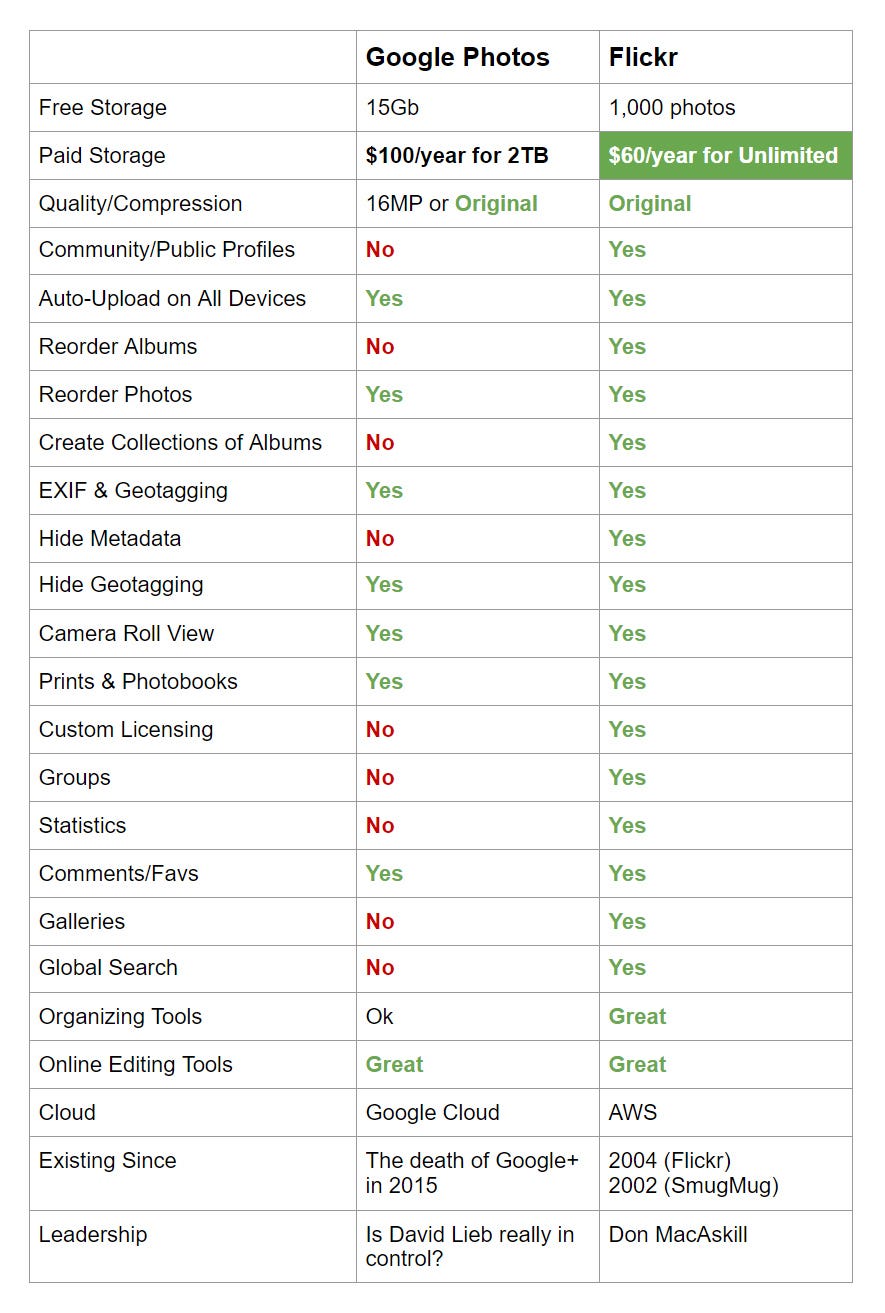

image CC0 from pexels.com
Lately I have been enjoying a series of podcasts from a young Toronto-based group called The Stoa. Some of their recent discussions have been about deliberative processes — the work we do, both personally and in groups, to think things through in a balanced, and, well, deliberate way (etymologically, the term comes from libra, the scales — nothing to do with liberation).
The best of these podcasts IMO have been those that have featured Daniel Schmachtenberger and Forrest Landry. Daniel, a home-schooled vegan, has been working on multiple fronts towards the lofty goal of reimagining (and perhaps reinventing) civilization and, towards that end, improving our dialogic and collaborative processes, on the basis that this goal can only be achieved through better sense-making and improvements to the ways we surface collective wisdom.
Forrest developed the idea of Immanent Metaphysics, and then went on to produce what he calls Ephemeral Group Process (EGP), an essentially inquiry-based collaborative process where the questions are collectively developed using a “technology” somewhat analogous to Open Space, explored in multiple small-group sessions (usually 5-7 people), and then “harvested” to make sense of the group’s understanding, using a specific methodology.
As an aside, both Daniel and Forrest have rather peculiar entrepreneurial histories: Daniel co-founded a nutritional supplement company that purports to sell products that improve cognitive capacity and health, while Forrest’s company sells portable vaporizers (perhaps to feed your mind in a different way).
The ideas and frameworks that Daniel and Forrest have developed are every philosopher-geek-idealist’s wet dream, but you may be wondering why I, having disavowed the existence of free choice, would be intrigued about ideas and processes that purport, ultimately, to improve our collective choices and (re-)make the world a better place.
I could be flip and say I have no choice as to what ideas I choose to get infatuated by (and inflict on my poor readers). But the truth is I think there is a role, even in a free-will-less world, for better — more disciplined, more open-minded, more creative — ways of thinking about the world, about what we believe about it, and about what our role is in it. If some of Daniel’s and Forrest’s ideas and approaches inspire you to think about things differently and to ultimately act differently, then, while you would inevitably be drawn to them (or not), my exposing them to you could actually make a difference. Our lack of free will does not in any way equate to determinism. None of us may have any choice, but our unpredictable interactions with each other will change our trajectories, and no one can say what that might lead to. We can run a marble race down the same track a dozen times and the outcome will be different every time, no matter how we try to control the variables.
Over my long career as an advisor to business, I witnessed and participated in many excruciating meetings that exemplified absolutely ghastly deliberative processes, many of them “led” by executives earning seven figure incomes. And away from the office, I have witnessed an equivalent number of equally-dreadful deliberative and collaborative activities, in communities, on boards, and even in very small-group conversations.
When I got involved with the Group Pattern Language Project that ultimately produced the Group Works deck, I realized that deliberative processes didn’t have to be so awful, if they were well-facilitated, and/or more thoughtfully structured. And I’ve since learned of many other facilitation tools, methods and formats that can help.
But even well-structured, well-facilitated activities can be unsuccessful, and even dysfunctional, if the processes that the individual participants employ, and which the collective group employs (influenced by an infinite number of dynamics), are poor processes. There is only so much a facilitator can do.
Daniel argues that there is a need for us to develop both our personal cognitive capacities and processes (and self-knowledge), and our collaborative capacities and processes — in other words, our personal and collective deliberation capacities and processes. Without doing so, he says, we have little hope of improving the quality and effectiveness of our collective decisions and actions, and are likely to fall back to preconceived ideas, hidden biases, and dysfunctional power dynamics. His Consilience Project (consilience = the tendency of evidence obtained from independent, unrelated sources to “converge” on strong, compelling conclusions) is designed to provide a framework for improving our deliberative processes, focused specifically on improving sense-making and combatting misinformation. And he suggests Forrest’s EGP as a method to use within such frameworks.
Both Daniel and Forrest stress that this isn’t just a matter of intellectual skill — deliberative processes are as much about how we feel as about what we think, and as much about the emotional dynamics of the group (and beyond) as it is about concepts, perceptions and ideas. And it’s not just about analytical rigour — the richer creative output and “emotional intelligence” that comes from effective deliberative work is perhaps even more important. That’s one of the reasons they both stress the importance of play in such processes.
So that has led me to ponder two questions: (1) how do we go about improving our own personal sense-making and communication processes so we contribute more effectively and creatively to group deliberations, and (2) how do we go about employing EGP or similar methods to work better as a group?
My sense is that the simple answer to both these questions is: No one knows. Daniel and Forrest are still working on these questions. The Consilient Project and EGP are both still under development, and there is nothing much online yet.
But perhaps the answers to these questions aren’t as important as the process for exploring them. If we were to follow the processes that Daniel and Forrest espouse, then in order to try to answer these two questions we would formulate additional questions, the answers to which might help us address these two ‘primary’ questions. Such questions might be of some of these forms, which apply analogously regardless of what our primary questions are (they could be applied equally to questions like how we might best address homelessness, systemic caste-ism, or climate collapse):
You get the idea. Every one of these questions begs further questions, and the inquiry-based approach enables us to deeply explore the issues at hand rather than jumping to conclusions (decisions, preferences, actions). One of the great values of questions is that they avoid the inclination for polarization and ego-reactivity that declarative statements, hypotheses and “suggested answers” can evoke, and hence encourage more group “binding” and thus collaborative energy and capacity.
There’s a question whether an individual or group thoughtfully and deliberately exploring such questions even needs to move from asking these questions to the ultimate question: OK so what do we do? It may be that the inquiry itself evolves ideas, approaches and collective knowledge such that the answer to this ultimate question is obvious.
In his book The Other Side of Eden Hugh Brody describes an indigenous deliberative process that involves story-telling and asking questions, but, unlike western processes, doesn’t conclude with a “who will do what by when” chart; it’s left up to the individuals listening to the stories and questions to decide tacitly what actions to take personally, and to discuss one-on-one (with the people affected) what actions they might want to take collectively. How might such a trust-and-personal-responsibility approach work in large, hierarchical groups and organizations? And how might such an approach enable such groups and organizations to evolve into self-organizing, self-managing groups and organizations, and eliminate the need for hierarchy entirely?
The most astonishingly productive, instructional, and enjoyable group activity of my life was a neighbourhood ‘barn-raising’ twenty years ago. A neighbour’s old barn, being used as a garage, was dangerously falling apart. An invitation was sent out to the neighbours to meet for tea and discuss ideas for converting it into a stable, more useful structure. In an entirely self-organized way, creative ideas evolved, others were consulted, and work bees happened. The result was an amazing multi-purpose space created without any blueprint or hierarchy. We all learned new skills. And every time we passed it, we could say “We did that!”
Forrest makes the point that our political processes and systems have evolved dysfunctionally much the same way our health care processes and systems have: to focus on ‘acute’ problems (eg the latest Trump executive order, a CoVid-19 spike, or a foreign threat) rather than ‘chronic’ problems (eg inequality, homelessness, caste-ism/racism, ecological and economic collapse). And that dysfunctionality stems largely from an incapacity of large groups to get their heads around very complex problems.
Listening to others with different perspectives, knowledge, ideas and experiences enables us to see an issue ‘stereoscopically’, he notes. Two perspectives are not only richer for problem-solving than one, they allow the seeing of multiple additional perspectives, much as having two eyes provides much more than just two monoscopic views of something.
Daniel makes the point that such a multi-dimensional perspective also allows groups to identify “synergetic satisfiers” — ideas and adaptations that satisfy more than one need at the same time. It also tends to nurture what Zeynep Tüfeckçi calls “epistemic humility” — appreciation that we don’t, and can’t, have all the knowledge, understanding, and “answers” we’d like, and sometimes presume to have.
Collaboration, he says, is only effective when there are three things in place: practice and experience working together, cognitive coherence (appreciation of others’ ways of thinking and communicating), and shared values. Connecting the collaborators at a more than semantic level is also helpful (prehistoric tribes did this through music and dance rituals, which allow for individual riffs that are in concert with the collective rhythm). Ideally, achieving a (non-western) culture of individual responsibility with shared, collective credit for outcomes is your goal.
The challenge we face, Daniel adds, is the context in which most of us have to work together: our destructive and debilitating globalized industrial culture. “There is no way to have your hands totally clean in a world that is built on institutional, structural violence”, he says. The only ethical resolution is to minimize the harms while maximizing our collective capacity to change things, which is especially difficult when so many of our harms are invisible to us personally (he uses factory farming as an example, though he could as easily have used our prison system, our education system, and toxic family and workplace environments). We all have to walk the razor’s edge between courage and sensitivity, he says, and not forfeit either.
Of course, this is easier if you have the background, the temperament, the capacity, the time, and the curiosity to work on these things. Expecting many or most people to be able and willing to do any of this is likely pretty unrealistic.
But it’s still worth keeping in mind. We can (as Daniel recommends) take training to become better facilitators. We can become guerrilla facilitators in situations when no one is facilitating, or the facilitator is floundering. We can use methods like Best Possible Outcome to exercise a group’s collaborative muscles.
And of course we can work on our own stuff. Not only the quality of our own work in groups, but the quality of our own internal deliberation — our capacity to ask the right questions of ourselves, and to be constantly self-aware and challenging ourselves about our biases, beliefs and blind spots.
So, in keeping with the theme of inquiry, instead of suggesting a process for evaluating your internal deliberation capacities, I will conclude with a question:
If you were designing a ‘scorecard’ to assess the quality of your own internal deliberative processes — leading to greater objectivity and openness, better articulation of your own thoughts and ideas, deeper self-knowledge and self-awareness, larger capacity for creativity, resilience, equanimity, effective listening, sense-making and ‘usefulness’ to yourself, others and the world — what elements would the scorecard score you on, how (highly) would you score yourself, and what one action might best improve your ‘score’?
And if you’re looking for a place to start with the process of self-inquiry, Daniel has — of course — a list of questions for you.
Last week's weeknotes took the form of my Personal Data Warehouses: Reclaiming Your Data talk write-up, which represented most of what I got done that week. This week I mainly worked on datasette-indieauth, but I also gave a keynote at PyCon Argentina and released a version of datasette-graphql with a small security fix.
I wrote about this project in detail in Implementing IndieAuth for Datasette - it was inspired by last weekend's IndieWebCamp East and provides Datasette with a password-less sign in option with the least possible amount of configuration.
Shortly after release version 1.0 of the plugin I realized it had a critical security vulnerability, where a malicious authorization server could fake a sign-in as any user! I fixed this in version 1.1 and released that along with a GitHub security advisory: Implementation trusts the "me" field returned by the authorization server without verifying it.
The IndieAuth community has an active #dev chat channel, available in Slack and through IRC and their web chat interface. I've had some very productive conversations there about parts of the specification that I found confusing.
This week I also issued a security advisory for my datasette-graphql plugin. This one was thankfully much less severe: I realized that the plugin was leaking details of the schema of otherwise private databases, if they were protected by Datasette's permission system.
Here's the advisory: datasette-graphql leaks details of the schema of private database files. It's important to note that the actual content of the tables was not exposed - just the schema details such as the names of the tables and columns.
To my knowledge no-one has installed that plugin on an internet-exposed Datasette instance that includes private databases, so I don't think anyone was affected by the vulnerability. The fix is available in datasette-graphql 1.2.
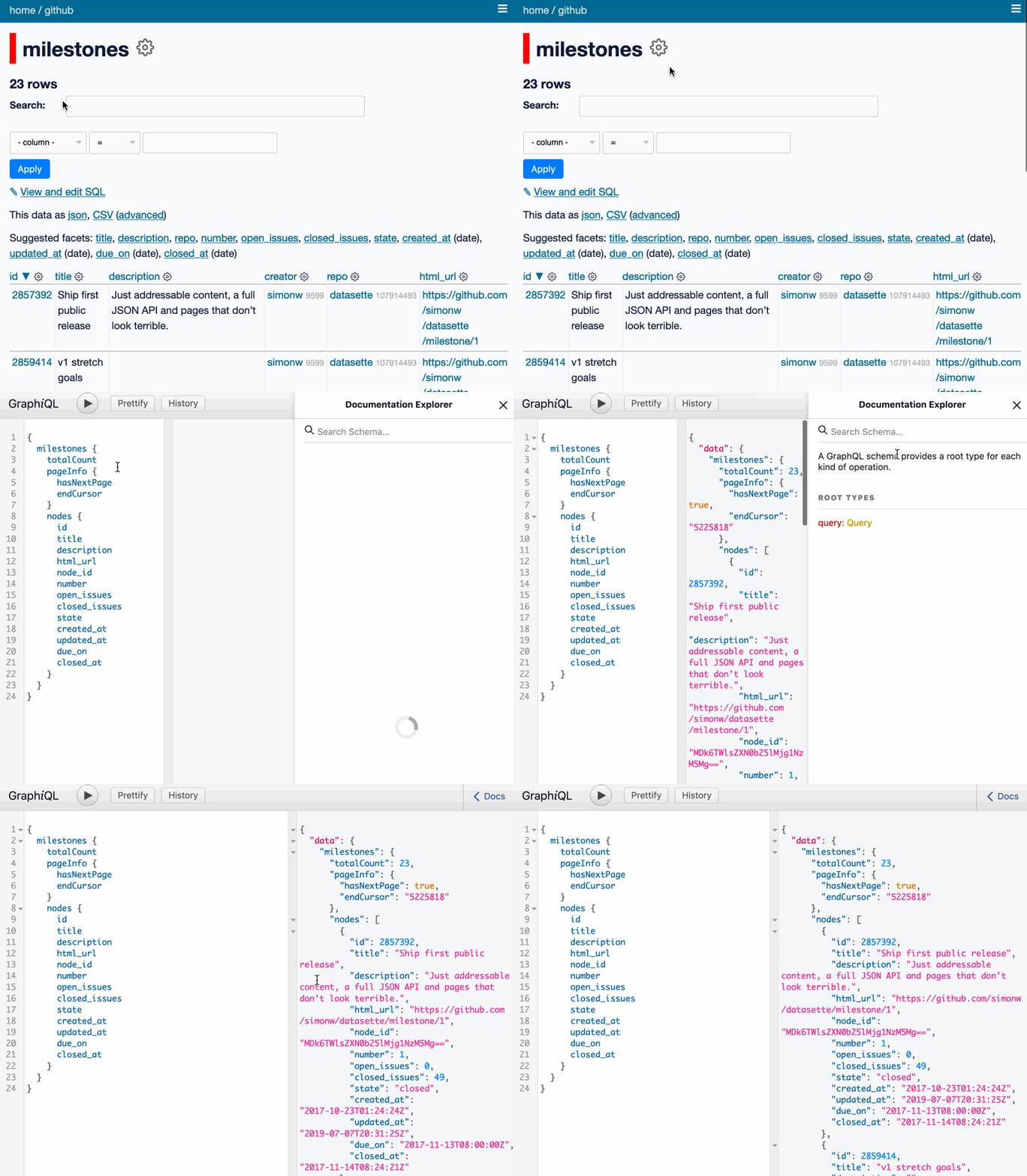
Also in that release: I've added table action items that link to an example GraphQL query for each table. This is a pretty neat usability enhancement, since the example includes all of the non-foreign-key columns making it a useful starting point for iterating on a query. You can try that out starting on this page.
On Friday I presented a keynote at PyCon Argentina. I actually recorded this several weeks ago, but the keynote was broadcast live on YouTube so I got to watch the talk and post real-time notes and links to an accompanying Google Doc, which I also used for Q&A after tha talk.
The conference was really well organized, with top notch production values. They made a pixel-art version of my for the poster!
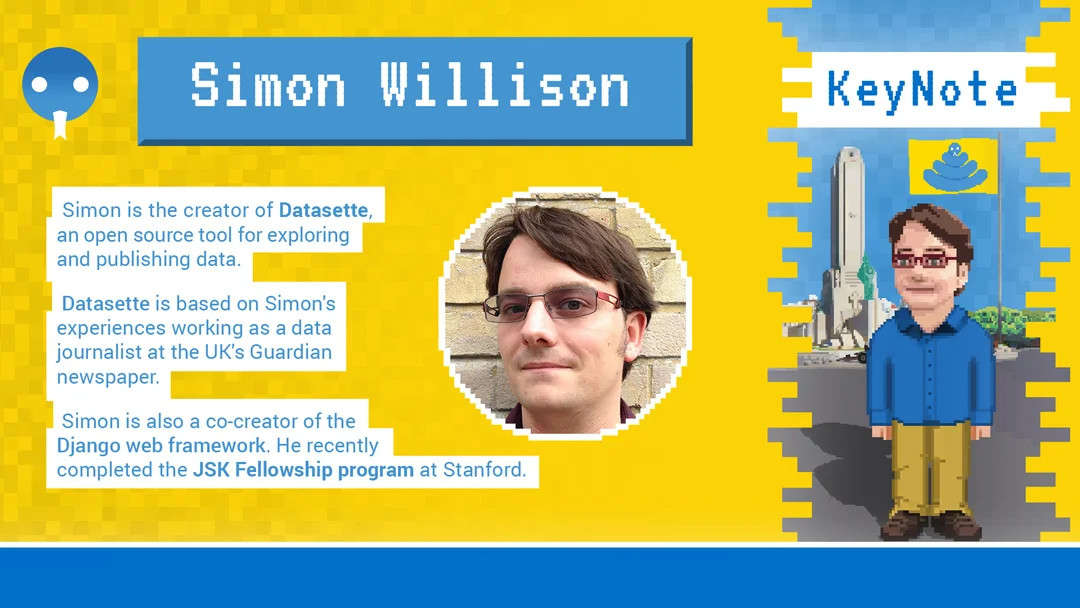
The video isn't available yet, but I'll link to it when they share it. I'm particularly excited about the professionally translated subtitles en Español.
Since Datasette depends on Python 3.6 these days, I decided to try out f-strings. I used flynt to automatically convert all of my usage of .format() to use f-strings instead. Flynt is built on top of astor, a really neat looking library for more productively manipulating Python source code using Python's AST.
I've long been envious of the JavaScript community's aggressive use of codemods for automated refactoring, so I'm excited to see that kind of thing become more common in the Python community.
datasette-search-all is my plugin that returns search results from ALL attached searchable database tables, using a barrage of fetch() calls. I bumped it to a 1.0 release adding loading indicators, more reliable URL construction (with the new datasette.urls utilities) and a menu item in Datasette's new navigation menu.
The growth of ecommerce has always fit the old line about a frog in boiling water. Every year, the share of retail taken by ecommerce rose a little higher, and physical retailers got a little more uncomfortable (and recently have started failing), but the growth in any given year was never dramatic enough to make headlines. That was until 2020, of course - now we’ve had a reset. Lockdowns triggered a huge spike in online sales of every kind, but then the question was where this would stabilise - once things started to calm down, where would the new level be set? We’re now starting to see.
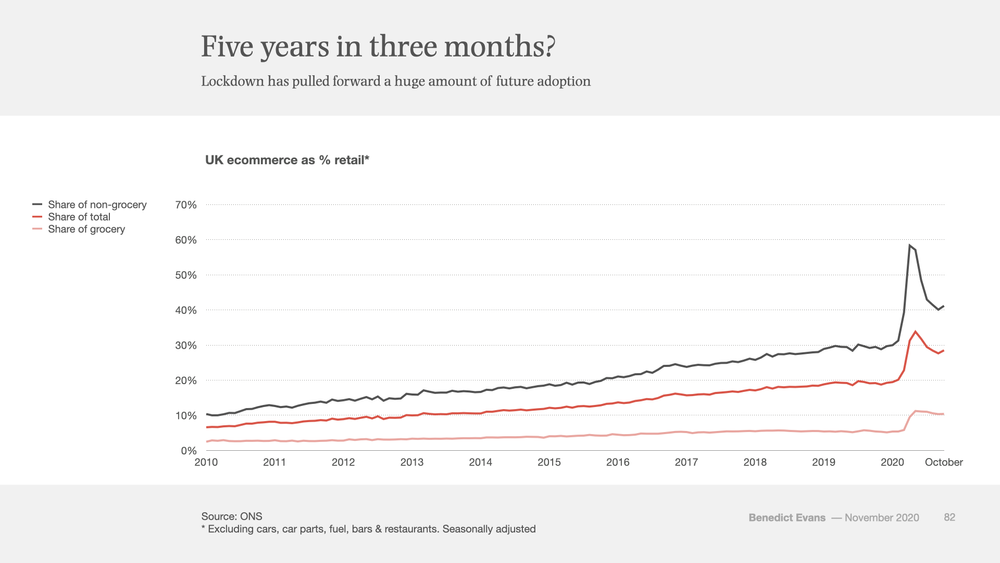
In the USA, where lockdowns have been pretty patchy, ecommerce was ~17% of addressable retail at the beginning of the year. It spiked up to 22.5% in Q2 and in Q3, reported last week, it dipped back to close to 20%. In the UK, where we have monthly data that makes the picture clearer, penetration was already 20%, spiked to over 30% and now seems to be stabilising in the high 20s.
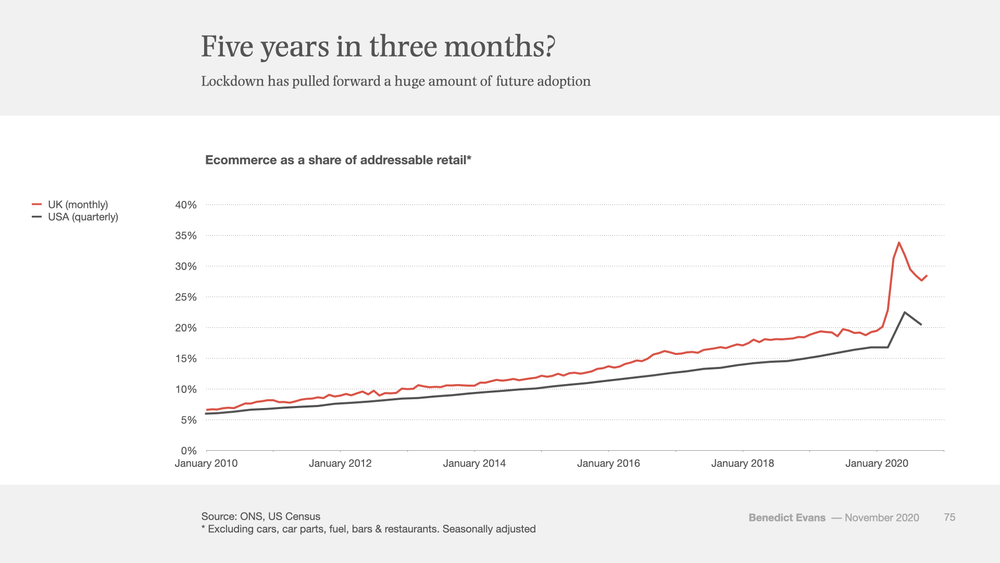
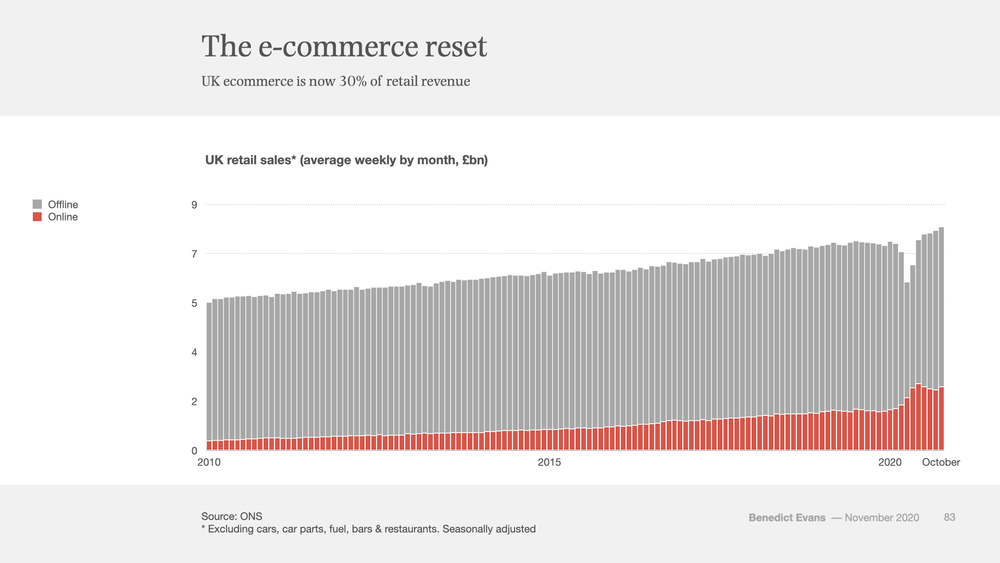
You have to be careful about the denominator here - if physical retail was closed, what does a percentage tell you? Hence, the next charts show you ecommerce and physical retail in absolute terms. The UK had a painful lockdown of physical retail, but ecommerce has stabilised at the same level in absolute terms even as it came out of that. Some of this may be because we’re still wearing masks to go out, and we still don’t really know the long-term change (as I wrote here, there will be cascading consequences), but the general picture is becoming more clear.
Fo the US, there has been less of a lockdown on a national level (though much more in some places, but we don’t have regional ecommerce data from the US Census), and less of a surge, but, again, ecommerce is holding at a new and much higher level.
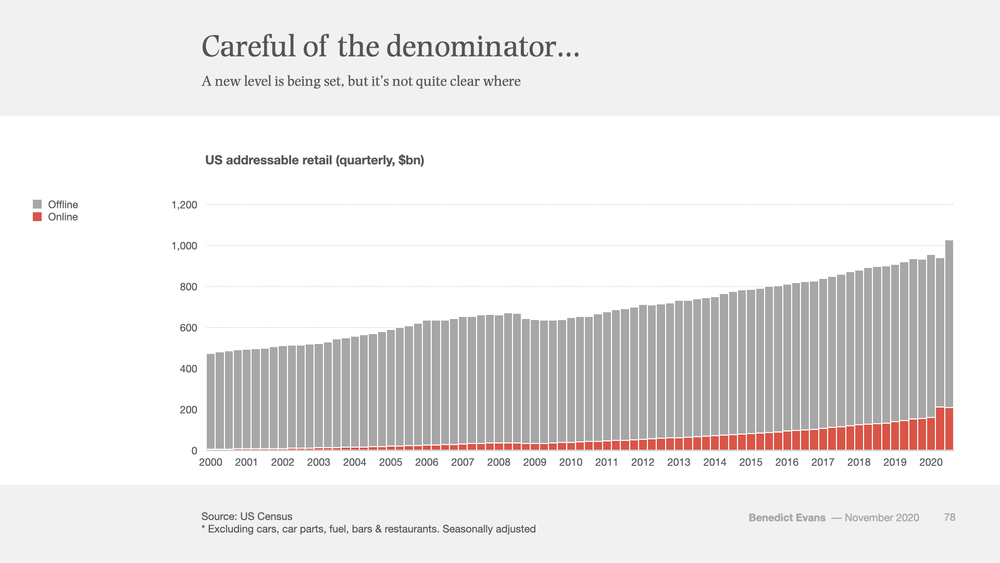
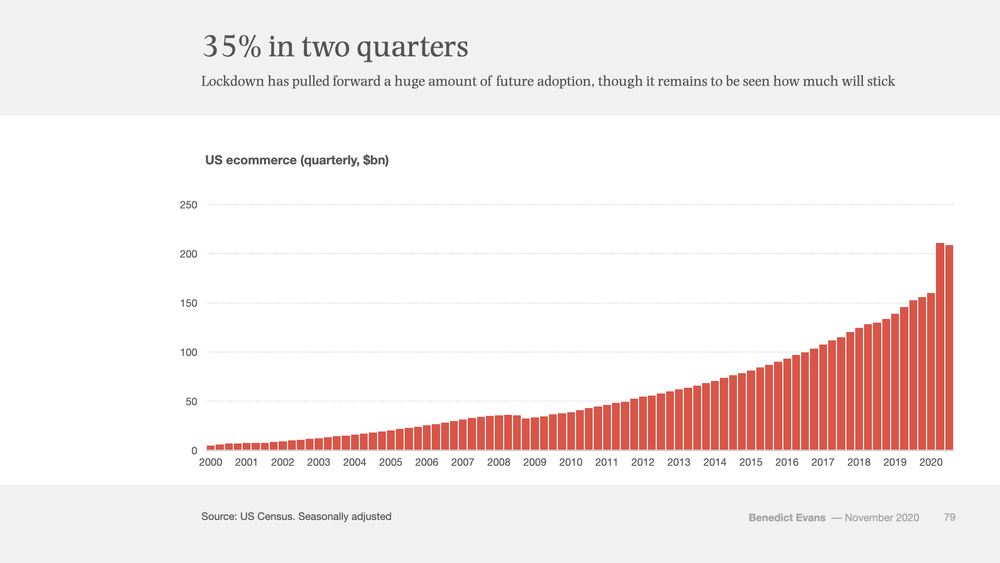
There’s always something of a debate about what parts of physical retail we should compare against ecommerce - hence the label ‘addressable retail’ in some of these charts. It doesn’t make much sense to include fuel sales or car repairs, which really can’t be done online, and we generally exclude bars and restaurants, even though food delivery has become a big business this years as well. But the really big exceptional category is grocery, since that requires a completely different logistical chain to other kinds of delivery. If you compare UK online sales against retail excluding grocery (on each side), ecommerce is now 40% of revenue.
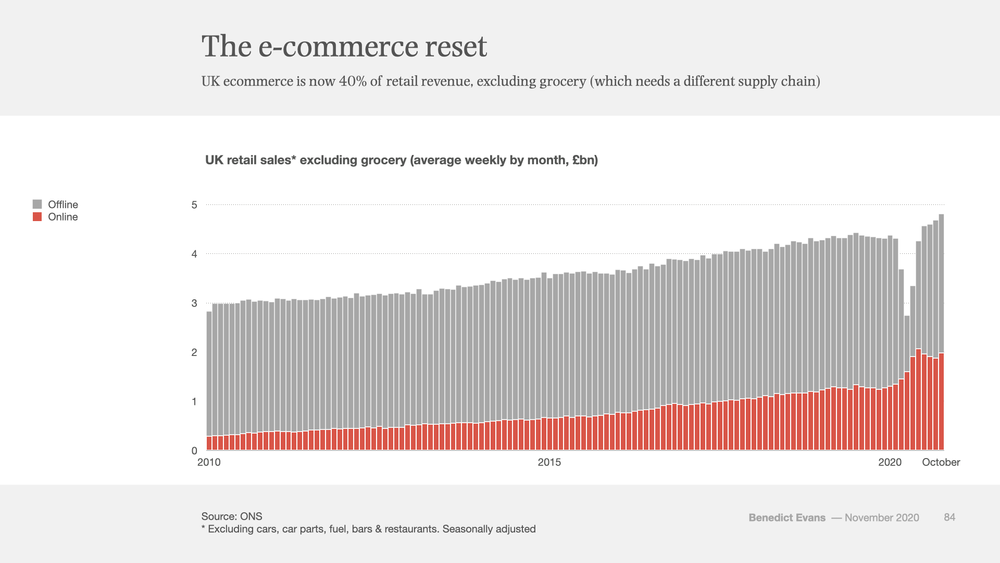
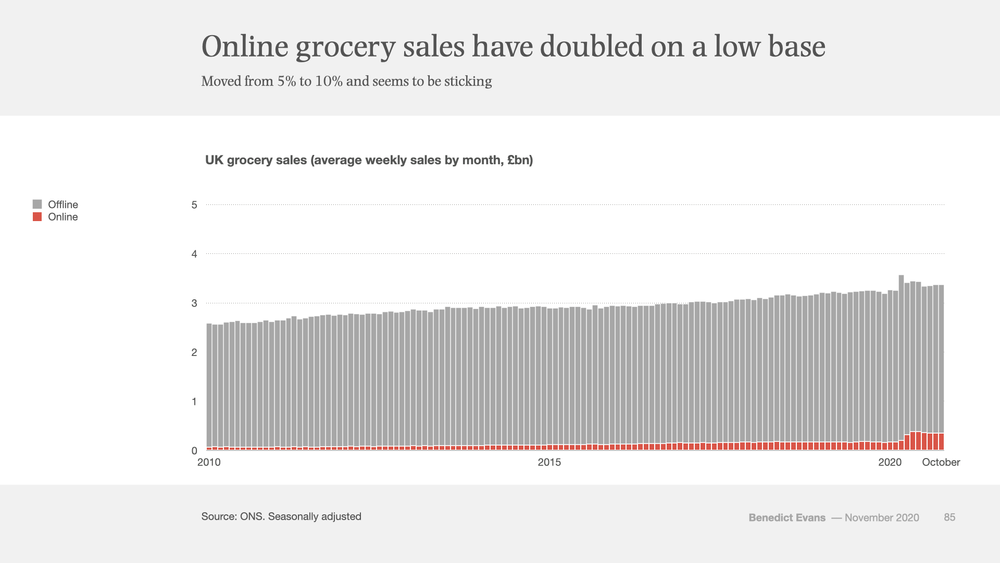
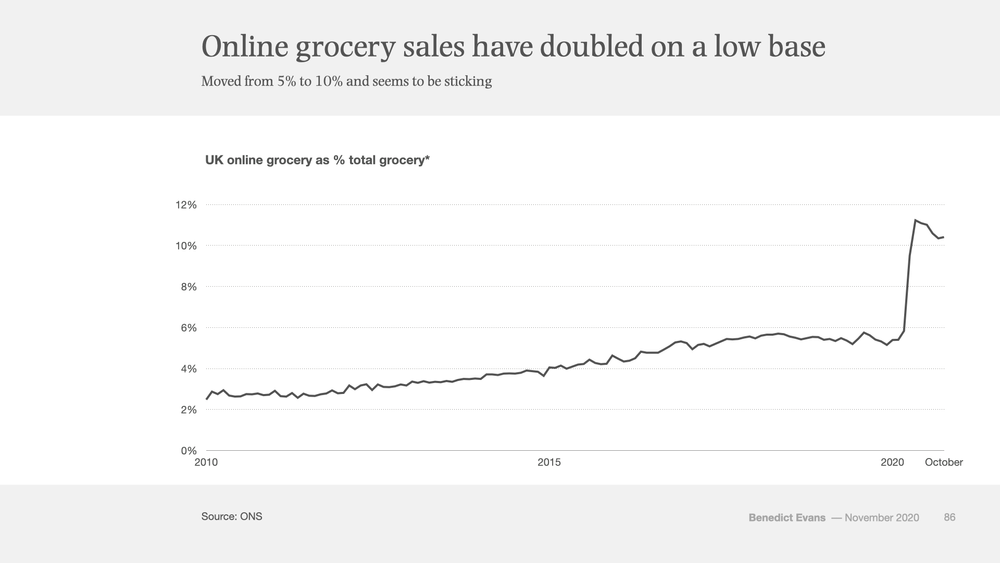
Meanwhile, online grocery delivery itself doubled in the UK, more or less overnight, and, again, is holding at the new level.
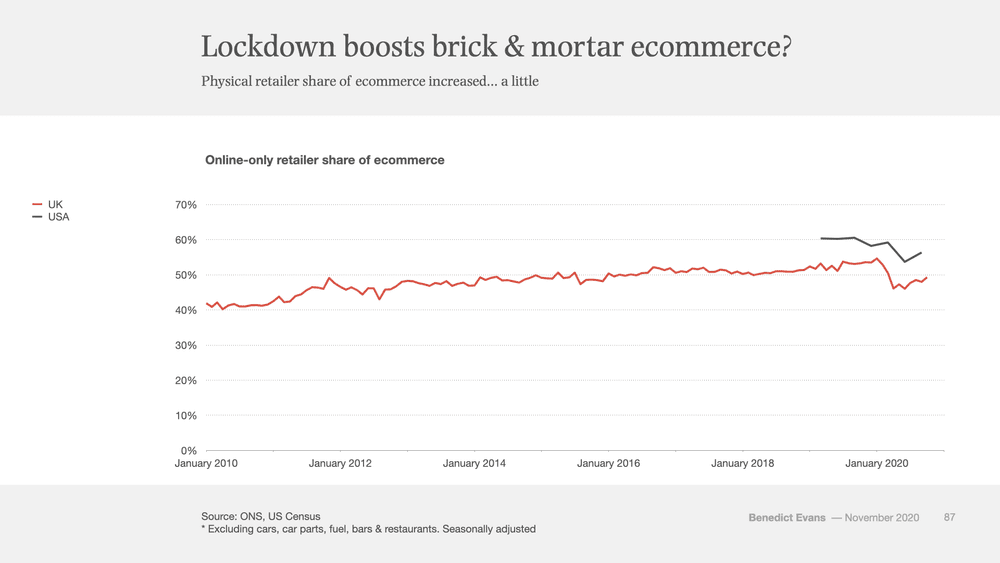
One final observation: roughly half of online sales now comes from physical retailers’ online stores. They gained share in lockdown - a little. So, this chart shows you the share of online sales made by online-only retailers, including Amazon. Amazon is having a good lockdown, but so is anyone else who can sell online - lots of habits are being broken right now.
Rolandtj


We will just keep going
Until we drop
And this is not a sad thing.
All the leaves that ever lived
Did the same.
— Alice Walker (2020) (images of Alice Walker and Ursula Le Guin above CC-SA 2.0 from wikimedia)
For the nearly 18 years I have been blogging, I have been keeping track of aphorisms (pithy observations containing general truths), principles (fundamental ideas that underlie a system of beliefs), and maxims (rules or suggestions on how to conduct oneself — eg “Trust your instincts.” “Show, don’t tell.”) Over the years I have deleted many that now strike me as overly simplistic (no matter how wittily articulated), or as simply untrue (I am decidedly less idealistic than I was 18 years ago, and some of what I used to espouse now just makes me cringe).
When I last looked through my collection, I lamented how few of them were written/said by women. So here are a few more by some very smart women:
There are some aphorisms or principles that are so profound and important that I’ve chosen to call them “laws”. To me, a law actually changes or reformulates your worldview. It creates a new lens through which you see everything.
Over the years I’ve come up with two “laws”, things that have “shaken my windows and rattled my walls”. They are:
Pollard’s Law of Human Behaviour: Humans have evolved to do what’s personally urgent for them (the unavoidable imperatives of the moment), then to do what’s easy, and then to do what’s fun. There is never time left for things that are seen as merely important. Social, political and economic change happens only when the old generation dies and a new generation with different entrained beliefs and imperatives fills the power vacuum. We have evolved to be a collaborative and caring species, and we are all doing our best — we cannot do otherwise.
Pollard’s Law of Complexity: Things are the way they are for a reason. To change something, it helps to know that reason. If that reason is complex (and it frequently is), success at truly understanding and changing it is unlikely, and developing workarounds and adapting to it is probably a better strategy. Complex systems evolve to self-sustain and resist reform until they finally collapse. For that reason, the systems of global industrial civilization culture, having precipitated the sixth great extinction of life on Earth, are now collapsing rapidly and inevitably.
Now I think I’m ready to add a third “law” to the list. Here it is as it currently stands (since it’s my law I have the right to rewrite it):
Pollard’s Law of Human Beliefs: We believe what we want to believe, not what is actually true. We want to believe in happy endings, simple answers, the inevitability of progress, self-control, karma, responsibility, destiny, miracles, a proper order of things, the power of love, and infinite human capacity and agency. Most of us want to believe in a higher power that can step in when we falter. We want to believe what those in our circles of trust believe (even if it’s crazy, gaslighting or propaganda). So we tend to seek sources that reinforce those beliefs and ignore those that undermine or unsettle them. Our hopes and expectations are determined by those beliefs. Our worldview is the sum of those beliefs, hopes and expectations, and bears no necessary resemblance to truth or reality. This invented reality is the only way we can make sense of a world that is vastly too complex to ever make sense of.
Yeah, it needs some editing, and I suspect it will evolve, but I think the essence of it is there. You can probably recognize some aphorisms (like Rebecca Solnit’s above, and the third one by Alice Walker above), and some of the work by Lawrence Lessig, Francis Bacon and others, that underpin this “law”.
One of the values of a “law”, to me, is that it not only reveals a profound truth but hints at why it is so. An aphorism teases us to ask “why” it is so for ourselves. That too is valuable, but it is incomplete without the dessert of appreciation for why it is so. Sometimes we have to supply our own dessert.
The best way to have a good idea is to have lots of ideas
Linus Pauling
I suppose it’s fitting that I have struggled with this blog post far more than most. It began with a desire to improve the rhythm and cadence of completing and published writing deliverables. Having just passed nineteen years writing this blog, you would think I was beyond fits of teenage angst. Maybe the onset of blogging adulthood is more daunting than I realized.
I’ve always liked the Pauling quote. Having lots of ideas has never been a particular problem for me, so I’ve trusted that some reasonable portion of them would be good enough to share. For a long time, I attributed my occasional struggles to focus on a particular train of thought on my ADD. Bright shiny objects always promise a dopamine hit, but I’ve felt like I’ve been able to keep it enough under control.
It occurs to me, however, that my ADD simply serves as an early introduction into a world that we all now live in. We all swim in an overwhelming abundance of ideas. Our training and practice focuses on turning individual ideas into a desired deliverable, whether that is a blog post, a client presentation, or a spreadsheet analysis for our boss.
While there’s much to be learned about that idea to deliverable evolution, there’s another layer of knowledge work practice that we must tackle. That thread of idea to deliverable is one element of a collection of threads and you have to manage the collection as something distinct from any one thread.
Simply splitting the problem into two layers is a step forward for me. I have a reasonable handle on the first layer; I know how to take an idea, develop it, extend it, and polish it into a deliverable. As a creative task, however, that process is rarely linear. Ideas are not widgets, you can’t simply plow ahead from idea to deliverable. You often need to set things aside and let them cook.
Which is where the second layer comes into play. What do you pick up when you set the first idea aside? Presumably another idea that you set aside earlier or a new idea trying to seduce you. You now have a management problem as well as a creation problem.
The management problem is about selecting ideas, monitoring progress, switching, sequencing, timing, and cadence. This is operating at a different level of abstraction from the creation process.
At small scales, you can likely manage organically. There aren’t so many threads that you can’t keep most or all of the management issues in your head. With time and the accumulation of a body of work, it’s worthwhile to externalize the management problem and not try to rely on the limits of memory. At the same time, the management process must be subordinate to the creative process.
Over the past eighteen months or so, I’ve been gradually retooling my baseline creative practices around a more disciplined note-centered practice. Like any retooling, this has led to a temporary drop in output. As committed to improvement as I may be, there’s still muscle memory to be overcome. Even bad habits are still habits that require extra energy to break down and replace. Some markers of this journey that have risen to things worth sharing include:
Early on, what management of the process I did was on the proverbial back of an envelope. Keep a list of ideas as they came to me and pick something off the list when I sat down to write the next piece. Look back at the last few blog posts and write a follow up piece. Do this for any length of time, however, and the envelope gets pretty full
My next thought was to take the list off the back of the envelope and formalize it. I dug into the approaches of other writers who’ve gone through this evolution. Among the appealing approaches I ran into were:
These approaches, however, don’t scale well. As your body of work grows, you risk spending more time maintaining the management control system than you do creating new work. That misses the point entirely.
Some Zettelkasten advocates claim that the necessary tools and structure emerge as you gain more experience and grow your collection of notes:
This hasn’t played out for me. Setting aside the hypothesis that this simply reflects my personal limitations, what’s missing?
This comes back to the distinction between creating and managing. Most of the discussion and advice I’ve been able to review is focused almost exclusively on creation. It either ignores managing the process as a whole or presumes that what needs to be managed is trivial relative to making creation work more smoothly and reliably.
To manage the overall process you need to get above the details of individual work in process (WIP) items. You want to collect just enough data about each item to not have to read the entire piece while you are trying to manage a collection of multiple WIP items. And you need to track the status of each piece of WIP relative to its transition from WIP to final deliverable. Is this item a new idea? A draft? In need of editing? Ready to publish? Published? There’s a life cycle to be defined. This is the metadata you need to make informed decisions about the overall process. Do you have enough WIP to feed your deliverable goals? How does the mix of materials look?
This is a classic data management problem that would seem to call for a simple spreadsheet as DBMS solution. Or a multi-column outline of some sort. Both of those approaches failed relative to the goal of keeping the management system subordinate to the creative system. As I continue the transition to a note-centric creation system, the challenge is to embed the pertinent metadata in the individual notes and create some method of querying the metadata to generate the schedules and lists that will help me manage the creative process. Now that I’ve got a handle on the basic requirements for managing my WIP, the next step is to discover or create the reporting tool.
The post Idea Management as an Abundance Problem appeared first on McGee's Musings.


Happy 267th day of March in the Year of Covid.
A rather heads down week or planning with some errands and running kid to his appointments. The weekend became caring for a kid’s insanely kinked neck followed by stomach issues.
ReadNot a whole lot of reading happened this week as it was planning week at work and some errands and driving my son (but having it dark I lost a bit of my reading books time while waiting in the car).
One of the things that is echoing loudly from the James Fallows’ and Deborah Fallows’ Our Towns: A 100,000-Mile Journey Into the Heart of America is people moving to “the city” or larger towns from where they grew up. This desire to get off the farm, move from a small town of a few thousand to the state’s large city of 100,000 or more for more opportunity, performing a role they trained or went to school to learn, or to get a larger dating pool to find a life mate. This desire is interesting and common, if you’ve lived in a large city. There are people who move between large cities following jobs or opportunities, but they don’t move to smaller cities (they may move to a city’s edge, an exurb, or suburb when raising families).
Somehow we are to one of my favorite times of the year a a reader, the “Top Books of the Year” time of the year. The New York Times top 100, Washington Post Top 10 (this links to other top book lists, and Financial Times Best Books of the Year 2020 have theirs out.
Sadly, a favorite author died this week at the age of 94. Jan Morris historian, travel writer, and trans pioneer dies, as the Guardian labelled her. I found Morris from her histories and culture overviews of Oxford that I read in the months prior to my heading to Oxford where I would take my last semester of undergrad. I later found collections of her travel writings and other histories, but it was the framings of Oxford that impressed me and I still return to today.
WatchedStarted in on Season 4 of The Crown and finding the Prince Charles character, whom they wrote in season 3 as a young man finding himself and a bit lost, but with a soft look on life (rather than a hard, non-caring stoic side, nor overly aggressive side), and seeing hints of the effort to spin him to a dark and evil-ish look. The glare at the end of episode 1 was more funny (in an “oh, really…” way). I’m curious where the story arcs are going to go.
On Friday got caught up with Mandalorian with my son, who in used downtime due to the Covid pandemic to watch Clone Wars in its entirety and is far more versed in the backstory, places, and names that I am. I’m still enjoying it, but is doesn’t have the richness it does for him.
ListenedNot much listening to happened this week other than a really good 99% Invisible - In The Unlikely Event podcast episode, which is a really good look at not just make instructional materials work well, but understanding the whole system first, from planes, mechanical, human, and the ever important understanding the psychology of humans.
This week Pomplamoose and KT Tunstall collaborated on a new arrangement of U2’s “Still Haven’t Found”, which I found incredibly good. There is also a really good Making of Still Haven’t Found, on Jack Conte’s own channel. This may be one of the best covers / versions of the song I’ve heard by U2 or others.
One of my favorite labels, Edition Record had some new releases this week, but so far I haven’t had a chance to listen to them much but liking it a bit.
ProductivityIt was good to see a New Yorker piece, The Rise and Fall of Getting Things Done by Cal Newport and starting off with Merlin Mann. It wove through the enhancements something like Getting Things Done offers, but also its gaps. It wove in Thomas Davenport’s knowledge management improvements for personal improvement and thinking. It is a good high level view, that roughly scratches the surface. But, the diversity of options and models are also ones that are quite personal, but also needed for diversity of intellectual processes and needs of different systems and purpose.
I’ve been doing some rethinking of some of my Social / Complexity Lenses Models to expand and branch them as need and realities dictate. It takes some rigor in understanding what you have, what the needs are, and even more what are the gaps. It is at that point where thinking of a system to support what is being worked through and augmented as well as things held in valuable tension.
 |
mkalus
shared this story
from  mrjamesob on Twitter. mrjamesob on Twitter.
|
We let columnists from the Times, Telegraph, and Spectator try running the country and 75,000 people died
 James O'Brien (mrjamesob)
on Sunday, November 22nd, 2020 1:34pm
James O'Brien (mrjamesob)
on Sunday, November 22nd, 2020 1:34pm |
mkalus
shared this story
from  wtyppod on Twitter. wtyppod on Twitter.
|

There are a ton of computer mice available across a variety of price points, but if you do a lot of gaming on your PC, the Glorious Model D mouse is an excellent option.
I’ve had the opportunity to test out a Model D mouse — along with one of the excellent Glorious mousepads — over the last few weeks, and overall, I’m very impressed. From excellent performance to its unique honeycomb design, the Model D is superb for work and play.

The mouse comes in a few variants — there’s the ‘D’ and the ‘D-,’ which refer to the size (the D- is slightly smaller). Also, each size comes in black or white, and each colour can be in either glossy or matte. I’ve been using the matte black, but both colours look great. I’m not a fan of the glossy, but if that’s your thing, more power to you.
The overall design, although it looks like just about every mouse, feels very ergonomic. My hands fits the mouse well, and my hands are fairly small. Someone with tiny hands may find the D- variant a more suitable option, but most people will be fine with the regular Model D size.

One of the things I like most about the Model D is its honeycomb design. I was a bit wary of it at first since the hexagonal holes leave the inner workings of the mouse exposed, but unless you’re prone to spilling liquids on your desk, there’s nothing to fear here.
The holes accomplished two things that help set this mouse apart for me. The first is something not everyone will relate to, but I have pretty sweaty hands. The Model D’s holes allow for some small airflow, which I found helped keep my hands dry. The other benefit of the holes is that they reduce the weight. The Model D weighs in at a low 68 grams (69g for the glossy variant).

I didn’t realize I cared about weight until switching to the Model D from my ageing Logitech G402 Hyperion Fury, which weighs 144g with the cable (108g without). It may not seem like a huge difference, but when you spend much of your day with a hand on the mouse, it makes a difference.

However, perhaps the most significant improvement for me was the cable. Glorious calls the cable on its Model D mouse the ‘Ascended Cord’ and it’s impressive, to say the least. It’s a lightweight, super flexible braided cable, and it doesn’t even feel like it’s there.
While many people opt for wireless mice these days, I still prefer corded mice — cables are just more reliable, and you don’t have to worry about wireless interference, latency issues, batteries or anything else that might get between you and gaming (or work). With my old G402, I could feel the cable when I moved the mouse. Glorious’ Model D doesn’t suffer from that same problem.

Along with the excellent cable, the plastic feet on the bottom of the mouse feel great, and the Model D glides around my mouse pad with ease. To be fair, I don’t really notice any difference between the Model D’s feet and the G402’s feet — both mice glide smoothly on a mousepad. The weight is the bigger differentiator here.

For that matter, I also don’t notice a significant difference between a regular mousepad and Glorious’ Stitch Cloth Mousepad when it comes to how the mice work. Still, I appreciate the size options — I tested the massive 3XL Extended variant, which was just slightly too big for my desk but helped cover up some of my cable management. And having that much mousepad space was great when gaming and working.
Back to the mouse, all of the buttons were clicky and tactile, the scroll wheel was fast with a handy tactile feel and the lighting options were great. Users can couple the Model D with optional software from Glorious capable of adjusting DPI, polling rate, lighting settings and more.

The mouse features a button below the scroll wheel for quickly toggling through different DPI settings. An LED on the bottom of the Model D shows which DPI setting you’re currently using.
Sure, the Model D isn’t the fanciest mouse out there. It lacks the rugged, angular designs, multi-button layouts and other crazy features of other gaming mice on the market, but I’d argue it doesn’t need those things. For a simple, ergonomic mouse, it’s feature-rich, lightweight and delivers consistent gaming performance.
You can find the Model D on Glorious’ website (USD pricing) or at retailers like Canada Computers for $79.99.
The post The Glorious Model D is a great mouse for the gamer on your holiday shopping list appeared first on MobileSyrup.

The government of British Columbia has no intention of adopting the federal COVID Alert exposure notification app.
CTV News reports that the provincial government has not revealed whether it has made any progress towards adopting the app.
“It’s been a challenge for us. We’ve not reached an agreement. It’s not at the point where it would be helpful for what we’re managing here in B.C. for our pandemic right now,” B.C. health officer Bonnie Henry stated.
There will likely be growing calls for the province to adopt the app, as the surge of infections in recent weeks continues to increase.
B.C. and Alberta are the only provinces that have yet to adopt the app. Alberta Premier Jason Kenney has rejected the COVID Alert app. Kenney has stated that Alberta no longer plans to sign onto the COVID Alert app because the province’s own app, ABTraceToegther, is more useful in stopping the spread of the virus.
COVID Alert is currently fully functional in Saskatchewan, Manitoba, Ontario, Quebec, New Brunswick, Nova Scotia, Newfoundland and Labrador, and Prince Edward Island.
The app can be downloaded everywhere, but other regions don’t provide one-time verification keys with positive tests, which are integral to how COVID Alert operates.
Source: CTV News
The post British Columbia currently has no intention of adopting COVID Alert app appeared first on MobileSyrup.

Google has announced that it’s extending Chrome support for Windows 7 until at least January 15th, 2022.
The tech giant originally wasn’t going to extend support past July 15th 2021, but is implementing the six-month extension due to customer feedback.
Google notes that this year has presented a lot of challenges for organizations and that some planned IT projects may have been delayed.
“Facing difficult business and technology decisions, supporting a changing work environment, and navigating uncertainty are among just a few of the issues IT leaders have faced over the course of 2020,” the tech giant noted in a blog post.
Although Windows 7 is over a decade old, Google says that 22 percent of organizations using Windows OS have yet to migrate to Windows 10.
“With this extension of support, enterprises with their upgrades still in progress can rest assured that their users remaining on Windows 7 will continue to benefit from Chrome’s security and productivity benefits,” the blog post outlines.
Google says that it’s going to continue to evaluate the conditions its enterprise customers are facing and will communicate any other changes in the future.
Source: Google
The post Google extending Chrome support for Windows 7 until January 2022 appeared first on MobileSyrup.
It’s time to talk about Cesil’s performance.
Now, as I laid out in an earlier post, Cesil’s raison d’etre is to be a “modern” take on a .NET CSV library – not to be the fastest library possible. That said, an awful lot of .NET and C#’s recent additions have had an explicit performance focus. Just off the top of my head, the following additions have all been made to improve performance:
Accordingly, I’d certainly expect a “modern” .NET CSV library to be quite fast.
However, I deliberately chose to wait until now to talk about Cesil’s performance. Since I was actively soliciting feedback on capabilities and interface with Cesil’s Open Questions, it was a real possibility that Cesil’s performance would change in response to feedback. Accordingly, it felt dishonest to lead with performance numbers that I knew could be rapidly outdated.
The Cesil solution has a benchmarking project, using the excellent BenchmarkDotNet library, which includes benchmarks for:
The command line interface allows selecting single or collections of benchmarks, and running them over ranges of commits – which enables easy comparisons of Cesil’s performance as changes are made.
Benchmarking in general is fraught with issues, so it is important to be clear on what exactly is being compared. The main comparison benchmarks for Cesil compare reading and writing two types of rows (“narrow” and “wide” ones), and a small (10) and large (10,000) number of rows. Narrow rows have a single column of a built-in type, while wide rows have a column for each built-in type. Built-in types benchmarked are:
Note that while Cesil supports Index and Range out of the box, most other libraries do not do so at time of writing so they are not included in benchmarks.
The only other library compared to currently is CsvHelper (version 15.0.6 specifically). This is because that is the most popular, flexible, and feature-ful .NET CSV library that I’ve previously used – not because it is particularly slow. It was also created almost a decade ago, so provides a good comparison for “modern” C# approaches.
Benchmarks were run under .NET Core 3.1.9, in X64 process, on a machine running Windows 10 (release 10.0.19041.630) with an Intel Core i7-6900K CPU (3.20GHz [Skylake], having 16 logical and 8 physical cores), and 128 GB of RAM.
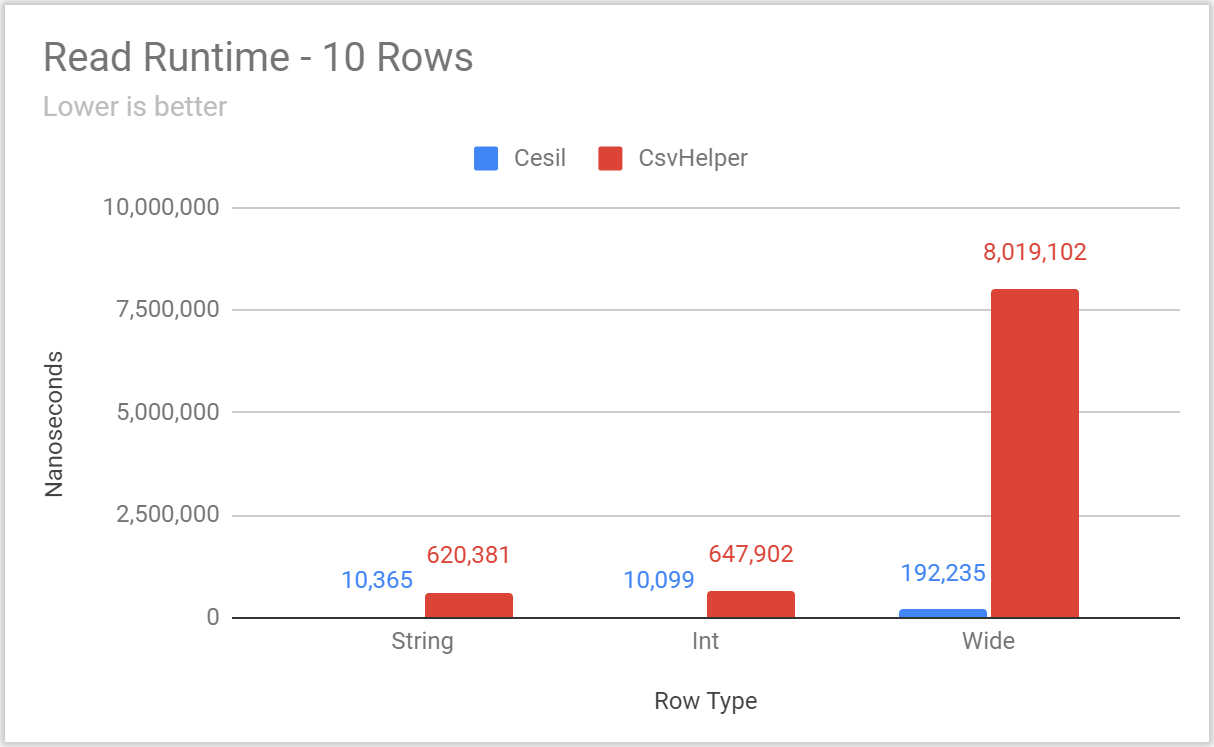
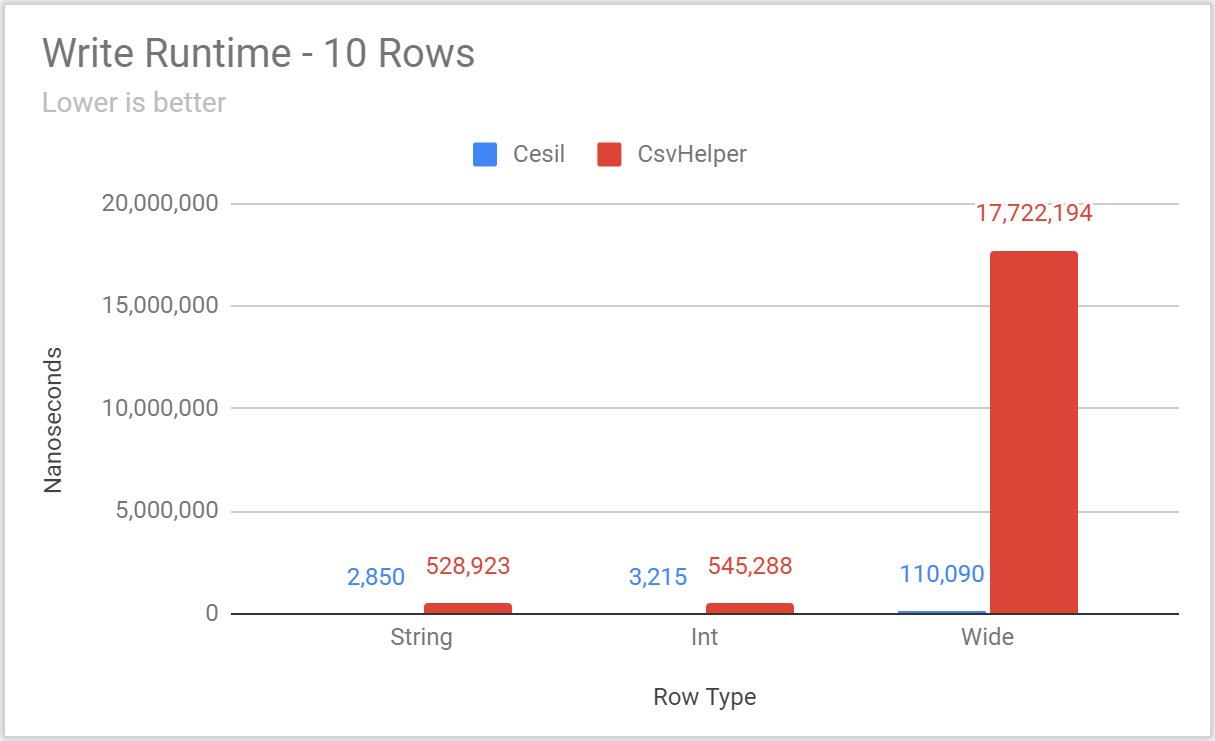
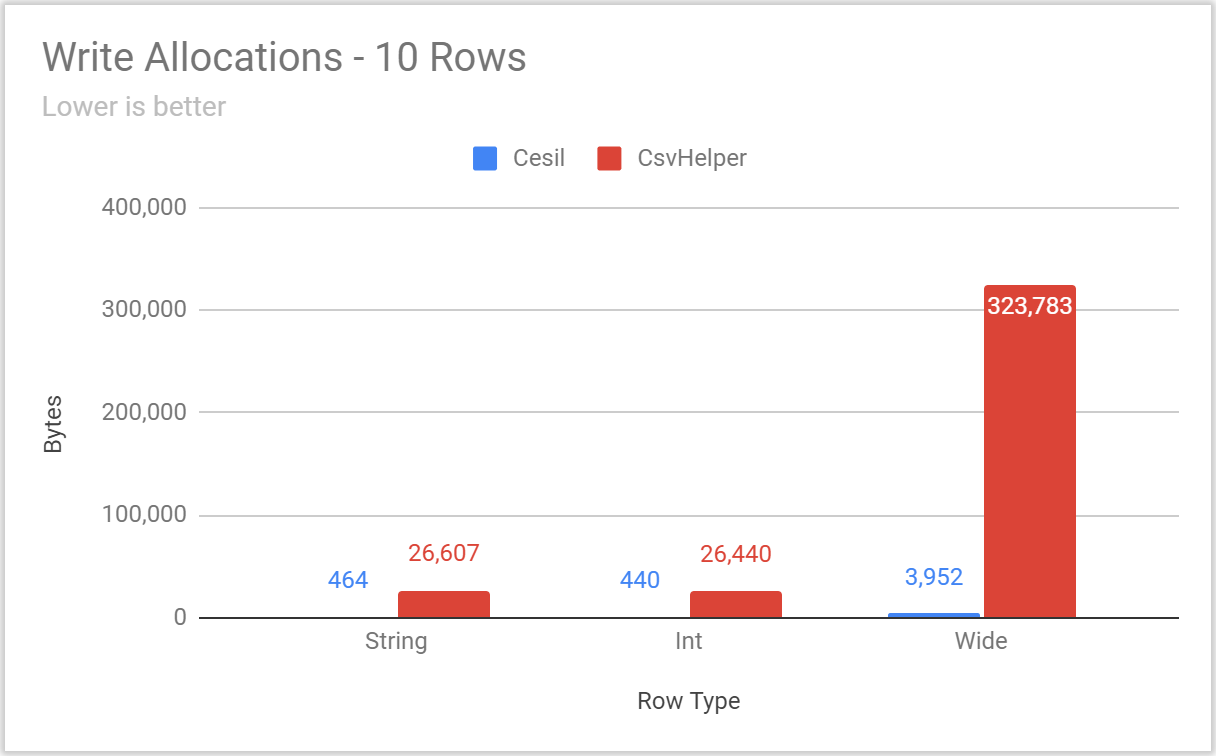
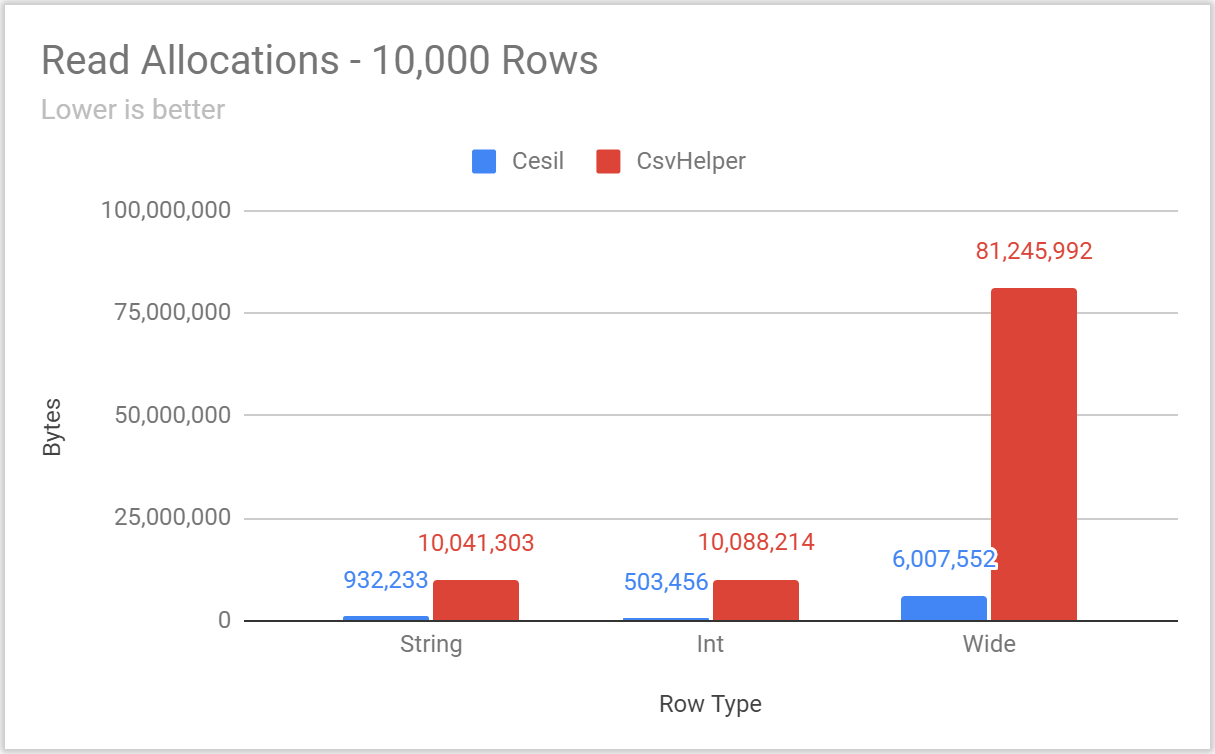
Cesil’s benchmarks report both runtime and allocations, meaning that there is quite a lot of data to compare. A full summary is checked in, but I have selected some subsets to graph here.
|
|
|
|
|
|
|
|
|
|
|
|
(charts and raw numbers can be found in this Google Sheet)
There are also benchmarks for reading and writing one million of these “wide” rows. Cesil can read ~59,000 wide rows per second (versus ~47,000 for CsvHelper), and write ~97,000 rows per second (versus ~78,000 for CsvHelper).
With all the typical benchmarking caveats (test your own use case, these are defaults not tailor tuned to any particular case, data is synthetic, etc.), Cesil is noticeably faster and performs fewer allocations, especially in the cases where relatively few rows are being written. Be aware that both Cesil and CsvHelper perform a fair amount of setup on the “first hit” for a particular type and configuration pair – and BenchmarkDotNet performs a warmup step that will elide that work from most benchmarks. Accordingly, if your workload is dominated by writing unique types (or configurations) a single time these benchmarks will not be indicative of either library’s performance.
And that wraps up Cesil’s performance, at least for now. There are no new Open Questions for this post, but the issue for naming suggestions is still open.
In the next post, I’ll be digging into Source Generators.
Let’s say I wake up one morning and I’m magically in charge of Android, iOS, or Mac OS. What do I do? Here are three ideas aimed at making operating systems more social.
It matters what goes in operating systems. Almost 20 years ago, many of us were banging the drum for location-aware computing. It’s hard to imagine now that computers (by which I include phones) didn’t know where they were. But put location in the OS, and you enable everything from turn-by-turn directions, to advertising, to takeaways, to Tinder.
ASIDE: If you’re into the history, Know Your Place (July 2017, The Fibreculture Journal) is an examination of the visionary and influential headmap manifesto for “locative media” (as it was called) by Ben Russell from 1999.
Another example:
Fonts on the original Macintosh, 1984, which was early in using fonts with characters of different widths, often referred to as proportional fonts.
(Previously most computers were more like typewriters.) The story goes that Steve Jobs went to a calligraphy class at college, and ended up caring a ton about typography. And so we ended up with desktop publishing and the democratisation of design!
Laptops and smartphones never escaped their PC history. They’re still personal computers, all our socialising and collaborating channeled through individual apps like email and Facebook. To be natively social, we need social capabilities at the OS level.
So, let me join the dots on a few recent blog posts, and briefly lay out some starting points…
Google Docs is amazing (and Sheets, and Slides). Like, of course in docs you should be able to
After all, this is exactly what you’d in a meeting room with a whiteboard, or in a cafe scribbling on a napkin.
Then you get the unintended uses of those capabilities like spreadsheet parties, as previously discussed.
Figma, the online design tool, has has multiplayer mode since 2016. A designer can show their work to viewers, all their cursors swarming round. More unintended uses: Tom Critchlow has been using Figma for salons.
And then there’s the new generation of collaboration apps such as MakeSpace with its video selfie cursors and shared canvas.
I find it insane that Google never turned Google Docs into a framework for all web apps.
Live text editing, multiplayer cursors, comments and chat: these are powerful primitives. Why doesn’t every text editor on the web, every sketching app, and every music maker include this? Google could have enabled that.
It’s not too late.
If I were Apple, or Google with Android, I’d bake this into the OS. It should be a native feature of the operating system, just like menu, or the file save dialog box.
Every application window should be thought of as a room. Tap on a window, open the door, and see cursors swarm, text get edited, and comments stream in. (Different cursors for different windows, naturally.)
And one of those team members? An artificial intelligence assistant. I talked yesterday about how the ideal interface to AIs is the team
Erving Goffman, sociologist, his 1956 book The Presentation of Self in Everyday Life:
when an individual comes in contact with other people, that individual will attempt to control or guide the impression that others might make of him by changing or fixing his or her setting, appearance, and manner.
Like… of course?
Goffman focuses on politeness: all participants in social interactions are engaged in practices to avoid being embarrassed or embarrassing others.
And costume: the dress and look of the performer.
Agency in self-presentation is about as close as you can get to a human fundamental. Sure enough, there are filters in individual apps. Yet there’s barely any attention given, at the OS level, to this kind of “dressing up,” to costume.
I wrote in October about virtual fashion: How about skin tight t-shirts with tracking markers, especially made for rendering synthetic shirts with physics-model fabric for wearing on Zoom?
And there are glimpses of apps that play in this domain. Recently I saw xpression camera on Product Hunt. It intercepts your webcam and lets you change your appearance on any call. Like, you give it an image of a person, and then it deepfakes your face into the image. Check out the second photo on that Product Hunt page: Take a photo of yourself in a suit, so you can attend Zoom meetings in your pyjamas.
The ability to not brush my hair for video calls is ABSOLUTELY a worthy operating system-level feature.
Is this trivial? I imagine people said the Mac’s focus on typography was a triviality when it launched in the 80s. But creative expression is what humans are all about, and nice fonts (and ugly fonts…) tap directly into that.
Here’s another: the video/podcast-editing tool Descript. Check out their launch video on YouTube. At 1 minute 50, you’ll see the ability to scrub every uh and um from your voice, automatically.
This is no different from spellcheck. We have spellcheck because it’s important to be professional. But computers (I include phones in this) are subject to the tyranny of work. What about hanging out with my friends? I want to sound cool and look silly, or whatever.
So for my second act, I’d bake deepfakes, dressing up, and yes, an app store for virtual fashion right into the OS. Give presentation-of-self features an absolute ton of attention.
Notifications are a system-level feature. Good.
But notifications are a blunt instrument.
Long-time listeners will know of my interest in social peripheral vision, the idea that you should be able to sense, as if from the corner of your eye, the busyness of a Slack channel, or the fact that a friend is slowly and quietly posting gorgeous photos somewhere.
And from that gentle, non-urgent awareness, you can build up (or not) to full focus.
But how should it work? One thought…
There’s an idea buried in my post about video calling interop from a few weeks back:
The icons on my home screen should appear “noisy” somehow if they’re currently full of my friends. Getting notifications only when I’m direct-mentioned is such a crude mechanism: I want to know where the action is!
Noisy icons. What if each icon gave off ripples? But the ripples would be static. If they did animate, it would be very slow.
From a visual scan of your home screen, you’d see which apps were busy and which were quiet. Bigger ripples if more of your friends are active; bigger ripples if your name is mentioned. Each app could have its own volume control.
Imagine seeing ripples around the Google Docs app as if there were some deep, distant activity. Open it… and there’s a particular document humming with comments. You listen at the door, you can tell who’s active, and the frequency of the interactions, but not what they’re saying precisely… a ping as your name is mentioned (the notification of which wouldn’t have bubbled all the way up to your home screen as it’s not important enough, but since you’re here) - so you enter and join your colleagues.
It’s not going to happen, nobody’s going to give me the keys to designing the OS.
But I’d love to see social computing given the attention that it deserves. As you can tell, I’m frustrated that OS designers and engineers haven’t gone further down this path already.
Just as, in the days of locative media, in 1999 before smartphones and before consumer GPS, we could only guess at what would happen with location-based computings, I feel like we’ve only scratched the surface with social, and I want to see what apps and services would be newly-enabled and newly-imagined by system-level Lego bricks like these.

Sometimes, there’s one spot in your home where Wi-Fi just doesn’t work very well. If your standalone Wi-Fi router keeps your laptop or phone reliably connected everywhere in your house except for that one trouble spot, a good Wi-Fi extender would be the quickest, cheapest fix. After a new round of research and testing, we’ve reaffirmed that the TP-Link RE315 can make a network noticeably more reliable in a small area, for an affordable price.

Last night at Grief Club (the monthly drop-in on Zoom hosted by Hospice PEI), this quote from John Green was read at the end:
Maybe there’s something you’re afraid to say, or someone you’re afraid to love, or somewhere you’re afraid to go. It’s gonna hurt. It’s gonna hurt because it matters.
I’ve never been one for weighty aphorisms, especially those from 43 year old YA authors (who aren’t named Dave), but this one held some weight for me.
I’m a little in awe of how much I get out of Grief Club: having a place to go every month where it’s not weird to talk about the dead we loved is such a privilege.
The four skills I needed most when I was managing people have all turned out to be equally important in teaching:
How to intervene when people behave badly. It doesn’t come up often, but knowing how makes you more likely to do it when you should.
How to run a meeting. Agenda before, minutes after, manage speaking time—none of it is magic, but without it, everything else is harder than it needs to be.
How to write a two-page memo making the case for doing something so that people have something concrete to debate (and so that there is a record later of why we did something).
How to set priorities and re-set them when the world changes or people fall behind. (The real purpose of a schedule is to tell you when to start cutting things from your plan…)
If I was going to add a 5th, it would be “how to make things discoverable” so that people can find what they need when they need it, but I’m still trying to figure that one out…