Shared posts

14 May 17:21

Practical SQL for Data Analysis

Practical SQL for Data Analysis

This is a really great SQL tutorial: it starts with the basics, but quickly moves on to a whole array of advanced PostgreSQL techniques - CTEs, window functions, efficient sampling, rollups, pivot tables and even linear regressions executed directly in the database using regr_slope(), regr_intercept() and regr_r2(). I picked up a whole bunch of tips for things I didn't know you could do with PostgreSQL here.

Via @be_haki

13 May 18:13

GPS weirdness

by jnyyz

Lately I’ve been noticing that some of the GPS tracks I’ve been getting from my iPhone 12 mini have been really inaccurate, and this is particularly bad on short rides. Take a look at the track for this ride.

Consulting the internet hive mind didn’t really provide an explanation, so this morning I decided to do a short ride with three devices running in parallel: the iPhone 12 mini, my old iPhone 6s, and my Garmin Edge 530. You can see the three tracks here:

  • iPhone 6s
  • iPhone12 mini
  • Garmin Edge 530

The data from the the two phones was close, aside from the fact that I forgot to turn on stop detection for the 6s, hence the slightly longer ride time.

The track was most accurately captured by the 6s, but the 12 was very close. The weird thing was that the track for the Garmin was offset by about two blocks, and was also distorted with the tracks not following roads at all. For this test, I was riding my commuter bike which does not have a Garmin mount, so I just had it vertically in a bar water bottle bag.

I decided to run a second test, this time with the Garmin mounted horizontally, and it tracked the ride accurately, along the same line as the 12 mini.

  • Garmin vertical
  • Garmin horizontal

This left the mystery has to why my iPhone 12 was not showing the earlier problem. I thought that it might be because the earlier data was taken with the phone stashed in a handlebar bag where it was in close proximity to the metal drop bar, so I ran a variation of the northern route shown in the first picture with the phone in the bag again.

Once again, an accurate track.

Preliminary conclusions:

  • The Garmin seems to require being mounted horizontally, whereas the iPhones do not.
  • I do not understand the bad GPS data that I was getting from the iPhone 12 mini as that problem seems to have gone away for the moment. The only thing that I can think of is that I toggled location services back and forth from “only while using the app” to “always” for today’s first test” and then back to the original setting.
  • I’ll keep an eye out for the iPhone 12 misbehaving again.

Update:

I’ve figured out that I get bad data if I have my phone in my pocket while pedalling as opposed to in a stationary water bottle holder. You can see the difference in these two traces.

  • in water bottle holder
  • in pocket


09 May 02:34

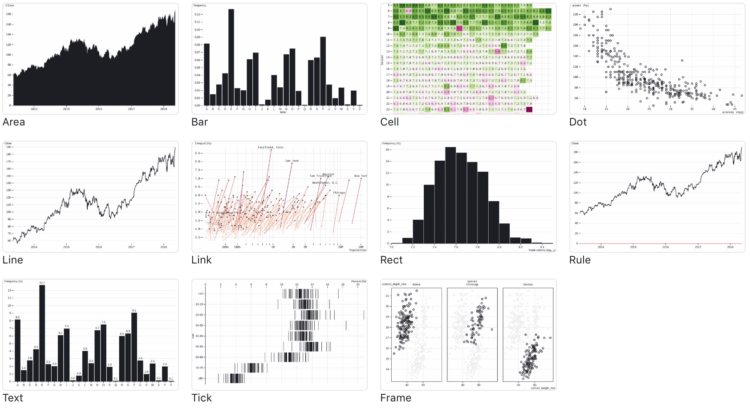
Observable Plot, a JavaScript library for more straightforward visualization of tabular data

by Nathan Yau

If you’re into the notebook workflow, Observable Plot is a JavaScript library built for you:

We created Plot to better support exploratory data analysis in reactive, JavaScript notebooks like Observable. We continue to support D3 for bespoke explanatory visualization and recommend Vega-Lite for imperative, polyglot environments such as Jupyter. Plot lets you see your ideas quickly, supports interaction with minimal fuss, is flexible with respect to data, and can be readily extended by the community. We believe people will be more successful finding and sharing insight if there’s less wrestling with the intricacies of programming and more “using vision to think.”

In case you’re curious how Plot compares to D3, which was used to build Plot, you can find that information here.

Tags: JavaScript, Observable

09 May 02:31

The Instagram ads Facebook won't show you

by Volker Weber

Screenshots of sample ads

Facebook is more than willing to sell visibility into people’s lives, unless it’s to tell people about how their data is being used. Being transparent about how ads use people’s data is apparently enough to get banned; in Facebook’s world, the only acceptable usage is to hide what you’re doing from your audience.

I guess you are still on Instagram or Facebook.

More >

09 May 02:31

Does Amazon know what it sells?

by Benedict Evans

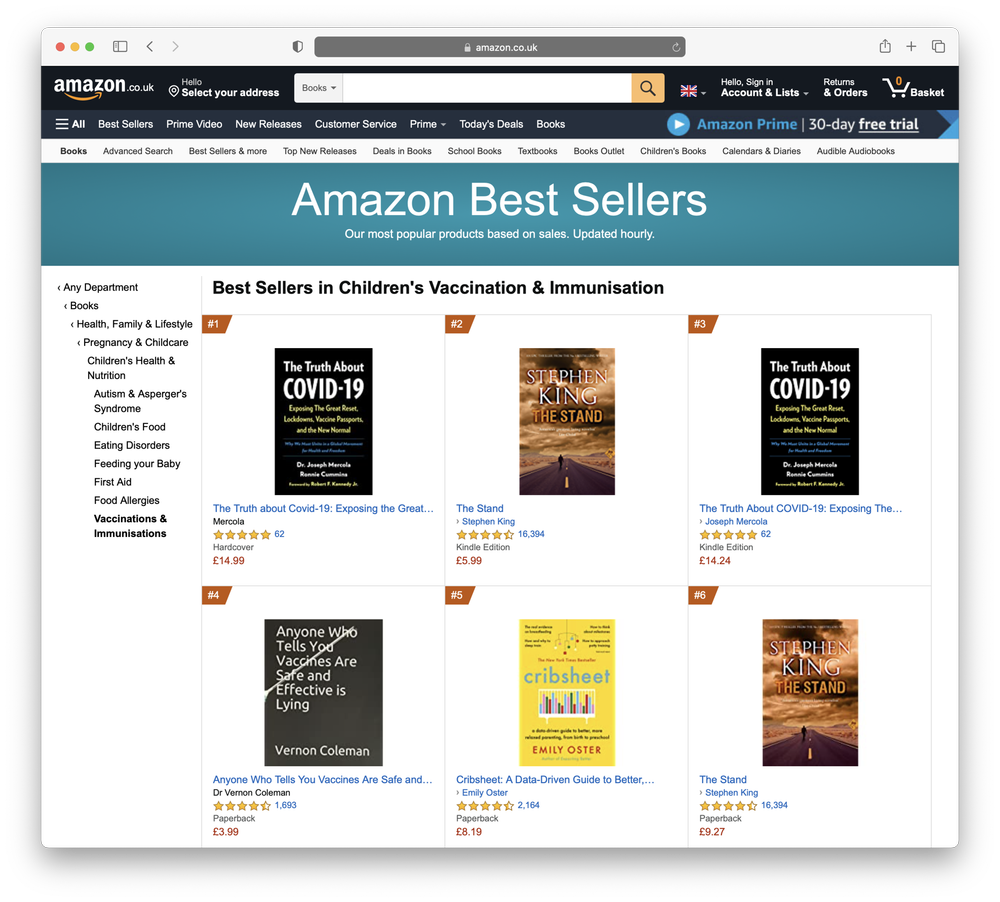
Of Amazon’s top 50 best-sellers in “Children's Vaccination & Immunisation”, close to 20 are by anti-vaccine polemicists, and 5 are novels about fictional pandemics.

Screenshot 2021-05-05 at 10.57.10 am.png

It’s easy to point at this and laugh, but it’s more interesting to ask what it means. How much content moderation should a universal bookshop do? And does Amazon really know what it sells?

The content moderation questions here are closely related to those that applied when Facebook and Twitter banned the US president. A single newspaper or a bookshop has no obligation to give you a platform, but there are other newspapers and other bookshops - what does it mean if there are only three newspapers (or only three with significant reach) and they all ban you? Should they allow you to be on the platform, but not ‘amplify’ you either with an ‘algorithm’ or something as mechanical as a best-seller list (and of course being in the list will increase your sales, so that’s also a moderation choice). What books, exactly, do we want Amazon to ban, or to ‘down-rank’? Who decides? What if Amazon put those books in ‘conspiracy theories’ instead? I don’t think we have a settled consensus.

More interesting to me in this case, though, is the fact that five of the top 50 are not about “Children's Vaccination & Immunisation” at all - they’re novels! This is a much more general problem, that I think that reflects a pretty fundamental aspect of Amazon as a retailer - it does not, in important ways, actually know what it sells, and that has always been inherent to the model.

There’s an old cliché that ecommerce has infinite shelf space, but that’s not quite true for Amazon. It would be more useful to say that it has one shelf that’s infinitely long. Everything it sells has to fit on the same shelf and be treated in the same way - it has to fit into the same retailing model and the same logistics model. That’s how Amazon can scale indefinitely to new products and new product categories - it doesn’t need to create new infrastructure and new retailing to sell new things (and why grocery, which requires an entirely different logistics chain, is such a departure). Instead, it turns products into packets in a network, and the whole point of a packet-switched network is that you don’t have to know what the payload is. That means it’s never really had any idea what any of those SKUs are - they’re a number, a size and a weight. It can say ‘people who bought X also bought Y’, but it doesn’t really know what X and Y are. And, of course, this is compounded by Marketplace - 60% of what’s sold on Amazon isn’t sold by Amazon.

This has always been the long-term Amazon market share question - how many product categories can be converted to Amazon’s model of pure commodities and how many need a different kind of retailing? More generally, this has been the story of ecommerce for the last 25 years - originally we thought there were some things people would never buy online, but in fact the question was how to convert a product from a high-touch experience in a shop to a low-touch experience online. Does it turn out that you don’t actually need that high-touch experience at all? Or do you need to replace it with something else - free returns, or recommendation, or video, or something else again? And Casper discovered that you don’t need to sit on a mattress before buying it, but also that the margin was destroyed by the returns (and the explosion in competition).

So, each Amazon fulfilment centre has several million SKUs, and each SKU really is just a number. A Stephen King thriller is classed in Children's Vaccination & Immunisation because it’s a ‘BOOK’, and we can see the keywords ‘CHILD’ and ‘VIRUS’. That’s probably a gross over-simplification, and unfair to all the clever people at Amazon working hard managing categories and building product indices. But explain this.

image-asset.png

Part of the problem is that Amazon’s data about the products comes from the suppliers. It was designed in a world of barcodes and mainframes, and in a world where most of this didn’t really matter, because you weren’t trying to sell millions of SKUs in one shop. The customer was never supposed to see this data, but now it’s how you sell. It’s also not a problem unique to retail - this is my carefully curated collection of ‘Rock music’, courtesy of record company metadata (half of which still runs on mainframes).

DbSdruRVwAE_RwA.jpeg
C8SbmJBVwAEAt3P.jpeg

But regardless of the cause, the real moonshot project for Amazon might be to have that sense of what the thing itself really is. That’s not simple, nor one project, and even Google fudged it by realising you could use hyperlinks as a vast mechanical turk. And what does ‘is’ mean, anyway? But if Amazon actually knew what was in the packets, and indeed knew what I bought, then it might be a rather different kind of retailer.

09 May 02:30

Sketching a Non-linear Software Installation Guide (Docker) Using TiddlyWiki

by Tony Hirst

Writing software installation guides is a faff. On OU modules, where students provide their own machines, we face a range of issues:

  • student provided machines could be any flavour Windows, Mac or Linux machine from the last five (or more) years;
  • technical skills and confidence in installing software cannot be assumed (make of that what you will! ;-)
  • disk space may be limited (“so am I expected to delete all my photos or buy a new computer?”);
  • the hardware configuration may be “overspecced” and cause issues (“I’m trying to run it on my gamer PC with a brand new top of the range GPU card and I’m getting an error…”), although more typically, hardware may be rather dated…

The following is, in part, a caricature of “students” (and probably generalises to “users” in a more general case!) and is not intended to be derogatory in any way…

In many cases, software installation guides, when the installation works and you have an experienced and confident user can be condensed to a single line, such as “download and install X from the official X website” or “run the following command on the command line”. Historically, we might have published an installer, for the dominant Windows platform at least, so that students just had to download and double click the installer, but even that route could cause problems.

This is an example of a just do this” sort of instruction, and as anyone who has had to provide any sort of tech support ever, just unpacks a long way. (Just knock me up quick Crème brûlée… The eggs are over there…” Erm…? “Just make a custard…” Erm….? “Just separate the egg yolks…” Erm… ? Later… Right, just set up a bain-marie… Erm…?! “..until it’s just set….” Erm…? Much later… “(Sighs…) Finally, now just caramelise the…” Erm…? Etc.)

More generally, we tend to write quite lengthy and explicit guides for each platform. This can make for long and unwieldy instructions, particularly if you try to embed instruction inline for “predictable” error messages. (With 1k+ students on a module per presentation, even a 1% issue rate is 10 students with problems that need sorting in a module’s online Technical Help forum.)

Another problem is that the longer, and apparently simpler, the instructions, the more likely that students will start to not follow the instructions, or miss a step, or misread on of the instructions, creating an error that may not manifest itself until something doesn’t work several steps down the line.

Which is why we often add further weight to instructions showing screen captures of before, “do this” and after views of each step. For each platform. Which takes time, and raises questions of how you get screenshots for not your platform or not your version of a particular Operating system.

In many cases we also create screencasts, but again these add overhead to production, raise the question of which platform you produce them for, and will cause problems if the screencast vision varies from the actuality of what a particular student sees.

(Do not underestimate: a) how literal folk can be following instructions and how easily they freeze if something they see in guidance is not exactly the same as what they seen their on screen, whilst at the same time b) not exactly following instructions (either by deliberately or in error) and also c) swearing blind they did follow each instruction step when it comes to tech support (even if you can see they didn’t from a screenshot they provided; and in which case they may reply they did the step the first time they tried but not the second because they thought they didn’t need to do it again, or they did do it on a second attempt when they didn’t need to and that’s why it’s throwing an “already exists” error etc.).)

So, a one liner quickstart guide can become pages and pages and pages and pages of linked documents in an online installation guide and that can then go badly for folk who would have been happy with the one liner. Plus the pages and pages and pages of instruction then need testing (and maintaining over the course life, typically 5 years; plus the guide may well be written diring course production a year or more before the first use date by students). And in pages and pages and pages and pages of instruction, errors, or omission or ordering errors or something can slip through. Which causes set up issues in turn.

If we then try to simplify the materials and remove troubleshooting steps out of the install guide, for example, and into a troubleshooting section, that makes life harder for students who encounter “likely” problems that we have anticipated. And so on.

And as to why we don’t just always refer to “official” installation guides: the reason is because they are often based on the “quick start by expert users” principle and often assume a recent and updated platform on which to install the software. And we know from experience that such instructions are in many cases not fit for our purposes.

So… is there a better way? A self-guided (self-guiding?) installation guide, maybe, perhaps built on the idea of “create your own adventure” linked texts? To a certain extent, any HTML base software guide can do this; but often, there is a dominant navigation pane the steers the order in which people navigate a text, when a more non-linear navigation path (by comparison with a the strcuture of an explicit tree based hierarchical menu, for example) may be required.

For years, I’ve liked the idea of TiddlyWiki [repo], a non-linear browser based web notebook that lets you easily transclude content in a dynamically growing linear narrative (for example, a brief mention here: Using WriteToReply to Publish Committee Papers. Is an Active Role for WTR in Meetings Also Possible?). But at last, I’ve finally got round to exploring how it might be useful (or not?!) as the basis of a self-directed software installation guide for our Docker based, locally run, virtual computing enviornments.

Note that the guide is not production ready or currently used by students. It’s a quick proof of concept for how it might work that I knocked up last week using bits of the current softwatre guide and some forum tech support responses.

To try it out, you can currently find it here: https://ouseful-testing.github.io/docker-tiddly-test/

So what is TiddlyWiki? A couple of things. Firstly, it’s novel way of navigating a set of materials within a single tab of a web browser. Each section is defined in its own subpage or section, and is referred to as a tiddler. Clicking a link doesn’t “click you forward” to a new page in the same tab/window or a new tab/window; by default, it open displays the content in a block immediately below the current block.

You can thus use the navigation mechanism to construct a linear narrative (referred to as the story river) dynamically, with the order of chunks in the document determined by the link you clicked in the previous chunk.

If you trace the temporal history of how chunks were inserted, you can also come up with other structures. Because a chunk is inserted immediately below the block that contains the link you clicked, if repeatedly click different links from the same block you get a different ordering of blocks in terms of accession into the document: START, START-BLOCK1, START-BLOCK2-BLOCK1, and so on.

If you don’t like that insertion point, a TiddlyWiki control panel setting lets you choose alternative insertion points:

Tiddler opening behaviour: as well as inserting immediately below, you can choose immediately above or at the top or the bottom of the story river.

The current page view can also be modified by closing a tiddler, which removes it from the current page view.

If you click on a link to a tiddler that is already displayed, you are taken to that tiddler (by scrolling the page and putting the tiddler into focus) rather than opening up a duplicate of it.

The Tiddlywiki has several other powerful navigation features. The first of these is the tag based navigation. Tiddlers can be tagged, and clicking on a tag pops up a menu of similarly tagged tiddlers (I haven’t yet figured out if/how to affect their presentation order in the list).

Tag based navigation in TiddlyWiki

A Tag Manager tool, rasied from the Tools tab gives a summary of what tags have been used, and to what extent. (I need to play with the colours!)

The TiddlyWiki tag manager.

Another form of navigation is based on dynamically created lists of currently open tiddlers, as well as recently opened (and potentially now closed) tiddlers:

Currently opened tiddlers; note also the tab for recently opened tiddlers.

By default, browser history is not affected by your navigation through the TiddlyWiki, although another control panel setting does let you add steps to the browser history:

Update browser history setting.

A powerful search tool across tiddlers is also available.

TiddlyWiki search shows tiddlers with title matches and content matches.

To aid accessibility, a full range of keyboard shortcuts for both viewing, and editing, TiddyWiki, are available.

Sample of TiddlyWiki keyboard shorcuts viewed from the Control Panel Keyboard Shortcuts tab.

One feature I haven’t yet made use of is the abilit to transclude one tiddler within another. This allows you to create reusable blocks of content that can be inserted in multiple other tiddlers.

To control the initial view of the TIddyWiki, the first tab of the Control Panel allows you to define the default tiddlers to be opened when the TiddlyWiki is first viewed, and the order they should appear in.

TiddlyWiki control panel, displaying the Infor tab and current default open tiddlers and their start order.

The view of the wiki at https://ouseful-testing.github.io/docker-tiddly-test/ is a standalone HTML document, generated as an export from a hosted TiddlyWiki, that is essentially being used in an offline mode.

Menu showing option to export offline TiddlyWiki.

The “offline” TiddlyWiki is still editable, but the changes are not preserved when you leave the page (although extensions are available to save a TiddlyWiki in browser storage, I think, so you may be able to update your own copy of an “offline” TiddlyWiki?).

To run the “online” TiddlyWiki, in a fully interactive read/write/save mode, I am using based on instructions I found here: How to use TiddlyWiki as a static website generator in 3 steps:

  • install node.js if you don’t already have it installed;
  • Run: npm install -g tiddlywiki
  • Initialise a new TiddlyWiki: tiddlywiki installationGuide --init server; this will create a new directory, installationGuide, hosting your wiki content;
  • Publish the wiki: tiddlywiki installationGuide --listen;
  • By default, the wiki should now be available at: http://127.0.0.1:8080/ . When you create and edit tiddlers, change settings, etc., the changes will be saved.

New tiddlers can be created by editing a pre-existing tiddler, creating a link to the new (not yet created) tiddler, and then clicking the link. This will created a not yet created tiddler, or open the current version of it if it does already exist.

You can edit a currently open tiddler by clicking on it’s edit button.

The tiddler editor is a simple text editor that uses it’s own flavour of text markup although a toolbar helps handle the syntax for you.

TiddlyWiki editor.

Image assets are loaded from an image gallery:

Insert image into tiddler.

The gallery is populated via an import function in the Tools tab.

Tools panel, with import button highlighted.

Looking at the structure of the TiddlyWIki directory, we see that each tiddler is saved to its own (small) .tid file:

View over some TiddlyWiki tdiddler (.tid) files showing “system” tiddlers (filenames prefixed with $_) and user created tiddlers.

The .tid files are simple text files with some metadata at the top and then the tiddler content.

Text file structure of a tiddler.

It strikes me that it should be easy enough to generate this files.

Looking at a report such as one of my rally results reports, there are lots of repeaated elements with a simple structure:

Rally results: lots of elements that could be tiddlers?

That report is generated using knitr from various Rmd templated documents. I wonder if I could knit2tid and then trivially create a TiddlyWiki of rally result tiddlers?

09 May 02:05

Tesla Autopilot engineer says Level 5 Autopilot not happening anytime soon

by Brad Bennett
Elon Musk

It turns out (surprise, surprise) that Elon Musk’s tweets don’t often hold much value.

A Tesla Engineer who spoke with a California DMV official said that “Elon’s tweet does not match engineering reality” when asked about full self-driving tech in Tesla cars by the end of the year.

The engineer, CJ Moore, is Tesla’s director of Autopilot engineering, so I’m leaning towards believing his side of the story rather than Musk’s since I assume Moore spends more time actually working on the company’s Autopilot software.

Beyond the Tweets about Autopilot’s capabilities, Musk also made a big deal about Tesla’s Robo-Taxi plan when he announced it a few years ago, which now seems significantly farther away than originally promised. To get Robo-Taxis working, Tesla needs to bring Autopilot up to SAE Level 5 and currently, it’s at Level 2.

In Ontario and most of the world, vehicle autopilot levels are defined as the following;

  • Level 0 – No Automation: No automated features.
  • Level 1 – Driver Assistance: Intelligent features add a layer of safety and comfort. A human driver is required for all critical functions.
  • Level 2 – Partial Automation: At least two automated tasks are managed by the vehicle, but the driver must remain engaged with the driving task.
  • Level 3 – Conditional Automation: The vehicle becomes a co-pilot. The vehicle manages most safety-critical driving functions but the driver must be ready to take control of the vehicle at all times.
  • Level 4 – High Automation: The vehicle is capable of performing all driving functions under certain conditions. The driver may have the option to control the vehicle.
  • Level 5 – Full Automation: Vehicle is capable of being completely driverless. Full-time automated driving in all conditions without need for a human driver.

In Ontario, only SEA Level 3 vehicles are allowed on the road.

Source: BNN Bloomberg

The post Tesla Autopilot engineer says Level 5 Autopilot not happening anytime soon appeared first on MobileSyrup.

09 May 02:05

I am very excited that my local coffee shop @ti...

I am very excited that my local coffee shop @timbertrain Depot is going to experiment with espresso tonics NEXT WEEK!!!

09 May 02:04

"The best smell is that of bread, the best taste is that of salt, the best love is that of children."

“The best smell is that of bread, the best taste is that of salt, the best love is that of...
09 May 01:57

Aston Martin engineer to join Canadian electric car venture Project Arrow

by Karandeep Oberoi

Fraser Dunn, Chief Engineer of Aston Martin‘s special creations such as the Valkyrie and Valhalla hypercars, is set to join Canada’s Project Arrow team to develop the country’s first zero-emission, self-driving vehicle.

Project Arrow is an initiative of the Automotive Parts Manufacturers’ Association (APMA), representing Canada’s automotive suppliers and aims to demonstrate to the world Canada’s ability to produce an advanced vehicle from the ground up. The project also aims to prepare Canadian manufacturers to produce parts that vehicles equipped with electric and self-driving technology use and is named after the controversial Avro Arrow jet project from the 50’s.

Dunn will take over as Project Arrow’s chief engineer on August 1st, according to APMA President Flavio Volpe, in a statement given to Automotive News (paywall).

“I take my job at Aston Martin seriously, but, in the big scale of things, it is bollocks,” said Dunn in an interview with Financial Post. “You are engineering extremely expensive pieces of machinery for very rich people to enjoy, which doesn’t actually change the world and doesn’t actually contribute much at all, and that is part of my drive for joining Project Arrow.”

Project Arrow is backed by 335 Canadian companies that have committed $100 million in technology, parts and engineering prowess to bring the vehicle to life.

Since Project Arrow will be a concept car, it won’t make its way to dealerships and showrooms. The vehicle’s specifications have also not been announced. However, it will likely be a hybrid with a battery-electric powertrain that includes a battery on the floor and an electric motor at each vehicle’s axle.

The final exterior design for the car was unveiled at the 2021 Consumer Electronics Show in Las Vegas. The finished vehicle will be unveiled in 2022, after which it will go on a world tour, according to the APMA website.

Image credit: Project Arrow

Source: Automotive News Europe

The post Aston Martin engineer to join Canadian electric car venture Project Arrow appeared first on MobileSyrup.

09 May 01:56

Snapdragon chip flaw puts Android users at risk of data theft

by Karandeep Oberoi
hacker-guy-header

According to research published by Check Point, nearly 40 percent of the world’s Android devices currently have a vulnerability that could grant hackers access to SMS messages and phone conversations.

Check Point found the flaw in Qualcomm’s Mobile Station Modem (MSM) and in Android’s ability to communicate with the MSM through the Qualcomm MSM Interface (QMI). Qualcomm’s MSM is a series of chips used to connect to 2G, 3G, 4G and 5G systems.

Attackers could use Android itself to inject malicious code, while apps could use the vulnerability to hide their activity within the modem and effectively make it invisible to security features Android uses to detect malicious activity.

Once an attacker has access, they could view the users’ SMS history, call history, and even listen in on real-time conversations. Hackers could also use the exploit to unlock a device’s SIM card.

Check Point notes that Qualcomm confirmed the issue, defined it as a high-rated vulnerability and recorded it as CVE-2020-11292. Bleeping Computer notes that Qualcomm made security patches available to vendors in December 2020, although it does not appear to have made it into a monthly Android security patch yet.

Here are a few tips based on Check Point’s recommendations to keep your device safe:

  1. Always run the latest version of the OS to protect your device against vulnerabilities and exploits.
  2. Always install apps from official app stores or other credible sources.
  3. To reduce the possibility of sensitive data loss, all your devices should have remote wipe enabled.
  4. Install an anti-virus software on all of your devices, such as CIRA Canadian Shield.

Source: Check Point, Bleeping Computer

The post Snapdragon chip flaw puts Android users at risk of data theft appeared first on MobileSyrup.

07 May 05:50

How NOAH might save Vancouver from the Amazon Flood

by Gordon Price


The Post, currently under construction on Georgia, will open in 2023 as the largest office building downtown.  Inside will be about 6,000 Amazon employees in a building over a million square feet, some relocated from buildings nearby.

Says Mayor Kennedy: “The City of Vancouver is so excited to see Amazon creating an additional 3,000 well-paying jobs for people who want to work and live in our city.”

Just the kind of well-paying jobs needed to afford Vancouver’s housing costs, assisted by a generous grant that Amazon gives its employees for initial accommodation, along with the services of a ‘head-hunter’ who tracks down available apartments.

You can guess where this is going.  Great if you’re an Amazonian on the upper floors, not so promising if you’re a barista in the lobby, disastrous if you’re tenuous low-income tenant in, say, the West End.  And Amazon isn’t alone in attracting educated workers from all over the world, taking advantage of Canada’s immigration policies, close to the mother ships in Seattle like Microsoft.

So what should the city and province be doing now in anticipation of this flood, especially to mitigate the impacts on those in the low end of the market? Perhaps this:

From Fast Company:

New possibilities are emerging with the Biden administration’s agenda, and this may be the most opportune moment in decades for cities to start filling their affordable housing deficits. There are several promising models—both longstanding and cutting edge—that show how. It starts with cities taking literal ownership of the problem by buying more of the housing within their borders.

“I’m going to go radical on you,” says James Stockard. A former longtime commissioner of the Cambridge Housing Authority, in Massachusetts … “If we really want to solve the housing problem in this country, we have to get as much of the private housing stock as we can out of the hands of for-profit owners and turn it over to nonprofit owners and public owners,” he says. …

Low-rent housing developments on the open market are a straightforward way for cities to buy and preserve affordable housing. In King County, Washington, the housing authority has created or preserved 7,000 units of housing since 2000. …

Some cities in the U.S. now have the legal framework to make it easier to buy up housing. In Washington, D.C., a right-of-first-refusal law gives the city or a development partner the ability to buy properties at market rate when they come up for sale …

The Province of BC has been purchasing hotels to house the homeless, but that stock is limited as well community tolerance for bits of the Downtown East Side to be imported to their neighbourhoods.  But more totally non-market housing doesn’t address the needs of the tranches above.  Many low-income tenants are located in the part of the market called Naturally Occurring Affordable Housing (NOAH): older and hence more affordable apartment buildings – affordable, as always, being a relative term.  But there are options to government funding:

The private sector is starting to fill the void, and it’s reaping benefits. In Charlotte, North Carolina, where growth is putting pressure on the housing market, social impact investors have funded an effort to buy and preserve naturally occurring affordable housing for the next 20 years.

And in Arlington, Virginia, the nonprofit Washington Housing Conservancy plans to preserve or create 1,300 units of affordable housing near the new Amazon HQ2, using below-market financing from Amazon’s new $2 billion Housing Equity Fund. These efforts are successful as much for their innovation as for the slow pace of action at the city level.

Did someone just say Amazon?

Amazon’s involvement came through its recently established Housing Equity Fund, a $2 billion pot of money dedicated to preserving or creating 20,000 units of affordable housing near its main office locations—the region around Amazon’s Seattle headquarters, in the Arlington area, and in Nashville, Tennessee, where the company has a large operations center.

To try to counteract pressure on the housing market, Amazon has taken the unusual step of financing the purchase of a market-rate apartment complex next to HQ2 that will be preserved for 99 years as affordable housing.

Does Vancouver anticipate Amazon’s buying or building housing for its employees?  One can already here the concerns: “… for local governments and residents already feeling the housing-market effects of big corporations coming to town, there may be at least some hesitance in giving companies even more sway over the fate of their communities.”

American corporations do love that part of the Canadian psyche: government funds health-care directly, for instance, and doesn’t require employers to provide basic insurance. Yes, taxes are higher, but the Amazons of the world have their ways of shifting taxable profits.  In other words, acceptable of more government intervention takes a lot of pressure off the private sector.

Nonetheless, an Amazon-induced housing crisis is hardly in their interest if their employees are scrambling for the same housing already occupied by less affluent tenants.  And they won’t be able to pass the buck they don’t provide if the City is caught in the squeeze play between creating significant opportunities for new rental housing and resistant neighbourhoods (hello, Grandview).  Then there are the voracious private-equity investors who target the existing rental stock and price it up.  (That’s why the reception for the Squamish’s Senakw proposal has been positive – so far.  It promises a new housing stock aimed exactly at the Amazon market, without the NIMBY backlash.)

So there are effective responses, as the NOAH purchase-strategy illustrates. There just isn’t a lot of time before the water rises even higher.

07 May 05:49

Multimodality

My Wednesday consisted mostly of running around and moving things. I used five transport modes and now I can’t not think about environmental impact and practicality and urban futures. Hop on board the car-share, boat, electric car, bus, and bike, and come along for the ride.

Background

What happened was, on Wednesday morning our boat was at the boatyard for a minor repair. They’d squeezed me in on the condition that I show up at 8AM to sail it away — they’re pretty well maxed out this time of year when everyone wants to get back on the water. Simultaneously, following on my recent bike accident, my bike was stuck in the repair shop — also maxed out in spring — because the replacement pedals they’d ordered were defective and the nearest available pair were in an indie bike shop in a distant suburb.

So, here’s what I did.

  1. Got up early and took a car-share which was just outside my house down to Granville Island, where the boatyard is.

  2. Putt-putted the boat over to my spot at the marina, hung out there for a while while I cleaned up the boat, put it into office mode, and did a bit of work.

  3. Walked twenty minutes to the nearest car-share and took that home.

  4. Took the electric car 32km from central Vancouver to Cap’s South Shore Cycle in Delta, picked up the necessary bike part, came back to Vancouver to drop it off at the local bike repair that was working on my bike, then went home for lunch.

  5. When the shop texted me that they were done, took a handy local bus eight stops or so starting four blocks from my house and getting off around the corner from the bike shop.

  6. Biked home!

Now let’s consider the experience and the economics.

Car Share

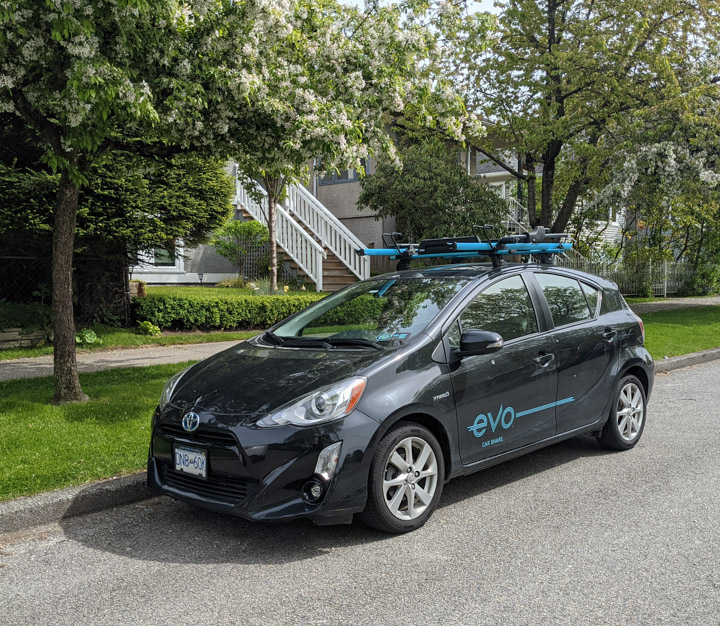
There’s been a lot of churn in this market over the years, with Zipcar and Car2Go and so on; it may or may not be a thing where you are. Here in Vancouver it’s alive and well under the Evo brand. You pick up the one that’s nearest and drop it off at your destination. There’s a mobile app, obviously.

An Evo car-share

They’re all Toyota Prii and thus pretty energy-efficient. Also, since a significant part of an automobile’s carbon load comes from manufacturing, when you provide more trips with fewer cars, that should be a win.

Having said that, the carbon-load impact story is mixed. The reason is that they’re so damn convenient that they end up replacing, not solo car trips, but public-transit and bike trips. I can testify to that; when I was working downtown at Amazon, mornings when the weather was crappy or I wasn’t feeling 100%, I regularly yielded to the temptation to car-share rather than bike or take the train. On the other hand, we have friends who don’t own a car but probably would were it not for car-share availability.

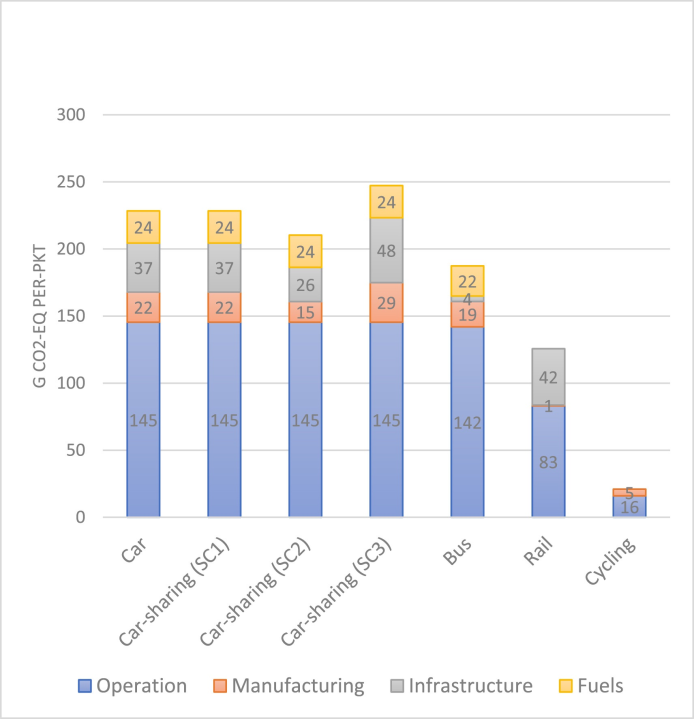
Anyhow, it’s beastly complicated. Does car sharing reduce greenhouse gas emissions? Assessing the modal shift and lifetime shift rebound effects from a life cycle perspective dives deep on this. Big questions: What kind of trips is the car-share displacing, and do the vehicles wear out faster than individually-owned cars? The image is from that paper linked above.

Transport modes emission factors

Emission factors for three car-share scenarios. The Y access is equivalent grams of CO2 per passenger-kilometre travelled.

My big gripe with the study is that in my experience, the kind of car offered by car-shares is quite a bit more efficient than the average proprietary car on the road. I’m also puzzled at the low carbon cost assigned to manufacturing; I had thought it closer to 50% from previous readings. No matter how you cut it, though, it’s not simple.

Boating

OMG forgive me, Mother Earth, for I have sinned. When we’re trundling along at 20+ knots to the cabin with weekend supplies, we get 1 km/litre, maybe 1.1. (It’s only 30km.) On the other hand, there’s this.

False Creek from a small boat

Shot while heading over to the boatyard a couple of days ago. It’s awfully nice to be out in a boat.

I console myself with the fact that this is the only petroleum-burning object in our possession; even our house heating and cooking is electric now. But still. There is hope; innovators all over the world are trying to figure out how to make boating less egregiously wasteful. For example, consider the lovely Candela boats, which combine modern battery technology with hydrofoils to get all that fiberglass up out of the water. They’re not the only ones; other manufacturers, mostly in Europe, are trying to get the right combination of range, performance, and carrying capacity. I sincerely hope to be able to buy such a thing in the boating years that remain to me.

But in my actual boat in the year 2021, it’s not good.

Driving (e-car)

I took another car-share Prius home (a long walk to get it, this time) and had time for a coffee before I fired up the electric car to go get bike parts.

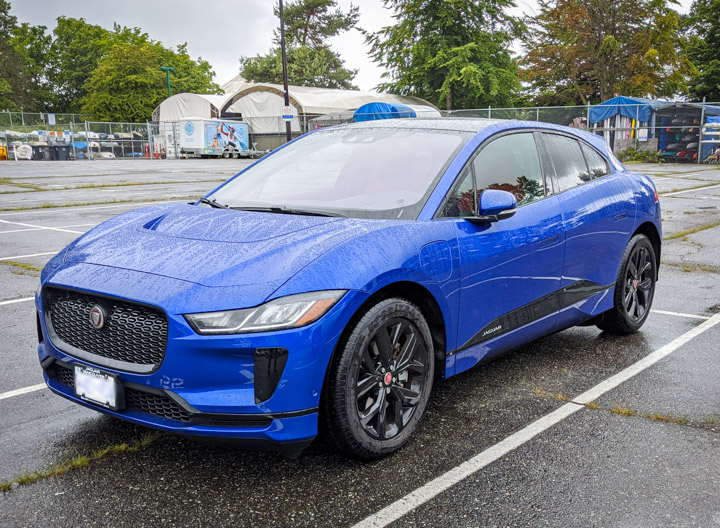
Jaguar I-Pace in the rain

I confess to having been all excited about this trip; it’s been a year or more since I’ve had the Jag out on the highway. Traffic was light and I may have driven a little too fast; actually cried out with joy as I vectored into the approaches to one of the Annacis Island bridges. The contrast to the friendly-but-frumpy little Prius is stark.

Let’s look at another graph, from Which form of transport has the smallest carbon footprint?.

carbon footprint for various travel modes

I encourage visiting the paper because this graphic is interactive, you can add lots more different travel modes.

Where I live the electricity is very green, but even with dirty coal-based power, battery cars are still way more carbon-efficient than the gas-driven flavor simply because turning fossil fuels into forward motion is so beastly inefficient. Still, considering manufacturing carbon cost, a single human in a heavy metal box is never going to be a really great choice, environmentally.

But wait: This is exactly the kind of errand cars exist for. There’s no good argument for decent public-transit service between residential Vancouver and a small store in a strip mall in a remote suburb. It’s too far to bike. The advantages of car-share, as we’ve seen, aren’t that overwhelming.

I once read a piece of analysis — sorry, can’t remember where — that suggested a future where lots of people still have cars, but that they are rarely used, mostly just sit there. Until, for example, you have to head off to fetch something from a distant suburb. That sounds plausible to me, partly because it describes our situation: We regularly get plaintive complaints from the Jag’s remote-control app saying that since we haven’t gone near it in days, it’s going into deep-sleep mode.

Busing

I generally don’t mind taking public transit, if only for the people-watching, except when there’s rush-hour compression.

Unfortunately, the carbon economics depend really a lot on how full your buses and trains are. To the extent that fossil-fuel shills have written deeply dishonest studies that I’m not gonna link to arguing that cars are more planet-friendly than buses unless the buses are really full all the time. In fact, in most places they’re full enough to make the carbon arithmetic come out ahead on carbon loading.

And there’s another subtle point: A successful public-transit system has to run some trains and buses at suboptimal loads because otherwise people won’t be able to depend on it to get around and will just go ahead and buy a car and then start driving everywhere.

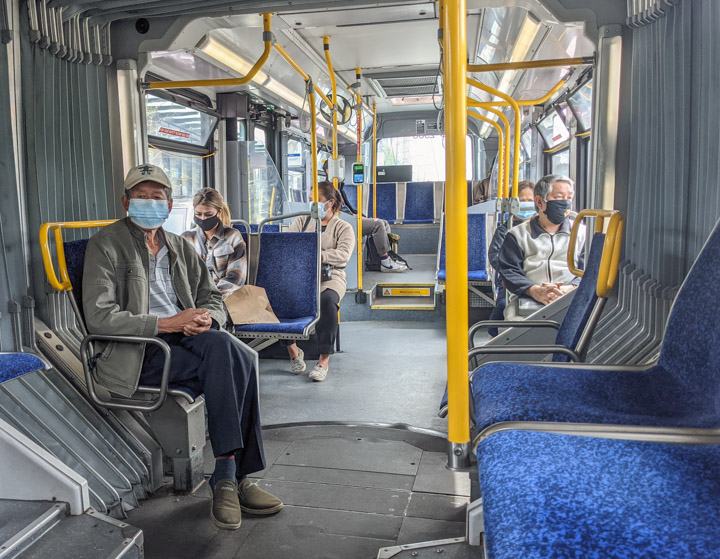
And having said that, Covid is definitely not not helping; check out this picture I took on the bus today.

On Vancouver’s #3 bus, May 5, 2021

Vancouver’s #3 Main Street bus on a Wednesday afternoon in May 2021.

Biking

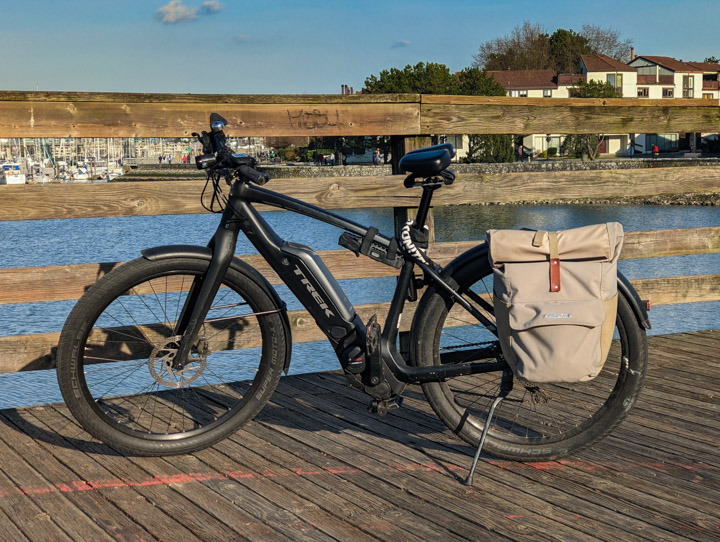
Anyhow, I finally, weeks after my accident, found myself back on my wonderful e-bike, heading home.

Trek e-bike at Vancouver’s False Creek

So far on this journey there’s been a whole lot of “It’s complicated.” No longer. Bikes’ carbon load is vanishingly small compared to any other way of traveling further than you want to walk. Plus they’re fun. Plus riding them is good for you. E-bikes hugely expand the range of situations where biking is an option for a non-young non-athletic person.

It’s not complicated. We need more bikes generally and more e-bikes specifically on the road, which means your city needs to invest in bike-lane infrastructure to make people safe and comfortable on two wheels.

07 May 05:46

2021-05-05 General

by Ducky

Vaccines

Pfizer has been approved down to age 12, yay!!


Moderna has been doing a clinical trial with a booster made to mimic the spike proteins of B.1.351 instead of COVID Classic, and their press release says it works better against B.1.351 and P.1 than a third shot of Moderna Classic. (Note: it “works better” in test tubes. Presumably there weren’t enough people who got sick to calculate efficacy that way.)


The US is backing a patent waiver on COVID vaccines. I’m not ideologically against patent waivers, I just don’t think they will help much in getting vax out to the people. The time/cost of building a factory and access to raw materials and knowhow are much, much bigger barriers (as this article also posits). There is also going to be an absolute flood of vaccine in 2022, even without IP waivers.


The Pfizer vaccine does not harm sperm. You can sleep easily now.

Variants

The US CDC has downgraded B.1.526 (one of the “New York” variants), saying basically that it’s not a concern, yay!

Disease

This paper says that one difference between COVID survivors and uh non-survivors is the speed at which they produce neutralizing antibodies. It sounds like people with fatal COVID just can’t pump out the antibodies fast enough. 🙁

Airborne v. Droplets

There has been a lot of frustration about whether COVID-19 is airborne or not. LOTS of bits have been devoted to this argument. The way I personally think about it is that while long-distance spread CAN happen, usually it DOES not. 

I believe that what epidemiologists call “airborne” is a little different than what lay people call airborne (i.e. “transmitted through the air”).  In a press conference, Dr. H said something about how “airborne” meant “through ducts and around corners”.

NOBODY disputes that the particles travel through the air.  The question is how far do they travel, and how long do the particles hang around?  Measles hangs around suspended in the air for so long and is so transmissible that you can catch it by walking through a room where someone with measles was a few hours earlier.

EVERYBODY agrees that big droplets spread COVID-19. EVERYBODY agrees that COVID-19 particles go through the air. Those are not in dispute.

After that, it gets grey.  I have a friend who I swear thinks that the virus emerges from mouths like swarms of angry mosquitos and makes a beeline for uninfected people.  That ain’t how it works.  (If it were, we would ALL have gotten sick.)  Dr. Henry says that plexiglass partitions have proven effective, and those certainly wouldn’t be effective against the angry-mosquitos model.  (She could be wrong, I suppose, but I sure hope that she and her team are more competent than that.)

There’s also nothing magic about 2m. (Particles containing viriuses don’t do a 90° turn towards the ground at 2m.) Some particles will travel farther, some won’t travel as far.  It depends on how loudly the person is talking, the air currents, the air temperature,  the air density, and some other factor (which scientists haven’t figured out yet) about the person transmitting (how loudly they talk?  how much vibrato their voice have?).

The receiving person’s immune system also affects whether a “successful” transmission occurred.  Like maybe Fred speaking normally results in 49N virus particles making it to someone standing 2m away, and your immune system today can handle 60N but mine can only handle 40N today. Maybe I need to be 3m away to be safe.

All this gives a huge number of shades of grey, and most humans are uncomfortable with grey.  Sorry.

HOWEVER, as a practical matter, contact tracers have to use some number, some cutoff to decide which contacts need to be followed up on and which do not. Otherwise, their job becomes intractable. 2 metres is a distance which is usually safe for most people, so the contact tracers use that.

There are some well-documented cases of transmission farther than 2m and/or through ducts. Almost the cases of long-distance spread which I can think of are some combination of singing, vents blowing air, and cold temperatures (e.g. meatpacking plants). 

There are some particular cases in a restaurant and a bar of people getting infected by people who were upstream of them in a place with noticeable airflow. I don’t know what the temperature were, but the vents were called air conditioning ducts, and most AC that I’m familiar with blows air which is way too freaking cold. Also, note that in both the cases I linked to, there were people in the establishment who were as close but not in the airstream who did not get infected.

One exception to singing/blowing/cold is the Diamond Princess: COVID-19 appears to have travelled through the ducts there.  I don’t now how cold that air was, but I suspect that old people cooped up in their rooms 24/7 might be more susceptible than the average person/situation.

Another exception is a case in New Zealand where infected person A opened a door, breathed for 50 seconds, closed their door, person B opened a door ten feet away, and person B got infected. 

HOWEVER, the two cases above are anomalous cases, written up because they are odd.  We don’t have writeups for all the times transmission did not occur around corners or through ducts.  I suspect that if it was common for transmission to happen around corners and through ducts, we would all be sick by now.

As I said, I think it CAN happen but usually DOES not happen.  Sort of like “Can big airliners crash?”  Yes, of course they can — we’ve all heard about it — but usually they don’t.  They just don’t write articles about the millions of times they don’t crash. 

NACI

The National Advisory Council on Immunizations gave some very confusing guidance yesterday. They said that the mRNA vaccines were preferred, and that Canadians should weigh the risks before they decide which one to receive. NACI’s chair went on to say “If, for instance, my sister got the AstraZeneca vaccine and died of a thrombosis when I know it could have been prevented and that she is not in a high risk area, I’m not sure I could live with it.”

Well. This did not go over well. People were confused at the change in message after Everybody Else saying, “take the first one you are offered”, and angry that NACI abdicated the careful thinking about the vaccine to the reciepients.

This exchange by Dan Mazur and Thomas Levi unfolded on social media:

Mazur: The wooden lifeboats are the preferred lifeboats. Just imagine if your sister used the inflatable lifeboat and it sunk. How could you live with it? We’re not necessarily saying don’t use the inflatable lifeboat, all we’re saying is to understand the risks and make an informed decision. Also, all the wooden lifeboats are full-up, so good luck.

Furthermore, it has come to our attention that some people are clinging to life preservers or floating bits of wood. You should know that this is extremely suboptimal. It is very cold and there are sharks, so you should have gotten into the wooden lifeboats before they were full.

Levi: If you’re currently in a part of the boat that is mostly above water, you may want to wait for a wooden lifeboat, or even better, a metal one which was ordered but hasn’t arrived yet. If you’re mostly under water, the risks of an inflatable boat may make sense for you. Also, all lifeboats are effective at preventing drowning. They are all safe. I wouldn’t use that inflatable one though, but you could. It’s safe. If you want it.

Wooden lifeboats have always been the preferred lifeboats, except during that brief period where we suggested that people who worked on the boat that was sinking should take inflatable lifeboats, mostly to make room for the more important people to get in the wooden ones.

In addition, consider the relative risk, if you’re mostly above water at this current time, you may want to wait for a preferred lifeboat to row to your section of the boat. Do note however, that the boat is continuing to break apart, so though you’ve taken all precautions and moved to the part of the boat currently most above water, this could change at any moment. Consider calculating the relative risk.

We repeat, all lifeboats are safe. Wooden lifeboats are preferred. Inflatable lifeboats are also safe. If you’re in such a rush to not drown, take an inflatable boat. Which is not safe. But all boats are safe and prevent drowning. Just not the inflatable ones.

Everyone got it?

Also, if my sister wasn’t currently drowning, got in an inflatable boat, and a lucky shark bit through her boat and it sank, and then she got eaten by that shark when she could have waited for a wooden boat, I’d never be able to forgive myself.

Mazur: To summarize, in order of preference:

  1. Get in a wooden lifeboat if one is available
  2. Pay a number of the stronger swimmers to form a raft that you can sit on to be safe from the sharks and the cold until the metal lifeboats arrive
  3. If absolutely necessary, consider the inflatable lifeboats

Levi: But all boats are safe. In addition, the Coast Guard has recently provided some single use rafts. Unfortunately these rafts were manufactured at a facility that recently mixed them up with life preservers, so we have decided to delay parachuting these in till we can test all of the rafts.

And to sum up: We recommend waiting for the jet packs.

(Mazur’s portion appears under a Creative Commons By 3.0 license.)

07 May 05:46

Open access publishing is the ethical choice

Martin Eve, WonkHe, May 05, 2021
Icon

I will admit that I find it very difficult to take lessons in ethics from people who have published them behind paywalls or teach them behind tuition barriers at elite universities. At a certain point, such ethics become self-justifying, defending in one way or another the privilege of the wealthy and powerful. So I'm sympathetic with this article, and with statements like "the assumption that most people won’t be interested in, or capable of, reading academic research is patronising." And like the author, I question the ethics of institutions that offer advancement to staff only if they publish in expensive academic journals. "Rather than focusing on career damage to those who can’t publish with an Elsevier title, we should focus on the opportunity cost in hundreds of lost careers in academia."

Web: [Direct Link] [This Post]
07 May 05:46

Eying a future subscription service, Twitter acquires the ad-free news startup Scroll

Sarah Scire, Nieman Lab, May 05, 2021
Icon

Commercial content companies really only have two ways to make money: selling advertising, or charging subscription fees. This revenue needs to cover the cost of content production, so it's in their interest to encourage users to create content for free. But they also need customers, which means they need high profile (ie., paid) content as well. It's a delicate balance between these two content sources, especially as the market shifts away from advertising (because, as this article says, "it turns out an uncluttered, ad-free reading experience really can make for a better internet"). No kidding. That's why I use Firefox with Ublock Origin - my internet experience is almost ad-free. Anyhow, this article talks about Twitter's acquisition of Scroll, where users pay versions of news sites. But on the other side of the ledger there's Twitter's creation of Spaces, which are basically open audio forums (yes, a lot like Clubhouse). Can all of this be bundled into a single fee and single login? I think that's what Twitter is betting the company on.

Web: [Direct Link] [This Post]
07 May 05:45

The Instagram ads Facebook won't show you

Signal, May 05, 2021
Icon

It's funny how easy it is for Facebook to moderate content when it's motivated. For example, when Signal created an Instagram advertisement that told readers exactly why the were targeted, it was swiftly banned. This article is a new release from Signal describing the incident. "Apparently," says a follow-up article in Gizmodo, "Facebook wasn’t a fan of this sort of transparency into its system." There are some lessons here, I think.

Web: [Direct Link] [This Post]
07 May 05:44

How to Clean Your Coffee Maker

by Joanne Chen
A coffee maker, shown next to a kitchen sink and a bottle cleaning brush.

Coffee-maker maintenance isn’t simply a matter of good hygiene and righteous housekeeping. It also affects flavor, which—depending on how your morning is going—may be far greater motivation than anything else for keeping your brewer sparkling clean.

07 May 05:44

20 years in IT

by Bogomil Shopov
I realized something today. It’s been 20 years since I left my military intelligence occupation for a career in IT. I’ve spent the last 20 years with my favorite 10 types of people – those who understand binary and those who don’t. I’ve been working as a webmaster, web developer, web architect, IT manager, marketing...

Read More

07 May 05:43

BIKEnnale/WALKennale 2021 is Open Now

by Gordon Price

From the Vancouver Biennale:

REGISTRATION NOW OPEN |  BIKEnnale/WALKennale 2021

What’s the BIKEnnale/WALKennale? It’s the quintessential COVID-safe way to combine our love of outdoor recreation with our love of great art.

Our self-guided walking and cycling tours are super fun and fully annotated with fascinating information on public art and points of cultural, historical and architectural interest throughout Metro Vancouver.  Register once and participate whenever you like and as often as you like all year!

Learn more and register here.

07 May 05:43

Your book needs no introduction. So don’t write one.

by Josh Bernoff

Nonfiction books should start with a bang. Introductions are boring. Ergo, don’t start with an introduction. Despite the logic of this, many business and nonfiction writers start their books with an introduction. They either think it’s required, or fall victim to the fallacy that, having created a book, they need to somehow explain it. Why … Continued

The post Your book needs no introduction. So don’t write one. appeared first on without bullshit.

07 May 05:34

We Checked 250 iPhone Apps—This Is How They’re Tracking You

by Thorin Klosowski
We Checked 250 iPhone Apps—This Is How They’re Tracking You

When millions of iPhones update to iOS 14.5 in the coming weeks, it will become much more obvious that many of the most common apps—including weather trackers, dating apps, and games—are advertising-data tools as much as they are anything else. When you open apps for the first time after Apple’s latest system update, you’ll get a pop-up asking to “track your activity,” and your approval will give permission for developers to link information about you to an advertising profile that can track you across apps (and across the web). On the App Store, Apple’s recently introduced “privacy nutrition label” helps detail what information each app seeks to collect, store, and share, but the implications aren’t always clear.

07 May 05:33

Twitter Favorites: [midijeffg] I’m excited to share that I’m starting today @FISSIONcodes! Excited to be working with @bmann , @expede, @walkah a… https://t.co/U9dPmqQn0j

Jeff Griffiths @midijeffg
I’m excited to share that I’m starting today @FISSIONcodes! Excited to be working with @bmann , @expede, @walkah a… twitter.com/i/web/status/1…
07 May 05:33

Twitter Favorites: [geerlingguy] Cryptocurrency ruins everything.

Jeff Geerling @geerlingguy
Cryptocurrency ruins everything.
07 May 05:32

Twitter Favorites: [JustinTrudeau] Be like Han, take the first shot. #CovidVaccine #MayThe4thBeWithYou https://t.co/6V6lQFapUz

Justin Trudeau @JustinTrudeau
Be like Han, take the first shot. #CovidVaccine #MayThe4thBeWithYou pic.twitter.com/6V6lQFapUz
07 May 05:25

Kansas City, which originated the term Jaywalking, no longer has jaywalking laws

by Drunk Engineer
mkalus shared this story from Systemic Failure.

This seems an important historical moment:

The Kansas City Star coined the term in 1905 to ridicule pedestrians who failed to stay to the right and yield to others on crowded sidewalks. It was a takeoff on “the jay driver,” an exasperated way to refer to the operators of horse-drawn carriages or early motor cars who traveled on the wrong side of the street. At the time, “jay” was a pejorative word to refer to a person believed to be dimwitted.

In time, of course, jaywalker became a more universal name for people who cross streets in places other than designated intersections. And, in Kansas City and other places, jaywalking became an ordinance violation—and a way for police to subjectively stop people and perhaps issue a ticket, even if the street crossing caused no one any harm.

On Thursday, the Kansas City Council voted to remove its prohibition against jaywalking. It also got rid of two offenses related to bicycling. The council acted quickly after Jane Brown, the mayor’s general legal counsel, reported on Wednesday that, of 123 jaywalking tickets issued in Kansas City over the last three years, 65% were handed out to Black pedestrians. Blacks make up only 30% of Kansas City’s overall population.


07 May 05:25

Who Deserves Better Healthcare

mkalus shared this story from Max Barry.

Do you think young people should get better care or be prioritized in hospitals? For example, let’s say there is a 20 year old and a 75 year old who both have COVID and are in need of a ventilator. But there is only one left. Who would you give it to?

Abrum Alexander

Great question. The easy answer, of course, is to give it to the 20-year-old, since s/he has more years of productive life left, which can be extracted and sacrificed to our corporate overlords. But consider this: Perhaps the 75-year-old is a CEO, or sits on the board of a major company. In that case, he or she is probably capable of stoking capitalism’s engine room with hundreds or even thousands of lives.

So it’s not as simple as it appears. I also have to consider whether the 20-year-old might notice I’m carrying a ventilator and physically wrestle it from me before I can apply its life-giving grace to the shriveled husk of the 75-year-old Chevron board member who’s spent his/her life trading away the planet’s climate for profit. I mean, it’s unlikely, since this 20-year-old needs a ventilator. I can probably fight off someone who can’t breathe properly. But it would be truly humiliating if I failed, and had the ventilator ripped from my hands, under the watery, yellowing eyes of a corporate titan.

Of course, these are the kinds of tough decisions our brave front-line medical workers have to make all the time. Let me tell you, I don’t envy the doctor who has to decide whether a sick patient has enough economic potential to justify the patent-inflated cost of a life-saving medicine. That must be hell. But I suppose you don’t get into that field unless you’re willing to look a patient in the eye and judge their net worth.

Bottom-line, I just hope that one day we have technology to free us from this kind of heart-wrenching dilemma. I imagine a future in which patients can submit their economic potential statements over the internet, thereby saving them an expensive and time-consuming trip to a hospital in the event that the algorithm calculates they represent a negative cost-benefit healthcare scenario. I know what you’re thinking: “But Max, the time and financial hit to economically unproductive citizens is of no consequence. If anything, it’s mildly stimulating to the transport sector.” Still, I like to hope that one day things might be different. Not soon, obviously. Not if it will cost us anything. But let’s keep hoping.

04 May 13:23

2021-05-03 BC

by Ducky

Vaccinations

This article reports that there have been 618 cases of COVID among people more than two weeks after they got their first dose (most of whom had not gotten their second dose). That’s 0.14% of vaccinated people. 18 people died, most of them over 80.

Vaccines are good, but not perfect.

Events

It’s not surprising, but is official: the Festival of Lights fireworks in Vancouver is cancelled again.

Press Briefing

tl;dr: Cases are down, hospitalizations are down, lots more vax is coming, please go register and please fill out the survey!

Remember that I paraphrase heavily and not completely 100% accurately. The snark is mine unless I specifically call it out, and I’ve never heard Dix or Henry being snarky.

Dr. Henry:

  • Appointments are now being booked for those 54 years old and older.
  • We are going to get a lot more vaccine, a million just from Pfizer just in May. This means we might, might, if everything goes right, see all the adults vaccinated by mid-June. We also might be able to shorten the interval between the first and second doses.
  • Yes, there have been glitches in the IT, that’s what happens with IT ¯\_(ツ)_/¯. There are bound to be bumps, but we will adjust. People who already got their AZ will probably get invitations to book, don’t worry about it (just don’t book). Everyone will get their vax, and soon.
  • For people who got the AZ first dose, don’t worry about your second dose. We’re working to get more vax, and we might want to give Pfizer as a second dose, depending upon how the mix&match studies (e.g. one in the UK) come out: it might be better to get a different brand of second dose than your first dose.
  • This virus can spread really fast with superspreading events, which is why we’ve been so anal about blocking events which can lead to superspreading. But! We’ve been seeing encouraging signs that cases and hospitalizations are coming down. Also, in places like the UK and Israel which have high vax rates, we’ll start to see more dramatic drops soon.
  • But we have to keep Doing The Things.
  • Go get registered!
  • Go take the survey!

Dix:

  • The hospitalizations are coming down slowly, but they are still too high. The number of postponed surgeries is too high. (One is too high!) Multiple hospitals are now using some of the surge beds, especially the ICU surge beds.
  • 41.53% of eligible BCers have been vaxxed, yay!
  • We’ve been using what we’ve been getting, e.g. 97% of all the available Pfizer. We’ve used 98% of the Moderna which we got last week.
  • A ton more vax is coming. This month, we’re going to get 275 kilodoses per week, and that’s going to go up in June. We’re getting more Moderna, so go register and book!
  • We’ve vaxxed 85% of the people over 70, and more than 190K of clinically extremely vulnerable, yay us!
  • BUT GO REGISTER! AND BOOK WHEN YOU GET AN INVITE!

Q&A

Snark alert.

Q: Fraser Health has higher cases, what’s behind that? More hesitancy, inadequate registration, language issues, what? A: Surrey actually has a higher level of immunization than elsewhere, but they have a high level of transmission. A lot of people in FH are essential workers who can’t stay home, and there are a lot of big multigenerational households. There are some barriers around language, we’re working on that. Over the weekend, a bunch of people from the pub health team were out at the gurdwaras, for example. Hey, I thought religious services were all cancelled, wouldn’t that include the gurdwaras? I guess they could have outdoor services? It’s also not just Surrey, there are communities around the province, like Terrace and Ft. St. John’s.

Q: You said you might decrease the interval between dose 1 and dose 2, what influenced the four-month decision and how much shorter could it be? A: It’s all about that vax, bout that vax, no kidding. We knew the max was 4 months, and all our modelling said that first-doses-first would be better, and a study in the UK said that HCW were well-protected even after only one dose, so we went for it.

That latter study was done before the variants hit, so we didn’t know how good the 1-dose protection would be, but so far we don’t seem to be having a problem with the variants evading the vax. We’re watching carefully, though.

For those who were immunized early, don’t worry, we’ve got you. We’re taking your second doses off the top to make sure you get your second.

We are looking at data for how we are doing that over the next few months, after we vax as many people as fast as possible.

Q: NACI said that those who don’t want to wait should get the AZ, while before we got the message that you should take the first dose you’re offered, why did this change? A: NACI has always had the recommendations based on comparisons something something you should take the first dose you are offered. Yes, there’s the clotting issue, but let’s be clear: we have really good, real-world data from the UK which says that a single dose of either AZ or Pfizer gives like 80% protection from serious illness / hospitalizations and also make it less transmissible. They are both awesome. My family members got AZ, and we will make sure you have access to information about second doses when it is available.

Q: The registration is borked, in that if you got AZ, the registration system will let you book at the age-based clinics. Could we miss some people who will thus get a second dose of Pfizer? A: The system will be very helpful in the future, but we’re building it as we go along. We have a Provincial Immunization Registry which every single dose, including from pharmacies, goes into. The Registration&Booking system sits on top of that, and anybody who is familiar with IT knows there will be glitches. Even I got a notice that I’m eligible! But we don’t think people will be missed.

There might be a delay as the pharmacies enter info; if you’ve already had your vax, just ignore the booking message.

The other thing the system will allow us to do is alert you at 13 weeks that your second shot is coming up. But if we decrease the interval, we can shorten that number.

Q: Any news about getting more AZ? A: I don’t have any news, but the feds are working on it.

Q: What about bumping pregnant women higher in the queue? A: We’re still looking into it. But meanwhile, vaxes are totes safe for preggers, and btw breastfeeding gives the babies antibodies, yay!

Q: Today, the Celebration of Light got cancelled. Can you provide guidance on summer events — PNE, Pride, etc. Do we just cancel everything, even if we’re all going to be vaxxed by Canada Day? A: We hope that we can have some small outdoor events, but we’re not likely to have big events, even outdoors, this summer. I can see many smaller, distanced events with maybe hundreds of people.

The UK has been doing experiments to see what’s dangerous and what isn’t. We recognize that cultural/arts events are important, but no big events this summer.

Q: Are strains more resistant? Is that why you want to ramp up second doses? A: Look, variants aren’t that different. B.1.1.7 and P.1 are more transmissible, but that’s what we’d expect from mutants. But the measures you take against any new strain are exactly the same as you’d take against COVID Classic. We’ve seen that in Whistler. The outbreak control measures made a difference, and they mostly had P.1. It’s not the variant which makes a difference, it’s what we people do.

We’ve had about1700 breakthrough cases, mostly from people who only had one dose. So far, we haven’t seen a problem with variants being resistant to vax.

Q: Is the delay of J&J going to affect the rollout? A: No, it’s a tiny amount. It’s good for some people who will be hard to find — people who come in and move around like farmworkers, tree planters, forest firefighters.

Q: How many people have registered, and is that a lot or a little? A: 2.1M, which is a good number; more than 100K of the 18-24 cohort, even. But we need the number to be higher. GO REGISTER! A fair number of people have not registered because they already got their first dose through one of the other programs (like LTCH).

We need to fill our clinics every week. That hasn’t been an issue because we’ve been supply-limited. REGISTER REGISTER REGISTER!

Q: Can you quantify what “significantly earlier than Canada Day” means? A: <hedging> Middle of June, if everything goes perfectly, which it won’t. GO REGISTER so we know how much vax we have to send where.

Q: Everyone over 16 will be able to get vax, so why not ask the 16 and 17 y/os to register? A: We’ll look into that in May/June.

There’s only one vax for under-18s, but yay Pfizer had good results for younger teens, yay!, Canada will make a decision whether to approve for younger folks within a week or two. Clearly we want to protect adolescents by next school year.

Moderna is also doing a study on even younger kids, down to six months. So if things look good, we’ll get Moderna as well.

Q: Will the decision to mix or match AZ be a provincial or national one? A: National. We should have results from the big UK of mixing and matching AZ and Pfizer by the end of this month, and we’ll be making a decision as fast as possible. I expect that will be late May or early June.

Q: You said registration needs to be higher, what if it isn’t? A: Then we work harder at outreach. Dix: more people are registering, we’re seeing that. We don’t see an issue, but we want to go as fast as we can. REGISTER!

Statistics

Fri/Sat: +835 cases
Sat/Sun: +671 cases
Sun/Mon: +668 cases

Over the weekend: +15 deaths, +89,519 first doses, +1,089 second doses (of which +17142 were AZ). Currently 474 in hospital / 176 in ICU, 7327 active cases, 11781 under monitoring, 122518 recovered.

We have 177,360 doses in fridges; we’ll use it up in 5.0 days at last week’s rate; we’ve given more doses than we had received by 7 days ago.

We have 118,390 doses of mRNA in fridges; we’ll use it up in 5.0 days at last week’s rate; we’ve given more doses than we had received by 6 days ago.

We have 58,970 doses of AZ in the fridges; we’ll use it up in 7.3 days at last week’s rate.

Charts

04 May 00:37

A Coronavirus Hell of Kenney’s Own Making

mkalus shared this story .

Alberta has now recorded more daily confirmed COVID-19 cases on a per capita basis than any other Canadian province or U.S. state.

That’s more than 2,400 cases a day in a province of four million people. Nearly 30 per cent of the infected are children.

With a rising infection rate of 12 per cent, one in eight Albertans now carry the virus, likely in the form of one its its many contagious variants, breaking all previous provincial records.

These numbers reflect, first and foremost, Premier Jason Kenney’s callous and persistent disregard for scientific findings and mathematical reality. He apparently does not understand or deliberately ignores the inconvenient truth that the virus spreads exponentially and therefore, left to its own devices, explosively. And that the faster and wider it spreads, the more it strengthens through mutation.

Because premiers have at their disposal any expert advice they choose to summon, and also the use of Google, all of this was knowable to Kenney a year ago. Yet even during the second wave last fall, he did not impose restrictions until COVID-19 threatened to totally overwhelm the province’s ICU capacity.

And now he’s daring fate again, behaving in the same reckless fashion.

As a consequence, Alberta now has 508.2 cases per 100,000 citizens. That’s double the rate in hard-hit Ontario and more than triple the rate in British Columbia.

As Lethbridge Mayor Chris Spearman lamented to the CBC last weekend: “We have done the least of the provinces. We’ve tolerated protests against masks and at the hospital and rapid vaccination clinic.”

Once you let the devil in the door, he often runs the house. Kenney again has waved him right in.

Failing to outrun the variants

A man with high opinions of himself, Kenney thought he could outrun the variants with vaccines. He lost that gamble totally, and now young citizens are struggling for air in hospitals with tubes in their tracheas. One 17-year-old woman in McGrath tragically died within five days of exposure. When governments give a dangerous virus free rein, bad things happen.

What explains Kenny’s dithering and wholesale aversion to leading in the public’s interest? The brash libertarian, probably the most unpopular premier in Alberta’s history, set the tone in his politicking by signalling he really doesn’t believe the government should restrict anything — including the movement of viruses.

Then when Kenney began to fiddle with closing, opening and closing again in response to lurching COVID-19 rates, 17 members of his own caucus flung his own don’t-tread-on-me notions back in his face, protesting such measures. Last month they openly chastised their premier and called for a regional approach that would allow areas with low infection rates to avoid restrictions.

The only problem with this idea is that the scientific evidence shows this kind of inequality doesn’t work in a pandemic for a logical reason. People travel from zones of high transmission to zones of low infection to avoid restrictions. In the process, they faithfully spread the virus.

Meanwhile, however, calls for Kenney to resign are reportedly growing among United Conservative Party influentials.

So, to appease his rebellious MLAs, Kenney has now done the unthinkable. He created, last week, a two-tiered pandemic system for Alberta based on half measures or no measures of consequence.

Cities like Calgary, Edmonton, Red Deer and Fort McMurray got one set of rules, including the closure of high schools and gyms along with the threat of curfew.

Meanwhile rural Alberta, where the virus is also running amuck, got another set of rules: the equivalent of don’t worry, you can ignore the science.

Saying no to science

To compound the confusion, the previous day Kenney proclaimed, “There’s a false idea that lockdowns stop viral spread, that they can be effective in every instance.”

That’s not what the science says at all. In fact, England only stopped its variants with a harsh three-month lockdown.

Kenney has stoked potentially deadly division and disinformation about the virus in other ways. For example, he has welcomed increasingly ugly anti-mask protests as legitimate forms of democratic debate. A notorious Edmonton church openly violated COVID-19 distance and masking rules for four months before the province took any action. What kind of message does that send to Albertans?

In a province where the premier doesn’t apparently give a damn, the enforcement of COVID-19 rules has become a joke throughout the province.

This willful dereliction of duty in the face of a public emergency prompted this sharp tweet from Shannon Phillips, NDP MLA for Lethbridge West:

“Conservatives used to be a party where self-discipline, rule of law, and understanding rights come w/ responsibilities was the narrative. Now it’s do what you want, disregard others, break the law, reject responsibility, just yell, blame, lie with no intellectual anchor.”

Discriminatory messages

Let’s not forget that Kenney didn’t see anything wrong when the cabinet minister in charge of vaccine distribution and other politicos took off for trips aboard last Christmas, until Albertans pointed out injustice and the double standard. Everyone knows that Kenney is a do-as-I-say guy, not a do-as-I-do leader.

Kenney’s messaging malpractice has at times been racist. He repeatedly has been tone deaf to how and why COVID-19 disproportionately attacks people of colour and essential workers. They are often one and the same population.

When last year the virus ravaged the largely immigrant workforce of the U.S.-owned meat packer Cargill — then one of the largest outbreaks in North America — Kenney refused to shut down the contaminated workplace. Several workers died, and the outbreak spread throughout the community of High River.

And when COVID-19 ran rampant last fall through Calgary’s northeast, a thriving immigrant community of 120,000, Kenney’s response was equally racist. Flaunting his ignorance of the science, he intimated that the whole problem had nothing to do with essential workers toiling in badly ventilated buildings or having to deal face to face with the public.

Kenney falsely argued that infection rates in Calgary’s northeast were due to “big family gatherings at home.” In Kenney’s world, no infection ever happens in the workplace.

Tellingly, government pandemic support for Calgary’s northeast did not arrive until last December. That response came in the form of free self-isolation hotels and information packages in foreign languages in the midst of a punishing second wave. Don’t even ask about sick benefits.

Kenney is now so fearful of making any decision that might antagonize his ideological base that he did nothing when COVID-19 cases surged through the school system last month.

Instead, he left it up to the Calgary Board of Education and Calgary Catholic School District to make the independent decision to shut down or not. That way, the premier of Alberta didn’t have to speak truth to science-blind constituents in order to protect young Albertans.

Kenney now hopes that he will be able to avoid any more restrictions by using the province’s exhausted health-care system as a sort of shock absorber.

Right now, 150 beds are full. There’s the capacity to expand to 425 — except there aren’t enough qualified personnel to staff them. The calculated political decision to fill hospitals with sick citizens in order to avoid proper public health restrictions in the community is nothing short of cowardly, incompetent and abusive.

The price of failed leadership

In January, experts warned that the variants represented a new pandemic. They advised prudent and conservative leaders to stamp out the new threat or face an ongoing catastrophe.

The experts advised these things for a reason. Because they are more contagious, the variants are much harder to bring under control. The English proved this reality with a lengthy and severe lockdown the hard way. So, too, did Portugal, Ireland and Denmark.

Last week, the Lancet published another study showing that jurisdictions that choose the approach called elimination — making a cluster of hard decisions to eliminate the virus within their borders — have achieved better outcomes socially, politically, economically and health wise.

Kenney has repeatedly disavowed elimination in favor of the failed strategy of mitigation, which typically translates into a circus of openings and closings that fail to solve the problem, instead eroding public trust.

In contrast, elimination uses a lockdown, followed by rigorous testing, tracing and quarantining, to achieve a health goal that frees the population from future restrictions.

OECD countries that opted for elimination (Australia, Iceland, Japan, New Zealand and South Korea) have recorded about 25 times lower deaths per million people than other OECD countries that championed mitigation. Unlike Alberta, their economies thrived.

The evidence also shows that jurisdictions that opted for elimination strongly minimized restrictions on civil liberties while the mitigators like Kenney’s Alberta locked their populations in COVID hell.

Eliminating the virus also gives people more freedom and choice. New Zealand, for example, is not panicking about vaccinating its people, because they are free of the virus.

Meanwhile, Alberta has belatedly realized that its linear vaccination program cannot outpace an exponential virus. Moreover, history shows repeatedly that no vaccination program can work without strong public health measures.

The Lancet study also highlights another truth made evident by Kenney’s failing COVID gamble. Relying solely on vaccines to control the pandemic is very risky for several reasons. The rollouts and uptakes for vaccinations are uneven; immunity is limited to perhaps 200 days, and new COVID variants keep emerging.

One workforce enjoys Kenney’s protection. He has closed Alberta’s legislature for two weeks out of viral precaution. For everyone else in Alberta, no such luck.

Kenny could have chosen a different path for Alberta. But that would have required leadership. Instead, a conceited political gambler has defended a failing strategy, squandered the province’s resources, ignored the best science, pandered to pandemic deniers and betrayed its citizens.

It’s time to pray for Alberta.  [Tyee]

04 May 00:36

Schwalbe aerothan tubes

by jnyyz

Schwalbe and Tubolito are two companies that have released tubes made from a polymer material that is quite different from a rubber tube. They claim to be much lighter than regular tubes, and they also are much smaller in packed volume. It is the latter thing that induced me to give the Schwalbe version a try.

Here is a size comparison of the Aerothan tube (in 700 x 40 size) with a comparable butyl rubber tube.

Now sans packaging.

This is the main reason I wanted the new tube. When you have a relatively small handlebar bag, a smaller spare tube makes a difference.

In terms of weight:

70 grams per wheel is nothing to sneeze at. On the other hand, it seems a bit ridiculous to be counting grams when I have a handlebar bag that weighs 679 grams.

The box claimed a weight of 61 g, so I reweighed the Aerothan without the rubber band and valve cap.

Still a bit more than advertised.

Old versus new tube.

I also saw while replacing the rear tire that my fender does touch the tire occasionally, despite the tweak to increase clearance. I bet this is because it is not braced well in the vertical direction, and that when I bunny hop those speed bumps at Tommy Thompson, the top of the fender might flex downwards.

It’ll take a while to see if the new tube makes a difference, but for the moment I am glad that I have more space in my handlebar bag.