Shared posts

04 Jun 18:10

Guide to Digital Publishing

I’ve been yammering online about the distinctions between different entities in the landscape of digital publishing and access, especially for digital scholarship on text. So I’ve collected everything I’ve learned over the last 10 years into one, handy-to-use, chart on a 10-year-old meme. The big points here are:

  1. HathiTrust and JSTOR are not for-profit cartels, and I can’t count the number of times I’ve seen faculty and other researchers attack them for not being open enough when they’re just following laws, especially around nonsense justifications for keeping scholarly work out of the public domain, that faculty continually reinforce (through paranoia about, say, disembargoing a dissertation or publishing in an open-access journal that lacks prestige or, God forbid, a journal that skips the tree-killing stage entirely).
  2. Stop publishing on Medium, goddammit! I’m not paying to read your blog post! You’re not going to make any money off of this! If the Huffington Post isn’t paying you and you don’t know how set up a Webserver, just get a Wordpress account and pretend that you’re doing it for old-school cool. Come on, pull it together.
  3. There are three places where change happens here. One is that the neutral Goods–Archive.org, especially–pull the lawful goods into slightly more open practices by doing good things and not getting sued. One is that the chaotic goods–the pirate sites–undermine the business model of the cartels in the lower left and keep them from changing things for the worse. And the last is that the faculty–the chaotic neutrals–pin this chart next to that shirtless picture of Zizek and stop publishing and demanding subscriptions to cengage content because it’s easier.

The common objections are:

  1. Google’s in the wrong place. I think you mean Alphabet. Yes, it sure is. It’s a monopoly; it contains multitudes. If there were a slot in this for fickle old- Testament God on which all else relies that punishes and rewards in equal measures–yeah, I’d use that instead. But it is what it is.
  2. JSTOR’s not good. Disagree. That’s the whole point here; we need something that isn’t gouging out our eyeballs in the scholarly journal space, and JSTOR is a not-for-profit targeted at nonexpert users that tries to keep pace.
  3. What about Aaron Swartz? Why does this keep coming up? No, JSTOR did not kill Aaron Swartz. First off, it was the US Attorney who insisted on going through with it. Go read the MIT report and you’ll see that JSTOR called for the prosecution to be dropped the day he was arrested, while MIT refused to issue a public statement for months.
  4. You forgot my favorite pirate site. I did! There are a lot of them, huh?
  5. Seriously, Medium? STOP PUBLISHING ON MEDIUM PEOPLE I AM NOT PAYING FOR YOUR BLOG POST I DON’T UNDERSTAND WHY PEOPLE ARE PRETENDING THIS IS SOMEHOW ANYTHING OTHER THAN JUST A WORSE VERSION OF BLOGSPOT.COM
  6. Google’s on it twice. Font choice.

Credits for suggestions to Alex Humphreys, Ted Underwood, Scott Weingart, Melissa Teras, Rachel Midura, Will Hanley, Ethan Gruber.

Permalink

23 May 03:33

Watercolor Maptiles by Stamen are now part of the Smithsonian’s permanent collection

by Nathan Yau

In 2012, Stamen Design released watercolor map tiles based on OpenStreetMap data. It was amazing to see, especially for a time when most online maps looked about the same. Now these watercolor map tiles are part of Cooper Hewitt, the Smithsonian design museum:

“Interactive digital works by their very nature subvert traditional museum collecting practices,” said Andrea Lipps, associate curator of contemporary design at Cooper Hewitt. “Watercolor Maptiles is itself a dynamic, living web-based map that is placeless; it exists on a browser and its assets are distributed across servers. By creating a duplicate version of the Watercolor Maptiles site and hosting it on Smithsonian Institution servers and domain, Cooper Hewitt has established a new acquisition model for the museum sector.”

Amazing.

Tags: Cooper Hewitt, Stamen, watercolor

23 May 03:30

Making useful photographs

by Doc Searls

What does it mean when perhaps hundreds of thousands of one’s photos appear in articles, essays and posts all over the Web?

It means they’re useful. That’s why I posted the originals in the first place, and licensed them to require only attribution. Because of that, I can at least guess at how many have been put to use.

For one example subject, take Lithium, a metal in the periodic table. Lithium is making news these days, because it’s both scarce and required for the batteries of electric and hybrid vehicles. At issue especially is how and where lithium is extracted from the Earth. As Ivan Penn and Eric Lipton put it in The Lithium Gold Rush: Inside the Race to Power Electric Vehicles (6 May in The New York Times), extraction “might not be very green.”

But it is blue. Or turquoise. Or aqua. Or whatever colors you see in the photo above.

I took that shot on a 2010 flight over Nevada. Looking out the window, it’s hard to miss lakes of bright colors on the desert floor, looking like stained glass windows into the Earth. I didn’t know at the time that the puddles were lithium, but I did know they’d be useful when I published them, along with whatever information a little bit of research would reveal about them. After I did the research, I put 17 photos in an album on Flickr titled Lithium Mines in Nevada and added the same set to another album called Mines and Mining, which is now 329 photos long.

Also on that flight, which produced 130 photos now in an album called 2010_08_06 rno-phx-bos, other topics of interest are the Shoshone Mountains, Yucca Lake and Yucca Flat (with “subsidence craters” over underground nuclear bomb explosions), the Nevada Test Site, (where hundreds of atomic bomb tests took place, among other interesting things, “Doom Town” on Frenchman Lake, Broom Lake in Area 51, Creech Air Force Base (from which military drones are remotely controlled), Grand Canyon, and Buffalo at night. None of the photos of mine at those links (all in Wikipedia) are especially artistic. In fact most of them make me cringe today, because I hadn’t yet mastered Photoshop when I posted them in the first place. Back then I shot only .jpgs, rather than RAW photos, which means I can’t go back do much to improve them. But all are useful, especially to writers and publications covering the topic of lithium mining. For example, my photos of those lithium lakes appear in—

And those are just the first six among 23,200 results in a search for my name + lithium. And those results are just from pubs that have bothered to obey my Creative Commons license, which only requires attribution. Countless others don’t.

Google also finds 57,400 results for my name + mining. On top of those, there are also thousands of other results for potash, river, geology, mining, mountains, dunes, desert, beach, ocean, hebrides, glacier, and other landforms sometimes best viewed from above. And that’s on top of more than 1500 photos of mine parked in Wikimedia Commons, of which many (perhaps most) are already in Wikipedia (sometimes in multiple places) or on their way there.

And those are just a few of the many subjects I’ve shot, posted and annotated to make them useful to the world. Which is why I’m guessing the number of photos actually being used is in the hundreds of thousands by now.

I have placed none of those photos in any of those places. I just put them up where they can easily be found and put to use. For example, when I shot Thedford, Nebraska, I knew somebody would find the photo and put it in Wikipedia.

Shots like these are a small percentage of all the photos I’ve taken over many decades. In fact, most of my photography is of people and scenes, not stuff like you find in the links above.

But apparently my main calling as a photographer is to push useful photos to the edge of the public domain, and to describe and tag them in ways that make them easy for researchers and journalists to find and use. And so far that has been a very successful strategy.

Addendum:::

So I have a camera question for the fellow photographers out there.

My main camera is a 2012-vintage Canon 5D Mark III , which replaced a 2005-vintage Canon 5D (source of the lithium lake shots), which replaced a Canon 30D of the same generation, and a Nikon Coolpix before that. All of these are retired or beat up now. Being um, resource constrained, every camera and lens I’ve used in this millennium I’ve either rented or bought used.

Now, out of great kindness, an old friend is giving me a Sony a7R that has been idle since she replaced it with a Sony a7Riii. I’ve played with her newer Sony, and really like how much lighter mirrorless full-frames can be. (And the a7R is lighter than the a7Riii.) The question now is what kind of lens I want to start with here, given that my budget is $0 (though I will spend more than that). The Sony equivalent of the lens I use most, a Canon 24-105 f4 L, runs >$1000, even used.

I suppose I could get non-Sony lenses for less, but … I’m not sure that’s the way to go. I’m kinda tempted to get a telephoto zoom or prime for the Sony and keep using the Canon for everything else. But then I’m carrying two cameras everywhere.

But I just looked at Ken Rockwell’s take on the Sony 24-105mm f/4
FE G OSS Full-Frame E-Mount
, which appears to outperform the Canon equivalent (two links back) so maybe I’ll find a bullet to bite, and spend the grand.

[25 May…] And I did that. The lens just arrived. Now I just need to match it up with a7R, which will probably happen next Tuesday. I trust you’ll see some results soon after that.

23 May 03:29

Twitter Favorites: [alexainslie] 👋, @robinrendle - we're trying out a new way for people to follow websites in @googlechrome! It's based on RSS an… https://t.co/AEO7VqhIik

Alex Ainslie @alexainslie
👋, @robinrendle - we're trying out a new way for people to follow websites in @googlechrome! It's based on RSS an… twitter.com/i/web/status/1…
23 May 03:29

Twitter Favorites: [AdaRoseCannon] Chrome encouraging websites to publish RSS feeds makes me incredibly happy.

Ada Rose Cannon @AdaRoseCannon
Chrome encouraging websites to publish RSS feeds makes me incredibly happy.
23 May 03:28

Finding duplicate records by matching name and nearby distance

by Simon Willison

I wanted to find potentially duplicate records in my data, based on having the exact same name and being geographically located within 500 meters of each other.

This worked:

with potential_duplicates as (
  select
    a.id as one,
    b.id as two,
    ST_Distance(a.point, b.point) as distance_m
  from location a, location b 
    where a.name = b.name
    and a.id > b.id
    and ST_Distance(a.point, b.point) < 500
)
select * from potential_duplicates

I'm using a CTE here because it makes it easy to further customize the output with an additional query.

A few tricks in here:

  • Alias the location twice as a and b in order to join against itself to find duplicates
  • The ST_Distance(a.point, b.point) < 500 clause returns locations within 500m of each other
  • The a.id > b.id clause solves a problem I had with the first version of this query where each pairing was returned twice, with one and two swapped. By requiring a to have a higher id than b I avoid this problem entirely - and also prevent rows from matching themselves (where a.id = b.id).
23 May 03:28

Squarespace Direct Listing

by Matt

Squarespace filed their S-1 last month, and went a direct listing route for their stock today under the ticker SQSP, so I’ve been getting lots of questions on my thoughts on their business. It’s easier to share here in a blog than individually.

Squarespace’s CEO Anthony Casalena is a thoughtful, creative leader. It’s amazing what he’s built since 2003, and he obviously has many decades ahead of him. From our conversations I know how seriously he takes the craft not just of designing great products, but designing great organizations that will stand the test of time.

Squarespace is a customer-centric company, that has reliable, well-designed services, great support, and puts their customers first by allowing things like standards-based export. I’ve always observed them to behave and compete with the highest of ethics.

Their products work well, and they’ve been strategic in their acquisitions, including recently Tock which I’m a big fan of.

Their metrics are great, and there’s huge opportunity still. If you add up all the companies (including Automattic) in the independent web space it’s still only tens of millions of subscribers. I truly believe the eventual audience is every business in the world, and a good chunk of the 7 billion individuals, so there is so much room for everyone to grow.

How about the stock? Some of my favorite investing advice comes from Charlie Munger:

“I could improve your ultimate financial welfare by giving you a ticket with only twenty slots in it so that you had twenty punches representing all the investments that you got to make in a lifetime. And once you’d punched through the card, you couldn’t make any more investments at all. Under those rules, you’d really think carefully about what you did and you’d be forced to load up on what you’d really thought about.”

If I had to pick between Squarespace or Wix, I’d pick Squarespace every time. They’re a company you could punch the card with. They’ve built a great brand through their marketing and rightly earned trust with their customers and within the community as a good business, and they have a founder-led path to success for many years to come. I’m wishing them the best in their next chapter as a public company.

23 May 03:27

A unifying theory of Singapore food that ends in a dream

‘Singapore food’ is a difficult term. It’s hard to put national wrappers around a smorgasbord of different culinary influences. This is why we keep getting into fights about appropriating others’ food. Singapore food is Cantonese, Hakka, Hokkien, Hokchiu, Teochew, Malay, Javanese, Sumatran, Tamil, Kerala, Mamak, Punjabi, Bengali, Kristang, Peranakan, Chetty, and many more. We simply consume some of them more than others, in public; and some are more widely available commercially.
23 May 03:27

Terms of Engagement With the OpenAI API

by Tony Hirst

Please note: quote formatting on this page is broken because WordPress craps up markdown styles when you edit a page. That is not AI, just crap code.

Remembering a time when I used to get beta invites on what seemed like a daily basis, I’ve just got my invite fot the OpenAI API beta, home of the text generating GPT-3 language model, I notice the following clauses in the terms and conditions.

First up, you must agree not to attempt to steal the models:

> (d) You will not use the APIs to discover any underlying components of our models, algorithms, and systems, such as exfiltrating the weights of our models by cloning via logits.

Second, no pinching of the data:

> (e) You may not use web scraping, web harvesting, or web data extraction methods to extract data from the APIs, the Content, or OpenAI’s or its affiliates’ software, models or systems.

Third, societal harm warnings:

> (i) You will make reasonable efforts to reduce the likelihood, severity, and scale of any societal harm caused by your Application by following the provided Safety best practices. OpenAI may request information from you regarding your efforts to reduce safety risks, and such information may be used to assess compliance with these Terms as well as to inform improvements to the API.
>
> (j) You will not use the APIs or Content or allow any user to use the Application in a way that causes societal harm, including but not limited to:
>
> – (i) Misleading end users that Application outputs were human-generated for generative use cases that do not involve a human in the loop;
> – (ii) Generating spam; and > – (iii) Generating content for dissemination in electoral campaigns.

The safety best practices include thinking like an adversary (for example, “[b]rainstorm the uses of your product you would be most concerned with – and importantly, how you might notice if these were happening”),  filtering sensitive and unsafe content, eg using OpenAI’s own content filter, and keeping a human in the loop to “ensure serious incidents are addressed and can set appropriate expectations of what is handled by the AI vs. handled by a human”:

> Indicate clearly what is performed by an AI vs. handled by a human within your application, particularly in initial user interactions.
>
> Disclose any uses for which your application is not suitable, due to a lack of a “human in the loop” (e.g., this product is not a suitable replacement to dialing 911 or other formal mechanisms).
>
> Require a human to manually authorize or otherwise act upon suggestions from the API, particularly in consequential circumstances. Users should generally not be creating automated workflows around the API without a human exercising judgment as part of the process.

A section on understanding safety and risk is also interesting:

> A common definition for safety in general is “Freedom from death, injury, occupational illness, damage to or loss of equipment or property, or damage to the environment.” For the API, we adopt an amended, broader version of this definition: >
> Freedom from conditions that can cause physical, psychological, or social harm to people, including but not limited to death, injury, illness, distress, misinformation, or radicalization, damage to or loss of property or opportunity, or damage to the environment.

The guidelines ‘fess up to the fact that ML components have limited robustness and “can only be expected to provide reasonable outputs when given inputs similar to the ones present in the training data” (i.e. they’re bigots who trade in stereotypes) and are subject to attack: “Open-ended ML systems that interact with human operators in the general public are susceptible to adversarial inputs from malicious operators who deliberately try to put the system into an undesired state”. (Hmmm. In some cases, “operators” might also consider the system itself to be adversarial to the (needs of) the operator?)

The question of bias explicity recognised: ML components are biased and “components reflect the values and biases present in the training data, as well as those of their developers”. If you never really think about the demographics of companies, and the biases they have, imagine the blokes in town on a Saturday night at club chucking out time. That. Them. And their peers who have no friends and aren’t invited on those nights out. Them too. That. ;-)

> Safety concerns arise when the values embedded into ML systems are harmful to individuals, groups of people, or important institutions. For ML components like the API that are trained on massive amounts of value-laden training data collected from public sources, the scale of the training data and complex social factors make it impossible to completely excise harmful values.

As part of the guidance, various harms are indentified, including but not limted to providing false information (in the sense of the system presenting “false information to users on matters that are safety-critical or health-critical”, although “intentionally producing and disseminating misleading information via the API is strictly prohibited”); perpetuating discriminatory attitudes (eg “persuading users to believe harmful things”, an admittance that the system may have the power to influence beliefs which should be filed away for use in court later?!); causing individual distress (such as “encouraging self-destructive behavior (like gambling, substance abuse, or self-harm) or damaging self-esteem”), incitement to violence (“persuading users to engage in violent behavior against any other person or group”) and causing physical injury, property damage, or environment damage (eg by  connecting the system to “physical actuators with the potential to cause harm, the system is safety-critical, and physically-damaging failures could result from unanticipated behavior in the API”). So that’s all good then… What could possibly go wrong? ;-)

The question of robustness is also considered in the sense of the system “reliably working as intended and expected in a given context”.  Failures might occur in (predictable, but) “unexpected ways due to, e.g., limited world knowledge”, including but not limited to “generation of text that is irrelevant to the context; generation of inaccurate text due to a gap in the API’s world knowledge; continuation of an offensive context; and inaccurate classification of text”. As a safeguard, the advice is to encourage human oversight and make the end-user responsible: “customers should encourage end-users to review API outputs carefully before taking any action based on them (e.g. disseminating those outputs)”. So when you send the kid on work experience out to work with your most valuable or vulnerable clients, if the kid messes up, it’s your client fault for not not listening to them. Keep testing is also recommended, not least because . That naive new graduate you’ve just taken onto the graduate training scheme? They have am identical twin who occasionally steps in to cover for them, but you don’t need to know that, right, so just keep an eye out if they start behaving differently oddly to how they usually behave.

And finally, fairness, in the sense of not having “degraded performance for users based on their demographics”, or producing text “that is prejudiced against certain demographic groups”, all of which is your fault (you are repsonsible for the actions on your employees, etc., aka vicarious liability?): “API customers should take reasonable steps to identify and reduce foreseeable harms associated with demographic biases in the API”. As mitigation, characterize fairness risks before deployment and try to “identify cases where the API’s performance might drop”, noting also that filtration tools can help but aren’t panaceas.

23 May 03:26

Apple TV :: Mehr als ein Hobby

by Volker Weber

1583bd00f424ad04bb0c5f6e462094c4

Apple hat ein neues Apple TV 4k herausgebracht. Für wen lohnt das Upgrade?

Ich habe ein Samsung TV und ein Apple TV 4k. Der Samsung ist mittlerweile zum Display degradiert und hat keinen Zugang zum Internet mehr. Zu viel Schnüffelei, zu viel Gängelei bis hin zur von Samsung eingeblendeten Werbung. Sämtliche Inhalte kommen vom Apple TV, das Video direkt per HDMI, der Ton spielt drahtlos über zwei HomePods aus, die eine beeindruckende Klangkulisse erzeugen. ARD, ZDF, arte, Netflix, Amazon Prime Video, Disney+, Apple TV+, sowie die ganze Suite von TV Pro: Live TV, Mediathek und Fernsehzeitschrift - ich bin ein Intensivverwender. Installiert, aber selten verwendet: TED, DailyMotion, vevo, Vimeo, joyn, playable, VLC, YouTube. Gar nicht genutzt: Apple Arcade.

Apple hat nun ein neues Modell gleichen Namens herausgebracht:

  • A12 Bionic, ein 64-bit ARM-basierter SoC (system on a chip) der 2018 in iPhone XS, XS Max und XR erschien und 2019 in iPad Air und iPad Mini, und schließlich 2020 im iPad Einzug erhielt. Es war der erste Chip, der in 7 nm-Technik gebaut wurde. Ein Biest!
  • Mit soviel Power kommen neue Fähigkeiten: High Frame Rate HDR, Dolby Vision und HDR10, HDMI 2.1, Dolby Atmos, Wifi 6 sowie das Home Automation Netzwerk Thread.
  • Eine völlig neue Fernbedienung Siri Remote, die man auch einzeln nachkaufen kann und die auch mit Apple TV HD kompatibel ist.

Von außen sind die beiden TV 4K nicht zu unterscheiden, der Sprung von A10 auf A12 ist nicht erkennbar. Der Umstieg war relativ schmerzlos: Man schaltet One Desktop in den Settings ein. Dadurch werden alle Apps auf dem neuen Apple TV automatisch installiert und das Layout des Hauptbildschirms bleibt erhalten. Lästig war, dass ich mich in den Apps neu anmelden musste. Die Bluetooth Pairings mit den AirPods werden wie bei Apple üblich übernommen. Bis zu zwei kann man gleichzeitig verbinden und damit z.B. nachts Krawall auf die Ohren geben, ohne Kinder und schlafende Hunde zu wecken.

Wohin mit dem alten Apple TV? Meine Idee: Im Heimbüro per HDMI an einem Monitor anschließen, so dass ich gleichzeitig ein TV-Programm im Hintergrund laufen lassen kann. Auch hier kommt der Ton über AirPods oder HomePods.

Das führt direkt zur Frage "lohnt sich das Upgrade"? Meine Ansicht nach nicht für das "alte" Apple TV 4K. High Frame Rate HDR gibt es bisher erst von Red Bull TV. Da ist das neue TV 4K einfach seiner Zeit voraus.

6febafa7b37d712f1a365e26978b08de

Die neue Fernbedienung will man übrigens unbedingt haben. Die legt Apple auch dem Apple TV HD bei. Ich habe einen Freund, der sämtliche alten Remotes austauschen wird. Der Siri-Knopf ist an die rechte Seite gewechselt, wo man ihn stets mit dem rechten Daumen erreicht. Auf der Front gibt es dafür nun einen Mute-Knopf, den ich schmerzlich vermisst habe. Am wichtigsten aber ist das runde Bedienungselement oben, das in der Mitte ein Touchfeld und außen vier Buttons hat. Legt man einen Finger auf eines dieser Buttons, dann erscheint nach kurzer Zeit auf dem Fernsehbildschirm eine Laufleiste und man kann in einem Video herumfahren, indem man auf dem Ring kreist, so wie früher bei iPods. Sehr clever gemacht, aber nicht so leicht zu entdecken. Dieses runde Bedienungselement ist auch blind einfach zu erstasten und sorgt dafür, dass man weiß, wo oben ist. Ich weiß nicht, wie oft ich die alte Remote falsch rum gehalten habe.

Eine Funktion, die für das neue Apple TV 4K beworben wird, funktioniert auch mit dem alten. Man kann die Color Balance mit Hilfe eines iPhones anpassen. Man hält das iPhone sehr nah an den Fernseher und dann misst der Lichtsensor auf der Vorderseite des iPhones mehrere Referenzflächen aus. Schließlich kann man unkalibrierte und kalibrierte Bilder vergleichen. Bei mir was das Original zu blau und ich bin auf die kalibrierte Ansicht gewechselt.

Als Nicht-Spieler habe ich Apple Arcade nur kurz getestet. Xbox One Controller per Bluetooth verbunden. Geht. Sieht unglaublich flüssig aus, egal welches Game ich geladen habe. Aber was verstehe ich schon davon? :-)

Was mir noch auffiel: Mir wird bei der Installation angeboten, mich bei einem Vodafone-Konto anzumelden, das ich nicht habe. Damit wird das Apple TV wohl zusätzlich zur "Cable Box".

Ich habe eigentlich nur ein Problem mit den Apple TVs: Apple TV, die App, möchte gerne das zentrale Fenster in die Welt des TVs sein und integriert dazu andere Apps wie Amazon Prime, ZDF, arte etc. mit den eigenen Angeboten von Apple TV+. Und versucht gleichzeitig mir Videos aus dem eigenen Store zur Miete anzubieten. Da fehlt ein wichtiger Schalter: Nur bereits bezahlte Inhalte anbieten. So lange der nicht da ist, bewege ich mich äußerst vorsichtig durch das Dickicht, um mir Inhalte aus dem Apple TV+ Katalog anzuschauen, etwa das großartige Ted Lasso. Sobald meine Probezeit abgelaufen ist, werde ich das Abo allerdings nicht verlängern und dann wird die Apple TV App nicht mehr aufgerufen. Amazon ist bei Prime schon dabei, Netflix und Disney+ teilen wir uns in der Familie, die Öffis haben wir sowieso und Apple TV+ fügt dem nicht genug hinzu, ein weiteres Abo zu bezahlen.

23 May 03:25

Swedish Lutheran Church – Dunlevy Avenue

by ChangingCity

This was the first Swedish Lutheran Church built in Vancouver, seen here in 1904, the year it was built, photographed by Philip Timms. It was built on the north-east corner of Princess (today that’s East Pender) and Dunlevy and was known as The First Swedish Church. There had been a house on the lot in 1903, and it looks like it was relocated next to the church, on the north side, and then altered and moved again in 1909, closer to the lane.

This building was founded by a visiting Augustana Lutheran, Pastor G A Anderson, whose congregation was in LaConner, in Washington. The newly established church had 34 members in 1903, and a year later the Rev. C Rupert Swanson organized the construction of the building that seated 100. It was 25 feet by 38, and cost $595 to erect. The census tells us that there were a number of Swedish carpenters in the city, and it’s likely that the cost was mostly the materials rather than the labour. The congregation grew, and in 1910 there was a new church that could seat up to 1,000, built a block away to the east.

This building was listed for several years into the early 1920s as ‘Miner Hall’, but there are no records of it being used, or any events associated with it. By the mid 1920s it was once again being used as a church – a Chinese Presbyterian congregation moving in, but by 1930 the address was no longer listed. However, the United Church Chinese Mission were based at a Dunlevy address from 1929. We think the new church was the ‘United Church Chapal and Seminary designed by H S Griffith in 1930. (The Chinese Presbyterians also built a new church on Keefer near Gore in 1930).

This new, larger building extending slightly further east. There was also a Christian Education Centre, and for nearly 70 years the mission relied on the Board of Home Missions and the Woman’s Missionary Society for financial support and leadership, and was known as the Chinese Mission, United Church of Canada. It achieved full self-support in 1955, and became known as the Chinese United Church.

Today the Chinese United Church Lodge provides 29 units of non-market housing, almost hidden by the landscaping. It was completed in 1993 and designed by Joe Wai Architects. The Chinese United Church joined congregations with the Chown Memorial United Church, and they jointly retain ownership of the land, which is leased to the Housing Society.

Image sources: VPL and City of Vancouver Archives CVA 786-50.01

1079


23 May 03:24

Twitter LinkedIn Digital Publishing Platforms 7 mins read “Stop whining and start fighting”: How publishers can build sustainable businesses in the era of platforms

Faisal Kalim, What's New in Publishing, May 20, 2021
Icon

As always, I contend that the future of media is in many ways the future of education, so this article about how online media companies can survive the threat of big tech (you know: Google, Amazon, Apple and the rest) is useful and relevant. Author Faisal Kalim recommends a symbiotic approach: pushing back where necessary, innovating while possible, and yet taking advantage of big tech in areas where they excel. This plays out in some specific recommendations: not depending on advertising, taking control of your own data, leveraging their technologies, and using their platforms to find stuff, to connect, to share. When I look at my own practices, this all seems pretty familiar, with the exception that I also include ethics in the mix. I don't require moral perfection, but I do reject working with some platforms (notably Facebook and Apple) for ethical reasons.

Web: [Direct Link] [This Post]
23 May 03:24

Kobo’s Elipsa e-reader is an e-ink tablet you can draw on

by Brad Bennett

Elipsa, the latest e-reader from Kobo, features a large 10.3-inch screen that you can draw on with a stylus.

The Elipsa takes the e-reading experience to the next level by allowing users to take notes, mark up books and more, all on one device. For anyone that reads a lot of non-fiction on an e-reader, this is likely to be a useful addition.

Overall, this seems like a cool concept, but I’ll have to wait until I go hands-on with the digital notebook/e-reader device to see if it truly feels natural to write on it. Kobo says that the stylus is pressure-sensitive, so the writing experience should feel similar to using a pen.

Beyond just being able to write in the margins of published books, the Elipsa includes a notebook function that allows you to jot down notes on the go. There’s even some software that allows users to convert written words to text. You can back all these up to Dropbox, too, giving users access to their notes and marked-up PDFs anywhere.

The device is packed with decent specs, including 32GB of strange and a 227 pixels per inch (ppi) screen, so it should look at least moderately crisp. It also features an adjustable backlight and 1GB of RAM.

The Elipsa starts at $499 and comes with a smart cover and a stylus. You can pre-order the device now and it starts shipping on June 24th.

If you’re looking for something a little less expensive just for reading, check out our Kobo Nia and Libra H20 reviews.

The post Kobo’s Elipsa e-reader is an e-ink tablet you can draw on appeared first on MobileSyrup.

23 May 03:21

Toronto Ride of Silence 2021

by jnyyz

Once again this year, due to the pandemic, we were not able to have an in person event. However, the following notice was put on the ARC Facebook page, and there were many responses.


“Hi everyone. The Ride of Silence is a world wide event where cyclists ride to remember all those fellow cyclists who died while riding. It is always the third Wednesday in May at 7 pm local time.However, it is apparent that once again we will not be able to run the Ride of Silence in person this year. What I would ask is that everyone ride to a ghost bike during the week of May 17, and then to post a photo of the ghost bike or a selfie with the ghost bike to this page. Alternatively, on Wednesday May 19 at 7 pm, if you find yourself on a ride, pause for a moment to remember all the cyclists who have died on the mean streets of the GTA.”


What follows are copies of the posts to that page.

Ingrid B:

I have rode by these bikes for years and am always reminded of how fragile we are. Today I stopped. 

Jonas and Xavier’s lives were taken from them and them from the fabric of many others lives. How do we as people lose respect for another person? How do people forget in the that split moment of time they are putting a father, sister, friend, child, a spirit in danger? How does a person in a car somehow have more rights and protection than one outside of it? 

  • Jonas Mitchell
  • Xavier Morgan

Cayla C

This is my best friends bike – Alex Amaro. For the #RideofSilence2021 we biked to her bike. It was actually the first time that I hopped on a bike since she passed, in December 2, 2020. It’s frustrating, because the thing that we loved to do together the most I am now the most afraid to do. The thing she loved to do killed her because of how unfair and unsafe the streets of Toronto are. 

When we got here, we actually saw a fellow cyclist take a photo with Alex’s bike as he was on the Ride of Silence as well. Thank you to everyone who took a moment to respect Alex and the other cyclists who died on our streets. 

I miss her every day.

Michael L

My #rideofsilence2021 I visited Alex, Jonas, John, and Xavier. It was an honour meeting Cayla C and her friends tending to Alex’s memorial.

  • Jonas Mitchell
  • John Offutt
  • Alex Amaro

Janet Joy

I visited Xavier’s Way on Sunday so I could weave some yarn around the sadly rusty bicycle leaving the ends hanging so they would blow in the breeze. The colourful kids’ yarn will never keep him warm. 

Today I rode past the ghost bike on Spadina south of Dundas & then the more recent one (Sept 2020) on Dundas at Denison. 

David N

To Colin and Safet, never knew either of you but think of you, your families and loved ones each time I pass by your memorial bikes. These sites are within 6 km of each other, one rural and the other on an urban street. Tragedies that could have been averted and sadly there is often  little justice for those left behind.

Melissa D

Helen Xiang, June 23, 2020 QEW & Third Line, Oakville

Rest In Peace 

Patrick B

My #rideofsilence2021 with Mike Duffy and Jim Davidson. We picked up flowers and visited memorials for Alexandra Amaro (Dufferin and Sylvan); Adam Excell (Davenport and Avenue); and Doug Crosbie (Dundas and Jones). A placement of flowers and a moment of silence was given at each.  Alex was 23. Adam was 26. Doug was 54.  Lives taken far too early.

These were not “accidents”. These were not “one of those things that happen”. These deaths were preventable. We ride in silence this week, but we will not remain silent until meaningful steps are taken to change our laws, our infrastructure, and our car culture.

  • Douglas Crosbie
  • Adam Excell
  • Alex Amaro

Julia_M 

Today we did our Ride of Silence to remember all of our fellow cyclists. We visited Xavier’s ghost bike and decorated it with this beautiful flower garland my mom Janet Armstrong made. We also visited Jonas Mitchell’s memorial, which is so beautiful thanks to his loved ones. It was an emotional ride to say the least. Today we are thinking about all of the families that have lost a loved one cycling. 

 Building safer cycling infrastructure in this city is 100% possible and I’m hopeful things will get better so that no more families have to lose a loved one.

Dafydd H

Ron C

these people lived so close to us, they could have been our neighbours.

In the morning, I rode by the ghost bike for John Offutt. Ironically, just as I took the picture, one of the green cement mixers from the company that killed John drove by.

At 7 pm, Joey and I met at the Peace Garden to read out the names of the cyclists who have died since 2018.

Joey’s video is here.


This list that was read is as follows:

2021

May 4   Rayyan Ali                                         

2020

Dec 2     Alexandra Amaro                       

Nov 20    John Offutt                                 

Sept 24   Inus                            

Sept 4    Giuseppe (Joe) Pellerito               

Sept 1      Nicholas Ramdeyall                   

August 6   Ahmed Kamal                                            

August 5  Pasquale Alonzi                           

July 24  Daniel Bertini           

July 9  Robert Bragg           

July 7   Geoffrey Mitchell            

June 23   Helen Xiang          

June 15  Safet Tairovski                    

May 2     Colin Fisher                       

Jan 21   Eric King  

2019        

Nov   Female cyclist                  

Sept    Elder de Oliveira Bueno            

May      Female cyclist                                            

April  Male cyclist                                                

2018

October   Male cyclist                                                

October    Clint             

June   Colin Patrick Sztronga                            

June  Dalia Chako                                                

June  Aaron Rankine-Wright                           

June   Jonas Mitchell                                           

May    Daunte Thompson-Bruce                     

May   Douglas Crosbie


If you would like to visit a tree planted at the lakefront in memory of cyclists who have died, it is just off the MGT just a little west of the memorial between Colborne Lodge and Ellis.

Thanks to all who rode and posted pictures.

23 May 03:20

2021-05-20 General

by Ducky

Vaccines

SinoVac/CoronaVac did a clinical trial in kids down to age 3. They found that compared to adults, the kids had better immune responses and fewer side-effects. They also tested full-doses vs. half-doses, and while a half-dose might be enough for the smallest kids, it interestingly didn’t make the side-effects any better. That surprised me: I have been thinking that probably the reason the side-effects of the COVID-19 vaxxes are so strong (compared to, like, flu or measles) is because they made the dose too high because they were in a hurry.

Disease

They found a not-seen-before coronavirus in Malaysia: this one from dogs! (Chill, it doesn’t seem to spread from person-to-person.) An interesting thing about it is that they found it with a pan-coronavirus test, just because they were curious about “what else is out there?”. It makes me wonder if there are a bunch more relatively mild coronaviruses circulating out there, and if this might help explain why some countries are/were managing COVID-19 better than would otherwise be expected.


This paper describes a really beautiful experiment. They took mice and genetically altered them to have a human immune system, and then started knocking out all of the pieces of the immune system to find out which ones were important in clearing (i.e. “getting rid of”) COVID-19 virions.

  • Knocking out the innate immune system (the one which LAVs boost): no significant difference.
  • Knocking out the B cells/antibodies: diminished capacity to clear, but still able to clear.
  • Knocking out either helper T cells or killer T cells: reduced capacity to clear. If the helper T cells were knocked out, there weren’t as many antibodies produced. (This is not a surprise, helper T cells, well, help.)
  • Knocking out all B cells and helper T cells wasn’t nearly as bad as knocking out all B cells and killer T cells.

They also transferred either serum (with antibodies) or T cells from mice which had recovered into “naive” mice (i.e. which hadn’t been either infected or vaccinated), and found that serum gave more protection than T cells. (This is strange, since convalescent plasma is of no help after hospitalization. I guess this means you need to get the antibodies before you get sick.)

They then took COVID Classic and B.1.351 and put it in mice which had depleted killer T cells and were either convalescent/vaccinated or naive. All the convalescent/vaccinated mice recovered; all the naive mice died.

This all suggests that it’s all about the antibodies, ’bout the antibodies — but ya gotta have helper T cells to help make the antibodies.


This preprint says that COVID-19 can infect deer mice easily, which means that COVID-19 could escape into the wild and stay there. Put another way: we are not going to get rid of this disease.

Science

Did you know that you can order pathogenic viruses by mail? There’s not much, in fact, to keep you from ordering anthrax or even smallpox. California thinks that’s dangerous, and has proposed laws against that.

23 May 03:20

Four types of people who prevent full vaccination

by Nathan Yau

The United States vaccination rate was rolling for a while there, but it has slowed down. Sema Sgaier for NYT Opinion talks about why that is, breaking it down to four general types of people who are hesitant or don’t plan on getting vaccinated:

After conducting a national survey of U.S. adults, we grouped people into distinct profiles based on their shared beliefs and barriers to getting the vaccine. This approach, borrowed from the marketing world, is called psychobehavioral segmentation. It will allow health officials to target their strategies in ways that ignore demographic categories, like age and race. In the United States, we used this approach to identify five distinct personas: the Enthusiasts, the Watchful, the Cost-Anxious, the System Distrusters and the Covid Skeptics.

The last two groups will be harder to convince, but for the watchful and cost-anxious, I hope they look at the numbers.

The risk of side effects is very low (especially when you compare to the everyday things we do to live), your risk of infection or hospitalization goes way down when you get vaccinated, and you don’t have to pay anything.

Tags: coronavirus, New York Times, vaccination

23 May 03:03

Confronting hate against east Asians – a photo essay | UK news

mkalus shared this story from The Guardian.

For Bonnie Kwok it was a subtle difference. Whenever she used public transport there was always a space left next to her. At first she dismissed it, but when it started to happen regularly she began to question why other passengers were reluctant to take the free seat.

Kwok, 43, who was born in Hong Kong but moved to the UK when she was 16, also started to notice children at the Hackney Chinese community school, where she is a headteacher, were increasingly coming in upset. They were, she says, being subjected to racist abuse on their way to school – something that started to happen with concerning regularity during the onset of the pandemic.

“There is no other way of explaining it – we were being shunned and abused because we were being blamed for spreading coronavirus,” she said. “Things definitely got worse with Covid: someone told one of our students to ‘go back to your country, we don’t want you here , you are a virus’ – the student was really upset. She couldn’t understand why she had been singled out.”

The experience described by Kwok and her students is part of a worrying trend. Over the past year there has been a significant rise in hate crime against people of east Asian appearance. In May 2020, ministers told MPs that hate crime directed at south and east Asian communities had increased by 21% during the coronavirus crisis, with police estimates suggesting a threefold increase in such incidents in the first three months of 2020 compared with the same period last year.

Incidents include individuals being spat on and assaulted, with an unprovoked attack on a 26-year-old woman in Edinburgh, the beating of a university lecturer out jogging in Southampton and a physical assault on Singaporean student Jonathan Mok on Oxford Street in London.

For Songsoo Kim, a South Korean cook who has been living in the UK for more than three years, there had always been a level of microaggressive behaviour towards her, as well as overt racial slurs, including being called “ching chong”, but there was a distinct change during the pandemic.

The 33-year-old, who lives in London, said one of her regular customers questioned whether she was still OK to work, with another making racially loaded comments about her mask.

“I think Covid has definitely brought about certain incidences and these kind of strange suspicions of east Asian people,” she said. “At first it was quite confusing – like: why am I being asked if I should be working still? – and then you realise what the meaning is and it hurts.”

But Kim says UK-based east Asians have suffered racism for many years, and due to a culture of quietly ignoring inappropriate comments and staying silent, the abuse had slipped under the radar.

“It is not something new for me and others, but our parents’ generation did not want to talk about it – it’s a deeply rooted cultural thing where there is a sense of shame in discussing it,” she said. “It’s also rooted in the fact that there is a facade of this model minority, of excelling, and so you kind of shut your mouth, don’t complain and keep going.”

However, movements to end violence and racism against east Asian people have begun to gain traction globally. In the US there have been dozens of rallies against anti-Asian hate across the country, viral social media campaigns spreading awareness of the issue and more than $25m in donations to groups supporting Asian American and Pacific Islanders (AAPI) causes. This comes after two high-profile, violent incidents in January against elderly Asian men, one of whom died from his injuries, and the murder of six Asian American women in a mass shooting in Atlanta.

In the UK, celebrities have united to back a #StopAsianHate campaign with Marvel film stars Gemma Chan and Benedict Wong among prominent east and south-east Asian people taking action on the country’s wave of Covid-related sinophobia.

The photographer Wendy Huynh, who grew up in the suburbs of Paris, raised by Chinese parents who immigrated to France in the early 1970s from Vietnam, says she created this series of portraits to try to encourage open dialogue about east Asian racism.

“Racism has been a constant thing for me and my family in France and this has followed me in the UK with people shouting ‘Ni Hao’ or ‘Ching Chong’ to me and making the slitty eyes,” she said. “Every time this happens I would just ignore it but in the wake of the Black Lives Matter protests and people being more vocal about racism I have opened my eyes on the issue,” she added.

The 28-year-old said the pandemic became an excuse for people to be actively racist towards the east Asian community. “It was the start of the pandemic last year and I was in a pharmacy when a woman shouted at me: ‘You people come here and bring your virus! Go back to your country! We don’t want your virus here’. I was so shocked that I didn’t immediately understand that she was talking to me,” she said.

“The east Asian community is one which doesn’t like to speak up or is afraid to. Parents would tell their kids to keep their heads down and just keep working hard in order to be accepted by our current society,” she said. “But our parents have risked their lives migrating to a western country to create a better life for their family and I feel like it is our turn today to tell the story of our immigrant parents, to embrace our culture and to speak up in order to fight racism.”

Natalie Chui, an amateur footballer, agrees with Huyhn about the importance of discussing racism openly. The 24-year-old was physically attacked in 2017 and says she has only recently been able to talk about the assault.

“I was at the bus stop in the morning and I saw this figure walk towards me, and without me kind of realising it, all of a sudden he was right in my face calling me a ‘dirty Vietnamese’. I have never been so aggressively attacked like that – there was a lot of rage – and then he hit me in the head,” said Chui, who is dual Malaysian Chinese heritage.

The attacker was arrested immediately by a passing police car and after a trial was found guilty of a racially aggravated assault and given a custodial sentence, but Chui says she still thinks about the attack often.

“At the time I just tried to move on from it quickly. It was so intense I blocked it out. I had spent most of my life living in Hong Kong, where I was the majority, and then all of a sudden to be attacked because of my race it was a real shock. I felt like an alien,” she said.

But Chui, who plays football for the Victoria Park Vixens team with her sister, Nicole, 25, says many in the east Asian community are feeling mobilised for the first time ever to tackle the issue.

“The Black Lives Matter protests really helped: it allowed us to reflect on what was happening in our communities, and we have bonded together and started to talk about these difficult things we have been experiencing,” she said. “It’s shocking and it’s sad and we would like for it to stop.”

Sarah, Sami and Roxy, founders at Baesianz, Loughborough Junction.

19 May 16:56

Flat Data

Flat Data

New project from the GitHub OCTO (the Office of the CTO, love that backronym) somewhat inspired by my work on Git scraping: I'm really excited to see GitHub embracing git for CSV/JSON data in this way. Flat incorporates a reusable Action for scraping and storing data (using Deno), a VS Code extension for setting up those workflows and a very nicely designed Flat Viewer web app for browsing CSV and JSON data hosted on GitHub.

19 May 16:56

A few pictures from today’s install of @rachael...

A few pictures from today’s install of @rachaelashe’s “Patterns of Influence” show. Opens this Thursday at the Craft Council gallery on Granville Island.

19 May 16:56

Computational Thinking for the Educator & Researcher

Ian O'Byrne, May 19, 2021
Icon

What I like about this presentation is that it takes the concept of computational thinking and, drawing from a number of recent models, presents it in a way that is accessible and easy to follow. But here's the thing. As I read Ian O'Byrne's presentation slides (there's also a video) I realized more and more that this is essentially a re-presentation of the system outline in Descarte's Discourse on Method, especially part 2, and Rules for the Direction of the Mind. Now Descartes is working with a different vocabulary, but the core ideas are the same. There's a history of what has come to be called rationalist thinking, and while there's a lot of value to it, it's important to remember that rationalism, and hence computational thinking, looks at the world in the abstract, and that this is not reality.

Web: [Direct Link] [This Post]
19 May 16:52

It’s 72% Cheaper To Answer A Question Via A Community Than Via Other Support Channels

by Richard Millington

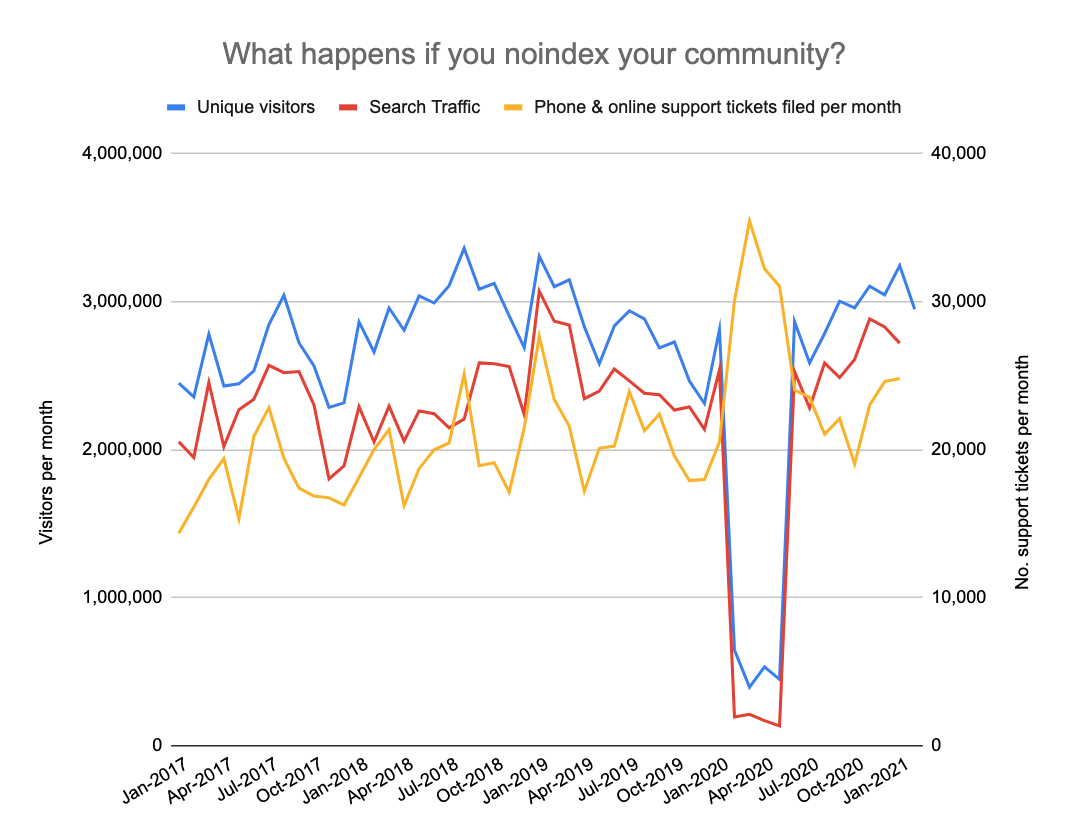
Back in March, I shared some data on Twitter where we definitively proved the ROI of an online community by removing it from search channels.

To the best of my knowledge, no one has ever done anything like this before and it was the persuasive data we’ve ever collected.

It’s one thing to develop a formula in theory, it’s another thing entirely to deliberately cause traffic to plunge and see what happens.

Now I’m happy to say we’ve published the data in longer form in this article on Harvard Business Review.

Here’s a graph showing the impact of communities on phone and online support tickets:

If you want to learn exactly how we undertook the experiment and the full range of results we discovered (they are amazing), read the article at HBR.

The post It’s 72% Cheaper To Answer A Question Via A Community Than Via Other Support Channels first appeared on FeverBee.

19 May 16:52

2021-05-18 BC

by Ducky

Testing

Some North Shore school districts are going to use home gargle tests for schoolkids. You’ll still have to drop them off at a LifeLabs, so they aren’t quite rapid tests, but they are still relatively speedy. (Plus you don’t have to get the back of your sinuses assaulted.)

Statistics

+411 cases, +2 deaths, +38,538 first doses, +1,814 second doses. NB: Richard Zussman of Global News said that he looked into why today’s doses were so much lower than last week’s, and he said it was a data error, but not to worry, we are still doing about 50K per day. I don’t entirely know what to make of that.

Currently 360 in hospital / 127 in ICU, 4,890 active cases, 133,383 recovered.

We have 366,604 doses in the fridges; we’ll use it in 7.4 days at last week’s rate. We’ve given more doses than we’d gotten by 8 days ago.

We have 326,361 mRNA doses in the fridges; we’ll use it in 6.6 days at last week’s rate. We’ve given more mRNA doses than we’d gotten by 8 days ago.

We have 40,243 doses of AZ in the fridges.

Charts

19 May 16:52

2021-05-18 General

by Ducky

Vaccines

 I took a look at a paper about a South African trial of AstraZeneca — I think this is the final paper of the preprint I’d seen before — and it says that AZ is really crappy against B.1.351. I knew that, I preach that.

HOWEVER, something I hadn’t noticed before is that there were no severe cases in either the vax or placebo branches of the trial. That means we don’t just don’t know how much protection against severe disease the AZ vax gives.  Might be a lot, might not be.

Meanwhile, there is another paper about B.1.351 in hamsters (which are a good animal model).  It showed poorer antibody response against B.1.351 than to COVID Classic, but still the hamsters didn’t get very sick.

So maybe AZ isn’t quite as bad against B.1.351 as I thought. As someone who has gotten one dose of AZ so far, that makes me happy.


Something which makes me even happier is that a mix&match study in Spain says that AZ first dose/Pfizer second dose gives seven times more neutralizing (i.e. useful) antibodies than AZ for both doses! This does not mean that it’s seven times as effective (uh, that would be difficult), but it does mean that it is likely that AZ+Pfizer is more effective than AZ+AZ. I expected this, but it’s nice to get a piece of supporting evidence. 🙂


There is a really interesting article calling for more research at using live attenuated virus vaccines (LAV), for fast, cheap, poor-effectiveness-but-better-than-nothing responses to pandemics. It says that LAVs don’t just stimulate the B and T cells’ immunity, they also stimulate the innate immune system for a while against lots of pathogens. (For example, oral polio vaccination campaigns in West Africa have been associated with a 25% reduction in all-cause mortality.)

Random LAVs’ protection isn’t as good as vaccines targeted to a specific disease, and the protection isn’t as long-lasting, but it does give some protection.

How do LAVs do this? We don’t know, this effect has not been studied much, hence the call for more research. But maybe next time a pandemic comes through, you should go get a measles booster.

Mitigation Measures

Something I missed while I was out: talks have started about reopening the Canada-US border. There’s no telling how long the discussions will take, but it’s interesting that they have at least started.

Seasonality

This article doesn’t think that the summer weather is going to (by itself) help the pandemic. NB: someone pointed out that article was from April 2020! Oops.

Border

Canadians can travel to the US without a quarantine to get vaccinated with a doctor’s note but they have to come IMMEDIATELY and DIRECTLY home (no stopping to buy milk!) and wear a mask in all public spaces for 14 days.

19 May 16:50

Coping with the big numbers

by Nathan Yau

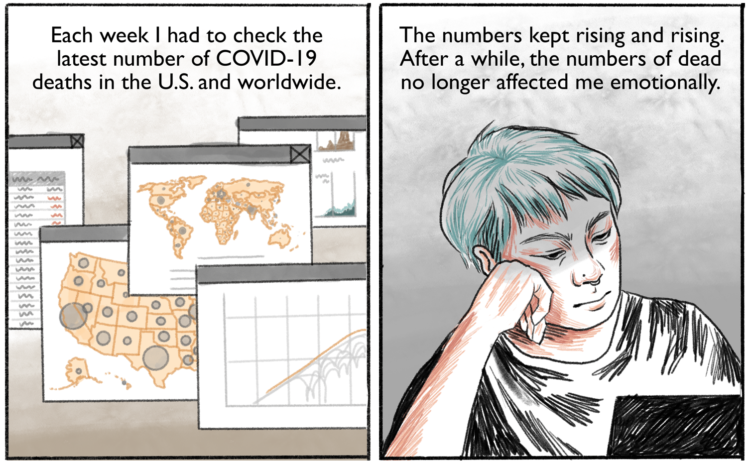
Connie Jin, who works for NPR and updates a Covid-19 dashboard, talks about in comic-form feeling numb to the large numbers and how to deal. It comes back to the individual.

Tags: comic, Connie Jin, coronavirus, NPR, scale

19 May 16:49

How Do We Know the COVID-19 Vaccine Won’t Have Long-Term Side Effects?

mkalus shared this story .

One of the reasons some people haven’t signed up to receive the COVID-19 vaccine is that they’re worried there might be unknown side effects that will show up months or years later.

Although it’s true there are still a lot of things we’re learning about the vaccines — like how effective they are against variants and how long their protection lasts — there are plenty of things we do know that give experts confidence in the long-term safety of the vaccines.

History tells us that severe side effects are extremely rare, and if they if do occur, they usually happen within the first two months.

The most recent example of this phenomenon is the Johnson & Johnson COVID-19 vaccine. The vaccine was put on pause when health officials learned that a small number of people who received the vaccine experienced a serious blood clotting problem.

About 7.4 million Americans had received the Johnson & Johnson vaccine when regulators paused its administration to investigate a handful of cases in which people had blood clots. All of the cases emerged within two weeks of vaccination.

Upon reviewing information about the cases, federal health officials determined that the benefits of the vaccine outweighed the risk, and they approved resumed use of the vaccine. 

This is how the system is designed to work if unexpected side effects emerge.

History shows this is a common pattern. When new vaccines are released, the unknown side effects, if any, show up within two months of vaccination. This history goes back to at least the 1960s with the oral polio vaccine and examples continue through today.

Because of this, scientists and public health officials continually monitor vaccine data before, during and after a vaccine becomes available to the public.

COVID-19 vaccine technologies have been studied for years and used in other treatments without issue.

mRNA vaccines. The vaccines made by Moderna and Pfizer-BioNTech use messenger RNA, or mRNA, to deliver a message to your immune system with instructions on how to fight the coronavirus infection.

Researchers have been studying and working with mRNA vaccines for decades. mRNA vaccines have been studied before for influenza, Zika and rabies. Beyond vaccines, cancer research has used mRNA to trigger the immune system to target specific cancer cells. Learn more about how mRNA vaccines work.

Adenovector vaccines. Viral vector vaccines use a modified version of a different virus (the vector) to deliver instructions that teach cells how to fight the coronavirus infection. In the case of the COVID-19 case, it’s the adenovirus, a common virus that causes colds or flu-like symptoms. However, the adenovirus was modified so it can enter cells but can’t replicate or cause illness.

Scientists began creating viral vectors in the 1970s, and they have been studied for gene therapy and cancer treatment. Some vaccines recently used for Ebola outbreaks have used viral vector technology, and studies have focused on viral vector vaccines against other infectious diseases such as Zika, influenza and HIV. Learn more about how the Johnson & Johnson vaccine works.

The vaccine development process, from clinical trials to ongoing monitoring, helps to uncover and understand side effects.

Clinical trials are a key part of vaccine development and involve evaluating use in tens of thousands of study participants. All of the COVID-19 vaccines went through this rigorous process before authorization.

In reviewing results from the trials, the federal Food and Drug Administration must determine that the known and potential benefits outweigh the known and potential risks of the vaccine. 

After vaccines are authorized and in use by the public, public health officials continue monitoring the data as an additional safety measure. Manufacturers must have a plan to report follow-up data, including any events such as hospitalizations and deaths, and they must continue research to generate more data on safety and efficacy. Learn more about FDA emergency use authorization.

19 May 16:49

Broadway will be narrowed to a four-lane road after the subway is built

mkalus shared this story :
Excellent. Still would have preferred LRT down the road, but this is the second best alternative.

The design of Broadway will change considerably as a result of the road reconstruction that will accompany SkyTrain’s Millennium Line Broadway Extension to Arbutus.

At each of the five subway station construction sites on Broadway, the arterial roadway will be permanently narrowed from six lanes (three lanes in each direction) to four lanes (two lanes in each direction) to accommodate a so-called Great Street concept that targets street experience improvements for pedestrians, and enhances the retail strip’s vibrancy.

There will be significantly wider sidewalks for pedestrians, plus space for restaurant patios, additional street trees, landscaping, sidewalk lighting, street furniture such as seating, and public art.

broadway subway road design changes

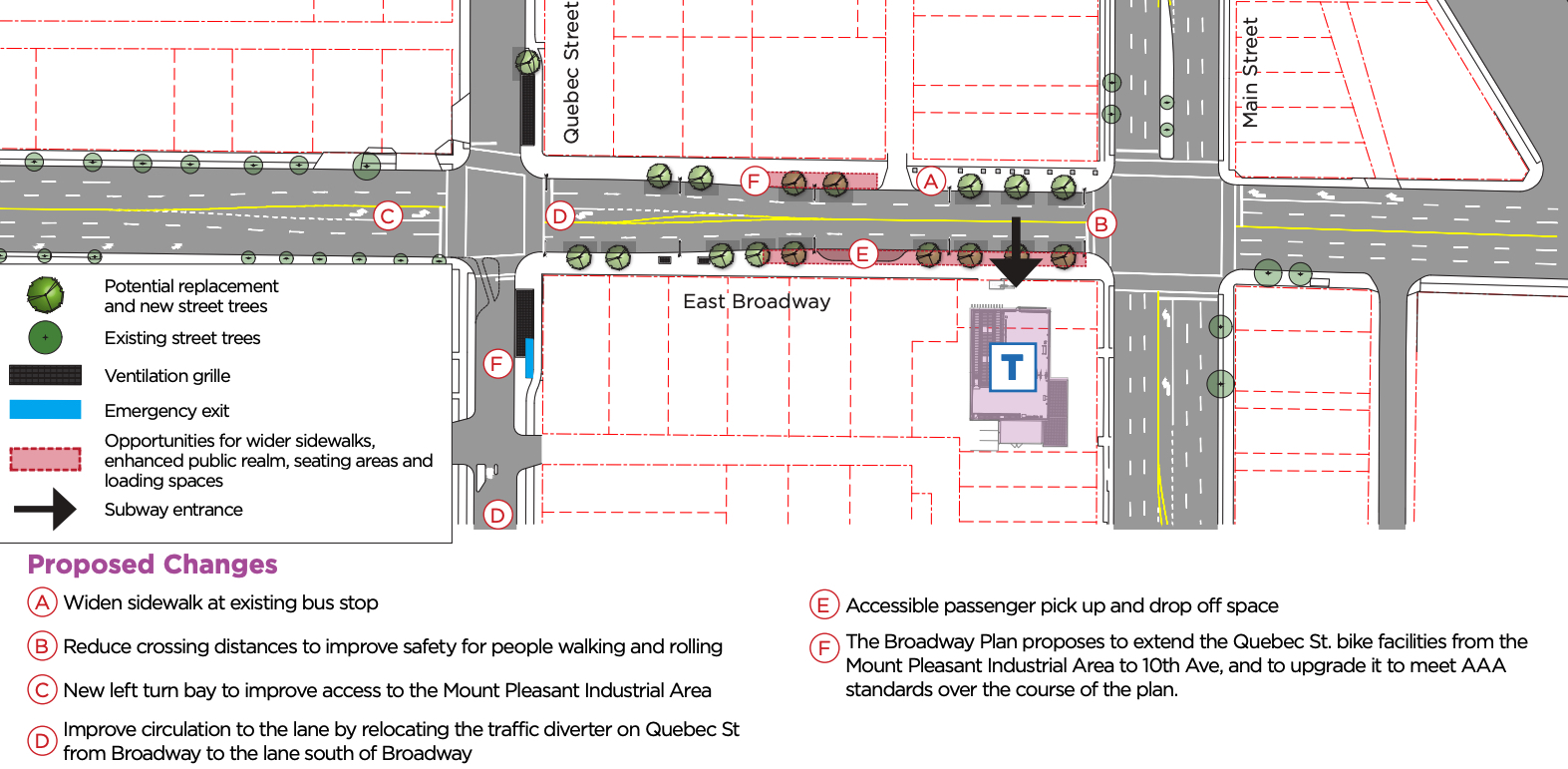
Narrowing of Broadway into a four-lane roadway with turning lanes in key areas. (City of Vancouver)

There are no plans to incorporate east-west bike lanes on Broadway given the limited space and focus for other uses for a true pedestrian-oriented experience, and the existence of east-west bike lanes within very close proximity.

But there will be improvements to accessing parallel bike lanes on the adjacent streets and the north-south cycling routes along the corridor. Other amenities for the new Broadway include bike parking and electric vehicle charging stations.

These public realm changes are being done to the station construction sites, where stretches of roadway will be temporarily replaced by road decks during the subway construction period, allowing traffic to pass through while station construction occurs beneath.

MOUNT PLEASANT STATION

mount pleasant station broadway road design

Broadway road design changes at Mount Pleasant Station. Click on the image for an enlarged version. (City of Vancouver)

BROADWAY-CITY HALL STATION

broadway-city hall station broadway road design

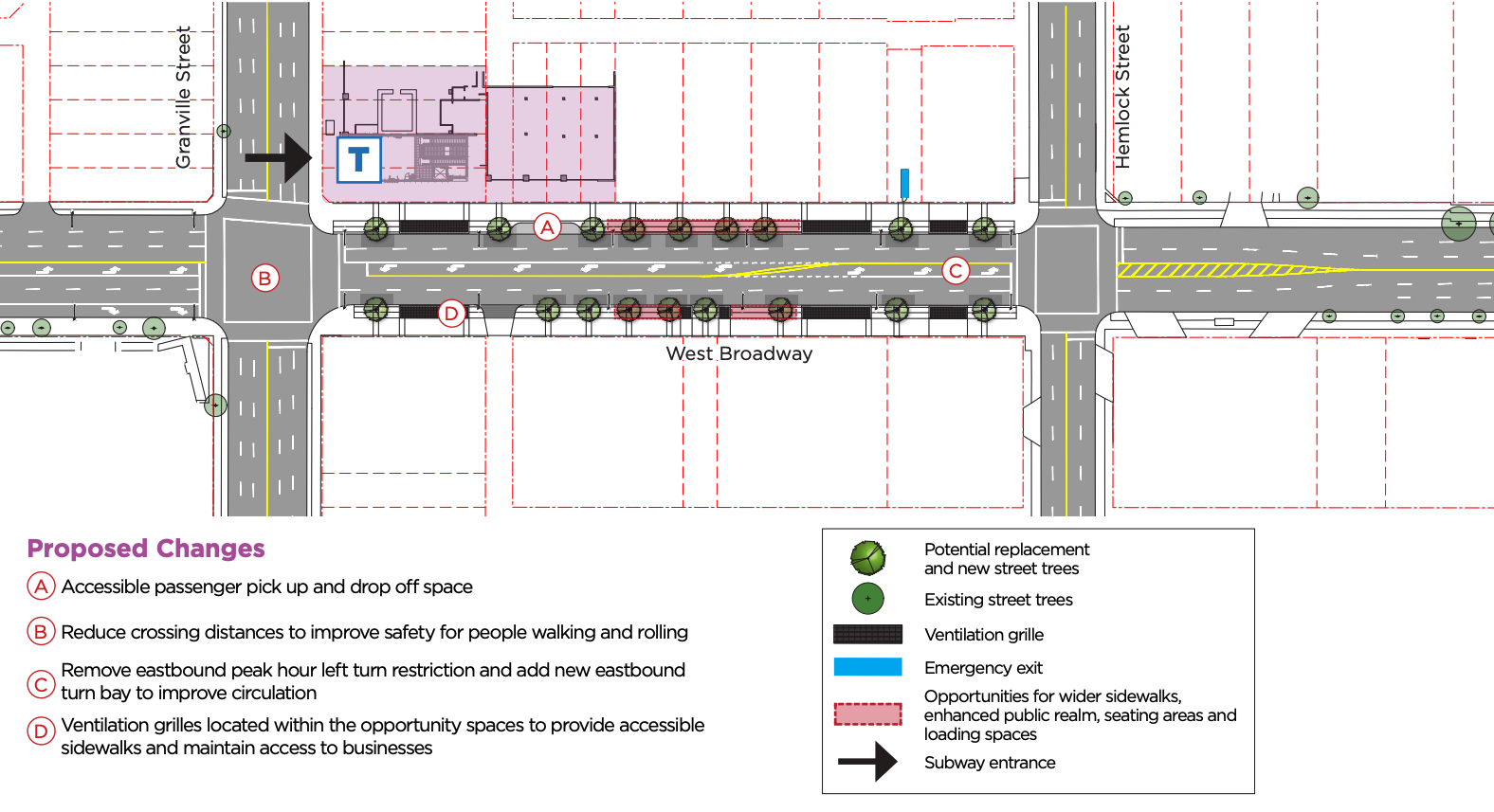
Broadway road design changes at Broadway-City Hall Station. Click on the image for an enlarged version. (City of Vancouver)

OAK-VGH STATION

oak-vgh station broadway road design

Broadway road design changes at Oak-VGH Station. Click on the image for an enlarged version. (City of Vancouver)

SOUTH GRANVILLE STATION

south granville station broadway road design

Broadway road design changes at South Granville Station. Click on the image for an enlarged version. (City of Vancouver)

ARBUTUS STATION

arbutus station broadway road design

Broadway road design changes at Arbutus Station. Click on the image for an enlarged version. (City of Vancouver)

Unlike the complete reconstruction of Cambie Street from 2nd Avenue to Marine Drive that was necessary for the Canada Line’s cut-and-cover method of tunnel construction, the Broadway subway’s construction from the surface is comparatively minimal as the project will largely be completed using tunnel boring machines.

A combined total of seven city blocks of Broadway will be narrowed in the redesign that will happen concurrently with subway construction, after the temporary road decks are removed.

The municipal government indicates these first blocks altered by the subway will generally set the standard for the rest of Broadway from Arbutus to Main Street, with other segments of the narrowing and pedestrian-oriented changes occurring incrementally over the long term from private redevelopment, utility upgrades, and other construction works. Until more spans of the new design are complete, most of Broadway’s core will remain as a six-lane roadway.

broadway subway road design changes map

Map of the Broadway subway’s station blocks for road reconstruction. (City of Vancouver)

The new design still maintains Broadway as a critical regional arterial route for people and goods movement, but less capacity is needed with the subway and the removal of the long, frequent 99 B-Line buses.

Upon the opening of the subway, the 99 B-Line route will operate a truncated route from the bus loop at Arbutus Station to UBC.

While there will be far fewer buses on Broadway, new measures will be explored to provide bus transit priority within the four-lane reconfiguration of the street to help ensure bus services continue to be fast and reliable.

Currently, the curbside lanes of Broadway from Arbutus Street to Commercial Drive are already used as bus-only lanes during weekday peak hours.

Urban design considerations have also been given to the emergency exit structures of the subway stations. Instead of the standalone structures built for the Canada Line, the emergency exits on the Broadway subway are designed and positioned in a way that can be integrated into future developments.

broadway corridor Broadway City Hall Crossroads subway construction

Preliminary conceptual artistic rendering of the subway entrance at the Crossroads building at the northwest corner of Broadway and Cambie Street. (City of Vancouver)

The City of Vancouver is currently conducting public consultation on the road design changes to Broadway’s subway station areas. An online survey is open until June 15, 2021.

Feedback will be used to provide finalized roadway designs for the station construction blocks to the provincial government and private contractor in Summer 2021. The road reconstruction is expected to occur in 2024.

If all goes as planned, the Millennium Line extension from VCC-Clark Station to Arbutus Station will open in 2025.

Broadway’s transformation is a component of the Broadway Plan, which is expected to reach a draft plan stage for city council’s review by the end of this year.

19 May 16:49

Coffee Chronicles 018

by Michael Kalus
mkalus shared this story from Michael Kalus.ca.

Coffee Chronicles 018

"Official" tasting notes and background information.

The Beans

Coffee Chronicles 018

Once again I get nothing off of the beans themselves. I am starting to question my nose.

Brewing Method AeroPress

I am following James Hoffman's "The Ultimate AeroPress Technique". 11 grams of coffee and 200 grams of water. Steep 2 minutes, then swirl and let settle for 30 seconds before fully pressing it through.

Coffee Chronicles 018

As with the beans, I do not really get any aroma off of the brew itself.

The first sip does give a citrus / orange note with some follow through creaminess. This is surprisingly refreshing, much like yesterday. A very pleasant, and surprisingly refreshing morning cup.

Rating: 4.6/5

Brewing Method AeroPress over Ice

I am following James Hoffman's "The Ultimate AeroPress Technique". 11 grams of coffee and 200 grams of water. Steep 2 minutes, then swirl and let settle for 30 seconds before fully pressing it through.

Coffee Chronicles 018

After the great success yesterday I decided to give the "over ice" another shot (pun intended).

Much like yesterday it does seem to bring out more sweetness, at least as an aroma before sipping.

Taste wise, interestingly enough, it produces much more bitter notes forward, with some sweetness coming through after. It is not quite as refreshing as yesterdays, but still rather pleasant.

I think for this one I prefer the hot method more.

Rating: 4.2/5

19 May 16:48

So doof sind die Deutschen:Trotz Pandemie haben die ...

mkalus shared this story from Fefes Blog.

So doof sind die Deutschen:
Trotz Pandemie haben die Beschäftigten in Deutschland im vergangenen Jahr 1,67 Milliarden Überstunden geleistet. [...] Mehr als die Hälfte der Überstunden – 892 Millionen – waren unbezahlt.
Nein, nein, wir werden hier nicht ausgebeutet. Wir beuten uns selber aus!1!!
19 May 16:48

How a change in the Pfizer shot's storage temperature could completely alter vaccine access

mkalus shared this story .

The Pfizer-BioNTech COVID-19 vaccine can now be stored at typical refrigerator temperatures in Europe for weeks longer than previously thought, which could have major implications on the rollout of vaccines across Canada and the world.

The European Medicines Agency (EMA) recommended the change to the "more flexible" storage conditions for the vaccine on Monday, saying it could have a "significant impact" on the deployment of vaccines throughout the European Union.

The EMA now says unopened, thawed vials of the vaccine can be stored at temperatures of between 2 and 8 C for a total of 31 days, up from the previously approved five days, after it analyzed additional data from Pfizer on the stability of the vaccine.

Health Canada currently allows thawed Pfizer vaccines to be kept at fridge temperatures for up to five days. Vials thawed at room temperature (up to 25 C) for 30 minutes must be used immediately, according to the vaccine's product monograph. The vaccine is typically stored at temperatures between –80 C to –60 C in Canada. 

A submission is now "under review" to introduce a "similar change to the Pfizer storage conditions in Canada," a spokesperson for Health Canada said in a statement to CBC News.

Dr. Zain Chagla, an infectious diseases physician at St. Joseph's Healthcare Hamilton and an associate professor at McMaster University, says changes to how the thawed vaccine is stored could break down barriers to access in Canada — especially as second doses roll in.

He says a longer storage time and more stable temperature would allow family physicians, homeless shelters, pharmacies, jails, pop up clinics and eventually schools to keep Pfizer vaccines longer and potentially administer more doses.

Dr. Isaac Bogoch, an infectious diseases physician at Toronto General Hospital and member of Ontario's COVID-19 vaccine task force, said the change in storage temperature would also make the vaccine easier to transport outside Canada's major urban centres.

"By mitigating these cold chain limitations, you can just more readily get this vaccine out to more places," he said. "It just basically makes this vaccine much more usable and much easier to scale to larger populations."

WATCH | Storing vaccine at warmer temperatures makes distribution 'so much easier':

Pfizer saying its COVID-19 vaccine could be stored at much warmer temperatures than previously stated would be great news for Canada if the change is approved here, says infectious disease specialist Dr. Isaac Bogoch, as it would make distribution much easier. 3:14

Bogoch says the proposed change could also lessen the pressure on individual provinces and territories when it comes to doses potentially expiring.

"You're just not going to have this vaccine expire, because you've got more wiggle room and more time that it can sit in conventional refrigeration," he said. "You just have the potential to vaccinate more people."

Pfizer storage challenged Canada's early rollout

Canada's early deployment of the Pfizer vaccine was hindered by its complicated temperature requirements, which forced provinces to get creative in order to quickly deliver it to vulnerable populations quickly.

Quebec took the bold step of actually putting its vaccine distribution centres inside long-term care facilities.

British Columbia moved the Pfizer vaccine from its distribution sites almost immediately into long-term care homes to inoculate residents and staff upon receiving its first doses.

Yet Ontario initially decided against bringing it directly into long-term care homes. The province and only did so more than three weeks after receiving its first shipment — prioritizing health-care workers instead. 

Bogoch says provinces were told in December that the vaccine shouldn't be moved after being thawed and that clinics should administer it at the same location and that the province was in contact with Pfizer about the issue at the time. 

Chagla says more provinces would have followed Quebec's model of distributing the vaccine from long-term care homes first and hospitals second if they had known the vaccine was stable at fridge temperatures. 

"It would have helped with decentralizing the vaccine rollout and it took a month or two before we could start [doing that]," he said. "This could have very well started — even for the high risk groups — decentralizing it and really getting it into places where the vaccine is hard to reach." 

Temperature changes 'exciting' for developing world

While an adjustment to the length of time the Pfizer vaccine can be stored and the more manageable temperatures for distribution could give Canada more flexibility in its rollout, the global benefits could be even more significant.

Alyson Kelvin, an assistant professor at Dalhousie University and virologist at the Canadian Center for Vaccinology and the Vaccine and Infectious Disease Organization in Saskatoon, says the change in recommendations are "exciting."

"It will have a global impact, especially in light of the recent problems plaguing AstraZeneca," she said, referring to the rare but serious blood clots that can occur after that COVID-19 vaccine. "The increased stability will allow the Pfizer vaccine to be more easily accessible in remote locations across the world."

Chagla says it could also allow for the Pfizer vaccine to be transported more easily to countries experiencing devastating surges of COVID-19, such as India, which recorded the highest number of deaths in a single day of any country on Tuesday.

"From a global standpoint it's huge … you could really expand how you do a vaccine campaign globally," he said. "As long as you can transport it to point X and then put it in refrigeration temperature you have a lot more options." 

Bogoch says we could potentially see this vaccine transported on "the back of a motorcycle" or the "back of a lorry" in smaller clinics in developing nations. 

WATCH | Distributing aid another hurdle in India's COVID-19 crisis:

Canada is among the countries sending medical supplies to India as it grapples with a devastating second wave of COVID-19, but getting enough supplies and distributing them are big hurdles. 1:59

"This really helps because you can mobilize this vaccine more readily in lower resource settings outside of bigger centres. I think that's the key point," Bogoch said. 

Kelvin says she hopes the potential change in storage conditions could even bring down the cost of the Pfizer vaccine since ultra-cold temperatures of up to –80 C may not be necessary for shipping. 

The Pfizer vaccine is estimated to cost about $19.50 US per dose in the United States, a price that Kelvin says is "astronomically" higher than the AstraZeneca-Oxford vaccine. It ranges from between $2 and $5 US per dose.

19 May 16:47

RT @ThoughtinLondon: @stuartjdneil @IainDale I loved this observation by @c_drosten in a recent podcast (translated from German). Really hi…

by Philip (ThoughtinLondon)
mkalus shared this story from c_drosten on Twitter.

@stuartjdneil @IainDale I loved this observation by @c_drosten in a recent podcast (translated from German). Really hits home the point. pic.twitter.com/M9UVQs9KdS


Retweeted by Christian Drosten (c_drosten) on Tuesday, May 18th, 2021 5:39pm


1075 likes, 252 retweets