Shared posts

19 May 17:08

Meeting… Aiyana Brooks, Software Engineer at The New York Times

by The NYT Open Team

“Meeting…” is an ongoing series from NYT Open that features New York Times employees from different corners of the company.

Illustration by Claire Merchlinsky

What are your pronouns?
She/her

What is your job title and does it mean?
Software engineer. This means I write code to provide the solutions needed to drive business value. I currently work on an application called Event Tracker which enables The New York Times to collect data and metrics about how our readers use our various products.

How long have you been at The Times?
This is actually my second time working at The Times. I first worked here from 2007 to 2013 as a software engineer on the CMS team, and I rejoined in July, 2020 on the Data Collections team.

Most Times employees are working remotely right now. What does working from home look like for you?
Working from home right now is … interesting. My oldest daughter is in second grade and doing remote school. She and I share the dining area as our work space and we usually have competing video calls. My partner is also an engineer and he takes his video calls in one of the bedrooms. In between meetings, we both take turns entertaining our two-year-old. After doing this for over a year, we have settled into a routine that enables us to be surprisingly efficient and effective.

Tell us about a project you’ve worked on at The Times that you’re especially proud of.
The Times and the Data Collections team take reader privacy very seriously, and readers who have visited our site can request to have any of the data we have collected about them removed — this is called a Data Subject Request (DSR). I wrote the code that takes a DSR, finds all of the instances of that reader’s data in our database and removes them.

This was challenging because the team had to find a way to effectively search through all of the data in a fairly large database. Additionally, we needed to be able to do this on a regular basis for any reader who submits a DSR, so I wrote the code, using Apache Airflow, in a way that could be run on a schedule.

What is the biggest challenge you faced in your career and how did you overcome it? Knowing what you know now, would you do things differently.
One challenge I faced early in my career was not knowing how to advocate for myself. I approached my early career the same way that I approached school: I did the work that was assigned to me to the best of my ability. I soon realized that this was not the best way to move my career forward.

Today, I am much more deliberate in identifying the kinds of projects that excite me and I am not afraid to make suggestions or volunteer for challenging assignments. I also make sure that I frequently communicate my goals with my manager and that I am getting opportunities that keep me on track toward meeting my goals.

Do you have any favorite life hacks or work shortcuts?
I’ve recently started using TiddlyWiki to organize all of my ideas. I like it because it’s really just a self-contained HTML file. This means I don’t have to worry about installing special software to be able to view my notes.

What is your best advice for someone starting to work in your field?
Learn how to learn. Software engineering is a field that changes rapidly; You need to have curiosity and you need to understand the learning style that works best for you.

There are so many great resources out there, many available for free or with a free trial. Massive open online courses can provide a great introduction to any software topic, but it’s also important to learn by doing. There are many sites, such as Advent of Code, Exercism and Free Code Camp, that offer code challenges. Cloud platforms, such as Amazon Web Services and Google Cloud Platform, typically offer a free tier or free credits so that someone interested in learning can experiment with the platforms.

With so much information available, it can feel intimidating to get started, but the best way is to just choose a resource and stick with it. Be patient with yourself and accept that being confused is part of the job, as is the satisfaction that comes when things start to “click.”

More in ‘Meeting’

Meeting… Tony Giaccone, Senior Software Engineer at The New York Times
Meeting… Alexandra Shaheen, Program Manager at The New York Times
Meeting… Vanessa Jiménez, Associate Software Engineer at The New York Times


Meeting… Aiyana Brooks, Software Engineer at The New York Times was originally published in NYT Open on Medium, where people are continuing the conversation by highlighting and responding to this story.

19 May 17:08

Flickr Commons Revitalization – May Update

by georgeoates

[ Previously, on revitalizing the Flickr Commons ]

Right. May. We’re about six weeks in. We’ve met with people in Helsinki, Cloyne, Slobozia, Belleville, Aberystwyth, San Diego, Sydney, London, Richmond, Tartu, Upper Arlington, Edinburgh, Melbourne, Chicago, Reykjavik, Amsterdam, Copenhagen, Culiacán, Washington DC, São Paulo, and that mystical universe called Zoom. One wonderful thing about the pandemic is the new comfort we feel having calls with anyone anywhere. (Although we must also all figure out how to restrain ourselves from Zooming for all hours of a day as COVID things hopefully calm down!)

Pausing to chat at outdoor auction near Hickman, May 1973

The interviews have been split across current Commons members, and non-member birds of a feather, which include academics, sister orgs like the Wikimedia Foundation, Creative Commons, Europeana, DPLA, OCLC, Local Contexts, people working in not-Commons GLAMs, and a even a  biodiversity super-editor. This week we’re sending a new blob of “Hello! Can we talk to you, please?” emails to try to talk with more members. This is made interesting by the number of blahblah@yahoo.com email addresses that must have been spurted into the sign up form when people first created an account, and are no longer checked. (If you are from a Commons member org and this sounds like you, please reach out!) 

Our research interview target remains about 40-50 interviews of Commons members and birds of a feather, so it feels like we’re roughly on track to do that, having done just over 20 so far. We’re tracking to complete interviews by the end of July-ish.

Robert Ridgway Bird Head Drawing 409

Early findings from conversations

  • Stats justify effort
    Everyone who works in GLAMs is time-poor. While we can’t solve that problem, we can look to find ways to provide reporting and data on usage and interaction derived from the work done by Commons members. I still feel like Flickr Commons is a fantastic place for community engagement, regular research contributions that are accurate and fastidious, and the sheer exposure members can enjoy by being part of the program has proved to be exciting (and even shocking) for some members. Views in the millions simply don’t happen on isolated org websites, unless you’re a very big GLAM, and there are only a few hundred of them in the world. The vast majority of GLAMs are tiny, with less than 10 staff. We want to provide reporting that helps member orgs understand why this effort building community on Flickr can reap real rewards.
  • Governance indicates stability
    Understandably, we’ve heard from some members that they drifted away because the future of the Commons under the previous owners was so unclear. Why should we put effort into something so crumbly? It’s a good question, and hopefully, this research work will lead to a new level of program governance and a refreshed foundation not previously considered.
  • Indigenous self-determination is not represented in any (?) cultural catalogues
    There’s growing awareness and concern at the colonial nature of most GLAM catalogues and how their design and creation has obliterated meaning about the places and people that collection objects come from. The added realisation that Open Everything All The Time can actually be culturally disrespectful and destructive has been a huge realisation for me. As in, what if the object in this photograph should only be seen by women? Or only in the winter? When it’s bundled into a huge content upload into a digital platform, that information is disregarded (or indeed may not even exist in the first place). We’re talking with Local Contexts, OCLC Research Library Partnership, reaching out to academics working on this, and reading more widely to ground ourselves in the problem, for example Camping in the shadow of the racist text by Dr Ali Gumillya Baker. If you’re working in this area, I would love to hear from you.
  • Flickr as infrastructure & tooling for it
    We’ve heard how Flickr and the API has actually become a bone in the digital bodies of some Commons members. Some are seeing it as a bonafide archive (though not with true preservation capacity) and others have built it into a core technical element of how they do digital. We’re also surveying tools that orgs have developed or borrowed to get photos into Flickr or to move them around to other services like Wikimedia Commons to see if there’s work we can do to improve them or support them.

Key research themes

As mentioned in our announcement blog post, we’re researching the terrain through three core themes, and have added a fourth: 

  1. Current members: Where they’re at, what they need, how their digital infrastructure has changed in the last decade, their approach to digital licensing
  2. Growing the program: How can we improve on-boarding of new members, streamline registration, form and strengthen governance, restore the Commons as a great destination for socialising around and enhancing cultural content
  3. Being part of the openGLAM ecosystem: What are the qualities and redundancies of the various participating support orgs in the openGLAM ecosystem? Can we be more selective and complementary of each other in our approach?
  4. Cost neutrality: Flickr Commons is in such an interesting position, compared with other cultural “public good/service” bodies like Wikimedia or Creative Commons. As Harry Verwayen from Europeana said, it’s a “cocoon of net neutrality inside a corporation, and what does that mean?” How should the company, Flickr, construct its ongoing protection of the Flickr Commons program? Indeed, should it? How much does the Commons cost, anyway?

There are broader questions coming up too, like what does success mean for Commons members, and also for the company? How could we define the different usage styles, both of Commons orgs themselves and also Flickr members who help gather information or curate Commons content, and how might we use these different usage types to help newer members engage? I mean, really, why is the Flickr Commons cool and why should people keep using it?!?

What are the deliverables of this research?

Unidentified man (Moustaches book), 1899-1953

In consultation with Ben MacAskill and Carol Benovic-Bradley, we’ve decided the research will focus on producing two main deliverables (as well as the raw research data/interviews/notes): 

  1. Research Report – what’s happened, who we talked with, what we found
  2. Flickr Commons Revitalization Plan: 2021-2023 – A shorter term way forward to implement features to support current members and growth of the program, and a preliminary governance framework. Nobody involved is denying that Commons has had no love for aaages. All of us are keen to change that.

Other points of interest:

As always, if you’re interested in the discussion, please consider joining the public Flickr Commons group, which we’re chatting in with a few new discussion threads. If you’re a Flickr Commons member and you haven’t received our interview requests, please do reach out! 

Ezquerra in de bergen / Ezquerra in the mountains

RAWR!

19 May 17:07

Lux Delivers an iPad Version of Halide That Addresses the Unique Challenges of iPad Photography

by John Voorhees

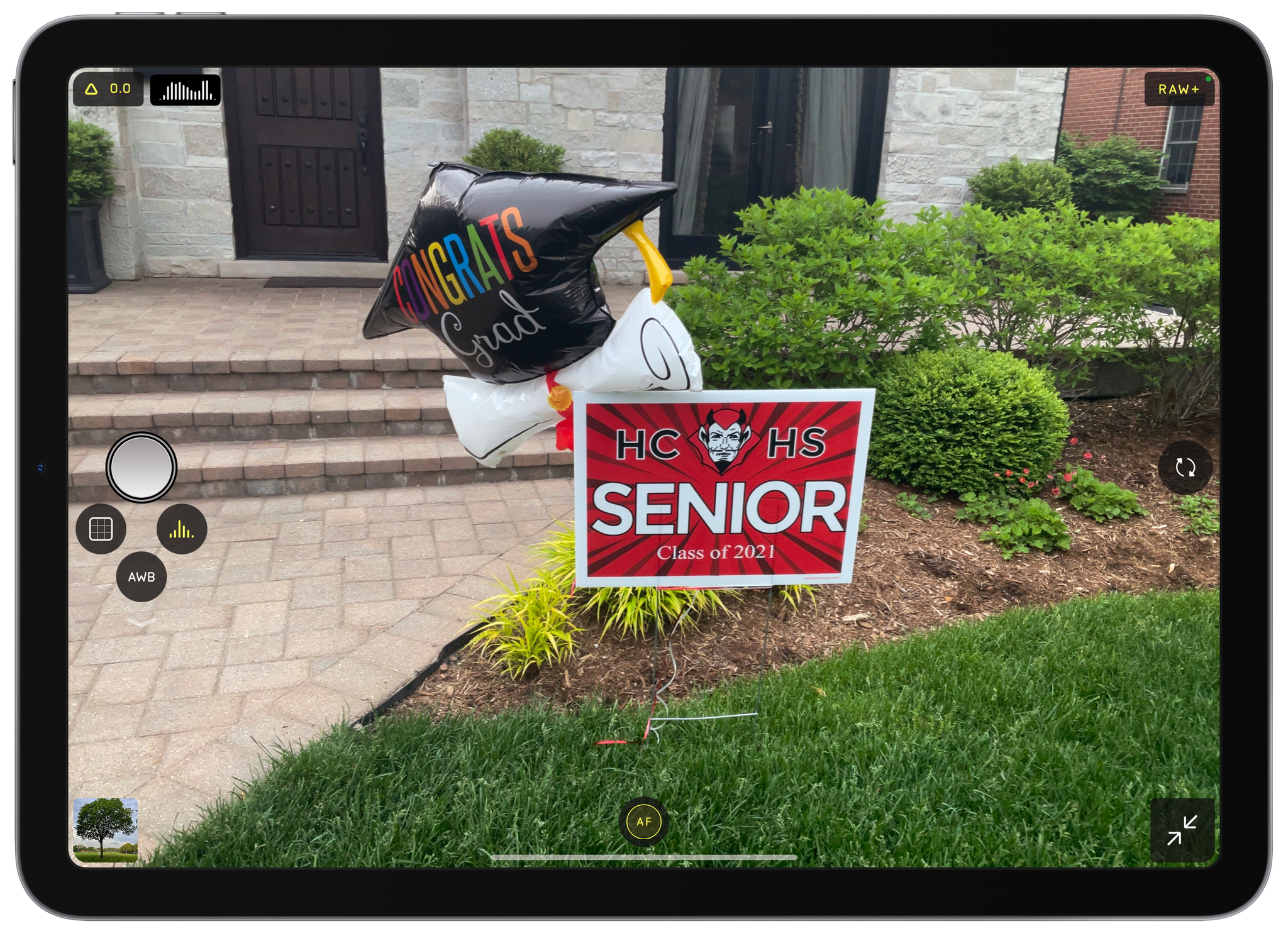
Students are finishing up the year here in the US, and nothing says graduation season like a relative gripping an iPad with two hands to snap photos of a graduate at a family gathering. It’s easy to poke fun at iPad photography, but those aren’t easy shots to get with Apple’s tablet. Both of your hands are occupied, and the viewfinder is huge and partially obscured by the app’s UI. If you’re at one of these events and see a relative struggling to take the perfect family portrait with their iPad, before you assume that they cut you out of the frame on purpose, show them Halide. The brand new iPad version of the app from the team at Lux makes taking iPad photos more natural and, of course, offers all the advanced features available in the iPhone version of the app.

I don’t take many photos with my iPad, and I doubt I ever will. The camera hardware isn’t as good as it is on the iPhone, and I don’t find myself in situations where I have my iPad but not my iPhone. However, once in a while, I’m using my iPad and want to capture a moment quickly without digging my iPhone out of my pocket. For those occasions, I’m going to use Halide because the app’s thoughtful design makes the experience far superior to other camera apps I’ve tried on the iPad.

I’ve covered the iPhone version of Halide before, so I’m going to focus on what makes the iPad version of the app unique. For more on the many pro-level photography features in Halide, be sure to check out our past reviews.

With a swipe down on the controls beneath the shutter button, three more are revealed.

With a swipe down on the controls beneath the shutter button, three more are revealed.

Halide solves the two-fisted iPad death grip by placing the most commonly used controls right under your thumb. The shutter button sits at the midpoint of the right edge of the iPad by default. Beneath it are grid, histogram, and auto white balance buttons and a downward-facing caret. With a downward swipe anywhere beneath the shutter button, three additional controls are revealed: flash, timer, and settings. You don’t need to precisely tap the caret to reveal the controls either. Halide uses a ‘sloppy swiping’ gesture, which is perfect when you’ve only got your thumb available for controlling the app. When you’re done with the controls, swipe up to hide them away again.

Halide for iPad can be configured for left-handed people.

Halide for iPad can be configured for left-handed people.

The interaction with the shutter button and six controls arrayed beneath it is handy, but my favorite feature is the degree of customization offered. The biggest revelation for me was swapping the side of the screen on which the controls appear. I’m left-handed and moving the shutter button and other controls to the left side of my iPad immediately made taking pictures feel more natural. Also, even if you don’t want to switch the controls around, give it a try because the animation as the controls switch from one side to the other is delightful.

Moving controls from one side of an app to the other isn’t new. It’s common in a lot of drawing apps, but I haven’t seen it in many apps beyond that category and never in a camera app. Not every app would benefit from swappable controls, but I hope Halide’s clever implementation encourages other developers to consider whether their apps would benefit from leftie customizations too.

Halide’s customization options extend to the UI beneath the shutter button too. By default, the viewfinder grid, histogram, which can be toggled between a mini and much larger iPad-appropriate size, and white balance controls sit below the shutter button. However, from Halide’s settings, you can promote the flash or timer buttons, so they are always visible onscreen. The remainder of Halide’s controls are found along the edge and in the corners of the screen, where the buttons follow the iPad’s curved corners.

Halide's Pro View pulls the viewfinder in from the iPad's edges to make it easier to compose a shot.

Halide’s Pro View pulls the viewfinder in from the iPad’s edges to make it easier to compose a shot.

The other issue Halide solves with its iPad app is one that I hadn’t ever considered. There’s a double arrow button in the corner of the screen that activates Halide’s ‘Pro View.’ Tap it, and the viewfinder shrinks into the center of the screen, allowing a clear view of the shot you’re framing.

The Lux team says that iPads are typically held closer to your face when framing a shot, making it harder to take in the full scene when the viewfinder extends to the edges of the screen. The issue is compounded when controls obscure part of the view. I’ve only had one day to use Halide’s iPad app, but I immediately preferred the smaller viewfinder, which makes framing a shot easier without being so small that it’s hard to make out details.

Halide for iPad isn’t going to turn me into an iPad photographer. However, I’ve been to enough graduation parties and sightseeing destinations on family vacations to know there are plenty of people for whom the iPad is their camera. For them, I’m glad Lux has gone to the trouble to build an app specifically designed for the iPad’s hardware and the way it’s used. You won’t find another camera app that’s been so carefully crafted with the iPad in mind.

I’m also glad that I’ve got Halide as an option on my iPad. The controls are customized for the iPad, but will be familiar to anyone who has used Halide before. I may not use it often, but it’s great to know the app is available on the iPad when I want it.

The iPad version of Halide is available for download on the App Store as a universal purchase along with the iPhone version of the app. New users can try the app for free and then subscribe or purchase Halide for a one-time payment.


Support MacStories Directly

Club MacStories offers exclusive access to extra MacStories content, delivered every week; it’s also a way to support us directly.

Club MacStories will help you discover the best apps for your devices and get the most out of your iPhone, iPad, and Mac. Plus, it’s made in Italy.

Join Now
19 May 17:07

No Unifying Theme

by peter@rukavina.net (Peter Rukavina)

Paul Graham, in Fierce Nerds:

To be a nerd is to be socially awkward, and there are two distinct ways to do that: to be playing the same game as everyone else, but badly, and to be playing a different game. The smart nerds are the latter type.

One long afternoon in my mid-20s I got into a debate with my friend Stephen about the two sentences:

Cynicism has to do with exercising innocence.

Cynicism has to do with exorcising innocence.

In my final year of high school I received a failing grade for turning in an assignment in comic book form. 

In the coffee shop this afternoon I spotted a fetching person sitting across the room with a Hudson Records sticker on their laptop. This struck me as odd, as Hudson Records is a small three-person record label in England. I’d assumed I was the only person on my block to have heard of it.

On the bottom of Stewart Brand’s website is the following:

Anything written by me here is licensed under the Creative Commons Attribution-Noncommercial 3.0 United States License.  (Please don’t ask permission to borrow my stuff: just do it.)

Working from Home, by Aurynn Shaw, is a rich early-pandemic guide to doing just that. I especially like:

You take lots of breaks at the office. You get up. You wander around, you talk to co-workers, go to the kitchen for water, etcetera. This is normal. So do it.

You don’t have to do any work-from-home presenteeism, so, don’t. Really, really, really don’t.

You need to step away, have normal lunch hours, sit on your couch and recharge while watching some TV, the things that help you disconnect and refocus.

Doing those things is stepping out of the made space. You leave the work space, you do the not-work things, you re-enter the work space, and can do work things again.

Having my house across the street from my office has been a terrific lever in this regard: I only realized last week that if I went out to pick up lunch there was no earthly reason I needed to eat at my desk in the office when there’s a perfectly wonderful place to relax just across the street.

19 May 17:06

Cloudflare on the Edge

by Rui Carmo

Some food for thought, although I think the industry is massively overloading the term “edge”. It doesn’t really mean what everyone thinks it means in real life.


19 May 17:06

Introducing Site Isolation in Firefox

by Anny Gakhokidze

When two major vulnerabilities known as Meltdown and Spectre were disclosed by security researchers in early 2018, Firefox promptly added security mitigations to keep you safe. Going forward, however, it was clear that with the evolving techniques of malicious actors on the web, we needed to redesign Firefox to mitigate future variations of such vulnerabilities and to keep you safe when browsing the web!

We are excited to announce that Firefox’s new Site Isolation architecture is coming together. This fundamental redesign of Firefox’s Security architecture extends current security mechanisms by creating operating system process-level boundaries for all sites loaded in Firefox for Desktop. Isolating each site into a separate operating system process makes it even harder for malicious sites to read another site’s secret or private data.

We are currently finalizing Firefox’s Site Isolation feature by allowing a subset of users to benefit from this new security architecture on our Nightly and Beta channels and plan a roll out to more of our users later this year. If you are as excited about it as we are and would like to try it out, follow these steps:

To enable Site Isolation on Firefox Nightly:

  1. Navigate to about:preferences#experimental
  2. Check the “Fission (Site Isolation)” checkbox to enable.
  3. Restart Firefox.

To enable Site Isolation on Firefox Beta or Release:

  1. Navigate to about:config.
  2. Set `fission.autostart` pref to `true`.
  3. Restart Firefox.

With this monumental change of secure browser design, users of Firefox Desktop benefit from protections against future variants of Spectre, resulting in an even safer browsing experience. If you aren’t a Firefox user yet, you can download the latest version here and if you want to know all the technical details about Firefox’s new security architecture, you can read it here.

The post Introducing Site Isolation in Firefox appeared first on Mozilla Security Blog.

19 May 17:06

Building Better Picnic Tables

by peter@rukavina.net (Peter Rukavina)

I’ve always hated standard picnic tables: they’re hard to get in and out of, and uncomfortable to sit in.

Today I spotted this design, which seems to have a lot to recommend it.

19 May 17:06

Twitter Favorites: [lisawilliams] My two sons just got their 2nd shot. On the way home we had a picnic with a pizza in the park, during which I read… https://t.co/g23la0OZ7I

Lisa Williams @lisawilliams
My two sons just got their 2nd shot. On the way home we had a picnic with a pizza in the park, during which I read… twitter.com/i/web/status/1…
19 May 16:50

Rijksmuseum slavery exhibition confronts cruelty of Dutch trade | Netherlands | The Guardian

mkalus shared this story from The Guardian.

Amsterdam show includes 140 objects ranging from Rembrandt portraits to human collars and ankle chains

First published on Tue 18 May 2021 11.09 BSTThe aim of a first exhibition on the Dutch slave trade to be shown at the Rijksmuseum, launched on Tuesday by King Willem-Alexander, is not to be “woke” but to be a “blockbuster” telling a truer story of the Golden Age, the director general of the national institution has said.

19 May 16:50

Police now able to enforce mask compliance in B.C. fitness facilities

mkalus shared this story .

B.C.'s solicitor general is aligning the Emergency Program Act on face coverings in fitness facilities with recently updated guidance from the provincial health officer — a move which now gives police and other officials the ability to enforce measures at their discretion.

On May 7, the provincial health officer ordered that masks be worn in fitness facilities which include gyms, fitness studios and dance studios at all times, including during workouts.

"This updated ministerial order on masks ensures a co-ordinated response to COVID-19," according to a statement from the Ministry of Public Safety and Solicitor General.

For the purpose of the order, the province defines a mask or face covering as a medical or non-medical mask that covers the nose and mouth. Face shields are not considered a substitute for a mask.

Anyone found not wearing a mask in an indoor public place, or who refuses to comply with an enforcement officer, can be subject to a $230 fine.

The province is asking people to report contraventions of the mask order by contacting a local bylaw office. 

"Local bylaw officers can help follow up on concerns and engage police departments and WorkSafeBC as necessary," according to the statement.

Otherwise, the province says, people can contact their local police department's non-emergency line. 

19 May 16:49

Amazon’s Ring is the largest civilian surveillance network the US has ever seen | Lauren Bridges

mkalus shared this story from The Guardian.

In a 2020 letter to management, Max Eliaser, an Amazon software engineer, said Ring is “simply not compatible with a free society”. We should take his claim seriously.

Ring video doorbells, Amazon’s signature home security product, pose a serious threat to a free and democratic society. Not only is Ring’s surveillance network spreading rapidly, it is extending the reach of law enforcement into private property and expanding the surveillance of everyday life. What’s more, once Ring users agree to release video content to law enforcement, there is no way to revoke access and few limitations on how that content can be used, stored, and with whom it can be shared.

Ring is effectively building the largest corporate-owned, civilian-installed surveillance network that the US has ever seen. An estimated 400,000 Ring devices were sold in December 2019 alone, and that was before the across-the-board boom in online retail sales during the pandemic. Amazon is cagey about how many Ring cameras are active at any one point in time, but estimates drawn from Amazon’s sales data place yearly sales in the hundreds of millions. The always-on video surveillance network extends even further when you consider the millions of users on Ring’s affiliated crime reporting app, Neighbors, which allows people to upload content from Ring and non-Ring devices.

Then there’s this: since Amazon bought Ring in 2018, it has brokered more than 1,800 partnerships with local law enforcement agencies, who can request recorded video content from Ring users without a warrant. That is, in as little as three years, Ring connected around one in 10 police departments across the US with the ability to access recorded content from millions of privately owned home security cameras. These partnerships are growing at an alarming rate.

Data I’ve collected from Ring’s quarterly reported numbers shows that in the past year through the end of April 2021, law enforcement have placed more than 22,000 individual requests to access content captured and recorded on Ring cameras. Ring’s cloud-based infrastructure (supported by Amazon Web Services) makes it convenient for law enforcement agencies to place mass requests for access to recordings without a warrant. Because Ring cameras are owned by civilians, law enforcement are given a backdoor entry into private video recordings of people in residential and public space that would otherwise be protected under the fourth amendment. By partnering with Amazon, law enforcement circumvents these constitutional and statutory protections, as noted by the attorney Yesenia Flores. In doing so, Ring blurs the line between police work and civilian surveillance and turns your neighbor’s home security system into an informant. Except, unlike an informant, it’s always watching.

Ring’s pervasive network of cameras expands the dragnet of everyday pre-emptive surveillance – a dragnet that surveils anyone who passes into its gaze, whether a suspect in a crime or not. Although the dragnet indiscriminately captures everyone, including children, there are obvious racial, gendered and class-based inequities when it comes to who is targeted and labelled as “out of place” in residential space. Rahim Kurwa, a professor of criminology, law and justice at the University of Illinois at Chicago, argues that neighborhood surveillance platforms such as Neighbors perpetuate a much longer history of the policing of race in residential space.

The concerns of activists and scholars have been compounded by developments in facial recognition technology and other forms of machine learning that could be conceivably applied to Ring recorded content and live feeds. Facial recognition technology has been denounced by AI researchers and civil rights groups for its racial and gendered biases. Although Ring doesn’t currently use facial recognition in its cameras, Amazon has sold this technology to police in the past. Following pressure from AI researchers and civil rights groups, Amazon placed a one-year pause on police use of its controversial facial recognition technology, but this moratorium will expire in June.

While pressure from civil rights groups and lawmakers to end Ring’s partnerships with police has been building, we need to demand more transparency and accountability from Amazon and law enforcement about what data is being collected, with whom it’s being shared, and how it’s being used.

  • Lauren Bridges is a PhD candidate at the Annenberg School for Communication at the University of Pennsylvania

19 May 16:46

Google’s new Smart Canvas helps teams plan projects together

by Brad Bennett

Google is adding a new tool to the Google work suite called ‘Smart Canvas.’

This is a new, smarter way to tie Google apps like Docs, Sheets and Slides together and is aimed at helping people work better online. Smart Canvas isn’t an app like Docs and Sheets but instead supplements them with better collaborative features.

This allows teams to create small tables, lists and more together. Plus, you can even save presets to Smart Canvas so you can quickly format docs and hit the ground running when you need to collaborate and plan a project.

Smart Chips

Users can now use @-tags to add users to a document so they know what things they’re supposed to be working on. These new @-tags can be used for more than tagging people and can also drop in elements from other documents quickly with a few simple keystrokes.

Whenever you @-mention someone, you can click on their name to see information about them, including their contact email and job title. This feature is launching in Google Docs now and will come to Sheets in a few months.

Google Meet, but everywhere

On top of this, Google Meet is getting built into a lot more Google products to make it easier to call your co-workers from all Google apps. This starts with Docs later this year, but it’s also planned for Sheets and Slides in an effort to make collaborating possible without a single user presenting their screen.

Smart Canvas looks to take tools that users might know from Trello, Asana and Monday and merge them with Google’s other work-based products.

Pageless Docs

This is a pretty minimal feature, but it actually looks very useful for anyone that tries to cram as many windows as possible on a screen at once. This new model removes traditional page boundaries and makes it so you can work on a written document in a much cleaner way.

Emojis come to Docs

Google is adding the ability to add emoji reaction in Docs. If you use a chat app like Slack or Discord, this seems to be the same concept. If someone writes or comments something, you can respond with an emoji to get your point across. For example, if MobileSyrup managing editor Patrick O’Rourke edited one of my stories, I could respond with a knife emoji to tell him to back off.

Editor’s note: I would likely respond with a bomb emoji, and then still make the change – Patrick O’Rourke.

Inclusive language corrections

Google is making spellcheck smarter in Docs this year by ensuring it recognizes gendered words. After the update, the company says that when you write a word like chairman, it will suggest you change it to chairperson to be more inclusive.

Overall, this new workspace tool seems a little convoluted, but it’s exciting Google is attempting to compete more directly with Microsoft Office. You can check out all the new Google Workspace updates, here.

Image credit: Google

Source: Google

The post Google’s new Smart Canvas helps teams plan projects together appeared first on MobileSyrup.

18 May 18:50

Lower Mainland and Greater Victoria Rail History – Google My Maps

mkalus shared this story :
Wow, bring it back!

Save this story

18 May 18:48

Future Myopia

by Mehitabel Glenhaber
Full-text audio version of this essay.

As a historian interested in the social history of environmentalism, I spend a lot of time thinking about what people in the past thought about the future. Last fall, while researching the history of 1980s United States climate policy, I read the Changing Climate report, written in 1983 by the Carbon Dioxide Assessment Committee. This committee had been created by the National Academy of Sciences in 1980 to assess the dangers of anthropogenic carbon emissions, and was chaired by Bill Nierenberg, a physicist who had worked on the Manhattan project and later headed the oceanographic expedition which first discovered oil drilling sites on the sea floor of the Gulf of Mexico.

The report’s first five chapters, each written by a different climate scientist, detailed the committee’s key findings: that unchecked fossil fuel consumption would lead to disastrous, nearly apocalyptic, consequences within the next hundred years. These chapters warned of a 1.5 to 4.5 degree rise in global temperatures, the collapse of the West Antarctic ice sheet, and severe water shortages in the Western United States.

Though rising global temperatures would undoubtedly be catastrophic, Schelling acknowledged, maybe future generations would simply, miraculously, solve the problem

After 449 pages of this clinically urgent writing, I came upon the final chapter, written by Thomas Schelling, an economist famous for his work in the field of game theory and for developing “deterrence theory” with respect to the Cold War. He considers the economic arguments in favor of and against taking immediate action to reduce carbon emissions. “The climate changes anticipated are at an unaccustomed planning distance in the future,” he wrote. “Our grandchildren will live into the span of time we have in mind.” Then, arguing that a dollar today is worth more than a dollar tomorrow, he mused that it was possible to “discount” the effects of climate change beyond the year 2000 in economic calculations. Though rising global temperatures would undoubtedly be catastrophic, he acknowledged, there was much uncertainty about how people in the future would live — in other words, maybe future generations would simply, miraculously, solve the problem.

Or maybe they would just learn to deal with it. As Nierenberg summarized in the report’s executive summary, future people’s methods of “adaptation to a high CO2 and high temperature world… are likely to be more economical… It is extraordinary how adaptable people can be.” Despite everything that climate scientists had written in the report’s first five chapters, Nierenberg concluded, based on Schelling’s argument, that “We do not believe… that the evidence at hand… would support steps to change current fuel-use patterns away from fossil fuels.”

The Changing Climate report was one of the key factors responsible for deterring earlier U.S. government action on climate change: As Naomi Oreskes and Erik Conway write in Merchants of Doubt, Nierenberg and Schelling’s arguments were used by White House science advisor George Keyworth to discredit EPA findings on climate change as unnecessarily “alarmist.” Delaying government action in the 1980s gave the fossil fuel industry crucial time to develop disinformation and denial strategies that set back environmentalist policy conversations by decades. My point here, however, is not that either Neirenberg or Schelling is uniquely to blame for the current climate crisis. It’s almost tautological to say that most of the people who lived during the past 200 years and had the power to mitigate climate change chose not to. If they had, we would not live in the world we live in now. The Report of the Carbon Dioxide Assessment Committee was just one more moment in a long history of powerful people who comprehended the dangers of the climate crisis, and saw the opportunity to prevent it, but decided instead to do nothing.

Nonetheless, this was one of those moments where you make eye contact with a ghost — where you suddenly find yourself in the close presence of a person from another time. Schelling was born in 1921 — a generation older than my grandparents. When he writes “our grandchildren,” he is speaking my name, summoning me. Across the thin, wavering membrane of history, Thomas Schelling and I are reaching out at the same time, trying to imagine each other. He sees the vague outline of a person living “an unaccustomed planning distance in the future,” and I see the vague outline of an economist sitting at his desk 38 years ago, trying to imagine me.

Schelling knows that my life must be very different from his, because he knows that his way of life is not sustainable

There are some things about me that Schelling probably could not have imagined — for instance, he probably did not expect his report to be read by a Gen-Z, they/them-pronoun-using PhD student in a digital communications program, reading the text on their laptop computer. But he might have been able to imagine that I would be living through an unusually warm spring, trying to make it through my 14th month of self-isolation during a zoonotic global pandemic. And one thing that I am certain he could have imagined about me is that I live on a dying planet, and I am terrified all the time.

He knows this because he is depending on my terrified ingenuity — my “extraordinary adaptability” — to come up with “economical” solutions to the problem of climate change. He knows that my life must be very different from his, because he knows that his way of life is not sustainable. And, yet, he does not seem to have put much work into imagining how I might feel about the whole thing.


Depending how you do the math, we have known about climate change for over 100 years now. In 1896, Svante Arrhenius first described the greenhouse effect, and noted that carbon dioxide released by burning coal could theoretically lead to rising global temperatures. In 1958, Charles David Keeling’s measurements showed that CO2 had been steadily increasing since the industrial revolution, enough to have noticeable effects on the earth’s climate. In 1962, Roger Revelle presented a report to President Lyndon Johnson predicting that by the year 2000, CO2 levels would be high enough to cause disastrous sea level rise. Yet, for every generation until now, climate change has always been “the next generation’s problem.”

Climate change messes up everything we think we know about how the past relates to the future. We are used to seeing the past as ruins. But how do we make sense of it when the past looks to the future and sees us in ruins instead? In Walter Benjamin’s words, we like to think of history as “a sequence of events, like beads on a rosary,” each one neatly occasioning the next. But climate change separates cause from effect. Carbon released into the atmosphere might have no effect on the people who burnt the coal, but will be felt by their descendants decades or centuries later.

In The Lathe of Heaven, Ursula Le Guin gives us a sense of what this time-traveling cycle of responsibility and consequences feels like: “It’s raining already… the endless warm drizzle of spring — the ice of Antarctica falling softly on the heads of the children of those responsible for melting it.” In 2019, a group of scientists and activists held a funeral for the rapidly melting Okjökull glacier — a test run of their new role as undertakers and mourners, holding a funeral in the present for a glacier which will fully melt in 50 years, because of carbon burned 50 years ago.

In The Arcades Project, written in 1940, Walter Benjamin lays out his own theory of history, which he describes in the form of an Angel. “This is how one pictures the angel of history,” he writes:

His face is turned toward the past. Where we perceive a chain of events, he sees one single catastrophe which keeps piling wreckage and hurls it in front of his feet. The angel would like to stay, awaken the dead, and make whole what has been smashed. But a storm is blowing in from Paradise; it has got caught in his wings with such a violence that the angel can no longer close them. The storm irresistibly propels him into the future to which his back is turned, while the pile of debris before him grows skyward. This storm is what we call progress.

Every time I read this passage, I am surprised that Walter Benjamin was not writing about the climate crisis. I always imagine the angel of history surrounded by eroded hillsides, melting ice caps, and thick clouds of pollution, with the earth burning up all around him. Where the businessmen and tycoons of the past look forward and see progress, he looks back and sees the destruction of his future.

Walter Benjamin also writes in The Arcades Project that “like every generation that preceded us, we have been endowed with a weak Messianic power, a power to which the past has a claim. That claim cannot be settled cheaply.” In the case of climate change, this claim is expensive indeed — Schelling’s logic of “discounting” literally sticks us with the bill for his generation’s excesses. Nobody understands that better than Gen-Z. This is what Autumn Peltier, Greta Thunberg, Xiye Bastida, Ayakha Melithafa, and many kids younger than me understand when they demand of older generations: “You have stolen our childhoods.” The past’s “economical” solution to climate change depended on endowing my generation with Messianic powers — we were tasked before birth with saving them from the guilt of their own inaction.

A ghost is your problem because you live in the house in which it lived — because we live on the same planet, tied up in the same catastrophic global economic system

At my college graduation, a very wealthy man my grandfather’s age told me, “The moon landing was my generation’s problem — now climate change is yours.” I think he meant to sound encouraging, but what I heard was an admission of culpability. Climate change could have been his generation’s problem — Keeling’s report was 11 years old when Americans landed on the moon in 1969 — but here he was, asking me to take on a responsibility that people like him hadn’t been willing to when they were my age. When Bill Nierenberg writes that readers would want to know about “changes in the atmosphere that their grandchildren are going to breathe,” yet recommends nothing to prevent those changes, he is claiming and disavowing us at the same time. He recognizes that we are connected to him, but claims no responsibility towards us, holding on to a cowardly faith, disguised as grandfatherly pride, that we would solve the problem for him.

After I finished reading the Carbon Dioxide Assessment Committee Report, I looked up whether Bill Nierenberg was still alive. After our brief haunting, I wanted to have a real conversation with him: He’d had the audacity to document, in a public record, how little he cared about me, and I wanted him to see me, not as a blurry specter or a messiah, but as a scared, hurting person. But he had died in 2000, which just seemed too neat.


I became a historian because I love talking to dead people. But sometimes, when I look back into the past and meet inventors, politicians, economists, captains of industry, scientists, or even mundane people who lived moderately luxurious lives, all I see are people who took actions that are hurting me right now. I read the names of oil barons engraved on buildings around my university campus, or look at the blissfully oblivious 1950s families drinking out of disposable plastic cups in old magazine ads, and I envy these people who lived pretending their actions didn’t have consequences. I think, “the way you lived made my life worse.”

How do you have a relationship with the ghosts of people who quite literally “discounted” you? In Ghostly Matters, Avery Gordon writes that when we notice we are being haunted, “it is our responsibility to recognize just where we are in the story, even if we do not want to be there… we cannot decline to identify as if such an (albeit worthy) act can erase or transcend the sedimented power relations in which we have lived and live now.”

I want to sit with that “(albeit worthy)” for a second. I think that what Gordon means is that it is perfectly natural, maybe even justified, to want to ignore a ghost — to reject the claims the past tries to put on you, and say “this is not my problem.” I feel this way all the time. It sucks to have to clean up someone else’s mess. It makes you want to say, “you got to live without considering the consequences of your actions, so why don’t I?” It makes you want to throw up your hands and do nothing, out of a despairing sort of spite.

But a ghost is your problem because you live in the house in which it lived — because we live on the same planet, tied up in the same catastrophic global economic system. The world we live in is cluttered with smog, chained with shipping routes and oil pipelines, and littered with the actions of our predecessors. If we ignore that, we aren’t getting back at the past but hurting ourselves, and a future which doesn’t deserve that from us. We can tell the ghosts we’re not doing it for them, but we have to do something; out of a concern for our own survival, if nothing else. 

Maybe, in considering our own estranged relationship with the past, we can learn to be better grandparents. I want to talk with the people of the future the way that I wish the people of the past would talk with me. The future will have its own historians. Someday, someone whose outline I can barely make out across the fuzzy veil of time is going to read about me, and see that I made a choice about whether or not to consider them disposable. The past may have demanded that I take up the work of repairing the planet; but I do this work so that when I meet someone from future in the archives, I’ll be able to look them in the eye.

18 May 17:00

Any sufficiently advanced correlation is indistinguishable from causation

Any sufficiently advanced correlation is indistinguishable from causation

Here is a lightly-annotated collection of articles and papers, on or about the question of inference, that have struck a chord recently. And some drawings and pictures thrown in for good measure.

Most deep neural networks are trained by stochastic gradient descent. Now "stochastic" is a fancy Greek word for "random"; it means that the training data are fed into the model in random order. So what happens if the bad guys can cause the order to be not random? You guessed it – all bets are off. Suppose for example a company or a country wanted to have a credit-scoring system that's secretly sexist, but still be able to pretend that its training was actually fair. Well, they could assemble a set of financial data that was representative of the whole population, but start the model's training on ten rich men and ten poor women drawn from that set – then let initialisation bias do the rest of the work. Does this generalise? Indeed it does. Previously, people had assumed that in order to poison a model or introduce backdoors, you needed to add adversarial samples to the training data. Our latest paper shows that's not necessary at all. If an adversary can manipulate the order in which batches of training data are presented to the model, they can undermine both its integrity (by poisoning it) and its availability (by causing training to be less effective, or take longer). This is quite general across models that use stochastic gradient descent.

This was interesting to me for two reasons: 1) It is the kind of generic toolkit that could/should be applied to any number of interactive contexts in any number of museums 2) It highlights the lack of capacity across the sector to be able to take something like this and adapt it to its own specific needs. I expect that, inside of five years, at least one large institution will blow 6 or 7 figures hiring an external firm to implement this as a one-off which is... a missed opportunity, really.

One final lesson that one might be tempted to take is that the kernel is running a terrible risk of malicious patches inserted by actors with rather more skill and resources than the UMN researchers have shown. That could be, but the simple truth of the matter is that regular kernel developers continue to insert bugs at such a rate that there should be little need for malicious actors to add more. The 5.11 kernel, released in February, has accumulated 2,281 fixes in stable updates through 5.11.17. If one makes the (overly simplistic) assumption that each fix corrects one original 5.11 patch, then 16% of the patches that went into 5.11 have turned out (so far) to be buggy. That is not much better than the rate for the UMN patches.So perhaps that's the real lesson to take from this whole experience: the speed of the kernel process is one of its best attributes, and we all depend on it to get features as quickly as possible. But that pace may be incompatible with serious patch review and low numbers of bugs overall. For a while, we might see things slow down a little bit as maintainers feel the need to more closely scrutinize changes, especially those coming from new developers. But if we cannot institutionalize a more careful process, we will continue to see a lot of bugs and it will not really matter whether they were inserted intentionally or not.

All three papers are a reminder that almost all machine learning work is predicated on disproving the adage that past performance is not an indicator of future success, which... well, you know.

This is very impressive work but the phrase “It greens the parched grass and hills in Grand Theft Auto’s (GTA) California” sort of sums it up. It’s clear that GTA is a MacGuffin for the underlying work but it betrays a disservice to the material quality of the GTA’s aesthetics and the relentless focus on “style transfers” suggests that it’s just pumpkin spice lattes all the way down...

During the time that I was at Stamen we had started to talk about a bias knob for data visualizations. This was largely a rhetorical device since no one was quite sure what the technology to make such a thing possible would be. It is nice to see the use of machine-learning in the work that GSD is doing framed in similar terms, that it is a fast and efficient tool for applying pressures to different parts of a dataset and seeing what happens rather than a magic veil of truth. These are some of the things I wrote about this at the time:

One of the things I like about this image is that you can clearly see that Fort Funston, the place where H. goes to walk her dogs, is part of her San Francisco. You can see this not because of the roads on the beach; there are none. You can see this because the photos cause the neighbourhood around the beach to materialize.

In a lot of generative art works, and in game design, there is the idea of a "physics knob" that you can use to adjust the relationships between different objects and the environment in which they exist. I've always tried to imagine what it would mean to have a "bias knob" that you could use to affect how cause and effect, or in this case maps, are displayed.

we need / MOAR dragons

In the past I've talked about producing and treating maps the same way you might work with a bolt of fabric but maybe it's also like making pasta where the data (and the choice of data) acts as a kind of extruder shaping the noodles. I don't really want to get lost in bad kitchen metaphors so I'm going to stop there and instead leave you with the image of the raw data acting as a kind of screen through which the squishy mass of history, of time and place, is passed to create a map.

I am awake and connected to the network

What search-by-color and other algorithmic cataloging points to is the need to develop an iconography, or a colophon, to indicate machine bias. To design and create language and conventions that convey the properties of the “extruder” that a dataset has been shaped by.

a colophon for bias

The SAND Lab at University of Chicago has developed Fawkes1, an algorithm and software tool (running locally on your computer) that gives individuals the ability to limit how unknown third parties can track them by building facial recognition models out of their publicly available photos. At a high level, Fawkes "poisons" models that try to learn what you look like, by putting hidden changes into your photos, and using them as Trojan horses to deliver that poison to any facial recognition models of you. Fawkes takes your personal images and makes tiny, pixel-level changes that are invisible to the human eye, in a process we call image cloaking. You can then use these "cloaked" photos as you normally would, sharing them on social media, sending them to friends, printing them or displaying them on digital devices, the same way you would any other photo. The difference, however, is that if and when someone tries to use these photos to build a facial recognition model, "cloaked" images will teach the model an highly distorted version of what makes you look like you. The cloak effect is not easily detectable by humans or machines and will not cause errors in model training. However, when someone tries to identify you by presenting an unaltered, "uncloaked" image of you (e.g. a photo taken in public) to the model, the model will fail to recognize you.

Which bookends nicely with the paper on data ordering attacks.

18 May 16:57

No feigning surprise

No feigning surprise

Don't feign surprise if someone doesn't know something that you think they should know. Even better: even if you are surprised, don't let them know! "When people feign surprise, it’s usually to make them feel better about themselves and others feel worse."

Via @cameronbardell

18 May 16:57

Apple threatens to upend podcasting’s free, open architecture

John Sullivan, Kim Fox, Richard Berry, What's New in Publishing, May 17, 2021
Icon

This is a bit of a theme for today: large companies working to monetize the open web by commercializing previously open content formats (podcasting, mailing lists, blogs) while commentators lament the loss of the open web in content posted using these commercial services. Or, in a word, irony. We've written previously about Spotify's acquisition of podcasting services for creators like Anchor. This article covers a similar focus on replacing open content with subscription revenue from Apple. "One thing is for certain: Apple and Spotify have given us a glimpse of a podcasting future where the walled gardens of platform-exclusive, premium content become the norm." As someone who has been podcasting since before there was podcasting, I will continue to publish open audio content by RSS - though you as listeners may find it harder and harder to find a way to listen to it.

Web: [Direct Link] [This Post]
18 May 16:57

Thoughts on Jeet Heer’s Can We Bring Back Blogging?

Chris Aldrich, May 17, 2021
Icon

Ironically writing on Substack, which is busily monetizing longer-form web content, Jeet Heer asks, "Can we bring back blogging?" From where I sit, I would observe that it actually wouldn't take very much work - all people would need to do is start blogging again (like I have been since 1995). It's not hard, but you do need to avoid services that throw up paywalls or worse in front of readers. In this response, Chris Aldrich cites with approval a comment about the need for "a sort of flywheel of engagement" and writes, "if we want a real resurgence of thought and discourse online, we’re going to need some new tools to do it." Perhaps, he suggests, "some of the building blocks the IndieWeb movement has built." Maybe. But in the end, I think, we ourselves have to choose openness. Image: Aggressive Growth Marketing, Can blogging be automated?

Web: [Direct Link] [This Post]
18 May 16:55

The Memex Method

Cory Doctorow, Medium, May 17, 2021
Icon

I am not the only one to note the irony of Cory Doctorow using a closed blogging service like Medium to tout the benefits of open blogging and the 'commonplace book' approach to writing (his open site isn't a blog at all, just a link dump without commentary). It's too bad, because the content of his post (aside from being the opposite of what he practices) is quite good. For example, "In the traditional world, an editor selects and then publishes... But for blog readers, the process is inverted: bloggers publish and then readers select." Also: "Traditionally, a writer identifies a subject of interest and researches it, then writes about it. In the (my) blogging method, the writer blogs about everything that seems interesting, until a subject gels out of all of those disparate, short pieces."

Web: [Direct Link] [This Post]
18 May 16:55

Apple unveils two new Pride edition Watch bands

by Karandeep Oberoi

Apple unveiled a new series of Apple Watch bands today to mark International Day Against Homophobia, Transphobia, and Biphobia, and promote the LGBTQ+ movement and community.

The latest Pride Edition Braided Solo Loop and Pride Edition Nike Sport Loop have strands to represent Black, Latinx, people living with HIV/AIDS, transgender, and nonbinary communities, as well as the original LGBTQ+ rainbow.

The Pride Edition Braided Solo Loop and the Pride Edition Nike Sport Loop are available to order on Apple’s web store for $119.45 and $59 CAD, respectively.

The Pride Edition Braided Solo Loop is compatible with Apple Watch SE and Apple Watch Series 4 and later. The upcoming Nike Sport Loop is designed to work with Apple Watch Series 3 or later.

Additionally, Apple will soon release a software update that will bring a new Pride Watch Face for the Apple Watch.

Apple’s news release reads, “This year’s special Pride watch face beautifully mirrors the new colours of the band to represent the combined strength and mutual support of the LGBTQ+ movement. With the rotation of the Digital Crown, the threads on the watch face infinitely scroll and animate with a raise of the wrist.”

Additionally, the new bands will also include App Clip functionality, which will allow users to get the new Pride Watch Face by just clicking on a prompt.

The new bands are available to order now on Apple’s web store and will be available in physical stores beginning May 25th.

Image credit: Apple

Source: Apple

The post Apple unveils two new Pride edition Watch bands appeared first on MobileSyrup.

18 May 16:55

How M1 Macs feel faster than Intel models

by Rui Carmo

This is extremely cool, and something that Intel has completely dropped the ball on. The most interesting aspect, though, is how moving those background tasks to the efficiency cores impacts power budgets.


18 May 16:54

2021-05-13/17 BC

by Ducky

NB: I hurt a tendon in my hand, so took a few days off from typing. It will probably take me a few days to catch up on all that has happened, and I will be less detailed.

Vaccination Clinics

Over the weekend, vaccine bookings have opened up to ALL yes all adults! This is an awesome milestone!


Justin McElroy said that 70% of the people 18-40 years old have registered to get a vax. (I don’t know where he got his numbers, but he’s reliable.) He also made some graphs with how many were vaccinated by nine days ago:

Based on how many have vaccinated, how many have registered, the shape of the curves, and knowing the % vaxxed is nine days behind, I squinted and crunched some numbers, and I am guessing that BC will get to 82% vaccinated, even without vaccinating kids 0-12. The COVID in BC Modelling Group’s video suggests that’s about the level that we need for herd immunity, yay!! NB: The COVID in BC Modelling Group’s video is worth watching. They have tended to forecast a more pessimistic outlook than what has actually happened.

I am guessing that we will hit 80% in mid June, at which point I expect that BC will switch over to mostly giving second doses.

Press Briefing

Last Thursday, Dr. H mostly talked about “breakout” cases, cases where someone who had been vaccinated got sick. You can see the slides, but SPOILER! the vaccines work really really absofuckinglutely well.

Today, Dr.H mostly talked about AZ second doses. The basic message was to chill out, that they would have enough AZ for everyone who wanted one, but that y’all might want a different vax for the second dose. (We should hear the results of the UK mix&match AZ/Pfizer study in a week or two.)

She mentioned that the efficacy of the first shot goes up for a while, even after the first three weeks. She mentioned that you get better efficacy AND more durable, long-lasting protection, from a second shot.

The stats look much better now than they did two weeks ago, but we aren’t completely out of the woods yet. Dix said that BC is still using 128 regular surge beds and 14 ICU surge beds. (Presumably those are mostly in Fraser Health.)

Statistics

  • Wed/Thu: +587 cases, +5 deaths
  • Thu/Fri: +494 cases, +2 deaths
  • Fri/Sat: +443 cases
  • Sat/Sun: +493 cases
  • Sun/Mon: +424 cases

For the past three days, +14 deaths, +145,063 first doses (!!!!), 5,143 second doses.

Currently 350 in hospital / 132 ICU, 5021 active cases, 132841 recovered.

We have 202,162 doses in the fridges; we will use that up in 3.7 days at last week’s rate. We have given more doses than we had received by 7 days ago.

We have 161,578 mRNA doses in the fridges; we will use that up in 3.01 days at last week’s rate. We have given more mRNA doses than we had received by 7 days ago.

Note that 3 days is not very many. The good news is that a lot of vax will be coming soon.

NB: I’m not going to talk about AZ doses until they become relevant again.

Charts

I am really astounded at how linear our rolling 7-day average of cases’ (i.e. the blue line in the graph immediately below) decline is. It’s about 18 cases per day. If we keep that up, we’ll be at 380 cases per day by Victoria Day. I had kind of expected the blue line to fall faster at about now due to the vaccinations, but I guess I was wrong.

18 May 16:51

Hosting vs. Engaging With The Community

by Richard Millington

There was a major fire in my building recently (I’m fine).

The tenants, angry with the property company which manages the building, quickly switched from the company’s official hosted community to a private WhatsApp group. We needed to discuss fire safety issues, legal problems, and next steps.

Likewise, I recently decided not to work with a debt management company that wanted to build a community for people to share debt-saving tips. A little primitive research suggested almost nobody wants to participate in a debt-advice community hosted by the very company they owe money to.

Sometimes you simply can’t build a hosted community because of the nature of who you are and the relationship you have with the people you want in the community. If you have power over them and/or they are angry with you, they want to have their own place.

No one wants to join a dieting community hosted by McDonalds. Trade unionists aren’t going to participate in a community hosted by industry. And we’ve seen many examples in major tech companies recently where employees created private groups to discuss major concerns.

I’ve met many, many, organisations over the past decade who ignored this and still tried to host their own community. They always wound up disappointed.

But just because you can’t host a community doesn’t mean you can’t proactively support and engage with a community. You can help encourage the community (or communities) which do exist, provide support where needed, and most importantly, take the time to listen and address their concerns.

It’s not as glamorous as hosting a community perhaps, but it’s far more useful for your audience.

The post Hosting vs. Engaging With The Community first appeared on FeverBee.

18 May 16:51

Cloudflare on the Edge

by Rui Carmo

Some food for thought, although I think the industry is massively overloading the term “edge”. It doesn’t really mean what everyone thinks it means in real life.


18 May 12:51

Codespaces: GitHub’s Play for a Remote Development Future

Codespaces Logo

When I first saw Codespaces, I immediately wanted it. With ubiquitous high-speed internet, why not offload more work to the cloud? What could our devices look like if most of their power came from the server? What would their battery life be like?

Seamlessly leveraging remote resources has always felt like an idea that’s just around the corner, but never arrives. Just having a big beefy machine on site usually ends up being the most practical solution (outside of some specialized use cases)1.

Codespaces is perhaps the biggest play ever to take remote development more mainstream. Development has always been a prime candidate for remote computing, because with time-sharing machines, it’s how the roots of programming itself began2.

Visual Studio Online to GitHub Codespaces

GitHub Codespaces began as a different product, called Visual Studio Online. Visual Studio Online was announced on the Visual Studio Blog in November 2019. Then, in April 2020, it was renamed to Visual Studio Codespaces, Nik Molnar described the motivation behind the name change on the same blog:

We learned that developers are finding Visual Studio Online to be much more than just an “editor in the browser”. They are saying that “the capabilities of this cloud-hosted dev environment make it the space where I want to write all my code“.

To better align with that sentiment, and the true value of the service, we’re renaming Visual Studio Online to Visual Studio Codespaces.

A few days later, a corresponding announcement appeared on the GitHub blog that Codespaces was coming to GitHub. Then, almost a year later in September 2020, it was announced on the Visual Studio Blog that Visual Studio Codespaces would be consolidated into GitHub Codespaces, and that Visual Studio Codespaces would be retired in February 2021.

Visual Studio Codespaces was similar to GitHub Codespaces, but it did have some key differences. Visual Studio Codespaces wore more of its implementation details on its sleeve, in particular, as being built on top of Microsoft Azure. When you setup a Visual Studio Codespaces, it was linked to an Azure subscription and location, and you chose a “Default Instance Type” for new codespaces3.

Create Environment

The decision to remove these details from GitHub Codespaces, and provide quick access to launch a codespace from a repository, was highlighted in the announcement letter about shutting down Visual Studio Codespaces in favor of GitHub Codespaces:

During the preview we’ve learned that transitioning from a repository to a codespace is the most critical piece of your workflow and the vast majority of you preferred a richly integrated, native, one-click experience.

This is a great example of iterative product design. From a practical perspective, Visual Studio Codespaces is essentially the same product as GitHub Codespaces (and GitHub Codespaces is presumably also running on Azure), but hiding the virtual machine implementation details makes GitHub Codespaces feel different, and a bit more revolutionary4.

Tour

Once you’re in the Codespaces beta, a “Codespaces” item appears in the navigation menu when you click your user icon in the upper right5. Click it, and you’re brought to a screen where you can manage the Codespaces you’ve already created, including removing them by clicking “Delete” under the three disclosure dots.

Codespaces in Navigation

Every repository also has an “Open with Codespaces” option, which can either create a new Codespace or open an existing one for that repository.

Open With Codespaces

After opening a codespace, you’re brought to a browser window running Visual Studio Code. It works similarly enough to the desktop version that it’s practically indistinguishable6.

Codespaces Running

Alternatively, you can connect to the codespace directly from the desktop version of VS Code by using the Visual Studio Codespaces extension. The extension adds a “Remote Explorer” icon to the Activity Bar where you can connect to, and manage, your codespaces.

Codespaces Running in VS Code

The About Codespaces section of the documentation explains a couple of details about the relationship between codespaces are repositories:

Each codespace is associated with a specific branch of a repository. You can create more than one codespace per repository or even per branch. However, each user account has a two-codespace limit during limited public beta.

Implementation Details

Codespaces uses Docker containers to setup development environments. GitHub and Microsoft calls a running codespace a “development container” presumably after Docker containers, emphasizing their close relationship.

Regarding what’s running locally, and what’s running in the development container, the Remote Development FAQ describes how the user-interface runs locally, i.e., in the browser or VS Code app, while a separate process running on the server (“VS Code Server”) handles the operations that need to happen on the server, such as file system access:

The VS Code Server is quickly installed by VS Code when you connect to a remote endpoint and can host extensions that interact directly with the remote workspace, machine, and file system.

The FAQ also includes this handy diagram illustrating what’s running on the server and what’s running locally:

Architecture

Whether extensions runs locally or on the development container depends on whether they “contribute to the VS Code user interface”. If they do, they’re called “UI Extensions” and run locally, if they don’t, they’re called “Workspace Extensions” and run on the server.

Whether extensions are UI Extensions or not, they’re all installed on the development container at the path ~/.vscode-remote/extensions/:

% ls ~/.vscode-remote/extensions/
castwide.solargraph-0.21.1
davidanson.vscode-markdownlint-0.37.0
dbaeumer.vscode-eslint-2.1.8
dbankier.vscode-quick-select-0.2.9
eamodio.gitlens-10.2.2
editorconfig.editorconfig-0.15.1
...

The Rise of Virtualization

The story of server-side infrastructure over the last couple of decades is the story of the rise of virtualization, and, its sibling, containerization. Both are ways of abstracting the hardware away from the software running on it, which has some powerful benefits. It makes it easier add or remove hardware at will, for example, which simplifies scaling. It also facilitates automating configuration, which eases deployment. Both of these qualities of virtualization are leveraged by Codespaces.

AWS, Azure, Docker, Heroku, and Kubernetes are all examples of services or technologies that leverage virtualization or containerization. It’s also the backbone of most CI/CD and serverless systems. While virtualization has revolutionized the server-side, it hasn’t had much impact on development environments outside of specialized use cases.

There are two, equally valid, ways of seeing the origins of Codespaces: one, is as a natural extension of an editor that began as a browse-based version of Visual Studio (formerly called “Visual Studio Online” now “Azure DevOps Services”), the other is as another step in the march of virtualization revolutionizing every aspect of development. These could even be considered the same story: Azure DevOps Services is of course also built on virtualization.

The Promise of Remote Development

Just being able to quickly spin up a remote development machine from git repo to make an open source contribution, or to get a quick development environment to spelunk into a dependency’s implementation details, is already enough benefit to make Codespaces popular. But the ceiling of Codespaces’ success hinges on how useful it is for day-to-day development.

On the VS Code blog, the vision is expressed with admirable restraint, focusing on the benefits for large code bases and data models requiring “massive storage and compute services”:

Because the code bases are so large, we see engineers at shops like Facebook (and Microsoft!) use editors like vim to work remotely against secure and powerful “developer VMs”, using alternative cloud-based search and navigation services that scale beyond what even the best laptop can handle.

Data Scientists building and training data models often need massive storage and compute services to analyze large datasets that can’t be stored or processed even on a robust desktop.

In Facebook’s later announcement of their partnership with Microsoft on remote development, the advantages are expressed in broader terms, suggesting that “any developer can gain” from remote development:

As Microsoft’s Visual Studio Code team stated when they first released the remote extensions, remote development is an emerging trend. While our use cases may be more advanced than most development teams given our scale, any developer can gain the benefits of remote development:

  • Work with larger, faster, or more specialized hardware than what’s available on your local machine
  • Create tailored, dedicated environments for each project’s specific dependencies, without worrying about errors due to mixed or conflicting configurations
  • Support the flexibility of being able to quickly switch between multiple running development environments without impacting local resources or tool performance

Those are compelling advantages that most developers could benefit from. So what are the chances of Codespaces supplanting local development, not just for specialized use cases, but developer’s day-to-day work on their main project?

Remote development isn’t new, it’s been around since the dawn of programming, and VS Code already has best-in-class support for it. But remote development in VS Code, while frequently praised, hasn’t moved the needle much on its own for day-to-day development. Which means we can look at the advantages of remote development that VS Code already had before Codespaces, and note that they probably won’t be enough on their own to make remove development more popular. Here are the often cited advantages of remote development before Codespaces:

  1. Developing in the same server environment that production code runs in.
  2. Using more powerful hardware.
  3. Accessing the same development environment from any machine.

In addition to those advantages, Codespaces has a new trick up it’s sleeve: Automatically setting up development environments when a new codespace is created, by installing dependencies via Docker7. In other words, Codespaces brings the same automated configuration advantages to the development side that virtualization and containerization have already brought to the deployment side. Configuring development environments is surprisingly complex, and subtle differences between manually-configured development machines creates its own problems.

It remains to be seen whether reproducible development environments is enough of a draw to move more developers over to remote development, but it’s certainly a compelling solution to a real problem.

Finally, there’s another important trait about Codespaces: It works with locked-down devices, like iPads, which normally can’t download and execute source code due to App Store Review Guideline 2.5.2. It also doesn’t require source code to be checked out locally, which many companies already consider a big security risk. These advantages will likely make some developers uncomfortable, those that see current computing trends as the gradual erosion of user freedoms, but the purpose of this piece is to predict the impact Codespaces will have on the development process, and that it aligns well with both the direction some devices are going, and many company’s security goals, are both important traits to consider.

Remote Development in Practice

Codespaces creates a fairly convincing illusion of working locally8. This is especially true when using the VS Code app with the Codespaces extension. Performing tasks like editing text, project-wide find-and-replace, or file management in the Explorer don’t exhibit any major differences from editing files locally.

One of VS Code’s best tricks is automatically forwarding ports for URLs printed in the console when connected to a remote machine. If, for example, a server process prints 127.0.0.1:3000 (because it’s running on port 3000) then port 3000 is automatically be forwarded to your local machine. You can then open that URL in a local browser window (or just -click the URL in the console), just like you would be able to if the server process were running locally9. This is another example of how VS Code creates the illusion of working locally.

But there are some situations where the illusion breaks down. Developing offline is obviously no longer an option. Another example is that when developing remotely, VS Code becomes the only easy way to edit files. If you want to edit a bitmap in Photoshop, or open a CSV file in Excel, you’ll have to figure out another way of doing so.

The vastness of VS Code’s ecosystem is an interesting tangent to explore from the limitation of not only being able to edit files with anything besides VS Code. There are extensions for tasks like editing raster graphics, a Draw.io editor for diagrams, and a tabular data viewer. If you squint, VS Code starts to look more like a general purpose platform, rather than just a text editor. The fact that this platform provides in many ways a better experience than say, VNC, is quite powerful10.

Draw.io Integration

The Draw.io Integration VS Code extension by Henning Dieterichs

Setting up and tearing down development environments at will, which Codespaces encourages, also has its downsides. If your development environment requires installing a lot of additional tools, such as compilers, linters, and other shell tools, then those tools will all need to be installed each time you create a new codespace. While Codespaces’ dotfiles support can automate this, having more dependencies will make it take longer to spin up a new codespace.

Finally, the last issue I observed while using Codespaces is that each project being in its own codespace makes it harder to make changes spanning multiple projects. This comes up when performing maintenance tasks (like updating continuous integration settings for several projects at once), making changes that span multiple projects (like many an API change and then updating consumers of that API), or even just trying to search through several projects to find a piece of code I know I’ve already written, but I don’t know where. These are all problems where organizing projects in the file-system hierarchy makes it easier to work on several related projects at once. But with Codespaces, every project is an island11.

It’s also worth mentioning that there are many types of development that Codespaces isn’t applicable for at all. Anything that needs access to local hardware, like mobile development, is obviously going to be out. The biggest audience for Codespaces is web developers (which not coincidentally, is the biggest audience of VS Code itself). Web development is a natural fit for remote development, since the deployment target of the project is also remote.

Conclusion

Codespaces provides enough utility that I suspect it will find its way into many, if not most, developers’ workflows. Just being able to open a Codespace to quickly explore, or make contributions to, a repository seems like enough to make it popular on its own. Not to mention being able to quickly edit a project from a machine that hasn’t been setup for development12. But the question I find the most interesting is whether Codespaces also has the potential to replace local development entirely, at least for some kinds of developer (those that aren’t deploying to local hardware).

I don’t expect Codespaces to win over many longtime developers, who already have sophisticated development environments setup, since Codespaces’ biggest gains come from initially setting up those environments13. The real benefit from Codespaces comes from never having to setup those local development environments in the first place, ever, over the course of a career. So what will be more interesting to watch is when new developers join projects. Without Codespaces, their first task would be to setup their development environment. With Codespaces, they can just click a button and start coding. Will developers who start working this way ever get around to setting up local development environments?14


  1. The continued relevance of the Mac Pro is an example of how relevant powerful, on premises, hardware still is. ↩︎

  2. Since Codespaces is still in beta, we’re not going to spend any time reviewing bugs or incomplete features, which might be fixed before release. This piece is about the full promise of Codespaces and remote development when it’s finished. ↩︎

  3. Setting an instance type will also come to GitHub Codespaces:

    Compute usage is billed per hour, at a rate that depends on your codespace’s instance type. During the beta, Codespaces offers a single, Linux instance type. At general availability, we’ll support three Linux instance types.

    It remains to be seen whether these features can be added without compromising the one-click experience. ↩︎

  4. At least one important feature was lost in the transition from Visual Studio Codespaces to GitHub Codespaces: self-hosted codespaces (which appears to be the most requested feature on the Codespaces Beta forum). In a way, it’s not surprising that it was removed, self-hosted codespaces fit more naturally into the Visual Studio Codespaces world (why not just let users swap the underlying Azure instance with their own hardware?), than they do into the GitHub Codespaces world (if a codespace is an extension of a repository on GitHub, how does using your own server make sense?). ↩︎

  5. Earlier in the beta, Codespaces was in the main GitHub navigation along the top (i.e., alongside “Pull Requests”, “Issues”, “Marketplace”, and “Explore”), I wonder why it was removed from there? ↩︎

  6. On macOS, the difference that jumps out between running Codespaces in the browser vs. the desktop app, is that some shortcuts that normally go straight to VS Code are instead interpreted by the browser. For example ⌘W, which closes the current split or tab, instead closes the entire browser tab. ↩︎

  7. In addition to installing a projects development dependencies, codespaces can also be personalized by installing dotfiles↩︎

  8. Emacs’ Tramp Mode is also known for creating the illusion of working locally when editing remote files. ↩︎

  9. VS Code’s port forwarding also works well with launch configurations. A launch configuration can be setup where hitting F5 (for Debug: Start Debugging) launches the server and navigates to it in your browser, and this launch configuration will work regardless of whether your project is running locally or on a remote server. ↩︎

  10. VNC works by sending a video feed from the server to the client (and forwarding keyboard and mouse events to the server), whereas with VS Code the client is actually running the front-end code. VS Code’s approach seems better to me, and it fixes the most glaring problem with VNC today: Video compression artifacts. ↩︎

  11. I’ve stopped using Codespaces for my own projects. My development environment is quite elaborate (e.g., I install many shell utilities), and I also like having all of my projects organized together on the same file system, so I can do searches or make edits across related projects. Neither of these are a good fit for Codespaces.

    But I have found I like some of the benefits of remote development. In particular, it’s nice to not have to use local hard drive space for things like npm modules, especially for smaller projects. So instead of Codespaces, I’ve been using Microsoft’s Remote SSH extension, with a VPS. This provides some of the benefits of Codespaces, while working more seamlessly with my workflow. This approach also forgoes some of Codespaces’ major selling points, like automatically setting up new development environments, and, perhaps most notably, web access via browser (it should be possible to add web access using code-server, if I ever decide I need it). ↩︎

  12. Codespaces can also be considered in terms of automation. This is my definition of automation:

    Software automation is the alignment of intention and action.

    You should be able to take one action to perform your intention.

    And ideally, that action is configurable, e.g., you can either select a menu item, press a button, or perform a keyboard shortcut.

    Codespaces takes what’s normally multi-step process, e.g., checking out the source code and then setting up a development environment, and turns it into a single action: Creating an environment for running and editing a project. Codespaces similarly optimizes finishing with a project. Normally, when you finish with a project, you might just delete the source, but this would still leave around any dependencies that were installed globally. When you remove a codespace, all of its dependencies are automatically removed with it.

    With Codespaces, intention and action are aligned. The single action of creating or removing a codespace accomplishes the intent of creating a working development environment or completely removing it. ↩︎

  13. Codespaces also presents a future for development that’s compatible with locked-down devices (e.g., iPads). I once thought creative professionals, like programmers, would eventually end up working on locked-down devices (defined here as a system that can only run sandboxed apps, but I no longer think that’s the case. ↩︎

  14. Replit is a start-up that’s also trying to remove the effort involved in setting up and maintaining development environments. See Replit co-founder Amjad Msaad discuss the original motivation behind it where he describes setting up a development environment as more difficult than development itself.

    The comparison of Replit to Codespaces is that Codespaces takes existing development workflows, and works backwards to figuring out how to make it as easy as possible for new developers to join projects. Whereas Replit asks what if development prioritized making it as easy as possible for new developers to start coding from the beginning? Both of these seem like valid approaches, and will likely end up serving different segments of the market. ↩︎

18 May 06:00

Has Speed & Efficiency Always Trumped Pedestrian Safety & Convenience? Vancouver 1937 & Today

by Sandy James Planner
mkalus shared this story from Price Tags.

I have been writing about Vancouver’s ominous placing as the first city in Canada to use the term “jaywalker”. It was the Montreal Gazette in 1918 that describes “jaywalker” as the “peculiar expression” that has “arisen” in Vancouver, describing unintelligent people not crossing at intersections, the same way heavy metal vehicles do.

This was of course an expression that was devised and advertised by motor vehicle companies to keep soft tissue beings (pedestrians) off the roads, reinforcing the right of vehicles to quickness and efficiency, which was deemed the modern approach to technological advancement. Pedestrians, cyclists and other sidewalk users were mandated to stay out of the way.

Peter Norton has written about how this term became common in the United States. It is a way to make two classes of people, those that drive and have rights to the road, and those who are not driving but still are responsible for not being hit by moving vehicles.

Early pedestrian or cyclist crashes written in local papers refer to people “running out” in the road or “colliding” with a vehicle. Vehicles had long blind spots in front of them, could not brake well, and there was no conformity at all to travel, signal, or behaviour on the road. Silent policemen bollards were installed at sidewalk intersections to keep vehicles from not mounting sidewalks. In 1918 “jaywalking” lines were approved to be painted at major intersections to get pedestrians to cross within markings at intersections.  Traffic policemen stood in the middle of the street with “stop and go” activated paddles in 1923. The first “pillar ” traffic electric traffic light was installed in 1937.

But even then, pedestrians were made to feel personally responsible for making streets safer for vehicle travel,  as this article from the September 3 1937 Vancouver Sun states:

“Pedestrians can stop more quickly than autos. Motorists are bound by law to exercise caution on the city’s streets but the wise pedestrian recognizes only one law-the law of caution. The fact that a motorist was to blame doesn’t lessen the pain of the victim in the hospital bed. A pedestrian may be sacrificing his rights sometimes in allowing a motorist to go by without slackening speed, but the price is small compared to the saving”.

This efficiency and speed  argument in favour of the automobile driver can also be seen in this advertisement in the Vancouver Sun in 1937, for “Super Shell gas” that quotes futurist Norman Bel Geddes, “an authority” on future trends.

” Over half the space in the city of 1960 will be used for parks and playgrounds. Pedestrians will move safely on elevated sidewalks above the traffic level. Streets will be made wider by removing sidewalks…parking and truck unloading will be done inside the building”.


And here’s the kicker:

“traffic going ten blocks or more will use high-speed express streets. No stop lights…no intersections…no stop and go!”

Why is that important? Because “stop and go “  “driving wastes fuel, and “one stop “can use up as much gasoline as five blocks of steady running. And wherever you live, you average 30 stops a day!”

We take for granted what this over eighty year old admonishment has meant for pedestrians: cross at the intersections, even though they are unsafe with four directions of travel,  and don’t cross midblock with only two directions of travel which is not good for vehicles who don’t want to “stop”.

Fifty years later research in the 1990’s  conducted by the US Transportation Research Board showed that  26 percent of all pedestrian accidents occurred by the “midblock dash” at informal “midblock crossings”.  But 25 percent of accidents happen at  so called “safer” marked crosswalked  intersections, and 50 percent by random vehicles mounting curbs and  other random crash sites. What we have been “told” about crossing at intersections has been for the vehicle drivers’ convenience, not the pedestrians.

Today, how much has changed?

images:vancouversun

18 May 05:59

Consumer Camouflage: Clever Box Designs Go Beyond ‘Handle With Care’ Labels [ARTICLE]

by Kurt Kohlstedt
mkalus shared this story from 99% Invisible.


In 2015, the owners of a Dutch cycling company began shipping bicycles across the Atlantic to the United States, but time and time again these deliveries were damaged in transit. VanMoof tried various solutions — “Tougher boxes? Better packaging? Different shipping partners? Nothing worked. Bikes obviously didn’t have the kind of priority flat-screen TVs have, for example” … and then it clicked.

The company began printing images of big, expensive television sets on the sides of boxes as a visual cue to handlers, a tacit message that the contents were fragile. They reported this “small tweak had an outsized impact,” with shipment damage dropping by 70 to 80% overnight.  Since most of their sales are online, this strategy has helped them better protect tens of thousands of orders to date. A Brooklyn workshop (previously dedicated entirely to fixing up bikes broken in various ways on their journey overseas) was suddenly freed up, too.

Meanwhile, other cycling companies have taken to using similar tactics, likely inspired by VanMoof’s example. The boxes aren’t entirely disguised — a close look reveals what’s really going on — but the image of the big screen dominates, and is apparently much more effective than the ordinary symbols and words used to indicate fragile contents.

At this point, the idea has spread beyond cycling. Companies like Uplift, which makes variable-height desks, have also shifted away from printing images of desks and taken instead to putting depictions of electronics on their boxes. Of course, like any camouflage, the wider it spreads the less effective it may ultimately be — if every box shows a television, shippers and handlers will certainly catch on.

The post Consumer Camouflage: Clever Box Designs Go Beyond ‘Handle With Care’ Labels appeared first on 99% Invisible.

18 May 05:58

First shot. Let’s get this sorted already.

by Michael Kalus
mkalus shared this story from Uploads from Michael Kalus.

Michael Kalus posted a photo:

First shot. Let’s get this sorted already.


18 May 05:57

Northern B.C. nurses counter protest anti-masking rally

mkalus shared this story .

More than a year into the COVID-19 pandemic, Prince George nurse Gloria Katrinchuk says health-care workers need a break.

"No matter where you are in the hospital, you're tired," she said. "What I'm tired of is holding the hands of families that are dying."

On Saturday, her day off work, Katrinchuk joined a dozen other Northern Health region nurses, family and friends, on the side of the road near Prince George's CN Centre.

Across the street some 200 anti-masking activists held a weekly "freedom rally" protesting pandemic restrictions.

"I think it's super important that the community band together to fight this thing,"  said Victoria Macdonald, an ICU nurse.

"We're nearly done. We'll get people vaccinated. Then it should be over. And I just don't think the influence of not wearing a mask and fighting the restrictions is a very good thing."

According to the B.C. Centre for Disease Control, 143 people have died of COVID-19 in northern B.C.  Almost 7,500 cases have been confirmed since the pandemic began.  Rates of infection in the northwest remain stubbornly high, despite increased immunization efforts.

Provincial Health Officer Dr. Bonnie Henry has raised concerns about vaccine hesitancy in northern communities.

While northern hospitals have escaped the worst of the pandemic crisis, Gloria Katrinchuk says nurses remain stressed and overworked.

"We're short staffed" she said. "We take care of nine to 10 patients per two nurses on [an] internal medicine [ward], but sometimes we're one nurse to nine patients.  How do you do that? You can't do that."

A recent report published by researchers from UBC and the Fraser Health Authority found at least half of critical care nurses have experienced probable or significant post-traumatic stress disorder symptoms as a result of the pandemic.

The concern is evident in Macdonald's voice.

"I hope we can never have another COVID patient in our ICU," she said.

Katrinchuk watched the anti-mask rally at a safe distance, as passing cars honked their support.

"I get it. Everybody wants it to be over, but the only way we can do that is if you wear your mask, get a vaccine," she said. "Then, you can go back to normal life."

Daybreak North10:20Prince George nurses plan counter-rally to COVID protesters

Every Saturday, a group of people gather outside the CN Centre to protest public health measures in B.C. This weekend, they will be joined by a group of nurses rallying support for following health guidlines. 10:20
18 May 05:56

How did Covid slip through Taiwan’s ‘gold standard’ defences? | Coronavirus

mkalus shared this story from The Guardian.

A worsening coronavirus outbreak in Taiwan has raised urgent questions about how the virus slipped past the island’s “gold standard” defences, and if it can quickly return to a zero-Covid life.

In 2020, the island state of 24 million people was producing extraordinary numbers: fewer than 1,000 cases, about 90% of them detected in recent arrivals, zero infection leaks from quarantine, a death toll of 12, and 253 days without a single local case.

On Friday, the numbers turned when health authorities reported 29 local cases, followed by 180 on Saturday, 206 on Sunday, and 333 on Monday. Most are in the north, with large clusters in Taipei city and New Taipei city, where testing stations have reported 10% positivity rates. About 91% of Taiwan’s total local caseload has come in the past four days.

The outbreak began in late April, connected to flight crews from the national carrier, China Airlines, and a Taoyuan airport Novotel, which was hosting both quarantining flight crews and Taiwanese flight enthusiasts who had booked in as part of a domestic tourism promotion. Both the airline and hotel have since been fined.

The first cases were reported in two pilots on 20 April. Ten days later, the Central Epidemic Command Centre (CECC) announced an investigation into “the possible risk of transmission” among staff who had quarantined at the Novotel in the previous two weeks. The cases confirmed fears about the government’s decision to steadily relax required quarantine time for flight crews, down to just three days by mid-April with a mandated period of self-monitoring of their health. By the time of the investigation many crew members had checked out and some were later found to have visited public venues while infectious, in breach of the rules.

Dr Chiou Shu-ti, former health commissioner of Taipei, said authorities were “playing with fire” by relaxing the requirements while being “complacent” with testing of arrivals.

By early May, 18 airline and hotel employees and 11 family members had tested positive, and soon cases emerged in counties without a known link to the airport or hotel. By Monday, there were cases in nine cities or counties, all reportedly the same UK variant of the virus.

In response, the national and local governments have announced caps on gatherings, the closures of some businesses, public venues and schools, reduced non-Covid medical services, and tighter border restrictions. Residents are urged to increase hygiene and avoid travel. But the measures vary across Taiwan, and even the stricter rules in Taipei and New Taipei don’t come close to a full lockdown.

Taiwan’s health minister, Chen Shih-chung, acknowledged his intent was to allow businesses – including indoor dining – to keep operating, saying: “The spirit of level three is to reduce the risks of coronavirus spread, to reduce the scale of any gathering.”

Dr Chiou, who said her history as a one-time political candidate had coloured responses to her advice, warned authorities against following the mitigation strategies of the UK or US instead of aiming for elimination. She called for an immediate nationwide quasi-lockdown (with government financial support for workers) and then mass testing.

“The [CECC’s] restrictions will slow down the transmissions, sure… but if they don’t get to zero then after they relax the curve will go up again,” she said.

She said Taiwan had been “stupid” in focusing testing on people who presented with symptoms and also had a travel history or connection to a confirmed case, rather than one or the other. As of Monday, rapid testing was only established in Wanhua, meaning there were potentially many more cases undetected.

“Everyone knows that Covid-19 can spread before the onset of symptoms,” she said.

Chiou pointed to three recent mass travel events that could contribute to a spread but would not be detected yet: the 8-9 May mother’s day weekend, last weekend’s high school entrance exams, and students returning to their home towns after universities switched to remote learning on Sunday.

Hassan Vally, associate professor of public health at Melbourne’s La Trobe University, said after 16 months it still wasn’t proven exactly what worked in terms of lockdowns but short sharp ones could be very effective “if for no other reason that they just buy you a bit of time where things don’t get worse while you assess the situation”.

Vally said Taiwan had the “gold standard” of responses in the beginning, and the high community cooperation with non-mandatory requests to stay home was a huge plus.

“It’s effectively a lockdown without enforcing it,” he said. “The answer will probably be revealed in the next seven days.”