Shared posts

26 Jan 21:47

Today you are an astronaut

Astronaut.io:

"Today, you are an Astronaut. You are floating in inner space 100 miles above the surface of Earth. You peer through your window and this is what you see. You are people watching. These are fleeting moments.

"These videos come from YouTube. They were uploaded in the last week and have titles like DSC 1234 and IMG 4321. They have almost zero previous views. They are unnamed, unedited, and unseen by anyone but YOU."

This video stream(s) are mesmerizing. At first, I thought they must have been curated somehow. But then I took a look at the number of views of them, and the count was usually under ten. I think they really are random. It's amazing.

26 Jan 21:47

The Great Unbundling

by Ben Thompson

To say that the Internet has changed the media business is so obvious it barely bears writing; the media business, though, is massive in scope, ranging from this site to The Walt Disney Company, with a multitude of formats, categories, and business models in between. And, it turns out that the impact of the Internet — and the outlook for the future — differs considerably depending on what part of the media industry you look at.

The Old Media Model

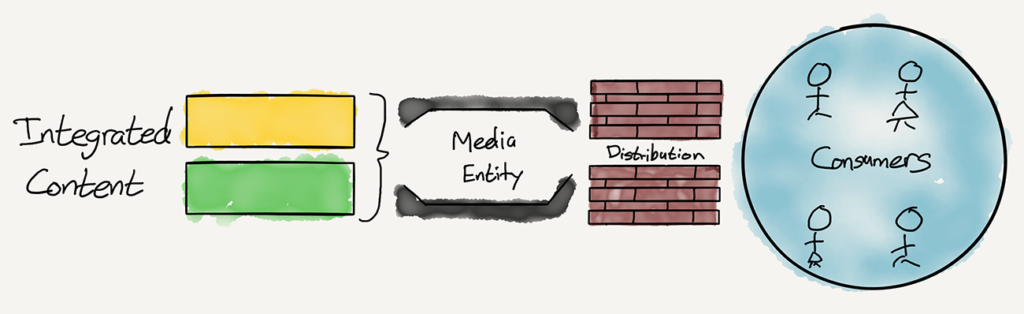
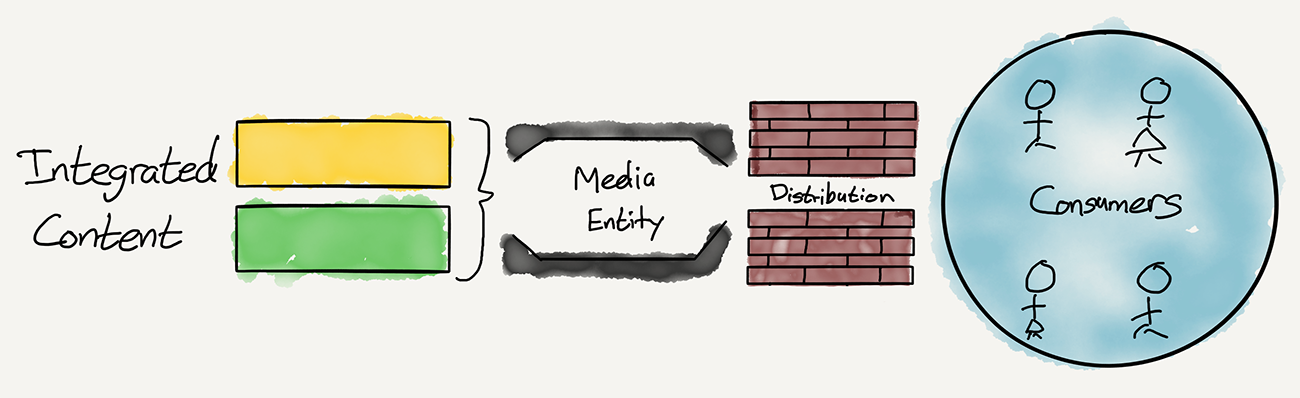
Nearly all media in the pre-Internet era functioned under the same general model:
img_0107

Note that there are two parts in this model when it comes to making money — distribution and then integration — and the order matters. Distribution required massive up-front investment, whether that be printing presses, radio airplay and physical media, or broadcast licenses and cable wires; the payoff was that those that owned distribution could create money-making integrations:

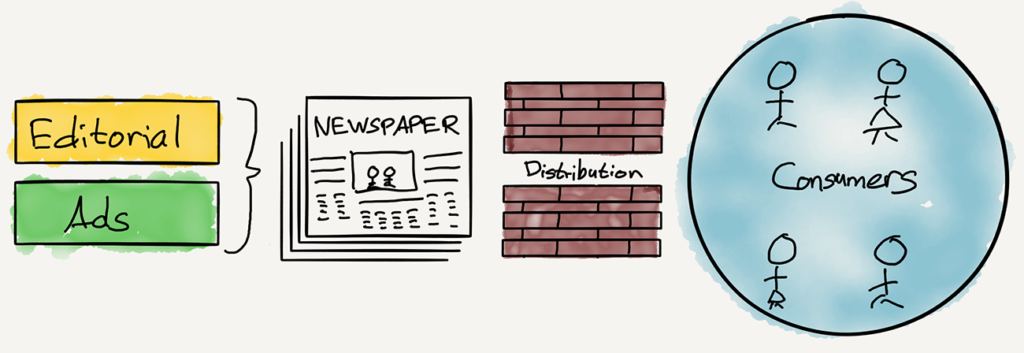
Print: Newspapers and magazines primarily made money by integrating editorial and advertisements into a single publication:
img_0113

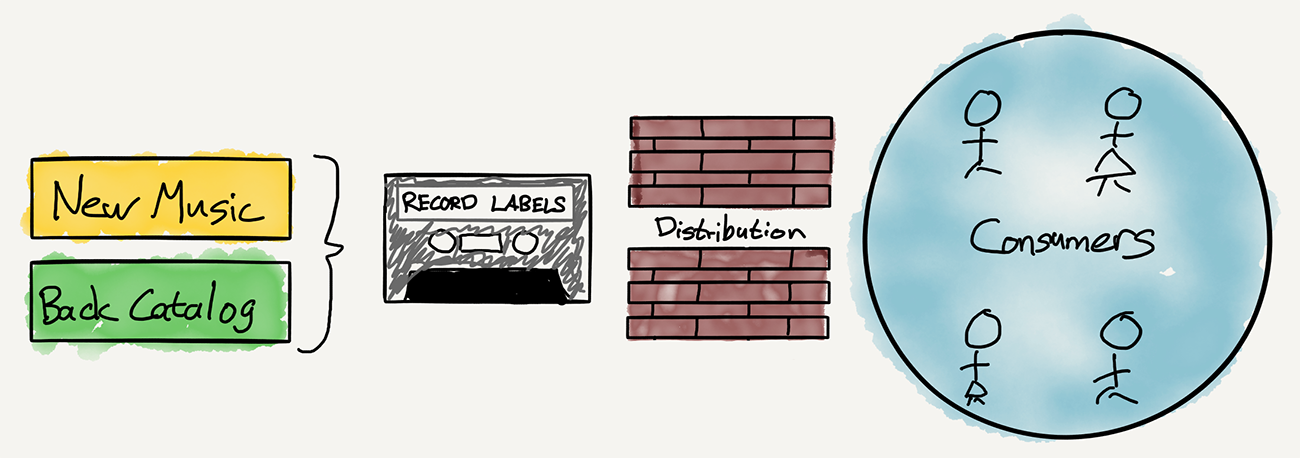
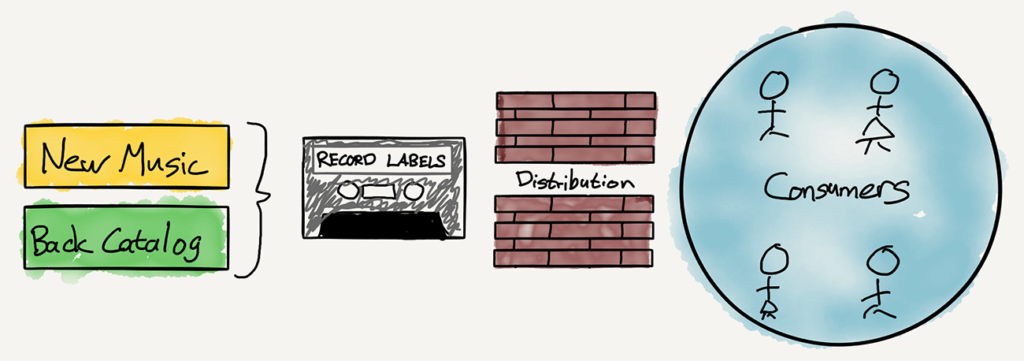
Music: Record labels primarily made money by integrating back catalogs with new acts (which over time became part of the back catalog in their own right):
img_0111

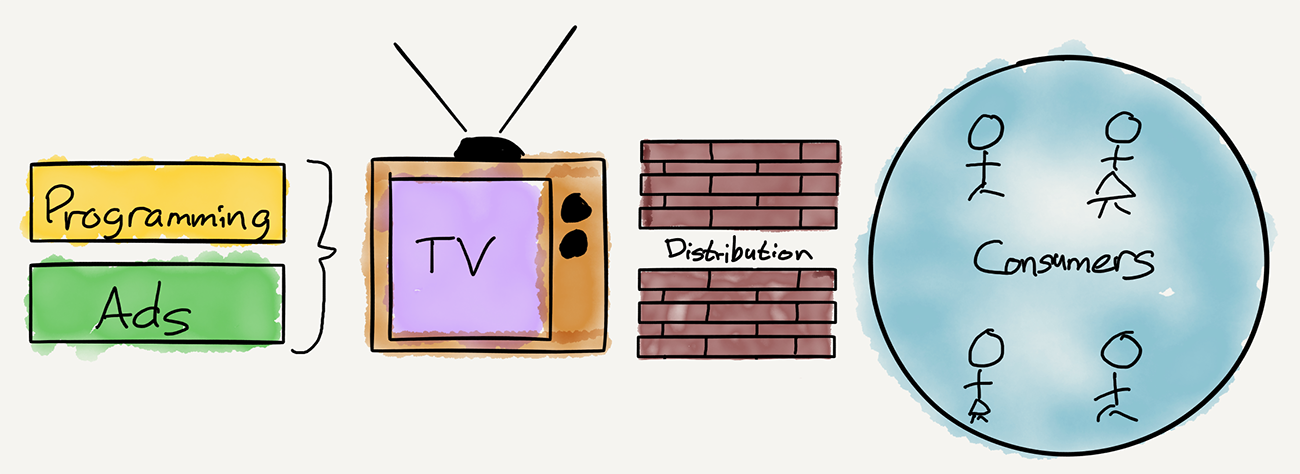
TV: Broadcast TV functioned similarly to print; control of distribution (via broadcast licenses) made it possible to integrate programming and advertising:

img_0110

Cable TV combined the broadcast TV model with bundling, a particular form of integration:
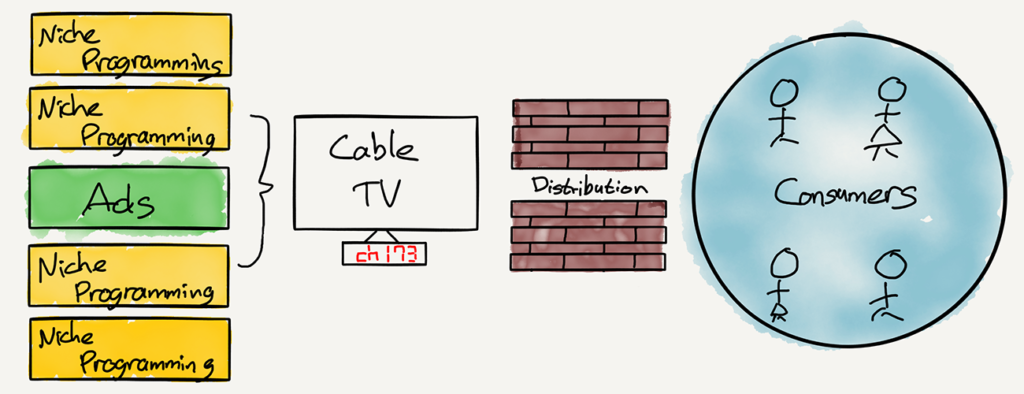
img_0109

The Economics of Bundling

It is important to understand the economics of bundling; Chris Dixon has written the definitive piece on the topic:

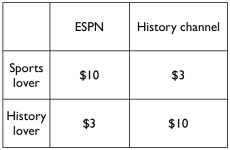
Under assumptions that apply to most information-based businesses, bundling benefits buyers and sellers. Consider the following simple model for the willingness-to-pay of two cable buyers, the “sports lover” and the “history lover”:
screen-shot-2012-07-05-at-6-24-27-pm

What price should the cable companies charge to maximize revenues? Note that optimal prices are always somewhere below the buyers’ willingness-to-pay. Otherwise the buyer wouldn’t benefit from the purchase. For simplicity, assume prices are set 10% lower than willingness-to-pay. If ESPN and the History Channel were sold individually, the revenue maximizing price would be $9 ($10 with a 10% discount). Sports lovers would buy ESPN and history lovers would buy the History Channel. The cable company would get $18 in revenue.

By bundling channels, the cable company can charge each customer $11.70 ($13 discounted 10%) for the bundle, yielding combined revenue of $23.40. The consumer surplus would be $2 in the non-bundle and $2.60 in the bundle. Thus both buyers and sellers benefit from bundling.

Dixon’s article is worth reading in full; what is critical to understand, though, is that while control of distribution created the conditions for the creation of the cable bundle, there is an underlying economic logic that is independent of distribution: if customers like more than one thing, then both content creators and customers gain from a bundle.

When Distribution Goes to Zero

A consistent theme on Stratechery is that perhaps the most important consequence of the Internet, at least from a business perspective, was the reduction of the cost of distribution to effectively zero.

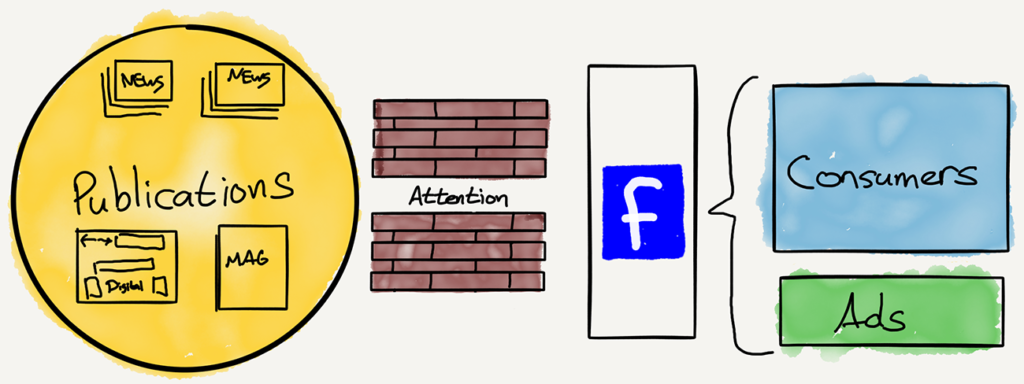
The most obvious casualty has been text-based publications, and the reason should be clear: once newspapers and magazines lost their distribution-based monopoly on customer attention the integration of editorial and advertising fell apart. Advertisers could go directly to end users, first via ad networks and increasingly via Google and Facebook exclusively, while end users could avail themselves of any publication on the planet.
img_0114

For Google and Facebook, the new integration is users and advertisers, and the new lock-in is attention; it is editorial that has nowhere else to go.

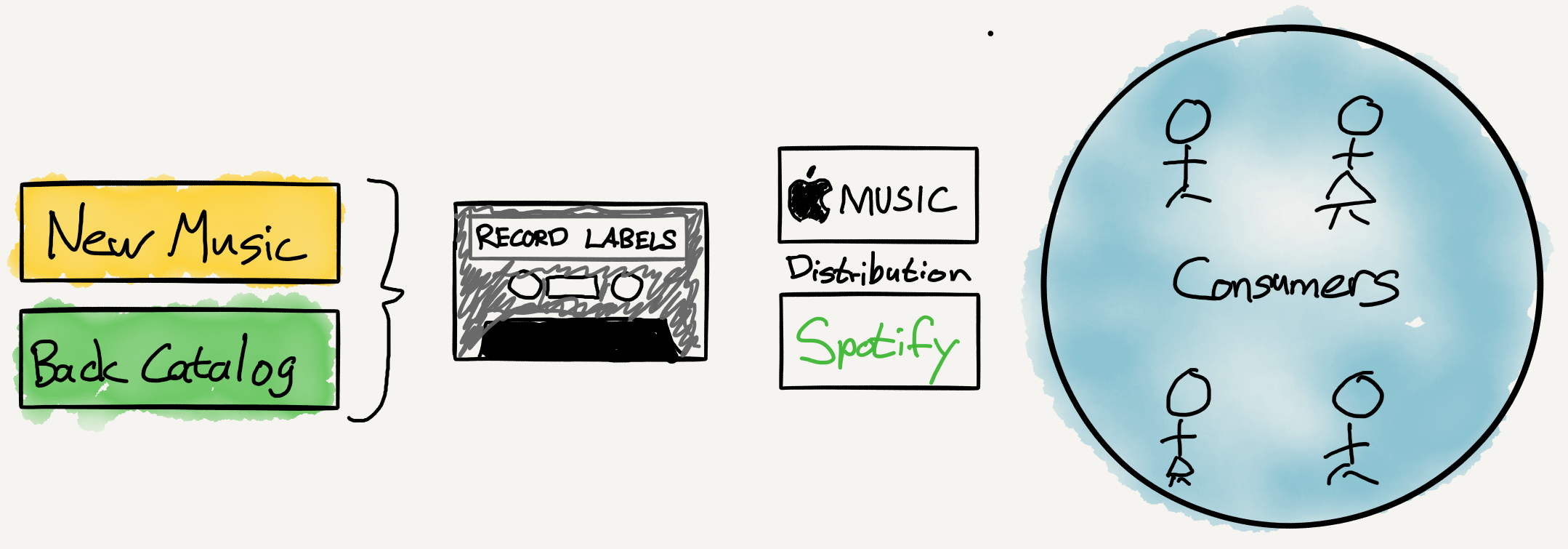
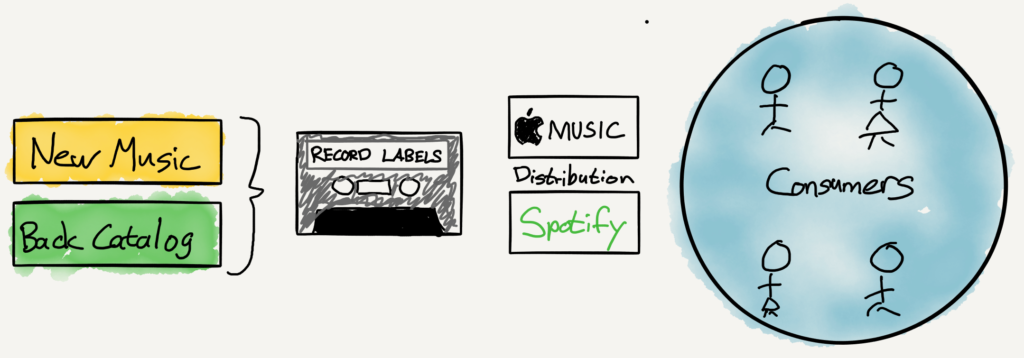
The music industry, meanwhile, has, at least relative to newspapers, come out of the shift to the Internet in relatively good shape; while piracy drove the music labels into the arms of Apple, which unbundled the album into the song, streaming has rewarded the integration of back catalogs and new music with bundle economics: more and more users are willing to pay $10/month for access to everything, significantly increasing the average revenue per customer. The result is an industry that looks remarkably similar to the pre-Internet era:
img_0112

Notice how little power Spotify and Apple Music have; neither has a sufficient user base to attract suppliers (artists) based on pure economics, in part because they don’t have access to back catalogs. Unlike newspapers, music labels built an integration that transcends distribution.

That leaves the ever-fascinating TV industry, which has resisted the effects of the Internet for a few different reasons:

  • First, and most obviously, until the past few years the Internet did not mean zero cost distribution: streaming video takes considerable bandwidth that most people lacked. And, on the flipside, producing compelling content is difficult and expensive, in stark contrast to text in particular but also music. This meant less competition.
  • Second, advertisers — and brand advertisers, in particular — choose TV not because it is the only option (like newspapers were), but because it delivers a superior return-on-investment. A television commercial is not only more compelling than a print advertisement, but it can reach a massive number of potential customers for a relatively low price and relatively low investment of resources (more on this in a moment).
  • Third, as noted above, the cable bundle, like streaming, has its own economic rationale for not just programmers and cable providers but also customers.

This first factor, particularly the lack of sufficient bandwidth, has certainly decreased in importance the last few years; what is interesting about TV, though, is that it is no more a unitary industry than is media: figuring out what will happen next requires unpacking TV into its different components.

The Jobs That TV Does

In 2013 I wrote a piece called The Jobs TV Does where I posited that TV has traditionally filled multiple roles in people’s lives:

  • TV kept us informed
  • TV provided educational content
  • TV provided a live view of sporting events
  • TV told stories
  • TV offered escapism, i.e. an antidote to boredom

It was already obvious then that the first two jobs had been taken over by the Internet: only old people got their news from TV, and there was better and broader educational content on YouTube or any number of websites than TV could ever deliver, even with 200 channels. The question I asked then was how long TV could maintain its advantage when it came to the last three jobs:

The disruption of TV will follow a similar path: a different category will provide better live sports, better story-telling, or better escapism. Said category will steal attention, and when TV no longer commands enough attention of enough people, the entire edifice will collapse. Suddenly.

I’d bet on escapism being the next job we give to something else, for a few reasons:

  • The economics of live sports are completely intertwined with the pay-TV model; this will be the last pillar to crumble
  • Networks still play a crucial role in providing “venture-funding” for great story-telling. Netflix is the great hope here
  • Escapism is in some sense indiscriminate; it doesn’t matter how our mind escapes, as long as it does. Yet it’s also highly personal; the more tailored the escape, the more fulfilling. This is why there are hundreds of TV channels. However, there will never be as many TV channels as there are apps.

I was right about escapism being on the verge of collapse, but the mechanism wasn’t so much apps as it was one app: Facebook.

Facebook, Snapchat, and Escapism

I wrote in The Facebook Epoch:

The use of mobile devices occupies all of the available time around intent. It is only when we’re doing something specific that we aren’t using our phones, and the empty spaces of our lives are far greater than anyone imagined. Into this void — this massive market, both in terms of numbers and available time — came the perfect product: a means of following, communicating, and interacting with our friends and family. And, while we use a PC with intent, what we humans most want to do with our free time is connect with other humans: as Aristotle long ago observed, “Man is by nature a social animal.” It turned out Facebook was most people’s natural habitat, and by most people I mean those billions using mobile.

Snapchat is certainly challenging Facebook in this regard, and one of the most interesting questions to watch in 2017 is if this is the year both companies finally start to steal away not just TV’s attention but also TV’s advertising.

Facebook is laying the groundwork to do just that; the company has been pushing video for a long time now, and recently added a dedicated video tab to its app. What has been missing, though, is an advertising unit that can actually compete with TV for brand advertising dollars; Facebook’s current advertising options are, both in terms of format but also in their focus on fine-toothed targeting, predominantly designed for direct marketing. Direct marketing has always been well-suited for digital advertising; the point of the ad is to drive conversion, and digital is very good, not only at measuring if said conversion occurred, but also at targeting customers most likely to convert in the first place.

Brand advertising is different; whereas direct marketing is focused at the bottom of the marketing funnel, brand advertising is about making end users aware of your product in the first place, or just building affinity for your brand as an investment in some future payoff. The mistake Facebook made for a long time was in trying to win brand marketing dollars by delivering direct marketing results: the company invested tons of time and money in trying to detect and track the connection between a brand-focused advertisement and eventual purchase, which is not only technically difficult — what if the purchase takes place months in the future, or offline? — but also completely misunderstood what mattered to brand advertisers.

I noted above that brand advertisers find TV to deliver a superior return-on-investment; with its focus on tracking Facebook was too concerned with the “return” at the expense of the “investment”. Specifically, taking advantage of Facebook’s targeting and tracking capabilities requires the continual time and attention of marketers; it was far more efficient to simply create a television commercial that reached a bunch of people at once and then track lift after the fact. This is why Procter & Gamble, the biggest TV advertiser in the world, scaled back its targeting efforts on Facebook.

Facebook is doing two things to change its value proposition for brand advertisers:

  • First, the company is reportedly on the verge of rolling out a new video advertising unit that will play in the middle of videos — kind of like a TV commercial.
  • Second, Facebook is focusing much more on being an advertising platform with massive scale than can also target — kind of like cable TV, but better — as opposed to a measurement machine that targets individuals and tracks them to the grocery store register.

That last point may not seem like much but it’s a noticeable shift: on last quarter’s earnings call COO Sheryl Sandberg focused on the fact Facebook made it possible for brand advertisers to do “big brand buys on our platform like they would do on TV, but make them much more targeted.”; exactly one year earlier the pitch was “personalized marketing at scale” and “measuring ROI”.

I think this is the right shift for Facebook, but it also highlights why Snapchat is very much its rival: thanks to Facebook’s ownership of identity the latter is unlikely to mount a serious challenge for direct marketing dollars (although it is — mistakenly in my opinion — building an app-install product); however, if identity is less important for brand advertising than simply scale, then Snapchat’s push for attention, particularly amongst young people, is very much a threat to Facebook.

Not that that is much comfort to TV: Facebook and Snapchat have peeled off the “escapism” job in terms of attention; doing the same in terms of advertising is a question of when, not if.

Netflix and Story-Telling

Meanwhile, Netflix is proving to be far more than a “hope”; as I described last year in Netflix and the Conservation of Attractive Profits, the company leveraged the commoditization of time enabled by streaming to own end users, creating the conditions to modularize suppliers — and that’s exactly what is happening.

What is interesting is that scripted TV is turning out very differently than music: instead of leveraging their back catalogs to maintain exclusivity on new releases, most networks sold the former to Netflix, giving the upstart the runway to compete and increasingly dominate the market for new shows. The motivation is obvious: networks have been far more concerned with protecting their lucrative paid-TV revenue than with propping up their streaming initiatives; the big difference in music is that the labels’ old album-based business model had already been ruined. It’s a lot easier to move into the future when there is nothing to lose.

The Great Unbundling

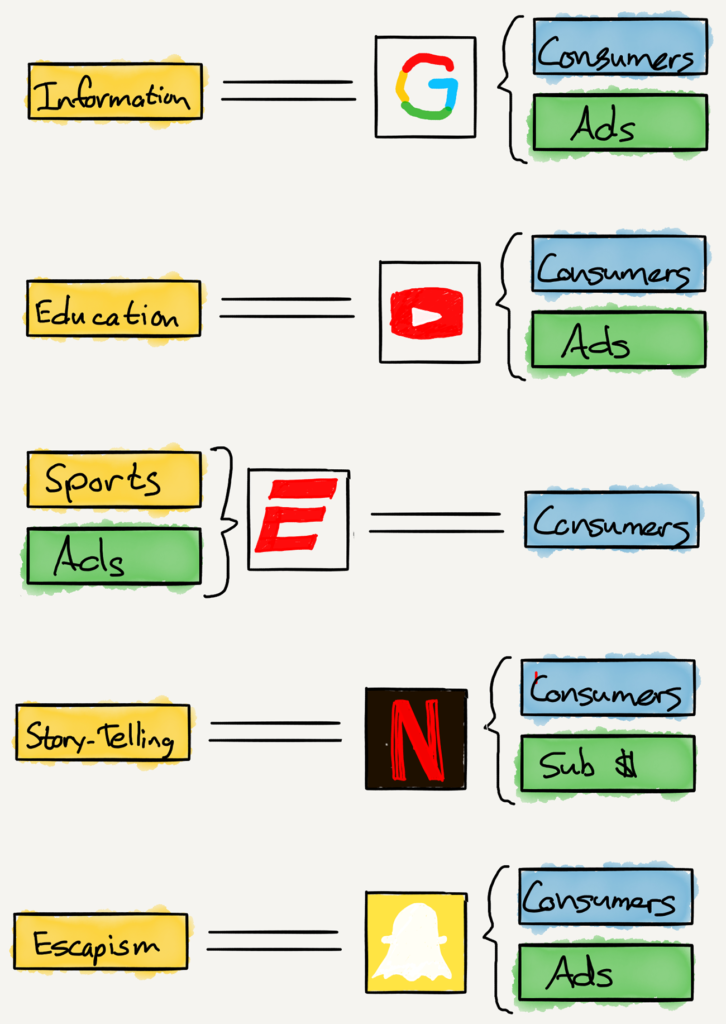
The shift of both escapism and story-telling away from traditional TV are noteworthy in their own rights; equally important, though, is that they are happening at the same time. Here is what the landscape looks like once TV is broken up into the different “jobs” it has traditionally done for viewers:
img_0115

First, the new winners have models that look a lot like the one that destroyed the publishing industry: by owning end users these companies either capture revenue directly (Netflix) or have compelling platforms for advertisers; content producers, meanwhile, are commoditized.

Secondly, all four jobs were unbundled by different services, which is another way of saying there is no more bundle. That, by extension, means that one of the most important forces holding the TV ecosystem together is being sapped of its power. Bundling only makes sense if end users can get their second and third-order preferences for less; what happens, though, if there are no more second and third-order preferences to be had?

To put this concept in concrete terms, the vast majority of discussion about paid TV has centered around ESPN specifically and sports generally; the Disney money-maker traded away its traditional 90% penetration guarantee for a higher carriage fee, and has subsequently seen its subscriber base dwindle faster than that of paid-TV as a whole, leading many to question its long-term prospects.

The truth, though, is that in the long run ESPN remains the most stable part of the cable bundle: it is the only TV “job” that, thanks to its investment in long-term rights deals, is not going anywhere. Indeed, what may ultimately happen is not that ESPN leaves the bundle to go over-the-top, but that a cable subscription becomes a de facto sports subscription, with ESPN at the center garnering massive carriage fees from a significantly reduced cable base. And, frankly, that may not be too bad of an outcome.


To be sure, it will take time for a lot of this analysis to play out; indeed, I’ve long criticized cable-cutting apostles for making the same prediction for going on 20 years. It’s a lot easier to predict unbundling than to say when it will happen — or how.

To that end, this is my best guess at the latter; as for when, the amount of change that has happened in just the last three years (since I wrote The Jobs TV Does) is substantial — and most of that change was simply laying the groundwork for actual shifts in behavior. Once those shifts start to happen in earnest there will be feedback loops in everything from advertising to content production to consumption that will only accelerate the changes, resulting in a transformed media landscape that will impact all parts of society. I’m starting to agree that the end is nearer than many think.
26 Jan 21:47

Rogue Amoeba’s 2016

by Paul Kafasis

While we’re always hard at work here at Rogue Amoeba, last year was one of our busiest in recent memory. Here’s a quick look back at the year that was 2016, as well as a look at what’s ahead in 2017.

A Brand-New App, A Major Upgrade

The winter of 2016 was a frenzied one for us, as we shipped one new application and released a pair of simultaneous upgrades to another.

Loopback

Loopback is our first brand-new product in several years, and it allows you to pass audio between applications on your Mac by creating virtual audio devices. Loopback has proven much more popular than we’d expected, and we’ve continued working to improve it, shipping Loopback 1.1 in December.

Airfoil

Shortly after introducing Loopback to the world, we shipped simultaneous upgrades to Airfoil for Mac and Airfoil for Windows. With its new ability to send to thousands of Bluetooth audio devices, Airfoil 5 is now about much more than just AirPlay audio.

Even as we shipped Airfoil 5, work on streaming audio to Google Chromecast devices was already in progress. Airfoil for Mac 5.5 shipped near the end of the year with the power to stream to Chromecast and all Google Cast devices. Windows users should keep an eye on our site for similar updates to Airfoil for Windows in 2017.

Updates, Big and Small

Last year we added compatibility with MacOS 10.12 (Sierra) and fixing myriad bugs and issues, but also found time for several larger updates, including:

Audio Hijack 3.3

This update continued our string of incremental improvements to our flagship audio recording app, adding powerful new low-latency options great for podcasters and musicians, improved AAC and ALAC recording, support for capturing audio from Slack, and more. Take Control of Audio Hijack, the companion eBook designed to help you get the most out of our app, was also updated for the latest version.

Piezo 1.5

Our simplified audio recorder now includes the Instant On component, which restores its ability to record from several hard-to-capture apps including Safari, Chrome, and FaceTime. However, this change forced Piezo to exit the Mac App Store. Fortunately, we were able to transition existing Mac App Store customers to our direct version, and we’ll continue to sell all of our software directly through our own store.

In total, we shipped nearly 50 distinct updates across our entire product line last year, or nearly one update every week. That’s not easy, but we want to provide our users with the latest fixes and features as rapidly as possible.

Reviews and Awards

2016 featured some wonderful distinctions for our team. We started with phenomenal reviews from Macworld, as Loopback earned a 4.5-mice review and Airfoil 5 followed that up with a perfect 5 out of 5 mice. That’s a veritable infestation!

On top of that, Audio Hijack 3 was selected by iMore as the Mac App of the Year for 2015. The many accessibility improvements we made also led to a Golden Apple award for Best Mac App from AppleVis, a site for visually-impaired users. It’s very gratifying to be recognized with awards like these.

A New Identity, and Other Staffing Notes

Our designer Neale really began to show his stuff in 2016, with improvements seen in both Loopback and Airfoil. The single biggest change he’s made, however, is Rogue Amoeba’s new logo and branding, which debuted in August. Yes, after almost fourteen years, we’ve rebranded with a splashy new logo and look.1

For a small company, staffing is both tremendously important and tremendously difficult. In 2016, we bid farewell to our longest tenured employee Jeff, who departed after providing eight years of rock-solid code inside just about every one of our apps. Our hope when we hire is always that an employee will stick around for such long tenures.

Given that, we were delighted to celebrate two anniversaries in 2016. We marked Grant’s five year anniversary with a motorcycle-themed gift, and a few months later, we celebrated Ed’s five year anniversary with some delightfully geeky hardware. I’m humbled to be able to work with the many talented folks we employ, and honored to have them stay with us year after year.

Toward the end of the year, we began looking to hire for three different roles. We’ve made great progress on filling those positions, and we anticipate expanding our team very shortly.

What’s Next

Enough about the past. You want to hear about what we have planned for the future. Long-time readers will know we’re fairly tight-lipped, but I’ll certainly drop a few hints.

We’ve already announced that Airfoil for Windows will gain support for Chromecast, just as its Mac cousin did. Unforeseen challenges have led that update to take longer than we’d hoped, but we remain committed to getting it out to our users.

After Loopback found a larger-than-expected niche, we’ve decided to dedicate more resources to it. We received a lot of great feedback and ideas, and we’ve got a very solid plan for future improvements. It’s not yet clear what we’ll ship in 2017, but Loopback is getting plenty of attention.

We shipped a small but useful update to Fission last year, with version 2.3 adding the ability to read and write for MP3 chapters and offering faster MP3 encoding. We’ve got a lot more in the pipeline for Fission, however, and we’re eager to get moving on it.

Of course, we won’t be ignoring any of our current applications. As usual, you can expect updates big and small to all of our products. We’ll be adding features, fixing bugs, and bringing compatibility with the likely next version of MacOS (our guess for the name: “Mojave”).

Perhaps most exciting is a brand-new application code-named “Iron Beetle”. Without revealing much, I’ll say that we think many of our existing customers will be quite pleased with this playback-based addition to our line-up. Keep an eye on this blog, as we’ll be starting a private beta test in the coming months.

Thanks To You

Let me close this post by thanking you for being a Rogue Amoeba customer (or at least for reading our blog). It’s your support that allows us to continue running this great software company with the strange name, putting out powerful audio tools that make the world just a little bit better. We’re incredibly grateful to those of you who purchase our software, provide us with valuable feedback, or even just tell a friend about our products.

Now here’s to 2017, and all the progress to come!


Footnotes:

  1. Our old mascot Ammo has taken a backseat, but you can still get one of the special plush toys we first created over a decade ago. We’ll ship a free plush Ammo to anyone who makes a new software purchase in January and requests a plushy. Purchase through our store, then request your free plushy through this form. We’ll ship him out to you free of charge. ↩︎

26 Jan 21:47

These Weeks in Firefox: Issue 8

by mconley

The first Firefox Desktop Engineering meeting for 2017 took place this morning! Here are the interesting bits:

Highlights

  • past wrote a blog post about some upcoming privacy and security features
  • ashughes has posted some very interesting GPU Process Experiment Results
    • TL;DR: A GPU process is a very good idea!
  • The Cliqz Test Pilot experiment has launched in Germany!
    • It’s available in other regions as well, but the suggestions it offers will be very Germany-centric

Contributor(s) of the Week

Project Updates

Add-ons

Content Handling Enhancement

Electrolysis (e10s)

Firefox Core Engineering

Form Autofill

Platform UI and other Platform Audibles

Privacy/Security

  • Florian reports that the new Captive Portal UI will ship in Firefox 52. Last bits of polish have just landed and are being uplifted.

Quality of Experience

Here are the raw meeting notes that were used to derive this list.

Want to help us build Firefox? Get started here!

Here’s a tool to find some mentored, good first bugs to hack on.

26 Jan 21:47

What I did (Jan. 17 & 18 '17)

by Anselm Eickhoff

Yesterday it became very late and I was too tired for a blog post - but I worked on the same thing today anyways!

  • I've been working on cleaning up code and writing documentation, starting with the lowest-level code of the engine
  • I set up an automatic documentation-building job that runs when new code is accepted into the master branch - so the documentation is always up-to-date!
    • This is what the documentation looks like
    • Rust documentation is very beautiful by default and I tried my best to make the content as clear and helpful as possible, documenting most importantly why I designed some code like I did.
    • So far, only a couple of the lowest-level libraries are covered
  • Today I started heavily cleaning up and also documenting Kay, the actor system that pretty much runs all the simulation and rendering of Citybound
    • Some of the abstractions I invented there had weird and inconsistent names, so I first invented better names for them
    • People say there are 3 difficult things in programming:
      • Naming things
      • Off-by-one errors
    • I'm not done with the documentation yet, but it will appear under the same link once I am
    • After I'm done, it's probably time to show off all of this architecture I built over the last couple months to the Rust community, maybe some more people will be interested in contributing!

And because someone kinda asked about it last time:
I decided to work in two-phase cycles:

  • Phase A: Produce juicy new features
  • Phase B: Clean up all the mess, fix bugs, polish architecture

As you might guess, right now I'm in Phase B, and I will continue until the end of January. Then, I will switch back to Phase A with the next big feature: basic economy.


26 Jan 21:46

The New York Times’ remarkable corporate self-criticism

by Josh Bernoff

While The New York Times may be the most successful news organization on the planet, it faces the existential threat of digital disruption. This, as Clayton Christensen would say, is a recipe for disaster. But maybe not. The Times’ 2020 Group has published a manifesto for change. The cogent self-criticism in this document is amazing. Learn from it. The Times’ … Continued

The post The New York Times’ remarkable corporate self-criticism appeared first on without bullshit.

26 Jan 21:46

Editorial Updated with 12.9-inch iPad Pro Support, Split View Multitasking

by Federico Viticci

Ole Zorn's Editorial was the text editor that completely reimagined how I could work from iOS. While I have since moved to Ulysses as my primary text editor, I still use Editorial almost daily for its unique Markdown automation. Editorial's combination of Python scripting and visual workflows for plain text editing is unparalleled and there's nothing else like it on the App Store.

After a couple of years without updates and a long TestFlight beta period, Editorial has been updated for iOS Split View and the 12.9-inch iPad Pro. There are other changes (the workflow editor has been moved to the accessory panel and the Python editor now opens in a separate tab), but, overall, it's still the same Editorial you know and love, updated for the latest iOS devices. I've been using the beta version of Editorial 1.3 for several months now – being able to keep Editorial next to another app is great for editing and research, and moving back and forth between a document and a workflow is easier.

As for everything else, my coverage of Editorial 1.0, 1.1, and 1.2 still stands; Editorial is the text editor for iOS power users thanks to its excellent automation features, advanced Markdown editing, and TaskPaper integration. As I wrote in November, I still edit all my longform stories in Editorial. Despite the paucity of updates, I love the app as it's a shining example of pro software for iOS.

If you haven't played with Editorial in a while, now's a good time to check it out again (the app is also available at a discounted price of $4.99).


Support MacStories Directly

Club MacStories offers exclusive access to extra MacStories content, delivered every week; it’s also a way to support us directly.

Club MacStories will help you discover the best apps for your devices and get the most out of your iPhone, iPad, and Mac. Plus, it’s made in Italy.

Join Now
26 Jan 21:46

Got a data app idea? Apply to get it prototyped by the JHU DSL!

Get your app built

Last fall we ran the first iteration of a class at the Johns Hopkins Data Science Lab where we teach students to build data web-apps using Shiny, R, GoogleSheets and a number of other technologies. Our goals were to teach students to build data products, to reduce friction for students who want to build things with data, and to help people solve important data problems with web and SMS apps.

We are going to be running a second iteration of our program from March-June this year. We are looking for awesome projects for students to build that solve real world problems. We are particularly interested in projects that could have a positive impact on health but are open to any cool idea. We generally build apps that are useful for:

  • Data donation - if you have a group of people you would like to donate data to your project.
  • Data collection - if you would like to build an app for collecting data from people.
  • Data visualziation - if you have a data set and would like to have a web app for interacting with the data
  • Data interaction - if you have a statistical or machine learning model and you would like a web interface for it.

But we are interested in any consumer-facing data product that you might be interested in having built. We want you to submit your wildest, most interesting ideas and we’ll see if we can get them built for you.

We are hoping to solicit a large number of projects and then build as many as possible. The best part is that we will build the prototype for you for free! If you have an idea of something you’d like built please submit it to this Google form.

Students in the class will select projects they are interested in during early March. We will let you know if your idea was selected for the program by mid-March. If you aren’t selected you will have the opportunity to roll your submission over to our next round of prototyping.

I’ll be writing a separate post targeted at students, but if you are interested in being a data app prototyper, sign up here.

26 Jan 21:46

My pre-Trump dystopian anxieties may be getting the better of me

by Alex
26 Jan 21:46

Learning from the rise of the right in the global South

by Michal Rozworski

With only two days left until Donald Trump’s inauguration, today’s two guests look at the turn to the right that’s already well under way across parts of the global South.

First, I speak with the historian, journalist and author Vijay Prashad about the nationalist Narendra Modi’s economic agenda in India. Vijay’s books include The Darker Nations A People’s History of the Third World and The Poorer Nations: A Possible History of the Global South. He teaches history in the northeastern US.

My second guest is Sabrina Fernandez, who discusses the permanent austerity being implemented in Brazil by the draconian Temer government. Sabrian is an activist on the radical left in Brazil and she recently completed a PhD in sociology focusing on the left in Brazilian politics from Carleton University. She spoke with me from Brasilia.

I finished each interview by asking what lessons the lefts of their countries hold for those of us battling an empowered right in the North.

As always, remember to subscribe using the links below the player to get new episodes as they appear (you can also donate to help keep the show going).

26 Jan 21:46

Wired Wednesday: Your smartwatch knows when you’re sick, Passport 2017 & BACtrack Skyn

by John

This week on News 1130 radio in Vancouver, I spoke about these tech topics for Wired Wednesday with Ben Wilson:

  • Can your smartwatch tell when you’re getting sick? (source)
  • Passport 2017: Keep up with all the Canada 150 events on your smartphone (source)
  • BACtrack Skyn: Apple Watch accessory tracks how drunk you are (source)

The post Wired Wednesday: Your smartwatch knows when you’re sick, Passport 2017 & BACtrack Skyn appeared first on johnbiehler.com.

26 Jan 21:45

Network Sharing Pains In The UK

by Martin

In many countries around the world, network operators are sharing parts of their radio access networks. In many cases the country they operate in is split up into different parts and each network operator exclusively installs the network infrastructure for both. Obviously this reduces cost but also denies companies that are part of the agreement to differentiate themselves in the one thing that matters: Speed and capacity.

Not that this would have stopped network sharing agreements in the past. But these days it seems some network operators are seeing the downsides of such agreements as well. Recently, TeleGeography reported that two network operators in the UK that are sharing their radio networks are having different opinions about how to counter the network expansion of a third network operator. While one network operator wants to aggressively expand coverage and capacity as well the other wants to take a slower approach. Tough luck, in for a penny, in for a pound as the saying goes.

The situation reminds me a bit of the tunnel coverage problems I’m having where network operators also share a single distribution network which is maintained by only one of them (who is totally incapable of fixing things, it’s still broken two months after I first noticed and reported it). Interestingly enough the network operator responsible for my tunnel problems is the one who’s sitting on the other side of the stick in the UK.

26 Jan 21:45

Pogue’s Basics: Money - Supply Your Own Cable Modem

At this moment, you’re paying about $10 a month to rent your cable modem, the gadget that brings high-speed Internet into your house. $10 a month, forever.

For no reason! Buy your own cable modem for $100, return the one you’ve been renting, and boom: $120 a year in savings.

Before you shop for your own modem, make sure you’ve found one that works with your cable company. Do a Google search for, for example, “Comcast compatible modems.”

Once you’ve ordered the modem, call up the cable company and let them know you’ve bought your own. It’s perfectly OK and increasingly common. They’ll walk you through setting it up. They’ll give you the address of a return center for shipping back the one you’ve been renting.

And then they’ll take that $10 fee off your monthly bill!

How cool is that?

More Pogue:

iOS 10 Hidden Feature: Bedtime-consistency management

Pogue’s Basics: Money – The Amazon card

iOS 10 Hidden Feature: Do Not Disturb Emergency Bypass

Pogue’s Basics: Money – Extended warranties

Pogue’s cheap, unexpected tech gifts #2: ThinOptics glasses

A dozen iOS 10 feature gems that Apple forgot to mention

GoPro’s most exciting mount yet: a drone

Professional-looking blurry backgrounds come to the iPhone 7 Plus

Pogue’s Basics: Turn off Samsung’s Smart Guide

Pogue Basics: Touch and hold Google Maps

The Apple Watch 2 is faster, waterproof—and more overloaded than ever

We sent a balloon into space — and an epic scavenger hunt ensued

Now I get it: Snapchat

The new Fitbits are smarter, better-looking, and more well-rounded

Apple has killed every jack but one: Meet USB-C


26 Jan 21:45

Dying on the Vine

by Reverend

When I was cruising around the web early this morning I saw an announcement that Vine was finally shutting down and January 17th (a.k.a. yesterday) is the last day to download your videos. I was a bit bummed because I created about 30 Vines that I wanted to archive. Fortunately they were still there, but unfortunately I could no longer get a downloadable archive from Vine. I’m sure those folks who are not Vine dilettantes like me got their stuff off in a timely manner. But I only used Vine for the UMW Console project (and a couple of personal outings) back in 2015, so the deadline for archiving fell off my radar. But once faced with the possibility of losing the videos, they quickly became invaluable memories waiting to be lost forever 🙂 Although, I think what bothered me most was the idea that 20 or so Vines across various blog posts would leave a huge, gaping embeddable media hole on the bava blog.
So I spent much of this morning using savedeo.com to grab my Vines (as well as those of folks whose vines I had embedded on my site).  Savedeo worked well, but keep in mind it will try and get you to click ads and install crap, so you need to navigate that minefield. That said, it’s pretty simple to use, just put qq before the URL of any Vine video’s permalink and you will be redirected to a site that offers you various quality downloads of the video, much like PWN Youtube does.

I did that for about 40 videos, so I now have a full archive of all the Vines embedded on this blog. I was considering uploading them all to Flickr and embedding those videos, but given my growing fear of having to archive and move them yet again, I am leaning towards finding a video player that acts like Vine and serving them directly from my blog given none of them are over 3 MBs.

But as you may have gathered from this post, they did not disable embeds from Vine just yet, so I figured I would enjoy the service while it lasts and share some Vines I took one day while toy antiquing in Fredericksburg during the Spring of 2015. 

26 Jan 21:45

Twitter Favorites: [dlbno] Pleeeeeeaaaase Canada, let's not get lost in the weeds and focus on this kind of nonsense. Trump proved we have to… https://t.co/aKmEiroOKL

db @dlbno
Pleeeeeeaaaase Canada, let's not get lost in the weeds and focus on this kind of nonsense. Trump proved we have to… twitter.com/i/web/status/8…
26 Jan 21:45

Using your AirPods with Windows

by Volker Weber

IMG 20170119 1143312

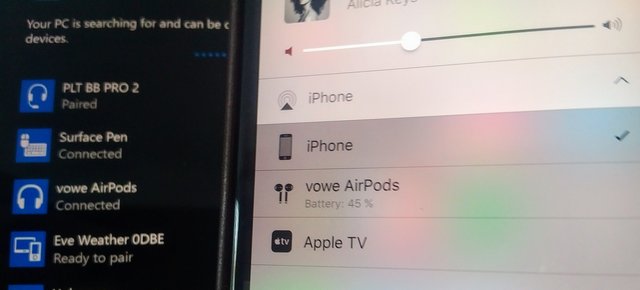
Daniel asks if you can use your AirPods with your iThings and your Windows PC at the same time. Yes, you can. Strictly not at the same time, but they do work. You place them in the carrying case (did I mention you always put them in the carrying case?) and hold the button on the back of the case for seven seconds. Now they are discoverable and you can pair them from Windows. Your iThings will not forget your AirPods and you can pull them over.

However, if you take out an AirPod while connected to Windows, it may not continue to play when you put it back in your ear. I had to put them back in the carrying case (did I mention ...) and then open the case to make them connect again. So, it does kinda work. But I am not sure I like it. Apple would say you should buy more mThings instead of Windows PCs. :-)

26 Jan 21:45

Feds launch networking site for academics, students and public servants

files/images/gccollab.PNG


Natalie Samson, University Affairs, Jan 22, 2017


This is a Canadian government initiative, "a digital networking platform called GCcollab.ca, a site it’ s pitching as an easy way for academics and students to connect and collaborate with Canada’ s public service." The open source software referred to in the article is Elgg, which formed the backbone of GCConnex. I am signed up on the site and will be welcoming connections and groups linking the academic sector and learning and development in the Canadian public service.

[Link] [Comment]
26 Jan 21:42

Twitter – Event horizon

by windsorr

Reply to this post

RFM AvatarSmall


Sale of Fabric collapses Twitter’s horizons. 

  • With the sale of Fabric to Google, Twitter has essentially given up all hope of becoming an ecosystem and its growth will be totally dependent on its ability to create engagement around media consumption.
  • This means that a blue-sky scenario for Twitter will see it with 28% coverage of the Digital Life pie up from 18% today.
  • In this instance, RFM estimates that the best possible revenue outcome for Twitter would be annualised revenues of around $3.9bn, growing 6-8% in the long-term.
  • Twitter first unveiled Fabric in 2014 as a developer platform by which developers could create other services and then tightly link them to Twitter.
  • The idea was that this would allow Twitter to collect data in other areas of Digital Life and thereby improve its addressable market when it came to monetisation.
  • However, the fact that it has now sold this to Google is a sign that it has given up on trying to develop this avenue of expanding its business and is doubling down on media consumption.
  • When it comes to monetising microblogging, Twitter is best in class but because it is present in such a small niche of Digital Life, growth has ground to a halt causing a major problem for both management and shareholders.
  • This is why Twitter has been trying to develop a media consumption offering and why the live casting of NFL games over its service is such a big deal for the company.
  • The response to the live streaming over Twitter has been quite good with Twitter adding 0.25m to the NFL’s regular audience of 15m or so but there is a very long way to go.
  • However, it is still very far from challenging YouTube or Facebook Video which is why I need to see far more than just NFL streaming in order to become confident that Twitter has a media consumption offering that it can monetise.
  • This is crucial because now that Fabric has gone, this is Twitter’s only real hope of extending beyond Microblogging and Instant Messaging.
  • The narrowing of its horizons means that, while Twitter could increase its revenues to a new level (and hopefully make some profit), revenues of $8bn-$10bn look hopelessly out of reach.
  • The company currently has an enterprise value of $10bn which looks much too high if the blue-sky scenario now returns maximum annualised revenues of around $4bn.
  • Hence, I still think that the shares could test $10 per share at which point it becomes an attractive tuck-in acquisition for any of the big ecosystems to complement their existing offerings.
  • Google, Facebook or maybe Tencent would be at the top of that list.
26 Jan 21:29

Omnicharge makes a portable charger for your laptop

by Eva Yoo

A startup wants to keep your laptop and mobile phone alive even when you’re cycling across China for a couple of months. A portable battery charger Omnicharge has recorded 4259% funded of its goal amount on Indiegogo, raising over 3 million USD in September. The company recently participated in CES 2017, and are now busy with shipping the product to backers.

Compared with other power bank distributors currently available in the market, such as ChargeTech PLUG (35 oz) and GoalZero Sherpa 100 (30.5 oz), Omnicharge is the lightest: 20.8 oz and recharges in three hours. The competitors do not have a screen, nor support heat management.

The battery charger has an OLED display screen that shows the time left for charging, AC/ DC power outlets, and two USB fast-charging ports. The company has two models: Omnicharge 13600 and Omnicharge 20400.

omnicharge.1

Omnicharge 20400

It also has a strong safety feature which ensures overheating and overpower protection. Once you connect high power consuming device that goes over 100 watts, it is not going to damage the device nor the Omnicharge, just deactivate. If the environment is too hot, then it will shut down to ensure there are no hazardous situations.

“We have been getting very inspiring stories and feedbacks from backers. One early adopter brought Omnicharge with him when he climbed the Himalayas to charge his heated socks, and Omnicharge was also able to power NBC journalists at the Olympics, and the recent Presidential Debates,” Eric Mathiesen, Customer Relations Manager at Omnicharge says.

The charger also supports wireless charging when the device is lying on top of it, working within 2-3 millimeters and users can take the charger on a flight. Omnicharge kit provides all the different connectors for different devices and supports solar charging. The cool thing is, you can charge five different devices at one time, using AC/ DC power outlets, two USB fast-charging ports, and wireless charging.

I wanted to charge my MacBook Retina 12-inch using Omnicharge, but the team didn’t have USBC connector. I connected my phone to Omnicharge instead, and boom, it charged up my phone in the nick of time.

Omnicharge uses battery cells produced by Panasonic, also used for Tesla to ensure safety and reliability. The battery charger looks slick and high quality. When you touch it, it feels solid.

Omnicharge will be available online  and in retail stores in the U.S. later this year, and will also be available in China later this year.

Image credits: Omnicharge

26 Jan 20:56

Photo


24 Jan 19:25

‘Super Mario Run’ Launches in March

by Evan Selleck
Back in December of last year, Nintendo officially launched Super Mario Run for iOS, which worked as an exclusive launch platform. Continue reading →
20 Jan 19:47

Edward Snowden criticizes BlackBerry for its stance on privacy

by Jessica Galang

The Cantech 2017 Investment Conference in Toronto featured an interview with American Edward Snowden, well-known for his role in exposing the scope of the National Security Agency’s global surveillance programs.

Over video conference, Snowden spoke with Round 13 Capital managing partner and The Disruptors co-host, Bruce Croxon, on a wide range of subjects, including what it means for the government to have access to private data on a mass scale, and the role corporations play in protecting their customers’ data.

“Ultimately, we’re not talking about privacy, we’re talking about the quality of society”

“The stipulation [is that] if you have nothing to hide, you have nothing to fear. What this is encouraging is to live a life in a vulnerable state. To expose yourself to the depredations of an outside group to scrutinize how you live, what you think, what your ideas are as long as what you do is okay by them,” said Snowden. “This misunderstands what rights are about and what privacy is about. Privacy isn’t about something to hide, it’s about something to protect.”

Snowden called out a number of companies, such as AT&T, for its role in helping the government obtain customer data in exchange for regulatory benefits. When asked about former Canadian tech giant BlackBerry by Croxon, Snowden called the company out for its public claims of security.

Last year, it was reported by Vice Canada that the RCMP has had backdoor access BBM since at least 2010, and decrypted more than one million messages.

Snowden claimed that while BlackBerry has tried to obscure its role in cooperating with government requests in North America, the company also cooperates in other markets, including India.

“India said ‘we’ll cut your market access unless you unlock these communications that we want for investigations that are going through your enterprise service, and BlackBerry says ‘okay’,” said Snowden. “They follow the AT&T model which is that the customer is not really the customer, the state is the customer. That’s the only person they really have to please.”

Snowden’s comments come shortly after BlackBerry’s signed partnership with Rudy Giuliani’s security consulting firm, Giuliani Partners, to use BlackBerry’s Secure platform in support of government and enterprise customers. Giuliani, recently named a cybersecurity advisor in the Trump administration, has been criticized for his own alleged lack of cybersecurity knowledge.

“They [BlackBerry] follow the AT&T model which is that the customer is not really the customer, the state is the customer”

The Waterloo company has also opened a Washington, DC-based security innovation centre, which BlackBerry CEO John Chen said will “serve as a hub for collaboration with key government customers and other expert partners.”

During the interview, Snowden contrasted BlackBerry’s approach with Apple’s stance on protecting its customers’ privacy, despite, as Snowden said, being accused by government officials of “helping terrorists” in the past, notably following the San Bernadino shooter, where the company refused to hand over data from one shooter’s iPhone.

“You can end up standing up for what is right, you have to trust that even if it is digital, if you take a principled stand that that will do more good not just for your bottom line or country, but for your society and future,” said Snowden.

Snowden had harsher words for BlackBerry on its cooperation with the government agencies: “This is why they’re going to be erased from the pages of history. Apple is a very successful company, particularly as they make this pivot toward enforcing quite publicly the privacy rights. Ultimately, we’re not talking about privacy, we’re talking about the quality of society.”

This post was originally published on BetaKit.

Image Credit: Ezra Chang

20 Jan 19:47

Galaxy S8 glass screen protector leak indicates front panels with ultra-thin bezels

by Rose Behar

What could be the most legitimate Galaxy S8 photo leak yet has emerged through Twitter tipster @DforDesign, who attributes the picture to a Chinese glass screen protector supplier.

The picture shows two display covers, both of which feature six windows in the top bezel. The array provides the necessary space for iris scanning technology, which is expected to arrive in the S8 due to its inclusion in the ill-fated Note 7. The exclusion of such windows in previous leaks have led many to question their authenticity.

In addition to the space for sensors in the top bezel, the pictures reveal ultra-slim bezels and rounded edges, which could indicate, as Android Police points out, that the edges themselves will be rounded, a significant design change.

Android Police further states that according to the publication’s insider sources, the images are a close match to the actual devices.

Source: Twitter Via: Android Police

20 Jan 19:47

Samsung might integrate an e-ink display into a flip-cover case

by Rose Behar

Samsung is investigating adding an interesting new feature to flip cover cases, a Korean patent application has revealed.

The year-old patent is for a flip cover case with an e-ink display, which would grace the front of the device and feature optional touch sensitivity that can be switched off to save energy. The images accompanying the filing show a cover with two windows, a small top section that can be used to interact with the actual screen and the e-ink segment, which takes up the rest of the case.

This is not the first time Samsung has experimented with smart and responsive flip cover cases. In March 2016 the company debuted the LED View, which connects to phones using NFC technology and features a hidden LED display which can display simple icons and accept touch commands for things like call rejection and turning off alarms.

Source: Galaxy Club

20 Jan 19:47

Microsoft expands AI presence in Montreal via $6 million donation to Université de Montréal

by Jessica Galang

On the heels of its Maluuba acquisition announcement, Microsoft announced that it will be doubling the size of Maluuba’s Montreal office, which it calls its “new AI research and development organization.” The company plans to grow the office in the next two years.

At the same time, Microsft will be donating $6 million CAD to the Université de Montréal and $1 million to McGill University to expand AI research, which will be funded over a five-year period. In December, Microsoft Ventures also invested in Element AI, an incubator that helps organizations develop an “AI-first” strategy.

“Microsoft is excited to engage with faculties, students and the broader tech community in Montreal, which is becoming a global hub for AI research and innovation,” said Brad Smith, president of Microsoft.

“Today’s news, along with the opening of Microsoft Vancouver and our ongoing work to create a new Cascadia Innovation Corridor connecting Vancouver and Seattle, reinforces the important role that Canada plays in Microsoft’s global business.”

Smith announced the news in Davos, Switzerland, during the World Economic Forum’s annual meeting. He was joined by Navdeep Bains, Minister of Innovation, Science and Economic Development; Dominique Anglade, Quebec Minister of Economy, Science and Innovation, and Quebec minister of Minister responsible for the Digital Strategy; and Quebec Premier Philippe Couillard.

“Microsoft’s investment is proof of Canadians’ world-renowned expertise in artificial intelligence and machine learning. This emerging field of research has the potential to revolutionize computing by transforming vast amounts of information into useful insights,” said Bains.

“The future of every industry, from finance and health to manufacturing and transportation, will be shaped by advances in artificial intelligence. And research conducted in Canada will play a defining role in developing this enabling technology, which will create better jobs and opportunities for Canadians.”

This story originally was published on Betakit

18 Jan 23:33

Tesla expands its massive Gigafactory in Nevada to produce Model 3 motors

by Rose Behar

Tesla is adding production for Model 3 electric motors and gearbox components to its Nevada-based Gigafactory, expanding the production by 550 new jobs and an extra $350 million USD in investment.

Tesla’s Gigafactory began production on lithium-ion batteries earlier this month and currently employs 1,000 full-time workers and 2,000 construction workers.

The factory is approximately one-third complete with 4.9 million square feet of operational space. When the project is complete, it is expected to reach over 10 million square feet of operational space, spanning, as The Verge notes, the size of 107 NFL football fields.

In creating the factory, Tesla agreed to create 6,500 jobs in the state, receiving an incentive package that totalled $1.3 billion USD in value return.

The company hopes to boost its production to 500,000 cars per year by 2018, and the Gigafactory is a necessary step in those plans.

In November 2016, the company released a blog post announcing its acquisition of automated manufacturing company Grohmann Engineering that put emphasis on the importance of developing its factory.

“As the machine that builds the machine, our factories are so important that we believe they will ultimately deserve an order of magnitude more attention in engineering than what they produce,” says the post.

“At very high production volumes, the factory becomes more of a product than the product itself.”

Source: The Verge

18 Jan 20:36

Ulysses Moments 2016

by Rebekka
mkalus shared this story from Ulysses Blog.

2016

Albeit 2016 was not exactly everybody’s darling of years, it has been a very special and successful year for Ulysses and for us — maybe even the most exciting year in our company’s history. That’s why we would like to pause for a moment, look back at the most important things that happened, and share them with you.

Ulysses for iPhone Release (Finally!)

After releasing Ulysses’ first iOS version for iPad in March 2015, it took us yet another year to finish optimization for iPhone. For our company, this release was a milestone, because our vision of Ulysses always included the ability to write anything and anywhere, no matter which (Apple) device is at hand. The release led to great media exposure (with some real biggies such as The Next Web, lifehacker, and TechCrunch) and to tons of new users.

The Ulysses family, finally complete

Exceptionally Noisy and Incredibly Crowded

That’s us and friends in our office in Leipzig, celebrating the of the iPhone app and Ulysses third anniversary.

Exceptionally noisy and incredibly crowded: Soulmen & friends in the office, celebrating the release of the iPhone app and Ulysses’ 3rd anniversary.

The Apple Design Award

Supposedly any passionate developer of apps for Apple platforms dreams of getting it: The Apple Design Award. For us, the dream came true: On June 13, 2016, a Soulmen delegation consisting of Max, Götz and Friedrich received the Apple Design Award at Apple’s World Wide Developers’ Conference in San Francisco. As a consequence, our otherwise serene office life was turned upside down for a couple of weeks, by congratulators, interview requests, even a camera team. The local media of Leipzig, our German hometown, were especially excited: “Diese Leipziger sind Apples beste Jungs”, meaning “These Leipzigers are Apple’s best boys”, read the title of the widely spread tabloid Bild.

Ulysses Publishes to WordPress

With our 2.6 release, we finally delivered on a promise we made a looong time ago. For anyone who owns a WordPress blog or uses WordPress as a content management system for his/her self-hosted blog, Ulysses now makes the process of publishing much more convenient. Bloggers can publish their posts with just a few clicks or taps; no more exporting as HTML or Markdown, no cumbersome pasting to the WordPress backend.

Write a Novel in a Month

2016 was our third term as a sponsor of NaNoWriMo, the challenge where hundreds of thousands of authors from all over the world commit to writing 50,000 words in a month — a novel. Among other things, the popular romance author Lauren Layne published a video on this occasion, where she introduced her process of setting up a book in Ulysses . And with your help we set up a handy list of things one can do if you get stuck during writing (or, in common parlance, if you suffer from writer’s block).

Best of 2016

In December we released Ulysses 2.7, and although the release may seem less spectacular than the previous two, it will serve as a solid basis for our future work. Shortly before the new version became publicly available, we received news that made our year complete: Ulysses, or rather Ulysses for iPad and iPhone, was included in the Best of App Store 2016 list!

New Team Members

Not only did Ulysses gain new features during the course of the year — also, the team behind it gained new members. Martin, who studied media informatics and was freelancing, joined to strengthen our development team. Philip took over the design department and now cares for Ulysses’ visual appearance.

Outlook on 2017

One big change has already taken place in the beginning of the year: Our company’s name is no longer The Soulmen GbR, but Ulysses GmbH & Co. KG. On the one hand, the new legal form better suits the needs of our continuously growing company. On the other hand, we don’t have to confuse you with two different names anymore: From now on, we’re not only the makers of Ulysses, but we are Ulysses, the company.

We’re of course also having plans for great new features, but you must understand that we can’t reveal any details at the moment. It is notoriously hard to put a realistic estimate on the effort required by a new feature, and we have been wide off the mark more than once in the past. Development takes time, and haste makes waste. That’s why we’re so reluctant with timelines and ETAs. Still, you can be assured that we have been listening to you and taken your wishes and requests seriously, and will do so in the future.

Here’s to a happy and productive 2017!

Apple Design Award

18 Jan 20:36

Recommended on Medium: Threaded messaging comes to Slack

Rolandt

jj

Keep conversations organized and easy to follow with Threads

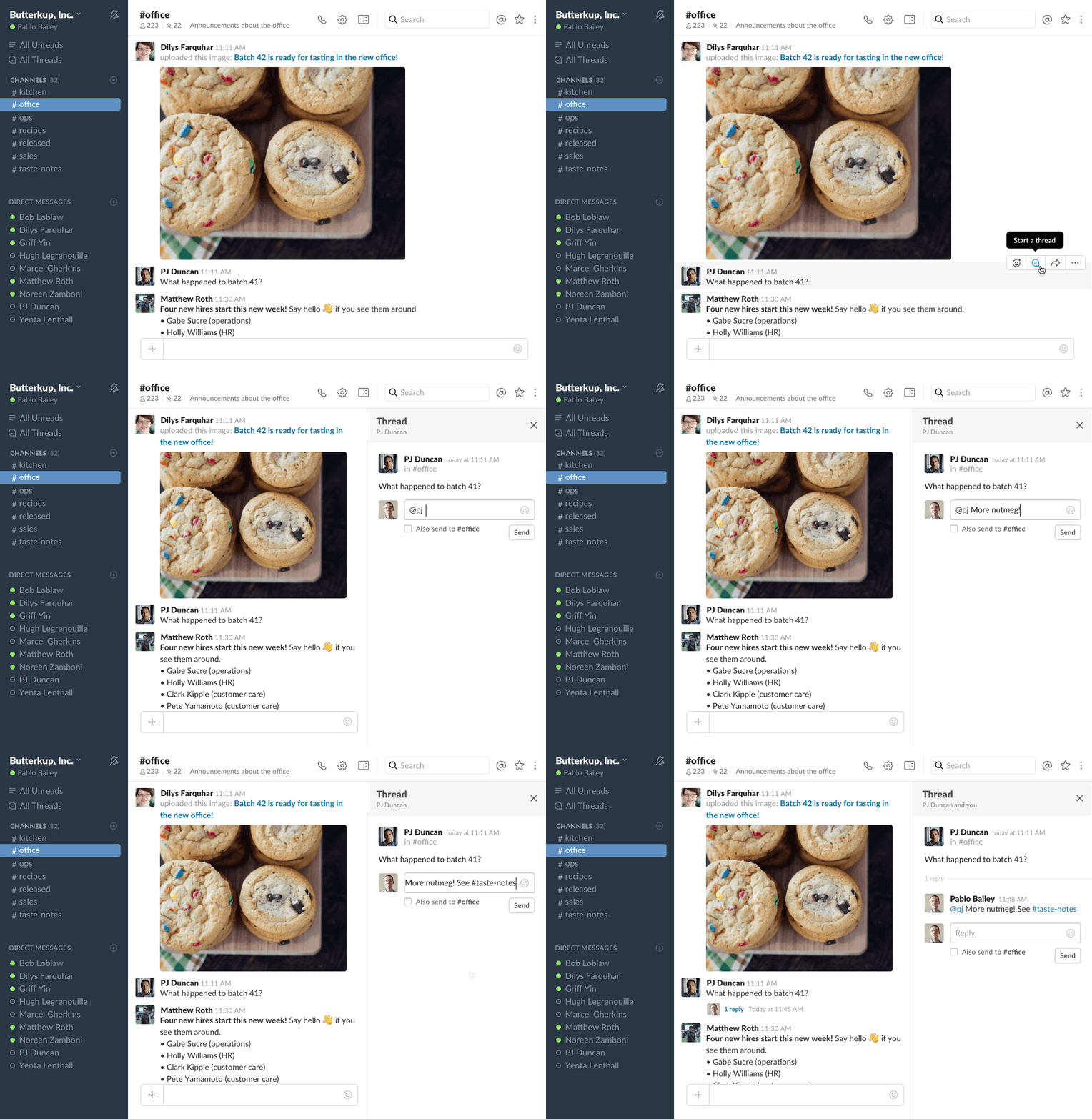
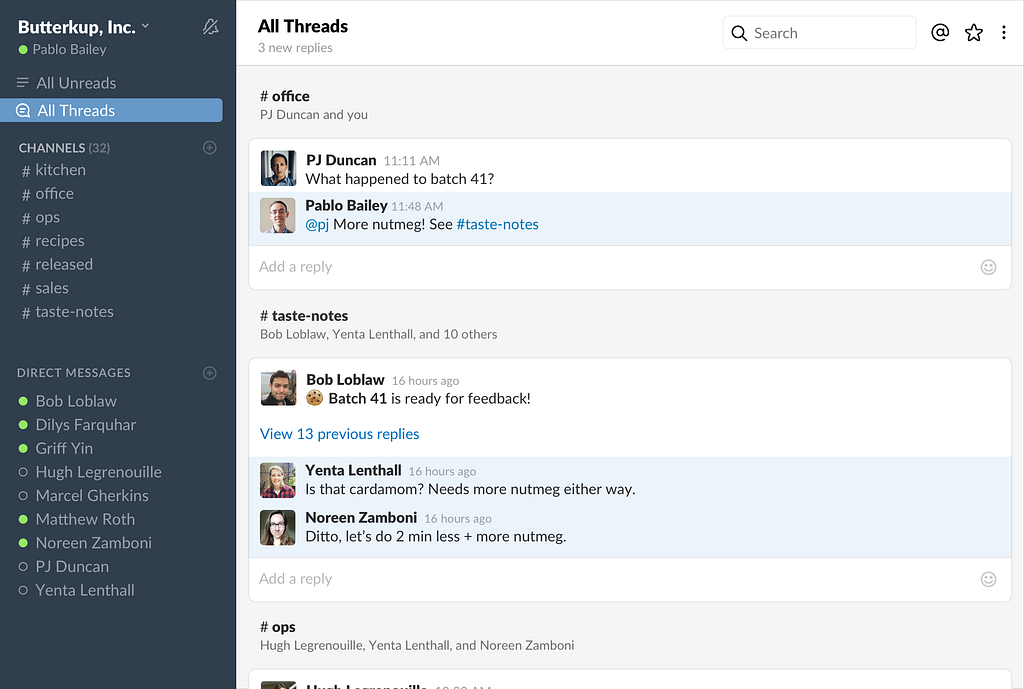
When you’re working with your team in Slack, discussions can move quickly and cover a lot of ground. They evolve — and branch off — as people share insights, ask questions, and introduce new topics (or resurface old ones), which may not involve everyone in a channel. Now with Threads, a new way to connect related messages, it’s easier to follow and manage the variety of conversations happening in Slack.

How Threads work

Starting a new thread

Say someone posts a message in Slack that you want to follow up on, but the deeper conversation doesn’t apply to everyone. Now, you can kick off a detailed discussion on that particular topic by hovering over the message and clicking Start a thread. The right sidebar in Slack will open, and you can add your reply.

Participating in ongoing threads

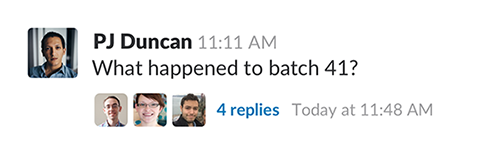
Messages with threaded replies will show thumbnails of discussion participants right in the channel, as well as the number of replies posted. Click through to view the threaded conversation in the right sidebar. You can chime in, add reactions, or simply select to follow along from there.

Looping people into conversations

Unlike a regular message posted in channel, replies to a thread won’t automatically mark the channel as unread or notify you, unless you’re directly mentioned. (The All Threads view in your sidebar will be highlighted, however, so you know there are new messages in one of your threads — see more on this below.) This way, you and a subset of your team can riff on ideas, triage problems, or clarify feedback in a focused space. Although they’re tucked away, threaded conversations are archived and searchable so anyone can access the information and context they need without joining every discussion.

Need to make sure a specific person sees your reply? Simply @-mention them as you normally would and they’ll be notified about the thread.

Posting replies from a thread in the channel

When decisions are made or a message in a thread is worth sharing back with the wider channel, you can post your reply alongside the original message in the channel. This will highlight the channel in the left sidebar and let members know that there’s a new message. Anyone can click on the update to open the thread and read through the discussion if they like.

Managing your threaded conversations

Since threads can happen in any channel, you might find yourself participating in more than one at a time. To help you keep track, all of your threads live in the new All Threads view, where you can read and reply to these conversations. Whenever someone replies to a message you wrote or responds to a thread you’re in, this view (located at the top of your channel list) will light up and appear bold.

When to use threads

Threads are particularly useful when you want to contain discussions around specific topics in one place. This includes asking (and answering) detailed questions, and posting updates to earlier messages. Some examples of the ways we’ve been using Threads across functions at Slack include:

  • When a press article or public announcement is posted in the #pr channel, any discussion takes place in a thread under that post.
  • When bugs are reported in our various #triage channels, team members use a threaded discussion to dig into the problem, and then report the fix back into the channel.
  • When an upcoming product launch is shared with the sales team in the #sales-announcements channel, people use a thread to ask and answer related questions and link to resources.

For more on how we designed Threads, head over to our Engineering blog. To learn how to develop your app with the Threads API, visit our Platform blog.

Threads are rolling out over the next few days and will be available on the latest versions of our desktop and mobile apps. Give them a try and send us a note or Tweet to let us know what you think. Learn more about Threads in our Help Center.


Threaded messaging comes to Slack was originally published in Several People Are Typing — The Official Slack Blog on Medium, where people are continuing the conversation by highlighting and responding to this story.

18 Jan 20:36

No More 'Beall's List'

files/images/bealls-list-logo.jpg


Carl Straumsheim, Inside Higher Ed, Jan 21, 2017


Beall's List, a collection of what the author called "predatory" journals, was suddenly  removed from the internet this week. The story broke on Twitter Sunday night and on  Debunking Denialism Monday. The site contained "thousands of journals and publishers that Beall alleged exploit open-access publishing for their own profit -- for example by spamming researchers with invitations to publish their findings or present at conferences, then pocketing publication or registration fees while providing little or no quality review." The emerging consensus is that the list was removed due to legal threats, but I have seen no formal confirmation of this. Beall was previously threatened  in 2013 and 2016. The list still exists on the Internet Archive; check here. You can also use thinkchecksubmit.org, "a cross-industry initiative led by representatives from ALPSP, DOAJ, INASP, ISSN, LIBER, OASPA, STM, UKSG, and individual publishers," to verify publications. More coverage:  Science Magazine, Ottawa Citizen.

[Link] [Comment]
18 Jan 20:35

Arbutus Greenway Consultation

by Ken Ohrn

The Arbutus Greenway is a 9-km long corridor, stretching across the city, with the opportunity to develop something magical out of a disused railway right-of-way. The next step is upon us, and another chance for us all to get involved.

arbutus-corridor

What should I be when I grow up?

The background is that the City of Vancouver wants to create a high-quality public space for walking, cycling and wheeling, with a streetcar line in the longer-term plan. Previous planning material is HERE (14-page PDF), including several reference designs from other places like Atlanta, Minneapolis and Chicago (with costs).

For those new to the idea, here’s a definition:  Transportation greenways are linear public corridors  for pedestrians and cyclists that connect parks, nature reserves, cultural features, historic sites, neighbourhoods  and retail areas.

You’ll get lots of chances to see what’s up, and to put your thoughts on the table.  Free hot chocolate, too.

Online survey HERE until Feb 15.

Open Houses

Pop-up Hot Chocolate Kiosk

  • Feb 1,  8:00am – 10:00am
    at Arbutus Street and Broadway Street by the Arbutus Greenway and eastbound B-line stop
  • Feb 1, 11:30am – 1:00pm
    at West 41st Avenue and West Boulevard