Shared posts

26 Jan 21:49

The Best Online Pharmacy. Buy Cialis Without Prescription – Orders-Cialis.info

by Emma

Why buy cialis on the internet is really beneficial for you?

So you’ve decided to order cialis and do not know where to start? We can give you some advice. First, ask your doctor for advice in order to properly determine the dosage, when you do that, you need to decide for yourself exactly where you will be buying the drug. You can buy cialis online, or you can just buy it at the pharmacy. Buy cialis online has a number of advantages, one of which is price. The cost of the Internet will always be lower than in stores, and when combined with the free shipping, it will be the best choice. Besides the price there are a number of advantages over conventional pharmacies, one of which is anonymity. Also, you can always check the online store on reliability, read reviews about it and the opinion of other buyers. Read more.

FacebookTwitterGoogle+Share

26 Jan 21:49

Apple iCloud Accounts Supported Again

by Dan Corbin

Apple made a change to iCloud that marked third party connections as “unsafe” and would block users swiftly after connecting their iCloud email to said applications. This affects services like Context.IO, as we rely on an open IMAP connection to a mailbox in order for our system to fetch email for Context.IO powered applications.

For these reasons, we had to stop supporting iCloud accounts on ContextIO. However, we now support such accounts, but only if users setup two-factor authentication and use an app-specific password for apps powered by Context.IO.

To do this, users will need to:

  1. Users set-up their account for two-factor authentication (unfortunately this could take up to three days due to Apple’s security policy)
    Apple iCloud two factor authentication and app specific password setting
  2. Once two-factor authentication has been enabled, the user should be able to create an app-specific password for your application.
  3. Have the user enter this app-specific password when connecting their mailbox to your app via ContextIO

Warning: If a user signs up to a Context.IO powered app without two-step verification and an app specific password, their account will be marked as locked by Apple for security reasons. The user would then need to unlock their account, but if the user remains signed up in a ContextIO powered app, they will just go back to getting locked again.

Apple iCloud accounts could be locked if they lack two factor authentication and app specific password

From a dev standpoint, you will likely see this error when trying to fetch messages for an iCloud user:

{

“type”: “error”,

“value”: “Error retrieving Message List. Retry later.”,

“reasons”: [

“Unable to connect to account due to credentials error”

]

}

Please note: This is not a Context.IO specific issue, this behavior happens to other applications that also connect to iCloud.
We would highly recommend adding some logic to your application that alerts users they must turn on two-step verification and use an app-specific password during user sign-up.

26 Jan 21:49

[NEW] [UNPROVEN] [TESTED]

by Richard Millington

Fake news isn’t a behavior problem, it’s a taxonomy problem.

The Onion has been serving up fake news for two decades without (much) complaint.

The problem is when fake news that pretends to be real news.

You can’t build relationships with a proven army of fact-checkers to distinguish what isn’t true. But that’s not the problem for you. Your problem isn’t disproving the negative, but highlighting the positive.

Build a set of categories that help members find the best stuff. Have 5 to 10 respected community members help. Build a set of categories. Begin simply with the following:

  • [NEW] – for genuinely new ideas in the community.
  • [UNPROVEN] – when there isn’t much evidence it succeeds yet.
  • [TESTED] – for when the idea has been tested by members and generally accepted.

Now members can quickly find the latest cutting edge ideas, see what’s tested and has worked, and what’s not proven yet – but might work. You can use more than one tag at a time.

Looking for the good is far more fun and useful than trying to remove the bad.

26 Jan 21:49

Why It's Sometimes Important for People to Attend a Council Meeting...

by Arjun Singh

We heard an application at today's council meeting for a resident to keep 3 dogs on their property. The limit is 2 but residents can apply to council for a variance to keep 3. Typically for these applications, the resident wanting the variance comes to council to verbally present their arguments as to why approval should be granted and to answer any questions council may have. This did not happen today. We did turn down the application. I am not saying we would have approved it if the applicant had appeared but, at least, it might have given the applicant more of a chance. I did a short Facebook live video on this soon after the council meeting:

https://www.facebook.com/bettercitizen/videos/10158035619560247/?l=6715786865035595522

26 Jan 21:48

Ben’s 2016

by Ben Moskowitz

Twenty sixteen: the year of Trump; the first swing of a wrecking ball that could demolish the liberal world order. It was also the year we discovered an Earth-like planet orbiting our nearest star. Might not be too early to start saving for the trip.

In January, I hosted a meeting on Video & the Commons, with the goals of 1) accelerating technical development on collaborative video editing systems and 2) creating more incentives for public media producers and universities to contribute open video to public interest projects like Wikipedia. You can read about it here.

In February, I headed to San Francisco to help articulate the foundational issues in Mozilla’s advocacy platform. Looking forward to seeing where the Internet Health Report goes from here.

From March through May, I departed for a teaching sabbatical at NYU Shanghai, the first American degree-granting university in China. Leaving personal electronics behind and brushing up on broken Mandarin, I had a fascinating experience seeing the 21st century through the eyes of my students—some international, some Chinese. My course was called “Unmanned Aerial Storytelling,” and covered the basics of consumer drone photography and producing short documentary films with drones.

While in China, I had the opportunity to travel to Shenzhen for the first time, where I chanced upon a half dozen DJI employees in an expat bar. DJI is the world’s leading consumer drone manufacturer, one of the first wave of innovative Chinese tech companies selling to an international market, and a major sponsor of the Drones & Aerial Robotics Conference I produced in 2013. The world is small. We discussed how DJI’s product development and marketing approach differs from some of its Western competitors, like 3DRobotics and Parrot.

It was clear then that DJI was eating 3DR’s lunch; to me there was something (microcosmic? ironic? symbolic?) in this. The most palpable sensation in today’s China is velocity. Here is a country that pulled a billion people out of poverty in a single generation. New hardware products can make their way from a whiteboard sketch to production to sidewalk seller in a matter of weeks. People of all ages are generally more optimistic than their counterparts in the West. Perhaps that’s because they have greater confidence that they and their children will be better off in their lifetimes. The rising populism in Western democracies suggests that many here feel the opposite. Either way, things like the Donald Trump “China” supercut were like catnip to my students.

Near the end of my short time in China, things got interesting for a foreigner in the NGO space. China passed an anti-foreign NGO law. On China’s first National Security Education Day, authorities distributed cute cartoons explaining that handsome foreigners might actually be spies. And the father of China’s Great Firewall was forced to use a VPN during a public lecture. Living in China at this time was a fascinating opportunity and offered some fresh perspective on how to think about global impact.

In May, some big and positive changes. Seeking a new challenge, I accepted a position at the International Rescue Committee as Director of Development for R&D and Innovation. IRC is an old and storied organization; founded at the request of none other than Einstein, it’s been responding to complex humanitarian crises for over 80 years. The cool thing about the modern IRC is how it thinks about innovation and the changing role of crisis response organizations. My mission at IRC is exactly where I want to be—at the intersection of fundraising and innovation—and it’s a serious privilege to contribute to refugees and forced migration at this moment. In a stroke of good timing, Camille was finally cleared for relocation and we moved to New York more permanently.

June was all about learning the ropes at IRC: a big culture change and transition. In July, I started writing grant proposals. My first niece was born to great fanfare in the Moskowitz clan. I built a home PC to experiment with VR and photogrammetry. I started to feel some dread about the prospect of a Trump presidency, playing witness to a dark and militant national convention, and—with a bunch of co-schemers—I began to germinate an idea for a next-gen media literacy program.

In August, we moved into a perfect new place at the intersection of Chinatown, Little Italy, and Soho. We took a short break to France to start clearing out our old place.

In September, I celebrated a birthday milestone, saw IRC in action for the first time in Seattle, and helped launch the Airbel Center at 92Y. I kicked off the first edition of my Hacking Political Rhetoric course at ITP, which put an open video spin on Neil Postman’s 1985 prophesies and facilitated the rebirth of Popcorn Maker.

In October, we closed the first major gift to support the Airbel Center, a $10m pledge to establish a five-year research and innovation partnership in NYC.

November was suddenly apocalyptic, with pantsuit nation obliterated at the Javits Center. The rest of the month was a genuine haze, with every waking morning a reminder that the unthinkable had come to pass. I retreated with loved ones into escapist back doors, binging on deep sea nature documentaries and utopian sci-fi. But the sun kept rising, and I took steps to restore sanity and a sense of agency. Subscribed to the print edition of the New York Times. Set up recurring auto-donations to ACLU. Tried to make out the way forward. I found unexpected solace in the story of Andy Grove, the late co-founder of Intel, a survivor of the Nazis and the Red Army, who was resettled in the United States by IRC in 1957. This man single-handedly shaped Silicon Valley, created vast prosperity, and laid the groundwork for all the benefits of the internet world—and he was a refugee. Somehow I feel we will be challenged to honor his legacy.

December, some semblance of resolve, through a hazy cloud of hot takes about fake news, post-truth politics, Russian election meddling, normalization, and the idea that Trump would hand the State Department to ExxonMobil, Labor to Carl’s Jr. and SBA to WWE. The real tragedy of this carnival-atop-the-swamp is that it was accompanied by more immediate signs of the apocalypse, like what was playing out in Aleppo.

I ended the year with family and loved ones, thankful again for our blessings and the privileged vantage from which we see the zeitgeist, and hoping for the best.

26 Jan 21:48

People are not Assets

by Stowe Boyd

Jack Altman starts a otherwise sensible post called How much does employee turnover really cost? repeating one of the most misused…

Continue reading on Work Futures »

26 Jan 21:48

Workout Wednesday Redux (2017 Week 3)

by hrbrmstr

I had started a “52 Vis” initiative back in 2016 to encourage folks to get practice making visualizations since that’s the only way to get better at virtually anything. Life got crazy, 52 Vis fell to the wayside and now there are more visible alternatives such as Makeover Monday and Workout Wednesday. They’re geared towards the “T” crowd (I’m not giving a closed source and locked-in-data product any more marketing than two links) but that doesn’t mean R, Python or other open-tool/open-data communities can’t join in for the ride and learning experience.

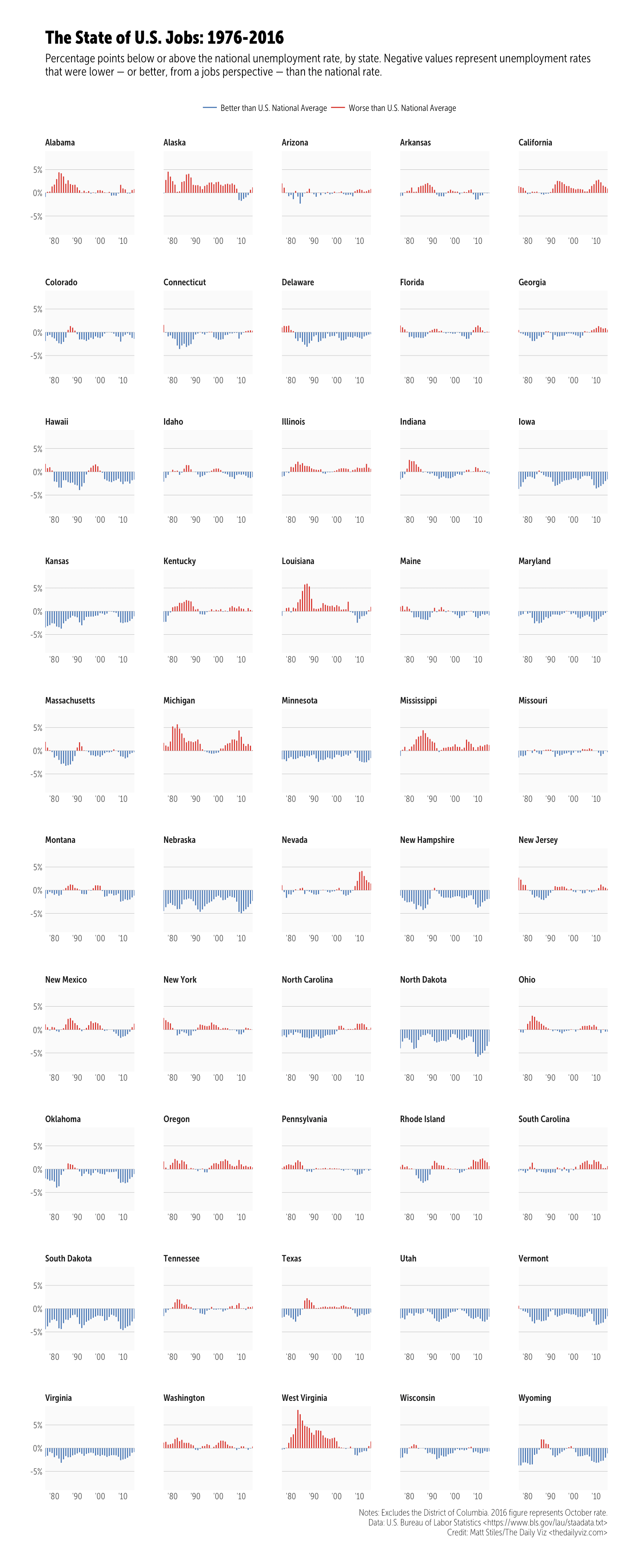
This week’s workout is a challenge to reproduce or improve upon a chart by Matt Stiles. You should go to both (give them the clicks and eyeballs they both deserve since they did great work). They both chose a line chart, but the whole point of these exercises is to try out new things to help you learn how to communicate better. I chose to use geom_segment() to make mini-column charts since that:

  • eliminates the giant rose-coloured rectangles that end up everywhere
  • helps show the differences a bit better (IMO), and
  • also helps highlight some of the states that have had more difficulties than others

Click/tap to “embiggen”. I kept the same dimensions that Andy did but unlike Matt’s creation this is a plain ol’ PNG as I didn’t want to deal with web fonts (I’m on a Museo Sans Condensed kick at the moment but don’t have it in my TypeKit config yet). I went with official annual unemployment numbers as they may be calculated/adjusted differently (I didn’t check, but I knew that data source existed, so I used it).

One reason I’m doing this is a quote on the Workout Wednesday post:

This will be a very tedious exercise. To provide some context, this took me 2-3 hours to create. Don’t get discouraged and don’t feel like you have to do it all in one sitting. Basically, try to make yours look identical to mine.

This took me 10 minutes to create in R:

#' ---
#' output:
#'  html_document:
#'    keep_md: true
#' ---
#+ message=FALSE
library(ggplot2)
library(hrbrmisc)
library(readxl)
library(tidyverse)

# Use official BLS annual unemployment data vs manually calculating the average
# Source: https://data.bls.gov/timeseries/LNU04000000?years_option=all_years&periods_option=specific_periods&periods=Annual+Data
read_excel("~/Data/annual.xlsx", skip=10) %>%
  mutate(Year=as.character(as.integer(Year)), Annual=Annual/100) -> annual_rate


# The data source Andy Kriebel curated for you/us: https://1drv.ms/x/s!AhZVJtXF2-tD1UVEK7gYn2vN5Hxn #ty Andy!
read_excel("~/Data/staadata.xlsx") %>%
  left_join(annual_rate) %>%
  filter(State != "District of Columbia") %>%
  mutate(
    year = as.Date(sprintf("%s-01-01", Year)),
    pct = (Unemployed / `Civilian Labor Force Population`),
    us_diff = -(Annual-pct),
    col = ifelse(us_diff<0,
               "Better than U.S. National Average",
               "Worse than U.S. National Average")
  ) -> df

credits <- "Notes: Excludes the District of Columbia. 2016 figure represents October rate.\nData: U.S. Bureau of Labor Statistics <https://www.bls.gov/lau/staadata.txt>\nCredit: Matt Stiles/The Daily Viz <thedailyviz.com>"

#+ state_of_us, fig.height=21.5, fig.width=8.75, fig.retina=2
ggplot(df, aes(year, us_diff, group=State)) +
  geom_segment(aes(xend=year, yend=0, color=col), size=0.5) +
  scale_x_date(expand=c(0,0), date_labels="'%y") +
  scale_y_continuous(expand=c(0,0), label=scales::percent, limit=c(-0.09, 0.09)) +
  scale_color_manual(name=NULL, expand=c(0,0),
                     values=c(`Better than U.S. National Average`="#4575b4",
                              `Worse than U.S. National Average`="#d73027")) +
  facet_wrap(~State, ncol=5, scales="free_x") +
  labs(x=NULL, y=NULL, title="The State of U.S. Jobs: 1976-2016",
       subtitle="Percentage points below or above the national unemployment rate, by state. Negative values represent unemployment rates\nthat were lower — or better, from a jobs perspective — than the national rate.",
       caption=credits) +
  theme_hrbrmstr_msc(grid="Y", strip_text_size=9) +
  theme(panel.background=element_rect(color="#00000000", fill="#f0f0f055")) +
  theme(panel.spacing=unit(0.5, "lines")) +
  theme(plot.subtitle=element_text(family="MuseoSansCond-300")) +
  theme(legend.position="top")

Swap out ~/Data for where you stored the files.

The “weird” looking comments enable me to spin the script and is pretty much just the inverse markup for knitr R Markdown documents. As the comments say, you should really thank Andy for curating the BLS data for you/us.

If I really didn’t pine over aesthetics it would have taken me 5 minutes (most of that was waiting for re-rendering). Formatting the blog post took much longer. Plus, I can update the data source and re-run this in the future without clicking anything. This re-emphasizes a caution I tell my students: beware of dragon droppings (“drag-and-drop data science/visualization tools”).

Hopefully you presently follow or will start following Workout Wednesday and Makeover Monday and dedicate some time to hone your skills with those visualization katas.

26 Jan 21:48

Early learning is making a difference for children from ethnic minority communities

files/images/cambodia_classroom.jpeg


Sam Waller, Medium, Jan 21, 2017


This article summarizes  two  reports from UNICEF on pre-school programs in rural Cambodia. The emphasis is on both early childhood education and on multilingual education, both of which are important for a student's future success. Pre-school teacher Chey Nita... has seen firsthand the difference that can be made through multilingual education in pre-schools. She has also seen the impact that early education, both for her students and her family." What strikes me looking at this is the complete absence of technology in the school - even the whiteboard is too small, there are no chairs, and of course there's no sign of electricity at all. More information on Cambodia can be found on the UNICEF country page.

[Link] [Comment]
26 Jan 21:48

The State of the MOOC: What Associations Should Know

files/images/0117_learning-800x480.jpg


Ernie Smith, Associations Now, Jan 21, 2017


This is a routine report on MOOCs with a focus on associations, but note the zinge rat the end: "Education outside of the university system could gain momentum through MOOCs, especially with the growth of certifications. That’ s good for associations, which tend to offer a lot in the way of education." We are rapidly approaching the day when universities have competition for certification, which will mean that they (like the New York Times) will have to rely on the quality of their offering. One wonders whether they are up to that.

[Link] [Comment]
26 Jan 21:48

AirPods: Ushering in a Wireless Future

by Ryan Christoffel

AirPods were announced at Apple's September keynote, accompanied by a video introduction in which Jony Ive proclaimed: "We believe in a wireless future, a future where all of your devices intuitively connect." In other words, a future that goes beyond getting wires out of the way by creating experiences that are only possible with smarter inter-device connections.

AirPods entered the world on the heels of a controversial decision to remove the standard headphone jack from the iPhone. Connecting wired headphones to an audio source is a decades-old practice we've all grown used to, and while this type of connection is still possible on the iPhone via a Lightning connector, AirPods represent Apple's efforts to move forward into a wireless future.

Though wired headphones are dead simple to use, no one can deny that they do get in the way in a material sense. We've all experienced the frustration of cords that tangle, tug, and keep us tethered to our devices. Even the most passionate wire-supporters among us are familiar with these challenges. Wireless AirPods were designed to make such issues ancient history, while simultaneously mitigating the negative trade-offs that are typically associated with Bluetooth headphones.

Technology is at its best when its net gains make you forget about any net losses. Traditional Bluetooth headphones have done a relatively poor job at this, plagued by poor battery life, unstable connections, and often, high cost. So Apple's challenge with AirPods was to achieve what its competition had not: create a device whose benefits over wired earbuds greatly outweighed its drawbacks.

After nearly a month with AirPods under my belt, I believe the company succeeded.

Case and Setup

When I first opened the AirPods' box, I was immediately surprised to find that the case was larger than I'd expected. Likely this is only because my expectations had been shaped by others' comments that the case was smaller than they'd expected. It still fits comfortably in my pocket as I'd hoped, but it is bigger than I imagined. One other early disappointment about the case was that it can't stand upright on its own. In the long run this likely won't bother me, but if it does, I'll use the Hackett solution.

Initial disappointments aside, the AirPods' case is still a neat little product. Besides simply looking beautiful, it's the small touches that make it unique. Magnets are employed in a delight-infusing way, both for closing the case and securing each AirPod in place. A small metal strip on the back makes it easy to identify the front of the case from the back. The battery charge indicator inside the case is useful as well. Overall, the AirPods' case, and the AirPods themselves, very much follow the design aesthetic of the Apple Pencil – glossy white with touches of metal, and a clever use of magnets. Now if only Apple's team could find a way to keep that glossy white finish from being such a lint magnet.

Pairing AirPods was as easy as in Apple's initial demonstration. I opened the case, and with one tap of the Connect button on my iPhone, they were paired – not just with my iPhone, but with my Apple Watch and iPad too.1 The pairing process is a perfect demonstration of Steve Jobs' old mantra: "It just works."

Pairing AirPods is dead simple.

Pairing AirPods is dead simple.

I was never too concerned about the possibility of AirPods not fitting in my ears because Apple's wired EarPods fit just fine, but it was good to confirm that my assumption held true. They not only feel comfortable, but also seem substantially more snug than wired EarPods; I've never had one of them fall out. I did, however, learn the importance of taking care not to hook the AirPods' stems when changing shirts. I don't consider this a problem though; I'd given up on trying to change with wires hanging from my ears, and AirPods allow me to do something I couldn't before.

Tether-Free

The example of changing clothes highlights one of my main takeaways from several weeks using AirPods: they free me up to go about my normal life in ways that I couldn't before. I've gotten in the habit of changing clothes and brushing my teeth with AirPods in, and doing chores around the house listening to podcasts while my iPhone stays on the office desk. I've even taken the trash out back while my iPhone remained indoors. The connection cut out for a brief second, but then resumed right away as I started walking back toward the house. Overall, I've quickly grown to use AirPods in more situations and places than I would have ever used wired earbuds. While some of these benefits are shared by any set of Bluetooth headphones, the AirPods' strength of connection and range is unique to Apple-owned headphones thanks to the W1 chip.

Apple's W1 chip contains what the company calls its "secret sauce" layered on top of a traditional Bluetooth connection. It represents the next step in letting users untether from an iPhone. Though in most cases you'll probably have your iPhone on you, the AirPods' W1 chip provides you freedom to leave the phone off your person when walking short distances away – a freedom I've enjoyed each day.

AirPods and Apple Watch make a perfect pair.

AirPods and Apple Watch make a perfect pair.

For those occasions when you do want to completely disconnect from your iPhone, coupling AirPods with an Apple Watch is the way to go. AirPods connected to a Watch can be used to play music, and in the future I have no doubt we'll see Apple's Podcasts app move to the Watch as well, enabling podcast listening sans iPhone. Unfortunately, Siri can't currently be invoked via AirPods when only an Apple Watch is present, but it can still be activated using the Watch.2

Taken as a pair, Apple's wearables make the strongest case yet for a post-smartphone future.

Siri

Siri is accessible by double tapping on one of the AirPods.3 Likely you'll find the gesture a bit uncomfortable. I find myself caught in a minor dilemma every time I want to invoke Siri via AirPods – do I tap lightly and risk Siri not activating, or do I tap harder and feel a little discomfort? Maybe my ears are just sensitive, but it's hard to imagine no one at Apple recognized this as an issue.

Aside from the clever play/pause gesture I'll detail later, Siri is the only built-in interface for controlling AirPods. You can use a separate device to control them – Apple Watch is my favorite method – but Siri is the only option otherwise. This decision makes a lot of sense, as there really isn't room for physical controls on the AirPods themselves. If Apple simply made AirPods bigger so they could fit controls, I likely wouldn't be as impressed by the product. Their size allows easily carrying them around in a pocketable case; I wouldn't want to lose that.

Siri in AirPods is mostly the same old Siri in function; the experience is where it differs. Siri in your ear feels different than Siri in your pocket or on your wrist. It feels more intimate, ever-present. It also seems to work better thanks to beam-forming microphones built into AirPods which help improve Siri's accuracy.

The discomfort of a double-tap gesture aside, AirPods are my new favorite way to interact with Apple's digital assistant. They provide a glimpse into the benefits of an AI-dominated future.

While Siri succeeds in many ways, there is one major change I'd like to see in the future: improvements to the way Siri handles successive queries. When Apple added "Hey Siri" activation as a feature of the iPhone 6s, it helped make interactions with Siri feel more natural. That is, unless you had to ask follow-up questions. "Hey Siri" breaks down as an imitation of human interaction when you have to say it over and over again in succession. People don't say "Hey person" to start every sentence in a conversation.

Unnatural as it is to repeat an activation phrase, I've found that repeatedly double tapping an AirPod is no better. If anything I've found it more disappointing; not because the method of activation is worse, but because the potential for Siri in AirPods isn't being realized. As I said, Siri in your ear feels more intimate and personal. But that promise of more human-like interactions is frustrated by the need for repeated double taps.

A more natural conversation could take place if Apple made a simple change: keep Siri listening for ten seconds after it answers each query. I wouldn't want to hear the Siri chime again, but just keeping it actively listening for that short time would cut out nearly all needs for repeated double taps. Whether this adjustment would be well-suited for Siri's other platforms, I'm not so sure. But for AirPods that stay in your ears and are uniquely equipped to pick up your voice alone, this change could make a world of difference.

Something I'm sure Apple is working on already is adding new domains of knowledge to Siri, which will increase its usefulness in AirPods. At WWDC last June, SiriKit introduced the opportunity for developers to use Siri in their own apps, provided the functionality fit within certain domains. There is plenty more work to be done in this area, though. Personally, this past year I've begun listening to a lot more podcasts than ever before. My current app of choice is Castro, but using Siri with AirPods made me briefly experiment with Apple's podcast client again. The experiment didn't last more than a couple days due to some features I missed, but the ability to start new episodes entirely by voice was great; passing this feature along to third-party clients is at the top of my SiriKit wish list.

Experience

The W1 chip and Siri-first interface are two standout features of AirPods, but it's a separate technology that makes the AirPods' play/pause gesture possible. Infrared sensors built in to the AirPods know when an AirPod has been placed in or removed from your ear, so removing an AirPod pauses playback, while putting it back in resumes playback. This gesture is quintessential Apple – it feels so natural and obvious, I'm now amazed that every pair of earbuds doesn't work the same way.

The amount of tech packed into each AirPod is impressive, but it is ultimately the experiences made possible by that tech which make AirPods so special. I've mentioned the freedom of leaving your iPhone behind while walking around at home or work; here are a few more good experiences I've had because of AirPods.

Phone

AirPods have quickly become my favorite way to talk on the phone. One evening I was listening to Audible when the audio paused. I checked my Apple Watch, saw that my wife was calling, and answered from the Watch, which fed audio to my AirPods.4 My wife said she was coming home from work, and I knew we would need to quickly head out together once she got home. I was able to get changed and ready for our night out all while keeping a conversation going on the phone. I know this hands-free approach isn't unique to AirPods, but it is easier than ever because of them.

I've taken a number of calls using AirPods, and no one has ever remarked that they had trouble hearing me, or gave any other indication that they noticed a difference. I've enjoyed using AirPods for phone calls so much that even if I'm not wearing them already when I get a call, I'll answer on my iPhone, then stick an AirPod in one ear and continue the conversation that way. Audio instantly routes to the AirPod, and my hands are free.

Work

During an average weekday, I'll be at work on my iPad while listening to podcasts or music on my iPhone using AirPods. When I come across a video I want to watch on the iPad, I simply take one AirPod out of my ear, pausing playback on my iPhone, and enjoy the video through the iPad Pro's great speakers. Alternately, if I'm in an environment where speakers aren't an option, I pull up Control Center on the iPad and select my AirPods as the source for routing audio. Without delving into Bluetooth settings at all, I can then watch the video while listening through AirPods. When the video's finished, Control Center on my iPhone makes AirPods the playback source again. There is a momentary delay when switching devices this way, but it's light years ahead of the mess that is switching devices using other Bluetooth headphones.

Gym

I go to the gym four days a week at the end of my workday, and AirPods make that entire part of the day better. Once I've finished working, I pop in the AirPods and begin listening to something as I change into my workout clothes. After I'm out the door, I keep the AirPods in on the drive, but my car automatically routes audio to its speakers through Bluetooth. So I can keep my AirPods in, but without being distracted from anything that may need my attention in the outside world.

When I get to the gym and stop the car, I hit play in the Now Playing screen of my Apple Watch to resume playback through AirPods. I've placed Now Playing and the Workouts app side-by-side in my Dock so I can easily switch between them. Once I'm in the middle of a workout, Now Playing makes adjusting volume or skipping forward easy without the awkwardness of using Siri in public. And wire-free workouts are better in every way – no untangling before listening and no accidental tugs while jogging. If I see a friend, I can quickly pop an AirPod out and have a quick conversation; no need for fumbling with playback controls. When I head back home, I leave my AirPods in my ears and get some chores done around the house before showering. The shower is the only place I have to take them out.5

Audio and Battery

You may have noticed that I've gotten near the end of my review without answering one of the most important questions about a pair of headphones: "How is the sound quality?"

Before answering that, I'll join the ranks of nearly every other reviewer of AirPods in saying that I'm not a so-called "audiophile." But disclaimer aside, the AirPods sound good. Certainly as good as Apple's wired EarPods, but I think actually better. Podcasts unsurprisingly sound fine, but I was especially impressed the first time I used AirPods to listen to music. Bass sounds better than I expected, and overall I have nothing negative to report.

Similar to the audio quality, I've found AirPods' battery life to be fine – better than expected even. That's not to say I'm a battery expert or that I've conducted scientific tests, but in my normal daily use the AirPods have never died on me and I haven't had any semblance of battery anxiety. I use my AirPods when I want to use them, and when I'm not using them I stick them in their case. Whenever it feels like it's been a while since I charged the case, I plug it into one of the several Lightning connectors at my desk. I'm sure at some point in the future I'll run into a scenario where I wish battery life was longer, but I haven't had that problem yet.

Entering a Wireless Future Today

All technology, no matter how beneficial it may be, comes with compromises. Particularly with devices as small as AirPods, every design decision is a series of trade-offs – balancing thinness and lightness versus adding more battery or other features. How important are physical playback controls? Which features make the cut, and which aren't feasible without compromising on size? Not every choice will suit the needs of every user.

AirPods are not without some kinks to work out. As I mentioned, it would be great if I could activate Siri with less forceful taps. A volume up/down gesture by sliding up or down on an AirPod would be nice.6 Occasionally, I've had issues with audio in one AirPod cutting out for a split second, then quickly fixing itself. It hasn't happened often enough to bug me, but that's something that could be improved. Separate, configurable double-tap gestures for each AirPod would be useful too.

Despite these areas that are ripe for improvement, AirPods are about as good a 1.0 device as anyone could ask for. They accomplish Apple's goal of ushering in a wireless future in a variety of ways.

Removing wires altogether should be a given when discussing wireless devices, yet many other so-called "wireless" earbuds aren't truly free from wires. AirPods are wireless in every sense of the word, and come with a compact charging case to reduce any worry of losing them. They're exactly the kind of product I want to have.

Intuitive connection is another trait of AirPods that lifts them above their competition. It's not just the easy pairing process, it's how AirPods connect to your devices in a way that enables new experiences. Your iPhone or iPad can be across the house, yet Siri can be invoked directly from your ear to create a Reminder, send an iMessage, or check your calendar. Playback of music or podcasts can continue issue-free despite being away from a source device. Phone calls can be answered without searching for your phone. You can even go for a stroll around the neighborhood with nothing but your AirPods and Apple Watch. These connections are only possible in a wireless world.

Apple's first wearable, the Apple Watch, was created in part because the iPhone, amazing as it is, was getting in the way of our lives.7 The Watch represented an effort to get technology out of the way, while at the same time bringing it physically closer to us than ever before, as a device we wear. Apple's second major product in the wearables category, AirPods, follows in the Watch's steps.

Apple has created a device that allows greater connection with other Apple devices while simultaneously granting greater freedom from them. The end result: AirPods represent what many people love most about Apple. They make possible an assortment of delightful experiences you just couldn't have any other way.


  1. I don't use a Mac anymore, and unfortunately the Apple TV isn't currently included in the list of devices that AirPods instantly pair with. They can be paired through a standard Bluetooth pairing process though. ↩︎
  2. When AirPods are connected to nothing but an Apple Watch, rather than activating Siri, an AirPod double tap acts as a play/pause option instead. ↩︎
  3. Optionally, you can change the double-tap gesture to serve as a play/pause function rather than activating Siri. ↩︎
  4. I could have also answered the call with a double tap of an AirPod. ↩︎
  5. Here's to waterproofing in version 2. ↩︎
  6. Though this isn't as necessary for me as an Apple Watch user. ↩︎
  7. From the linked Wired article: "We’re so connected, kind of ever-presently, with technology now," [Apple's Kevin] Lynch says. "People are carrying their phones with them and looking at the screen so much...People want that level of engagement," Lynch says. "But how do we provide it in a way that’s a little more human, a little more in the moment when you’re with somebody?" ↩︎

Support MacStories Directly

Club MacStories offers exclusive access to extra MacStories content, delivered every week; it’s also a way to support us directly.

Club MacStories will help you discover the best apps for your devices and get the most out of your iPhone, iPad, and Mac. Plus, it’s made in Italy.

Join Now
26 Jan 21:48

How to make Microsoft Word look like iA Writer

by Volker Weber

WordWriter

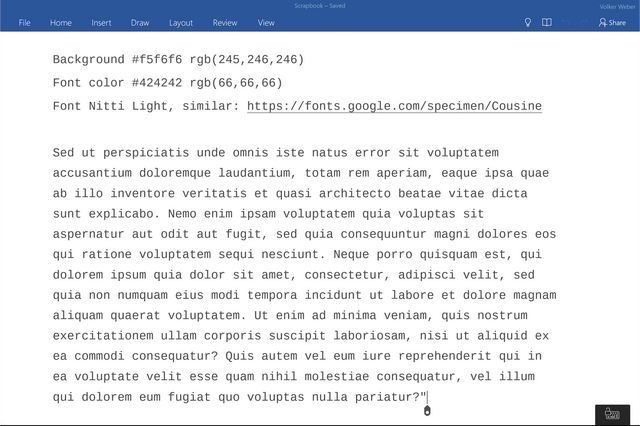
Sadly there is no iA Writer for Windows. So I have to fake it.

One of the reasons iA Writer is so good for authoring text is great readability. You are able to see your typos because every character is very distinct. But Nitti, the font that iA Writer uses, also make it very easy to read quickly. It's not as rough as something like Courier. I referred to this five your old post to first find the font, and then a free font that looks remarkably similar.

If you set your document in Cousine 11 on A4, 1.5 line spacing and reduce the contrast by setting the font color to 75% black, you have a similar visual experience to iA Writer. It's not as simple to use but I can live with it.

26 Jan 21:48

The Recursive Spiral

by Bryan Mathers
teach learn assess

…following a conversation with writer Ruth Culham about the relationship between formative assessment and instructional decisions— and the learning that takes place during the process.

The post The Recursive Spiral appeared first on Visual Thinkery.

26 Jan 21:48

Fabric Acquired by Google

by John Voorhees

Fabric, a suite of developer tools owned by Twitter, is being acquired by Google and will become part of Google's Developer Product Group, working with Google’s Firebase team. According to Francis Ma, Firebase Product Manager:

As a popular, trusted tool over many years, we expect that Crashlytics will become the main crash reporting offering for Firebase and will augment the work that we have already done in this area. While Fabric was built on the foundation of Crashlytics, the Fabric team leveraged its success to launch a broad set of important tools, including Answers and Fastlane. We'll share further details in the coming weeks after we close the deal, as we work closely together with the Fabric team to determine the most efficient ways to further combine our strengths.

It appears that Google is clearly interested in Crashlytics, Fabric’s crash reporting tool, but has left open the extent to which the other components of Fabric will be incorporated into the Firebase toolset.


Support MacStories Directly

Club MacStories offers exclusive access to extra MacStories content, delivered every week; it’s also a way to support us directly.

Club MacStories will help you discover the best apps for your devices and get the most out of your iPhone, iPad, and Mac. Plus, it’s made in Italy.

Join Now
26 Jan 21:47

Twitter Favorites: [MobyDickatSea] But if I know not even the tail of this whale, how understand his head?

Moby Dick @MobyDickatSea
But if I know not even the tail of this whale, how understand his head?
26 Jan 21:47

Recommended on Medium: Help me I’m on Tinder: I tried to build an army to conquer Vegeta

I’m a little bit conflicted about listing my interests in my Tinder profile. As we’ve seen, so much as saying what my job is has lead to an onslaught of questions I get tired of answering, and strange behaviour surrounding the more nerdy interests of mine.

But last night, a miracle happened. Honestly, it’s probably the best thing that has ever come out of Tinder for me.

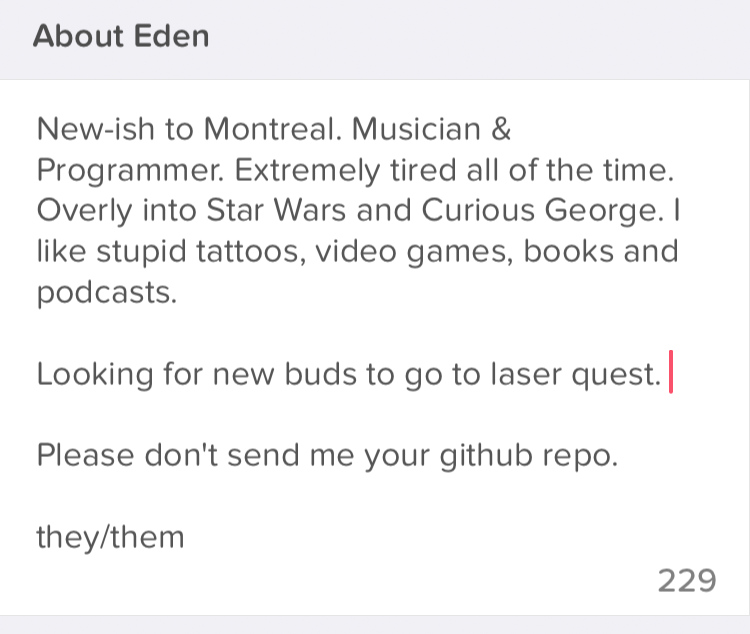
I suppose it’s best to start by showing you my Tinder bio:

do not ask me how many people have asked if i’ve really been sent github repos.

Every interest listed in a Tinder bio becomes a talking point. I’ve been asked by at least 10 different people what I thought about Rogue One. Sometimes, we’ll get into a conversation about one of these topics, and that might turn into deciding to go on a date and maybe smooch. A lot of the time men like to challenge my knowledge about Star Wars or video games — which is really annoying.

This time; however, something perfect happened.

The concept of a man in his late 30s or early 40s who goes to Laser Quest enough to memorize the course seemed so surreal to me that I quickly found myself googling to find evidence. And I did.

The Iron Man Mission is a 30 minute game, whereas a normal game is 15 minutes. You move around a lot in Laser Quest (which is part of the reason I like it!), and so 30 minutes can be kind of exhausting. But, according to Laser Quest Montreal’s Facebook page, this man won 3 regular rounds AND 3 Iron Man Missions. This man, he is a legend.

His name, Vegeta, is a reference to a Dragon Ball Z character. In the photos I found, he does in fact play in a Dragon Ball Z shirt made to look like Vegeta’s uniform.

no running or flying allowed in laser quest, Vegeta.

I haven’t watched Dragon Ball Z since I was a kid, and even then it was in passing, but in case you aren’t familiar: Vegeta is a Saiyan soldier whose dad is the king of Planet Vegeta and who is best known for being shorter than Goku, another Saiyan. He is the only one who wears traditional Saiyan armor, and from what I remember he’s kind of a jerk. His hair is black but when he goes “Super Saiyan” it turns yellow for some reason. Honestly, I’m not going to pretend I understand Dragon Ball Z at all. I feel like I have to rewatch it now, though.

This is Vegeta and his taller friend, Goku.

I want to defeat Vegeta. I want to defeat him in as many rounds of Laser Quest that I can possibly handle.

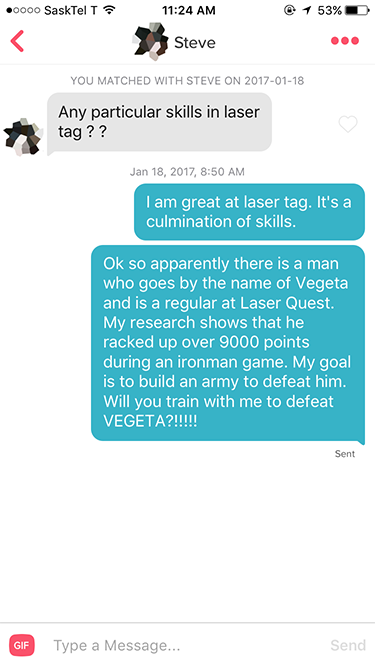
So, I decided I needed to recruit others to help me in this mission.

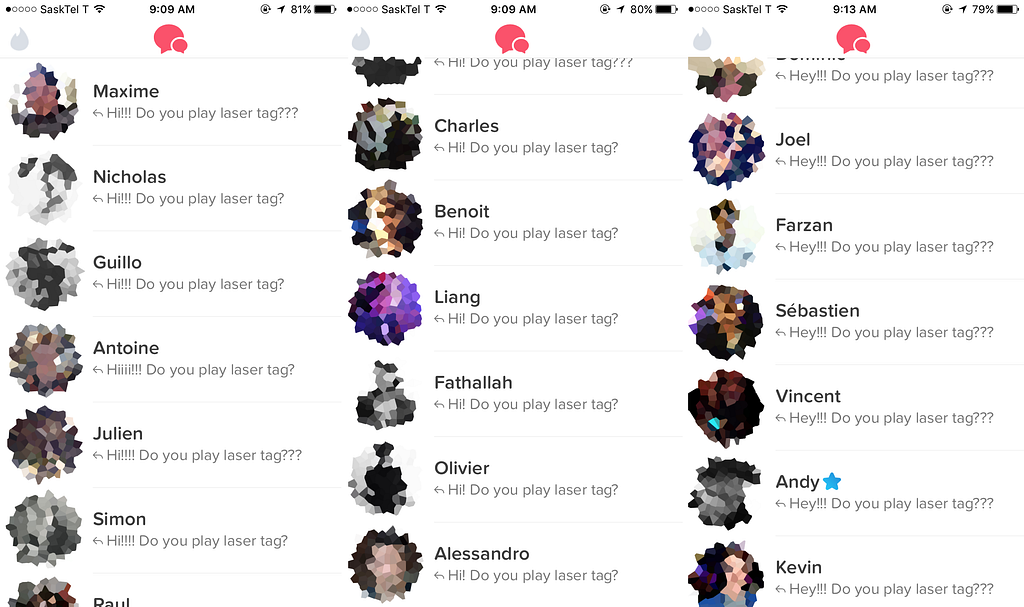
At first, I started explaining the Vegeta situation to the Tinder matches that had already asked me about Laser Quest.

This didn’t work out so well. Most people didn’t take me seriously. I received a lot of patronizing emojis and empty promises. None of my Tinder matches were as passionate about defeating Vegeta as I was. Certainly, no one understood the weight of the battle at hand — nor were they prepared for it. I was baffled.

cloudsofdisappointment.png

I decided I needed to cast a wider net. So, I went through all of the people that I matched with and hadn’t started conversations with, and asked if they played laser tag. All of them.

This also mostly worked to my disadvantage. Many people AREN’T EVEN PLAYING laser tag. Nevermind, being good at it. Also, many men are gross!

i hate this emoji so much now

It appears that the men of Tinder simply aren’t as interested in defeating Vegeta as I am. Luckily, I’ve had a few friends reach out to me on Twitter saying that they would help me out. Vegeta will be defeated, but truly Tinder has disappointed me yet again.

To see all of my posts on Tinder, find the list here:

Help me I’m on Tinder

20 Jan 19:47

How fast is Freedom Mobile’s LTE network in Toronto?

by Rose Behar

When Wind Mobile launched its LTE network in November 2016, it did so with a bang. Alongside the new mobile network, which would finally allow it to compete in a more meaningful way with the Canada’s Big Three carriers (Bell, Telus and Rogers), it also gained a large-scale marketing campaign, fuzzy mascot and a new name: Freedom.

The only thing it lacked, at least at first, was the network.

Three weeks after its announced launch, users were unable to connect to LTE speeds in downtown Vancouver and Toronto. The company explained that a few optimizations were needed before the network could truly go live, but it didn’t help much when it came to customer satisfaction. Many customers also didn’t care for the fact that they had to switch to a specific $45 6GB LTE plan to use the network, or that, at the outset, there was only one device that supported the network’s new band. In short, the launch became somewhat shrouded in confusion and frustration.

“We think that based on testing our competitors and ourselves we’re the same or better than their typical speeds”

But when it comes to Canadian telecoms, the back story is always a little more complicated than it seems. Freedom Mobile’s choice of a new and obscure LTE band wasn’t random — the carrier purchased it because its options were limited. As of 2015, the Big Three had secured most of the 4G LTE spectrum in Canada, either through auctions or acquisitions. The auction held in March of that year gave Freedom (then Wind) a chance at purchasing LTE spectrum — albeit of the brand new AWS-3 variety. This meant there was still much work to be done to bring LTE Band 66 up and running once the company officially secured the spectrum in Southern Ontario, Alberta and British Columbia.

Compatible devices had to be sourced — the LG V20 and ZTE Grand X 4 are currently the only devices in Canada that support Band 66, though ZTE’s Hawkeye adds another compatible device to the pipeline — and the network had to be built out. Brian O’Shaughnessy, Freedom’s executive vice-president of technology services, says the process was a “logistical nightmare.”

“There’s no invention involved, it’s all work,” O’Shaughnessy stated in an exclusive interview with MobileSyrup, explaining that the lengthy process involves preparing rooftops and towers, installing the radios and optimizing them for minimal interference. He notes, however, that while the work has been intensive, “it’s gone incredibly well.”

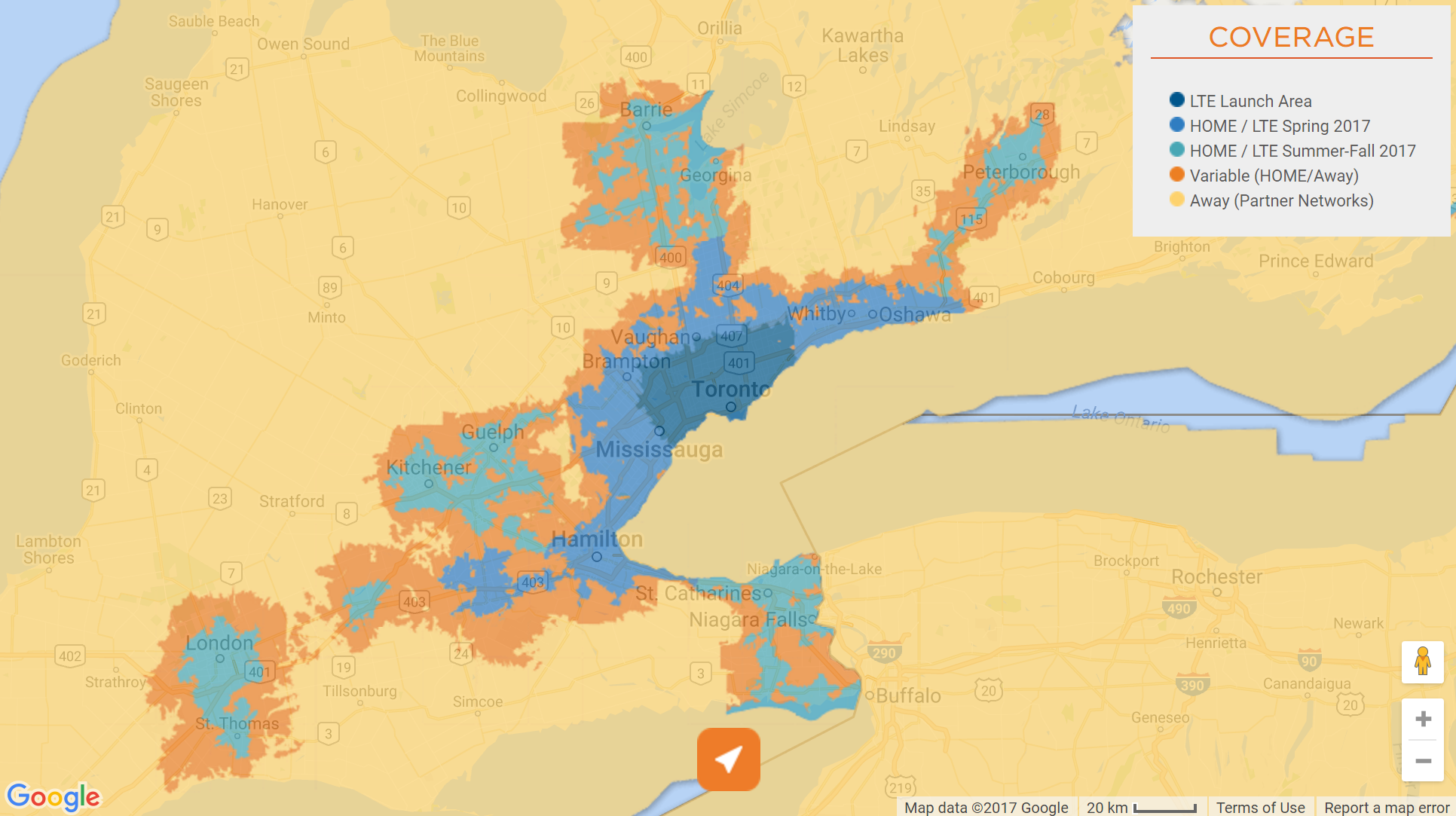
In total, the infrastructure project carries a price tag of approximately $250 million, per a joint announcement made with Nokia last year. Freedom expects to have the Greater Toronto Area fully deployed by spring 2017, all of its western footprint complete by the summer and the rest of country by fall — though O’Shaughnessy says the company will attempt to go achieve these goals at a faster pace.

So far, Freedom hasn’t revealed just how many people are on its “traffic-free” network, but it is adamant the speeds are competitive with the Big Three.

“We think that based on testing our competitors and ourselves we’re the same or better than their typical speeds,” said O’Shaughnessy, adding that beyond speed, stability is an important feature of its new network.

“I mean, you can always find a place and a time where they’re going to be better. They have more spectrum than we do so naturally they can get a higher peak speed. But I kind of liken it to the 401 [highway]. At 3 o’clock in the morning, you could drive 200 kilometres per hour if the police didn’t catch you, but you’re not going to do that during rush hour. What most people are getting throughout the entire day, for us it’s the same all day long, 24 hours a day.”

O’Shaughnessy adds that he believes it will be “at least a couple years” before customers have to worry about congestion issues on the carrier’s network, stating that the company will “find ways of getting around that” when the time eventually does come.

He’s optimistic about device support for AWS-3, too, citing the fact that heavyweight U.S. players Verizon and AT&T purchased large amounts of the spectrum and will soon make support a mandatory requirement for manufacturers.

“I’d say every quarter you’re going to see new phones introduced and by mid, second half of the year, almost every phone will be able to work on our network.”

Along with a wider diversity of devices due to arrive soon, O’Shaughnessy notes customers can expect to see more LTE plans coming out as 2017 progresses. He says the choice to offer a single LTE plan was based on a desire for simplicity.

“We made it very simple at the start just saying, ‘here’s the two phones, here’s the plan to work with it.’ We put a lot of value into it making it 6GB of data so we thought that was a good launch plan to start with. Over time, I would see more and more plans having it.”

From a technical perspective, however, O’Shaughnessy says he’d love to see all Freedom customers on LTE plans.

“I’d be ecstatic if every customer would move over… because it does two things. One, they’ll find it’s a fantastic experience, whether it be speed or latency. Our latency on our network is I think the best in the country… And as soon as those customers move over, their traffic moves with them. So, things only get better on the 3G network in areas where we do have some congestion now.”

To ascertain just how fast and responsive the network is, MobileSyrup obtained an LG V20 and ZTE Grand X 4 with Freedom Mobile SIMs, courtesy of the carrier, and performed speed tests across various points in the Greater Toronto Area, simultaneously testing the network speeds for Rogers, Bell and Telus.

The tests were carried out at the extremities of Toronto accessible by subway (north, south, west and east) as well as in the downtown, mainly during the morning and early afternoon.

The networks were measured in megabits per second for download and upload speed, as well as ping rate in milliseconds. For those unfamiliar with the latter term, it indicates the latency of a network, or how fast data can be fetched from the server with which the user is connecting.

To explain the concept, Speed Test by Ookla invokes the image of a water pipe, stating that bandwidth is the total amount of water that can flow through the pipe at any given time, while latency is the amount of time it takes for the water that enters the pipe at one end to exit at the other.

Nine samples were collected for each carrier using the LG V20, and the tests were also completed on a ZTE Grand X 4 with a Freedom Mobile SIM. The testing shouldn’t be referenced as exhaustive, but it does give a good indication of what speeds customers might be able to expect from the carriers.

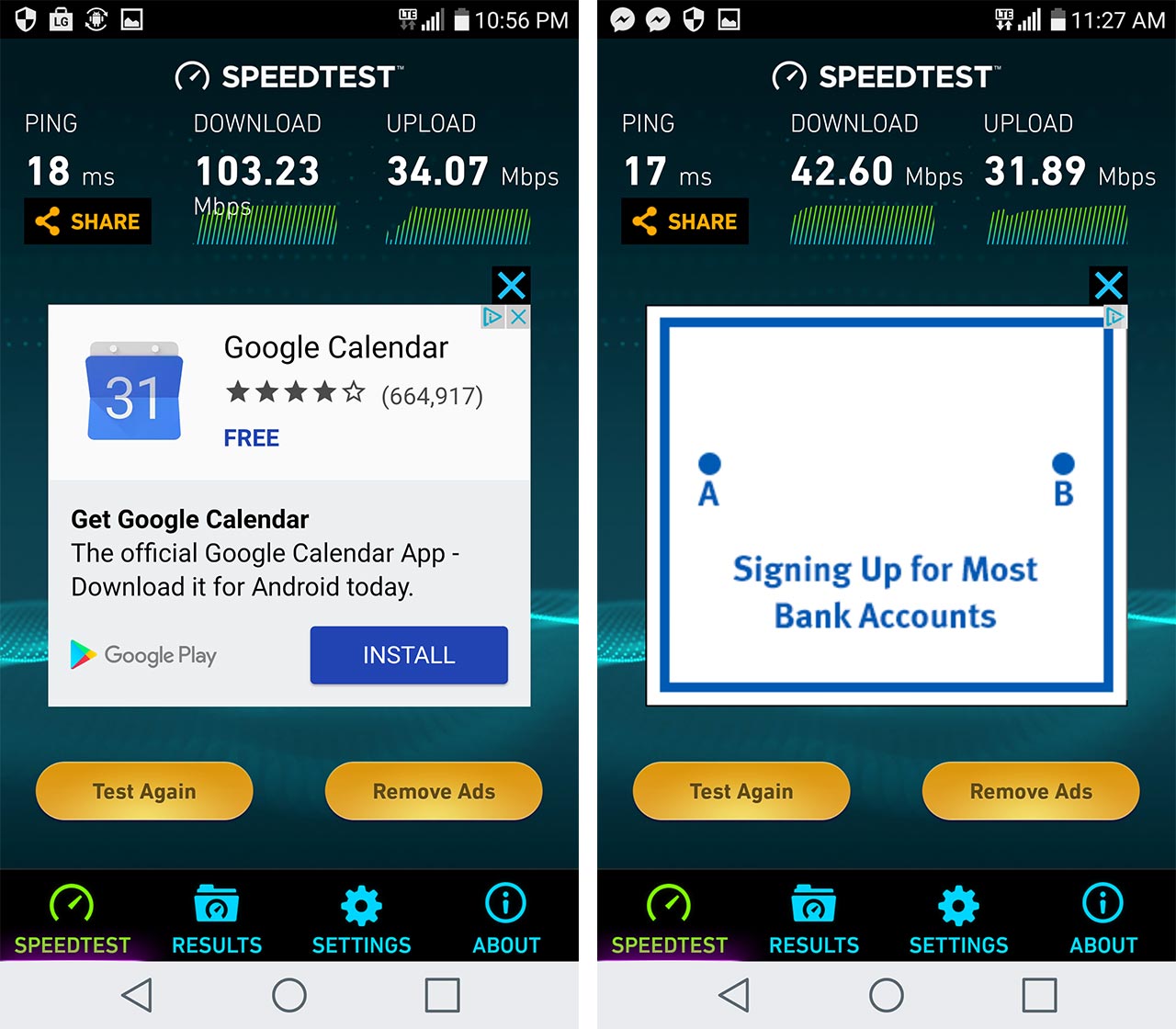
Freedom Mobile fared well in the tests, with a 45.81Mbps average download speed, 26.79Mbps average upload speed and 19.42ms average latency. It bested Rogers, which averaged 20.17Mbps for downloads, 11.59Mbps for uploads and 31.71ms for latency.

Above: left, Freedom’s LTE network at Bloor and Quebec. Right, Freedom’s LTE network at Simcoe and King.

It fell significantly short of Bell and Telus, however, which received similar results due to an agreement in which they share infrastructure and network, with Bell investing in infrastructure in the East and Telus in the West.

Bell delivered a 90.27Mbps average download speed, 34.59Mbps average upload speed and 14.71ms average latency – unsurprising for a network that has been consistently named Canada’s fastest 4G LTE network by PCMag, while Telus came in a close second, posting a 83.79Mbps average download speed and 32.53Mbps average upload speed. The latency, however, didn’t keep pace with Bell, Freedom or Rogers, at an average of 32.42ms.

Meanwhile, the test on the ZTE Grand X 4 showed similar results to its more premium counterpart, with an average 44.11Mbps download speed, 27.33Mbps upload speed and 23.85ms latency on the Freedom LTE network.

Geographically, Telus took the top spot in the east (Main and Danforth), north (Finch and Yonge) and south (John and King) for best download/upload speeds, while Bell took the top spot in the west (Bloor and Quebec) — though in most locations it was close, and in the north it bumped Telus’ upload speed by a small margin. Freedom took third place in the west, south and north, with Rogers snagging second in the east.

In terms of latency across all directional extremities, Bell took first, followed closely by Freedom. Rogers and Telus lagged behind by a lengthy margin.

The testing also allowed for ample testing of Freedom’s LTE accessibility on TTC subway platforms, which O’Shaughnessy states is about 90 percent deployed. I found excellent LTE connectivity was accessible at the western stations from High Park to downtown, and around the southern loop. At the northern stations past St. Clair on the Finch line, however, I was not able to connect to the network (LTE or otherwise) and likewise for the stations past Broadview to the east. The feature remains an incredible bonus for the stations where it does exist, allowing for better music streaming and the ability to send messages over data or browse social media as one travels.

Other bonuses for Freedom Mobile customers coming down the pipeline are Wi-Fi calling and voice over LTE (VoLTE), which O’Shaughnessy states is currently in testing and will likely arrive in spring or summer of 2017. O’Shaughnessy also stressed that while Freedom is currently rolling out LTE and these new services, that doesn’t mean it has forgotten about its 3G spectrum.

“We’re building well over a 100 sites a year across the country for adding capacity and coverage and they’re 3G and LTE. So, they will help LTE customers as well, but absolutely performing our 3G performance whether it’s coverage or capacity is always important.”

O’Shaughnessy also noted that Freedom was looking at 5G technology, but had not started tests yet.

As for consumer feedback on the new network, O’Shaughnessy sees the roll-out as ultimately successful, while acknowledging some of the negative comments received.

“You go online and you see people saying ‘why are they making me buy a new phone?’ Well, we’re not making you buy a new phone, the only frequencies we had to put it on are the new phones. But I think as people learn what it’s all about, those things will naturally work their way through.”

Are you a Freedom Mobile user in Vancouver? Our west coast testing will hit MobileSyrup shortly, so make sure to stay tuned!

Update 01/18/17: This article previously stated that AT&T and T-Mobile had purchased large amounts of spectrum, when in fact Verizon and AT&T were the top purchasers. It has been updated to reflect that.

18 Jan 20:39

chromeless jens's mountainmath.ca map of property tax values in city of vancouver january 2017 Screenshot 2017-01-17 21.58.10 added as a favorite.

by ctmagnus
ctmagnus added this as a favorite.

chromeless jens's mountainmath.ca map of property tax values in city of vancouver january 2017 Screenshot 2017-01-17 21.58.10

18 Jan 20:37

Some Things We Might Buy in 2017: A Goofball’s Guide to the Outdoor Retailer Trade Show

by WC Staff

Twice a year, the Salt Palace Convention Center in Salt Lake City turns into a winter (or summer) wonderland of rugged shoes, packs, outerwear, and other outdoor gear. This is the Outdoor Retailer trade show, the world’s biggest outdoor retail show, where all the major American gear brands (and hundreds of newcomers and up-and-comers) gather to show off their wares for the near future. We sent the Wirecutter outdoors team to cover the 2017 Winter Market. We’ll be reviewing tons of the new items over the coming months, but to start, here are a few that we’re lusting after for real-world, personal use.

Get next week's picks this week

Subscribe to our newsletter and be the first to know about our latest research.

The OR show is the CES of the outdoors. Companies debut groundbreaking technologies, explain their take on solutions to gear problems everyone has, and demonstrate the lighter/faster/comfier/cheaper/eco-friendlier upgrades to their old models. Startups launch their really great ideas. Industry leaders reflect on trends—such as Made in the USA products—and on the future of outdoor sports and recreation. It’s what counts for long-term market growth planning in an industry built on having fun. In the past, companies tackled themes like how to get more kids outside and how to increase diversity outdoors. This year’s show turned political when two influential industry executives called for the show, which generates an estimated $45 million in annual direct spending, to move to a state where the local politicians’ views on public lands and recreational access align better with those of many companies in the industry. The executives’ argument is that public lands are essential to providing their customers a place to use their products.

The items we feature here are as diverse as what was at the show (and as diverse as our interests), including backyard fun and games, lifestyle apparel and activewear, techy toys you can take outdoors, performance and camp food and beverage, and the technical sports gear you might expect. A lot of the stuff at the OR show could be passed over for being gimmicky, impractical, or barely changed from year to year. The following are the items we’d actually make a place for on our next trip, in a crowded gear closet, or at camp or in a cabin.

A new take on snowshoes that could really work

Crescent Moon Eva All-Foam Snowshoes, $160, expected release in fall 2017

outdoor retailer tradeshow crescent moon eva

Photo: Crescent Moon

It’s not often that a major piece of gear undergoes such an extreme makeover that it could change the industry and the sport. The Crescent Moon Eva All-Foam Snowshoes could do just that. Unlike traditional designs, which consist of myriad straps, buckles, and hinges, this model features a much more user-friendly unibody design that looks and feels more like a shoe than an intimidating piece of technical snow equipment. Putting on the snowshoe is simple: A Velcro hook-and-loop adjustable binding system makes it more like getting into a pair of kids’ sneakers. This approachable design should make people who have never been snowshoeing want to try it out.

The Eva All-Foam Snowshoes are made of two layers of dual-density EVA foam—the same type that you’ll find on most lightweight running shoes. Since foam is lighter than most metals, and the design uses it for everything but the binding, the Eva pair is designed for better front-to-back weight distribution than competing models. Foam also has two unexpected advantages over metal in snowshoes: It insulates your feet from the cold and spares your ears the ubiquitous snowshoe squeak. A third component, a traction plate made of a nylon-like material, bites into icy slopes with lugs reminiscent of snow tires. Furthermore, the Eva’s lack of moving parts should also make it more durable in the long run, since most snowshoes fail when their hinges, straps, or joints snap (hopefully not bringing your ankle along with them).

What struck me the most about the Eva All-Foam Snowshoes were the emotions that winter enthusiasts expressed about them—namely, rabid obsession. Just in the three days of the OR show, the Eva pair won multiple awards, including Outside Magazine’s Gear of the Show, Digital Trends’s Best of Show, Backpack Gear Test’s Creative Award, Gear Junkie’s Gear of the Show, and The Manual’s Gear of the Show. We have to test the snowshoes when they are released in fall 2017 to make sure the foam doesn’t sacrifice durability for lightness, but if the Eva All-Foams offer any improvement over what is currently out there, bring on the industry revolution.

—Elizabeth Thomas

For passing the time at the campsite or your living room

Outside Inside games for camp and cabin, available now, $10 and up

outdoor retailer tradeshow exercise machine ping pong

Outside Inside game designer Dave Smrtka is not demonstrating an exercise machine. This is a go-anywhere ping pong setup. Photo: Dan Koeppel

In an industry where nearly everyone has a great job—or at least one that allows you to get out and play, a lot—Dave Smrtka’s gig is as good as we’ve seen: He designs all of the items for GSI’s Outside Inside games line. (GSI is one of the biggest outdoor companies you’ve never heard of; it makes tons of basecamp essentials, like tableware and cooking gear.) Smrtka, who began his career making eclectic cribbage sets, including one shaped like a rainbow trout, describes what he does simply: “I design outdoor versions of indoor games, and indoor versions of outdoor games.” So if you’ve ever dreamed of playing horseshoes in your living room, Smrtka’s got a won’t-shatter-your-flatscreen foam version. Ping pong under the trees? Outside Inside’s set includes paddles and an expandable net that clamps to a picnic table. There’s some very cool innovation behind all these games, too: The company’s new-for-2017 Backpacker Bocce set, for example, uses balls made of a decelerating rubber, so they won’t roll too far away when you’re in the heat of competition. And if those games don’t appeal, Smrtka’s line includes more than 30 additional choices.

—Dan Koeppel

The backyard and forest double-decker instant treehouse

Tentsile T-Mini Double Hammock and Flite+ Tree Tent, available now, $150 to $350

outdoor retailer tradeshow three-point treehouses outdoor retailer tradeshow outdoor retailer tradeshow t-mini double hammock

Basically, this design offers a hybrid of a tent and a hammock in a triangle shape, securing at three points (yeah, you pretty much need a trio of trees—a possible drawback) so that it doesn’t swing back and forth the way a traditional hammock might. Though Tentsile has been around for about five years, its products have been fairly pricey, some over $1,000. In 2017, you can get in on the fun for a lot less money: The T-Mini Double Hammock is $150, and the covered Flite+ Tree Tent is $350. That gives you the sweet setup—a double-decker arrangement—for under $500.

—Dan Koeppel

The thinking person’s coffee creamer?

Know Brainer Thinker’s Instant coffee and creamer, available April 2017, $2 for 1 ounce

outdoor retailer tradeshow know brainer

Coffee that helps you think? How did they think of this product before it existed? Photo: Know Brainer

Endurance athletes have been some of the loudest lovers of instant coffee—and of ketogenic diets. Available in 2017, Know Brainer Thinker’s Instant marries those two trends in one product. Thinker’s Instant is the premeasured and preblended single-serving sibling of the much-written-about Bulletproof Coffee. Each 1-ounce packet contains concentrated coffee, shelf-stable medium-chain triglyceride (MCT) oil from coconuts, and grass-fed ghee (clarified butter). Drinkers simply massage the packet, dump it into 8 ounces of hot water, and stir. On-the-go outdoor adventurers, travelers, and commuters will have the benefit of super morning joe without extra tools or a messy cleanup.

Launched in 2016, Know Brainer claims its ketogenic-friendly creamer alternative fuels brain and body without leaving cravings. So far, no hard data backs up the benefits of adding Know Brainer creamer to java. The company’s new product, Thinker’s Instant, won’t require mixing, though, as it blends the Know Brainer “creamer” and the coffee in the same packet. Thinker’s Instant will be available in original and French vanilla flavors, both with MCT and organic grass-fed butter. For those allergic to casein or lactose, a mocha flavor will be available in a casein- and lactose-free version.

How excited you might be about Know Brainer or its upcoming Thinker’s Instant depends on your enthusiasm for the ketogenic diet and Bulletproof Coffee in general—and there’s plenty of reason to doubt its proponents’ lofty claims. But regardless of the validity of the science behind the ketogenic diet—or whether this is just a fad—what’s important is that Know Brainer is delicious. It won the Anaheim Coffee Festival’s 2016 People’s Choice Award. And at $2 per packet, you can afford to try it for yourself.

—Elizabeth Thomas

A fashionable, warm, technically sound women’s coat

Cotopaxi Women’s Kusa Parka, available now, $200 (past season colors on sale for $100)

outdoor retailer trade show cotopaxi jacket

Insulation is a big deal in the outdoor world right now. As brands aim for sustainability and transparency in their supply chains, they’re throwing everything at the wall to see what will stick: At the OR show, we saw bison fill, llama fill, alpaca fill, traditional down, DWR-treated down, and duck feathers—and that list doesn’t even include the synthetic fibers that are also gaining traction. Basically, however, it all keeps you warm, and it all has varying degrees of sustainability.

But among the sea of similar-performing options, the Cotopaxi Women’s Kusa Parka stood out to us not only for its llama-fur-blend insulation but also for being one of the few insulation pieces that look like they’re styled for the real world. Big, puffy coats are an outerwear staple these days, but you can’t layer them under anything. This piece is thin, tailored, and without a hood, so I can use it to turn my existing coats into a layering system, exactly the way I would if I were going hiking. That means any spring coat I have can now be a winter coat, and any rain jacket I own can now have a liner. While my 850-fill down technical jacket has performance-oriented features that make it indispensable on a snowy mountain—such as a big hood and articulated arms—those same features make it much too bulky to fit under street wear.

The color palette is also worth mentioning. When it comes to color, little-known boutique brand Cotopaxi is currently the best player in the game, and that’s a huge deal. Year after year, major brands attempt to “figure out” what color to make clothing for people who find that the traditional male aesthetic doesn’t work. Usually they come up with purple. Although purple is good, that’s still a tiny box. For anyone who struggles with projecting their identity in a way that isn’t so narrowly stereotyped, this is a company to check out.

—Eve O’Neill
18 Jan 18:23

This is your AirPod control

by Volker Weber

IMG 8997

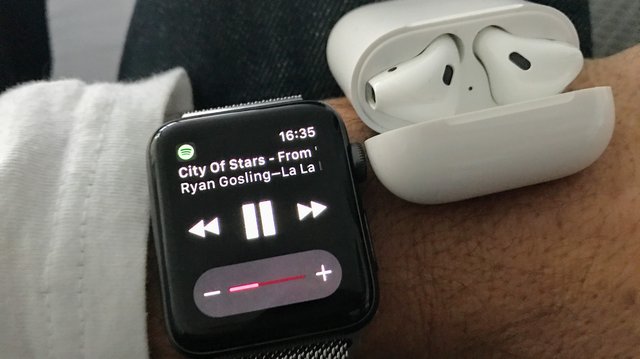
AirPods don't have any physical controls. You can double tap them for calling up Siri. Or you can set this double tap to Play/Pause. One way or the other it looks kind of silly to tap on your ear. But how do you control the volume or skip a track? Simple: use your Apple Watch. The Now Playing glance lets you control the iPhone. And with that your AirPods.

Most of the time, you don't need these controls, because the AirPods are pretty smart. They know when they are in your ear. Take one out, when the flight attendant asks you what you like to drink and the music stops. Put it back in and the music continues. How do they sound? Pretty similar to the wired earbuds, with a bit more heft. Outbound noise cancellation during phone calls works very well, inboud there is none. And since they don't seal your ears, they are pretty useless when you need to isolate yourself from crying babies or office noise. During a flight, you have to crank them up all the way, which isn't good for your ears.

1da558364ec40ad88d36c91ef12662c0

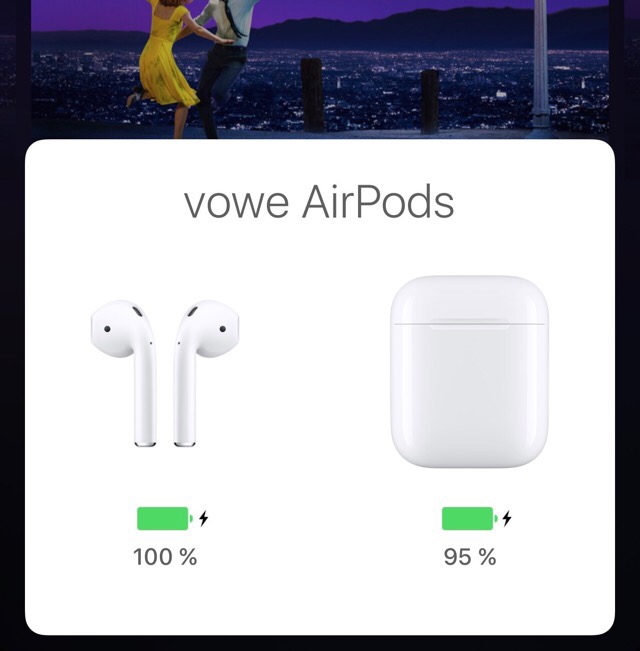
The AirPods will not fall out of your ears and I tried them in ears of all sizes. But you may drop them when you take them out of the case. They are safe inside the case and your ear, but not anywhere inbetween. I suggest you use a very strict protocol of moving them swiftly between those two places. The case is a wonderful example of Apple engineering. Everything snaps in place, the AirPods and the lid are held with very gentle magnets. Your iPhone will tell you how much juice there is in the AirPods and the case. They charge faster than they run down the battery. 15 minutes charging equals 3 hours of playing music.

This is a great product. Editor-refuses-to-give-it-back award.

18 Jan 18:22

9 years of blogging have totally been worth it

by Kristina Chodorow

Worth of Web is kind of a neat site:

Oh well. It’s been worth it to me.

18 Jan 06:22

Rest in Peace, Rob Cole

by Jeffrey Friedl
A Pretty Picture a kusaridoi at the Eigenji Temple (永源寺), in Shiga Japan -- Eigenji Temple (永源寺) -- Higashiomi, Shiga, Japan -- Copyright 2016 Jeffrey Friedl, http://regex.info/blog/ -- This photo is licensed to the public under the Creative Commons Attribution-NonCommercial 4.0 International License http://creativecommons.org/licenses/by-nc/4.0/ (non-commercial use is freely allowed if proper attribution is given, including a link back to this page on http://regex.info/ when used online)
Nikon D4 + Voigtländer 125mm f/2.5 — 1/400 sec, f/5.6, ISO 3200 — map & image datanearby photos
A Pretty Picture
a kusaridoi at the Eigenji Temple (永源寺), in Shiga Japan

Rob Cole used to be one of the more prolific engineers creating plugins for Adobe Lightroom, until two years ago when he seemed to have fallen off the face of the Internet. His web site vanished, taking with it his valuable trove of solutions for photographers, and at the same time, his active participation in online forums stopped.

For the past two years no one in this facet of his life knew what had happened, but I've finally learned today that Rob passed away unexpectedly in January 2015.

This situation brings to mind “On the Permanence of One’s Online (and Offline) Presence” from seven years ago, but in this case the online presence disappeared at the same time he did. Judging by the various messages from his users that I've received since Rob disappeared, I know his work had helped a lot of people. For what it's worth, I've reached out to his family to see whether they'd like to find a way to make it available again, if they even have access to it.

Anyway, since his disappearance was so unsettling, I'm posting this to provide some closure to those that knew him online. Rest in peace, Rob, and condolences to your family.

18 Jan 05:35

Siemens delivers first vehicle of new Muni Metro fleet

by News
mkalus shared this story from Global Rail News.

The first new Muni Metro light rail vehicle from Siemens has arrived in San Francisco.

Siemens is building 215 new vehicles for the system – its largest-ever light rail order in the US.

The first vehicle has now been delivered to the Muni Metro East facility. It will undergo testing before entering service at the end of the summer.

The high-floor vehicles consist of two cars but can operate as multiple units.

San Francisco Municipal Transportation Agency (SFMTA) placed an order with Siemens for 175 vehicles in September 2014. The contract included an option for up to 85 additional units. In June 2015, SFMTA ordered another 40 vehicles.

Siemens and SFMTA estimate that the new vehicles will be capable of running 10 times longer between faults than the current fleet and will consume 40 per cent less energy.


18 Jan 05:34

st-misanthropez: Dr. Strangelove or: How I Learned to Stop...

18 Jan 05:34

Running X11 apps in an rkt container

rkt is a container runtime I've been using on a few projects recently. I was creating a container for Mozart which uses emacs as an IDE. This requires running an X11 application within the container and have it displayed on the host display.

To get this working I needed to mount my hosts X11 unix domain socket inside the container and provide an Xauthority file that gave the container the rights to connect to the host X server.

The following shell commands use acbuild to create a container that runs xclock as an example of the process:

acbuild begin docker://ubuntu:16.04
acbuild set-name bluishcoder.co.nz/xclock
acbuild run -- apt install --no-install-recommends --yes x11-apps
acbuild run -- rm -rf /var/lib/apt/lists/*
acbuild environment add DISPLAY unix$DISPLAY
acbuild environment add XAUTHORITY /root/.Xauthority
acbuild mount add x11socket /tmp/.X11-unix
acbuild mount add x11auth /root/.Xauthority
acbuild set-exec xclock
acbuild write --overwrite xclock.aci
acbuild end

It uses an Ubuntu Linux image from the Docker hub as a base and installs x11-apps. To reduce disk space it removes cached package files afterwards. A DISPLAY environment variable is set to point to use the same DISPLAY as the host. The XAUTHORITY enviroment variable is set to point to a file in the home directory of the root user in the container.

The mount subcommands expose the x11socket and x11auth endpoints to point to where the X11 unix domain socket and the Xauthority file are expected to be. These will be provided by the rkt invocation to mount host resources in those locations.

The final part of the script sets the executable to be xclock and writes the aci file.

On the host side we need to create an Xauthority file that provides the container access to our X11 server. This file needs to be set so that any hostname can connect to the X11 server as the hostname for the container can change between invocations. To do this the authentication family in the file needs to be set to FamilyWild. I got the steps to do this from this stack overflow post:

xauth nlist :0 | sed -e 's/^..../ffff/' | xauth -f myauthority nmerge -

This will retrieve the Xauthority information for display :0 and modify the first four bytes to be ffff. This sets the authority family to FamilyWild. A new file called myauthority is created with this data. This file will be mapped to the x11auth mount point in the container.

The container can be executed with rkt:

rkt run --insecure-options=image xclock.aci \
        --volume x11socket,kind=host,source=/tmp/.X11-unix \
        --volume x11auth,kind=host,source=./myauthority

The --volume command line arguments map the mount points we defined in the acbuild commands to locations on the host. The running xclock application should now appear on the host X11 display.

18 Jan 05:34

Forderungen an Obama nach Begnadigung für Snowden und Manning (Update: Manning kommt frei)

by Constanze
mkalus shared this story from netzpolitik.org.

barack obama

Foto: CC BY-NC 2.0 | SS&SS.

Bürgerrechtler hatten im September eine Initiative gestartet, um die Begnadigung von Edward Snowden zu erreichen. Nun übergaben sie US-Präsident Barack Obama die Unterschriften von mehr als einer Million Menschen, die einen Straferlass befürworten. Snowden soll in den Vereinigten Staaten wegen Verletzung des Espionage Acts angeklagt werden.

Die ACLU (American Civil Liberties Union) hatte gemeinsam mit Amnesty International und Human Rights Watch zur Unterstützung aufgefordert. Nun konnten die Organisationen gemeinsam in einem Brief an Obama vermelden:

We are hereby delivering signatures from 1,101,252 people across the world who ask that you use your presidential authority to pardon Edward Snowden.

(Hiermit überbringen wir die Unterschriften von 1.101.252 Menschen von überall auf der Welt, die um die präsidiale Befugnis zur Begnadigung Edward Snowdens ersuchen.)

Amnesty International hat parallel auch eine Unterstützungskampagne ins Leben gerufen, die den Geflüchteten in Hongkong helfen soll, die Snowden bei seiner Flucht Beistand geleistet hatten.

Begnadigung für Chelsea Manning?

Chelsea Manning soll unterdessen auf einer sogenannten „short list“ stehen, die Menschen umfasst, die zur Begnadigung in Frage kommen, wie NBC News meldete. Manning sitzt eine 35-jährige Freiheitsstrafe für die Preisgabe von Regierungsgeheimnissen im Zusammenhang mit der Veröffentlichung von Diplomaten-Depeschen des US-amerikanischen Außenministeriums ab.

Update:
Soeben (Dienstagabend) wird auf allen Kanälen gemeldet, dass Chelsea Manning im Mai auf Geheiß von US-Präsident Obama entlassen wird. Auch in den deutschen Medien, wie hier in der FAZ, wird die gute Nachricht bereits weiterverbreitet, dass sie an 17. Mai eine freie Frau sein wird. :}


Unterstütze unsere Recherchen und Berichterstattung für Grundrechte und ein freies Internet durch eine Spende.

18 Jan 05:34

Amnesty-Bericht: Viele EU-Länder unterscheiden sich kaum noch von Überwachungsstaaten

by Markus Reuter
mkalus shared this story from netzpolitik.org.

Viele europäische Länder befinden sich in einem Zustand der sicherheitspolitischen Aufrüstung. (Symbolbild). Foto: CC0 1.0 | Harri Kuakkanen.

Amnesty International hat die Auswirkungen von Anti-Terrorgesetzen auf die Grund- und Freiheitsrechte in 14 EU-Staaten analysiert. John Dalhuisen, Direktor für die Region Europa bei Amnesty International, kommt zu folgendem Fazit:

„Einzeln beleuchtet sind viele Antiterrormaßnahmen besorgniserregend. Betrachtet man sie zusammen, ergibt sich ein verstörendes Bild. Für unsere Gesellschaften lange selbstverständliche Rechte werden nun unkontrolliert massiv eingeschränkt“.

Der 70-seitige Bericht mit dem Titel „Dangerously disproportionate: The ever-expanding national security state in Europe“ betrachtet aus der Vogelperspektive in acht Kapiteln verschiedene Schwerpunkte wie Nostandsgesetze, Überwachung, Meinungsfreiheit oder Bewegungsfreiheit.

Schwellen für Notstandsgesetze gesenkt

In vielen Staaten seien die Schwellen drastisch gesenkt worden, um Not- und Ausnahmezustände zu erklären, in denen Sicherheitsbehörden weitgehende Einschränkungen der Grund- und Menschenrechte ohne ausreichende richterliche Kontrolle erlaubt werden, heißt es in der deutschen Zusammenfassung des Berichtes.

So könnten in Ungarn nach Ausrufen des Notstands nicht nur Versammlungs- und Bewegungsfreiheit stark eingeschränkt werden: Geltende Gesetze können einfach ausgesetzt und neue im Eilverfahren erlassen werden.

In Frankreich sei der Ausnahmezustand inzwischen fünf Mal verlängert worden, wodurch eine Reihe einschränkender Maßnahmen zum Standard wird, darunter Durchsuchungen ohne gerichtliche Genehmigung und das Verbot von Demonstrationen. So wurden die Notstandsgesetze auch als Begründung genutzt, um im Vorfeld der UN-Klimakonferenz Umweltschützer unter Hausarrest zu setzen.

Erweiterung von anlassloser Massenüberwachung

Viele EU-Länder unterschieden sich kaum noch von „Überwachungsstaaten“, indem sie Sicherheitsbehörden und Geheimdiensten weitreichende Befugnisse zur anlasslosen Massenüberwachung ohne die notwendige rechtsstaatliche richterliche Kontrolle einräumen, heißt es im Bericht.

So seien beispielsweise in Großbritannien, Frankreich, Deutschland, Polen, Ungarn, Österreich, Belgien und den Niederlanden Befugnisse zur Massenüberwachung erteilt beziehungsweise erweitert worden, die das anlasslose Abgreifen und den Zugang zu den Daten von Millionen von Menschen erlauben.

Polens neues Antiterrorgesetz räume den Behörden unverhältnismäßig weitreichende Machtbefugnisse ein, darunter diskriminierendes Vorgehen gegen ausländische Staatsangehörige. Es erlaubt die verdeckte Überwachung von ausländischen Staatsangehörigen über einen Zeitraum von drei Monaten, ohne dass eine gerichtliche Kontrolle erfolgt – einschließlich des Abhörens von Gesprächen, der Kontrolle elektronischer Kommunikation und der Überwachung der Telekommunikationsnetze.

In Großbritannien habe der Investigatory Powers Act verheerende Auswirkungen für die Privatsphäre und andere Menschenrechte im Land. An Deutschland kritisiert der Bericht vor allem das neue BND-Gesetz. Hier habe die Bundesregierung keine der Warnungen des UN-Sonderberichterstatters berücksichtigt.

Einschränkung von Versammlungsrecht und Bewegungsfreiheit

Zur Gefahrenabwehr schränkten Behörden zunehmend Rechte wie Bewegungsfreiheit, Versammlungsfreiheit oder Privatsphäre ein. In vielen Fällen werden Menschen mit Ausgangssperren oder Reiseverboten belegt oder müssen eine elektronische Fußfessel tragen. Die Anwendung solcher Kontrollmaßnahmen müsse stets verhältnismäßig und tatsächlich notwendig sein, sie dürfe erst nach einer richterlichen Prüfung und Anordnung erfolgen, fordert Amnesty International.

Besonders stark von diskriminierenden Maßnahmen betroffen seien Menschen muslimischen Glaubens und ausländische Staatsangehörige beziehungsweise Personen, die für solche gehalten werden. Diskriminierendes Handeln seitens der Staatsgewalt scheine vor dem Hintergrund der nationalen Sicherheit zunehmend als „akzeptabel“ angesehen zu werden.


Unterstütze unsere Recherchen und Berichterstattung für Grundrechte und ein freies Internet durch eine Spende.

18 Jan 05:33

Google Reportedly Bringing Android One to The U.S.

by Evan Selleck
Android One is Google’s effort at launching relatively inexpensive smartphones, which still have the full support of Google itself, as far as software updates are concerned. Continue reading →
18 Jan 05:33

Are We Not Reclaim?

by Reverend

I’ve been back in the US for the last week working on the Reclaim offices, and it’s been a lot of fun. The last two days the whole crew has been working together in the new diggs, and the vision of the office, co-working space, maker space, and 1980s video rental store is coming together nicely.

Tim and I did some work installing ceiling tiles, hooking up recessed lighting, painting paneling, and laying carpet tiles in a small back office while the major construction work continues in the main area. Considering we’re two web hosting sysadmins, it went pretty well and relatively fast. In fact, the room is almost done. I’ll save the before and after images for later this week when all the furniture is in and the final ceiling tiles are done. But in the meantime I wanted to share a quick action photo. 

The above shot was taken after painting, and the suit was a necessity given I didn’t have any throwaway painting clothes. It was also an homage to the Reclaim Hosting migration page art (which is an homage to Repo Man):

I also started calling the suit I was wearing a Devo Suit to pay respect to the awesome style sense to America’s greatest New Wave band from Akron, Ohio. I even put a Reclaim Hosting sticker on my heart in order to seize the marketing opportunity. After Tweeting the image, it came back to me as the best album cover I have seen in a very, very long time! Paul Bond is no joke, and he was even attentive enough to incorporate Booji Boy, a character created by the band and the name of their early independent label.

I never tire of the remix engine that is my Twitter community. Solid gold!

18 Jan 05:33

Führerscheine werden ungültig

by Udo Vetter
mkalus shared this story from law blog.

Ziemlich genau in einem Jahr kann es für die Fahrer von Klein-Lkw eine böse Überraschung geben. Ihr Führerschein ist dann möglicherweise nicht mehr gültig. Die Geltung der Fahrerlaubnisklassen C1 und C1E ist nachträglich auf fünf Jahre befristet worden. Und zwar rückwirkend ab dem 19. Januar 2013. Das bedeutet, nächstes Jahr im Januar werden die ersten Führerscheine ungültig, wenn sich die Inhaber nicht rechtzeitig um eine Verlängerung bemühen.

Grund für die nachträgliche Befristung ist nach Angaben der Bundesregierung ein Vertragsverletzungsverfahren, das die EU-Kommission gegen die Bundesrepublik eingeleitet hat. Um dem Verfahren den Wind aus den Segeln zu nehmen, ist die nachträgliche Befristung nun in Kraft getreten.

Betroffen sind zunächst alle Fahrerlaubnisse der Klassen C1 und C1E, die ab den 19. Januar 2013 erteilt wurden. Diese Fahrerlaubnisse gelten nur noch fünf Jahre ab Erteilung. Sie können verlängert werden. Hierfür müssen die Antragsteller aber eine Gesundheitsprüfung ablegen. Dabei wird unter anderem das Sehvermögen neu getestet.

Tückisch ist die Neuregelung vor allem für Inhaber von relativ neuen Fahrerlaubnissen (ausgestellt ab dem 19. Januar 2013), bei denen im Führerschein noch eine Befristung auf das 50. Lebensjahr eingetragen ist. Diese Befristung ist ab sofort nicht mehr gültig. Das bedeutet: Wer die Fahrerlaubnis länger als fünf Jahre hat und jünger als 50 Jahre alt ist, kann sich bei einer Kontrolle nicht darauf berufen, dass sein Führerschein ausweislich des Eintrags im Feld „Befristung“ bis zum 50. Lebensjahr gilt.

Vielmehr ruft das Verkehrsministerium Baden-Württemberg die Betroffenen konkret dazu auf, ihre Führerscheine umschreiben und an die neue Rechtslage anpassen zu lassen. Wer am Steuer erwischt werde, riskiere ein Strafverfahren.

Für ältere Fahrerlaubnisse ändert sich dagegen nichts. Ist die Fahrerlaubnis zwischen dem 1. Januar 1999 und dem 18. Januar 2013 erteilt worden, bleibt es bei der Befristung bis zur Vollendung des 50. Lebensjahres. Danach muss dann ebenfalls eine Gesundheitsprüfung abgelegt werden, aber das war bisher auch schon so.

Ebenfalls nicht betroffen sind Fahrerlaubnisse der alten Klasse 3 (erteilt vor dem 31. Dezember 1998). Für diese Fahrer gilt Bestandsschutz. Sie dürfen mit der Klasse C1 und C1E auch über das 50. Lebensjahr hinaus Klein-Lkw fahren, ohne eine Gesundheitsprüfung machen zu müssen.

Zu allem Überfluss ändert sich auch noch der Geltungsbereich „neuer“ Fahrerlaubnisse der Klassen C1, C1E, C und CE. Ab einem Gesamtgewicht von 3.500 kg dürfen keine Personen mehr befördert werden. Wer dies machen möchte, braucht künftig die Fahrerlaubnis Klasse D1 oder D1E. Aber auch hier gibt es wieder eine Ausnahme. Die Änderung gilt nicht für Wohnmobile, gepanzerte Limousinen und die Fahrzeuge von Polizei und Rettungskräften.

Flattr this!

18 Jan 05:33

So, You’re Starting a Design Studio?

by Eric Karjaluoto

The other day, the owner of a new design studio asked me for some advice, on Officehours. During our session, I shared some thoughts on what has worked—and hasn’t—over the past 17 years, at smashLAB. I later realized that others might also find this information useful. So, I’ve summarized the guts of our talk, in this blog post.

Here are my tips for what to consider when starting your new design company. Admittedly, others will hold different perspectives, but these are the best recommendations I can muster:

Figure out what you want to be

Agencies and studios seem alike, but are in fact vastly different. Before you start either, ask yourself how you’d like to spend your day. An agency will require you to focus on sales and management. If you’d rather do hands-on design, a studio might be a better fit for you. Alternately, you might want to develop your own products. Each of of these is a fine pursuit. However, it’s important to pick the one that suits your personality—or you might regret your choice.

Drum up some cash flow

Start by finding some steady work. One of the easiest ways to do this, is to offer to be someone’s off-site designer—I explain how to do so here. This is a low-pressure approach that’s easy to sell. In fact, if you’re leaving a regular job, you can offer this working arrangement to them, as a way to ease the transition. Once you have a little money coming in, you’ll breathe easier and your studio will feel more stable.

Keep your overhead low

The easiest way to reduce economic pressure isn’t to earn more—it’s to spend less. Don’t rent an office; it’s costly and unnecessary. Work from home to save yourself the lease payments, commuting, furnishings, and other expenses. Even more important: Avoid hiring people until absolutely necessary. Payroll will bankrupt you faster than you realize. Instead, find good people to partner with, and work together. This is more fun, easier to administer, and affords you a lot of flexibility.

Buy good tools (once)

You don’t need many objects when you start a design business. That said, you’ll require a few essentials (i.e., a chair, computer, and desk). Some things, like the desk, you can do on the cheap. I recommend spending a little more on the other items, though. A basic Aeron chair is nice on long work days, and holds its value surprisingly well. Similarly, a good laptop allows you to work from anywhere. You don’t need the top of the line for these sorts of items, but I doubt you’ll regret buying sturdy tools.

Work in your business—not on it

A design studio isn’t an assembly line business. As such, the approaches used in building one or the other aren’t necessarily transferable. Early on in our business, someone told me to, “work on our business—not in it.” This amounted to creating systems, so we could hand work off to others. Following that advice led us to do a lot of things prematurely. Systems are great. As a small design shop, though, you should mostly concentrate on securing even cash flow and doing good work—not imagining how to turn your studio into a franchise.

Worry not about your website

Designers tend to overvalue their websites—and obsess over their shortcomings. Most clients, though, don’t know the difference—or even care. A single page website with a bit of information about your studio, and some (preferably notable) client logos will often suffice.

Bypass all the self-promotion

The act of promotion might seem useful, but can easily overtake your efforts. This is a common trap that pits your ego against you. Write if you like to write, and speak at conferences if you want to meet some nice people—but don’t confuse either as a means of keeping your studio healthy. Awards afford an even lower yield—and are costly in both prep time and entry fees. I suggest avoiding these altogether. There’s a better way to find new work.

Go for lunch

This is the single best piece of business advice I can share with you: meet with people. Lunch is a great way to keep in touch, strengthen friendships, and sometimes be in the right place at the right time. At our studio, we stumbled into more (and often substantial) new work, just by sitting down with past/prospective clients over a burger and fries.

Obsess over results for your clients—not your portfolio

Every time you split your focus, you make your job harder. Early on at smashLAB I wanted us to: Produce good design; Make our clients happy; Be financially sound; Push the medium in innovative ways; And, win design awards. While all of those can happen, these desires can overlap and create conflicts. For that reason, I urge you to focus on making your clients happy. If you do that one thing, you’ll be OK—and some of those other things might happen as well.

Have a side project

Making clients happy sometimes means making design changes that will leave you dissatisfied with what you produced. In worst case scenarios, you can’t even show this work, because it’s so clumsy. Such discomfort is lessened by having something of your own to work on—that affords you complete autonomy. Whether it’s an app, resource, or whatever, pick a side project that you alone own. Then set aside time during which you can work on this.

Be easy to hire

I have a friend who’s smart and well qualified, but he can’t find steady work. My hunch is that no one hires him because he makes the process unnecessarily difficult. He complains about their HR software. He questions whether their interest is legitimate. He gets frustrated when the process carries on. Don’t fall into this trap. Make it easy for clients to try you out, see how you work, and get comfortable. If you’re not sure how to do this, I urge you to read this article.

Enjoy the ride

I rush a lot. In turn, I miss out on some good times. Lately, I’m finding ways to take my time—and have a bit more fun. Running a design studio is involving, but it needn’t be stressful or approached like a race. Instead, structure your business so it helps you live the life you want.

Admittedly, this is an incomplete list. As such, I might return to it and add other notes as they come to mind. In the meanwhile, if you have questions, I’m happy to answer them. Book me on Officehours, and I’ll lend a hand.