Shared posts

11 May 22:15

Google Chrome won't be allowed on Windows 10 S

files/images/light-at-the-end-of-tunnel.jpg

Ed Bott, ZDNet, May 13, 2017


Icon

We are in the process of entering an unhappy world where the browser is part of the operating system. This seems to be the trend set by Windows-S, on which Google's Chrome browser won't run. I'm not sure, but I don't think you can run Internet Explorer on a Chrome desktop either. "In theory, Google could use those tools to turn the desktop version of its Chrome browser into an app package.....But if Google or Mozilla or any of those smaller developers submitted one of those packages to the Store for distribution, the submission would be rejected." [Link] [Comment]

11 May 22:15

A Plan to Kill High School Transcripts … and Transform College Admissions

files/images/model.png

May 13, 2017


Icon

I think it would be very interesting to be able to hear some of the discussions behind the scenes. The  "Edward E. Ford Foundation on Tuesday announced a $2  million grant to support the effort," according to this article, and one wonders, why? "This foundation has a narrow focus in its support—independent, private U.S. high schools," according to Inside Philanthropy.  According to  Scott Looney, head of school of the Hawken School, a private institution in Cleveland, "Once the new mastery transcript takes hold, he said, colleges will value it over traditional materials they currently receive. Looney said that, initially, he expected the use of the mastery transcript might encourage colleges to pay more attention to standardized-test scores." [Link] [Comment]

11 May 22:14

Email is the new RSS (or a Factotum is Born)

files/images/etf.png

Clint Lalonde, ClintLalonde.net, May 13, 2017


Icon

I'm not sure I agree with Clink Lalonde that email is the New RSS, but I'm not sure I disagree as well. I can say both modes have been declining as large publication networks  squeeze out the voices of non-members. Anyhow, I'm looking forward to the new newsletter, which will focus on three curated articles per week.  [Link] [Comment]

11 May 22:14

Unsplashing

files/images/unsplashing.jpg

Alan Levine, CogDogBlog, May 13, 2017


Icon

Alan Levine writes about trying out Unsplash. "I’ve known and used photos from  Unsplash  before but after a presentation on it at the  Creative Commons Summit, I thought it was time to try it out with my first set of 10 photos," he writes. He isn't happy that they seem to emphasize a grab-and-go approach without worrying about credit, but was intrigued by the possibility of an API. [Link] [Comment]

11 May 22:14

Lifting weights now can help you ace your golden years

mkalus shared this story from globeandmail - Fitness.

The other day a prospective client – a woman in her mid-30s who runs often but rarely lifts – asked a question I hadn’t heard in quite some time. It was a smart question, a question I’m surprised people don’t ask more often, and that question went something like this: “I feel good and I like the way I look. Why, exactly, should I care about lifting weights?”

I smiled. I’m the sort who needs to understand the “why” before buying into anything, so right away I knew that the two of us were going to get along. I was also reminded of the famous Seinfeld joke about the absurdity of working out – nobody’s really getting in shape for anything; we’re working out so we can be in shape for when we have to do our exercises.

When taken only at face value, it’s easy to see why weight training is the butt of so many jokes. Along with being viewed as self-indulgent, if not downright narcissistic, there is an inherent absurdity to the act of repeatedly lifting heavy objects over and over again; it’s a Sisyphean ordeal in the literal sense of the term, since at no time do you ever reach a real end point. Getting in shape – whatever that means – is simply something you do until you decide to stop or you die.

So what is the point of this painful, time-consuming business? If the whole “looking good naked” part is evident, what are the not-so-obvious benefits that adults – specifically those of us that are fast approaching middle age – should consider before writing off the endeavour as a fool’s game for the young and insecure?

Glad you asked.

It keeps your bones healthy

In the underrated suspense-thriller Unbreakable, Samuel L. Jackson plays a mysterious figure with a congenital disease that causes his bones to shatter like glass at the slightest of impacts. And while it’s ostensibly a story about heroes and villains and the duality of humankind, I like to think it’s really a long and dramatic public-service announcement about the dangers of osteoporosis.

Osteoporosis is a disease that causes bones to lose their density over time, leaving those who are afflicted at high risk for fractures. According to the International Osteoporosis Foundation, one out of four Canadian women over the age of 50 will suffer an osteoporotic fracture. The stats are slightly better – one in eight – for Canadian men of the same age group. Approximately 30,000 of these incidents are hip fractures, a number that’s expected to quadruple by 2030.

For years we’ve been told that calcium is the key to preventing osteoporosis, this despite the fact that Canadians, per capita, have been drinking an average of 81 litres of milk since 1997. Turns out the real bone-strengthening hero is iron, though we’re talking about the kind you lift rather than ingest. Dozens of studies have proven that resistance training not only increases bone density, but also minimizes other risk factors for osteoporosis by improving strength, balance and muscle mass. And here you thought it was milk that does the body good.

It keeps your muscles from wasting away

Sarcopenia is the fancy medical term for the involuntary loss of muscle tissue that naturally occurs as we age. A sort of cousin to osteoporosis, sarcopenia can begin as early as your 40s, though it’s more common in seniors. Once it starts, the downward slope gets steeper each year; it’s not uncommon for those in their 80s to have lost as much as 50 per cent of their muscle mass due to this condition.

The impact of sarcopenia can be downright sinister: loss of motor function, rheumatoid arthritis (a chronic and painful inflammation of the joints) and insulin resistance (a common precursor to Type 2 diabetes) are but a few of the effects. Scientists aren’t sure what exactly causes this deterioration – a host of issues are believed to be blamed, from cellular dysfunction to low levels of certain hormones – but they all agree on the treatment. As with osteoporosis, resistance training has been proven to not only slow down the onset of sarcopenia, it can actually reverse the effects.

There’s a clear commonality in the effects of sarcopenia and osteoporosis: both conditions can reduce one’s quality of life as they age by limiting mobility, making everyday tasks painful and potentially dangerous. A strong and muscular body acts as insurance against slips and falls, making our bones more resilient and our movements more stable, meaning we can keep doing the things we love to do for as long as possible.

Of course, the most effective way to combat these ailments of aging is to maximize your muscle mass in the years before their onset, mitigating the inevitable losses that are to come. If you’re in your 30s and you haven’t started lifting, now’s the time.

Super simple at-home body-weight and bands workout

You don’t need to commit to an Olympic-style training regiment either. You don’t even need a gym – basic body-weight exercises (i.e., push-ups, squats, lunges) combined with resistance band work is all it takes. Here’s a program to help get you started:

Perform all of the required reps before moving on to the next exercise, with as little rest as possible in between. After completing the second exercise in the circuit, rest for 60 seconds, repeat, then move on to the next circuit.

Circuit 1

● Body-weight squats: 10-12 reps

● Resistance-band pull apart: 12-15 reps

Circuit 2

● Stability ball leg curls: 12-15 reps

● Push-ups (drop to your knees if needed): 10-12 reps

Circuit 3

Glute bridges: 12-15 reps

● Single leg lowering: 8-10 reps per leg

Paul Landini is a personal trainer and health educator at the Toronto West End College Street YMCA. You can follow him on Twitter @mrpaullandini.

Report Typo/Error

Follow us on Twitter: @Globe_Health

11 May 22:14

The World is Full of Bullshit

by rands

The world is full of bullshit right now. Perhaps it’s always been full of bullshit, but I’m sitting here right now, and I feel that we – as a species – have taken the bullshit to an entirely new level. Strongly held beliefs are based on the flimsy opinions delivered by totally unqualified sham journalists who are more interested in the size of the audience their stories attract rather than the quality of the facts that support the story.

As an idealistic engineer, I believe that we should be able to source all facts. If you tell me that the sky is blue, there should be a convenient way for me to say, “Well, that’s an interesting theory, but can you definitively prove to me that the sky is, in fact, blue?” You would respond by providing me a URL to a site (or something), ideally several, which definitively and incontrovertibly explain how the sky is blue. I’m not talking about a Wikipedia link or a Quora article; I’m talking about a well-sourced thing, a universally agreed-upon thing that once and forever clearly defines: yes, the sky is blue.

It turns out this is hard.

In academic papers, there are no less than three types of citation styles used “to uphold intellectual honesty (or avoiding plagiarism), to attribute prior or unoriginal work and ideas to the correct sources, to allow the reader to determine independently whether the referenced material supports the author’s argument in the claimed way, and to help the reader gauge the strength and validity of the material the author has used.” As you read that definition, you’ll note that nowhere does it state that a citation’s purpose is to determine whether said fact is or is not bullshit. A citation’s purpose is to help the reader gauge strength and validity of an argument, to compare other important ideas, and help the reader to form a judgment.

Does this mean we are doomed because of bullshit? Maybe.

I originally posted this piece in June of 2013. It was an introduction to another Rands charity shirt to support children literacy1, but I am re-releasing this shirt because of the bullshit… the bullshit is getting strong. While I firmly believe a well-researched opinion is a good strategy to inoculate against bullshit, the US of A is breeding virulent bullshit and not only does it feel like it’s spreading… it feels like it’s winning.

This is the third release of this shirt with popular logo designed by Victoria Wang. Unlike like prior versions, this comes in a multitude of colors thanks to the extremely competent humans at Cotton Bureau.

However, the most important fact you need to know about this shirt is that all proceeds from the sale go to the ACLU. The humans have a hard job. Each day they are working to defend and preserve the individual rights and liberties guaranteed by the Constitution and laws of the United States. In a world full of virulent bullshit where critical thinking is ignored, we need a respectable body who responsible for defending a set of principles and laws so important that we wrote them down.


  1. Kyle is still available. He loves you. 
11 May 22:14

Men’s restrooms should have the koala kare diaper stations too. Sick of having to lay on the ground to change my diaper.

by shutupmikeginn
mkalus shared this story from shutupmikeginn on Twitter.

Men’s restrooms should have the koala kare diaper stations too. Sick of having to lay on the ground to change my diaper.


Posted by shutupmikeginn on Wednesday, May 10th, 2017 6:22pm


854 likes, 119 retweets
11 May 22:13

Henry James on Art

by Caterina Fake

“It is art that makes life, makes interest, makes important, for our consideration and application of these things, and I know of no substitute whatever for the force and beauty of its process.”

–Henry James, letter to H.G. Wells


11 May 22:13

Quebec is still a hotbed for wireless competition, Virgin unveils $69 per month 6GB data promo plan

by Ian Hardy
virgin mobile

One of the hottest wireless promos to arrive in Canada is the recent port-in deal from most carriers, offering 2GB of free data. However, Quebec seems to be a great spot to score a solid monthly wireless plan.

According to an internal document obtained by MobileSyrup, Virgin recently expired its Gold 65, Platinum 70, BYOP 46, Silver 53 and Gold 61 and unveiled an attractive looking Platinum 69 plan for $69 per month.

Effective starting today for an undetermined point in time, Virgin is offering Quebec customers unlimited Canada-wide minutes, unlimited text and picture messaging in Canada and the United States, unlimited worldwide texting from Canada, voicemail, call display and a respectable 6GB of data.

This matches Videotron’s current offering, but might be just shy of Koodo’s $49/month promo that offers 5GB plus 1GB data bonus.

For those who are even heavier data users, Virgin is offering an 8GB plan for $75/month.

Source: Virgin

The post Quebec is still a hotbed for wireless competition, Virgin unveils $69 per month 6GB data promo plan appeared first on MobileSyrup.

11 May 22:13

Microsoft emphasizes the importance of broadcasting in its Xbox gaming business

by Rose Behar

In speaking about Microsoft’s Xbox business during a Build financial analyst building, CEO Satya Nadella said it’s not just about focusing on the users playing games, it’s also about “the people who aren’t playing the game.”

Nadella noted that every windows machine and PC can now turn into a broadcast station for livestreaming and said it is important that the company “connect the dots around gaming” and support the new expressions and creations of users.

Corporate vice president of Xbox Phil Spencer reiterated Nadella’s comments.

“For us at Microsoft, when we thought out both our path forward we came from a place of console and realized […] that the number one asset we have is our customers and the engagement they put into our network,” said Spencer, referring to broadcasting and the Xbox community at large.

There are clear upsides to game broadcasting in the form of potential advertising or subscription revenue, but Spencer noted another upside: a large percentage of broadcasts are viewed through mobile devices, meaning they could be a good way to draw in more Android and iOS users into the Xbox community, which has stronger footholds in console and PC gaming.

Microsoft’s Twitch competitor, game streaming platform Beam launched in January 2016. Xbox One also integrates Amazon-owned Twitch into its gaming platform.

The post Microsoft emphasizes the importance of broadcasting in its Xbox gaming business appeared first on MobileSyrup.

11 May 22:13

The Next Stage of Times Square – completed

by pricetags

Stephen Wilkinson, still keeping up with change in NYC even though relocated to YVR, sends along this:

Times Square Redesign

Snøhetta

Snøhetta redesigns Times Square, doubling the amount of public space. The new plaza on Broadway radically carves out 2.5 acres of pedestrian-only space at Manhattan’s core, transforming a congested vehicular district into a world-class civic space.

More photos here.

This is not the part of Times Square to the north that was previously pedestrianized – the location of the red-stepped TKTS booth.  It’s the southern part of the bow-tie.  And if you need an explanation, go this Price Tags on Times Square, published in 2009, when the above was all asphalt.


11 May 22:13

Auto-Annotating News Articles To Scaffold Media Literacy Skills In Students

by mikecaulfield

I’ve been playing around a bit with auto-annotating news articles to foster better literacy reflexes in students. Here’s the latest work in progress: I’ve made an annotation bot that goes out and finds articles mentioning industry front groups and asks students to do research to confirm or deny the connection.

How does this work? I compiled a list of over 150 known front groups — groups that present as social activism groups, but are thought to be industry-funded astroturf.

Since most people don’t understand bots, I want to be really clear about what I’m about to show you. My code doesn’t annotate in real time. It runs as a “batch” process overnight, goes and tries to find new articles mentioning front groups, and has new pages annotated for the general public when you wake up. (It’s a surprisingly quick process, actually, so if you wanted to run it during the day or during a coffee break you could).

Got it? This goes out and annotates pages based on the fact they mention some potentially dubious organizations. But it does so in a way that anyone can look at the annotations.

So let’s show an example. Some test crawls from last night showed this story here (among about a couple hundred other stories):

tulsaworld

Ignore the “Untitled Document” bit right now — that’s a bug being worked out. Future annotations will display titles.

In any case, we go check this article out. Maybe we’re just interested. Or maybe as a student we were told to check out one of the results of contextbot and further annotate it. Here’s what we find:

slinky

It’s an op-ed from a researcher who talks about their lab’s cute little test piglet “Slinky” and how much they adored him. It’s pretty folksy stuff:

Let me tell you about Slinky.

Slinky was sweet and full of personality, an adorable and playful piglet who grew to be a gentle and smiley giant. Everyone who met him was smitten instantly. He was purchased when he was 2 months old to help us develop surgical solutions to congenital heart defects in children.

It goes on. And the point of the article (which I actually don’t disagree with) is that animal testing is necessary to save human lives. The subpoint, which is more debatable, is that scientists in these industries already do their best to minimize the suffering of animals where possible, and more regulation isn’t necessary. That point I don’t actually have an opinion on — so it’s great to see a view from inside the process from a dedicated scientist.

At the end of the article is this byline:

bot

The byline identifies the author as chair of Americans for Medical Progress. It’s the sort of thing an perceptive student would select and search on, to find more about the source of the information. And it’s the kind of thing a majority of students wouldn’t notice or think about at all. What you notice above, however, is that we’ve already pre-annotated this using our Hypothes.is-based bot.

The highlight calls the students eye to the name of the organization. Clicking the annotation brings up this:

botanno

The annotation displayed informs the student that this may be a front organization — an organization that attempts to appear independent but is really there to do the bidding of others. But it doesn’t solve it for the student — it invites the student to add to the investigation.

Clicking on the investigate link brings up a page that reveals, among other things, that the organization is primarily run and funded by pharmaceutical companies and a large supplier of lab animals:

AMP’s board of directors consists of senior executives and other representatives employed by the pharmaceutical and vivisection industries. They include Charles River, Abbott Laboratories, GlaxoSmithKline, Pfizer, AstraZeneca, Sanofi-Aventis and Merck. [2] Charles River Laboratories is the world’s largest supplier of laboratory animals. It has been described as the “General Motors of the laboratory animal industry”. [3] Board members also represent universities and institutions receiving government grants for vivisection. Many corporations and institutions on AMP’s board have amassed a history of gross animal welfare violations in the United States and Europe and been the focus of animal, health, consumer and human rights advocates. See also sections 2 & 4 & SW articles on individual companies.

It follows with a list of animal welfare violations of the companies of the board members.

Is this believable? Reliable? We don’t know. SourceWatch, the source of the page on this organization, leans left and is a fairly anti-corporate site. But this gives the student enough search terms, context, and momentum to start their own investigation. Armed with these facts, we search Google for connections and find this Google book (from Springer, though students will not recognize publisher quality. The book explains the group was largely set up by the US Surgical Corporation which came under fire for the use of live dogs to demonstrate surgical staples:

staples

Again, I don’t necessarily trust this, or think it’s cause to throw out the argument made in the column. But it’s a heck of a qualifier. So we add to the stub that the annotation bot has added a link to this reference, as a reply to the botted annotation:

hapadd

In the annotation we link to the passage in the book directly, and add a link to citations of Garner’s work in Google Scholar, to show that he’s respected in this field.

More students can come, do more searches, and add more information. The process is similar to the process Wikipedia uses to generate “stubs” — we use publicly available resources plus automation to find work that needs to be done and provide a scaffold for starting it. Students can be graded on the strength of their contribution — either directly, or through conversation with other students to keep them impartial.

I’m pretty excited about this. It provides the sort of scaffolding and direction that students may need in this area while still allowing students to do authentic, public work.

What do you all think?


11 May 22:13

Google has acquired the VR studio behind Job Simulator and Rick and Morty: Virtual Rick-ality

by Patrick O'Rourke
Job Simulator Screenshot

Google has announced that it’s in the process of acquiring Owlchemy Labs, the virtual reality studio behind pioneering, critically acclaimed VR titles like Job Simulator and Rick and Morty: Virtual Rick-ality.

Google says that Owlchemy will continue developing VR games for multiple platforms, but now has the financial backing of the tech giant. The deal seems very similar to Google’s acquisition of Tilt Brush developer Skillman & Hackett back in 2015, though the financial details of the acquisition have not been disclosed.

“We have a slate of original games that we have in [the] production and prototyping phase, and we’re going to continue to do that,” said Owlchemy co-founder Alex Schwartz in a statement. “We’re very excited to continue to do that with the support of Google behind us.”

Owlchemy is best known for its ability to develop games that mimic the feeling of using your actual hands in the real-world, withthe studio’s recent blog post regarding the acquisition emphasizing this.

“[We’re] continuing to focus on hand interactions and high quality user experiences, like with Job Simulator,” reads the blog post.

It’s still unclear if Owlchemy will begin working on projects designed for Google’s low-cost Daydream virtual reality platform given that its controller features limited motion controls. The announcement does however mention that it’s possible Owlchemy could soon begin contributing to Google’s Daydream Labs initiative.

It’s worth noting that the studio says it will continue engaging in the collaboration that’s currently going on in the broader VR development community via the sharing of knowledge and best practices.

Source: Owlchemy

The post Google has acquired the VR studio behind Job Simulator and Rick and Morty: Virtual Rick-ality appeared first on MobileSyrup.

11 May 22:13

Barclays CEO sees no reason for Brexit jobs shift to Europe

by Jill Treanor
mkalus shared this story from EU referendum and Brexit | The Guardian.

Jes Staley describes challenge as ‘wholly manageable’ and less costly than other problems the bank has encountered

The chief executive of Barclays has said he sees no reason to shift British jobs to Europe as a result of Brexit and described the restructuring required as straightforward compared with other challenges faced by the bank.

Jes Staley said Brexit would be “a wholly manageable challenge” and “significantly less costly” than other problems the bank had encountered.

Continue reading...
11 May 22:13

#Vancouver Police are searching for a vehicle on Boundary Road. Female driver reported to be drinking a bottle of wine while driving.

by ScanBC
mkalus shared this story from scanbc on Twitter.

#Vancouver Police are searching for a vehicle on Boundary Road. Female driver reported to be drinking a bottle of wine while driving.


Posted by ScanBC on Thursday, May 11th, 2017 2:26am


80 likes, 69 retweets
11 May 22:13

Brexit will leave ‘a business support black hole,' says report

by Emma Featherstone
mkalus shared this story from EU referendum and Brexit | The Guardian.

UK small firms will face a £3.6bn EU funding shortfall by 2021, according to Federation of Small Businesses research, with deprived areas hardest hit

Eight in 10 SMEs have sought business support services over the past 12 months, according to a report from the Federation of Small Businesses (FSB). With £3.6bn of dedicated small business support coming from the EU (between 2014 and 2020) the UK must fill the shortfall to prevent economic slowdown after Brexit.

In addition, the UK government has not budgeted for a regional development fund beyond 2021. Mike Cherry, national chair of the FSB, said: “Small businesses across the country are staring into a business support black hole from 2021. This is a particularly pressing issue for the many small firms with growth ambitions and those in less economically developed regions.”

Continue reading...
11 May 22:13

These Weeks in Firefox: Issue 16

by Johann Hofmann

Highlights

  • about:addons now has a legacy tag to show when an extension is not a WebExtension and addons.mozilla.org now specifically tags WebExtensions as compatible on Firefox 57!
  • The Activity Stream Test Pilot now shows recommended stories from Pocket, and you can  try the first bits of the Activity Stream integration in Firefox on Nightly by switching the pref browser.newtabpage.activity-stream.enabled

The new about:newtab featuring Activity Stream!

Friends of the Firefox team

(Give a shoutout/thanks to people for helping fix and test bugs. Introductions)

Project Updates

Add-ons

Electrolysis (e10s)

  • gabor turned on the pre-allocated process manager, which should improve the perceived performance of opening tabs and windows in new processes
  • mconley is currently fixing a regression in the tab switch spinner metric
  • e10s-multi A/B test is currently underway on Beta
  • e10s-a11y support still targeted for Firefox 55

Firefox Core Engineering

  • Shield Study defaulting Flash to click-to-play (Plugin Safety) has begun on Release 53 and will run through June 15.

Form Autofill

Mobile

Photon

Performance
  • We are working on deterministic perf tests for sync reflows and files loaded too early during startup
    • Sync layout and style flush tests will be in browser/base/content/test/performance. When these become available, make sure to run these when you add Photon-y things!
  • Expect big patches to land to stop using Task.jsm in browser/ and toolkit/, and stop using the non standard Promise.defer from promise.jsm
    • If you have WIP patches for these folders, consider landing them soon to avoid bitrot.
Animation
Visuals
Onboarding
  • Fischer and Rex and Fred report that the team has been iterating on the overlay prototype for the onboarding experience
    • The team is in discussions with the Activity Stream team to figure out how the overlay will integrate with the Activity Stream page
    • The team is also sorting out integration with Firefox Account log-in, and Automigration
    • The onboarding overlay experience is currently being developed as a system add-on
Preferences
  • timdream reports that the team has almost finished scoping out the work for this project, and that this wiki page is a great way to track the team as they work
  • Please file about:preferences bugs! Preferably blocking the right meta bugs.

Privacy/Security

  • jkt is looking into rewriting containers to use WebExtensions instead of the Addon SDK
  • Our three Outreachy interns for May 30 – August 30 were announced last week:

Project Mortar (PDFium)

Search

Sync / Firefox Accounts

Test Pilot

Here are the raw meeting notes that were used to derive this list.

Want to help us build Firefox? Get started here!

Here’s a tool to find some mentored, good first bugs to hack on.

11 May 22:13

Google Search Will Now Help You Find Events Happening Near You

by Rajesh Pandey
Starting from today, Google will help you find activities, things to do, and search for events near you. The feature will be available on the Google app and the mobile web in the US. Continue reading →
11 May 22:12

Twitter Favorites: [Planta] I voted early on Saturday and voted NDP. I voted Liberal last time, and NDP the time before. So I'm alternating parties I guess.

Joseph Planta @Planta
I voted early on Saturday and voted NDP. I voted Liberal last time, and NDP the time before. So I'm alternating parties I guess.
11 May 22:12

Twitter Favorites: [skeskali] I just realized something from Sense8. The detective who follows sun is named Mun. SUN AND MOON, Y'ALL.

Cecily Walker
11 May 22:12

Twitter Favorites: [leppert] Don’t come at Sally Yates unless you’ve clerked for the Chief Justice of the U.S. https://t.co/7C7ILDYr8v

Greg Leppert @leppert
Don’t come at Sally Yates unless you’ve clerked for the Chief Justice of the U.S. twitter.com/NerdyWonka/sta…
11 May 22:12

Twitter Favorites: [mor10] @Stv @DancingABC I can relate. I'm the same with sports. I'm a dance nut so... This is my NHL/NFL/[insert sport here]

MortenRandHendriksen @mor10
@Stv @DancingABC I can relate. I'm the same with sports. I'm a dance nut so... This is my NHL/NFL/[insert sport here]
11 May 22:11

Twitter Favorites: [DenimAndSteel] It’s a 3 coffee day here gang. https://t.co/eLroOEyzAZ

Denim & Steel @DenimAndSteel
It’s a 3 coffee day here gang. pic.twitter.com/eLroOEyzAZ
11 May 22:11

Twitter Favorites: [Planta] Imagine if Trump fired Comey after 8pm Pacific. That would have knocked BC election coverage, wouldn't it?

Joseph Planta @Planta
Imagine if Trump fired Comey after 8pm Pacific. That would have knocked BC election coverage, wouldn't it?
10 May 19:36

Glorifying busy, the cult of productivity and the constant contradictions within academia

by Raul Pacheco-Vega

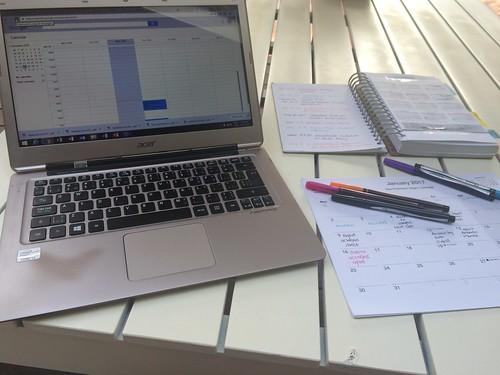
With the generous funding of CONACYT, Mexico’s research agency, I recently launched a project on water conflicts in Mexico. I hired a number of research assistants to my lab a couple of months ago. I am a lead PI with my co-PI being an expert in social network analysis from CentroGEO, Dr. Adriana Aguilar. One of the key elements of the project is the deployment of fieldwork to study six different water-related conflicts across the country. This, obviously, necessitates the coordination of a large research group, and one (very fair) question that my lab members asked was “how will we distribute workloads and assign responsibilities?” This is a question that obviously necessitates the use of a project management software tool. A few weeks ago, I had asked my Twitter followers and Facebook friends for help finding the right project management software (I had used 5pm, BaseCamp, Micro$oft Project, but was recommended Asana, Trello, and others).

Puerto Vallarta Dec 2016 090

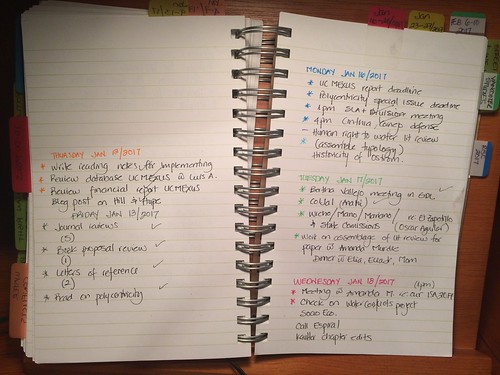
I offer this as as a key piece of context, because I have found myself for the past few weeks avoiding the never easy process of testing project management software that I know will be useful to my entire research team, and yet I haven’t made the time to test different project management tools. This is because, for better or worse, I have also conditioned myself to think of “producing” as “doing research, finding articles, analyzing data, writing up articles/book chapters“. It took me a while to realize that “producing” also implies “reading and grading undergraduate students’ essays, reading graduate students’ theses, writing letters of reference“. Or even testing new software. I avoid administrative work like the plague, but there are meetings that I can’t simply avoid because those short one-on-one meetups are the ones that allow me to give instructions on how funds should be allocated, deal with reimbursements, payments, etc.

Everything Notebook and travel kit

We have, in fact, glorified the idea of busyness, almost like a cult. Since grade school (see my threaded rant below), we have been conditioned to work on weekends. This is particularly true in academic life. To work all the time. Not surprisingly, my dear friend, Dr. Janni Aragon, also wrote about how we are conditioned to always being busy, since we are kids.

And I sincerely acknowledge that I have done the same, even on this blog. I have recommended my readers that they use even 15 minute pockets to do *some* writing. I have suggested that there are 7 ways to procrastinate productively. But as I’ve said before, several times already – academia itself as a profession and academic life is full of contradictions. Squarely against my “productivity tips”, I have written about how we can’t take shortcuts in academia and we need time to reflect and think and really process and soak ideas and mull over them, and think about their implications. I have written in praise of slow scholarship. This would seem, to those who don’t know me well, like a contradiction. But I believe it is not: I want to help you be a more productive academic, but I also want you to take time off, to take care of yourself, of make sure to slow down and don’t give into the glorification of busyness, don’t give into the cult of “productivity”. I have clearly said that there is no “magic bullet” for anything in academia. We are such a heterogeneous population that what works for me may, or may not, work for you.

And like Dr. Amelia Hoover Green said in her post on academia, productivity and mental health, I know that I can speak about taking time off because I’m privileged in the sense that my publication record is decent enough that my tenure case hasn’t been a concern at all. But I also want to acknowledge that this “go, go, go” mentality has had detrimental effects on my own health. I almost died of overwork, TWICE, in the last five years. This is not normal. This is not ok.

So let’s join Janni Aragon in her quest to “not glorify busy“. Busy should not be a status symbol.

One final note – I know I’m one of those people who says “I’m eternally busy”, which I definitely am. But I don’t use “busy” as a status symbol. I use “busy” as a signal to protect my time, and to teach myself to prioritize. I am eternally busy, but if an undergraduate student asks me to help him read an essay over, I WILL MAKE TIME. I am always on the go, travelling, researching, doing fieldwork, but I will connect to Skype at 3 am in the morning to have a conversation with one of my students on how she can deal with an issue at school. I am overwhelmed with the amount of work I have, but I will always make time to spend with my friends, go for a walk, or simply sit down and listen to whatever they need to share. I am fiercely protective of my time, and I know that I use the fact that I’m always busy as a signal, not that I feel like being busy is a status symbol, but as a means to show people in my life that I prioritize where I spend my time.

And sometimes, it’s important to spend that time, researching the best project management tools out there to share with my research lab members.

Or doing nothing and taking a few days off to relax on the beach.

10 May 19:35

Mozilla Awards Nearly $300,000 to Research Grant Winners

by Jofish Kaye

We’re happy to announce the results of the Mozilla Research Grant program for the first half of 2017. This was a competitive process, and after three rounds of judging, we settled on funding nine proposals in five countries for a total of $299,444. These projects support Mozilla’s mission to make the internet safer, more empowering and more accessible.

The Mozilla Research Grants program is part of Mozilla’s Emerging Technologies charter to explore the future of the open internet, and reflects Mozilla’s commitment to open innovation, as well as accelerating our own research. As such, these grants include research supporting our core projects like Firefox and Rust, as well as exploring new domains for the future of the Internet.

Cosmin Munteanu University of Toronto Mississauga Communication, Culture, Information, and Technology A safer Internet for the socially-isolated and digitally-marginalized older adults
Eelke Folmer University of Nevada, Reno Computer Science and Engineering Understanding Gender Differences in VR Locomotion Interfaces
Ethan Hanner University of Colorado Boulder Computer Science Understanding Perceptions of Ethics in Hacktivism
J. Shane Culpepper RMIT University School of Science (Computer Science) Efficient and Effective Multi-Stage Retrieval in Rust
James Clawson Indiana University Bloomington School of Informatics and Computing Designing aurally distinct audio corpora for use in eyes-free text entry evaluations.
Karen Louise Smith Brock University Communication, Popular Culture & Film Add-ons for Privacy: Open Source Advocacy Tactics for Internet Health
Kenneth Heafield University of Edinburgh School of Informatics Open Data: Mining Translations and Transcripts from the Web
Louise Barkhuus The IT University of Copenhagen Department of Digital Design Understanding and encouraging grade school girls’ interest in in computer programing
Taesoo Kim Georgia Tech Computer Science Designing New Operating Primitives to Improve Fuzzing Performance

Congratulations to all successfully funded applicants! The 2017H2 round of grant proposals will open in early August and be due September 1st.

Sean White, Senior Vice President, Emerging Technologies, Mozilla
Jofish Kaye, Principal Research Scientist, Emerging Technologies, Mozilla

The post Mozilla Awards Nearly $300,000 to Research Grant Winners appeared first on The Mozilla Blog.

10 May 19:35

How to increase focus at work in 5 steps

by Ben Taylor

It’s a familiar story. You arrive at work, eager to get started on a new project. Then the distractions begin: a handful of emails, a chatty colleague, a personal errand, a trip to the coffee klatch. You keep trying to concentrate, but for one reason or another, you can’t stay on task.

We know the feeling. That’s why we set out to find some smart tips for increasing concentration at work. Sometimes it just takes a few small adjustments to go from scattered to focused.

1. Simplify your to-do list

When you’re having trouble focusing, it’s tempting to write everything out in a long bulleted list, complete with detailed steps for finishing every project on your agenda. But research suggests a giant to-do list can be overwhelming. You’ll find yourself pulled in several directions and less confident in your ability to get it all done.

Instead, consider focusing on just one goal at a time, with detailed steps only for that particular project. With this approach, you can keep completing full tasks one after the other, rather than trying to chip away at 10 all at once.

2. Establish rituals

It turns out some distractions can be helpful, provided you turn them into rituals. Studies show that practicing small rituals—like preparing a cup of coffee, checking your favorite news site, or stretching before you begin a project—can help you beat procrastination and focus on the task at hand. If you can establish a consistent routine right before you roll up your sleeves, you can train your brain that it’s time to start concentrating.

Just don’t let your rituals become hour-long distractions. It might help to read an article before getting started, but when one story becomes 10, you’re back to wasting time.

3. Do your most thoughtful work in the mid-morning

Your brain tends to be most alert in the mid-morning—about two to four hours after you wake up. Even if you’re a self-proclaimed night owl, you’re still likely to have the clearest head around 10:00 am. From there, your ability to concentrate will begin to fall off, and studies say the decrease becomes even more significant as you reach middle age.

As a result, consider shifting around your daily schedule to maximize your most alert hours. You might move status update meetings, data entry, or social breaks to the afternoon, while switching important presentations, team brainstorming, or creative writing to the mid-morning. If you can find focus for thoughtful projects early in the day, you’ll have time for repetitive or carefree tasks later.

4. Do mindless tasks—including email—in chunks

Your big, important projects tend to get interrupted by small tasks throughout the day, and email is among the worst offenders. Unfortunately, you can’t always just ignore the less urgent requests. One trick is to find a good balance, getting small jobs done without letting them take over your day. Consider the following options:

1. Too hot: You can’t stand leaving any task unfinished, so you always do the small things right away. Unfortunately, you’re never quite able to find flow with your bigger projects.
2. Too cold: You always put off small tasks in favor of the important stuff. Unfortunately, you’ll likely be distracted by that unopened message or lingering question. In fact, knowing you have an unread email can temporarily lower your IQ by 10 points.
3. Just right: You set aside planned, half-hour chunks to knock out emails and minute-long tasks.

When you handle mindless tasks in concentrated, short bursts, you’ll be able to cross them off your list while still leaving uninterrupted time for more thoughtful, creative work.

5. Find breaks for physical activity

Your brain craves breaks—which help recharge your creative energy—but not all breaks are created equal. Ten minutes of browsing social media can help break up the tedium of an assignment, but such breaks might come with a cost. Studies suggest that social networks decrease our ability to think critically and independently.

Meanwhile, taking a break for physical activity has a variety of positive effects, with very little downside. A University of Bristol study found that exercise increases employee concentration, improves mood, helps people solve problems, and gives workers an increased sense of calm.

The trick is finding the time for exercise in a busy workday. Even if you can’t do a full midday workout, a 7-minute burst of activity can still help. If you can fit in a few of these breaks—whether it’s 50 sit-ups, a quick walk with a colleague, or some lunchtime stretching—you’ll take advantage of the activity-based benefits throughout the full day.

In the end, what’s most important is finding the tips that work for you. If you find yourself spending less time fighting distractions—and more time in a creative groove—you’ll know your new habits are paying off.
Grow bigger, brighter ideas with Dropbox Paper. Find out how.

10 May 19:33

Major Android flaw discovered, but won’t be fixed until next build of OS

by Bradly Shankar
Android on phone

A major vulnerability in the Android OS has been discovered by cybersecurity firm Check Point, but reportedly won’t be fixed until the next build, despite Google being aware of the issue.

Check Point says it found the source of the danger comes from the permission model ‘SYSTEM_ALERT_WINDOW,’ which was added in Android version 6.0.0 (“Marshmallow”).

SYSTEM_ALERT_WINDOW is said to be unique in its ability to “enable an app to display over any other app without notifying the user.” This can potentially lead to multiple sources of cyber attacks, including ransomware, banking malware and adware.

According to Check Point, nearly 45 percent of the applications using SYSTEM_ALERT_WINDOW are from the Google Play Store.

Check Point says Google will be fixing this flaw in the upcoming Android O version. In the meantime, Check Point suggests users avoid “fishy apps” by reading comments from other people and to use “a protective solution capable of identifying and blocking known and unknown malware.”

Microsoft users should also be aware of an issue with Windows Defender that led to devices becoming vulnerable to ransomware.

Source: Check Point

Via: Phone Arena 

The post Major Android flaw discovered, but won’t be fixed until next build of OS appeared first on MobileSyrup.

10 May 19:33

Celebrating #Dropbox10: 10 things we don’t miss about working in 2007

by Ben Taylor

Since the company’s founding day in 2007, we’ve been honored to see the Dropbox community develop, grow, and thrive. To celebrate, we’re putting together a series of posts looking back at an exciting—and often surprising—decade. Join us as we reminisce, share a few stories, and reflect on how the industry has changed.

While we sometimes miss the crazy scramble of Dropbox’s early days, there’s a lot more we’re happy to have left behind. Here are 10 things we remember about how the world worked in 2007 (that we don’t miss today).

1. We’d drive to the office just to check email

2. Wading through a pile of voicemails was an evening ritual

3. Everything had to be printed

4. Every other webpage had a long, unskippable intro animation

5. Simple questions would regularly become 10-minute phone calls

6. We’d crowd eight people around a single conference phone so one person could “dial in”

7. Forgetting to sync a new album to your iPod could ruin the whole morning commute

8. We printed out MapQuest directions to get to business lunches

9. All whiteboard notes had to be copied by hand

10. Typing an “s” on our phones meant hitting the 7 key four times

10 May 19:32

Weekly Photo Challenge: Reflecting

by Stephen Rees

When I first saw the photo challenge this week, I thought that I had already done it. That’s because the first time I responded was using a photo of a reflection in a puddle for the challenge “shine”. And the picture I used then looks  a lot like the one the challenger used this week. So when I went looking in my archive, instead of working from most recent backwards, I started at the oldest of the images that happen to reside in Apple photos. This one dates back to April 2009, when I was working on the swing bridge at Annacis Island, and it was unusually still.

Boat reflections

Or perhaps not that unusual since there are 104 pictures of mine in a flickr group called “Favorite Water Reflections“. I just happen to like the look of this one. And the fact that it allows me to take the idea of reflections just a bit further.

I do not regret retiring. But I do often reflect on my experiences when I was working – and indeed you can see the result of that often in this blog. The job of a bridge tender is not exactly demanding most of the time. You have to be there to listen to the radio and be ready to open the bridge if a boat calls. The rest of the time you fill as best you can. Taking pictures – or trawling through the interwebs. Which, of course, is pretty much how I spend a lot of my time now. I am just not at anyone’s beck and call, and can make up my own mind about what to do, and when to do nothing at all. The very small pay cheque I got as a bridge tender is not nearly enough to make me want to go back to that. And recently we were talking about the sort of jobs you can get in retirement – like working on the census or as an election official. I have done both in my time, so it is not an experience I feel much need to repeat. And since there are plenty of people who do need both the experience and the pay cheque more than I do, I do not feel any need to apply for such positions, and wish them all the best. Indeed I do think that more people of my generation (the baby boomers) need to get out of the way of those who really need jobs – or a promotion in their present career.


Filed under: photography Tagged: photo challenge, reflecting, reflections, WordPress