Shared posts

01 Jun 20:27

The Best Managed Kubernetes Hosting in 2026

Author: Angelo Saraceno

Search "best managed Kubernetes hosting" and you get fifty listicles that read like they were written by the same intern with the same affiliate spreadsheet. They rank platforms on cluster provisioning speed and the color of the dashboard, then bury the only question that matters: should you be on Kubernetes at all.

I'm going to answer that question first. Then I'll rank the platforms, because if you've read this far you probably still want the ranking. But I want you to leave this post knowing that the cheapest managed Kubernetes cluster in the world is still more expensive than not running Kubernetes.

House rule: every claim in this post is sourced. If I can't back something up I cut it rather than handwave.

Before Railway I was at Citrix, working on customer environments at Verizon and Lockheed. Those are the kinds of shops where Kubernetes makes sense: enormous service fleets, hard compliance boundaries, platform teams measured in dozens. If your shop does not look like that, keep reading; the honest answer might surprise you.

When Kubernetes is the right answer

There are four shapes of team for whom Kubernetes is the correct answer in 2026. If you don't fit one of these, the rest of this post is mostly entertainment.

You run a large fleet of services. I mean dozens of long-running services with independent release cadences, not a monolith and three workers. Kubernetes earns its complexity tax once you're orchestrating enough services that the cost of managing them by hand exceeds the cost of managing the orchestrator. The break-even point is higher than most teams think. Three services and a cron job is not a fleet.

You have a platform engineering team. Plural. Kubernetes is a platform you build platforms on, not a platform you ship products on. Somebody has to own the cluster, the upgrade path, the ingress controller, the secrets backend, the observability stack, the cost-allocation tagging, and the on-call rotation when CoreDNS decides to have a bad Tuesday. If that somebody is also your senior backend engineer, you don't have a platform team, you have a person who is about to burn out.

You have multi-tenancy or compliance requirements that force your own VPC. Customers in regulated industries (HIPAA-covered health data, PCI cardholder environments, FedRAMP workloads, ITAR-restricted defense) often need workloads inside their own cloud account, with their own network controls, their own audit trail. Bring-your-own-cloud (BYOC) Kubernetes is the right tool when an enterprise customer says "we will not let your runtime touch our data, but we'll let it run in our account." That contract is worth a lot of money and worth a lot of operational complexity.

You have exotic workload requirements. GPU pools for training jobs, specific kernel modules, custom CNI plugins, stateful workloads with operators that only ship as Helm charts, multi-region failover that has to be coordinated at the orchestrator layer. Kubernetes has the longest tail of "yes you can do that" of any platform around. That tail is the product.

If you fit one of these, congratulations, Kubernetes is for you and you should read the rankings below carefully.

If you don't fit any of these, here is the part the other listicles will not tell you: most teams searching for managed Kubernetes are paying an operational tax they did not need to pay. The tax shows up as dashboards nobody reads, runbooks nobody updates, and Slack threads at 2am that start with "our certs expired." A managed control plane removes maybe a third of that tax. You still own the rest.

What managed Kubernetes buys you

Let's be precise about what "managed" means, because the marketing pages elide this on purpose.

When you buy managed Kubernetes, the provider runs the control plane: the API server, etcd, the scheduler, the controller-manager. They handle HA, they handle etcd backups, they handle Kubernetes version upgrades on the control plane (usually behind a button, sometimes automatically). This is real and valuable. Running your own etcd cluster in 2026 should be considered a hostile act against your future self.

What you still own is the data plane and everything that touches it:

  • Nodes: their OS, their kernel patches, their right-sizing, their autoscaling configuration
  • Cluster autoscaler / Karpenter: tuning, eviction policies, spot interruption handling
  • Ingress: picking, deploying, and operating ingress-nginx, Traefik, Envoy Gateway, or your cloud's load balancer integration
  • cert-manager: installing it, configuring issuers, debugging why a Let's Encrypt rate limit ate your renewal
  • Secrets: External Secrets Operator, sealed-secrets, or a Vault integration, and the lifecycle of all of it
  • Observability: Prometheus, Grafana, Loki, OpenTelemetry collectors, and the storage bill behind them
  • Networking: NetworkPolicies, service mesh (or aggressive avoidance of one), egress controls, pod-to-pod encryption if your threat model requires it
  • RBAC and policy: who can deploy what to which namespace, enforced by something like Kyverno or OPA Gatekeeper

If reading that list made you tired, that is the correct response. Managed K8s is "managed" the way a managed apartment building is managed. They fix the boiler. You still have to live there.

The 10 platforms, ranked

At a glance:

Comparison of six managed Kubernetes platforms by control-plane cost and best-fit use case

1. AWS EKS

Best for production workloads that already live in AWS.

Most production Kubernetes in 2026 runs on EKS. That isn't because EKS has the nicest ergonomics (it does not). It's because the rest of the workload is already in AWS, the IAM model is already understood, and the org chart has already grown a team that knows how to wrangle VPCs. EKS wins by gravity.

The control plane is solid, upgrades are well-trodden, and the ecosystem is unmatched: ALB ingress controller, AWS Load Balancer Controller, IRSA for pod-level IAM, EKS Pod Identity for the slightly-less-painful successor, Karpenter for autoscaling that holds up under load.

Features: managed control plane, IRSA / Pod Identity for AWS IAM integration, Karpenter for node autoscaling, EKS Anywhere for on-prem, EKS Auto Mode for fully managed compute, integration with every AWS service you already pay for.

Pricing: $0.10/hour per cluster ($73/month) plus EC2 node costs, plus NAT gateway, plus data transfer, plus the inevitable bill from whatever ALB you forgot about.

Best for: AWS-native shops with a platform team that already speaks IAM fluently.

Honest trade-offs: the AWS networking setup is the cost. Standing up EKS the right way (VPC CNI, subnets, NAT, IRSA, ALB controller, Karpenter, cluster autoscaler, ExternalDNS) is a two-week project for somebody who has done it before, and a quarter-long project for somebody who hasn't. The console is also still slow.

2. Google GKE

Best for teams who want the cleanest Kubernetes experience available.

Google invented Kubernetes (it was Borg, then it was Omega, then it was Kubernetes, the lineage is well documented). GKE shows it. The control plane is the most polished of any cloud provider, upgrades are the least anxiety-inducing, and Autopilot mode is the closest any hyperscaler has come to "Kubernetes but you don't think about nodes."

Autopilot deserves its own paragraph. You pay per-pod for CPU, memory, and ephemeral storage, and Google handles node provisioning, scaling, OS patching, and the rest. For teams who want K8s semantics but don't want to operate the data plane, it is the best deal in the category, with the caveat that you give up some flexibility (DaemonSets are constrained, certain privileged workloads don't run).

Features: Autopilot mode (per-pod pricing, no node management), Standard mode for full control, GKE Enterprise (formerly Anthos) for multi-cluster, native Workload Identity, Gateway API support, image streaming for faster pod starts.

Pricing: Standard mode is $0.10/hour per cluster plus node costs. Autopilot is per-pod (CPU, memory, ephemeral storage) with no separate cluster fee on the first zonal cluster in a billing account. One zonal cluster per billing account is free on the management fee.

Best for: teams without strong AWS gravity who want the cleanest K8s experience available.

Honest trade-offs: GCP's ecosystem outside of GKE is smaller than AWS's, so if your data lives in BigQuery and your compute lives in GKE you're fine, but if you need a hundred adjacent managed services you'll feel the gap. Pricing math for Autopilot can be surprising at scale; benchmark it before committing.

3. Azure AKS

Best for Microsoft-aligned shops, especially enterprise with Entra ID.

AKS is Microsoft's managed Kubernetes, and it lives or dies by your relationship with the rest of the Azure ecosystem. If your identity provider is Entra ID (the artist formerly known as Azure AD), if your compliance answers involve "we use Azure Government," if your developers already have Visual Studio licenses, AKS is a natural fit.

The free tier (no Uptime SLA) is free on the control plane, which is the most aggressive pricing of any hyperscaler. The Standard tier adds an SLA for $0.10/hour per cluster.

Features: free control plane on the no-SLA tier, Entra ID integration, Azure Policy for governance, AKS Automatic for opinionated managed mode, virtual nodes via Azure Container Instances for burst capacity.

Pricing: Free tier control plane is $0. Standard tier with Uptime SLA is $0.10/hour per cluster. Premium tier with long-term support is $0.60/hour. Nodes billed at standard VM rates.

Best for: enterprise shops with Microsoft licensing agreements already in place.

Honest trade-offs: AKS upgrades have historically been the most painful of the big three, though they've gotten better. The defaults for the no-SLA tier are not what you want in production. And the Azure portal remains a UI choice that Microsoft made on purpose.

4. Northflank

Best for teams who want Kubernetes underneath without the Kubernetes ergonomics on top.

Northflank is the most interesting platform in this category because it's honest about what it is: a PaaS-shaped product surface that runs on real Kubernetes underneath, with BYOC into your AWS, GCP, or Azure account at no markup. You get the operational properties of K8s (multi-tenancy, network isolation, custom resource definitions if you need them) without writing YAML for everything.

The pitch lands well for teams who've outgrown a pure PaaS but don't want to staff a platform team. You bring your cloud account, Northflank brings the platform layer.

Features: BYOC into AWS / GCP / Azure with no markup on the underlying compute, build pipelines, preview environments, jobs and workflows, GPU support, addons (Postgres, Redis, etc.).

Pricing: BYOC starts around $300/month for the platform plus your cloud's compute bill at list price. There's also a Northflank-hosted option on their own infrastructure with usage-based pricing.

Best for: teams who want K8s semantics for compliance or multi-tenancy reasons but don't want to operate Kubernetes themselves.

Honest trade-offs: you're trusting another vendor's control plane abstraction over your cloud account, which means you've added a layer that can break, and a layer you can't fix yourself. The pricing only makes sense once you're at a certain scale; below that, you're better off on a pure PaaS.

5. DigitalOcean Managed Kubernetes

Best for accessible mid-tier workloads that don't need hyperscaler depth.

DigitalOcean's managed Kubernetes (DOKS) is the platform that introduced a generation of indie devs and small teams to "managed K8s." The control plane is free, the droplets are reasonably priced, and the dashboard does not require a PhD.

Features: free control plane, integrated load balancers, block storage via DO Volumes, container registry, 1-click app marketplace for Helm charts.

Pricing: control plane is $0. Standard droplet nodes start around $12/month for the smallest viable size. HA control plane is an extra $40/month per cluster if you want it (you do, for anything resembling production).

Best for: small to mid-size teams who want K8s without an AWS bill.

Honest trade-offs: the ecosystem is shallow compared to the hyperscalers. If you need GPU pools, advanced networking, or anything exotic, you'll outgrow it. The HA control plane being an upsell is mildly annoying.

6. Linode Kubernetes Engine (Akamai)

Best for teams who want DigitalOcean's shape with Akamai's network footprint.

LKE is structurally similar to DOKS: free control plane, reasonable node pricing, accessible dashboard. The differentiator since the Akamai acquisition is the network. Linode nodes now sit closer to Akamai's edge, which matters if you're doing anything latency-sensitive.

Features: free standard control plane, HA control plane upgrade available, integrated NodeBalancers, block storage, object storage.

Pricing: Standard control plane is $0. HA control plane is $60/month per cluster. Nodes start around $12/month for a 1GB shared CPU plan; production-shaped nodes are in the $30-100/month range.

Best for: teams with a latency-sensitive workload who want managed K8s without hyperscaler complexity.

Honest trade-offs: smaller ecosystem than the hyperscalers, smaller community than DigitalOcean, and the Akamai integration story is still maturing. Documentation quality is uneven.

7. Civo

Best for fastest cluster provisioning, K8s-first cloud.

Civo built their cloud around Kubernetes from the start, on k3s. The marketing claim is cluster creation in under 90 seconds, and in my testing that's roughly accurate. If you're the kind of team that spins up and tears down clusters for CI or for ephemeral environments, that speed is a real product advantage.

Features: k3s-based clusters, cluster creation in roughly 90 seconds, simple flat-rate pricing, GPU instances, marketplace apps.

Pricing: nodes start around $10/month for the smallest size, with a free control plane on standard clusters.

Best for: teams whose workflow involves frequent cluster creation, or who want a K8s-first cloud rather than a general cloud with K8s bolted on.

Honest trade-offs: smaller scale than the hyperscalers, fewer regions, and k3s has some semantic differences from upstream Kubernetes that can bite you in edge cases (etcd is replaced with SQLite or embedded etcd, certain controllers are absent by default).

8. Vultr Kubernetes Engine

Best for budget-conscious teams who want VPS-flavored Kubernetes.

VKE is Vultr's managed Kubernetes, and it competes on price. The control plane is free, the nodes are some of the cheapest in the market, and the regional footprint is wide.

Features: free control plane, integrated load balancers, block storage, wide regional coverage including secondary markets.

Pricing: control plane is $0. Nodes start around $6/month for the smallest size, with production-shaped nodes in the $20-50/month range.

Best for: budget-sensitive workloads, especially in regions where the hyperscalers don't have a nearby presence.

Honest trade-offs: the support experience is what you'd expect for the price. The dashboard is functional but not delightful. Ecosystem depth is the shallowest on this list.

9. OVHcloud Managed Kubernetes

Best for European data residency and sovereignty requirements.

OVHcloud is the answer when your compliance posture demands that your data stays in the EU, under EU jurisdiction, on infrastructure owned by an EU company. Post-Schrems-II, that question gets asked a lot more than American teams realize.

Features: managed control plane, EU data residency, integrated with OVHcloud's broader infrastructure (bare metal, public cloud, private cloud), GDPR-aligned operating model.

Pricing: control plane is free. Nodes billed at OVHcloud's public cloud rates, generally competitive with the hyperscalers in EU regions.

Best for: European teams, or teams selling to European customers who require EU-sovereign hosting.

Honest trade-offs: the ecosystem outside of OVHcloud's own services is thinner than the hyperscalers, and the operational tooling is more European in style, which is a polite way of saying the docs assume you know what you're doing. The 2021 Strasbourg datacenter fire is a memory that informs current architecture decisions, and OVHcloud has been transparent about their changes since, but it's worth reading up on if you haven't.

10. Self-hosted (k3s, kubeadm, Talos Linux)

Best for teams who want to run their own.

Self-hosted Kubernetes is free in licensing and expensive in operations. The tooling has gotten dramatically better in the last few years. k3s gives you a single-binary lightweight distribution that's appropriate for edge and small clusters. kubeadm is the canonical "I want vanilla K8s and I'll bring my own automation" path. Talos Linux is the most interesting modern entry: an immutable, API-driven Linux distribution built specifically to run Kubernetes, with no SSH and no shell, configured entirely through declarative manifests.

Features: total control, no per-cluster fee, your hardware (or your VMs) your rules.

Pricing: free in software. Your time, your servers, your on-call.

Best for: teams with a real reason to self-host (sovereignty, air-gapped, specific hardware) and the operational maturity to back it up.

Honest trade-offs: you are now the managed control plane provider. Upgrades are yours. etcd backups are yours. The 3am page when the control plane goes down is yours. Talos Linux makes this much more reasonable than it used to be, but "reasonable" is doing a lot of work in that sentence.

Six K8s-shaped decision questions

Before you pick a platform from the list above, answer these honestly:

  1. Do you have at least two engineers whose job will be the cluster? If no, you don't have a platform team, and you're going to feel it.
  2. Do you have more than a dozen long-running services? If no, the orchestrator complexity is greater than the orchestration value.
  3. Do you have a compliance or contractual requirement that forces your own VPC? If yes, K8s might be the cleanest path. If no, that's not a reason.
  4. Do you have workloads that need K8s primitives (operators, CRDs, DaemonSets, custom schedulers)? If you can't name the specific primitive, you don't.
  5. Are you willing to own ingress, cert-manager, secrets, observability, and networking forever? The control plane is managed. Everything else is you.
  6. Is your team's time worth more than the operational tax? If yes, that's the answer.

If you answered no to most of these, the question isn't "which managed Kubernetes." The question is "why am I considering Kubernetes."

Closing

The vanilla-cloud anchor for this category remains AWS EKS. If you must run Kubernetes in production and you don't have a strong reason to pick something else, EKS is the default, and the listicles that rank it lower are usually selling you something.

Railway is intentionally not on this list. We are not a Kubernetes platform. That's a feature, not a bug, for the vast majority of teams who land on a post like this. If you don't fit one of the four shapes at the top of this article, the honest move is to save yourself the operational quarter and ship on a platform that handles the boring parts (build, deploy, networking, observability, scaling) without making you hire a platform team to do it.

If you fit one of those four shapes, K8s is the right answer, and you should pick from the list above based on where your gravity already is.

Happy shipping.

Angelo


Angelo Saraceno is a Solutions Engineer at Railway. Before Railway he was at Citrix, working inside Verizon and Lockheed environments, so he has seen what "enterprise IaaS" looks like after the slides come down. He writes about infrastructure, deployment, and the gap between how cloud is sold and how it runs in practice.


Try Railway →

01 Jun 20:18

Pedraz imputa a la cúpula de la UDEF durante el gobierno del PP por presunto espionaje a Podemos.

by Fino

Pedraz imputa a la cúpula de la UDEF durante el gobierno del PP por presunto espionaje a Podemos.

El juez de la Audiencia Nacional ha imputado al excomisario José Manuel García Catalán, a petición de Pablo Iglesias, y le ha citado a declarar el próximo jueves 25 de junio. Catalán, junto a otro funcionario de policía que aparece citado en el escrito al que ha tenido acceso RTVE por su número de placa, tendrá que aclarar si entre 2015 y 2016, siendo Jorge Fernández Díaz ministro del Interior del Ejecutivo de Mariano Rajoy, la Unidad de Delincuencia Económica y Fiscal llevó a cabo investigaciones irregulares contra Podemos. @rtve

Pedraz imputa a la cúpula de la UDEF durante el gobierno del PP por presunto espionaje a Podemos.

Pedraz imputa a la cúpula de la UDEF durante el gobierno del PP por presunto espionaje a Podemos.

Ver post completo: Pedraz imputa a la cúpula de la UDEF durante el gobierno del PP por presunto espionaje a Podemos.

01 Jun 20:17

Introducing the GKE standby buffer: Improve node startup times without blowing your budget

by Eyal Yablonka

Application owners and platform engineers have long faced a difficult choice: spend excessively by over-provisioning to guarantee quick startups, or minimize costs but endure slow cold starts.

We are excited to announce a solution to this compromise: Google Kubernetes Engine standby buffers. This builds on the launch of GKE active buffers earlier this year, a native version of the Kubernetes CapacityBuffers API that makes it easy to provision readily available capacity to handle traffic spikes, delivering near-zero startup latency for new pods. However, active buffers still impose a trade-off between performance and cost. New GKE standby buffers help by maintaining a low-cost, suspended capacity buffer for your GKE clusters. With a cost overhead in the low single-digit percent, GKE standby buffers help you achieve near-immediate scheduling for your workloads with negligible cost overhead. This is useful for all kinds of workloads — general-purpose, agentic, and everything in between.

1

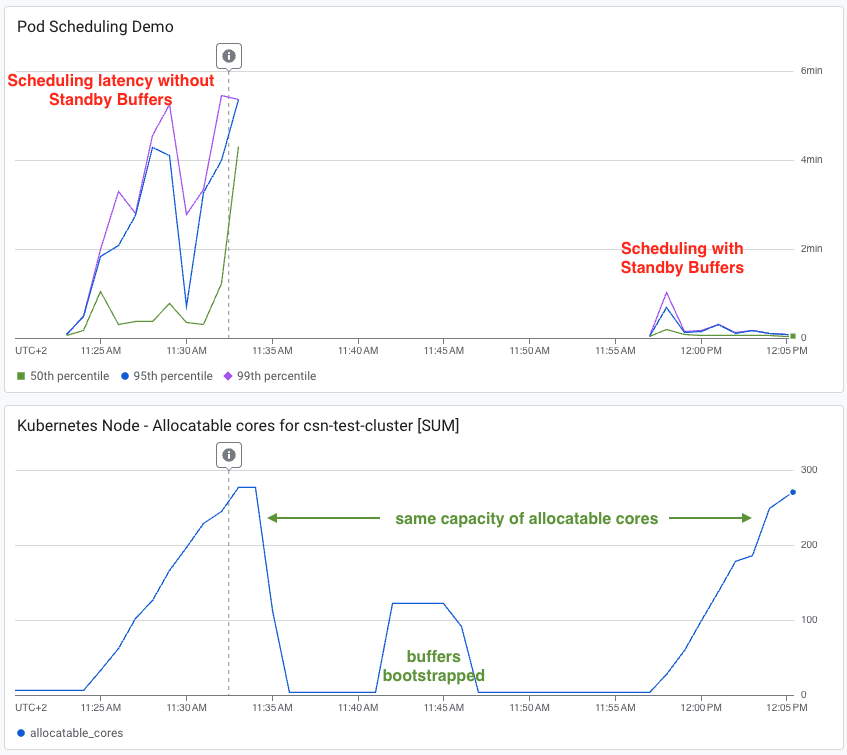
Under identical traffic loads, the cluster without standby buffers suffered severe latency spikes, with P50, P95, and P99 metrics trapped between 4 and 6 minutes. Conversely, the cluster with standby buffers maintained a P50 latency of just single-digit seconds, while its P95 and P99 metrics briefly peaked at one minute before quickly normalizing to single-digit seconds. Both setups exhibited a similar allocatable core cost, making the buffered approach far more efficient.

The problem: High costs and latency

Traditionally, autoscaling with standard Kubernetes has been effective but slow. Traffic surges or batch jobs require cluster autoscalers to provision fresh nodes, leaving Pods in a pending state. To circumvent delays, you have to resort to clunky workarounds like lowering your Horizontal Pod Autoscaler (HPA) thresholds or managing so-called balloon pods. These workarounds are expensive: 

  • Managing balloon pods is operationally complex, requiring manual configuration and ongoing maintenance of priority classes and resource requests to ensure they function correctly.

  • Lowering the HPA threshold adds empty (wasted) space that linearly scales with the size of the node pool.

Both GKE active and standby buffers allow capacity to be defined declaratively, removing the need for clunky and operationally heavy workarounds.

In addition, GKE standby buffers lower infrastructure costs by storing the node’s state to disk, releasing compute and memory costs and keeping only persistent disk and IP address costs. Then, combined with an active buffer, you can achieve near-instant pod scheduling that has similar performance to over-provisioning, but at a very affordable price.

Active and standby buffers working together

All GKE capacity buffers operate on a principle similar to video streaming on platforms like YouTube. By proactively attempting to provision and manage available capacity ahead of impending demand (much like pre-downloading video content) GKE helps to ensure that resources are readily available when they’re needed.

With today’s launch, the two types of capacity buffers can work in harmony:

  • Active buffer: Cluster Autoscaler works to reserve enough capacity for a predefined amount of pods on existing cluster nodes, and, if needed, provisions extra nodes. Select this ready-to-use buffer to provide capacity to your most latency-sensitive workloads. 

  • Standby buffers: Nodes are pre-provisioned and fully initialized with necessary components like Kubernetes DaemonSets, and given time to preload images, but are then suspended, while the underlying compute capacity is released to save costs. When demand spikes, these nodes resume 2-3x faster than creating a fresh node, bridging the gap between cold starts and always-on capacity.

The active buffer covers the initial spike until standby buffers resume. The system prioritizes refilling the active buffer from the standby buffer. The standby buffer handles an extended load and protects against slower node cold starts. As standby buffers refill, they initially kick into an active state for a configurable amount of time before they are suspended, providing a boost of active capacity during sustained traffic loads.

Early benchmarks

In our tests, using standby buffers enabled us to deliver sub-second Agent Sandbox scheduling latency for up to 90% lower cost compared to complete overprovisioning.

2 GKE Buffers Cloud Metrics

Optimized for business needs

Businesses are under constant pressure to optimize resource consumption while streamlining operations. Recognizing that organizations need smarter tools to manage sporadic and spikey workloads, we worked hard to deliver standby buffers quickly. Now, whether you’re running agents, batch jobs, CI/CD pipelines, game servers, or spiky workloads, GKE capacity buffers allow you to dynamically balance performance and cost. You can finally define your "insurance policy" against traffic spikes without paying a high premium for it. With GKE standby buffers you can:

  1. Circumvent cold starts: Nodes suspended by standby buffers resume 2-3x faster than provisioning fresh nodes, reducing pod scheduling latency during traffic spikes and sustained traffic load.

  2. Enjoy lower costs: A standby buffer incurs a fraction of the cost of active capacity because the underlying VM is suspended. You pay for storage and an IP address, rather than for full compute-hours.

  3. Gain declarative control: Replace complex balloon pod workarounds with the simple, native declarative CapacityBuffers API, explicitly stating how much headroom you need, and letting GKE handle the rest.

unico

“Using GKE standby capacity buffers has lowered our time-to-ready from several minutes to 30 seconds at a very affordable price.”
- Pedro Spagiari, Chief Architect at Unico

Get started

Ready to improve your performance and save on costs?

  • Start by defining a CapacityBuffer resource in your cluster to specify your target buffer size.

  • Try balancing between standby buffers to reduce pod scheduling latency for sustained loads, and active buffers to address immediate unpredictable capacity needs.

Let’s look at an example of how to configure buffers for a Deployment while also using custom ComputeClasses.

Basic setup

Beginning with some basic setup, create a namespace:

code_block
<ListValue: [StructValue([('code', 'apiVersion: v1\r\nkind: Namespace\r\nmetadata:\r\n name: my-namespace'), ('language', ''), ('caption', <wagtail.rich_text.RichText object at 0x7f41f817d670>)])]>

Then, create a custom ComputeClass (optional):

code_block
<ListValue: [StructValue([('code', 'apiVersion: cloud.google.com/v1\r\nkind: ComputeClass\r\nmetadata:\r\n name: my-ccc\r\n namespace: my-namespace\r\nspec:\r\n # Buffers will also be created according to these priorities \r\n priorities:\r\n - machineFamily: n4\r\n - machineFamily: n4d\r\n - machineFamily: c4\r\n - machineFamily: c4d\r\n nodePoolAutoCreation:\r\n enabled: true'), ('language', ''), ('caption', <wagtail.rich_text.RichText object at 0x7f41f845f370>)])]>

Define the buffer unit size

You can use a PodTemplate as a reference for the buffer unit size. You can also create a buffer for a  specific deployment or any object that defines scale subResource.

code_block
<ListValue: [StructValue([('code', '# Defines the resource requirements for one unit of buffer.\r\napiVersion: v1\r\nkind: PodTemplate\r\nmetadata:\r\n name: my-buffer-unit-template\r\n namespace: my-namespace\r\ntemplate:\r\n spec:\r\n terminationGracePeriodSeconds: 0\r\n tolerations:\r\n # Optional: Ensures buffer pods can land on any node.\r\n - key: "node-role.kubernetes.io/master"\r\n operator: "Exists"\r\n effect: "NoSchedule"\r\n containers:\r\n - name: buffer-container\r\n image: registry.k8s.io/pause:3.9\r\n resources:\r\n requests:\r\n cpu: "1"\r\n memory: "1Gi"\r\n limits:\r\n cpu: "1"\r\n memory: "1Gi"\r\n # Optional: Using buffers with a custom ComputeClass / \r\n # controls the properties of the nodes GKE provisions. \r\n nodeSelector:\r\n cloud.google.com/compute-class: my-ccc'), ('language', ''), ('caption', <wagtail.rich_text.RichText object at 0x7f41f845f400>)])]>

Create buffers

Lastly, create a CapacityBuffer object by referring to our PodTemplate. Here, you create a standby buffer of 50 CPUs and 50 GB of RAM:

code_block
<ListValue: [StructValue([('code', 'apiVersion: autoscaling.x-k8s.io/v1beta1\r\nkind: CapacityBuffer\r\nmetadata:\r\n name: my-standby-buffer-resource-limits\r\n namespace: my-namespace\r\n annotations:\r\n # Optional: Time after which buffer nodes are suspended.\r\n # Default is 5 minutes. \r\n buffer.gke.io/standby-capacity-init-time: "5m"\r\n # Optional: Time after which standby buffers are recreated.\r\n # Default is 1 day, "never" avoids refreshing. \r\n buffer.gke.io/standby-capacity-refresh-frequency: "1d"\r\nspec:\r\n podTemplateRef:\r\n name: my-buffer-unit-template\r\n # The desired state is 20 standby buffer units.\r\n # When a standby buffer gets used, a new one gets created.\r\n limits:\r\n cpu: "50"\r\n memory: "50Gi"\r\n provisioningStrategy: "buffer.gke.io/standby-capacity"'), ('language', ''), ('caption', <wagtail.rich_text.RichText object at 0x7f41f845f880>)])]>

And an active buffer of seven 5 CPUs and 5 GB of RAM (optional):

code_block
<ListValue: [StructValue([('code', 'apiVersion: autoscaling.x-k8s.io/v1beta1\r\nkind: CapacityBuffer\r\nmetadata:\r\n name: my-active-buffer-resource-limits\r\n namespace: my-namespace\r\nspec:\r\n podTemplateRef:\r\n name: my-buffer-unit-template\r\n # The desired state is 2 active buffer units.\r\n # When an active buffer gets used, a new one gets created. \r\n limits:\r\n cpu: "5"\r\n memory: "5Gi"\r\n provisioningStrategy: "buffer.x-k8s.io/active-capacity"'), ('language', ''), ('caption', <wagtail.rich_text.RichText object at 0x7f41f845f670>)])]>

Finally, apply the above objects to your cluster. That’s it!

Now, any existing and future deployments that can schedule on the space reserved by the buffers will benefit from faster pod scheduling latencies.

Test the buffers

You can check on the status of your buffers. In Kubernetes, suspended nodes can be identified by condition Suspended.

code_block
<ListValue: [StructValue([('code', 'kubectl get nodes -o custom-columns=\'NAME:.metadata.name,SUSPENDED:.status.conditions[?(@.type=="Suspended")].status\''), ('language', ''), ('caption', <wagtail.rich_text.RichText object at 0x7f41f8177b50>)])]>

Expect the following kind of output, and wait for the standby buffers to get suspended.

code_block
<ListValue: [StructValue([('code', 'NAME SUSPENDED\r\ngke-my-cluster-nap-n4-standard-8-k960-...-ffbx False # Node has been resumed.\r\ngke-my-cluster-nap-n4-standard-4-k960-...-h2x4 <none> # Node was never suspended.\r\ngke-my-cluster-nap-n4d-standard-8-1cip-...-74jf True # Node is suspended.'), ('language', ''), ('caption', <wagtail.rich_text.RichText object at 0x7f41f9cbcd60>)])]>

To test the buffers, create a deployment and scale it.

code_block
<ListValue: [StructValue([('code', 'apiVersion: apps/v1\r\nkind: Deployment\r\nmetadata:\r\n name: my-deployment\r\n namespace: my-namespace\r\nspec:\r\n replicas: 1\r\n selector:\r\n matchLabels:\r\n app: my-deployment\r\n template:\r\n metadata:\r\n labels:\r\n app: my-deployment\r\n spec:\r\n containers:\r\n - name: busybox\r\n image: busybox\r\n command: ["sleep", "inf"]\r\n resources:\r\n requests:\r\n cpu: "500m"\r\n memory: "500Mi"\r\n # Optional: Using buffers with a custom ComputeClass /\r\n # controls the properties of the nodes GKE provisions. \r\n nodeSelector:\r\n cloud.google.com/compute-class: my-ccc'), ('language', ''), ('caption', <wagtail.rich_text.RichText object at 0x7f41f902e160>)])]>

Scaling this deployment to two replicas allows them to be assigned to the active buffer for immediate scheduling. The active buffer is then immediately refilled from the standby buffer. Simultaneously, the standby buffer initiates the provisioning of new nodes.

If you further scale the deployment to 50 replicas, scheduling all of them on the standby buffer occurs once the nodes resume. New nodes provisioned to refill the standby buffer briefly function as active buffers providing a temporary active standby boost. Therefore, when further scaling the deployment to 100 replicas during this time, you may notice that new replicas benefit from immediate scheduling.

GKE standby buffer best practices

When working with GKE standby buffers, here are a few things to consider:

  1. Define standby buffers that are sufficient to cover the extended load you expect to encounter, so that buffers can refill in the background from a cold start. A sufficiently sized standby buffer can drop your max pod scheduling latency to the time it takes to resume a node — around 30 seconds.

  2. When the buffer starts to get used and is refilled, new buffer nodes initially swing into an active state prior to suspending. This helps to boost active capacity during a prolonged load.

  3. If your application requires the lowest possible pod scheduling latency, define an active buffer size that is sufficient to cover any initial spikes you expect to encounter until standby buffer nodes are able to resume. The system prioritizes refilling the active buffer by consuming the standby buffer. A sufficiently sized active buffer and a sufficiently sized standby buffer can help you achieve one-second pod scheduling latency for a fraction of the cost of overprovisioning.

  4. Experiment with different buffer sizes to get the best result for your workload.

To help, we created a simulator to help with sizing the buffers to achieve your performance targets, available at https://github.com/gke-labs/buffers-simulator

Try it yourself!

Active and standby buffers in GKE provide a native solution for low-latency and cost-effective workload scaling by maintaining warm and standby capacity buffers. By circumventing slow node cold starts, buffers help performance-critical applications handle sudden traffic spikes. This feature replaces complex manual workarounds like balloon pods with a simple, declarative API, and allows for fixed, percentage-based, or resource-limited buffering strategies to help maintain strict service-level objectives cost-effectively and without over-provisioning for peak.

Standby buffers are available for GKE clusters running version 1.36.0-gke.2253000 or later. To get started with buffers, check out the documentation.

01 Jun 20:16

U.S. names with the oldest population

by Nathan Yau

Erin Davis calculated the average age of people with a given name to find the oldest name in the United States:

In short, the U.S. government produces estimates of the share of people born in year X who will still be alive in year Y. It also produces data on how many babies with a given name are born in each year.

By combining these two datasets, we can estimate how many babies with a specific name born in year X are still alive in 2025. Then, we can use those numbers to find a weighted average age for that name. (One big flaw this doesn’t account for immigration, but I haven’t found a way around that)

Myrtle wins for oldest average age. Davis provides an interactive version to search for your name.

Tags: age, Erin Davis, names

01 Jun 20:16

You’ve been trying to get around Amazon – but it’s not that easy

by Yuanyuan (Gina) Cui, Assistant Professor of Marketing, Coastal Carolina University
Many online shoppers who order from independent small retailers have no idea who ships their goods. Odds are growing that it's Amazon. AP Photo/Damian Dovarganes

You did the right thing this morning.

Instead of the one-click default to your laptop’s last opened tab, you opened Etsy and bought a ceramic mug from a maker you’d been following on Instagram. Yesterday, your sister’s birthday gift came from a Shopify store run by a kitchenware designer in Sacramento, California. You felt something when you clicked “buy,” a small, warm, fuzzy feeling. Not Amazon. Not a giant. Someone real.

The package will arrive on time, in unmarked brown cardboard, in two days.

It will arrive that way because Amazon delivered it.

On May 4, 2026, Amazon announced the launch of Amazon Supply Chain Services. It opens Amazon’s warehouses, trucks and delivery network – built over decades to ship products from its own website – to outside companies of any size. Procter & Gamble, 3M, Lands’ End and American Eagle are among the first customers. The headlines framed it as a logistics story – Amazon is coming for UPS and FedEx – and most coverage stopped there.

Amazon’s announcement that it would open its logistics network to other companies has major implications for consumers trying to ‘shop small.’

But the bigger shift is one that consumers can’t see, and it has to do with how they support small businesses. A 2024 Pew Research survey found that 86% of Americans say small businesses have a positive effect on the country. For the millions of shoppers who have been redirecting their dollars away from corporate giants and toward small and local businesses, the May 4 announcement isn’t a logistics story at all. It’s about whether that effort still means what they think it means.

We’re scholars of consumer behavior and marketing who study how people square their purchasing decisions with ethical considerations, and we see a growing dilemma for consumers: If you pick the small brand instead of the giant, part of your payment actually goes somewhere you don’t expect. You may think you’ve made a conscious choice, but you’ve just walked through a different door into the same store.

And it’s getting harder and harder to escape.

Invisible but growing

Dragon Glassware is a small kitchenware company that began in a garage in Sacramento in 2017. You may have bought one of their wine glasses on their Shopify website, drawn in by the founder’s story and the small-business feel. Yet the order was picked, packed and shipped from an Amazon warehouse.

Another example is Poppi, which started at a Texas farmers market and went viral on TikTok as a cooler, healthier alternative to the giant soda companies. For years, the cans you ordered from Poppi’s own website – the ones that felt like a vote against Big Soda – were shipped to you by Amazon. Poppi was sold to PepsiCo for nearly US$2 billion in 2025, which is its own David-becomes-Goliath story.

These aren’t rare cases. Amazon’s Multi-Channel Fulfillment program, the service that ships these orders, now serves more than 200,000 U.S. merchants, and the network grew by roughly 70% in 2024 alone, according to Amazon. The same Amazon service also handles fulfillment for sellers on Shopify, Etsy, eBay and TikTok Shop. But you wouldn’t know this — the packaging is left unmarked by design.

What changed on May 4 is that Amazon opened this service up for all businesses – not just the small brands that have been there all along, but every kind of company at every size, from American Eagle retail orders to Procter & Gamble raw-material shipments between factories.

Peter Larsen, the executive quoted in the May 4 press release, said Amazon is doing for shipping what Amazon Web Services did for the internet. But there’s more to that comparison. Most people don’t know which websites run on AWS, and they don’t care. That’s the kind of invisibility Amazon is now building underneath physical things, too.

A blue and white airplane labeled Amazon Supply Chain Services flies over clouds.
Amazon Supply Chain Services announced on May 4, 2026, that it’s opening up its shipping and logistics services to all companies, a sign of its growing reach. Business Wire photo illustration

It’s also extremely lucrative. Amazon collects a fulfillment fee on every order it ships for an outside brand – roughly $15 for a three-pound package shipped in two days, according to Amazon’s own published rates. It also collects monthly storage fees on that brand’s inventory. And it gathers real-time visibility into what every competitor sells, to whom, in what quantities, at what moments of the year.

Amazon CEO Andy Jassy publicly described Supply Chain Services as a “major growth opportunity.” When Amazon says growth opportunity, it means the same thing it said about AWS – a business that could one day rival its retail arm.

Why the small brands are using Amazon

It’s tempting to think the small brands are selling out. They’re not. They’re doing the math.

A small kitchenware founder shipping out of her own garage can only get a wine glass to a customer in three to five days. Amazon’s network can get there in two. After 15 years of Amazon Prime, two-day delivery isn’t a luxury – it’s what shoppers expect. Small brands that can’t match it lose sales. Independent fulfillment companies exist, but Amazon’s service is typically cheaper and integrates directly with the platforms small brands already sell on, such as Shopify, Etsy, TikTok Shop and eBay.

The bigger implication is upstream, however. Amazon now controls roughly four out of every 10 dollars Americans spend online – more than four times the share of its nearest competitor. A small brand that wants to be discovered by new customers has little choice but to be on Amazon. Once there, the path of least resistance is to use Amazon’s warehouses for everything – including the orders that come in from Shopify and Etsy.

So for consumers, the choice technically exists. But the economics make it a decoy. And the more small brands are routed through Amazon’s network, the more Amazon can raise fees, change terms and shape the conditions for small commerce. In fact, Multi-Channel Fulfillment prices have already risen for three years running.

If even Procter & Gamble has decided to route part of its logistics through Amazon, what can a kitchenware founder in Sacramento realistically do?

For years, you’ve been telling yourself something every time you supported a small business – that your dollars meant something, that you weren’t pouring every dollar into the same handful of giants. But what does shopping your values even mean when the system underneath is invisible?

The impulse to shop your values isn’t naive. But it’s becoming harder to act on. For small businesses caught in the middle, deeper dependence on Amazon’s logistics means rising fees, with no leverage to push back. For those consumers who want choices, it means something uncomfortable: They can keep trying harder to avoid the giants, but the giants keep getting bigger anyway.

The mug will arrive Tuesday. It will be beautiful, made by hand, wrapped in brown paper tied with twine. The truck pulling up outside won’t have a logo on it. None of that is an accident. All of it is by design.

The Conversation

The authors do not work for, consult, own shares in or receive funding from any company or organization that would benefit from this article, and have disclosed no relevant affiliations beyond their academic appointment.

01 Jun 18:34

Una química israelí que vendió fósforo blanco militar deja en Catalunya 45 millones de toneladas de sal contaminante

by UNOMAS83

La montaña de sal de la empresa ICL Ibérica ha contaminado el río Llobregat y sus alrededores, según denuncian el documental 'Sal a la ferida' y varias sentencias judiciales

etiquetas: contaminación, fósforo blanco, israel

» noticia original (www.eldiario.es)

01 Jun 18:33

Cambios en la jubilación flexible

by Ripio

Se ha publicado un decreto que mejora para los trabajadores algunos aspectos de la jubilación flexible. Es parecida a la jubilación parcial pero volviendo a trabajar después de jubilarse, manteniendo el cobro de la pensión con un descuento, de forma que se pueda ganar más dinero en total que cobrando solo la pensión. El Gobierno no lo va a reconocer, pero os podemos confirmar que la principal dificultad real de la jubilación flexible es encontrar empresarios que quieran contratar a jubilados y encima a jornada parcial.

etiquetas: cambios, jubilación flexible, trabajo

» noticia original (laboro-spain.blogspot.com)

01 Jun 18:33

Las fachadas y portales de pisos turísticos, vandalizadas en Asturias en protesta contra la turistificación de los barrios

by Dakaira

Las pintadas llevan el lema 'Su negocio, nuestra ruina. 6J XIXÓN' que es el que presidirá la manifestación convocada por el Sindicatu Vivienda d'Asturies y el Sindicato de inquilinas e inquilinos de Asturias para el próximo sábado, 6 de junio, en Gijón en contra de la especulación inmobiliaria.

etiquetas: turistificacion, asturias, 6j xixón

» noticia original (www.eldiario.es)

01 Jun 18:33

Martín Varsavsky, tras los disturbios del PSG: "Europa necesita un Milei y un Bukele"

by Oghaio

Las declaraciones de Varsavsky reflejan una tendencia que viene creciendo entre ciertos sectores políticos y empresariales: la admiración por las políticas de ajuste económico de Javier Milei en Argentina y la estrategia de seguridad implementada por Nayib Bukele en El Salvador.

etiquetas: martín varsavsky, disturbios, psg, milei, bukele

» noticia original (eleconomista.com.ar)

01 Jun 17:12

La política en España nos mantiene con décadas de retraso en temas que son VITALES.

by Fino
01 Jun 16:56

AWS Weekly Roundup: Claude Opus 4.8 on AWS, Aurora MySQL with Kiro Powers, and more (June 1, 2026)

by Micah Walter

In my last Week in Review post, I shared what I’d been hearing from customers in the AI-Driven Development Lifecycle (AI-DLC) workshops I’ve been delivering. Last week I was back at it, this time in Denver for a two-day AI-DLC workshop, where I helped facilitate 17 teams to deliver nearly 20 separate use cases in just two days. The pace of acceleration that AI-DLC unlocks—especially when paired with tools like Claude Code on Amazon Bedrock—is fundamentally changing how businesses operate. Traditional roles within software development teams are collapsing into smaller, AI-augmented squads, and the paradigm shift is beginning to take place right in front of us. To learn more about how to utilize various AI tools, visit the GitHub repository of AI-DLC workflow.

This shift is also reshaping how AWS account teams (solutions architects, customer solutions managers, and technical account managers) collaborate with customers. It’s becoming less about handing off advisory design documents and more about building alongside them in real time. It’s a genuinely exciting moment to be in the middle of the change, and this week’s headline launch — Anthropic’s most capable model yet, now on AWS — is going to push that pace even further.

Now, let’s get into this week’s AWS news…

Headlines
Claude Opus 4.8 on AWS — Anthropic’s most capable generally available model is now accessible through both Amazon Bedrock and the Claude Platform on AWS. Opus 4.8 is built for agentic coding, knowledge work, and extended autonomous task execution — it sustains longer autonomous sessions with deeper reasoning, recovers from errors, and synthesizes information across lengthy documents. For coding workloads, it reads codebases like an engineer, plans before it edits, and holds context across long sessions. On Amazon Bedrock, you get AWS-managed features like Guardrails, Knowledge Bases, and data residency; on the Claude Platform on AWS, you get Anthropic’s native APIs unified with AWS billing. To learn more, visit the deep-dive blog post.

Last week’s launches
Here are some launches and updates from this past week that caught my attention:

  • Introducing the next generation of AWS Resilience Hub — A reimagined Resilience Hub gives SREs and developers a unified framework to define resilience standards, evaluate applications against them, and demonstrate compliance across an entire portfolio. It introduces modular resilience policies (covering service-level objectives (SLOs), multi-AZ/Region DR, and data recovery), business-oriented application modeling, generative AI-powered assessments aligned with the Well-Architected and Resilience Analysis Frameworks, and automatic dependency discovery via DNS query log analysis. Integration with AWS Organizations enables organization-wide resilience management from a single delegated administrator account.
  • Introducing the next generation of Amazon OpenSearch Serverless for building agentic AI applications — Amazon OpenSearch Serverless is now a fully managed search and vector engine purpose-built for agentic AI applications. It scales from zero to thousands of requests per second—roughly 20x faster than the prior generation—delivers up to 60% cost savings versus peak-provisioned clusters, and adds GPU acceleration plus new SEARCH and VECTORSEARCH collection types. Native integrations with Vercel, Kiro, Claude Code, and Cursor through OpenSearch Agent Skills make it straightforward to plug into your agent stack.
  • New assessment capabilities in AWS Transform — AWS Transform expands with new tools to help you build migration business cases and evaluate TCO before moving workloads to AWS. You can ingest data from RVTools exports, CMDB data, the AWS Transform discovery tool, and third-party discovery tools, then run what-if scenarios across region, utilization, and service mapping for EC2, FSx, S3, SQL Server on EC2, and virtual desktops. The release also adds Agentic Readiness Analysis (ARA) and Modernization Analysis (MODA), which scan code repositories in 5 to 30 minutes per repo to surface severity-tagged findings with file-level evidence and AWS-mapped remediation guidance.
  • Amazon Aurora MySQL with Kiro Powers — Aurora MySQL now integrates with Kiro Powers, drawing from a curated repository of pre-packaged MCP servers, steering files, and hooks validated by Kiro partners. Developers can execute both data plane tasks (queries, schema management) and control plane tasks (cluster management) in natural language, with dynamic guidance for Aurora MySQL Serverless scaling, RDS-to-Aurora migration, and replication setup. The companion Database Blog post explains how the agent produces the API calls, SQL, and configuration for you to review and run — available via one-click install from the Kiro IDE or webpage.
  • Amazon WorkSpaces Applications now supports Windows Desktop OS — You can now bring your own Windows Desktop licenses to Amazon WorkSpaces Applications and stream full Windows desktops and applications from AWS-hosted dedicated hardware. BYOL eliminates OS fees (you pay only for compute and streaming infrastructure), supports eligible Microsoft 365 Apps for enterprise, and gives users a matching experience between local and remote environments — same workflows, shortcuts, and navigation in both.

For a full list of AWS announcements, be sure to keep an eye on the What’s New with AWS page.

Other AWS news
Here are some additional posts and resources that you might find interesting:

For a full list of AWS blog posts, be sure to keep an eye on the AWS Blogs page.

Learn more about AWS, browse and join upcoming AWS-led in-person and virtual events, startup events, and developer-focused events as well as AWS Summits and AWS Community Days. Join the AWS Builder Center to connect with builders, share solutions, and access content that supports your development.

That’s all for this week. Check back next Monday for another Weekly Roundup!

-Micah

01 Jun 16:51

U.S. Oil Reserves To Dry Up Before August?

by Tyler Durden
U.S. Oil Reserves To Dry Up Before August?

As oilprice.com asked earlier this week, why hasn’t oil hit $150 (yet)?

Tonight at 7 PM ET, ZeroHedge will host two former Goldman heavyweights to answer the question: is the recent oil price surge merely a temporary geopolitical shock, or are we entering a period of structurally higher energy prices?

Joining the discussion are former colleagues Jeff Currie, now chief strategy officer for energy pathways at the Carlyle Group, and Arjun Murti, Partner at Veriten. The conversation will be hosted by Real Vision's Ash Bennington.

After five potential deals to re-open the Strait of Hormuz and none resulting in a full resumption of traffic, Currie’s betting that it won’t be different this time:

Interesting highlight by Jim Bianco: “If you bought the crude oil collapse every time Trump said the war is over, you made $58, even though the price is only up $27 since the war started.“

Even if it is different this time, Currie has argued that global oil markets were already facing structural supply shortages before tensions with Iran escalated, with years of underinvestment leaving the system increasingly vulnerable to disruptions. In his view, the current conflict has simply accelerated a trend that was already underway, bringing forward a period of sustained higher oil prices that many investors have yet to fully appreciate.

Strait closure + baked in supply constraints, he says, could mean American storage tanks run dry as soon as July 4… just in time for the big 250 celebration.

Murti likewise remains bullish oil. Last October, he joined ZeroHedge for a debate on the price outlook and argued that crude prices were headed higher… a peaceful time when WTI crude sat at $60/barrell. The months that followed validated Murti so let’s see if that happens again.

Together, Currie and Murti will examine whether current oil prices fully reflect the underlying supply picture, how much of today's rally is attributable to Iran, what role U.S. foreign policy may play going forward, and whether investors should prepare for a prolonged period of elevated energy prices.

See you tonight at 7pm ET, here on the ZH homepage, X feed, or YouTube channel.
 

Tyler Durden Mon, 06/01/2026 - 12:00
01 Jun 16:24

El presidente de Colombia no acepta los resultados de la primera vuelta electoral.

by Fino

El presidente de Colombia no acepta los resultados de la primera vuelta electoral.

Monedero antes de que Petro y Cepeda no acepten el resultado electoral:

“Yo tengo una bola de cristal. Soy capaz de predecir el futuro. No vas a escuchar a Iván Cepeda cuestionar el resultado de la primera vuelta. La izquierda siempre acepta el resultado”.

Monedero ahora:

El presidente de Colombia no acepta los resultados de la primera vuelta electoral.

Ver post completo: El presidente de Colombia no acepta los resultados de la primera vuelta electoral.

01 Jun 16:23

Todo depende del prisma con el que se mira.

by Fino
01 Jun 15:28

El Imperio Romano regaló joyas de oro a los jefes bárbaros durante siglos, y eso explica uno de los mayores enigmas de la historia europea

by Free_palestine

Cuando los bárbaros entraron en el Imperio Romano en el siglo V y fundaron sus propios reinos, algo extraño ocurrió: no destruyeron nada. Los palacios, las iglesias, los impuestos, las monedas, el latín y el griego siguieron siendo los mismos. Los nuevos reyes solo tuvieron que poner su cara en las monedas.

etiquetas: roma, joyas, sobornos, compra de voluntades, barbaros

» noticia original (www.labrujulaverde.com)

01 Jun 15:28

El exjefe de la Patrulla Fronteriza de Trump asiste a una cumbre neonazi en Portugal

by Dakaira

El evento, denominado "Cumbre de Remigración 2026", reunió a destacadas figuras del fascismo internacional en Oporto.

etiquetas: cumbre de remigración 2026, fascismo, portugal

» noticia original (diariosocialista.net)

01 Jun 15:28

¿A QUIÉN protege realmente el COPYRIGHT?

by qwertyTarantino

España, Octubre de 2021. 5 antidisturbios con ariete, escopetas tácticas a las 8 de la mañana entrando en un piso. Detrás entran 3 tipos más, estos sin casco de la brigada de delitos telemáticos ¿A quién están reduciendo este pelotón de operación especial? A un historiador de cine, en pijama, que tenía una web donde subía películas lost-media. La web se llamaba Zoowoman.

etiquetas: copyright, baity bait, filmoteca maldita, egeda, cerezo

» noticia original (www.youtube.com)

01 Jun 15:28

Pedro Vera, historietista: “La censura siempre consigue el efecto contrario: intentas tapar algo y la discusión se multiplica por mil”

by Esteban_Rosador

Ahora es actualidad por la querella que ha ganado a El Jueves, una asociación ultracatólica tras haber nombrado a su presidenta Gilipollas del año, sección a la que está al frente y que acaba de recopilar en Titanes del Bochorno.

etiquetas: pedro vera, comic, abogados cristianos, gilipollas

» noticia original (www.elblogoferoz.com)

01 Jun 15:28

“Tú no vas a investigar nada”: la respuesta de dos sindicatos policiales a la delegada del Gobierno por la agresión de un agente a una manifestante en València

by Thornton

“Tú no vas a investigar nada. Lo harán los órganos competentes, que decidirán algo que tú ya das por sentado, que es la culpabilidad de alguien. Luego pedimos respeto a la presunción de inocencia en otros ámbitos…”, así ha reaccionado la Confederación Española de Policía al anuncio realizado este domingo por la delegada del Gobierno en la Comunidad Valenciana, Pilar Bernabé, tras difundirse un vídeo de un agente golpeando por la espalda a una mujer que participa en una protesta de profesores en València. Bernabé ha calificado de “inaceptables”.

etiquetas: sindicatos policiales, delegada del gobierno, manifestación, valencia

» noticia original (www.eldiario.es)

01 Jun 15:27

Onlyoffice denuncia posibles infracciones de licencia en el proyecto «Euro-Office» de Nextcloud e Ionos [ENG]

by Grahml

En Onlyoffice, hemos pasado años desarrollando un editor de documentos online totalmente funcional y listo para producción, invirtiendo de forma profunda en compatibilidad, rendimiento y usabilidad en entornos reales. Hoy, el problema que observamos no es una cuestión de competencia tecnológica, sino de cumplimiento legal. El proyecto “Euro-Office” utiliza tecnología derivada de los editores de Onlyoffice en violación de nuestros términos de licencia y de la legislación internacional sobre propiedad intelectual.

etiquetas: ionos, onlyoffice, euro-office, licencia, nextcloud, licencia, infracciones

» noticia original (www.onlyoffice.com)

01 Jun 15:27

Un T. Rex de 67 millones de años saldrá a subasta en Nueva York: cuánto cotiza su excepcional grado de conservación

by inconformistadesdeel67

Con 183 elementos óseos, un cráneo con el 82% de sus huesos preservados y fracturas soldadas en vida, es uno de los especímenes de T. Rex más completos del registro fósil. Sotheby’s lo subasta el 14 de julio.

etiquetas: tyrannosaurus rex, subasta, paleontología, nueva york, imbéciles

» noticia original (www.infobae.com)

01 Jun 15:26

elDiario.es no rectificará sus noticias sobre Julio Iglesias

by Cayetan卐

Así lo ha aclarado Ignacio Escolar en un vídeo subido a la cuenta del medio: «No nos retractamos». Este continúa asegurando que «Julio Iglesias no quería que quedara ni rastro de nuestra información, tampoco de los detalles más turbios, como esas pruebas de enfermedades de transmisión sexual que realizaban a estas mujeres. Un tipo de pruebas médicas que solo pasaban ellas, las cocineras y las criadas, no los jardineros».

etiquetas: julio iglesias, eldiario.es, querella, libertad de prensa

» noticia original (jenesaispop.com)

01 Jun 15:24

Empiezan a salir los nombres de todos los lobistas y agentes del régimen marroquí (PSOE)

by AynRand

Empiezan a salir los nombres de todos los lobistas y agentes del régimen marroquí. Llevo años señalándoles. Hoy se confirma.

etiquetas: traidores, psoe, marruecos, lobby

» noticia original (x.com)

01 Jun 15:22

Una química israelí que vendió fósforo blanco militar deja en Catalunya 45 millones de toneladas de sal contaminante

by @MaKaNaS@tardigram.com

La montaña de sal de la empresa ICL Ibérica ha contaminado el río Llobregat y sus alrededores, según denuncian el documental 'Sal a la ferida' y varias sentencias judiciales

Una montaña de 200 metros de altura con 45 millones de toneladas de sal. Eso es lo que se encuentran los vecinos de la comarca catalana del Bages cuando salen a pasear por la naturaleza que rodea sus viviendas. El residuo es consecuencia de la explotación, desde 1998, de una mina de potasa en los municipios de Sallent y Súria por parte de Israel Chemical Limited (ICL) a través de su filial ICL Iberia. La sal ha contaminado el río Llobregat y los terrenos limítrofes.

Agricultores y campesinos afectados aseguran que las analíticas que han realizado de esa agua no permiten su uso ni siquiera para regadío, pues su nivel de sal multiplica por diez el que posee el agua marina. La mina también ha dejado tras de sí varios trabajadores fallecidos. Los últimos tres, en marzo de 2023, de los cuales dos eran estudiantes en prácticas. Además, en la zona se ha levantado un movimiento que llama al boicot de ICL, empresa que ha vendido durante años fósforo blanco para proyectiles en EEUU que, a su vez, es proveedor del Ejército de Israel, según denuncia el Observatori Drets Humans i Empreses.

Lee Beritutti es la directora del documental Sal a la ferida, cinta recién estrenada que narra las historias de seis personas directamente afectadas por la mina de potasa, producto que se utiliza principalmente en la elaboración de fertilizantes químicos. “Desde que llegaron, comenzaron las protestas por el desastre medioambiental que estaban produciendo y por la explotación laboral de sus trabajadores”, comenta esta joven italiana de 27 años. La empresa comenzó a explotar la mina en 1998.

Los testimonios que ahora salen a la luz tras romper el manto de silencio que envuelve a ICL aúnan las principales luchas que rodean a la explotación minera, que desde hace más de una década no cumple con las sentencias condenatorias que pesan sobre ella. “Es una pasividad que llega a ser irritante”, adelanta el abogado de los afectados, Climent Fernández.

01 Jun 15:19

Serena Williams regresa al tenis profesional a los 44 años de edad

by AFP
Lo hará en el torneo femenino de dobles de Queen's entre el 8 y el 14 de junio, tras 4 años fuera de las pistas Leer
01 Jun 15:19

lolo y su ADV

Hoy, he encontrado en el bolsillo del abrigo de invierno un billete de cinco euros, me ha hecho la misma ilusión que si fuera mucho más. Mi mujer me ha dicho "ese te lo había metido yo en febrero por si te lo encontrabas y te alegrabas". ADV

01 Jun 15:13

El poder psicoterapéutico del silencio

by Adhara Psicología
En las conversaciones cotidianas, el silencio suele tener mala fama. Se asocia a vacío emocional, a momentos incómodos o de vergüenza, o incluso a distanciamiento emocional. Sin embargo, esto no tiene por qué ser así, especialmente en el contexto de la psicoterapia; porque en ella, el silencio puede ser una herramienta más para reforzar la salud mental o el desarrollo personal. Las últimas investigaciones en [procesos psicoterapéuticos](/clinica/el-proceso-terapeutico-un-camino-hacia-la-salud-emocional) muestra que el silencio no es ausencia de trabajo, sino una forma distinta (y profundamente significativa) de actividad clínica. Lejos de ser un mero “tiempo muerto”, puede convertirse en un instrumento para elaborar emociones, reorganizar la experiencia y favorecer el insight. ## El silencio estructurado: una herramienta clínica intencional La literatura científica ha ido delineando sistemas para categorizar pausas en la sesión de psicoterapia. El ejemplo más claro de esto lo tenemos en el Pausing Inventory Categorization System (PICS) de Levitt, el cual distingue entre silencios productivos (como los reflexivos, emocionales o asociativos) de silencios obstructivos relacionados con evitación o descompromiso. Estudios posteriores han mostrado que las terapias con buenos resultados suelen contener más silencios emocionalmente cargados, capaces de abrir huecos en los que el paciente procesa y organiza significados. En este sentido, el silencio productivo no es un gesto pasivo; es un contenedor simbólico. Me explico: cuando el terapeuta sostiene un silencio con presencia, atención y un marco claro, el espacio se convierte en un territorio interno donde el paciente puede escuchar su propia voz emocional sin interrupción. Por el contrario, **los silencios obstructivos suelen aparecer cuando la persona se desconecta, duda o intenta esquivar un contenido mental difícil**. Identificarlos, nombrarlos y devolverlos al proceso clínico es un arte delicado que requiere sintonía y observación sensible por parte de los profesionales de la psicología. * Artículo relacionado: ["Cómo reencontrarte contigo a través del Silencio"](/coach/como-reencontrarte-contigo-a-traves-silencio) ## El silencio como puntación y reorganización del discurso Los análisis conversacionales en terapias psicodinámicas han mostrado que ciertos silencios sirven para “puntuar” el flujo narrativo del paciente. Tras relatar un episodio cargado de afecto, un silencio sostenido puede actuar como una especie de signo de puntuación emocional. Es entonces cuando el paciente, reanudando la palabra, tiende a formular comprensiones nuevas: “me doy cuenta de que…”, “esto me dolió más de lo que creía”. Este fenómeno se vincula con el denominado “silencio intra-tema”: pausas que no cambian de tema, sino que profundizan en él. Lejos de cortar la conversación, la expanden hacia niveles más subjetivos y emocionalmente cargados. En esos momentos, la persona suele desprenderse de discursos estereotipados y encontrar modos menos convencionales y más auténticos de comprender su experiencia. Dicho de otra manera, un silencio estratégicamente gestionado por el psicoterapeuta es una oportunidad para que el paciente deje de reaccionar a las preguntas respondiendo en modo “contestador automático” y piense más allá de las rutas de pensamiento convencionales, aquellas por las que suele transitar de manera acrítica cada vez que le viene a la mente un concepto clave para su estabilidad emocional. ## El silencio como forma de co-construcción relacional La función del silencio también se expresa en su dimensión relacional. Terapeuta y paciente lo co-construyen: a veces marca cierre de un bloque temático; otras, una suspensión necesaria para procesar algo doloroso; y, en ocasiones, se vuelve un fenómeno explícito cuando una de las partes lo nombra. Cuando el silencio aparece en continuidad temática y el terapeuta transmite disponibilidad mediante señales no verbales, suele facilitar elaboraciones afectivas posteriores. Este tipo de silencios no son un “quieto todo el mundo”; son un “estoy aquí contigo, aunque no hablemos”. La disponibilidad implícita del terapeuta (mirada receptiva, postura relajada, escucha encarnada) convierte la pausa en un espacio donde el paciente puede dejar caer defensas sin sentirse presionado o juzgado. En esta atmósfera, la vivencia emocional encuentra lugar para desplegarse, ya que el paciente percibe una complicidad entre ambas partes y puede mostrarse vulnerable. ## Cuando el silencio incomoda: efectos en los terapeutas ¡Ojo! A pesar de sus beneficios, hay que ir con cuidado, porque el silencio es uno de los estímulos más activadores a nivel contratransferencial. **Muchos terapeutas, especialmente en sus primeras etapas de formación, experimentan inquietud al sostenerlo**: miedo a que el paciente se sienta abandonado, temor a parecer incompetentes o urgencia por “hacer algo”. Esta ansiedad suele llevar a intervenciones prematuras que interrumpen silencios potencialmente fértiles. No es casual que gran parte de la literatura clínica subraye que la capacidad de tolerar el silencio forma parte del crecimiento profesional del terapeuta. Estudios cualitativos revisados por Levitt y Berger muestran que los terapeutas que integran el silencio como un recurso útil logran leerlo con mayor finura, con más matices: **¿se trata de reflexión, resistencia, emoción emergente, desconexión?** Esta lectura funcional incrementa su capacidad para acompañar y sostener el proceso sin precipitarse. En cambio, quienes no toleran esos instantes tienden a hablar demasiado pronto, lo que a veces induce a los pacientes a sentir que deben “producir” contenido para tranquilizar al profesional. ## La vivencia del paciente: contención, profundidad y riesgo Para muchas personas en terapia, el silencio bien acompañado genera una sensación de espacio interno. Permite que afloren pensamientos y emociones que, en el ritmo más rápido de la conversación cotidiana, quedarían ocultos. La pausa puede sentirse como un permiso para entrar en contacto con vulnerabilidades profundas. Sin embargo, no todos los silencios son vividos igual, claro. Algunos pacientes pueden interpretarlos como distancia o falta de interés. De ahí la relevancia de que el terapeuta mantenga señales claras de presencia y, cuando sea necesario, verbalice lo que está ocurriendo: “estoy aquí contigo”, “parece que estamos haciendo un espacio para lo que estás sintiendo”. Esta devolución no rompe el silencio; lo legitima. ## El valor de la pausa en un mundo acelerado Si tienes que quedarte con una sola idea a partir de este artículo, que sea esta: el silencio terapéutico, lejos de ser una interrupción del proceso, es en muchos casos el proceso mismo. Ofrece al paciente un territorio donde la palabra puede madurar y al terapeuta un recordatorio de que su función no consiste solo en intervenir, sino en sostener. **En una cultura que premia la rapidez, la terapia se convierte en uno de los pocos lugares donde detenerse es un acto clínicamente significativo**. El reto está en desarrollar sensibilidad para diferenciar los silencios que abren puertas de los que levantan barreras y, sobre todo, en cultivar la capacidad de permanecer presentes en ese espacio ambiguo que existe entre lo que se dice y lo que aún no puede decirse.
01 Jun 13:46

He's "Full Of Sh!t": JPMorgan CEO Jamie Dimon Slams Coinbase's Armstrong, Declares War On Clarity Act

by Tyler Durden
He's "Full Of Sh!t": JPMorgan CEO Jamie Dimon Slams Coinbase's Armstrong, Declares War On Clarity Act

JPMorgan Chase CEO Jamie Dimon has drawn a battle line in Washington: the Clarity Act, as written, is dead on arrival - and Coinbase CEO Brian Armstrong is the enemy driving it.

In a Fox Business interview late last week, Dimon unloaded on the pending crypto market structure legislation, calling it a threat to the financial system and a gift to an industry that wants the privileges of banking without the responsibilities.

“It allows cryptocurrency firms to effectively pay interest on deposits - stablecoins or something like that - without the protection that they should have,” Dimon said.

“It has almost no legal protections.”

As Micah Zimmerman reports for BitcoinMagazine.com, Dimon's core argument: if a crypto platform walks like a bank and talks like a bank, it needs to be regulated like one. That means Anti-Money Laundering compliance, Bank Secrecy Act obligations, FDIC insurance, capital requirements, liquidity rules, and the full weight of financial oversight that traditional banks carry. The Clarity Act, in his view, lets crypto firms skip all of it.

The fight over stablecoin rewards sits at the center of the dispute. Banks say allowing crypto exchanges to pay customers for holding stablecoins would accelerate deposit flight from traditional institutions — a ticking clock on the business model that has defined American banking for a century. 

Crypto advocates counter that such incentives are a natural evolution of payments infrastructure. The bill’s markup is approaching, and neither side is backing down.

Dimon also flagged the AML problem with cross-border stablecoin payments.

“The first one may be legitimate,” he said, “the second one may be a sex trafficker.”

Once money lands in a digital wallet overseas, it can move to a third wallet, a fourth — with no visibility and no accountability. That, he said, is the unresolved risk hiding beneath the optimism around stablecoin utility.

Dimon: Coinbase CEO Armstrong is full of sh*t

But Dimon reserved his sharpest words for Armstrong. The Coinbase CEO, he claimed, is spending hundreds of millions of dollars in Washington to push the legislation through.

“No one is going to bow down to this guy,” Dimon said, calling Armstrong “full of sh*t.” 

It was not the first time — Dimon made similar remarks at the World Economic Forum in Davos earlier this year.

JPMorgan is not alone. The American Bankers Association, community banks, and credit unions are aligned in opposition to the bill’s current form.

Dimon made clear this is a fight — not a negotiation.

“We’ll fight it,” he said. “If we lose, we lose. But it will be fought.”

Tyler Durden Mon, 06/01/2026 - 07:45
01 Jun 13:41

PERIODISTA DESTAPA los SECRETOS de los YIHADISTAS y las MARAS | Yzan Pérez #121

by Vaquero Podcast

Bienvenidos a un nuevo episodio de "Vaquero Podcast", esta vez con el periodista Yzan Pérez.

Estuvo dentro del CECOT y nos cuenta cómo operan los yihadistas, las maras y los cárteles. No os lo perdáis.

-Alicia Sanz Agency: https://aliciasanzagency.com/

- Si además de mis análisis de actualidad política te apasiona la historia de España, esta newsletter privada es para ti. Descubre curiosidades, reflexiones históricas y recomendaciones de libros, solo para mi comunidad más cercana: https://robertovaquero.beehiiv.com/upgrade

- Consigue un 10% de descuento en https://cafespuertorico.es con el código: ROBERTOVAQUERO10

- Camisetas «No tomarán Occidente» y «Vengan cuando quieran». Consigue la tuya aquí: https://robertovaquero.es/tienda
01 Jun 13:41

El Secreto de los Congelados 🧊

by spicy4tuna