Recent research offers a new spin on using nanoscale semiconductor structures to build faster computers and electronics. Literally.
Rafa Spoladore Ψ
Shared posts
26 Feb 00:27
RIP Mark Crispin
by ris
Wikipedia's biography
on Mark Crispin notes that he passed away last December. "Mark
Reed Crispin (born July 19, 1956 in Camden, New Jersey; died December 28,
2012 in Poulsbo, Washington) is best known as the father of the IMAP
protocol, having invented it in 1985 during his time at the Stanford
Knowledge Systems Laboratory. He is the author or co-author of numerous
RFCs; and is the principal author of UW IMAP, one of the reference
implementations of the IMAP4rev1 protocol described in RFC 3501. He also
designed the mix mail storage format." The news of the illness that
led to his death was
posted on the imap5 mailing list. (Thanks to Jonathan Abbey)
Rafa Spoladore likes this
26 Feb 00:26
 Depois de Holmes, Watson e, apenas talvez, do Professor Moriarty, a atriz, cantora e "aventureira" Irene Adler -- a única mulher a derrotar Sherlock Holmes -- é a personagem da saga criada por Sir Arthur Conan Doyle mais famosa no cânone sherlockiano. Das adaptações audiovisuais atualmente em andamento, Irene aparece tanto na série de BBC quanto na sequência cinematográfica estrelada por Robert Downey Junior.
Descrita como "a coisinha mais fofa debaixo de um chapéu neste planeta", Irene conta uma longa bibliografia dedicada à sua pessoa, incluindo várias séries de aventuras próprias, e a honra de ser considerada, por alguns autores, como a mãe de Nero Wolfe.
A tantas honras, soma-se o fato de ela ter sido antagonista escolhida para a "segunda gênese" de Sherlock Holmes. O Grande Detetive havia sido criado para protagonizar o romance Um Estudo em Vermelho, publicado em 1886, e trazido de volta à luz para a novela O Signo dos Quatro, lançada em 1890, mas foi apenas com o início da série de contos publicada na Strand Magazine, a partir de 1891,que Holmes se tornou um fenômeno mundial. E é na primeira história dessa série, Um Escândalo na Boêmia, que Irene Adler aparece.
Muito já foi escrito sobre Irene Adler. Comentaristas dos mais eruditos já vasculharam o texto de Conan Doyle em busca de insinuações de que ela seria, de fato, uma das infames grandes horizontales, ou prostitutas de luxo, da Era Vitoriana, e também chamaram a atenção para o fato de que seu endereço, no distrito de St. John's Wood, era famoso por abrigar as residências de amantes de homens poderosos: aparentemente, o londrino abastado das décadas de 1860 a 1880 mantinha a "matriz" na mansão da família e a "filial" em St. John's. Conan Doyle pode ter escolhido o endereço para enviar uma mensagem cifrada aos leitores. Ou seria mera coincidência?
 O mistério da verdadeira profissão de Irene empalidece, no entanto, diante de um de ainda maior importância: quem escreveu, afinal, a seção central de Um Escândalo na Boêmia?
Uma edição facsimilar do manuscrito original foi publicada, em 2011, pelos Baker Street Irregulars, acompanhada de uma série de ensaios explicativos. O que o fac-símile revela é que, da página 13 à 19, o texto está escrito em uma letra que não é a de Sir Arthur Conan Doyle!
O problema é conhecido há décadas, o que torna ainda mais surpreendente o fato de nenhuma solução satisfatória jamais ter sido encontrada. O autor da primeira biografia autorizada de Conan Doyle, John Dickson Carr, escreveu que a caligrafia dessa seção corresponde à "letra de descanso" de Conan Doyle, uma caligrafia mais relaxada que ele usaria para descansar o pulso.
O fato de essa "letra de descanso" apresentar outras discrepâncias -- como no uso de minúsculas e maiúsculas -- em relação aos hábitos de escrita do autor, e de não aparecer em nenhum outro manuscrito, no entanto, milita contra a hipótese, assim como o fato de o filho mais novo de Sir Arthur, Adrian Conan Doyle, ter dito que a letra era de uma de suas tias -- Lottie, irmã de Sir Arthur, que teria anotado um ditado do irmão.
 Lottie, no entanto, estava morando em Portugal na época em que o conto foi escrito; e a caligrafia usada na seção central do conto não se parece em nada com as amostras remanescentes da letra de Lottie Doyle.
Uma hipótese que resta, depois de o impossível ter sido descartado, é o de que a letra seja da própria Irene Adler. Esta era, afinal, sua história; por que ela não poderia ter sido consultada, e convidada a apresentar emendas ao relato, até mesmo apensando sua versão pessoal dos fatos?
Claro, admitir que Irene Adler poderia ter emendado o manuscrito de Um Escândalo na Boêmia levaria à admissão de outras ideias polêmicas -- como a de que John H. Watson era, de fato, o autor das narrativas, e que Conan Doyle apenas atuava como agente e editor. O que nos põe em contato direto com o Grande Jogo, de que trato em mais detalhes no prefácio do volume Sherlock Holmes - AventurasSecretas.
(Nota do autor: o ensaio acima é um pseudofactual. Inclui verdades incontestáveis e mentiras deslavadas. Separar o joio do trigo pode ser uma grande dor de cabeça ou uma bela diversão, dependendo da disposição de cada um).

Quem escreveu "Um Escândalo na Boêmia"?
by Carlos Orsi
Depois de Holmes, Watson e, apenas talvez, do Professor Moriarty, a atriz, cantora e "aventureira" Irene Adler -- a única mulher a derrotar Sherlock Holmes -- é a personagem da saga criada por Sir Arthur Conan Doyle mais famosa no cânone sherlockiano. Das adaptações audiovisuais atualmente em andamento, Irene aparece tanto na série de BBC quanto na sequência cinematográfica estrelada por Robert Downey Junior.Descrita como "a coisinha mais fofa debaixo de um chapéu neste planeta", Irene conta uma longa bibliografia dedicada à sua pessoa, incluindo várias séries de aventuras próprias, e a honra de ser considerada, por alguns autores, como a mãe de Nero Wolfe.
A tantas honras, soma-se o fato de ela ter sido antagonista escolhida para a "segunda gênese" de Sherlock Holmes. O Grande Detetive havia sido criado para protagonizar o romance Um Estudo em Vermelho, publicado em 1886, e trazido de volta à luz para a novela O Signo dos Quatro, lançada em 1890, mas foi apenas com o início da série de contos publicada na Strand Magazine, a partir de 1891,que Holmes se tornou um fenômeno mundial. E é na primeira história dessa série, Um Escândalo na Boêmia, que Irene Adler aparece.
Muito já foi escrito sobre Irene Adler. Comentaristas dos mais eruditos já vasculharam o texto de Conan Doyle em busca de insinuações de que ela seria, de fato, uma das infames grandes horizontales, ou prostitutas de luxo, da Era Vitoriana, e também chamaram a atenção para o fato de que seu endereço, no distrito de St. John's Wood, era famoso por abrigar as residências de amantes de homens poderosos: aparentemente, o londrino abastado das décadas de 1860 a 1880 mantinha a "matriz" na mansão da família e a "filial" em St. John's. Conan Doyle pode ter escolhido o endereço para enviar uma mensagem cifrada aos leitores. Ou seria mera coincidência?
O mistério da verdadeira profissão de Irene empalidece, no entanto, diante de um de ainda maior importância: quem escreveu, afinal, a seção central de Um Escândalo na Boêmia?Uma edição facsimilar do manuscrito original foi publicada, em 2011, pelos Baker Street Irregulars, acompanhada de uma série de ensaios explicativos. O que o fac-símile revela é que, da página 13 à 19, o texto está escrito em uma letra que não é a de Sir Arthur Conan Doyle!
O problema é conhecido há décadas, o que torna ainda mais surpreendente o fato de nenhuma solução satisfatória jamais ter sido encontrada. O autor da primeira biografia autorizada de Conan Doyle, John Dickson Carr, escreveu que a caligrafia dessa seção corresponde à "letra de descanso" de Conan Doyle, uma caligrafia mais relaxada que ele usaria para descansar o pulso.
O fato de essa "letra de descanso" apresentar outras discrepâncias -- como no uso de minúsculas e maiúsculas -- em relação aos hábitos de escrita do autor, e de não aparecer em nenhum outro manuscrito, no entanto, milita contra a hipótese, assim como o fato de o filho mais novo de Sir Arthur, Adrian Conan Doyle, ter dito que a letra era de uma de suas tias -- Lottie, irmã de Sir Arthur, que teria anotado um ditado do irmão.
Lottie, no entanto, estava morando em Portugal na época em que o conto foi escrito; e a caligrafia usada na seção central do conto não se parece em nada com as amostras remanescentes da letra de Lottie Doyle.Uma hipótese que resta, depois de o impossível ter sido descartado, é o de que a letra seja da própria Irene Adler. Esta era, afinal, sua história; por que ela não poderia ter sido consultada, e convidada a apresentar emendas ao relato, até mesmo apensando sua versão pessoal dos fatos?
Claro, admitir que Irene Adler poderia ter emendado o manuscrito de Um Escândalo na Boêmia levaria à admissão de outras ideias polêmicas -- como a de que John H. Watson era, de fato, o autor das narrativas, e que Conan Doyle apenas atuava como agente e editor. O que nos põe em contato direto com o Grande Jogo, de que trato em mais detalhes no prefácio do volume Sherlock Holmes - AventurasSecretas.
(Nota do autor: o ensaio acima é um pseudofactual. Inclui verdades incontestáveis e mentiras deslavadas. Separar o joio do trigo pode ser uma grande dor de cabeça ou uma bela diversão, dependendo da disposição de cada um).
Rafa Spoladore and -1 others like this
26 Feb 00:24


Hooked on hacking life
by Seth Godin
Perhaps you can quote the GTD literature chapter and verse, understand lean and MVP and the modern meeting standard. Maybe you now delete your emails with a swipe. It's possible you've read not just this blog but fifty others, every day, and understand go to market strategies and even have a virtual assistant to dramatically increase your productivity.
That's great. But the question remains, "what have you shipped?"
You're saving a ton of time, freeing yourself up to... do what, precisely?
The productivity industry doesn't do this work to entertain us. They're trying hard to help you get more done better. Emphasis on done.
Striving to get smarter, better and faster helps us create our future. The risk is that merely collecting, trading and discussing the tools turns into the point.
It's possible that your next frontier isn't to get more efficient, it's to get more brave.
Rafa Spoladore likes this
25 Feb 23:56
A pro-firewall paper
by Luboš Motl
The black hole firewall saga has continued with several new papers. Since the last blog entry about the topic, three Japanese authors proposed something that they call a self-consistent model of the black hole evaporation, probably without any firewalls. Because a starting point is semiclassical gravity, the paper can't be self-consistent, however.

Rodolfo Gambini and Jorge Pullin propose that loop quantum gravity "solves" the firewall problem by producing some new degrees of freedom. They extend the LQG algebra to a Lie algebra. I guess other LQG proponents won't like such a heretical modification but one must realize that in LQG, one may add, modify, or erase any degrees of freedom and any terms in the constraints and equations of motion because they're completely ill-defined and arbitrary and they don't change the quality of the theory because of the GIGO principle (garbage in, garbage out).
These adjectives must be considered on top of the fact that regardless of the choices, LQG is inconsistent and amazingly dumb, too. At any rate, an attempt to find new degrees of freedom in a theory is very modern – and I would say stringy. Kudos to the authors for that.
Today, there's a new pro-firewall paper.
Steven G. Avery and Borun D. Chowdhury explicitly try to disprove some recent anti-firewall papers, especially the excellent Papadodimas-Raju paper (on firewall considerations and doubled operators in the context of AdS/CFT) as well as the Harlow-Hayden claim that speed limitation on quantum computers hold and are essential to save us from firewall paradoxes.
The basic claim of these two authors is that AMPS is right and firewalls have to exist because the AdS/CFT dual of a thermal state in the CFT is a firewall. That's great and understandable. However, I was trying to find out why they think so and I just can't see anything rational in that paper that would explain their opinion.
These authors must be thanked for noticing that a basic criticism of the firewall meme is that \({\mathcal A}={\mathcal C}\), approximately: the degrees of freedom in the radiation and in the black hole interior aren't "two wives" that would violate the monogamy rule for quantum entanglement because they're – partly or entirely – the same woman! However, Avery and Chowdhury don't like this observation – which has been at the heart of the black hole complementarity from the beginning.
Nevertheless, they seem to misunderstand or overlook all the other important insights that have been unmasked in the context of the AMPS research and, equally importantly, all the arguments meant to support their conclusion that there has to be a firewall at the horizon of the bulk dual of a thermal state seem vague, dull, and emotional to me. I just don't see any real arguments. Instead, what I see are numerous repetition of the word "bizarre". So they argue against the resolutions in the following way:
To make you sure that the word "bizarre" appears thrice in the paper, here are the remaining two copies:
But even if I imagined myself to be agnostic about the existence of firewalls, I think that I would still find the logic of the text above incomprehensible – a polite word for "fallacious". They study a toy model in which they manually replace the CFT by something entirely different and then they claim that it's bizarre because the CFT is replaced by something general. But everything they call "bizarre" was created by themselves so why do they complain about it?
In the case of AdS/CFT black holes, all the dynamics anywhere in the spacetime is encoded in a CFT. If someone claims that string theory i.e. quantum gravity in an AdS space reconciles all the requirements nicely without any firewalls, he is only making a statement about the way how the degrees of freedom in a CFT may be picked, evolved, and interpreted. Such a defender of the consistency of quantum gravity without firewalls clearly makes no statement about non-quantum-gravity theories that have something else instead of a CFT. In fact, he will probably agree that the consistency of quantum gravity is such a delicate and sensitive feature that if you modify almost anything about it, the whole structure will become inconsistent. So if you find a bizarre feature of such "mutated" theories, it's your personal problem, surely not a problem of quantum gravity or defenders of its consistency (without firewalls)!
Also, these authors try to demonize nonlocality of any kind. It seems obvious – and I think that all sensible experts as of 2013 agree – that some nonlocality is present when black holes evaporate. This is needed to avoid Hawking's semiclassical conclusion that the information simply can't get out so the evolution of the initial star to the final Hawking radiation has to be non-unitary.
In reality, the nonlocality encountered in these situations is tiny and an exponentially tiny nonlocal effects are enough to reconcile all the principles. However, these folks – and I think it's not just Avery-Chowdhury but also the authors of AMPS and probably others – seem to work in some "yes/no" dogmatic way. When some nonlocality is needed, they say "everything has gone awry" and they immediately make huge claims.
What they forget is, among other things, that the existence of a firewall requires a huge violation of locality, too. In fact, the violation of locality and causality needed to produce a firewall at the place of the event horizon is much larger than the nonlocality believed by Raju-Papadodimas, by me, and by many others. The claim that the nonlocality imposed upon us is tiny is the very main point of the Raju-Papadodimas paper and many others! The firewall proponents seem to use perfect locality of some sort as their main motivation or argument (that's also why Avery and Chowdhury think that the "completely decoupled heat bath" is a valid model of a black hole, after all; in the real world, the interior's non-decoupling from the exterior and from the radiation is a key principle and the essence of the black hole complementarity expressed in different words) but then they derive, using their assumptions, that the locality is actually violated brutally (by the existence of the firewalls) and they don't seem to care that their conclusions are inconsistent with their assumptions which means that their "whole theoretical framework" is inconsistent gibberish.
Again, the firewall defenders seem to (correctly) conclude that the black holes can't preserve all the quantum-information principles with a perfect locality – so they immediately make the jump and conclude that the nonlocality must be so huge that it doesn't allow you to enter the black hole interior at all (at least not if you want to stay alive). But they actually never prove anything of the sort. In fact, they never really define what a "firewall" is and they never quantify how strong effects it is actually supposed to have. They're entering some bizarre "fundamentalist", Yes/No discourse. I am just not getting it. When it comes to firewalls, they don't seem to be thinking as physicists at all.
Let me copy the rest of a paragraph I have already posted:
Their convergence towards the sentence "We conclude that there are firewalls" looks pretty much isomorphic to this well-known cartoon:

"Step one. Step two: here a miracle happens. Now, we conclude that there are firewalls." Very nice but could you please be more explicit in Step two? ;-)
I have my doubts about certain aspects of the Papadodimas-Raju claims and constructions as well but I feel that it's due to some localized misunderstandings of mine – and perhaps less likely, localized mistakes by them – and these problems could be "perturbatively fixed" (which may or may not change the major conclusions). However, when I read the paper by Avery-Chowdhury, I just don't recognize it as rational thinking of the type I know. There's no place for me to start. I understand what they want to conclude but I can't find any calculations or analyses of anything that could possibly be related to these things.


Rodolfo Gambini and Jorge Pullin propose that loop quantum gravity "solves" the firewall problem by producing some new degrees of freedom. They extend the LQG algebra to a Lie algebra. I guess other LQG proponents won't like such a heretical modification but one must realize that in LQG, one may add, modify, or erase any degrees of freedom and any terms in the constraints and equations of motion because they're completely ill-defined and arbitrary and they don't change the quality of the theory because of the GIGO principle (garbage in, garbage out).
These adjectives must be considered on top of the fact that regardless of the choices, LQG is inconsistent and amazingly dumb, too. At any rate, an attempt to find new degrees of freedom in a theory is very modern – and I would say stringy. Kudos to the authors for that.
Today, there's a new pro-firewall paper.
Steven G. Avery and Borun D. Chowdhury explicitly try to disprove some recent anti-firewall papers, especially the excellent Papadodimas-Raju paper (on firewall considerations and doubled operators in the context of AdS/CFT) as well as the Harlow-Hayden claim that speed limitation on quantum computers hold and are essential to save us from firewall paradoxes.
Firewalls in AdS/CFTI was trying to read the paper but it just doesn't click. They're trying to offer lots of ambitious claims but I can't see any evidence backing these claims so far. Can you help me?
The basic claim of these two authors is that AMPS is right and firewalls have to exist because the AdS/CFT dual of a thermal state in the CFT is a firewall. That's great and understandable. However, I was trying to find out why they think so and I just can't see anything rational in that paper that would explain their opinion.
These authors must be thanked for noticing that a basic criticism of the firewall meme is that \({\mathcal A}={\mathcal C}\), approximately: the degrees of freedom in the radiation and in the black hole interior aren't "two wives" that would violate the monogamy rule for quantum entanglement because they're – partly or entirely – the same woman! However, Avery and Chowdhury don't like this observation – which has been at the heart of the black hole complementarity from the beginning.
Nevertheless, they seem to misunderstand or overlook all the other important insights that have been unmasked in the context of the AMPS research and, equally importantly, all the arguments meant to support their conclusion that there has to be a firewall at the horizon of the bulk dual of a thermal state seem vague, dull, and emotional to me. I just don't see any real arguments. Instead, what I see are numerous repetition of the word "bizarre". So they argue against the resolutions in the following way:
Taking the next logical step, we let an arbitrary system play the role of the early radiation. In other words, we imagine coupling a source/sink to the CFT, allowing them to equilibrate and thereby become entangled, and then decouple them. Next, we couple a source to the CFT to create an infalling observer. The \({\mathcal A}={\mathcal C}\) argument in this case would mean that the degrees of freedom of the source/sink that purifies the CFT are available to the infalling observer, allowing her free infall. Since the systems are decoupled, this seems to be a bizarre state of affairs given that we are talking about arbitrary (decoupled) systems giving universal free infall. We thus conclude that the dual to a thermal state in the CFT is a firewall!Well, the individual parts of the spacetime in the black hole spacetime never quite decouple and never become quite independent so the toy model that they study is self-evidently not equivalent to the case of a real black hole – one that is formed, one that adopts infalling observers, and that later evaporates. Whatever they derive about this system can't be trusted to be a valid conclusion about a full-fledged, genuine black hole.
To make you sure that the word "bizarre" appears thrice in the paper, here are the remaining two copies:
We simply do not have the other CFT's degrees of freedom that are necessary for free infall. The equivalent of Papadodimas-Raju and Harlow-Hayden argument would be that the degrees of freedom of \({\mathcal H}_S\) (which is the equivalent of \({\mathcal H}_A\) for the evaporating branes) nevertheless come into play. However, given that we have decoupled the source/sink from the CFT this seems rather bizarre. Furthermore, the CFT could have been thermalized by an arbitrary system which may not be described by a CFT at all. It seems rather bizarre that an observer falling into the CFT system would still be able to access the degrees of freedom of HS universally, irrespective of the properties of the latter system. [Said differently...]And so on. One question is whether firewalls are forced upon us by a valid argument. I think that the answer is No because the black hole interior may always be viewed as a "dead end extrapolation" of the degrees of freedom outside the black hole and whatever the observers measure inside a black hole will never get out so these measurements simply can't lead to any contradictions, whatever their results are.
But even if I imagined myself to be agnostic about the existence of firewalls, I think that I would still find the logic of the text above incomprehensible – a polite word for "fallacious". They study a toy model in which they manually replace the CFT by something entirely different and then they claim that it's bizarre because the CFT is replaced by something general. But everything they call "bizarre" was created by themselves so why do they complain about it?
In the case of AdS/CFT black holes, all the dynamics anywhere in the spacetime is encoded in a CFT. If someone claims that string theory i.e. quantum gravity in an AdS space reconciles all the requirements nicely without any firewalls, he is only making a statement about the way how the degrees of freedom in a CFT may be picked, evolved, and interpreted. Such a defender of the consistency of quantum gravity without firewalls clearly makes no statement about non-quantum-gravity theories that have something else instead of a CFT. In fact, he will probably agree that the consistency of quantum gravity is such a delicate and sensitive feature that if you modify almost anything about it, the whole structure will become inconsistent. So if you find a bizarre feature of such "mutated" theories, it's your personal problem, surely not a problem of quantum gravity or defenders of its consistency (without firewalls)!
Also, these authors try to demonize nonlocality of any kind. It seems obvious – and I think that all sensible experts as of 2013 agree – that some nonlocality is present when black holes evaporate. This is needed to avoid Hawking's semiclassical conclusion that the information simply can't get out so the evolution of the initial star to the final Hawking radiation has to be non-unitary.
In reality, the nonlocality encountered in these situations is tiny and an exponentially tiny nonlocal effects are enough to reconcile all the principles. However, these folks – and I think it's not just Avery-Chowdhury but also the authors of AMPS and probably others – seem to work in some "yes/no" dogmatic way. When some nonlocality is needed, they say "everything has gone awry" and they immediately make huge claims.
What they forget is, among other things, that the existence of a firewall requires a huge violation of locality, too. In fact, the violation of locality and causality needed to produce a firewall at the place of the event horizon is much larger than the nonlocality believed by Raju-Papadodimas, by me, and by many others. The claim that the nonlocality imposed upon us is tiny is the very main point of the Raju-Papadodimas paper and many others! The firewall proponents seem to use perfect locality of some sort as their main motivation or argument (that's also why Avery and Chowdhury think that the "completely decoupled heat bath" is a valid model of a black hole, after all; in the real world, the interior's non-decoupling from the exterior and from the radiation is a key principle and the essence of the black hole complementarity expressed in different words) but then they derive, using their assumptions, that the locality is actually violated brutally (by the existence of the firewalls) and they don't seem to care that their conclusions are inconsistent with their assumptions which means that their "whole theoretical framework" is inconsistent gibberish.
Again, the firewall defenders seem to (correctly) conclude that the black holes can't preserve all the quantum-information principles with a perfect locality – so they immediately make the jump and conclude that the nonlocality must be so huge that it doesn't allow you to enter the black hole interior at all (at least not if you want to stay alive). But they actually never prove anything of the sort. In fact, they never really define what a "firewall" is and they never quantify how strong effects it is actually supposed to have. They're entering some bizarre "fundamentalist", Yes/No discourse. I am just not getting it. When it comes to firewalls, they don't seem to be thinking as physicists at all.
Let me copy the rest of a paragraph I have already posted:
[...of the latter system.] Said differently the evolution of a perturbation created with support on the CFT beyond the horizon depends not only on how the CFT is entangled with some other system but also on the Hamiltonian of the combined system. We thus conclude that for generic System 2 the infalling observer hits a firewall. This is shown in Figure 6.We learn that "We thus conclude [something]". That's nice that they "conclude" something except that "something" doesn't follow from the previous sentences and it isn't even well-defined. In principle, the evolution of any degrees of freedom in a black hole spacetime may depend on any other degrees of freedom – there is room for some nonlocality – except that we must always ask how strong the nonlocality is, how it can be parameterized, whether it may be operationally measured, what variables may parameterically suppress it, and so on. Apologies for this analogy but their approach to the "firewalls are real" claim is analogous to the climate alarmists' approach to the "global warming is real" meme. The content of the sentence isn't well-defined. It apparently doesn't even have to be well-defined and whatever its meaning is, the claim doesn't have to be rationally justified, anyway. It's just not science I can understand – in my understanding, science is composed of propositions about things that are in principle observable by a well-defined protocol and links between such propositions justified by flawless logic.
Their convergence towards the sentence "We conclude that there are firewalls" looks pretty much isomorphic to this well-known cartoon:
"Step one. Step two: here a miracle happens. Now, we conclude that there are firewalls." Very nice but could you please be more explicit in Step two? ;-)
I have my doubts about certain aspects of the Papadodimas-Raju claims and constructions as well but I feel that it's due to some localized misunderstandings of mine – and perhaps less likely, localized mistakes by them – and these problems could be "perturbatively fixed" (which may or may not change the major conclusions). However, when I read the paper by Avery-Chowdhury, I just don't recognize it as rational thinking of the type I know. There's no place for me to start. I understand what they want to conclude but I can't find any calculations or analyses of anything that could possibly be related to these things.
Rafa Spoladore likes this
25 Feb 23:47



The Pirate Bay Departs Sweden And Sets Sail For Norway and Spain
by enigmax
 When it comes to hosting a website there are thousands of companies and organizations around the world open for business. However, the options reduce massively when your site is internationally infamous.
For this reason The Pirate Bay has been hosted in many countries over the years, hopping across borders when one country or another became intolerant to its activities. As legal and political pressure mounted on the site its options narrowed further, with the threat of police raids eventually forcing even more drastic countermeasures.
For a while now the site’s true location has been unknown, hidden away in a far-off cloud and identifiable only by the connections it makes with the outside world. However, the site has to come up for air somewhere and for the last three years the site has received its Internet connectivity from Scandinavia, courtesy of the Swedish Pirate Party.
With the actual site located who-knows-where, last week the Pirate Party received the call they had been expecting. Local anti-piracy group Rights Alliance told the pirates and other Internet companies further up the chain that continuing to work with The Pirate Bay beyond Tuesday 26 would result in legal action.
Rights Alliance have the backing of the world’s largest movie and music companies and fighting them in court would be a huge burden for the Swedish Pirate Party, one that would sap their resources and divert them from their mission. So, reluctantly, the Swedish pirates have now stopped hosting The Pirate Bay, but not before a new plan was put into action.
Sometime earlier today the ropes connecting the Pirate Bay galleon to the shores of Sweden were cut and the ship sailed away into the sunset. And then, as if by magic, it split into two parts and docked in two brand new ports.
With a seamless transition The Pirate Bay is now being serviced by the pirate parties of Norway and Catalunya.
“TPB did of course have lots of backup transit lined up for ages. This is however the first time we are going to show two at the same time,” The Pirate Bay’s Winona told TorrentFreak.
“It will be interesting to see who is now blamed for hosting TPB. In the end, maybe the anti-interneterians will understand that they can’t win a fight when they have the people against them.”
The decision to choose Norway and Spain as locations for The Pirate Bay is perhaps best viewed through the prism of recent court action in the former and a complete lack of action in the latter.
Following initial pressure and a court case in 2009, the IFPI and several movie studios failed to force local ISP Telenor to block The Pirate Bay. Their 2010 appeal was also rejected when the court found that there was no legal basis to force Telenor to block the site. While that ruling on ISP liability will be of some comfort to the Norwegian pirates, the position could change if the law is amended.
But of course there’s a backup – Spain.
Despite introducing new legislation after the US threatened to place it on a trade blacklist, Spain currently offers a favorable environment for file-sharing sites.
Last April and just a month after the so-called Sinde Law went live, the Spanish Ministry of Culture revealed that the Comisión de Propiedad Intelectual (Copyright Commission) had received dozens of site closure requests from rightsholders. However, according to the Intellectual Property Alliance, little has been done in response.
“To date, only two websites have closed in response to complaints submitted to the IP Commission by IIPA’s member affiliates, and those websites closed voluntarily,” the IIPA wrote in a recent submission to the USTR.
“As of yet the IP Commission has not once made use of its authority to request a judicial writ from the Administrative Court to order the closure of a single infringing website or service. Meanwhile, IIPA is aware of at least 80 complaints that remain outstanding. More than ever, websites providing or linking to illegal content can be secure in the knowledge that takedown measures are nonexistent and result in no consequences,” they add.
Spain also offers other benefits to a site like The Pirate Bay since under current law file-sharing linking sites are not explicitly illegal. Also of interest is an IIPA complaint that Spain’s e-commerce laws do not make it clear that infringement notices are an effective means of providing ISPs with knowledge that infringement is occurring on their services.
Which is just as well, since The Pirate Bay may well attract quite a few of those.
Update: Comment from Swedish Pirate Party Leader Anna Troberg
“It is wonderful to be able to pass on the baton to two sister parties. It is testament to the pirate movement’s maturity and strength. We help each other and work with our sight set firmly on the future. Today, there are more than sixty different Pirate Parties all around the world. Every cut connection to The Pirate Bay will generate two new connections.
“You always have to chose your battles wisely,” Troberg adds. “It would be crazy to enter a game where the rules are decided by the other team. The Pirate Party’s mission is not to produce martyrs for the copyright industry. Our mission is to create longterm political change that ensures that the copyright industry in the future will not be allowed to threaten companies, organisations and individuals into silence with our common judicial system as a weapon.”
Update 2: The party may issue a police complaint.
“The Pirate Party has a board meeting in a few days. I will recommend the board to file a police report against the Rights Alliance for unlawful coercion,” Troberg says. “It is important to determine precisely how forgiving the system is to those who try to abuse the judicial system to silence others.”
Source: The Pirate Bay Departs Sweden And Sets Sail For Norway and Spain
Rafa Spoladore likes this
25 Feb 13:45
Ao menos 70% das espécies da Terra são desconhecidas
Dando início ao Ciclo de Conferências 2013 do BIOTA-FAPESP Educação, Thomas Lewinsohn (Unicamp) falou sobre o tempo e o custo estimado para descrever todas as espécies do planeta e Jean Paul Metzger (USP) alertou para o risco de extinção de plantas, animais e microrganismos
Rafa Spoladore likes this
21 Feb 19:24


Pirate Bay Bandwidth Supplier Disconnected, But The Ship Sails On
by enigmax
In 2010 after Hollywood studios obtained injunctions against the site’s former hosting providers, The Pirate Bay turned to the Swedish Pirate Party for support.
The party, which has long stood for the same free sharing of information ideals as The Pirate Bay, agreed to begin supplying bandwidth to the site. For three years the arrangement went along just fine, but now there is a serious challenge to the status quo.
This Tuesday the Pirate Party announced that they had received legal threats from the Swedish Rights Alliance. Stop serving TPB with Internet connectivity, they ordered, or face legal action in a week. But can the party be held liable as a traditional host might?
Yesterday, in an attempt to illustrate the relationship the party has with the site, former Pirate Bay spokesman Peter Sunde described the technical setup and how it differs from a regular hosting arrangement.
“There is no question of the Pirate Party being a final destination for The Pirate Bay, but rather a stretch of road. [The party's systems] store no data, there is no data in them. Everything is in cables only temporarily,” he wrote.
But despite the technical differences between hosting and simply pushing data around, the threats from Rights Alliance persist.
Serious Tubes, the company that sells bandwidth to the Pirate Party, also received similar threats from Rights Alliance. They were ordered to stop providing bandwidth to the Pirate Party and must now consider their position and reveal their intentions by next Tuesday, February 26.
But not content with moving at least two steps up the bandwidth chain with legal threats, new information has revealed that Rights Alliance have taken things even further by threatening to sue Portlane, the Swedish Internet provider that supplies Serious Tubes with bandwidth.
To underline just how detached this situation has become, picture this. The Pirate Bay (hosted who-knows-where) is connected directly (or maybe indirectly) to the Pirate Party. In turn the party are connected to Serious Tubes, who in turn are connected to Portlane. So what we have here is the supplier of the supplier of the supplier of bandwidth to The Pirate Bay coming under legal threat. That’s quite a chain.
Nevertheless, indications are that the long chain of intermediaries, all of which act as “mere conduits” as far as Internet connectivity is concerned, are taking the threats fairly seriously.
A little while ago Cluez, a member of the Pirate Party’s admin group, told TorrentFreak via party founder Rick Falkvinge that Portlane are no longer involved in the supply chain to Pirate Bay.
“Serious Tubes routed past Portlane on their own initiative, because of a threat against Portlane, as to not put Portlane in unnecessary trouble,” he confirmed.
But before readers begin frantically opening new tabs to check that The Pirate Bay is still alive, rest assured that panic is not required. Measures are already in place to safeguard the site’s uptime.
“Obviously, Serious Tubes (and Pirate Party) are now getting their bandwidth from elsewhere,” comments Rasmus Fleischer, one of the founders of Piratbyrån, the group that founded The Pirate Bay.
“No one should think that TPB will stand or fall solely with the Pirate Party supply.”
It’s clear that The Pirate Bay are well prepared for these kinds of attacks on their infrastructure, as the lack of downtime shows. Furthermore, when their entire site can be squeezed onto the smallest of USB sticks, reappearance in new locations is possible in a matter of minutes.
TorrentFreak contacted Portlane for an official comment but we are yet to receive a response.
Source: Pirate Bay Bandwidth Supplier Disconnected, But The Ship Sails On
Rafa Spoladore likes this
21 Feb 13:35
Rainhas de abelhas sem ferrão podem ser produzidas em larga escala
by angel
A multiplicação de colônias de abelhas sem ferrão ganha novo impulso com as inovações obtidas por um grupo de pesquisadores. Larvas que dariam origem a operárias são retiradas da colônia e superalimentadas em laboratório até se desenvolvem em rainhas. Dessa forma, é possível produzir milhares de rainhas a partir de uma única colônia matriz.
Rafa Spoladore likes this
21 Feb 00:02
O Mito da Queda
by Carlos Orsi
Uma das vantagens de meu emprego atual é o acesso liberado ao conteúdo do Chronicle of Higher Education, onde parte dos artigos são de livre leitura e parte, exclusiva para assinantes. Se o artigo Misguided Nostalgia for Our Paleo Past estiver disponível gratuitamente, faça um favor a si mesmo e leia-o. De autoria da bióloga Marlene Zuk, ele é um excerto do livro Paleofantasy: What Evolution Really Tells Us about Sex, Diet, and How We Live ,
que deve sair em março, e que já pedi na pré-venda.
,
que deve sair em março, e que já pedi na pré-venda.
O argumento geral parece ser este:
"Nem nós, nem nenhuma outra espécie jamais chegou a um ajuste perfeito com o ambiente. Em vez disso, nossa adaptação é como um zíper quebrado, onde alguns dentes se alinham e outros se afastam (...) querer ser mais como nossos ancestrais significa desejar um conjunto diferente de ajustes".
Soa até meio óbvio, suponho, mas é bom parar para pensar no que essa afirmação representa para o que talvez seja o meme dos memes, a mitologia por trás de praticamente todas as pulsões ideológicas conhecidas pelo homem (e pela mulher, também): o Mito da Queda. A ideia de que, em algum momento do passado, houve uma Era de Ouro onde tudo era perfeito (ou encaminhava-se rapidamente nesse sentido) mas aí apareceu alguém -- os capitalistas, os comunistas, Eva, a Serpente, Xenu, os militares, os imperialistas, os colonialistas, Sauron, Palpatine -- e, pimba, fudeu.
A característica mais impressionante do Mito da Queda é sua aplicação universal. Praticamente toda corrente de pensamento tem uma Era de Ouro em seu inconsciente coletivo, seja a era de capitalismo laissez-faire de antes da I Guerra Mundial, seja o "comunismo primitivo" dos primeiros cristãos ou dos povos paleolíticos, seja o Jardim do Éden. O problema com isso, claro, é que mesmo nas Eras de Ouro havia quem sonhasse com Eras de Ouro ainda mais antigas. O conceito de Era de Ouro vem da Grécia Antiga, que se considerava, já, um período de decadência da raça humana.
Com o passar do tempo, o mito ganha novas roupagens -- em tempos modernos, tende a despir-se da linguagem mais religiosa e abraçar uma roupagem de pretensões científicas. Sua versão mais popular, na seara contemporânea, é de idealizar um passado onde as coisas eram mais "naturais" e menos "processadas", ou um estilo de vida mais próximo àquele para o qual nossa espécie "evoluiu" -- afinal, passamos 99% de nossa existência como espécie na Idade da Pedra. Então, estamos mais "adaptados" a ela. Certo?
 Bom, voltando ao trecho citado anterior: "querer ser mais como nossos ancestrais significa desejar um conjunto diferente de ajustes". Nossos ancestrais não eram "perfeitamente" adaptados ao ambiente deles, da mesma forma que não somos "perfeitamente" adaptados ao nosso. Se hoje temos problemas com comida processada e com calçados que prejudicam a coluna, nossos ancestrais tinham verminoses provocadas por comida crua "orgânica" e parasitas que entravam no corpo pela sola dos pés.
Ou, como escreve Zuk:
"Será que nossos ancestrais nas cavernas sentiam nostalgia dos dias antes de serem bípedes, quando a vida era boa e as árvores, uma zona de conforto? Acredita-se que o hábito de comer restos deixados por predadores, como as hienas fazem, precedeu, ou ao menos acompanhou, o nascimento da caça na espécie humana. Então, será que os primeiros caçadores-coletores acreditavam que tirar a gazela do leão que a havia matado era melhor do que essa novidade de matar o bicho por conta própria?"
O Mito da Queda deixa-se ligar com muita facilidade ao do Bom Selvagem (sobre o qual, aliás, outro livro muito interessante, Noble Savages: My Life Among Two Dangerous Tribes -- the Yanomamo and the Anthropologists, acaba de ser lançado) e à falácia do Apelo à Natureza -- a ideia de que se é "natural" é "bom" -- o que provavelmente ajuda a explicar o complexo ideológico eco-evangélico que se está plasmando em torno da figura de Marina Silva.
É importante notar que o Mito da Queda, mesmo quando abraçado em nome de causas ditas "revolucionárias" -- como no caso da parcela da esquerda terceiromundista para quem o capitalismo imperialista é o Um Anel da nossa Terra Média tropical -- é inerentemente conservador e autoritário, já que aponta para uma versão idealizada do passado como o nec plus ultra da condição humana, um lugar para onde todos deveriam voltar, custe o que custar.
Existe um mito oposto ao da Queda, que é o Mito do Progresso -- o de que o futuro será sempre, inevitavelmente, melhor do que o presente é, ou do que o passado foi. A ameaça do holocausto nuclear, do colapso ecológico e dezenas de distopias literárias mais ou menos convincentes ajudaram bastante a enterrá-lo, embora ele ainda seja popular entre certos economistas ultraliberais.
Ambos os mitos são falsos e, no limite, perigosos, mas por alguma razão o da Queda sempre teve uma certa aura de respeitabilidade intelectual, enquanto que o do Progresso costuma ser tratado como uma fantasia de nerds ingênuos. O que não deixa de ser engraçado porque, ao menos na origem, tanto o marxismo quanto cristianismo pareciam muito mais ligados a uma visão brilhante do futuro do que do passado. Talvez a idealização do passado seja, no cenário ideológico, um sinal de cansaço -- uma admissão de derrota, a admissão de que o futuro falhou em chegar.

,
que deve sair em março, e que já pedi na pré-venda.O argumento geral parece ser este:
"Nem nós, nem nenhuma outra espécie jamais chegou a um ajuste perfeito com o ambiente. Em vez disso, nossa adaptação é como um zíper quebrado, onde alguns dentes se alinham e outros se afastam (...) querer ser mais como nossos ancestrais significa desejar um conjunto diferente de ajustes".
Soa até meio óbvio, suponho, mas é bom parar para pensar no que essa afirmação representa para o que talvez seja o meme dos memes, a mitologia por trás de praticamente todas as pulsões ideológicas conhecidas pelo homem (e pela mulher, também): o Mito da Queda. A ideia de que, em algum momento do passado, houve uma Era de Ouro onde tudo era perfeito (ou encaminhava-se rapidamente nesse sentido) mas aí apareceu alguém -- os capitalistas, os comunistas, Eva, a Serpente, Xenu, os militares, os imperialistas, os colonialistas, Sauron, Palpatine -- e, pimba, fudeu.
A característica mais impressionante do Mito da Queda é sua aplicação universal. Praticamente toda corrente de pensamento tem uma Era de Ouro em seu inconsciente coletivo, seja a era de capitalismo laissez-faire de antes da I Guerra Mundial, seja o "comunismo primitivo" dos primeiros cristãos ou dos povos paleolíticos, seja o Jardim do Éden. O problema com isso, claro, é que mesmo nas Eras de Ouro havia quem sonhasse com Eras de Ouro ainda mais antigas. O conceito de Era de Ouro vem da Grécia Antiga, que se considerava, já, um período de decadência da raça humana.
Com o passar do tempo, o mito ganha novas roupagens -- em tempos modernos, tende a despir-se da linguagem mais religiosa e abraçar uma roupagem de pretensões científicas. Sua versão mais popular, na seara contemporânea, é de idealizar um passado onde as coisas eram mais "naturais" e menos "processadas", ou um estilo de vida mais próximo àquele para o qual nossa espécie "evoluiu" -- afinal, passamos 99% de nossa existência como espécie na Idade da Pedra. Então, estamos mais "adaptados" a ela. Certo?
 Bom, voltando ao trecho citado anterior: "querer ser mais como nossos ancestrais significa desejar um conjunto diferente de ajustes". Nossos ancestrais não eram "perfeitamente" adaptados ao ambiente deles, da mesma forma que não somos "perfeitamente" adaptados ao nosso. Se hoje temos problemas com comida processada e com calçados que prejudicam a coluna, nossos ancestrais tinham verminoses provocadas por comida crua "orgânica" e parasitas que entravam no corpo pela sola dos pés.
Ou, como escreve Zuk:
"Será que nossos ancestrais nas cavernas sentiam nostalgia dos dias antes de serem bípedes, quando a vida era boa e as árvores, uma zona de conforto? Acredita-se que o hábito de comer restos deixados por predadores, como as hienas fazem, precedeu, ou ao menos acompanhou, o nascimento da caça na espécie humana. Então, será que os primeiros caçadores-coletores acreditavam que tirar a gazela do leão que a havia matado era melhor do que essa novidade de matar o bicho por conta própria?"
O Mito da Queda deixa-se ligar com muita facilidade ao do Bom Selvagem (sobre o qual, aliás, outro livro muito interessante, Noble Savages: My Life Among Two Dangerous Tribes -- the Yanomamo and the Anthropologists, acaba de ser lançado)
e à falácia do Apelo à Natureza -- a ideia de que se é "natural" é "bom" -- o que provavelmente ajuda a explicar o complexo ideológico eco-evangélico que se está plasmando em torno da figura de Marina Silva.É importante notar que o Mito da Queda, mesmo quando abraçado em nome de causas ditas "revolucionárias" -- como no caso da parcela da esquerda terceiromundista para quem o capitalismo imperialista é o Um Anel da nossa Terra Média tropical -- é inerentemente conservador e autoritário, já que aponta para uma versão idealizada do passado como o nec plus ultra da condição humana, um lugar para onde todos deveriam voltar, custe o que custar.
Existe um mito oposto ao da Queda, que é o Mito do Progresso -- o de que o futuro será sempre, inevitavelmente, melhor do que o presente é, ou do que o passado foi. A ameaça do holocausto nuclear, do colapso ecológico e dezenas de distopias literárias mais ou menos convincentes ajudaram bastante a enterrá-lo, embora ele ainda seja popular entre certos economistas ultraliberais.
Ambos os mitos são falsos e, no limite, perigosos, mas por alguma razão o da Queda sempre teve uma certa aura de respeitabilidade intelectual, enquanto que o do Progresso costuma ser tratado como uma fantasia de nerds ingênuos. O que não deixa de ser engraçado porque, ao menos na origem, tanto o marxismo quanto cristianismo pareciam muito mais ligados a uma visão brilhante do futuro do que do passado. Talvez a idealização do passado seja, no cenário ideológico, um sinal de cansaço -- uma admissão de derrota, a admissão de que o futuro falhou em chegar.
Osiasjota, Albener Pessoa and one other like this

20 Feb 20:53
iOS Developer Site At Core of Facebook, Apple Watering Hole Attack
by Soulskill
msm1267 writes "The missing link connecting the attacks against Apple, Facebook and possibly Twitter is a popular iOS mobile developers' forum called iphonedevsdk which was discovered hosting malware in an apparent watering hole attack that has likely snared victims at hundreds of organizations beyond the big three. It's not clear whether the site remains infected, but researcher Eric Romang dug into the situation and determined that the site was hosting malicious JavaScript that was redirecting visitors to another site, min.liveanalytics. That site had been hosting malware as of Jan. 15." 


Read more of this story at Slashdot.
Rafa Spoladore likes this
20 Feb 20:52


Google Refuses to Index Huge Streaming Movie Portal Homepage
by enigmax
 As it comes under massive pressure from rightsholders, Google’s day to day copyright-related decisions – and indeed those of rightsholders – are coming under increasing scrutiny, largely thanks to the existence of Google’s Transparency Report and the DMCA takedown archive at Chilling Effects.
Through these reports we can look at copyright claims and the actions taken by Google, which overwhelmingly follow the US DMCA to the letter. Today, however, we look at an instance where the search engine appears to be going quite a bit further.
Movie2K is a site dedicated to indexing streaming movies and TV shows. Its indexes are huge and with as little as two clicks mountains of premium content – including movies still in theaters – will play in an embedded window.
To give an idea of how big the site is, Alexa ranks Movie2K as the 240th most popular site in the world but on a local level things are even more impressive. In Germany, for example, the site is ranked 19th, making it more popular than Twitter, Amazon, Apple, PayPal and Microsoft.
However, Movie2K is struggling to correct what it sees as an injustice. In March 2012, Paramount Pictures sent a copyright complaint to Google asking it to remove from its search listings two links to the movie Transformers: Dark of the Moons. However, while one was a specific URL, the other was Movie2K’s homepage.
As a result, for nearly a year Movie2K’s homepage has been absent from Google search results, despite requests to have it reinstated.
“We have received and reviewed your message. At this time, Google has decided not to take action based on our policies concerning content removal and reinstatement,” the search engine told Movie2K in April 2012.
During the months that followed Movie2K kept up their efforts but despite the Transformers movie not being listed on the site’s homepage or present at the URL listed in the DMCA complaint, Google still refuse to reinstate the site’s homepage to its listings.
“Thanks for reaching out to us. We have received and reviewed your DMCA counter notice. At this time, Google has decided not to take action based on our policies concerning content removal and reinstatement. We encourage you to review [link] for more information about the DMCA,” the company wrote in a recent email.
Google add that should Movie2K remove the allegedly infringing content from their entire site (the Transformers movie in question is currently available on another URL) and promise not to put it back, then Movie2K can let them know.
What appears to be happening in this particular instance is that when asked to remove a specific link Google responded as they are required to under the law. However, faced with a URL removal by Movie2K but a subsequent relisting of the content on another URL, Google considers the content as still up, a major problem if the URL is the site’s main page.
Movie2K admin Terry believes that Google is hinting at an even more aggressive solution to becoming re-listed.
“So they want us to remove all links which are somehow copyright infringement, that’s the only way we can have our index back listed on their search engine,” Terry told TorrentFreak. “That might happen to every other site, to thepiratebay, to mega.co.nz.”
But considering the infringement issues many content providers have with the site, is Google justified in issuing tough demands to Movie2K before reinstating its listing?
“If Google wants to filter all websites with infringing links, then they will need to do the same with a lot of sites in the world, especially with our competition like 1channel.ch and kinox.to since they all have copyright infringing material on their homepages,” Terry says.
The Movie2K admin concludes by saying that Google’s efforts against infringement are not only hurting his site but are actually boosting the chances of Internet users being harmed by malicious content.
“Delisting has a terrible effect. If you compare our Alexa stats we are still growing, but a lot of people aren’t able to find our site on Google and are instead diverted to malicious and virus infected websites,” Terry says.
“The bad guys have recognized that our website index is not listed on Google and are trying to make profit from their sites with similar names that appear in the results instead. Google knows that but they don´t care and in this case they are supporting such malicious and virus infected websites.”
While the rightsholders whose content is linked from Movie2K will be wholly unsympathetic to the site’s plight, this situation further highlights how Google is being forever drawn into the copyright debate. The decisions it makes have to strike a balance between the interests of many parties including those of rightsholders, site owners and the general public, not to mention their own.
Google received 14,380,699 takedown requests last month and is apparently struggling to keep up with demand, to the point where it has been forced to limit the number of complaints copyright holders can file. Rightsholders argue that this problem can be solved immediately if Google simply delists offenders’ sites.
Source: Google Refuses to Index Huge Streaming Movie Portal Homepage
Rafa Spoladore likes this
20 Feb 20:50
This Is Objectively the Worst Logo for Anything
by Sam Biddle


Rafa Spoladore likes this
20 Feb 15:03


So Apparently Occult Rap is a Thing: SickTanick Tha Soulless
by Disinformation
 Meet SickTanick, a self-described “Occult Rap” artist rapper who has gained some degree of notoriety for his use of esoteric themes in his lyrics.
Here’s a bit of his biography, via the horrorcore wiki:
Not long after hitting his teenage years he found a obsession with the occult, being turned away from church and “god” he found a path to a more dark way of life, Satanism. Reading Anton Lavey’s “The Satanic Bible” and all of its companions, he soon became secluded from the outside world. Lavey’s writings were never enough, he soon delved into many books by Aleister Crowley, The man who was once labeled “The most wicked man on earth”, and other occult related books such as the Necronomicon, The Black Arts, And many books on Necromancy and Necromantik Rites. This opened a new world for him and would come into play much more then he thought in his daily life.
Gimmick or not, SickTanick has been active as a contributor to the Hermetic Library’s music library. (Incidentally, I highly recommend the Hermetic Library as a source for esoteric studies, particularly for those interested in Western esotericism.) Check out some of the lyrics from his track “Exorkismos:”
Lord deliver this your servant from these evil clutches
he serves your righteous hand so save him from this great destruction
spiritual rape ina physical state is the very tools that he will use
listen not to the demon for what he is saying it is not the truth
love is abused by this profane mockery of nature, swine of the earth
filthy disgusting is this so called savior, born in the manger
died on a cross sacrifice to the one true god, lord of the sun
lord of the aeon please expose this fraud, give us strength during
this great battle, let us eat the forbidden apple inside the chapel
we will cast our shadow upon the world by the light of the candle
demon begone, back to your heaven of lies and deceit, in the name of
the prince the air i demand and command that you now leave.
While the use of occult themes in rap and other forms of popular music isn’t new, I don’t recall any rappers who explicitly identify themselves as occultists. Then again, I’m no expert on the genre. Maybe resident hiphop Disinfonaut Camron Wiltshire can shed some light on the matter.
Meanwhile check out an interview with SickTanick in the charmingly DIY periodical MurderZine.
Great big hat tip to the Hermetic Library blog for turning us on to SickTanick.
Rafa Spoladore likes this
20 Feb 13:31
 Ampliar
Decreto regulamenta desoneração nos investimentos em redes de telecomunicação no País
by Portal Brasil
O impacto fiscal total será de cerca de 3,8 bilhões até 2016, prazo de validade da medida
Divulgação/Blog do Planalto
- O impacto fiscal total será de cerca de 3,8 bilhões até 2016, prazo de validade da medida
O decreto que regulamenta a desoneração dos investimentos em redes de telecomunicação no País, assinado pela presidenta Dilma Rousseff e publicado no Diário Oficial dessa segunda-feira (18), permitirá a antecipação, até 2016, de investimentos da ordem de R$ 16 a 18 bilhões ao desonerar impostos (IPI, PIS/Pasep e Cofins) para a implantação de redes de telecomunicações com suporte para banda larga.
Para contar com as desonerações previstas, as empresas devem encaminhar até o dia 30 de junho deste ano seus projetos de investimento em rede. Segundo o Secretário de Telecomunicações do Ministério das Comunicações, Maximiliano Martinhão, os projetos devem ser voltados para a redução das diferenças regionais, a modernização dos padrões de qualidade das redes e à massificação do acesso à banda larga.
O decreto também pretende incentivar a indústria nacional ao definir níveis de nacionalização para os equipamentos.
O Ministério das Comunicações publicará, nos próximos dias, portaria estabelecendo os percentuais para cada uma das redes definidas no Decreto. Além disso, segundo o Secretário de Telecomunicações, a Receita Federal deverá editar uma Instrução Normativa com os procedimentos tributários. O prazo para análise dos projetos será de 15 dias.
- 80 municípios fecham acordo para implantar projeto Cidades Digitais
- Governo e Fifa firmam parceria para serviço de telecomunicações para Copa 2014
- Equipamento irá melhorar serviço de telefonia móvel em locais com sinal fraco
- Consumidores que já adquiriram serviços de internet, devem se informar sobre os seus direitos
O Regime Especial de Tributação do Programa Nacional de Banda Larga (REPNBL), que integra o plano Brasil Maior, é uma proposta do MiniCom para ampliar a oferta de serviços de banda larga no País e baratear os preços. Daí a isenção de IPI, PIS e Cofins para máquinas, aparelhos, instrumentos e equipamentos novos, bem como materiais de construção adquiridos pelas empresas beneficiárias do regime especial.
A desoneração tributária deverá incentivar os investimentos em redes de telecomunicações para suporte a serviços de internet em banda larga.
Os tipos de rede que terão desoneração são o datacenter, a rede de acesso metálico, a rede de acesso móvel, a Rede de acesso óptico, a Rede de acesso em sistemas smartgrid, a Rede de acesso sem fio ponto a ponto e a Rede de acesso sem fio na faixa de 450 MHz. Também terão desoneração as redes de trasnporte óptico, de transporte óptico por meio de cabos OPGW, de transporte sem fio, local sem fio e o Sistema de comunicação por satélite.
Rafa Spoladore likes this
19 Feb 20:51
Não é, mas deveria ser
by Carlos Orsi
É uma pena que a maior parte do conteúdo da revista Free Inquiry não seja oferecido online. Isso é até parte de uma estratégia de marketing -- "o melhor conteúdo sobre humanismo e ateísmo não está na internet!", diz o slogan da publicação -- mas aí o pessoal perde coisas como o artigo publicado no fim do ano passado pela jornalista Katrina Voss, chamado Homosexuality Is Not a Choice, But It Should Be: ou, "Homossexualidade Não É Uma Escolha, Mas Deveria Ser".
O argumento é o de que o movimento gay americano (e, por tabela, no resto do mundo) acabou caindo numa armadilha dos conservadores religiosos ao usar o dado científico, de que a orientação sexual tem base biológica, para sustentar a reivindicação de direitos civis iguais aos dos heterossexuais e o fim do preconceito.
A ideia geral parece ser a de que, se convencermos os fundamentalistas de que ser gay é um fato biológico, como ser canhoto ou ter olhos azuis, e não algo sob a tutela do livre arbítrio, então não tem como ser pecado; se não tem como ser pecado, então, ora bolas, não é pecado; e se não é pecado, não tem por que esses carolas ficarem enchendo o saco.
Os problemas em adotar essa linha de argumentação são tantos que chega a ser difícil começar uma enumeração, por isso vou citar apenas três: primeiro, quem assume essa ideia de igualar o "natural" ao "irrepreensível" um dia corre o risco, a depender dos avanços da ciência, de ter de declarar pedófilos, estupradores e autores de crimes de ódio (homofóbicos, racistas, etc.) como pobres vítimas inimputáveis de pulsões plantadas no cérebro do primata tribal pela evolução.
Segundo, implicitamente legitima o conceito altamente problemático e autoritário de "pecado" -- que corresponde, na raiz, não àquilo que prejudica outros seres humanos ou demais seres vivos capazes de sofrer, que é a preocupação básica da ética racional, mas àquilo que "ofende a Deus".
Terceiro, e talvez mais grave, a estratégia subestima de modo cabal a capacidade que "Deus" tem para se ofender com as coisas que Ele mesmo faz. Há vários casos clássicos na Bíblia -- o mais famoso deles provavelmente é o do Dilúvio, onde toda a natureza criada de repente passa a ser vista como "ofensiva" pelo Criador, com os resultados conhecidos.
Mas temos ainda outros exemplos. Aqui, durante o Êxodo: quem viu o filme do Charlton Heston provavelmente se lembra de que as pragas foram enviadas ao Egito porque o faraó tinha desobedecido à ordem de Deus para deixar partir os hebreus, certo? Usou o livre-arbítrio para fazer bobagem, danou-se.
Mas:
O Senhor disse a Moisés: “Vê: vou fazer de ti um deus para o faraó, e teu irmão Aarão será teu profeta./Dirás tudo o que eu te mandar, e teu irmão Aarão falará ao rei para que ele deixe sair de sua terra os israelitas./Mas eu endurecerei o coração do faraó, e multiplicarei meus sinais e meus prodígios no Egito./Ele não vos ouvirá. Então estenderei minha mão sobre o Egito e farei sair dele os meus exércitos, meu povo, os israelitas, com uma grandiosa manifestação de justiça.
(Êxodo 7:1-4)
Ou seja, o Senhor fez o faraó desobedecê-lo só para poder castigá-lo depois. Até mesmo o Rei David caiu numa dessas:
1. A cólera do Senhor se inflamou novamente contra Israel e excitou Davi contra eles, dizendo-lhe: Vai recensear Israel e Judá./ (...) /Depois que foi recenseado o povo, Davi sentiu remorsos e disse ao Senhor: Cometi um grande pecado, fazendo isso. Mas agora apagai, ó Senhor, a culpa de vosso servo, porque procedi nesciamente. (2 Samuel 24) .
Quer dizer, Deus induz o rei a fazer um censo (o que, por algum motivo, era pecado) e, depois, o rei ainda tem que pedir desculpas. Não vou nem entrar na questão do papel de Judas Iscariote no plano da salvação, para não complicar demais a coisa, mas os exemplos são bem claros: Deus volta e meia cria situações só para ter a quem punir depois. Nada impede, portanto, que ele tenha inventado o fenômeno natural da homossexualidade só para "se ofender" e aí ter o prazer de atormentar os gays. Mesmo dentro da lógica bíblica, portanto, a ideia de "é natural, logo não é pecado" não funciona.
Toda a discussão sobre se a homossexualidade é "natural" ou não, no fim, não passa de uma armadilha: um atoleiro retórico. E se não fosse natural? Óculos não são, e nem por isso a moral cristã exige que os míopes andem por aí dando trombadas nas paredes. O verdadeiro critério de certo e errado, admissível e inadmissível, etc., não é, não pode ser esse.
(Claro, a investigação dos limites e das interações entre o biológico e o cultural tem valor intrínseco; o que questiono aqui é o uso dos resultados dessas investigações na esgrima -- ou seria no pugilato? -- em torno dos direitos civis dos gays.)
Em seu romance The Forever War , escrito na ressaca da Guerra do Vietnã, Joe Haldeman fala de um soldado que, depois de passar séculos numa guerra, volta à Terra e descobre que, por conta de uma campanha maciça de propaganda do governo, toda a população tornou-se homossexual. Ele quase chega a seduzir uma mulher com tendências heterossexuais latentes, mas evita fazê-lo, para que ela não fique estigmatizada.
A ficção de Haldeman, escrita numa época em que a sexualidade humana era vista como perfeitamente maleável, explicita o fato de que a relação da cultura e da sociedade com a homossexualidade depende muito mais dos mores do momento do que de qualquer outra coisa.
Se nossa soi-disant civilização tem alguma vantagem nesse campo, é a capacidade de refletir criticamente sobre esses mores e sobre as tradições que os trouxeram até nós: matar e roubar têm consequências negativas óbvias, mentira e traição causam sofrimento em gente inocente, mas duas pessoas adultas e descompromissadas que sentem desejo uma pela outra e agem com base nisso estão prejudicando quem, exatamente?
Quem considera a homossexualidade imoral e, portanto, deseja ver os direitos dessas pessoas restringidos, tem a obrigação de encontrar uma resposta para isso. Não são os defensores dos direitos dos homossexuais que devem explicações à comunidade maior dos seres humanos pensantes, mas o contrário.
Por fim, voltando um pouco à questão bíblica: alguns exegetas mais sofisticados já concluíram que as condenações à homossexualidade na Escritura, em Levítico e nas cartas de Paulo, não se referem à prática em si, mas a um tipo de prostituição ritual praticada em honra de deuses pagãos. Ou seja, o que temos não é YHWH fiscalizando o que cada um faz com as partes pudentas, e sim tendo apenas mais uma das inúmeras crises de ciúme tão exaustivamente documentadas no Velho Testamento.
Em seu artigo The Husband of One Husband, o teólogo Robert M. Price pondera:
Romanos 1:27 condena homens que, contra suas inclinações, têm relações com outros homens, mas não é disso que trata a homossexualidade moderna. Pelo contrário, ser gay é obedecer às inclinações de ser atraído pelo mesmo sexo. Então, dá para dizer que Paulo está condenando os gays?
O argumento é o de que o movimento gay americano (e, por tabela, no resto do mundo) acabou caindo numa armadilha dos conservadores religiosos ao usar o dado científico, de que a orientação sexual tem base biológica, para sustentar a reivindicação de direitos civis iguais aos dos heterossexuais e o fim do preconceito.
A ideia geral parece ser a de que, se convencermos os fundamentalistas de que ser gay é um fato biológico, como ser canhoto ou ter olhos azuis, e não algo sob a tutela do livre arbítrio, então não tem como ser pecado; se não tem como ser pecado, então, ora bolas, não é pecado; e se não é pecado, não tem por que esses carolas ficarem enchendo o saco.
Os problemas em adotar essa linha de argumentação são tantos que chega a ser difícil começar uma enumeração, por isso vou citar apenas três: primeiro, quem assume essa ideia de igualar o "natural" ao "irrepreensível" um dia corre o risco, a depender dos avanços da ciência, de ter de declarar pedófilos, estupradores e autores de crimes de ódio (homofóbicos, racistas, etc.) como pobres vítimas inimputáveis de pulsões plantadas no cérebro do primata tribal pela evolução.
Segundo, implicitamente legitima o conceito altamente problemático e autoritário de "pecado" -- que corresponde, na raiz, não àquilo que prejudica outros seres humanos ou demais seres vivos capazes de sofrer, que é a preocupação básica da ética racional, mas àquilo que "ofende a Deus".
Terceiro, e talvez mais grave, a estratégia subestima de modo cabal a capacidade que "Deus" tem para se ofender com as coisas que Ele mesmo faz. Há vários casos clássicos na Bíblia -- o mais famoso deles provavelmente é o do Dilúvio, onde toda a natureza criada de repente passa a ser vista como "ofensiva" pelo Criador, com os resultados conhecidos.
Mas temos ainda outros exemplos. Aqui, durante o Êxodo: quem viu o filme do Charlton Heston provavelmente se lembra de que as pragas foram enviadas ao Egito porque o faraó tinha desobedecido à ordem de Deus para deixar partir os hebreus, certo? Usou o livre-arbítrio para fazer bobagem, danou-se.
Mas:
O Senhor disse a Moisés: “Vê: vou fazer de ti um deus para o faraó, e teu irmão Aarão será teu profeta./Dirás tudo o que eu te mandar, e teu irmão Aarão falará ao rei para que ele deixe sair de sua terra os israelitas./Mas eu endurecerei o coração do faraó, e multiplicarei meus sinais e meus prodígios no Egito./Ele não vos ouvirá. Então estenderei minha mão sobre o Egito e farei sair dele os meus exércitos, meu povo, os israelitas, com uma grandiosa manifestação de justiça.
(Êxodo 7:1-4)
Ou seja, o Senhor fez o faraó desobedecê-lo só para poder castigá-lo depois. Até mesmo o Rei David caiu numa dessas:
1. A cólera do Senhor se inflamou novamente contra Israel e excitou Davi contra eles, dizendo-lhe: Vai recensear Israel e Judá./ (...) /Depois que foi recenseado o povo, Davi sentiu remorsos e disse ao Senhor: Cometi um grande pecado, fazendo isso. Mas agora apagai, ó Senhor, a culpa de vosso servo, porque procedi nesciamente. (2 Samuel 24) .
Quer dizer, Deus induz o rei a fazer um censo (o que, por algum motivo, era pecado) e, depois, o rei ainda tem que pedir desculpas. Não vou nem entrar na questão do papel de Judas Iscariote no plano da salvação, para não complicar demais a coisa, mas os exemplos são bem claros: Deus volta e meia cria situações só para ter a quem punir depois. Nada impede, portanto, que ele tenha inventado o fenômeno natural da homossexualidade só para "se ofender" e aí ter o prazer de atormentar os gays. Mesmo dentro da lógica bíblica, portanto, a ideia de "é natural, logo não é pecado" não funciona.
Toda a discussão sobre se a homossexualidade é "natural" ou não, no fim, não passa de uma armadilha: um atoleiro retórico. E se não fosse natural? Óculos não são, e nem por isso a moral cristã exige que os míopes andem por aí dando trombadas nas paredes. O verdadeiro critério de certo e errado, admissível e inadmissível, etc., não é, não pode ser esse.
(Claro, a investigação dos limites e das interações entre o biológico e o cultural tem valor intrínseco; o que questiono aqui é o uso dos resultados dessas investigações na esgrima -- ou seria no pugilato? -- em torno dos direitos civis dos gays.)
Em seu romance The Forever War
, escrito na ressaca da Guerra do Vietnã, Joe Haldeman fala de um soldado que, depois de passar séculos numa guerra, volta à Terra e descobre que, por conta de uma campanha maciça de propaganda do governo, toda a população tornou-se homossexual. Ele quase chega a seduzir uma mulher com tendências heterossexuais latentes, mas evita fazê-lo, para que ela não fique estigmatizada.A ficção de Haldeman, escrita numa época em que a sexualidade humana era vista como perfeitamente maleável, explicita o fato de que a relação da cultura e da sociedade com a homossexualidade depende muito mais dos mores do momento do que de qualquer outra coisa.
Se nossa soi-disant civilização tem alguma vantagem nesse campo, é a capacidade de refletir criticamente sobre esses mores e sobre as tradições que os trouxeram até nós: matar e roubar têm consequências negativas óbvias, mentira e traição causam sofrimento em gente inocente, mas duas pessoas adultas e descompromissadas que sentem desejo uma pela outra e agem com base nisso estão prejudicando quem, exatamente?
Quem considera a homossexualidade imoral e, portanto, deseja ver os direitos dessas pessoas restringidos, tem a obrigação de encontrar uma resposta para isso. Não são os defensores dos direitos dos homossexuais que devem explicações à comunidade maior dos seres humanos pensantes, mas o contrário.
Por fim, voltando um pouco à questão bíblica: alguns exegetas mais sofisticados já concluíram que as condenações à homossexualidade na Escritura, em Levítico e nas cartas de Paulo, não se referem à prática em si, mas a um tipo de prostituição ritual praticada em honra de deuses pagãos. Ou seja, o que temos não é YHWH fiscalizando o que cada um faz com as partes pudentas, e sim tendo apenas mais uma das inúmeras crises de ciúme tão exaustivamente documentadas no Velho Testamento.
Em seu artigo The Husband of One Husband, o teólogo Robert M. Price pondera:
Romanos 1:27 condena homens que, contra suas inclinações, têm relações com outros homens, mas não é disso que trata a homossexualidade moderna. Pelo contrário, ser gay é obedecer às inclinações de ser atraído pelo mesmo sexo. Então, dá para dizer que Paulo está condenando os gays?
Rafa Spoladore, Albener Pessoa and -1 others like this
19 Feb 20:31

Open, generous and connected
by Seth Godin
Isn't that what we seek from a co-worker, boss, friend or even a fellow conference attendee?
Open to new ideas, leaning forward, exploring the edges, impatient with the status quo... In a hurry to make something worth making.
Generous when given the opportunity (or restless to find the opportunity when not). Focused on giving people dignity, respect and the chance to speak up. Aware that the single most effective way to move forward is to help others move forward as well.
and connected. Part of the community, not apart from it. Hooked into the realities and dreams of the tribe. Able and interested in not only cheering people on, but shining a light on how they can accomplish their goals.
Paradoxically, the fancier the conference, the more fabled the people around the table, the less likely you are to find these attributes. These attributes, it turns out, have nothing to do with fame or resources. In fact, fear is the damper on all three. Fear of failure, intimacy and vulnerability. Fear closes us up, causes us to self-focus and to disconnect.
When we find our own foundation and are supported in our work by those around us, we can get back to first principles, to realizing our own dreams and making our own art by supporting others first and always.
Rafa Spoladore likes this
19 Feb 20:27
 Mikołaj Kopernik was born on February 19th, 1473 – half a millennium and 9.5 months before your humble correspondent – into a rich family in Toruń (thorn) in Royal Prussia, a part of the Crown of the Kingdom of Poland.
At that time, the nationality of the people was more associated with the territory and not with ethnic groups: modern European 19th century nation states weren't born yet (American readers will forgive me but they still haven't invented the concept as of early 21st century).
However, Nicolaus spoke Polish, German, and Latin very well and equally well; he also spoke Greek and Italian. At some school, he was pretty much led to register himself as a German which doesn't mean much. His father was a successful copper trader at the Wall Street, selling the commodity to Danzig. His mother died when Nicolaus was a small boy but she was a member of a very rich dynasty.
Some people claim that the name "Koperník" is actually related to copper that his father traded. I find it unlikely. Such an influence of the job on the name seems too fast to me. It's more likely that it's related to the dill plant – koperek or kopernik in Polish, kopr in Czech, a Slavic word – that was abundant in Prussia.
He studied not only the mathematical-astronomical disciplines but also some theological ones (canon law) and some kind of humanities, too. I don't want to go into the boring list of institutions he was affiliated with. More interestingly, he organized defense against the attacks by the Teutonic Order (in Czech, we call it The Order of Germanic Knights); he worked as the canon in Frauenberg; drew some maps; and wrote macroeconomic analyses mostly focusing on inflation such as the Treatise on the Coin (he was a clear monetary hawk).
Some people could imagine that Copernicus was a life-long heretic of a sort but that's completely wrong. Theology was earning him a very convenient life. For example, in 1503, your humble correspondent's Kingdom of Bohemia gave him sinecure at the Collegiate Church of the Holy Cross in Wrocław, Silesia, Bohemia (yes, our territory was a bit bigger than today). Sinecure means that he didn't have to do anything. It was handy.
In 1514, he began to write blog entries about the heliocentric theory. And he wrote a book about it etc. Again, it would be a mistake to think that the Church was disgusted. For example, Pope Clement VII – and two cardinals – were told what the heliocentric theory had taught us by Johann Widmanstetter, the Holy Father's secretary. The Pope was so happy about the new insights that he gave the secretary a valuable gift.
The heliocentric system wasn't really new; some Greeks such as Aristarchus of Samos were discussing these models already 300 years before Christ. However, Copernicus was at least a major figure who revived the heliocentric idea in the Middle Ages and incorporated the state-of-the-art knowledge of astronomy into it so that it could have been considered a viable alternative to the prevailing Ptolemy's model.
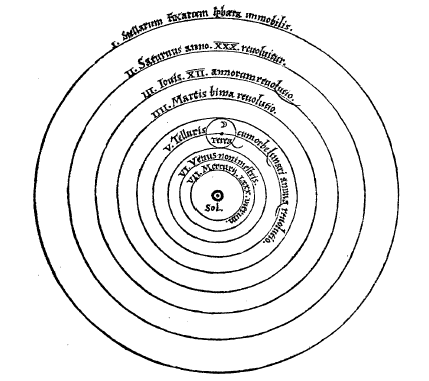
This diagram of the Solar System looks really, really simple. It's remarkable why people weren't attracted by the simple model much more strongly than they actually were. This preference for "simpler models" is something we take for granted but it apparently wasn't always obvious. Copernicus was among the folks who helped us to prioritize the ideas in this way. We should be more precise when we say what is simple. The ultimate application of the model and calculations of observed phenomena may be rather complex; what's important is that the primary starting ideas such as the diagram above is simple.
Copernicus hasn't really faced any problems with the fundamentalist Christian ideology during his lifetime. His main problem came in 1538 when Johannes Dantiscus, a new bishop who had still been friend of Copernicus' at that time, accused Copernicus of coitus with Anna Schilling, a housekeeper (an act incompatible with his celibate). In 1538, Copernicus relinquished the Breslau sinecure (one of the jobs where he had no duties) and this fact is probably related to the accusation. Nevertheless, Copernicus never married and never had children.
The real controversy about the Copernican system only began to be built after Copernicus' death. Various Dominicans and Luther's collaborators and others were gradually finding inconvenient truths in Copernicus' writing and they were building fan clubs of haters who would ultimately transform Copernicus' theory into a magnificent heresy. Note that Giordano Bruno was burned at the stake in 1600, 57 years after Copernicus' death. (Bruno's valid claims went beyond Copernicus; he also recognized that the Sun was a star and he even claimed that there are "infinitely many" inhabited planets orbiting various other stars in the Universe.) The trial against Galileo took place in 1633.
Dozens of blog entries at this blog mention Copernicus. I am going to single out the myths about epicycles where I try to explain that the Copernican model, while having a more modern and simpler "core", didn't away with the need for epicycles. Epicycles were a clever phenomenological theory to improve the precision of the orbits – which are not exactly circular in the real world – some kind of higher harmonic corrections to the leading harmonic orbits in a Fourier expansion. Most contemporary people who feel very clever by slinging mud on epicycles understand astronomy much less than the 15th and 16th century astronomers.

There's really nothing wrong with the geocentric frame; it is just another coordinate system in which the motion of the celestial bodies (yellow Sun, blue Earth, red Mars) may be described. In general relativity, we're allowed to use both frames but it's still true that the metric tensor (gravitational) field in the heliocentric system is "simpler", more stationary, closer to the flat Minkowski space, and that's why the heliocentric frame was much straighter a path towards the Newtonian theory, a non-relativistic limit of GR.
Also, I have to mention that Copernicus is often cited as the "role model" for the proponents of the anthropic principle and the multiverse. They say that the world is always greater than previously thought and this process has been underway since Copernicus, we hear. It's the Copernican Revolution according to them. Well, I think they are rewriting the history a bit. Copernicus hasn't really enlarged the Universe and the revolution was about the change of the celestial body at the center of the Universe. (As I mentioned above, Giordano Bruno surely did propose to extend the world. Maybe the anthropic folks should talk about the Brunian Revolution.)
But OK, the role of the Earth was downgraded – and in the same way, the anthropic folks want to downgrade the whole observable Universe. The problem is that if the former step were legitimate, it doesn't follow that the latter step is legitimate. These are two different questions and attempts to identify them in between the lines is an ideology, not a proper logical reasoning. There's another key difference between the two situations: the worlds outside the Earth may be observed (so their existence is really indisputable today) while the worlds outside the observable Universe cannot be observed (which is a big reason why their existence is questionable). ;-) 

Nicolaus Copernicus: 540th birthday
by Luboš Motl
Off-topic, Higgs: Fox News, BBC, and others are suddenly excited by the possibility suggested by the Higgs boson mass that our Universe is intrinsically unstable. See some 4-month or years old TRF blog entries.
Mikołaj Kopernik was born on February 19th, 1473 – half a millennium and 9.5 months before your humble correspondent – into a rich family in Toruń (thorn) in Royal Prussia, a part of the Crown of the Kingdom of Poland.At that time, the nationality of the people was more associated with the territory and not with ethnic groups: modern European 19th century nation states weren't born yet (American readers will forgive me but they still haven't invented the concept as of early 21st century).
However, Nicolaus spoke Polish, German, and Latin very well and equally well; he also spoke Greek and Italian. At some school, he was pretty much led to register himself as a German which doesn't mean much. His father was a successful copper trader at the Wall Street, selling the commodity to Danzig. His mother died when Nicolaus was a small boy but she was a member of a very rich dynasty.
Some people claim that the name "Koperník" is actually related to copper that his father traded. I find it unlikely. Such an influence of the job on the name seems too fast to me. It's more likely that it's related to the dill plant – koperek or kopernik in Polish, kopr in Czech, a Slavic word – that was abundant in Prussia.
He studied not only the mathematical-astronomical disciplines but also some theological ones (canon law) and some kind of humanities, too. I don't want to go into the boring list of institutions he was affiliated with. More interestingly, he organized defense against the attacks by the Teutonic Order (in Czech, we call it The Order of Germanic Knights); he worked as the canon in Frauenberg; drew some maps; and wrote macroeconomic analyses mostly focusing on inflation such as the Treatise on the Coin (he was a clear monetary hawk).
Some people could imagine that Copernicus was a life-long heretic of a sort but that's completely wrong. Theology was earning him a very convenient life. For example, in 1503, your humble correspondent's Kingdom of Bohemia gave him sinecure at the Collegiate Church of the Holy Cross in Wrocław, Silesia, Bohemia (yes, our territory was a bit bigger than today). Sinecure means that he didn't have to do anything. It was handy.
In 1514, he began to write blog entries about the heliocentric theory. And he wrote a book about it etc. Again, it would be a mistake to think that the Church was disgusted. For example, Pope Clement VII – and two cardinals – were told what the heliocentric theory had taught us by Johann Widmanstetter, the Holy Father's secretary. The Pope was so happy about the new insights that he gave the secretary a valuable gift.
The heliocentric system wasn't really new; some Greeks such as Aristarchus of Samos were discussing these models already 300 years before Christ. However, Copernicus was at least a major figure who revived the heliocentric idea in the Middle Ages and incorporated the state-of-the-art knowledge of astronomy into it so that it could have been considered a viable alternative to the prevailing Ptolemy's model.
This diagram of the Solar System looks really, really simple. It's remarkable why people weren't attracted by the simple model much more strongly than they actually were. This preference for "simpler models" is something we take for granted but it apparently wasn't always obvious. Copernicus was among the folks who helped us to prioritize the ideas in this way. We should be more precise when we say what is simple. The ultimate application of the model and calculations of observed phenomena may be rather complex; what's important is that the primary starting ideas such as the diagram above is simple.
Copernicus hasn't really faced any problems with the fundamentalist Christian ideology during his lifetime. His main problem came in 1538 when Johannes Dantiscus, a new bishop who had still been friend of Copernicus' at that time, accused Copernicus of coitus with Anna Schilling, a housekeeper (an act incompatible with his celibate). In 1538, Copernicus relinquished the Breslau sinecure (one of the jobs where he had no duties) and this fact is probably related to the accusation. Nevertheless, Copernicus never married and never had children.
The real controversy about the Copernican system only began to be built after Copernicus' death. Various Dominicans and Luther's collaborators and others were gradually finding inconvenient truths in Copernicus' writing and they were building fan clubs of haters who would ultimately transform Copernicus' theory into a magnificent heresy. Note that Giordano Bruno was burned at the stake in 1600, 57 years after Copernicus' death. (Bruno's valid claims went beyond Copernicus; he also recognized that the Sun was a star and he even claimed that there are "infinitely many" inhabited planets orbiting various other stars in the Universe.) The trial against Galileo took place in 1633.
Dozens of blog entries at this blog mention Copernicus. I am going to single out the myths about epicycles where I try to explain that the Copernican model, while having a more modern and simpler "core", didn't away with the need for epicycles. Epicycles were a clever phenomenological theory to improve the precision of the orbits – which are not exactly circular in the real world – some kind of higher harmonic corrections to the leading harmonic orbits in a Fourier expansion. Most contemporary people who feel very clever by slinging mud on epicycles understand astronomy much less than the 15th and 16th century astronomers.
There's really nothing wrong with the geocentric frame; it is just another coordinate system in which the motion of the celestial bodies (yellow Sun, blue Earth, red Mars) may be described. In general relativity, we're allowed to use both frames but it's still true that the metric tensor (gravitational) field in the heliocentric system is "simpler", more stationary, closer to the flat Minkowski space, and that's why the heliocentric frame was much straighter a path towards the Newtonian theory, a non-relativistic limit of GR.
Also, I have to mention that Copernicus is often cited as the "role model" for the proponents of the anthropic principle and the multiverse. They say that the world is always greater than previously thought and this process has been underway since Copernicus, we hear. It's the Copernican Revolution according to them. Well, I think they are rewriting the history a bit. Copernicus hasn't really enlarged the Universe and the revolution was about the change of the celestial body at the center of the Universe. (As I mentioned above, Giordano Bruno surely did propose to extend the world. Maybe the anthropic folks should talk about the Brunian Revolution.)
But OK, the role of the Earth was downgraded – and in the same way, the anthropic folks want to downgrade the whole observable Universe. The problem is that if the former step were legitimate, it doesn't follow that the latter step is legitimate. These are two different questions and attempts to identify them in between the lines is an ideology, not a proper logical reasoning. There's another key difference between the two situations: the worlds outside the Earth may be observed (so their existence is really indisputable today) while the worlds outside the observable Universe cannot be observed (which is a big reason why their existence is questionable). ;-)
Rafa Spoladore likes this

19 Feb 19:53
 A new nanostructured enzyme complex can lower blood alcohol levels in intoxicated mice, according to a new study. The nano-pill, which assembles and encapsulates three types of enzymes, could work as a type of alcohol antidote. It also suggests that this unique protein-tailoring method could be used for lots of ailments.


Drunk Mice Sober Up Fast After Nanoparticle Injection
by Rebecca Boyle
Multiple enzymes delivered in a nanocapsule could work as an alcohol antidote, reducing blood alcohol levels and preventing liver damage.
A new nanostructured enzyme complex can lower blood alcohol levels in intoxicated mice, according to a new study. The nano-pill, which assembles and encapsulates three types of enzymes, could work as a type of alcohol antidote. It also suggests that this unique protein-tailoring method could be used for lots of ailments. Enzymes are proteins that spark a whole host of biological processes, but many can only work when they are in specific places in a cell, or when they are accompanied by other enzymes. Proper positioning speeds up chemical reactions, and it mitigates the potentially nasty byproducts of some of those reactions. Researchers have been trying to use enzymes as drugs for a long time, but it has been difficult to produce the right combinations, meaning they might not function properly or they might be rejected by the body.
After you drink alcohol, it loiters in your bloodstream until enzymes produced in the liver can break it down. But this takes the liver some time, and meanwhile, you're intoxicated. This new enzyme injection does the same job much quicker, helping the liver break down alcohol and thus sobering up a tipsy mouse in a hurry. This also helps protect the hard-working liver from damage.
Researchers in California packed up complementary enzymes in a nano-capsule, producing what basically amounts to a tiny enzyme pill. The capsule coating, made of a superthin polymer, keeps the enzymes together and protects them from breaking down in the body.
Led by Yunfeng Lu, a chemical and biomolecular engineering professor at UCLA, researchers injected mice with three enzymes related to the breakdown of sugars, and after this worked, they tried it with two enzymes related to the breakdown of alcohol, alcohol oxidase (AOx) and catalase. They wanted to test the enzymes as both an intoxication preventive and a treatment.
When mice were fed a diet of alcohol and the nano-capsule at the same time, their blood alcohol concentrations were greatly reduced within 30-minute increments, compared to mice that were fed just alcohol or alcohol plus one of the enzymes. The team also tested it on drunk mice, and found the treatment greatly lowered yet another enzyme, alanine transaminase, which is a biomarker for liver damage.
“Nanocomplexes containing alcohol oxidase and catalase could reduce blood alcohol levels in intoxicated mice, offering an alternative antidote and [preventive treatment] for alcohol intoxication,” the authors write. The paper appears in Nature Nanotechnology.
 |
 |
Rafa Spoladore likes this
19 Feb 19:53
 During an update to flight computers earlier this morning, the International Space Station lost communications with ground controllers in Houston, but now everything is back up, according to NASA. The blackout lasted about three hours, during which time the station was able to communicate with ground control in Moscow.


NASA Restores Communications With The Space Station [Updated]
by Rebecca Boyle
Blackout lasted about three hours.
During an update to flight computers earlier this morning, the International Space Station lost communications with ground controllers in Houston, but now everything is back up, according to NASA. The blackout lasted about three hours, during which time the station was able to communicate with ground control in Moscow. Flight controllers were updating the station's flight software Tuesday morning when the ISS' data relay stations malfunctioned around 9:45 a.m. Eastern time. While the station flew above Russia about an hour later, mission control in Houston was able to check on the crew--they're fine--and instruct them to connect a backup computer to restore communications. That happened around 12:30 p.m. Eastern time, NASA said.
The problem stemmed from a computer that would not let the station talk to NASA's Tracking and Data Relay Satellites. The ISS does have a ham radio on board for emergency communications, but that wasn't necessary today.
Commander Chris Hadfield apparently may have seen this whole thing coming. The best news is that now he can start tweeting again.
|
|
Rafa Spoladore likes this
19 Feb 19:53
 Humans have been fermenting alcoholic beverages since as early as 10,000 B.C., but we've probably enjoyed the effects of natural fermentation much longer than that. Our ability to digest alcohol might have sprung from a primate ancestor that ate fermenting fruits, a new theory suggests.


When Did Primates Learn To Metabolize Alcohol? A Chemist Reenacts Drunk History
by Shaunacy Ferro
According to this laboratory study, the desire for a stiff drink could go further back than we think.
Humans have been fermenting alcoholic beverages since as early as 10,000 B.C., but we've probably enjoyed the effects of natural fermentation much longer than that. Our ability to digest alcohol might have sprung from a primate ancestor that ate fermenting fruits, a new theory suggests. Humans metabolize the ethanol in alcoholic drinks thanks to enzymes called alcohol dehydrogenase 4, or ADH4. Other primates have ADH4 enzymes, but not all can metabolize ethanol. To analyze how ethanol digestion changed over time, Steven Benner, a chemist at the Foundation for Applied Molecular Evolution, built enzymes in the lab that estimated how extinct primates metabolized alcohol.
Benner and his colleagues looked at the DNA stretches responsible for ADH4 in 27 modern primates. Using lemurs, monkeys, apes and humans, they mapped the DNA sequences on an evolutionary family tree for primates going back 60 million years, estimating what genes could have looked like for extinct primate ancestors. Then they resurrected these ancient ADH4 proteins in the lab.
They found that for most of our ancient ancestors, ADH4s were inactive against ethanol, although they could metabolize other alcohols, like those found in the leaves of plants.
Ten million years ago, though, a common ancestor of gorillas, chimps and humans emerged with an enzyme that could digest alcohol 50 times more efficiently than earlier incarnations. Benner proposes that this ancestor became more terrestrial, rather than primarily tree-dwelling. He introduced his theory at the annual meeting of the American Association for the Advancement of Science on February 15.
With the availability of fermented fallen fruit on the ground, those forest-dwellers with the ability to digest alcohol would have had an evolutionary leg up. Species like orangutans, which primarily live in trees, didn't evolve to metabolize ethanol, perhaps because they wouldn't have run into fermented fruit living above-ground.
However, it's still up for debate whether or not the last common ancestor of humans, chimps and gorillas actually spent time on the ground or lived entirely in trees. "We’ll be able to evaluate it with better evidence as we find more fossils from that time period," biological anthropologist Jeremy DeSilva told Science News.
Still, this is a good enough excuse to add drinking back into your Paleolithic diet.
|
|
Rafa Spoladore likes this
19 Feb 19:53
 Last April, a minivan-sized chunk of leftover primordial planet punched through Earth’s atmosphere at 64,000 miles per hour. The minivan-sized meteor weighed just under 100,000 pounds before it exploded high above northern California, disintegrating into rock dust and smaller meteoroids that fell onto suburban driveways in El Dorado County.


How Amateur Videos Will Help Astronomers Reconstruct Meteorite's Life History
by Rebecca Boyle
Astronomers can retrace space rocks' paths to find their birthplace.
Last April, a minivan-sized chunk of leftover primordial planet punched through Earth’s atmosphere at 64,000 miles per hour. The minivan-sized meteor weighed just under 100,000 pounds before it exploded high above northern California, disintegrating into rock dust and smaller meteoroids that fell onto suburban driveways in El Dorado County. Video cameras and weather radar captured the space rock, later nicknamed the Sutter’s Mill meteorite, as it streaked through the sky. Thanks to these detailed observations, scientists were able to reconstruct its entire life history. They hope to do the same thing for the massive meteor that exploded above Russia on Friday.
Russian drivers, skywatchers and pedestrians captured voluminous video tracking Friday’s meteoroid, so scientists will have plenty of evidence to reconstruct its trajectory, astronomers said.
“We would need observations from at least three different locations, and then you can calculate the pre-atmospheric orbit,” said Philipp Heck, assistant curator of Meteoritics and Polar Studies at the Field Museum of Natural History in Chicago. Among the more than 45,000 officially recognized meteorites, scientists have been able to reconstruct trajectories, orbits and life histories for just 18. “So this is really a big thing if one can do that,” he said.
Heck was part of the collaboration that published the history of the Sutter’s Mill meteorite last December. It came from the asteroid belt near Jupiter, flying toward the sun and passing by both Mercury and Venus before heading out to Earth. The vast majority of meteorites are from that region--some are from Mars, and very few come from the moon. But for Sutter’s Mill, researchers were able to pinpoint a specific debris field within the asteroid belt that they believe gave birth to the meteorite.
Many small asteroids become near-Earth objects and (rarely) meteors after a kind of asteroid-belt billiards, said Peter Jenniskens, an astronomer at the SETI Institute and lead author of the Sutter’s Mill paper.
Collisions among space rocks send them bouncing in different directions and sometimes, these impacts shear off hunks of rock that become new mini-asteroids. Light from the distant sun warms their sun-facing sides, and they quickly shed this warmth in the frozen vacuum of space. Gradually, this heat exchange starts them spinning, further feeding the thermal cycle--this is known as the Yarkovsky effect. Over time, this effect grows so pronounced that it changes the asteroid’s orbit around the sun, Jenniskens said.
This ever-changing orbital instability is heightened by the gravitational effects of the sun, Jupiter and the other planets. Eventually, the asteroid pieces are pulled toward the sun--and toward us.
“At some point, the object can hit the Earth. That’s how we are getting our meteorites,” Jenniskens said. “What we are getting doesn’t necessarily reflect what the near-Earth objects are; they reflect what objects in the asteroid belt are producing these pieces. We think we have a number of discrete places in the asteroid belt that are sending us these pieces.”
In the case of Sutter’s Mill, Jenniskens and colleagues were able to determine the asteroid family that birthed the fragment that hit Earth. They crawled on the asphalt in Henningsen Lotus Park in El Dorado County, hunting for meteor shards to study. They figured out how long these fragments had been exposed to cosmic rays in the solar system, which can be used to deduce how long ago it split from the rest of the family. They determined it was pretty recently in solar system history.
“There is a known debris field that could be the source for this,” Jenniskens said.
There’s still plenty of work to do before anyone can determine where Friday’s meteorite came from, but scientists are certain it did not come from the same part of the asteroid belt as 2012 DA14, which harmlessly whizzed past Earth a few hours after the meteorite impact. That rock came from the opposite direction, said Laurie Leshin, dean of science at Rensselaer Polytechnic Institute and former research director of the Center for Meteorite Studies at Arizona State University.
As they determine the meteorite’s path, astronomers might realize they could have seen it coming. On Friday, several astronomers said the massive meteor was certainly large enough to have shown up in sky surveys, and the fact that no one saw it is somewhat curious. Timothy Spahr, director of the Minor Planet Center at the Harvard-Smithsonian Center for Astrophysics, said he is planning to check his data to determine whether survey teams did actually see something. Once astronomers determine its orbit, he will know where to look, he said. Spahr sent an email from Vienna, where he was attending an extraordinarily well-timed UN conference discussing near-Earth objects.
“If the object came from the nighttime sky, we have a shot at [finding] it up to a few days from impact,” he said. “But about half of the objects will approach the Earth from the sunlit side of the sky, and no survey will ever detect these. This is one reason we wish to find all the impactors well before the last approach.”
Along with reconstructing its past via video evidence, scientists are scrambling to find fragments they can examine to unravel the meteor’s makeup. The odds are pretty good that it’s a run-of-the-mill stony chondrite--95 percent of the stony meteorites that fall to Earth fit into this category. Incidentally, Sutter’s Mill was a carbonaceous chondrite and therefore much more unique. Whatever it is, scientists would like to get their hands on it--and so would members of the public, as evidenced by reports of people trudging onto a lake near the meteorite impact to find fragments. There are already eBay listings, too.
While they shared concern for the hundreds of people who were injured, many researchers said the meteorite fall was spectacular for science. Hundreds of observations from a wide range of locations will provide plenty of data to reconstruct its trajectory, and from there, its orbit around the sun.
“At the moment, it’s a blank canvas,” Jenniskens said. “But eventually, this rock will get an identity and we will know more about it.”
|
|
Rafa Spoladore likes this
19 Feb 19:52
New evidence for link between depression and heart disease
A Loyola University Medical Center psychiatrist is proposing a new subspecialty to diagnose and treat patients who suffer both depression and heart disease. He's calling it "Psychocardiology."
Rafa Spoladore likes this


19 Feb 11:51
 Ampliar
 Ampliar
Tecnologia russa chega ao Brasil e contribui para navegação por satélite
by Portal Brasil
A UnB vai inaugurar a primeira estação fora da Rússia do sistema russo de monitoramento e correção diferenciada
Nesta terça-feira (19), a Universidade de Brasília (UnB) vai inaugurar a primeira estação do sistema de monitoramento e correção diferenciada, que integra o Global Navigation Satellite System (Glonass), da Rússia. A rede serve para localizar posições na superfície terrestre utilizando 24 satélites espalhados pela órbita da Terra.
Divulgação / AEB- A rede serve para localizar posições na superfície terrestre utilizando 24 satélites espalhados pela órbita da Terra
Entre os objetivos desta implantação está a contribuição para operacionalização do sistema Glonass na América do Sul e o fornecimento de serviços confiáveis de posicionamento e de navegação para essa região do globo, que estabelecem cooperação técnica entre o Brasil e a Rússia no contexto do Glonass. A ação também vai promover o suporte para estudos de pesquisa em sistemas de navegação por satélite conduzidas pelos pesquisadores envolvidos no projeto, além disso irá também contribuir na formação de pessoal com expertise técnica em Glonass.
Além de ser um importante componente para redução do erro de posicionamento do sistema Glonass na América do Sul, sua instalação beneficiará pesquisas na área aeroespacial desenvolvidas nos laboratórios de Automação e Robótica (Lara) e de Biomédica (LAB), da UnB. Será importante também para as aplicações satelitais e para estudos geodésicos da universidade.
- Olimpíada Brasileira de Astronomia e Astronáutica abre inscrições
- O tenente-coronel da FAB, Marcos Pontes, foi o primeiro brasileiro a viajar ao espaço
O Programa de Cooperação no Campo da Utilização e Desenvolvimento do Sistema Russo de Navegação Global por Satélite é fruto de uma parceria entre a Agência Espacial Russa (Roscosmos), a Agência Espacial Brasileira (AEB) e a Universidade de Brasília.
Para Ícaro dos Santos, coordenador do LAB, quando o projeto estiver concluído, em 2020, a precisão dos cálculos de posicionamento no planeta será melhorada em até 10 vezes. “Teremos acesso aos dados brutos fornecidos pela estação. Assim, serão beneficiadas todas as nossas pesquisas sobre navegação de robôs, foguetes e veículos aéreos não tripulados, por exemplo”, disse Ícaro.
Estação
Três especialistas russos vieram para Brasília instalar a estação no telhado do novo prédio do Centro de Processamento de Dados (CPD). O equipamento trazido da Rússia conta com uma antena e dois racks com processadores, um para receber o sinal e outro para transmitir
Divulgação / Unb- Três especialistas russos vieram a Brasília instalar a estação no telhado do novo prédio do Centro de Processamento de Dados (CPD)
informações para sede do projeto na Rússia. Até 2020, a Roscosmos espera ter 56 estações semelhantes a esta que está sendo montada na UnB. Outras 22 estações semelhantes já funcionam em território russo, uma delas na Antártida.
Ivan Revnivykh, líder de engenharia da JSC Russian Space Systems, garante que o projeto facilitará qualquer engenharia de precisão como atracamento de navios e a construção de estradas e prédios, todos voltados para fins civis. “Até o momento, temos excelente cobertura nos polos norte e sul. As novas estações fora da Rússia precisam ser em regiões relativamente próximas à Linha do Equador, como aqui em Brasília”, explica.
Evento
A inauguração da Estação de Referência para o Sistema de Correção Diferencial e Monitoramento do GLONASSS acontece no dia 19 de fevereiro, a partir das 11h, no Centro de Processamento de Dados da Universidade de Brasília (CPD/UnB).
- Concurso irá escolher projeto para reconstrução de estação de pesquisa na Antártica
- Rede de radares meteorológicos do Brasil será ampliada a partir de 2013
Estarão presentes o presidente da Agência Espacial Brasileira (AEB), José Raimundo Coelho; a vice-reitora da Universidade de Brasília, Sônia Báo; o vice-chefe da Agência Espacial Russa (Roscosmos), Sergey Saveliev; o diretor geral da JSC (Sistemas Espaciais da Rússia), Andrey Chimiris; e os coordenadores do Departamento de Engenharia Elétrica da Universidade de Brasília (ENE/FT/UnB), Geovany Araújo e Ícaro dos Santos.
Fonte:
Rafa Spoladore likes this
18 Feb 11:50
Tudo é genético. E isso é mais complicado do que você imagina
by Carlos Orsi
Creio que todo mundo já viu uma das inúmeras fotos que circulam pela internet, de tartarugas que cresceram dentro de anéis de plástico e ficaram com as carapaças deformadas. Agora, responsa rápido: a deformidade dessas pobres tartarugas tem causa genética ou ambiental?
A carapaça da tartaruga é, obviamente, um fenômeno genético. Genes de tartaruga levam ao surgimento de carapaças de tartaruga, afinal. Só que a deformidade não existiria se não fosse o anel de plástico, que é um fator ambiental. Mas a deformidade também não seria o que é se não fossem os genes: são eles que ditam como o desenvolvimento do animal vai responder à pressão exercida pelo plástico. Com genes diferentes, a tartaruga poderia arrebentar o anel, ou crescer de um modo ainda mais rococó.
Enfim, a deformidade da tartaruga é genética ou ambiental? Um brinde para o cavalheiro que pensou na palavra interação, ali ao fundo. Notemos, porém, que tanto a genética quanto o ambiente são determinantes para o resultado: tirando um ou outro, não haveria um quelônio com aquele formato de carapaça específico.
Notemos, ainda, que o anel de plástico só está no mar porque os seres humanos têm genes que lhes dão cérebros grandes o bastante para refinar petróleo e moldar polímeros, mas aparentemente não grandes o suficiente para jogar o lixo no lugar certo. Mais um ponto para a genética, portanto.
Ou não? Os maus hábitos humanos são, afinal, um fenômeno da cultura, algo "totalmente independente" da genética. Certo?
Sempre que ouço alguém defendendo a ideia de que fenômenos culturais e fenômenos genéticos pertencem a esferas separadas e estanques, fico tentado a responder: "Mas claro! É por isso que os pombos escrevem poesia, que as formigas demonstram teoremas e que os babuínos desenvolveram a democracia parlamentar. Afinal, só o que nos separa dessas outras espécies são os genes e, como todo ser humano bem pensante sabe, genes e cultura são coisas totalmente independentes!"
Para dar o devido crédito aos isolacionistas genético-culturais, sua posição parece derivar de uma espécie de preocupação ética, ou desconfiança ideológica, para com a ideia de que certos fenômenos culturais desprezíveis, tais como a opressão da mulher, o racismo ou o hábito de destruir o meio ambiente, uma vez declarados "genéticos", passem a ser vistos como dados imutáveis ou obrigatórios da natureza humana. Aliás, para muita gente, a simples ideia de "natureza humana" soa terrivelmente reacionária.
Mas esses temores todos nascem de uma visão extremamente simplista de o que genes são e de como funcionam. Uma metáfora útil, ainda que limitada, é a que compara o gene a uma receita de bolo: ele dá o caminho, mas o produto final depende da qualidade dos ingredientes, do talento do cozinheiro, do estado da cozinha. Essa metáfora permite ainda incluir o mecanismo de feedback: uma vez servido, o bolo gera reações entre os comensais que podem acarretar em mudanças na receita, em seu modo de preparação -- ou, mesmo, garantir que ela nunca mais seja executada.
Da mesma forma, os genes humanos que se expressam de modo a produzir cultura geram um ambiente que vai, por sua vez, afetar a expressão dos genes, reprimindo ou premiando certos comportamentos, estimulando ou vedando a transmissão de certos genes. São genes que produzem, no cérebro, o potencial para surtos de fúria homicida, do mesmo modo que são genes que criam as funções executivas de autocontrole, no mesmo cérebro. Da interação entre os seres humanos, construídos por esses genes, surge o ambiente cultural que vai valorizar o guerreiro berserker ou o diplomata sutil -- ou ambos.
Uma das fronteiras atuais do conhecimento é exatamente a busca por entender como o ambiente afeta o gene -- não apenas sua chance de transmissão para as futuras gerações, mas sua expressão: se um gene predispõe para determinada doença ou determinado comportamento, quais os gatilhos que ativam esses resultados? Alguma substância presente no ambiente? Um hormônio do próprio corpo, liberado em resposta a um determinado estado emocional? Uma cascata de outros genes, cada um com seu gatilho específico?
É até possível que, no caso dos genes que se expressam de modo a afetar a cultura, a rede de interações seja tão caótica e complexa que, para todos os fins práticos, o modelo de "cultura" aqui e "genética" ali, como campos separados, seja o mais eficaz para fins epistemológicos, assim como tratamos a biologia como algo separado da física de partículas, embora todos os entes biológicos sejam feitos das mesmas partículas estudadas pelos físicos.
Mas notemos que os biólogos não conseguem escapar de vez das partículas dos físicos: a dança dos elétrons no interior da célula é parte fundamental do fenômeno da vida. Talvez, um dia, psicólogos e antropólogos também tenham de pôr o pejorativo termo "biologicista" de lado e comecem a falar, ainda que de forma bem limitada, em genes ou, mais provavelmente, em redes de interação gene-ambiente-cultura.
As culturas humanas e as sociedades humanas são produtos do genoma humano. Têm de ser: a espécie humana, afinal, é um produto do genoma humano!
A aversão a esse fato deriva, provavelmente, do temor de que o apelo à genética seja usado para impor limites artificiais e desnecessários ao que a cultura pode aspirar, ou ao que a sociedade pode vir a ser. Não está claro, porém, que a genética nos imponha qualquer limite nesse sentido -- de fato, a inteligência produzida por nossa genética está prestes a nos conceder o poder de modificar essa mesma genética, o que torna a questão de eventuais limitações um tanto quanto ociosa, ao menos no longo prazo. Mas, se limites existirem, conhecê-los -- até para que possamos, talvez, eliminá-los -- é melhor do que fechar os olhos e nos esborracharmos contra eles.
A carapaça da tartaruga é, obviamente, um fenômeno genético. Genes de tartaruga levam ao surgimento de carapaças de tartaruga, afinal. Só que a deformidade não existiria se não fosse o anel de plástico, que é um fator ambiental. Mas a deformidade também não seria o que é se não fossem os genes: são eles que ditam como o desenvolvimento do animal vai responder à pressão exercida pelo plástico. Com genes diferentes, a tartaruga poderia arrebentar o anel, ou crescer de um modo ainda mais rococó.
Enfim, a deformidade da tartaruga é genética ou ambiental? Um brinde para o cavalheiro que pensou na palavra interação, ali ao fundo. Notemos, porém, que tanto a genética quanto o ambiente são determinantes para o resultado: tirando um ou outro, não haveria um quelônio com aquele formato de carapaça específico.
Notemos, ainda, que o anel de plástico só está no mar porque os seres humanos têm genes que lhes dão cérebros grandes o bastante para refinar petróleo e moldar polímeros, mas aparentemente não grandes o suficiente para jogar o lixo no lugar certo. Mais um ponto para a genética, portanto.
Ou não? Os maus hábitos humanos são, afinal, um fenômeno da cultura, algo "totalmente independente" da genética. Certo?
Sempre que ouço alguém defendendo a ideia de que fenômenos culturais e fenômenos genéticos pertencem a esferas separadas e estanques, fico tentado a responder: "Mas claro! É por isso que os pombos escrevem poesia, que as formigas demonstram teoremas e que os babuínos desenvolveram a democracia parlamentar. Afinal, só o que nos separa dessas outras espécies são os genes e, como todo ser humano bem pensante sabe, genes e cultura são coisas totalmente independentes!"
Para dar o devido crédito aos isolacionistas genético-culturais, sua posição parece derivar de uma espécie de preocupação ética, ou desconfiança ideológica, para com a ideia de que certos fenômenos culturais desprezíveis, tais como a opressão da mulher, o racismo ou o hábito de destruir o meio ambiente, uma vez declarados "genéticos", passem a ser vistos como dados imutáveis ou obrigatórios da natureza humana. Aliás, para muita gente, a simples ideia de "natureza humana" soa terrivelmente reacionária.
Mas esses temores todos nascem de uma visão extremamente simplista de o que genes são e de como funcionam. Uma metáfora útil, ainda que limitada, é a que compara o gene a uma receita de bolo: ele dá o caminho, mas o produto final depende da qualidade dos ingredientes, do talento do cozinheiro, do estado da cozinha. Essa metáfora permite ainda incluir o mecanismo de feedback: uma vez servido, o bolo gera reações entre os comensais que podem acarretar em mudanças na receita, em seu modo de preparação -- ou, mesmo, garantir que ela nunca mais seja executada.
Da mesma forma, os genes humanos que se expressam de modo a produzir cultura geram um ambiente que vai, por sua vez, afetar a expressão dos genes, reprimindo ou premiando certos comportamentos, estimulando ou vedando a transmissão de certos genes. São genes que produzem, no cérebro, o potencial para surtos de fúria homicida, do mesmo modo que são genes que criam as funções executivas de autocontrole, no mesmo cérebro. Da interação entre os seres humanos, construídos por esses genes, surge o ambiente cultural que vai valorizar o guerreiro berserker ou o diplomata sutil -- ou ambos.
Uma das fronteiras atuais do conhecimento é exatamente a busca por entender como o ambiente afeta o gene -- não apenas sua chance de transmissão para as futuras gerações, mas sua expressão: se um gene predispõe para determinada doença ou determinado comportamento, quais os gatilhos que ativam esses resultados? Alguma substância presente no ambiente? Um hormônio do próprio corpo, liberado em resposta a um determinado estado emocional? Uma cascata de outros genes, cada um com seu gatilho específico?
É até possível que, no caso dos genes que se expressam de modo a afetar a cultura, a rede de interações seja tão caótica e complexa que, para todos os fins práticos, o modelo de "cultura" aqui e "genética" ali, como campos separados, seja o mais eficaz para fins epistemológicos, assim como tratamos a biologia como algo separado da física de partículas, embora todos os entes biológicos sejam feitos das mesmas partículas estudadas pelos físicos.
Mas notemos que os biólogos não conseguem escapar de vez das partículas dos físicos: a dança dos elétrons no interior da célula é parte fundamental do fenômeno da vida. Talvez, um dia, psicólogos e antropólogos também tenham de pôr o pejorativo termo "biologicista" de lado e comecem a falar, ainda que de forma bem limitada, em genes ou, mais provavelmente, em redes de interação gene-ambiente-cultura.
As culturas humanas e as sociedades humanas são produtos do genoma humano. Têm de ser: a espécie humana, afinal, é um produto do genoma humano!
A aversão a esse fato deriva, provavelmente, do temor de que o apelo à genética seja usado para impor limites artificiais e desnecessários ao que a cultura pode aspirar, ou ao que a sociedade pode vir a ser. Não está claro, porém, que a genética nos imponha qualquer limite nesse sentido -- de fato, a inteligência produzida por nossa genética está prestes a nos conceder o poder de modificar essa mesma genética, o que torna a questão de eventuais limitações um tanto quanto ociosa, ao menos no longo prazo. Mas, se limites existirem, conhecê-los -- até para que possamos, talvez, eliminá-los -- é melhor do que fechar os olhos e nos esborracharmos contra eles.
Rafa Spoladore likes this
18 Feb 11:50
Postagem atualizada na manhã e sábado, 16/2, com informações da Nasa!
O que se sabe até o momento (via RT e Astronomy Now): um meteoro, com massa estimada, antes de sua entrada na atmosfera terrestre, em50 9.000 toneladas, explodiu sobre o sul da Rússia, a leste dos Montes Urais, por volta das 9h20 da manhã, hora local (1h20 da madrugada, no Brasil). Pelo menos três fragmentos já foram recuperados, dois na vizinhança do Lago Chebarkul, perto da cidade de Chelyabinsk, a 1.500 km de Moscou. O terceiro fragmento estava a 80 km dali, na cidade de Zlatoust.
As ondas de choque e os fragmentos menores produzidos pela passagem do meteoro causaram danos que, por sua vez, levaram mais de900 1.000 pessoa a procurar serviços de saúde. Pelo menos duas pessoas estariam em estado grave.
De acordo com a prefeitura de Chelyabisnk, uma cidade de 1,1 milhão de habitantes, citada pelo site RT, cerca de 3.000 edifícios foram danificados, incluindo 34 hospitais e postos de saúde e 361 escolas. O total de janelas estilhaçadas soma uma área de 100.000 metros quadrados.
Os fragmentos sugerem que o objeto que entrou na atmosfera, despedaçando-se a uma altitude de 10.000 24.000 metros, era composto de uma mistura de metal e rocha, tinha 15 metros de diâmetro e uma massa de 9.000 toneladas. O objeto teria entrado na atmosfera terrestre a uma velocidade de 30 quilômetros por segundo -- isso é 108.000 km/h 65.000 km/h, aproximadamente igual à velocidade com que a Terra orbita o Sol. Isso sugere que a pedra estava "parada" ali no espaço, e nós é que trombamos com ela (NE: ou pode ser só uma coincidência, como apontado nos comentários).
Sobre se eventos assim são raros ou comuns, o astrônomo Jay Tate, do Centro Spaceguard do Reino Unido, disse ao Astronomy Now que pelo menos três casos parecidos foram registrados no século 20: Tunguska, Sibéria, em 1908; Rio Curaçá, na Amazônia brasileira, em 1930; e, talvez o mais parecido com o evento de Chelyabisnk, Revelstoke, no Canadá, em 1965, quando a queda produziu, de acordo com a Wikipedia, um "esplendoroso rastro no céu". Ainda sobre meteoritos que atingiram áreas urbanas, em 1992 uma rocha espacial caiu no porta-malas de um automóvel em Peekskill, Estados Unidos.
Neste século, já tivemos o caso de uma criança atingida por um meteorito, na Alemanha, em 2009; e o meteorito do Sudão, que foi rastreado em sua trajetória rumo ao deserto africano, em 2008. Não há, no entanto, nenhum registro confirmado, até agora, de que alguém já tenha sido morto por causa da queda de uma rocha espacial. Há uma lenda persistente de que o meteorito Nakhla, um pedaço do planeta Marte que caiu na Terra em 1911, teria aterrissado sobre um cachorro especialmente azarado, matando-o, mas o relato carece de confirmação.
A Nasa completou, em 2011, uma tarefa que lhe havia sido dada pelo Congresso americano, em 1998, de rastrear e catalogar 90% dos os asteroides capazes de provocar uma catástrofe global -- o que não deixa de ser uma boa notícia, mas eventos como o de Chelyabisnk deixam bem claro que não é preciso o potencial de uma "catástrofe global" para que uma rocha no espaço seja perigosa. A tabela abaixo, retirada deste artigo da Wikipedia, mostra a frequência esperada do impacto de meteoroides com o planeta:

De acordo com esses números, podemos esperar um asteroide pequeno, com cerca de 4 metros de diâmetro, praticamente a cada ano, e outros um pouco mais desagradáveis, com 20 metros, uma ou duas vezes por século. A maior parte dos impactos acontece no oceano -- que cobre a maior parcela da superfície terrestre -- mas, à medida que a humanidade expande sua pegada sobre o planeta, o risco de um meteorito causar danos graves a pessoas ou a atividades econômicas cresce.

Meteoro!
by Carlos Orsi
 |
| Buraco aberto por meteorito em lago congelado. Foto de Andrey Orlov |
O que se sabe até o momento (via RT e Astronomy Now): um meteoro, com massa estimada, antes de sua entrada na atmosfera terrestre, em
As ondas de choque e os fragmentos menores produzidos pela passagem do meteoro causaram danos que, por sua vez, levaram mais de
De acordo com a prefeitura de Chelyabisnk, uma cidade de 1,1 milhão de habitantes, citada pelo site RT, cerca de 3.000 edifícios foram danificados, incluindo 34 hospitais e postos de saúde e 361 escolas. O total de janelas estilhaçadas soma uma área de 100.000 metros quadrados.
 |
| A região da queda |
Sobre se eventos assim são raros ou comuns, o astrônomo Jay Tate, do Centro Spaceguard do Reino Unido, disse ao Astronomy Now que pelo menos três casos parecidos foram registrados no século 20: Tunguska, Sibéria, em 1908; Rio Curaçá, na Amazônia brasileira, em 1930; e, talvez o mais parecido com o evento de Chelyabisnk, Revelstoke, no Canadá, em 1965, quando a queda produziu, de acordo com a Wikipedia, um "esplendoroso rastro no céu". Ainda sobre meteoritos que atingiram áreas urbanas, em 1992 uma rocha espacial caiu no porta-malas de um automóvel em Peekskill, Estados Unidos.
 |
| O carro de Peekskill, atingido por meteorito nos anos 90 |
Neste século, já tivemos o caso de uma criança atingida por um meteorito, na Alemanha, em 2009; e o meteorito do Sudão, que foi rastreado em sua trajetória rumo ao deserto africano, em 2008. Não há, no entanto, nenhum registro confirmado, até agora, de que alguém já tenha sido morto por causa da queda de uma rocha espacial. Há uma lenda persistente de que o meteorito Nakhla, um pedaço do planeta Marte que caiu na Terra em 1911, teria aterrissado sobre um cachorro especialmente azarado, matando-o, mas o relato carece de confirmação.
A Nasa completou, em 2011, uma tarefa que lhe havia sido dada pelo Congresso americano, em 1998, de rastrear e catalogar 90% dos os asteroides capazes de provocar uma catástrofe global -- o que não deixa de ser uma boa notícia, mas eventos como o de Chelyabisnk deixam bem claro que não é preciso o potencial de uma "catástrofe global" para que uma rocha no espaço seja perigosa. A tabela abaixo, retirada deste artigo da Wikipedia, mostra a frequência esperada do impacto de meteoroides com o planeta:

De acordo com esses números, podemos esperar um asteroide pequeno, com cerca de 4 metros de diâmetro, praticamente a cada ano, e outros um pouco mais desagradáveis, com 20 metros, uma ou duas vezes por século. A maior parte dos impactos acontece no oceano -- que cobre a maior parcela da superfície terrestre -- mas, à medida que a humanidade expande sua pegada sobre o planeta, o risco de um meteorito causar danos graves a pessoas ou a atividades econômicas cresce.
Rafa Spoladore likes this
18 Feb 11:45

Confusing loyalty with silence
by Seth Godin
Some organizations demand total fealty, and often that means never questioning those in authority.
Those organizations are ultimately doomed.
Respectfully challenging the status quo, combined with relentlessly iterating new ideas is the hallmark of the vibrant tribe.
Rafa Spoladore likes this