Read more of this story at Slashdot.

Read more of this story at Slashdot.
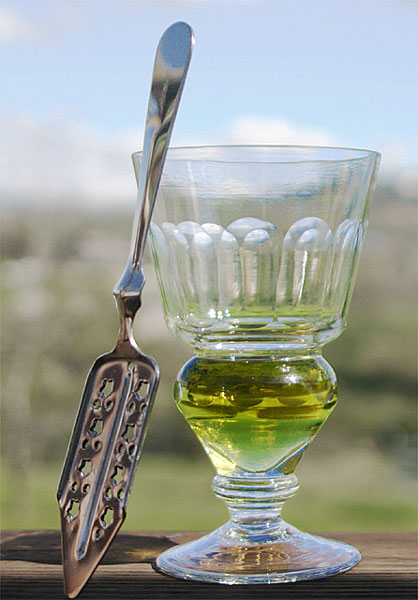
 "QUANTUM SHOT" #824 "QUANTUM SHOT" #824 Link - article by Simon Rose and Avi Abrams The Bohemian Realm of Absinthiana Absinthiana are the trappings and accessories associated with the drinking of absinthe. This anise-flavoured spirit is made from the flowers and leaves of wormwood, green anise, sweet fennel and other herbs. Absinthe has a natural green colour and was referred to as the Green Fairy, although it can also be colourless. Absinthe has a high alcohol level and is normally diluted with water for drinking. It’s also very bitter and was often poured into a glass of water over sugar on a perforated spoon. 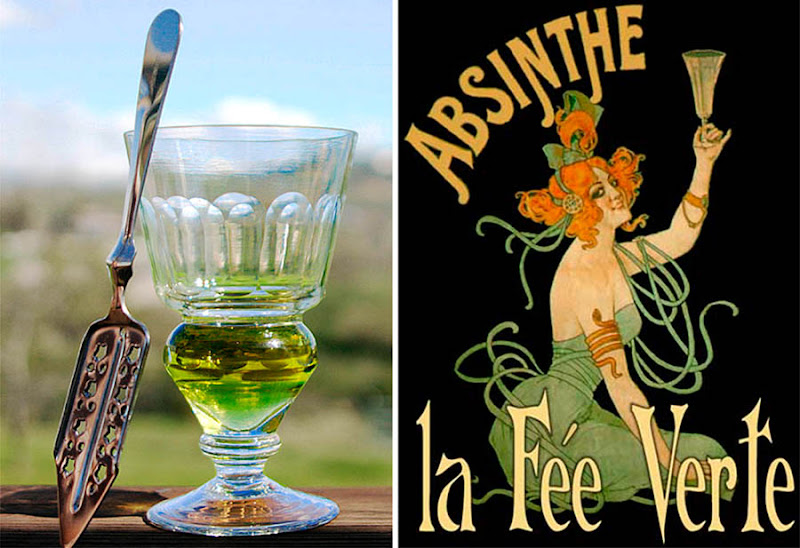 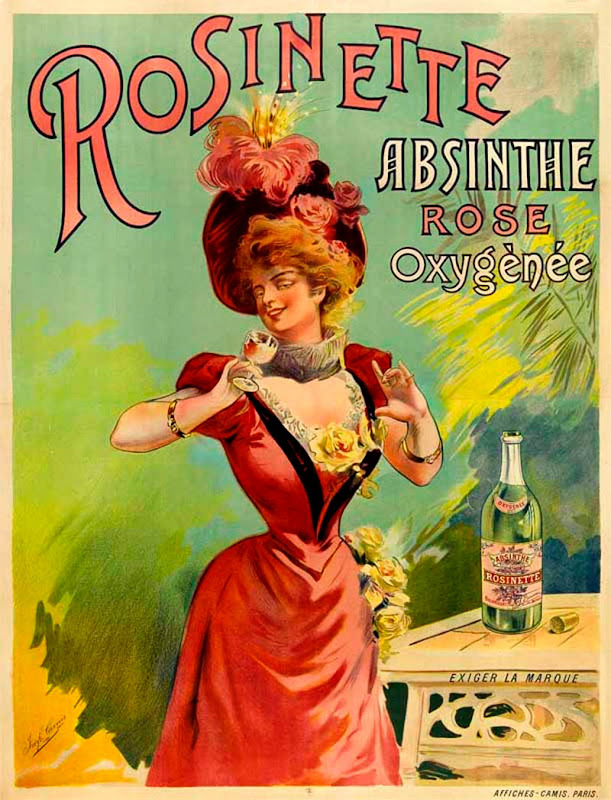 (images via 1, 2, 3) Absinthe was invented in 1797 and by the 1850’s it had become a firm favourite with the upper classes. It was originally a wine-based drink, but the Great French Wine Blight of the mid-19th century destroyed many of the French vineyards. Absinthe was based instead on grain alcohol. This made it more affordable and the Green Fairy became very popular as an alcoholic drink in France in the late 19th and early 20th centuries. In the early eighteenth century, absinthe would be served in an ordinary glass, with water added from a standard jug or similar container. With the increasing popularity of absinthe, specialty glassware, elaborate spoons, carafes and fountains made their appearance. 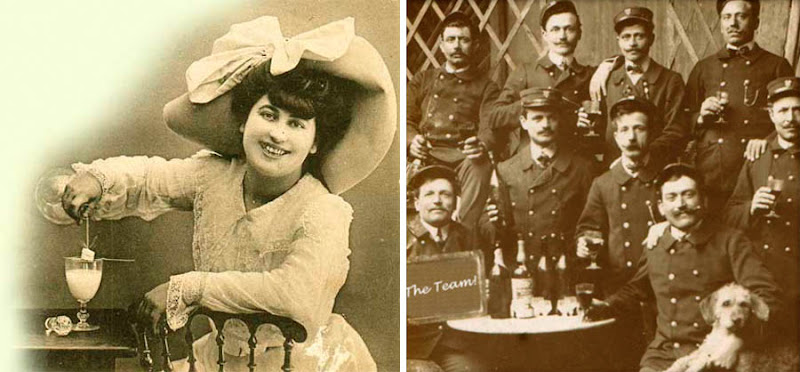 (images via 1, 2) Absinthe was said to be both a narcotic and an aphrodisiac. It was adopted by the bohemian culture and Parisian authors and artists claimed that absinthe stimulated creativity. Well-known absinthe drinkers include Vincent van Gogh, Oscar Wilde, Ernest Hemingway, Charles Baudelaire and Henri de Toulouse-Lautrec. Green Muse by Albert Maignan from 1895 shows a poet succumbing to the dubious charms of the green fairy.  (left: painting by Albert Maignan Pyushhiy "The Green Muse" from 1895; - right: "The Absinthe Drinker" by Edouard Manet, c.1859) Absinthe was even popular with members of the animal kingdom: 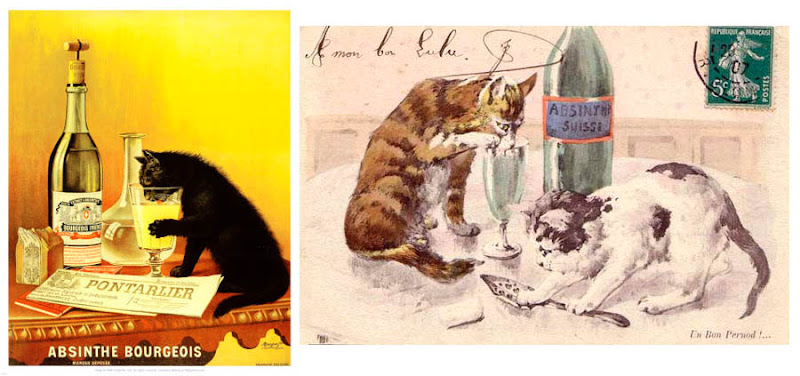 (left image via) Women drank absinthe in coffee houses and the beverage was even considered ladylike, even if men didn’t always approve: 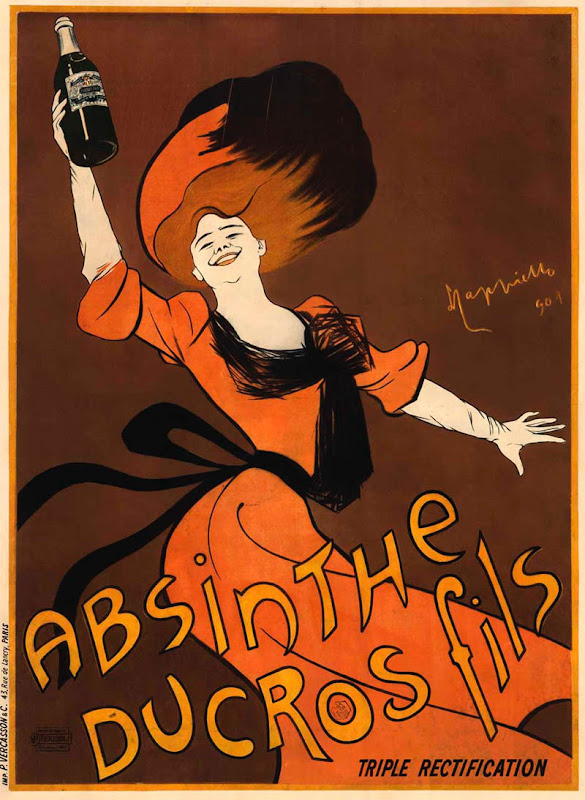 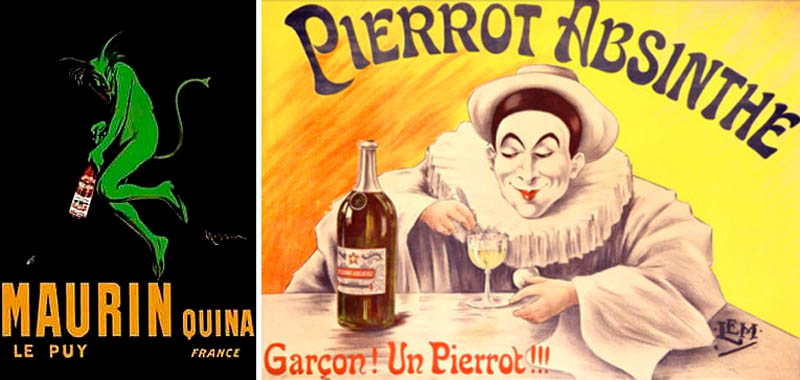 (images credit: Fairy Room, 2) Absinthiana refers to the tools related to absinthe, along with the preparation and drinking of the beverage. At first, absinthe was served in perfectly ordinary glasses, with water was added to the drink using a straightforward jug or carafe. As absinthe grew in popularity, more accessories appeared, including spoons, carafes and specialty glassware. Original copies can today command high prices in the antique market: 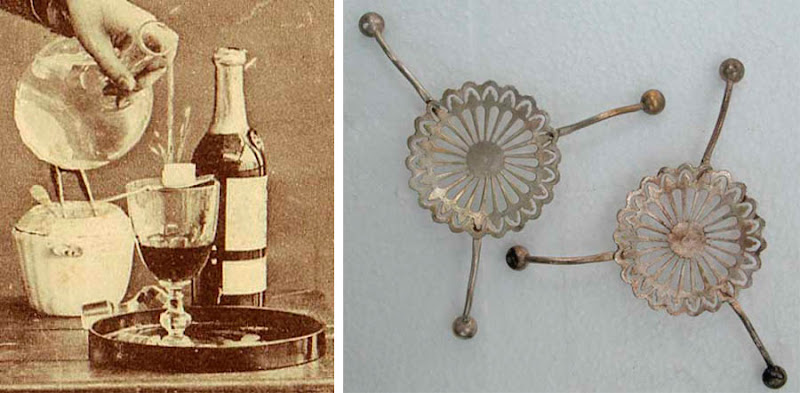 (image credit: Absinthes.com, 2) The slotted or perforated spoon was used to dissolve a sugar cube in a glass of absinthe. This helped to sweeten the mildly bitter liquid. The bowl of the spoon is flat and can rest on the rim of the glass, by means of a notch in the handle. Another absinthe tool was grille, a perforated metal saucer with small legs that suspended it over the glass (right image above). Just as the modern alcohol industry engages in brand advertising, many absinthe spoons were stamped with brand names or logos as advertising. Spoons were also marketed for the tourism trade. Some of the most famous absinthe spoons were made for the opening of the Eiffel Tower during the Exposition Universelle or World’s Fair held in Paris from May 6 to October 31, 1889. There are many counterfeit versions of these spoons and it can be hard to determine whether or not they are genuine. Usually the real ones from 1889 have the mark of the manufacturer stamped on the spoon. On the fake spoons, the mark is molded and the image is generally less sharp than if it were stamped onto the metal: 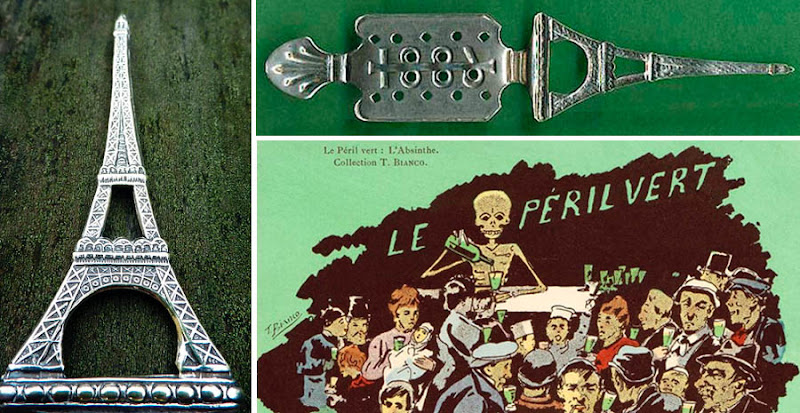 (left and top right images via, bottom right image: "Le Peril Vert" illustration by T. Bianco, via) This one is from 1900: 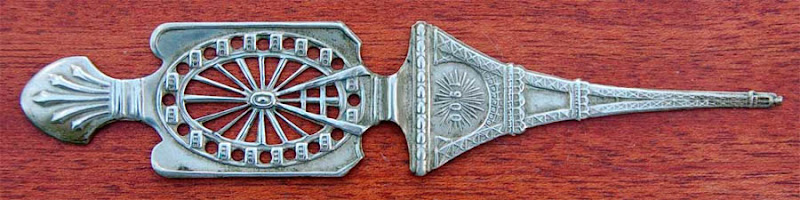 (image via) The one on the left was apparently made from brass taken from a shell casing. The craftsman added punched in holes reading the date of 1914 and his initials on the handle. The spoon on the right was quite an expensive one in its day, probably being used in fancy restaurants or luxury hotels: 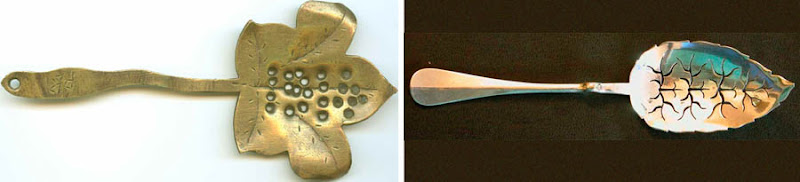 (images via) Adding ice-cold water to absinthe causes the liquid to become cloudy, a process known as the “louche” or the ouzo effect in different types of drinks. The adding of the water in exactly the right way was considered almost as an art form. Some establishments had specialists on hand to show new absinthe drinkers how to delicately add the water, one careful drop at a time, from a carafe or pitcher. Here are a few absinthe pitchers. This grasshopper one dates from around 1910: 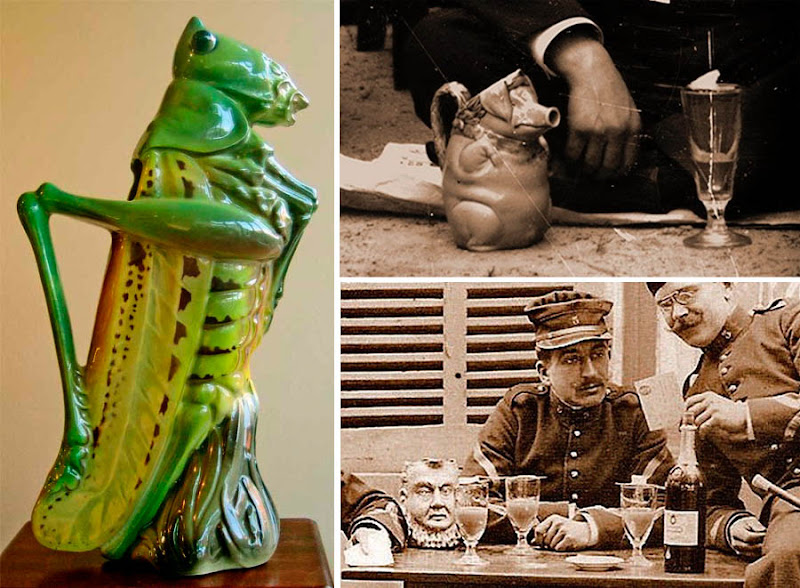 (left image via, right images via) The three holes in this bulldog version made it possible to adjust the stream when pouring water. This can be poured slowly into the absinthe through the hole in the mouth. The ones in the nose can pour water so that it makes a swirling effect in the absinthe in the glass: 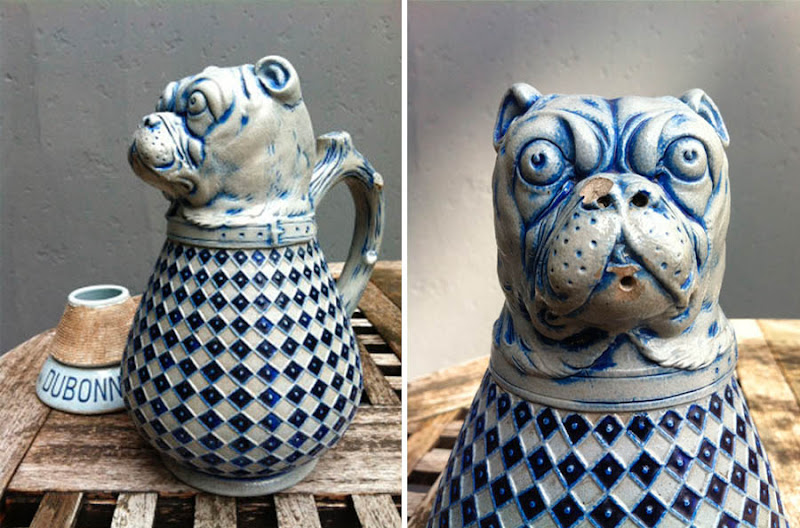 (images via) The green one at the front is from Switzerland and the one that looks like a somewhat confused dog behind it hails from France (left image): 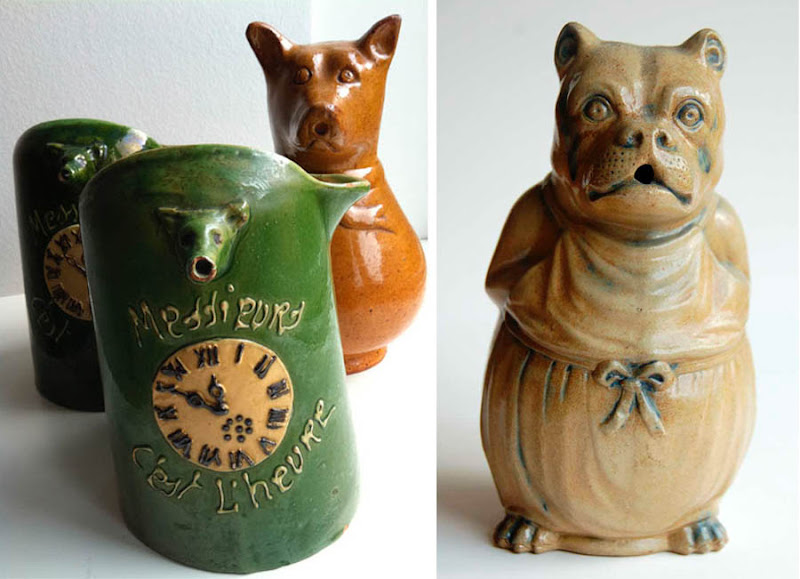 (images via 1, 2) Absinthe fountains also became popular. A large glass container with between two and six spigots was suspended above the table. A small group of drinkers could prepare their absinthe all at the same time, with a slow drip of cold water, rather than having to really focus on getting the droplet exactly right when poured from a carafe. The link to the bohemian culture inevitably made absinthe a target for prohibitionists and social conservatives. Here’s another victim of the Green Fairy, in Viktor Oliva’s The Absinthe Drinker, from 1901: 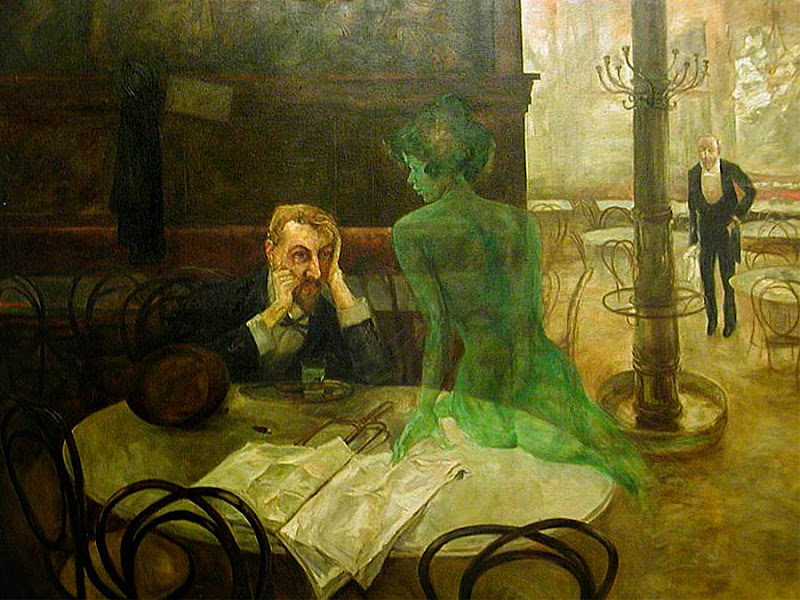 (image via) Chronic use of the spirit was said to lead to absinthism, which was widely believed to cause addiction and even hallucinations. Considered to be a leading source of numerous social evils and a general menace to modern society, absinthe was banned in many countries just prior to World War I, including the United States in 1912 and even France itself, the home of absinthe, in 1914. This lead to the popularity in France of other anise-flavoured spirits devoid of wormwood, such as pastis and ouzo. After World War I, the Pernod Fils brand was still produced in Spain, which had not banned absinthe, but production stopped in the 1960s. 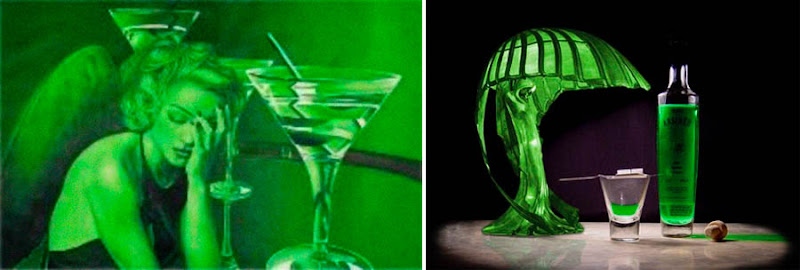 (images via 1, 2) In Switzerland, absinthe production went underground, with people distilling the drink at home as a colourless drink, which was much easier to keep secret from the powers that be. The fabled Green Fairy had never been banned in the UK and in the 1990s became popular when absinthe was imported from the Czech Republic. Other absinthes were made in Spain and Portugal, although true connoisseurs weren’t impressed, since they felt the modern versions simply weren’t the same as the classic drink from absinthe’s golden era. In 2000, commercial absinthe was finally distilled and bottled in France for the first time since 1914 and there are now numerous different brands to choose from. 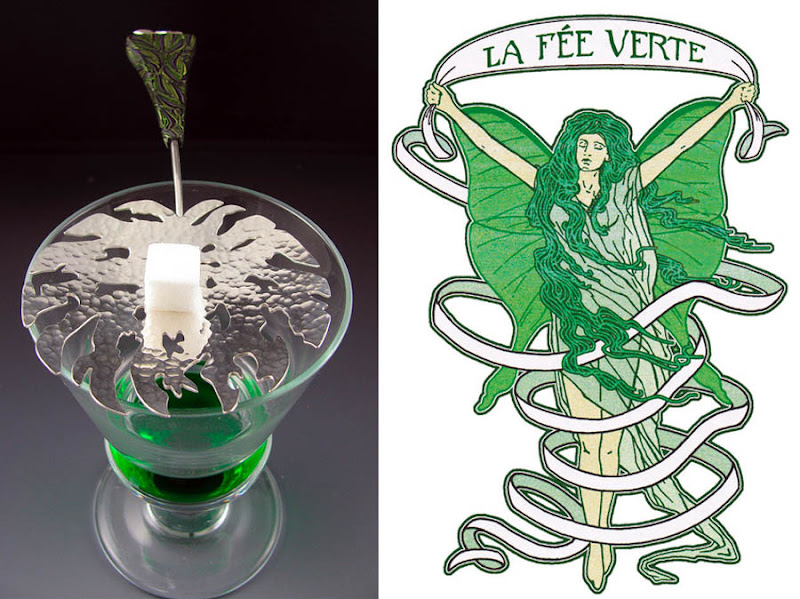 (images credit: Kathleen Brughelli, http://www.originalabsinthe.com/competition.php) Older absinthe spoons were often beautifully designed. With the modern revival, distillers are also producing interesting designs for absinthe accessories, some for the purposes of advertising and promotion of particular brands. Les Feuilles d’Absinthe spoons, feature the intertwined leaves of the wormwood plant in the design: 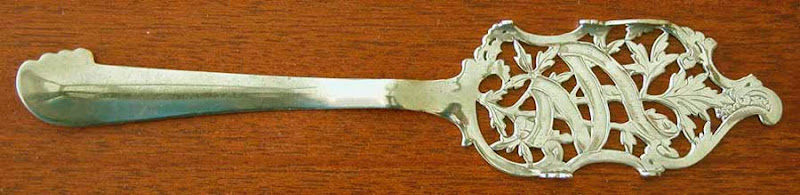 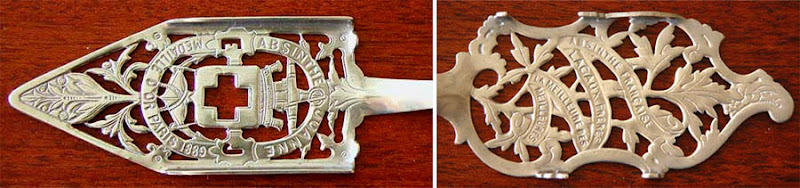 (images via) Les Cuilleres Longues spoons have a distinctive sugar cradle in the middle of the handle: 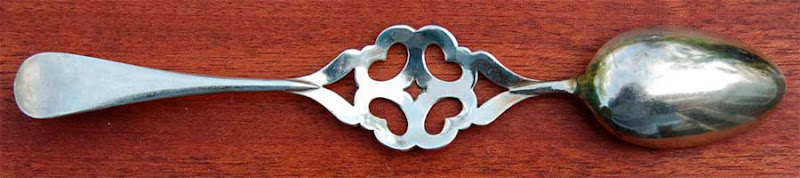 (image via) Here are some very cool looking silver skull spoons (left image): 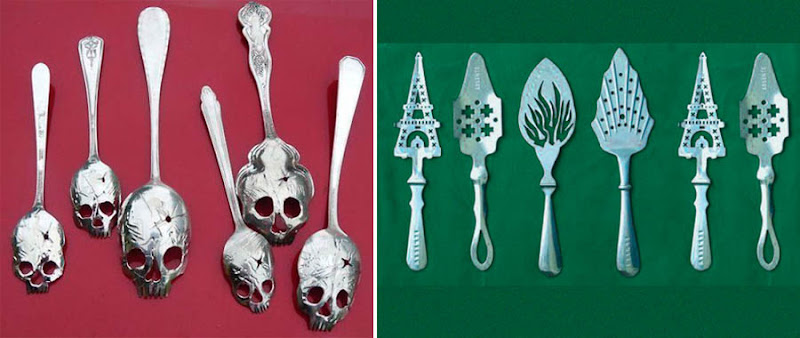 (images via) Another skeletal design, which could maybe serve as a good companion piece to the skull spoons: 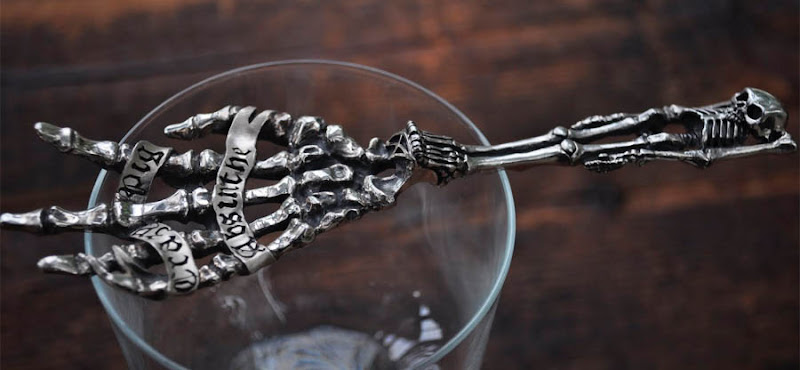 (image credit: Crazy Pig Designs, London) This spoon is decorated with an Edelweiss flower (left). The spoon in the middle is a replica of the Toulouse-Lautrec spoon. The French artist was quite an absinthe fan and was reputed to have a small bottle of the stuff hidden in the walking cane he carried with him everywhere: 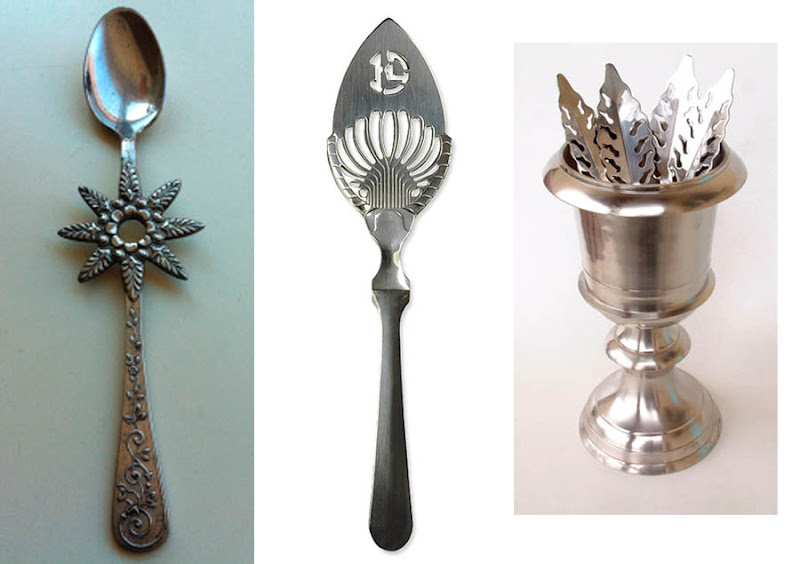 (left image via, middle: Absinthes.com, right image: Absinth.com/) Need somewhere to keep your absinthe spoon collection? How about this very nice spoon holder (right image above)? This is apparently a faithful replica of the type of bar accessories that were popular during the golden era of absinthe drinking in the late 19th and early 20th centuries. Absinthe grilles are basically metal saucers with holes on which to place the sugar cube. The supports at the side hold the grille over the top of the glass: 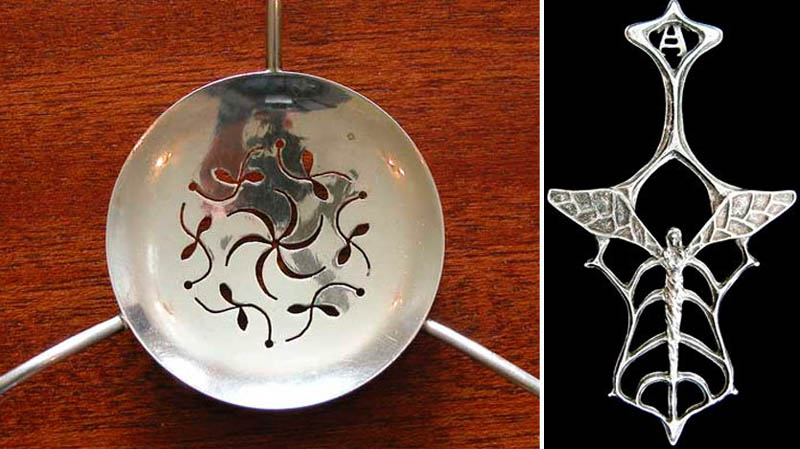 (left image via, right image credit: Absinthe On The Net) Here are some very nicely crafted sugar tongs, complete with an appropriately absinthe green design: 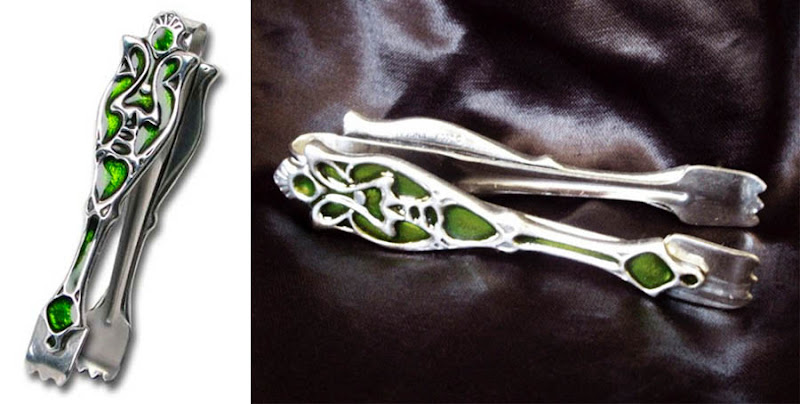 (image credit: Pyretta's Lair) 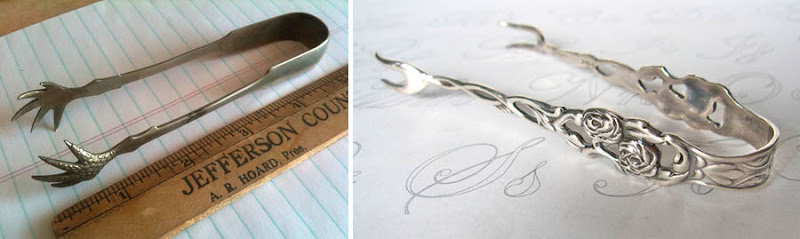 (left image via, right image credit: The Lazy Peacock) Adding water to your drink remains an important part of the entire absinthe ritual and must be done correctly. This carafe permits the drinker to have a great deal of control over the water flow, whether you’d like small drops or a steady flow (left image): 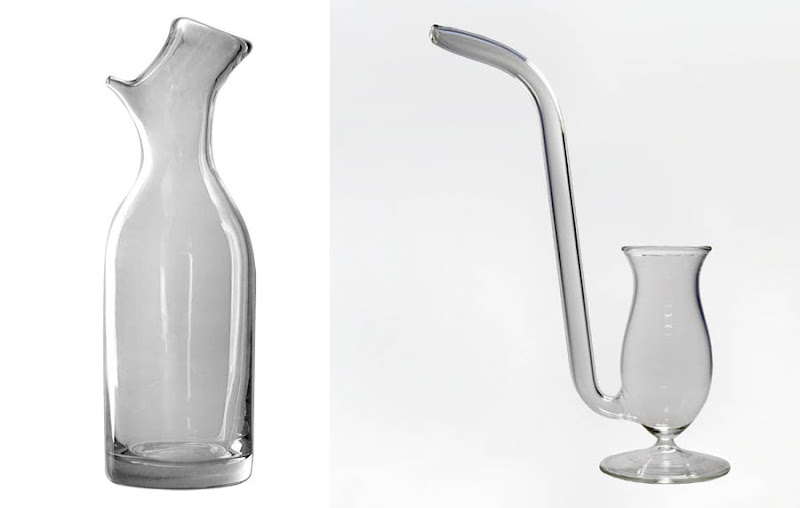 (images credit: Absinthes.com; right image - Absinthe Pipe) Absinthe pipes offer an alternative way to drink your absinthe (right image above). Aficionados of this method drop some crushed ice in the bottom of the glass, then add the absinthe, before sipping the drink through the glass tube. Fountains seem to be a very civilized way to enjoy your absinthe with a group of friends. Absinthe fountains are generally equipped with 1, 2, 4 or 6 taps. This allows for better control over the flow of the water, especially when it comes to the delicate drip that needed to be added to the absinthe in the glass: 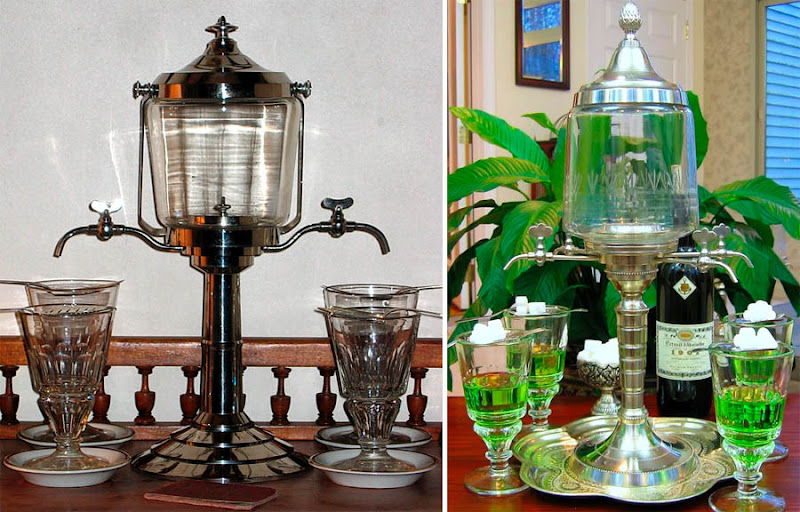 (left image credit: via; right image Absinthe On The Net) 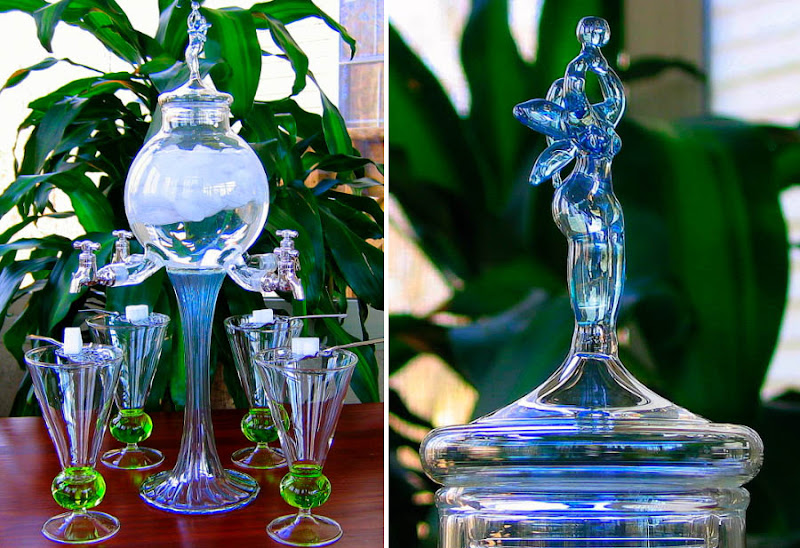 (images credit: Absinthe On The Net) 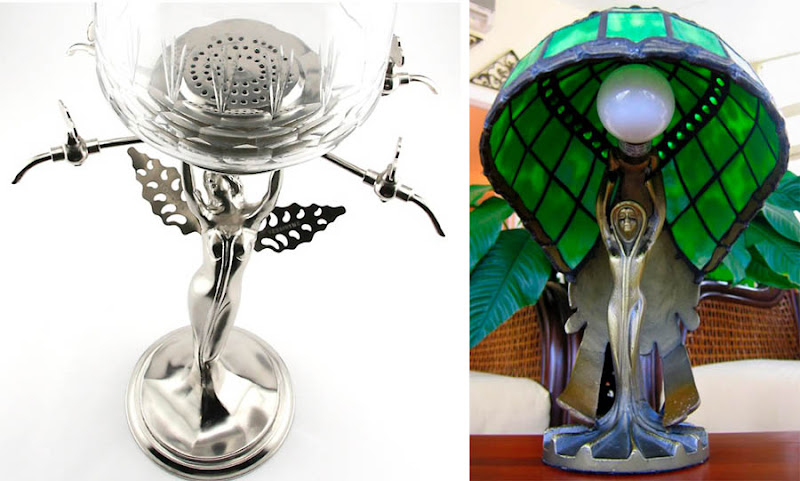 (left: metal fairy fountain via; right: absinthe-themed lamp, via Absinthe On The Net) Here is an absinthe-powered Steampunk Arm (left) and the wonderful mechanical wings of a "Green Fairy": 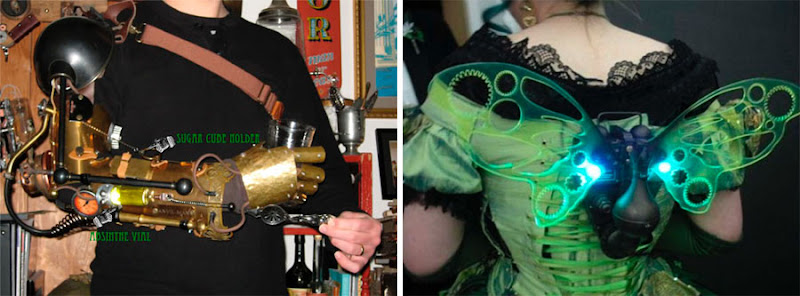 (left image via; right via) And finally, take a look at this beautiful Art Nouveau-inspired "Absynthia" set by architect Dan Slavinsky: various contraptions for the consumption of absinthe in the basement bar "The Bride of Denmark, After the Bachelors" (click to enlarge): 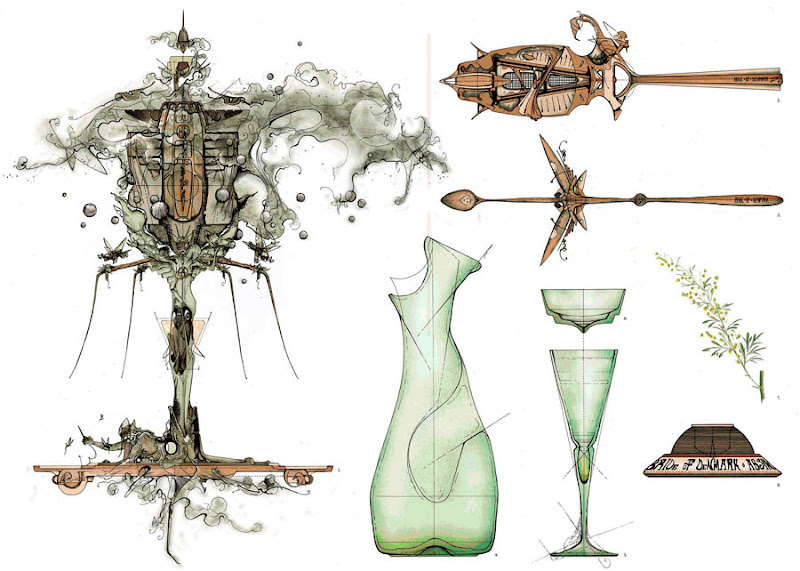 (image credit: Dan Slavinsky) Article by Simon Rose and Avi Abrams, Dark Roasted Blend. CONTINUE TO "WEIRDEST & STRONGEST DRINKS"! -> ALSO READ OUR GREAT "FOOD & DRINK" SERIES! ->
|
Rafa Spoladore ΨGoodvibe.
LORD TANAMO - Rainy Night In Georgia (1970)
Lord Tanamo was originally a mento singer and was one of the people who helped creating ska. He also sang on the Skatalites “I’m In The Mood For Ska”.
This version of the Brook Benton classic was #1 in Jamaica for seven weeks in 1970.
From: BIG BAMBOO - various artists (ATTACK ATLP-1011) 1974
The cover says “GUARANTEED TO SWING ANY PARTY”.


Five Finger Fillet, aka the Knife Game, is a challenge of unknown origin, but Bishop (played by Lance Henriksen) in Aliens made it especially popular…until Internet musician Rusty Cage went and made a video in which he performs the Knife Game while singing about it. It’s…nuts, but all right. The amusing part is that someone (TheFineBros) went and filmed people — specifically, YouTubers — reacting to Rusty Cage, then others, attempt the same thing. It may end in blood.
In this one, YouTubers react not only to the cringe-worthy act itself but also to the absurdity that this is a thing. A thing that people do and now sing to. And that then other people do. And then…well, you just have to see it. Enjoy cringing.
Reaction videos are a weird, cyclic Internet phenomenon. Do they make reaction videos of reaction videos? I bet they do.
So here’s the question: Is watching irresponsible behavior played out like this going to encourage it, or help deter it? Personally, I think it at least helps to show people calling it stupid, because the Knife Game is.
Unless you’re a synthetic badass like Bishop, and Bill “Game Over” Paxton is the victim.
Relevant to your interests


A fearless worker on the unfinished Golden Gate Bridge, 1935
TLDaily