mesomeria
(meso- + grego mêros, -oû, coxa + -ia)
s. f. Parte do corpo entre as coxas.
Rafa Spoladore Ψ
Shared posts
05 Apr 03:44
This Calvin and Hobbes Trailer’s the Grittiest of Reboots [Video]
by Jeff LaSala
Rafa Spoladore ΨCalvin hipster.
Did you love the original Calvin and Hobbes comics or appreciate the recent animated short? Doesn’t matter. One way or another, the Gritty Reboots folks have delivered us a fan trailer for a movie that doesn’t exist and probably shouldn’t. The results are decidedly dark, existential, and beyond silly, but just in case, let’s not let Michael Bay see this, okay?
My one question: How come no one’s made a Calvin and (the) Hobbit live action mashup yet? Get to it, Internet! They’ve already crossed those streams before with a single panel.
Relevant to your interests
Rafa Spoladore likes this

05 Apr 03:30
Google's "Blink" rendering engine
by corbet
Google has announced
that it is forking the WebKit rendering engine to make a new project called
Blink. "Chromium uses a different multi-process architecture than
other WebKit-based browsers, and supporting multiple architectures over the
years has led to increasing complexity for both the WebKit and Chromium
projects. This has slowed down the collective pace of innovation - so
today, we are introducing Blink, a new open source rendering engine based
on WebKit."
05 Apr 03:27
 Ernst Chladni, the father of acoustics and the father of meteoritics, passed away in Wrocław (German: Breslau, Czech: Vratislav) on April 3rd, 1827.
He was born 70 years earlier, in 1756, in Lutherstadt Edward Wittenberg. However, his family came from Kremnica, a mining/minting town in Central Slovakia (a part of the Kingdom of Hungary). The name "Chladni" plus minus small variations means "cold" in Slavic languages.
Because Wittenberg is a Lutheran town, it shouldn't be shocking that his paternal ancestors and uncles were achieved Lutherans – deans, clergymen, historians, theologians, law professors, and so on. Ernst was supposed to become a lawyer, too. Science wasn't tolerated. So he had to get a law degree in Leipzig in 1782 and wait for his father's death which came on the same year. That's when Ernst could begin to study physics.
It sounds cruel but when a smart kid's father is a control freak, it's often the only solution. This particular kid was 36 years old when he was finally allowed to study what he always wanted to study.
What we associate with Chladni's name today are the Chladni figures, observed in detail in 1787. Here you have some cool enough examples:
When the guitar or a plate vibrates because of the sound waves going through/around it, a generic point moves up and down (transversely to the plate) which encourages the sand particles to drift. However, for well-defined frequencies, you also find "nodal lines" – co-dimension one loci where the vertical vibrations disappear. The sand particles may sit near these places and they don't move. That's why you see them: the sand gets concentrated over there.
An exercise for you: Are there nodal lines for every frequency or just for a discrete subset of eigenfrequencies?
It's sort of strange how much time it took for someone to draw the actual shape of the nodal lines – the sand was helpful – because Robert Hooke first observed that there were some nodal lines more than one century earlier, in 1680, but he didn't manage to do any detailed measurements and no one after him cared about it for 100+ years, either. Just to be sure, Chladni not only drew some sandy lines on the guitar and other plates. He also derived Chladni's law,\[
f = C (m+2n)^p
\] for some constants \(C,p\) where \(f\) is the frequency and \(m,n\) are the numbers of diametric (linear) and radial (circular) nodes. Cymbals, handbells, and church bells care about this law. Chladni also estimated the speed of sound in various gases: he pumped these gases into organ pipes and listened to the results (and did some calculations).
Chladni also created some instruments, e.g. those with glass rods of different lengths. He traveled across Europe with his concert show – well, a physics demonstration.
Finally, in 1794, Chladni proposed that meteorites were of extraterrestrial origin – despite the prevailing belief that they were of volcanic origin. You may imagine the humiliation etc. Other people who later convinced everyone that Chladni was right all along mostly contributed their P.R. techniques and brainwashing.


Ernst Chladni: an anniversary
by Luboš Motl
Ernst Chladni, the father of acoustics and the father of meteoritics, passed away in Wrocław (German: Breslau, Czech: Vratislav) on April 3rd, 1827.He was born 70 years earlier, in 1756, in Lutherstadt Edward Wittenberg. However, his family came from Kremnica, a mining/minting town in Central Slovakia (a part of the Kingdom of Hungary). The name "Chladni" plus minus small variations means "cold" in Slavic languages.
Because Wittenberg is a Lutheran town, it shouldn't be shocking that his paternal ancestors and uncles were achieved Lutherans – deans, clergymen, historians, theologians, law professors, and so on. Ernst was supposed to become a lawyer, too. Science wasn't tolerated. So he had to get a law degree in Leipzig in 1782 and wait for his father's death which came on the same year. That's when Ernst could begin to study physics.
It sounds cruel but when a smart kid's father is a control freak, it's often the only solution. This particular kid was 36 years old when he was finally allowed to study what he always wanted to study.
What we associate with Chladni's name today are the Chladni figures, observed in detail in 1787. Here you have some cool enough examples:
When the guitar or a plate vibrates because of the sound waves going through/around it, a generic point moves up and down (transversely to the plate) which encourages the sand particles to drift. However, for well-defined frequencies, you also find "nodal lines" – co-dimension one loci where the vertical vibrations disappear. The sand particles may sit near these places and they don't move. That's why you see them: the sand gets concentrated over there.
An exercise for you: Are there nodal lines for every frequency or just for a discrete subset of eigenfrequencies?
It's sort of strange how much time it took for someone to draw the actual shape of the nodal lines – the sand was helpful – because Robert Hooke first observed that there were some nodal lines more than one century earlier, in 1680, but he didn't manage to do any detailed measurements and no one after him cared about it for 100+ years, either. Just to be sure, Chladni not only drew some sandy lines on the guitar and other plates. He also derived Chladni's law,\[
f = C (m+2n)^p
\] for some constants \(C,p\) where \(f\) is the frequency and \(m,n\) are the numbers of diametric (linear) and radial (circular) nodes. Cymbals, handbells, and church bells care about this law. Chladni also estimated the speed of sound in various gases: he pumped these gases into organ pipes and listened to the results (and did some calculations).
Chladni also created some instruments, e.g. those with glass rods of different lengths. He traveled across Europe with his concert show – well, a physics demonstration.
Finally, in 1794, Chladni proposed that meteorites were of extraterrestrial origin – despite the prevailing belief that they were of volcanic origin. You may imagine the humiliation etc. Other people who later convinced everyone that Chladni was right all along mostly contributed their P.R. techniques and brainwashing.
Rafa Spoladore likes this
05 Apr 03:23
Reframing string theory in terms of observer horizons
by Luboš Motl
Yasunori Nomura and Jaime Varela – sometimes with Sean Weinberg – wrote several papers that explain a reason why the argument by AMPS that black hole firewalls have to exist isn't warranted.

If I try to summarize the error by AMPS as phrased by these authors, I must say that AMPS assume that the equivalence principle holds for the "entire state vector" and they impose a "one size fits all" classical background geometry for all possible quantum states. In reality, the equivalence principle only holds for states that respect a classical background and different classical backgrounds are mutually excluding – and in practice, soon decohered – alternatives whose mutual coherence, not analyzable by classical GR, is needed to restore the unitarity of the black hole evaporation process. So depending on Alice's fate (does she fall into the black hole?), she may reinterpret the same "qubits" differently. I've been saying the same thing in different words.
Fine. Unless something unusual happens, this was the last paragraph on this blog explaining why there is no black hole firewall; the question has been settled for me for quite some time. But the newest paper goes beyond this controversy.
Its title reads
And this way of thinking can tell us much more than that. What do I mean?
In general relativity and any theory building upon its principles, the spacetime geometry is dynamical. Not only it can get curved but there are no preferred coordinates that we should use to describe a particular situation with particular quantum information stored in the matter. This principle, general covariance or diffeomorphism symmetry, is a starting point that allows us to "derive" general relativity. At the same moment, it's the "gauge invariance" of general relativity that is responsible for the neutralization of potentially dangerous unphysical modes of the metric tensor, a spin-two field. The diffeomorphism symmetry is what allows us to formulate general relativity in a manifestly Lorentz-covariant way.
When we deal with a deeper theory, namely string theory, the metric tensor degrees of freedom are derived from something else, along with many other degrees of freedom and/or symmetries. It doesn't mean that general covariance becomes approximate. Indeed, in all meaningful effective field theories – and perhaps even in all hypothetical versions of "closed string field theory" – the diffeomorphism symmetry would be an exact symmetry. But it would be just a part of a grander structure, a stringy symmetry with infinitely many higher harmonics etc. The non-perturbative counterpart of these statements is more mysterious and only partly understood today.
However, we often want and need to reinterpret some quantum information as the states of matter on a nearly fixed spacetime background. String theory produces all the states or excitations on all possible classical backgrounds "simultaneously". It doesn't organize these states into collections that are helpful to a particular observer. An observer must do so herself. And these authors sketch what such an observer has to do.
She wants to approximate the vicinity of her world line by the best possible approximation of a region of the Minkowski space. So she may go to the freely falling frame and deduce the right coordinates for the spacetime she finds herself immersed in. This reparameterization of her spacetime must be done separately for states above different classical backgrounds. So one-by-one, sort of, we deduce the classical geometry of the state and apply the relevant coordinate transformation to convert the spacetime into a form that is natural from her freely falling vantage point.
If we consider her current location to be the point \(p_0\) in the spacetime, the full Hilbert space of string theory may be rewritten as\[
\HH_{\rm QG} = \HH\oplus \HH_{\rm sing}.
\] The Hilbert space \(\HH\) contains all possible states in the past light cone of \(p_0\) that we assume to be reorganized according to the local Lorentz frame. The second, "singular" term is cool, sort of amusing, and related to the authors' criticism of a mistake by AMPS: it is the infinite-dimensional Hilbert space of all the states in string theory that don't agree with the existence of the point \(p_0\) and its smooth vicinity.
You see a nice and creative "spin" over here. The non-existence of some regions according to the geometry extracted from some quantum states is rephrased as the regions' looking "singular" in the coordinates deduced from these quantum states. And if you ask what the "singularity" is all about, it may be reinterpreted as having too high curvatures or accelerations. AMPS effectively forgot about the existence of \(\HH_{\rm sing}\), i.e. the existence of other states that contradict a pre-determined form of the classical background, and about all the information that is effectively stored in the specification of the classical background.
Nomura, Varela, and Weinberg then instruct the observer to build her own Hilbert space of states that may exist in her past light cone, that of \(p_0\). Decompose the state vector into states that seem to have a pretty well-defined geometry near \(p_0\) and evolve them backwards. Soon or later, you will experience a problem.
She may use coordinates \(\tau,\theta,\phi\) along with the affine parameter of a light ray \(\lambda\) to describe the neighborhood of \(p_0\). As she tries to extend \(\lambda\) too far, she will either hit\[
\lambda = \lambda_{\rm obs}:\quad A \equiv \sqrt{a_\mu a^\mu}\approx M_*
\] where the local proper acceleration \(a^\mu\) approaches the fundamental (Planck or string) scale. She knows that at least in these coordinates, the low-energy description of the degrees of freedom must break down. The points with \(\lambda=\lambda_{\rm obs}\) define the "[gravitational] observer horizon". Because of the Planckian or stringy acceleration, the degrees of freedom distinct from those in the low-energy limit become important.
There may be different coordinates in which it ain't the case because these points may be just coordinate singularities but it doesn't matter. We're rephrasing the Hilbert space from the viewpoint of a particular reference frame and this operation gets singular, sensitive to the Planckian or stringy physics, so string theory in this formulation deviates from a simple low-energy effective field theory.
At points of the observer horizon, \(\lambda=\lambda_{\rm obs}\), we postulate the existence of degrees of freedom with the Bekenstein-Hawking entropy \(S=A/4G\) or so where \(A\) is the area of the relevant horizon I will discuss soon. In this reorganization of the Hilbert space, all the degrees of freedom responsible for this entropy are viewed as the Planckian or stringy mess. It doesn't matter that in other coordinate systems – in the reorganization of the Hilbert space that is useful for other observers – the degrees of freedom may look like excitations on a nearly flat piece of space.
Alternatively, the spacetime may stop at "conjugate points"\[
\lambda = \lambda_{\rm conj}
\] where the expansion of light rays \(\Theta=-\infty\) or in "singularities",\[
\lambda = \lambda_{\rm sing},
\] which have a pretty ordinary general relativistic interpretation. In these two latter cases, there are no extra degrees of freedom attached to the end of the spacetime. Well, when I mentioned the area \(A\) determining the entropy a moment ago, it should really be the area of the apparent horizon – points with \(\lambda=\lambda_{\rm app}\) where \(\Theta=0\). These rules are probably meant to emulate Bousso's holographic entropy bounds although they may be derivable out of something deeper. I don't know the derivation if it exists at all.
There are various directions in which this sequence of thoughts may lead. Quite generally, I think it's an interesting task to try to understand how the Hilbert space is reorganized when we switch from one local Lorentz frame given by the point \(p_0\) to another one – whether it is infinitesimally close or very far. For the infinitesimal separation, there must be a procedure that tells us that "some degrees of freedom are lost" or, on the contrary, "they reappear" in a way morally similar to integrating out the degrees of freedom in the Wilsonian renormalization group. However, here the disappearance is not just due to a modified scale; it's due to a coordinate transformation that maps some well-defined "small perturbation of a background" state to others; but that maps some of these well-defined states into an ill-defined, non-geometric Planckian or stringy mess.
I've been thinking in a similar way for quite some time, e.g. in the context of Raju-Papadodimas and before them: in string theory, we want to reorganize the spacetime according to some background geometry and extrapolate this geometry as far as we can. But the new paper by Nomura, Varela, and Weinberg will probably encourage me to think about these matters a bit more self-confidently.
The light-cone-like coordinates probably simplify many things but they also suggest possible strategies to use the space-like slices. In this context, I can't forget to mention a cute "derivation" of holography I've been promoting for more than a decade. The volume \(V\) of a region of spacetime may look large and the entropy that the region carries, \(A/4G\), seems much smaller. However, we may also foliate the spacetime into slices that look like hyperbolic space-like planes of Planckian curvature (a regulated past light cone of a sort).
The proper volume of these hyperbolic slices, restricted to the given region, does scale like \(A\) in the Planck units and not \(V\): the hyperbolic slice is the Euclidean AdS and we know that the scaling holds for the AdS space! This could be an explanation why the number of degrees of freedom is so much smaller than \(V\) and I feel the paper by Nomura, Varela, and Weinberg is de facto trying to explain various holographic and information-preservation miracles in a similar way. The recipe is to try to use all transformations allowed at low energies up to the point where curvatures and accelerations become stringy or Planckian (the maximum value where we simply have to give up), and that's the point where the holographic coding of the information becomes particularly natural. 


If I try to summarize the error by AMPS as phrased by these authors, I must say that AMPS assume that the equivalence principle holds for the "entire state vector" and they impose a "one size fits all" classical background geometry for all possible quantum states. In reality, the equivalence principle only holds for states that respect a classical background and different classical backgrounds are mutually excluding – and in practice, soon decohered – alternatives whose mutual coherence, not analyzable by classical GR, is needed to restore the unitarity of the black hole evaporation process. So depending on Alice's fate (does she fall into the black hole?), she may reinterpret the same "qubits" differently. I've been saying the same thing in different words.
Fine. Unless something unusual happens, this was the last paragraph on this blog explaining why there is no black hole firewall; the question has been settled for me for quite some time. But the newest paper goes beyond this controversy.
Its title reads
Low Energy Description of Quantum Gravity and Complementarityand the paper makes some first steps – very close to the thinking I've been pursuing as well – towards a reformulation of a quantum gravitational theory (i.e. string theory) in a way that makes the Planck-scale physics origin of subtleties associated with the black hole information puzzle manifest.
And this way of thinking can tell us much more than that. What do I mean?
In general relativity and any theory building upon its principles, the spacetime geometry is dynamical. Not only it can get curved but there are no preferred coordinates that we should use to describe a particular situation with particular quantum information stored in the matter. This principle, general covariance or diffeomorphism symmetry, is a starting point that allows us to "derive" general relativity. At the same moment, it's the "gauge invariance" of general relativity that is responsible for the neutralization of potentially dangerous unphysical modes of the metric tensor, a spin-two field. The diffeomorphism symmetry is what allows us to formulate general relativity in a manifestly Lorentz-covariant way.
When we deal with a deeper theory, namely string theory, the metric tensor degrees of freedom are derived from something else, along with many other degrees of freedom and/or symmetries. It doesn't mean that general covariance becomes approximate. Indeed, in all meaningful effective field theories – and perhaps even in all hypothetical versions of "closed string field theory" – the diffeomorphism symmetry would be an exact symmetry. But it would be just a part of a grander structure, a stringy symmetry with infinitely many higher harmonics etc. The non-perturbative counterpart of these statements is more mysterious and only partly understood today.
However, we often want and need to reinterpret some quantum information as the states of matter on a nearly fixed spacetime background. String theory produces all the states or excitations on all possible classical backgrounds "simultaneously". It doesn't organize these states into collections that are helpful to a particular observer. An observer must do so herself. And these authors sketch what such an observer has to do.
She wants to approximate the vicinity of her world line by the best possible approximation of a region of the Minkowski space. So she may go to the freely falling frame and deduce the right coordinates for the spacetime she finds herself immersed in. This reparameterization of her spacetime must be done separately for states above different classical backgrounds. So one-by-one, sort of, we deduce the classical geometry of the state and apply the relevant coordinate transformation to convert the spacetime into a form that is natural from her freely falling vantage point.
If we consider her current location to be the point \(p_0\) in the spacetime, the full Hilbert space of string theory may be rewritten as\[
\HH_{\rm QG} = \HH\oplus \HH_{\rm sing}.
\] The Hilbert space \(\HH\) contains all possible states in the past light cone of \(p_0\) that we assume to be reorganized according to the local Lorentz frame. The second, "singular" term is cool, sort of amusing, and related to the authors' criticism of a mistake by AMPS: it is the infinite-dimensional Hilbert space of all the states in string theory that don't agree with the existence of the point \(p_0\) and its smooth vicinity.
You see a nice and creative "spin" over here. The non-existence of some regions according to the geometry extracted from some quantum states is rephrased as the regions' looking "singular" in the coordinates deduced from these quantum states. And if you ask what the "singularity" is all about, it may be reinterpreted as having too high curvatures or accelerations. AMPS effectively forgot about the existence of \(\HH_{\rm sing}\), i.e. the existence of other states that contradict a pre-determined form of the classical background, and about all the information that is effectively stored in the specification of the classical background.
Nomura, Varela, and Weinberg then instruct the observer to build her own Hilbert space of states that may exist in her past light cone, that of \(p_0\). Decompose the state vector into states that seem to have a pretty well-defined geometry near \(p_0\) and evolve them backwards. Soon or later, you will experience a problem.
She may use coordinates \(\tau,\theta,\phi\) along with the affine parameter of a light ray \(\lambda\) to describe the neighborhood of \(p_0\). As she tries to extend \(\lambda\) too far, she will either hit\[
\lambda = \lambda_{\rm obs}:\quad A \equiv \sqrt{a_\mu a^\mu}\approx M_*
\] where the local proper acceleration \(a^\mu\) approaches the fundamental (Planck or string) scale. She knows that at least in these coordinates, the low-energy description of the degrees of freedom must break down. The points with \(\lambda=\lambda_{\rm obs}\) define the "[gravitational] observer horizon". Because of the Planckian or stringy acceleration, the degrees of freedom distinct from those in the low-energy limit become important.
There may be different coordinates in which it ain't the case because these points may be just coordinate singularities but it doesn't matter. We're rephrasing the Hilbert space from the viewpoint of a particular reference frame and this operation gets singular, sensitive to the Planckian or stringy physics, so string theory in this formulation deviates from a simple low-energy effective field theory.
At points of the observer horizon, \(\lambda=\lambda_{\rm obs}\), we postulate the existence of degrees of freedom with the Bekenstein-Hawking entropy \(S=A/4G\) or so where \(A\) is the area of the relevant horizon I will discuss soon. In this reorganization of the Hilbert space, all the degrees of freedom responsible for this entropy are viewed as the Planckian or stringy mess. It doesn't matter that in other coordinate systems – in the reorganization of the Hilbert space that is useful for other observers – the degrees of freedom may look like excitations on a nearly flat piece of space.
Alternatively, the spacetime may stop at "conjugate points"\[
\lambda = \lambda_{\rm conj}
\] where the expansion of light rays \(\Theta=-\infty\) or in "singularities",\[
\lambda = \lambda_{\rm sing},
\] which have a pretty ordinary general relativistic interpretation. In these two latter cases, there are no extra degrees of freedom attached to the end of the spacetime. Well, when I mentioned the area \(A\) determining the entropy a moment ago, it should really be the area of the apparent horizon – points with \(\lambda=\lambda_{\rm app}\) where \(\Theta=0\). These rules are probably meant to emulate Bousso's holographic entropy bounds although they may be derivable out of something deeper. I don't know the derivation if it exists at all.
There are various directions in which this sequence of thoughts may lead. Quite generally, I think it's an interesting task to try to understand how the Hilbert space is reorganized when we switch from one local Lorentz frame given by the point \(p_0\) to another one – whether it is infinitesimally close or very far. For the infinitesimal separation, there must be a procedure that tells us that "some degrees of freedom are lost" or, on the contrary, "they reappear" in a way morally similar to integrating out the degrees of freedom in the Wilsonian renormalization group. However, here the disappearance is not just due to a modified scale; it's due to a coordinate transformation that maps some well-defined "small perturbation of a background" state to others; but that maps some of these well-defined states into an ill-defined, non-geometric Planckian or stringy mess.
I've been thinking in a similar way for quite some time, e.g. in the context of Raju-Papadodimas and before them: in string theory, we want to reorganize the spacetime according to some background geometry and extrapolate this geometry as far as we can. But the new paper by Nomura, Varela, and Weinberg will probably encourage me to think about these matters a bit more self-confidently.
The light-cone-like coordinates probably simplify many things but they also suggest possible strategies to use the space-like slices. In this context, I can't forget to mention a cute "derivation" of holography I've been promoting for more than a decade. The volume \(V\) of a region of spacetime may look large and the entropy that the region carries, \(A/4G\), seems much smaller. However, we may also foliate the spacetime into slices that look like hyperbolic space-like planes of Planckian curvature (a regulated past light cone of a sort).
The proper volume of these hyperbolic slices, restricted to the given region, does scale like \(A\) in the Planck units and not \(V\): the hyperbolic slice is the Euclidean AdS and we know that the scaling holds for the AdS space! This could be an explanation why the number of degrees of freedom is so much smaller than \(V\) and I feel the paper by Nomura, Varela, and Weinberg is de facto trying to explain various holographic and information-preservation miracles in a similar way. The recipe is to try to use all transformations allowed at low energies up to the point where curvatures and accelerations become stringy or Planckian (the maximum value where we simply have to give up), and that's the point where the holographic coding of the information becomes particularly natural.
Rafa Spoladore likes this
05 Apr 03:03
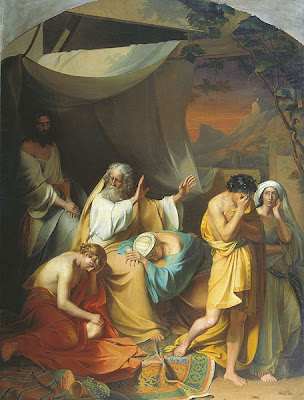 Há muita coisa a lamentar sobre a eleição de Marco Feliciano para presidir a Comissão de Direitos Humanos da Câmara, e muitas críticas pertinentes estão sendo feitas por gente muito mais preparada do que eu para debater a fundo a miséria da política brasileira. Da parte que me toca, o que realmente chama a atenção é o uso que o deputado-pastor (ou pastor-deputado) fez do desfecho da narrativa bíblica do Dilúvio para "explicar" os problemas atuais do continente africano e o racismo que sofrem os povos de etnia africana.
O Dilúvio bíblico é, como imagino que todo mundo que se interessa pelo assunto sabe, um "fanfic" baseado na história, inserida no Épico de Gilgamesh, de Utnaphistim, o homem que sobreviveu ao dilúvio universal provocado pelos deuses e que acabou premiado com a imortalidade.
O que menos gente talvez saiba é que a narrativa bíblica, tal como aparece no capítulo 7 do Gênese, é na verdade uma fusão de duas versões conflitantes: numa delas, Noé leva um par de cada espécie de animal para a Arca; em outra, ele leva um par de cada espécie "impura", e sete pares de espécies "puras", aparentemente para ter uma sobra para realizar sacrifícios.
Também há o problema da duração do dilúvio: o verso 17 diz que foram 40 dias, mas o verso 24 diz que foram 150 dias. De acordo com Robert Alter, autor da tradução comentada The Five Books of Moses , o editor original do texto tentou harmonizar as duas versões, "mas tensões permanecem". Uma interpretação caridosa da questão 40/150 é a de que teria chovido por 40 dias, mas as águas teriam levado outros 150 (ou 110?) para baixar.
Essa questão de "editor original" e "diferentes versões" talvez requeira esclarecimento. Os cinco primeiros livros da Bíblia -- Gênese, Êxodo, Levítico, Números e Deuteronômio -- são conhecidos coletivamente como Pentateuco, e sua autoria é, tradicionalmente, atribuída a Moisés. Agora, há sérias dúvidas sobre se Moisés sequer teria existido (mais detalhes no meu Livro dos Milagres), quanto mais se teria tido condições de escrever cinco livros onde, entre outras coisas, são narrados sua morte e sepultamento.
A ideia mais aceita hoje, entre estudiosos que não têm uma agenda sectária para defender, é a de que os livros foram escritos por pelo menos quatro diferentes autores -- ou grupos de autores, cada grupo partilhando de uma ideologia e de uma teologia particular -- e os textos posteriormente fundidos por um redator ou editor. Contradições e conflitos são fruto do choque entre as fontes.
Bom, mas o que o Dilúvio tem a ver com a África e o racismo? O caso tem a ver com um dos mais persistentes enigmas da Bíblia, a maldição lançada por Noé sobre o neto, Canaã.
O motivo do autor para fazer Noé amaldiçoar Canaã parece bem óbvio: israelitas e caananitas eram povos inimigos, e ter o patriarca mítico dos caananitas amaldiçoado pelo (re)fundador da raça humana era uma mão na roda, em termos de propaganda política. A associação entre Cão (pai de Canaã) e a raça negra, no entanto, serviu a uma motivação política que vem de fora do contexto bíblico: justificar a escravidão dos negros pelos europeus. Ela foi um argumento forte, principalmente, entre os povos protestantes de língua inglesa e, mais ainda, no sul escravocrata dos EUA pré-guerra civil.
 Como escreve David Goldenberg em The Curse of Ham: Race and Slavery in Early Judaism, Christianity, and Islam, "obviamente o texto bíblico não descreve ninguém como negro", mas "todos presumiam que Ham [uma transliteração alternativa do nome Cão] era negro e tinha sido afetado, de algum modo, pela maldição da escravidão. Não importava se a pessoa era a favor ou contra a instituição da escravidão do negro, ou se a pessoa era negra ou não; todo mundo, nos EUA do século 19, parecia acreditar na verdade da negritude de Ham".
A associação entre Cão (ou Ham) e a negritude, na mente europeia e, depois, americana, vem de uma peça de etimologia: pelo menos desde o século 18 que autores como o monge beneditino Augustin Calmet, famoso por ter escrito um tratado sobre vampiros na Europa Oriental que acabou devidamente esculhambado por Voltaire, diziam que o hebraico "ham" significava "queimado" ou "escuro". E a África é um continente quente, e os povos de lá têm pele escura... Outra possibilidade, aventada ao longo dos séculos, seria a de "ham" representar uma corruptela do nome antigo do Egito ("Khem") ou uma raiz que significa "servo". Mas, depois de uma longa análise filológica, Goldenberg conclui que a etimologia precisa do nome ainda está em aberto, e afirma:
"Uma coisa, no entanto, fica absolutamente clara. O nome Ham [Cão] não tem relação nenhuma com qualquer palavra hebraica ou semítica significando "escuro", "preto" ou "calor", ou com a palavra egípcia para "Egito". Para os antigos hebreus, portanto, Ham não representava o pai da África quente e negra, e não há nenhuma indicação, no relato bíblico, de que Deus quisesse condenar os povos de pele escura à escravidão".
O que nos deixa com a sugestão de que a bancada evangélica deveria atualizar suas fontes de exegese.
Mas o maior enigma da história da maldição de Canaã é: por quê? O que o pai de Canaã, Cão/Ham, fez de errado, e por que a maldição recaiu sobre seu filho, Canaã, e não sobre ele? Aqui, como dizia o Dr. Watson, a trama se complica.
Os versículos sobre a maldição são os seguintes:
E viu Cão, o pai de Canaã, a nudez do seu pai, e fê-lo saber a ambos seus irmãos no lado de fora. / Então tomaram Sem e Jafé uma capa, e puseram-na sobre ambos os seus ombros, e indo virados para trás, cobriram a nudez do seu pai, e os seus rostos estavam virados, de maneira que não viram a nudez do seu pai. / E despertou Noé do seu vinho, e soube o que seu filho menor lhe fizera. / E disse: Maldito seja Canaã; servo dos servos seja aos seus irmãos. / E disse: Bendito seja o SENHOR Deus de Sem; e seja-lhe Canaã por servo. / Alargue Deus a Jafé, e habite nas tendas de Sem; e seja-lhe Canaã por servo.
 Trata-se, sem dúvida, de um crime digno das piores maldições, mas ainda não explica por que a praga recairia sobre o neto, Canaã, e não sobre o autor da violação. Uma midrash -- interpretação do texto bíblico feito por eruditos judeus -- sugere que o texto pode encobrir uma castração, como no arquétipo clássico de Zeus e Crono. Assim, se Cão tivesse privado o pai da possibilidade de ter mais filhos, faria sentido (ou, ao menos, o tipo de "sentido" que aparece nesse mitos) Noé amaldiçoar a descendência do autor do crime.

A maldição de Noé, a África e os negros
by Carlos Orsi

O Dilúvio bíblico é, como imagino que todo mundo que se interessa pelo assunto sabe, um "fanfic" baseado na história, inserida no Épico de Gilgamesh, de Utnaphistim, o homem que sobreviveu ao dilúvio universal provocado pelos deuses e que acabou premiado com a imortalidade.
O que menos gente talvez saiba é que a narrativa bíblica, tal como aparece no capítulo 7 do Gênese, é na verdade uma fusão de duas versões conflitantes: numa delas, Noé leva um par de cada espécie de animal para a Arca; em outra, ele leva um par de cada espécie "impura", e sete pares de espécies "puras", aparentemente para ter uma sobra para realizar sacrifícios.
Também há o problema da duração do dilúvio: o verso 17 diz que foram 40 dias, mas o verso 24 diz que foram 150 dias. De acordo com Robert Alter, autor da tradução comentada The Five Books of Moses
, o editor original do texto tentou harmonizar as duas versões, "mas tensões permanecem". Uma interpretação caridosa da questão 40/150 é a de que teria chovido por 40 dias, mas as águas teriam levado outros 150 (ou 110?) para baixar.Essa questão de "editor original" e "diferentes versões" talvez requeira esclarecimento. Os cinco primeiros livros da Bíblia -- Gênese, Êxodo, Levítico, Números e Deuteronômio -- são conhecidos coletivamente como Pentateuco, e sua autoria é, tradicionalmente, atribuída a Moisés. Agora, há sérias dúvidas sobre se Moisés sequer teria existido (mais detalhes no meu Livro dos Milagres), quanto mais se teria tido condições de escrever cinco livros onde, entre outras coisas, são narrados sua morte e sepultamento.
A ideia mais aceita hoje, entre estudiosos que não têm uma agenda sectária para defender, é a de que os livros foram escritos por pelo menos quatro diferentes autores -- ou grupos de autores, cada grupo partilhando de uma ideologia e de uma teologia particular -- e os textos posteriormente fundidos por um redator ou editor. Contradições e conflitos são fruto do choque entre as fontes.
Bom, mas o que o Dilúvio tem a ver com a África e o racismo? O caso tem a ver com um dos mais persistentes enigmas da Bíblia, a maldição lançada por Noé sobre o neto, Canaã.
O motivo do autor para fazer Noé amaldiçoar Canaã parece bem óbvio: israelitas e caananitas eram povos inimigos, e ter o patriarca mítico dos caananitas amaldiçoado pelo (re)fundador da raça humana era uma mão na roda, em termos de propaganda política. A associação entre Cão (pai de Canaã) e a raça negra, no entanto, serviu a uma motivação política que vem de fora do contexto bíblico: justificar a escravidão dos negros pelos europeus. Ela foi um argumento forte, principalmente, entre os povos protestantes de língua inglesa e, mais ainda, no sul escravocrata dos EUA pré-guerra civil.

A associação entre Cão (ou Ham) e a negritude, na mente europeia e, depois, americana, vem de uma peça de etimologia: pelo menos desde o século 18 que autores como o monge beneditino Augustin Calmet, famoso por ter escrito um tratado sobre vampiros na Europa Oriental que acabou devidamente esculhambado por Voltaire, diziam que o hebraico "ham" significava "queimado" ou "escuro". E a África é um continente quente, e os povos de lá têm pele escura... Outra possibilidade, aventada ao longo dos séculos, seria a de "ham" representar uma corruptela do nome antigo do Egito ("Khem") ou uma raiz que significa "servo". Mas, depois de uma longa análise filológica, Goldenberg conclui que a etimologia precisa do nome ainda está em aberto, e afirma:
"Uma coisa, no entanto, fica absolutamente clara. O nome Ham [Cão] não tem relação nenhuma com qualquer palavra hebraica ou semítica significando "escuro", "preto" ou "calor", ou com a palavra egípcia para "Egito". Para os antigos hebreus, portanto, Ham não representava o pai da África quente e negra, e não há nenhuma indicação, no relato bíblico, de que Deus quisesse condenar os povos de pele escura à escravidão".
O que nos deixa com a sugestão de que a bancada evangélica deveria atualizar suas fontes de exegese.
Mas o maior enigma da história da maldição de Canaã é: por quê? O que o pai de Canaã, Cão/Ham, fez de errado, e por que a maldição recaiu sobre seu filho, Canaã, e não sobre ele? Aqui, como dizia o Dr. Watson, a trama se complica.
Os versículos sobre a maldição são os seguintes:
E viu Cão, o pai de Canaã, a nudez do seu pai, e fê-lo saber a ambos seus irmãos no lado de fora. / Então tomaram Sem e Jafé uma capa, e puseram-na sobre ambos os seus ombros, e indo virados para trás, cobriram a nudez do seu pai, e os seus rostos estavam virados, de maneira que não viram a nudez do seu pai. / E despertou Noé do seu vinho, e soube o que seu filho menor lhe fizera. / E disse: Maldito seja Canaã; servo dos servos seja aos seus irmãos. / E disse: Bendito seja o SENHOR Deus de Sem; e seja-lhe Canaã por servo. / Alargue Deus a Jafé, e habite nas tendas de Sem; e seja-lhe Canaã por servo.
(Gênesis 9:22-27)
Agora, o que cazzo está acontecendo aí? Cão vê o pai nu, avisa os irmãos, os irmãos vestem o pai, o pai fica puto sabe-se lá o motivo e amaldiçoa o neto, que nem estava por perto? hein?
"Ninguém jamais descobriu o que Cão fez a Noé", escreve Alter em seu comentário ao Pentateuco. Versões populares (mas tão extrabíblicas quanto a associação entre Cão e os povos de etnia negra) dão a entender que o filho teria tirado sarro da cara do pai (Noé tinha caído de bêbado), daí o castigo. Mas essa explicação aparece num livro apócrifo, A Caverna de Tesouros, datado do século 6 EC.
Lendo os versículos com atenção, fica claro que Cão fez alguma coisa com o pai, e alguma coisa que deixou vestígios: "E despertou Noé do seu vinho, e soube o que seu filho menor lhe fizera". O que nos traz ao maravilhoso mundo dos eufemismos sexuais da Bíblia!
O Pentateuco fala muito em sexo e órgãos genitais, só que não o faz de modo explícito. Pênis e vaginas são normalmente chamados de "pés" e "coxas" -- quando Abraão diz ao servo "põe tua mão debaixo de minha coxa", antes de extrair dele um juramento solene, o que ele está dizendo é "jure segurando meu pinto", o que devia ser um tipo de voto especialmente grave. Ainda que, suponho, desconfortável. Ou, de repente, o servo era um cara boa-pinta. Sei lá.
Entre os vários eufemismos usados para descrever o ato sexual -- além do infame "conhecer" -- estava, precisamente, "ver a nudez de". Com esse dado em mente, o trecho "E viu Cão, o pai de Canaã, a nudez do seu pai" ganha uma conotação atroz.

Alter sugere que todo o episódio da maldição pode muito bem encobrir tradições politeístas conhecidas pela audiência original da história, mas que o autor monoteísta não quis descrever por completo.
Rafa Spoladore, Tadeu likes this
05 Apr 02:55
Conan Doyle para o Dia da Mulher
by Carlos Orsi
Minha humilde sugestão para este Dia Internacional da Mulher é a leitura de um conto de Sir Arthur Conan Doyle. Algo um tanto quanto raro em sua época, Conan Doyle tinha um grande respeito -- simpatia, até -- por mulheres trabalhadoras, como fica claro no grande número de clientes femininas de Sherlock Holmes que eram, não duquesas ou imperatrizes, mas secretárias, babás, governantas. Essa característica tinha, provavelmente, raiz autobiográfica: o pai, Charles Altamont Doyle, era um alcoólatra que passou a maior parte da vida internado, o que forçou a mãe de Conan Doyle a tomar as rédeas da família. Além disso, as irmãs do escritor acabaram, por força das circunstâncias, tornando-se jovens profissionais.
Também, é claro, não podemos deixar de notar que Holmes foi sido derrotado apenas uma única vez, nas crônicas do Dr. Watson -- e por uma mulher.
Conan Doyle escreveu muito mais do que as aventuras do Grande Detetive, no entanto. Uma de suas obras menos lembradas, hoje em dia, é a coletânea de contos Round the Red Lamp, com histórias envolvendo médicos e medicina ("red lamp", lâmpada vermelha, é uma alusão à luz que os doutores deixavam acesas no lado de fora de suas casas, como aviso que que ali atendia um médico). E uma das histórias dessa coletânea, The Doctors of Hoyland, fala de uma mulher que decide praticar a medicina numa cidadezinha do interior da Inglaterra, enfrentando, principalmente, o preconceito do médico-macho tradicional do lugar.
O conto chama atenção por ser extremamente simpático à personagem feminina, e também por levantar questões que estão mal resolvidas até hoje, como o dilema (real ou aparente) entre carreira e família. Longe de ser um manifesto feminista -- a história segue firmemente enraizada nas tradições vitorianas --, é uma leitura leve que ajuda a pensar em como ideias importantes da atualidade desenvolveram-se, a partir de um estado embrionário e com inúmeras idas e vindas, ao longo dos últimos cento e poucos anos.
O link para uma edição online de The Doctors of Hoyland pode ser encontrado aqui. Quem preferir baixar uma cópia PDF da edição original de 1894 pode achar o arquivo aqui. Boa leitura!

Também, é claro, não podemos deixar de notar que Holmes foi sido derrotado apenas uma única vez, nas crônicas do Dr. Watson -- e por uma mulher.
Conan Doyle escreveu muito mais do que as aventuras do Grande Detetive, no entanto. Uma de suas obras menos lembradas, hoje em dia, é a coletânea de contos Round the Red Lamp, com histórias envolvendo médicos e medicina ("red lamp", lâmpada vermelha, é uma alusão à luz que os doutores deixavam acesas no lado de fora de suas casas, como aviso que que ali atendia um médico). E uma das histórias dessa coletânea, The Doctors of Hoyland, fala de uma mulher que decide praticar a medicina numa cidadezinha do interior da Inglaterra, enfrentando, principalmente, o preconceito do médico-macho tradicional do lugar.
O conto chama atenção por ser extremamente simpático à personagem feminina, e também por levantar questões que estão mal resolvidas até hoje, como o dilema (real ou aparente) entre carreira e família. Longe de ser um manifesto feminista -- a história segue firmemente enraizada nas tradições vitorianas --, é uma leitura leve que ajuda a pensar em como ideias importantes da atualidade desenvolveram-se, a partir de um estado embrionário e com inúmeras idas e vindas, ao longo dos últimos cento e poucos anos.
O link para uma edição online de The Doctors of Hoyland pode ser encontrado aqui. Quem preferir baixar uma cópia PDF da edição original de 1894 pode achar o arquivo aqui. Boa leitura!
Rafa Spoladore likes this
05 Apr 02:45

1986: Recém-saído de uma ditadura de duas décadas, o Brasil ressuscita uma das marcas do período autoritário, a censura de artes e espetáculos, para evitar a exibição do filme Ave-Maria, de Jean-Luc Godard, considerado ofensivo aos católicos.


O estado do Estado laico, ou: recordar é viver
by Carlos Orsi
Setores do movimento evangélico brasileiro vêm adquirindo uma reputação -- não de todo imerecida, diga-se -- de inimigos do Estado laico. Por contraste, o catolicismo começa a a parecer até "manso", e não é difícil encontrar nas redes sociais alusões a uma suposta "ameaça evangélica" às liberdades civis e republicanas.
Minha impressão, no entanto, é a de que os evangélicos estão apenas pagando o preço de chegar tarde à festa, e que quando se trata de violar a liberdade alheia não existe, de fato, religião "mansa". Abaixo, alguns casos em que liberdades básicas de um Estado supostamente laico -- de investigação científica, de crítica, de expressão artística -- foram violadas, no Brasil, por motivos religiosos. E o único evangélico que teve algo a ver com qualquer um deles foi, no fim, a vítima.

1986: Recém-saído de uma ditadura de duas décadas, o Brasil ressuscita uma das marcas do período autoritário, a censura de artes e espetáculos, para evitar a exibição do filme Ave-Maria, de Jean-Luc Godard, considerado ofensivo aos católicos.
1995: Chute em imagem de gesso de santa católica leva a comoção nacional. Pastor Sérgio von Helde é condenado em público por figuras que vão de Afanásio Jadadzji ao então presidente Fernando Henrique Cardoso. O ato é tratado como um escandaloso caso de "intolerância religiosa". Von Helde acaba condenado à prisão (o que, curiosamente, não é visto como uma reação intolerante), mas uma série de apelações e a morosidade da justiça brasileira atuam a seu favor. Hoje, segundo a Wikipédia, vive nos EUA.
2005: O então procurador-geral da República, Claudio Fonteles, católico fervoroso, vai ao STF para tentar invalidar a lei que autoriza pesquisas científicas com células-tronco. A Advocacia-Geral da União contesta a tese de Fonteles, denunciando-a como "embasadas na doutrina católica" e, portanto, sem valor jurídico num Estado laico. O STF acaba concordando com a Advocacia-Geral, mas só em 2008. Os prejuízos para a ciência brasileira, nesse meio-tempo, são imensos.

2006: Protestos de católicos levam o Banco do Brasil (empresa estatal de um Estado laico) a censurar as obras "Desenhando com Terços", da artista plástica Márcia X, de sua mostra sobre arte erótica.

2008: Decisão judicial, em ação impetrada por padre católico, proíbe a Editora Abril de reutilizar as fotos da atriz Carol Castro segurando um terço, publicadas originalmente na revista Playboy, e impede ainda a realização de futuros ensaios fotográficos para a revista masculina envolvendo objetos de culto religioso.
Rafa Spoladore likes this
05 Apr 02:43
Historical photos superimposed on the same locations currently [4 pictures]
by Abraham
A 2010 campaign for The History Channel by photographer Seth Taras…
Normandy, 1944/2004

Lakehurst, New Jersey, 1937/2004

Berlin Wall, 1989/2004

Eiffel Tower, 1940/2004

(via PetaPixel)
Faezehya, Manuel.leduc and -1 others like this
05 Apr 02:26

ComScore accused of mass privacy violations in newly-awarded class action lawsuit
by Sam Byford
Analytics company comScore provides data on everything from smartphone marketshare to social network adoption, but those figures could come at a heavy cost to user privacy. That's the allegation set out in a lawsuit filed against the company in 2011; this week, the case was awarded class action status. Lawyers acting on behalf of two individuals claim that comScore surreptitiously and intrusively collects user information via tracking software before selling it on to third parties; the company's OSSProxy software is often installed on computers alongside other free downloads.
Rafa Spoladore likes this

04 Apr 20:16
Massive Data Leak Reveals How the Ultra Rich Hide Their Wealth
by timothy
bshell writes "According to the CBC, there was a massive leak of "files containing information on over 120,000 offshore entities — including shell corporations and legal structures known as trusts — involving people in over 170 countries. The leak amounts to 260 gigabytes of data, or 162 times larger than the U.S. State Department cables published by WikiLeaks in 2010...In many cases, the leaked documents expose insider details of how agents would incorporate companies in Caribbean and South Pacific micro-states on behalf of wealthy clients, then assign front people called "nominees" to serve, on paper, as directors and shareholders for the corporations — disguising the companies' true owners." Makes a good read and there are some good interactive components. Perhaps Slashdot readers can figure out how the source of the leak, the D.C.-based International Consortium of Investigative Journalists got their hands on this data." 


Read more of this story at Slashdot.
04 Apr 20:09
Scientists to Io: Your volcanoes are in the wrong place
(Phys.org) —Jupiter's moon Io is the most volcanically active world in the Solar System, with hundreds of volcanoes, some erupting lava fountains up to 250 miles high. However, concentrations of volcanic activity are significantly displaced from where they are expected to be based on models that predict how the moon's interior is heated, according to NASA and European Space Agency researchers.
Rafa Spoladore likes this

04 Apr 17:04
Random image from fukung.net: 1a17040d0b37308b6e258db5ad70ea0c.jpg

Rafa Spoladore likes this


04 Apr 04:50
Visual Optical Illusion - WARNING. This video may cause...
Visual Optical Illusion - WARNING. This video may cause temporary hallucinogenic effects through optical input. If you suffer from epilepsy or any other disorder that can be triggered by visual stimuli, please DO NOT watch this!
Rafa Spoladore likes this
04 Apr 04:48
copyright
- ©, the piss on a particular phrase, piece of prose, or novel.
Rafa Spoladore likes this





04 Apr 04:43


Photo Fad of the Day: Hadoukening Inspires Vadering
This is America's answer to Hadokening, the latest Twitter meme from Japan inspired by a power attack move featured in the popular manga / anime seriesDragon Ball. Hat tip goes to Kotaku!
Submitted by: Unknown (via Kotaku)
Tagged: star wars , vadering Share on Facebook
Rafa Spoladore and -1 others like this
04 Apr 04:40
Cats: How Do They Work? Here’s a Look at the Science Behind Them
by Glen Tickle
Cats are a pretty big deal on the Internet, so it’s fitting that the Internet try to explain what cats are all about. The new video by AsapSCIENCE looks at why cats do the things they do like rubbing against us, purring, and even why they bury their poop. One explanation that’s noticeably missing from the video is why Grumpy Cat is so grumpy.
(via YouTube)
Relevant to your interests
03 Apr 20:37
 Click here to enter the gallery


9 Revolutionary Elevators From The Otis Elevator Company
by Rose Pastore
Happy 160th birthday, Otis Elevator Company! Thanks for making modern cities possible. Here are the 9 coolest Otis elevator inventions from the Popular Science archive.
Click here to enter the gallery Elisha Otis, inventor of the world's first elevator safety brake, founded the Otis Elevator Company 160 years ago today. The innovative company has not only made skyscrapers (and thus modern cities) possible--it's also brought us conveniences like the first elevator car park and the first computer-controlled elevator. Check out the gallery for nine of the greatest Otis inventions from the Popular Science archives.
 |
 |
Rafa Spoladore likes this
03 Apr 20:33
Zap a Cocaine Addiction With … Lasers?
Scientists showed they could erase a rat's cocaine habit by shining a laser light on its brain.
Rafa Spoladore likes this
03 Apr 04:41
Random image from fukung.net: 3154d166f4e13c68ef61891c9a1e1a92.gif

Rafa Spoladore likes this